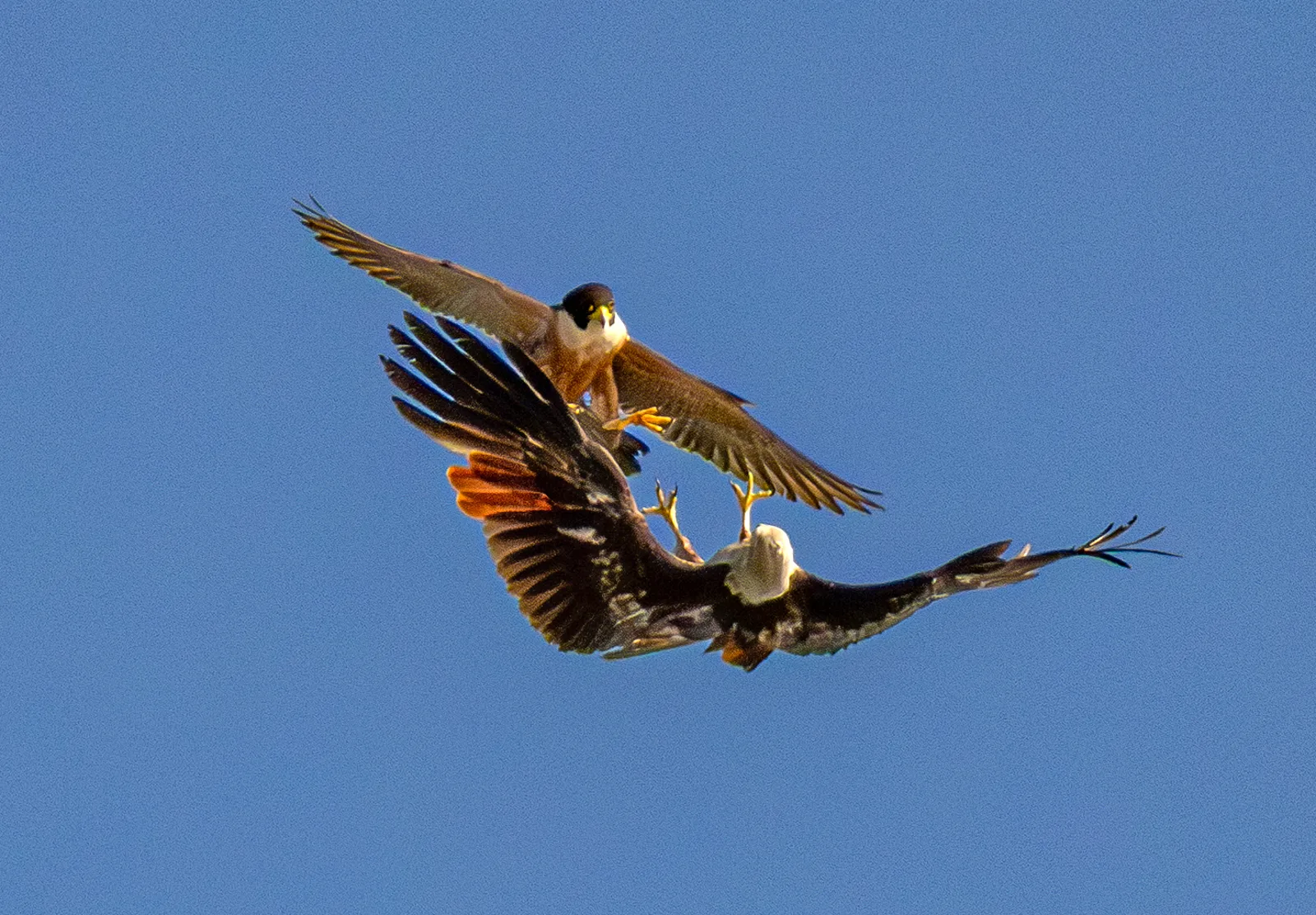
Peregrine falcon
The fastest animal alive, now nesting on city towers
Falco peregrinus
Living individuals or members of this group exist today. This does not mean they are safe from extinction.
Meet the peregrine falcon
The peregrine falcon is the fastest animal on Earth. It dives on other birds from a great height and now nests on city skyscrapers as readily as on sea cliffs.
Images of the peregrine falcon


Lifespan in the wild
Up to 20 years
Weight
0.33 to 1.5 kg
Length
34 to 58 cm
Top speed
Up to 184 km/h
Fact file
Peregrine falcon
- Location
- Every continent except Antarctica
- Habitat
- Coast, Mountains, Towns and cities, Grassland
- Diet
- Carnivore
- Prey / food
- Pigeons, ducks, songbirds, shorebirds
- Predators
- Eagles, large owls
- Lifestyle
- Diurnal
- Name of young
- Eyas
- Incubation
- About 32 days of incubation
- Clutch size
- 3 to 4 eggs
- Biggest threat
- Pesticides in the past; now mostly recovered
- Distinctive feature
- A dark 'helmet' and moustache stripe
- Colour
- Slate blue-grey above, barred cream below
- Skin type
- Feathers
Size
Next to a person
Measurements
Size and speed
- Length
- 34 to 58 cm
- Wingspan
- 0.74 to 1.2 m
- Weight
- 0.33 to 1.5 kg
- Weight, male
- 0.33 to 1 kg
- Weight, female
- 0.7 to 1.5 kg
- Top speed
- Up to 184 km/h in a dive, the highest figure measured by radar
Typical adult ranges. Source: Wikipedia.
Life cycle
Lifespan
- In the wildUp to 20 years
- In captivityUp to 25 years
- 025 years
The pale bar is the record. Source: Animal Diversity Web.
Appearance
Colour and coat
- Primary colours
- slate greywhite
- Secondary colours
- blackyellowrust
- Skin type
- feathers
- Male and female
- Marked in size only. The female is up to 30% larger and often half as heavy again, but the two sexes share the same plumage.
Life cycle
Mating and family
- Mating system
- monogamous pairs, usually for life
- Social structure
- solitary and territorial, in pairs when breeding
- Breeding
- one clutch of three or four eggs a year
Pairs return to the same cliff or building each year and court with dives and food passes. The female lays three or four eggs in a bare scrape and does most of the incubation for 29 to 33 days. The chicks fledge at 42 to 46 days and still need their parents for about two months after that. Most die in their first year, but a survivor can reach 20 in the wild.
Classification
Taxonomy
- Kingdom
- Animalia
- Phylum
- Chordata
- Class
- Aves
- Order
- Falconiformes
- Family
- Falconidae
- Genus
- Falco
- Species
- Falco peregrinus
Conservation
Red List status
- LC
- NT
- VU
- EN
- CR
- EW
- EX
Least Concern on the IUCN Red List
Range
Recorded in 22 countries
- Argentina
- Ashmore and Cartier Islands
- Belgium
- Brazil
- Canada
- People's Republic of China
- Germany
- Algeria
- Spain
- France
- United Kingdom
- India
- Italy
- Japan
- South Korea
- Mexico
- Portugal
- Russia
- Thailand
- Taiwan
- United States of America
- South Africa
Habitat layer: tropical grassland, savanna and shrubland, temperate grassland, savanna and shrubland, montane grassland and shrubland, mangrove.
Countries from 41,861 wild records on GBIF (iNaturalist research grade), filtered and checked by hand. Country shapes: Natural Earth. Habitat: RESOLVE Ecoregions 2017, CC BY 4.0. Basemap: Natural Earth.
Habitats
Three things to know
- 1
Bony tubercles in the nostrils let it breathe at full dive speed.
- 2
A peregrine strikes prey with its feet in mid-air.
- 3
Its name means 'wanderer'; some migrate 25,000 km a year.
Did you know
Seven more facts
- 1
The name means wanderer, because falconers caught young birds on migration rather than at the nest.
- 2
Some Arctic peregrines fly from Alaska to Argentina and back each year.
- 3
A feral pigeon makes up 80% or more of a city peregrine's meals.
- 4
The species died out in Belgium and the eastern United States in the DDT years and has since returned.
- 5
A pair kept up to seven separate nest ledges in one territory over 16 years.
- 6
Falconers cross the peregrine with the gyrfalcon and the lanner to make hybrid hunting birds.
- 7
iNaturalist holds 61,786 observations of the species, and GBIF has records from 231 countries and territories.
Field notes
How it looks and acts
Field notes
Distinguishing features
- A black cap and a broad black moustache stripe on a white cheek.
- A slate grey back and long pointed wings.
- Pale underparts with thin dark bars in the adult, streaks in the young bird.
- Yellow cere and feet with a black hooked bill.
- A body 34 to 58 centimetres long and a wingspan of 74 to 120 cm.
- A female clearly larger than the male.
Field notes
Unique adaptations
- Bony knobs in the nostrils that let it breathe during a dive.
- A third eyelid that clears the eye without blocking sight.
- A notched upper beak that cuts the spinal cord of prey.
- A dark malar stripe that probably reduces glare in bright light.
- Very fast visual processing that tracks a moving target at speed.
Field notes
Interesting behaviours
- Stoops from a great height and strikes prey with a clenched foot.
- Watches for prey from a cliff, a tall tree or a building.
- Plucks a kill on a feeding perch and caches leftovers for later.
- Drops dead prey in the air for fledglings to chase and catch.
- Hunts by night under city lights, especially during migration.
Field notes
Temperament
- Solitary outside the breeding season and territorial all year.
- Fierce at the nest, and willing to attack eagles and people who come near.
- Even-tempered in the hand, which makes it one of the easier falcons to train.
Field notes
Communication
- A harsh cack call in alarm and nest defence, individual to each bird.
- A screea beg from hungry chicks.
- Quick kee notes from a hunting bird.
- Raised feathers and an open bill as a threat, flattened feathers as submission.
Ecology
Ecological role
The peregrine is a top predator of open country and cities, and it shapes the numbers and behaviour of the birds it hunts.
- Controls pigeons, doves, ptarmigan and ducks in many regions.
- Its presence lowers its favourite prey and, by that, helps the species it ignores.
- Carries lice, fleas, flies and blood parasites, and can spread avian pox and Newcastle disease.
- Feeds larger owls and eagles in turn, mostly as eggs and chicks.
Stories
Myths and legends
- In ancient Egyptian tradition, Horus and other falcon-headed gods protected the pharaoh.
- In Mississippian tradition, the falcon carried messages between the upper world and the earth.
- In Norse tradition, Freyja's falcon-feather cloak let the wearer fly between the worlds.
- In medieval European tradition, the peregrine was the falcon of princes, below the gyrfalcon of kings.
People
Relationship with humans
People
Living alongside us
People have trained peregrines for hunting for more than 3,000 years. Pesticides nearly destroyed the species in the 20th century, and falconers, scientists and governments bred and released enough birds to bring it back. Today it nests on buildings in cities across the world, where webcams follow its chicks. Trained birds also keep runways clear of other birds.
- A peregrine does not attack people on its own and cannot cause serious harm.
- A parent will dive at a climber or a worker who comes close to the nest ledge.
- The talons and beak can probably cut the skin of a handler who holds the bird badly.
People
Status, uses and products
- Domestication
- Wild
- As a pet
- Not suitable. A peregrine is a working falconry bird, not a pet. Keeping one needs a licence, years of training, daily flying and a supply of whole prey. Most countries protect the species by law.
- Uses
- falconrybird control at airportspest control on farmsecotourism
- Products
- None recorded
The full account
About the peregrine falcon
The peregrine falcon, Falco peregrinus, is a bird of prey about the size of a crow. It has a slate grey back, a dark head with a black moustache stripe and pale underparts marked with fine bars. An adult measures 34 to 58 centimetres long and spans 74 to 120 cm across the wings. The female is much larger than the male, as in most raptors that hunt birds. The species lives on every continent except Antarctica and is the most widespread raptor on Earth.
The peregrine hunts other birds and takes most of them in the air. It climbs high, folds its wings and drops in a steep dive called a stoop, then strikes the prey with a clenched foot. The highest dive speed confirmed by radar is 184 kilometres per hour, though some sources claim far more. Pesticides almost wiped the species out in the mid 20th century, and a long recovery programme brought it back. The IUCN now lists it as Least Concern, and pairs nest on cathedrals, bridges and office towers in many cities.
Name and taxonomy
Marmaduke Tunstall, an English ornithologist, gave the bird its scientific name in 1771. The phrase Falco peregrinus is older, and Albertus Magnus used it in 1225. Peregrinus is Latin for a foreigner or a wanderer, and both the English and the scientific name mean wandering falcon. The name probably arose because falconers caught young birds on migration rather than at the nest. Falco itself is linked to falx, the Latin word for a sickle, after the shape of the pointed wings in flight.
The peregrine belongs to the genus Falco, the family Falconidae and the order Falconiformes. Between 18 and 19 subspecies are accepted, and they differ in size and colour across the world. Older names include the duck hawk in North America and the black-cheeked falcon in Australia. In German it is the Wanderfalke, in French the faucon pelerin and in Japanese the hayabusa.
Evolution and relatives
The peregrine sits in a lineage that also holds the hierofalcons, such as the saker and the gyrfalcon, and the prairie falcon. That group probably split from the other falcons between 3 and 8 million years ago. Because the group has members in both the Old World and North America, it most likely arose in western Eurasia or Africa. Its exact relationships are unclear, because falcons hybridise often and that muddles the genetic evidence.
The Barbary falcon of North Africa was once treated as a separate species. It differs from the peregrine by only about 0.6 to 0.8% in its genes, so the main authorities now treat it as a subspecies. That split appears to date only to the last ice age. Falconers cross peregrines with gyrfalcons and lanner falcons, which shows how close these species remain.
Appearance
The body measures 34 to 58 centimetres and the wingspan 74 to 120 cm. Males weigh 0.33 to 1 kilogram, and the larger females weigh 0.7 to 1.5 kg. A female can be up to 30% larger than her mate, and cases where she weighs half as much again are not rare. The wings are long and pointed, and the tail is fairly short with a black tip and a thin white end band.
The back and upper wings are bluish black to slate grey with faint darker bars. The underparts run from white to rust and carry thin, clean bars of dark brown or black. The crown is black, and a black moustache, the malar stripe, runs down each cheek beside a white throat. A 2021 study of photographs found the stripe is larger where sunlight is stronger, so it probably cuts glare. The cere and the feet are yellow, and the beak and claws are black.
The upper beak has a notch near the tip, which the falcon uses to cut the neck of its prey. A young bird is browner, with streaks rather than bars below and a pale bluish cere and eye ring. The plumage does not change with the seasons.
Habitat and range
The peregrine breeds from the Arctic tundra to the tropics. It is absent only from the polar ice, the highest mountains, most tropical rainforest and the islands of New Zealand. Only the feral pigeon covers more ground among land birds, and that bird got there with human help. GBIF holds records from 231 countries and territories, which reflects how far the species ranges.
It favours open country: coasts, river valleys, mountain ranges, tundra, grassland and meadows. It nests on cliffs and has bred at 3,600 metres in the Rocky Mountains. It is most common on tundra and along coasts and rare in tropical forest. Since the late 20th century it has moved into cities, where tall buildings stand in for cliffs and pigeons are plentiful.
Birds in mild regions stay put all year, and adult males often hold the territory through winter. Only the Arctic breeders travel far, and some fly from Alaska and Canada to Argentina and Chile. They follow coasts, lake shores, barrier islands and mountain chains on the way. Birds ringed in North America have turned up in 16 states of Brazil during the northern winter.
Diet and hunting
Birds make up 77 to 99% of the peregrine's prey. Pigeons and doves matter most by weight, followed by ducks, gamebirds, shorebirds, seabirds and songbirds. Across the world the species takes an estimated 1,500 to 2,000 kinds of bird, about a fifth of all bird species. Prey runs from a 3 gram hummingbird to a 3.1 kg sandhill crane, but most weigh between 20 g and 1,100 g. In cities the feral pigeon makes up 80% or more of the diet. Bats are the commonest mammal prey, and lemmings, rodents, lizards, insects and even fish are taken now and then.
The peregrine watches from a high perch or circles in the air, and it hunts mostly at dawn and dusk. When it spots a target it folds its wings and tail, tucks its feet and drops into a stoop. It hits the prey with a clenched foot, which stuns or kills it, then turns and catches the body in the air. It aims for one wing so that it does not hurt itself on impact. If the prey is too heavy to carry, the falcon lets it fall and eats on the ground. A missed strike turns into a twisting chase.
Some sources claim dives over 320 kilometres per hour, and a 2005 television record gave 389 km/h. Radar tracks have never confirmed such speeds, and the highest reliable measurement is 184 km/h. A 2018 simulation study found that high speed gives the falcon more precision and a tighter turn, not just a harder hit. City lights let peregrines hunt after dark, and in Britain they now take night migrants such as redwings and woodcocks.
Behaviour and social life
The peregrine is active by day and lives alone outside the breeding season. Each bird holds a territory, and the size depends on how much food the land offers. In the densest northern populations nests sit 3.3 to 5.6 km apart on average. Home ranges have been estimated at 177 to 1,508 square kilometres, and both sexes hunt up to 5 km from the nest.
A breeding pair hunts together and defends the nest with force. Peregrines will attack ravens, eagles and mammals far larger than themselves near the nest. Pairs have killed golden eagles and bald eagles that came too close, by hitting them in a full stoop. In one case a snowy owl killed a young peregrine, and a parent then killed the owl.
The pair may keep several nesting ledges in one territory, and one pair used up to seven over 16 years. The peregrine is calm in the hand for a wild raptor, which is one reason falconers have prized it for 3,000 years. It circles above the falconer until game is flushed, then stoops on it, a habit that suits the sport well.
Communication and senses
Peregrines call mostly in the breeding season, between mates, between parents and young, or in a fight. The alarm call is a harsh cack, and it is so individual that listeners can tell birds apart in 72 to 90% of calls. Chicks beg with a repeated screea, and a fast chitter serves in several situations. A hunting bird often gives sharp kee notes in quick succession.
Posture carries meaning too: raised feathers and an open bill mean threat, and flattened feathers with a lowered head mean submission. The eyesight is exceptional, and the bird can pick out small prey from a long way off. Its eyes refresh an image at 129 cycles per second, far faster than a mammal, which helps it track a target in a dive. A third eyelid sweeps across the eye during the stoop to spread tears and clear debris. Small bony knobs in the nostrils are thought to steer the airflow so the bird can breathe at full speed.
Reproduction and life cycle
A peregrine can breed at one year old, but in dense populations most wait until two or three. Pairs usually stay together for many seasons and return to the same site each year. The bond is probably tied to the site as much as to the partner, because both birds are loyal to the ledge. Courtship includes spirals, steep dives and rolls, and the male passes prey to the female in the air. She flies upside down to take it from his talons.
The peregrine builds no nest. The female scrapes a shallow hollow in soil, sand or gravel on a cliff ledge, usually under an overhang and facing south. In some regions pairs use large tree hollows or the old nests of other big birds. City pairs choose window ledges, bridges and towers, because those look much like a cliff to the bird. Nesting pairs keep more than 1 km apart even where the species is common.
Laying runs from February to March north of the equator and from July to August south of it. The clutch is usually three or four eggs, white to buff with red or brown marks, and one egg follows another every 48 hours. The female does most of the incubation, and the male takes turns by day only. The eggs hatch after 29 to 33 days. The chicks, called eyases, wear creamy white down and have very large feet. They fledge at 42 to 46 days. The parents feed them for as long as two months more, often by dropping dead prey for them to catch in the air.
On average 2.5 young hatch per nest and about 1.5 fledge. Between 59 and 70% of young die in their first year, and adult mortality falls to 25 to 32% a year. A wild bird can live up to 20 years, and one captive peregrine reached 25.
Predators and threats
Large owls and eagles take peregrines of every age. The great horned owl in North America and the Eurasian eagle-owl in Europe are the worst nest predators. They hunt at night and pick off nestlings, fledglings and adults, and they slowed many reintroduction projects. Gyrfalcons and golden eagles kill adults, and foxes, cats, bears and wolverines reach low nests. Collisions with wires, glass and vehicles kill many birds in settled country.
The gravest threat came from organochlorine pesticides such as DDT and dieldrin in the 1950s to 1970s. The chemicals built up in the falcon's fat through its prey and thinned the shells of its eggs, so the eggs broke. Every breeding pair vanished from the eastern United States, and the species died out in Belgium. Poachers still take eggs and chicks for falconry, so unprotected nest sites are kept secret. City birds can pick up heavy metals and human-borne germs, and those can kill chicks.
Population and conservation
The IUCN lists the peregrine falcon as Least Concern. Numbers have recovered across most of the world since DDT was banned in the early 1970s. Breeders raised chicks in captivity and fed them through a chute or a hand puppet so they did not imprint on people. Young birds were then released from towers and cliffs in a method called hacking. The United States removed the species from its endangered list on 25 August 1999.
The RSPB estimated 1,402 breeding pairs in the United Kingdom in 2011. Canada took the species off its at-risk list in December 2017, four decades after it found a single breeding pair in the Yukon. iNaturalist holds 61,786 observations, many of them from city nests watched by webcam. Some regions still list it: Switzerland and Aland call it Vulnerable, and Michigan and North Carolina keep it as endangered. The Cape Verde subspecies is down to six to eight pairs, and a Japanese island form may survive on a single island.
Relationship with humans
People have flown peregrines in falconry for more than 3,000 years, starting with nomads in central Asia. It is one of the easier falcons to train, and its many subspecies give a bird for almost any size of game. Falconers helped the recovery programme, and captive breeding now supplies most birds for the sport. Trained peregrines clear birds from airport runways, and in the Second World War they intercepted homing pigeons.
Farmers gain because raptors kill large numbers of crop pests, and the odd chicken taken is a small cost by comparison. City nests draw crowds and webcams, and the first urban pair in Britain nested on Swansea Guildhall in the 1980s. In 2013 a nest on a phone mast in Southampton stopped repairs for months, because the law protects a nest with chicks. Portland holds ten percent of Oregon's peregrine nests on about 0.1 percent of the state's land. The bird is not dangerous to people, though a parent will dive at anyone who climbs near its ledge.
In culture and myth
The stoop made the peregrine a symbol of force and war in many cultures. In ancient Egypt, the sun god Ra was shown with a falcon's head, though most scholars think the model was a lanner. Horus and other falcon-headed gods stood guard over the king. The Mississippian peoples of North America, from about 800 to 1500, used the falcon as a sign of power in the sky. They buried high-ranking men in costumes that echoed a raptor, and the falcon carried messages between the upper world and earth.
In medieval Europe the peregrine was the prince's bird, one step below the gyrfalcon of kings. In Norse myth the goddess Freyja owned a cloak of falcon feathers that let the wearer fly between the worlds. J. A. Baker's 1967 book The Peregrine is counted among the finest nature writing of the 20th century. Suzuki named its Hayabusa motorcycle, launched in 1999, after the Japanese word for the bird. The peregrine is the city bird of Chicago and appears on the 2007 Idaho state quarter. Bowling Green State University in Ohio has used it as a mascot since 1927.
A sentence with a dotted underline is inferred: it describes the group the animal belongs to, or is a reading of the sources, rather than a measured or reported fact about this species.
Questions
Peregrine falcon questions, answered
How fast can a peregrine falcon fly?
The highest dive speed confirmed by radar is 184 kilometres per hour. Some sources claim over 320 km/h and one television recording gave 389 km/h, but those figures have not been confirmed by instruments.
Is the peregrine falcon the fastest animal in the world?
Yes, in a dive. No other animal has a confirmed speed that matches its stoop. In level flight other birds, such as swifts, may be as fast.
How big is a peregrine falcon?
It is about the size of a crow. The body is 34 to 58 centimetres long and the wingspan 74 to 120 cm. Males weigh 0.33 to 1 kilogram and females 0.7 to 1.5 kg.
What do peregrine falcons eat?
Mostly other birds, which account for 77 to 99% of what they catch. Pigeons, doves, ducks, shorebirds and songbirds are the main food, and city birds live largely on feral pigeons. They also take bats and a few rodents, lizards and insects.
How does a peregrine falcon hunt?
It climbs high, folds its wings and dives on a bird in flight. It strikes with a clenched foot, which stuns or kills the prey, then turns and catches it in the air.
Where do peregrine falcons live?
On every continent except Antarctica. They are absent only from polar ice, the highest mountains, most rainforest and New Zealand. They favour coasts, mountains, tundra and, increasingly, cities.
Are peregrine falcons endangered?
No. The IUCN lists the species as Least Concern. It was endangered in many countries in the DDT era. Numbers recovered after the ban, and the United States delisted it in 1999.
Why do peregrine falcons nest on buildings?
A ledge on a tall building looks much like a cliff ledge to the bird. Cities also hold large numbers of feral pigeons, which are its main food there.
How many eggs does a peregrine falcon lay?
Usually three or four, though a clutch can hold from one to five. The eggs are whitish with red or brown speckles and hatch after 29 to 33 days.
Do peregrine falcons mate for life?
Usually. Pairs stay together for many seasons and return to the same nest site each year. The loyalty to the site may matter as much as the bond between the two birds.
How long do peregrine falcons live?
Most young birds die in their first year. A bird that survives lives about 13 years on average, up to 20 years in the wild and 25 in captivity.
What eats a peregrine falcon?
Great horned owls and Eurasian eagle-owls take nestlings and adults at night. Golden eagles and gyrfalcons kill adults, and foxes and cats reach low nests.
Why did peregrine falcons almost die out?
The pesticide DDT built up in their bodies through their prey and thinned the shells of their eggs. The eggs broke before hatching, and whole regions lost every pair.
Can you keep a peregrine falcon?
Only as a licensed falconry bird. Falconers have flown peregrines for more than 3,000 years. The bird needs daily flying and whole prey, and the law protects it in most countries.
What does the name peregrine mean?
It comes from the Latin peregrinus, a foreigner or wanderer. Both the English and the scientific name mean wandering falcon, after the long migrations of northern birds.
How well can a peregrine falcon see?
Very well. It spots small prey from far away, and its eyes process about 129 images a second, far more than a human eye. That lets it track a bird during a dive.
Food web
Prey and food
- pigeons
- ducks
- songbirds
- shorebirds
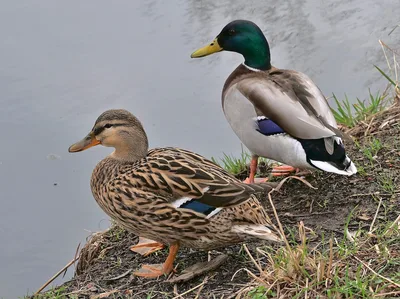 Mallard
 Rock dove
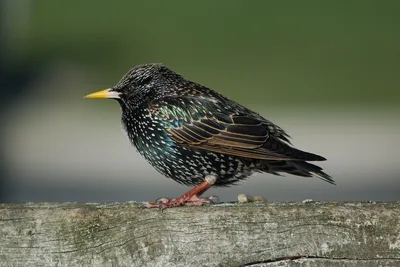 Common starling
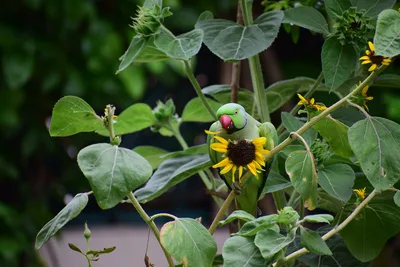 Rose-ringed parakeet
 Barn swallow
 Carrion crow
 Eurasian sparrowhawk
 Razorbill
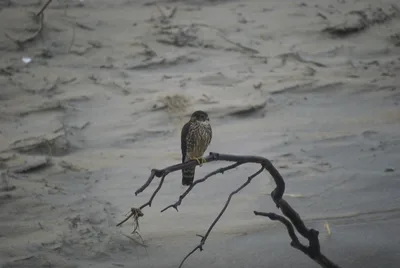 Merlin
Food web
Predators
- eagles
- owls
Ecological equivalents
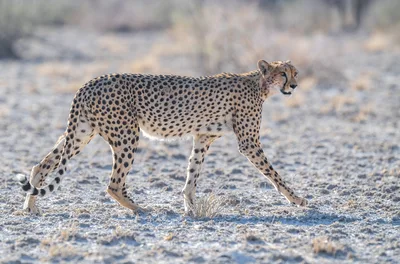
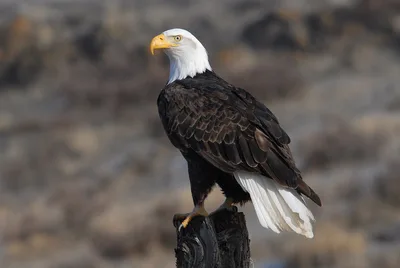
Related species on this site
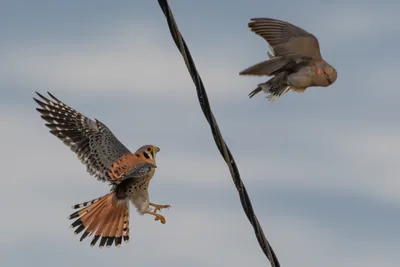
American kestrel (same genus), Gyrfalcon (same genus), Merlin (same genus), Falcon (same family).
 LC
Birds
American kestrel
Falco sparverius
The American kestrel is the smallest falcon in the Americas and the most numerous.
Living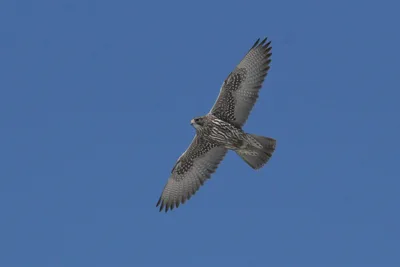 LC
Birds
Gyrfalcon
Falco rusticolus
The gyrfalcon is the biggest of all falcons, and it hunts across the Arctic tundra.
Living- LC
Birds
Merlin
Falco columbarius
The merlin is a small, stocky falcon of open northern country that hunts small birds in fast low flight.
Living 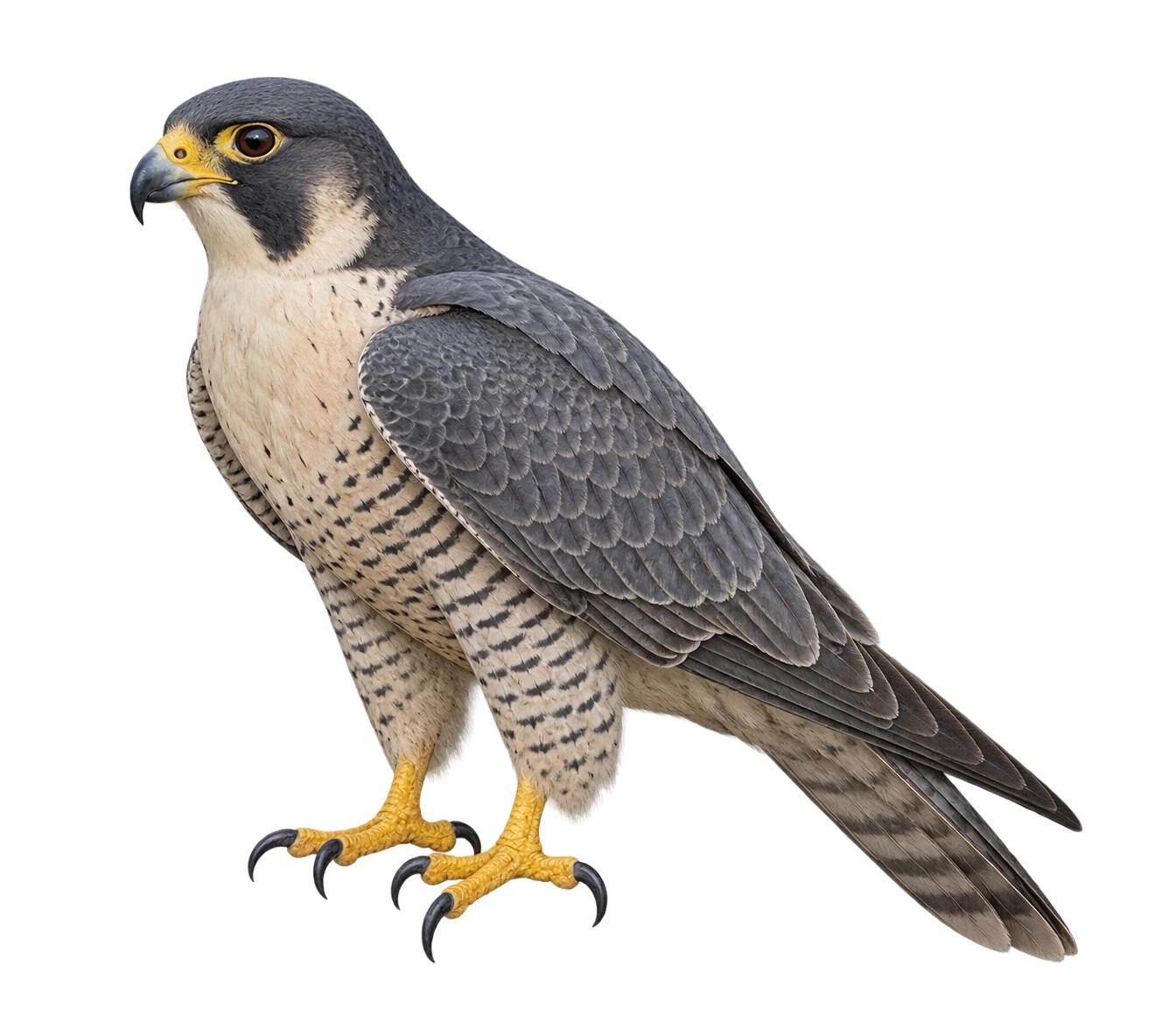
Birds
Falcon
Falconidae
Classification and source reference
LivingAI illustration