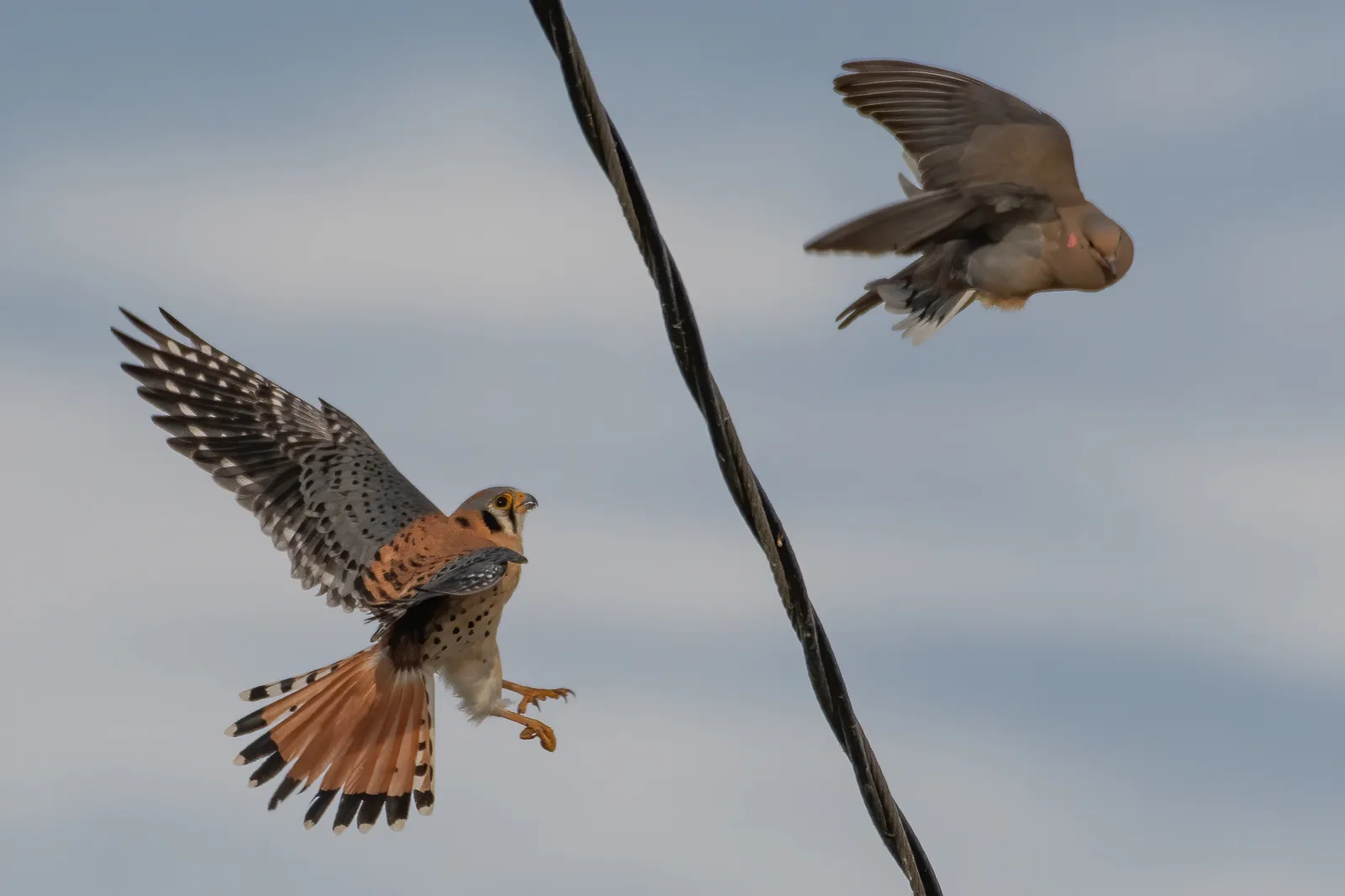
American kestrel
The smallest falcon in the Americas
Falco sparverius
Also called Sparrow hawk, American sparrowhawk, Grasshopper hawk, Killy hawk
Living individuals or members of this group exist today. This does not mean they are safe from extinction.
Meet the american kestrel
The American kestrel is the smallest falcon in the Americas and the most numerous. It hunts insects, mice and small birds from a perch over open ground. It lays in a ready-made hole rather than a nest of its own.
Images of the american kestrel
Lifespan in the wild
3 to 5 years the oldest ringed wild bird reached 11 years and 7 months
Weight
80 to 165 g
Length
22 to 31 cm
Wingspan
51 to 61 cm
Fact file
American kestrel
- Location
- Alaska and Canada south to Tierra del Fuego
- Habitat
- Grassland, Desert, Towns and cities, Mountains
- Diet
- Carnivore
- Prey / food
- Grasshoppers, crickets, beetles, dragonflies, mice, voles, shrews, lizards, small birds
- Predators
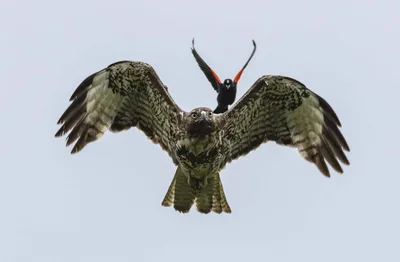
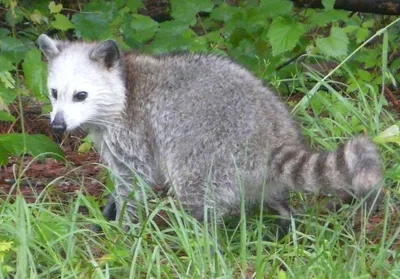
- Great horned owls, red-tailed hawks, prairie falcons, snakes, raccoons
- Lifestyle
- Active by day, solitary outside the breeding season
- Group name
- Usually alone or in a pair
- Name of young
- Nestling
- Incubation
- Incubation about 30 days
- Clutch size
- 3 to 7 eggs, usually 4 or 5
- Population
- About 9.2 million mature birds
- Biggest threat
- Loss of nest holes and open hunting ground
- Distinctive feature
- Two black stripes on each side of the white face
- Colour
- Rufous back and tail, with blue-grey wings on the male
- Skin type
- Feathers
Size
Next to a person
Measurements
Size and speed
- Length
- 22 to 31 cm
- Wingspan
- 51 to 61 cm
- Weight
- 80 to 165 g males are the lighter sex
- Weight, male
- 80 to 143 g
- Weight, female
- 86 to 165 g
Typical adult ranges. Sources: Animal Diversity Web, Wikipedia.
Life cycle
Lifespan
- In the wild3 to 5, up to 11 years the oldest ringed wild bird reached 11 years and 7 months
- In captivityUp to 17 years
- 017 years
The pale bar is the record. Sources: Wikipedia, Animal Diversity Web.
Appearance
Colour and coat
- Primary colours
- rufouswhite
- Secondary colours
- blue-greyblack
- Skin type
- feathers
- Male and female
- Strong, and stronger in colour than in size. The male has blue-grey wings and a rufous tail with one black band. The female has rufous wings and a tail with many narrow bars. Females are about 10 to 15% larger.
Life cycle
Mating and family
- Mating system
- monogamous pairs, often for life
- Social structure
- solitary outside the breeding season
- Breeding
- one brood a year, with a replacement clutch if the first fails
A kestrel can breed at one year old. The male displays over the territory and feeds the female for weeks before she lays. She lays three to seven eggs in a hole and sits for about 30 days. The chicks hatch helpless and leave the hole 28 to 31 days later. The family stays together for about three more weeks.
Classification
Taxonomy
- Kingdom
- Animalia
- Phylum
- Chordata
- Class
- Aves
- Order
- Falconiformes
- Family
- Falconidae
- Genus
- Falco
- Species
- Falco sparverius
Conservation
Red List status
- LC
- NT
- VU
- EN
- CR
- EW
- EX
Least Concern on the IUCN Red List
Range
Recorded in 9 countries
Habitat layer: tropical grassland, savanna and shrubland, temperate grassland, savanna and shrubland, montane grassland and shrubland, desert and xeric shrubland.
Countries from 92,932 wild records on GBIF (iNaturalist research grade), filtered and checked by hand. Country shapes: Natural Earth. Habitat: RESOLVE Ecoregions 2017, CC BY 4.0. Basemap: Natural Earth.
Habitats
Three things to know
- 1
A large northern female can weigh about twice as much as a small southern male.
- 2
The bird builds no nest and lays its eggs on the floor of a hole or a box.
- 3
Two black spots on the nape may work as false eyes against an attacker from behind.
Did you know
Seven more facts
- 1
The name sparrow hawk stayed official in North America until 1983.
- 2
Flight muscles make up about 12% of a kestrel's weight, against about 20% in a peregrine.
- 3
A pair may lay a second clutch if the first one fails.
- 4
One recorded clutch held nine eggs, and two others held eight.
- 5
An egg is about 10% larger than expected for a bird of this weight.
- 6
Kestrels take dust baths, flicking dust over the body with the wings.
- 7
The species is one of the few raptors that breed at a year old and raise large broods.
Field notes
How it looks and acts
Field notes
Distinguishing features
- Two vertical black stripes on each side of a white face.
- A rufous back and a rufous tail, in both sexes.
- Blue-grey wings on the male and barred rufous wings on the female.
- A length of 22 to 31 centimetres, the smallest falcon of the Americas.
- Two black spots on the pale nape.
- Long pointed wings and a long tail, worked in quick beats and short glides.
Field notes
Unique adaptations
- Hovering flight holds the bird over one patch of ground while it searches.
- A lean body and a low daily food need let it live on small, common prey.
- Strong feet and a hooked bill kill prey quickly for so small a raptor.
- Nesting inside a hole shields the eggs from weather and from most predators.
- False eye spots on the nape may deter an attack from behind.
Field notes
Interesting behaviours
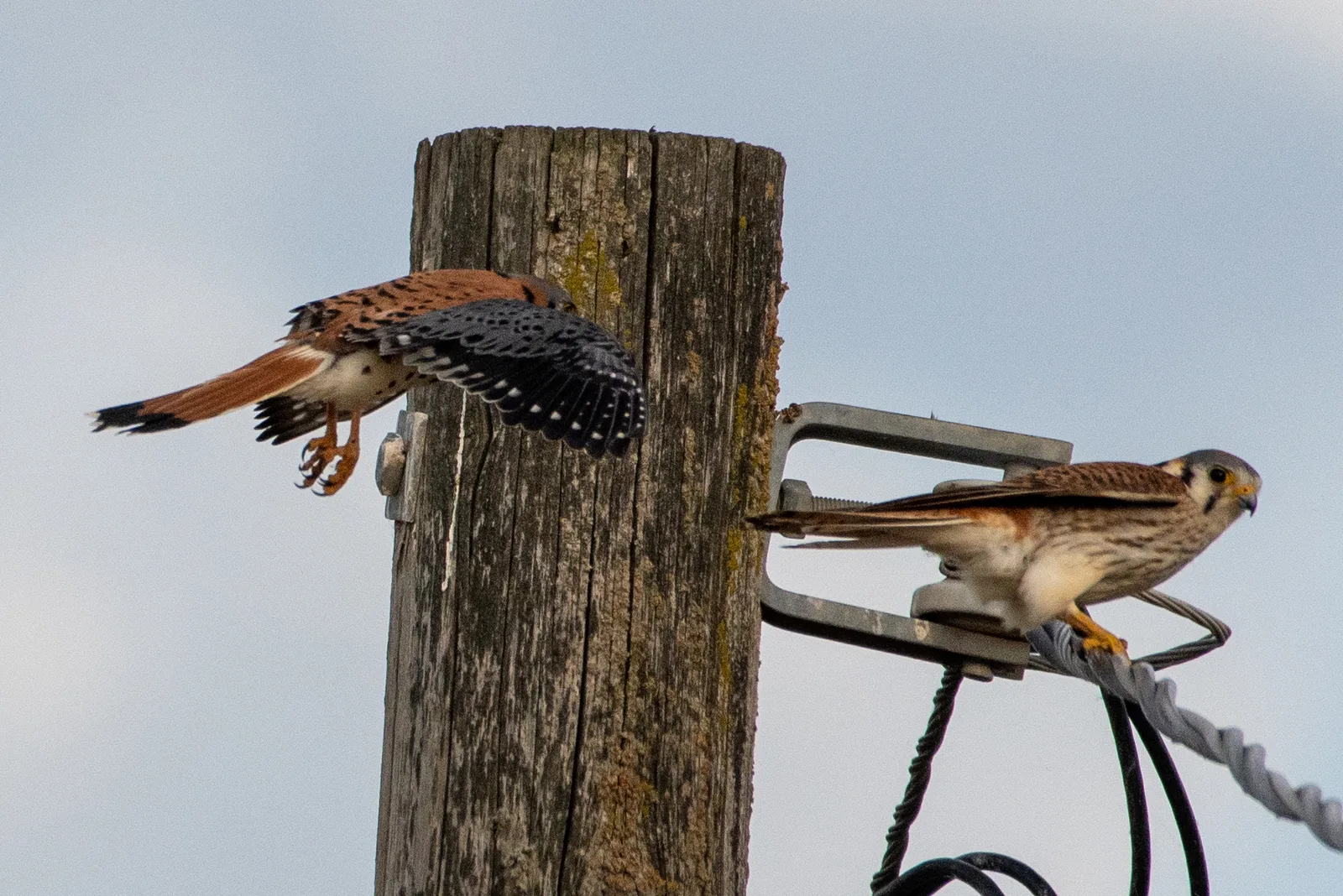
- Perching on wires and fence posts to watch open ground.
- Bobbing the head and the tail just before an attack.
- Hovering with fast wing beats over a field.
- Carrying a catch up to a high perch to eat it.
- Diving at a rival over a nest hole while calling loudly.
Field notes
Temperament
- Bold for its size, and willing to take prey as heavy as itself.
- Solitary outside the breeding season.
- Tolerant of people, and content to nest on a building or a pole.
- Quick to settle in captivity, which is why beginners in falconry start with one.
Field notes
Communication
- The klee or killy call, repeated fast when the bird is alarmed.
- The whine, given at a meal and during mating.
- The chitter, exchanged by a pair at the nest.
- Climb and dive displays by the male over his territory.
- Posture and plumage signals between birds at close range.
Ecology
Ecological role
The American kestrel is the small predator of open country, and it links insects and mice to the larger raptors above it.
- It holds down grasshoppers, crickets and beetles on farmland.
- It takes mice, voles and shrews along field edges.
- It feeds great horned owls, red-tailed hawks and other larger raptors.
- It hosts parasites such as mites, nematodes and the malaria parasite Plasmodium relictum.
Stories
Myths and legends
- In North American farming tradition the kestrel was the grasshopper hawk, named for its food.
- In older American bird books it was the sparrow hawk, which confused it with a European hawk.
- In Ojibwe tradition the bird carries the name bibiigiwizens.
- In Brazilian tradition it is the quiriquiri, a name that appears to repeat its call.
- In falconry tradition it is the beginner's falcon, and old writers called it the killy hawk.
People
Relationship with humans
People
Living alongside us
People and kestrels share the same open, worked country. Farmers gain from a bird that eats grasshoppers and mice, and many put up boxes for it. Falconers train kestrels more often than any other small raptor in North America. Laboratories use the species because it breeds well in a pen. A permit is needed to keep one in the United States, Canada or Mexico.
- A kestrel weighs less than a small bag of sugar and cannot hurt a person.
- It may strike at a hand near its nest hole, but its feet are small.
- It occasionally kills a chicken chick or a very small pet.
People
Status, uses and products
- Domestication
- Wild
- As a pet
- Not suitable. No. The species is protected by the Migratory Bird Treaty Act, so a permit is required in the United States, Canada and Mexico. A kestrel also needs live prey, daily weight control and space to fly.
- Uses
- falconrypest control on farmsscientific researchdisease surveillance
- Products
- None recorded
The full account
About the american kestrel
The American kestrel is the smallest falcon in the Americas, and its scientific name is Falco sparverius. It is also the most numerous, and it watches for prey from wires and posts along country roads. An adult measures 22 to 31 centimetres in length, with a wingspan of 51 to 61 cm. A bird weighs 80 to 165 grams, so the heaviest female is about twice the weight of the lightest male. The male carries blue-grey wings, while the female has rufous wings barred with dark brown.
Two black stripes run down each side of the white face, and other falcons show only one. The bird takes grasshoppers, beetles, mice, voles, lizards and small birds. It waits on a perch, drops onto its prey, and sometimes hangs in the air on beating wings. It lays in a ready-made hole rather than a nest, and it uses a wooden box readily. The IUCN lists it as Least Concern, and about 9.2 million mature birds remain. Numbers in North America have fallen since 1966, and nobody has settled the reason.
Name and taxonomy
Carl Linnaeus named the species in 1758, in the tenth edition of Systema Naturae. He worked from an account of a little hawk that Mark Catesby published in the 1730s. Catesby collected in Carolina, so the type locality is now fixed there. The genus name Falco comes from a late Latin word for a falcon. The species name sparverius is medieval Latin and means a sparrowhawk. The English word kestrel arrived through the French crecerelle, a word for a ratchet rattle.
North American books called this bird the sparrow hawk for most of two centuries. The American Ornithologists' Union dropped that name in 1983, because it pointed at the wrong family. The Eurasian sparrowhawk belongs to the genus Accipiter and is only a distant relative. Older names include grasshopper hawk, which describes the food, and killy hawk, which copies the call. Seventeen subspecies are recognised, and they differ in size, voice and plumage.
Evolution and relatives
The kestrel belongs to the family Falconidae, which holds the falcons, the caracaras and the forest falcons. Falcons are not close kin of hawks and eagles, and they sit near the parrots and the songbirds. For many years this bird was grouped with the kestrels of Europe and Africa. DNA work moved it away from them, and it now sits at the base of the other falcons. The resemblance is probably a case of convergent evolution, because both groups hunt small ground animals. Nobody has renamed the bird, so it keeps a name that its genes do not support.
Species in the genus Falco stay close enough that most pairs can be crossed by artificial insemination. The spot-winged falconet of South America is almost as small as this kestrel. The 17 subspecies run from large northern birds to small tropical ones. That range in size is wide, and northern birds tend to be the larger ones.
Appearance
This is a slim falcon with long pointed wings and a long tail. The body runs from 22 to 31 centimetres, and the wings span 51 to 61 cm. A male weighs 80 to 143 grams and a female 86 to 165 g. The female is the larger sex, usually by 10 to 15% within one subspecies. The bill is short and hooked, and it measures about 1.2 to 1.4 centimetres. The tail is 11 to 15 cm long, and the wing bone is 16 to 21 cm.
The two sexes differ more in colour than in size, which is unusual among raptors. A male has blue-grey upper wings with black spots, and a rufous back barred at the rear. His tail is rufous, with a black band near the pale tip. A female has rufous wings and back, both barred with dark brown. Her underparts are cream to buff with heavy brown streaks, and her tail carries many narrow bars. Both sexes wear a white face crossed by two black stripes, under a blue-grey crown.
Two black spots sit on the pale nape, and they may work as false eyes. A young bird looks much like an adult female. The flight muscles make up about 12% of the body weight. In a peregrine falcon the same muscles reach about 20%, which shows how lean a kestrel is.
Habitat and range
A kestrel needs three things: open ground to hunt over, a perch, and a hole for its eggs. Where it finds them it settles, from prairie and pasture to desert, town park and roadside. The species breeds from central Alaska and northern Canada south to Tierra del Fuego. It lives above the Arctic Circle in summer and at over 4,500 metres in the Andes. GBIF holds occurrence records from 72 countries.
Birds that breed in Canada and the northern United States move south for the winter. Those that breed below about 35 degrees north usually stay in place all year. Some northern birds reach Mexico, Central America and the Caribbean. In winter the sexes separate, and females hold the most open ground. One reading of that pattern is that the larger females arrive first and drive males away. Stray birds have reached the United Kingdom, Denmark, Malta and the Azores.
Diet and hunting
The American kestrel eats whatever small animal is common near its perch. Grasshoppers, crickets, beetles, dragonflies, moths and butterflies fill the summer diet. In winter it turns to mice, voles, shrews, lizards, frogs and small birds. One study in a town found insects at 78% of the food and mammals at 14%. Reptiles and amphibians made up 6% of that diet, and birds 3%. Kestrels have also killed scorpions, snakes, bats and squirrels.
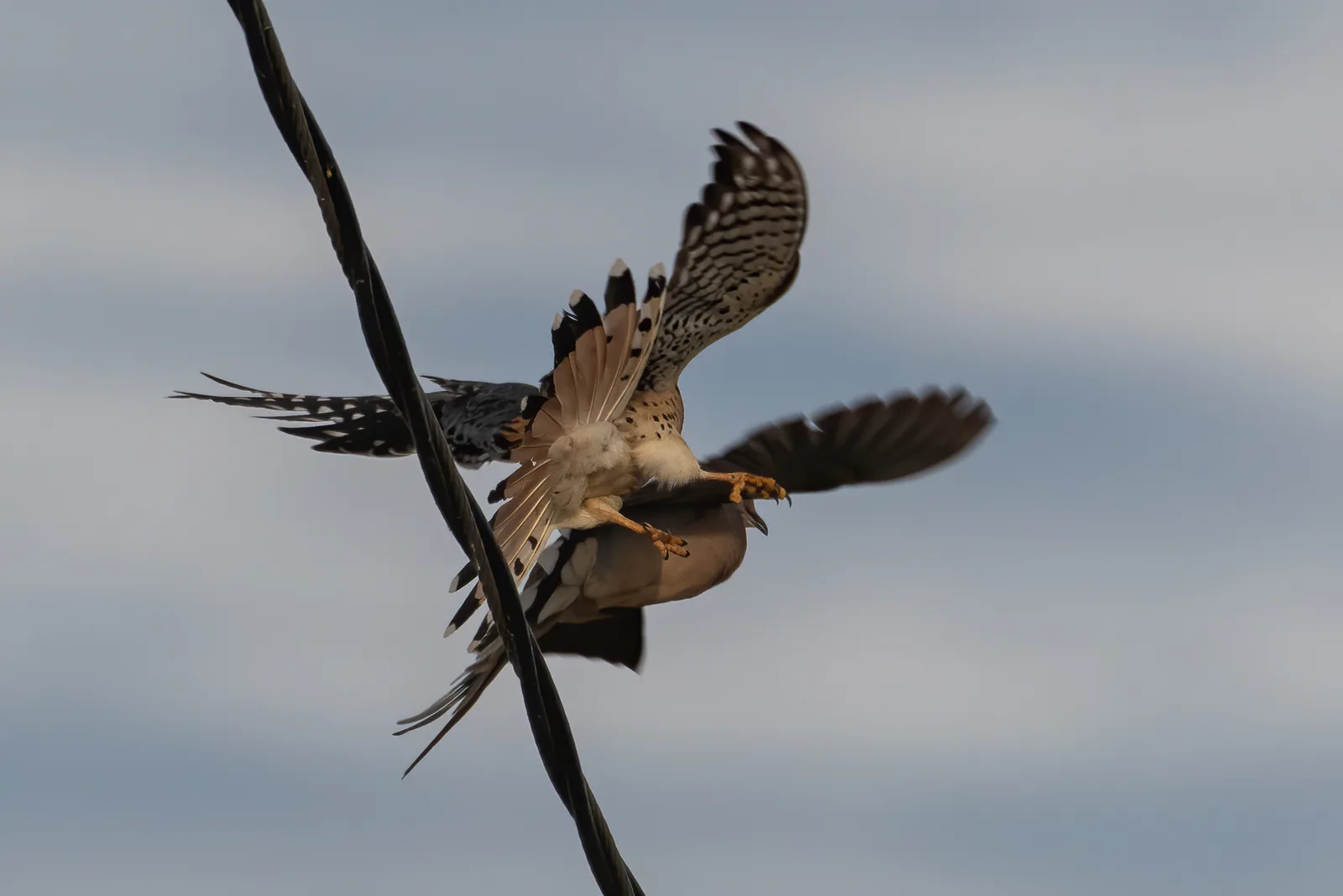
The usual method is to sit on a wire or a bare branch and study the ground. The bird bobs its head and tail, then flies straight down and grips the prey in its feet. It also hovers on fast wing beats, holding one point in the air while it looks below. Other hunts are low flights across a field, or a chase after an insect on the wing. A kestrel often carries a catch to a high perch, away from animals on the ground. The broad diet is probably the main reason the species is so widespread.
Behaviour and social life
The American kestrel lives alone for most of the year. It pairs in the breeding season and defends a territory around the nest hole. Quarrels over prey, perches and holes involve circling, diving and loud calling. One bird gives way in the end, and the loser leaves the ground it fought for. Home ranges are small for a raptor, at about 4.5 to 5.2 square kilometres.
The flight is quick, with rapid beats broken by short glides. Kestrels bathe in shallow water and during rain showers. They also take dust baths, throwing dust through the feathers with the wings. The dust probably cuts the number of feather mites and other parasites. After the young leave the hole, a family may hunt together for a short time. Hunting is a daytime job, and the bird roosts at night.
Communication and senses
The kestrel uses three main calls. The klee, often written killy, is a fast repeated note given in alarm or excitement. Both sexes use it, and females call at a lower pitch than males. The whine goes with food, at a meal and during mating. The chitter passes between a male and a female at courtship, mating and the feeding of chicks. Nestlings give calls like an adult's at about 16 days old.
Sight is the sense that matters most to a hunting kestrel. A perched bird appears to pick an insect out of grass long before a person would. Keen eyesight is also the main defence against a predator. Display flights carry information as well, and a male climbs and dives while calling. Birds signal to each other with posture and with the pattern of the plumage.
Reproduction and life cycle
American kestrels can breed in their first spring. In migratory populations the male arrives first, and the female then chooses a mate. He climbs and dives over the territory, calling at the top of each climb. Pairs form a strong bond, and many stay together for life. A pair usually returns to the same hole in later years, which gives it local knowledge. The male passes food to the female for weeks before she lays.
The species builds nothing and takes a ready-made cavity. Tree holes, old woodpecker holes, cliff ledges, cactus cavities and gaps in buildings all serve. Kestrels use wooden boxes readily, and box schemes now support many pairs. A clutch holds three to seven eggs, and four or five is the usual number. Each egg is white or cream, blotched with brown and grey. An egg measures about 32 by 29 millimetres, which is large for a bird of this size.
Incubation lasts about 30 days, and the female does most of it. The male sits for 15 to 20% of the time. Chicks hatch blind and helpless, over three or four days. They reach an adult weight in about 16 to 17 days. The young leave the hole 28 to 31 days after hatching. They still depend on their parents for about three more weeks.
A pair raises one brood a year, and tries again if the first fails. Lost eggs are usually replaced within 11 to 12 days. Most wild kestrels live 3 to 5 years. The oldest ringed wild bird reached 11 years and 7 months. Captive birds have lived up to 17 years.
Predators and threats
Larger raptors take kestrels, above all the great horned owl, the red-tailed hawk and the prairie falcon. Cooper's hawk is bold enough to attack a kestrel that is busy on the ground. Raccoons, skunks, bobcats, coyotes and snakes rob the nest holes. Most losses fall on eggs, chicks and birds in their first year. In Florida, large introduced snakes such as Burmese pythons have eaten kestrels.
People cause far more deaths than predators do. One review of 1,355 reported deaths blamed humans for 43.2% and predation for 2.8%. Those figures are biased, because a dead bird is easier to find near a road or a house. Pesticides reach kestrels through the animals they eat. Flame retardants called PBDEs weaken the immune system and disturb the thyroid gland. PCBs change plumage colour, delay laying and lower breeding success.
Population and conservation
The IUCN lists the American kestrel as Least Concern. Its 2025 assessment put the world population at about 9.2 million mature birds. An older estimate gave 1.2 million pairs in North America, with as many again to the south. A smaller count put about 236,000 birds in North America in winter. Numbers probably rose in the 18th and 19th centuries, as forest gave way to farmland.
Since 1966 the North American breeding population has fallen steadily. Counts at migration watch sites agree with the breeding bird survey. New England and coastal California have lost birds faster than the rest. The southeastern subspecies Falco sparverius paulus has declined by 82% since 1940. Clearance of longleaf pine for crops took away the holes it needed. Fewer holes, fewer insects, more pesticide and competition from starlings are all suspected.
The Peregrine Fund started the American Kestrel Partnership in 2012. It runs a web network where volunteers and scientists enter nest box records. Researchers use the data to link nesting success to land use, weather and pollution. A camera streams from a box at the fund's campus in Boise, Idaho, each season.
Relationship with humans
This is the classic beginner's bird in North American falconry. Its small size makes it easy to keep, but its weight must be managed with care. Trained birds hunt sparrows and starlings, and bold ones tackle prey twice their own weight. Falconers call the small-scale sport micro-hawking, and it needs no dogs and no wide estate. A wild-caught bird often feeds from the hand the day after capture. In the United States, Canada and Mexico a permit is needed to hold one.
Farmers value kestrels because they take grasshoppers, mice and voles from the fields. Boxes on farm buildings and fence posts bring pairs onto working land. Public health officers watch sick and dead kestrels as an early sign of West Nile virus. Researchers use the species widely, because it breeds well in captivity. A kestrel now and then kills a chicken chick or a very small pet.
In culture and myth
Many local names for this bird appear to copy the sound of its call. Brazilian Portuguese speakers call it quiriquiri, and some Spanish speakers call it cliclí. Birdwatchers in the United States write the common call as killy-killy-killy. In Ojibwe the bird is bibiigiwizens. Spanish also gives it the names cernícalo americano and halconcito colorado, the little red falcon.
In North American farming tradition the bird was the grasshopper hawk. In older American bird books it was the sparrow hawk, and that name held until 1983. In falconry tradition it is the bird a beginner learns on. Like other kestrels, it hovers, and European writers call that habit windhovering. Roland Wauer wrote a book about the species under the title falcon of many names.
A sentence with a dotted underline is inferred: it describes the group the animal belongs to, or is a reading of the sources, rather than a measured or reported fact about this species.
Questions
American kestrel questions, answered
How big is an American kestrel?
It measures 22 to 31 centimetres long, with a wingspan of 51 to 61 cm. A bird weighs 80 to 165 grams. That makes it the smallest falcon in the Americas.
What does an American kestrel eat?
Insects fill most of the summer diet, above all grasshoppers, crickets and beetles. In winter it hunts mice, voles, shrews, lizards, frogs and small birds. It has also killed snakes, bats and scorpions.
Is an American kestrel a hawk or a falcon?
It is a true falcon, in the family Falconidae. Falcons are not close relatives of hawks and eagles. The old name sparrow hawk caused the confusion.
Why was it called a sparrow hawk?
Early writers linked it to the Eurasian sparrowhawk, which belongs to a different family. The American Ornithologists' Union corrected the name in 1983. The Latin species name sparverius keeps the old mistake.
Where do American kestrels live?
From central Alaska and northern Canada south to Tierra del Fuego. They use open ground of almost any kind, including farmland, desert, mountain slopes and towns. GBIF holds records from 72 countries.
Do American kestrels migrate?
Northern birds do. Kestrels that breed in Canada and the northern United States move south for the winter, some as far as Central America. Birds below about 35 degrees north usually stay all year.
How do you tell a male from a female?
Look at the wings. A male has blue-grey wings, and a female has rufous wings barred with brown. The female is also the larger of the two.
Do American kestrels build nests?
No. The bird takes a ready-made hole in a tree, a cliff, a cactus or a building. It also uses wooden nest boxes, which is why box schemes work so well.
How many eggs does an American kestrel lay?
Three to seven, and usually four or five. The female sits for about 30 days. Chicks fly from the hole 28 to 31 days after they hatch.
How long do American kestrels live?
Most wild birds live 3 to 5 years. The oldest ringed bird in the wild reached 11 years and 7 months. Captive kestrels have lived up to 17 years.
Are American kestrels endangered?
No. The IUCN lists the species as Least Concern, with about 9.2 million mature birds. Some regions have still lost most of their kestrels.
Why are American kestrel numbers falling?
Nobody has settled the question. Suspects include the loss of nest holes and open ground, fewer large insects, pesticides, predation by larger hawks and competition from starlings.
Can you keep an American kestrel as a pet?
No. It is protected by law in the United States, Canada and Mexico, and a permit is needed. Falconers who hold one must control its weight daily and give it live prey.
Why do American kestrels hover?
Hovering holds the bird over one patch of ground when no perch is near. It beats its wings fast and scans below, then drops on anything it sees.
What sound does an American kestrel make?
The best known call is a fast klee, often written killy-killy-killy. The bird also gives a whine at food and a chitter between a pair. Females call at a lower pitch.
What eats an American kestrel?
Larger raptors take them, above all great horned owls, red-tailed hawks and prairie falcons. Raccoons, skunks, bobcats, coyotes and snakes raid the holes for eggs and chicks.
Food web
Prey and food
- grasshoppers
- crickets
- beetles
- dragonflies
- mice
- voles
- shrews
- lizards
- birds
Food web
Predators
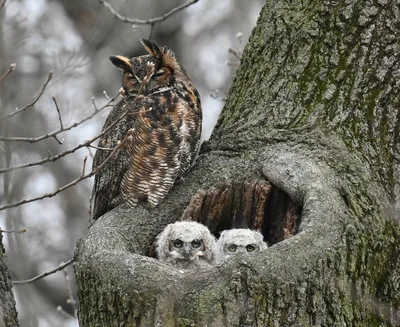 Great horned owl
 Red-tailed hawk
- prairie falcons
- snakes
 Raccoon
Ecological equivalents
Related species on this site
Gyrfalcon (same genus), Merlin (same genus), Peregrine falcon (same genus), Falcon (same family).
 LC
Birds
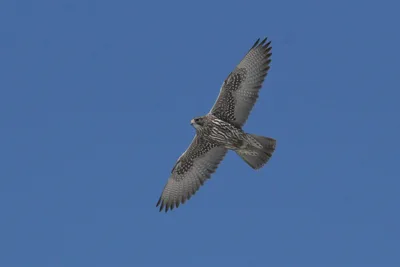
Gyrfalcon
Falco rusticolus
The gyrfalcon is the biggest of all falcons, and it hunts across the Arctic tundra.
Living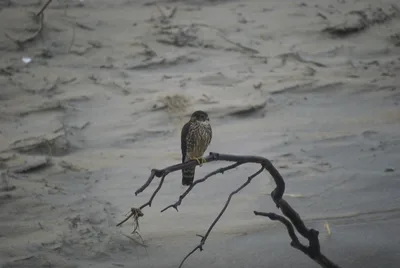 LC
Birds
Merlin
Falco columbarius
The merlin is a small, stocky falcon of open northern country that hunts small birds in fast low flight.
Living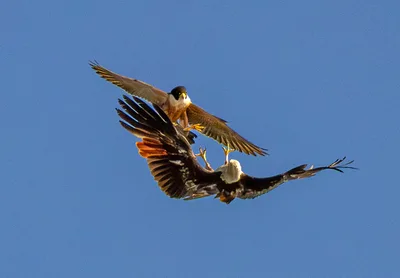 LC
Birds
Peregrine falcon
Falco peregrinus
The peregrine falcon is the fastest animal on Earth.
Living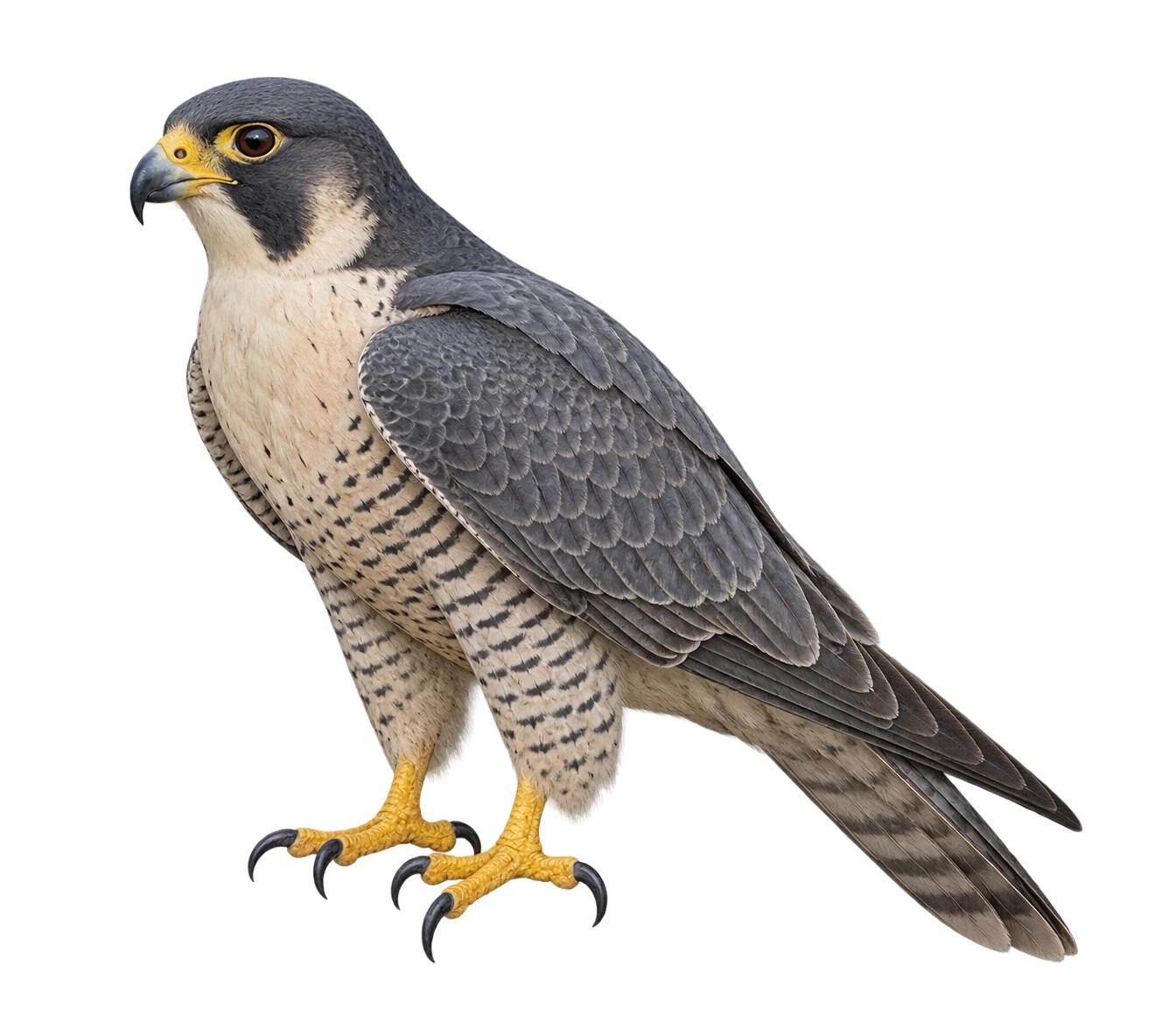
Birds
Falcon
Falconidae
Classification and source reference
LivingAI illustration