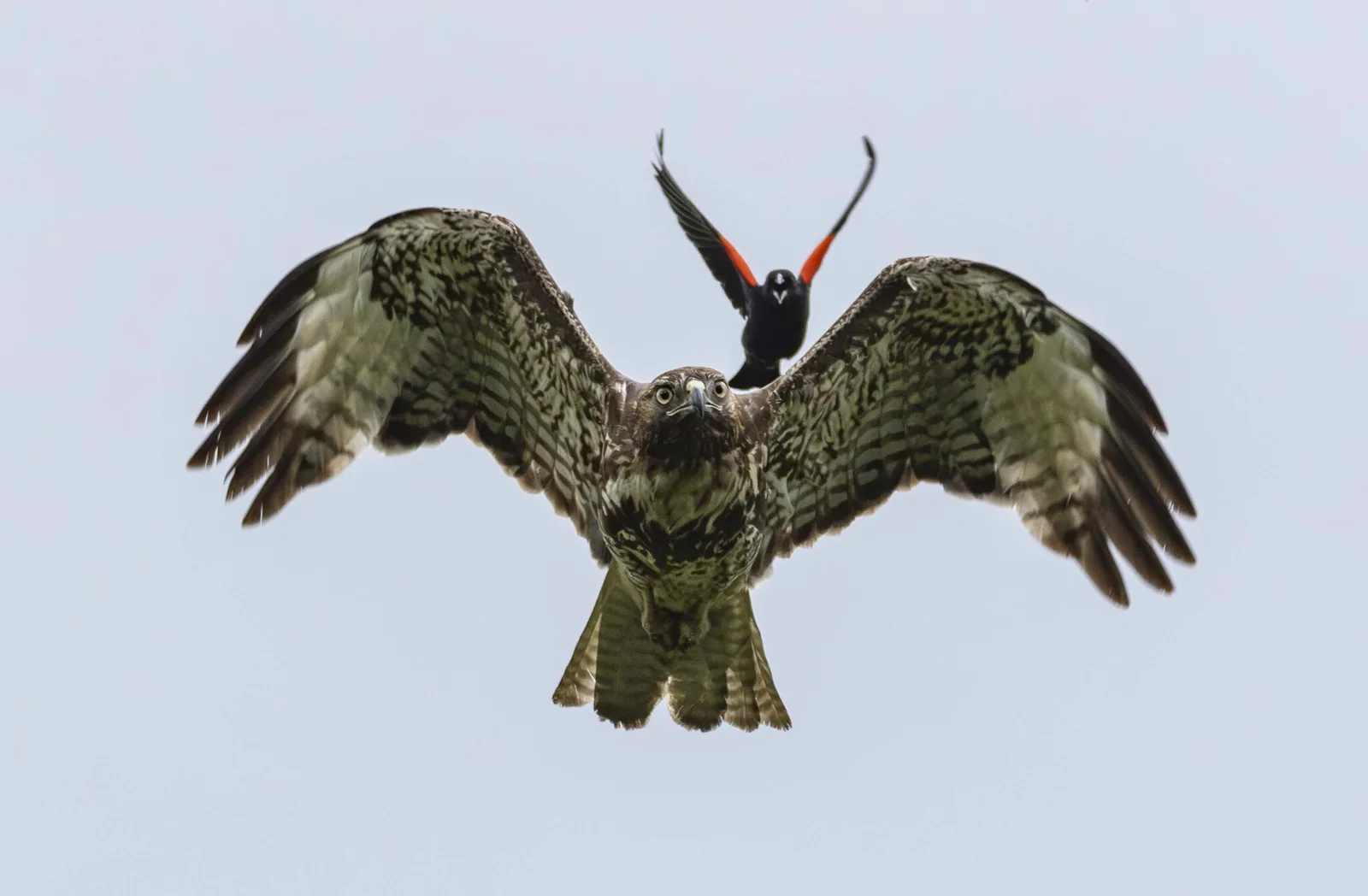
Red-tailed hawk
The roadside hawk with the brick-red tail
Buteo jamaicensis
Also called Chickenhawk, Harlan's hawk, Krider's hawk
Living individuals or members of this group exist today. This does not mean they are safe from extinction.
Meet the red-tailed hawk
The red-tailed hawk is the common broad-winged hawk of North America, named for the brick-red tail of the adult. It hunts rodents from a perch or from a slow circling glide, and it nests everywhere from desert cliffs to city buildings.
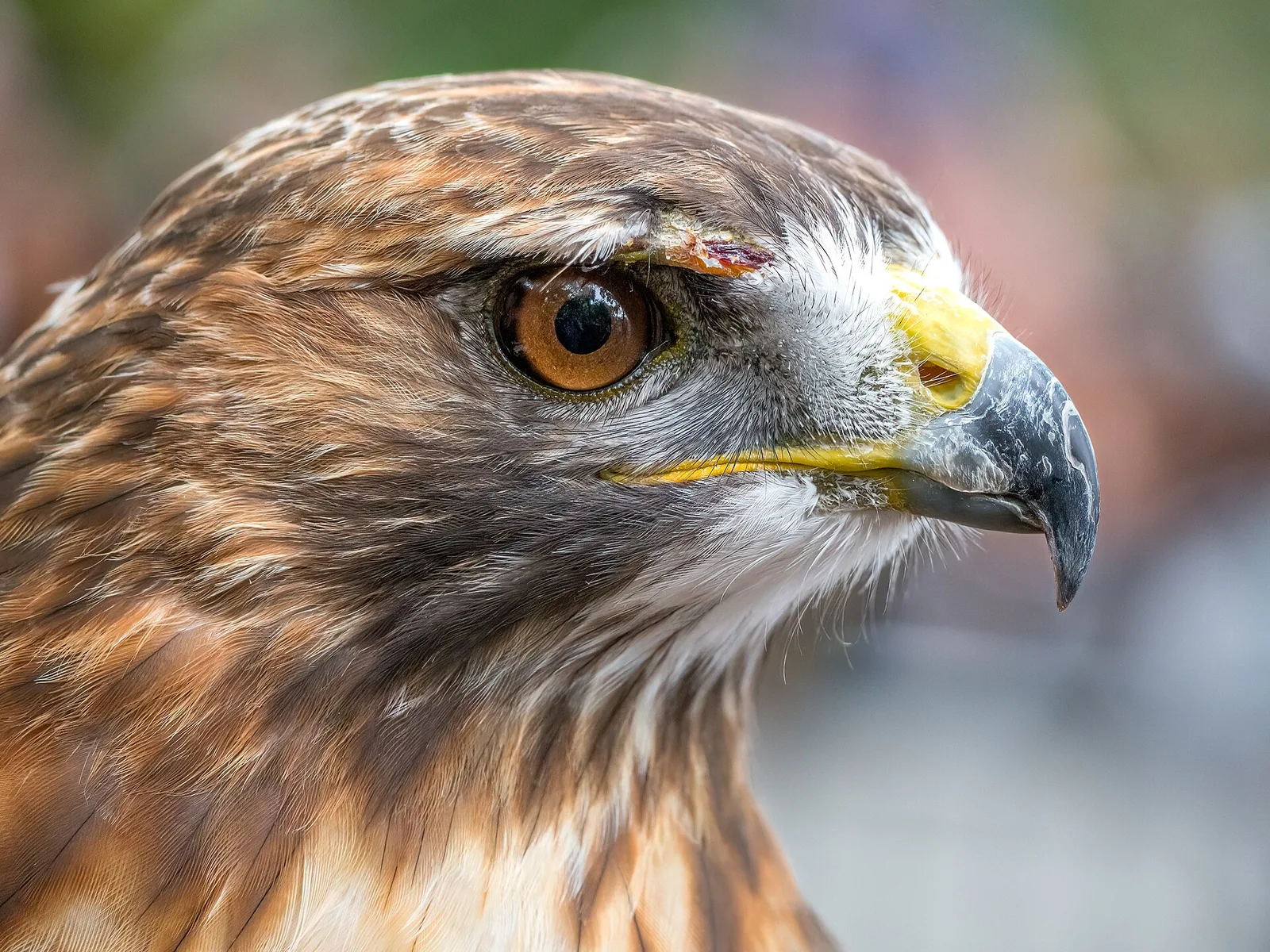
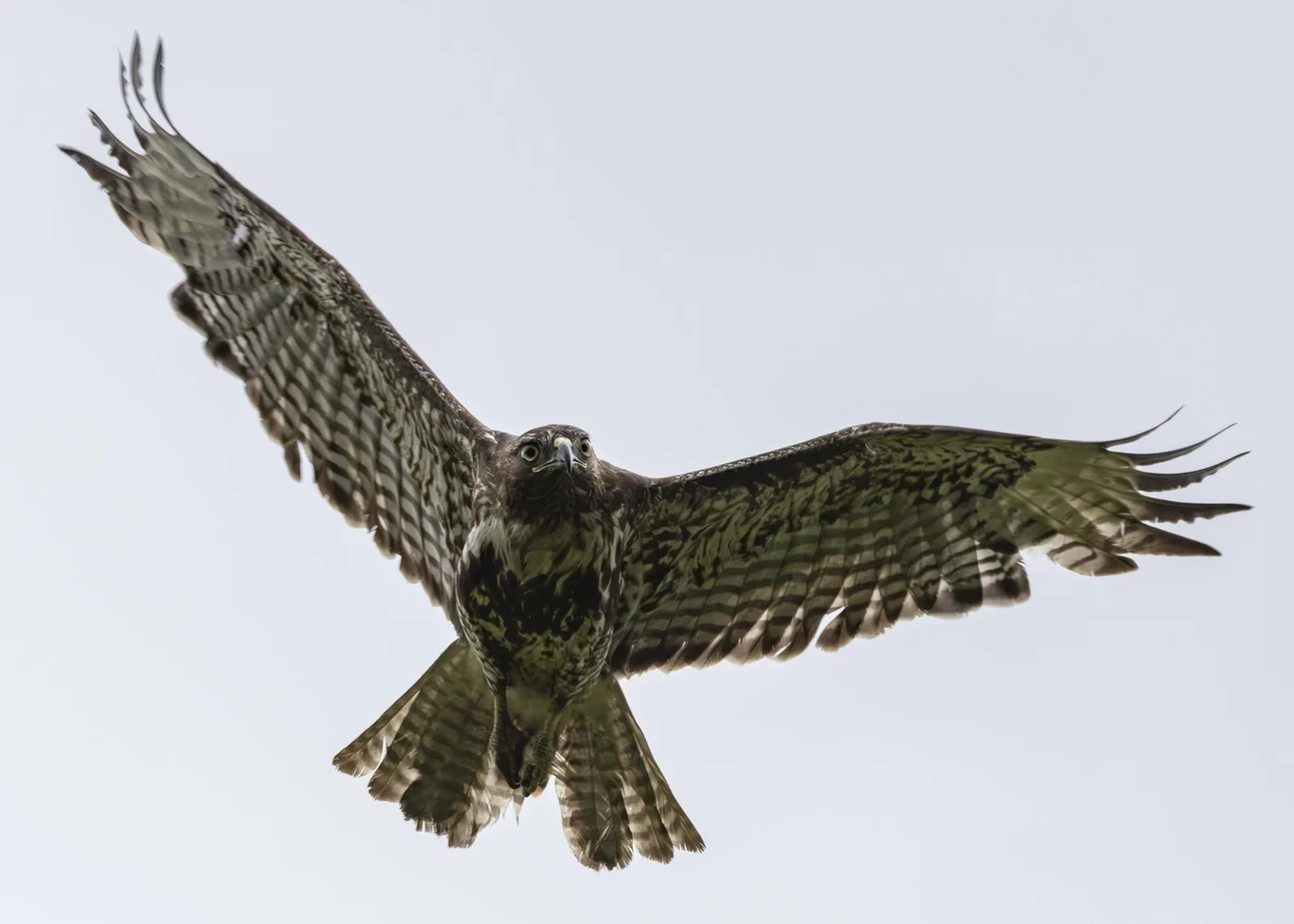
Images of the red-tailed hawk
Lifespan in the wild
Up to 30.7 years
Weight
0.69 to 1.6 kg
Length
45 to 65 cm
Top speed
32 to 64 km/h
Fact file
Red-tailed hawk
- Location
- Alaska and Canada south to Panama and the West Indies
- Habitat
- Temperate forest, Grassland, Desert, Towns and cities
- Diet
- Carnivore
- Prey / food
- Mice, voles, gophers, squirrels, rabbits, snakes, pigeons
- Predators
- Great horned owls take nestlings, and corvids and raccoons take eggs
- Lifestyle
- Active by day, hunting from a high perch
- Group name
- Kettle
- Name of young
- Chick
- Incubation
- Incubation 28 to 35 days
- Clutch size
- 1 to 5 eggs, laid every other day
- Population
- About one million in the United States
- Biggest threat
- Shooting, collisions with cars and rat poison
- Distinctive feature
- A brick-red tail and a dark band across the belly
- Colour
- Brown above and pale below, with a red tail
- Skin type
- Feathers
Size
Next to a person
Measurements
Size and speed
- Length
- 45 to 65 cm
- Wingspan
- 1.05 to 1.41 m
- Tail
- 18.8 to 25.9 cm
- Weight
- 0.69 to 1.6 kg the typical range across the species; the largest females reach 2 kilograms
- Weight, male
- 0.69 to 1.3 kg
- Weight, female
- 0.9 to 2 kg
- Top speed
- 32 to 64 km/h, up to 190 km/h cruising speed, and the speed of a dive
Typical adult ranges. Sources: Animal Diversity Web, Wikipedia.
Life cycle
Lifespan
- In the wildUp to 30.7 years
- In captivityUp to 29.5 years
- 030.7 years
The pale bar is the record. Sources: AnAge, Animal Diversity Web.
Appearance
Colour and coat
- Primary colours
- brownwhite
- Secondary colours
- redyellowblack
- Skin type
- feathers
- Male and female
- Reversed in size and modest in plumage. Females run up to 25 per cent larger than males, and the two sexes look alike. Colour differs far more between subspecies and morphs than between the sexes.
Life cycle
Mating and family
- Mating system
- monogamous pairs that stay together for life
- Social structure
- solitary or in a pair holding one territory
- Breeding
- one clutch each spring
Red-tailed hawks first breed at two or three years old and keep the same mate. The pair builds a stick nest in a tall tree or on a ledge, and adds to it each season. The female lays 1 to 5 eggs, and both parents incubate for 28 to 35 days. The young leave the nest after 42 to 46 days and learn to hunt over about 10 more weeks. Many die young, but a survivor can live for decades.
Classification
Taxonomy
- Kingdom
- Animalia
- Phylum
- Chordata
- Class
- Aves
- Order
- Accipitriformes
- Family
- Accipitridae
- Genus
- Buteo
- Species
- Buteo jamaicensis
Conservation
Red List status
- LC
- NT
- VU
- EN
- CR
- EW
- EX
Least Concern on the IUCN Red List
Range
Recorded in 3 countries
Habitat layer: temperate broadleaf and mixed forest, temperate conifer forest, boreal forest and taiga, tropical grassland, savanna and shrubland, temperate grassland, savanna and shrubland, desert and xeric shrubland.
Countries from 254,553 wild records on GBIF (iNaturalist research grade), filtered and checked by hand. Country shapes: Natural Earth. Habitat: RESOLVE Ecoregions 2017, CC BY 4.0. Basemap: Natural Earth.
Habitats
Three things to know
- 1
Its screaming call is dubbed over almost every eagle in film and television.
- 2
Rodents make up as much as 85 per cent of what it eats.
- 3
A hawk called Pale Male nested on a Fifth Avenue building in New York for three decades.
Did you know
Seven more facts
- 1
The name chickenhawk is unfair, because the bird rarely takes an adult chicken.
- 2
Its hind talon is the largest of any hawk in the family Accipitridae.
- 3
Harlan's hawk looks so different that some authors treat it as a separate species.
- 4
The eyes turn from yellow to reddish brown as the bird matures.
- 5
Pairs sometimes hunt as a team, flushing a squirrel around a tree trunk.
- 6
A captive hawk eats about 135 grams of meat a day in winter.
- 7
House sparrows nest inside the walls of an occupied hawk nest.
Field notes
How it looks and acts
Field notes
Distinguishing features
- The adult tail is plain brick-red with one black band at the tip.
- A dark brown band crosses the whitish belly in most colour forms.
- The wings are broad and blunt and the tail is short.
- The cere, legs and feet are bright yellow.
- The bird soars with its wings held in a shallow V.
- Young birds show about six dark bars on the tail instead of red.
Field notes
Unique adaptations
- Broad wings and a short tail probably suit long soaring over open ground.
- Very sharp eyesight picks out a moving rodent from far away.
- An oversized hind talon gives a firm grip on struggling prey.
- Colour morphs may let one species match many landscapes.
- A wide diet lets the bird switch prey with the season and the region.
Field notes
Interesting behaviours
- It hunts from a pole or tree and drops on prey below.
- It hangs on the wind above one spot when the breeze is strong enough.
- It builds a fresh nest when owls take over the old one.
- It follows American badgers to catch the animals they flush.
- It migrates alone rather than in flocks, and only on helpful winds.
Field notes
Temperament
- The bird tolerates people and nests in busy cities.
- It is territorial and circles its ground looking for intruders.
- The female defends the nest itself more fiercely than the male does.
- Captive birds train easily and have a calmer temper than most raptors.
Field notes
Communication
- The rasping scream carries territory ownership and anger.
- A croaking note is used at close range.
- Young birds peep for food when a parent leaves the nest.
- Raised feathers and an upright body signal threat.
- Undulating flight and steep dives mark the edges of a territory.
Ecology
Ecological role
The red-tailed hawk is the main day-flying predator of rodents across North America. It keeps mouse and rabbit numbers in check on farmland and grassland.
- It removes large numbers of mice, voles and gophers each year.
- Its old nests are taken over by great horned owls the following winter.
- House sparrows and other small birds live in the fabric of its nest.
- It both robs and is robbed by eagles and other large hawks.
Stories
Myths and legends
- In many Native American traditions, red-tailed hawk feathers are sacred objects.
- In United States law, those feathers rank with eagle feathers and need the same permission.
- In screen tradition, this hawk's voice stands in for every eagle and vulture.
- In New York tradition, Pale Male appears to stand for wildlife holding on inside a city.
People
Relationship with humans
People
Living alongside us
This hawk lives comfortably beside people. It hunts from highway poles and nests on city buildings, and it eats the rodents that damage crops. Falconers in the United States fly it more than any other raptor, and beginners are allowed to keep one. Native American nations treat its feathers as sacred, and the law protects them. A Central Park bird called Pale Male made the species famous.
- The hawk does not hunt people and ignores most human activity.
- A parent may strike at anyone who climbs to the nest.
- Small pets are probably safe, because the bird hunts rodent-sized prey.
People
Status, uses and products
- Domestication
- Wild
- As a pet
- Not suitable. It is a protected bird, and keeping one needs a falconry licence and training. Falconers house it in a proper mews and fly it at game, which no household can offer.
- Uses
- falconryrodent controlbirdwatching
- Products
- ceremonial feathers
The full account
About the red-tailed hawk
The red-tailed hawk is the most familiar large hawk in North America. Adults measure 45 to 65 centimetres long, with a wingspan of 105 to 141 cm. Most weigh from 690 to 1,600 grams, and the largest females reach 2 kilograms. The adult tail is brick-red above and pale buff-orange below. That tail is probably the quickest way to name the bird in the field.
The species breeds from western Alaska and northern Canada to Panama and the West Indies. It uses deserts, grassland, woodland edges, farmland and cities. It avoids only unbroken forest and the high Arctic. Rodents make up most of its food, and it hunts them from a perch. Pairs keep the same mate and the same territory for years.
The IUCN lists the red-tailed hawk as Least Concern. Canada, Mexico and the United States all protect it under the Migratory Bird Treaty.
Name and taxonomy
Johann Friedrich Gmelin described the bird in 1788 as Falco jamaicensis. He worked from an account by John Latham of 1781, based on a specimen from Jamaica. The species now sits in Buteo, a genus Bernard Germain de Lacepede named in 1799. Buteo comes from a Latin word for a buzzard. Europeans call these birds buzzards, while North Americans call them hawks.
The second half of the name points to Jamaica. That island name comes from the Taino word Xaymaca, the land of woods and water. In the United States the bird is one of three called the chickenhawk. It seldom takes an adult chicken, so the name misleads. At least 14 subspecies are recognised, and Harlan's hawk may deserve species rank.
Evolution and relatives
Buteo holds 28 species of medium-sized raptor with heavy bodies and broad wings. The red-tailed hawk is among the largest of them in North America. Swainson's hawk, the rough-legged hawk and the ferruginous hawk are close relatives. All of them overlap with it in prey or in hunting method at some point. The northern goshawk belongs to another genus and competes with it too.
Subspecies differ in colour more than in shape. Harlan's hawk of Alaska and north-western Canada is blackish and white with no warm tones. Krider's hawk of the northern prairies is very pale, with a pink or white tail. The western subspecies calurus has light, dark and rufous morphs. Dark and intermediate birds form 10 to 20 per cent of that western population.
Appearance
The bird is blocky and broad, and heavier than other hawks of the same length. Most colour forms show a whitish belly crossed by a dark brown band. The back runs from light auburn to deep brown. The bill is short, dark and hooked, and the head can look small on the thick body. The cere, the legs and the feet are yellow.
An adult tail is plain brick-red above and ends in a single black band. Young birds are harder to name, and their tails carry about six dark bars. The iris starts yellowish and darkens to reddish brown over three to four years. The tail measures 18.8 to 25.87 centimetres. The hind talon is the largest of any hawk in its family.
Females run up to 25 per cent larger than males, which is normal in large raptors. Males weigh from 690 to 1,300 grams and females from 900 to 2,000 g. Migrants at Cape May in New Jersey are the heaviest measured, with females averaging 1,278 g. The breeding birds of Puerto Rico are the lightest, at 795 g for a male. Even so, the heaviest race averages only about 18 per cent above the lightest.
Habitat and range
Breeding covers central Alaska, the Yukon and the Northwest Territories, then runs east to the Maritime Provinces. It reaches south to Florida, the West Indies and Central America. The winter range covers southern Canada and everything south of it. Only the peregrine falcon uses more kinds of habitat in North America. The hawk fails only where forest is unbroken or the Arctic is too harsh.
The ideal ground is a mix of woodland and open field with tall perches. Scrub desert, montane grassland, pasture, city parks and tropical rainforest all hold birds. Nests sit at a forest edge, in a wooded fence line or in a lone tree among open land. Pairs defend territories of 0.85 to 3.9 square kilometres. Home ranges run from 1.3 to 5.2 sq km, depending on food, sex and season.
Human settlement has helped this hawk more than it has hurt it. Clearing forest in the north-east made hunting ground, and the woodlots that were left held nest sites. Fire control and tree planting on the Great Plains let the species spread west. Highways with utility poles beside open medians created ideal perch hunting. The bird tolerates crowds and nests in cities, where pigeons and brown rats feed it.
Diet and hunting
Small rodents make up 80 to 85 per cent of the diet. Mice, voles, gophers, chipmunks, ground squirrels and tree squirrels lead the list. Rabbits and hares come next, then shrews, bats, pigeons, quail, crows and waterfowl. Reptiles, fish, crustaceans, insects and earthworms fill out the rest. On Caribbean islands the birds live mostly on snakes and lizards instead.
A hawk will take prey heavier than itself when the chance appears. Adult jackrabbits, striped skunks and western diamondback rattlesnakes have all been killed. Carrion is eaten when nothing else offers, though the bird does not seek it. A captive adult eats about 135 grams of food a day in winter. The hawk does not store food for later.
Two hunting methods cover most kills. The bird watches from a pole, tree or bluff and drops onto whatever moves below. It also scans while flying, then chases prey on the ground and pins it with the talons. Pairs sometimes hunt together, working opposite sides of a tree to drive out a squirrel. In cruising flight it travels at 32 to 64 kilometres per hour, and a dive can pass 190 km/h.
Behaviour and social life
The hawk soars with its wings raised in a shallow V and flaps as little as it can. Powered flight is slow, with deep beats. In a headwind the bird can hang almost motionless above one patch of ground. Birds are active by day and spend clear mornings circling their own ground. The female guards the nest area, while the male patrols the outer boundary.
Most northern birds migrate, and the far north empties in autumn. Coastal populations in the Pacific Northwest and Nova Scotia stay put all year. Autumn watches in Ontario, Quebec and the northern states count 4,500 to 8,900 birds. Hawk Ridge in Duluth, Minnesota has logged up to 15,000 in one season. Unlike some relatives, these hawks pass one at a time rather than in flocks.
Spring movement can start in late February and peaks in late March and early April. Derby Hill at Oswego in New York has counted up to 19,000 birds in a spring. More than 5,000 have passed there in a single day. Smaller birds mob a hawk that perches too openly. Crows working together can drive one off a carcass.
Communication and senses
The call is a hoarse rasping scream that lasts two or three seconds. It starts high and slides down, and people compare it to a steam whistle. The bird calls while hunting and soaring, and loudest at a rival or a predator. Close up it makes a croaking note instead. Chicks give soft peeping calls that deepen as they grow hungry and older.
Film and television use that scream for almost any bird of prey on screen. The bird shown is often an eagle, which sounds nothing like it. Posture carries messages too, with the body upright and the feathers raised in threat. A submissive bird lowers its head and flattens its feathers. Display flights include an undulating line for territory and a steep dive.
Sight probably does most of the hunting work. The hawk picks up the movement of a mouse from a great distance. Courting pairs swoop at each other and touch talons in the air. A yellowish iris marks a young bird at close range. The flight outline is often the only clue a watcher gets on a distant bird.
Reproduction and life cycle
Birds first breed at two or three years old. A pair keeps the same mate for years and takes a new one only when the first dies. The same territory may be held for many seasons. In courtship both birds circle wide and call, and the male dives and climbs again. He sometimes grips her talons in mid-air, and such flights last 10 minutes or more.
The pair builds a nest of sticks in a tall tree, 4 to 21 metres above the ground. A cliff ledge 35 m or higher will serve, and so will a building or a pylon. The nest measures 71 to 97 centimetres across and can stand 90 cm tall. Twigs form the frame, and bark, pine needles, husks and stalks line the cup. Fresh greenery is added through the season to keep the nest clean.
The female lays 1 to 5 eggs in spring, about one every other day. Both parents incubate for 28 to 35 days, and the male brings food to the sitting female. Chicks hatch helpless over 2 to 4 days, and the female tears food into pieces for them. They start to leave the nest after 42 to 46 days. Learning to fly and hunt takes about 10 more weeks, and the oldest wild bird reached 30.7 years.
Predators and threats
An adult red-tailed hawk has few enemies. Great horned owls kill hawks of any age, and the hawks never kill adult owls. Owls, crows and raccoons take most eggs and nestlings. Golden eagles, bald eagles and ferruginous hawks rob the bird of its kills. Owls also seize hawk nests, because they cannot build one themselves.
Most young hawks die in their first two years. Shooting, collisions with cars and disturbance at the nest cause most human-related losses. Lead shot swallowed with prey poisons a number of birds every year. City hawks eat rats that have taken warfarin bait and can bleed internally as a result. A bird that survives its early years may live for decades.
Population and conservation
The species is common and the IUCN lists it as Least Concern. The United States alone holds about one million birds. The range has widened over the past hundred years. Patchy woodland beside open land created the habitat that suits it. iNaturalist holds 356,404 records of the species, more than for most raptors.
The gain may not be permanent. Where those patches close into full forest, or open into bare prairie, the habitat is lost. NatureServe rates the bird secure across Canada and in Ontario. The Migratory Bird Treaty protects it in Canada, Mexico and the United States. It also appears on Appendix II of CITES, which controls trade.
Relationship with humans
Farmers gain from the hawk, which eats mice, moles and other crop pests. ADW records no negative effect of the species on people. The old name chickenhawk still colours how some people see it. City birds may become public figures in their own right. A hawk called Pale Male arrived in Central Park in 1991 and nested on a Fifth Avenue building.
In December 2004 the building removed his nest, and the protest reached the world's press. The Audubon Society and city agencies had a nest cradle back in place within weeks. Pale Male took eight mates over three decades and died in 2023 at the age of 33. His descendants now nest across New York City. Watchers still set telescopes beside the Central Park boat pond.
Falconers in the United States use this hawk more than any other. It is calm, easy to train, long-lived and resistant to disease. Novice falconers are allowed to fly it, which few other raptors permit. It works best on ground quarry, chiefly rabbits and squirrels. Fewer than 5,000 falconers practise in the country, so the take is negligible.
In culture and myth
Many Native American nations treat the feathers of this hawk as sacred. The tail feathers in particular appear on regalia and in ceremony. They stand beside the feathers of the bald eagle and the golden eagle in that role. United States law treats all three the same way. The eagle feather law makes an exception to the Migratory Bird Treaty Act of 1918.
Enrolled members of federally recognised tribes may hold the feathers for ceremonial use. The Fish and Wildlife Service hands them out through the National Eagle Repository. A first offence against that law risks a fine of 100,000 dollars and a year in prison. John James Audubon painted and described the bird in the 1830s. He treated Harlan's hawk separately and called it the Black Warrior.
A sentence with a dotted underline is inferred: it describes the group the animal belongs to, or is a reading of the sources, rather than a measured or reported fact about this species.
Questions
Red-tailed hawk questions, answered
How big is a red-tailed hawk?
Adults are 45 to 65 centimetres long with a wingspan of 105 to 141 cm. Most weigh 690 to 1,600 grams, and females are up to 25 per cent larger than males.
What do red-tailed hawks eat?
Mainly small rodents, which form 80 to 85 per cent of the diet. Rabbits, birds, snakes, lizards, fish and large insects fill in the rest.
How fast can a red-tailed hawk fly?
It cruises at 32 to 64 kilometres per hour. A dive can pass 190 km/h.
Where do red-tailed hawks live?
Across North America, from western Alaska and northern Canada to Panama and the West Indies. They avoid only unbroken forest and the high Arctic.
Are red-tailed hawks endangered?
No. The IUCN lists the species as Least Concern, and the United States alone holds about one million birds.
How long do red-tailed hawks live?
Most die within two years, but survivors last much longer. The oldest wild bird on record reached 30.7 years.
Do red-tailed hawks mate for life?
Yes, in effect. The bond lasts for years, and a bird pairs again only after its mate dies.
How many eggs does a red-tailed hawk lay?
One to five, laid about every other day in spring. Both parents incubate them for 28 to 35 days.
Why is the red-tailed hawk called a chickenhawk?
It is one of three American hawks given that nickname. The name is misleading, because the bird rarely takes an adult chicken.
Is the eagle scream in films really a red-tailed hawk?
Usually yes. Film and television use this hawk's rasping cry for almost any bird of prey on screen.
Can you keep a red-tailed hawk?
Only under a falconry licence. The species is protected by the Migratory Bird Treaty in Canada, Mexico and the United States.
Why do falconers prefer red-tailed hawks?
They are calm, easy to train, long-lived and resistant to disease. Novice falconers in the United States are allowed to fly them.
Do red-tailed hawks migrate?
Northern birds do, and the far north empties each autumn. Coastal populations in the Pacific Northwest and Nova Scotia stay all year.
Where do red-tailed hawks nest?
In a stick nest 4 to 21 metres up a tall tree, or on a cliff ledge, building or pylon. The nest is 71 to 97 centimetres across.
Are red-tailed hawks dangerous to pets?
Rarely. The bird hunts rodent-sized prey, and a cat or a dog is far larger than its usual target.
Who was Pale Male?
A red-tailed hawk that reached Central Park in 1991 and nested on a Fifth Avenue building. He died in 2023 at the age of 33.
Food web
Prey and food
- mice
- voles
- gophers
- squirrels
- rabbits
- snakes
- pigeons
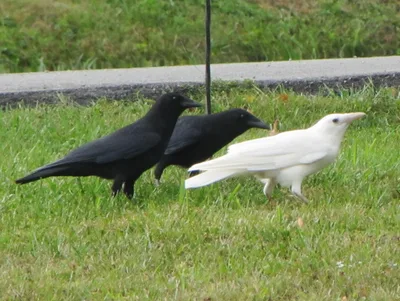 American crow
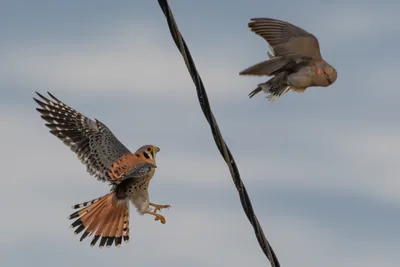 American kestrel
Food web
Predators
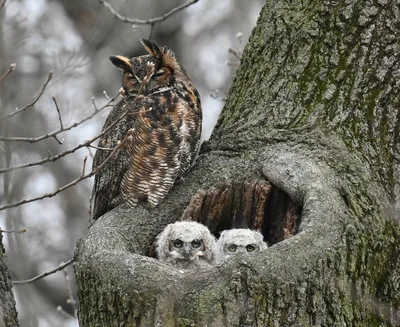 Great horned owl
Ecological equivalents
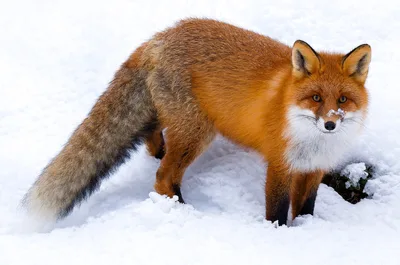
Related species on this site
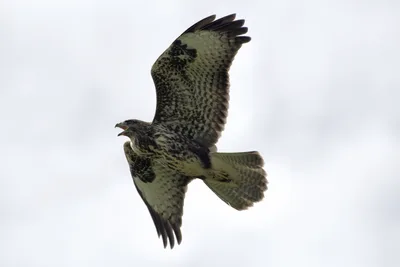
Common buzzard (same genus), Ferruginous Hawk (same genus), Red-Shouldered Hawk (same genus), Rough-Legged Hawk (same genus), Swainson's Hawk (same genus), African Fish Eagle (same family), and more.
 LC
Birds
Common buzzard
Buteo buteo
The common buzzard is a broad-winged hawk of Europe and northern Asia, and the commonest bird of prey across most of that range.
Living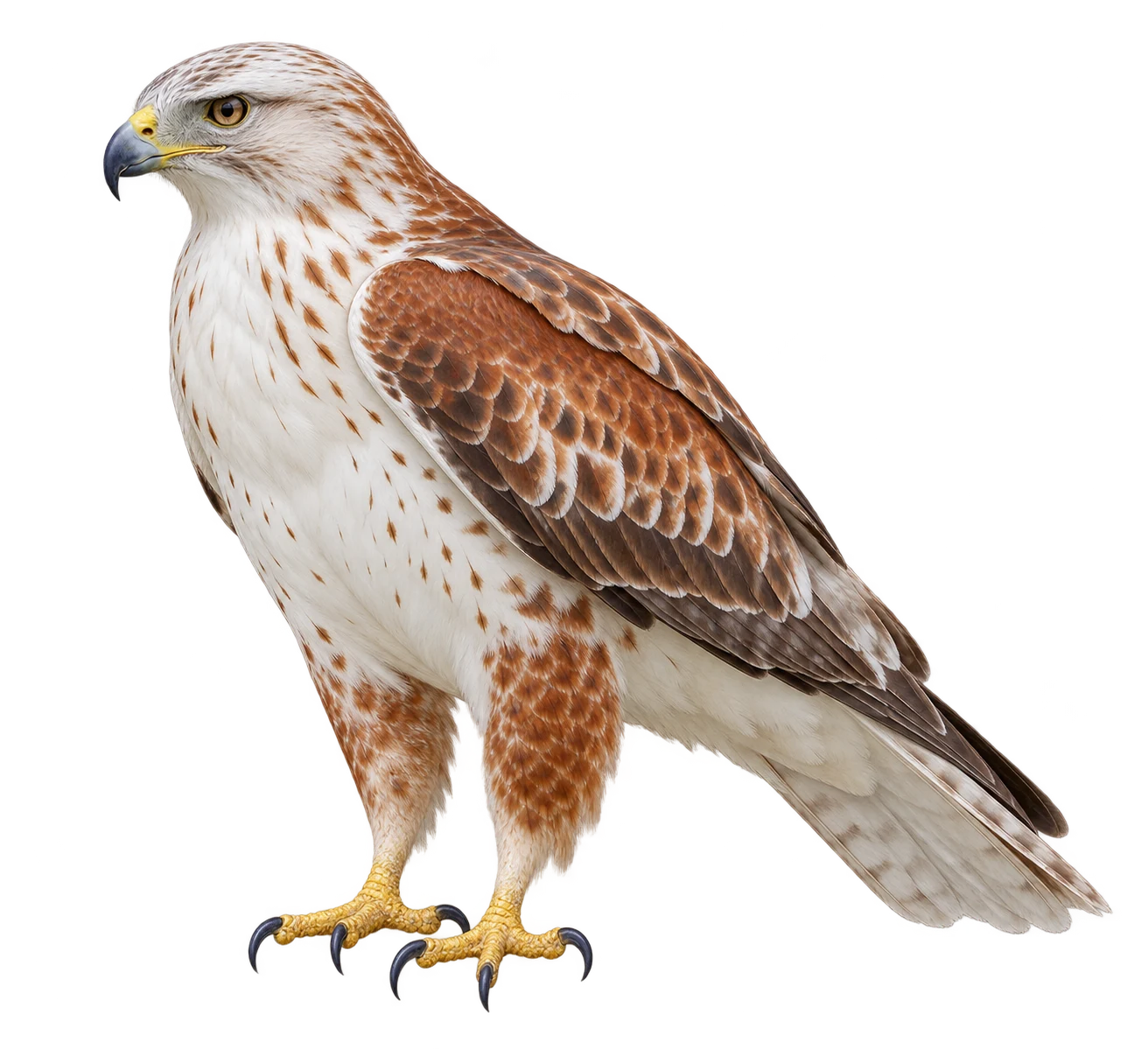
Birds
Ferruginous Hawk
Buteo regalis
Classification and source reference
LivingAI illustration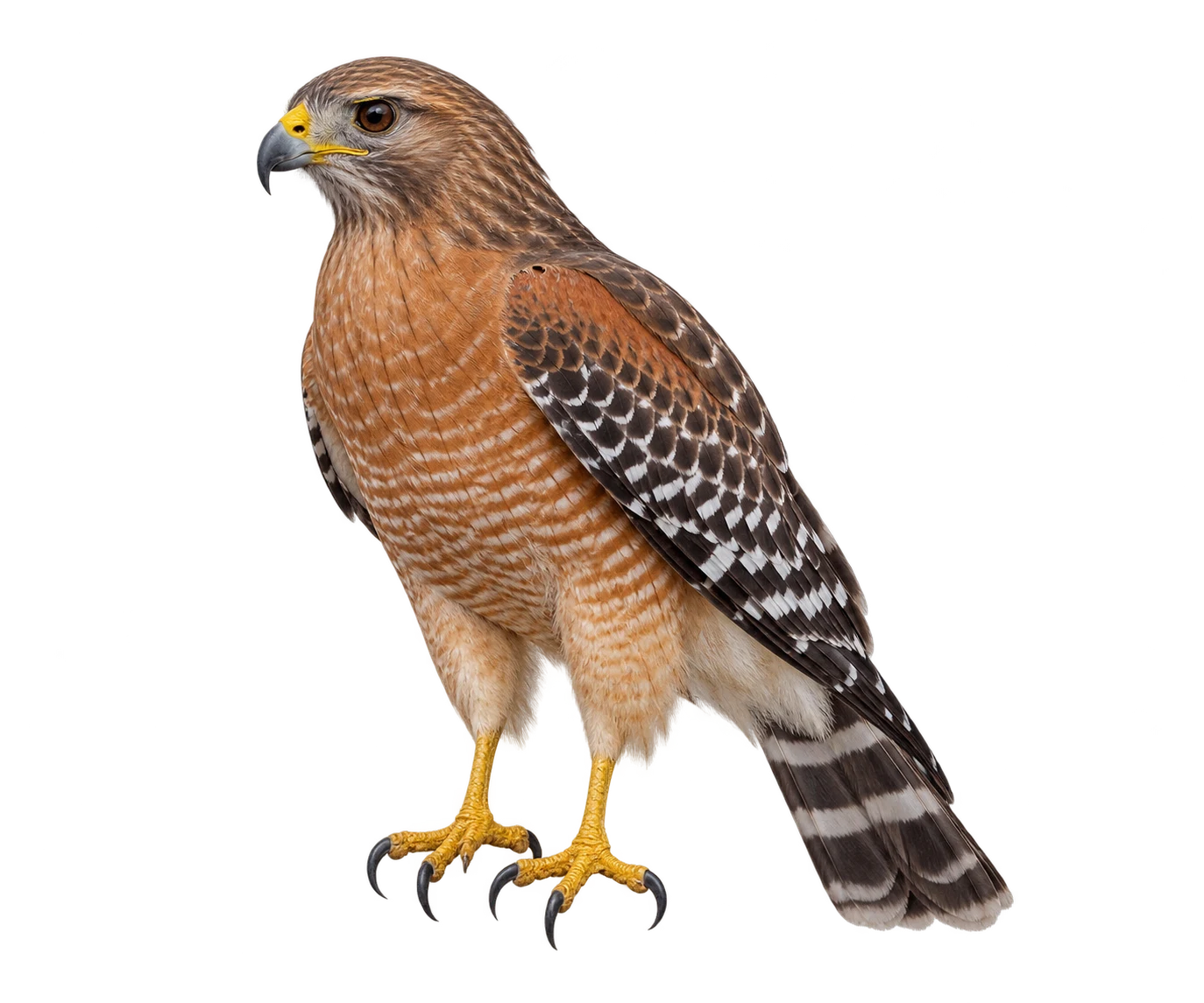
Birds
Red-Shouldered Hawk
Buteo lineatus
Classification and source reference
LivingAI illustration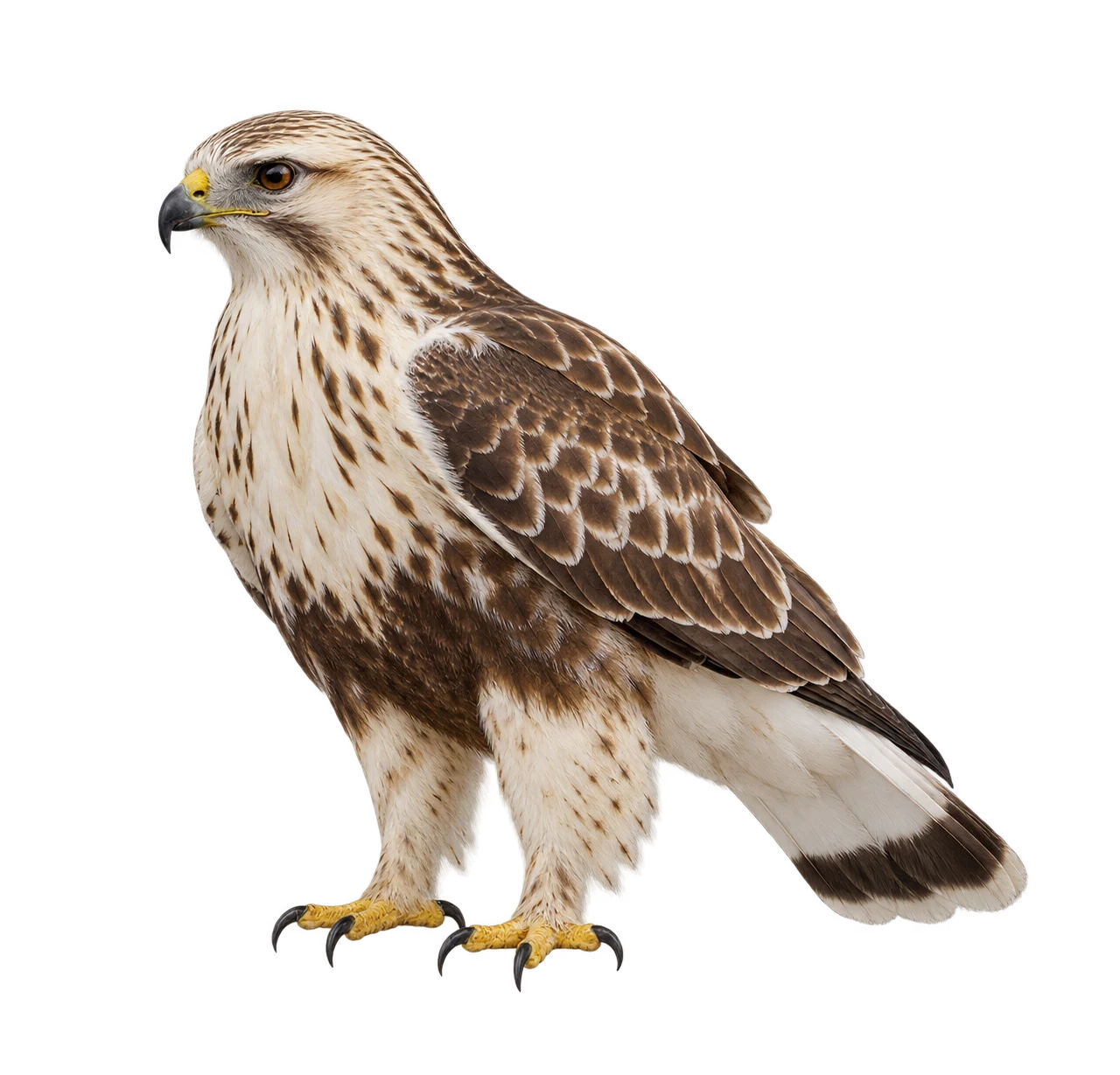
Birds
Rough-Legged Hawk
Buteo lagopus
Classification and source reference
LivingAI illustration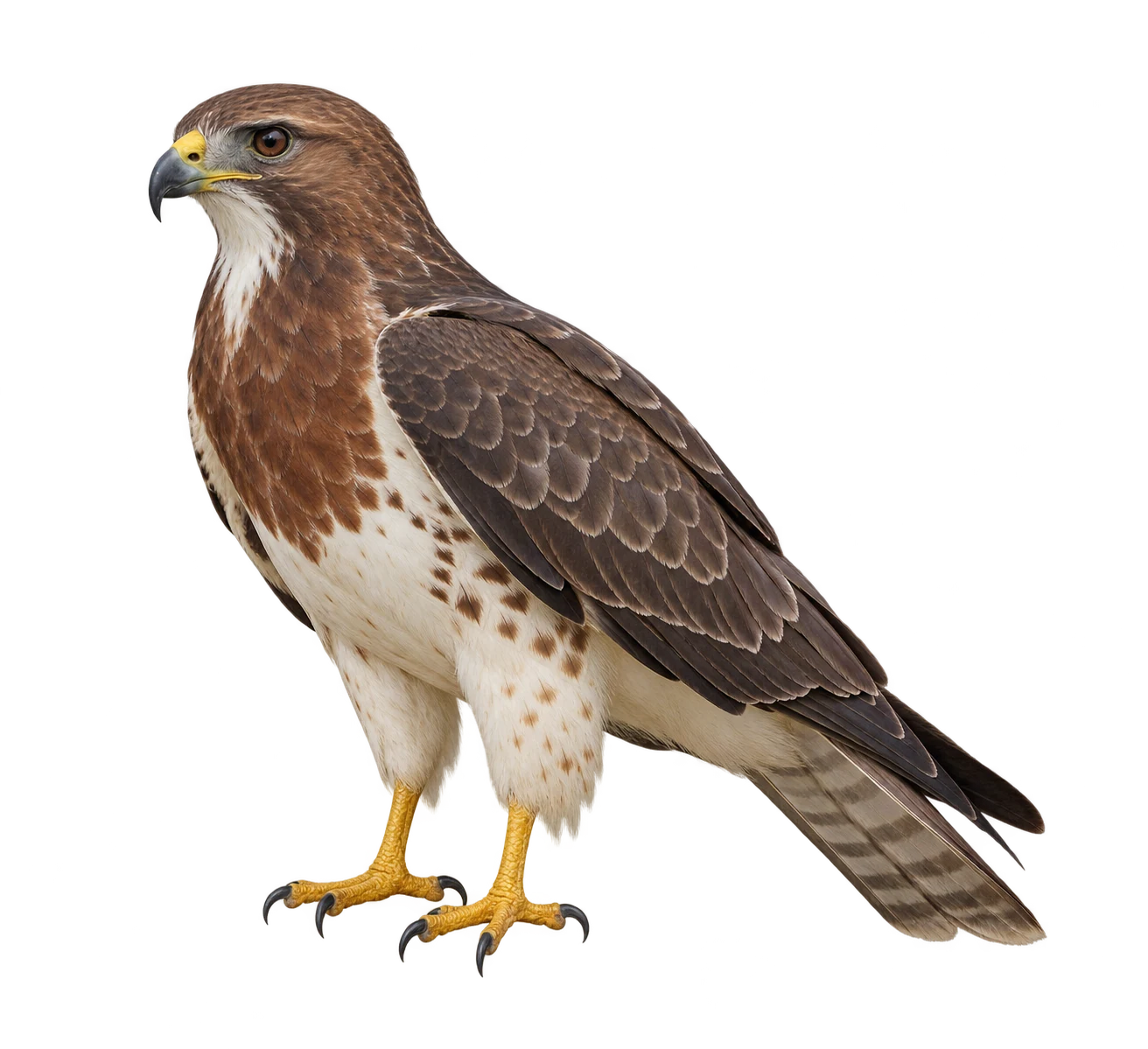
Birds
Swainson's Hawk
Buteo swainsoni
Classification and source reference
LivingAI illustration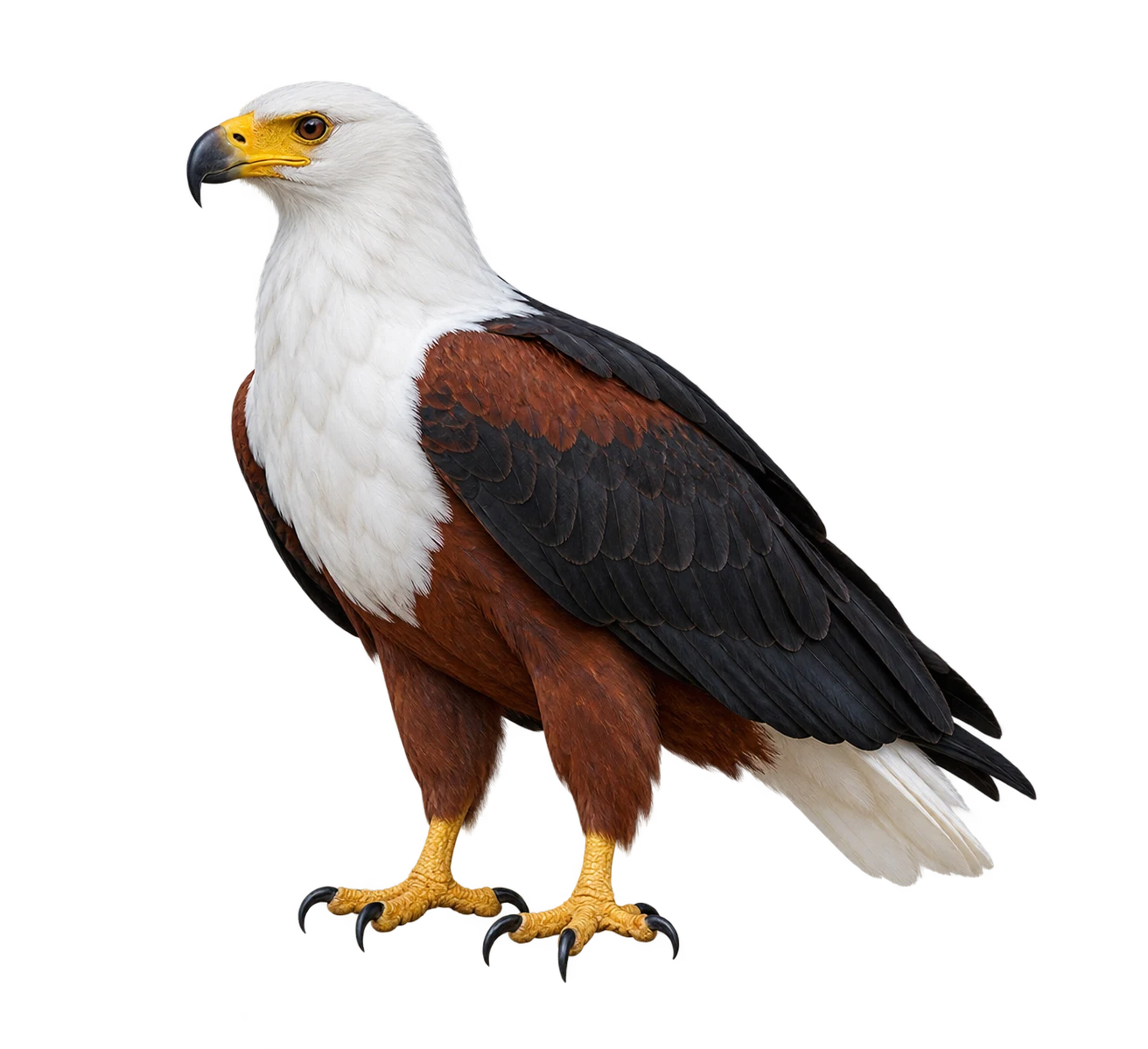
Birds
African Fish Eagle
Haliaeetus vocifer
Classification and source reference
LivingAI illustration