Living individuals or members of this group exist today. This does not mean they are safe from extinction.
Meet the bald eagle
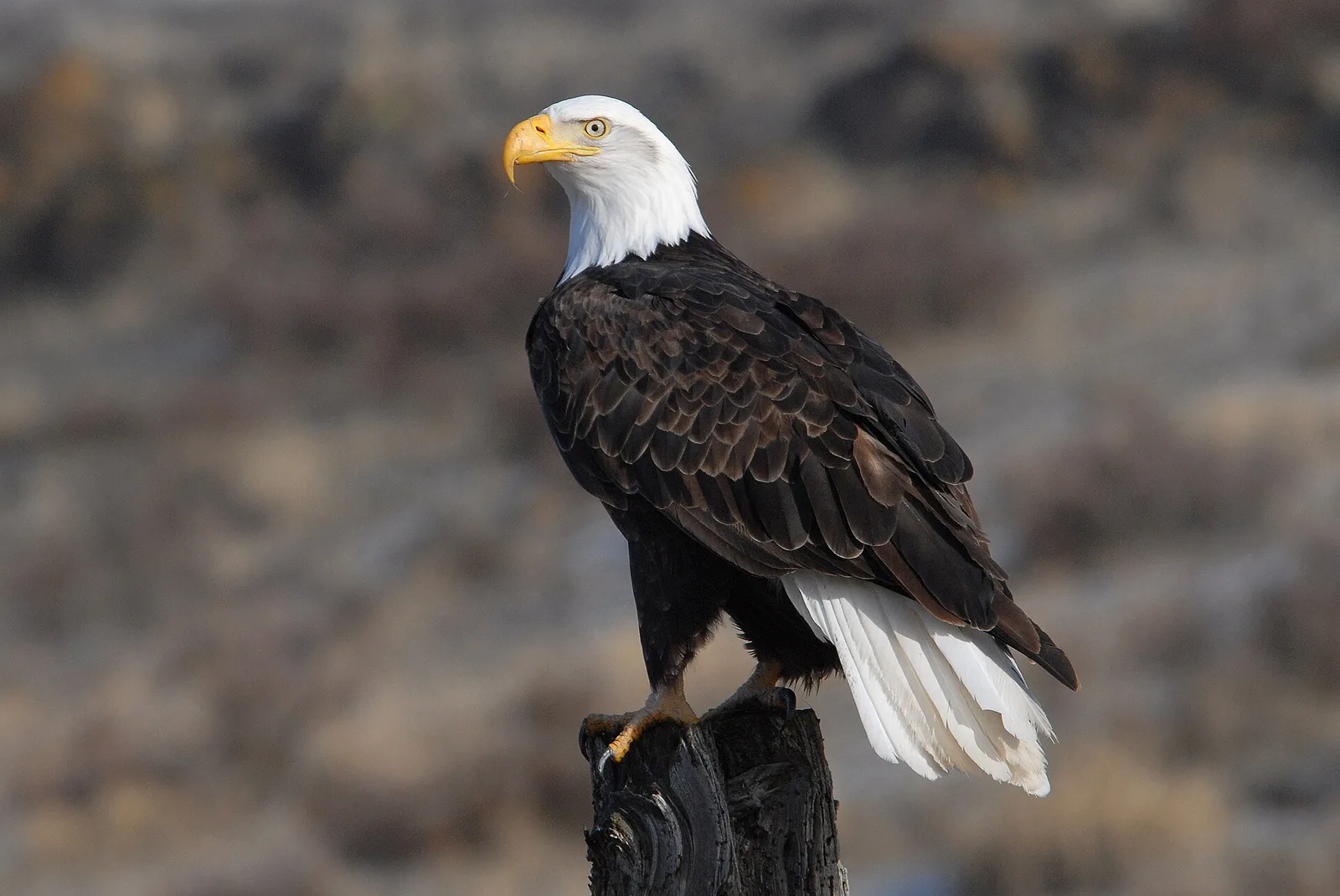
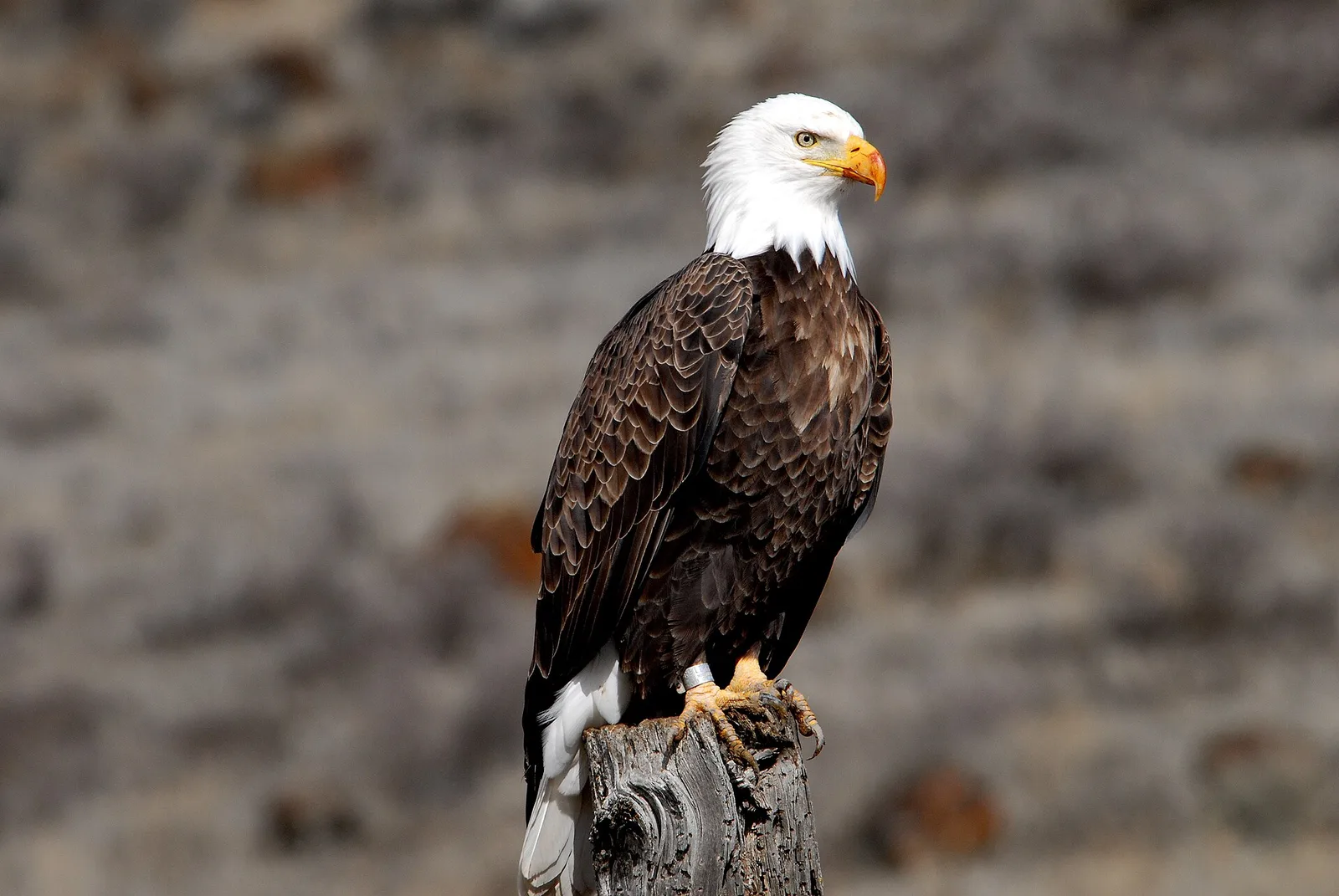
The bald eagle is the national bird of the United States. It fishes from lakes, rivers and coasts and builds the largest tree nest of any bird.
Images of the bald eagle
Lifespan in the wild
15 to 20 years
Weight
3 to 6.3 kg
Length
0.7 to 1.02 m
Top speed
56 to 70 km/h
Fact file
Bald eagle
- Location
- Canada, the USA and northern Mexico
- Habitat
- Coast, Rivers and lakes, Temperate forest
- Diet
- Piscivore
- Prey / food
- Fish, waterfowl, carrion
- Predators
- None as adults
- Lifestyle
- Diurnal
- Group name
- Convocation
- Name of young
- Eaglet
- Incubation
- 35 days of incubation
- Clutch size
- 1 to 3 eggs
- Population
- About 316,000 in the USA
- Biggest threat
- Lead poisoning and habitat loss; recovered from DDT
- Distinctive feature
- A white head and tail on a dark brown body
- Colour
- Brown, white and yellow
- Skin type
- Feathers
Size
Next to a person
Measurements
Size and speed
- Length
- 0.7 to 1.02 m
- Wingspan
- 1.8 to 2.3 m
- Tail
- 23 to 37 cm
- Weight
- 3 to 6.3 kg
- Top speed
- 56 to 70 km/h, up to 160 km/h in flight; the top figure is a dive
Typical adult ranges. Source: Wikipedia.
Life cycle
Lifespan
- In the wild15 to 20, up to 28 years
- In captivity20 to 30, up to 47 years
- 047 years
The pale bar is the record. Source: Animal Diversity Web.
Appearance
Colour and coat
- Primary colours
- dark brownwhite
- Secondary colours
- yellow
- Skin type
- feathers
- Male and female
- Slight in colour, strong in size. Females are about 25% larger than males, but both sexes wear the same brown body with a white head and tail.
Life cycle
Mating and family
- Mating system
- monogamous pairs that mate for life
- Social structure
- solitary or paired, with communal roosts of up to 400 in winter
- Breeding
- one clutch of one to three eggs a year, usually two
Bald eagles pair for life and breed from about five years old. The pair repairs a huge stick nest each winter, and the female lays one to three eggs, usually two. Both birds incubate for about 35 days. The chicks fledge at 8 to 14 weeks and stay near the nest for several more weeks. Wild eagles live 15 to 20 years.
Classification
Taxonomy
- Kingdom
- Animalia
- Phylum
- Chordata
- Class
- Aves
- Order
- Accipitriformes
- Family
- Accipitridae
- Genus
- Haliaeetus
- Species
- Haliaeetus leucocephalus
Conservation
Red List status
- LC
- NT
- VU
- EN
- CR
- EW
- EX
Least Concern on the IUCN Red List
Range
Recorded in 3 countries
Habitat layer: temperate broadleaf and mixed forest, temperate conifer forest, boreal forest and taiga, flooded grassland and savanna, mangrove.
Countries from 167,036 wild records on GBIF (iNaturalist research grade), filtered and checked by hand. Country shapes: Natural Earth. Habitat: RESOLVE Ecoregions 2017, CC BY 4.0. Basemap: Natural Earth.
Habitats
Three things to know
- 1
A nest can weigh over a tonne after years of additions.
- 2
Young eagles stay brown all over until about five years old.
- 3
The eagle's eyesight is about four times sharper than a human's.
Did you know
Seven more facts
- 1
The eagle's real call is a weak chirping whistle, and the scream in films belongs to a red-tailed hawk.
- 2
Bald means white-headed in old English, not hairless.
- 3
A young eagle stays brown for about five years before its head turns white.
- 4
The feathers weigh about 700 grams, twice as much as the skeleton.
- 5
An eagle can swim, and it tows a fish too heavy to lift ashore with its talons.
- 6
Eagles have nested on the ground on Amchitka Island and on giant cactuses in Sonora.
- 7
Benjamin Franklin disliked the eagle but never proposed the turkey in its place.
Field notes
How it looks and acts
Field notes
Distinguishing features
- A white head and tail on a dark brown body.
- A large, hooked yellow bill and yellow eyes.
- Bare yellow legs with strong toes and large talons.
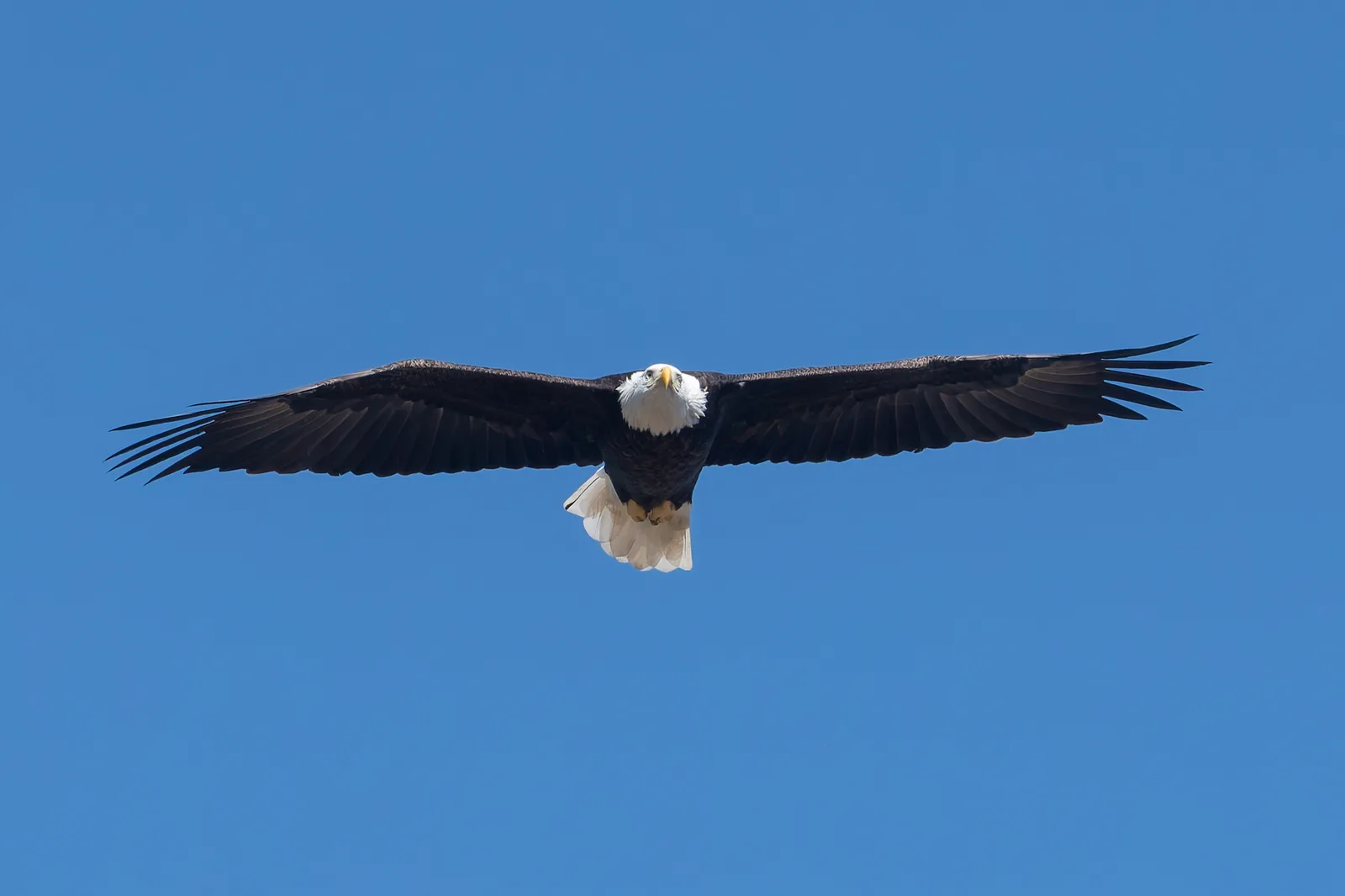
- A wingspan of 180 to 230 centimetres, held flat in flight.
- Brown plumage with white streaks in birds under five years old.
Field notes
Unique adaptations
- Spicules on the toes grip slippery fish.
- A long hind talon pierces prey while the front toes hold it.
- Broad wings let it soar on thermals for hours at little cost.
- A crop stores up to 1 kilogram of food for lean days.
- Sharp eyesight spots a fish near the surface from a high perch.
Field notes
Interesting behaviours
- Snatches fish from the surface without diving.
- Steals catches from ospreys and other eagles.
- Adds sticks to the same nest year after year.
- Gathers in hundreds at salmon runs in winter.
- Forces a duck to dive repeatedly until it is exhausted.
Field notes
Temperament
- Bold at a carcass, and it drives off most other scavengers.
- Shy of people at the nest and quick to abandon feeding when disturbed.
- Fierce in nest defence, even against a bear.
- Solitary for most of the year but tolerant at a rich food source.
Field notes
Communication
- A chatter of chirping whistles between mates and rivals.
- A long, high peal when a threat appears.
- Head and wing movements and crouching to signal aggression.
- Cartwheel and chase flights between a pair in courtship.
Ecology
Ecological role
The bald eagle is a top predator and scavenger of North American waters, and its recovery has reshaped some seabird colonies.
- Takes fish, waterbirds and small mammals across a spectrum of more than 400 species.
- Cleans up carrion, from spawned salmon to roadkill deer and stranded whales.
- Its predation now drives declines in common murres on parts of the Pacific coast.
- As with other top predators, its presence probably signals a water body with a healthy fish stock.
Stories
Myths and legends
- In Lakota tradition, the eagle carries prayers to the Creator, and a feather marks an honour earned.
- In Tlingit and Haida tradition, Eagle is one of the two moieties that divide society, paired with Raven.
- In Choctaw tradition, the eagle touches the upper world of the sun and stands for peace.
- In Pawnee tradition, the eagle is a symbol of fertility because it nests high and guards its young.
- In United States tradition, the eagle on the Great Seal stands for freedom and the union of the 13 founding states.
People
Relationship with humans
People
Living alongside us
Americans shot the eagle as a lamb thief for a century and then poisoned it with DDT. Laws in 1940 and 1972 turned that around, and the bird now nests in every state and province. It draws bird watchers by the million and remains sacred to many Native nations. Lead from hunters' bullets in carcasses is now its main poison.
- The bald eagle does not attack people and takes no prey larger than a small lamb.
- Old stories of eagles carrying off children have no basis.
- A pair may swoop at a person who climbs towards the nest.
People
Status, uses and products
- Domestication
- Wild
- As a pet
- Not suitable. Federal law bans private ownership of a bald eagle, and only licensed institutions may hold injured birds. An eagle needs open water, fish and a territory of several square kilometres.
- Uses
- ecotourismeducationceremonial feathers
- Products
- None recorded
The full account
About the bald eagle
The bald eagle, Haliaeetus leucocephalus, is a large sea eagle found only in North America. An adult has a dark brown body, a white head, a white tail, a hooked yellow bill and yellow feet. It is not bald: the name uses an old English meaning of the word, white-headed. It lives beside coasts, rivers and large lakes, where it snatches fish from the surface with its talons. It also eats waterbirds, mammals and a great deal of carrion, and it steals food from ospreys and other hunters.
An adult measures 70 to 102 centimetres long, spans 180 to 230 cm across the wings and weighs 3 to 6.3 kilograms. Pairs mate for life and build the largest tree nest of any animal, which can weigh a tonne after years of additions. The pesticide DDT drove the species to about 412 nesting pairs in the lower 48 states by the 1950s. After DDT was banned in 1972 the eagle recovered, and it left the endangered list in 2007. The IUCN lists it as Least Concern, and it has been the national emblem of the United States since 1782.
Name and taxonomy
The genus name Haliaeetus comes from the Greek for sea eagle. The species name leucocephalus joins the Greek words for white and head. Bald in the English name once meant having a white face or head, not hairless, and it describes the white feathers against the dark body. Carl Linnaeus described the bird in the 18th century as Falco leucocephalus. It belongs to the family Accipitridae, the hawks and eagles, in the order Accipitriformes.
Two subspecies are named: H. l. leucocephalus from the southern states down into Baja California, and the larger H. l. washingtoniensis in the north. Many authors treat them as one form that simply grows bigger towards the pole, following Bergmann's rule. Its closest relative is the white-tailed eagle of Eurasia, which fills the same role across the Atlantic. Other languages name it for the head too: the German Weisskopfseeadler and the French pygargue a tete blanche both mean white-headed sea eagle.
Evolution and relatives
The bald eagle and the white-tailed eagle split from the other sea eagles by the Early Miocene, about 10 million years ago. If the oldest fossil assigned to the genus is correct, the split may date to the Oligocene, 28 million years ago. The two species are almost the same size, one with a white head and one with a tan head. The white-tailed eagle is paler and has longer wings and a shorter tail.
A fossil toe bone from Cumberland Bone Cave in Maryland matches the bald eagle and shows it lived in the region in the Pleistocene. Its closest relatives today are the other Haliaeetus sea eagles, including the huge Steller's sea eagle of the North Pacific. The golden eagle, the only other very large raptor in North America, belongs to a different genus, Aquila.
Appearance
An adult bald eagle is dark brown with a pure white head and tail. The bill, cere, feet and eyes are bright yellow, and the legs are bare of feathers. The toes are short and strong, with large talons, and the hind talon pierces prey while the front toes hold it still. Males and females look alike, but females are about 25% larger. A female averages about 5.6 kilograms and a male about 4.1 kg.
The body measures 70 to 102 centimetres, the wingspan 180 to 230 cm and the tail 23 to 37 cm. Weight runs from 3 to 6.3 kilograms. Birds grow larger towards the north: South Carolina eagles average 3.27 kg, while large Alaskan females can pass 7 kg and span 2.44 metres. One Alaskan female weighed 7.4 kg, and an 1876 record from New York claimed 8.2 kg.
A young eagle is dark brown with untidy white streaks, and it takes about five years to gain the adult pattern. The eyes lighten in the second year, the bill turns yellow in the third and the head whitens in the fourth. An immature bird can be confused with a golden eagle. It has a larger head, a bigger bill and blotchy white under the wings.
Habitat and range
The bald eagle breeds from Alaska and most of Canada down through every one of the contiguous states into northern Mexico. It is the only sea eagle native to North America. Since 2018 it has nested in every continental state and province, and in 2024 a pair nested in Toronto for the first time. Northern birds migrate south in winter, while southern birds stay on their territories all year. GBIF holds records from 26 countries, which includes captive birds and vagrants, and iNaturalist lists 234,721 observations.
In the breeding season it needs open water with plenty of fish and big old trees to nest in. It prefers lakes larger than 10 square kilometres and shorelines longer than 11 km. Nest trees are usually over 20 metres tall with an open crown, and most nests stand within 200 m of water. In Florida it nests in pines, cypresses and mangroves, and in south-east Alaska Sitka spruce held 78% of nests. Where there are no trees, as on Amchitka Island in Alaska, it nests on the ground, and in Sonora it has nested on giant cactuses.
The eagle is sensitive to people while nesting and keeps more than 1.2 km from light disturbance and 1.8 km from heavy disturbance. Even so, pairs have nested inside Portland and Philadelphia, and a family settled in Harlem, New York, in 2010. In winter it gathers where water stays open, and one to two thousand birds winter at Squamish, British Columbia, for the salmon run. Inland winter birds often roost far from water on prairie or tundra where carrion and rabbits are plentiful.
Diet and hunting
The bald eagle is an opportunist, and more than 400 prey species are recorded. Across 20 diet studies, fish made up 56% of nesting eagles' food, birds 28%, mammals 14% and other prey 2%. At least 100 fish species are taken, from salmon, herring and shad to catfish, carp and pike. It prefers fish of about 36 centimetres and mostly takes those between 20 and 75 cm. In the Columbia River estuary 58% of fish were caught alive, 24% scavenged and 18% stolen.
To fish, the eagle swoops low and snatches its prey from the surface with its talons, and it never dives under. Rough scales on the toes, called spicules, grip a slippery fish. It can lift a fish equal to its own weight. A heavier catch may drag it into the water, and it then tows the fish ashore. A gorged eagle stores up to 1 kilogram of food in its crop and can then fast for days.
Birds come next: grebes, coots, ducks, gulls, cormorants and, in colonies, murres, from eggs to adults. It has killed geese in mid-air and taken herons, loons, cranes and even swans. In winter inland it hunts prairie dogs and jackrabbits, sometimes in pairs, and it takes sea otter pups and seal afterbirth on the coast. Carrion of every kind matters, from spawned-out salmon to deer and whales. It also steals from ospreys, herons, otters and other eagles, a habit called kleptoparasitism.
Behaviour and social life
The bald eagle spends most of its day at rest, about 91% of its time in one study. It soars on thermals and updrafts to save energy, and it flies at 56 to 70 kilometres per hour. A dive reaches 120 to 160 km/h, though it rarely drops straight down. On the ground it walks with an awkward rocking gait.
Adults are solitary outside the breeding season, but they gather where food is rich and roost together in groups of up to 400. A breeding pair defends about 1 to 2 kilometres of shoreline, and home ranges in Oregon and Washington run 6 to 47 square kilometres. Birds whose water freezes in winter migrate south or to the coast, and Florida eagles wander north after breeding. Migration happens by day, mostly between 8 in the morning and 6 in the evening, when the sun makes thermals.
Young eagles play, passing sticks in the air and playing tug of war in the nest. At carrion the eagle drives off coyotes, foxes, gulls, vultures and other raptors, though a dog or a bobcat can push a young eagle aside. It hunts waterfowl by forcing a duck to dive again and again until it tires. Where people disturb its feeding grounds it may cut its foraging by as much as 35%.
Communication and senses
The bald eagle's voice is surprisingly weak. Its call is a thin series of chirping whistles and chatters, kleek kik ik ik ik, with a cadence like a gull's. The fierce scream heard in films belongs to a red-tailed hawk, dubbed in because the eagle's own call is so feeble. It also gives a wail and a long, high peal when it senses a threat. Threats are shown with head and wing movements and crouching, and pairs call to each other when they return to the nest.
The eyes are large and face forward, so the bird has strong binocular vision. Its eyesight is about four times sharper than a human's. Smell is poor, though it rejects food that tastes spoiled. Like other raptors, it probably locates fish from a perch by sight alone before it launches.
Reproduction and life cycle
Bald eagles mature at four or five years and usually return to breed near where they hatched. Pairs stay together for life, though a survivor takes a new mate and a pair that keeps failing may part. Courtship includes high circling, chases and the cartwheel display, in which the pair lock talons and spin down, letting go just above the ground. They breed early: nest repair starts by mid-February, eggs are laid in late February and the young fledge from late June. In Florida nesting begins in September, and in Alaska in January.
Both birds build the nest from sticks in a tall tree near water, and they add to it every year. A nest can reach 4 metres deep, 2.5 m across and a tonne in weight. One Florida nest measured 6.1 m deep and 2.9 m across and weighed about 2.7 tonnes, the largest tree nest ever recorded. Most nests last under five years before they fall, but one in the Midwest was used for at least 34 years. The female lays one to three eggs, usually two, each about 73 millimetres long and about 130 grams in Alaska.
Both parents incubate for about 35 days, though the female does most of the sitting. A chick weighs about 60 grams at hatching and can gain up to 170 g a day, the fastest growth of any North American bird. The older chick sometimes kills its sibling, yet nearly half of nests still raise two young. The young fledge at 8 to 14 weeks and depend on the parents for several more weeks. They then wander for about four years until they gain adult plumage. Wild eagles live 15 to 20 years, and the oldest wild bird known reached 28.
Predators and threats
A healthy adult has no natural predator. Eggs and chicks are taken by gulls, ravens, crows, magpies, owls, other eagles, raccoons, bobcats, wolverines and black bears. An adult will knock a black bear out of a tree to defend its nest. About half of young eagles die in their first year. A common loon defending its nest has killed an eagle with a stab of its bill.
People cause most adult deaths. Of 1,428 eagles examined between 1963 and 1984, 23% died from impact with wires and vehicles, 22% from gunshot and 11% from poisoning. A Michigan study of 1,490 deaths from 1986 to 2017 found 36% killed by cars while eating roadkill and 12% by lead poisoning. Eagles swallow lead shot and bullet fragments in carcasses, and a 2022 study found lead poisoning in more than half of adults across 38 states. Electrocution on power lines, leg traps and oil spills add to the toll, and the Exxon Valdez spill killed about 247 in 1989.
Population and conservation
The IUCN Red List rates the bald eagle as Least Concern, and its numbers are rising. In the early 18th century there may have been 300,000 to 500,000 birds. By the 1950s only 412 pairs nested in the lower 48 states. DDT was the main cause: it did not kill adults, but it thinned eggshells until they broke under the sitting bird. Shooting was the other, and about 70,000 eagles were shot in Alaska in the 12 years before 1930.
The 1940 Bald and Golden Eagle Protection Act banned killing and egg collecting, and the species was listed as endangered in 1967. DDT was banned in the United States in 1972 and in Canada in 1989. Numbers climbed to about 100,000 in the early 1980s and 110,000 to 115,000 by 1992. The bird moved from endangered to threatened in 1995 and left the list on 28 June 2007. Today about 316,000 live in the United States, with Alaska holding 40,000 to 50,000 and British Columbia 20,000 to 30,000.
Washington's occupied nests rose from 105 in 1980 to 840 in 2005. Mexico still lists the eagle as in danger of extinction, and several states rank it as rare. In some places the recovered eagle now eats so many murres and other seabirds that it has become a conservation problem of its own.
Relationship with humans
For much of the 20th century ranchers and fishermen shot eagles in the belief that they took lambs and even children. Lamb predation is rare and attacks on children are unknown. Only permitted institutions may keep the bird in the United States, and the eagles on show are usually injured birds that cannot be released. It cannot legally be flown for falconry in the United States, though Canada and England issue licences.
In 2016 the US Fish and Wildlife Service proposed letting wind farms kill up to 4,200 eagles a year without penalty. Bird watchers travel to see winter gatherings, and the wider hobby was worth about 20 billion dollars a year by 1989. Benjamin Franklin called the eagle a bird of bad moral character because it steals from the osprey and flees from the kingbird. There is no evidence that he ever proposed the turkey instead.
In culture and myth
The Continental Congress placed the bald eagle on the Great Seal on 20 June 1782. It grips 13 arrows in one foot and an olive branch in the other. It appears on the presidential seal, on coins and stamps and in the logos of many federal agencies. Congress made it the official national bird only in 2024. The eagle also sits on the coat of arms of the Philippines, a reminder of that country's time as a US territory. A legend says the eagle on the presidential flag turns to face the arrows in wartime, but the flag has not changed since 1945.
For many Native nations the eagle is sacred, and its feathers carry meaning in ceremony. The Lakota give an eagle feather to honour an achievement, and in Lakota belief the eagle carries prayers to the Creator. In the Sun Dance of the Plains peoples a medicine man uses a fan of eagle feathers and a whistle of eagle wing bone. The Pawnee see the eagle as a sign of fertility, and the Choctaw as a sign of peace. Among the Tlingit and Haida, Eagle and Raven are the two halves of society. Under federal law only enrolled members of recognised tribes may hold eagle feathers, supplied by the National Eagle Repository.
A sentence with a dotted underline is inferred: it describes the group the animal belongs to, or is a reading of the sources, rather than a measured or reported fact about this species.
Questions
Bald eagle questions, answered
How big is a bald eagle?
An adult is 70 to 102 centimetres long with a wingspan of 180 to 230 cm and a weight of 3 to 6.3 kilograms. Females are about 25% larger than males. Alaskan birds are the biggest.
Why is it called a bald eagle?
Bald once meant white-headed in English, not hairless. The name describes the white feathers of the head against the dark brown body.
What do bald eagles eat?
Mostly fish, which make up about 56% of the diet at nests. They also take waterbirds, rabbits, prairie dogs and carrion, and they steal food from ospreys and other eagles.
Where do bald eagles live?
Across Canada, Alaska, all 48 mainland states and northern Mexico. They need open water with fish and tall trees to nest in, and they gather in winter where rivers stay unfrozen.
How fast can a bald eagle fly?
About 56 to 70 kilometres per hour in level flight and about 48 km/h with a fish. In a dive it reaches 120 to 160 km/h, though it rarely dives straight down.
How good is a bald eagle's eyesight?
About four times sharper than a human's. Its large, forward-facing eyes give strong binocular vision, and it spots fish near the surface from a high perch.
Do bald eagles mate for life?
Yes. A pair stays together until one dies, and the survivor then takes a new mate. Pairs that fail to breed several times may split up.
How big is a bald eagle nest?
The largest tree nest of any animal. A typical old nest is up to 4 metres deep and 2.5 m across and weighs about a tonne. One Florida nest was 6.1 m deep and weighed about 2.7 tonnes.
Are bald eagles endangered?
Not any more. They fell to about 412 nesting pairs in the lower 48 states in the 1950s because of DDT and shooting. After DDT was banned in 1972 they recovered, and they left the endangered list in 2007. About 316,000 now live in the United States.
How long do bald eagles live?
About 15 to 20 years in the wild, and the oldest known wild bird reached 28. In captivity they live 20 to 30 years, and one reached 47.
What does a bald eagle sound like?
A weak series of chirping whistles and chatters, a bit like a gull. The loud scream used in films is a red-tailed hawk.
Why did Benjamin Franklin dislike the bald eagle?
In a 1784 letter he called it a bird of bad moral character. It steals fish from the osprey and flees from the tiny kingbird. He never publicly proposed the turkey as the national bird.
When do bald eagles get their white head?
At about five years old. Young birds are brown with white streaks. The bill and eyes turn yellow by the third year, and the head is mostly white by the fourth.
Can a bald eagle carry off a child or a lamb?
No child has ever been taken, and lamb predation is rare. An eagle can lift only about its own weight, and it usually flies with prey under half its weight.
Why is the bald eagle the symbol of the United States?
The Continental Congress put it on the Great Seal in 1782, following the Roman habit of using eagles for power. It stands for freedom and the union of the 13 founding states. Congress made it the official national bird in 2024.
Is it legal to own a bald eagle feather?
Only enrolled members of federally recognised Native American tribes may hold bald or golden eagle feathers, for religious use. The National Eagle Repository distributes feathers from dead eagles to tribes.
Food web
Prey and food
- fish
- waterfowl
- carrion
 Osprey
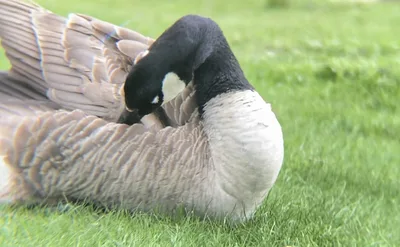 Canada goose
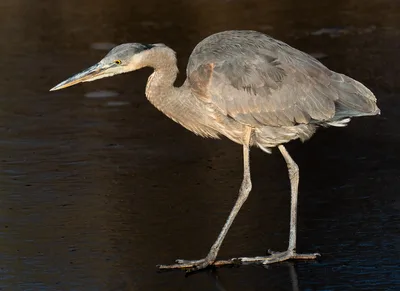 Great blue heron
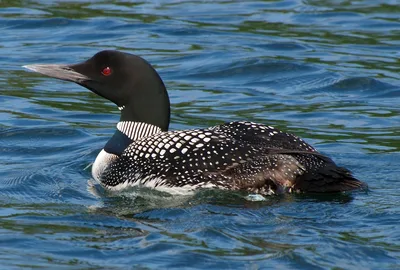 Common loon
Food web
Predators
No natural predator is recorded.
Ecological equivalents
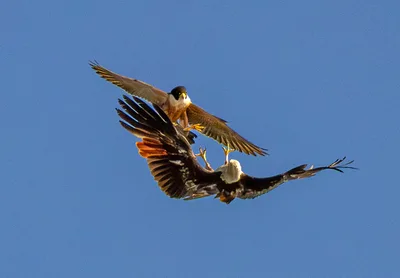
Related species on this site
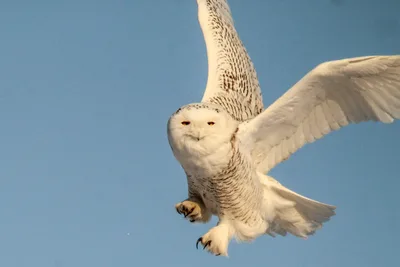
African Fish Eagle (same genus), Steller's sea eagle (same genus), White-tailed eagle (same genus), Australian Firehawk (same family), Bearded vulture (same family), Black kite (same family), and more.
Birds
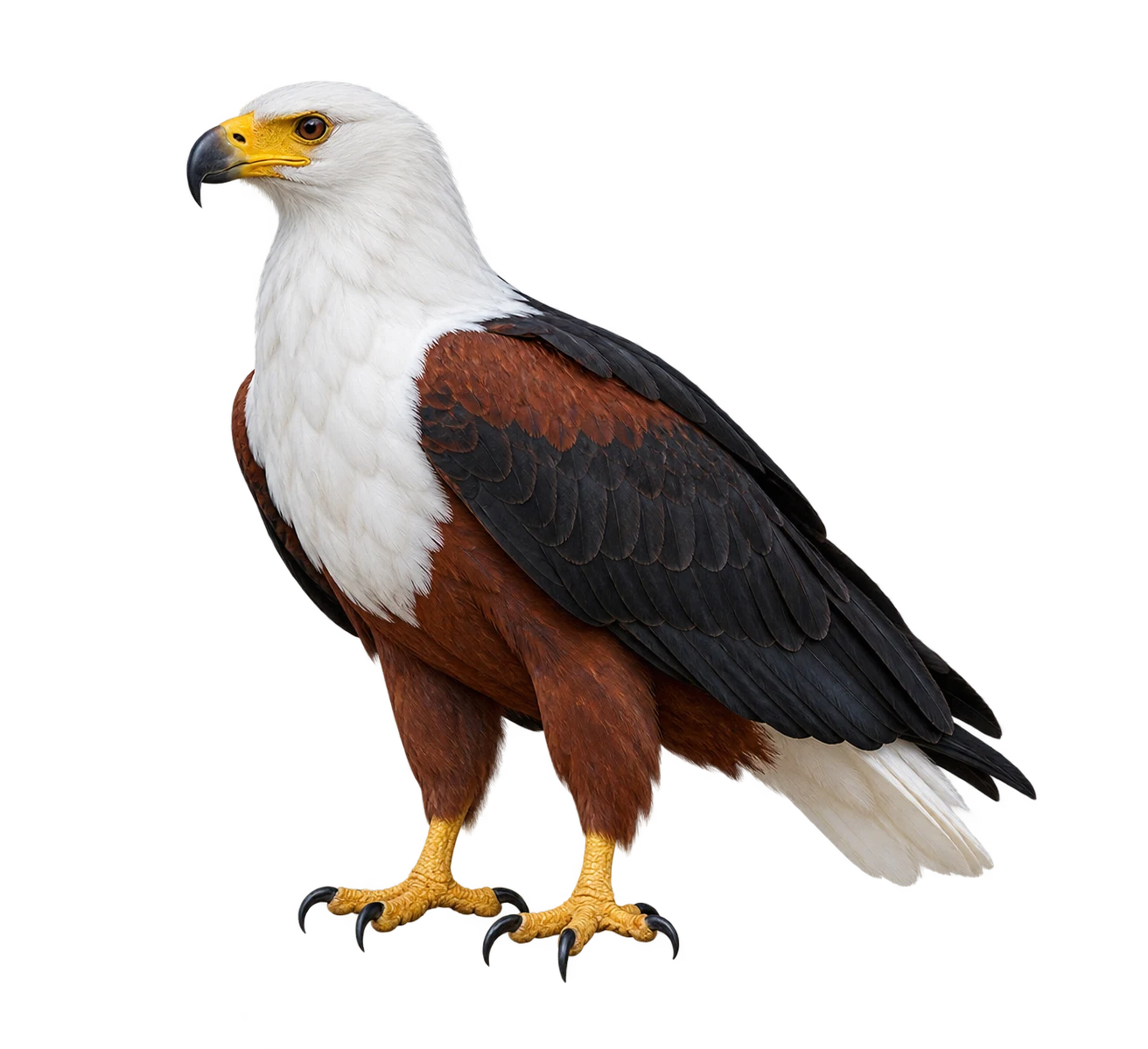
African Fish Eagle
Haliaeetus vocifer
Classification and source reference
LivingAI illustration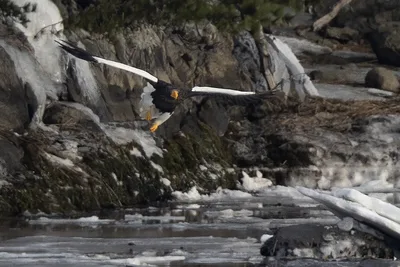 VU
Birds
Steller's sea eagle
Haliaeetus pelagicus
Steller's sea eagle is the heaviest eagle in the world, a black and white fish hunter of the northeast Asian coast.
Living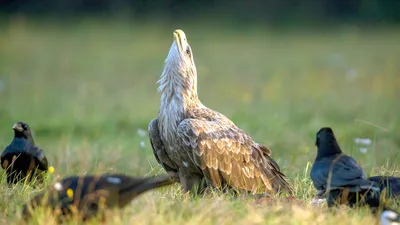 LC
Birds
White-tailed eagle
Haliaeetus albicilla
The white-tailed eagle is the largest bird of prey in Europe, a brown sea eagle with a short white wedge of a tail.
Living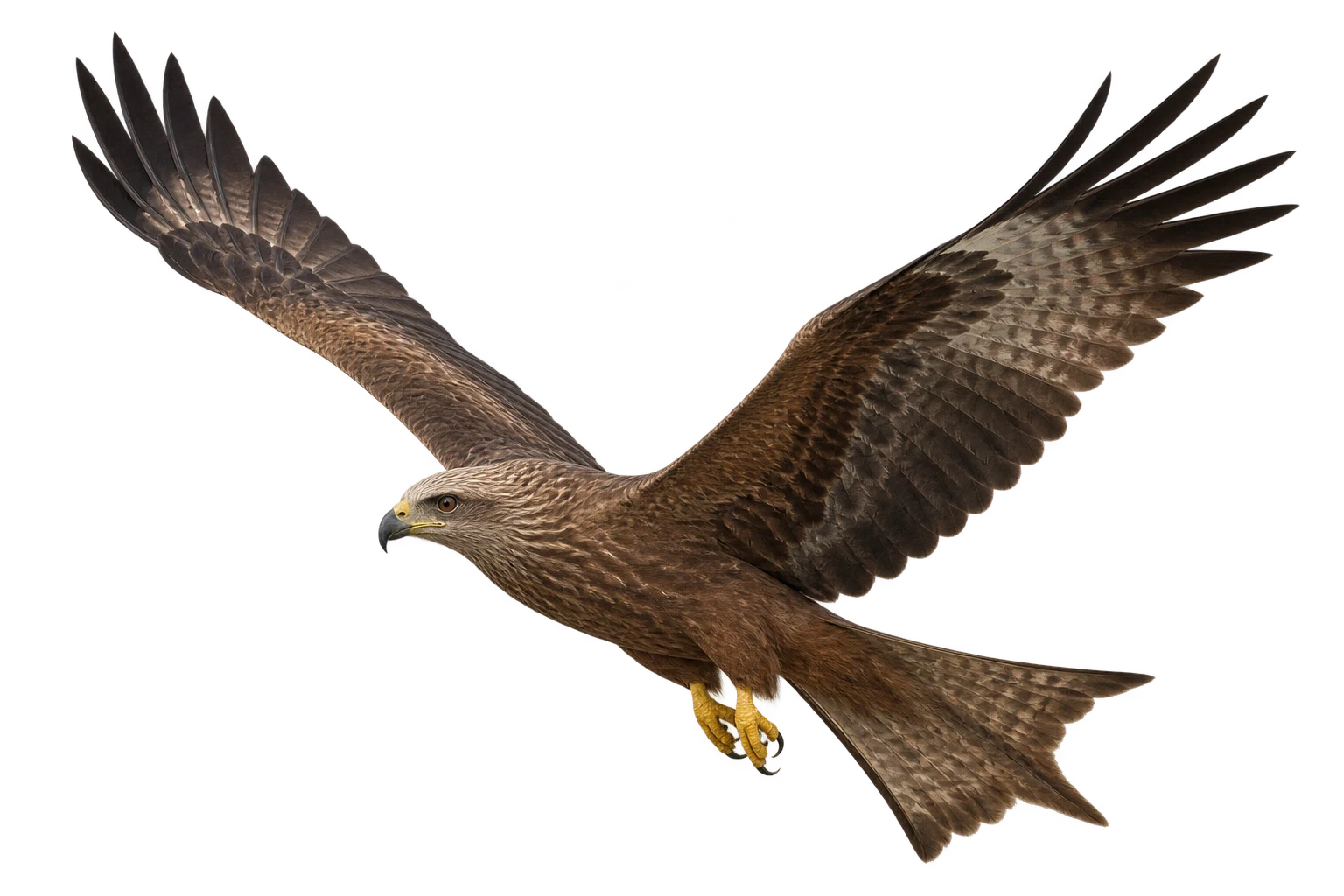
Birds
Australian Firehawk
Milvus migrans
Classification and source reference
LivingAI illustration NT
Birds
Bearded vulture
Gypaetus barbatus
The bearded vulture is a huge mountain raptor that lives almost entirely on bone.
Living LC
Birds
Black kite
Milvus migrans
The black kite is a medium-sized raptor with angled wings and a forked tail.
Living