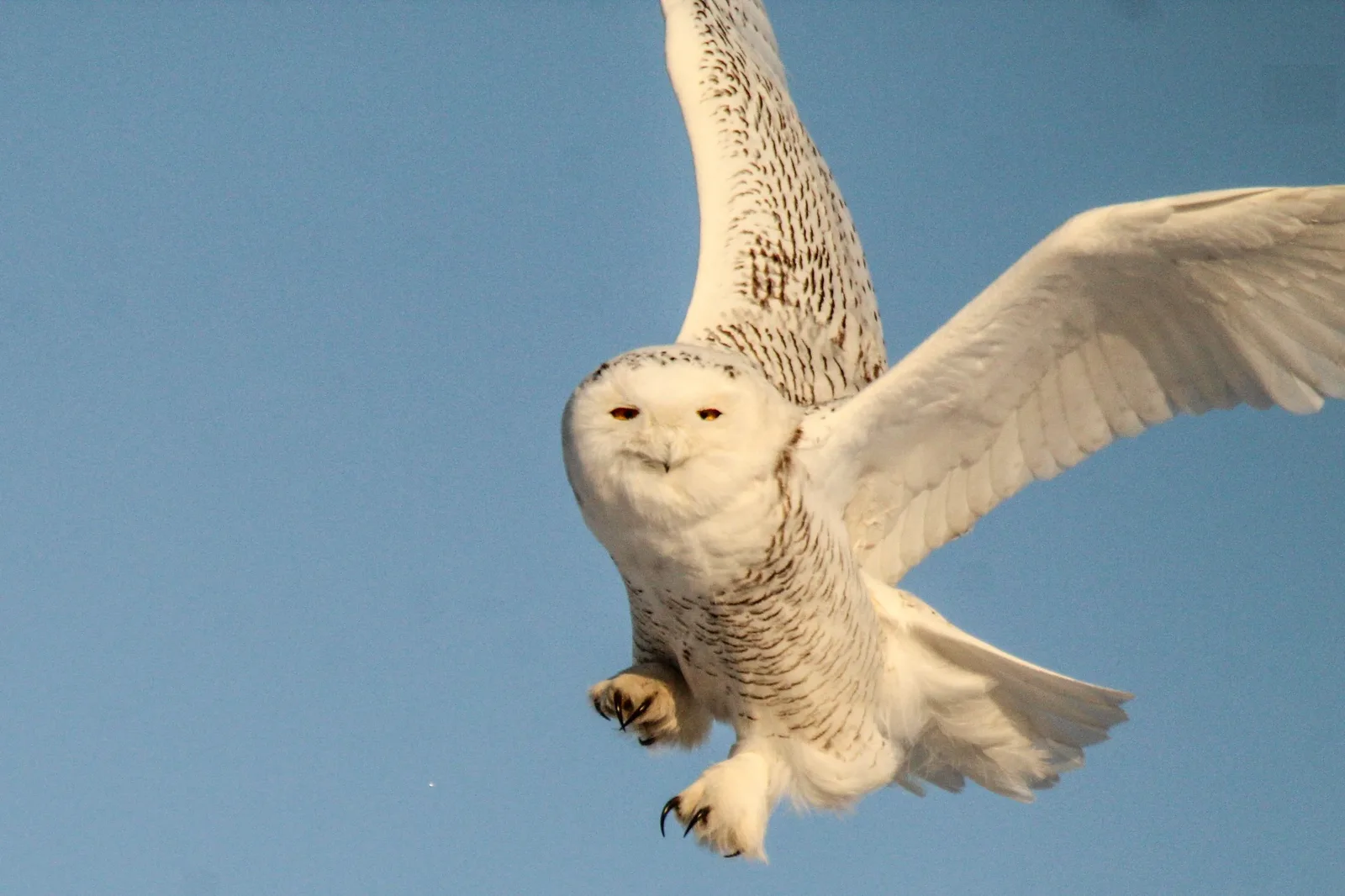
Living individuals or members of this group exist today. This does not mean they are safe from extinction.
Meet the snowy owl
The snowy owl breeds on the open Arctic tundra and hunts by day under the midnight sun. In winters when lemmings are scarce, it wanders far south.
Images of the snowy owl
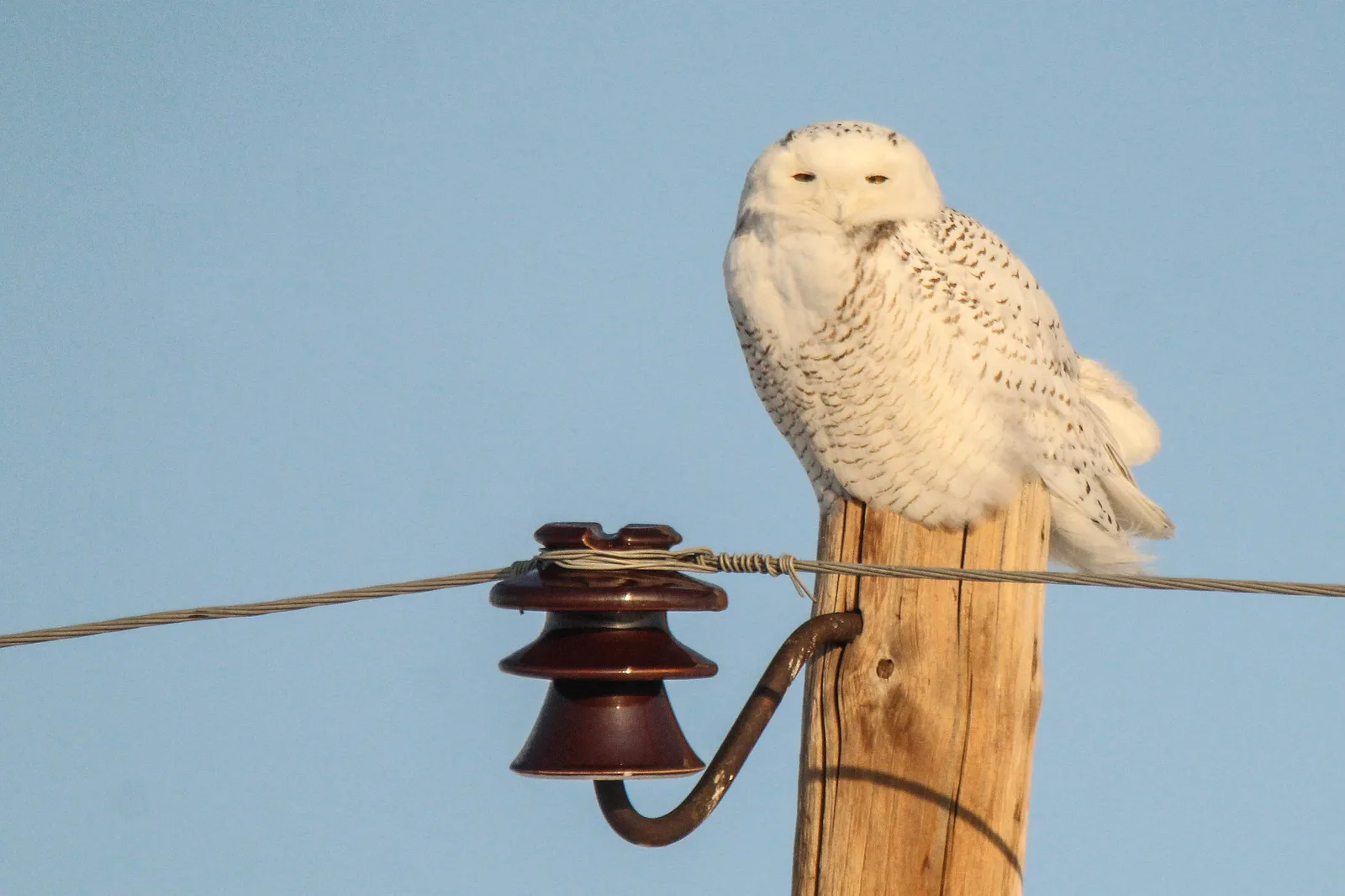
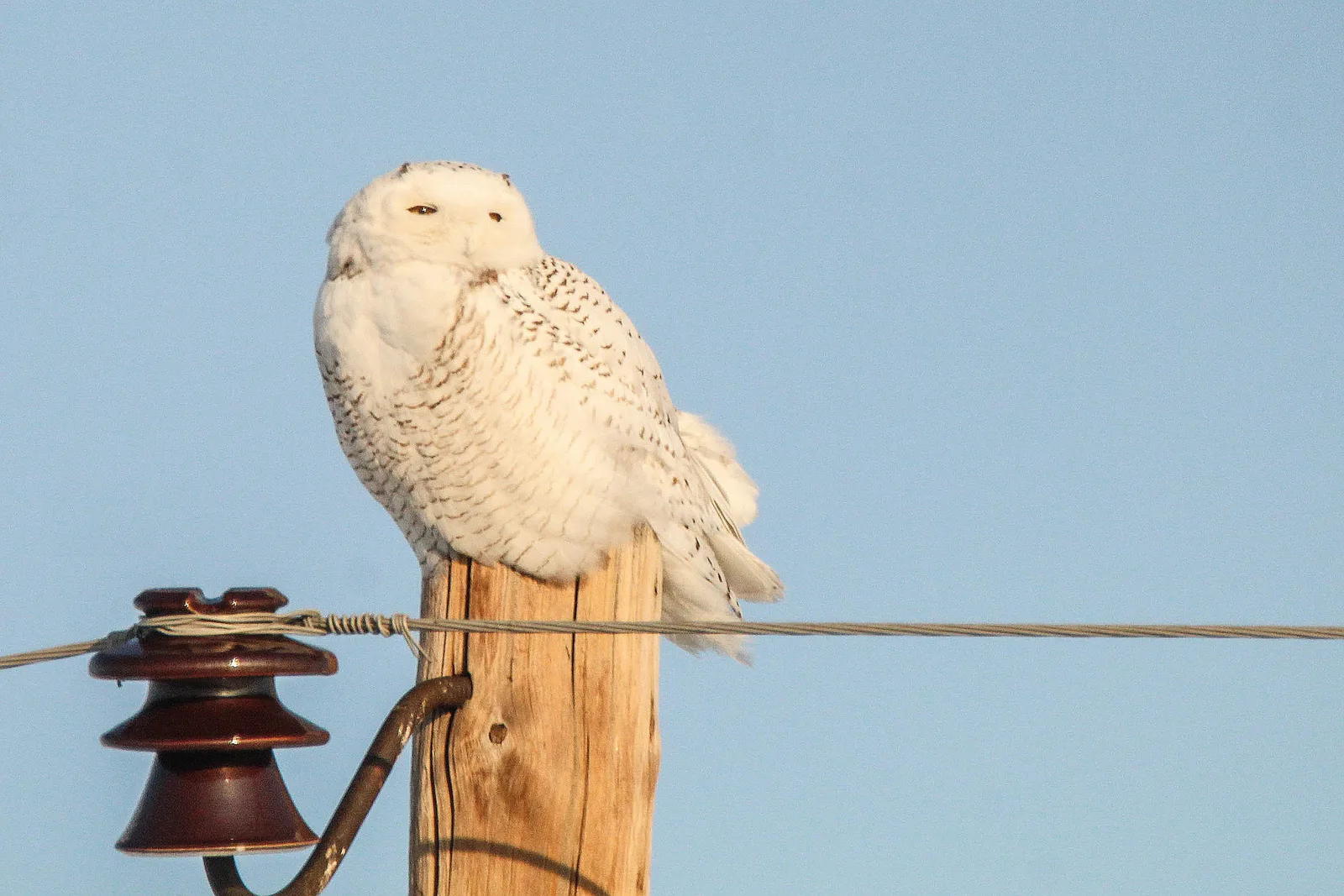
Lifespan in the wild
About 10 years
Weight
1.3 to 2.95 kg
Length
52.5 to 71 cm
Wingspan
1.16 to 1.83 m
Fact file
Snowy owl
- Location
- The Arctic tundra of North America and Eurasia
- Habitat
- Tundra, Grassland, Coast
- Diet
- Carnivore
- Prey / food
- Lemmings, voles, hares, ducks
- Predators
- Arctic foxes and wolves take eggs and chicks
- Lifestyle
- Diurnal
- Group name
- Parliament
- Name of young
- Owlet
- Incubation
- About 32 days of incubation
- Clutch size
- 3 to 11 eggs, more in lemming years
- Population
- About 28,000 mature birds
- Biggest threat
- Climate change on the tundra
- Distinctive feature
- White plumage and bright yellow eyes
- Colour
- White; females barred with dark brown
- Skin type
- Feathers
Size
Next to a person
Measurements
Size and speed
- Length
- 52.5 to 71 cm
- Wingspan
- 1.16 to 1.83 m
- Wingspan, male
- 1.16 to 1.66 m
- Wingspan, female
- 1.46 to 1.83 m
- Tail
- 18.8 to 28.8 cm
- Weight
- 1.3 to 2.95 kg
- Weight, male
- 1.3 to 2.5 kg
- Weight, female
- 1.33 to 2.95 kg
Typical adult ranges. Source: Wikipedia.
Life cycle
Lifespan
- In the wildAbout 10 years
- In captivityUp to 28 years
- 028 years
Appearance
Colour and coat
- Primary colours
- white
- Secondary colours
- dark brownblackyellow
- Skin type
- feathers
- Male and female
- Clear. The female is larger and heavier, and she carries brown bars and spots where the mature male is almost pure white.
Life cycle
Mating and family
- Mating system
- monogamous for one season, rarely bigamous
- Social structure
- solitary, with pairs spaced widely across the tundra
- Breeding
- one clutch of 3 to 11 eggs in a good year, none in a poor year
Pairs form on the tundra in April or May, and the male courts with a display flight and a lemming. The female scrapes a bare hollow on a rise and lays 3 to 11 white eggs two days apart. She alone sits for 31.8 to 33 days while the male hunts. The chicks hatch in turn, walk off the nest at 18 to 28 days and fly at 35 to 50 days. A wild owl lives about 10 years.
Classification
Taxonomy
- Kingdom
- Animalia
- Phylum
- Chordata
- Class
- Aves
- Order
- Strigiformes
- Family
- Strigidae
- Genus
- Bubo
- Species
- Bubo scandiacus
Conservation
Red List status
- LC
- NT
- VU
- EN
- CR
- EW
- EX
Vulnerable on the IUCN Red List
Range
Recorded in 7 countries
Habitat layer: tropical grassland, savanna and shrubland, temperate grassland, savanna and shrubland, tundra, mangrove.
Countries from 8,310 wild records on GBIF (iNaturalist research grade), filtered and checked by hand. Country shapes: Natural Earth. Habitat: RESOLVE Ecoregions 2017, CC BY 4.0. Basemap: Natural Earth.
Habitats
Three things to know
- 1
A snowy owl can eat more than 1,600 lemmings in a year.
- 2
Its feet are covered in thick feathers like slippers.
- 3
Unlike most owls, it hunts in daylight.
Did you know
Seven more facts
- 1
Linnaeus named the white males and the barred females as two different species.
- 2
The toe feathers are the longest of any owl, about 33.3 millimetres on average.
- 3
One ringed owl travelled from Massachusetts to Montana and was found 23 years and 10 months later.
- 4
Three siblings from one nest at Cambridge Bay were later found in Ontario, Hudson Bay and Sakhalin Island.
- 5
In 1886 a snowy owl landed on a steamship more than 800 km from land.
- 6
A German falconer bred snowy owl and eagle-owl hybrids in 2013 and called them Schnuhus.
- 7
iNaturalist holds 12,582 observations, and GBIF has records from 44 countries.
Field notes
How it looks and acts
Field notes
Distinguishing features
- Mostly white plumage, pure in the male and barred with brown in the female.
- Bright yellow eyes in a round white face with no visible ear tufts.
- Feet covered in thick white feathers with black claws.
- A wingspan of 116 to 183 centimetres, the widest of any North American owl.
- A weight of 1.3 to 2.95 kilograms, the female heavier.
Field notes
Unique adaptations
- Plumage that insulates almost as well as a penguin's and keeps out cold below minus 60 degrees Celsius.
- White colour that hides the bird against snow and probably signals to other owls.
- Eyes tuned to long-range sight over open ground.
- Fat reserves up to 22 millimetres thick that carry it through a 40-day fast.
- Huge clutches that turn a lemming boom into a boom of owls.
Field notes
Interesting behaviours
- Sits still on a low rise for hours and watches for movement.
- Hunts by day in summer and by night in winter, following the lemmings.
- Plunges through snow to catch a vole beneath it.
- Stores surplus lemmings in a cache near the nest.
- Wanders across the Arctic each year and rarely nests in the same place twice.
Field notes
Temperament
- Solitary and intolerant of other owls near the nest.
- Fierce in defence of eggs and chicks.
- Often tame around people in the south, because it has met few.
Field notes
Communication
- A barking krooh song that carries for kilometres.
- A grating keeea alarm call.
- A bill clap or tongue click when annoyed.
- A raised-back, spread-wing threat display.
- A bouncing display flight with a lemming in the bill.
Ecology
Ecological role
The snowy owl is the biggest bird of prey in the High Arctic and one of the main controls on lemming numbers.
- Takes hundreds of lemmings a year and tracks their boom and bust across the tundra.
- Competes with jaegers, buzzards, harriers, Arctic foxes and ermine for the same prey.
- Shelters geese, ducks and shorebirds that nest near its mound, though it eats some of them too.
- Kills other raptors in winter, from kestrels to short-eared owls.
Stories
Myths and legends
- In Inuit and Yupik tradition, Raven painted Owl white while Owl covered Raven in soot.
- In many Native American traditions, owls are thought to be tied to death or to shape-shifting.
- In Arctic traditions, the white owl is thought to stand for wisdom and protection.
- In modern British fiction, Hedwig the snowy owl carries Harry Potter's post.
People
Relationship with humans
People
Living alongside us
Arctic peoples have hunted the snowy owl for food since the Stone Age. Settlers in the south shot it by the hundreds in irruption years. Today it is protected, and winter birds draw birdwatchers and news crews. Airports trap and move owls that settle on the runways. The main harm people now do is indirect, through a warming climate that breaks the lemming cycle.
- A parent at the nest dives at people and has caused head wounds, but no human death is known.
- Away from the nest the owl avoids or ignores people.
- A handled bird can probably cut skin with its talons, as any large owl can.
People
Status, uses and products
- Domestication
- Wild
- As a pet
- Not suitable. A snowy owl needs Arctic cold, open space and a diet of whole rodents. It is protected by law across its range, and the Harry Potter films did not make it any easier to keep. Leave it to licensed rehabilitation centres and zoos.
- Uses
- ecotourismscientific research
- Products
- None recorded
The full account
About the snowy owl
Bubo scandiacus, the snowy owl, is a big white owl of the Arctic. It breeds on the open tundra of North America, Greenland and northern Eurasia and is the only owl with mostly white plumage. A male is close to pure white, and a female carries bars and spots of dark brown. An adult measures 52.5 to 71 centimetres long, spans 116 to 183 cm across the wings and weighs 1.3 to 2.95 kilograms. Unlike most owls, it is often active in daylight, which suits a summer without night.
The snowy owl lives on lemmings above all, and its breeding follows the rise and fall of those rodents. In a good lemming year a female may lay up to 11 eggs, and in a poor year most pairs do not breed at all. The species wanders across the Arctic and, in some winters, pours south in large numbers. New surveys show it is far rarer than anyone thought, and the IUCN raised it to Vulnerable in 2017. Climate change on the tundra is the main threat.
Name and taxonomy
Carl Linnaeus described the snowy owl in 1758 in the tenth edition of Systema Naturae, as Strix scandiaca. He took the white males and the barred females for two species and gave the females a second name, Strix nyctea. Bubo is Latin for a horned owl, and scandiacus means of Scandinavia. The old genus name Nyctea comes from the Greek for night.
For most of the 20th century the bird stood alone in its own genus as Nyctea scandiaca. DNA studies then showed it sits close to the horned owls and eagle-owls, so most authorities moved it into Bubo. Some still keep Nyctea, because the leg bones differ from those of the other Bubo owls. The species belongs to the family Strigidae, the true owls, in the order Strigiformes. It is the Schneeeule in German, the harfang des neiges in French and the tunturipollo in Finnish.
Evolution and relatives
Genetic tests put the snowy owl about 8% apart from the other Bubo owls. Its closest living relative is the great horned owl of the Americas, and it split from its relatives about 4 million years ago. In 2013 a German falconer crossed a male snowy owl with a female Eurasian eagle-owl. The young had the ear tufts, orange eyes and markings of the mother and the white base colour of the father.
Fossils show the snowy owl ranged much farther south during the ice ages. Bones have been found in Austria, England, France, Germany, Hungary, Italy, Poland and Spain, and in Illinois. Ice age birds from France were a little bulkier than the modern form and showed a bigger size gap between the sexes. No subspecies are recognised, because the birds wander so widely that populations mix freely.
Appearance
A male measures 52.5 to 64 centimetres long with a wingspan of 116 to 165.6 cm. A female measures 54 to 71 cm and spans 146 to 183 cm. Males weigh 1.3 to 2.5 kilograms and females 1.33 to 2.95 kg. The tail is 18.8 to 28.8 cm long. As in most birds of prey, the female is the larger bird. It is the heaviest and longest-winged owl in North America.
The plumage is whiter than that of a polar bear or an Arctic fox, and a resting owl can pass for a lump of snow. A mature male is plain white above with a few dark spots, and his underside is often pure white. A female carries dark brown spots and bars on the crown, the flanks and the upper breast. Bars mark a female's wing and spots mark a male's, which is the most reliable way to sex a bird. The eyes are bright yellow, the bill is black and the tiny ear tufts are almost never seen.
Chicks hatch greyish white and soon turn dark grey-brown, which hides them among the lichens of the tundra. A young bird looks like a dark female and grows whiter with each moult, reaching adult plumage at three to four years. Some males may not reach their whitest until their ninth or tenth year. The toes carry the longest feathers of any owl, about 33.3 millimetres on average, and the claws are black.
Habitat and range
The snowy owl breeds around the top of the world, mostly north of 60 degrees. The core of the range is northern Alaska, the Canadian Arctic islands and the tundra of northern Russia. It also breeds in northern Greenland, on Spitsbergen and, in some years, in the mountains of Norway. The whole breeding range covers a little over 12,000,000 square kilometres, but only about 1,300,000 of those are used often. Between 1967 and 1975 a pair even bred on Fetlar in the Shetland Islands.
The nesting ground is open tundra of moss, lichen and rock, usually below 300 metres. The owls pick spots with a small rise, a hummock, ridge or knoll, that gives a view over the flat ground. In winter they take almost any open landscape: coastal dunes, prairie, moorland, stubble fields and airports. Logan Airport in Boston holds one of the most reliable winter populations in the United States. Many also winter out on the sea ice and hunt seabirds at open leads.
Winter movements are hard to predict. Southern Canada, the northern United States, Scandinavia, central Russia and northern China see the bird most years. In an irruption year, thousands push far south, and owls have reached Texas, Florida, Hawaii, Bermuda, Iran, Pakistan and Japan. GBIF holds records from 44 countries, many of them from such wanderers.
Diet and hunting
The snowy owl is a hunter of small mammals first and a hunter of birds second. On the tundra, lemmings are the main food, and at Utqiagvik in Alaska they made up almost all of 42,177 prey items over 25 years. An owl may eat about 326 grams of lemmings a day, and one bird can take more than 1,600 in a year. Where lemmings are scarce the owl turns to voles, ptarmigan, ducks, geese, seabirds and shorebirds. More than 200 kinds of prey are recorded, from a shrew of 8.1 g to a red fox of about 6 kg.
Winter diets are broader. Inland owls take voles, mice, rats and rabbits, and coastal owls take ducks, grebes and gulls, often snatched from the water. The snowy owl also eats carrion and has fed on reindeer, walrus and whale carcasses and followed polar bears to their kills. It swallows small prey whole and coughs up the bones and fur as a pellet 18 to 24 hours later.
It hunts mostly by sight from a low rise or a post, sitting still for long spells like a buzzard. Tests show it can spot prey 1.6 kilometres away. The usual attack is a short dash from the perch that ends in a hard pounce. It can hover in a strong wind, plunge through 20 cm of snow for a vole, or chase birds on the wing. It also steals kills from other raptors and takes prey caught in traps.
Behaviour and social life
The snowy owl is active at any hour, though it rests most at noon and midnight. In the Arctic summer it hunts in the twilight around midnight, and in winter it hunts through the short day and the long night. It spends most of its time on the ground or a low rise, because its short broad legs are poorly suited to perching in trees. It walks and runs well and may hold its wings out for balance.
Outside the breeding season the owl lives alone. In winter a female may hold a territory for up to 80 days, while a male stays only a day or two in one place. Loose gatherings of 20 to 30 birds form where food is concentrated, and 31 to 35 once wintered in 2.6 square kilometres in Montana. Nesting pairs space themselves 1.6 to 3.2 km apart at Utqiagvik and do not tolerate close neighbours. Fights are rare but can end with two owls locked by the talons in the air.
The bird stands extreme cold. It has been recorded at minus 62.5 degrees Celsius without distress, and its plumage insulates almost as well as that of an Adelie penguin. On a sunny day it faces its whitest feathers toward the sun about 44% of the time, perhaps as a signal or for warmth. Fat reserves 19 to 22 mm thick let some owls fast for about 40 days.
Communication and senses
The snowy owl's song is a series of two to six rough barks, krooh krooh krooh, closer to a dog than to a hoot. As many as 15 different calls have been recorded. In the thin Arctic air the call carries more than 3 kilometres and perhaps as far as 10 or 11. The male sings to hold his ground and to draw a female, and she answers with a higher, more guttural version. The alarm call is a loud grating keeea, and a rattling rick rick rick or kre kre kre warns of a threat near the nest.
Both sexes clap the bill, or perhaps click the tongue, when annoyed. A threatened owl lowers its front, stretches its head forward, raises its back and spreads its wings. If pressed it rolls onto its back and slashes with its talons. The bird relies on sight more than most owls, because its ears and facial disc are simpler than those of its relatives. Its eyes suit long-range vision over the tundra rather than close work, and it probably sees less well at night than other owls.
Reproduction and life cycle
Most pairs form on the breeding ground in late April or May, and the bond seldom lasts beyond one season. Of 239 breeding attempts at Utqiagvik, 232 were monogamous and 7 involved a male with two females. The male courts with a bouncing, moth-like flight, often with a lemming in his bill, and then bows on the ground with his tail cocked. A female may refuse to breed if he skips the display.
The nest is a bare scrape on a dry, windswept rise with a view over the tundra. The female digs it with her claws over about three days, turning to shape a round bowl, and adds no lining. Laying starts in early May or the first days of June, and the eggs come about every two days. A clutch averages 7 to 9 white eggs, and clutches of 15 or 16 have been recorded in years of plenty. Each egg is about 56.4 by 44.7 millimetres and weighs 47.5 to 68 grams.
The female alone incubates, from the first egg, for 31.8 to 33 days, and the male brings her food. The chicks hatch one to three days apart, so the oldest may weigh 350 g when the youngest hatches at 46 g. The young leave the nest on foot at 18 to 28 days and hide in the rocks and plants nearby. They fly at 35 to 50 days and hunt for themselves by 50 to 60 days, but the parents feed them into September or October. In a good lemming year 90 to 100% of the nests succeed, and a pair may skip breeding for years when food is short. A wild bird typically lives about 10 years, and one captive owl reached 28.
Predators and threats
On the tundra an adult snowy owl has almost nothing to fear. Arctic foxes, wolves, wolverines, bears, jaegers, gulls, ravens and falcons all take eggs and chicks. Parents defend the nest hard and dive-bomb foxes, dogs, gulls and people, and researchers have suffered head wounds. A parent also feigns a broken wing and has drawn an observer 2 km from the nest.
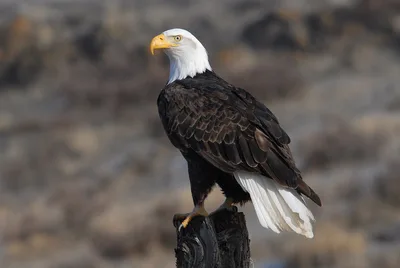
In the south the owl meets larger enemies, and Eurasian eagle-owls and golden, bald and sea eagles have killed adults. Far more often the snowy owl is the killer, and it has taken foxes, cats, mink, hawks, falcons and other owls.
People cause most recorded deaths. Of 438 ringed owls recovered in the United States, 11.9% were shot and 7.1% hit by cars. In British Columbia, shooting was the commonest known cause of death at 25%, long after the bird gained legal protection. Rat poison, mercury, fox traps in Siberia and collisions at airports add to the toll. The deepest threat is a warming Arctic, which brings rain and thin snow that break the lemming cycle the owl depends on.
Population and conservation
The IUCN lists the snowy owl as Vulnerable. For decades the world population was put at 200,000 to 290,000 birds. Better surveys in the 2010s showed those figures were far too high. The best current estimate is 14,000 to 28,000 mature breeding pairs, and in a lemming crash the number of nesting females may fall to 1,700. The IUCN raised the species to Vulnerable in 2017 on the strength of that decline.
North America has lost about 52% of its snowy owls since the 1960s, and one estimate puts the fall from 1970 to 2014 at 64%. Europe holds only a few hundred pairs at most, and Norway, Finland and Sweden all list the bird as Critically Endangered. No nest has been seen in Sweden since 2015, and in 2025 the Swedish Species Information Centre proposed listing it as extinct there. In northern Greenland the lemmings collapsed after 1998, and owl productivity fell by 98%.
The species is on Appendix II of CITES, which regulates trade across borders. The United States protects it under the Migratory Bird Act, and airports now move owls rather than shoot them. iNaturalist holds 12,582 observations, most of them from winter birds in southern Canada and the northern United States.
Relationship with humans
People have eaten snowy owls since the Stone Age, and cave deposits in France hold their bones. Arctic peoples still hunt the bird for food in places, and biologists argue that this right no longer fits modern communities. In the irruption of 1876 to 1877 about 500 owls were shot, and 500 to 1,000 died in Ontario alone in 1901 to 1902. Farmers and gamekeepers shot the owl for taking poultry and game, and some shooting goes on today for no clear reason.
Winter owls draw crowds of birdwatchers and photographers, and irruption years make the news. Trappers in the north lose animals to owls that learn to follow a trapline. At airports the bird is both a risk to aircraft and a regular guest, so staff catch and move the owls elsewhere. A nesting owl will attack a person who comes too close, but no human death is known.
In culture and myth
An Inuit and Yupik story tells how Owl and Raven decorated each other's feathers. Owl gave Raven a coat of soot, and Raven turned Owl white with powder. Many Native American traditions are thought to link owls with death or shape-shifting, while Arctic peoples see wisdom and protection. In northern art the white owl stands for winter and mystery.
The snowy owl is the bird emblem of Quebec, where it is the harfang des neiges. Hedwig, the pet owl in J. K. Rowling's Harry Potter books and films, is a female snowy owl. Some feared the films would fuel an illegal trade in the species, but no clear rise in seized owls followed. Wildlife centres did report more snowy owls than usual in those years.
A sentence with a dotted underline is inferred: it describes the group the animal belongs to, or is a reading of the sources, rather than a measured or reported fact about this species.
Questions
Snowy owl questions, answered
How big is a snowy owl?
An adult measures 52.5 to 71 centimetres long with a wingspan of 116 to 183 cm. A male weighs 1.3 to 2.5 kg and a female 1.33 to 2.95 kg. It is the heaviest owl in North America.
Where do snowy owls live?
They breed on the Arctic tundra of Alaska, Canada, Greenland and northern Russia, with a few in Scandinavia. In winter they spread across southern Canada, the northern United States and northern Eurasia.
What do snowy owls eat?
Mostly lemmings, and one owl can eat more than 1,600 in a year. They also take voles, rats, hares, ptarmigan, ducks and seabirds, and they eat carrion.
Do snowy owls hunt during the day?
Yes. Unlike most owls they hunt at any hour, and in the Arctic summer there is no night. They rest most at noon and midnight.
Are snowy owls endangered?
The IUCN lists the snowy owl as Vulnerable, one step below Endangered. New surveys put the world at only 14,000 to 28,000 breeding pairs, far below the old estimate of 200,000 birds.
Why are snowy owls declining?
Climate change is the main cause. Warmer, wetter winters break the lemming cycle the owls depend on. Shooting, traps, rat poison and collisions with cars, wires and aircraft add to the losses.
How many eggs does a snowy owl lay?
Usually 3 to 11, with an average of 7 to 9 in a good year. Clutches of 15 or 16 have been recorded when lemmings are abundant, and pairs may not breed at all in a poor year.
Why do snowy owls come south in some winters?
A big lemming year lets pairs raise many chicks, and the young owls then spread south in autumn. About 90% of the birds seen in an irruption are juveniles.
Are male and female snowy owls different?
Yes. The female is larger and carries brown bars and spots. A mature male is almost pure white. Bars on the wing mean a female and spots a male.
How long do snowy owls live?
About 10 years in the wild, and one captive bird reached 28. One ringed wild owl was found 23 years and 10 months later.
How far can a snowy owl see?
Tests show it can detect prey 1.6 kilometres away. Its eyes suit long-range sight over open ground more than close work.
Is Hedwig a snowy owl?
Yes. Hedwig in the Harry Potter books and films is a female snowy owl. The films raised fears of an illegal trade, but no clear rise in seized owls followed.
What sound does a snowy owl make?
A rough barking krooh krooh krooh rather than a soft hoot. The call carries more than 3 kilometres, and the alarm call is a grating keeea.
Do snowy owls build nests?
No. The female scrapes a bare bowl on a dry rise in the tundra over about three days and adds no lining. Old buzzard or eagle nests are used now and then.
Are snowy owls dangerous to people?
Only at the nest. A parent will dive at anyone who comes close and has caused head wounds, but no human death is known.
Food web
Prey and food
- lemmings
- voles
- hares
- ducks
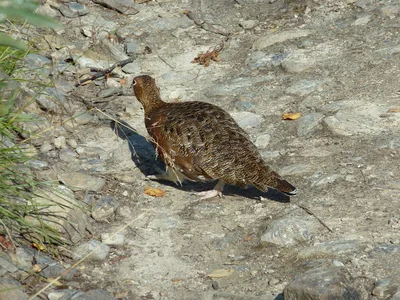 Willow ptarmigan
Food web
Predators
- arctic foxes
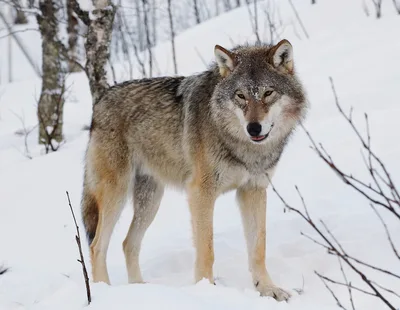 Gray wolf
Ecological equivalents
Related species on this site
Eurasian eagle-owl (same genus), Great horned owl (same genus), Barred owl (same family), Burrowing owl (same family), Elf Owl (same family), Long-Eared Owl (same family), and more.
 LC
Birds
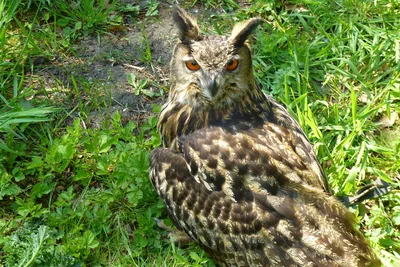
Eurasian eagle-owl
Bubo bubo
The Eurasian eagle-owl is one of the largest owls in the world, with orange eyes and long ear tufts.
Living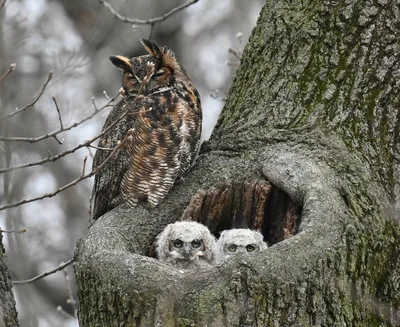 LC
Birds
Great horned owl
Bubo virginianus
The great horned owl is a heavy, ear-tufted owl of the Americas, at home from Alaska to Argentina.
Living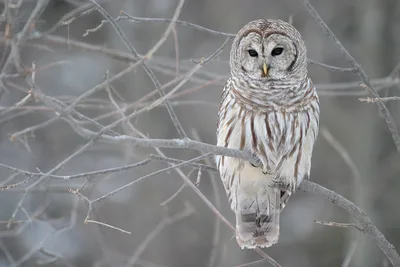 LC
Birds
Barred owl
Strix varia
The barred owl is a large brown owl of North American woodland, with dark eyes, a round head and no ear tufts.
Living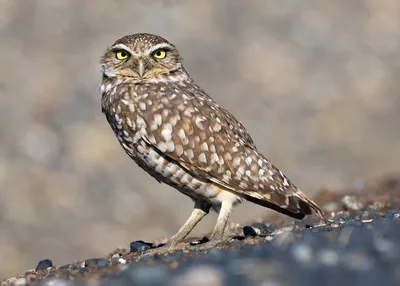 LC
Birds
Burrowing owl
Athene cunicularia
The burrowing owl is a small, long-legged owl of open country in the Americas.
Living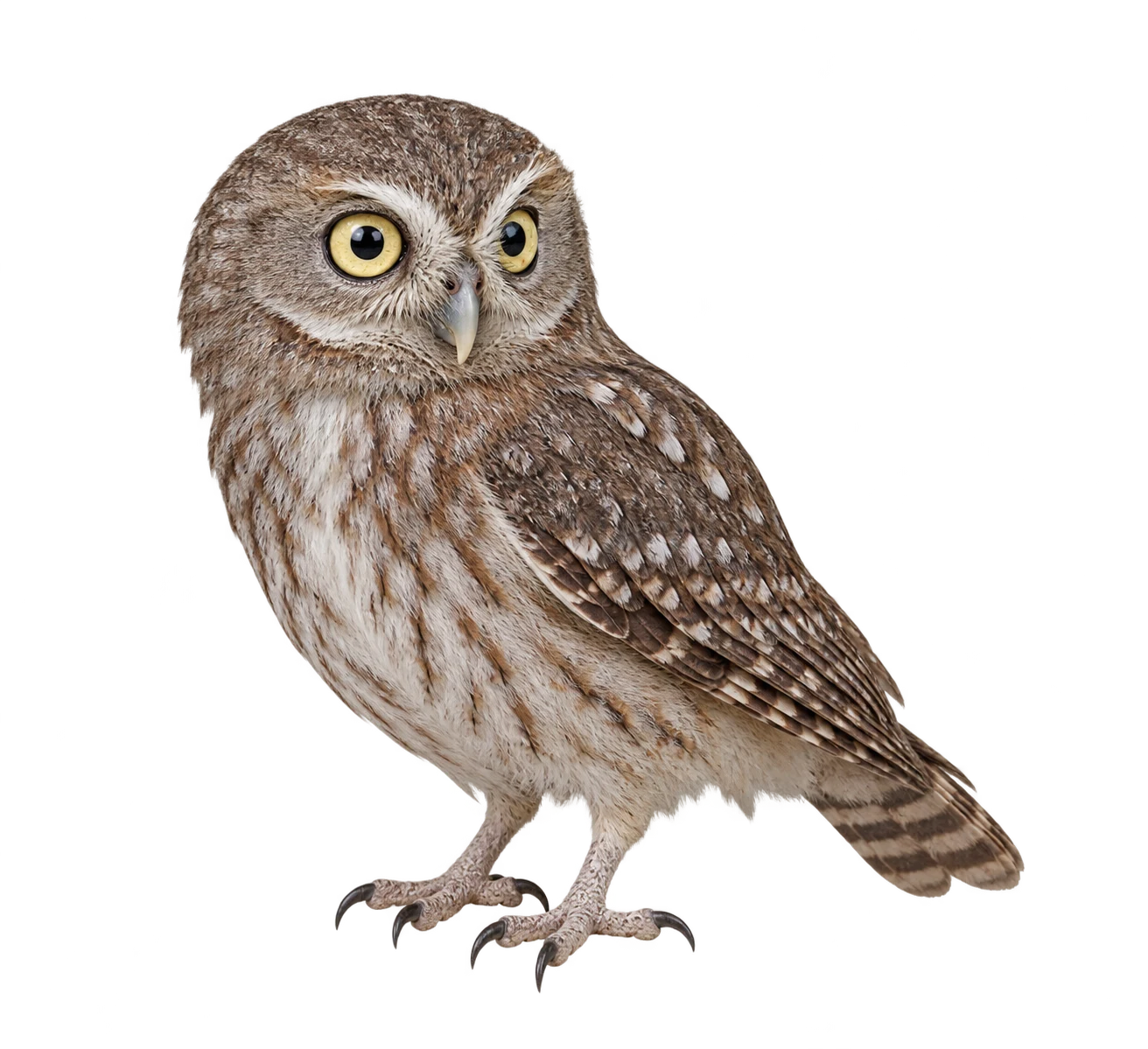
Birds
Elf Owl
Micrathene whitneyi
Classification and source reference
LivingAI illustration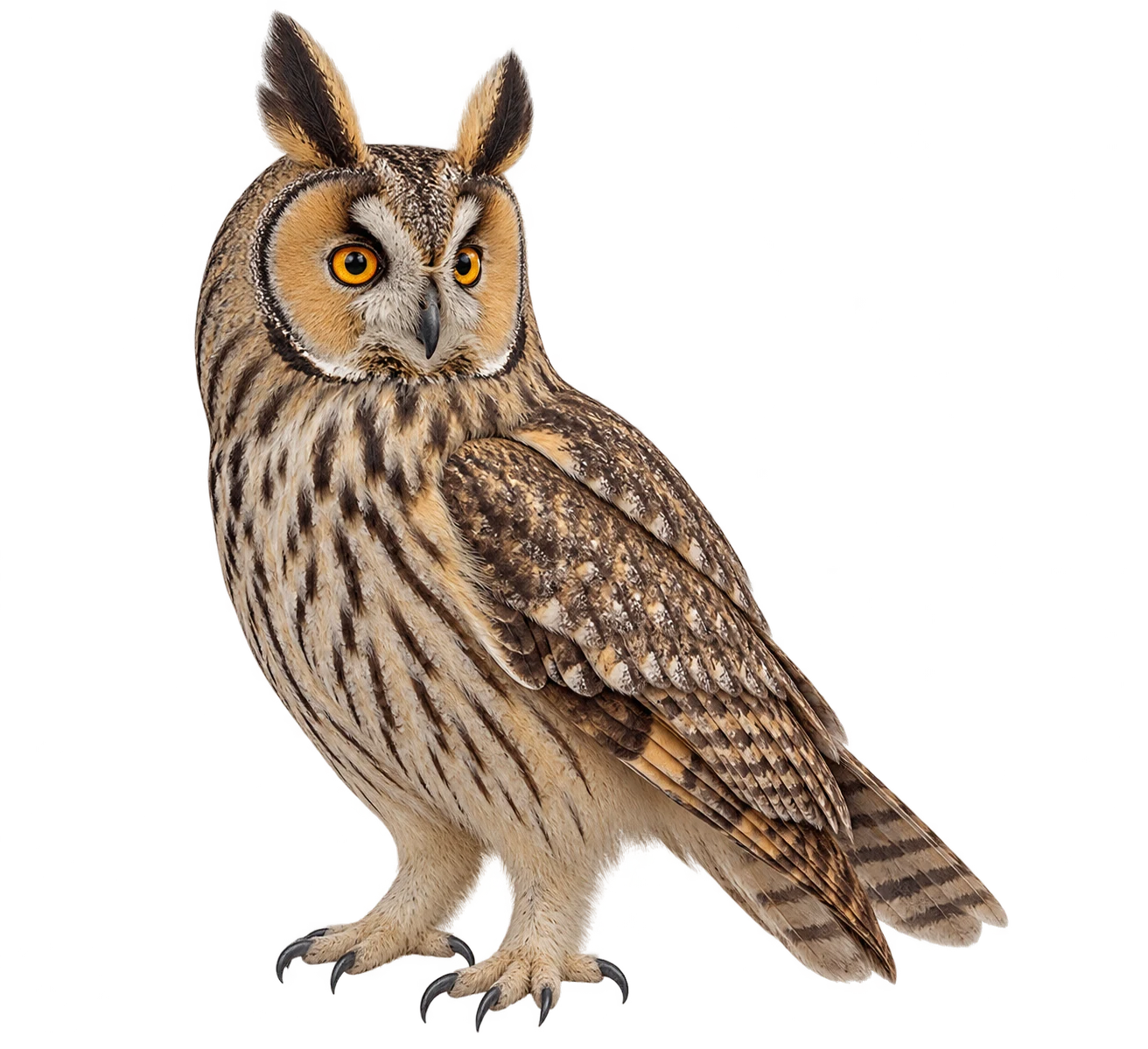
Birds
Long-Eared Owl
Asio otus
Classification and source reference
LivingAI illustration