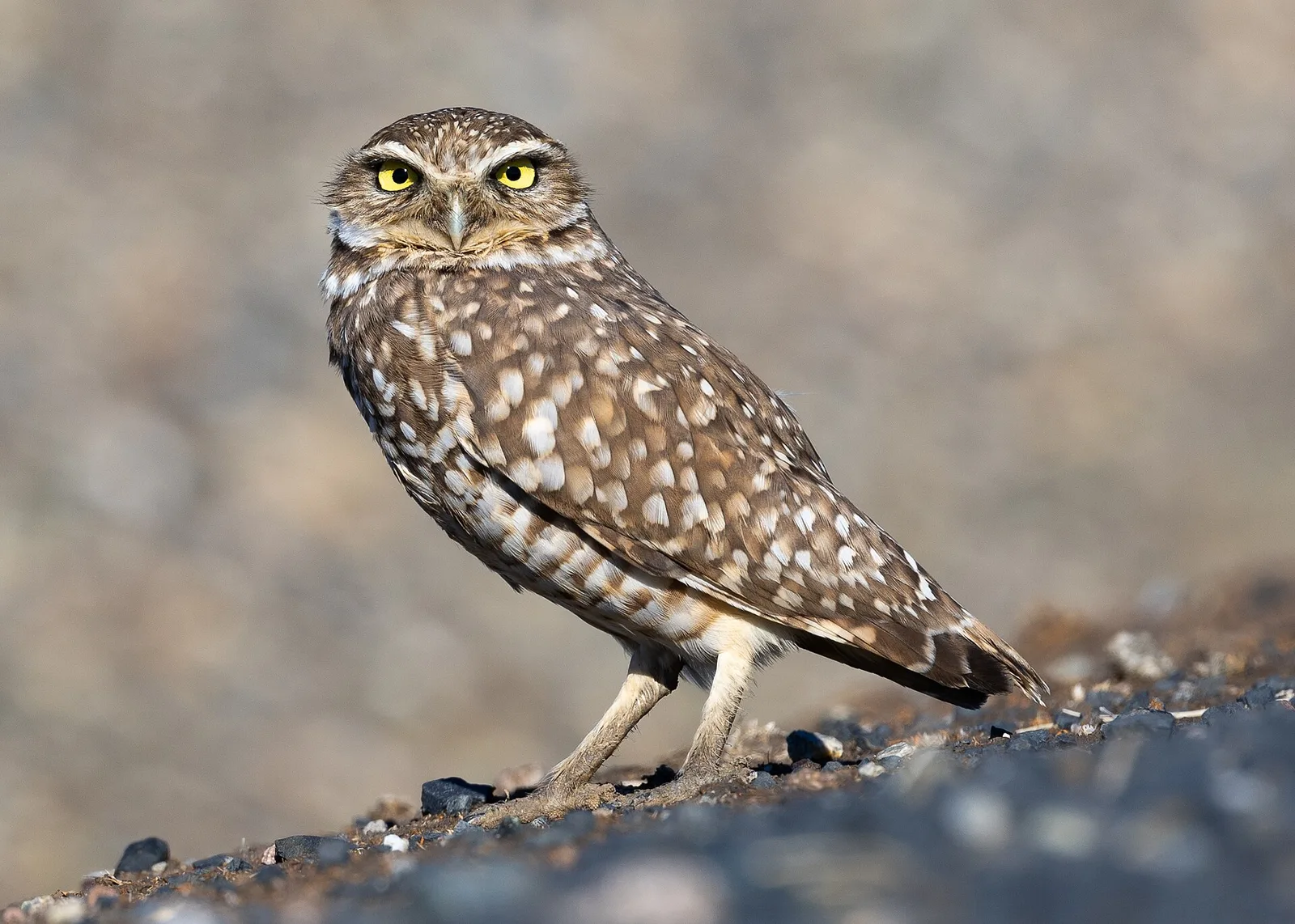
Burrowing owl
A long-legged owl that lives down a hole
Athene cunicularia
Also called Shoco, Western burrowing owl, Florida burrowing owl
Living individuals or members of this group exist today. This does not mean they are safe from extinction.
Meet the burrowing owl
The burrowing owl is a small, long-legged owl of open country in the Americas. It nests underground, usually in a hole dug by a prairie dog, a ground squirrel or a badger.
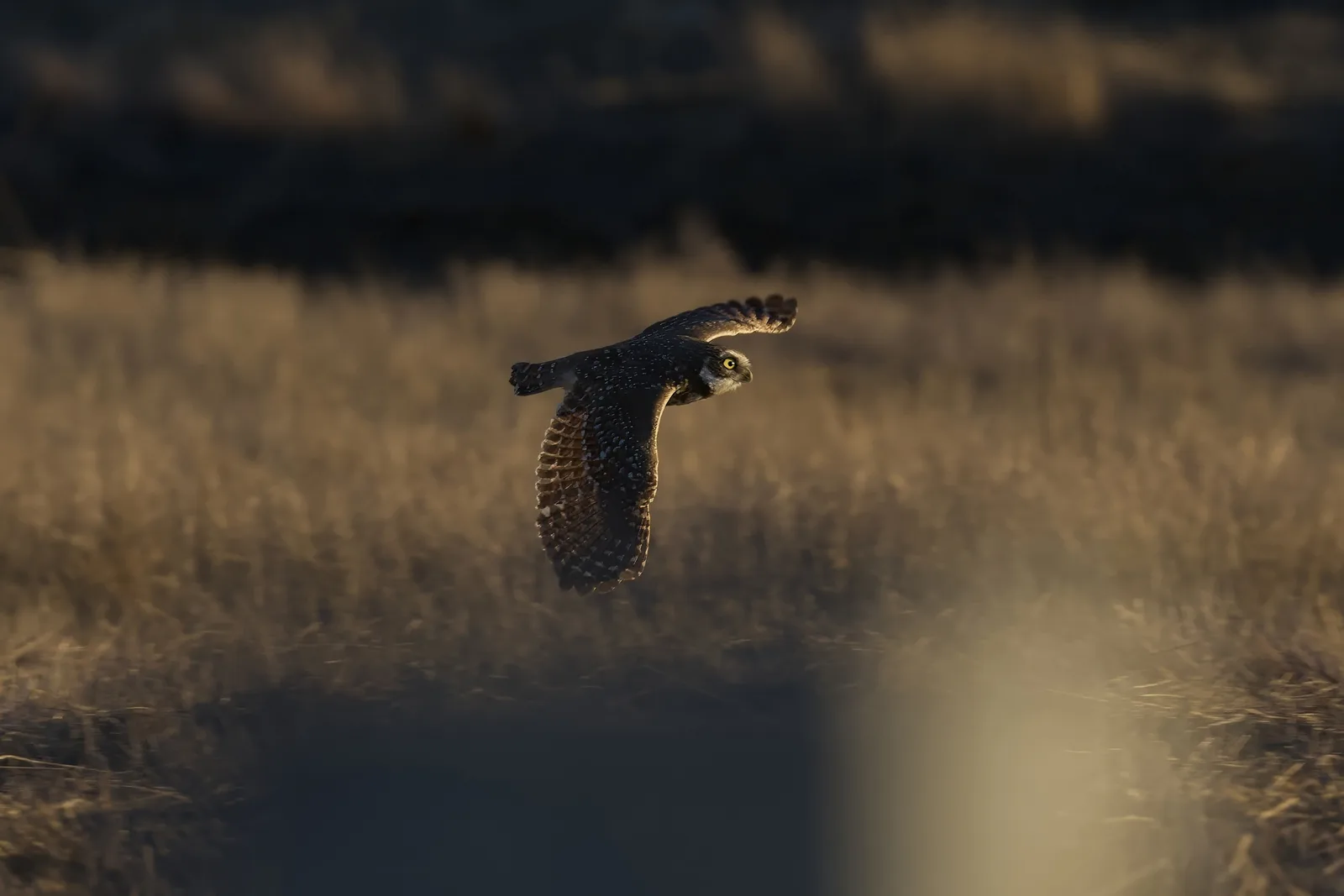
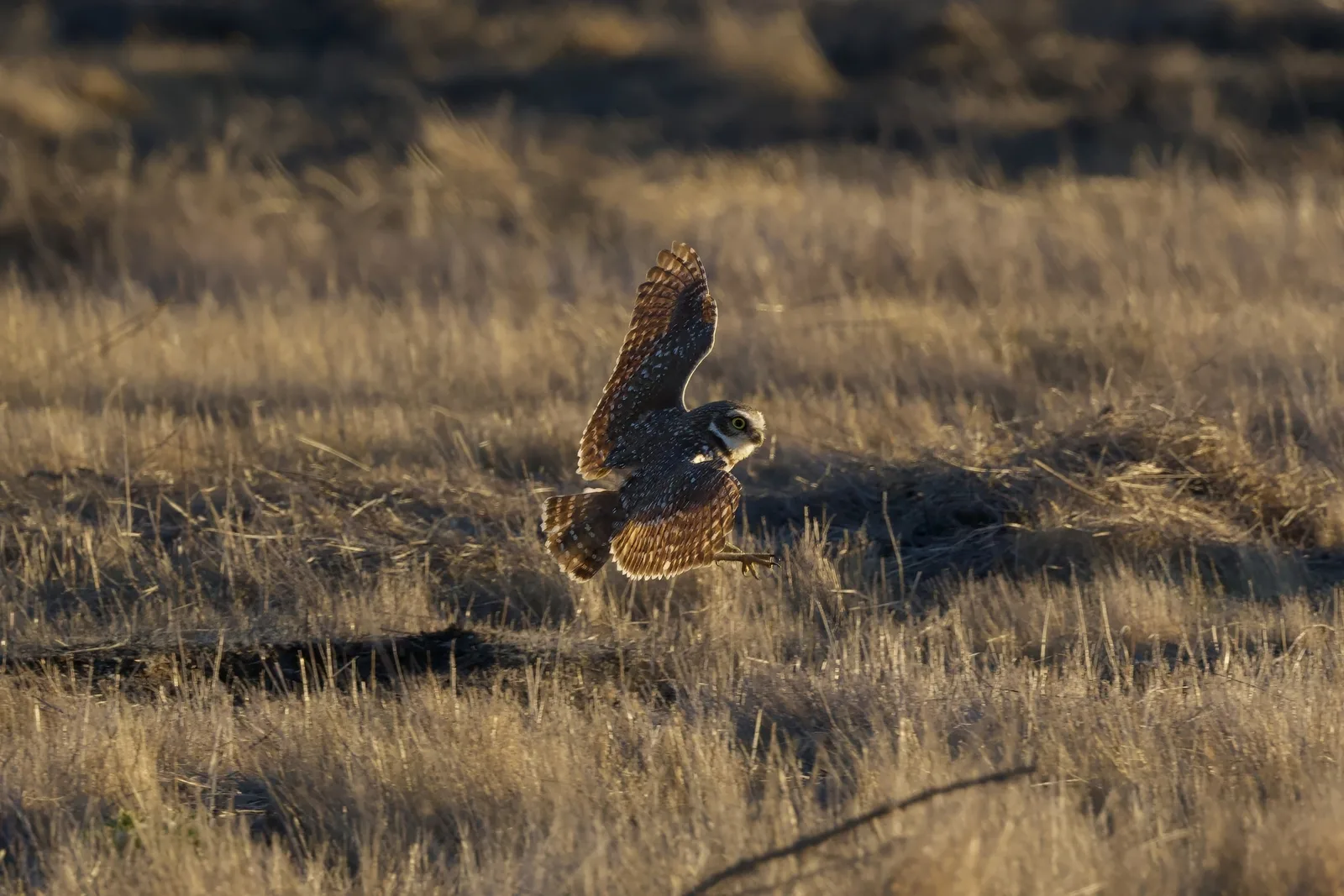
Images of the burrowing owl
Lifespan in the wild
6 to 8 years
Weight
140 to 240 g
Length
19 to 28 cm
Wingspan
50.8 to 61 cm
Fact file
Burrowing owl
- Location
- Western North America, Florida, the Caribbean and most of South America
- Habitat
- Grassland, Desert, Towns and cities
- Diet
- Carnivore
- Prey / food
- Grasshoppers, crickets, beetles, mice, lizards, small birds
- Predators
- Badgers, coyotes, snakes, hawks, falcons, cats and dogs
- Lifestyle
- Ground dwelling, out by day, hunting hardest at dawn and dusk
- Group name
- Colony
- Name of young
- Chick
- Incubation
- Incubation 28 to 30 days
- Clutch size
- Four to 12 eggs, usually nine
- Population
- Least Concern worldwide, but endangered in Canada and threatened in Mexico
- Biggest threat
- Loss of grassland and the poisoning of prairie dogs
- Distinctive feature
- Long grey legs and white eyebrows over yellow eyes
- Colour
- Brown above with white spots, barred white below
- Skin type
- Feathers
Size
Next to a person
Measurements
Size and speed
- Length
- 19 to 28 cm
- Wingspan
- 50.8 to 61 cm
- Weight
- 140 to 240 g
Typical adult ranges. Source: Wikipedia.
Life cycle
Lifespan
- In the wild6 to 8, up to 11 years
- In captivityUp to 10 years
- 011 years
The pale bar is the record. Source: Animal Diversity Web.
Appearance
Colour and coat
- Primary colours
- brownwhite
- Secondary colours
- greyyellow
- Skin type
- feathers
- Male and female
- The two sexes look almost the same. Females are usually heavier, males measure longer in the wing and tail, and males look paler because the sun bleaches their feathers.
Life cycle
Mating and family
- Mating system
- monogamous pairs, with occasional bigamy
- Social structure
- loose colonies inside a burrow system
- Breeding
- one brood a year
Pairs form in late winter or early spring and settle on a burrow. The female lays four to 12 eggs, an egg every one or two days, and incubates for three to four weeks. The male brings her food throughout. Both parents feed the chicks, which leave the burrow four weeks after hatching. The young are independent at about 53 days and can breed at about 10 months.
Classification
Taxonomy
- Kingdom
- Animalia
- Phylum
- Chordata
- Class
- Aves
- Order
- Strigiformes
- Family
- Strigidae
- Genus
- Athene
- Species
- Athene cunicularia
Conservation
Red List status
- LC
- NT
- VU
- EN
- CR
- EW
- EX
Least Concern on the IUCN Red List
Range
Recorded in 12 countries
- Argentina
- Bolivia
- Brazil
- Canada
- Chile
- Colombia
- Ecuador
- Mexico
- Peru
- Paraguay
- United States of America
- Uruguay
Habitat layer: tropical grassland, savanna and shrubland, temperate grassland, savanna and shrubland, desert and xeric shrubland.
Countries from 31,933 wild records on GBIF (iNaturalist research grade), filtered and checked by hand. Country shapes: Natural Earth. Habitat: RESOLVE Ecoregions 2017, CC BY 4.0. Basemap: Natural Earth.
Habitats
Three things to know
- 1
The owl hisses and rattles like a rattlesnake when something reaches into its burrow.
- 2
It lines the burrow mouth with cattle dung, which draws in beetles to eat.
- 3
Unlike other owls, it eats fruit, and takes prickly pear and cholla cactus.
Did you know
Seven more facts
- 1
The genus name Athene honours the Greek goddess Athena.
- 2
Two of the 18 subspecies are already extinct.
- 3
A clutch can hold as many as 12 eggs.
- 4
A newly hatched chick weighs only 8 to 9 grams.
- 5
A burrow can run 3.7 metres from the entrance to the nest chamber.
- 6
Adults use 13 different calls and chicks use only three.
- 7
Cape Coral in Florida holds the state's largest group of these owls.
Field notes
How it looks and acts
Field notes
Distinguishing features
- Grey legs much longer than any other owl's.
- White eyebrows above bright yellow eyes.
- A flat facial disc and no ear tufts.
- A white chin patch that swells during display.
- Brown upperparts covered in white spots.
- A short tail on a small, upright body.
Field notes
Unique adaptations
- Long legs allow a running chase and give lift on take-off.
- A rattlesnake imitation protects a bird trapped down a hole.
- A curved tunnel keeps sunlight off the eggs and the chicks.
- Dung at the entrance attracts beetles and steadies the air inside.
- Daytime activity probably lets the owl use ground that offers no night cover.
Field notes
Interesting behaviours
- The owl hunts hardest at sunrise and sunset.
- It bobs its head and flares the white chin when it is disturbed.
- It takes dust baths to shift mites from its feathers.
- It hovers over long grass when it hunts small mammals.
- Pairs often nest in loose groups inside a prairie dog town.
Field notes
Temperament
- The owl tolerates people and often nests beside roads and houses.
- It grows steadily more aggressive at the burrow as the eggs hatch.
- A cornered bird screams, clucks, chatters and snaps its bill.
- City birds appear bolder around people than country birds.
Field notes
Communication
- The male's two-note coo-coooo claims a burrow and calls a mate.
- Rattling and hissing from inside the hole copy a rattlesnake.
- Bill snapping and a flapped wing signal distress.
- Chicks whine for food and give a separate distress call.
Ecology
Ecological role
The burrowing owl keeps insect and rodent numbers down on open ground, and it depends on the animals that dig its home.
- It removes large numbers of grasshoppers, crickets and beetles.
- It feeds badgers, coyotes, snakes, hawks and falcons.
- It shares burrow systems with prairie dogs, ground squirrels and tortoises.
- Its decline is probably a signal that the burrowing mammals have gone.
Stories
Myths and legends
- In ancient Greek tradition, the owl of Athena stood for wisdom, and this bird carries her name.
- In Roman tradition, the same owl belonged to Minerva.
- In American naming tradition, both the English and the Latin name call the bird a digger.
- In Florida tradition, Cape Coral appears to treat its owl colonies as a local attraction.
- In prairie tradition, February bird festivals in the United States are built around the species.
People
Relationship with humans
People
Living alongside us
The burrowing owl lives easily beside farms, airports and towns. Building work and prairie dog poisoning are the main problems it faces. Managers move colonies by preparing a new site and sealing the old holes. Birding festivals and burrow cameras have made the bird popular. Canada, the United States and Mexico all protect it under the Migratory Bird Treaty Act.
- The burrowing owl has no known harmful effect on people.
- A bird at the nest may snap its bill and scream if a person comes close.
- Like other small owls, it weighs too little to injure anyone.
People
Status, uses and products
- Domestication
- Wild
- As a pet
- Not suitable. The burrowing owl is a protected wild bird and cannot be kept. It needs open ground, a tunnel and a steady supply of live insects and rodents. Licensed rescue centres are the only places that hold one.
- Uses
- birdwatching tourismpest control on farmland
- Products
- None recorded
The full account
About the burrowing owl
The burrowing owl is a small owl of open country in North and South America. It has long grey legs, bright yellow eyes and white eyebrows. It has no ear tufts, and its facial disc is flat. The bird spends most of its life on the ground rather than in a tree.
An adult is 19 to 28 centimetres long and weighs 0.14 to 0.24 kilograms. The wings span 50.8 to 61 cm. The owl nests down a hole, usually one dug by another animal. Prairie dogs, ground squirrels, badgers and foxes all supply burrows.
The species is out by day, which is unusual for an owl. The IUCN rates it as Least Concern, but Canada lists it as endangered. Its numbers follow the numbers of the animals that dig its home.
Name and taxonomy
The scientific name of the burrowing owl is Athene cunicularia. The Spanish naturalist Juan Ignacio Molina described the bird in 1782. He worked from a specimen collected in Chile and called it Strix cunicularia. The second name comes from a Latin word for a burrower or a miner. The genus Athene dates from 1822 and the work of Friedrich Boie. That name honours the Greek goddess Athena, whose owl stood for wisdom.
Some authors once put the bird in a genus of its own, Speotyto. Bone structure and DNA place it with the little owls instead. Most authorities now treat it as a ground-living member of Athene.
Ornithologists recognise 18 subspecies, and two of those are extinct. The Antiguan bird died out around 1905 and the Guadeloupe bird around 1890. Most of the remaining forms live near the Andes or on Caribbean islands. Several differ so little in appearance that their status is still argued over.
Evolution and relatives
Athene is the genus of the little owls of Europe, Asia and North Africa. The burrowing owl is probably the branch of that group that took to the ground. Life in the open appears to have shaped the body plan. The legs are far longer than those of any other owl. Long legs let the bird sprint after prey and give it a push into the air.
A fossil form from the Pleistocene of the Bahamas has been named as a separate subspecies. Nobody knows whether it led to the modern Florida birds or died out on its own. Fossils of similar owls come from Barbuda, the Cayman Islands, Jamaica, Mona Island and Puerto Rico. Those island owls disappeared as the last ice age closed. Changing sea levels and habitat probably killed them, rather than people.
Appearance
An adult measures 19 to 28 cm long and weighs 0.14 to 0.24 kg. The wingspan runs 50.8 to 61 cm. That makes the bird a little larger than an American robin. The legs are grey and much longer than an owl's legs usually are. The tail is short in proportion to the body.
The head and wings are brown with white spots. The chest and belly are white, marked with brown spots or bars. White eyebrows arch over yellow eyes. A white patch on the chin swells when the bird is agitated. The bird bobs its head at the same time. The bill is dark yellow or grey, depending on the subspecies.
A young bird has fewer white spots above and little barring below. It carries a buff bar across the upper wing and a buff breast. The sexes look almost the same. Females tend to be heavier and males tend to measure longer in wing and tail. An adult male often looks paler, because sun outside the burrow bleaches his feathers.
Habitat and range
The burrowing owl wants open ground with short plants and few trees. Grassland, prairie, rangeland, farmland, badlands, chaparral and desert all suit it. It also uses airports, golf courses, fairgrounds and empty city lots. The one requirement is probably a hole in the ground it can move into.
The range reaches from southern British Columbia, Alberta, Saskatchewan and Manitoba to western Panama. A separate population holds central and southern Florida and some Caribbean islands. In South America the bird lives in every country. It skips the deep interior of the Amazon and the highest ranges of the Andes. Numbers rise again south of the Amazon, from southern Brazil down to Tierra del Fuego.
Most birds stay in one place all year. Canadian and northern American breeders move down to Mexico for the winter. Range has shrunk in North America since European settlement. In parts of South America it is spreading, because logging opens the forest up. The species is recorded in 40 countries on GBIF.
Diet and hunting
The burrowing owl appears to take a wider range of food than most owls. Invertebrates make up about one third of the diet and small vertebrates about two thirds. Animal Diversity Web counts arthropods as roughly 90% of the items taken. Grasshoppers, crickets, katydids, beetles and termites are the staples. The owl also eats mice, small birds, lizards, snakes, frogs, bats and earthworms.
A study in the Dominican Republic put invertebrates at about 53% of the diet. Other birds made up about 28%, reptiles about 15% and amphibians about 3%. The largest prey are birds such as eared doves, which can weigh nearly as much as the owl. Ground squirrels live alongside the owls, and the owls seldom touch them. Unlike other owls, this one eats fruit, including prickly pear and cholla cactus.
A hunting owl waits on a low perch and drops onto whatever moves. It also snatches insects in the air and hovers over cover to find small mammals. It will run down prey on foot across bare ground. Males range up to 9.6 kilometres from the nest, though most hunting stays inside 1.6 km. The owl also spreads mammal dung around the burrow mouth to draw dung beetles in. That trick probably turns the burrow entrance into a feeding station.
Behaviour and social life
This owl is out in daylight, which sets it apart from most of its family. It avoids the heat of the middle of the day. Hunting peaks around sunrise and sunset, when its night vision and hearing still work well. The bird flies in short low bursts and stays close to the ground. It walks, hops and runs after insects instead.
Burrows dug by colonial animals give the owls a loose colony of their own. Pairs sometimes nest close together in the same prairie dog town. A burrow runs 3 to 3.7 metres long and slopes down, so no sunlight reaches the end. Florida birds dig their own, about 1 metre deep and 2 to 3 metres long. Most tunnels curve, which keeps the nest chamber dark.
Owls bathe in a puddle or in falling rain. They also take dust baths and flick grit through the feathers to shift mites. When something reaches into the burrow, the bird makes a rattling, hissing noise. The sound is close to a rattlesnake, and it works on animals that know that danger. Researchers treat the copy as acoustic mimicry.
Communication and senses
Adults use 13 recognised calls and young birds use only three. The young give a defence call, a food-begging whine and a distress call. The main song is a two-note coo-coooo, higher in pitch than a mourning dove. The male sings it to attract a mate, to hold ground and before mating.
A bird defending the nest screams, clucks and chatters. It also snaps its bill and flaps a wing to show distress. The rattlesnake imitation is probably the loudest signal of all, and it comes from inside the hole. Head bobbing with the white chin patch flared appears to be a visual warning.
The eyes face forward and give a field of view of about 110 degrees. The bird can turn its head about 270 degrees. Sharp hearing and good night vision make dawn and dusk the best hunting hours. Prairie dogs nearby give alarm calls, and the owls appear to use that warning.
Reproduction and life cycle
Nesting starts in late March or April in North America. In the south of the range the season can open as early as February. Most pairs are monogamous, though a male sometimes keeps two mates. Courtship includes song, preening and a gift of food from the male. Display flights climb to about 30 metres, hover, then drop fast.
The pair line the burrow with whatever they can carry. Cattle dung is the commonest lining, and some of it is left at the entrance. Researchers think the dung steadies the climate inside and draws in insects. The female adds one egg every day or two until the clutch is complete. A clutch runs from four to 12 eggs, and nine is usual.
She incubates for three to four weeks while the male brings her food. A chick weighs 8 to 9 grams when it hatches. Both parents feed the brood once the eggs open. The female stays close until the chicks can hold their own body heat. She starts hunting further out when they are about two weeks old.
Four weeks after hatching the young make short flights and leave the burrow. Parents keep feeding them for one to three months. Independence comes at about 53 days and breeding age at about 10 months. A wild bird usually lives 6 to 8 years, and the record is 11 years. Two thirds of young owls never reach adulthood.
Predators and threats
Badgers, coyotes, foxes, bobcats, weasels, skunks and opossums all kill burrowing owls. Snakes take eggs and young from the burrow. Larger birds of prey hunt the adults, including peregrine and prairie falcons. Red-tailed, Swainson's and Cooper's hawks take them too. In Florida, escaped pythons, boas and anacondas now eat them as well.
Feral and domestic cats and dogs kill many owls near towns. Cars kill birds that cross roads, because the owls fly low. Farmers fill in burrows in their pastures. Lice, fleas, mites and gapeworm all live on or in the birds.
The largest threat is the loss of the animals that dig the burrows. Poisoning programmes against prairie dogs and ground squirrels remove the owls' housing. Owl decline tracks prairie dog decline closely. Fewer holes also mean more owls in each hole, which makes a predator's work easier. Prairie dogs also act as alternative prey and as a warning system.
Population and conservation
The IUCN lists the burrowing owl as Least Concern. The species is common and widespread across the Neotropics, even in city parks. The northern picture is worse. Canada lists the bird as endangered and Mexico lists it as threatened. NatureServe ranks it S2B in Saskatchewan.
Colorado and Florida both treat it as a state threatened species. California calls it a species of special concern. In March 2024 seven groups petitioned California to list five populations under state law. The petition asked for endangered status in three coastal regions and threatened status in two others.
The owl is protected under the Migratory Bird Treaty Act in Canada, the United States and Mexico. It is also on Appendix II of CITES. Conservation groups dig artificial burrows where no digging animals remain. Those holes help in the short run but do not fix the problem. iNaturalist holds 46,673 observations of the species.
Relationship with humans
The burrowing owl lives close to people more readily than most owls. It nests beside roads, farms, houses and irrigation canals. Urban birds breed about as successfully as birds on open rangeland. City owls dig their own holes more often and react differently to people and dogs. Artificial burrows made of plastic pipe work well as nest sites.
Where building work threatens a colony, managers use passive relocation. They prepare a nearby site with burrows and perches months in advance. One-way trapdoors then stop the owls returning to the old holes. A colony can move across in a few nights if the work is done properly. Some groups argue that any removal has helped wipe out Californian colonies, because the owls stick to a site.
The bird does no harm to people. Birding festivals in late February bring visitors and money to owl country. Live burrow cameras let people watch nests online. Cape Coral in Florida holds the largest concentration of the owls in that state.
In culture and myth
The genus name probably carries the oldest story attached to this bird. Athene honours the Greek goddess Athena, and her owl was a sign of wisdom. A tetradrachm of about 500 BC shows a little owl holding an olive branch. A bronze of the fifth century BC shows Athena with the bird in her hand. The Roman goddess Minerva took over the same emblem.
The English name is plain description, and it appears to be slightly wrong. Most burrowing owls take over a hole rather than dig one. The Latin name says the same thing, because cunicularia means miner.
Modern American culture appears to treat the bird as a mascot of the open prairie. Festivals in the southern United States are built around the owls each February. Volunteer groups such as the Burrowing Owl Preservation Society campaign for them. Florida towns such as Cape Coral may now advertise their owl colonies to visitors.
A sentence with a dotted underline is inferred: it describes the group the animal belongs to, or is a reading of the sources, rather than a measured or reported fact about this species.
Questions
Burrowing owl questions, answered
What is a burrowing owl?
It is a small, long-legged owl of open country in the Americas. It lives and nests in a hole in the ground.
How big is a burrowing owl?
An adult is 19 to 28 cm long and weighs 0.14 to 0.24 kg. The wings span 50.8 to 61 cm.
Do burrowing owls dig their own burrows?
Usually not. Most take over a hole left by a prairie dog, ground squirrel, badger or fox, though Florida birds often dig for themselves.
Are burrowing owls active during the day?
Yes, and that sets them apart from most owls. They avoid the midday heat and hunt hardest around sunrise and sunset.
What do burrowing owls eat?
Mostly large insects and small rodents, plus small birds, lizards, snakes, frogs and bats. They are the only owls that also eat fruit.
Why do burrowing owls sound like rattlesnakes?
A cornered bird rattles and hisses from inside the burrow. Animals that know rattlesnakes back off, so the copy works as a defence.
Why do burrowing owls collect dung?
They spread cattle dung around the entrance. It draws in dung beetles for food and helps steady the air inside the tunnel.
How many eggs does a burrowing owl lay?
Four to 12 eggs, and nine is the usual number. The female sits on them for three to four weeks.
How long do burrowing owls live?
Most wild birds live 6 to 8 years, and the record is 11 years. Two thirds of chicks never reach adulthood.
Where do burrowing owls live?
From southern Canada through the western United States and Mexico to Panama, plus Florida and the Caribbean. In South America they live in every country.
Do burrowing owls migrate?
Most stay put all year. Canadian and northern American breeders head south for the winter.
Are burrowing owls endangered?
The IUCN rates them Least Concern worldwide. Canada lists them as endangered, Mexico as threatened, and Colorado and Florida as state threatened.
Why are burrowing owls declining?
Open grassland is being built on, and prairie dogs and ground squirrels are poisoned. Without those diggers the owls have nowhere to nest.
What eats burrowing owls?
Badgers, coyotes, foxes, snakes and larger birds of prey. Cats, dogs and cars kill many owls near towns.
Can you move a burrowing owl colony?
Yes, with passive relocation. Managers prepare burrows at a nearby site months ahead, then fit one-way doors on the old holes.
Why is the burrowing owl named Athene?
Friedrich Boie named the genus in 1822 after the Greek goddess Athena. Her owl was an old symbol of wisdom.
Food web
Prey and food
- grasshoppers
- crickets
- beetles
- mice
- lizards
- birds
Food web
Predators
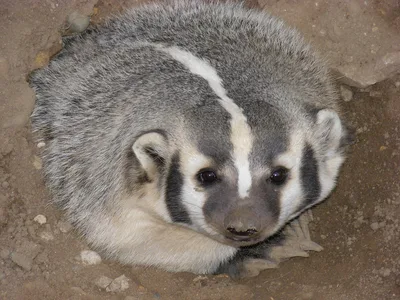 American badger
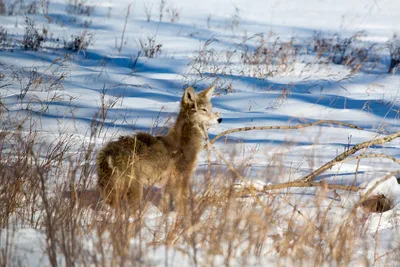 Coyote
- snakes
- hawks
- falcons
- cats
- dogs
Ecological equivalents
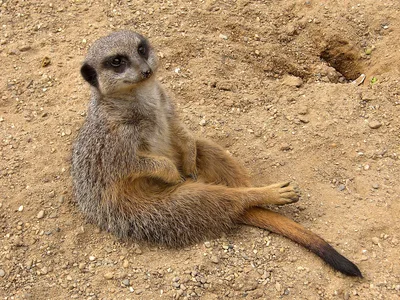
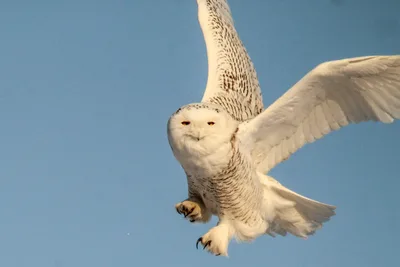
Related species on this site
Barred owl (same family), Elf Owl (same family), Eurasian eagle-owl (same family), Great horned owl (same family), Long-Eared Owl (same family), Short-Eared Owl (same family), and more.
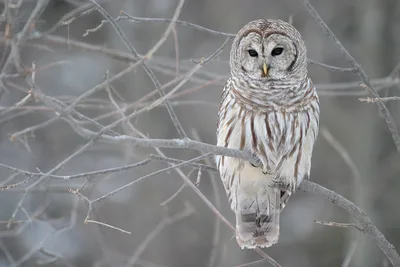 LC
Birds
Barred owl
Strix varia
The barred owl is a large brown owl of North American woodland, with dark eyes, a round head and no ear tufts.
Living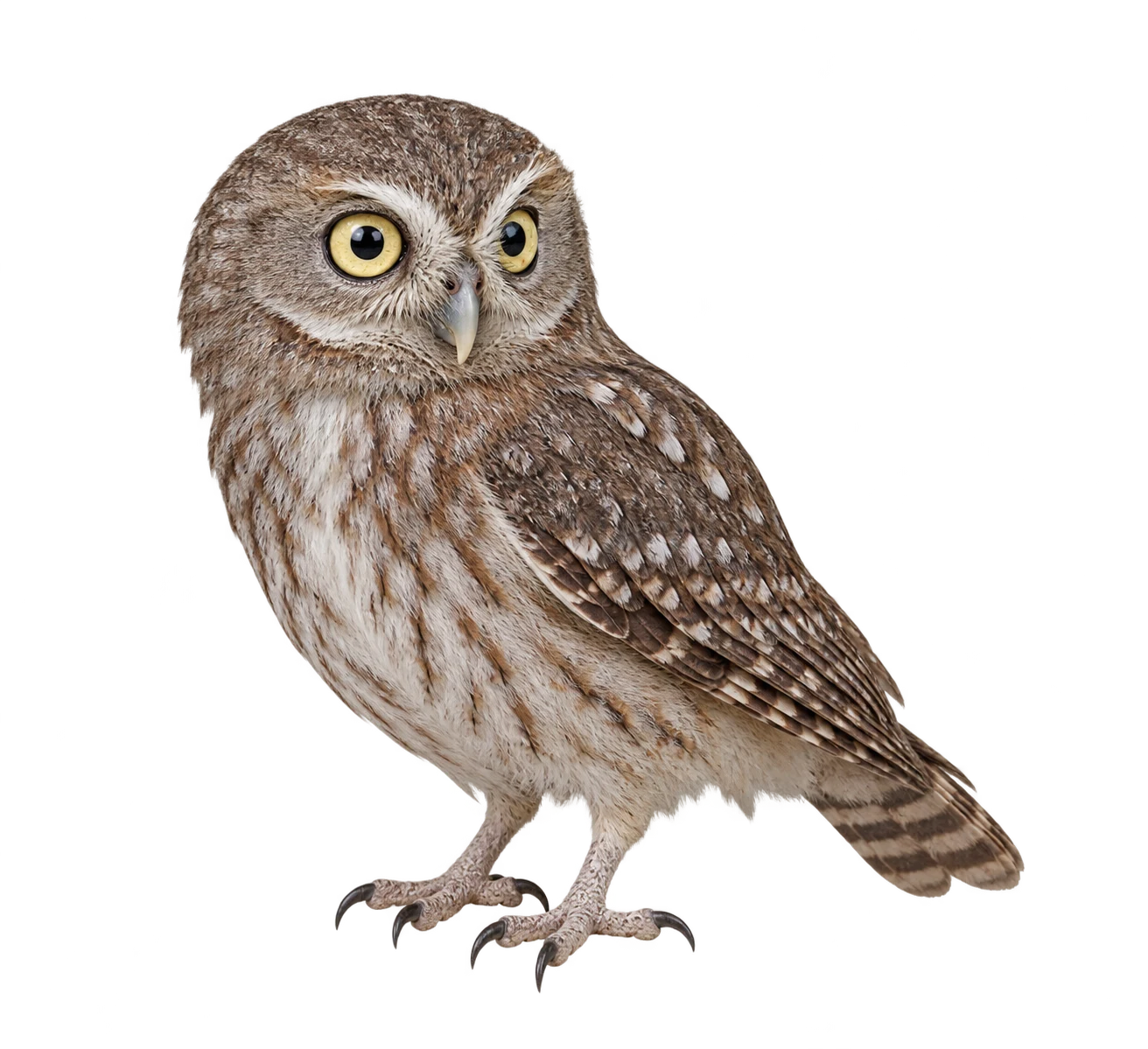
Birds
Elf Owl
Micrathene whitneyi
Classification and source reference
LivingAI illustration LC
Birds
Eurasian eagle-owl
Bubo bubo
The Eurasian eagle-owl is one of the largest owls in the world, with orange eyes and long ear tufts.
Living LC
Birds
Great horned owl
Bubo virginianus
The great horned owl is a heavy, ear-tufted owl of the Americas, at home from Alaska to Argentina.
Living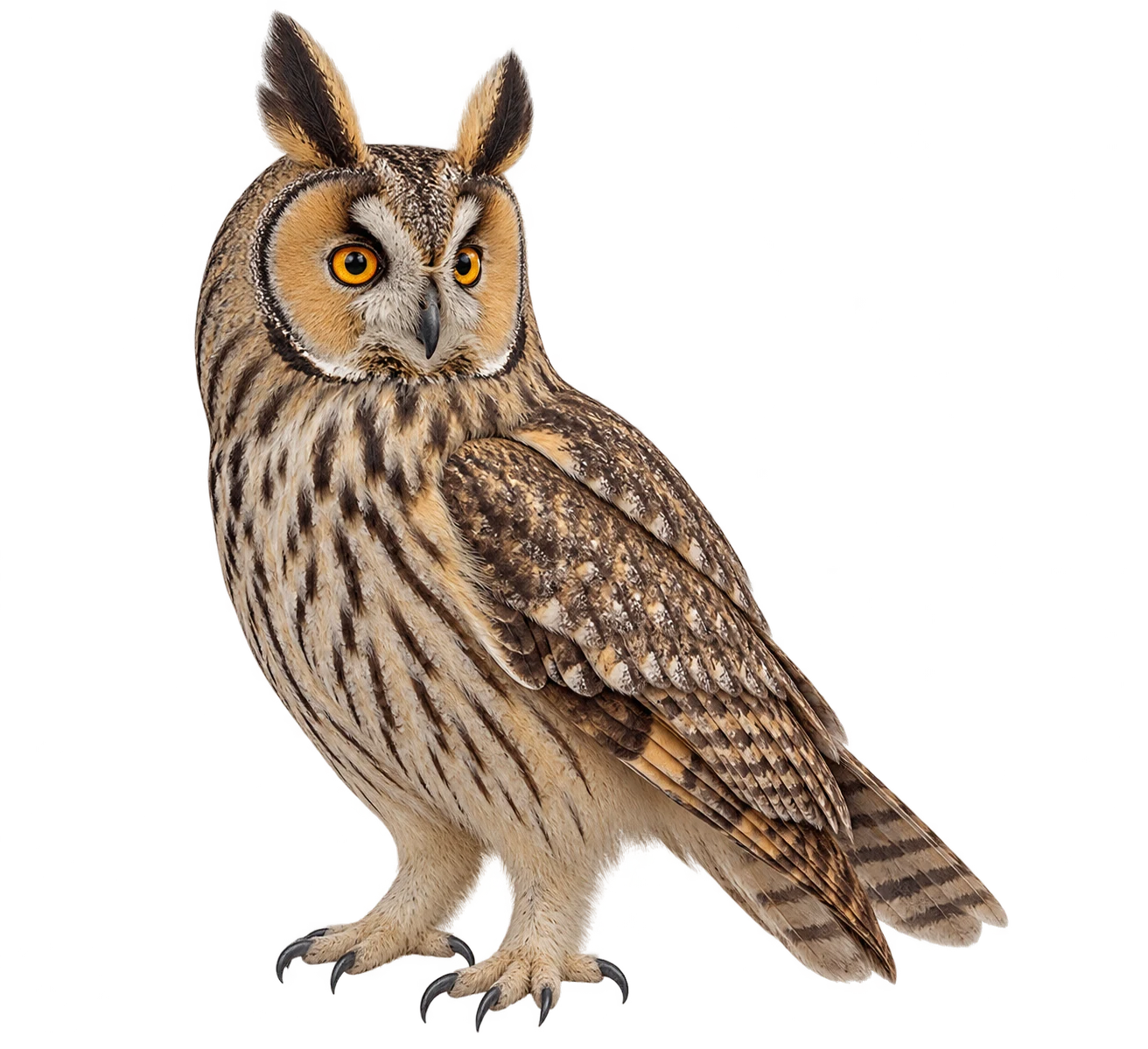
Birds
Long-Eared Owl
Asio otus
Classification and source reference
LivingAI illustration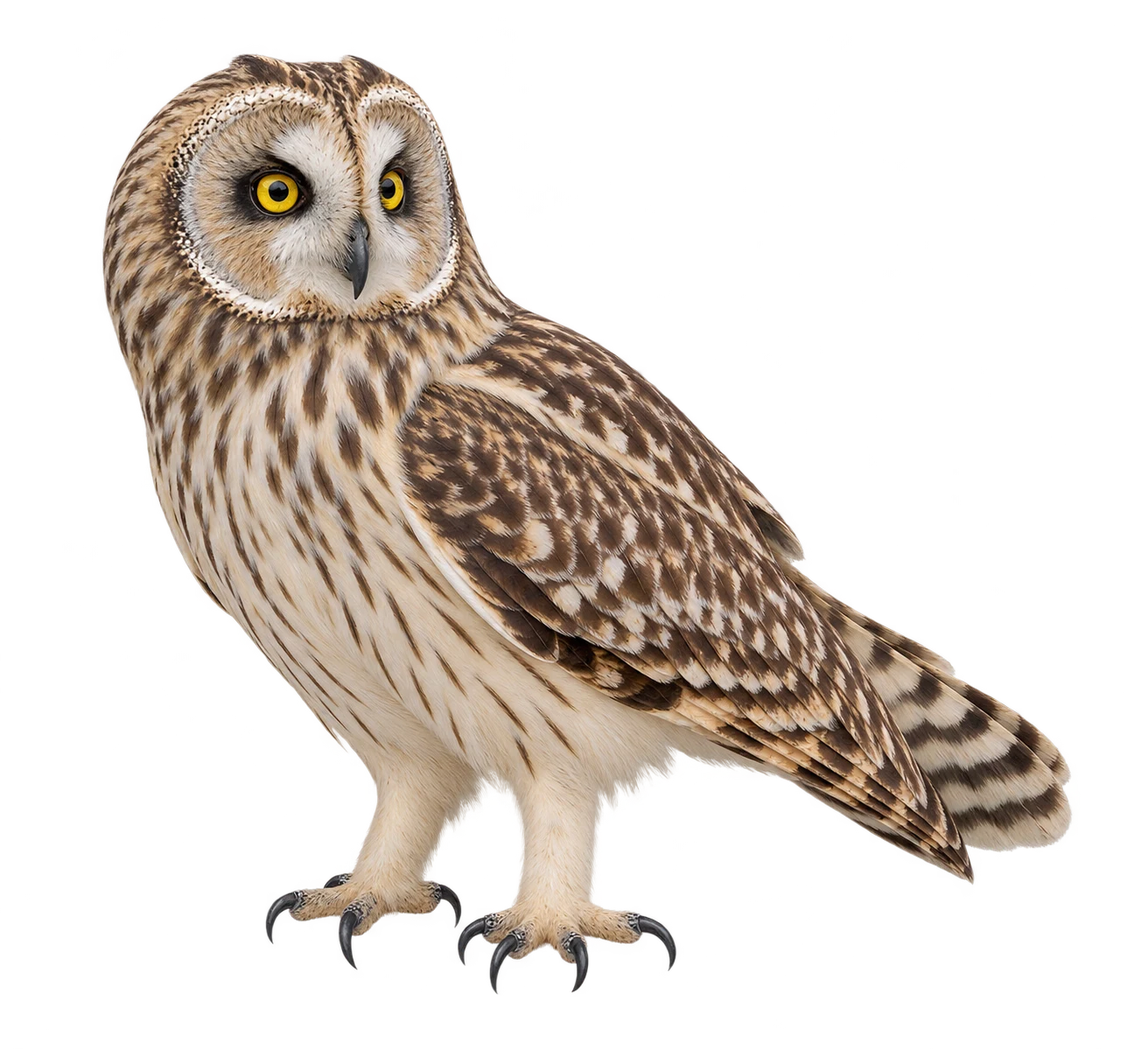
Birds
Short-Eared Owl
Asio flammeus
Classification and source reference
LivingAI illustration