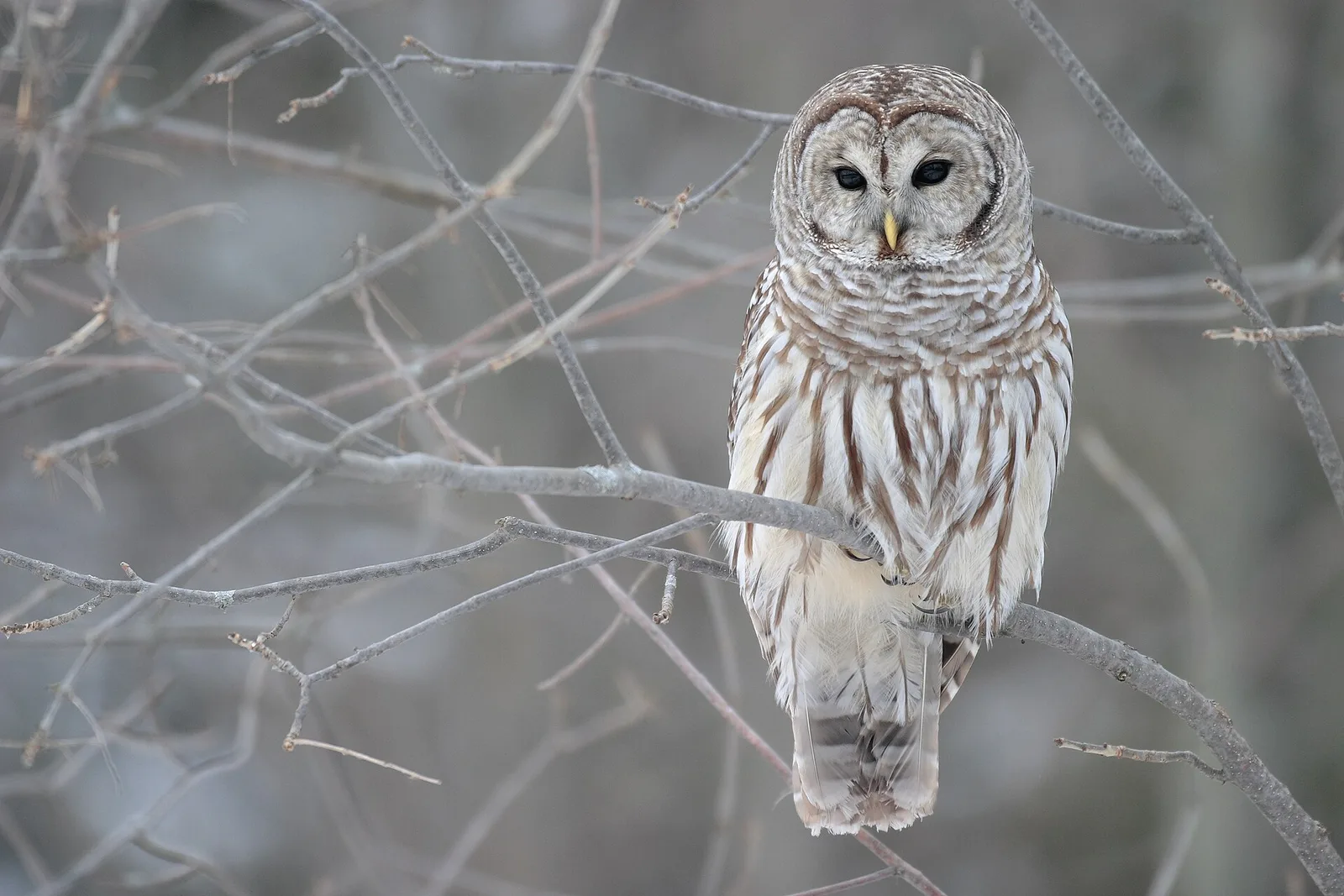
Barred owl
The hoot owl of American woods, and a bird on the move
Strix varia
Also called Northern barred owl, Hoot owl, Eight hooter, Striped owl
Living individuals or members of this group exist today. This does not mean they are safe from extinction.
Meet the barred owl
The barred owl is a large brown owl of North American woodland, with dark eyes, a round head and no ear tufts. It hunts small mammals from a perch at night, and it has spread west across the continent in the last hundred years.
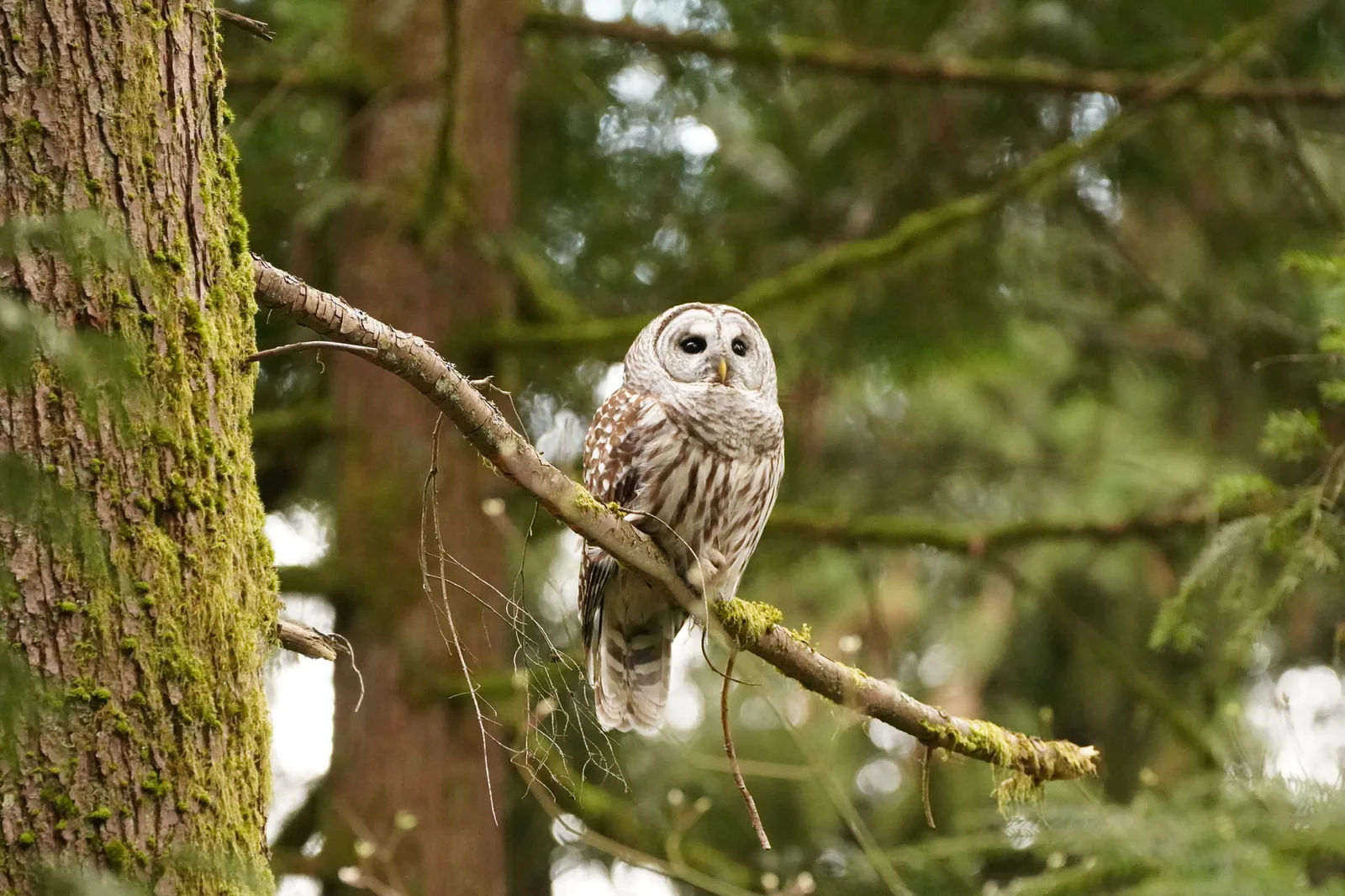
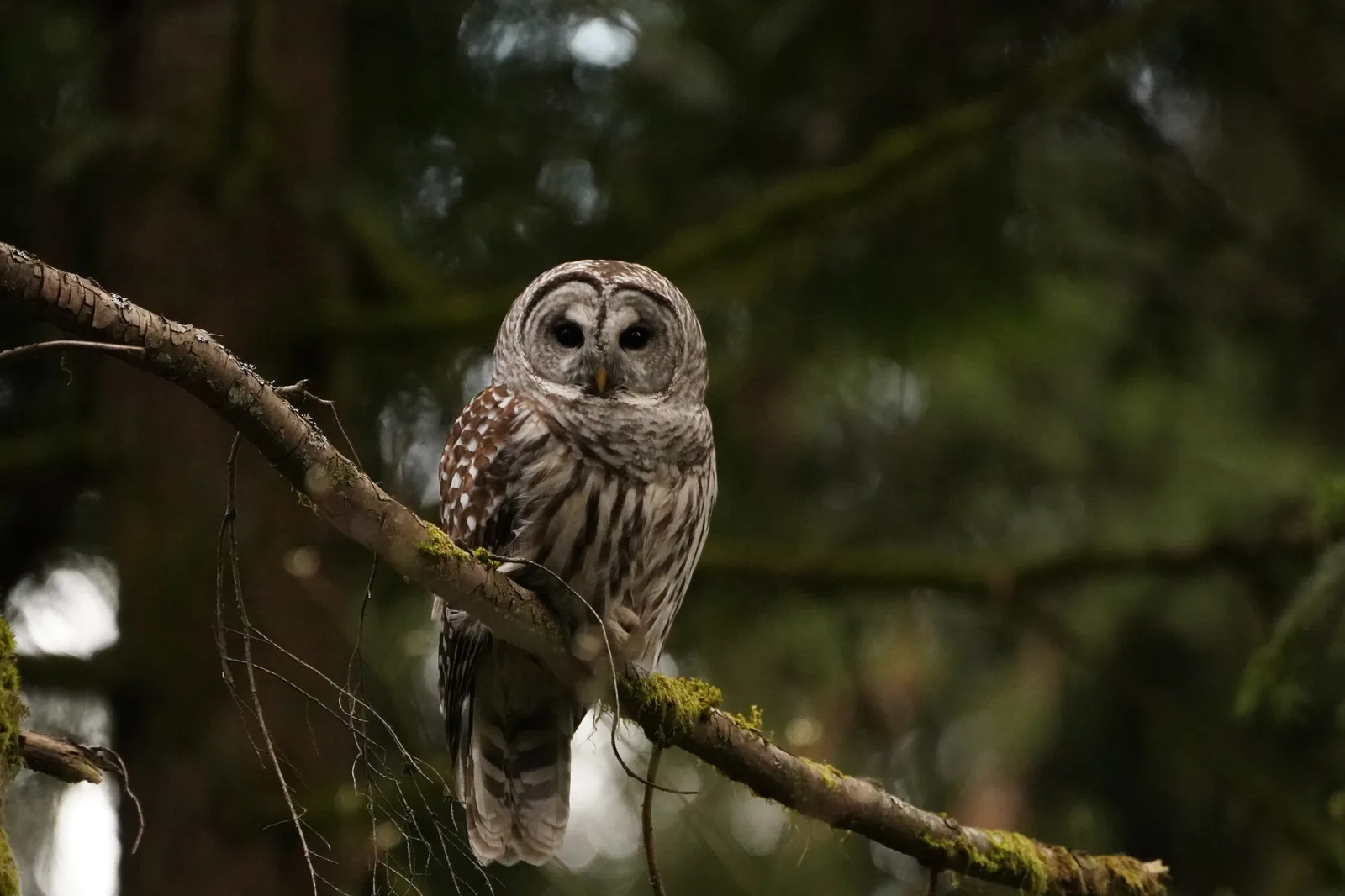
Images of the barred owl
Lifespan in the wild
Up to 24 years a banded wild bird in Minnesota reached 24 years and 1 month
Weight
0.47 to 1.15 kg
Length
40 to 63 cm
Wingspan
0.96 to 1.25 m
Fact file
Barred owl
- Location
- Eastern North America, and the west coast since the twentieth century
- Habitat
- Temperate forest, Wetlands, Towns and cities
- Diet
- Carnivore
- Prey / food
- Voles, mice, rats, squirrels, shrews, frogs, crayfish, small birds
- Predators
- Great horned owls; raccoons take eggs and young
- Lifestyle
- Mainly nocturnal, territorial all year
- Group name
- Pair
- Name of young
- Owlet
- Incubation
- Incubation about 28 days
- Clutch size
- 2 to 3 eggs
- Population
- Up to 3 million birds in North America
- Biggest threat
- Cars, collisions and disease; culling in the Pacific Northwest
- Distinctive feature
- Dark brown eyes in a round head with no ear tufts
- Colour
- Grey-brown above, barred across the chest and streaked down the belly
- Skin type
- Feathers
Size
Next to a person
Measurements
Size and speed
- Length
- 40 to 63 cm
- Wingspan
- 0.96 to 1.25 m
- Tail
- 18.2 to 25.7 cm
- Weight
- 0.47 to 1.15 kg males 468 to 812 grams, females 610 to 1,150 grams
- Weight, male
- 468 to 812 g
- Weight, female
- 0.61 to 1.15 kg
Typical adult ranges. Source: Wikipedia.
Life cycle
Lifespan
- In the wildUp to 24 years a banded wild bird in Minnesota reached 24 years and 1 month
- In captivityUp to 34 years
- 034 years
The pale bar is the record. Source: Wikipedia.
Appearance
Colour and coat
- Primary colours
- browngrey
- Secondary colours
- whitebuff
- Skin type
- feathers
- Male and female
- The female is larger and can weigh a third more than the male. Both sexes carry the same plumage. The female's voice is higher, with longer notes at the end of a call.
Life cycle
Mating and family
- Mating system
- monogamous pairs, usually for life
- Social structure
- solitary or a pair on one permanent territory
- Breeding
- one clutch a year, laid from late winter to spring
Pairs form in late winter and call together before laying. The female lays two or three white eggs in a tree hollow and sits on them for about 28 days. The male feeds her throughout, and then feeds the owlets for their first three weeks. The young leave the nest at about five weeks and fly well by ten weeks. They separate from their parents in autumn and breed at two years old.
Classification
Taxonomy
- Kingdom
- Animalia
- Phylum
- Chordata
- Class
- Aves
- Order
- Strigiformes
- Family
- Strigidae
- Genus
- Strix
- Species
- Strix varia
Conservation
Red List status
- LC
- NT
- VU
- EN
- CR
- EW
- EX
Least Concern on the IUCN Red List
Range
Recorded in 2 countries
Habitat layer: temperate broadleaf and mixed forest, temperate conifer forest, boreal forest and taiga, flooded grassland and savanna, mangrove.
Countries from 54,680 wild records on GBIF (iNaturalist research grade), filtered and checked by hand. Country shapes: Natural Earth. Habitat: RESOLVE Ecoregions 2017, CC BY 4.0. Basemap: Natural Earth.
Habitats
Three things to know
- 1
Its song is a run of eight hoots that ends on a drawled note.
- 2
It hunts from a perch and swoops on prey from as close as 6 metres.
- 3
It moved west across the Great Plains and now crowds out the threatened spotted owl.
Did you know
Seven more facts
- 1
The dark brown eye is rare among North American owls, where yellow is the usual colour.
- 2
The species plunges into snow to grab voles in their tunnels, a trick once credited only to great grey owls.
- 3
Barred owls sometimes eat roadkill, which owls very rarely do.
- 4
One tree hollow was used by barred owls for 25 years running.
- 5
In Montana one winter, 97.6% of 1,153 prey items were voles.
- 6
The red-shouldered hawk uses the same woods in the same way by day, with little conflict.
- 7
Only 47 hybrids turned up among more than 9,000 banded spotted owls.
Field notes
How it looks and acts
Field notes
Distinguishing features
- A round head with no ear tufts.
- Dark brown eyes that look black in the field.
- Bars across the throat and chest, and streaks down the belly.
- A pale straw-yellow bill.
- Grey-brown upper parts scalloped with white.
- A wingspan of 96 to 125 cm on a bird 40 to 63 cm long.
Field notes
Unique adaptations
- Comb-edged flight feathers make the approach silent.
- Large eyes packed with rod cells gather what light there is.
- High wing loading suits a bird that drops from a perch rather than quarters a field.
- A broad diet lets the owl switch between voles, frogs, fish and insects.
- Owlets climb back up a trunk with feet and bill after they fall.
Field notes
Interesting behaviours
- Gliding from perch to perch while scanning the forest floor.
- Duetting with a mate through the winter nights.
- Answering a recorded call, even from a known neighbour.
- Caching a dead animal in a branch fork for later.
- Preening a partner's head feathers.
Field notes
Temperament
- Territorial in every season, and quick to answer a rival.
- Often tame and curious near people.
- Nervous of close approach at the roost, and quick to fly.
- Fierce at the nest in some pairs and calm in others.
Field notes
Communication
- The eight-note hoot that names the bird.
- A rising call that ends on a drawn-out note.
- Cackles, screams and gurgles during disputes.
- A rasping hiss and loud bill snaps when agitated.
- Begging screeches from the female and the young.
Ecology
Ecological role
The barred owl is the main night predator of small animals in eastern American forest.
- It holds down vole, mouse and rat numbers across whole woodlands.
- It cuts the nesting success of forest songbirds nearby, and took 62% of some thrush fledglings in one study.
- It fills the same role at night that the red-shouldered hawk fills by day.
- In the west it displaces the spotted owl and changes the whole owl community.
Stories
Myths and legends
- In many Native American traditions, an owl heard at night warns of a coming death.
- In Hopi tradition, the great horned owl Mongwu keeps order and punishes bad behaviour.
- In Apache tradition, the figure of Big Owl frightens children into obeying their elders.
- In Seminole tradition, the Stikini is an owl that was once a person.
- In Tlingit tradition, families carry the owl as a clan crest on carved poles.
People
Relationship with humans
People
Living alongside us
People rarely see this owl, but many hear it. Its song is the best known owl call in eastern North America. Human land use built the wooded corridors that carried the bird west across the plains. That move now puts it in conflict with the northern spotted owl, and officials plan to shoot large numbers in the Pacific Northwest. In gardens and farms the owl earns its keep by killing rats and mice.
- The species probably never treats a person as prey.
- Some parents strike people who climb to the nest, and have knocked climbers down.
- Attacks appear to follow repeated visits rather than one approach.
People
Status, uses and products
- Domestication
- Wild
- As a pet
- Not suitable. This is a protected wild predator that needs whole prey and a large flight space. Keeping one is illegal without a licence across its range. Injured birds belong with a licensed rehabilitator, not in a house.
- Uses
- birdwatchingrodent control
- Products
- None recorded
The full account
About the barred owl
The barred owl, Strix varia, is a large brown owl of North American woodland. Adults measure 40 to 63 centimetres long, with a wingspan of 96 to 125 cm. Males weigh 468 to 812 grams and females 610 to 1,150 g. The head is round, the eyes are dark brown and there are no ear tufts. Bars cross the chest and dark streaks run down the belly, which gives the bird its name.
The species belonged to eastern North America until the last century. It then crossed the Great Plains and reached British Columbia, Washington, Oregon and California. In the west it now competes with the threatened northern spotted owl, and usually wins. It hunts voles, mice, rats and squirrels from a perch, mostly after dark. The IUCN lists the barred owl as Least Concern, and it may number up to 3 million birds.
Name and taxonomy
Benjamin Smith Barton, a naturalist in Philadelphia, described the barred owl in 1799. The name points to the dusky marks that run in several directions across the underside. The bird belongs to Strix, the genus that gave the true owl family its name. People also call it the northern barred owl, the striped owl, the hoot owl and the eight hooter.
Three subspecies are usually accepted after the fulvous and cinereous forms were split away. The northern race covers most of the range and includes every western bird. A southern race lives from the Carolina coast through Georgia and Florida and averages smallest. A third race holds most of Texas and shows paler, gingery-cream ground colour.
Evolution and relatives
The barred owl sits between the Ural owl and the tawny owl in size. Its short, curved claws and its habits resemble those of the tawny owl of Europe. Some authors once grouped it with the spotted owl as a single superspecies. Genetic tests reject that, because the two lines split very early in North America. The two species can still interbreed, and the young are nicknamed sparred owls.
Pleistocene fossils that probably belong to this species come from Florida, Tennessee and Ontario. A larger, longer-legged fossil owl from California now sits in its own genus, Oraristrix. Western and eastern populations of the northern race may have parted about 7,000 years ago. That gap suggests a history in remote Canadian forest that nobody has yet traced.
Appearance
The plumage is grey-brown above, scalloped with white bars on the back and mantle. The throat and upper chest carry crescent-shaped bars across the body. The belly is boldly streaked from top to bottom in blackish or dusky brown. The facial disc is pale grey-brown with faint rings, and the bill is straw-yellow. Dark brown eyes set this owl apart from the yellow-eyed owls around it.
Adults measure 40 to 63 cm long, and the tail runs 18.2 to 25.7 cm. The wingspan is 96 to 125 cm. Females are the larger sex, at 610 to 1,150 g against 468 to 812 g in males. Feathers cover the legs and toes down to dark grey talons. Young birds look like dull adults, and a few rare albinos are pure white with brown eyes.
Habitat and range
The species holds most of the eastern United States and southern Canada. Old deciduous and mixed forest suits it best, and swampy bottomland is a favourite. Old growth offers nest hollows, open flight lanes below the canopy and cover from mobbing. Water is usually somewhere nearby, whether a river margin or wet ground. In North Carolina most birds sat in blocks of at least 86 to 370 hectares of woodland.
Suburbs with big old trees also suit the bird, and it counts as a local synanthrope. Owls in Charlotte, North Carolina increased faster in suburbs than in old growth. Easy rodent prey probably explains that, though cars and collisions kill more birds there. In parts of New Jersey great horned owls push barred owls out of edge habitat. In suburban Ohio, forest covered 41.4% of barred owl range and low-density housing 29.8%. Birds in Saskatchewan chose areas with at least 66% forest cover. GBIF holds records of the species from 10 countries.
Diet and hunting
The barred owl waits on a perch and glides from one to the next until it sees prey. Soft, comb-edged flight feathers let it close in silence, sometimes from only 6 to 10 metres. Among 2,234 prey items in one wide study, 76% were mammals and 15.8% invertebrates. Voles, deermice, rats, woodrats, chipmunks and flying squirrels lead the list. The mean size of prey in the east was estimated at 33.5 grams. Winter food can be almost all rodents, and voles made 91.5% of 118 items in New Jersey.
More than 100 bird species turn up in the diet, from swallows to grouse. Frogs, salamanders, lizards, snakes, crayfish and insects fill out the rest. The owl wades into shallow water for fish, which few owls do. It also plunges through snow for voles in their winter tunnels. Flying squirrels alone can supply up to 25.6% of the food by weight. A pellet of fur and bone measures about 3.5 cm across and 7.2 cm long.
Behaviour and social life
Adults hold a territory all year and keep the same borders for many years. Thirteen tracked territories in Minnesota averaged 273 hectares. Seven in Michigan averaged 282 hectares, and ten in Wisconsin 337.9 hectares. Ranges overlap widely between a pair in the breeding season and then shrink apart. Birds sing from perches near the edge of the ground they claim.
The species is mainly nocturnal, with peaks just after sunset and before dawn. It is more active by day than most owls, especially under heavy cloud. By day it hides in thick foliage, usually at least 5 metres above the ground. Small birds, crows and woodpeckers mob it whenever they find the roost. The bird does not migrate, and winter recoveries in the north lay within 10 km.
Communication and senses
The usual song is a run of eight accented hoots that drops in pitch at the end. Birders learn it as the phrase who cooks for you, drawled on the last note. The call probably carries well beyond 0.8 km through forest. Another call rises through several notes and ends on a long oo-aw. Other sounds run to cackles, caws, gurgles and screams, which is unusual in this genus.
An annoyed bird hisses about three times in three seconds and claps its bill. The female's voice is higher, and observers could sex 87 to 94% of calls in one study. The eyes are very large and hold many rod cells, which suits hunting in low light. Like other owls, the bird finds prey by ear as well as by sight. Birds answer a recording of their own species more readily than any eastern hawk.
Reproduction and life cycle
Pairs normally stay together for life and duet through the winter. The male bows, nods and half spreads his wings in courtship. The favourite nest is a hollow trunk or a broken snag in an old tree. Across 25 studies the mean nest tree stood 18.2 metres high and measured 65.7 cm across. Where hollows are scarce the birds take over hawk nests or squirrel dreys.
The female lays 2 to 3 eggs, and 5 at the most, straight onto the floor of the hollow. The eggs are pure white and weigh about 45.5 grams each. She lays at two or three day intervals and incubates alone for about 28 days. The male brings all the food to her during that month. A hatchling weighs about 46 grams and cannot feed itself.
The female broods the owlets for three weeks and then starts hunting again. Owlets leave the nest at about 36 to 39 days and often fall to the ground. They climb back up the trunk with their feet and bill while flapping hard. Parents feed them until the autumn, when the young disperse. Most birds first breed at two years old, and a few at three.
Predators and threats
The great horned owl kills barred owls of every age and is the main predator. Raccoons probably take eggs, nestlings and fledglings. Northern goshawks also kill nestlings and grown birds. Cars, traps set for fur-bearing mammals and hunting accidents kill others. A few adults have even eaten members of their own species. One owl died from the bite of a rodent that was defending itself.
Aspergillosis, a lung infection, kills forest owls including this one. About 15% of barred owls tested in Georgia carried West Nile virus. In one necropsy study 26.7% of birds carried the toxoplasmosis parasite. Worms, flies and feather lice are common and rarely fatal on their own. Logging removes the old hollow trees that the species needs for nesting.
Population and conservation
The barred owl is one of the commonest owls in North America. Partners in Flight puts the world total at up to 3 million birds. Canada holds an estimated 10,000 to 50,000 pairs. The Canadian Maritimes carry the densest known population, with 3,600 pairs. Iowa, Tennessee and Maryland show the highest United States densities.
The conservation problem here runs the other way, because the owl threatens another species. Barred owls survive at an estimated 91% a year against 82% for spotted owls. Where barred owls moved within 0.8 km of a spotted owl nest, 39% of spotted owls vanished. In 2023 the United States Fish and Wildlife Service drafted a plan to shoot large numbers of them. The plan would cull more than half a million birds in the Pacific Northwest.
Relationship with humans
This owl lives close to people and often nests in suburban woodland. It takes rats and mice, which helps farmers and gardeners. Its loud song is probably the owl call most Americans know. Birders draw it in by playing recordings, and it answers readily. Some birds ignore a climber at the nest, while others strike hard at intruders.
There are accounts of nesting owls knocking people out of trees. Attacks seem to follow repeated disturbance rather than a single visit. Human changes to the land let the species cross the Great Plains. Fire suppression and tree planting built the wooded corridors it followed. Wildlife officers now shoot the bird in the west to protect the spotted owl.
In culture and myth
John James Audubon drew the barred owl as Plate 46 of Birds of America. The prints appeared in London between 1827 and 1838, and the bird faces a grey squirrel. Robert Havell's London workshop engraved and coloured the image. The Brooklyn Museum owns the original aquatint. The nickname eight hooter comes from the count of notes in the song.
Most Native American nations read an owl call as a warning of death. Apache and Seminole parents told children to stay inside when owls called. Hopi story names Mongwu, the great horned owl, who punishes villagers that break the rules. The Tlingit and the Mohave both hold owl clans, and Northwest Coast carvers use the owl as a crest. Among the Creek, dancers perform a screech owl dance and also a horned owl dance. Audubon showed the owl threatening a squirrel, which probably says how people then saw the bird.
A sentence with a dotted underline is inferred: it describes the group the animal belongs to, or is a reading of the sources, rather than a measured or reported fact about this species.
Questions
Barred owl questions, answered
What does a barred owl sound like?
It gives a run of eight accented hoots that falls away at the end. Birders remember it as the phrase who cooks for you, with a drawl on the last note. It also screams, cackles and gurgles.
How big is a barred owl?
Adults are 40 to 63 cm long with a wingspan of 96 to 125 cm. Females weigh 610 to 1,150 g and males 468 to 812 g. It is a large owl, though smaller than a great horned owl.
What do barred owls eat?
Mostly small mammals such as voles, mice, rats and squirrels. They also take frogs, salamanders, crayfish, insects, small birds and even fish. In one wide study 76% of prey items were mammals.
Where do barred owls live?
Across the eastern United States and southern Canada, and now west to British Columbia, Washington, Oregon and California. They prefer mature forest near water, and they also settle in leafy suburbs.
Are barred owls endangered?
No. The IUCN rates the species as Least Concern and it may number up to 3 million birds. It is one of the commonest owls in North America.
Why are barred owls being killed in the Pacific Northwest?
They moved into the range of the northern spotted owl and out-compete it for food and space. In 2023 the United States Fish and Wildlife Service drafted a plan to cull more than half a million barred owls.
Do barred owls migrate?
No. A pair holds the same territory year after year. Winter recoveries in the north were all within 10 km of the ringing site.
How long do barred owls live?
A banded wild bird reached 24 years and 1 month. The captive record is 34 years and 1 month. Most young birds die in their first year.
Where do barred owls nest?
In a hollow trunk or a broken snag in a large old tree, usually 6.8 to 13.4 metres up. They also use old hawk nests and squirrel dreys where hollows are scarce. They build nothing themselves.
How many eggs does a barred owl lay?
Two or three white eggs, and up to five at most. The female incubates alone for about 28 days. The male brings her food throughout.
Do barred owls attack humans?
Very rarely, and only near a nest. A few defending birds have struck people climbing to nest trees. They are far more likely to fly away than to attack.
What is the difference between a barred owl and a spotted owl?
The barred owl is bigger, paler and barred across the chest, while the spotted owl is browner with round white spots. The barred owl is also far more aggressive and more flexible in its diet.
Are barred owls nocturnal?
Mainly, yes, with peaks after sunset and before dawn. They are more willing to hunt by day than most owls, especially under cloud. Daytime calls are common in Florida.
Do barred owls eat cats or small dogs?
No. This owl takes prey it can swallow or carry, and the biggest regular prey are rats, squirrels and grouse. A pet cat is far too heavy for it.
What eats barred owls?
The great horned owl is the main predator and kills birds of every age. Northern goshawks take some, and raccoons probably take eggs and young. Cars and disease kill many adults.
Why did barred owls spread west?
Trees spread across the Great Plains after settlers suppressed fire and planted woodland. Those corridors of forest let the owl move along the rivers. It reached Washington by 1965 and California by 1976.
Food web
Prey and food
- voles
- mice
- rats
- squirrels
- shrews
- frogs
- crayfish
- birds
Food web
Predators
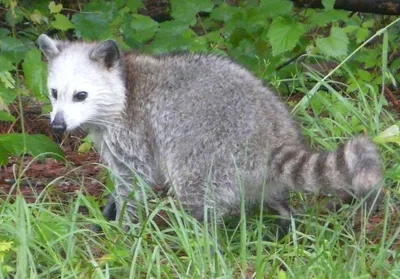 Raccoon
Ecological equivalents
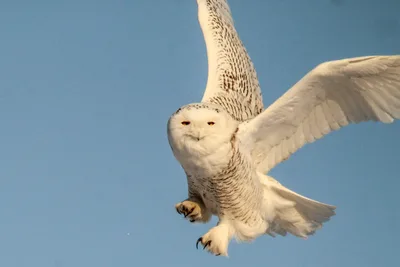
Related species on this site
Tawny owl (same genus), Ural owl (same genus), Burrowing owl (same family), Elf Owl (same family), Eurasian eagle-owl (same family), Great horned owl (same family), and more.
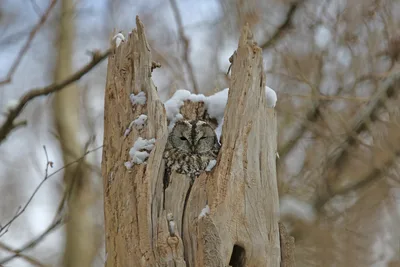 LC
Birds
Tawny owl
Strix aluco
The tawny owl is the common night owl of European woodland, with a round head, black eyes and no ear tufts.
Living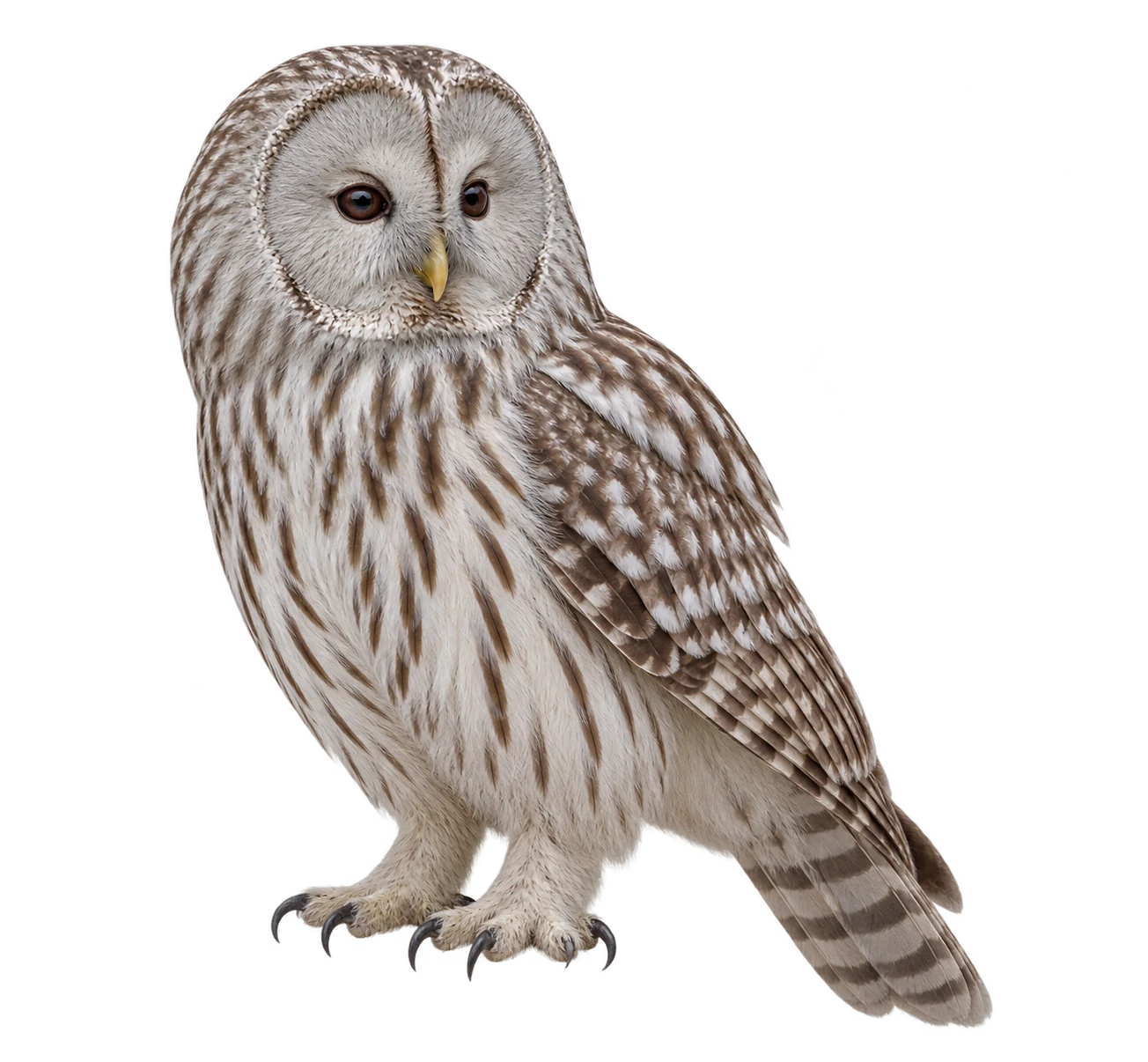
Birds
Ural owl
Strix uralensis
Classification and source reference
LivingAI illustration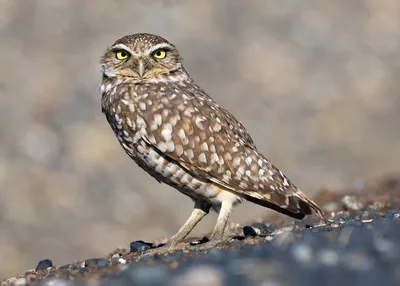 LC
Birds
Burrowing owl
Athene cunicularia
The burrowing owl is a small, long-legged owl of open country in the Americas.
Living
Birds
Elf Owl
Micrathene whitneyi
Classification and source reference
LivingAI illustration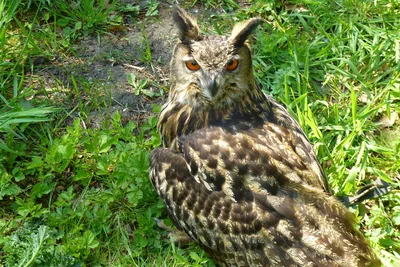 LC
Birds
Eurasian eagle-owl
Bubo bubo
The Eurasian eagle-owl is one of the largest owls in the world, with orange eyes and long ear tufts.
Living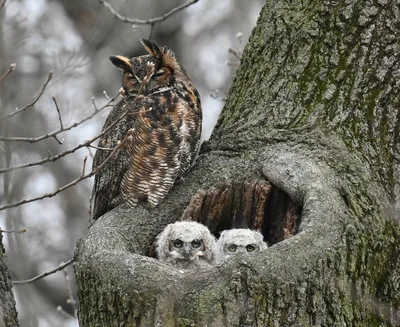 LC
Birds
Great horned owl
Bubo virginianus
The great horned owl is a heavy, ear-tufted owl of the Americas, at home from Alaska to Argentina.
Living