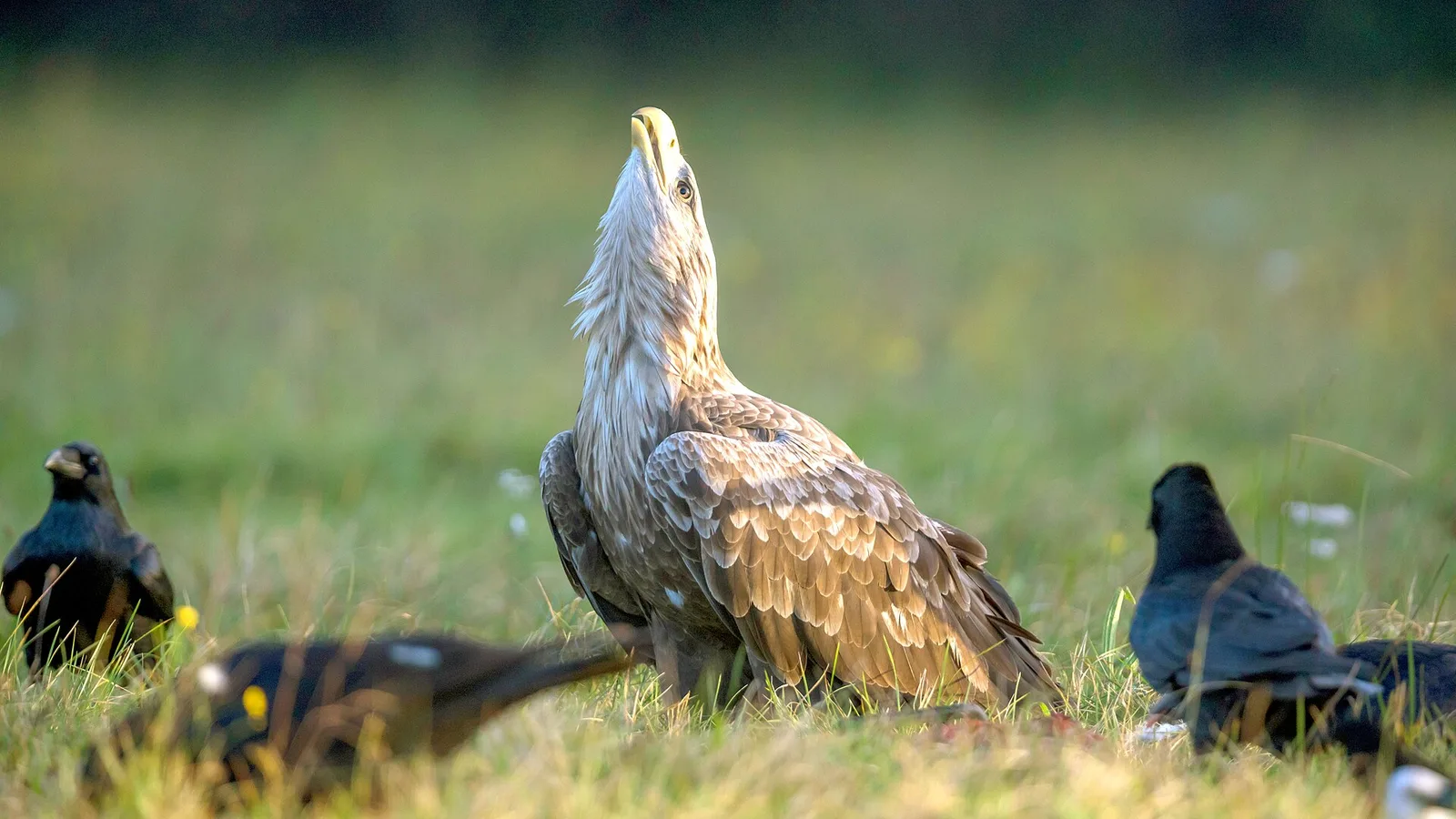
White-tailed eagle
Europe's biggest eagle, back from near extinction
Haliaeetus albicilla
Also called Sea eagle, White-tailed sea eagle, Erne, Eurasian sea eagle, Grey sea eagle
Living individuals or members of this group exist today. This does not mean they are safe from extinction.
Meet the white-tailed eagle
The white-tailed eagle is the largest bird of prey in Europe, a brown sea eagle with a short white wedge of a tail. Persecution and pesticides nearly wiped it out, and protection and reintroduction have brought it back across the continent.
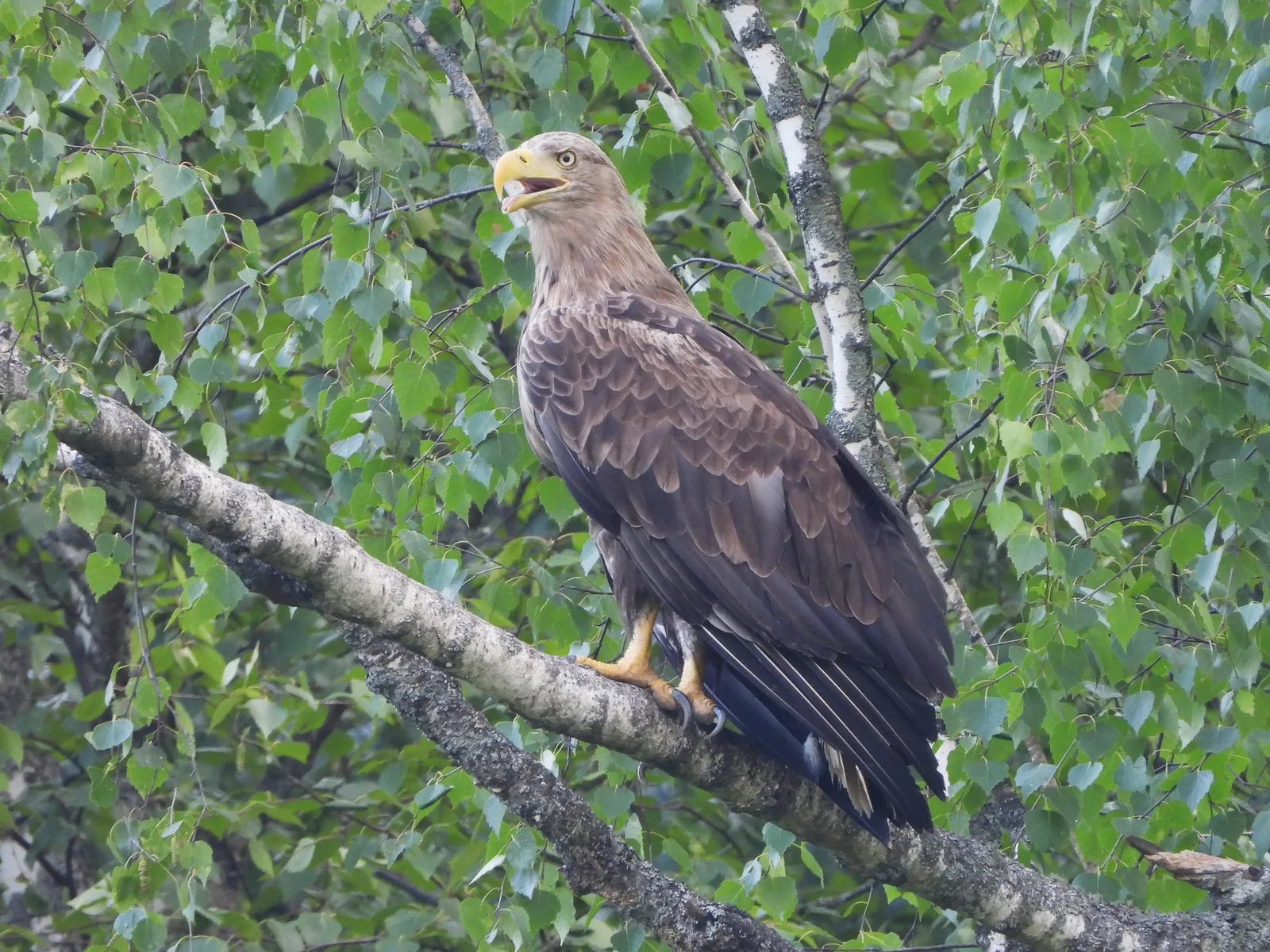
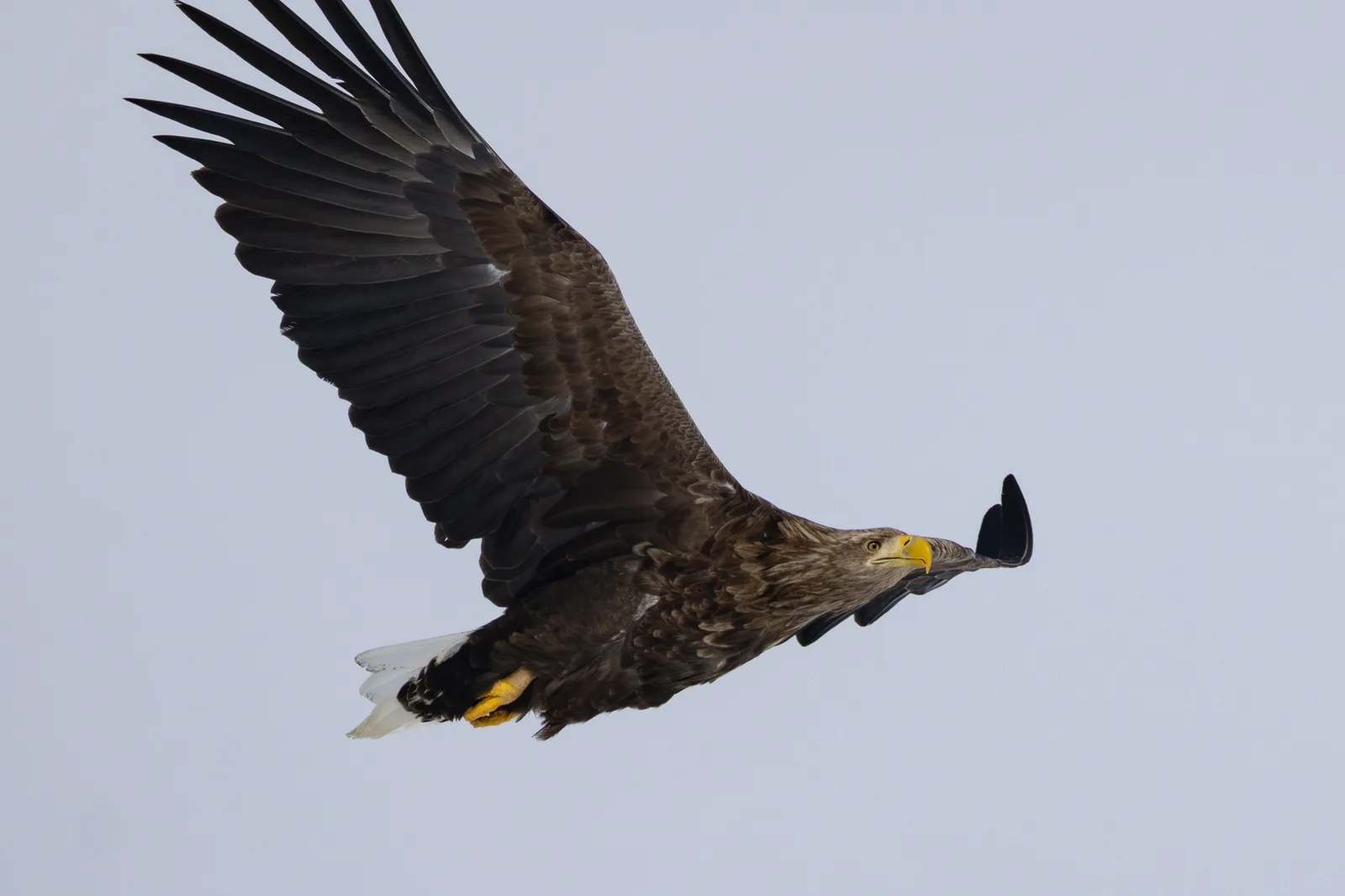
Images of the white-tailed eagle
Lifespan in the wild
About 21 years the oldest known bird was ringed in Germany in 1985 and still bred in 2022
Weight
3.1 to 6.9 kg
Length
66 to 94 cm
Wingspan
1.78 to 2.45 m
Fact file
White-tailed eagle
- Location
- Greenland and Iceland east across Eurasia to Hokkaido
- Habitat
- Coast, Rivers and lakes, Wetlands, Temperate forest
- Diet
- Carnivore
- Prey / food
- Pike, carp, cod, ducks, geese, gulls, hares, carrion
- Predators
- None as adults; foxes, martens, bears and crows take eggs and chicks
- Lifestyle
- Perches for most of the day, hunts over open water
- Group name
- Convocation
- Name of young
- Eaglet
- Incubation
- Incubation 38 to 42 days
- Clutch size
- Usually 2 eggs, rarely 3 or 4
- Population
- About 3,500 pairs in Europe and 5,000 to 7,000 in Russia
- Biggest threat
- Illegal shooting, poisoning and wind turbines
- Distinctive feature
- A short white wedge-shaped tail and a heavy yellow bill
- Colour
- Greyish brown with a paler head and a white tail
- Skin type
- Feathers
Size
Next to a person
Measurements
Size and speed
- Length
- 66 to 94 cm
- Wingspan
- 1.78 to 2.45 m, up to 2.53 m a Greenland specimen spanned 2.53 metres
- Tail
- 25 to 33.1 cm
- Weight
- 3.1 to 6.9 kg males 3.1 to 5.4 kg, females 4 to 6.9 kg, global mean about 5 kg
- Weight, male
- 3.1 to 5.4 kg
- Weight, female
- 4 to 6.9 kg
Typical adult ranges. Source: Wikipedia.
Life cycle
Lifespan
- In the wildAbout 21, up to 37 years the oldest known bird was ringed in Germany in 1985 and still bred in 2022
- In captivityUp to 42 years
- 042 years
Appearance
Colour and coat
- Primary colours
- brownwhite
- Secondary colours
- yellowgrey
- Skin type
- feathers
- Male and female
- Moderate. Females are heavier at 4 to 6.9 kilograms, against 3.1 to 5.4 kg for males. The plumage of the two sexes is the same.
Life cycle
Mating and family
- Mating system
- monogamous pairs for life
- Social structure
- territorial pairs, with loose gatherings of young birds at food
- Breeding
- one clutch a year, usually of two eggs
A pair holds one territory and keeps the same nest for years. Courtship brings soaring, calling and a talon-locked cartwheel through the air. The female lays two eggs and does most of the incubation, which lasts 38 to 42 days. The eaglet feeds itself in the nest from about 35 days and flies at about 70 days. A bird that reaches adulthood lives about 21 years.
Classification
Taxonomy
- Kingdom
- Animalia
- Phylum
- Chordata
- Class
- Aves
- Order
- Accipitriformes
- Family
- Accipitridae
- Genus
- Haliaeetus
- Species
- Haliaeetus albicilla
Conservation
Red List status
- LC
- NT
- VU
- EN
- CR
- EW
- EX
Least Concern on the IUCN Red List
Range
Recorded in 22 countries
- Austria
- Belarus
- Czech Republic
- Germany
- Denmark
- Finland
- France
- United Kingdom
- Croatia
- Hungary
- Japan
- South Korea
- Kazakhstan
- Lithuania
- Netherlands
- Norway
- Poland
- Romania
- Serbia
- Russia
- Sweden
- Ukraine
Habitat layer: temperate broadleaf and mixed forest, temperate conifer forest, boreal forest and taiga, flooded grassland and savanna, mangrove.
Countries from 24,252 wild records on GBIF (iNaturalist research grade), filtered and checked by hand. Country shapes: Natural Earth. Habitat: RESOLVE Ecoregions 2017, CC BY 4.0. Basemap: Natural Earth.
Habitats
Three things to know
- 1
Its wings can span 2.45 metres, and one Greenland bird measured 2.53 m.
- 2
A pair locks talons in the air and cartwheels towards the ground during courtship.
- 3
The last British nest failed on Skye in 1916, and Scotland now holds a breeding population again.
Did you know
Seven more facts
- 1
The old name erne means soarer, and it survives in Swedish and Finnish words for the bird.
- 2
The species name means white tail, and it comes from a medieval misreading of Latin.
- 3
The rear talon is the largest carried by any bird in the hawk family.
- 4
The eagle can take fish only from shallow water, often less than a metre deep.
- 5
Of 98 Norwegian nests, only eight stood in trees and the rest were on cliffs.
- 6
Over 500 white-tailed eagles spend the winter in Japan.
- 7
The oldest known wild bird was ringed in Germany in 1985 and still bred in 2022.
Field notes
How it looks and acts
Field notes
Distinguishing features
- The short tail is white and wedge-shaped in every adult.
- The bill, cere, feet and eyes of an adult are all yellow.
- The head and breast are paler than the rest of the brown body.
- The wings are broad and flat-edged, and they span up to 2.45 metres.
- A juvenile is darker, blotchier and carries a dark bill and dark eyes.
- The bill is heavy even by the standard of the sea eagles.
Field notes
Unique adaptations
- A sharply curved rear claw holds prey that is slippery and struggling.
- Broad wings probably let the bird carry heavy prey over water.
- A very wide diet lets it switch between fish, birds and carrion.
- Long spells of perching may save energy on days when hunting is poor.
- The heavy bill probably tears carrion that smaller raptors cannot open.
Field notes
Interesting behaviours
- The bird perches for most of the day and watches the water.
- It robs other birds and otters of the food they have caught.
- A pair duets in early spring, in the air or from a branch.
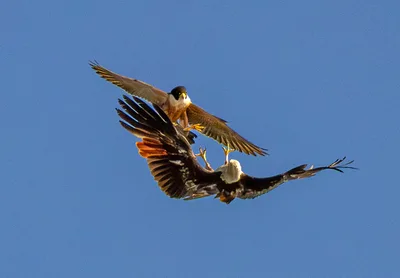
- Two rivals grapple talons in mid-air and fall together.
- Young birds gather where carrion is plentiful in winter.
Field notes
Temperament
- Adults are strongly territorial and fight intruders of their own kind.
- The species avoids noisy places, though Danish birds now feed near towns.
- A sitting female crouches over her eggs when a person approaches.
- Away from the nest the bird seems wary and keeps its distance from people.
Field notes
Communication
- The male has a dry rattling call, and the female answers a note lower.
- A call sequence can run to 15 or 30 notes and speeds up as it goes.
- Alarm is three or four short loud klee notes.
- A perched bird throws its head back on the last note of a call.
- Chicks beg with a thin call that hardens if nobody feeds them.
Ecology
Ecological role
The white-tailed eagle sits at the top of the food web of northern coasts and lakes, and it cleans up as much as it kills.
- It takes fish, ducks and geese, and it probably removes many sick and slow birds.
- It removes carcasses from shores and frozen lakes in winter.
- Its numbers may rise and fall with the state of the water it hunts over.
- Its eggs and chicks feed foxes, martens, bears and crows.
Stories
Myths and legends
- In Shetland tradition a sea eagle overhead made the fish float up belly first.
- In Polish tradition a white eagle on its nest showed Lech where to found the city of Gniezno.
- In Orkney tradition, or so the excavators once argued, the eagle was a totem of the people in the cairn.
- In Saxon tradition the bird runs through art and story, and it named many places.
- In Gaelic tradition it is the eagle of the sun's eye.
People
Relationship with humans
People
Living alongside us
People nearly destroyed this eagle in western Europe. Bounties, guns, egg collectors and pesticides emptied one country after another. Legal protection, clean winter food and careful reintroduction have brought it back to Britain, Ireland and the Netherlands. Illegal shooting and poisoning still happen, and wind turbines kill birds at some coastal farms. The eagle now earns money for island communities through wildlife tourism.
- The eagle does not hunt people and avoids them where it can.
- A bird defending a nest may call and swoop at a climber.
- Claims that the species carries off lambs are mostly false.
People
Status, uses and products
- Domestication
- Wild
- As a pet
- Not suitable. This is a protected wild eagle with a two metre wingspan. It needs a huge hunting range and a great deal of meat every day. Only licensed rehabilitators and zoos may hold one.
- Uses
- wildlife tourismbirdwatchingheraldry
- Products
- None recorded
The full account
About the white-tailed eagle
The white-tailed eagle, Haliaeetus albicilla, is the largest bird of prey in Europe. It measures 66 to 94 centimetres from bill to tail. The wings span 1.78 to 2.45 metres, and one Greenland bird reached 2.53 m. Males weigh 3.1 to 5.4 kilograms, and females weigh 4 to 6.9 kg. A short white wedge of a tail marks out every adult.
The bird lives beside open water, from sea cliffs to inland lakes and marshes. It hunts fish and water birds, and it eats carrion whenever it finds any. The range runs from Greenland and Iceland east to Hokkaido in Japan. People shot, trapped and poisoned the species almost out of western Europe. Protection and reintroduction have brought it back to Britain, Ireland and the Netherlands. The IUCN now lists the species as Least Concern.
Name and taxonomy
Carl Linnaeus described the bird in 1758 as Falco albicilla. Marie Jules Cesar Savigny set up the genus Haliaeetus in 1809. He published it in the Description de l'Egypte. Haliaeetus is Neo-Latin for sea eagle, from the Greek words for sea and eagle. The second half of the name means white tail, and it rests on a medieval mistake. Scholars misread the Latin motacilla and invented a word cilla for a tail.
The old English name for the bird is erne, which means soarer. The Swedish orn and the Finnish aarni share that root. Gaelic has several names, among them one that calls the bird the eagle of the sun's eye. English also uses sea eagle, grey sea eagle and white-tailed sea eagle for the same species.
Evolution and relatives
The species belongs to the Accipitridae, the family of hawks, kites and harriers. Its genus holds up to eleven sea eagles worldwide. The white-tailed eagle and the bald eagle form a species pair. One holds the temperate north of Eurasia and the other the same ground in North America. The two look and behave so alike that a pale, worn adult can pass for a faded bald eagle.
The bill is heavy even for a sea eagle, at 45 to 65 millimetres of exposed ridge. The rear talon runs 37 to 46 mm and averages 40.9 mm. That claw is the largest a bird of this family carries. It is shorter than a golden eagle's and curves more sharply. The extra curve probably helps the bird hold a fish that is trying to slip free.
Appearance
The adult is a greyish mid-brown bird with little pattern. The head, neck and upper breast are paler, often a buff shade. A worn bird can bleach almost to cream. The short tail is white and shaped like a wedge, and it stands out against the brown. Bill, cere, feet and eyes are all yellow in an adult. The tail measures 25 to 33.1 centimetres in a grown bird.
A juvenile is much darker and far more blotchy, with pale feather edges below. Its head is blackish, its tail dirty grey-cream, and its eyes dark brown. Half of the young bird's bill is dark, and the feet are a dull yellow. The full adult plumage probably takes several years to arrive. As with most birds of prey, the female is the larger sex.
Habitat and range
This eagle stays near large open water for most of the year. It uses sea coasts, estuaries, big lakes, rivers, marshes and bogs. It needs old tall trees or good sea cliffs for a nest. In the alluvial wetlands of Croatia, 95 percent of nests sat within 4 kilometres of deep fresh water. Mostly a lowland bird, it still lives at 1,500 to 2,300 metres in Central Asia and Siberia.
Breeding runs from southern Greenland and Iceland east to Hokkaido. Russia is the only country that holds the bird across one huge unbroken area. Norway holds the largest population in Europe, along its coast. Eagles in the west of the range hardly migrate at all. Young birds wander furthest, and one German bird turned up 1,520 kilometres away in France. Over 500 birds winter in Japan, most of them in Hokkaido.
Diet and hunting
Fish and water birds carry this eagle through the year. Nearly 70 kinds of fish and about 170 kinds of bird appear in its prey lists. It prefers fish between 30 and 60 centimetres long, which pay best for the effort. Most prey items weigh between 0.5 and 3 kilograms. It can only take fish in very shallow water, often less than a metre deep.
Now and then a bird plunges into the water from a height of 200 metres or more. A large fish can outweigh the eagle and prove too heavy to lift. The biggest pike taken were put at 12 to 15 kilograms. Captive birds need 500 to 600 grams of food a day, about a tenth of their weight. One male ate an estimated 2 kg at a sitting after he landed a big fish. The eagle also scavenges carcasses and robs other birds of their catch.
Behaviour and social life
A white-tailed eagle spends most of its day sitting still on a tree or a crag. Up to 90 percent of a poor-weather day may pass on one perch. It soars less than a golden eagle does, and it soars mostly over water. A pair roosts together, often close to the nest. Territories run from 52 to 415 square kilometres, and usually stay under 130.
The birds are gregarious where food is heaped, and young birds gather at a carcass. Even so, an adult male that enters an occupied territory can start a serious fight. Two eagles may lock talons, fall and wreck a nest, and one of them can die. In much of Russia the population migrates, unlike most European birds. Juveniles leave their home area by August or September in northwest Europe.
Communication and senses
The species calls a great deal during the breeding season. Some writers find the voice thin for a bird of this size. The male calls a dry krick-krick-krick and the female a deeper krau-krau-krau. A sequence can run to 15 or 30 calls, rising in speed and pitch. Pairs duet in early spring, in the air or from a perch.
An alarm is three or four short loud klee notes. A person near the nest may draw a deep barking call like that of a big gull. Chicks beg with a thin repeated note that grows harder as they wait. A hungry eaglet keeps up a flat monotonous call until a parent feeds it. Like other eagles, it finds prey by sight from a long way off.
Reproduction and life cycle
Pairs stay together for life, though a widowed bird finds a new mate quickly. The season runs from January to July in the south and from April to September in the north. Courtship brings soaring, sky-dancing and loud calling from both birds. The pair may grip talons in mid-air and cartwheel down together. They sometimes break off only a few feet above the ground.
Most nests sit high in a big tree, and cliff nests dominate where trees are scarce. Of 98 Norwegian eyries only eight stood in trees. German tree nests ranged from 8 to 30 metres up and averaged 20 m. A clutch usually holds two eggs, and three or four are rare. A fresh egg weighs 120 to 148 grams. Incubation lasts 38 to 42 days, and the female does 80 to 90 percent of it.
A hatchling weighs about 90 to 100 grams and wears creamy white down. First feathers push through the down at about 30 days. The eaglet feeds itself in the nest from 35 to 40 days old. It tries its first flight at about 70 days and flies well by about 90 days. The mean brood across many studies was 1.52 chicks. A bird that reaches adulthood lives about 21 years, and the oldest known reached 37.
Predators and threats
A grown eagle probably has no natural predator, though the nest is another matter. Red foxes, martens and bears rob accessible nests of eggs and chicks. Wild boars eat eggs and chicks that fall from the nest. Crows, ravens and marsh harriers take eggs when the parents are away. Eurasian eagle owls have killed fairly large nestlings at night.
About a third of nesting attempts raise nothing at all. Starvation and nest collapse kill more chicks than any predator. The larger chick sometimes kills the smaller one, though that is rare in this species. Shooting, poisoning and power lines still kill grown eagles. Turbines at the Smola wind farm in Norway killed 36 birds between 2005 and 2010.
Population and conservation
The bird once bred across western Europe and south to the Mediterranean. Persecution ran from the early 1800s to the Second World War. Britain lost the species by the early 1900s, and the last nest failed on Skye in 1916. Pesticides then broke eggshells across the surviving range from the 1950s. In the 1970s, 56 percent of ringed young in the Nordic countries and Greenland were found dead. Most of those had been shot.
Protection appears to have changed the picture within a generation. Sweden put clean carcasses out in winter, and breeding success rose from 29 to 44 percent. Poland preserves a group of trees around every eyrie in its state forests. Russia held 5,000 to 7,000 pairs in the late 1990s, with about 3,500 pairs in Europe. The IUCN lists the species as Least Concern. France and Israel still class it as Critically Endangered inside their borders.
Relationship with humans
Shepherds and gamekeepers once treated the eagle as a rival for their stock. The charge against sheep was largely false, but the law backed the killers. Britain paid a bounty of five shillings a head by about 1700. Coastal nests were easy to reach, so egg collectors emptied them for sale. Trappers hid in a pit, baited an eagle with carrion and seized it by the leg.
Reintroduction reversed the loss in Britain. Workers released 82 Norwegian birds on the isle of Rum between 1975 and 1987. Fifteen more chicks went to a site in Fife in 2008. England had breeding birds again in 2019, and the Netherlands from 2006. The Dutch population reached 20 breeding pairs by 2020. Eagle watching now seems to draw many visitors to the Scottish islands.
In culture and myth
People in Orkney placed sea eagle bones in a Neolithic cairn on South Ronaldsay. The site is known as the Tomb of the Eagles, and the cairn dates from about 3200 BC. The bird bones are much younger, from about 2450 to 2050 BC. That gap weakens the old reading of the eagle as a totem of the people buried there. Pictish carvers on Orkney cut sea eagles into stone as well.
Cut marks on eagle talons at Krapina suggest that Neanderthals wore them as jewellery. Saxon art and story gave the bird a large place, and many landmarks carry its name. Heralds often draw a sea eagle holding a pike, which separates it from other eagles. The white eagle of the Polish coat of arms is thought to be this species. In the legend, Lech found a white eagle on its nest and built Gniezno on the spot.
Fishermen in Shetland held that fish rose belly up when a sea eagle appeared. Some of them smeared eagle fat on their bait to bring a bigger catch. Gaelic keeps a name that ties the bird to the eye of the sun.
A sentence with a dotted underline is inferred: it describes the group the animal belongs to, or is a reading of the sources, rather than a measured or reported fact about this species.
Questions
White-tailed eagle questions, answered
How big is a white-tailed eagle?
It measures 66 to 94 centimetres long, and the wings span 1.78 to 2.45 metres. Females weigh 4 to 6.9 kilograms and males 3.1 to 5.4 kg.
Is the white-tailed eagle the biggest eagle in Europe?
Yes. No other European bird of prey matches its wingspan. A Greenland specimen spanned 2.53 metres.
What do white-tailed eagles eat?
Mostly fish and water birds, with carrion whenever it is available. Nearly 70 kinds of fish and about 170 kinds of bird have been recorded in the diet.
How do white-tailed eagles catch fish?
They snatch fish from very shallow water, usually less than a metre deep. They sometimes plunge in from a height of 200 metres or more. A fish that is too heavy can drag the bird down.
Where do white-tailed eagles live?
Beside open water across northern Europe and northern Asia, from Greenland and Iceland to Hokkaido. They need tall old trees or good sea cliffs to nest on.
Are white-tailed eagles endangered?
Not globally. The IUCN lists the species as Least Concern after a long recovery. France and Israel still treat it as Critically Endangered within their own borders.
Why did white-tailed eagles disappear from Britain?
People shot, trapped and poisoned them, and collectors took the eggs. A bounty of five shillings a head was on offer by about 1700. The last British nest failed on Skye in 1916.
How were white-tailed eagles brought back to Scotland?
Young eagles from Norway were released on the isle of Rum. Workers freed 82 birds there between 1975 and 1987, and 15 more went to Fife in 2008.
How long do white-tailed eagles live?
A bird that reaches adulthood lives about 21 years on average. The oldest known wild bird was 37. Captive birds have passed 40 years.
How many eggs does a white-tailed eagle lay?
Usually two, and three or four only rarely. Incubation takes 38 to 42 days, and the female does most of it.
When do young white-tailed eagles fly?
They try a first flight at about 70 days old and fly well by about 90 days. They can feed themselves in the nest from about 35 days.
Do white-tailed eagles take lambs?
Very seldom. Shepherds long believed it, and the belief drove the killing. Fish, water birds and carrion make up almost all of the diet.
What is the difference between a white-tailed eagle and a bald eagle?
They are close relatives that fill the same role on different continents. The bald eagle has a white head and tail, while this bird has a pale brown head and a white tail only.
What sound does a white-tailed eagle make?
The male gives a dry krick-krick-krick and the female a deeper krau-krau-krau. A sequence can run to 15 or 30 notes. Pairs duet in early spring.
Why is it called an erne?
Erne is the old English name for the bird, and it means soarer. The Swedish and Finnish words for the eagle come from the same root.
Do wind farms harm white-tailed eagles?
They can. Turbines at the Smola wind farm in Norway killed 36 eagles between 2005 and 2010. Pairs nesting close to the turbines also raised fewer young.
Food web
Prey and food
- pike
- carp
- cod
- ducks
- geese
- gulls
- hares
- carrion
 Great auk
 Grey heron
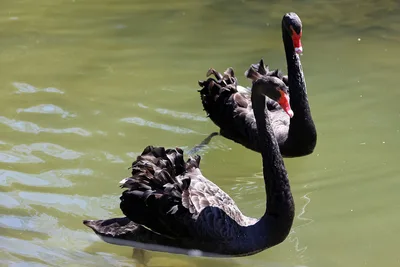 Black swan
Food web
Predators
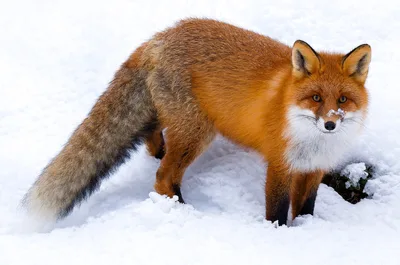 Red fox
- martens
- bears
- crows
Ecological equivalents
Related species on this site
African Fish Eagle (same genus), Bald eagle (same genus), Steller's sea eagle (same genus), Australian Firehawk (same family), Bearded vulture (same family), Black kite (same family), and more.
Birds
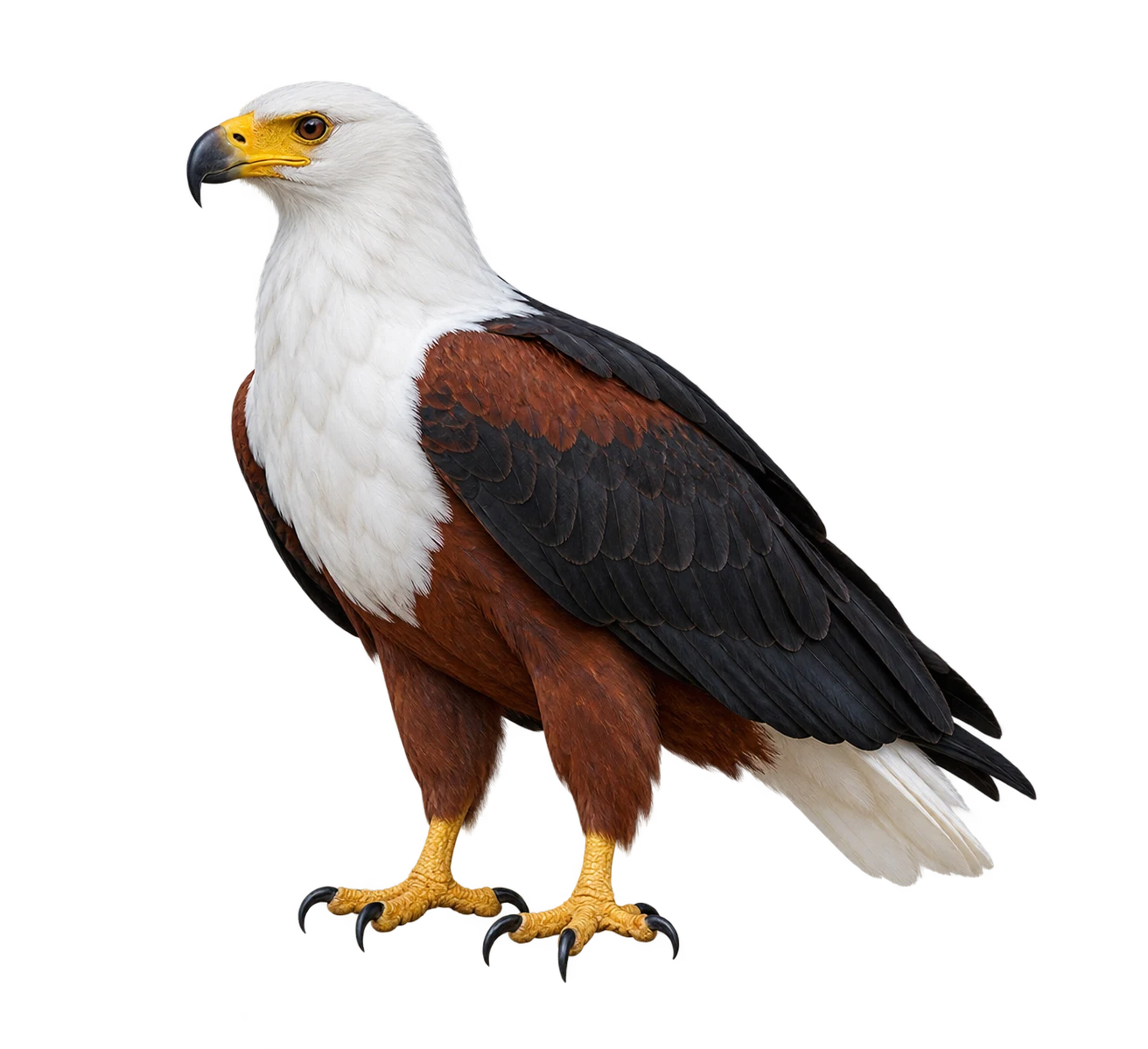
African Fish Eagle
Haliaeetus vocifer
Classification and source reference
LivingAI illustration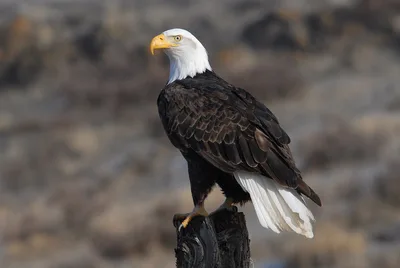 LC
Birds
Bald eagle
Haliaeetus leucocephalus
The bald eagle is the national bird of the United States.
Living VU
Birds
Steller's sea eagle
Haliaeetus pelagicus
Steller's sea eagle is the heaviest eagle in the world, a black and white fish hunter of the northeast Asian coast.
Living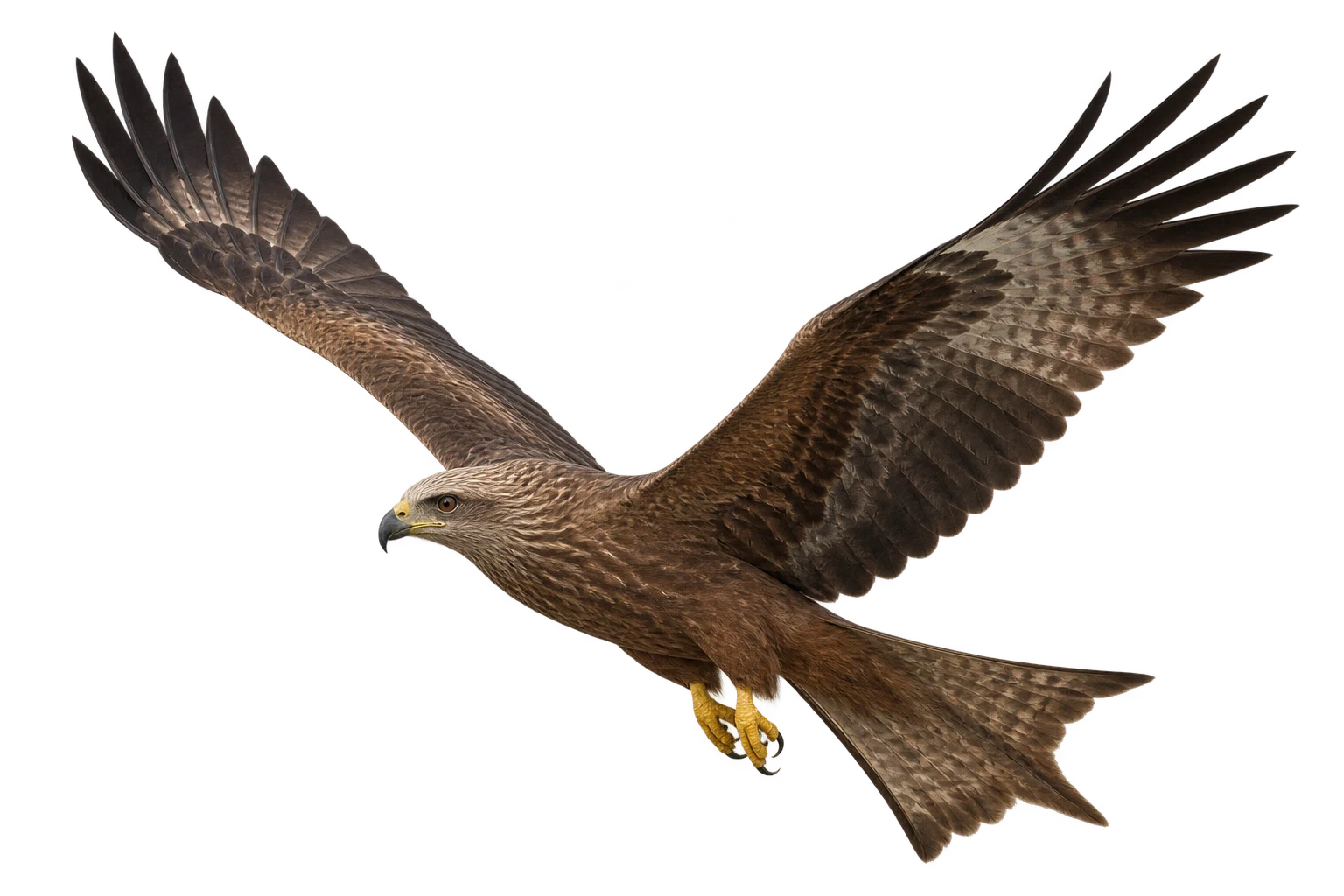
Birds
Australian Firehawk
Milvus migrans
Classification and source reference
LivingAI illustration NT
Birds
Bearded vulture
Gypaetus barbatus
The bearded vulture is a huge mountain raptor that lives almost entirely on bone.
Living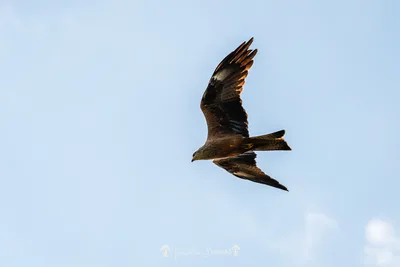 LC
Birds
Black kite
Milvus migrans
The black kite is a medium-sized raptor with angled wings and a forked tail.
Living