Great auk
The flightless diver of the North Atlantic
Pinguinus impennis
Also called Garefowl, Gairfowl, Spear bird
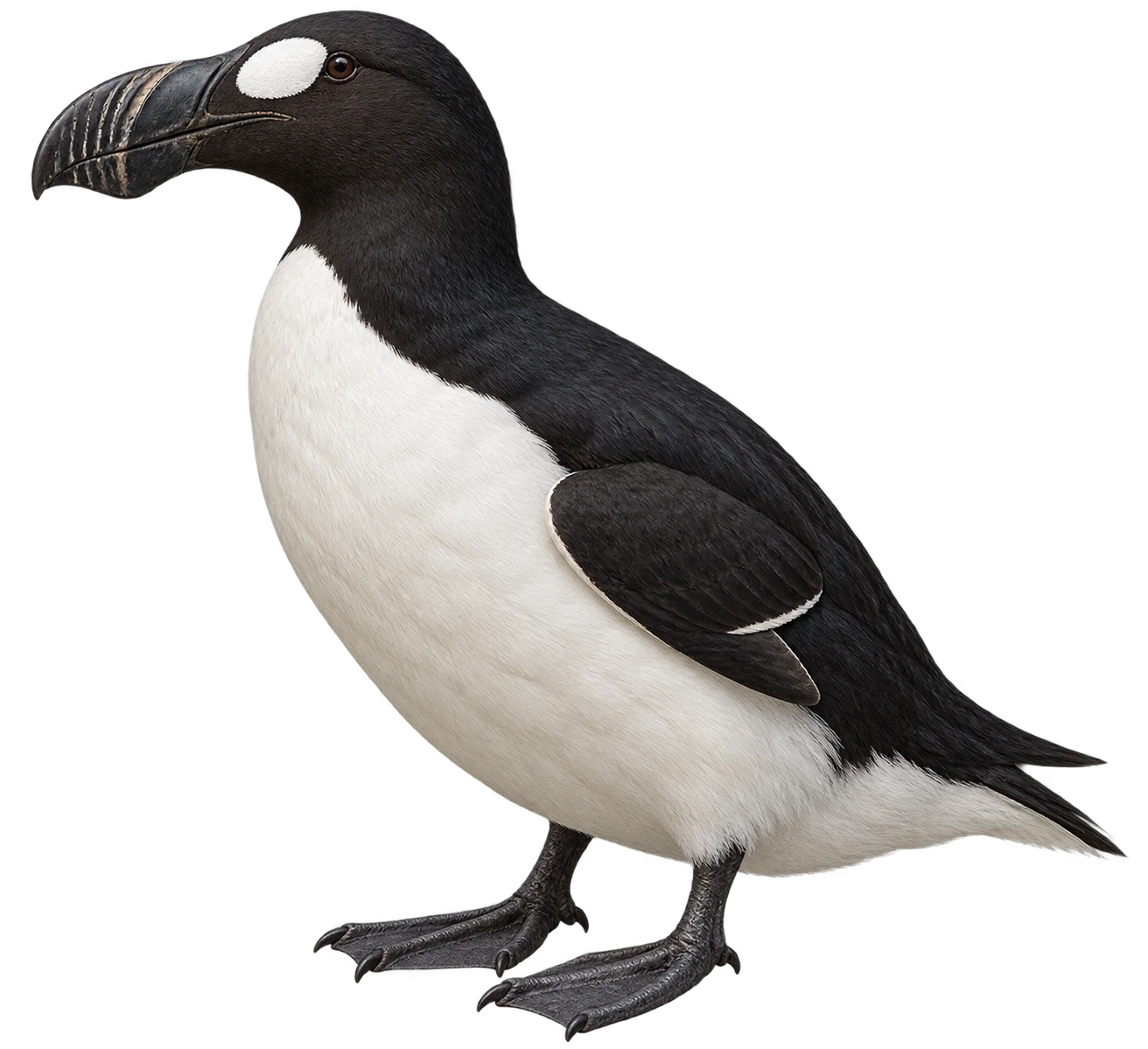
This animal is extinct. No living individuals remain.
Meet the great auk
The great auk was a large flightless seabird of the North Atlantic that swam with its wings and caught fish under water. Hunting for meat, eggs, oil and down destroyed it, and the last confirmed pair died in Iceland in 1844.
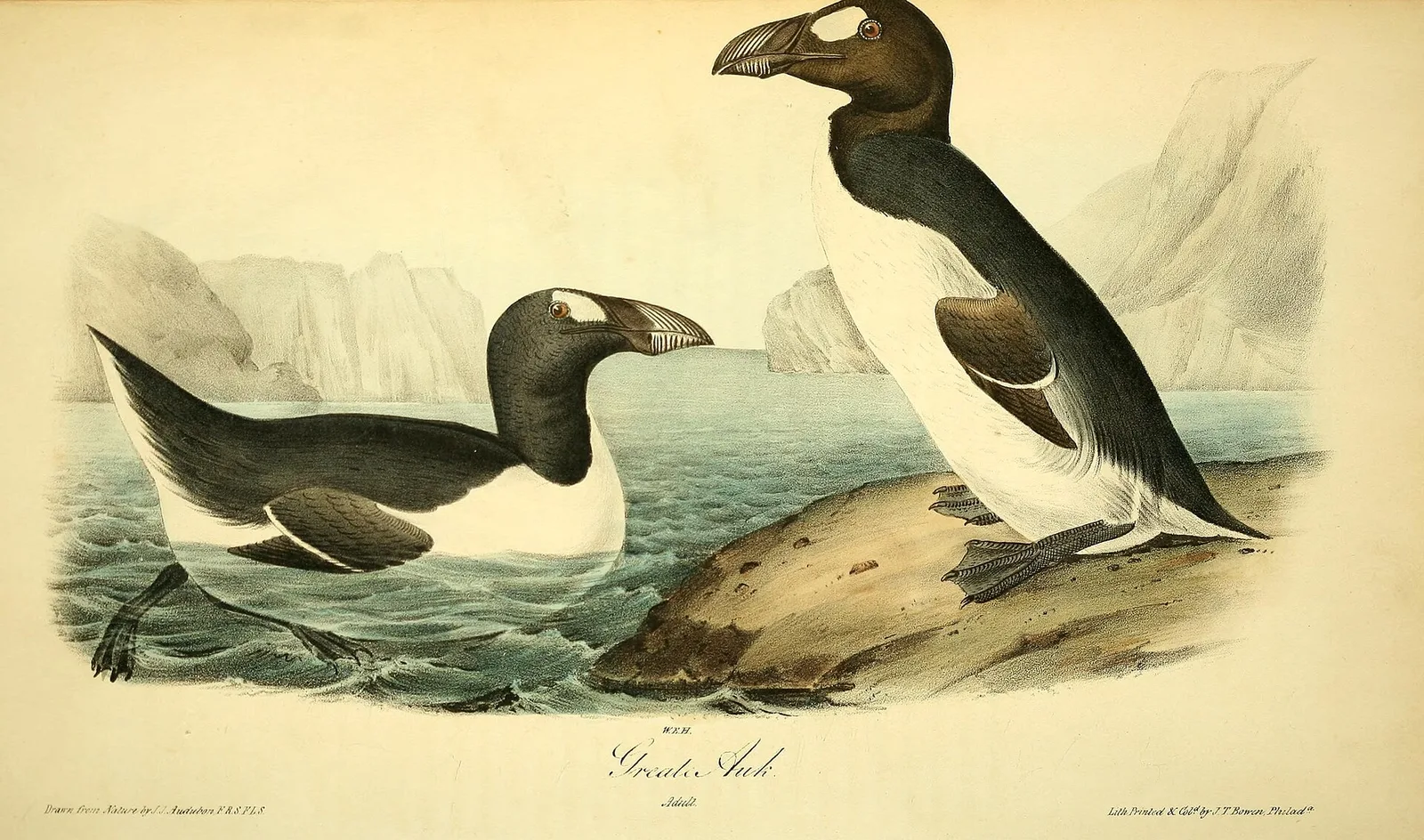
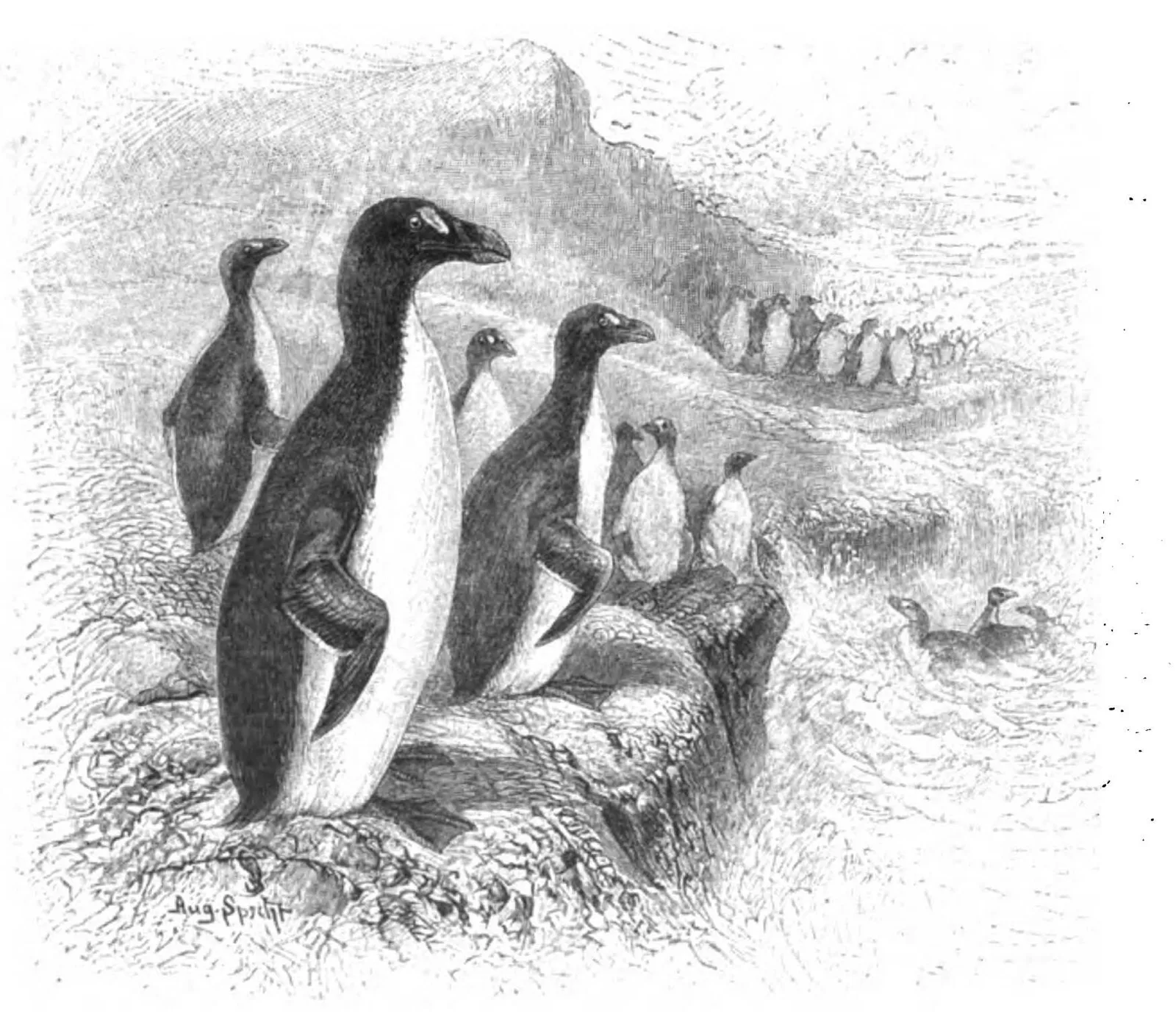
Images of the great auk
Lifespan in the wild
20 to 25 years an estimate; no one measured the lifespan of a wild bird
Weight
About 5 kg
Height
70 to 85 cm
Fact file
Great auk
- Location
- North Atlantic coasts and islands, from Canada to Norway
- Habitat
- Coast, Open ocean
- Diet
- Piscivore
- Prey / food
- Menhaden, capelin, cod, sand lance, sculpins, crustaceans
- Predators
- Orca, white-tailed eagle, polar bear at colonies; above all people
- Lifestyle
- At sea outside the breeding season, in dense island colonies to nest
- Group name
- Colony
- Name of young
- Chick
- Incubation
- Incubation 39 to 44 days
- Clutch size
- One egg a year
- Population
- None; the species is extinct
- Biggest threat
- Hunting for down, meat, eggs and museum specimens
- Distinctive feature
- Heavy grooved bill and a white patch before each eye
- Colour
- Glossy black above, white below
- Skin type
- Feathers
Size
Next to a person
Measurements
Size and speed
- Height
- 70 to 85 cm accounts give 70 to 75 centimetres standing; Wikidata records a height of 85
- Weight
- About 5 kg
Typical adult ranges. Source: Wikipedia.
Life cycle
Lifespan
- In the wild20 to 25 years an estimate; no one measured the lifespan of a wild bird
- 025 years
Source: Animal Diversity Web.
Appearance
Colour and coat
- Primary colours
- blackwhite
- Secondary colours
- yellowbrown
- Skin type
- feathers
- Male and female
- Slight. Males and females carried the same plumage. Measurements of bones suggest males had slightly longer bills and leg bones.
Life cycle
Mating and family
- Mating system
- monogamous pairs, thought to last for life
- Social structure
- dense breeding colonies, small groups at sea
- Breeding
- one egg a year, and none at all in poor food years
Great auks paired in early May and nested at the foot of low cliffs. The female laid a single egg on bare rock, and both birds sat on it for 39 to 44 days. The chick went to sea after two or three weeks and was still fed by its parents. Young birds bred first at four to seven years old. Estimates give a wild life of 20 to 25 years.
Classification
Taxonomy
- Kingdom
- Animalia
- Phylum
- Chordata
- Class
- Aves
- Order
- Charadriiformes
- Family
- Alcidae
- Genus
- Pinguinus
- Species
- Pinguinus impennis
Conservation
Red List status
- LC
- NT
- VU
- EN
- CR
- EW
- EX
Extinct on the IUCN Red List
Range
Historical range: 9 countries
This animal is extinct. The map shows historical records, not a current living population.
Habitat layer: mangrove.
Countries from 0 wild records on GBIF (iNaturalist research grade), filtered and checked by hand. Country shapes: Natural Earth. Habitat: RESOLVE Ecoregions 2017, CC BY 4.0. Basemap: Natural Earth.
Habitats
Three things to know
- 1
It was the largest auk to live into modern times, and it could not fly.
- 2
Its name penguin passed to the southern seabirds that later took the word.
- 3
Egg collectors and museums bought the last birds off the last colony.
Did you know
Seven more facts
- 1
The razorbill is the nearest living relative of the great auk.
- 2
The egg of a great auk held about three times the yolk of a murre egg.
- 3
Only 78 skins of the species survive in the world's museums.
- 4
The bird could hold its breath for about 15 minutes.
- 5
A volcanic eruption in 1830 sank the rock that held the last big colony.
- 6
Great Britain banned killing the bird for its feathers in 1794.
- 7
Neanderthals were eating great auks more than 100,000 years ago.
Field notes
How it looks and acts
Field notes
Distinguishing features
- A heavy black bill about 11 centimetres long, cut with deep white grooves.
- A broad white eye patch, worn only through the breeding season.
- Wings of only 15 centimetres, useless for flight but strong under water.
- Glossy black upper parts against a clean white breast and belly.
- An upright stance about 75 centimetres tall, the tallest of any auk.
- Legs set far back on the body, which forced a stiff walk.
Field notes
Unique adaptations
- The wings worked as paddles and drove the bird through the water.
- Dense bones and a heavy body probably helped the bird sink and stay down.
- Deep diving let the species feed where other auks could not follow.
- Black and white countershading hid the bird from prey below and above.
- Both parents grew brood patches, so either bird could sit on the egg.
Field notes
Interesting behaviours
- The birds bred in packed colonies on a handful of low rocky islands.
- Pairs bobbed their heads and showed the yellow inside of the mouth.
- Birds could shoot up out of the sea onto a rock ledge.
- In winter they travelled south in pairs or in small groups.
- Parents swam with the chick riding on the back.
Field notes
Temperament
- The bird showed almost no fear of a person walking towards it.
- It jabbed with the bill when a hand closed on it.
- One observer found some birds tame and others hard to approach.
- The species was social, and it fed and nested in company.
Field notes
Communication
- The recorded voice is a low croak and a rough scream.
- A captive bird gurgled when something worried it.
- Pairs used head bobbing and bowing at the nest site.
- The white eye patch and the grooved bill worked as display marks.
- Its calls were probably like the razorbill's, only deeper.
Ecology
Ecological role
The great auk was the North Atlantic answer to a penguin. It was a wing-propelled fish eater that carried sea nutrients onto a few small islands.
- It hunted mid-sized shoaling fish such as capelin and menhaden.
- Its dense colonies likely fed island soil with droppings, bone and eggshell.
- Deep diving separated it from the smaller auks that fed nearer the surface.
- Its loss appears to leave a diving niche that no North Atlantic bird has filled.
Stories
Myths and legends
- In St Kilda folklore a great auk could raise a storm, so the last one was killed as a witch.
- In Maritime Archaic burial custom, auk skins and beaks were laid with the dead.
- In Norse naming the bird was the spear bird, after its long heavy bill.
- In Beothuk cooking the eggs of the bird were made into a pudding.
- In the lore of the Grand Banks fishery, a great auk in sight meant land was near.
People
Relationship with humans
People
Living alongside us
People used the great auk for as long as the two shared a coast. Neanderthals ate it, Maritime Archaic people buried their dead with its beaks, and European crews filled ships with its meat. Down for pillows drove the killing hardest, and collectors finished the work. The last confirmed pair died in Iceland in 1844. The bird is now the standard example of an extinction that people caused.
- The great auk was harmless to people and hunted only fish.
- A cornered bird jabbed with its heavy bill, which may break skin.
- No account describes a great auk hurting anyone badly.
People
Status, uses and products
- Domestication
- Wild
- As a pet
- Not suitable. The species is extinct, so no one can keep one. The few captive birds kept in tubs did not last long. A great auk needed cold sea water and a daily catch of fish.
- Uses
- foodfishing baitlamp fuelmuseum and private collections
- Products
- meateggsdownfeathersoil
The full account
About the great auk
The great auk was a large flightless seabird of the cold North Atlantic. Adults stood about 75 centimetres tall and weighed about 5 kilograms. It swam with its small wings and caught fish under water. On land it walked slowly and could not escape a person on foot.
People took the birds for meat, eggs, oil and down for centuries. The species bred on a few rocky islands that boats could reach. Researchers think it never held more than 20 colonies at any time. Hunters killed the last confirmed pair on the Icelandic island of Eldey in 1844. A bird reported off Newfoundland in 1852 is the last record the IUCN accepts.
Name and taxonomy
Carl Linnaeus described the bird in the eighteenth century and called it Alca impennis. The genus Pinguinus was raised for it in 1791. The Latin word pinguis means plump, and impennis points to the missing flight feathers. The great auk was the only species of its genus to reach modern times.
The Norse called it geirfugl, the spear bird, and English took that as garefowl. The Basque name arponaz meant spear bill, and the Irish name meant big auk. An Inuit name for the bird, isarukitsok, meant little wing. In the sixteenth century, English writers applied the name penguin to the great auk. Sailors later gave the same word to the southern birds that look like it.
Evolution and relatives
Studies of mitochondrial DNA make the razorbill the nearest living relative. The little auk sits close to both, though it took a very different path. The oldest fossils of the modern species are about 400,000 years old. They come from a site in England and from a rock formation in Bermuda.
A sister species, Pinguinus alfrednewtoni, lived in the western Atlantic in the Early Pliocene. It was larger and also flightless, and it is known from bones found in North Carolina. After it died out, the great auk spread into the water it had held. Other flightless auks such as Mancalla were not close kin. Some writers kept the bird in the genus Alca because it looked so like a razorbill.
Appearance
An adult stood about 75 centimetres tall and weighed about 5 kilograms. That made it the largest auk to live into modern times. The back was glossy black and the breast and belly were white. The bill was heavy, hooked and about 11 centimetres long, with deep grooves. Inside the mouth the gape was bright yellow.
In summer a broad white patch sat in front of each eye. In winter that patch went, and a white band crossed between the eyes. The wings reached only 15 centimetres, far too short to lift the bird. The legs sat well back on the body, which gave power in water. Chicks were grey and downy, and no skin of a chick survives.
Habitat and range
The great auk lived in cold coastal water across the North Atlantic. Records run from Canada and Greenland to Iceland, Norway, Britain and Ireland. Birds sometimes reached northern Spain in the months away from the colonies. Ice age fossils show the species once ranged into Italy and the Mediterranean. In the west, bones have turned up as far south as Florida.
In winter the birds rarely went south of Massachusetts Bay. They came ashore only to breed, and rested on the sea the rest of the year. A colony needed a rocky island with a sloping shore the birds could climb. It also had to lie far enough out to keep bears and people away. Only seven colony sites are known by name, and Funk Island was the largest. Bones and specimens of the species are recorded in 21 countries on GBIF.
Diet and feeding
Adults ate fish and took them under water. Most prey ran 12 to 20 centimetres long and weighed 40 to 50 grams. Bones at the colonies point to menhaden and capelin as the usual catch. Cod, sand lance, sculpins, sticklebacks and crustaceans also appear in the remains. A big bird could swallow a fish half its own length.
The species fed over shallower water than the other auks of the region. Some studies place much of the feeding within 2 kilometres of the shore. Away from the colonies, birds were seen 500 kilometres out from land. Flocks are thought to have worked together to drive fish. Chicks probably ate plankton and food that the parents brought up.
Behaviour and social life
On land the great auk walked with short steps in a straight line. It used its wings to steady itself over rough rock. In water it was fast, and it could bank and turn while chasing fish. It dived to 75 metres, and sailors claimed far deeper dives. Most dives were shallow, which saved energy.
One account gives a held breath of 15 minutes, longer than a seal manages. A bird could drive upward and land on a ledge above the sea. Colonies were packed, and birds used the bill against neighbours and against people. The birds noticed sound but showed little fear of anything they saw. In winter they moved south in pairs or in small parties, never as a whole colony.
Communication and senses
Written accounts give the great auk a low croak and a hoarse scream. One captive bird made a gurgling sound when it was uneasy. The rest of its voice is lost, because no naturalist studied the species alive. Its calls probably resembled those of the razorbill, but deeper and louder. No recording exists, and no naturalist wrote down a full description of the sound.
A pair had a display in which both birds bobbed their heads. The display showed off the white eye patch, the grooved bill and the yellow gape. Observers also recorded head shaking and bowing between birds. The iris was hazel or chestnut, set in a white ring in young birds. Like other diving auks, it probably hunted by sight in clear water.
Reproduction and life cycle
Pairs formed in the first half of May. The birds are thought to have kept the same mate from year to year. They nested at the foot of cliffs in crowded groups. One estimate puts a sitting bird on every square metre of ground. Where other auks shared the site, the great auk took the best ground.
A female laid one egg a year, on bare rock, in late May or early June. She could lay again if that egg was lost. In years when fish were scarce the birds did not breed at all. The egg averaged 12.4 centimetres long and 7.6 centimetres across. It was pale with black or brown streaks, heaviest at the blunt end. Each pattern was different, which probably let a parent find its own egg.
Both parents sat upright over the egg for 39 to 44 days. The chick left the rock for the sea after two or three weeks. Its parents went on feeding it, and carried it on their backs while swimming. Young birds first bred at four to seven years old. A wild bird is estimated to have lived 20 to 25 years.
Predators and threats
The great auk had few enemies at sea. Orcas and white-tailed eagles took some birds. Polar bears reached some colonies and killed sitting birds. Ships put rats ashore on the nesting islands, and the rats ate eggs.
The Little Ice Age may have opened more colonies to bears. Recent work puts the weight of the loss on hunting by people. The down trade was the worst of it, because pillow makers paid well. Egg collectors learned that a colony could be robbed again and again. They kept the clean eggs and threw away the ones with a chick inside.
Population and conservation
At its peak the species is estimated to have numbered in the millions. Hunting on a large scale runs back to at least the eighth century. By the middle of the sixteenth century the European colonies were nearly all gone. The bird got its first official protection in 1553. A law of 1775 in St John's had feather hunters flogged in public. Great Britain banned killing the bird for feathers in 1794.
Funk Island, the largest colony, was empty by about 1800. A volcanic eruption sank the Icelandic stack Geirfuglasker in 1830. The survivors shifted to Eldey, an island with one shore that a boat could reach. Nearly fifty birds were counted there in 1835, and collectors began to buy skins. The last pair died on Eldey on 3 June 1844, with an egg under them. The IUCN lists the great auk as Extinct.
What is left is 78 skins, about 75 eggs and 24 whole skeletons. Thousands of loose bones came out of the soil of Funk Island. The eyes and organs of the last two birds are held in Copenhagen. DNA from those organs matched two museum skins, one in Brussels and one in Cincinnati. Some researchers argue about bringing the species back from that DNA. The debate probably turns on cost, on ethics and on where such a bird would live.
Relationship with humans
Neanderthals ate great auks more than 100,000 years ago. Cleaned bones lay around their fires, and cave art in Spain and France shows the bird. Coastal middens across Europe hold great auk bones over thousands of years. The Beothuk of Newfoundland made a pudding from the eggs. The Dorset hunted the bird, and the Saqqaq of Greenland cut back a local population.
European crews used colonies as a food store and as a source of bait. Some ships ran planks ashore and drove birds aboard in numbers. An egg was worth taking because it held three times the yolk of a murre egg. Sailors also read a sighting as a sign that the Grand Banks lay ahead.
Once the bird was gone, its remains became expensive. An Icelandic museum paid 9000 pounds for a mounted bird in 1971. Britain now holds 15 specimens, more than any other country. Two mounted birds were destroyed in the twentieth century, one by war and one by fire.
In culture and myth
In July 1840 three men on St Kilda caught the last great auk seen in Britain. They kept it alive for three days, and then a storm blew up. They decided the bird was a witch raising the weather and beat it to death. The story is the best known piece of folklore about the species.
The bird mattered to Maritime Archaic people on the Newfoundland coast. One grave at Port au Choix held a body under more than 200 auk beaks. The beaks are read as the trim of a cloak made from the skins. Nearly half the bird bones in that burial ground came from the great auk.
Charles Kingsley gave the last gairfowl a speech in The Water-Babies in 1863. Anatole France built a satirical history around the bird in Penguin Island in 1908. James Joyce mentions it in Ulysses as a character falls asleep. The journal of American ornithology carried the name The Auk until 2021. Today the bird stands as an emblem of extinction caused by people.
A sentence with a dotted underline is inferred: it describes the group the animal belongs to, or is a reading of the sources, rather than a measured or reported fact about this species.
Questions
Great auk questions, answered
When did the great auk go extinct?
Hunters killed the last confirmed pair on Eldey, off Iceland, on 3 June 1844. The IUCN accepts a sighting off Newfoundland in 1852 as the final record.
Why did the great auk go extinct?
People killed it faster than it could breed. Down for pillows, meat, oil and eggs drove most of the loss, and museum collectors bought the last birds.
Could the great auk fly?
No. Its wings reached only 15 centimetres, which is far too small to lift a bird of this weight. It used them to swim instead.
How big was the great auk?
The bird reached about 75 centimetres in height and about 5 kilograms in weight. No other auk of modern times grew so large.
Was the great auk a penguin?
No. It was an auk, and southern penguins are only distant kin. Sailors handed the great auk's old name to those birds because the two looked alike.
What did the great auk eat?
It ate fish of about 12 to 20 centimetres, mostly menhaden and capelin. It also took cod, sand lance, sculpins and crustaceans.
How deep could a great auk dive?
Records give dives to 75 metres. Most dives were much shallower, which saved the bird energy.
Where did the great auk live?
It lived in the cold North Atlantic, from Canada and Greenland to Iceland, Norway, Britain and Ireland. It bred on a small number of rocky islands.
How many eggs did a great auk lay?
One a year, laid on bare rock. A female could lay a second egg if she lost the first, and she skipped the season when food was short.
How long did great auks live?
Estimates give 20 to 25 years in the wild. No one measured a wild bird, so the figure comes from other large seabirds.
Which living bird is the great auk's nearest relative?
The razorbill. Genetic work agrees with the bones and with where the two birds lived.
How many great auk specimens are left?
About 78 skins, roughly 75 eggs and 24 complete skeletons survive. Britain holds 15 of the skins, more than any other country.
Did the great auk have any natural predators?
Few. Orcas and white-tailed eagles took birds at sea, and polar bears raided some colonies.
Can scientists bring back the great auk?
Some researchers want to try, using DNA from museum specimens. The idea is argued over, and nothing has been brought back so far.
Why is the great auk important today?
It shows how fast steady hunting can end a common species. Its name is attached to bird science, and its story shaped early wildlife protection laws.
Food web
Prey and food
- menhaden
- capelin
- cod
- sand lance
- sculpins
- crustaceans
Food web
Predators
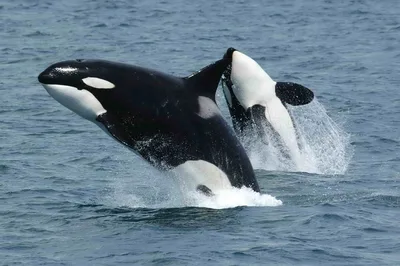 Orca
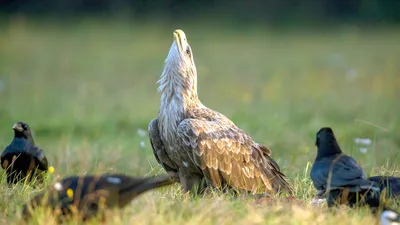 White-tailed eagle
- polar bear at colonies
- above all people
Ecological equivalents
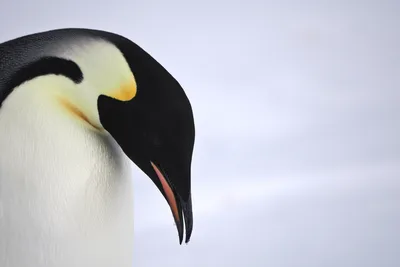
Related species on this site
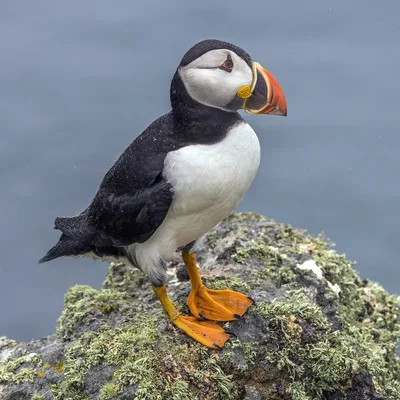
Atlantic puffin (same family), Puffin (same family), Razorbill (same family), African Jacana (same order), Bronze-winged Jacana (same order), Comb-crested Jacana (same order), and more.
 VU
Birds
Atlantic puffin
Fratercula arctica
The Atlantic puffin is a small black and white seabird with a bright triangular bill.
Living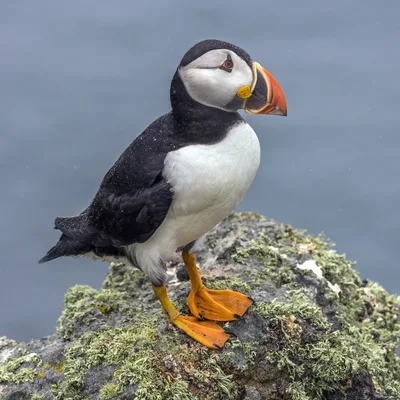
Birds
Puffin
Fratercula
Puffins are diving seabirds.
Living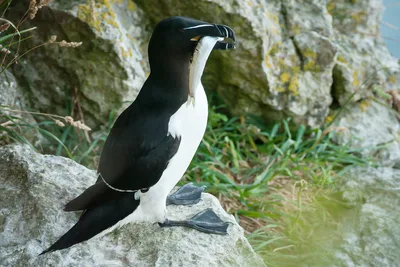 LC
Birds
Razorbill
Alca torda
The razorbill is a black and white North Atlantic auk with a deep, blade-like bill.
Living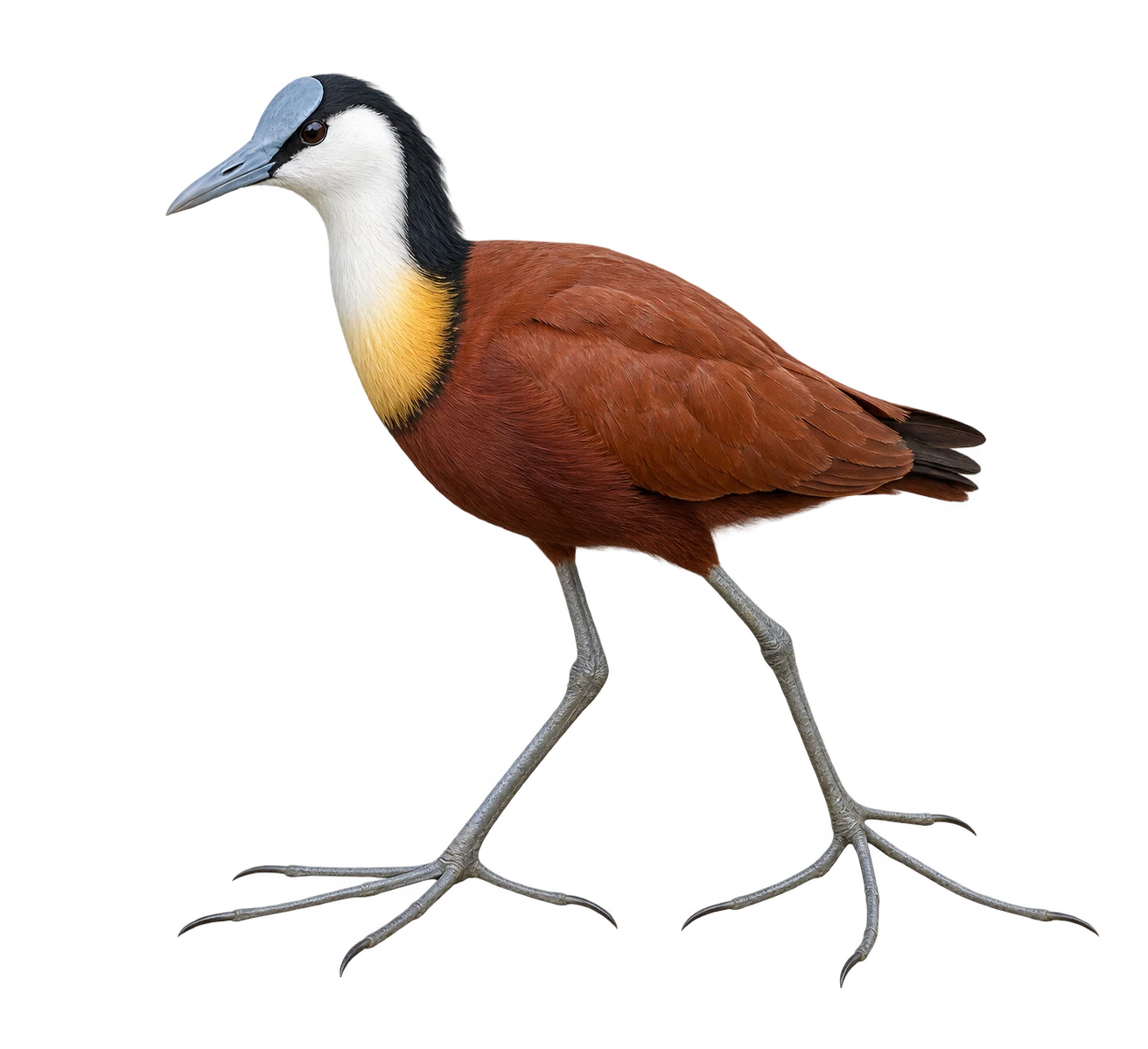
Birds
African Jacana
Actophilornis africanus
Classification and source reference
LivingAI illustration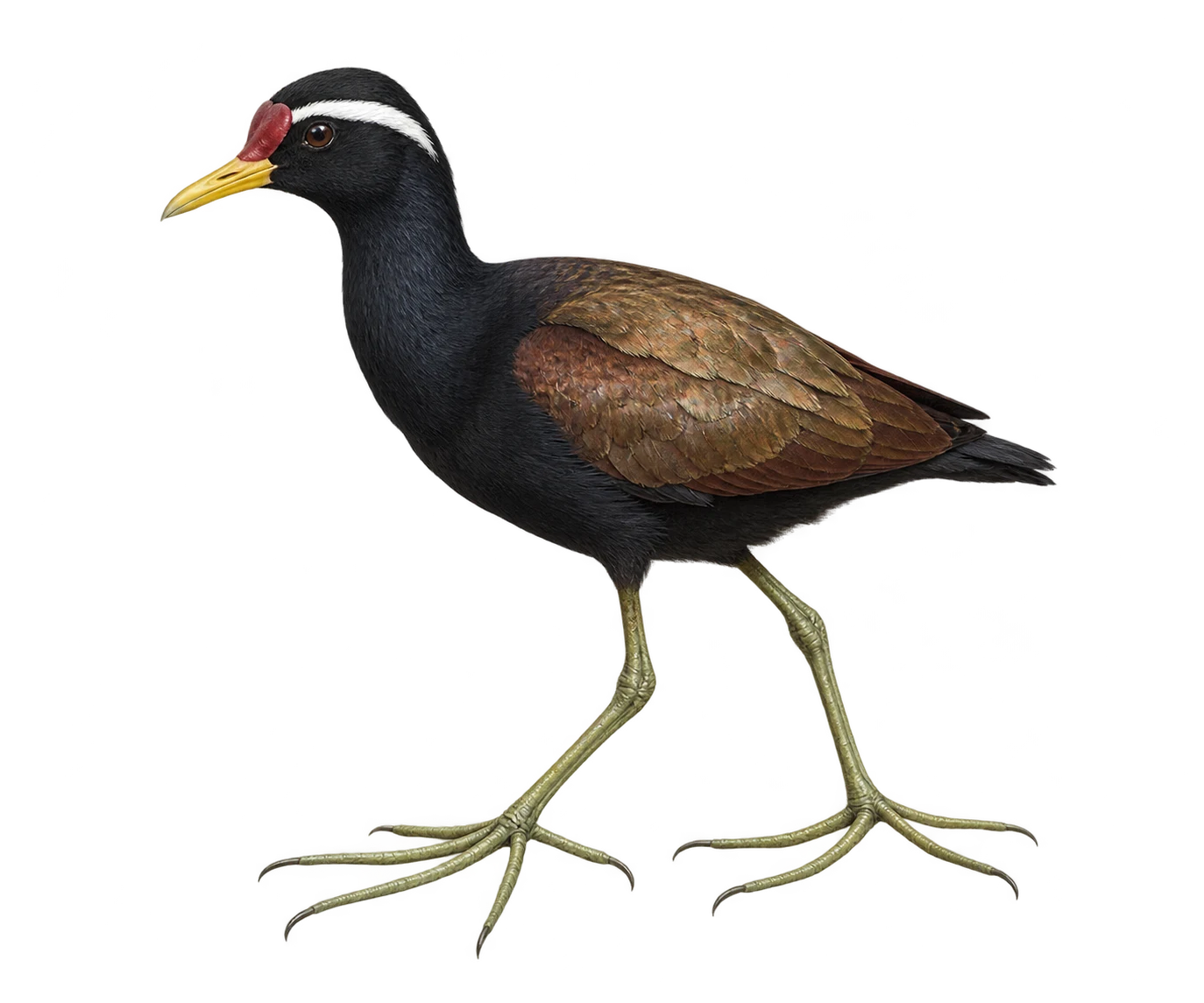
Birds
Bronze-winged Jacana
Metopidius indicus
Classification and source reference
LivingAI illustration
Birds
Comb-crested Jacana
Irediparra gallinacea
Classification and source reference
LivingAI illustration