Steller's sea eagle
The heaviest eagle on earth fishes the ice of the Pacific
Haliaeetus pelagicus
Also called Pacific sea eagle, White-shouldered eagle, Steller's fish eagle
Living individuals or members of this group exist today. This does not mean they are safe from extinction.
Meet the steller's sea eagle
Steller's sea eagle is the heaviest eagle in the world, a black and white fish hunter of the northeast Asian coast. It breeds in far eastern Russia and winters on the drift ice around Hokkaido.
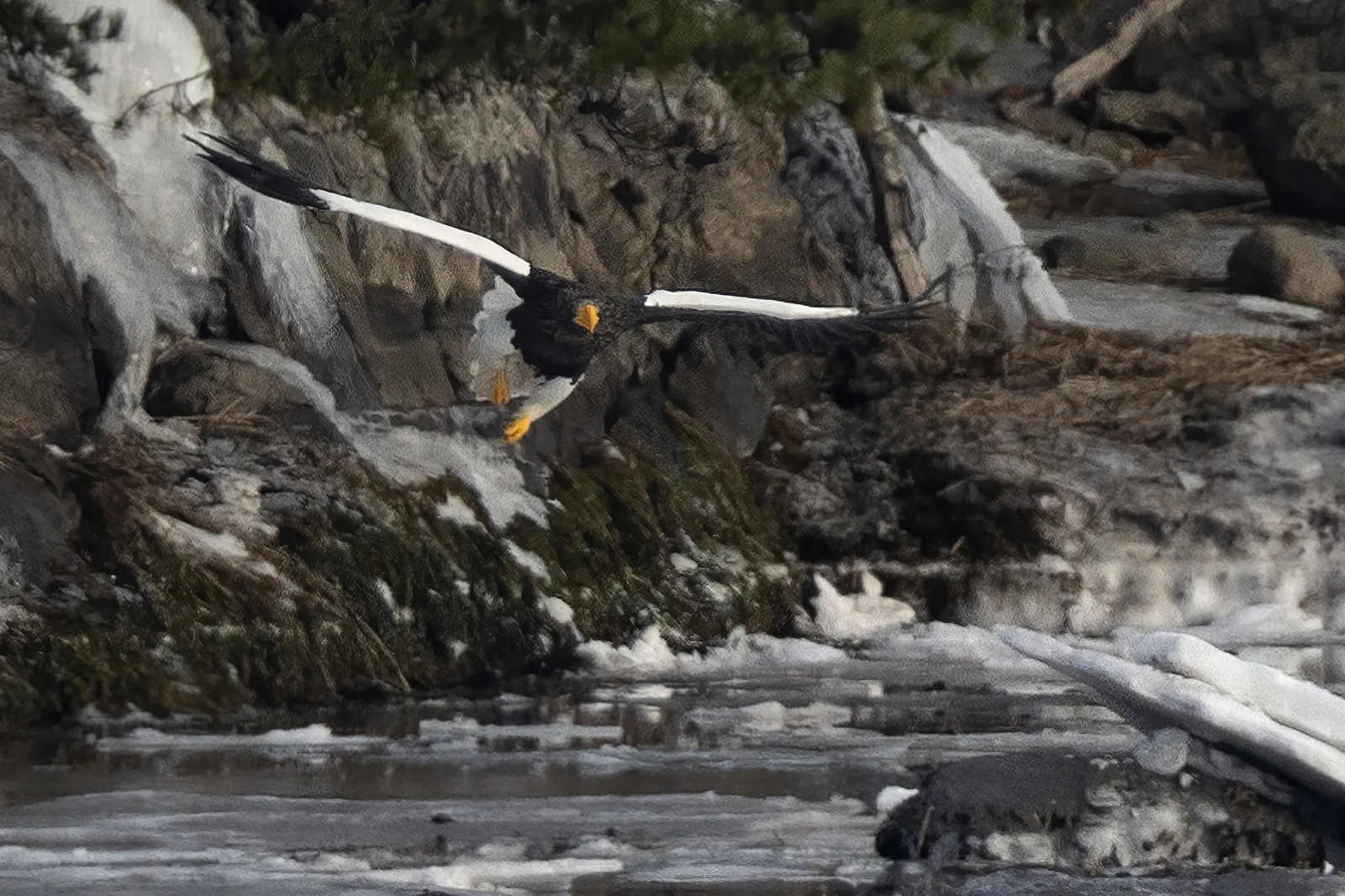
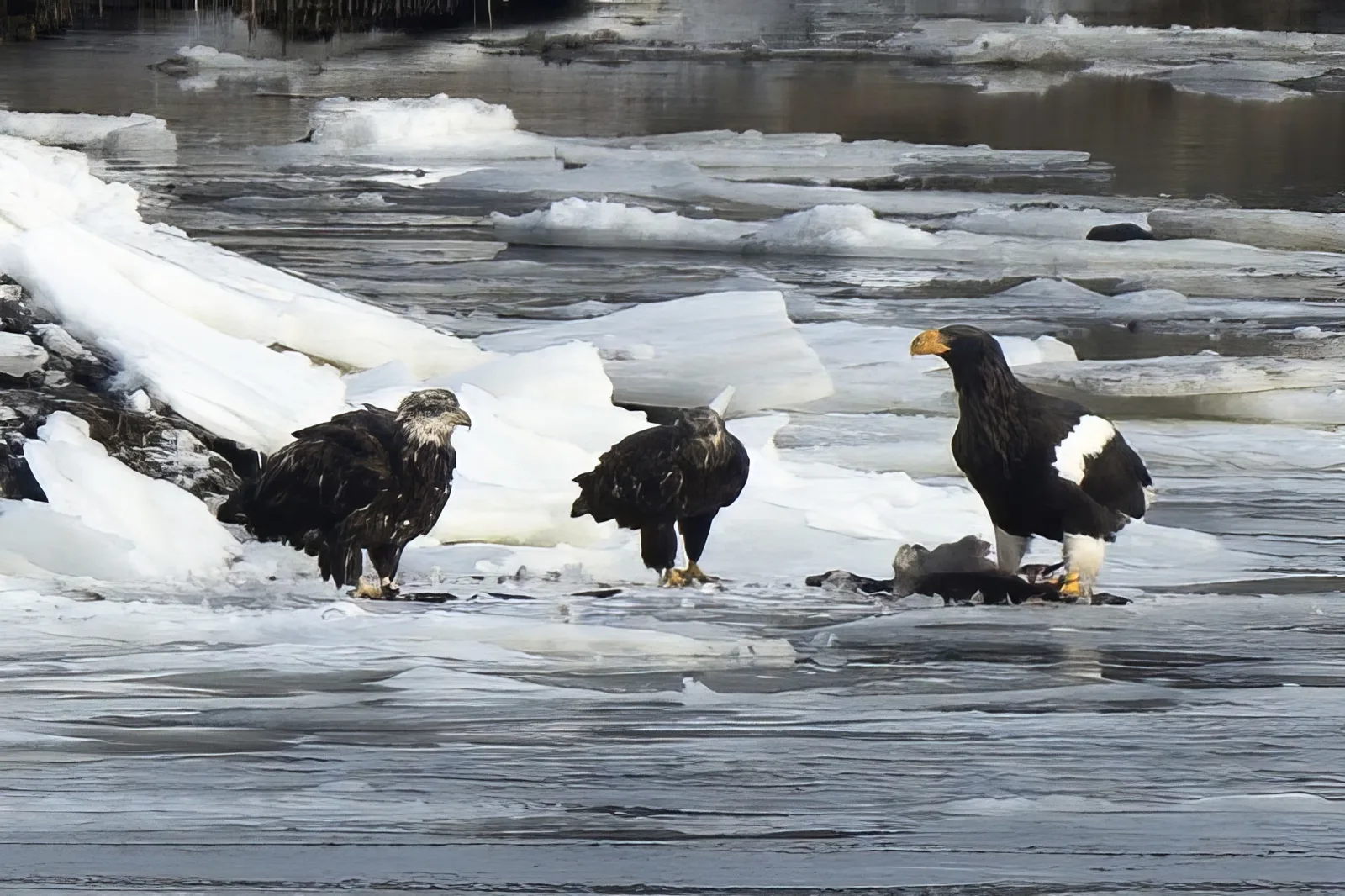
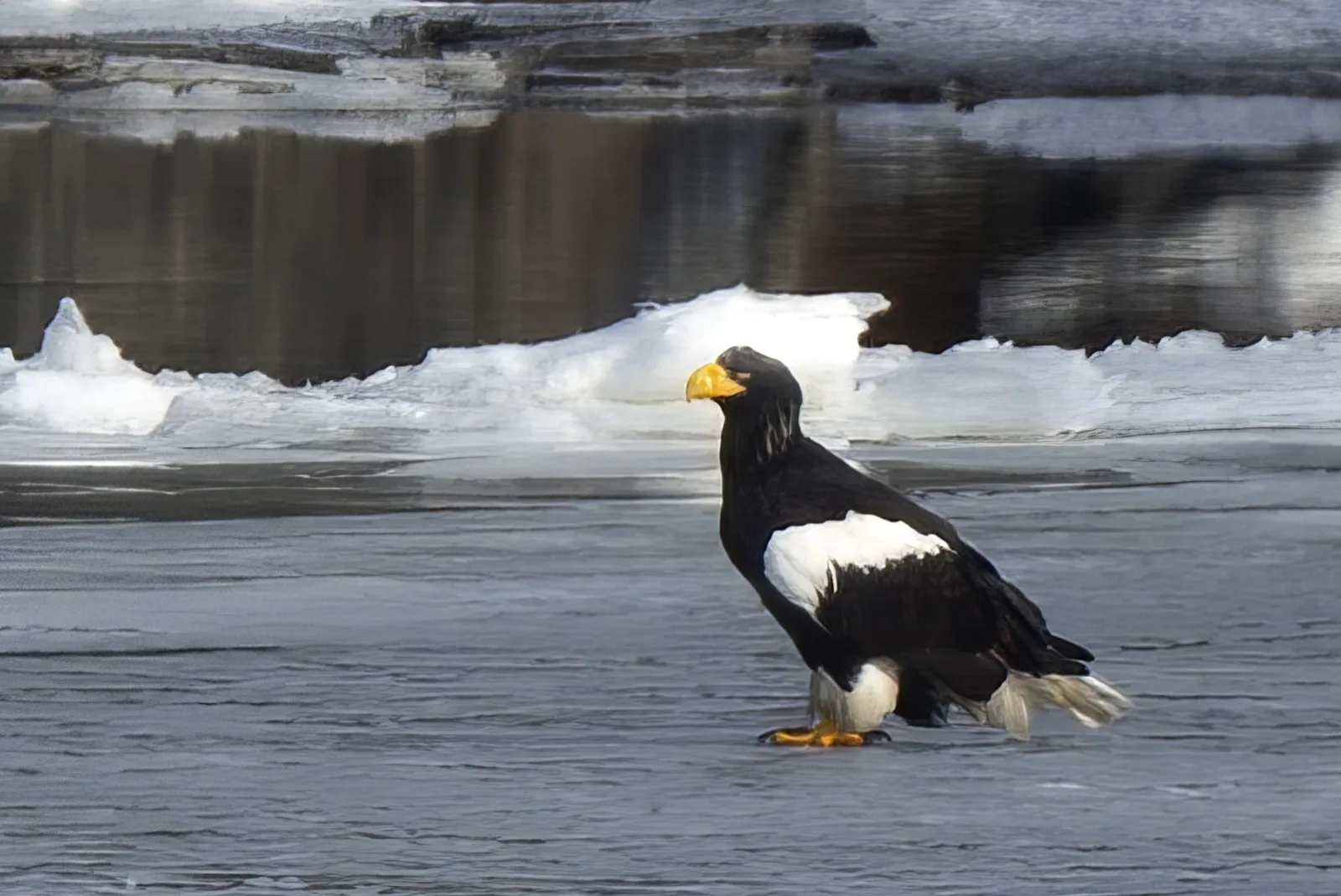
Images of the steller's sea eagle
Lifespan in the wild
20 to 25 years no direct figure exists; ADW infers the range from the closely related white-tailed eagle
Weight
4.9 to 9.5 kg
Length
0.85 to 1.05 m
Wingspan
1.95 to 2.5 m
Fact file
Steller's sea eagle
- Location
- Kamchatka, the Sea of Okhotsk, the Amur, Sakhalin and Hokkaido
- Habitat
- Coast, Rivers and lakes, Temperate forest
- Diet
- Piscivore
- Prey / food
- Pink and chum salmon, trout, cod, pollock, gulls, murres, hares, carrion
- Predators
- None as adults; sables, ermines and crows take eggs
- Lifestyle
- Diurnal, solitary, and migratory in part
- Group name
- Convocation
- Name of young
- Eaglet
- Incubation
- Incubation 39 to 45 days
- Clutch size
- 1 to 3 eggs, usually 2
- Population
- About 5,000 birds and falling
- Biggest threat
- Lost habitat, overfishing and lead poisoning
- Distinctive feature
- A huge yellow bill and white shoulders
- Colour
- Dark brown to black with white shoulders, thighs and tail
- Skin type
- Feathers
Size
Next to a person
Measurements
Size and speed
- Length
- 0.85 to 1.05 m males average about 89 cm and females about 100 cm
- Wingspan
- 1.95 to 2.5 m the median is about 213 to 220 cm
- Weight
- 4.9 to 9.5 kg males 4.9 to 6.8 kg, females 6.2 to 9.5 kg
- Weight, male
- 4.9 to 6.8 kg
- Weight, female
- 6.2 to 9.5 kg
Typical adult ranges. Source: Wikipedia.
Life cycle
Lifespan
- In the wild20 to 25 years no direct figure exists; ADW infers the range from the closely related white-tailed eagle
- 025 years
Source: Animal Diversity Web.
Appearance
Colour and coat
- Primary colours
- brownwhite
- Secondary colours
- yellowblack
- Skin type
- feathers
- Male and female
- Marked. Females are much heavier, at 6.2 to 9.5 kg against 4.9 to 6.8 kg for males, and average about 11 cm longer. The plumage of the two sexes is the same.
Life cycle
Mating and family
- Mating system
- monogamous pairs, probably for life
- Social structure
- solitary, except at rich feeding grounds
- Breeding
- one clutch a year, laid in April or May
A pair keeps two to four huge stick nests in one territory and uses them in turn. The female lays one to three greenish-white eggs, and two is usual. The eggs need about 39 to 45 days of sitting. The parents bring two or three fish a day to the nest. The young fly in August or September, and usually only one chick survives to adulthood.
Classification
Taxonomy
- Kingdom
- Animalia
- Phylum
- Chordata
- Class
- Aves
- Order
- Accipitriformes
- Family
- Accipitridae
- Genus
- Haliaeetus
- Species
- Haliaeetus pelagicus
Conservation
Red List status
- LC
- NT
- VU
- EN
- CR
- EW
- EX
Vulnerable on the IUCN Red List
Range
Recorded in 6 countries
Habitat layer: temperate broadleaf and mixed forest, temperate conifer forest, boreal forest and taiga, flooded grassland and savanna, mangrove.
Countries from 1,245 wild records on GBIF (iNaturalist research grade), filtered and checked by hand. Country shapes: Natural Earth. Habitat: RESOLVE Ecoregions 2017, CC BY 4.0. Basemap: Natural Earth.
Habitats
Three things to know
- 1
A female can weigh 9.5 kilograms, more than any other eagle.
- 2
No living eagle carries a bigger bill.
- 3
Each winter the Okhotsk drift ice carries thousands of these eagles south to Japan.
Did you know
Seven more facts
- 1
The bird carries 14 tail feathers, while other sea eagles carry 12.
- 2
Rough bumps on the soles of the feet stop a wet fish slipping free.
- 3
It is the only sea eagle whose young already have a yellow bill.
- 4
The dark form was thought extinct after 1968, then hatched in captivity in 2001.
- 5
One eagle was filmed chasing and robbing a cinereous vulture in flight.
- 6
No other living eagle carries so large a bill.
- 7
About 35% of the birds wintering in Japan move inland to eat dead sika deer.
Field notes
How it looks and acts
Field notes
Distinguishing features
- A very large yellow bill, deeper than that of any other eagle.
- White shoulders and white thighs against a dark brown body.
- A white tail shaped like a diamond.
- A wingspan of 195 to 250 cm and a weight of up to 9.5 kg.
- Broad, paddle-shaped wings in flight.
- Short, stout toes with strongly curved talons.
Field notes
Unique adaptations
- Spicules on the sole of the foot that grip a slippery fish.
- Short curved talons suited to fish rather than to mammals.
- A huge bill that dismembers a seal carcass where it lies.
- A heavy body that probably holds heat through a subarctic winter.
- A willingness to eat carrion when live fish are locked under ice.
Field notes
Interesting behaviours
- Watching for fish from a perch 5 to 30 metres above the water.
- Standing on a sandbank or ice floe to grab a passing fish.
- Robbing other eagles and ospreys of their catch.
- Gathering by the hundred on a spawning river in late summer.
- Following the drift ice south to Hokkaido each winter.
Field notes
Temperament
- Solitary for most of the year, and tolerant of company only at food.
- More aggressive and more active than the bald or white-tailed eagle.
- Wary of people it does not know.
- Dangerous in the hand, with a grip that can pierce an arm.
Field notes
Communication
- A deep barking cry, written as ra-ra-ra-raurau.
- Honking notes that recall a Canada goose.
- A deep gull-like call between a pair in the courtship season.
- A soaring display flight over the nesting ground.
- Bold plumage that may signal age and rank at a carcass.
Ecology
Ecological role
Steller's sea eagle is the top predator of the northeast Asian coast, and it moves nutrients from spawning rivers into the forest.
- It takes large numbers of pink and chum salmon on the spawning rivers.
- It preys on murres, kittiwakes, gulls and other seabirds along the coast.
- It clears the carcasses of seals, sea lions and deer in winter.
- Its abandoned nests and fish scraps probably feed a range of smaller animals.
Stories
Myths and legends
- In Japanese tradition, the bird is o-washi, the great eagle, and the state protects it as a treasure.
- In Korean tradition, the name chamsuri sets it apart as the true eagle.
- In Chinese usage, the name calls it the tiger-headed sea eagle.
- In Russian usage, the name marks out the white shoulders.
- In modern birding culture, the wanderer called Stella has become a celebrity.
People
Relationship with humans
People
Living alongside us
Steller's sea eagle depends on the same fish that people catch. Cod fishing off Hokkaido helps to feed the wintering birds, and the eagles walk close to fishermen they know. Russian trappers shoot eagles that raid their traps. Hunters who leave a shot deer behind poison the birds with lead. Eagle watching on the drift ice now brings visitors to northern Japan.
- The eagle keeps away from people and has never been recorded attacking anyone in the wild.
- A handled bird is dangerous, and one female drove her talons through a vet's arm.
- A defending parent may strike at a person who climbs to its nest.
People
Status, uses and products
- Domestication
- Wild
- As a pet
- Not suitable. This is a protected species in Russia, Japan, China and South Korea, and it is listed on CITES Appendix II. A bird of 9 kilograms needs several kilograms of fish a day and a very large flight space. Only zoos and licensed breeding centres keep it.
- Uses
- eagle watchingwildlife photography
- Products
- None recorded
The full account
About the steller's sea eagle
Steller's sea eagle is the heaviest eagle in the world. It is dark brown to black, with white shoulders, white thighs and a white wedge of tail. The bill and the feet are bright yellow. A female weighs 6.2 to 9.5 kilograms, and a male 4.9 to 6.8 kg. The body measures 85 to 105 centimetres and the wings span 195 to 250 cm.
The species breeds only on the coasts of far eastern Russia. Many birds move south in winter to Japan, Korea and northern China. It hunts salmon and other fish in shallow water and takes seabirds as well. About 5,000 birds survive, and the number is falling. The IUCN Red List places the species in the Vulnerable category. Japan protects it as a national treasure, and most Russian nest sites lie in reserves.
Name and taxonomy
Peter Simon Pallas described the bird in 1811 as Aquila pelagica. The species name comes from the Greek word for the open sea. Coenraad Jacob Temminck renamed it the white-winged eagle in 1824. In 1832 Heinrich von Kittlitz gave it the name Falco imperator. George Robert Gray placed it in the genus Haliaeetus in 1849. The International Ornithologists' Union settled on the English name Steller's sea eagle.
The name honours Georg Wilhelm Steller, a German naturalist who lived from 1709 to 1746. He sailed with Vitus Bering on the second Kamchatka expedition. A jay, an eider, a sea lion and the extinct sea cow all carry his name too. Russian speakers call the bird the white-shouldered sea eagle. In Japanese it is o-washi, the great eagle, and in Mandarin the tiger-headed sea eagle. The Korean name chamsuri means true eagle.
Evolution and relatives
The species belongs to Haliaeetus, the sea and fish eagles. It is the largest bird in that genus. A study of mitochondrial DNA in 1996 dated its split from its nearest kin. It parted from the line of the bald eagle and the white-tailed eagle three to four million years ago. Those three share yellow eyes, bills and talons, which Pallas's fish eagle lacks. Its size and its narrow range suggest a relict of the ice ages.
No subspecies are accepted. A dark form without white on the wings was once named as one. That bird was last seen in the wild in 1968 and was thought to be gone. A dark female then hatched in a German breeding centre in 2001. Both her parents wore normal plumage, which showed the dark form to be a rare colour morph. One of her sons, hatched in 2014, is dark as well.
Appearance
The adult is dark brown or black over most of the body. White marks the shoulders, the thighs, the under-tail and the leading edge of the wing. The tail is white and shaped like a diamond. It carries 14 tail feathers, where other sea eagles carry 12. The body measures 85 to 105 cm, and males average about 89 cm against 100 cm for females. The wingspan runs 195 to 250 cm, with a median near 2.13 metres.
The bill is enormous and probably the largest of any living eagle. The skull measures about 14.6 cm and the upper bill 62 to 75 millimetres. The legs and tail are short for such a big eagle. The toes are short and stout, and the talons are short and strongly curved. Rough bumps called spicules cover the sole of each foot and grip a wet fish. One veterinarian was badly hurt when a female drove her talons through his arm.
A newly hatched chick wears silky white down that soon turns smoky grey-brown. A juvenile is a uniform sooty brown, with a white tail mottled in black. Its eyes are dark brown, its legs whitish and its bill blackish. The bird passes through at least three intermediate plumages. Full adult colours appear in the fourth or fifth year. Even a young bird has a yellow bill, which no other sea eagle shows.
Habitat and range
The eagle breeds on the Kamchatka Peninsula and around the Sea of Okhotsk. It also nests on the lower Amur River, on northern Sakhalin and on the Shantar Islands. Nests sit on rocky outcrops or in tall trees by the coast or a large river. The birds favour stands of Erman's birch and floodplain forest of larch, alder, willow and poplar. They keep close to sea level, and inland records are rare. GBIF holds occurrence records from 22 countries and territories.
Winter drives many birds south. Drifting ice on the Sea of Okhotsk pushes thousands towards Japan every year. The ice reaches Hokkaido in late January, and eagle numbers in the Nemuro Strait peak in late February. Birds gather on the coast and on lakes near it, beside many white-tailed eagles. They leave between late March and late April, with the adults going first. Coastal nesters may skip the journey altogether when the water stays open.
The species wanders less than the white-tailed eagle does. Even so, stray birds have reached the Aleutians, the Pribilofs and Kodiak Island. One bird has toured North America since August 2020, when it appeared near Denali. It then turned up in Texas, in Atlantic Canada, in Massachusetts and along the coast of Maine. Wing marks show that every sighting belongs to the same eagle. Birders nicknamed it Stella, and their travel gave a lift to local businesses.
Diet and hunting
The eagle sits at the top of its food web and lives mainly on fish. Pink salmon and chum salmon are the favourites on the rivers. Grayling and three-spined stickleback fill in when salmon are scarce. A mature pink salmon averages about 2.2 kilograms and a chum about 5 kg. The eagle often takes fish of 6 to 7 kg. Along the coast it also takes wolffish, lumpfish and sculpins.
On the Amur, fish supply roughly 80% of what the eagles eat. Elsewhere other prey makes up nearly half of it. Seabirds are the second staple, above all murres, kittiwakes and slaty-backed gulls. Ducks, geese, swans, cranes and herons all appear in the diet. Grouse and ptarmigan matter in Russia, and no other sea eagle takes them often. The bird also kills sables, minks, foxes, voles, hares and small dogs.
Most hunting happens from a perch 5 to 30 metres above the water. The eagle may also circle 6 to 7 m up and drop onto its prey. Sometimes it simply stands on a sandbank or an ice floe and grabs a passing fish. Carrion matters in winter, and it will strip a seal or a sea lion where it lies. About 35% of the birds wintering in Japan move inland to feed on dead sika deer. One study estimated that seal pups carried away in flight weighed at least 9.1 kg.
Behaviour and social life
The eagle is active by day and usually alone. Rich food brings it together in numbers all the same. Spawning rivers draw crowds from August into September. Gatherings of as many as 700 birds have been reported on Kamchatka. Outside the breeding season the birds probably roost together near their feeding grounds. Migrants travel singly, and a loose group keeps 100 to 200 m apart.
Where eagles feed in a group, food theft is common. Adults gain most from it, though young birds try it just as often. The bold black and white pattern may help the birds sort out rank at a carcass. The species is described as more aggressive and more active than its two close relatives. It robs ospreys where the two overlap. One bird was filmed chasing and robbing a cinereous vulture, the largest of all accipitrids.
Size does not settle every contest. A golden eagle has been filmed pushing a young Steller's off its fish. Smaller eagles sometimes take a fish from a distracted bird face to face. At other times three eagle species feed side by side and ignore each other. Competition turns fierce inland, where food and nest sites are both scarce. On these rivers golden eagles depend on fish, which happens nowhere else in their range.
Communication and senses
The usual call is a deep barking cry, written as ra-ra-ra-raurau. The bird also gives honking notes that recall a Canada goose. An angry bird sounds like a white-tailed eagle but deeper. During the courtship display a pair calls like very loud, deep-voiced gulls. The display itself is a soaring flight above the nesting ground.
Sight probably does most of the work for a fish-hunting raptor. The eagle spots a fish from a perch tens of metres up and dives on it. It also reads other eagles, and it tells a familiar person from a stranger. Birds on Hokkaido walk within a few feet of fishermen they know. They keep their distance when a stranger stands on the same ice. The plumage pattern may itself carry a signal to other eagles.
Reproduction and life cycle
The breeding season runs from February through August. Nest building starts in February or March, and the display flights follow in March. A pair keeps two to four nests in one territory and uses them in turn. A nest is a bulky pile of sticks up to 1.5 metres deep and 2.5 m across. It sits 15 to 20 m up a tree or on a rock, and sometimes as high as 45 m. Alternate nests usually stand within 900 m of each other.
Pairs were long thought to stay together for life. Genetic work found chicks that closely resemble chicks from other nests. That result may point to occasional mating outside the pair. The greenish-white eggs arrive in April or May. Each egg measures about 78 to 85 mm long and weighs around 160 grams. A clutch holds one to three eggs, and two is the average.
Incubation lasts about 39 to 45 days. The chicks hatch helpless and covered in white down. Parents bring two or three live fish of 20 to 30 cm to the nest each day. The young fly in August or early September, about 70 days after hatching. Usually only one chick reaches adulthood, though three may fledge. Both parents feed the brood to independence.
Only 45 to 67% of eggs produce a grown bird. Egg theft and collapsed nests cause most of the loss, and up to 25% of nestlings die. Adult plumage arrives at four years of age. First breeding waits another year or two, at six or seven years old. No one has measured the lifespan directly. ADW puts it near the white-tailed eagle's 20 to 25 years in the wild.
Predators and threats
A grown Steller's sea eagle has no natural predator. Eggs and small chicks are another matter. Sables, ermines and crows raid a nest by stealth when the parents are away. A parent kills any of them that it catches. One brown bear climbed to a nest set on rock and ate the eaglet, which is rare. A grown chick in a tree nest is probably safe from everything.
The dangers that count are all human. Logging and coastal development take away the tall trees the birds nest in. Industrial pollution reaches the rivers and the sea. Overfishing strips the salmon that the nestlings depend on. Heavy flooding in Russian rivers has caused near total nest failure in some years. Trappers still shoot eagles that steal fur-bearing animals from their traps.
Lead is the newest threat. Eagles on Hokkaido move inland to feed on deer carcasses left by hunters. The meat holds lead shot, which poisons a bird that swallows it. Poisoned birds lose weight sharply before they die. Climate change probably drives both the floods and the loss of drift ice.
Population and conservation
The IUCN Red List places Steller's sea eagle in the Vulnerable category. The total stands at about 5,000 birds and is falling. Counts add up to roughly 3,200 breeding pairs. Kamchatka holds about 4,000 eagles, with 320 pairs recorded and 89 nesting areas unmonitored. Over 1,200 pairs breed in the Koryak mountains and along the Bay of Penshina. iNaturalist holds 1,844 observations of the species.
Another 600 pairs nest on the lower Amur and about 280 on Sakhalin. The Khabarovsk coast holds about 500 pairs and the Shantar Islands about 100. Up to 3,500 birds may winter on Kamchatka and roughly 2,000 on Hokkaido. Russia lists the eagle in its Red Book. Japan protects it as a national treasure, and Korea and China protect it too. It sits on Appendix II of CITES, which controls international trade.
Most Russian breeding sites lie inside nature reserves. Japan has set aside key wintering habitat as well. The food supply in the main wintering areas remains secure for now. Commercial cod fishing off Rausu even helps to feed the birds. The outlook is therefore called favourable, despite the falling count.
Relationship with humans
The eagle and the fishing industry live off the same fish. Pacific cod peak off Rausu and in the Nemuro Strait in February. That fishery supports both a fleet and the wintering eagles. Alaska pollock and cod are the main winter foods in Japan. Eagles walk close to fishermen they recognise and keep away from strangers.
Not every meeting is friendly. Russian trappers lose fur-bearing animals to eagles and shoot the birds in return. Immature eagles hang about slaughterhouses in winter to snatch offal. Hunters who leave a shot deer behind poison the eagles that feed on it. Lead-free ammunition would probably remove that risk.
Watching the eagles has become an industry of its own. Boats carry visitors onto the drift ice off Hokkaido each February. The wandering bird known as Stella drew birders across North America. Their spending lifted local businesses in Maine and Newfoundland. That bird began to show nesting behaviour in Newfoundland in 2024. It has driven off bald eagles nesting nearby.
In culture and myth
In Japan the bird is o-washi, the great eagle, and it is protected as a national treasure. Japanese law grants that status to animals of high scientific value under the Cultural Properties system. Winter eagle watching on the ice off Hokkaido has become a fixture of Japanese wildlife photography. In Korean tradition the bird is chamsuri, which means the true eagle. In Mandarin it is the tiger-headed sea eagle, after the size and colour of its head.
The English name carries a piece of exploration history. Georg Wilhelm Steller joined Vitus Bering's voyage from Kamchatka in the 1740s. He described six birds and mammals new to European science on that journey. Two of the six are now extinct, including the sea cow that also bears his name. Three more, this eagle among them, are near threatened or vulnerable.
Modern birding has made a celebrity of one individual. Stella has been tracked across the continent since 2020 by wing markings. Crowds gathered on the Taunton River in Massachusetts and along the Maine coast to see her. The bird settled in Newfoundland and now stays there all year. Her story appears to have done more for the species' fame than any other event.
A sentence with a dotted underline is inferred: it describes the group the animal belongs to, or is a reading of the sources, rather than a measured or reported fact about this species.
Questions
Steller's sea eagle questions, answered
How big is Steller's sea eagle?
It measures 85 to 105 centimetres long, with a wingspan of 195 to 250 cm. Females weigh 6.2 to 9.5 kilograms and males 4.9 to 6.8 kg.
Is Steller's sea eagle the biggest eagle in the world?
It is the heaviest. The harpy eagle and the Philippine eagle beat it on some other measures. No living eagle has a bigger bill.
Where does Steller's sea eagle live?
It breeds only in far eastern Russia, around Kamchatka, the Sea of Okhotsk, the lower Amur and Sakhalin. Many birds winter in Japan, Korea and northern China.
What does Steller's sea eagle eat?
Mainly fish, above all pink and chum salmon and, in winter, cod and pollock. It also takes seabirds, grouse, hares, small carnivores and carrion.
How heavy a load can it carry?
One study estimated seal pups carried off in flight at 9.1 kilograms, which would be a record for any bird. Those weights were never verified.
Is Steller's sea eagle endangered?
The IUCN Red List places it in the Vulnerable category. About 5,000 birds remain and the number is falling. Russia and Japan both protect it by law.
How long does Steller's sea eagle live?
Nobody has measured it directly. ADW puts the wild lifespan near that of the white-tailed eagle, at 20 to 25 years.
How many eggs does it lay?
One to three, and two is the average. The pair sits on the eggs for roughly 39 to 45 days. Usually only one chick survives to adulthood.
Why is it called Steller's sea eagle?
The name honours Georg Wilhelm Steller, a German naturalist who sailed with Vitus Bering to Kamchatka. A jay, an eider, a sea lion and an extinct sea cow also carry his name.
What is Stella the sea eagle?
It is a single wandering bird first seen near Denali in Alaska in August 2020. It has since appeared in Texas, Atlantic Canada, Massachusetts and Maine, and now stays in Newfoundland.
How do you tell it from a white-tailed eagle?
Look at the bill, which is far more massive and bright yellow. The Steller's also has white shoulders, a diamond-shaped tail and broader, paddle-shaped wings.
Do Steller's sea eagles migrate?
Many do. Drifting ice on the Sea of Okhotsk pushes thousands south each winter, and the ice reaches Hokkaido in late January. Coastal nesters with open water may stay put.
What kills Steller's sea eagles?
Nothing hunts a grown bird. Sables, ermines and crows take eggs and small chicks. Lead poisoning, lost nesting trees, overfishing and shooting cause the losses that matter.
Why do the eagles gather on the drift ice?
The ice carries them south and concentrates the fish they hunt. Numbers in the Nemuro Strait peak in late February, and boats now take visitors out to watch.
How big is the nest?
A nest reaches 1.5 metres deep and 2.5 m across. It stands 15 to 20 m above the ground in a tree or on a rock, and sometimes 45 m up. A pair keeps two to four of them.
Can you keep a Steller's sea eagle?
No. It is protected in every range state and listed on CITES Appendix II. Only zoos and licensed breeding centres hold the species.
Food web
Prey and food
- pink
- chum salmon
- trout
- cod
- pollock
- gulls
- murres
- hares
- carrion
Food web
Predators
 Sable
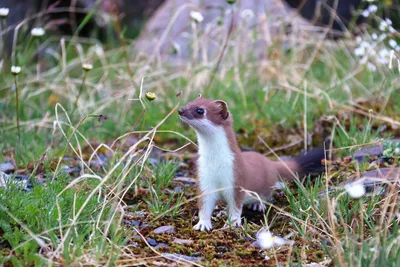 Stoat
Ecological equivalents
Related species on this site
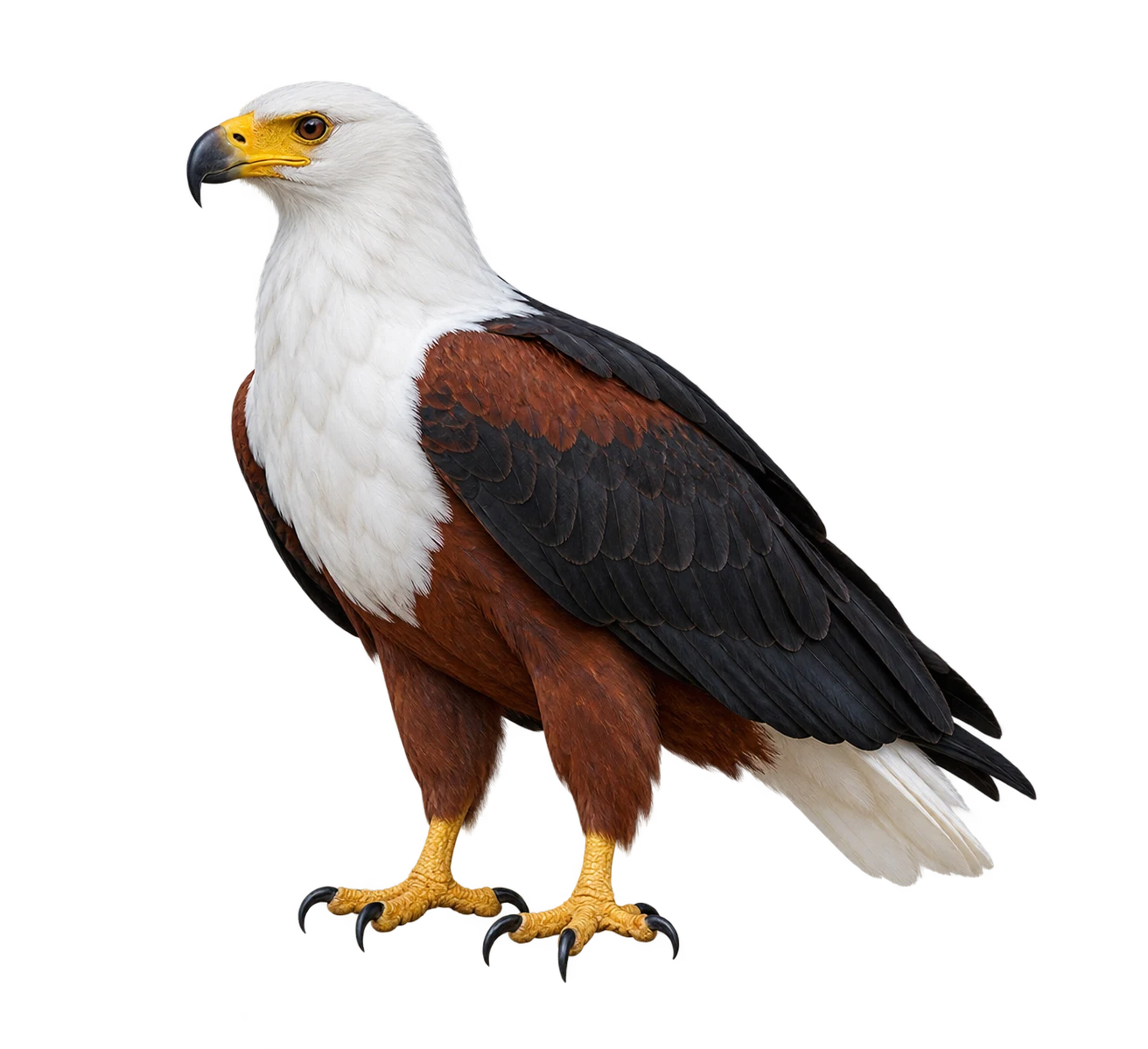
African Fish Eagle (same genus), Bald eagle (same genus), White-tailed eagle (same genus), Australian Firehawk (same family), Bearded vulture (same family), Black kite (same family), and more.
Birds
African Fish Eagle
Haliaeetus vocifer
Classification and source reference
LivingAI illustration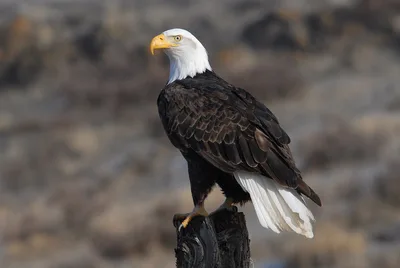 LC
Birds
Bald eagle
Haliaeetus leucocephalus
The bald eagle is the national bird of the United States.
Living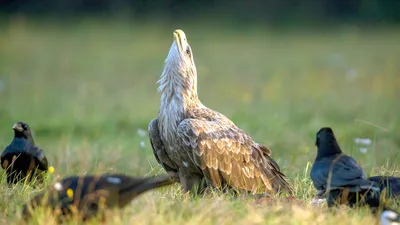 LC
Birds
White-tailed eagle
Haliaeetus albicilla
The white-tailed eagle is the largest bird of prey in Europe, a brown sea eagle with a short white wedge of a tail.
Living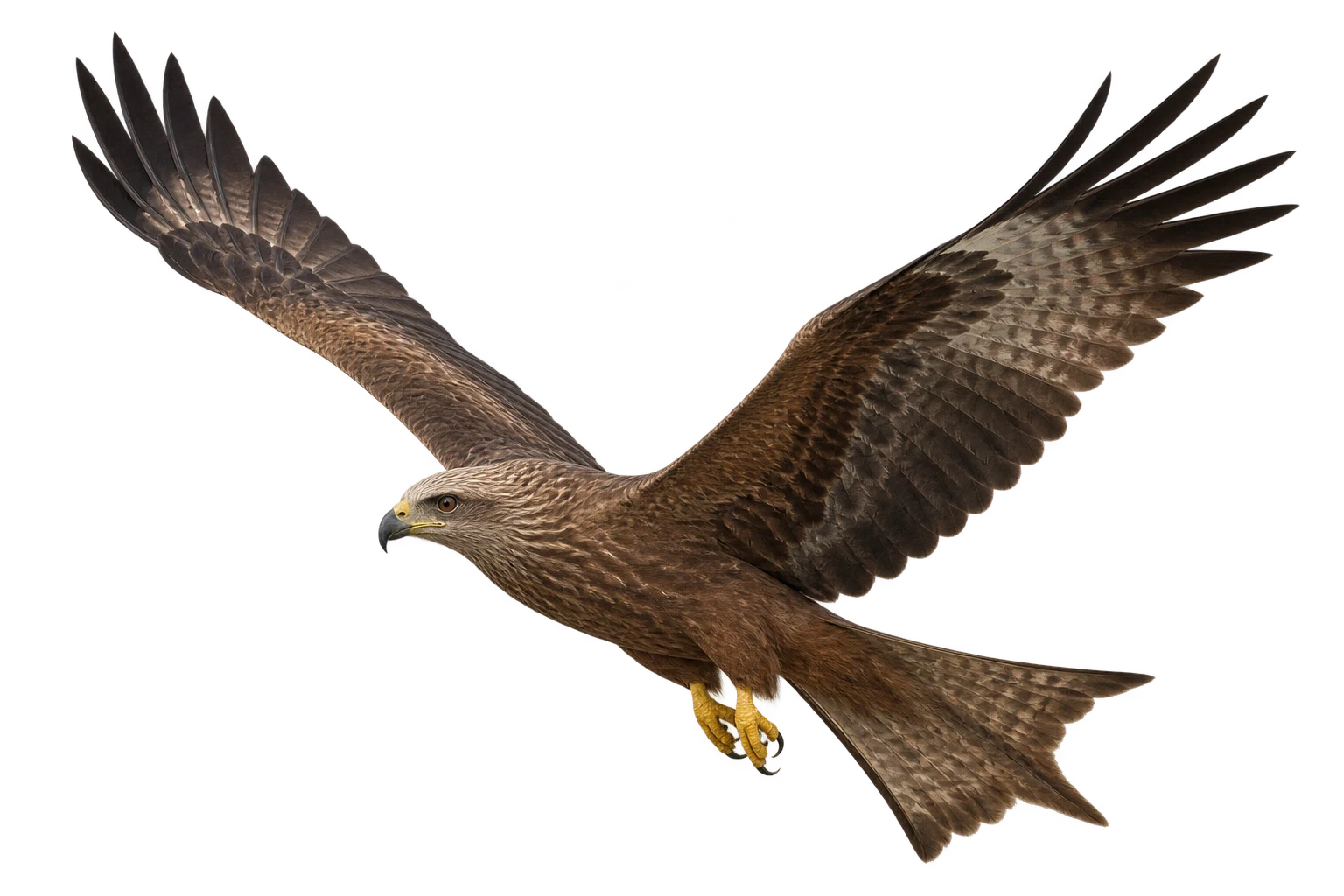
Birds
Australian Firehawk
Milvus migrans
Classification and source reference
LivingAI illustration NT
Birds
Bearded vulture
Gypaetus barbatus
The bearded vulture is a huge mountain raptor that lives almost entirely on bone.
Living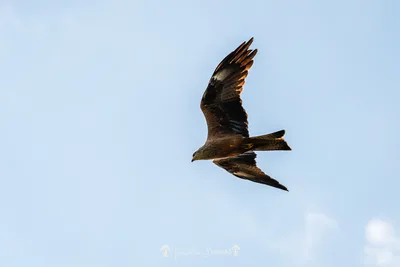 LC
Birds
Black kite
Milvus migrans
The black kite is a medium-sized raptor with angled wings and a forked tail.
Living