
Rock dove
The cliff bird that moved into our cities
Columba livia
Also called Rock pigeon, Common pigeon, Feral pigeon, Blue rock pigeon
Living individuals or members of this group exist today. This does not mean they are safe from extinction.
Meet the rock dove
The rock dove is the wild pigeon of sea cliffs and rocky gorges in Europe, North Africa and southern Asia. It is the ancestor of every domestic and street pigeon, and buildings serve it as cliffs.
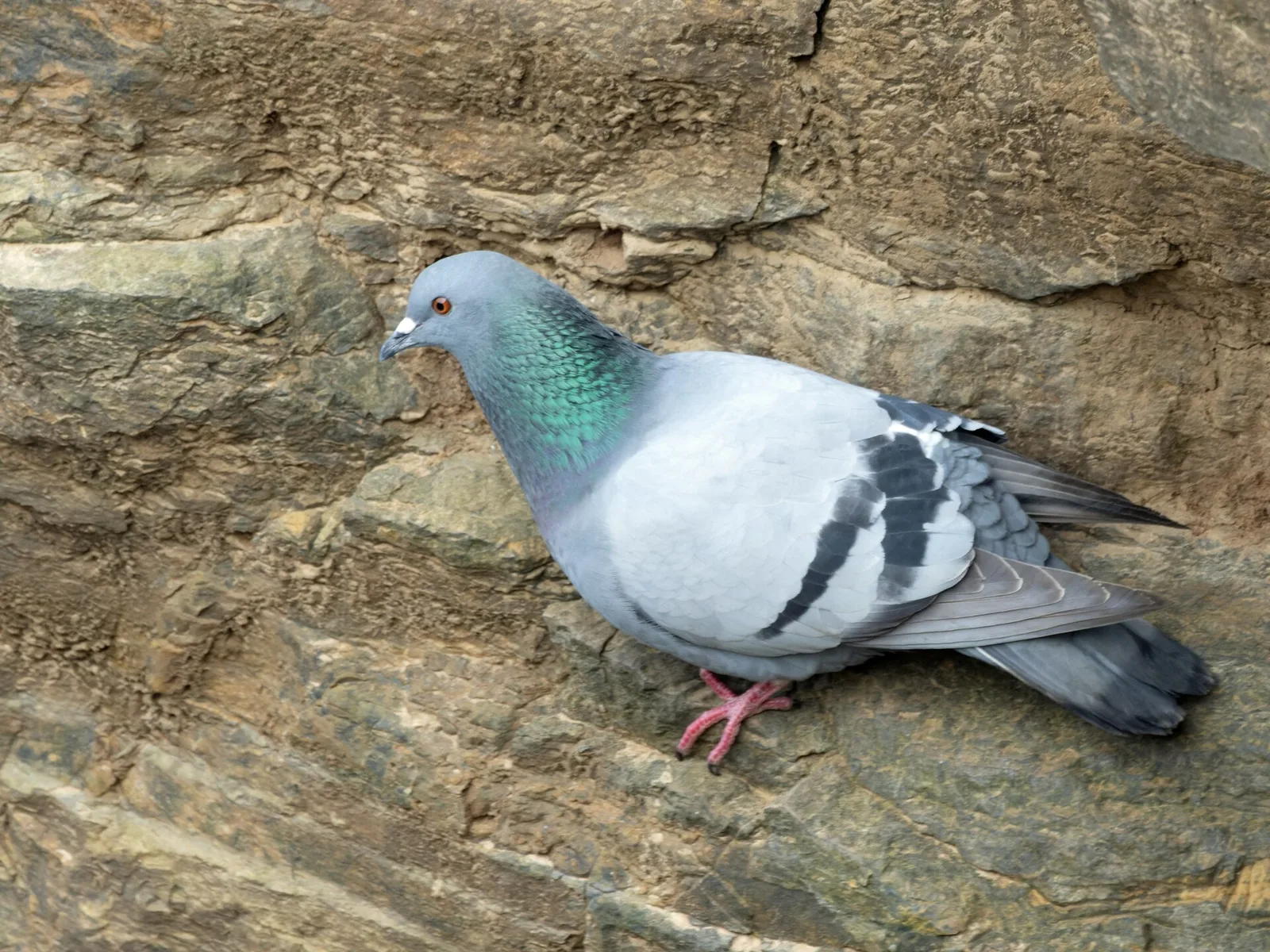
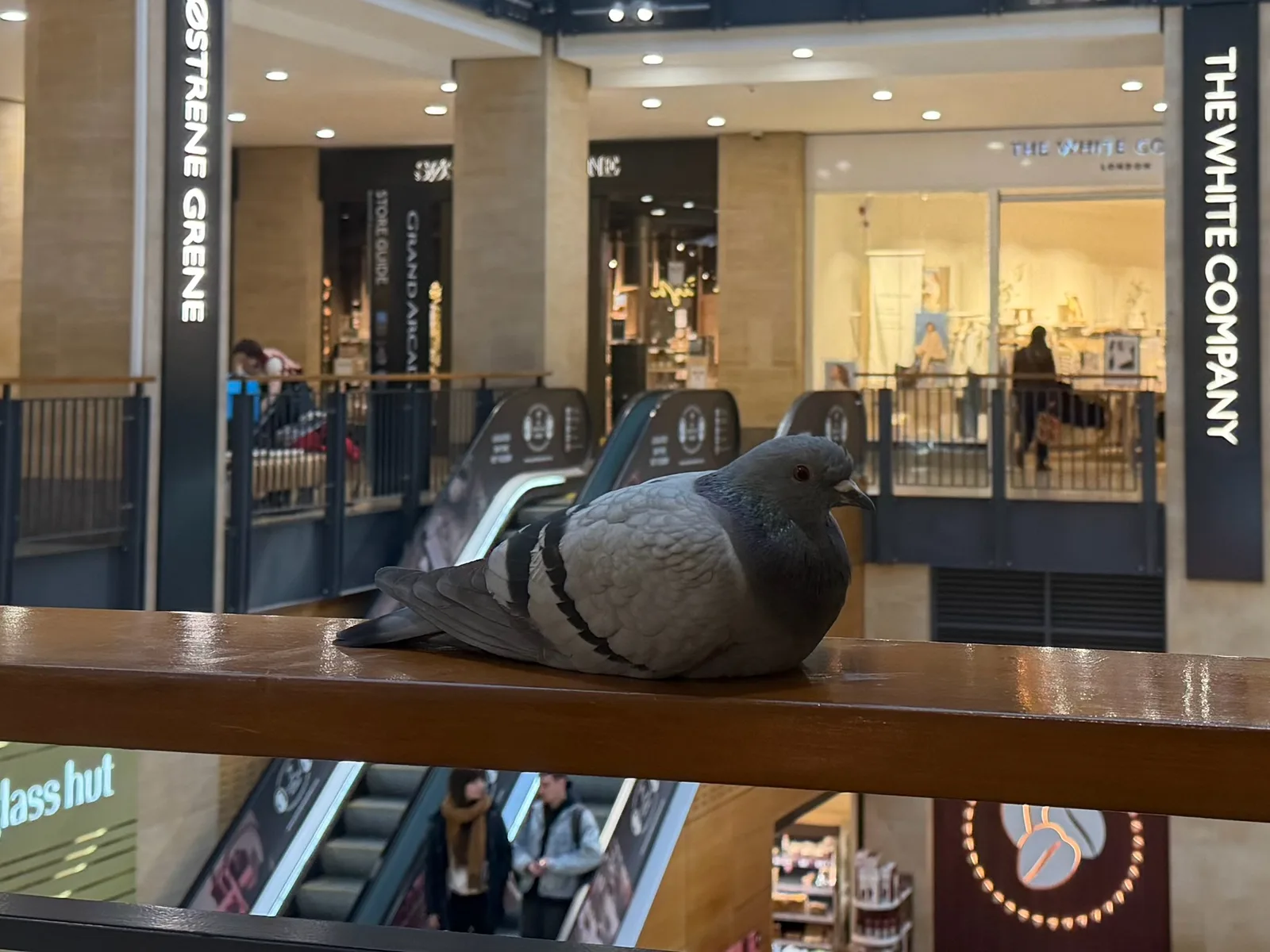
Images of the rock dove
Lifespan in the wild
3 to 5 years
Weight
238 to 380 g
Length
30 to 35 cm
Top speed
About 97 km/h
Fact file
Rock dove
- Location
- Europe, North Africa and southern Asia; feral almost everywhere
- Habitat
- Coast, Mountains, Towns and cities
- Diet
- Omnivore
- Prey / food
- Seeds, grain, fruit, worms, insect larvae and food scraps
- Predators
- Peregrine falcons, goshawks, owls, kestrels, raccoons, cats
- Lifestyle
- Active by day, lives in flocks, nests on ledges
- Group name
- Flock
- Name of young
- Squab
- Incubation
- Incubation 17 to 19 days
- Clutch size
- Two eggs, up to six clutches a year
- Population
- 17 to 28 million in Europe, and up to 120 million worldwide
- Biggest threat
- Interbreeding with feral pigeons, which dilutes the wild form
- Distinctive feature
- Two black wing bars and a white lower back
- Colour
- Pale blue-grey with a green and purple sheen on the neck
- Skin type
- Feathers
Size
Next to a person
Measurements
Size and speed
- Length
- 30 to 35 cm
- Wingspan
- 62 to 68 cm
- Weight
- 238 to 380 g wild and feral birds; overfed domestic birds weigh more
- Top speed
- About 97 km/h, up to 160 km/h measured on racing homing pigeons, the domestic form of this bird
Typical adult ranges. Source: Wikipedia.
Life cycle
Lifespan
- In the wild3 to 5 years
- In captivityAbout 15, up to 35 years Wikipedia gives about 15 years; AnAge records one bird of 35
- 035 years
Appearance
Colour and coat
- Primary colours
- grey
- Secondary colours
- blackwhitegreen
- Skin type
- feathers
- Male and female
- Very slight. The male shows stronger green and purple iridescence on the neck and breast. The female is otherwise almost identical in size and colour.
Life cycle
Mating and family
- Mating system
- monogamous pairs, usually for life
- Social structure
- flocks of 50 to 500 birds, with pairs inside them
- Breeding
- two eggs a clutch, and up to six clutches a year
A male puffs his crop, bows and turns in front of a female, then feeds her from his crop. The pair build a thin nest of straw on a ledge, and the female lays two white eggs. Both birds sit for 17 to 19 days. The squabs live on crop milk at first and leave the nest at about 30 days. Young birds can breed at about 140 days old.
Classification
Taxonomy
- Kingdom
- Animalia
- Phylum
- Chordata
- Class
- Aves
- Order
- Columbiformes
- Family
- Columbidae
- Genus
- Columba
- Species
- Columba livia
Conservation
Red List status
- LC
- NT
- VU
- EN
- CR
- EW
- EX
Least Concern on the IUCN Red List
Range
Recorded in 27 countries
- Argentina
- Austria
- Ashmore and Cartier Islands
- Brazil
- Canada
- Colombia
- Czech Republic
- Germany
- Spain
- France
- United Kingdom
- Hong Kong
- India
- Italy
- Japan
- South Korea
- Mexico
- New Zealand
- Peru
- Poland
- Portugal
- Russia
- Singapore
- Thailand
- Taiwan
- Ukraine
- United States of America
Habitat layer: montane grassland and shrubland, mangrove.
Countries from 328,165 wild records on GBIF (iNaturalist research grade), filtered and checked by hand. Country shapes: Natural Earth. Habitat: RESOLVE Ecoregions 2017, CC BY 4.0. Basemap: Natural Earth.
Habitats
Three things to know
- 1
Every homing pigeon, fancy breed and street pigeon descends from this one wild species.
- 2
A pigeon drinks by sucking, without tipping its head back like other birds.
- 3
Charles Darwin bred pigeons and used them to argue his case for selection.
Did you know
Seven more facts
- 1
Rock doves start foot stamping with the same foot every time.
- 2
The bird has no working preen gland and dresses its feathers with feather powder.
- 3
Bones from Israel show the species lived there 300,000 years ago.
- 4
The clap of a startled bird tells the flock how bad the danger is.
- 5
One flock in Tunisia lives at the bottom of a deep well.
- 6
About 1,000 domestic breeds descend from the wild rock dove.
- 7
Over a middle distance a racing pigeon keeps up roughly 97 kilometres per hour.
Field notes
How it looks and acts
Field notes
Distinguishing features
- Two clean black bars across each pale grey wing.
- A white lower back, which is the surest mark of a pure wild bird.
- Green and purple iridescence over the neck.
- A black band at the end of the tail.
- A red-brown iris above a grey-black bill with a pale cere.
- Red to pink feet under a body of 30 to 35 centimetres.
Field notes
Unique adaptations
- Crop milk lets a pair raise young at any season of the year.
- Loose body feathers pull free in a predator's mouth and buy a second to escape.
- A sucking drink lets the bird finish at a puddle without lifting its head.
- Several senses together give the bird a way home from a strange place.
- Kidneys rather than a salt gland handle the water balance in dry country.
Field notes
Interesting behaviours
- Flocks feed on open ground in the morning and again in the afternoon.
- Producers find the food and scroungers follow them to it.
- A male bows and turns in half circles in front of a female.
- Both birds of a pair sit on the eggs in turn.
- Birds roost on ledges at night and shelter through the midday heat.
Field notes
Temperament
- The rock dove seems nervous in the open and is quick to take flight.
- Town birds lose that caution and feed at the feet of people.
- Both sexes defend the nest ledge and peck at anything that comes close.
- The species is highly social and rarely stays alone for long.
Field notes
Communication
- A soft wavering coo serves for courtship and for holding a ledge.
- A grunting note warns the flock that a hunter is in sight.
- Wing claps carry a message that needs no voice at all.
- Bill snapping is the answer of a squab to anything at the nest.
- An inflated throat and a fanned tail probably turn the body into a signal.
Ecology
Ecological role
The rock dove is a seed eater that has become a town animal. It clears spilled grain and scraps, and it is the main food of city peregrines.
- It eats seed, grain and fallen fruit in large amounts.
- It supports peregrine falcons and other raptors that hunt in cities.
- Its droppings likely add nitrogen to walls, ledges and the ground below.
- It probably competes with other ground-feeding birds where food is put out.
Stories
Myths and legends
- In Mesopotamian religion the dove was sacred to Inanna and Ishtar.
- In Greek religion the dove belonged to Aphrodite, goddess of love.
- In Jewish tradition a dove ends the flood story with an olive branch.
- In Christian tradition the dove is the form of the Holy Spirit.
- In modern political language a dove is a person who argues for peace.
People
Relationship with humans
People
Living alongside us
No wild bird has a longer working relationship with people. Rock doves were kept perhaps 5,000 years ago, and breeding produced about 1,000 domestic forms. Homing birds carried messages in peace and in war, and 32 of them hold the Dickin Medal. Escaped birds then built the feral flocks that now fill city squares. Many towns treat those flocks as a nuisance, while other people feed them daily.
- The rock dove has no weapon and does not attack people.
- Droppings can carry histoplasmosis, a fungal illness of the lungs.
- Large roosts foul buildings, and the acid in droppings eats stone and metal.
People
Status, uses and products
- Domestication
- Feral
- As a pet
- Kept by some. Domestic forms of this species are common pets and racing birds. They are calm, long lived and easy to feed. They need a dry loft, daily flight and company of their own kind. Taking a wild or feral bird from the street is a different matter and is often against local law.
- Uses
- message carryingpigeon racingmeatshow breedinglaboratory research
- Products
- meateggsmanurefeathers
The full account
About the rock dove
The rock dove is the wild pigeon of sea cliffs and rocky gorges. An adult is 30 to 35 centimetres long with a wingspan of 62 to 68 centimetres. It is pale grey with two black bars across each wing and a white lower back. Its home ground runs from southern Europe through North Africa into southern Asia.
Every domestic pigeon and every street pigeon descends from this one species. People have kept it for thousands of years for food, for racing and for messages. Escaped birds set up feral flocks in towns on almost every continent. Walls, bridges and roof ledges give the bird what a cliff once gave it. The wild form now survives in numbers only in remote coastal country.
Name and taxonomy
Johann Friedrich Gmelin described the species in 1789 and named it Columba livia. Columba is the Latin word for a pigeon or a dove. The root behind it is a Greek word for a diver, after the bird's plunging flight. The second name comes from a Latin word for a bluish grey colour.
Rock dove is the standard English name set by the International Ornithological Congress. Most people simply say pigeon, and rock pigeon and common pigeon are also in use. A specimen from Fair Isle in Scotland now serves to define the species. Nine subspecies are recognised across the natural range. A young pigeon is called a squab. Two other birds also carry the English name rock pigeon, which confuses matters.
Evolution and relatives
Fossils suggest the species began in southern Asia. Bones from Israel show the bird lived there at least 300,000 years ago. Its history with people is so long that the first natural range cannot be traced. The nearest relative in the genus is the hill pigeon. The snow, speckled and white-collared pigeons come next.
Breeding under human care produced about 1,000 domestic breeds. Those breeds vary in size, shape and colour far beyond anything in the wild. Charles Darwin used that range of forms to argue his case for selection. A study of feather pigment found the reason for the extra colour. Mutations changed how much black and reddish pigment each feather holds. Darker birds may store more trace metal in the feathers, which helps in dirty air.
Appearance
An adult is 30 to 35 centimetres long and weighs 238 to 380 grams. The wings span 62 to 68 centimetres. The head, neck and chest are dark bluish grey. Green, purple and red light plays over the neck feathers as the bird turns. Two black bars cross the pale grey wing, and the lower back is white.
A black band closes the tail, and the outer tail feathers are edged in white. The iris is red-brown, the bill grey-black, and the feet red to pink. A female looks almost the same, with less shine on the neck and breast. The white underwing shows well when a bird circles overhead. The bird glides often, holding its wings in a sharp V. Feral birds may be red, brown, chequered, plain or pied. Subspecies differ in size and in how dark the mantle and the back are. One North African form is almost black on the head, rump and underparts.
Habitat and range
The natural range covers western and southern Europe, North Africa and South Asia. European ships carried the bird to the rest of the world from 1603 onward. With the feral flocks counted, the range covers about 10 million square kilometres. Wild birds nest in crevices on sea cliffs, in canyons and in caves. They will hold ground in the Sahara where there is rock, water and some plant food.
The species avoids thick vegetation and needs open ground to feed on. Tall buildings, bridges and farm sheds copy the ledges of a cliff. Town birds do best where there are high walls, green space and spare food. Outer suburbs with dense streets and few tall buildings suit them least. One flock in Tunisia lives inside a deep well. Records for the species come from 241 countries and territories on GBIF. Farm country suits the bird better than woodland does.
Diet and feeding
The rock dove eats mainly plant food, above all seeds, grain and fruit. It swallows any seed that fits down the gullet. Worms and insect larvae go down now and then as extra protein. One study of semi-rural birds in Kansas found a diet of 92 per cent corn. Town birds add bread, cake, peanuts, popcorn and currants.
Flocks feed on open ground in the early morning and again in mid-afternoon. Some birds act as producers and find the food. Others act as scroungers and eat what the producers have found. A flock usually holds more scroungers than producers. A pigeon drinks by dipping the bill and sucking, without tipping its head back. A female needs more protein and calcium in the weeks before she lays. A long flight range lets a desert flock reach water far from the roost. Kidneys, not a salt gland, keep the water balance of the body in order.
Behaviour and social life
Rock doves live in flocks of 50 to 500 birds, depending on the food supply. Pairs keep together within the flock through the breeding season. A startled bird takes off with a loud clap of the wings. That clap tells the rest of the flock to go, and a faster beat means a worse threat. Birds walk and run with the head rocking forward and back.
Other sounds without the voice include hissing, bill snapping and foot stamping. A bird starts stamping with the same foot each time, much as a person favours a hand. Squabs snap the bill when something comes at the nest. Both parents peck an intruder on the head. The birds take cover at night and in the hottest part of the day. They flock to roost, to sun themselves and to feed, and no play has been seen.
Communication and senses
The call is a soft wavering coo with a slight break in it. There is a separate nest call, an alarm grunt and a set of begging notes. A displaying male puffs his throat, fans his tail, struts and bows. The display is part courtship and part threat. Wings clap in flight during a chase and after mating.
Homing birds find their way with a map and compass system. They use the sun for direction and a magnetic sense through a nerve in the face. Smell, landmarks such as roads, deep sound and slight shifts in gravity all help. Racing birds have covered 1,800 kilometres in a single flight. Over a middle distance a racing bird keeps up roughly 97 kilometres per hour. Messenger birds were already flying in Egypt about 3,000 years ago.
Reproduction and life cycle
The species can breed in any month, because crop milk frees it from an insect season. The peak falls in spring and summer, when food is easiest to find. A pair may lay as many as six times in one year. A male puffs his crop, walks at the female and coos in short repeated notes. He bows, turns in half circles, and then feeds her from his crop.
Pairs form at any time of year and usually last for life. The bond is not absolute, and males in particular mate outside the pair. The nest is a thin platform of straw and sticks on a sheltered ledge. The female lays two white eggs. Both birds sit, and the eggs hatch after 17 to 19 days.
A squab hatches with pale yellow down and a flesh-coloured bill. Both parents make crop milk and feed it to the chick for the first days. Seeds are then added, and the young bird leaves the nest at about 30 days. Birds can breed at about 140 days old. A wild bird lives 3 to 5 years, while one captive bird reached 35. Predators and people are the main causes of death in the wild. The eggshell carries fine pores that let water pass and keep the embryo from drying.
Predators and threats
Flight is the only real defence the rock dove has. Peregrine falcons hunt it hard and are very good at catching it. Kestrels, golden eagles, great horned owls and screech owls also take pigeons. Raccoons and opossums raid nests in North American towns.
Body feathers sit loosely in the skin and pull out at a touch. A hunter often ends up with a mouth of feathers while the bird escapes. Tail feathers drop in the same way under a fright. People are the other main cause of death, through shooting and control work. Droppings can carry histoplasmosis, which is one reason towns act against flocks. Hunters shoot pigeons for food in many countries within the natural range.
Population and conservation
The IUCN lists the rock dove as Least Concern. Europe alone holds an estimated 17 to 28 million wild and feral birds. The world total may reach 120 million. Watchers have logged 453,113 records of the species on iNaturalist.
The pure wild form is in a weaker position than that headline suggests. Feral birds breed with wild ones and blur the original type. In Britain the truest stock hangs on in northern and western Scotland. The Outer Hebrides hold the strongest population of that kind. No conservation body treats the species as a whole as being at risk. City feeding keeps feral numbers high whatever the weather does.
Relationship with humans
People may have kept rock doves for as long as 5,000 years. The birds probably gave meat, eggs, manure and company from the start. Messenger birds were flying in Egypt about 1350 years before the common era. Fanciers later built up hundreds of breeds for show and for racing. Homing birds became a working postal service in peace and in war.
Armies used pigeons because they were fast and hard to stop. About 95 per cent of the messages sent by pigeon arrived. American forces trained 54,000 birds during the Second World War. Cher Ami carried 12 messages at Verdun and flew on after being shot. That last flight is credited with saving 194 trapped soldiers. In all, 32 pigeons have received the Dickin Medal for bravery.
Feral flocks are less welcome, and many cities treat them as a nuisance. Droppings damage stone and metal, and large roosts foul buildings. Farmers lose grain where flocks are large. Other people feed the birds in parks, which keeps the numbers high.
In culture and myth
In Mesopotamian religion the dove belonged to Inanna and to Ishtar. In Greek religion it was the bird of Aphrodite. In the Hebrew flood story a dove returns with an olive branch. In Christian art a dove stands for the Holy Spirit.
The white dove of peace grew out of that long religious history. In modern politics a person who wants peace is called a dove. In British and American memory the war pigeon is a small national hero. Cher Ami now stands mounted in a museum in Washington. In science the bird is remembered for the part it played in Darwin's argument.
A sentence with a dotted underline is inferred: it describes the group the animal belongs to, or is a reading of the sources, rather than a measured or reported fact about this species.
Questions
Rock dove questions, answered
Are rock doves and pigeons the same bird?
Yes. The rock dove is the wild form, and the pigeons in city squares are its feral descendants. Every domestic breed traces back to it.
How long do pigeons live?
A wild rock dove lives 3 to 5 years. In captivity 15 years is normal, and one bird is recorded at 35.
How fast can a pigeon fly?
A racing bird averages roughly 97 kilometres per hour on a middle-distance course. The fastest reach 160 kilometres per hour over a short flight.
How do homing pigeons find their way?
They use the sun as a compass and a magnetic sense to work out direction. Smell, landmarks, low sound and small gravity changes all add to the picture.
What do pigeons eat?
Seeds, grain and fruit make up most of the diet, with the odd worm or larva. Town birds also take bread, cake, peanuts and popcorn.
How many eggs do pigeons lay?
Two white eggs in a clutch, and up to six clutches in a year. Both parents sit on them for 17 to 19 days.
What is pigeon milk?
It is a rich curd made in the crop of a parent bird. Both the male and the female produce it, and it feeds the squab for its first days.
Why do you never see baby pigeons?
Squabs stay hidden on a ledge or in a crevice for about 30 days. By the time one leaves the nest it is near adult size.
Do pigeons mate for life?
Most pairs stay together for life, and they form at any time of year. The bond is not absolute, and birds do mate outside it.
Are pigeons dangerous or dirty?
They do not attack people. Droppings can carry histoplasmosis and they damage stonework, which is why cities try to limit large roosts.
What eats pigeons?
Peregrine falcons are the main hunters, in the wild and in cities. Goshawks, kestrels, eagles, owls, raccoons and cats also take them.
Where do wild rock doves still live?
On remote sea cliffs and rocky gorges from Europe to South Asia. In Britain the truest wild stock sits in northern and western Scotland.
Why do pigeons bob their heads?
The head stays still while the body moves forward, then snaps ahead. That gives the bird a steady view of the ground as it walks.
Were pigeons really used in war?
Yes. Armies sent messages by pigeon because the birds were fast and hard to stop, and about 95 per cent of messages arrived. Thirty-two pigeons hold the Dickin Medal for bravery.
Are rock doves endangered?
No. The IUCN lists the species as Least Concern, with up to 120 million birds worldwide. The pure wild form is scarcer, because feral birds breed with it.
Food web
Prey and food
- seeds
- grain
- fruit
- worms
- insect larvae
- food scraps
Food web
Predators
 Peregrine falcon
- goshawks
- owls
- kestrels
 Raccoon
- cats
Ecological equivalents
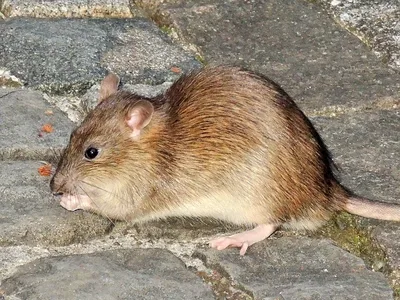
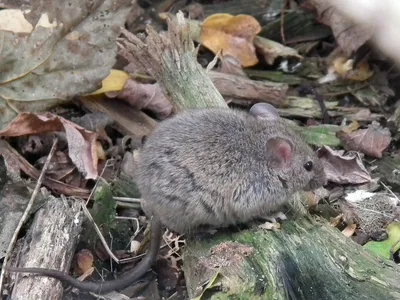
Related species on this site
Dodo (same family), Eurasian collared dove (same family), Mourning dove (same family), Nicobar pigeon (same family), Passenger pigeon (same family), Pigeon (same family), and more.
 EX
Birds
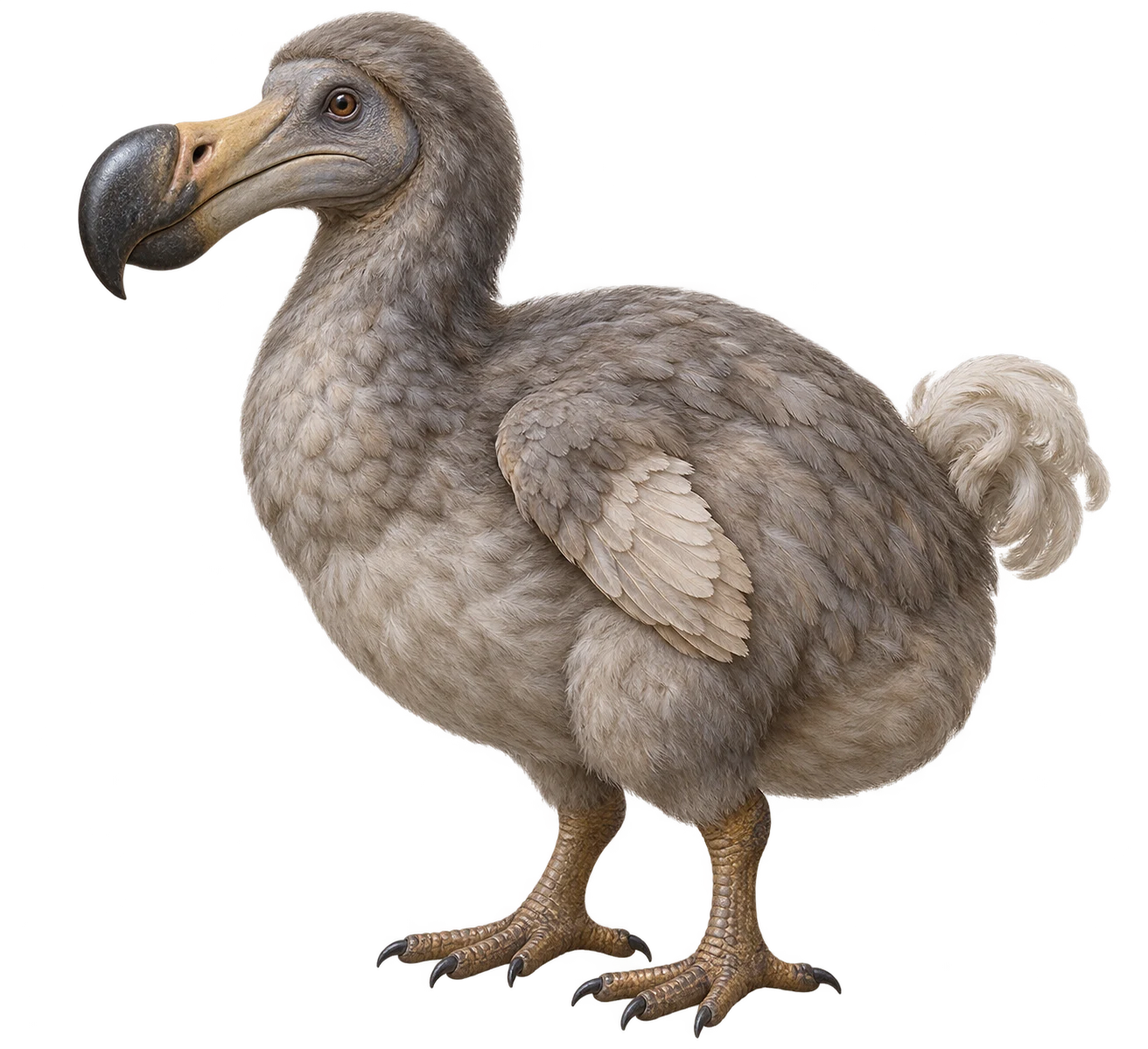
Dodo
Raphus cucullatus
The dodo was a flightless pigeon that lived only on Mauritius, and it is now extinct.
ExtinctAI reconstruction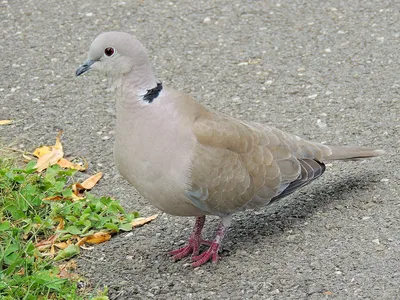 LC
Birds
Eurasian collared dove
Streptopelia decaocto
The Eurasian collared dove is a pale grey dove with a black half-collar on the neck.
Living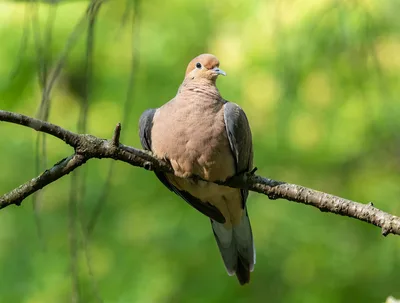 LC
Birds
Mourning dove
Zenaida macroura
The mourning dove is a slim grey-brown dove of open country, farmland and gardens across North America.
Living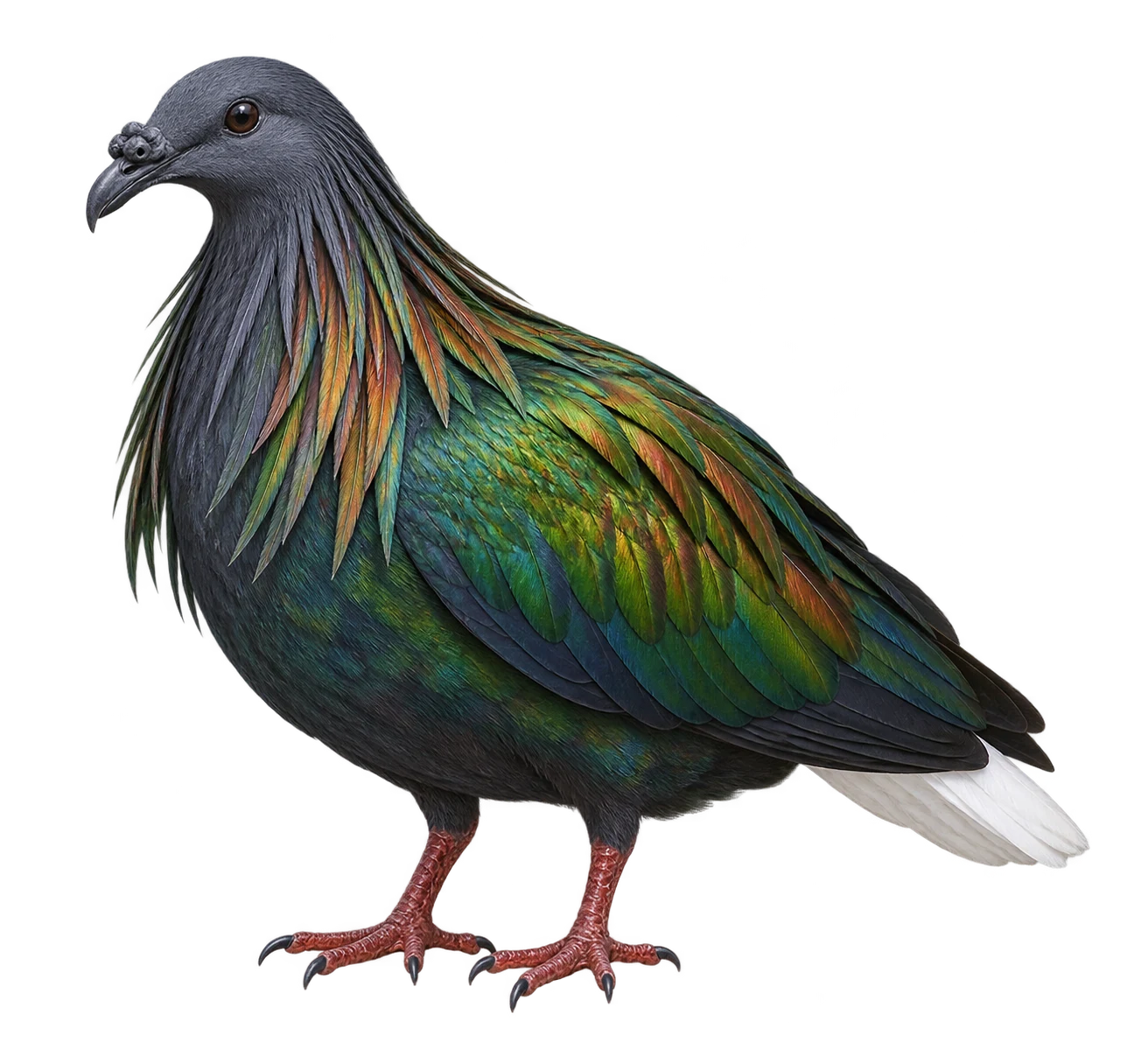
Birds
Nicobar pigeon
Caloenas nicobarica
Classification and source reference
LivingAI illustration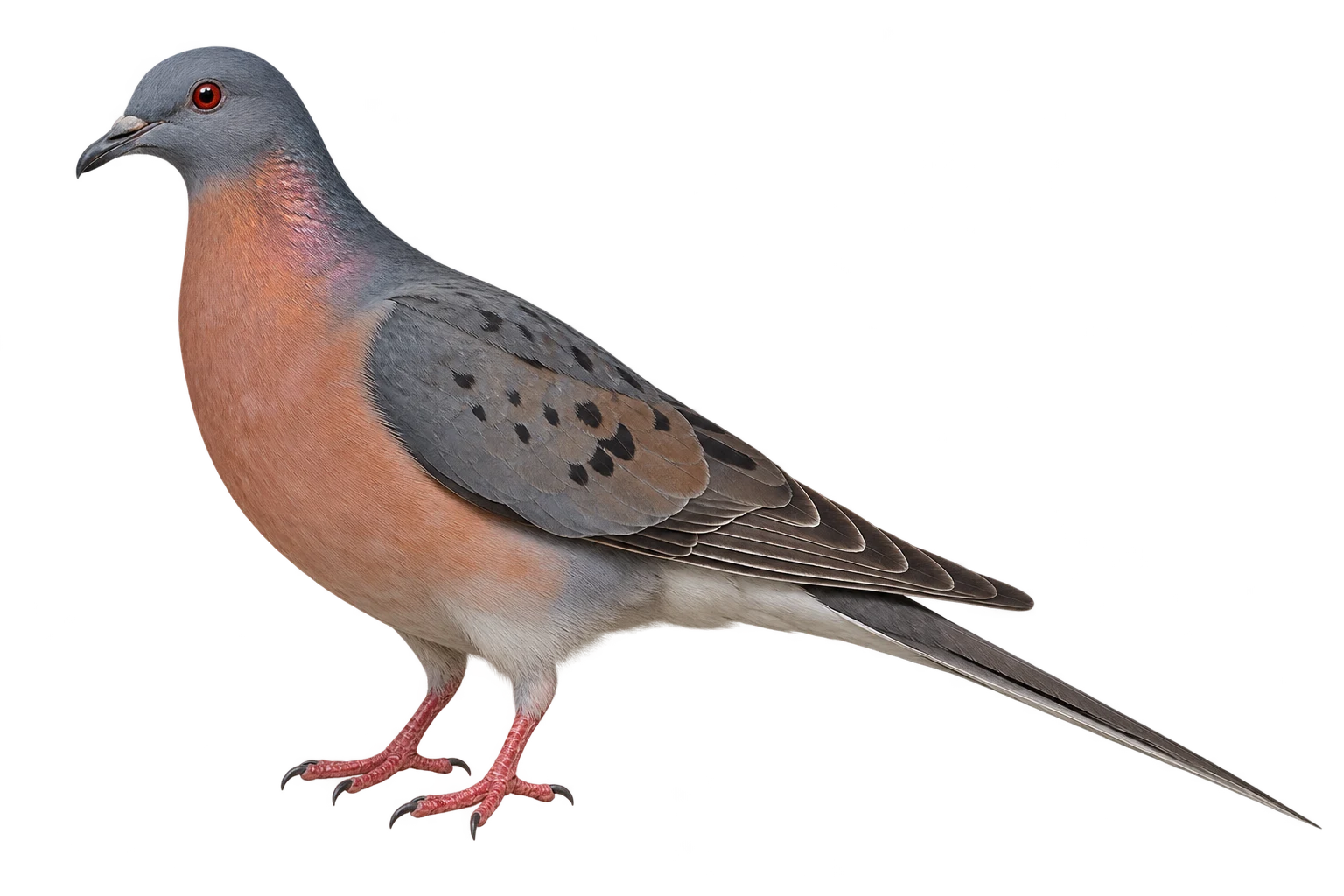 EX
Birds
Passenger pigeon
Ectopistes migratorius
The passenger pigeon was a fast, long-tailed pigeon of eastern North America that moved in flocks of millions.
ExtinctAI reconstruction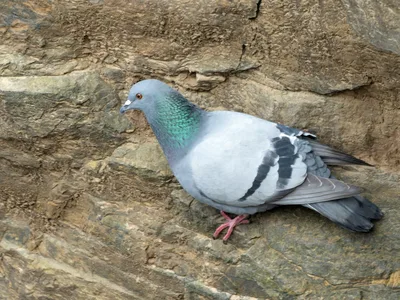
Birds
Pigeon
Columbidae
Pigeons include a wide variety of birds.
Living