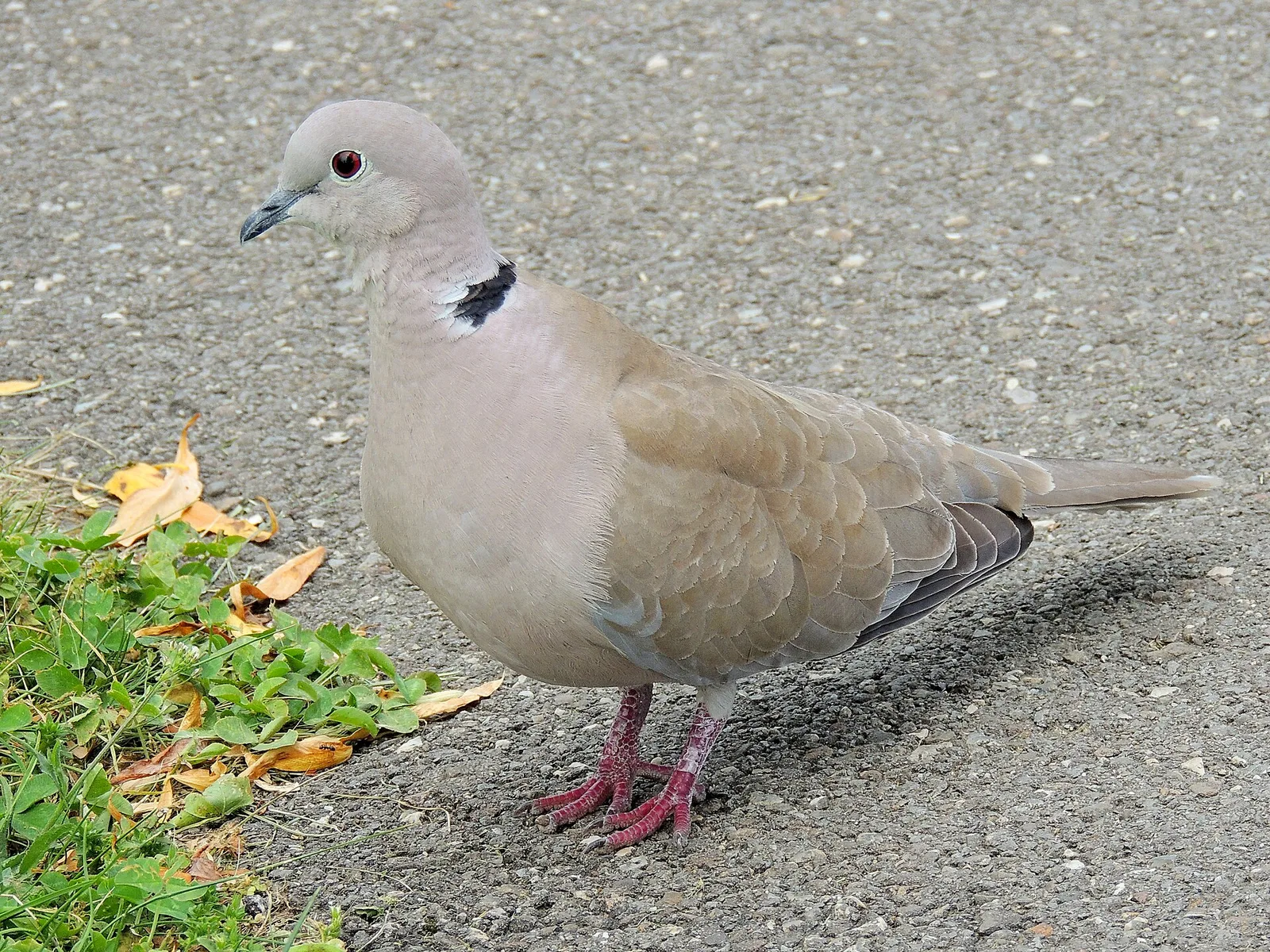
Eurasian collared dove
The dove that crossed two continents in one century
Streptopelia decaocto
Also called Collared dove, Turkish dove
Living individuals or members of this group exist today. This does not mean they are safe from extinction.
Meet the eurasian collared dove
The Eurasian collared dove is a pale grey dove with a black half-collar on the neck. It spread from Asia across Europe in one century, and then across North America from a handful of escaped birds.
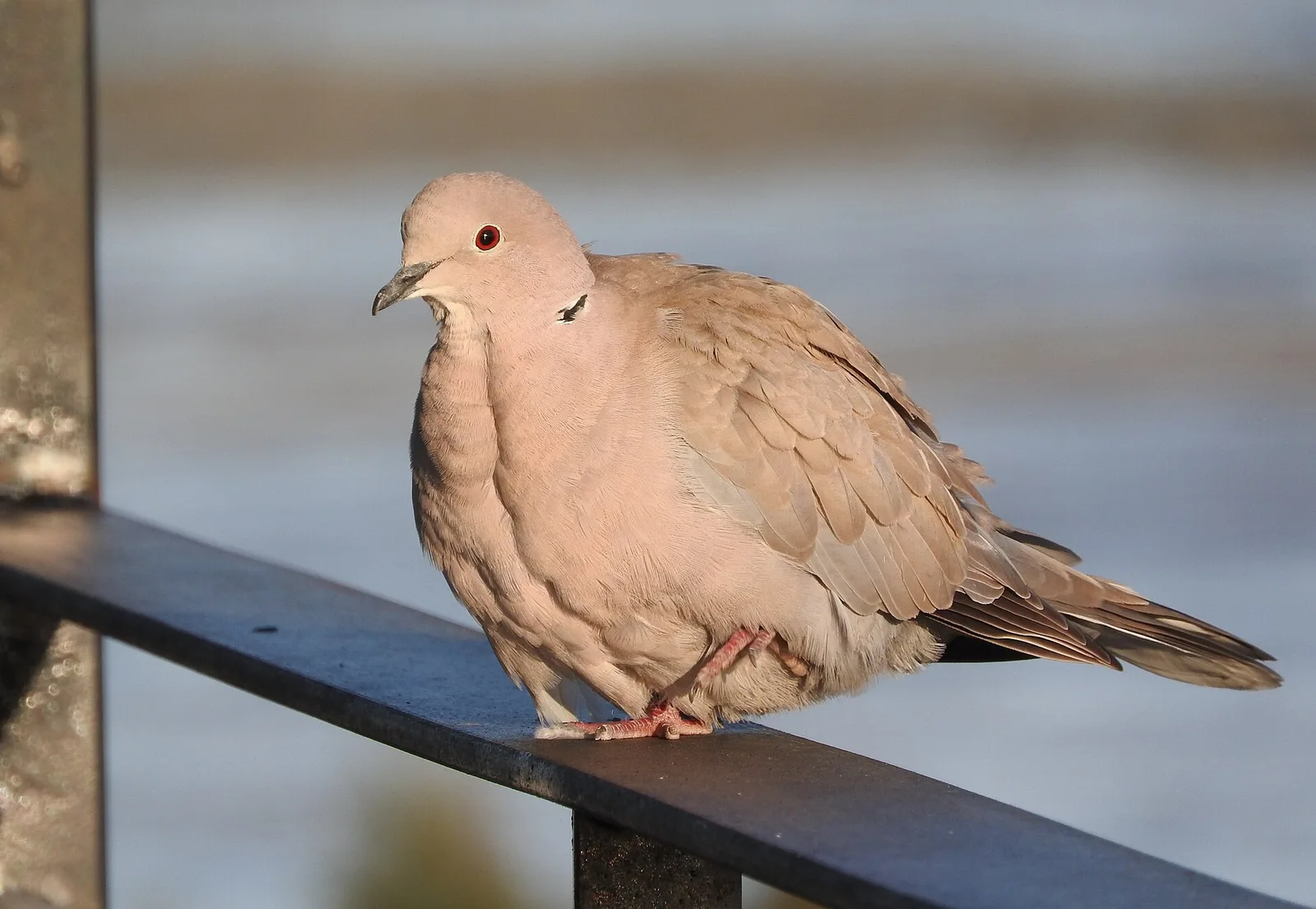
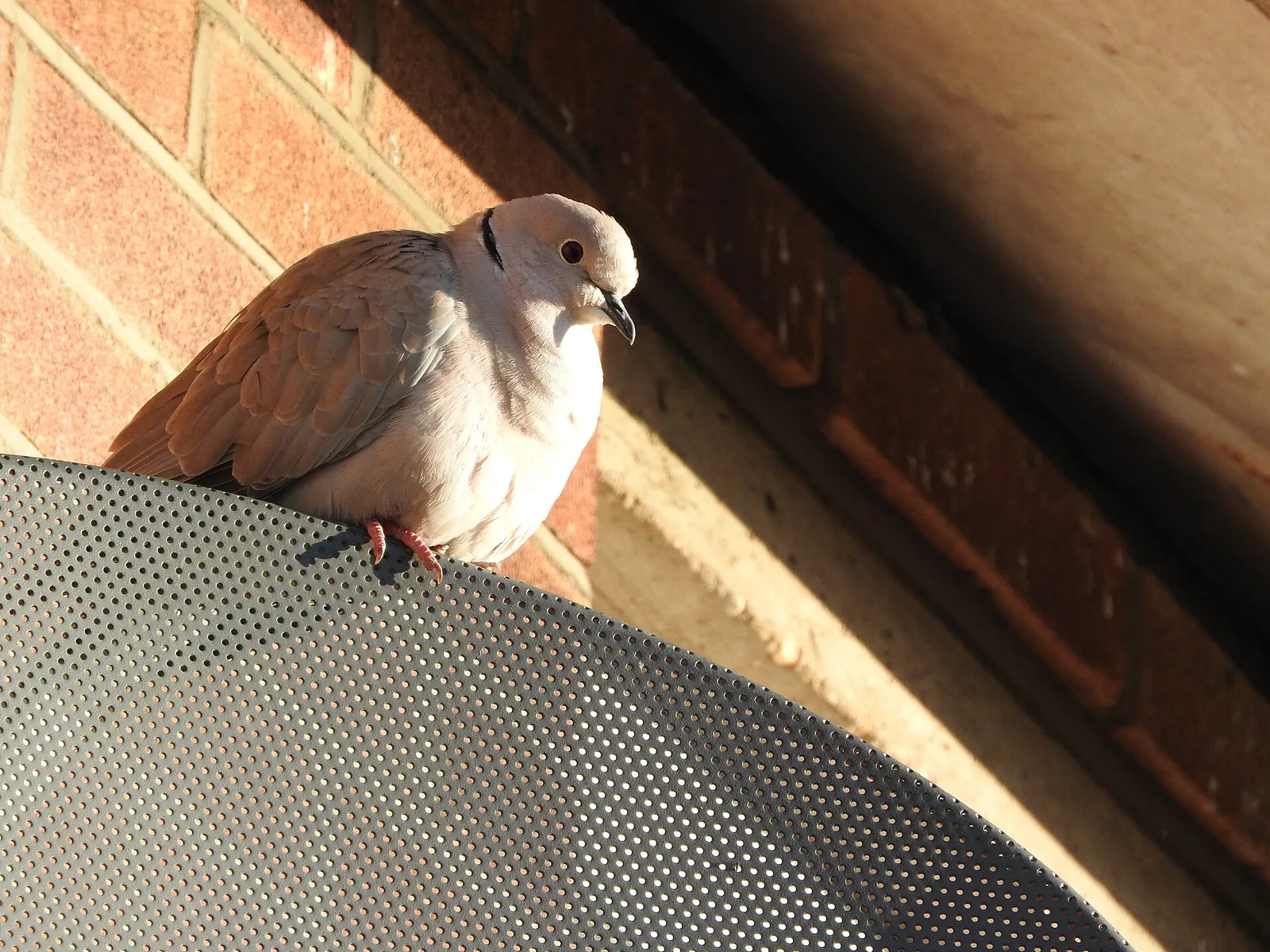
Images of the eurasian collared dove
Lifespan in the wild
Up to 17.8 years
Weight
125 to 240 g
Length
About 32 cm
Wingspan
47 to 55 cm
Fact file
Eurasian collared dove
- Location
- Europe, Asia and North Africa, and introduced to North America
- Habitat
- Towns and cities, Grassland, Temperate forest
- Diet
- Omnivore
- Prey / food
- Grain, seeds, shoots, insects
- Predators
- Sparrowhawks and other raptors, and cats near houses
- Lifestyle
- Resident, active by day, close to people
- Group name
- Flock
- Name of young
- Squab
- Incubation
- Incubation 14 to 18 days
- Clutch size
- 2 eggs
- Population
- Very common and still spreading, listed as Least Concern
- Biggest threat
- Trichomonosis, a parasite disease of garden birds
- Distinctive feature
- A black half-collar edged with white
- Colour
- Grey-buff to pinkish-grey
- Skin type
- Feathers
Size
Next to a person
Measurements
Size and speed
- Length
- About 32 cm from the tip of the bill to the tip of the tail
- Wingspan
- 47 to 55 cm
- Weight
- 125 to 240 g Wikidata gives an adult mass of 193 grams
Typical adult ranges. Source: Wikipedia.
Life cycle
Lifespan
- In the wildUp to 17.8 years
- In captivityUp to 17.9 years
- 017.9 years
The pale bar is the record. Source: AnAge.
Appearance
Colour and coat
- Primary colours
- greybuff
- Secondary colours
- pinkblackwhite
- Skin type
- feathers
- Male and female
- None known. Male and female look the same. A young bird differs only in a weak collar and a brown iris.
Life cycle
Mating and family
- Mating system
- monogamous pairs
- Social structure
- pairs in the breeding season, flocks at food in winter
- Breeding
- three or four broods a year, and up to six
A pair builds a thin nest of sticks in a tree near houses. The female lays two white eggs and sits on them at night, while the male sits by day. Incubation lasts 14 to 18 days, and the young fly at 15 to 19 days. Both parents feed the squabs. Where food lasts all year, the pair can raise brood after brood.
Classification
Taxonomy
- Kingdom
- Animalia
- Phylum
- Chordata
- Class
- Aves
- Order
- Columbiformes
- Family
- Columbidae
- Genus
- Streptopelia
- Species
- Streptopelia decaocto
Conservation
Red List status
- LC
- NT
- VU
- EN
- CR
- EW
- EX
Least Concern on the IUCN Red List
Range
Recorded in 23 countries
- United Arab Emirates
- Austria
- Canada
- Czech Republic
- Germany
- Spain
- France
- United Kingdom
- Greece
- Hungary
- India
- Italy
- Morocco
- Mexico
- Netherlands
- Poland
- Portugal
- Romania
- Serbia
- Russia
- Turkey
- Ukraine
- United States of America
Habitat layer: temperate broadleaf and mixed forest, temperate conifer forest, boreal forest and taiga, tropical grassland, savanna and shrubland, temperate grassland, savanna and shrubland.
Countries from 118,793 wild records on GBIF (iNaturalist research grade), filtered and checked by hand. Country shapes: Natural Earth. Habitat: RESOLVE Ecoregions 2017, CC BY 4.0. Basemap: Natural Earth.
Habitats
Three things to know
- 1
The dove reached Britain in 1952 and bred there for the first time in 1956.
- 2
Fewer than 50 birds escaped in the Bahamas in 1974, and the species now covers the United States.
- 3
Its scientific name decaocto is the Greek word for eighteen, after the rhythm of its call.
Did you know
Seven more facts
- 1
The male sits on the eggs by day and the female sits at night.
- 2
Almost every nest stands within 1 km of a building people live in.
- 3
Cooing doves in March are sometimes mistaken for early cuckoos.
- 4
A chick weighs about 9.2 grams at hatching.
- 5
Iceland has recorded only strays, 41 of them up to 2006.
- 6
Finland lists this common bird as Endangered within its own borders.
- 7
One captive bird reached 17.9 years of age.
Field notes
How it looks and acts
Field notes
Distinguishing features
- A black half-collar edged with white on the back of the neck.
- Pale grey-buff plumage with a pinkish cast.
- Short red legs and a black bill.
- A red iris that looks black at any distance.
- A body about 32 cm long, with a wingspan of 47 to 55 cm.
- White tips to the underside of the tail feathers.
Field notes
Unique adaptations
- A diet of grain that ties the bird to farms and gardens.
- Breeding through the whole year wherever food allows it.
- Up to six broods a year, which replaces losses fast.
- Long dispersal by young birds, which drives the spread.
- A tolerance of cold that probably let the species pass the Arctic Circle.
Field notes
Interesting behaviours
- Feeding on spilt grain around stores and stockyards.
- Gathering in winter flocks of 10 to 50 birds.
- Climbing steeply and gliding down in a display circle.
- Screeching harshly in the moment before landing.
- Building a thin stick nest in a garden tree.
Field notes
Temperament
- Tame around houses and gardens.
- Sociable at a food supply, and often in flocks.
- No more aggressive than the native mourning dove.
- Persistent in song, and probably vocal from before dawn.
Field notes
Communication
- A three-note coo with the stress on the middle note.
- A harsh screech of about two seconds in flight.
- A display climb and glide by the male.
- The white-edged collar, which may show best from behind.
Ecology
Ecological role
The collared dove is a seed eater of farmyards and suburbs, and it is a new arrival almost everywhere it now lives.
- It clears spilt grain around stores and feeding troughs.
- It probably feeds sparrowhawks and other town raptors.
- It carries Trichomonas gallinae and pigeon paramyxovirus type 1 into garden bird communities.
- It shares food with the mourning dove in America without displacing it.
Stories
Myths and legends
- In Greek tradition, a maid paid 18 coins a year begged the gods, and the dove calls decaocto still.
- In Mesopotamian tradition, doves belonged to Inanna-Ishtar, goddess of love and war.
- In Jewish tradition, the dove that brought Noah an olive leaf stands for hope.
- In Christian tradition, the dove stands for the Holy Spirit.
- In Islamic tradition, pigeons hid the Prophet Muhammad by nesting at a cave mouth.
People
Relationship with humans
People
Living alongside us
The collared dove lives on what people leave behind. Grain stores, stockyards and garden feeders supply most of its food. Fewer than 50 escaped birds started the North American population in 1974. Some people worry that the dove crowds out native birds, but the evidence does not show it. The real concern is the disease it can pass to poultry and to garden birds.
- The dove weighs 125 to 240 grams and cannot hurt a person.
- It carries Trichomonas gallinae, which sickens birds rather than people.
- Pigeon paramyxovirus type 1 may reach domestic poultry from wild doves.
People
Status, uses and products
- Domestication
- Wild
- As a pet
- Not suitable. The wild collared dove is not a cage bird. The tame relative people keep is the barbary dove, which comes from the African collared dove. A wild collared dove needs open country and long flights, and it visits gardens freely without any need for a cage.
- Uses
- birdwatchinggame shooting
- Products
- None recorded
The full account
About the eurasian collared dove
The Eurasian collared dove is a pale dove with a black half-collar on the neck. The plumage runs from grey-buff to pinkish-grey, a little darker on the back. An adult measures about 32 centimetres from the bill to the tail tip. The wings span 47 to 55 cm. A bird weighs 125 to 240 grams.
The species was once an Asian bird, from eastern Turkey to southern China. It crossed Europe during the 20th century and reached Britain in 1952. Escaped birds in the Bahamas in 1974 founded the North American population. It now lives in nearly every state of the United States. It eats grain, seeds, shoots and insects, mostly close to people. The IUCN lists the species as Least Concern.
Name and taxonomy
The Hungarian naturalist Imre Frivaldszky described the bird in 1838. He treated it as a wild form of the tame barbary dove. The type locality is Plovdiv, in Bulgaria. Charles Lucien Bonaparte set up the genus Streptopelia in 1855. Streptos is Ancient Greek for collar, and peleia means dove. The second half of the name, decaocto, is the Greek word for eighteen.
The Burmese collared dove was treated as a subspecies until 2021. The IOC then split it off as a species of its own. Two further named subspecies from Turkestan and southern India are no longer accepted. Wikidata records the English names collared dove and Turkish dove. Genetic work shows the barbary dove came from the African collared dove, not from this one. The 2021 decision left the Eurasian bird with no accepted subspecies.
Evolution and relatives
The Eurasian collared dove forms a superspecies with two close relatives. One is the Sunda collared dove of southeast Asia. The other is the African collared dove, south of the Sahara. A silent African collared dove is hard to separate from this bird. That species is a shade smaller and paler. The two calls settle the question, because the African bird purrs rather than coos. As with many doves, the three species differ more in voice than in plumage.
The barbary dove is the domestic form of the African species. Linnaeus named it Columba risoria in 1758, from a Latin word for laughing. It may have reached Italy from North Africa in the late 16th century. The white strain of that dove is the bird used in stage magic. Barbary doves can breed with either wild species, which leaves their rank unsettled.
Appearance
The body is grey-buff to pinkish-grey, and paler below than above. A blue-grey patch shows on the underwing. The black half-collar on the nape is edged with white. The tail is grey-buff on top, and dark grey with white tips underneath. The legs are short and red, and the bill is black.
The iris is red, and the pupil is large. At any distance the eye looks entirely black. A small patch of bare skin, white or yellow, rings the eye. Male and female look the same. A young bird has a weak collar and a brown iris. An adult measures about 32 cm long and spans 47 to 55 cm. Wikidata gives an adult mass of 193 grams, near the middle of the range.
Habitat and range
The dove nests close to houses wherever food is easy and trees stand nearby. Almost every nest lies within 1 km of an inhabited building. Farms with spilt grain hold the largest numbers. Suburbs and mixed farmland suit the bird best. It does not migrate, but young birds move a long way from where they hatched.
At the end of the 19th century the range reached from eastern Turkey to southern China. It also ran south through India to Sri Lanka. A record from Bulgaria came in 1838, and the Balkans followed between 1900 and 1920. The bird arrived in Germany in 1945, in Denmark in 1948 and in Britain on 14 May 1952. The first British nest followed in 1956. Ireland followed in 1959, and the Faroes in the early 1970s.
By the end of the 20th century the dove had passed the Arctic Circle in Norway. In the east it reached the Ural Mountains. In the southwest it took the Canary Islands and North Africa, from Morocco to Egypt. It also spread through central and northern China, and turned up in Japan. Iceland gets only strays, with 41 records up to 2006. The Japanese birds were most likely brought there by people.
Diet and feeding
Grain is the main food of the collared dove. Seeds, green shoots and insects fill out the diet. The bird feeds around grain stores and wherever livestock get fed. Garden bird tables draw it in as well. As with other pigeons, it walks over the ground and picks food up as it goes.
The species is sociable, and winter flocks build up around a steady food supply. A flock usually holds 10 to 50 birds. Gatherings of up to 10000 have been counted. In North America the diet overlaps with that of the mourning dove. Work in Florida found no sign that the newcomer bullies the native bird. Grain spilt at a store probably holds a flock through a whole winter.
Behaviour and social life
The collared dove lives beside people and appears to take little notice of them. Ordinary flight is direct, on fast and clipped wing beats. The bird rarely glides while it travels. The display flight of the male is the exception. He climbs almost vertically, then glides down in a wide circle.
During that glide he holds the wings below the body in a shallow V. Pairs stay together and share the work of raising the young. Birds feed together at a rich site, so they probably defend little beyond the nest. Numbers in a long-settled area level off and then start to fall. In newly reached country the population still climbs.
Communication and senses
The song is a three-syllable goo-GOO-goo, with the stress in the middle. That rhythm gave the bird its scientific name. In several Balkan languages the word for eighteen also has three syllables. The dove adds a harsh screech that lasts about two seconds. It uses that call in flight, just before it lands. Both sounds probably carry the same rhythm from one country to the next.
In early spring, people sometimes take the cooing for an early cuckoo. The song carries well across gardens and farmyards, which probably suits a bird of open country. Sight and hearing likely matter most, as in other pigeons. The white-edged collar may work as a signal between birds.
Reproduction and life cycle
The pair build a nest of sticks in a tree. The female lays two white eggs. She sits on them at night, and the male sits by day. Incubation lasts 14 to 18 days. The young fly at 15 to 19 days old. A chick weighs about 9.2 grams when it hatches.
Three or four broods a year are normal. Six broods in one year have been recorded. A pair that loses a clutch may start again within weeks. Breeding runs right through the year where food holds out. In cold regions such as northeastern Europe the birds seldom nest in winter. The species is monogamous, and both parents feed the squabs.
The oldest wild bird on record reached 17.8 years. A captive bird lived to 17.9 years. Most birds probably die long before that age. A short incubation and many broods probably make up for those losses.
Predators and threats
Birds of prey take adults, and cats probably catch some near houses. A stick nest in a garden tree is likely open to crows and squirrels. Disease is the clearer threat to this species. The dove carries the parasite Trichomonas gallinae. It also carries pigeon paramyxovirus type 1.
Both can pass to native birds where they mix at a feeder. A hawk that eats an infected dove can pick the parasite up as well. The parasite causes canker in pigeons and frounce in birds of prey. It broke out in British finches in 2005 and hit greenfinches hardest. Pigeon paramyxovirus type 1 could reach poultry, which makes the dove an economic worry.
Population and conservation
The IUCN lists the Eurasian collared dove as Least Concern. iNaturalist holds 174309 observations of the species. GBIF records it from 152 countries and territories. British numbers fell after 2005, and finch trichomonosis is the likely cause. By 2026 the British population was down by 40 percent.
Finland lists the bird as Endangered inside its own borders. Norway lists it as Near Threatened. NatureServe treats the Canadian birds as an introduced population with no rank. Growth in Florida has stopped, and recent counts there point downward. Across newer parts of the American range, numbers rose by more than 1.5 percent a year up to 2015. Warm places with middling levels of building hold the most birds. Austria records the species as not endangered. Portugal, Israel and parts of France also place it at Least Concern.
Relationship with humans
This dove takes most of its food from people, directly or by accident. Grain stores, stockyards and bird tables all feed it. It reached North America by escape rather than by plan. Fewer than 50 birds got out of captivity in Nassau, in the Bahamas, in 1974. Their descendants crossed Arkansas at about 100 km a year.
That was more than twice the European rate of 45 km a year. It covered about 500 km of that state between 1989 and 1997. Some people fear the dove will crowd out native species. The evidence gathered by 2012 did not support that fear. The risk of disease to poultry is probably the stronger case against the bird. The collared dove is probably among the most familiar garden birds in Europe. Few people in Britain saw one before the 1950s, and most probably see one now.
In culture and myth
The name decaocto comes from a Greek story. A maid worked hard for 18 silver coins a year and thought the wage unfair. She asked the gods to make her treatment known. Zeus answered, and the maid became a dove that calls out her wage. Most of the European range lay inside the Ottoman Empire in the 19th century. So the bird is the Turkish dove in Danish, German and French.
Doves in general carry heavy symbolism across the old world. In Mesopotamia the dove belonged to Inanna-Ishtar, the goddess of love and war. Greek writers passed the bird on to Aphrodite. In the Hebrew Bible a dove brings Noah an olive leaf. Christians read the dove as the Holy Spirit at the baptism of Jesus.
In Islamic tradition, pigeons built a nest at a cave mouth and screened the Prophet Muhammad on his flight. Early Christian tombs show a dove holding an olive branch. That pairing became the modern symbol of peace. Picasso drew a dove called La Colombe. It became the emblem of the World Peace Council in 1949. White doves released at weddings are usually homing pigeons, because tame doves cannot find their way back. The wild collared dove probably inherits all of that goodwill without earning any of it.
A sentence with a dotted underline is inferred: it describes the group the animal belongs to, or is a reading of the sources, rather than a measured or reported fact about this species.
Questions
Eurasian collared dove questions, answered
How big is a Eurasian collared dove?
It measures about 32 cm from bill to tail and spans 47 to 55 cm. A bird weighs 125 to 240 grams. That makes it smaller than a feral pigeon.
What does a collared dove sound like?
It gives a three-syllable coo, goo-GOO-goo, with the stress on the middle note. It also screeches harshly for about two seconds just before landing. In spring the coo is sometimes taken for a cuckoo.
Where do collared doves live?
They live across Europe, much of Asia and North Africa, and in nearly every state of the United States. They keep close to houses and farms. Almost every nest is within 1 km of an inhabited building.
What do collared doves eat?
Grain above all, plus seeds, green shoots and insects. They feed around grain stores and where livestock are fed. Garden bird tables draw them in.
How did the collared dove reach North America?
Fewer than 50 birds escaped from captivity in Nassau, in the Bahamas, in 1974. They spread to Florida and then across the continent. The move was an accident, not a release.
How fast did the collared dove spread?
It crossed Arkansas at about 100 km a year, covering roughly 500 km between 1989 and 1997. In Europe the rate was about 45 km a year. The American spread was more than twice as fast.
When did collared doves arrive in Britain?
The first British record is 14 May 1952. The first British nest came in 1956. Ireland followed in 1959.
Are collared doves endangered?
No. The IUCN puts it in the Least Concern category. Finland does list it as Endangered inside its own borders, and Norway as Near Threatened.
Why are collared dove numbers falling in Britain?
Numbers began to drop after 2005, and by 2026 they were down by 40 percent. Finch trichomonosis is the suspected cause. That disease appeared in British garden birds in the same year.
How many eggs does a collared dove lay?
Two white eggs in each clutch. Each clutch takes 14 to 18 days to hatch, and the chicks fly at 15 to 19 days. A pair usually raises three or four broods in a year.
Do male collared doves sit on the eggs?
Yes. The male incubates during the day and the female takes the night shift. Both parents then feed the young.
How long do collared doves live?
The record for a wild bird is 17.8 years, and a captive bird reached 17.9 years. Most birds die much younger than that.
Are collared doves a problem for native birds?
The evidence collected by 2012 found little harm in Florida, where the bird is most numerous. It is no more aggressive than the native mourning dove. The disease it carries is the real worry.
What is the difference between a collared dove and a barbary dove?
The barbary dove is a domestic bird, and genetics shows it came from the African collared dove. The Eurasian collared dove is a wild species. The two can interbreed.
Why is the collared dove called decaocto?
Decaocto is Greek for eighteen, and the three-note call matches the rhythm of the word. A Greek story tells of a maid paid 18 silver coins a year who became the dove.
Do collared doves migrate?
No. They stay put all year. Young birds do disperse a long way, and that habit carried the species across two continents.
Food web
Prey and food
- grain
- seeds
- shoots
- insects
Food web
Predators
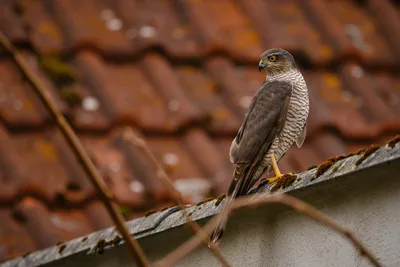 Eurasian sparrowhawk
- raptors
- cats near houses
Ecological equivalents
Related species on this site
Dodo (same family), Mourning dove (same family), Nicobar pigeon (same family), Passenger pigeon (same family), Pigeon (same family), Pink-Necked Green Pigeon (same family), and more.
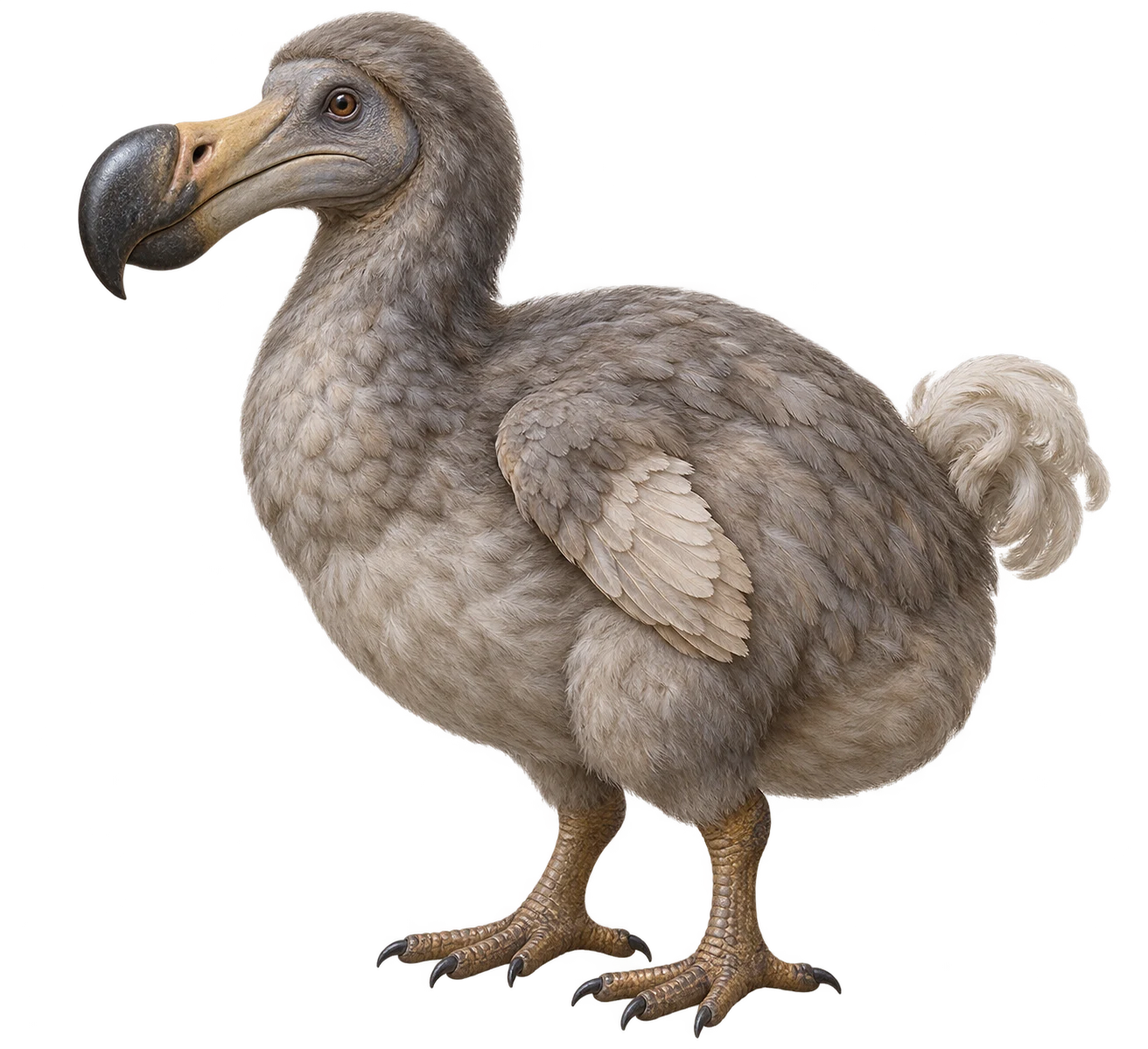 EX
Birds
Dodo
Raphus cucullatus
The dodo was a flightless pigeon that lived only on Mauritius, and it is now extinct.
ExtinctAI reconstruction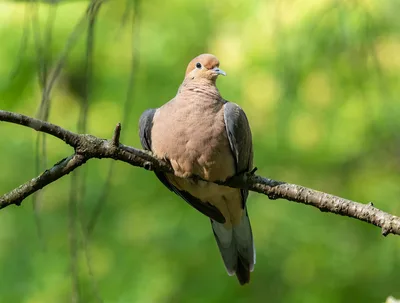 LC
Birds
Mourning dove
Zenaida macroura
The mourning dove is a slim grey-brown dove of open country, farmland and gardens across North America.
Living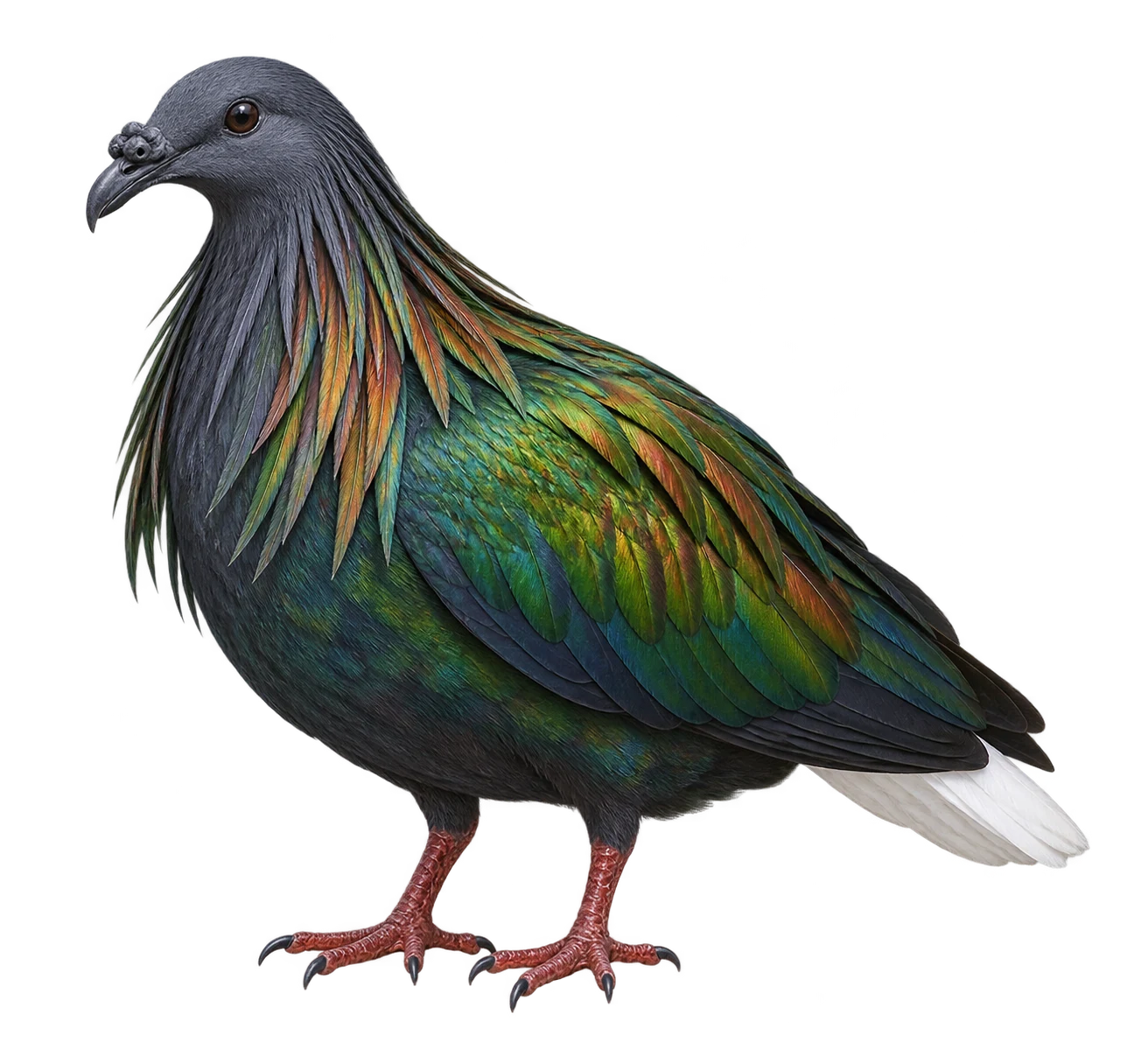
Birds
Nicobar pigeon
Caloenas nicobarica
Classification and source reference
LivingAI illustration EX
Birds
Passenger pigeon
Ectopistes migratorius
The passenger pigeon was a fast, long-tailed pigeon of eastern North America that moved in flocks of millions.
ExtinctAI reconstruction
Birds
Pigeon
Columbidae
Pigeons include a wide variety of birds.
Living
Birds
Pink-Necked Green Pigeon
Treron vernans
Classification and source reference
LivingAI illustration