Dodo
The giant ground pigeon that vanished in a century
Raphus cucullatus
Also called Dodo bird, Dronte, Walghvoghel
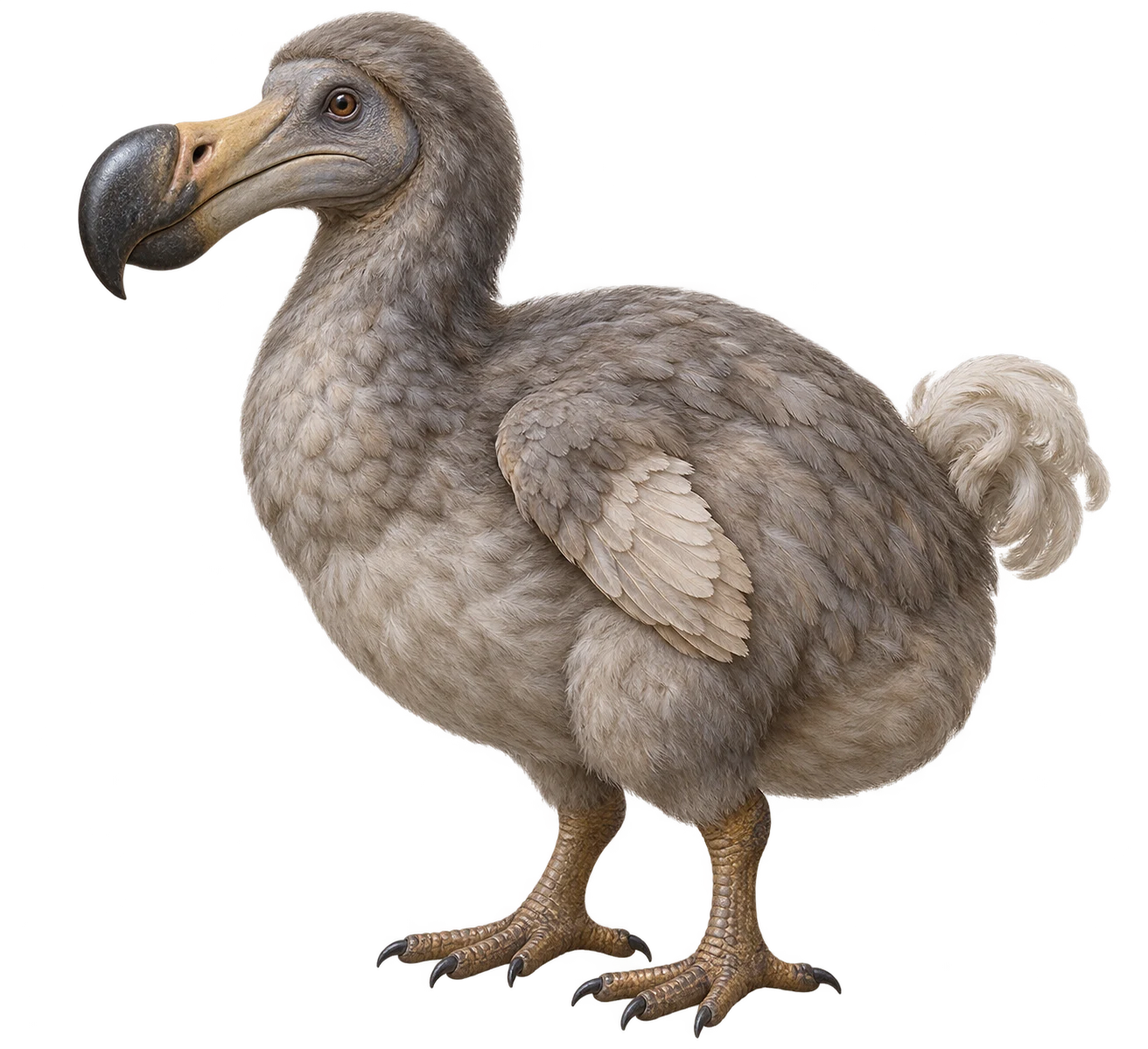
Meet the dodo
The dodo was a flightless pigeon that lived only on Mauritius, and it is now extinct. Sailors met it in 1598, and the animals their ships carried wiped it out within a century.
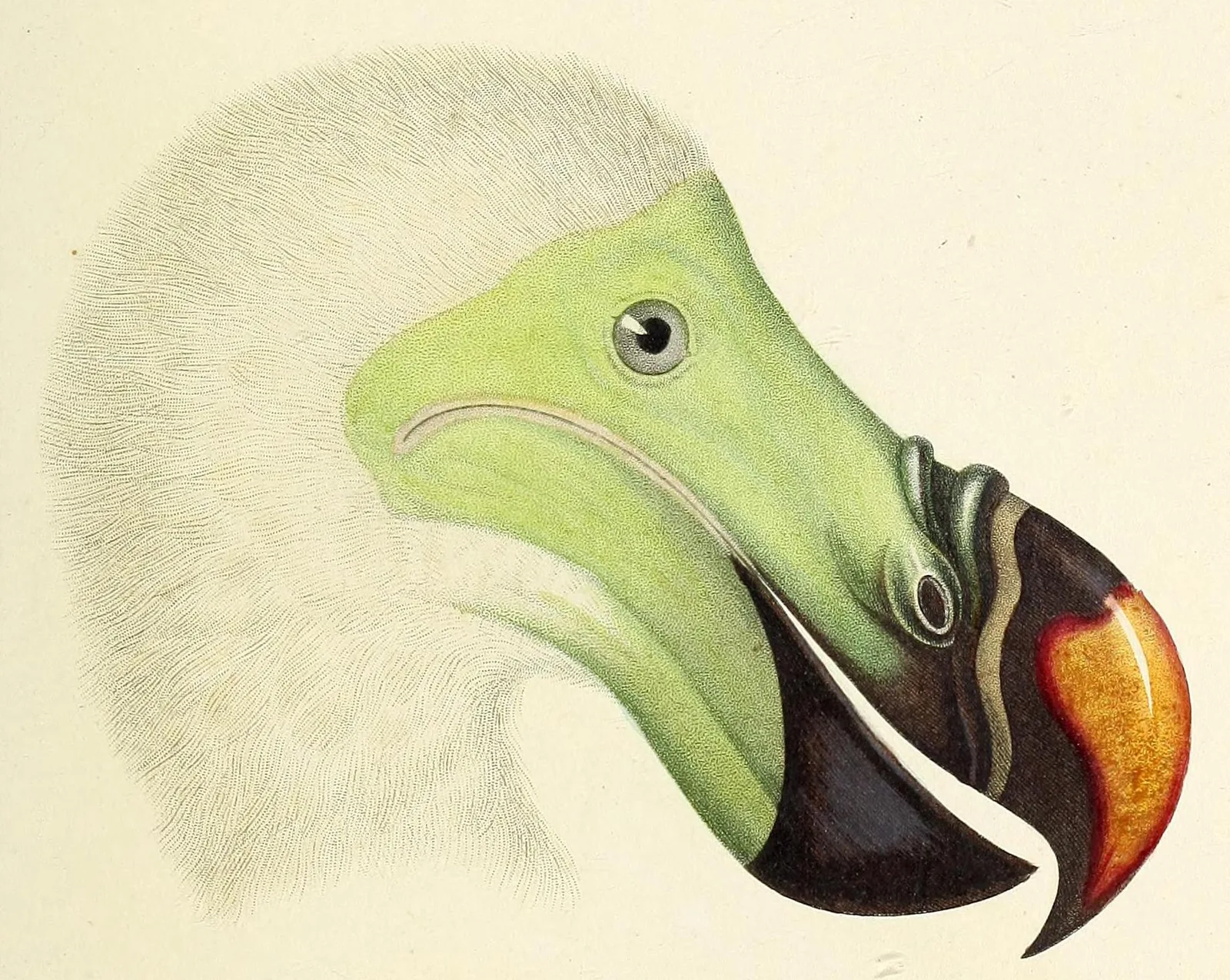
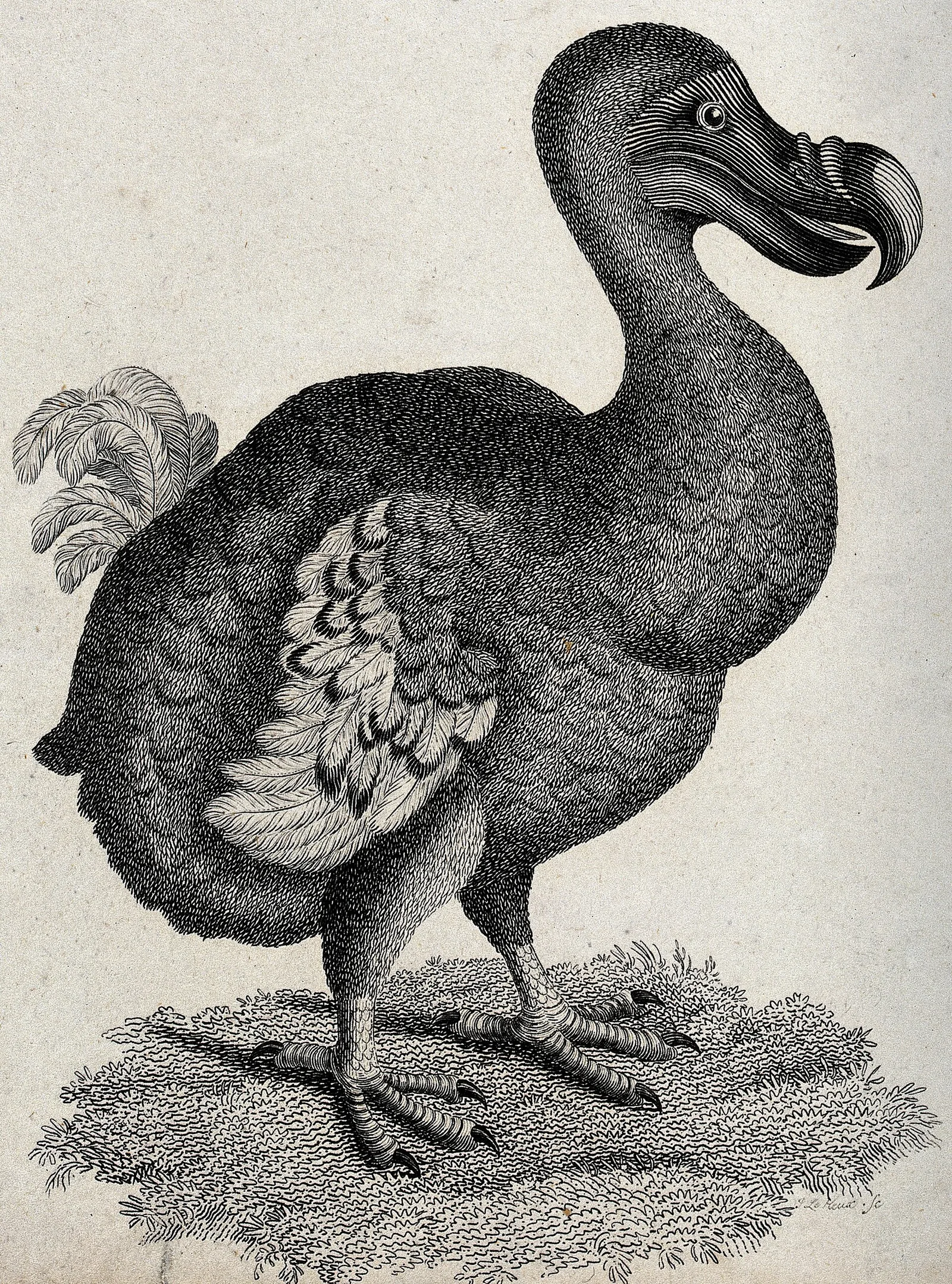
Images of the dodo
Lifespan in the wild
17 to 21 years estimated from body size, never measured
Weight
10.6 to 17.5 kg
Height
62.6 to 75 cm
Fact file
Dodo
- Location
- Mauritius, in the Indian Ocean
- Habitat
- Temperate forest, Coast
- Diet
- Omnivore
- Predators
- None on Mauritius; introduced pigs, macaques, cats, dogs and rats took eggs and chicks
- Lifestyle
- Ground living and flightless
- Group name
- Flock
- Name of young
- Chick
- Incubation
- Incubation period unknown
- Clutch size
- One egg
- Population
- Extinct since the 17th century
- Biggest threat
- Introduced pigs and macaques, and forest clearance
- Distinctive feature
- A large hooked beak on a bare grey face
- Colour
- Grey and brown with a pale tail tuft
- Skin type
- Feathers
Size
Next to a person
Measurements
Size and speed
- Height
- 62.6 to 75 cm from subfossil bones
- Weight
- 10.6 to 17.5 kg estimates for wild birds; captive birds in Europe were heavier
Typical adult ranges. Source: Wikipedia.
Life cycle
Lifespan
- In the wild17 to 21 years estimated from body size, never measured
- 021 years
Source: Wikipedia.
Appearance
Colour and coat
- Primary colours
- greybrown
- Secondary colours
- yellowblackgreen
- Skin type
- feathers
- Male and female
- Present but modest. Males grew larger, and their beaks were proportionally longer. The Oxford foot is 11 per cent smaller than the lost London foot and probably came from a female.
Life cycle
Mating and family
- Mating system
- unknown, probably monogamous pairs as in other pigeons
- Social structure
- loose groups on the forest floor
- Breeding
- one egg a year, laid around August
The dodo nested on the ground in a bed of grass it gathered. One white egg made the whole clutch, by the only account that survives. Bone studies suggest laying began around August, after the adults had fattened. Chicks grew fast and neared adult size before the cyclone season. The adults then moulted, finishing in time for the next breeding year.
Classification
Taxonomy
- Kingdom
- Animalia
- Phylum
- Chordata
- Class
- Aves
- Order
- Columbiformes
- Family
- Columbidae
- Genus
- Raphus
- Species
- Raphus cucullatus
Conservation
Red List status
- LC
- NT
- VU
- EN
- CR
- EW
- EX
Extinct on the IUCN Red List
Range
Historical range: 1 country
This animal is extinct. The map shows historical records, not a current living population.
Habitat layer: temperate broadleaf and mixed forest, temperate conifer forest, boreal forest and taiga, mangrove.
Countries from 0 wild records on GBIF (iNaturalist research grade), filtered and checked by hand. Country shapes: Natural Earth. Habitat: RESOLVE Ecoregions 2017, CC BY 4.0. Basemap: Natural Earth.
Habitats
Three things to know
- 1
The dodo laid one egg at a time, on a bed of grass on the forest floor.
- 2
Mauritius puts the dodo on its coat of arms and on its banknotes.
- 3
The dodo swallowed stones so that its gizzard could grind hard fruit.
Did you know
Seven more facts
- 1
Dutch sailors first called the bird Walghvoghel, meaning a bird with no flavour.
- 2
Later crews used Dronte, a word for swollen, and some languages keep it.
- 3
The dodo swallowed pebbles to grind hard fruit in its gizzard.
- 4
One white egg made up the whole clutch, by the single account we have.
- 5
Over 300 dodos have been dug out of one Mauritian swamp.
- 6
About 26 museums around the world hold significant dodo material.
- 7
Most stuffed dodos on display are models built from other birds' feathers.
Field notes
How it looks and acts
Field notes
Distinguishing features
- A large hooked beak, nearly twice the length of the braincase.
- Wings far too small to lift the body off the ground.
- A bare grey face, with skin reaching back around the eye.
- Stout yellow legs with black claws, built to carry weight.
- A tuft of curled pale feathers where a long tail would sit.
- A height of about 62.6 to 75 centimetres, which is huge for a pigeon.
Field notes
Unique adaptations
- Losing flight probably saved the energy that big wing muscles cost.
- Strong leg bones let a heavy bird move quickly through forest.
- Gizzard stones broke down hard fruit and seeds.
- Large olfactory bulbs gave the bird a good nose for fruit.
- A movable upper jaw helped it swallow large items whole.
Field notes
Interesting behaviours
- It fed on the forest floor rather than up in the canopy.
- It nested on open ground in a bed of collected grass.
- It may have used its beak to settle disputes with rivals.
- It probably put on fat before the dry season each year.
- It stood and watched approaching people instead of fleeing.
Field notes
Temperament
- The dodo showed no fear of humans at all.
- It could bite hard when handled or when a nest was threatened.
- Reports of stupidity reflect that tameness, not a small brain.
Field notes
Communication
- The only recorded call is a cry compared to that of a gosling.
- A captured bird called out, and others came towards the sound.
- Good hearing at low frequencies suggests the voice was deep.
- Wings held out in display may have carried a signal.
Ecology
Ecological role
The dodo was the largest fruit eater in the Mauritian forest, and it moved big seeds.
- It swallowed large fruit that few other island animals could handle.
- Seeds probably passed through the gut and landed away from the parent tree.
- Stanley Temple claimed the tambalacoque tree could not germinate without it, and later work rejected that.
- Researchers argue that losing wide gaped fruit eaters cut seed dispersal on the island.
Stories
Myths and legends
- In English usage, dead as a dodo marks something finished for good.
- In Victorian Britain, many naturalists treated the dodo as an invented creature.
- In Mauritian national symbolism, the dodo stands for the island itself.
- In European art, the bird was drawn as a figure of gluttony.
- In modern conservation, the dodo serves as the emblem of species loss.
People
Relationship with humans
People
Living alongside us
People met the dodo in 1598 and had lost it within a century. Dutch crews ate the birds and salted the rest for the voyage home. At least eleven live dodos went to Europe and Asia as curiosities. The animals the ships carried did the real damage, by eating eggs and chicks. Mauritius now puts the bird on its coat of arms.
- The dodo never killed or seriously injured anyone on record.
- It could bite hard with a heavy hooked beak if a person handled it.
- Sailors were warned to keep their hands clear of the bill.
People
Status, uses and products
- Domestication
- Wild
- As a pet
- Not suitable. The dodo has been extinct since the 17th century, so nobody can keep one. It was a forest bird of 10.6 to 17.5 kg that laid a single egg a year. Nothing about it suits a house.
- Uses
- food for ships' crewslive curiositiesmuseum specimens
- Products
- meatfeathers
The full account
About the dodo
The dodo was a large flightless pigeon that lived only on the island of Mauritius. Mauritius lies in the Indian Ocean, east of Madagascar. The bird stood about 62.6 to 75 centimetres tall. Weight estimates for wild birds run from 10.6 to 17.5 kilograms (kg). It could not fly, and no mammal on the island hunted it.
Dutch sailors wrote the first account of the bird in 1598. Within about a century the species was gone. Pigs, macaques, cats, dogs and rats came ashore with the ships. Those animals ate dodo eggs and chicks, and people cleared the forest. Most experts accept a sighting from 1662 as the last.
No complete stuffed dodo survives anywhere. Scientists work from bones, a dried head and foot, and pictures made by travellers. Because the evidence is thin, much about the living bird is still argued over. The dodo is now the best known emblem of extinction caused by people.
Name and taxonomy
Dutch crews used several names for the bird before dodo settled. A crew under Wybrand van Warwijck called it Walghvoghel in 1598, meaning a bird with no flavour. The crew of the ship Gelderland used Dronte, a word for swollen, in 1602. Some languages still use dronte for the species today.
The origin of the word dodo is not settled. One idea links it to the Dutch dodaars, a name for the knot of feathers at the rear. Another idea makes it an imitation of a two note call. Thomas Herbert put the word dodo into English print in 1634.
Early naturalists filed the dodo under ostriches, rails, albatrosses and even vultures. Johannes Theodor Reinhardt argued in 1842 that it belonged with the ground pigeons. Hugh Strickland and Alexander Melville backed him in 1848, after dissecting the Oxford head and foot. Mathurin Jacques Brisson had coined the genus Raphus in 1760, which gives the name Raphus cucullatus. The species now sits in the pigeon family Columbidae, in the subtribe Raphina.
Evolution and relatives
The nearest relative of the dodo was the Rodrigues solitaire. That bird was flightless too, and it lived on another of the Mascarene islands. Both are extinct, and both descend from pigeons that could fly. Genetic work published in 2002 named the Nicobar pigeon as the closest living relative. Crowned pigeons of New Guinea and the tooth-billed pigeon of Samoa sit nearby on the tree.
The two Mascarene lineages split from each other about 23 million years ago. The islands are younger than that, so the ancestors probably still flew when they arrived. Researchers read the pattern as island hopping from South Asia. No mammal grazed these islands, so the birds grew large and gave up flight. Fiji held another giant flightless pigeon, known from bones described in 2001.
Appearance
Most pictures show greyish or brownish plumage with paler flight feathers. A tuft of curly pale feathers sat high on the rear. The head was grey and bare, and the stout legs were yellow with black claws. The beak carried green, black and yellow, and it ended in a hook. Adults stood about 62.6 to 75 centimetres tall, which is very large for a pigeon.
Weight is the hardest figure to pin down. Bradley Livezey proposed 21 kg for males and 17 kg for females in 1993. Andrew Kitchener argued in the same year that wild birds weighed 10.6 to 17.5 kg. He thought the round birds in European paintings had been overfed in captivity. A study in 2016 used scans of skeletons and reached a low range again.
Males were larger than females and had proportionally longer beaks. The skull was heavy, and the upper bill was nearly twice the length of the braincase. The wings were small, but muscle scars on the bones show they carried real muscle. Researchers now treat the fat, clumsy dodo of old paintings as a poor likeness.
Habitat and range
The dodo lived on Mauritius and nowhere else. The island covers about 1,860 square kilometres. Old accounts place the bird in woodland in the drier south and west. Bones from highland caves show that it reached the mountains as well. Animal Diversity Web stresses that it was a forest bird, not a shore bird.
Most remains come from the Mare aux Songes, a swamp near the south east coast. Work there found tambalacoque trees, screwpines and native palms around the site. Bones of dodos and tortoises built up there about 4,200 years ago, during a long drought. A range this small probably made the species easy to lose. Forest once covered the whole island, and very little of it is left today.
Diet and feeding
A Dutch letter of 1631 gives the only contemporary note on the diet. It says the birds fed on raw fruit. Fallen fruit was probably the staple, with nuts, seeds, bulbs and roots as well. France Staub suggested in 1996 that palm fruit mattered most of all. Other writers have proposed crabs and shellfish, since crowned pigeons take them.
Several sailors described the bird swallowing large stones. Hamon L'Estrange watched a keeper in London feed pebbles to a live dodo. These gizzard stones ground hard food inside the bird. A study in 2016 found that the upper jaw bones could move against each other. That flexibility helps a bird swallow big items, and the beak could take heavy loads.
The bird may have fattened on ripe fruit at the end of the wet season. Stored fat probably carried it through the dry months that followed. Contemporary reports called its appetite greedy. Like other pigeons, it almost certainly fed its chick on crop milk.
Behaviour and social life
Very little was written about how the dodo behaved. Sailors described a bird that held its ground and did not run from people. Studies of the leg bones show they were strong enough for fast running. The bird was probably agile in dense forest, where short bursts of speed count.
The wings were too small for flight, yet they were not empty of muscle. Pigeons use their wings in display and for balance, so the dodo probably did the same. There is no sign that it fought rivals with its wings. The Rodrigues solitaire did fight that way, and it grew a bony knob on each wrist. The dodo may have settled disputes with its heavy hooked beak instead.
Mauritius gets more rain than Rodrigues and has milder seasons. Food was therefore steadier, and fierce territorial behaviour had less reason to evolve. The account of 1662 describes birds running towards a captured companion. That story suggests the dodo answered the calls of its own kind.
Communication and senses
François Cauche wrote in 1651 that the cry resembled that of a gosling. A sailor quoted by Animal Diversity Web heard the same sound from a chick in the nest. No other description of the voice survives. The name dodo may itself copy a two note call.
A cast of the braincase was made in 2016 and compared with living pigeons. It showed a brain of normal pigeon proportions for the body size. The dodo was therefore probably no less clever than a pigeon alive today. The olfactory bulbs were large, which points to a good sense of smell.
A later study of brain casts found sharper vision, smell and touch than in other pigeons. The visual pattern may fit a bird active at dusk and dawn. The Nicobar pigeon, its closest living relative, does feed at those hours. Both the dodo and the solitaire heard low sounds well, which suits a deep voice. The upper beak carried more touch information than a normal pigeon bill.
Reproduction and life cycle
The dodo nested on the ground, because nothing on Mauritius hunted the adults. Cauche reported a single white egg laid on a bed of gathered grass. Small clutches fit that account, since pigeons rarely lay many eggs. No incubation period was ever recorded. An egg in a South African museum is claimed as a dodo egg, but nobody has verified it.
One large egg points to a slow breeding strategy. Chicks probably needed long care before they could feed themselves. Like other pigeons, both parents probably supplied crop milk. One suggestion is that crop milk set a ceiling on how large the young could grow.
A study of bone structure in 2017 reconstructed the yearly cycle. It found that breeding began around August, after the adults had put on fat. Chicks grew fast and reached almost adult size before the cyclone season. Adults moulted after the southern summer, starting around March. Wing and tail feathers went first, and the moult finished by late July. Body size suggests males may have reached 21 years and females about 17.
Predators and threats
Mauritius held no mammal that could hunt a full grown dodo. Land crabs lived on the island, and the birds were used to them. That long safety left the dodo fearless of anything new. Sailors found they could walk up to a bird and take it by hand.
Ships brought pigs, crab-eating macaques, cats, dogs and rats to the island. Pigs and macaques raided nests on the ground and ate the single egg. The same animals competed with the birds for fruit and seeds. Most researchers now rank these newcomers above hunting as the cause of the loss.
People also cut and burned the lowland forest the bird depended on. The human population of Mauritius stayed under 50 through that century. A small number of settlers was therefore enough to end the species. A flash flood killed dodos and other animals at least once, as bones found in 2005 show. Such events probably hit an already small population hard.
Population and conservation
The IUCN Red List records the dodo as Extinct. No living dodo has been seen since the 17th century. Nobody ever counted the birds, so the size of the original population is unknown. Some researchers argue the species was already scarce or local before people landed.
Volkert Evertsz gave the account of 1662, after a shipwreck put him on an islet. He described birds so tame that his party gathered them up by hand. A hunting record of 1688 is the last claim of any kind. A statistical study in 2003 put the likely end around 1693. Later mentions of a dodo probably refer to the red rail, another flightless island bird.
Nobody recognised the extinction at the time. Many scholars did not accept that a species could vanish at all. A magazine article of 1833 used the bird as a case of loss caused by people. Conservation groups now use the dodo as an emblem. The Durrell Wildlife Conservation Trust carries it, and one award for environmental harm is named after it.
Relationship with humans
Contact between people and dodos lasted less than a hundred years. Dutch ships used Mauritius as a stop for water and fresh meat. A journal of 1602 records two dozen birds killed for the pot. Crews salted what they could not eat at once. Opinions on the meat differed, and several sailors preferred parrots and pigeons.
Hunters had to keep clear of the beak, which could bite hard. Live birds were shipped to Europe, India and Japan as curiosities. Julian Hume reckons that at least eleven reached their destinations alive. One arrived in Nagasaki in 1647 and was valued like a white deer. Peter Mundy saw two live birds at Surat in the 1620s.
Only a handful of remains from that century survive. Oxford keeps a dried head and foot, the sole soft tissue left anywhere. Copenhagen holds a skull, and Prague holds part of an upper jaw. Scans of the Oxford head found lead shot inside it. The bird had therefore been shot, though nobody knows when or by whom.
In culture and myth
The dodo entered English as a byword for something finished. The phrase dead as a dodo means beyond any doubt over. A practice that goes the way of the dodo has dropped out of common use. The bird was also called stupid, a reputation the brain casts do not support.
Lewis Carroll put a dodo into Alice's Adventures in Wonderland in 1865. He is thought to have used the bird as a version of himself. A stammer made him say his own surname as Do-do-dodgson. Carroll and Alice Liddell visited the Oxford dodo remains together. The book made the species famous far beyond science.
Painters shaped the popular image more than naturalists did. Roelant Savery made at least twelve dodo pictures, and one became the standard portrait. A Mughal painting found in St Petersburg in 1955 shows a slimmer bird. Julian Hume rates that image among the most accurate we have.
Mauritius keeps the dodo at the centre of its national symbols. The coat of arms granted in 1906 shows a dodo holding sugar cane. A deer stands opposite, under the motto Stella Clavisque Maris Indici. The design survived independence in 1968 and the republic of 1992. The bird also appears on coins and as a watermark on the banknotes.
A sentence with a dotted underline is inferred: it describes the group the animal belongs to, or is a reading of the sources, rather than a measured or reported fact about this species.
Questions
Dodo questions, answered
What was the dodo?
The dodo was a flightless pigeon of the island of Mauritius. It reached about 62.6 to 75 centimetres in height, and it is now extinct.
When did the dodo go extinct?
Most experts take a sighting in 1662 as the last reliable one. A statistical study puts the real end nearer 1693.
Why did the dodo go extinct?
Ships brought pigs, macaques, rats, cats and dogs to Mauritius. Those animals ate eggs and chicks, and settlers cleared the forest.
Did people hunt the dodo to extinction?
Sailors did eat dodos, but hunting was not the main cause. Introduced animals and forest loss did far more damage.
What did the dodo eat?
Fallen fruit was the staple. It probably also took nuts, seeds, bulbs and roots.
How big was the dodo?
It stood about 62.6 to 75 centimetres tall. Wild birds are estimated at 10.6 to 17.5 kg.
Was the dodo stupid?
No. A cast of its braincase shows a brain in normal pigeon proportion to the body.
What is the dodo's closest living relative?
The Nicobar pigeon of South East Asia. The crowned pigeons of New Guinea come next.
Could the dodo fly?
No. Its wings were small and its breastbone was too weak to anchor flight muscles.
Where did the dodo live?
Only on Mauritius, in the Indian Ocean east of Madagascar. It favoured woodland in the drier south and west.
How many eggs did a dodo lay?
One, by the single account that survives. That matches the small clutches of other pigeons.
How long did a dodo live?
Nobody measured it. Estimates from body size give about 21 years for males and about 17 for females.
Are there any stuffed dodos left?
No complete specimen survives. Oxford keeps a dried head and foot, and other museums hold a skull and a jaw.
Why do people say dead as a dodo?
The phrase grew out of the bird's total disappearance. It now means something finished beyond argument.
Can the dodo be brought back?
A company called Colossal says it is trying, using the Nicobar pigeon as a template. No dodo exists today.
What did the dodo sound like?
The one description compares the cry to that of a gosling. Nothing else about its voice was written down.
Food web
Prey and food
Not recorded.
Food web
Predators
- none on mauritius
- pigs
- macaques
- cats
- dogs
- rats took eggs
- chicks
Ecological equivalents
Related species on this site
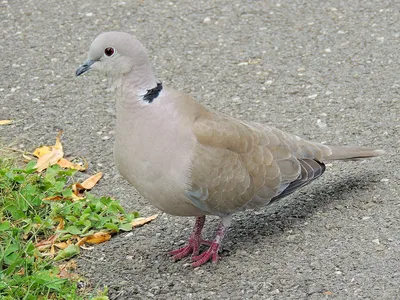
Eurasian collared dove (same family), Mourning dove (same family), Nicobar pigeon (same family), Passenger pigeon (same family), Pigeon (same family), Pink-Necked Green Pigeon (same family), and more.
 LC
Birds
Eurasian collared dove
Streptopelia decaocto
The Eurasian collared dove is a pale grey dove with a black half-collar on the neck.
Living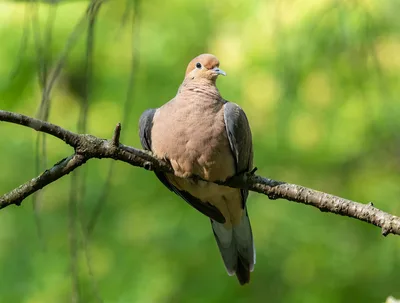 LC
Birds
Mourning dove
Zenaida macroura
The mourning dove is a slim grey-brown dove of open country, farmland and gardens across North America.
Living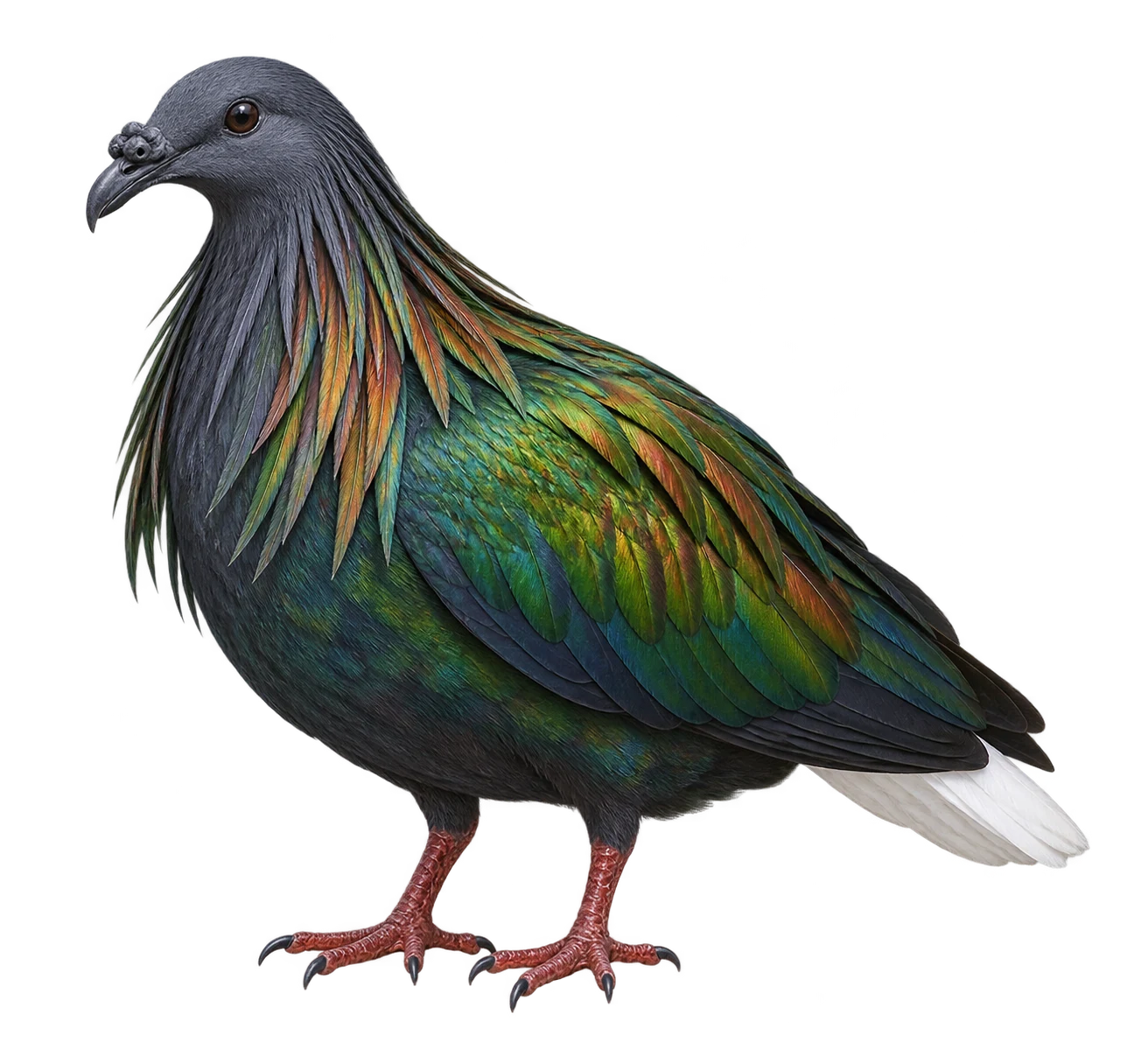
Birds
Nicobar pigeon
Caloenas nicobarica
Classification and source reference
LivingAI illustration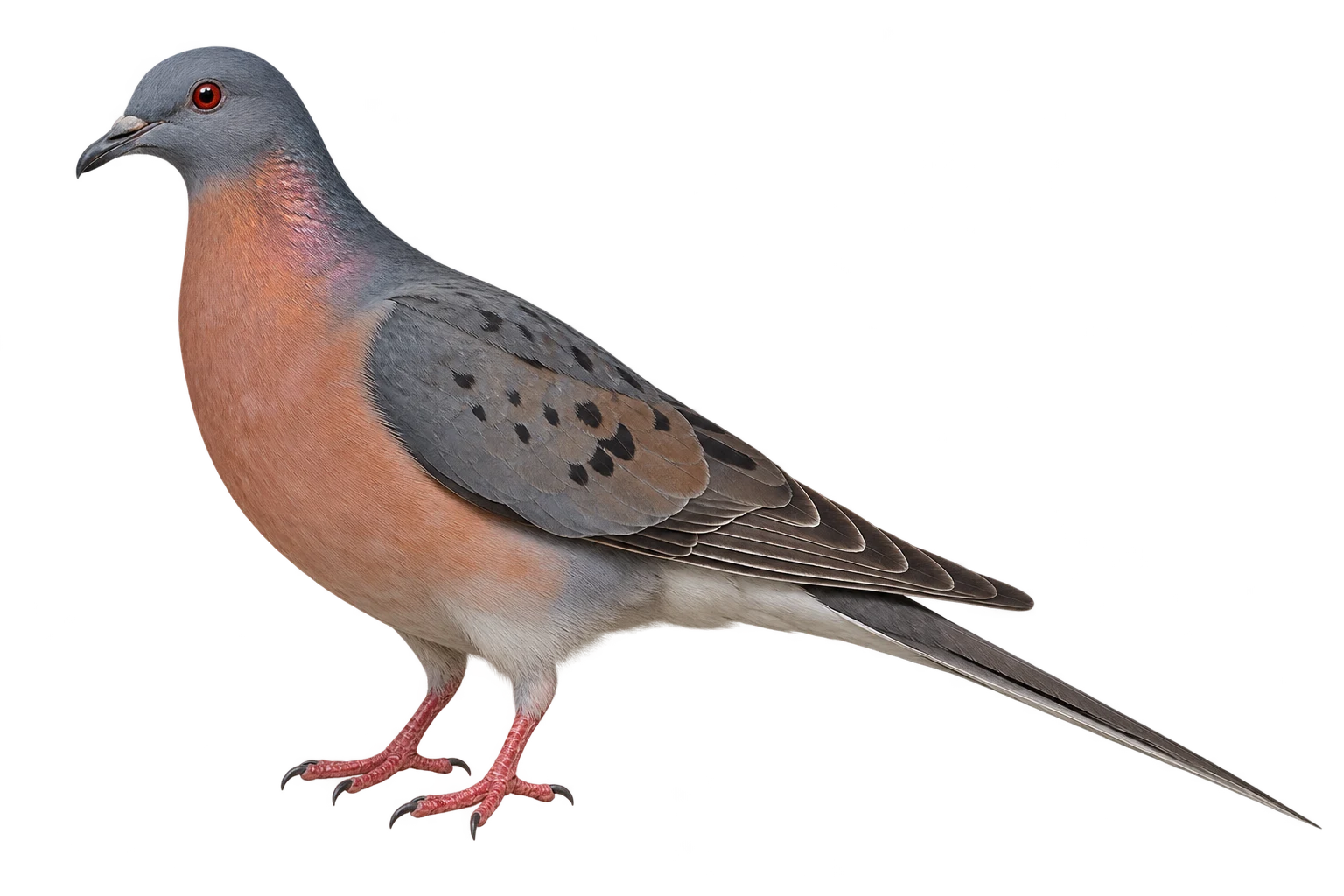 EX
Birds
Passenger pigeon
Ectopistes migratorius
The passenger pigeon was a fast, long-tailed pigeon of eastern North America that moved in flocks of millions.
ExtinctAI reconstruction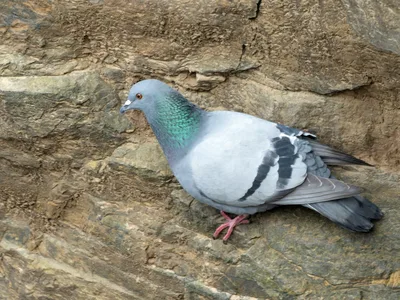
Birds
Pigeon
Columbidae
Pigeons include a wide variety of birds.
Living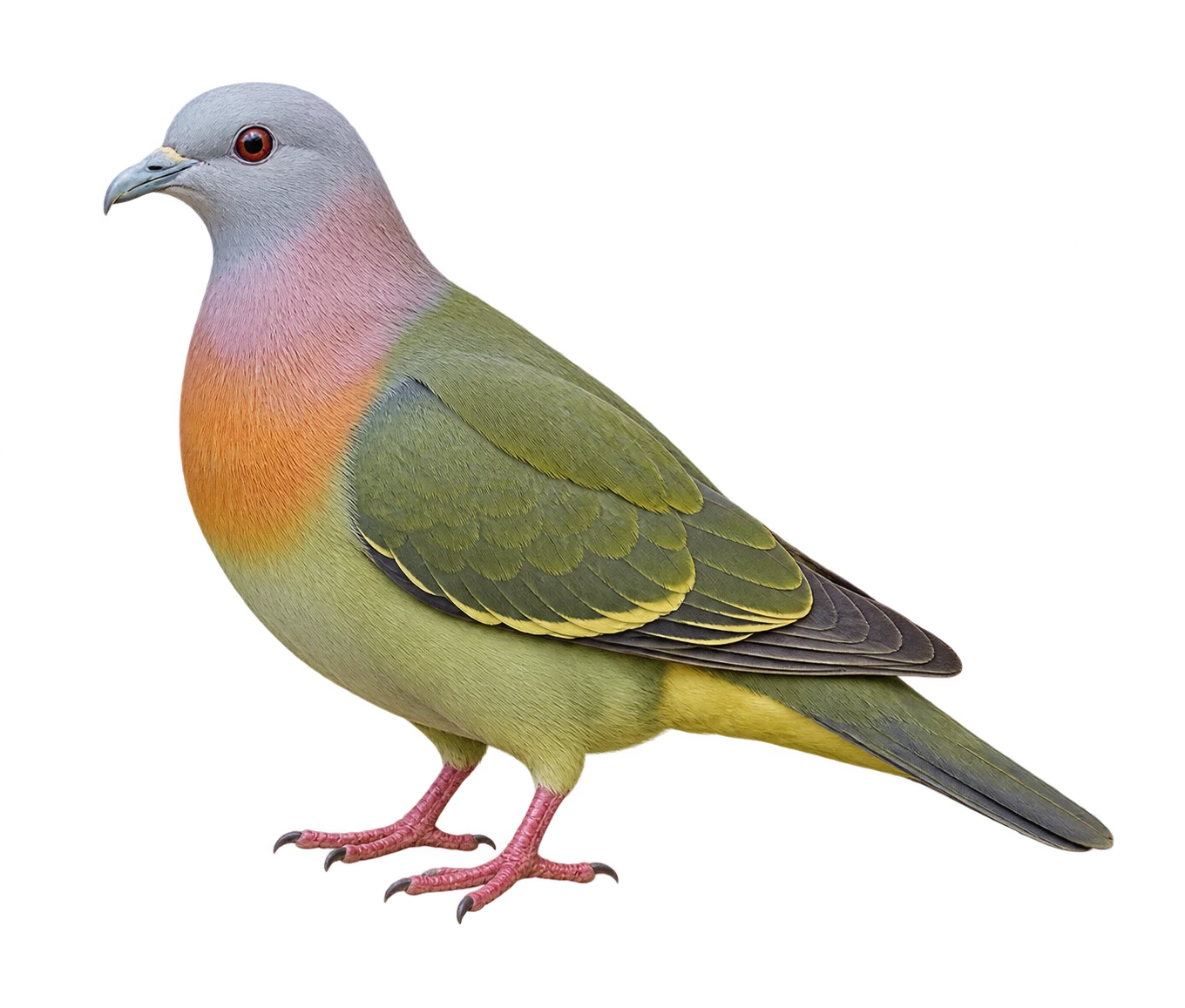
Birds
Pink-Necked Green Pigeon
Treron vernans
Classification and source reference
LivingAI illustration