Steller's sea cow
A nine-metre kelp grazer, gone 27 years after its discovery
Hydrodamalis gigas
Also called Great northern sea cow, Bark animal, Cabbage-eater
Meet the steller's sea cow
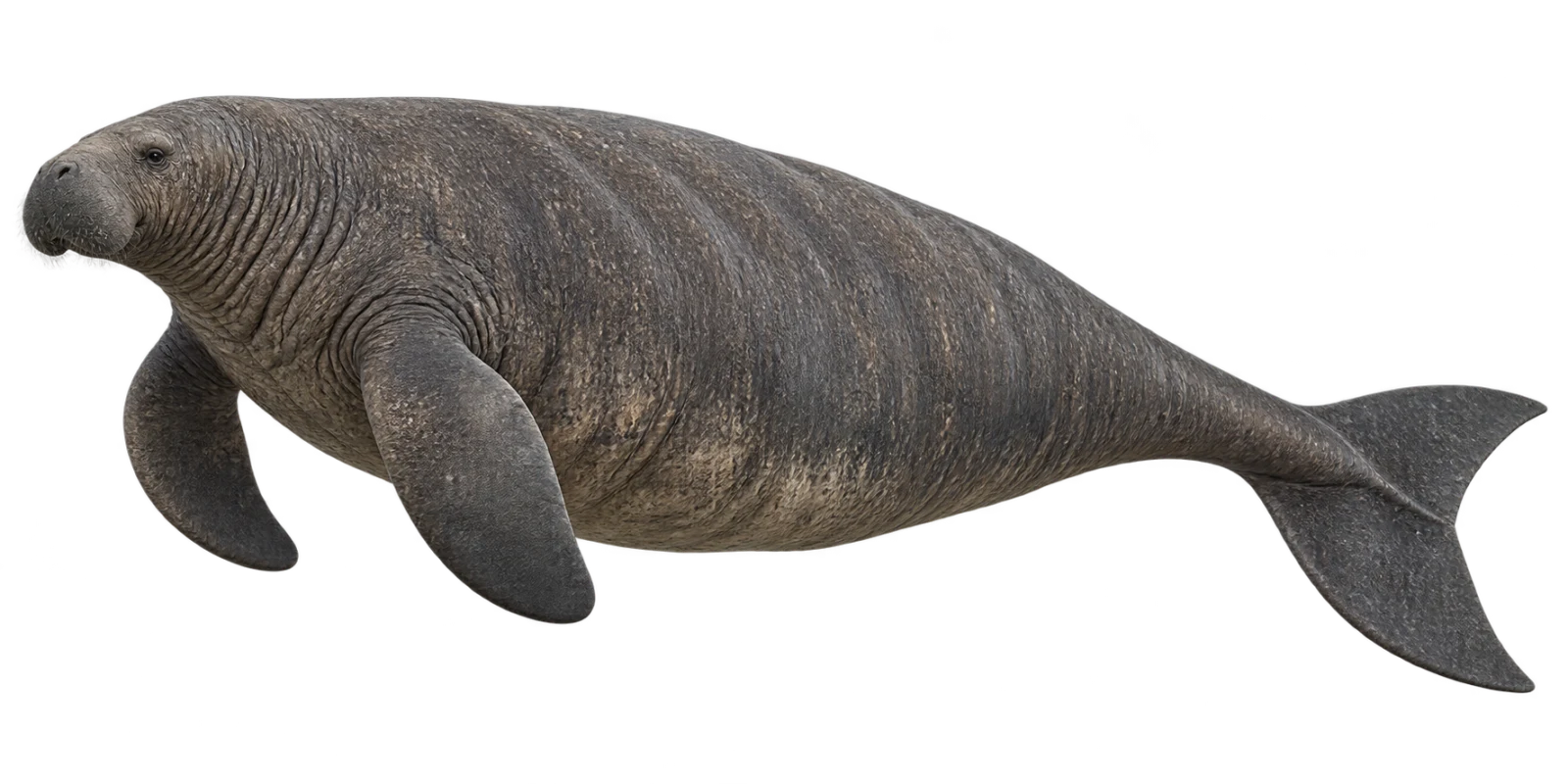
Steller's sea cow was a giant sirenian of the Bering Sea that floated in shallow kelp beds and ate seaweed. Fur hunters killed the last of them by 1768, only 27 years after Georg Steller described the species.
Images of the steller's sea cow
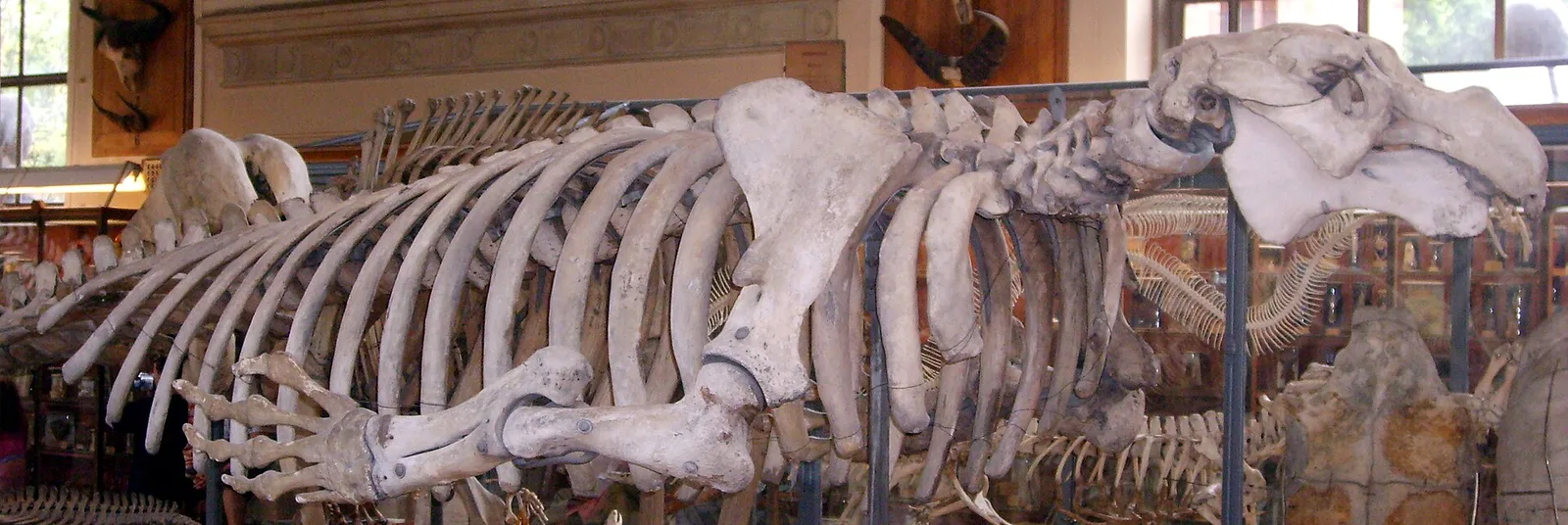
Lifespan in the wild
50 to 70 years an estimate for the order Sirenia; no record exists for the species
Weight
5.4 to 11.2 t
Length
8 to 9 m
Fact file
Steller's sea cow
- Location
- Commander Islands, Bering Sea
- Habitat
- Coast
- Diet
- Herbivore
- Prey / food
- Kelp, brown and red algae, some seagrass
- Predators
- Killer whales and sharks were possible; people were the real threat
- Lifestyle
- Floated at the surface and grazed by day
- Group name
- Herd
- Name of young
- Calf
- Gestation
- A little over a year
- Litter size
- 1 calf
- Population
- Extinct since about 1768
- Biggest threat
- Hunting for meat, fat and hide
- Distinctive feature
- No teeth, a bark-like hide, and a body that could not sink
- Colour
- Brownish-black, sometimes with white patches
- Skin type
- Thick, rough skin
Size
Next to a person
Measurements
Size and speed
- Length
- 8 to 9 m, up to 9 m reported adult length; Steller measured one female at 7.5 metres
- Weight
- 5.4 to 11.2 t published estimates; no animal was ever weighed
Typical adult ranges. Sources: Wikipedia, Animal Diversity Web.
Life cycle
Lifespan
- In the wild50 to 70, up to 73 years an estimate for the order Sirenia; no record exists for the species
- 073 years
The pale bar is the record. Source: Animal Diversity Web.
Appearance
Colour and coat
- Primary colours
- brownish-black
- Secondary colours
- white
- Skin type
- thick, rough skin
- Male and female
- None known. Early writers claimed that males were larger, but Domning found no evidence for it in the skeletons.
Life cycle
Mating and family
- Mating system
- monogamous pairs, according to Steller
- Social structure
- small family herds of males, females and calves
- Breeding
- one calf per birth, after a gestation of a little over a year
Steller's sea cows mated in early spring. Gestation lasted a little over a year, so most calves were born in early autumn. A female had one pair of mammary glands and raised a single calf at a time. No record gives the lifespan, but living sirenians average 50 to 70 years. Slow breeding meant that the population could not replace the animals that hunters killed.
Classification
Taxonomy
- Kingdom
- Animalia
- Phylum
- Chordata
- Class
- Mammalia
- Order
- Sirenia
- Family
- Dugongidae
- Genus
- Hydrodamalis
- Species
- Hydrodamalis gigas
Conservation
Red List status
- LC
- NT
- VU
- EN
- CR
- EW
- EX
Extinct on the IUCN Red List
Range
Historical range: 2 countries
This animal is extinct. The map shows historical records, not a current living population.
Habitat layer: mangrove.
Countries from 0 wild records on GBIF (iNaturalist research grade), filtered and checked by hand. Country shapes: Natural Earth. Habitat: RESOLVE Ecoregions 2017, CC BY 4.0. Basemap: Natural Earth.
Habitats
Three things to know
- 1
It had no teeth at all and chewed kelp between two horny plates in its mouth.
- 2
It was so buoyant that it could not sink below the surface, so hunters simply waded out to it.
- 3
The whole species was wiped out within 27 years of the first written description.
Did you know
Seven more facts
- 1
Steller wrote down two weights for the animal, 4 tonnes and 24.3 tonnes, and neither was a measurement.
- 2
The first bones were found around 1840, more than 70 years after the last animal died.
- 3
The heart alone weighed about 16 kilograms.
- 4
A 2017 skeleton from Bering Island measured 5.2 metres, from an animal probably about 6 metres long in life.
- 5
Steller's account was published in 1751, after his death, by the Russian Academy of Sciences.
- 6
Seabirds ate whale lice from the backs of floating sea cows, much as oxpeckers clean African mammals.
- 7
Most museum skeletons are built from the bones of 2 to 16 different animals.
Field notes
How it looks and acts
Field notes
Distinguishing features
- A body 8 to 9 metres long, larger than any living sirenian.
- A toothless mouth, a mat of white lip bristles, and two horny chewing plates.
- Rough, bark-like, brownish-black skin about 2.5 centimetres thick.
- Short, hooked forelimbs without finger bones, used to walk along the seabed.
- A forked, whale-like tail fluke.
- A small head, tiny eyes and no external ears.
Field notes
Unique adaptations
- A huge body cut heat loss in the cold Bering Sea, as with large whales.
- Blubber 8 to 10 centimetres thick insulated the animal against near-freezing water.
- A thick outer skin protected it from sharp rocks and ice in the shallows.
- Strong buoyancy kept it in shallow water where predators could not follow.
- A cold-adapted haemoglobin let its blood carry oxygen well at low temperatures.
Field notes
Interesting behaviours
- Grazed at the surface most of the day and lifted the head to breathe every 4 to 5 minutes.
- Pulled itself through the shallows on its forelimbs as it fed.
- Slept on its back at the surface after a meal.
- Kept calves between the adults and the shore.
- Came to the aid of a herd member that hunters had harpooned.
Field notes
Temperament
- Calm and almost without fear of people.
- Loyal to its mate, which followed a captured female to shore.
- Protective of the young and of injured herd members.
Field notes
Communication
- Made heavy breathing sounds when it surfaced.
- Gave a raspy snort like a horse.
- Sighed, and was otherwise nearly silent.
- Probably used the muzzle bristles as touch organs, as living sirenians do.
Ecology
Ecological role
Steller's sea cow was the only large grazer of the North Pacific kelp canopy, and its loss changed those forests.
- Cropped the kelp canopy, which let more light reach the forest below and probably boosted kelp growth.
- Spread kelp fragments and spores to new sites through its feeding.
- Kept nutrients flowing from kelp forests to nearby habitats all year, not only in storms.
- Fed seabirds that picked parasites from its back.
Stories
Myths and legends
- In Russian hunting tradition, the sea cow was the cabbage-eater, a floating larder in the kelp.
- In the tradition of Aleut people on Attu, sea cows were said to survive into the 1800s, long after the official extinction.
- In cryptozoology, sea monster reports from Hudson Bay have been read as sea cows, with little evidence.
- In Rudyard Kipling's Jungle Book, Sea Cow guides the white seal Kotick to a safe island.
People
Relationship with humans
People
Living alongside us
People met Steller's sea cow late and killed it fast. Aleut and Yupik hunters may have taken sea cows from the Aleutians and St. Lawrence Island long before Europeans arrived. Bering's shipwrecked crew learned to harpoon the animals in 1741, and fur traders then stopped at the Commander Islands to fill their holds with meat. The species was extinct by 1768. Today its bones are museum pieces and carving material, and two groups talk of bringing it back.
- The animal never attacked people and showed almost no fear of them.
- Herd members rammed and rocked a hunting boat that had harpooned a female.
- The species is extinct, so it poses no danger to anyone today.
People
Status, uses and products
- Domestication
- Wild
- As a pet
- Not suitable. The species is extinct. Even in life, an 8-tonne animal that ate kelp all day in cold seawater could not be kept.
- Uses
- museum specimensbone carving
- Products
- meatfatmilkhidebone
The full account
About the steller's sea cow
Steller's sea cow, Hydrodamalis gigas, was a giant sirenian of the cold North Pacific. It was a relative of the dugong and the manatees, but it grew far larger than any of them. Adults reached 8 to 9 metres in length and weighed about 8 tonnes. It floated at the surface of shallow kelp beds and ate the soft fronds of seaweed. Georg Wilhelm Steller described it in 1741, when Vitus Bering's crew was shipwrecked on Bering Island.
By then the species survived only near the Commander Islands, a small group in the Bering Sea. Fur hunters followed Bering's route and killed the slow, trusting animals for meat, fat and hide. The species was gone by 1768, only 27 years after Europeans first saw it. The IUCN lists it as Extinct. Almost everything known about its life comes from Steller's notes, published after his death as The Beasts of the Sea.
Name and taxonomy
The common name honours Georg Wilhelm Steller, the naturalist who described the living animal. Eberhard von Zimmermann gave the species its first formal name, Manati gigas, in 1780. Anders Jahan Retzius moved it into a new genus, Hydrodamalis, in 1794. Johann Karl Wilhelm Illiger placed it in the genus Rytina in 1811, and many writers used that name. Theodore Sherman Palmer first used the current combination Hydrodamalis gigas in 1895.
The species belonged to the order Sirenia, the sea cows, and to the family Dugongidae. Russian hunters called it the cabbage-eater, because it grazed the kelp they knew as sea cabbage. Its rough hide earned it the nickname bark animal, and several European languages still call it that. GBIF lists the English name great northern sea cow as well.
Evolution and relatives
Hydrodamalis and its sister genus Dusisiren form the subfamily Hydrodamalinae. This line split from the other sirenians about 4 to 8 million years ago. Its ancestors lived on warm mangrove coasts before they moved into the cold North Pacific. Steller's sea cow descended from the Cuesta sea cow, Hydrodamalis cuestae, which lived off California. The Cuesta sea cow probably died out when the Quaternary ice ages cooled the oceans. One lineage adapted to the cold and became Steller's sea cow.
Over time the genus grew larger and lost both its teeth and its finger bones. The dugong, Dugong dugon, is the only living member of the family Dugongidae. It is therefore the closest living relative of Steller's sea cow, though it reaches only about 3 metres. Genetic work shows that the sea cow converged with other marine mammals in genes for metabolism and immunity.
Appearance
Adults were reported at 8 to 9 metres long, far beyond any living sirenian. Steller measured one female at 7.5 metres, and Domning later estimated an upper limit of about 7.9 metres. Published weight estimates run from 5,400 to 11,196 kilograms, with an average near 8,000 kg. Steller himself wrote down two conflicting weights, 4 and 24.3 tonnes. The body was rounded and swollen at the belly and tapered towards the head and the tail.
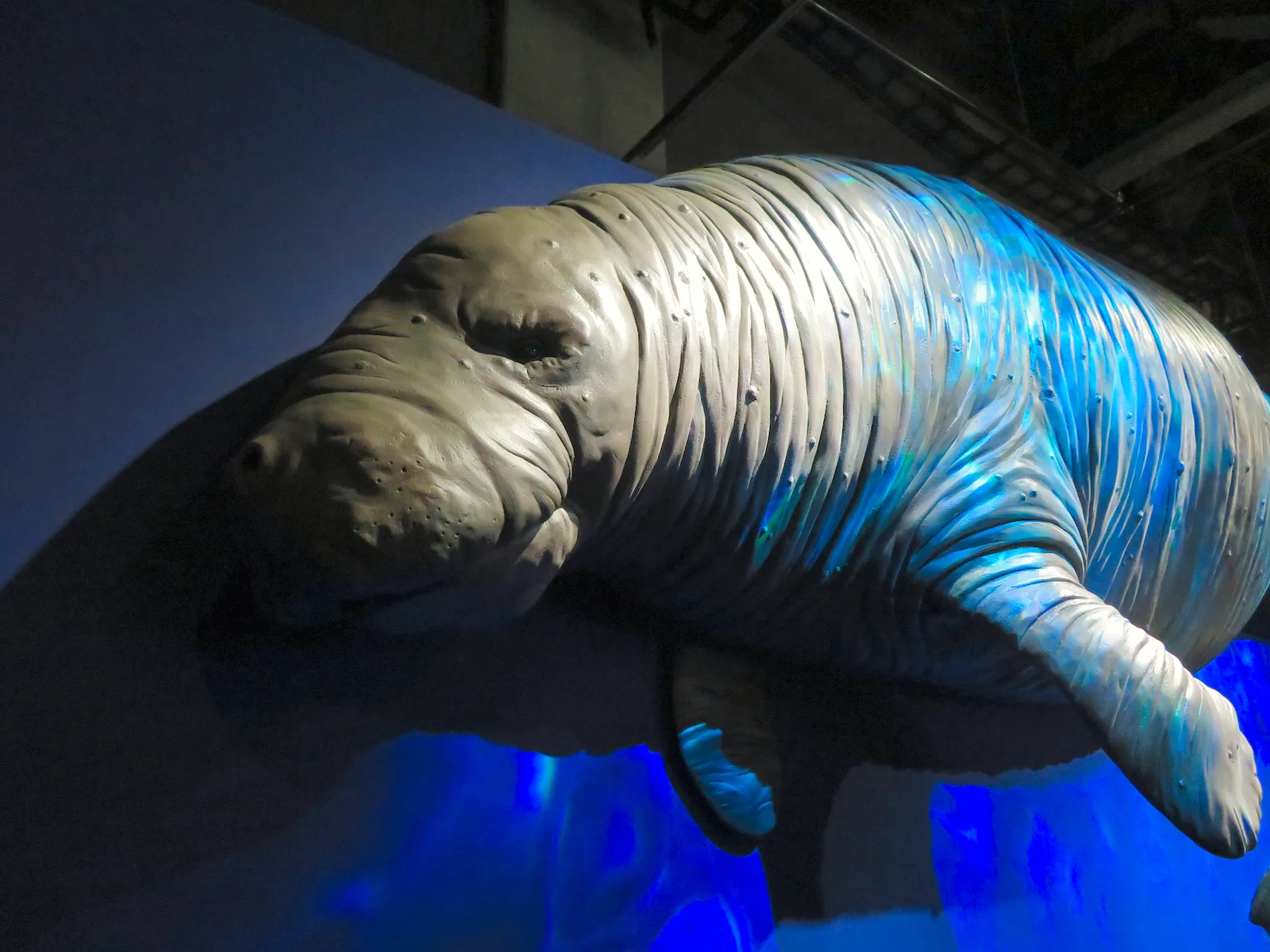
The head was small and short, with tiny eyes and no external ears. The skin was brownish-black, and some animals carried white patches. Its outer layer was about 2.5 centimetres thick and rough like tree bark on the sides. Under the skin lay 8 to 10 cm of blubber against the cold. The forelimbs were short, hooked and about 67 cm long, and the tail ended in a forked fluke.
The mouth had no teeth at all. Instead, the upper lip carried a mat of white bristles about 3.8 cm long, and two horny plates ground the food. Stiff bristles 10 to 12.7 cm long also stood out from the muzzle. Domning found no evidence that males and females differed in size.
Habitat and range
When Steller found it, the species lived only in the shallow seas around the Commander Islands. These islands, Bering and Copper, lie in the Bering Sea between Kamchatka and Alaska. The animals stayed in cold, shallow coastal water rich in kelp and seaweed. Herds gathered near the mouths of streams, which suggests they needed fresh water to drink. They floated so close to shore that hunters could wade out to them.
Fossils show a much wider range in the Pleistocene. Bones have turned up on Amchitka in the Aleutians, in Monterey Bay in California, and on Honshu in Japan. A rib from Kiska Island was dated to about 1,000 years old. Bones from St. Lawrence Island came from an animal that lived between 800 and 920 CE. Aleut accounts suggest that sea cows still lived in the Near Islands shortly before 1741.
GBIF holds records of the species from 4 countries, all of them specimens or fossils. The Commander Islands themselves had no people until 1825, when the Russian-American Company moved Aleuts there.
Diet and feeding
Steller's sea cow was a strict herbivore, and it ate mostly kelp. It fed on brown and red algae, with seagrass as a minor part of the diet. Because it floated, it could reach only plants within about 1 metre of the surface. It took only the soft parts of the kelp, so tough stems and holdfasts washed ashore in heaps. Canopy kelp holds fewer chemical deterrents than deeper kelp, which probably let the sea cow graze safely.
An animal spent most of the day feeding and lifted its head to breathe every 4 to 5 minutes. It pulled itself along the shallows with its hooked forelimbs while it grazed. The bristles on the lip tore seaweed stalks and held the food, and the horny plates chewed it. Its gut was about 151 metres long, more than 20 times the length of the body. In winter the kelp grew slowly, and the animals became so thin that their ribs showed.
Behaviour and social life
Steller described the sea cow as highly social. It lived in small family groups, and herds held males, females and young together. Adults kept the calves in the middle of the herd, or between themselves and the shore. When hunters harpooned a female, the others rammed and rocked the boat. Her mate followed the boat to shore and stayed near her body after she died.
Steller believed the species was monogamous, and the pair bond seemed strong. The animals showed almost no fear of people. Boats could row into a herd, and men could wade among the animals with little reaction. After feeding, the animals often slept on their backs at the surface. They swam slowly by sweeping the fluke from side to side, and faster with strong vertical beats.
The forelimbs anchored the body against the surf, and a male used them to hold his partner during mating. Steller wrote that the sea cow could not dive or even submerge completely. Domning doubted this claim, though he agreed that the animal spent most of its time afloat.
Communication and senses
Steller reported that the sea cow was nearly mute. Its only sounds were heavy breathing, a horse-like snort and a sigh. The eyes were small, sat halfway between the nostrils and the ears, and had black irises. A third eyelid covered each eye while the animal fed among the rocks. There were no eyelashes and no external ear flaps.
The nostrils were about 5 cm across and sat near the tip of the snout. Long bristles on the muzzle probably worked as feelers in murky water, as in living sirenians. Like other sirenians, the animal is thought to have relied on touch more than on sight.
Reproduction and life cycle
Mating took place in early spring. Steller judged that gestation lasted a little over a year. Calves could arrive at any time, but most births fell in early autumn. A female had one pair of mammary glands and bore a single calf at a time. Steller saw more calves in autumn than in any other season.
No record gives the lifespan of the species. Living sirenians average 50 to 70 years, with a maximum near 73, so the sea cow probably lived as long. Slow breeding, with one calf every few years, left the population unable to recover from hunting. Calves probably nursed for many months, as dugong calves do.
Predators and threats
Nobody knows whether the sea cow had a natural predator. Killer whales may have hunted it, though its buoyancy would have made it hard to drown. The rocky kelp forests it lived in may have kept sharks away. Adults guarded the calves, which suggests some real threat from predators.
Seabirds perched on the exposed backs of the animals and picked off a parasite, a whale louse named Cyamus rhytinae. Steller also found a roundworm inside the gut. The real threat was people. Sea otter hunting may have added to the pressure, because urchins spread when otters vanish and eat the kelp. Hunters speared an animal from the shallows and waited for the body to drift ashore, and many carcasses were lost.
Population and conservation
The IUCN lists Steller's sea cow as Extinct. Genetic work in 2021 showed that the Commander Islands animals were the last remnant of a population once spread across the North Pacific. Their genetic diversity was as low as that of the last woolly mammoths on Wrangel Island. A bottleneck about 400,000 years ago and shrinking habitat during the ice ages had already cut the numbers. By the time sea levels settled about 5,000 years ago, the population was already tiny.
When Europeans arrived, perhaps 2,000 animals remained. Stejneger estimated in 1887 that fewer than 1,500 had been alive at Steller's discovery. A hunting ban was ordered for the islands in 1755, but by then the animal was already rare. Ivan Korovin hunted sea cows in 1762, and Dimitri Bragin saw none in 1772. Brandt concluded that the species was extinct by 1768.
Native people of Attu told Lucien Turner that sea cows survived into the 1800s. In 1962 a whaling crew reported six large animals, 6 to 8 metres long, grazing off Kamchatka. None of these later sightings has been confirmed. Two groups now say they want to bring the species back by editing the dugong genome, but no suitable surrogate mother exists.
Relationship with humans
Steller's crew failed on their first attempt to catch one, because the hook could not pierce the hide. A month later a harpooner speared one, and men on shore hauled it in with a cable. After that the animals were easy to kill, and fur traders detoured to the islands to restock. The meat tasted like beef and was slow to spoil. The fat burned as odourless lamp oil, and the crew drank it by the cup. The milk was drunk or churned into butter, and the hide made shoes, belts and skin boats.
In the late 1800s the bones sold to museums at high prices. As of 2006, 27 nearly complete skeletons and 62 complete skulls were known, most assembled from several animals. Dense sea cow bone is still carved in Alaska as mermaid ivory, which the law allows because the species is extinct. Commander Island Aleuts played a game of accuracy called kakan with sea cow bones. The Pallas Picture of 1840 is the only known drawing thought to show a whole specimen.
In culture and myth
Writers return to the sea cow again and again. In Rudyard Kipling's story The White Seal, the seal Kotick asks Sea Cow for the way to a safe island. Scottish poet John Glenday wrote The Kelp Eaters in 2003, about the harpooning of the gentle animals. W. G. Sebald's Nach der Natur of 1995 and Andrei Bronnikov's Species Evanescens of 2009 both tell of its loss. The 2023 Finnish novel Beasts of the Sea by Iida Turpeinen follows a skeleton to a Helsinki museum.
In Russian hunting tradition, the animal was the cabbage-eater, a floating store of meat among the sea cabbage. In the tradition of naturalists, the gentle giant became a warning story of human greed, the first marine mammal that hunting erased. In cryptozoology, Loren Coleman suggested that the species reached Hudson Bay, to explain sea monster reports, with little evidence. Etienne de France's 2012 film Tales of a Sea Cow imagines the animal found alive off Greenland in 2006.
A sentence with a dotted underline is inferred: it describes the group the animal belongs to, or is a reading of the sources, rather than a measured or reported fact about this species.
Questions
Steller's sea cow questions, answered
Is Steller's sea cow extinct?
Yes. The IUCN lists it as Extinct. The last confirmed animals were killed around the Commander Islands, and Brandt dated the extinction to 1768.
How big was Steller's sea cow?
Adults were reported at 8 to 9 metres long and weighed an estimated 5,400 to 11,196 kilograms. That made it far larger than the dugong, which reaches about 3 metres.
Why did Steller's sea cow go extinct?
Fur hunters and seal hunters killed it for meat, fat and hide after Bering's crew found it in 1741. The population was already small and inbred, and it bred slowly. Hunting of sea otters may also have let sea urchins destroy the kelp it ate.
When did Steller's sea cow go extinct?
The accepted date is 1768, 27 years after Steller described the animal. Later reports of sightings in the 1800s and in 1962 have never been confirmed.
What did Steller's sea cow eat?
It ate kelp and other brown and red algae, with a little seagrass. It grazed only the soft parts near the surface, within about 1 metre of the water line.
Where did Steller's sea cow live?
In historic times it lived only near the Commander Islands, which lie in the Bering Sea between Kamchatka and Alaska. Fossils show that it once ranged from Japan along the North Pacific coast to California.
Who discovered Steller's sea cow?
Georg Wilhelm Steller, a German naturalist on Vitus Bering's expedition, described it in 1741 while shipwrecked on Bering Island. His account appeared in 1751 as The Beasts of the Sea.
Could Steller's sea cow dive?
Steller said it could not dive or even fully submerge, because it was so buoyant. Domning later doubted that claim, but agreed that the animal spent most of its time floating.
Did Steller's sea cow have teeth?
No. It had a mat of white bristles on its lip, plus two horny plates inside the mouth, and it ground kelp between the plates.
How long did Steller's sea cow live?
No record exists for the species. Living sirenians average 50 to 70 years and reach a maximum near 73, so a similar lifespan is likely.
What is the closest living relative of Steller's sea cow?
The dugong, Dugong dugon. It is the only surviving member of the family Dugongidae, to which the sea cow also belonged.
Was Steller's sea cow dangerous?
No. It was calm and showed almost no fear of people. Hunters could wade among a herd, and the animals only reacted by rocking a boat when one of them was harpooned.
Can Steller's sea cow be brought back?
Two groups have said they want to try, by editing the genome of the dugong. No living species is large enough to serve as a surrogate mother, so an artificial womb would be needed first.
How many Steller's sea cows were there?
Perhaps 2,000 remained when Europeans found them. Stejneger later put the figure below 1,500. Genetic studies show that the population had been tiny for thousands of years.
Was Steller's sea cow related to the manatee?
Yes, both belong to the order Sirenia. The manatees form one family, and the sea cow shared the other family, Dugongidae, with the dugong.
Food web
Prey and food
- kelp
- brown
- red algae
- some seagrass
Food web
Predators
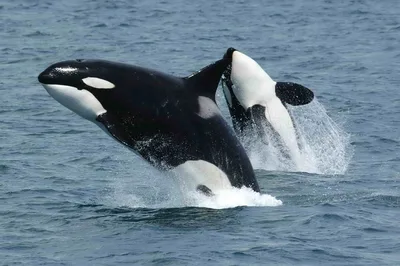 Orca
- sharks were possible
- people were the real threat
Ecological equivalents
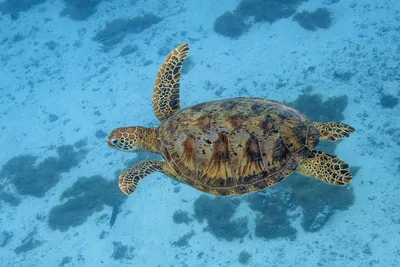
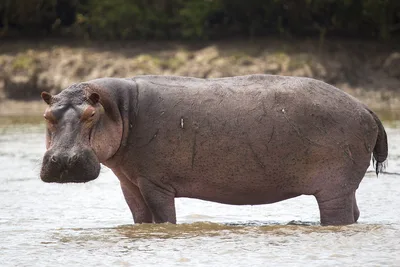
Related species on this site
Dugong (same family), Manatee (same order).