Living individuals or members of this group exist today. This does not mean they are safe from extinction.
Meet the green sea turtle
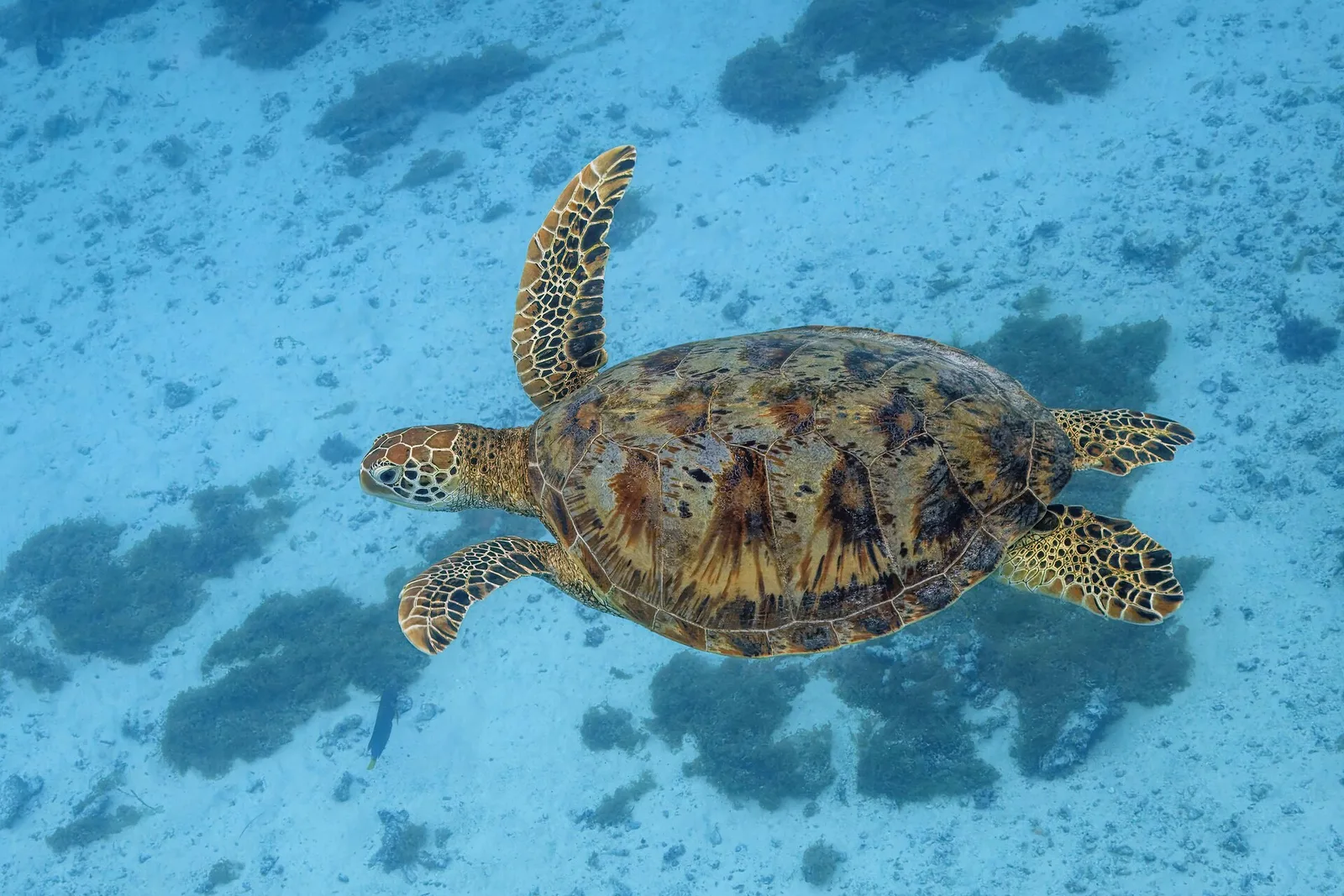
The green sea turtle grazes on seagrass in warm coastal waters. Females swim thousands of kilometres to lay eggs on the beach where they hatched.
Images of the green sea turtle
Lifespan in the wild
Up to 90 years
Weight
68 to 190 kg
Length
0.78 to 1.12 m
Top speed
2.5 to 3 km/h
Fact file
Green sea turtle
- Location
- Tropical and subtropical seas worldwide
- Habitat
- Coral reef, Coast, Open ocean
- Diet
- Herbivore
- Prey / food
- Seagrass, algae; jellyfish when young
- Predators
- Tiger sharks; crabs and birds take hatchlings
- Lifestyle
- Diurnal
- Group name
- Bale
- Name of young
- Hatchling
- Incubation
- About 60 days of incubation
- Clutch size
- 100 to 120 eggs per clutch
- Biggest threat
- Fishing bycatch, egg harvesting and beach development
- Distinctive feature
- A smooth heart-shaped shell
- Colour
- Olive to brown shell; the green is its body fat
- Skin type
- Scales and shell
Size
Next to a person
Measurements
Size and speed
- Length
- 0.78 to 1.12 m, up to 1.53 m shell length
- Weight
- 68 to 190 kg, up to 395 kg
- Top speed
- 2.5 to 3 km/h swimming
Typical adult ranges. Source: Wikipedia.
Life cycle
Lifespan
- In the wildUp to 90 years
- 090 years
The pale bar is the record. Source: Wikipedia.
Appearance
Colour and coat
- Primary colours
- olivebrown
- Secondary colours
- yellowblack
- Skin type
- scales and shell
- Male and female
- Slight. The male's tail is longer and thicker and extends beyond the shell, and his front claws are longer. Males are also reported to have slightly shorter shells.
Life cycle
Mating and family
- Mating system
- polygynandrous, both sexes with several mates
- Social structure
- solitary, gathering only at feeding grounds and breeding beaches
- Breeding
- 3 to 5 clutches in a season, every two to four years
Adults migrate to the beach where they hatched and mate in the shallows. The female climbs ashore at night, digs a pit and lays 85 to 200 eggs, then covers them and returns to the sea. The eggs hatch after about 50 to 70 days, and the sand temperature sets the sex. Hatchlings drift at sea for three to five years before they settle inshore. They mature at 20 to 50 years and may live to 90.
Classification
Taxonomy
- Kingdom
- Animalia
- Phylum
- Chordata
- Class
- Reptilia
- Order
- Testudines
- Family
- Cheloniidae
- Genus
- Chelonia
- Species
- Chelonia mydas
Conservation
Red List status
- LC
- NT
- VU
- EN
- CR
- EW
- EX
Least Concern on the IUCN Red List
Range
Recorded in 21 countries
- Ashmore and Cartier Islands
- Brazil
- The Bahamas
- Costa Rica
- Curaçao
- Ecuador
- Egypt
- Indonesia
- Japan
- Sri Lanka
- Mexico
- Malaysia
- New Caledonia
- Norfolk Island
- Oman
- French Polynesia
- Philippines
- Puerto Rico
- Taiwan
- United States of America
- United States Virgin Islands
Habitat layer: mangrove.
Countries from 30,576 wild records on GBIF (iNaturalist research grade), filtered and checked by hand. Country shapes: Natural Earth. Habitat: RESOLVE Ecoregions 2017, CC BY 4.0. Basemap: Natural Earth.
Habitats
Three things to know
- 1
The name comes from the green fat under the shell, not the shell colour.
- 2
A green turtle can hold its breath for several hours while resting.
- 3
Only about one hatchling in a thousand reaches adulthood.
Did you know
Seven more facts
- 1
The name refers to the green fat under the shell, not the shell colour.
- 2
A basking turtle looks as if it is crying, because a gland behind the eye drains salt.
- 3
Yellow tang fish clean algae and barnacles off a turtle's shell on the reef.
- 4
Up to 100,000 females have nested on Raine Island in a single season.
- 5
The longest recorded mating lasted 119 hours.
- 6
The species has been recorded in 170 countries on GBIF.
- 7
The Dutch name soepschildpad means soup turtle.
Field notes
How it looks and acts
Field notes
Distinguishing features
- A smooth, heart-shaped shell 78 to 112 centimetres long.
- A short snout with an unhooked, serrated beak.
- A single pair of prefrontal scales between the eyes.
- One claw on each front flipper, where the hawksbill has two.
- Five central scutes and four pairs of side scutes on the shell.
- A yellow belly plate and dark flippers edged with yellow.
Field notes
Unique adaptations
- Paddle-shaped front flippers drive it through the water.
- A serrated beak cuts seagrass and algae.
- A salt gland behind each eye removes the salt it swallows with seawater.
- Blood that shunts oxygen to the heart and brain lets it dive for hours.
- A magnetic sense guides it back to its birth beach.
Field notes
Interesting behaviours
- Grazes seagrass by cropping the tops and leaving the roots.
- Sleeps wedged under a rock or reef ledge, often the same one each night.
- Migrates between feeding grounds and nesting beaches along ocean currents.
- Comes ashore at night to dig a nest above the high-tide line.
- Basks on warm beaches to raise its body temperature.
Field notes
Temperament
- Calm and slow-moving, and it does not defend a territory.
- Untroubled by swimmers nearby, even during mating.
- A female bites a male she rejects.
Field notes
Communication
- A female signals consent by lying still under a male.
- She rejects a male by swimming off with her hind flippers closed.
- She floats belly-up with limbs spread to refuse a persistent male.
- Hears only low sounds and senses vibration through the shell.
Ecology
Ecological role
The green turtle is the lawn-mower of tropical seagrass meadows and a link between the sea and the shore.
- Keeps seagrass beds healthy by cropping the tops of the plants.
- Fertilises the meadows with nitrogen-rich droppings.
- Carries nutrients to beaches in its eggs and hatched shells.
- Feeds tiger sharks as an adult and crabs, gulls and fish as a hatchling.
Stories
Myths and legends
- In Hawaiian tradition, the honu is a guardian spirit, a symbol of long life and the navigator who always finds home.
- In Hawaiian legend, the turtle Kailua became a girl to watch over children on Punalu'u Beach.
- In Maya tradition, the green turtle constellation Yax Ahk crowns the sky when hatchlings run to the sea.
- In Cayman Islands tradition, the turtle is the national symbol and appears on the flag and banknotes.
People
Relationship with humans
People
Living alongside us
People have hunted the green turtle for meat, eggs, oil, shell and skin for centuries, and turtle soup was fashionable in the 1800s. Fishing nets, boat strikes, plastic and beach development now kill more turtles than hunting does. Most countries protect the species and its nesting beaches, and CITES bans all trade. The turtle is harmless to people and draws tourists to hatcheries and reefs. Hawaii and the Cayman Islands treat it as a national symbol.
- The green turtle has no known adverse effects on people.
- It grazes on plants and ignores swimmers nearby.
- Its beak can bite, but it uses that only on a rejected male.
People
Status, uses and products
- Domestication
- Wild
- As a pet
- Not suitable. The species is protected under CITES Appendix I and national laws, so keeping one is illegal. It grows to over 100 kilograms, needs the open sea and lives for decades.
- Uses
- ecotourismturtle farmingaquarium exhibition
- Products
- meateggsshelloilleather
The full account
About the green sea turtle
The green sea turtle, Chelonia mydas, is a large sea turtle found in warm seas around the world. It is the only sea turtle that lives mainly on plants once it is grown, and it grazes on seagrass in shallow lagoons. The name comes from the green fat under its shell, not from the shell itself, which is olive to brown or nearly black. An adult weighs 68 to 190 kilograms and has a shell 78 to 112 centimetres long. The heaviest on record weighed 395 kg with a shell of 153 cm.
Green turtles migrate between feeding grounds and the beach where they hatched, sometimes over 2,600 kilometres. A female crawls ashore at night, digs a pit and lays about 100 to 120 eggs, then returns to the sea. The hatchlings dig out together and run for the water, where crabs, gulls and sharks wait for them. The IUCN listed the species as Endangered from 1982 until 2025, then moved it to Least Concern. A green turtle that survives its early years may live for up to 90 years in the wild.
Name and taxonomy
Carl Linnaeus described the species as Testudo mydas in 1758, in the tenth edition of Systema Naturae. It is now the only species in the genus Chelonia, within the family Cheloniidae and the order Testudines. In 1868 Marie Firmin Bocourt named a dark Pacific form Chelonia agassizii, the black sea turtle, after Louis Agassiz. Genetic work later showed that the black turtle is not a separate species, and the name is now a junior synonym. The Galápagos green turtle, smaller and darker, is treated as a local form of the same species.
A 1993 study placed the green turtle in its own tribe, Cheloniini, apart from the meat-eating hawksbill, loggerhead and ridleys. Other English names include green turtle, Pacific green turtle and black sea turtle. Hawaiians call it honu, French speakers tortue verte, and Spanish speakers tortuga verde or tortuga blanca. An old French name, tortue comestible, means edible turtle, and the Dutch name soepschildpad means soup turtle.
Evolution and relatives
Sea turtles belong to the superfamily Chelonioidea within the hidden-necked turtles, the Cryptodira. The green turtle's closest relatives are the other members of the family Cheloniidae: the hawksbill, loggerhead, ridleys and flatback. The 1993 study found the flatback, Natator, further from the rest than anyone had thought. The leatherback sits in a family of its own and is the only sea turtle larger than the green.
Genetic studies split the species into two main groups, one in the Atlantic and Mediterranean and one in the Pacific and Indian Oceans. Each group carries its own type of mitochondrial DNA. The cold water off the southern tips of Africa and South America probably keeps the two groups apart. The genome of the species was sequenced in 2013 to study how the turtle body plan evolved.
Appearance
The green turtle has a flattened body, a short neck with a beaked head and two large paddle-shaped front flippers. An adult weighs 68 to 190 kilograms, and the shell measures 78 to 112 centimetres. Wikipedia gives a total length of up to 1.5 metres, and a few animals pass 315 kg. The largest known weighed 395 kg and had a 153 cm shell. Turtles that nest on Ascension Island are among the biggest, many with shells over 1 metre and weights up to 300 kg.
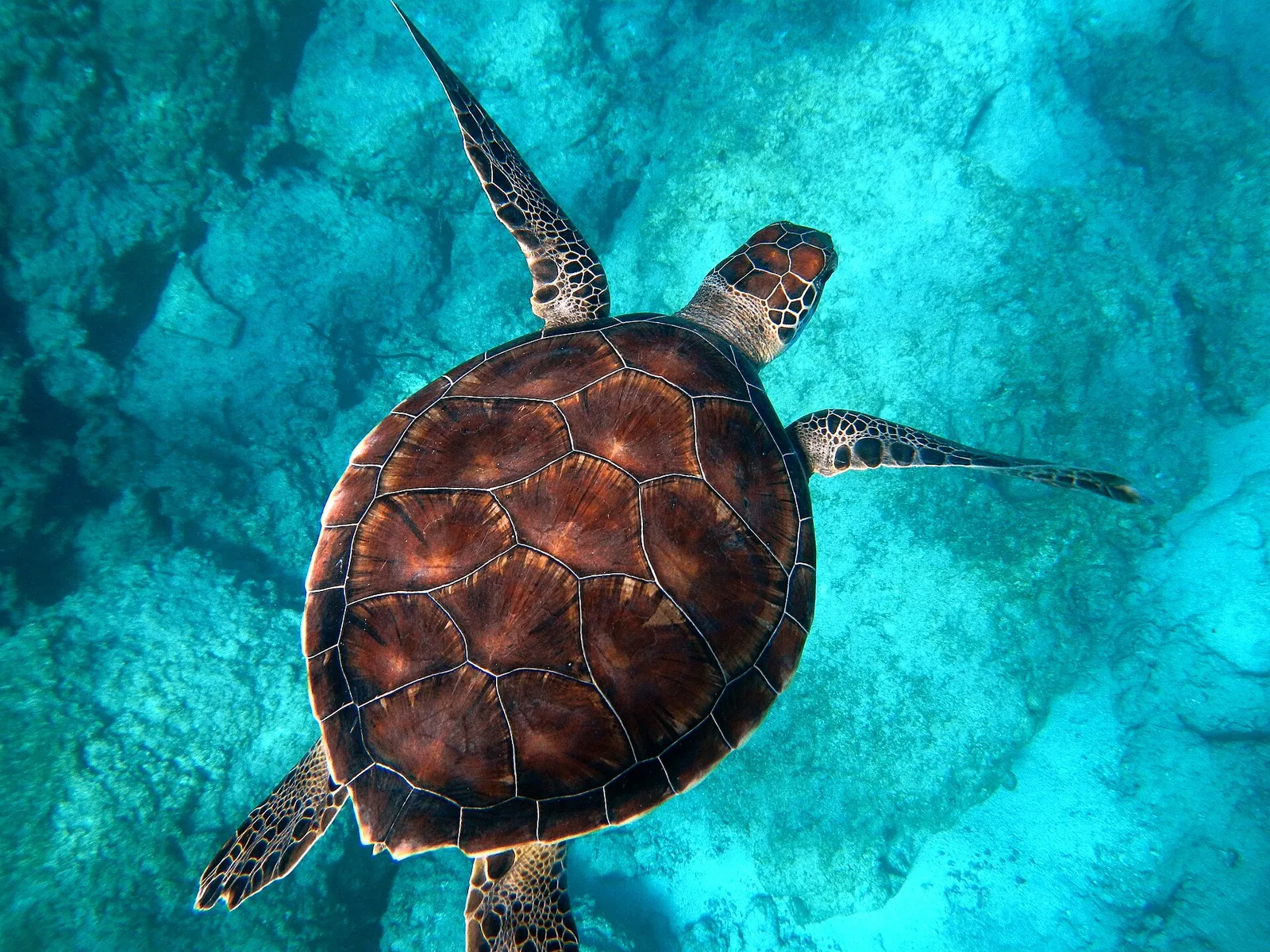
The shell is smooth and shaped like a teardrop or a heart. It carries five central scutes and four pairs of side scutes, and one pair of prefrontal scales sits on the head. Unlike the hawksbill, the green turtle has a short snout, an unhooked beak and only one claw on each front flipper. The edge of the beak is finely toothed, and the lower jaw is more strongly serrated, which suits a diet of plants. The neck cannot be pulled back into the shell.
A hatchling has a black shell and a pale belly. Juveniles turn dark brown to olive, and adults are brown, spotted or marbled with rays of colour. The belly plate is yellow, and the dark flippers are edged with yellow. Eastern Pacific animals can be almost black. A male has a longer tail that extends beyond the shell, plus longer front claws.
Habitat and range
The green turtle uses three habitats in turn: the nesting beach, the open ocean and the coastal shallows. Hatchlings spend their first years drifting in the open sea, and they are rarely seen there. Older juveniles and adults settle in shallow bays, lagoons and reefs with seagrass beds. Water below 7 to 10 degrees Celsius sets the limit of the range. At night an adult wedges itself under a rock or a reef ledge, and many return to the same sleeping spot every night.
The species lives in tropical and subtropical seas worldwide, mostly between 30 degrees north and 30 degrees south. It feeds along the coasts of more than 140 countries and nests in over 80. The largest populations are on the Great Barrier Reef of Australia and in the Caribbean. Raine Island on the Great Barrier Reef has drawn up to 100,000 nesting females in a season. Ascension Island in the South Atlantic holds 6,000 to 25,000 nests a year, and Tortuguero in Costa Rica supplies most of the Caribbean's turtles.
Other nesting grounds lie in Florida, Mexico, Hawaii's French Frigate Shoals, Oman, Pakistan, India, Sri Lanka and Southeast Asia. In the Mediterranean the main beaches are in Turkey, Cyprus and Syria. Stray animals reach Canada, Alaska, Japan, New Zealand and the southern tip of Africa. GBIF holds records from 170 countries, a figure that includes strandings and aquariums.
Diet and feeding
The diet changes with age. Hatchlings and small juveniles are carnivores of the open sea and eat jellyfish, hydrozoans, bryozoans, sea hare eggs, molluscs and small crustaceans. As they grow they become omnivores, then almost pure herbivores. Adults graze on seagrass and on red and green algae such as sea lettuce, and they also eat salt-marsh plants and mangrove leaves.
The serrated jaw cuts and tears plant matter. A grazing turtle bites off only the top of the seagrass and leaves the roots, which keeps the meadow healthy and growing. Plant food has low nutritional value, so green turtles grow slowly. The vegetable diet turns the body fat green and gives the species its name.
Turtles have been seen eating tar balls in polluted water, which block the gut and swell the tissues. Plastic causes the same harm, and one adult in San Diego Bay died with fishing line packed in its throat. A basking turtle appears to weep, because a gland behind the eye drains excess salt from seawater.
Behaviour and social life
Green turtles usually swim at 2.5 to 3 kilometres per hour. On migration they travel about 20 to 90 km a day, often in groups from the same natal beach. Some swim more than 2,600 km between feeding grounds and nesting beaches. They follow the major ocean currents on these journeys. An adult keeps a home range of 3.8 to 642.2 hectares but does not defend a territory.
A turtle breathes with one explosive exhalation and a quick inhalation. During normal activity it dives for four to five minutes and surfaces for one to three seconds. A resting turtle can stay under for several hours, but a stressed turtle uses its air fast and soon drowns in a trawl net. Turtles at higher latitudes may hibernate briefly in mud during winter.
On coral reefs the green turtle visits cleaning stations, where yellow tang fish eat algae, barnacles and parasites off its shell. The cleaning smooths the shell and cuts drag, so the turtle swims better. Like other sea turtles, adults are probably solitary for most of the year and meet mainly at breeding grounds.
Communication and senses
The green turtle sees well under water and is most sensitive to light between 400 and 600 nanometres, from violet to yellow. It sees little in the orange to red range. On land it is short-sighted, because its lens is shaped for water. With no outer ear and a single ear bone, it hears only low sounds, from 200 to 700 hertz. It smells by pumping water through its nose past a Jacobson's organ.
In the open ocean the turtle steers by wave direction, sunlight and temperature. It also carries an internal magnetic compass and senses the strength of Earth's field through magnetic crystals in its brain. Researchers think a hatchling imprints on the magnetic signature or the smell of its beach and uses that memory to return decades later.
Communication is mostly visual and happens at mating time. A willing female lies still while a male mounts her. An unwilling female swims away with her hind flippers closed, bites the male, or floats belly towards him with all four limbs stretched out.
Reproduction and life cycle
Females return to the beach where they hatched, a habit called natal homing. Males return too, because they know the females will be there. A female breeds every two to four years, while males visit the breeding grounds every year. Mating takes place in shallow water off the beach, and rival males may cling to a mating pair for hours to dislodge the male. Seasons differ by population: June to September in the Caribbean, March to June in French Guiana, and all year round in the tropics.
The female comes ashore at night, climbs above the high-tide line and digs a pit 28 to 56 centimetres deep with her hind flippers. She lays 85 to 200 round white eggs, each about 45 mm across, then covers the nest and returns to the sea. The whole visit lasts about 60 to 90 minutes. She nests 3 to 5 times in one season, and the web notes say she digs a decoy nest beside the real one. There is no care after that.
The eggs hatch after about 50 to 70 days, and incubation runs longer in the wet season. Nest temperature during days 20 to 40 fixes the sex: below 30 degrees Celsius most hatchlings are male, above 30 degrees most are female. Eggs at the warm centre of the nest tend to become females. A hatchling has a shell about 5 cm long and weighs about 25 grams. The young wait below the sand until they can all emerge together at night, then run straight for the water.
A juvenile drifts in the open ocean for three to five years and then settles in coastal shallows. Sexual maturity comes late, at somewhere between 20 and 50 years. Only about 1% of hatchlings live to breed. Those that do may reach 90 years in the wild.
Predators and threats
Only large sharks and people kill adult green turtles. The tiger shark is the main predator and takes turtles of every size, often near nesting beaches where the animals crowd together. Eggs are dug up by red foxes, golden jackals, feral dogs, jaguars and people. Hatchlings on the beach are taken by crabs, gulls and other shorebirds, and saltwater crocodiles catch them on land and in the water. In the sea, tiger sharks and oceanic whitetip sharks wait for them.
Barnacles grow on the shell, and leeches feed on the flippers and skin. One leech, Ozobranchus branchiatus, spreads a herpesvirus that causes fibropapilloma, a disease of tumours on the skin, lungs, stomach and kidneys. Fibropapilloma is the worst disease threat and kills a large share of the turtles it infects. Blood flukes in the heart and vessels also kill many turtles.
People remain the greatest danger. Fishing nets without turtle excluder devices drown turtles, and shrimp trawlers in Mexico kill more than any other cause. Boat strikes, plastic, tar balls and chemical pollution add to the toll. Beach-front building and bright lights destroy nesting beaches and send hatchlings the wrong way. Warmer sand on the northern Great Barrier Reef is producing almost no males.
Population and conservation
The IUCN now lists the green turtle as Least Concern worldwide. The IUCN first listed the species as Endangered in 1982 and kept that status through the 1996 and 2004 assessments. In October 2025 it moved the global population to Least Concern, because several large populations are stable or growing. Some subpopulations remain in danger: the Mediterranean turtles are Critically Endangered, and Florida and some Mexican populations are Endangered. Australia and Israel rate the species Vulnerable and Endangered respectively, and Singapore lists it as Critically Endangered.
CITES placed the whole family Cheloniidae on Appendix I in 1977, and the Australian population joined in 1981. That listing bans all commercial trade in turtles, shell, meat and eggs. In 2015 Florida recorded more than 37,000 nests, a record. The Hawaiian population has recovered enough to become a focus of ecotourism. iNaturalist holds 47,779 observations of the species.
Costa Rica has limited egg collection at Tortuguero since the 1950s and made the beach a national park in 1976. Between 2011 and 2020 Queensland reshaped Raine Island with machinery so females could reach the nests and floods would not drown them. Indonesia restricted the turtle trade in 1999 after Bali's harvest became the heaviest in the world. The Cayman Turtle Farm has released over 31,000 captive-bred turtles since 1968, and some now return to nest.
Relationship with humans
People have eaten green turtles for centuries. The fat, cartilage and flesh, called calipee, went into turtle soup, a favourite dish in England and America in the 19th century. Ancient Chinese cooks prized the meat, and in Bali turtle meat was central to religious feasts. In Java the eggs were a delicacy, though Muslims there treat the flesh as unclean. Hawaiians once tanned the skin for handbags.
Columbus named the Cayman Islands Las Tortugas in 1503 because of the turtles in their waters. Sailors took them aboard as fresh meat for long voyages. The Cayman farm once held 100,000 turtles for meat, oil, shell and leather, and today it is mainly a tourist attraction with 11,000 animals. Poaching of eggs and meat continues in Southeast Asia, and shells are still sold as ornaments and jewellery.
The green turtle is harmless to people. Rehabilitation centres such as the Florida Aquarium treat injured turtles and released 180 of 200 patients over 20 years. Hatcheries in Sabah, Malaysia, let tourists help release hatchlings, and students in Hawaii have tagged thousands since the early 1990s. James Parsons' book The Green Turtle and Man helped start the movement to save the species.
In culture and myth
In Hawaii the honu is a symbol of good luck and long life. A petroglyph of a turtle in the Pu'u Loa lava fields may date from the first settlement of the islands. The turtle stands for a navigator who always finds the way home, just as the real animal returns to its birth beach. Some Hawaiian legends say the honu guided the first Polynesians to the islands. The legend of Kailua tells of a turtle who took the form of a girl to watch over children on Punalu'u Beach. Many Hawaiian families regard the honu as an aumakua, a guardian spirit.
The web notes report that the Maya named a constellation Yax Ahk, the green turtle, within Orion. It stands highest in July and August, the months when the hatchlings emerge. The 13 scutes of the shell are said to match 13 constellations. Aboriginal and Torres Strait Islander peoples hold the turtle in deep cultural regard. The Cayman Islands put the green turtle on their coat of arms and flag. The turtle is also the banknote watermark, and the national airline paints a cartoon turtle, Sir Turtle, on its planes. Many islands around the world are called Turtle Island because green turtles nest there.
A sentence with a dotted underline is inferred: it describes the group the animal belongs to, or is a reading of the sources, rather than a measured or reported fact about this species.
Questions
Green sea turtle questions, answered
Why is it called a green turtle?
The name comes from the green fat under the shell, which the turtle gets from eating seagrass and algae. The shell itself is olive, brown or nearly black.
How big is a green sea turtle?
Adults weigh 68 to 190 kilograms, with a shell of 78 to 112 centimetres. The largest on record weighed 395 kg with a 153 cm shell.
What do green sea turtles eat?
Adults graze on seagrass and algae and are the only sea turtles that live mainly on plants. Young turtles in the open ocean eat jellyfish, sea hare eggs, molluscs and small crustaceans.
Are green sea turtles endangered?
The IUCN listed the species as Endangered from 1982 until 2025. In October 2025 it moved the global population to Least Concern, but the Mediterranean population is Critically Endangered and several others remain at risk.
How long do green sea turtles live?
A turtle that survives its early years may live for up to 90 years in the wild. Lifespan is hard to measure because few turtles are tagged for that long.
How long can a green sea turtle hold its breath?
A resting or sleeping turtle can stay under for several hours. An active turtle dives for four to five minutes at a time and takes a breath of one to three seconds.
Where do green sea turtles live?
They live in tropical and subtropical seas worldwide, mostly between 30 degrees north and 30 degrees south. Adults stay in shallow bays and lagoons with seagrass, and they nest on beaches in over 80 countries.
How do green sea turtles find their way back to their birth beach?
They sense Earth's magnetic field with magnetic crystals in the brain and steer by waves, sunlight and temperature. Scientists think a hatchling imprints on the magnetic signature or the smell of its beach.
How many eggs does a green sea turtle lay?
A female lays 85 to 200 eggs in each nest, and she nests 3 to 5 times in a season. She breeds every two to four years.
How long do green sea turtle eggs take to hatch?
About 50 to 70 days. The eggs take longer in the wet season, and warmer nests hatch sooner.
What decides whether a green turtle hatches male or female?
The temperature of the sand during days 20 to 40 of incubation. Nests below 30 degrees Celsius produce mostly males, and nests above 30 degrees produce mostly females.
How fast can a green sea turtle swim?
A green turtle usually cruises at 2.5 to 3 kilometres per hour. On migration it covers about 20 to 90 km a day.
What eats green sea turtles?
Tiger sharks are the main predator of adults. Crabs, gulls, foxes, jackals, dogs and crocodiles take eggs and hatchlings, and sharks catch the young at sea.
Are green sea turtles dangerous?
No. They are plant-eaters with no known harmful effect on people, and they ignore swimmers nearby.
How old is a green turtle when it first breeds?
Somewhere between 20 and 50 years, which is late even for a turtle. Only about 1% of hatchlings reach that age.
Can you keep a green sea turtle as a pet?
No. The species is protected by CITES and by national laws, so keeping one is illegal. It also needs the open sea and grows to over 100 kilograms.
Food web
Prey and food
- seagrass
- algae
- jellyfish
Food web
Predators
- tiger sharks
- crabs
- birds
Ecological equivalents
Related species on this site
Hawksbill sea turtle (same family), Loggerhead sea turtle (same family), Galápagos giant tortoise (same order).
Reptiles
Hawksbill sea turtle
Eretmochelys imbricata
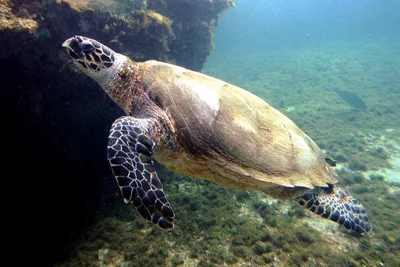
The hawksbill sea turtle has a narrow, pointed beak and overlapping shell scales.
Living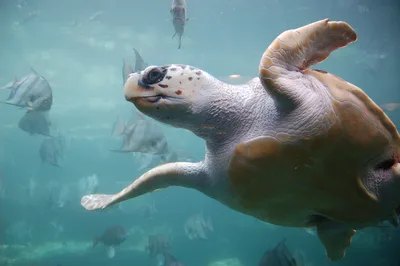
Reptiles
Loggerhead sea turtle
Caretta caretta
The loggerhead sea turtle uses powerful jaws to crush hard-shelled prey.
Living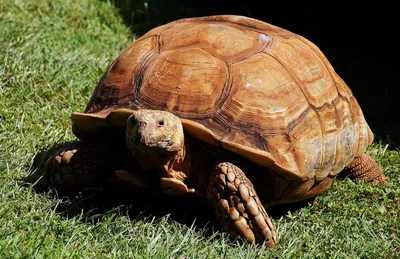 VU
Reptiles
Galápagos giant tortoise
Chelonoidis niger
The Galápagos giant tortoise is the largest living tortoise and one of the longest-lived animals.
Living