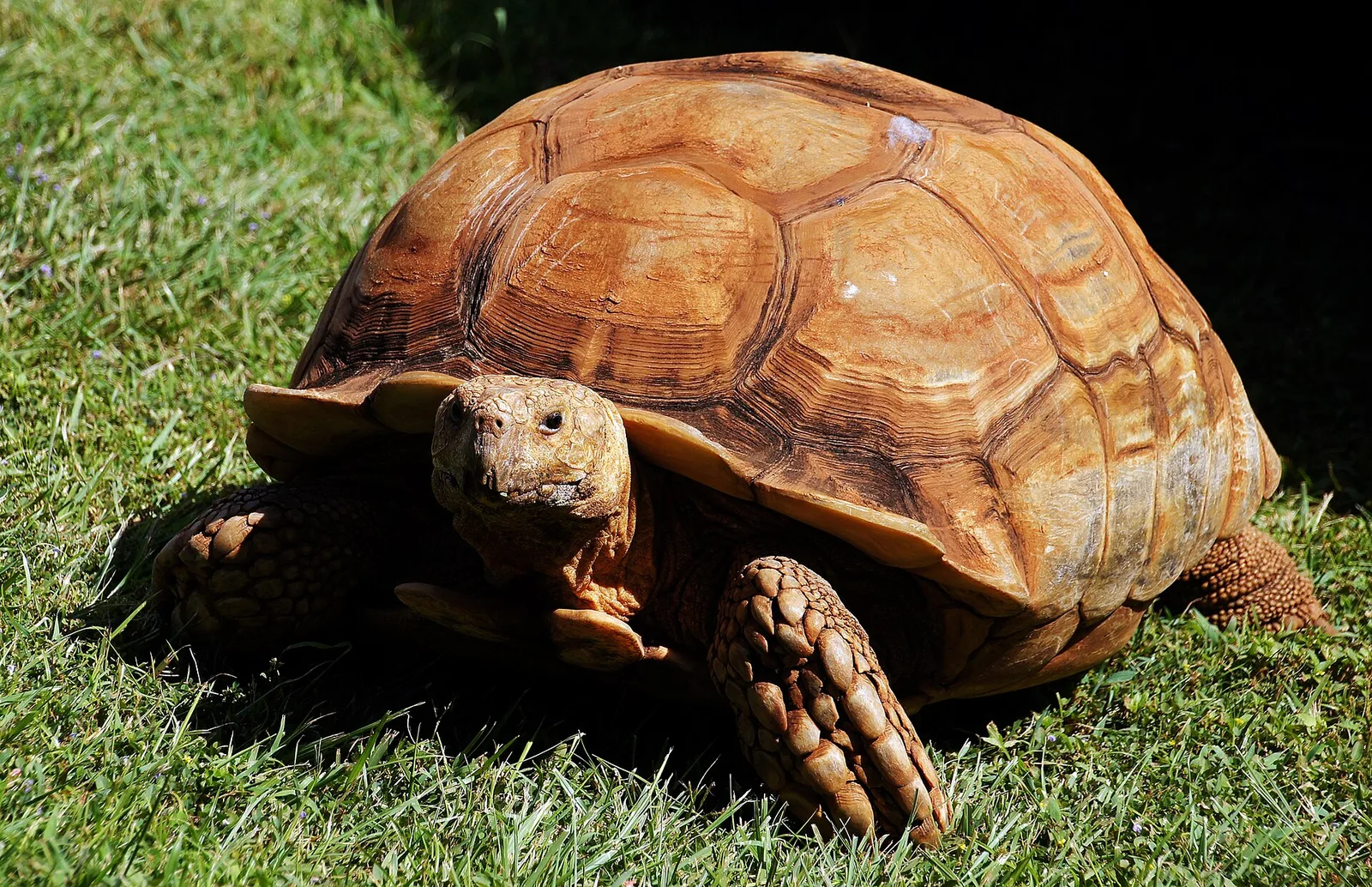
Galápagos giant tortoise
The largest tortoise alive, and one of the longest lived
Chelonoidis niger
Living individuals or members of this group exist today. This does not mean they are safe from extinction.
Meet the galápagos giant tortoise
The Galápagos giant tortoise is the largest living tortoise and one of the longest-lived animals. Each island has its own form, which helped Darwin think about how species change.
Images of the galápagos giant tortoise
Lifespan in the wild
About 100 years or more
Weight
136 to 317 kg
Length
0.75 to 1.5 m
Top speed
About 0.3 km/h
Fact file
Galápagos giant tortoise
- Location
- The Galápagos Islands, Ecuador
- Habitat
- Grassland, Temperate forest, Coast
- Diet
- Herbivore
- Prey / food
- Cactus, grasses, leaves, fruit
- Predators
- Introduced rats, dogs and pigs take eggs and young
- Lifestyle
- Diurnal
- Group name
- Creep
- Name of young
- Hatchling
- Incubation
- 4 to 8 months of incubation
- Clutch size
- 2 to 16 eggs
- Population
- About 15,000 to 20,000
- Biggest threat
- Introduced species and past hunting
- Distinctive feature
- A dome or saddle-shaped shell, depending on the island
- Colour
- Dull grey-brown
- Skin type
- Scales and shell
Size
Next to a person
Measurements
Size and speed
- Length
- 0.75 to 1.5 m, up to 1.87 m shell length
- Weight
- 136 to 317 kg, up to 417 kg
- Weight, male
- 272 to 317 kg
- Weight, female
- 136 to 181 kg
- Top speed
- About 0.3 km/h
Typical adult ranges. Source: Wikipedia.
Life cycle
Lifespan
- In the wildAbout 100 years or more
- In captivityUp to 177 years
- 0177 years
The pale bar is the record. Source: Wikipedia.
Appearance
Colour and coat
- Primary colours
- greybrown
- Secondary colours
- black
- Skin type
- scales and shell
- Male and female
- Males are larger, with longer tails and a concave lower shell. In saddleback forms the front of the male's shell arches higher than the female's.
Life cycle
Mating and family
- Mating system
- polygynous, with males competing for females
- Social structure
- herds on the wet islands, solitary and territorial on the dry islands
- Breeding
- one to four clutches of up to 16 eggs each season
Mating peaks from February to June. From July to November the female digs a nest in dry sand and lays 2 to 16 eggs. The sun incubates them for 4 to 8 months, and cool nests produce more males. Hatchlings weigh about 50 grams and get no parental care. They mature at 20 to 25 years in captivity and live 100 years or more.
Classification
Taxonomy
- Kingdom
- Animalia
- Phylum
- Chordata
- Class
- Reptilia
- Order
- Testudines
- Family
- Testudinidae
- Genus
- Chelonoidis
- Species
- Chelonoidis niger
Conservation
Red List status
- LC
- NT
- VU
- EN
- CR
- EW
- EX
Vulnerable on the IUCN Red List
Range
Recorded in 1 country
Habitat layer: temperate broadleaf and mixed forest, temperate conifer forest, boreal forest and taiga, tropical grassland, savanna and shrubland, temperate grassland, savanna and shrubland, mangrove.
Countries from 1,534 wild records on GBIF (iNaturalist research grade), filtered and checked by hand. Country shapes: Natural Earth. Habitat: RESOLVE Ecoregions 2017, CC BY 4.0. Basemap: Natural Earth.
Habitats
Three things to know
- 1
A tortoise can live a year without food or water.
- 2
Saddleback shells let tortoises reach higher plants on dry islands.
- 3
Sailors once carried them as fresh meat on long voyages.
Did you know
Seven more facts
- 1
A hatchling weighs about 50 grams and is about 6 centimetres long.
- 2
Cool nests hatch more males and warm nests hatch more females.
- 3
Every hatchling has a domed shell, whatever shape its parents carry.
- 4
The Pinta tortoise turned out to be closest to tortoises from Española and San Cristóbal, over 300 kilometres away.
- 5
A live female of the Fernandina subspecies turned up in 2019, more than a century after the only known specimen.
- 6
In 2010, 39 sterile hybrid tortoises were released on Pinta to restore the island's plants.
- 7
The Aldabra giant tortoise is the only other surviving island giant tortoise.
Field notes
How it looks and acts
Field notes
Distinguishing features
- A dull brown or grey bony shell fused to the ribs.
- A dome-shaped or saddle-shaped shell, depending on the island.
- Thick stumpy legs with five claws in front and four behind.
- A long neck, longest in the saddleback forms.
- A shell length of 75 to 150 centimetres in adults.
- A weight of 136 to 317 kilograms in adults.
Field notes
Unique adaptations
- Fat and water reserves let it go a year without food or water.
- A saddle-shaped shell and a long neck give reach to cactus pads on dry islands.
- Its large body holds heat, which probably helps it cope with cold nights and hot days.
- A gut as efficient as a horse's extracts energy from tough plants.
- Buoyancy and a raised neck let its ancestors survive months adrift at sea.
Field notes
Interesting behaviours
- Basks after dawn, then feeds for most of the day.
- Migrates between lowlands and highlands with the seasons on the wetter islands.
- Wallows in mud and rain pools.
- Stands tall to let finches pick off ticks.
- Returns to the same nesting site year after year.
Field notes
Temperament
- Slow and placid, and it retreats into its shell when startled.
- Domed forms tolerate crowds and feed in herds.
- Saddleback forms are more aggressive and defend a territory.
- Males are rough in courtship and ram and bite the female.
Field notes
Communication
- Bellows and grunts during mating.
- Hisses as air leaves the lungs when it withdraws into the shell.
- Settles rivalries by a neck-stretching display, and the tallest head wins.
- Finds a mate by scent.
Ecology
Ecological role
The Galápagos tortoise is a keystone species that shapes the plant life of its islands.
- Spreads plant seeds in its dung as it migrates.
- Tramples brush and thins the undergrowth, which lets light reach the ground and seeds sprout.
- Feeds flycatchers, which catch the insects it stirs up.
- Gives finches and mockingbirds a meal of ticks in return for grooming.
Stories
Myths and legends
- In Spanish naming tradition, the islands took their name from galápago, the word for a tortoise.
- In the lore of pirates and whalers, the tortoise was the sweetest meat at sea, as William Dampier wrote.
- In the story of Darwin's voyage, the tortoises helped him see that each island held its own kind.
- In modern conservation lore, Lonesome George stands for the last of a line.
People
Relationship with humans
People
Living alongside us
Pirates, whalers and sealers took an estimated 200,000 tortoises as live food for ships. Settlers then hunted them for meat and oil and cleared their grazing land. Ecuador protected the species in 1936, and a breeding programme has run since 1965. The tortoise is now the flagship of Galápagos conservation and a major reason people visit the islands.
- The tortoise cannot chase a person, because it walks at about 0.3 kilometres per hour.
- It pulls into its shell and hisses when startled, rather than attacking.
- A bite from a rough courting male probably hurts, but no source records an attack on a person.
People
Status, uses and products
- Domestication
- Wild
- As a pet
- Not suitable. Export from Ecuador is illegal, and CITES Appendix I bars commercial trade. An adult weighs more than 136 kilograms and can outlive its owner by generations.
- Uses
- ecotourismzoo exhibitionscientific research
- Products
- meat (historical)oil (historical)
The full account
About the galápagos giant tortoise
The Galápagos giant tortoise, Chelonoidis niger, is the largest tortoise alive today. It is also the heaviest land animal that depends on the sun for its body heat. The heaviest individual on record weighed 417 kilograms. Adult females weigh 136 to 181 kg, and the largest males reach 272 to 317 kg. It lives only on the Galápagos Islands, which belong to Ecuador and lie in the eastern Pacific.
Wild tortoises live for more than 100 years, and one captive animal reached about 177. Each island shaped its own form, with domed shells in wet highlands and saddle shells on dry islands. Charles Darwin saw these differences in 1835, and they fed into his theory of evolution. Sailors and settlers killed perhaps 200,000 tortoises, and the population fell to about 15,000 by the 1970s. Captive breeding has since raised the numbers, but the IUCN still lists the species as Vulnerable.
Name and taxonomy
Spanish sailors reached the islands in 1535 and named them after galápago, their word for a tortoise. For a long time naturalists grouped these animals with the giant tortoises of the Indian Ocean. In 1783 Johann Gottlob Schneider placed every giant tortoise in Testudo indica. Duméril and Bibron split off the Galápagos animals in 1834 under the name Testudo nigrita. The current name niger means black, and it was revived in 1984 because it was the oldest valid name.
During most of the 1900s the species sat in the genus Geochelone. In the 1980s Chelonoidis rose from a subgenus to a full genus, and later DNA work supported the move. Between 14 and 15 subspecies have been named, and 12 survive. Before 2021 most authorities treated each island form as a full species. A 2021 study found the differences were smaller than thought, so the forms became subspecies of one species again. Wikidata still lists Floreana giant tortoise and Charles Island giant tortoise as English names for the type form.
Evolution and relatives
All Galápagos tortoises descend from ancestors that floated across the sea from South America. Their closest living relative is the Chaco tortoise of Argentina and Paraguay, a much smaller animal. The two lines split 11.95 to 25 million years ago, before the oldest current islands formed 5 million years ago. The founders may have been a single pregnant female or one breeding pair. A tortoise floats, breathes with its neck raised above the water, and can go months without food. The Humboldt Current probably carried them on the 1,000 kilometre crossing, because they swim poorly.
DNA shows that tortoises settled Española and San Cristóbal first, because those islands are the oldest. From there tortoises drifted to younger islands on local currents, one stepping stone at a time. Isolation on each island then produced the forms we see today. The Galápagos group is one of only two giant tortoise radiations left, the other being Aldabra in the Indian Ocean. Humans wiped out the rest, including the Mascarene tortoises, by the 19th century.
Appearance
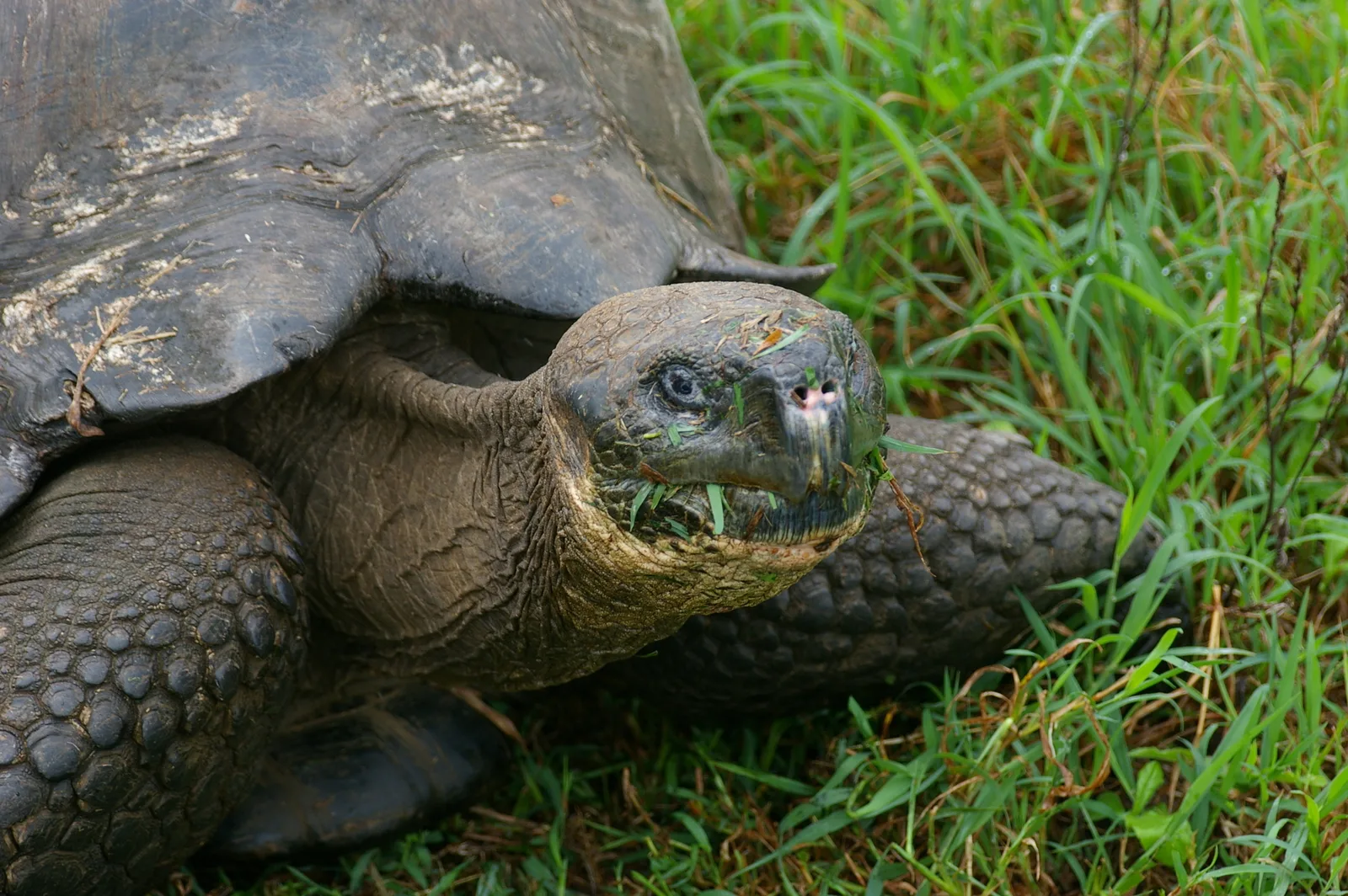
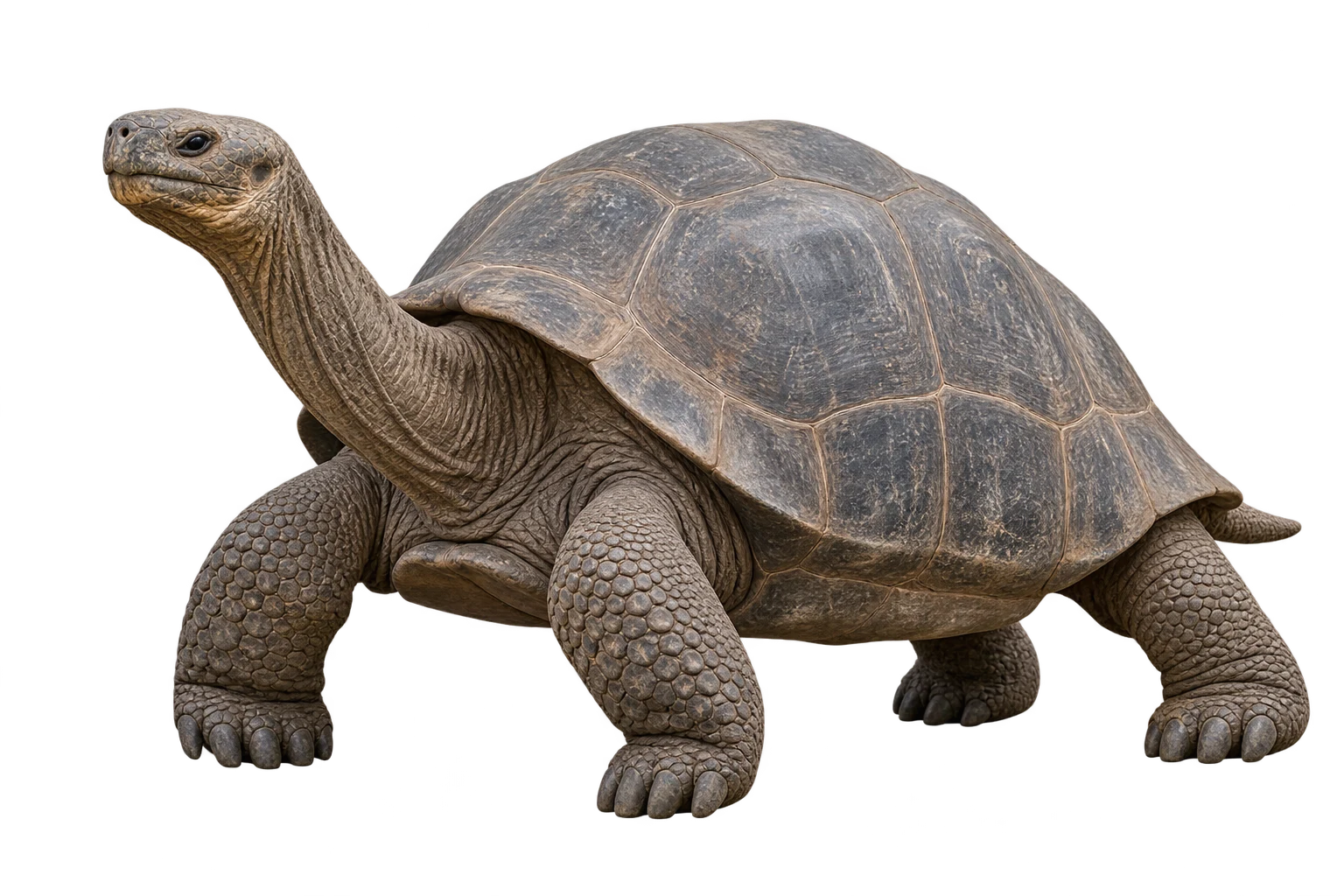
The shell is a large bony case of dull brown or grey. Its plates fuse to the ribs, so the shell is part of the skeleton. The legs are thick and stumpy, with dry scaly skin, five claws in front and four behind. The tortoise pulls its head, neck and front legs inside the shell when it feels threatened. Lichens often grow on the shell and give it a mottled look.
Shell length runs from 75 to 150 centimetres, and the longest known reached 187 cm. Size varies by island: Pinzón tortoises weigh at most 76 kg with a shell about 61 cm long. Two shell shapes occur. Domed tortoises come from large wet islands with highlands above 800 metres and thick ground plants. Saddleback tortoises come from small dry islands below 500 metres, and they have longer necks and legs. The front edge of a saddleback shell arches up, which leaves a gap over the neck when the head withdraws.
Males are larger than females, with longer tails and a concave lower shell that helps them mount. Females have a wider and longer shell outline than males. Growth rings on the shell do not give a reliable age, because the outer layers wear away.
Habitat and range
The species occurs naturally on seven islands of the Galápagos, about 1,000 km west of mainland Ecuador. Five subspecies live on separate islands, and five more live on the volcanoes of Isabela, the largest island. Habitat ranges from dry lowland scrub and grassland to moist highland meadows. The lowlands hold cactus and dry grass, while the highlands hold lush plants and pools.
On the larger islands tortoises migrate with the seasons. They graze the lowlands when rain turns them green, then climb to meadows up to 610 metres in the dry season. Generations of tortoises walk the same routes, which wear into clear paths called tortoise highways. Satellite tags on 83 tortoises since 2009 show that these journeys follow the changing quality of plants.
Young tortoises stay in the warm lowlands for their first 10 to 15 years. GBIF holds records from 9 countries, but only the records from Ecuador show the native range. Fernandina has no people and no feral mammals, yet its tortoise is very rare, probably because lava flows often cover the island.
Diet and feeding
The tortoise is a herbivore. It eats cactus, grasses, forbs, leaves, lichens, berries and fallen fruit. It also takes plants that hurt people, such as stinging nettle and the poison apple Hippomane mancinella. Young tortoises eat about 16.7% of their body weight in dry matter each day. Their gut digests plant matter about as well as a horse or a rhino does.
Most water comes from dew and from the sap of plants, above all the Opuntia cactus. A tortoise can go more than six months without a drink. It can survive up to a year with no food or water at all, because it breaks down fat to make water. When water is available it drinks fast and stores it in the bladder and at the base of the neck. On dry islands tortoises lick dew from boulders, and over generations this has worn hollows in the rock.
Some tortoises also eat birds. A finch that comes to pick parasites may walk under the raised body, and the tortoise then drops and crushes it. It probably does this to add protein to a diet of leaves.
Behaviour and social life
The tortoise is active by day. It cannot make its own heat, so it basks for 1 to 2 hours after dawn to warm its dark shell. It then feeds for 8 to 9 hours. It walks at about 0.3 kilometres per hour. Movement between rest and feeding sites happens mostly in the early morning or the late afternoon.
Domed tortoises on wet islands are sociable and often gather in large herds. Saddleback tortoises on dry islands are more solitary and defend a territory. In zoos, tortoises enter and leave their shelter in a fixed order, and each keeps its own spot inside. Animal Diversity Web reports that they sleep for about sixteen hours.
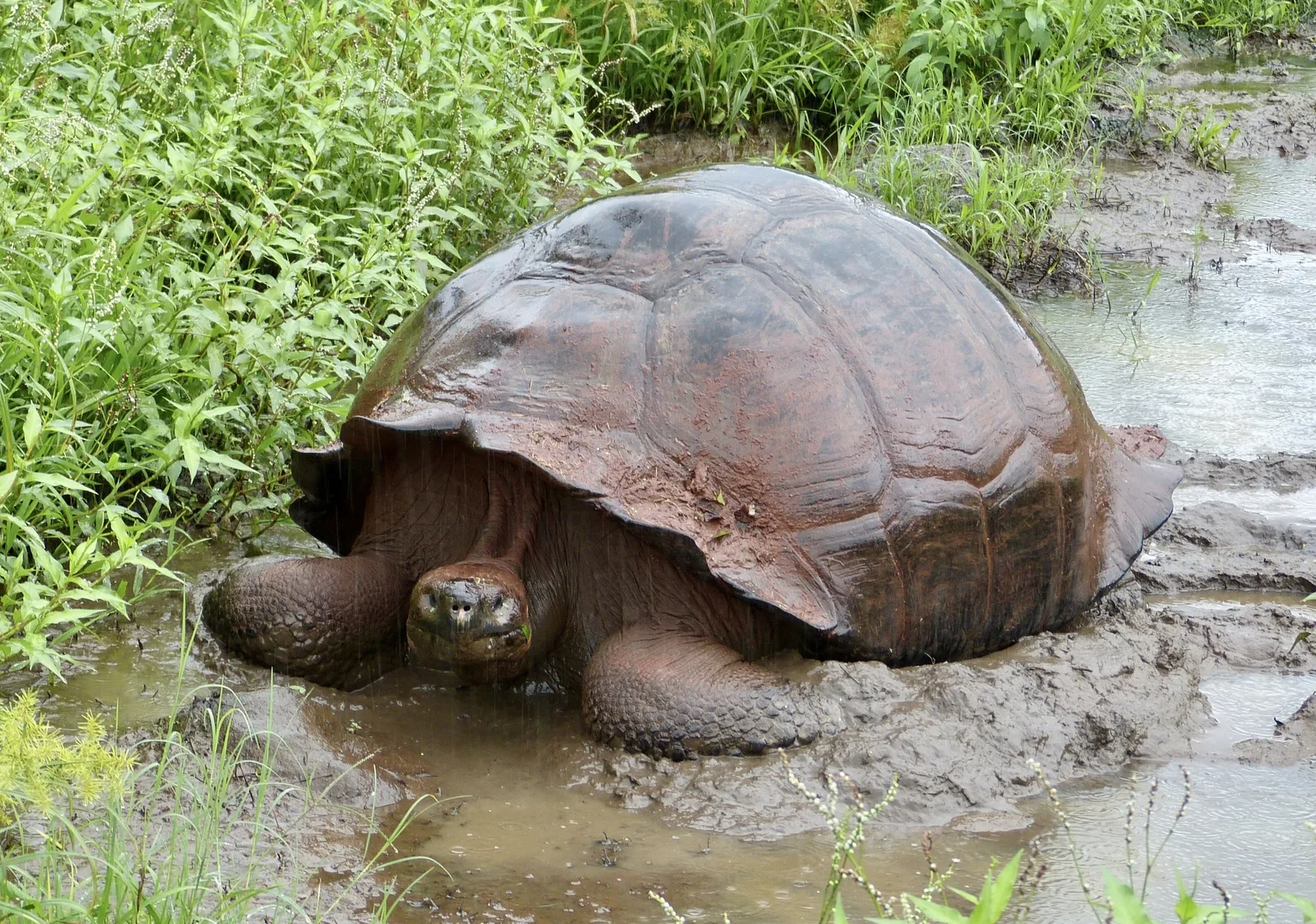
Tortoises rest in mud wallows and rain pools. The mud keeps them warm on cool nights and probably protects them from mosquitoes and ticks. They also roll in loose soil to shed parasites. At night some shelter under rock overhangs or settle into a hollow called a pallet. On Volcán Alcedo, repeated use of the same pallets has dug small sandy pits.
Communication and senses
Tortoises make few sounds. A male bellows and grunts during mating, in a hoarse rhythm. A tortoise hisses as it pulls into its shell, because the movement forces air out of its lungs. Other noises come during fights or when an animal struggles to right itself.
Darwin wrote that local people thought the tortoises deaf, because they did not hear him walk up behind them. They can hear, but they rely far more on sight and smell. A male finds a female in the breeding season by sniffing the air for her scent. Rival males settle disputes by a display: each rises on its legs and stretches its neck as high as it can. The tortoise with the lower head usually gives way.
Tortoises also signal to birds. When finches hop in front of it, a tortoise stands tall and stretches out its neck and legs. This tells the birds that it is ready to be cleaned of ticks.
Reproduction and life cycle
Mating can happen at any time, but it peaks from February to June in the wet highlands. Courtship is rough. The male rams the female with his shell and bites her legs until she pulls them in. He then mounts her, and the hollow underside of his shell helps him keep his balance.
From July to November a female walks several kilometres to a dry sandy nesting site near the coast. She digs a hole about 30 centimetres deep with her back legs, working blind over several days. She lays 2 to 16 hard round eggs, each 82 to 157 grams, about the size of a billiard ball. Domed populations lay bigger clutches, about 9.6 eggs against 4.6 for saddlebacks on Pinzón. She seals the nest with a plug of mud and urine and leaves the sun to warm the eggs. A female may lay one to four clutches in a season.
Incubation takes 4 to 8 months, and cool nests produce more males while warm nests produce more females. Hatchlings weigh about 50 grams and measure about 6 cm. They dig upwards for several weeks, fed by a yolk sac that can last up to seven months. Every hatchling has a domed shell, so the subspecies cannot be told apart at that age. Sexual maturity comes at 20 to 25 years in captivity and perhaps 40 years in the wild. Wild tortoises live 100 years or more, and Harriet at Australia Zoo died in 2006 at an estimated age above 170.
Predators and threats
An adult tortoise has no natural predator. Darwin noted that old tortoises seemed to die of accidents, such as a fall from a cliff. The Galápagos hawk once took many hatchlings, but it is now rare. Introduced pigs, dogs, cats and black rats now eat eggs and young. On Pinzón, black rats killed every hatchling for perhaps more than a century.
Goats, donkeys and cattle eat the same plants and walk over nest sites. Goats also strip the plant cover, which leaves nests easier to find. Hatchlings die in hardened soil during drought, and floods can drown a nest. In the lowlands young tortoises fall into cracks, get crushed by rocks or overheat. Poachers have taken more than 120 tortoises since 1990. Tourism and growing towns now press on the remaining habitat.
Population and conservation
The IUCN lists the species as Vulnerable. About 250,000 tortoises lived on the islands when Spain found them in the 16th century. A 1974 census counted only 3,060. An estimate for 1995 to 2009 put the total at 19,317, and current figures run from about 15,000 to 20,000. Some subspecies are far worse off, and the IUCN rates them from Vulnerable to Extinct in the Wild.
Ecuador protected the tortoise in 1936, made the islands a national park in 1959, and later banned all export. The species sits on CITES Appendix I, which bars commercial international trade. Breeding centres started work in 1965, and they have lifted seven of the eight endangered subspecies. Eggs are collected from threatened nests, and the young are kept for four to five years before release.
The Española subspecies fell to 3 males and 12 females, spread so far apart that they never met. Brought to Santa Cruz in 1971, they produced over 1,200 young in 33 years. One male, Diego, fathered between 350 and 800 of them. Española now holds more than 1,000 tortoises that breed on their own. Rats were cleared from Pinzón in 2012, and wild hatchlings appeared there in 2013 for the first time in a century. On Pinta, more than 41,000 goats were shot in the first campaign from 1971 to 1982.
Relationship with humans
Pirates used the islands from the 17th century as a base and loaded tortoises as food. From the 1790s to the 1860s, whalers and sealers took far more. A tortoise stays alive on deck for a year or more without food, so it gave sailors fresh meat. Whaling logs record over 13,000 tortoises taken between 1831 and 1868. Later, tortoises were boiled down for oil and sold to mainland Ecuador. The California Gold Rush of 1849 opened a new market, and tortoise bones turn up in San Francisco digs.
Scientific expeditions took 661 tortoises between 1888 and 1930. Today the tortoise is the flagship of Galápagos conservation and a major draw for visitors. Like other tortoises, it is harmless to people. iNaturalist holds 6,276 observations of the species.
In culture and myth
Fray Tomás de Berlanga, who found the islands in 1535, wrote of tortoises so big that each could carry a man. Darwin recorded that lifting a large one took six or eight men. He also rode on their backs, rapped the shell to make them walk, and found it hard to stay on.
Vice-Governor Lawson told Darwin that he could tell which island any tortoise came from. Darwin did not take the point at first and mixed his collections from two islands. The Beagle left with more than 30 tortoises on deck, all meant for the pot. Only later, when he compared tortoises with mockingbirds, did he suspect that island forms were varieties of one stock.
Sailors praised the meat. William Dampier wrote that no chicken tasted better, and Captain Porter said all other meat seemed poor afterwards. Lonesome George, the last Pinta tortoise, became a symbol of extinction before his death in June 2012. Diego, the Española male, earned the nickname Playboy Tortoise in 2020 news reports. The tortoise is thought to be the animal most people picture when they think of the Galápagos.
A sentence with a dotted underline is inferred: it describes the group the animal belongs to, or is a reading of the sources, rather than a measured or reported fact about this species.
Questions
Galápagos giant tortoise questions, answered
How big is a Galápagos giant tortoise?
An adult shell measures 75 to 150 centimetres, and the longest known was 187 cm. Females weigh 136 to 181 kilograms, and the largest males reach 272 to 317 kg. The record weight is 417 kg.
How long do Galápagos tortoises live?
Wild tortoises live for 100 years or more. In captivity the record is about 177 years, and Harriet at Australia Zoo died in 2006 at an estimated age above 170.
What do Galápagos tortoises eat?
They eat cactus, grasses, forbs, leaves, lichens, berries and fruit. They get most of their water from dew and plant sap, and they can go more than six months without drinking.
Are Galápagos tortoises endangered?
The IUCN rates the species Vulnerable. Some subspecies are rated worse, and the Pinta subspecies died out in 2012. About 15,000 to 20,000 tortoises remain.
Where do Galápagos tortoises live?
They live only on the Galápagos Islands, about 1,000 kilometres west of mainland Ecuador. They are native to seven islands, and five subspecies live on the volcanoes of Isabela.
Why do some tortoises have saddle-shaped shells?
Saddlebacks come from small dry islands where food grows high off the ground. The raised front edge and the long neck let the tortoise reach up to cactus pads. The shape may also help males win neck-stretching contests.
How fast does a Galápagos tortoise walk?
About 0.3 kilometres per hour. It moves mostly in the early morning and the late afternoon.
How long can a Galápagos tortoise go without food or water?
Up to a year. It breaks down its body fat, which releases water. This is why sailors kept tortoises alive on ships for months.
How many eggs does a Galápagos tortoise lay?
A female lays 2 to 16 eggs in a nest about 30 centimetres deep. She may lay one to four clutches in a season. The eggs hatch after 4 to 8 months.
What did Darwin learn from the Galápagos tortoises?
Local people told him that each island had its own tortoise. He later used this, with the mockingbirds, to argue that island forms were varieties of one stock. It became a step towards his theory of evolution.
Who was Lonesome George?
Lonesome George was the last known Pinta Island tortoise. He lived at a breeding centre on Santa Cruz and died on 24 June 2012 without leaving young. Hybrid tortoises with Pinta ancestry have since been found on Isabela.
Do Galápagos tortoises have predators?
Adults have none apart from people. The Galápagos hawk once ate many hatchlings, and introduced rats, pigs, dogs and cats now eat eggs and young.
Can Galápagos tortoises swim?
They swim poorly, but they float and can raise the head above the water. Their ancestors probably drifted from South America on the Humboldt Current.
Can you keep a Galápagos tortoise as a pet?
No. Ecuador bans their export, and CITES Appendix I forbids commercial trade. Zoos and breeding centres keep them under permit.
How many Galápagos tortoises are left?
About 15,000 to 20,000, up from a low of 3,060 in a 1974 census. Captive breeding since 1965 has released thousands of young onto their home islands.
Do Galápagos tortoises make any sounds?
Very few. Males bellow and grunt during mating, and any tortoise hisses as it pulls into its shell. They rely on sight and smell far more than on hearing.
Food web
Prey and food
- cactus
- grasses
- leaves
- fruit
Food web
Predators
- rats
- dogs
- pigs
Ecological equivalents
Related species on this site
Galapagos Tortoise (same genus), Red-Footed Tortoise (same genus), Aldabra Giant Tortoise (same family), Desert Tortoise (same family), Egyptian Tortoise (same family), Gopher Tortoise (same family), and more.
Reptiles
Galapagos Tortoise
Chelonoidis niger
Classification and source reference
LivingAI illustration
Reptiles
Red-Footed Tortoise
Chelonoidis carbonarius
Classification and source reference
LivingAI illustration
Reptiles
Aldabra Giant Tortoise
Aldabrachelys gigantea
The Aldabra giant tortoise is a large land reptile native to a Seychelles atoll.
Living
Reptiles
Desert Tortoise
Gopherus agassizii
The Mojave desert tortoise is a burrowing reptile of the southwestern United States.
Living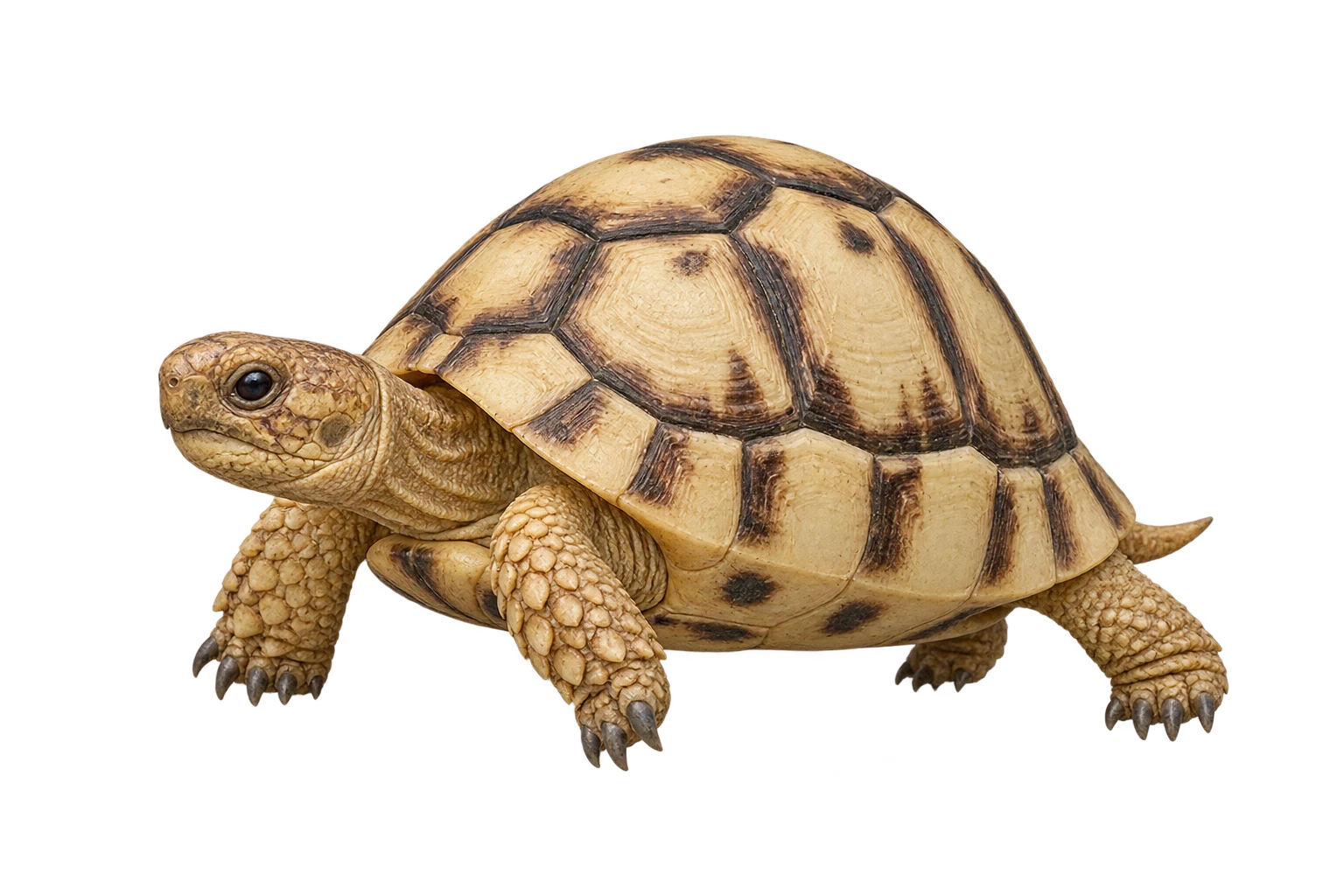
Reptiles
Egyptian Tortoise
Testudo kleinmanni
Classification and source reference
LivingAI illustration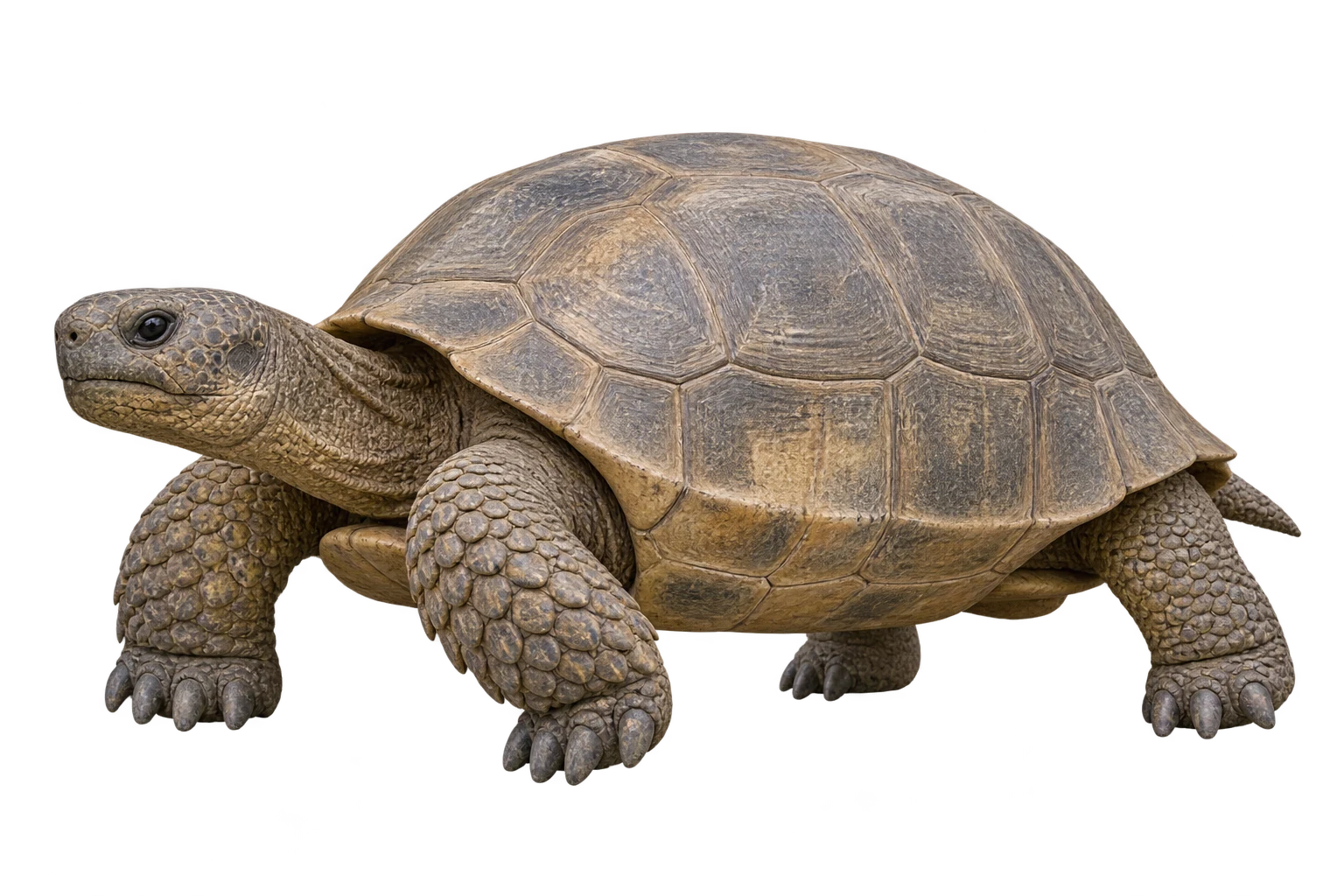
Reptiles
Gopher Tortoise
Gopherus polyphemus
Classification and source reference
LivingAI illustration