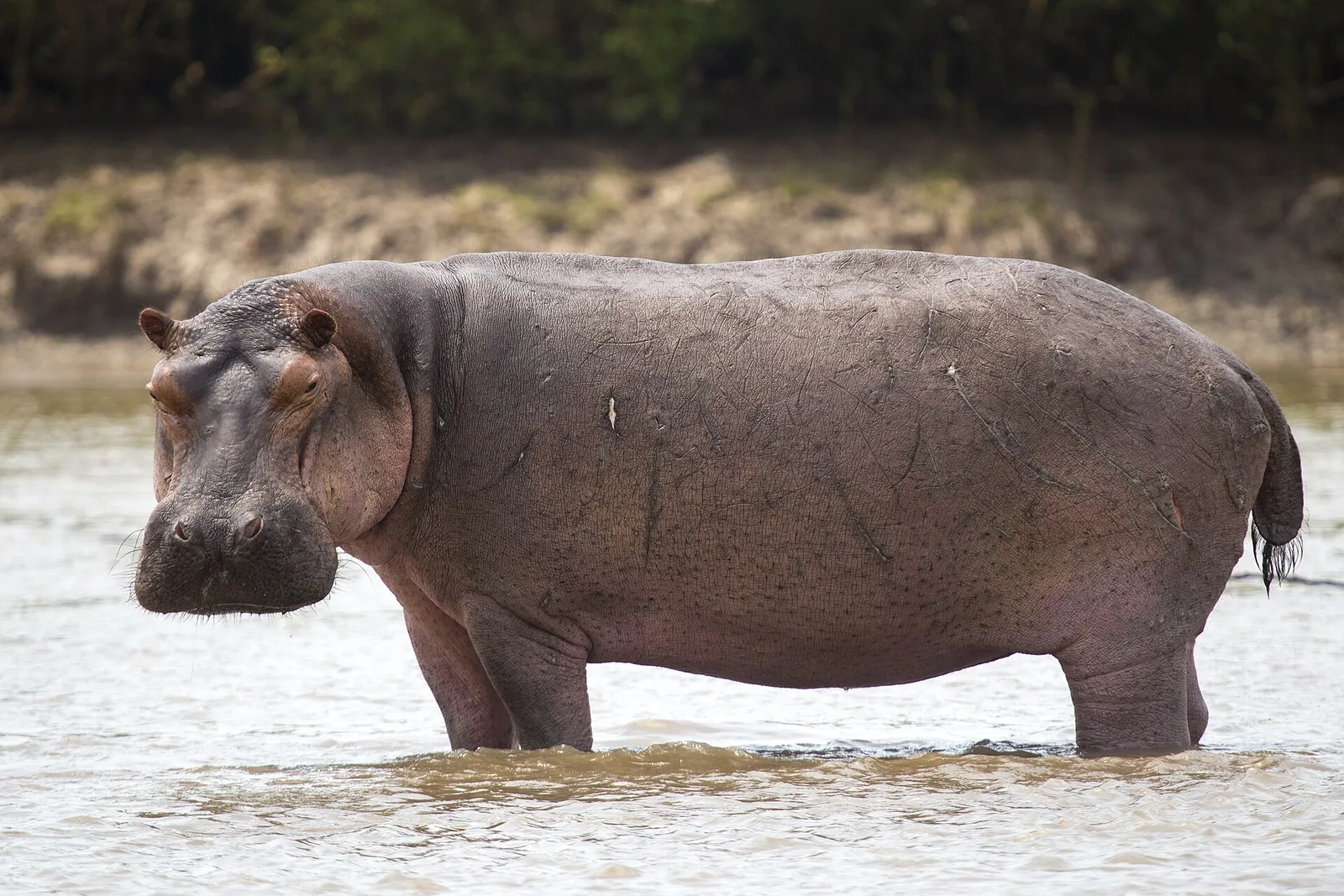
Hippopotamus
The river horse, among Africa's most dangerous animals
Hippopotamus amphibius
Also called Hippo, Common hippopotamus
Living individuals or members of this group exist today. This does not mean they are safe from extinction.
Meet the hippopotamus
The hippopotamus spends its days in rivers and lakes and its nights grazing on land. Despite its bulk it is fast, territorial and among the most dangerous animals in Africa.
Images of the hippopotamus
Lifespan in the wild
40 to 50 years
Weight
1.3 to 4.5 t
Length
2.9 to 5.05 m
Height
1.3 to 1.65 m
Fact file
Hippopotamus
- Location
- Sub-Saharan Africa
- Habitat
- Rivers and lakes, Wetlands, Savanna
- Diet
- Herbivore
- Prey / food
- Grass
- Predators
- Lions and crocodiles take calves
- Lifestyle
- Nocturnal grazer
- Group name
- Bloat or pod
- Name of young
- Calf
- Gestation
- About 8 months
- Litter size
- 1 calf
- Population
- 115,000 to 130,000
- Biggest threat
- Habitat loss and poaching for ivory teeth
- Distinctive feature
- A huge mouth with tusk-like canines
- Colour
- Grey-brown with pink patches
- Skin type
- Thick, hairless skin
Size
Next to a person
Measurements
Size and speed
- Height
- 1.3 to 1.65 m at the shoulder
- Length
- 2.9 to 5.05 m including the tail
- Tail
- 35 to 56 cm
- Weight
- 1.3 to 4.5 t
Typical adult ranges. Sources: Animal Diversity Web, Wikipedia.
Life cycle
Lifespan
- In the wild40 to 50 years
- In captivityUp to 61.2 years
- 061.2 years
Appearance
Colour and coat
- Primary colours
- purplish greyblue-black
- Secondary colours
- pink
- Skin type
- thick, nearly hairless skin
- Male and female
- Slight to the eye. Bulls average about 1.5 tonnes to a cow's 1.3 and keep growing for life. Their canines are twice as long, but cows and young bulls look alike in the field.
Life cycle
Mating and family
- Mating system
- polygynous, one territorial bull with the cows in his stretch of water
- Social structure
- pods of 5 to 30 in a bull's territory, sometimes over 100
- Breeding
- one calf about every two years
Hippos mate and give birth in the water. Gestation lasts eight months, and the single calf weighs about 50 kilograms. It suckles for about a year, often under water, and rides on its mother's back in deep water. Cows mature at five to six years and bulls at about 7.5. A wild hippo lives 40 to 50 years.
Classification
Taxonomy
- Kingdom
- Animalia
- Phylum
- Chordata
- Class
- Mammalia
- Order
- Artiodactyla
- Family
- Hippopotamidae
- Genus
- Hippopotamus
- Species
- Hippopotamus amphibius
Conservation
Red List status
- LC
- NT
- VU
- EN
- CR
- EW
- EX
Vulnerable on the IUCN Red List
Range
Recorded in 22 countries
- Angola
- Burkina Faso
- Benin
- Botswana
- Democratic Republic of the Congo
- Ethiopia
- Gabon
- The Gambia
- Kenya
- Malawi
- Mozambique
- Namibia
- Nigeria
- Rwanda
- Sudan
- Senegal
- South Sudan
- Tanzania
- Uganda
- South Africa
- Zambia
- Zimbabwe
Habitat layer: tropical grassland, savanna and shrubland, flooded grassland and savanna, mangrove.
Countries from 11,668 wild records on GBIF (iNaturalist research grade), filtered and checked by hand. Country shapes: Natural Earth. Habitat: RESOLVE Ecoregions 2017, CC BY 4.0. Basemap: Natural Earth.
Habitats
Three things to know
- 1
A hippo's skin gives off a red, oily fluid that works as sunscreen.
- 2
Hippos cannot swim. They walk or push off the river bottom.
- 3
A hippo can open its mouth about 150 degrees.
Did you know
Seven more facts
- 1
A hippo sleeps under water and rises to breathe without waking.
- 2
A newborn calf weighs about 50 kilograms and suckles under water.
- 3
Bulls keep growing all their lives.
- 4
Hippo dung feeds river fish, but too much of it can strip the water of oxygen.
- 5
A flatworm lives on the hippo's eye, the only such parasite known on a mammal.
- 6
A feral herd of about 100 hippos lives in Colombia, descended from Pablo Escobar's animals.
- 7
iNaturalist holds 17,294 observations of the species.
Field notes
How it looks and acts
Field notes
Distinguishing features
- A barrel body on short legs, with almost no hair.
- A vast mouth with tusk-like lower canines.
- Eyes, ears and nostrils set high on the head.
- Purplish grey skin with pink around the eyes, ears and belly.
- A shoulder height of 130 to 165 centimetres.
- A short tail of 35 to 56 cm.
Field notes
Unique adaptations
- Red skin secretions that block ultraviolet light and bacteria.
- Nostrils and ears that seal shut under water.
- Dense bones and a low centre of gravity for walking on the river bed.
- Webbed feet for grip on muddy bottoms.
- A three-chambered stomach that holds grass for slow digestion.
Field notes
Interesting behaviours
- Rests submerged all day and grazes at night.
- Follows the same paths from water to grass and back.
- Scatters dung with a spinning tail.
- Yawns wide as a threat.
- Opens its mouth for cleaner fish to pick off parasites.
Field notes
Temperament
- Placid in the water among its own pod.
- Fiercely territorial in water, and quick to charge boats.
- A mother attacks anything that comes near her calf.
- Unpredictable, which makes it one of the most dangerous animals in Africa.
Field notes
Communication
- Wheeze honks that carry far over water.
- Underwater clicks that may be echolocation.
- Dung showers and yawns as visual and scent signals.
- Bellows from fighting bulls.
Ecology
Ecological role
The hippo is a megaherbivore that moves nutrients from land to water and shapes the channels and lawns where it lives.
- Grazes lawns short each night and keeps its paths bare of plants.
- Carries about 40 kilograms of grass a night into the water as dung, which feeds fish and invertebrates.
- Its trampled paths become channels that flood and form pools for fish in drought.
- In large numbers its dung can rob water of oxygen and kill aquatic life.
Stories
Myths and legends
- In Egyptian tradition, the goddess Taweret, a pregnant hippo, guards mothers and infants.
- In Egyptian tradition, Set turns into a red hippopotamus to fight Horus and loses.
- In San tradition, the hippo may live in water only because it promised to eat grass rather than fish.
- In Ndebele tradition, a jealous hare burned the hippo's fine hair, so it hides in the water.
- In Yoruba tradition, the hippo is erinmi, the elephant of the water, and its ivory served in divination.
People
Relationship with humans
People
Living alongside us
People have hunted the hippo since Neanderthal times, for meat, hide and ivory. The Egyptians feared it and made it a god. It is one of the world's most dangerous animals, capsizing boats and charging on land. Poaching for meat and teeth has emptied some rivers, especially in the Congo. Zoos have kept hippos since 1850 and breed them easily.
- A hippo capsizes small boats, and 13 people died in one such attack in Niger in 2014.
- Cows about to give birth or guarding calves attack anyone who comes near.
- On land a hippo trots at a reported 30 kilometres per hour and cannot jump.
People
Status, uses and products
- Domestication
- Wild
- As a pet
- Not suitable. A hippo needs a body of water about 2 metres deep and 40 kilograms of grass every night. It is one of the most dangerous animals alive and cannot be kept safely outside a zoo.
- Uses
- subsistence huntingzoo exhibitionecotourism
- Products
- meativory teethhide
The full account
About the hippopotamus
The hippopotamus, Hippopotamus amphibius, is a huge semi-aquatic mammal of sub-Saharan Africa. Its name is Greek for river horse, but its closest living relatives are the whales. It spends the day in rivers and lakes to keep cool and comes out at dusk to graze on grass. Only the elephants and some rhinos are heavier among land mammals. A barrel body, short legs, nearly bare skin and a vast mouth with tusk-like canines make it unmistakable.
An adult weighs 1,300 to 4,500 kilograms and measures 2.9 to 5.05 metres including the tail. It stands 130 to 165 centimetres at the shoulder. Bulls hold territories in the water and rule a group of 5 to 30 cows and calves. The hippo is aggressive and unpredictable, and it is counted among the world's most dangerous animals. The IUCN lists it as Vulnerable, with 115,000 to 130,000 left, threatened by habitat loss and poaching for meat and ivory.
Name and taxonomy
The Latin hippopotamus comes from the Greek hippos, horse, and potamos, river. The usual English plural is hippopotamuses, and most people say hippo. The Yoruba call it erinmi, the elephant of the water. Wikidata lists it as the common, river or Nile hippopotamus, and GBIF adds names such as the Cape and East African hippo.
Linnaeus named the species in 1758, with the type locality later fixed as the Nile in Egypt. The family Hippopotamidae has only two living members, this species and the pygmy hippopotamus. Five subspecies were described from skull differences and range, from the Gambia to South Africa. Field biologists never adopted them, because the differences were small enough to be sampling noise. A DNA study of skin from 13 sites found low but real differences among three of them. Until 1909 naturalists grouped hippos with pigs because their molars looked alike.
Evolution and relatives
Blood proteins, DNA and fossils all show that whales, dolphins and porpoises are the hippo's nearest living relatives. The two lines share a semi-aquatic ancestor that split from other even-toed ungulates about 60 million years ago. That group divided again about 54 million years ago. One branch became the whales, starting with animals such as Pakicetus about 52 million years ago. The other became the anthracotheres, four-legged beasts that looked like thin hippos with narrow heads.
Every anthracothere line died out in the Pliocene except the one that led to the hippos. Hippo ancestors probably entered Africa from Asia about 35 million years ago, as the fossil Epirigenys suggests. Kenyapotamus lived in Africa 15 to 9 million years ago, and Archaeopotamus from 7.5 to 1.8 million years ago. The genus Hippopotamus appears in the Pliocene, and the modern species is certain from the Middle Pleistocene. Extinct relatives include the giant Hippopotamus gorgops, over 4,000 kilograms, and dwarf hippos on Crete, Cyprus, Malta and Sicily. Three Malagasy hippos survived on Madagascar until the last 1,000 years.
Appearance
The hippo has a barrel-shaped body, short legs, a short tail and a long-snouted skull shaped like an hourglass. Adults weigh 1,300 to 4,500 kilograms, and a bull averages about 1.5 tonnes to a cow's 1.3. Head, body and tail measure 2.9 to 5.05 metres, with the tail 35 to 56 centimetres. Shoulder height is 130 to 165 cm. The largest recorded was a captive male in Munich at 4,500 kg. Bulls keep growing all their lives, while cows stop at about 25 years.
The skin is about 6 centimetres thick and almost hairless, purplish grey or blue-black above and brownish pink below and around the eyes. Glands secrete an oily red fluid, once called blood sweat, that is neither blood nor sweat. It contains hipposudoric and norhipposudoric acids, which absorb ultraviolet light and stop bacteria. The fluid comes out colourless and turns red-orange in minutes. Even so, the skin cracks if the animal stays out of water too long.
The eyes, ears and nostrils sit high on the head, so the hippo can breathe and watch while submerged. The nostrils and ears close under water. Huge jaw muscles and a far-back hinge let the mouth open to 100 to 110 degrees, and ADW gives up to 150. Lower canines grow to 50 cm and lower incisors to 40 cm, and they are weapons rather than tools for eating. The feet are webbed, and the dense bones and low centre of gravity let the animal walk along the bottom.
Habitat and range
Hippos need water deep enough to cover the body, close to grass. They live in rivers, lakes, swamps and estuaries, and prefer still water with gently sloping banks. They are absent from rainforest except along big rivers, and they range from sea level to 2,000 metres. In West Africa they keep to the lower reaches of rivers and sometimes enter the sea.
The species lives across sub-Saharan Africa, from the Gambia east to Ethiopia and Somalia and south to South Africa. It is found in 29 countries, and declines are confirmed in half of them. It was once common along the Nile down to the delta. It had become rare in Egypt by 1600 and vanished in the early 19th century. GBIF holds records from 60 countries, a figure inflated by zoos.
In the Pleistocene the species reached Europe, as far north as Britain, and lived there until about 30,000 years ago. During the wet early Holocene, about 10,000 to 4,000 years ago, hippos lived across a green Sahara. A feral herd in Colombia descends from animals that escaped Pablo Escobar's estate after 1993 and numbered about 100 by the 2020s.
Diet and feeding
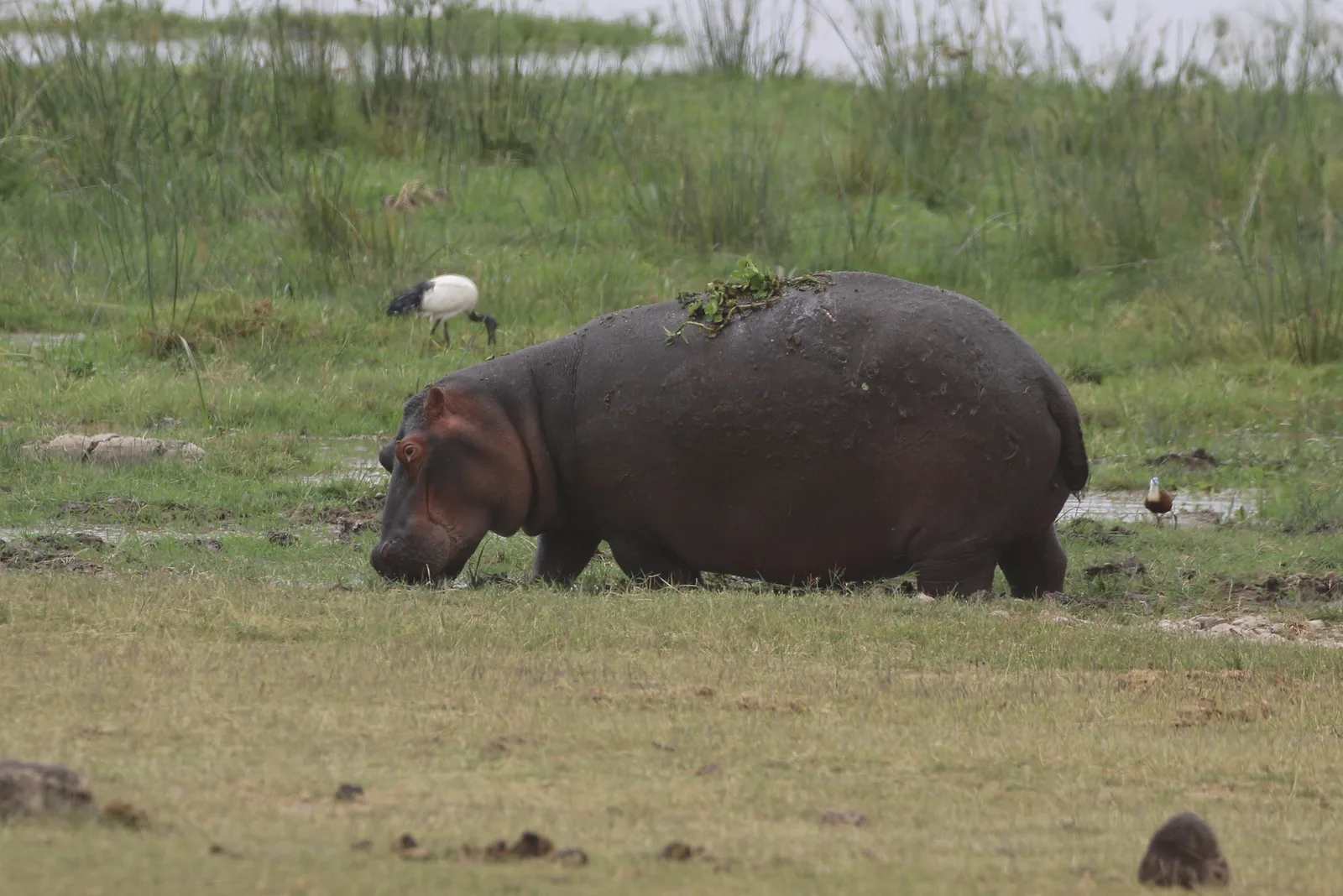
The hippo is a grazer, and grass makes up nearly all of its diet. It eats little aquatic vegetation, though it takes other plants in captivity. It leaves the water at dusk, walks 3 to 5 kilometres along fixed paths and eats about 40 kilograms of grass. Grazing takes four to five hours, and the animal is back in the water by dawn. A hippo eats only 1 to 1.5 percent of its body weight a night, because it rests so much.
Wide horny lips, about 50 cm across, grasp and tear the grass, which the molars then grind. The jaws cannot move sideways, so chewing is inefficient. The stomach has three chambers, but the hippo does not chew the cud, so it is called a pseudoruminant. Food stays in the gut longer than in most large herbivores.
Hippos raid crops, especially rice, when they get the chance. They have been filmed eating carrion, and there are reports of meat-eating and even cannibalism. The gut is not built for meat, so this behaviour is probably a sign of hunger or illness.
Behaviour and social life
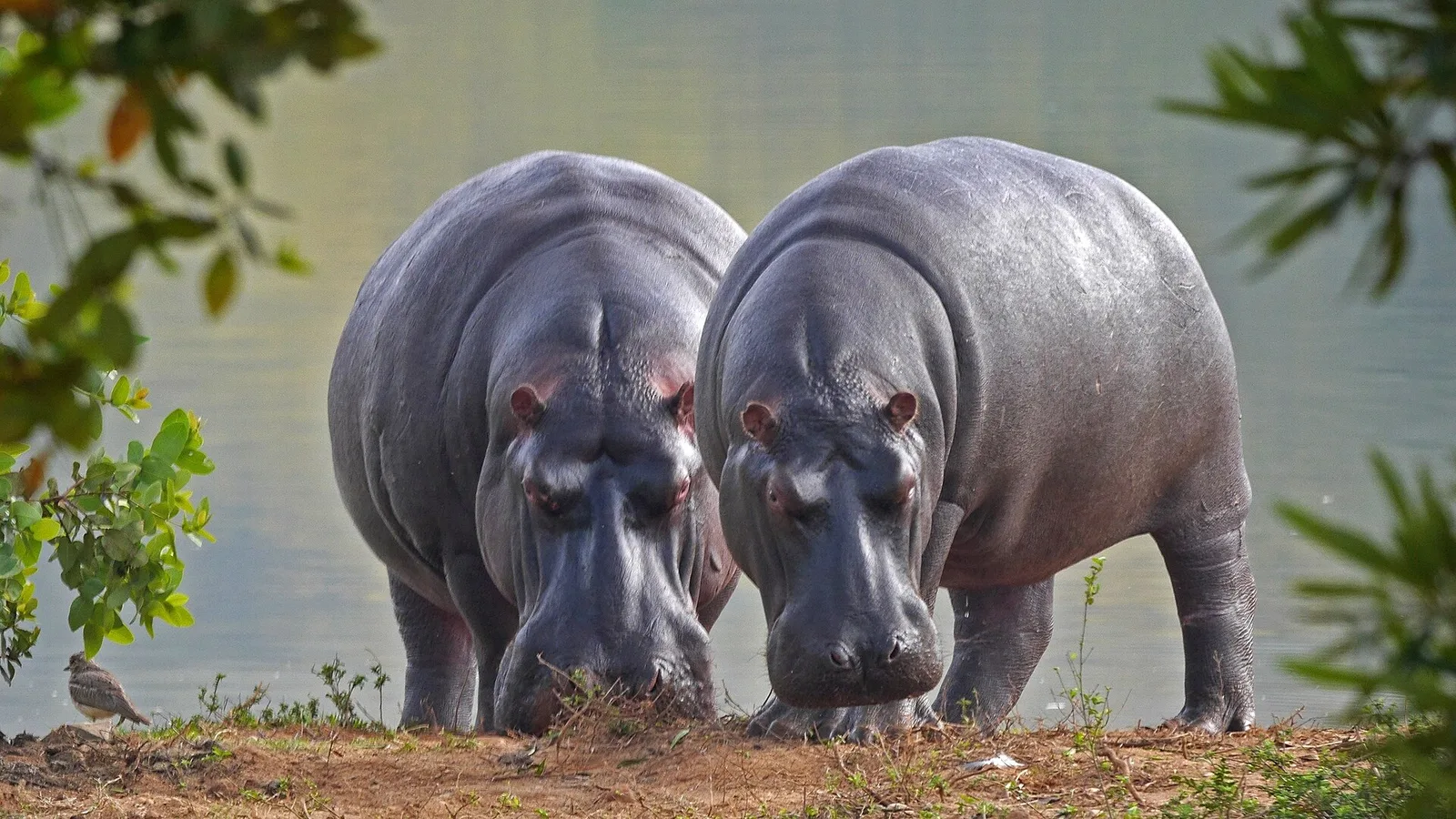
Hippos rest in the water through the day, often lying close together with heads on each other's backs. Pods vary in size and can hold over 100 animals, though adults form almost no bonds. Bulls hold territories in water only, 250 to 500 metres of lake shore or 50 to 100 m of river. The territorial bull mates with every cow in his stretch, and bachelors may stay if they defer to him. On land there is no territory, and each hippo grazes alone.
Hippos do not swim so much as walk or bounce along the bottom. An adult must surface at least every six minutes, and a calf every two to three. On land the hippo trots, and at speed all four feet leave the ground. It is reported to reach 30 kilometres per hour, though this is unconfirmed, and it cannot jump. It can sleep under water and surface to breathe without waking.
A bull scatters dung by spinning his tail, on land and in water, a habit called muck-spreading. The function is unclear, but the piles may mark the trails between water and grazing. A wide yawn is a threat, and fighting bulls block with their incisors and stab with their canines. Over-crowded bulls sometimes kill calves, though this is rare in normal conditions. Fights are worst in the dry season, when water shrinks and animals crowd together.
Communication and senses
The commonest call is the wheeze honk, a high squeal followed by a deep resonant note. It carries a long way through air, and ADW puts it at up to 115 decibels. Hippos recognise each other's voices and react more to a stranger's call than to a neighbour's. A hippo can hold its head half out of the water and give a cry that travels through water and air at once. That is the only known case of an amphibious call in a mammal.
Under water hippos produce clicks that may serve as echolocation. Sound passes into the water from a fat pad over the larynx and reaches other hippos through their jaw bones. Alarmed hippos exhale sharply, and fighting bulls bellow. Scent matters too: hippos read dung and urine, and a vomeronasal organ draws in urine under water to test breeding state.
Reproduction and life cycle
Cows mature at five to six years, though puberty can start at three or four, and bulls at about 7.5 years. Conceptions and births peak in the wet season, but bulls can breed all year. The bull walks through the herd sniffing each cow's rear, acting submissive to avoid attack. Mating takes place in the water, with the cow below the surface and rising now and then to breathe.
Gestation lasts eight months. The cow gives birth alone, on land or in shallow water, and rejoins the herd after 10 to 14 days. A calf weighs about 50 kilograms and measures about 127 centimetres at birth. It suckles under water or on land, with ears folded and nostrils shut, and rides on its mother's back in deep water. Calves are weaned at about a year, and the cow does not ovulate again for about 17 months.
Mothers are fiercely protective, and calves may be kept in nurseries watched by one or more adults. A cow produces one calf about every two years. In the wild a hippo lives 40 to 50 years, and the oldest captive animal reached 61.2 years. Two zoo hippos, Bertha in Manila and Lu in Florida, reached 65.
Predators and threats
Adult hippos have no regular predator apart from people. Nile crocodiles, lions and spotted hyenas take calves. Large lion prides have killed adults at Gorongosa, but that is rare. Hippos often chase or kill crocodiles, though they avoid any longer than 3.5 metres. Crocodiles in groups have finished off bulls wounded in mating fights.
The main threats are the loss of wetland, the diversion of water and hunting for meat and ivory. Hippo teeth serve as a substitute for elephant ivory, and hippo meat is prized in parts of central Africa. In the Democratic Republic of the Congo, Virunga National Park fell from about 29,000 hippos in the mid 1970s to 800 or 900 by 2005. Militias and unpaid soldiers did the poaching during the Second Congo War. West African populations are small and have the poorest outlook.
Population and conservation
The IUCN rated the hippo Vulnerable in 2017, with a stable population of 115,000 to 130,000. An earlier estimate gave 125,000 to 148,000 across 29 countries. Populations fell 7 to 20 percent over ten years, according to the IUCN. South Africa rates its own hippos as Least Concern, and iNaturalist records that listing.
The species is on CITES Appendix II, so international trade needs documents. Hunting is illegal in most range states, and most countries with many hippos have parks and strict rules. Virunga's hippos appear to have recovered somewhat by 2016, helped by rangers working with local fishermen. Few conservation efforts target the hippo alone.
Where hippos grow too dense they strip vegetation and cause erosion, and some parks culled them in the 1950s and 1960s. Colombia's feral herd is treated as an invasive species, and officials use sterilisation and culling to contain it.
Relationship with humans
Neanderthals butchered hippos in Spain between 230,000 and 120,000 years ago. Modern humans left cut marks on hippo bones in Ethiopia about 160,000 years ago. Rock art 4,000 to 5,000 years old in the central Sahara shows hippo hunts. Egyptian nobles had hunts painted on their tombs, and Herodotus and Pliny both described the animal. Manetho wrote that the pharaoh Menes was carried off and killed by a hippo.
Hunters value the meat, the hide for shields and whips, and the canine ivory, which sells illegally. The hippo attacks boats and can capsize a small one. In Niger in 2014 a hippo overturned a boat and 13 people died. Most attacks on people come from cows about to give birth or guarding calves. Crop raids bring hippos into conflict with farmers, and either side can die.
Egyptians kept hippos for display at Hierakonpolis as early as 3500 BC. Obaysch reached London Zoo in 1850 and drew crowds of up to 10,000 a day, and a song, the Hippopotamus Polka, followed. Hippos breed well in zoos, and Cincinnati Zoo spent 73 million dollars from 2015 on a home for three adults. Huberta became a celebrity in the Great Depression for her long trek across South Africa.
In culture and myth
In Egyptian myth the god Set becomes a red hippopotamus to fight Horus and loses. Temple scenes show that hippo speared as the defeat of disorder. The goddess Taweret has a hippo's head on a pregnant woman's body and stands for fierce maternal love. She protected mothers and infants. The Behemoth of the Book of Job is probably a hippo.
In a San story the Creator let the hippos live in water only if they ate grass, not fish, and flung their dung for inspection. In a Ndebele tale a jealous hare set fire to the hippo's long hair, and the shamed hippo hid in a pool ever after. In another African tale, God gave the hippo the job of cutting grass for the other animals. Africa was too hot for it, so it asked to spend the day in the water and graze at night. The Ijaw of the Niger Delta wore hippo masks in water spirit cults, and the Chewa used them in Nyau funerals. Yoruba diviners used hippo ivory, and Zulu warriors named the hippo in war chants.
Rubens painted The Hippopotamus and Crocodile Hunt around 1615, a rare hippo in European art. Since Obaysch the hippo has been a comic figure in the West: a ballerina in Disney's Fantasia, Gloria in Madagascar, and Hungry Hungry Hippos. T. S. Eliot's poem The Hippopotamus uses the animal to stand for the Church. Gayla Peevey's I Want a Hippopotamus for Christmas was a hit in 1953, and Flanders and Swann wrote The Hippopotamus Song.
A sentence with a dotted underline is inferred: it describes the group the animal belongs to, or is a reading of the sources, rather than a measured or reported fact about this species.
Questions
Hippopotamus questions, answered
Are hippos dangerous?
Yes. The hippo is one of the world's most dangerous animals because it is aggressive and unpredictable. It capsizes boats, and 13 people died in one attack in Niger in 2014. Cows with calves are the most likely to charge.
What do hippos eat?
Grass, almost entirely. A hippo leaves the water at dusk, walks 3 to 5 kilometres and eats about 40 kilograms of grass before dawn. It occasionally eats carrion, but its gut is not built for meat.
Can hippos swim?
Not really. A hippo walks or bounces along the bottom and rarely enters deep water. Its dense bones let it sink and move on the river bed.
How big is a hippo?
An adult weighs 1,300 to 4,500 kilograms and measures 2.9 to 5.05 metres long. Shoulder height runs 130 to 165 centimetres. A bull averages about 1.5 tonnes.
Are hippos endangered?
The IUCN lists the hippo as Vulnerable. About 115,000 to 130,000 remain, and numbers have fallen in half of the 29 countries where it lives. Poaching for meat and ivory and the loss of wetlands are the main threats.
How fast can a hippo run?
Hippos are reported to reach 30 kilometres per hour on land, though that figure is unconfirmed. They trot and cannot jump, but they climb steep banks.
Why do hippos sweat red?
The fluid is not sweat or blood. Skin glands secrete an oily substance that turns red in minutes and works as a sunscreen and an antiseptic.
How long can a hippo stay under water?
An adult must surface at least every six minutes. A calf must come up every two or three minutes. Hippos can sleep under water and surface without waking.
What is a hippo's closest relative?
The whales, dolphins and porpoises. Hippos and whales share an ancestor that split from other even-toed ungulates about 60 million years ago.
How long do hippos live?
About 40 to 50 years in the wild. The oldest captive hippo lived to 61.2 years, and two zoo animals reached 65.
How many calves does a hippo have?
One calf about every two years, after a gestation of eight months. The calf weighs about 50 kilograms and suckles for about a year.
Why do hippos open their mouths so wide?
A wide yawn is a threat display, and the mouth opens to 100 to 110 degrees. Bulls fight with their canines, which grow to 50 centimetres. A hippo also opens its mouth to let cleaner fish pick off parasites.
Where do hippos live?
In rivers, lakes and swamps across sub-Saharan Africa, from the Gambia to Ethiopia and south to South Africa. They need water deep enough to submerge in and grass nearby.
Do hippos live in Colombia?
Yes. A feral herd descends from animals that escaped from Pablo Escobar's estate in the 1990s. It reached about 100 by the 2020s, and officials cull and sterilise them.
What is a group of hippos called?
A pod, or a bloat. A territorial bull holds 5 to 30 cows and calves in his stretch of water, and pods can exceed 100.
Why do hippos spread their dung?
A hippo spins its tail while defecating, on land and in water. The purpose is unclear, but the dung may mark the paths between water and grazing.
Food web
Prey and food
- grass
Food web
Predators
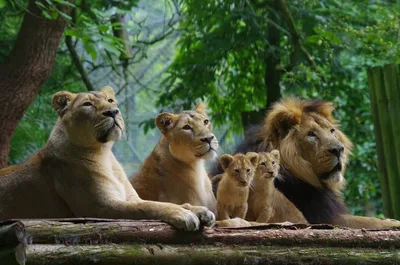 Lion
- crocodiles
Ecological equivalents
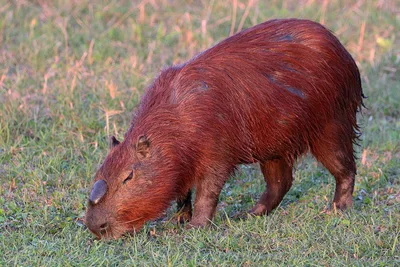
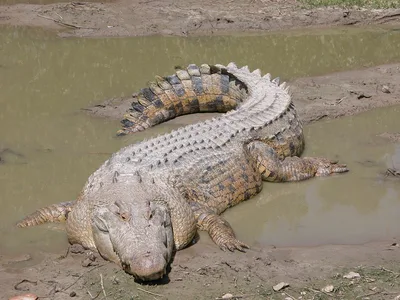
Related species on this site
Hippopotamus gorgops (same genus), Pygmy Hippopotamus (same family), Addax (same order), African buffalo (same order), Alpaca (same order), Alpine Goat (same order), and more.
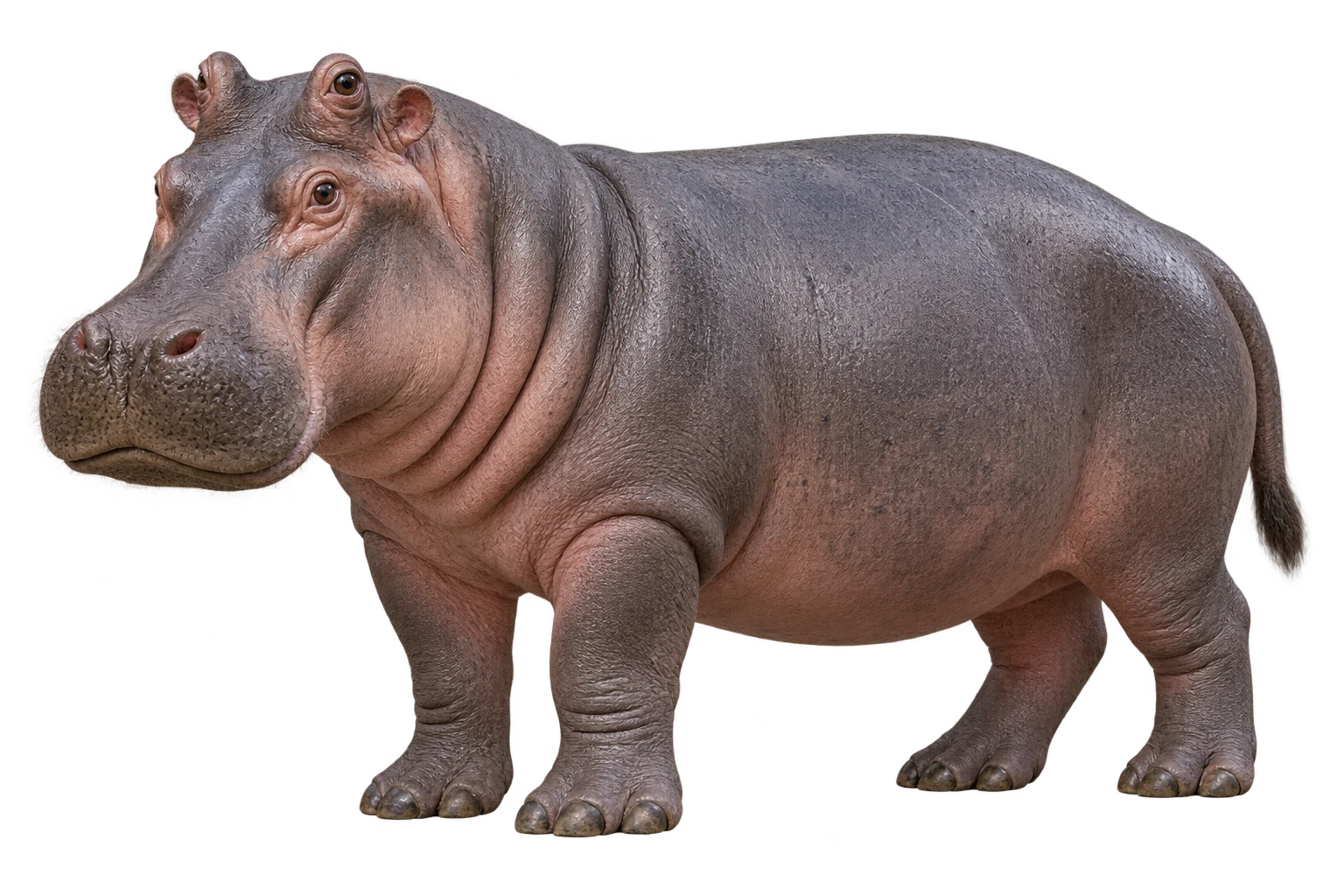
Mammals
Hippopotamus gorgops
Hippopotamus gorgops
Classification and source reference
ExtinctAI reconstruction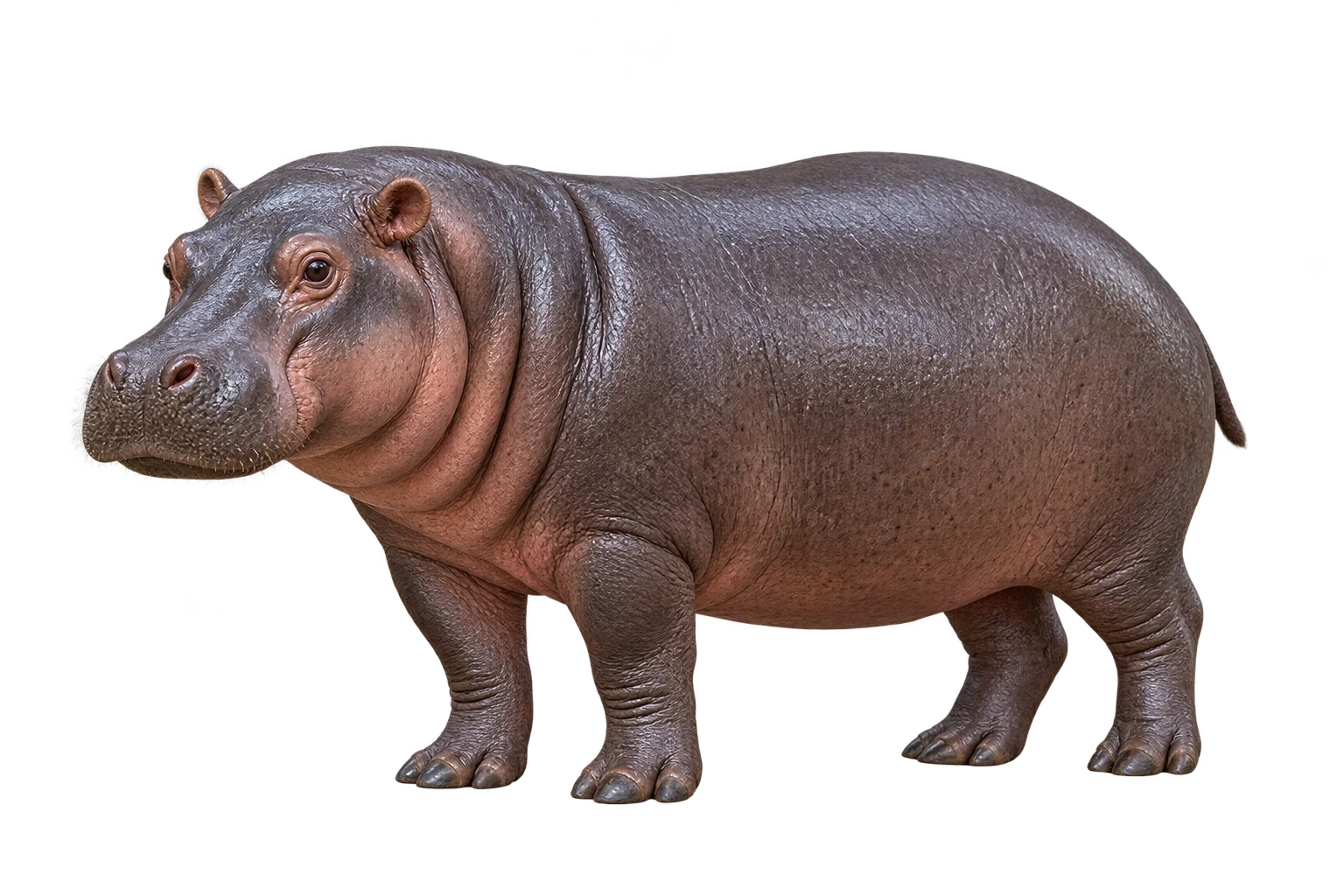
Mammals
Pygmy Hippopotamus
Choeropsis liberiensis
Classification and source reference
LivingAI illustration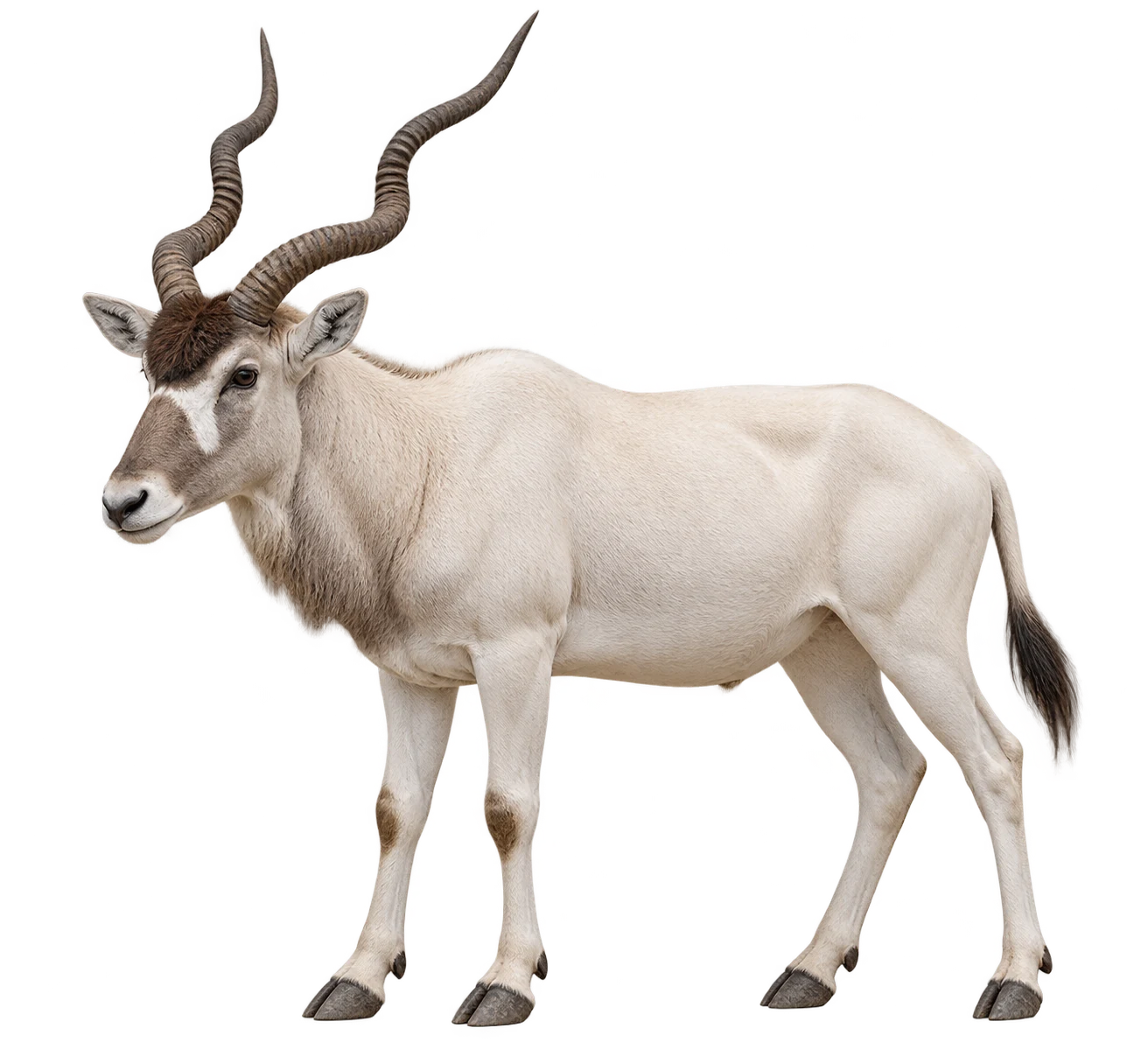
Mammals
Addax
Addax nasomaculatus
Classification and source reference
LivingAI illustration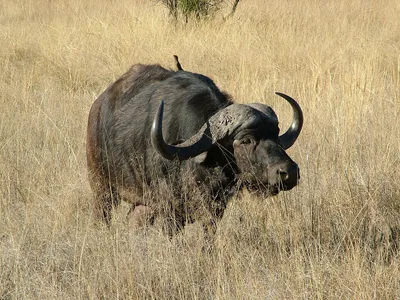 NT
Mammals
African buffalo
Syncerus caffer
The African buffalo is a heavy wild ox of sub-Saharan Africa that lives in herds of dozens to thousands and must drink every day.
Living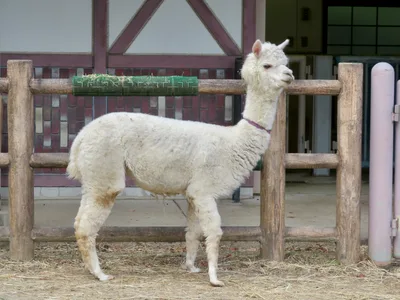
Mammals
Alpaca
Vicugna pacos
The alpaca is a domesticated Andean camelid kept for its fleece.
Living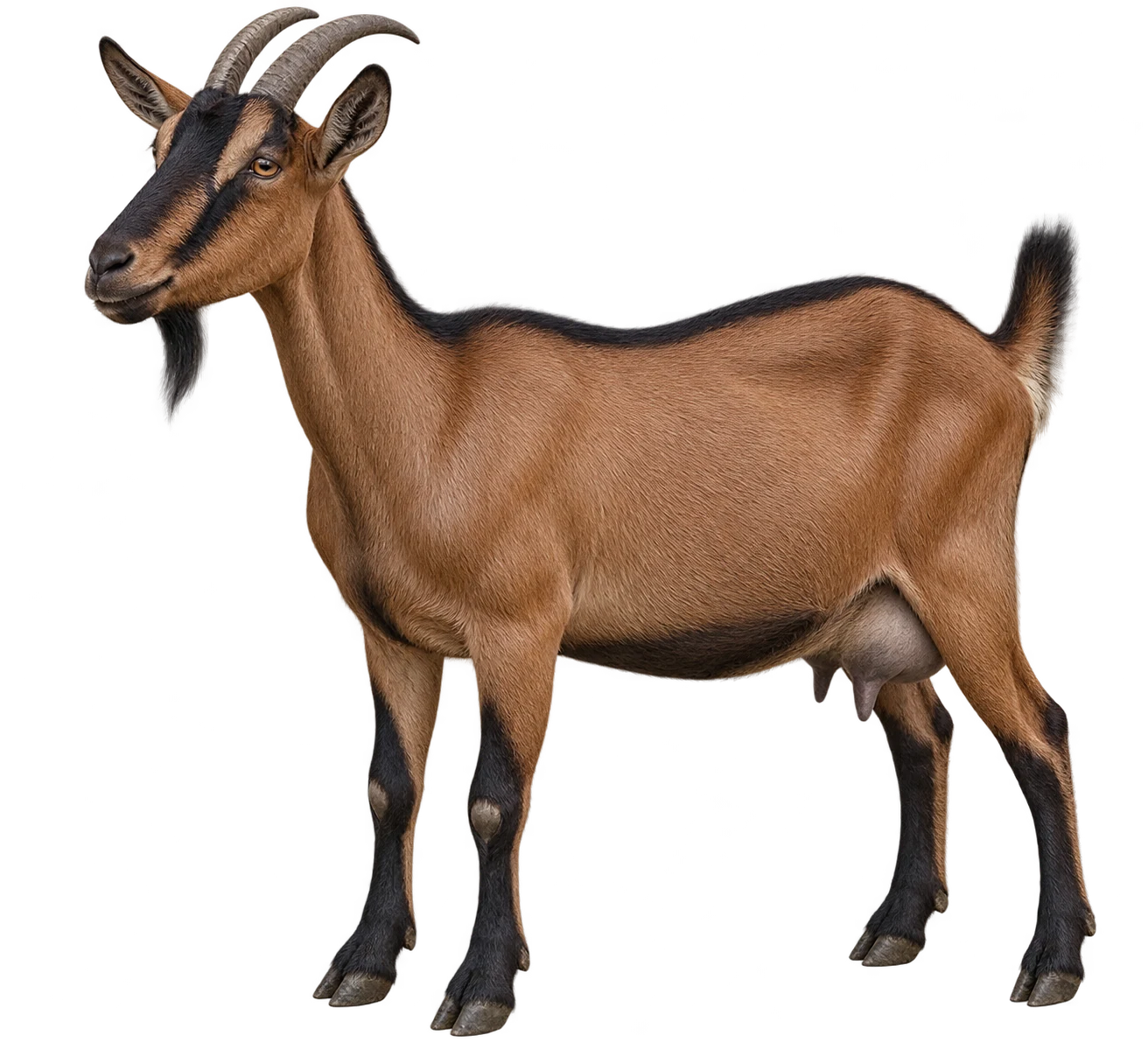
Mammals
Alpine Goat
Capra hircus
Classification and source reference
LivingAI illustration