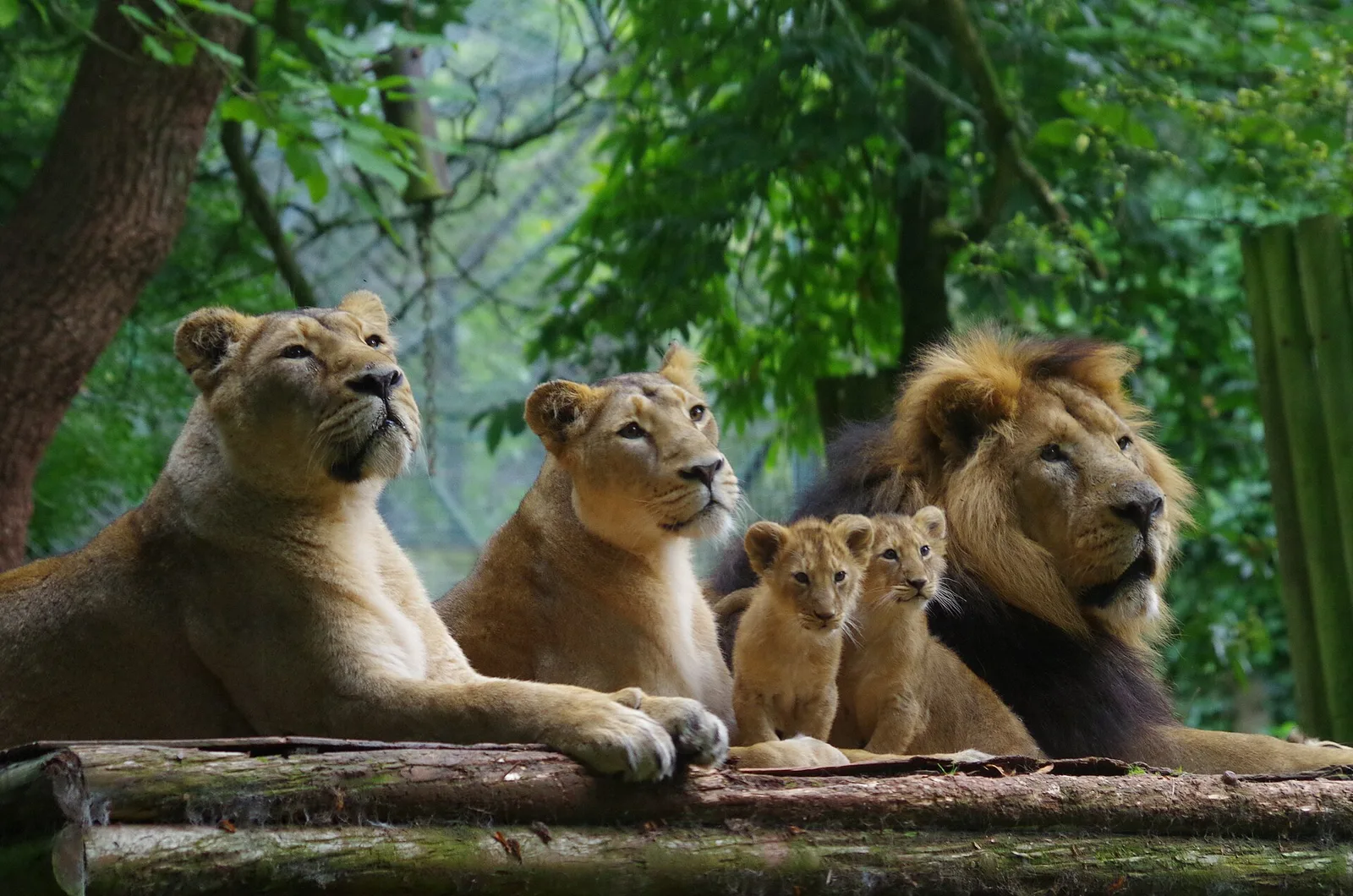
Lion
The only cat that hunts and raises cubs as a family
Panthera leo
Also called African lion
Living individuals or members of this group exist today. This does not mean they are safe from extinction.
Meet the lion
The lion is the only cat that lives in social groups. Prides of related females hunt together on the African savanna, while a small population survives in the Gir Forest of India.
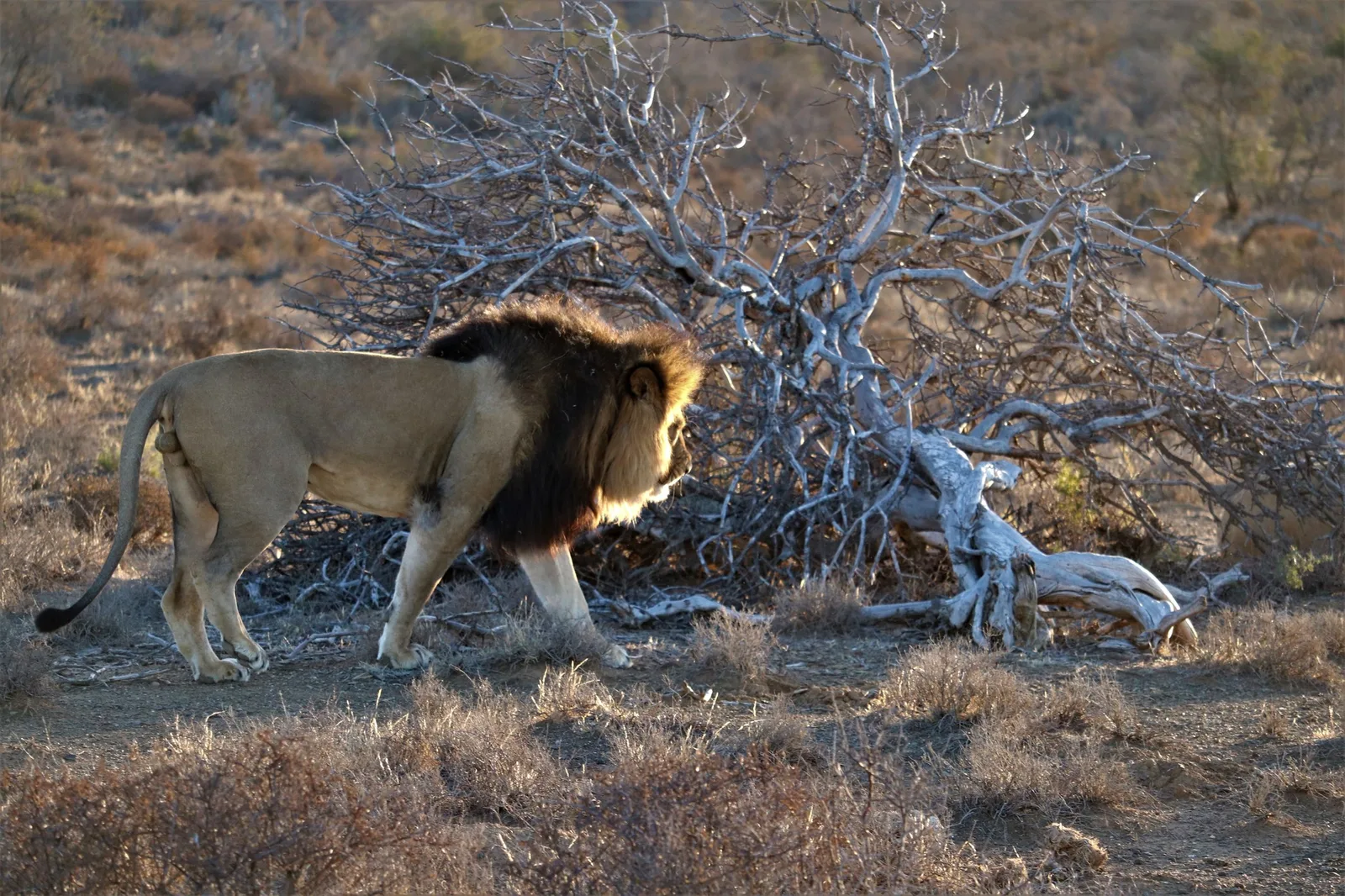
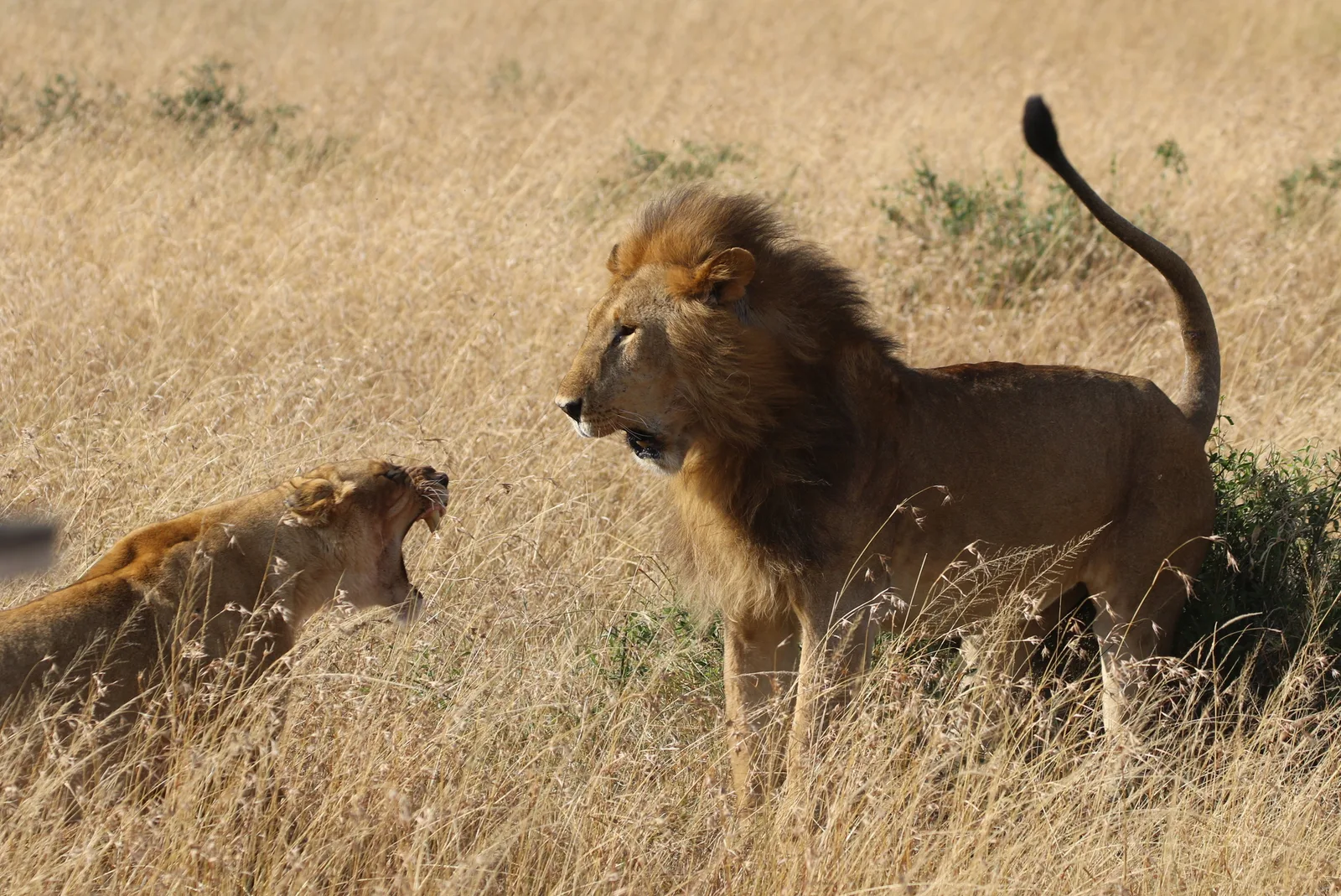
Images of the lion
Lifespan in the wild
12 to 17 years
Weight
126 to 272 kg
Length
2.4 to 3.3 m
Top speed
48 to 59 km/h
Fact file
Lion
- Location
- Sub-Saharan Africa; Gir Forest, India
- Habitat
- Savanna, Grassland
- Diet
- Carnivore
- Prey / food
- Zebra, wildebeest, buffalo, antelope
- Predators
- None as adults; hyenas take cubs
- Lifestyle
- Mostly nocturnal
- Group name
- Pride
- Name of young
- Cub
- Gestation
- About 110 days
- Litter size
- 2 to 4 cubs
- Population
- About 20,000 in the wild
- Biggest threat
- Habitat loss and conflict with livestock farmers
- Distinctive feature
- The male's mane
- Colour
- Tawny gold
- Skin type
- Fur
Size
Next to a person
Measurements
Size and speed
- Length
- 2.4 to 3.3 m including the tail
- Weight
- 126 to 272 kg
- Top speed
- 48 to 59 km/h, up to 74.1 km/h in short bursts
Typical adult ranges. Sources: Animal Diversity Web, Wikipedia.
Life cycle
Lifespan
- In the wild12 to 17 years
- In captivityUp to 30 years
- 030 years
The pale bar is the record. Sources: Wikipedia, Animal Diversity Web.
Appearance
Colour and coat
- Primary colours
- tawnybuff
- Secondary colours
- dark brownblack
- Skin type
- fur
- Male and female
- Strong. Males are larger, carry a mane from the head to the chest, and have broader heads. Females have no mane.
Life cycle
Mating and family
- Mating system
- polygynous
- Social structure
- prides of related females with their cubs and one to four resident males
- Breeding
- usually one litter every two years
Lions breed all year round. A lioness carries her cubs for about 110 days and gives birth to two to four cubs in a hidden den. She joins the pride again at six to eight weeks, and related females nurse each other's cubs. Cubs are weaned at six to seven months but stay dependent for well over a year. Wild lions live 12 to 17 years, and one captive lion reached 30.
Classification
Taxonomy
- Kingdom
- Animalia
- Phylum
- Chordata
- Class
- Mammalia
- Order
- Carnivora
- Family
- Felidae
- Genus
- Panthera
- Species
- Panthera leo
Conservation
Red List status
- LC
- NT
- VU
- EN
- CR
- EW
- EX
Vulnerable on the IUCN Red List
Range
Recorded in 26 countries
- Angola
- Burkina Faso
- Benin
- Botswana
- Democratic Republic of the Congo
- Central African Republic
- Cameroon
- Ethiopia
- Ghana
- India
- Kenya
- Malawi
- Mozambique
- Namibia
- Niger
- Nigeria
- Rwanda
- Sudan
- Senegal
- South Sudan
- Chad
- Tanzania
- Uganda
- South Africa
- Zambia
- Zimbabwe
Habitat layer: tropical grassland, savanna and shrubland, temperate grassland, savanna and shrubland.
Countries from 14,659 wild records on GBIF (iNaturalist research grade), filtered and checked by hand. Country shapes: Natural Earth. Habitat: RESOLVE Ecoregions 2017, CC BY 4.0. Basemap: Natural Earth.
Habitats
Three things to know
- 1
A lion's roar can be heard up to 8 km away.
- 2
Lionesses do most of the hunting, often at night.
- 3
A darker mane signals an older and healthier male.
Did you know
Seven more facts
- 1
A newborn cub weighs 1.2 to 2.1 kilograms and cannot see for its first week.
- 2
The tail tuft is missing at birth and appears at about five and a half months.
- 3
White lions are not albinos, because they carry a recessive gene for leucism and keep normal eye colour.
- 4
Lions and tigers have been crossed in zoos, and the liger outgrows both parents.
- 5
Lion cubs first stalk at around three months but do not hunt well until nearly two years old.
- 6
The lion is the only cat in which the female regularly deals with several males at once.
- 7
iNaturalist holds 24,745 observations of the species, from wild prides to zoo animals.
Field notes
How it looks and acts
Field notes
Distinguishing features
- A mane on the adult male, unique among cats.
- A dark tuft at the tip of the tail.
- A tawny coat with a paler belly, spotted in cubs.
- A short, round head and round ears on a deep-chested body.
- A total length of 240 to 330 centimetres including the tail.
- A roar that is louder and deeper in the male than in the female.
Field notes
Unique adaptations
- Fast-twitch muscle fibres give a short burst of speed of 48 to 59 kilometres per hour.
- A tawny coat blends into dry grass, which probably helps a stalking lioness get close.
- Group hunting nearly doubles the success rate, from 17% alone to 30% in a pride.
- Synchronised births let cubs of one age share milk and grow at the same rate.
- A strong jaw and a clamping throat bite kill prey many times the lion's weight.
Field notes
Interesting behaviours
- Rests for about twenty hours a day and hunts mostly after dark.
- Greets pride mates by rubbing heads and licking.
- Marks territory by spraying urine and scraping the ground.
- Steals kills from hyenas, cheetahs, leopards and wild dogs.
- Moves cubs to a fresh den several times a month.
Field notes
Temperament
- Tolerant of pride mates, hostile to outsiders of the same sex.
- Males squabble over food, females rarely do.
- Usually avoids people on foot, but a few individuals turn to man-eating.
Field notes
Communication
- Roars to claim territory, to find pride mates and to warn rivals.
- Rubs heads and licks to greet and to make peace after a quarrel.
- Sprays urine and scrapes the ground to leave a scent message.
- Uses a bared-teeth grimace, the flehmen response, when it tests a scent.
Ecology
Ecological role
The lion is the top predator of the African savanna and a keystone species across its range.
- Takes the most common large hooved animals in each area, mainly zebra, wildebeest and buffalo.
- Competes with spotted hyenas for prey and carrion, with a 58.6% overlap in diet.
- Suppresses cheetahs, leopards and wild dogs by stealing kills and killing their young.
- Cleans up carrion, though its effect on prey numbers is probably smaller than the effect of food supply.
Stories
Myths and legends
- In ancient Egyptian tradition, the lioness goddess Sekhmet brought both protection and destruction.
- In Hindu tradition, Vishnu took the man-lion form Narasimha to defeat the tyrant Hiranyakashipu.
- In Greek tradition, Heracles strangled the Nemean lion because no weapon could cut its hide.
- In Ethiopian tradition, the Lion of Judah stood for the emperors' descent from Solomon.
- In Chinese tradition, paired stone lions guard the gates of palaces and temples.
People
Relationship with humans
People
Living alongside us
Lions have been kept, hunted and painted by people for thousands of years. Zoos hold over 1,000 African lions, and lion taming filled circuses for two centuries. In the wild, lions kill livestock, and herders kill lions in return. A few lions turn to hunting people, mostly where wild prey is scarce. Ecotourism now gives many African parks a financial reason to protect them.
- A lion can kill an adult human, and man-eating lions have taken hundreds of people in Tanzania since 1990.
- Most lions avoid people on foot and move away when seen.
- Attacks rise in the dark nights after a full moon and near villages with little wild prey.
People
Status, uses and products
- Domestication
- Wild
- As a pet
- Not suitable. A lion needs about 5 to 7 kilograms of meat a day, a territory of many square kilometres and a pride. No private home can give that, and a hand-raised lion stays dangerous.
- Uses
- ecotourismtrophy huntingzoo exhibitioncircus acts
- Products
- skins
The full account
About the lion
The lion, Panthera leo, is the second largest cat in the world after the tiger. It is the only wild cat that lives in a permanent group, called a pride. A pride is built around a core of related females and their cubs. One male, or a small coalition of males, holds the pride for a few years and then loses it. Adult males carry a mane, which no other cat grows.
Wild lions now live in scattered parts of sub-Saharan Africa and in one forest in western India. A typical adult weighs 126 to 272 kilograms and measures 240 to 330 centimetres from nose to tail tip. Lions hunt hooved mammals such as zebra, wildebeest and buffalo, mostly at night. The IUCN lists the species as Vulnerable, because African numbers fell by about 43% after the early 1990s. Around 20,000 lions remain in the wild.
Name and taxonomy
Carl Linnaeus named the lion Felis leo in 1758. Lorenz Oken created the genus name Panthera in 1816, and the lion moved into it later. The English word lion reached the language through Anglo-Norman from the Latin leo, which itself came from Greek. iNaturalist calls the genus Panthera the roaring cats, and the lion shares it with the tiger, leopard, jaguar and snow leopard.
Between the mid 1700s and the mid 1900s, naturalists proposed 26 lion subspecies. Most were separated only by the size and colour of the mane and coat. In 2017 the Cat Specialist Group cut the list to two subspecies. P. l. leo covers the Asiatic lion, the extinct Barbary lion, and the lions of West and northern Central Africa. P. l. melanochaita covers the lions of East and Southern Africa, together with the extinct Cape lion. Genetic studies split these two groups into seven smaller clades.
Evolution and relatives
The Panthera line split from the rest of the cat family about 10.8 million years ago. The oldest fossils that are clearly lions come from Olduvai Gorge in Tanzania and may be 2 million years old. Lions spread out of Africa into Eurasia about 1 million years ago. That wave gave rise to the cave lion, Panthera spelaea, which is now treated as a separate species. The cave lion lived across Europe, Siberia and into Alaska, and it died out by 11,900 years ago. Its American cousin, Panthera atrox, left the cave lion line about 165,000 years ago and ranged from Canada far to the south.
Expanding rainforest cut the East and Southern lions off from the West and North lions between 183,500 and 81,800 years ago. Lions from North Africa moved into southern Europe and on into Asia, starting about 38,800 years ago and ending near 8,300 years ago. In zoos, lions have bred with tigers to produce ligers and tigons, and with leopards to produce leopons.
Appearance
The lion is a heavy, deep-chested cat with a short round head, round ears and a tufted tail. Males weigh about 189 kilograms on average, and the heaviest on record reached 272 kg. A female averages about 126 kg. Head, body and tail together measure 240 to 330 centimetres, and the tail alone is 0.6 to 1.0 metres. Skeletal muscle makes up 58.8% of body weight, the highest share known in any mammal.
The coat runs from pale buff through silvery grey and yellowish red to dark brown, with paler underparts. Cubs are born with dark spots on a greyish coat, and faint spots can persist on the belly and legs of adults. White lions turn up around Kruger National Park in South Africa. They carry a recessive gene for leucism, so their eyes and skin keep normal pigment, unlike an albino.
The male's mane sets the lion apart from every other cat. It starts to grow when testosterone rises in adolescence and reaches full size at about four years. Darker manes go with higher testosterone, longer tenure in a pride and more cubs, but also with more heat stress. The mane probably evolved to signal male condition to females rather than to protect the neck in fights.
Habitat and range
Lions favour open country: grassy plains, savanna, thorn scrub along rivers and light woodland. They avoid dense closed forest and true desert. Savanna with 300 to 1,500 millimetres of rain a year makes up most of their African habitat. Lions climb high: they are recorded at 3,600 metres on Mount Elgon and at 4,240 metres in Ethiopia's Bale Mountains.
Historically the lion ranged across all of Africa outside the Congo rainforest and the Sahara. Today the species lives in fragmented populations, mostly inside protected areas in East and Southern Africa. West African lions are cut off from those in Central Africa and number only about 400. GBIF holds records of the species from 71 countries, but that count includes zoos and escapes, not the native range.
In Asia the lion once ranged from Greece through the Caucasus and Iran to central India. The only Asiatic population left lives in Gujarat, in Gir National Park and the dry scrub forest around it.
Diet and hunting
The lion is a hypercarnivore that takes a wide range of prey, and it sits at the top of its food web. Its main prey are medium and large hooved animals: zebra, wildebeest, buffalo, gemsbok, giraffe and warthog. In India the usual wild prey are chital and sambar deer, while livestock makes up a large share of kills outside the park. Lions also scavenge, and they watch for circling vultures as a sign of a carcass.
Females do most of the hunting, because a maned male is easier for prey to spot. In the Serengeti a lone hunter succeeds on 17% of attempts, and a group on 30%. Lions lack stamina, so they stalk to within about 20 metres before the rush. The charge reaches 48 to 59 kilometres per hour, and one lion was clocked at 74.1 km/h in 2018. The kill comes from a bite that clamps the throat or muzzle until the animal stops breathing, up to 13 minutes.
A lioness needs 5 kilograms of meat a day on average, and a male needs about 7 kg. After a big kill a lion can eat up to 30 kg in one sitting, then rest for hours before it returns. Males squabble most at a carcass, and cubs go hungry first when food is short.
Behaviour and social life
A pride holds on average about 15 lions: several adult females, up to four adult males, plus cubs. Females stay in the pride where they were born, so pride females are close relatives. Members split into small parties and rejoin, and they keep contact by roaring. Female pride mates do not fight over food or rank, which makes shared cub care possible.
Young males leave their birth pride at about two to three years of age. They wander as nomads, often with a brother, and form a coalition to take over a pride. In the Serengeti, a coalition first wins a pride when its males are 3.5 to 7.3 years old. A coalition of two rarely holds a pride longer than two and a half years. The pride males patrol the edges of the territory and take the lead against intruders.
Lions rest for about twenty hours a day. Activity picks up after dusk with grooming and socialising, and hunting peaks late at night and towards dawn. Where prey is dense, open country supports up to 12 lions per 100 square kilometres.
Communication and senses
The roar is the lion's long-distance signal, and it carries about 8 kilometres on a still night. A male's roar is louder and deeper than a female's. Pride members often roar in chorus, which may strengthen the bond between them. Other calls include growls, snarls, puffs, hums and a breathy purr, and cubs mew and bleat.
Close up, lions greet by rubbing heads and licking each other's head and neck. Males spray urine on bushes and scrape the ground to mark the territory. When a lion sniffs a scent mark it pulls a grimace, with open mouth and wrinkled nose, called the flehmen response. Like other cats, the lion sees well in low light, which suits its night hunting.
Reproduction and life cycle
Lions breed in any month, though births in Africa peak in the rainy season. A female is in heat for four days and mates on average 2.2 times an hour during that time. Gestation lasts about 110 days. The mother gives birth away from the pride in a thicket, reed bed or cave. A litter usually holds two to four cubs, sometimes as many as six, each 1.2 to 2.1 kilograms at birth.
Cubs are born blind, open their eyes after about a week and walk at three weeks. She brings them to the pride at six to eight weeks. Pride females often give birth close together, and every cub can suckle from any nursing female. Weaning ends at six to seven months, but cubs depend on the pride until at least 16 months.
A new male coalition usually kills the unweaned cubs of the previous males. The mothers then return to heat within two to three weeks, which lets the new males father cubs sooner. Females first breed at about four years and males at five, though males peak at five to nine. Wild lions live 12 to 17 years, and females usually outlive males. The record in captivity is 30 years.
Predators and threats
An adult lion has no natural predator. Most adults die violently all the same, killed by other lions or by people. Spotted hyenas take cubs, and they also kill sick or old adults. Nile crocodiles sometimes kill a lion at the water, and lion claws have been found inside crocodiles. Infanticide by incoming males remains the biggest single killer of cubs.
Ticks, tapeworms and biting flies trouble lions, and a 1962 stable fly outbreak cut the Ngorongoro population from 70 to 15. Beyond disease, the real threats are the loss of habitat and prey and conflict with herders over livestock. Snares, poisoned carcasses and rifles kill lions that leave protected land. Trophy hunting is legal in six African countries, and the killing of Cecil in 2015 made the practice a public argument.
Population and conservation
The IUCN Red List rates the lion as Vulnerable. The listing dates from 1996, after surveys showed African populations fell by about 43% from the early 1990s. Current estimates put the wild population near 20,000. Estimates for Africa in 2002 to 2004 ran from 16,500 to 47,000, which shows how uncertain the counts are.
The West African population is listed as Critically Endangered, with about 400 animals and fewer than 250 adults. Most of them live in the W-Arly-Pendjari complex, where Benin, Burkina Faso and Niger meet. In 2015, two lions appeared in Ghana's Mole National Park, the first there in 39 years. The same year a camera trap found up to 200 lions in Alatash, Ethiopia, a population thought lost.
South Africa rates its own lions as Least Concern, because they live in well-managed reserves. The Asiatic lion is listed as Endangered on its own. Its numbers rose from 180 in 1974 to 400 in 2010, then 523 in 2015 and about 650 in 2017. Lion Conservation Strategies drawn up in 2005 aim to keep habitat, protect wild prey and reduce conflict with people. Where herders keep cattle in strong enclosures at night, lions kill far fewer livestock.
Relationship with humans
People have kept lions since Roman times, and zoos have shown them since the late 18th century. Zoos and wildlife parks hold over 1,000 African lions and around 100 Asiatic ones. In 1987 most zoo lions in North America turned out to be African-Asiatic hybrids, so breeding was reset with wild-born imports. Lion taming began in circuses in the early 19th century with Henri Martin and Isaac Van Amburgh.
Lions rarely hunt people, and a lion that meets a person on foot usually moves off. Some do turn to man-eating, most of them males. In 1898 two Tsavo lions took 28 recorded railway workers in nine months in Kenya. Attacks in rural Tanzania rose sharply from 1990 to 2005, with at least 563 people attacked. Worn teeth explain some cases, but a shortage of wild prey near villages is the more likely cause.
Kings hunted lions for show in Egypt, Assyria and Mughal India. Maasai men once killed a lion as a rite of passage, but elders now discourage solo hunts. Today the lion is one of the most valuable species for ecotourism in Africa. Trophy hunting continues in six countries, and white lions have been bred for canned hunts in South Africa.
In culture and myth
The lion is called the king of beasts in many languages, and it stands for power, royalty and protection. Rulers have taken its name, from Sundiata Keita, the Lion of Mali, to Richard the Lionheart. In Egypt the lion belonged to the sun and the Nile, and the war goddess Sekhmet had a lioness head. Nubia worshipped the lion god Apedemak, tied to the flooding of the Nile. In Mesopotamia the lion was the beast of the goddess Inanna, and glazed lions line the Processional Way to the Ishtar Gate.
In the Bible the lion marks the tribe of Judah, and Daniel survives a night in a lions' den. Ethiopian emperors took the Lion of Judah as the sign of the Solomonic line. Hindu tradition tells of Narasimha, the man-lion form of Vishnu, who kills the demon king Hiranyakashipu. Emperor Ashoka's lion capital, with four lions back to back, dates from the 3rd century BCE. China never had wild lions, yet stone lions guard palace and temple gates and the lion dance is over a thousand years old.
The Greeks told of the Nemean lion, whose hide no weapon could pierce, so Heracles strangled it and wore the skin. Aesop's fable of the lion and the mouse shows a small favour repaid. African folklore often makes the lion strong but slow-witted, and a smaller animal tricks it. Some West and East African traditions make the lion the link between seers and the spirit world, and a healer's animal. Modern stories run from the Cowardly Lion in The Wonderful Wizard of Oz to Aslan and The Lion King.
A sentence with a dotted underline is inferred: it describes the group the animal belongs to, or is a reading of the sources, rather than a measured or reported fact about this species.
Questions
Lion questions, answered
How big is a lion?
An adult lion weighs 126 to 272 kilograms and measures 240 to 330 centimetres from the nose to the tip of the tail. Males stand about 1.2 metres at the shoulder. Only the tiger is larger among cats.
How fast can a lion run?
A lion charges at 48 to 59 kilometres per hour, and one was recorded at 74.1 km/h. It keeps that speed only for a short burst, so it stalks to within about 20 metres before it attacks.
What do lions eat?
Lions eat hooved mammals such as zebra, wildebeest, buffalo, gemsbok, giraffe and warthog. In India they take chital and sambar deer. They also scavenge carcasses and steal kills from hyenas and cheetahs.
Are lions endangered?
The IUCN lists the lion as Vulnerable, one step below Endangered. Around 20,000 remain in the wild, and African numbers fell by about 43% after the early 1990s. The West African population is Critically Endangered and the Asiatic lion is Endangered.
Where do lions live?
Lions live in savanna, grassland and open woodland across sub-Saharan Africa. A single Asiatic population lives in and near Gir National Park in Gujarat, India. They avoid rainforest and true desert.
How long do lions live?
A wild lion lives 12 to 17 years, and a lioness usually outlives a male. In captivity the record is 30 years.
Why do lions live in prides?
A pride defends a territory, protects cubs from rival males and hunts large prey together. Lions live at higher densities than other big cats, so group defence pays off. Related females also nurse each other's cubs, which raises cub survival.
Do female lions do all the hunting?
Females do most of the hunting, because a maned male is easier for prey to see. Males hunt alone in thick bush and often target buffalo. Pride males rarely join a group hunt.
How far can a lion's roar be heard?
A roar carries about 8 kilometres. Lions roar mostly at night to mark territory, to find pride mates and to warn rivals.
Why do male lions have manes?
The mane probably signals a male's condition to females. Darker manes go with higher testosterone and more cubs. The idea that it protects the neck in fights is disputed.
Do lions climb trees?
Lions can climb, but they do it far less than leopards. Lionesses sometimes climb to steal a leopard's kill, and lions in the Ngorongoro Crater climbed trees to escape biting flies.
Why do male lions kill cubs?
A new coalition that takes over a pride kills the unweaned cubs of the old males. The mothers come back into heat within two to three weeks, so the new males can father their own cubs during their short tenure.
How many cubs does a lion have?
A litter usually holds two to four cubs after a gestation of about 110 days. Each cub weighs 1.2 to 2.1 kilograms at birth and is blind for about a week.
Are lions dangerous to humans?
Yes, a lion can kill a person, and man-eating lions attacked at least 563 people in rural Tanzania between 1990 and 2005. Most lions avoid people, and a lion that meets someone on foot usually walks away.
What is a white lion?
A white lion carries a recessive gene for leucism, which removes colour from the coat but not from the eyes or skin. It is not an albino. White lions occur around Kruger National Park in South Africa.
Are lions and tigers the same size?
No, the tiger is larger. The lion is the second largest cat. In zoos the two have bred to produce ligers, which grow larger than either parent.
Food web
Prey and food
 American bison
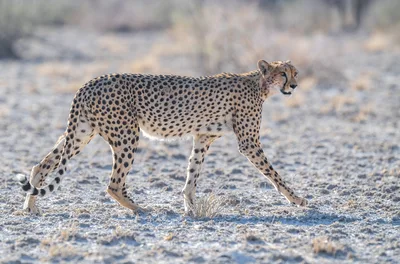 Cheetah
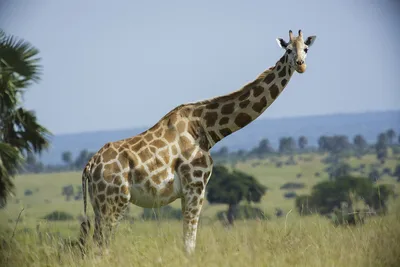 Giraffe
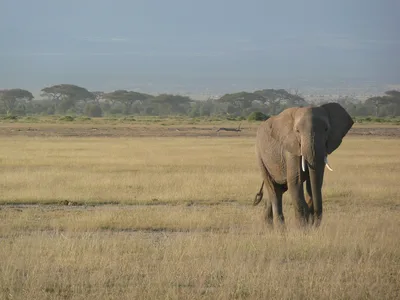 African bush elephant
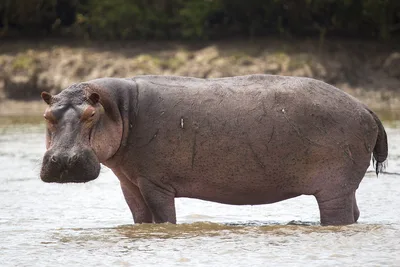 Hippopotamus
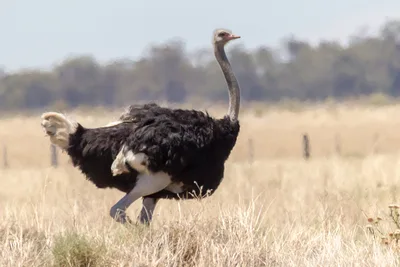 Common ostrich
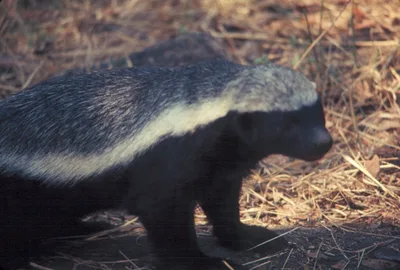 Honey badger
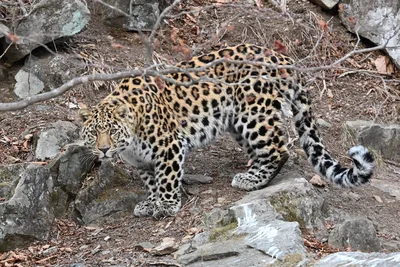 Leopard
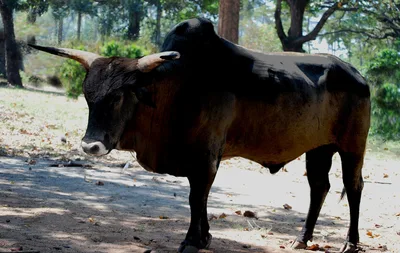 Aurochs
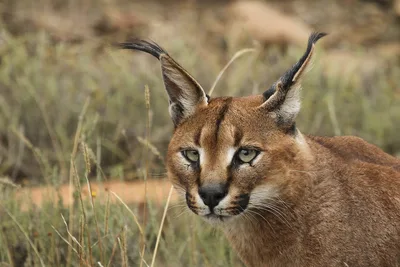 Caracal
 Aardvark
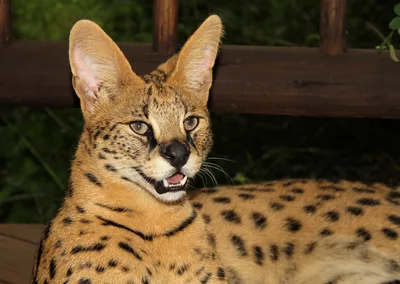 Serval
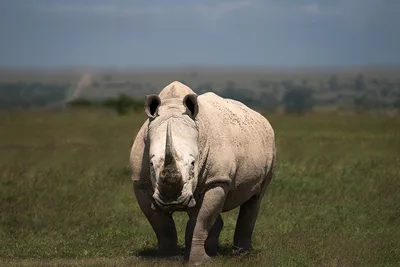 White rhinoceros
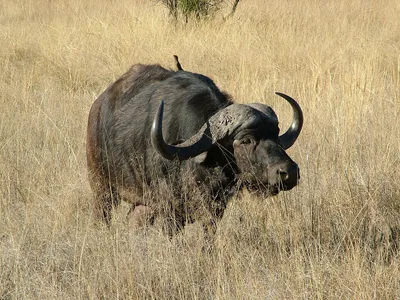 African buffalo
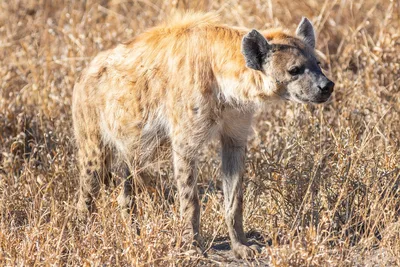 Spotted hyena
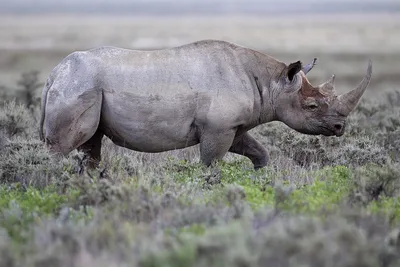 Black rhinoceros
 Striped hyena
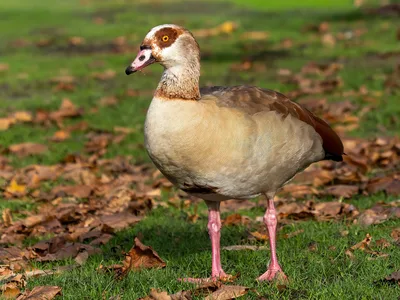 Egyptian goose
Food web
Predators
- hyenas
Ecological equivalents
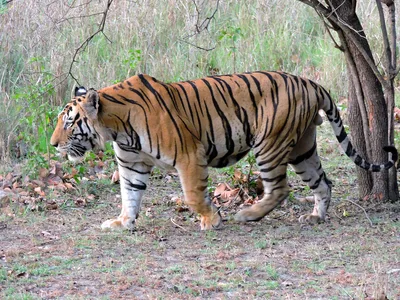
Related species on this site
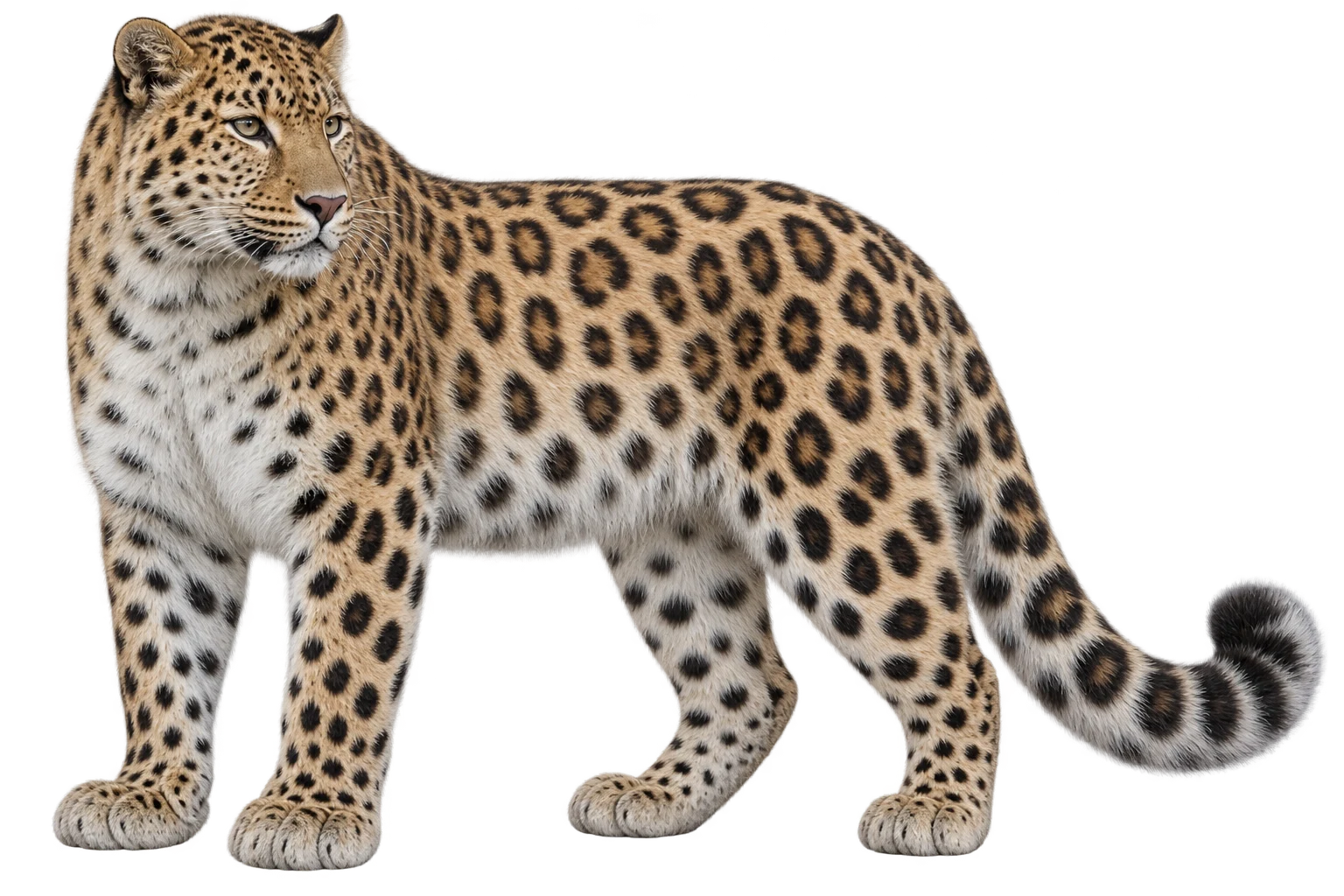
Amur Leopard (same genus), Bengal Tiger (same genus), Cape Lion (same genus), Cave Lion (same genus), Indochinese Tiger (same genus), Jaguar (same genus), and more.
Mammals
Amur Leopard
Panthera pardus orientalis
Classification and source reference
LivingAI illustration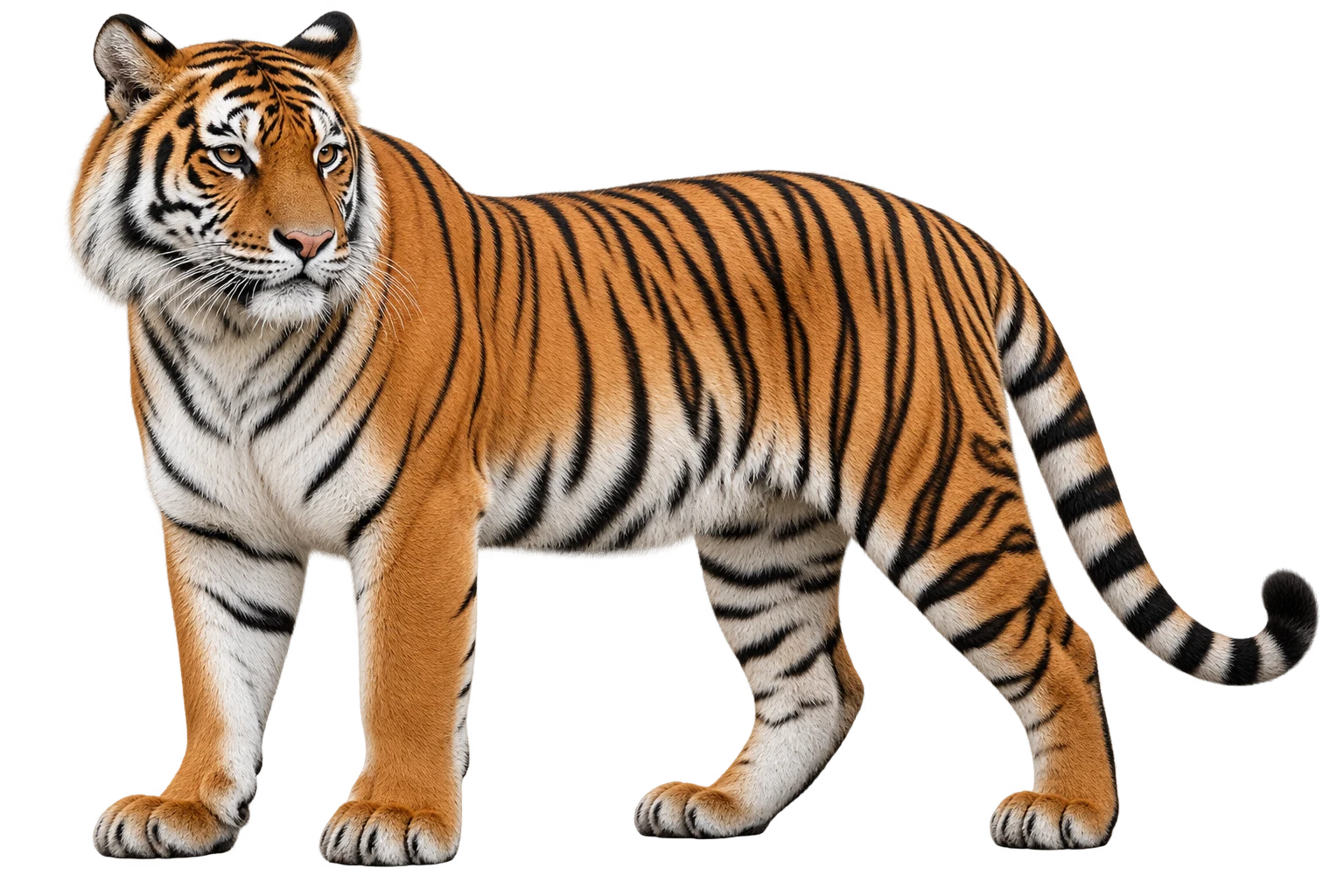
Mammals
Bengal Tiger
Panthera tigris tigris
Classification and source reference
LivingAI illustration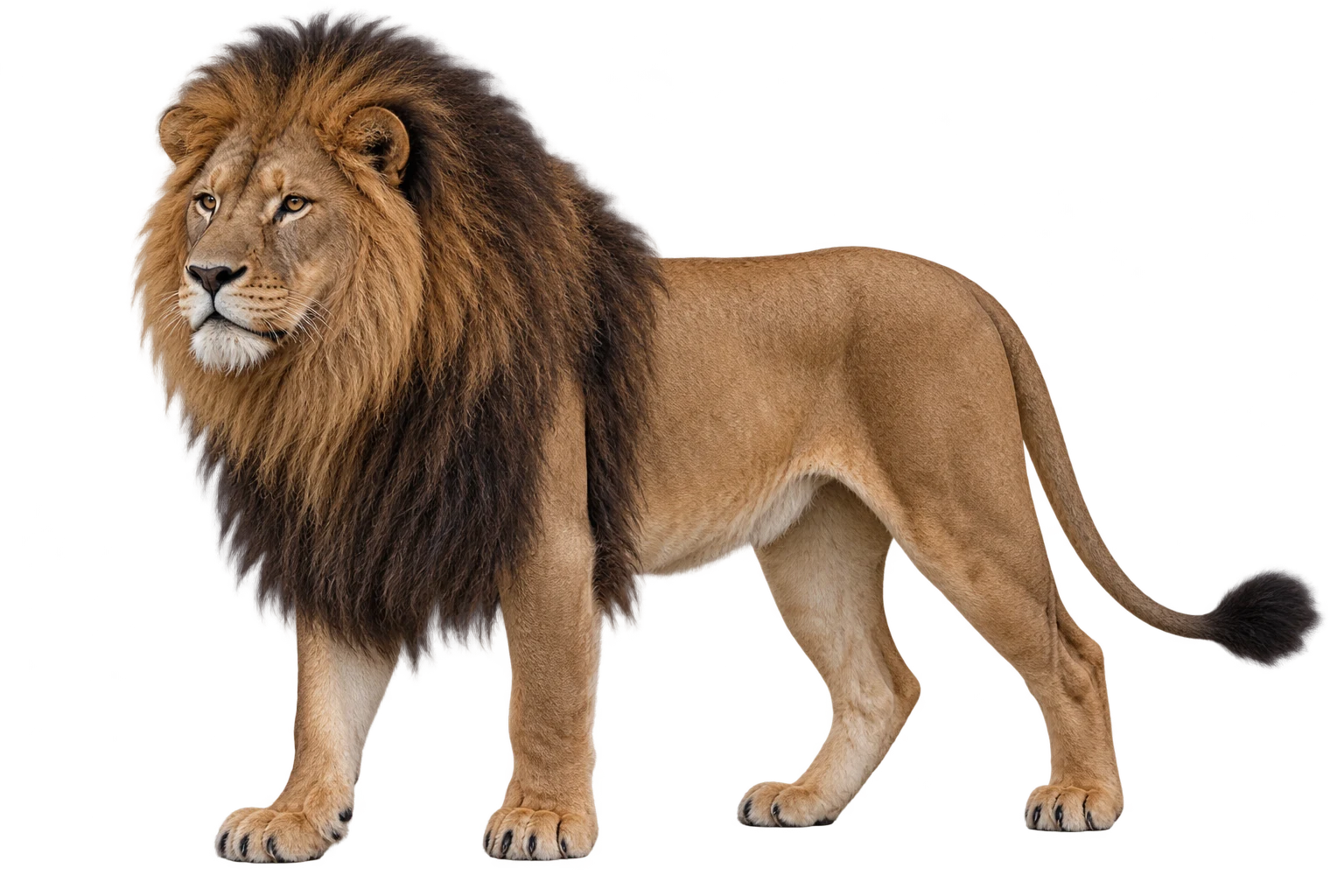
Mammals
Cape Lion
Panthera leo melanochaita
Classification and source reference
ExtinctAI reconstruction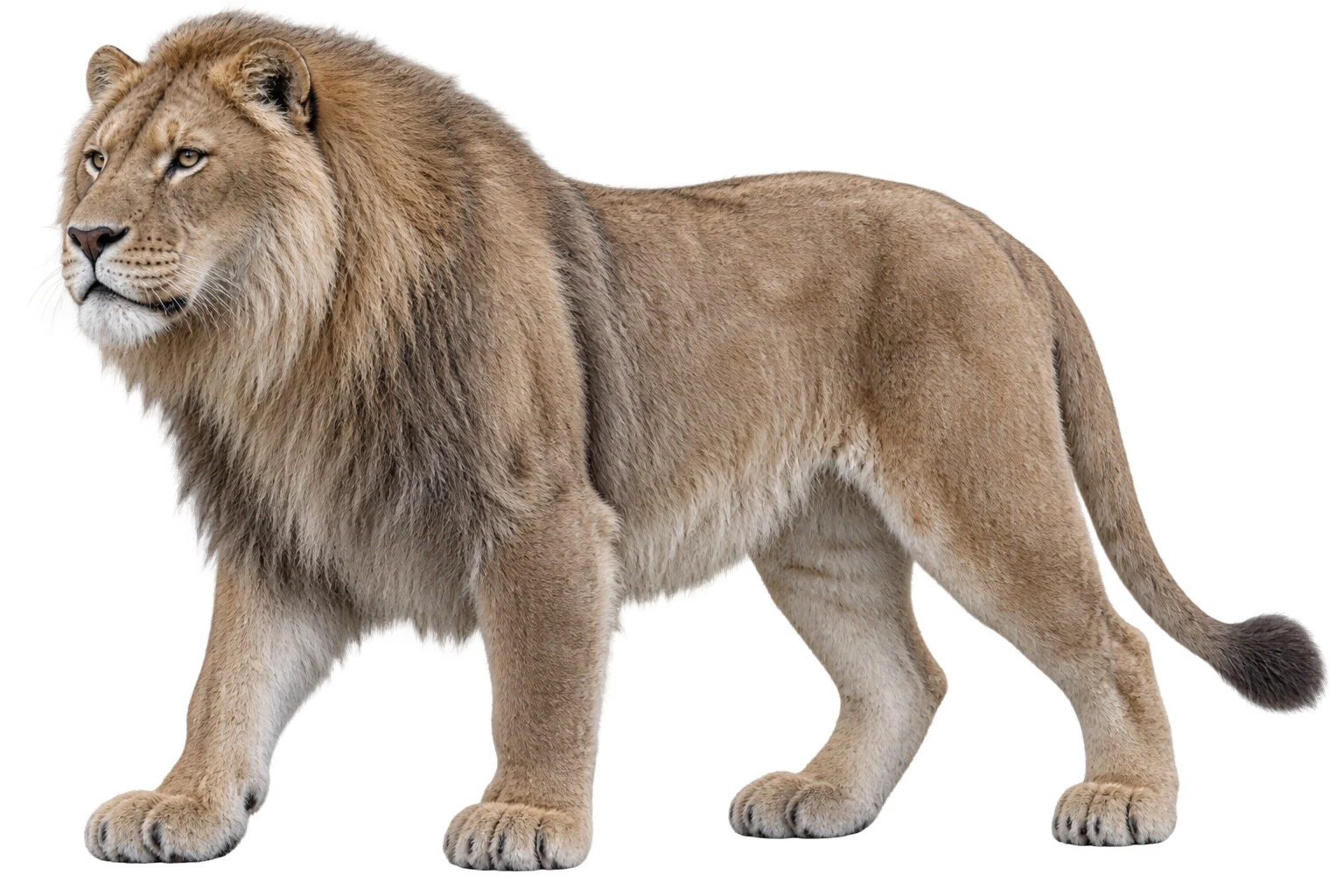
Mammals
Cave Lion
Panthera spelaea
Classification and source reference
ExtinctAI reconstruction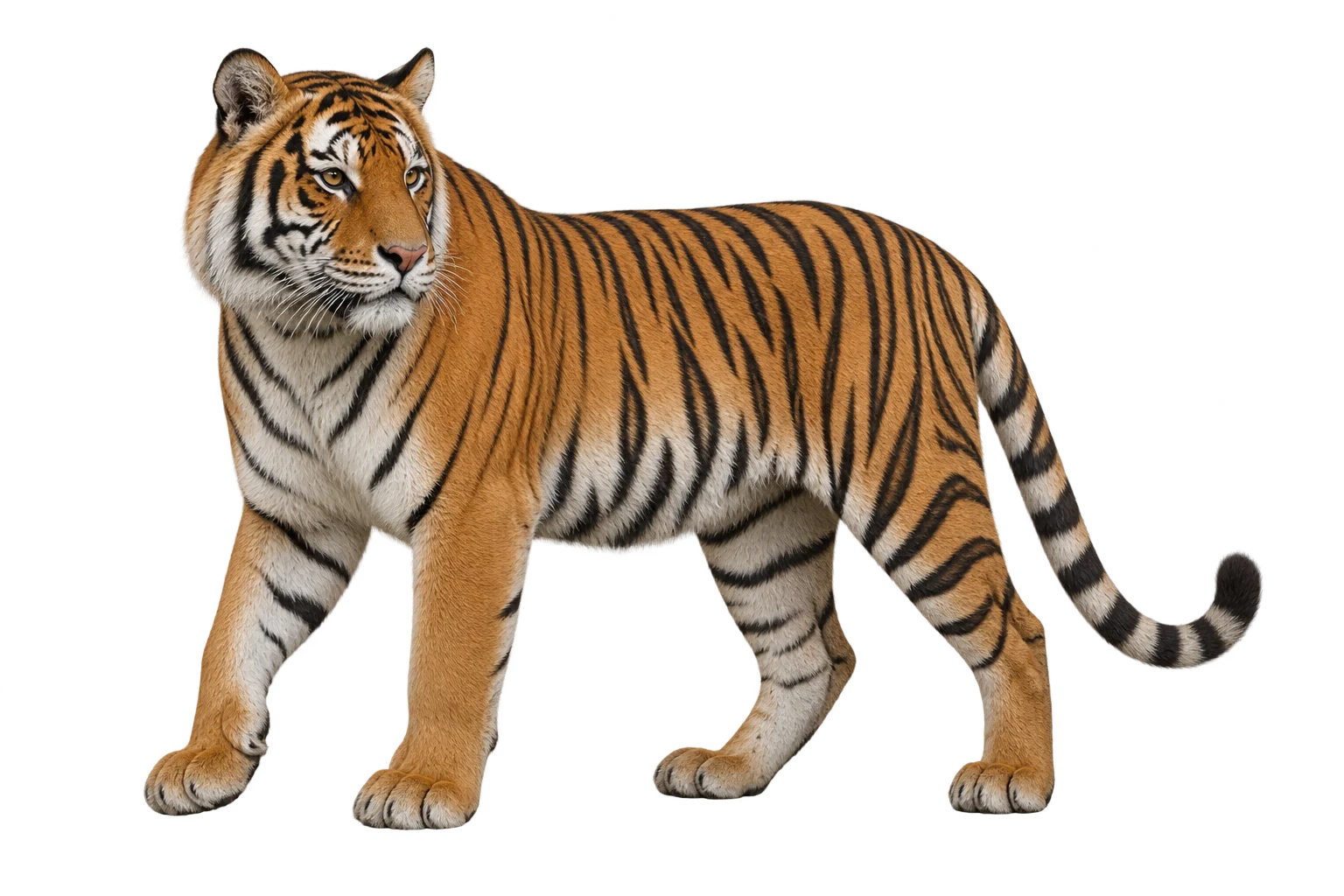
Mammals
Indochinese Tiger
Panthera tigris corbetti
Classification and source reference
LivingAI illustration NT
Mammals
Jaguar
Panthera onca
The jaguar is the largest cat in the Americas and the third largest in the world.
Living