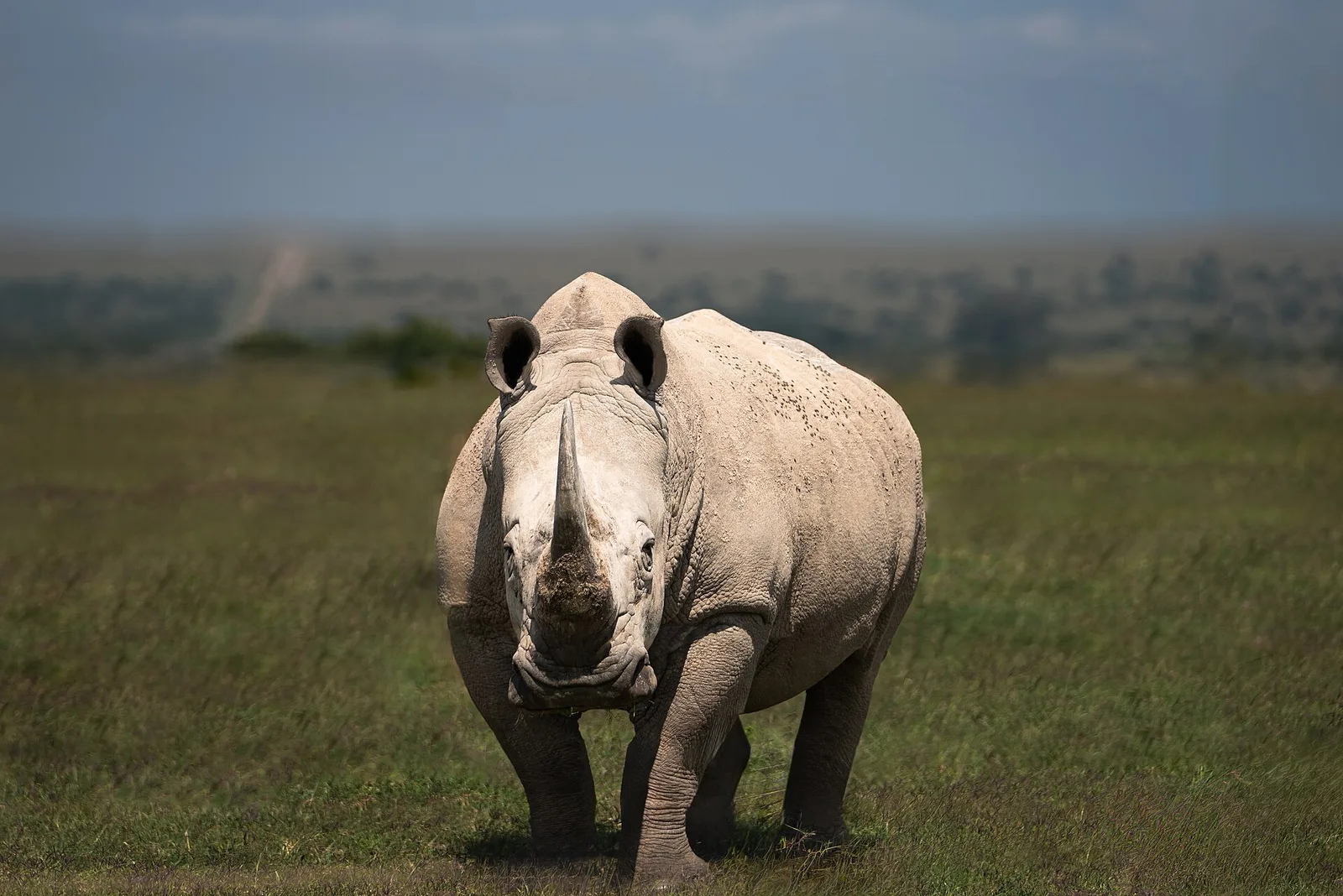
White rhinoceros
The square-lipped giant that mows the African savanna
Ceratotherium simum
Also called White rhino, Square-lipped rhinoceros, Southern white rhinoceros, Northern white rhinoceros
Living individuals or members of this group exist today. This does not mean they are safe from extinction.
Meet the white rhinoceros
The white rhinoceros is the biggest and most social of the five living rhinos. Its wide, square mouth crops short grass on the savannas of southern Africa, where poaching for its horn is the main threat.
Images of the white rhinoceros


Lifespan in the wild
40 to 50 years
Weight
1.6 to 2.3 t
Length
3.35 to 4 m
Top speed
48 to 50 km/h
Fact file
White rhinoceros
- Location
- South Africa, Namibia, Botswana, Zimbabwe, Kenya, Eswatini
- Habitat
- Savanna, Grassland
- Diet
- Herbivore
- Prey / food
- Short grasses such as panic grass, signal grass and finger grass
- Predators
- None as adults; lions and spotted hyenas rarely take calves
- Lifestyle
- Active by day, most in the morning and late afternoon
- Group name
- Crash
- Name of young
- Calf
- Gestation
- About 16 months
- Litter size
- 1 calf
- Population
- About 17,464 southern white rhinos in the wild at the end of 2023
- Biggest threat
- Poaching for the horn
- Distinctive feature
- Two keratin horns and a wide, square upper lip
- Colour
- Grey, often stained by the local mud
- Skin type
- Thick, almost hairless skin
Size
Next to a person
Measurements
Size and speed
- Height
- 1.6 to 1.86 m at the shoulder
- Height, male
- 1.7 to 1.86 m
- Height, female
- 1.6 to 1.77 m
- Length
- 3.35 to 4 m head and body, without the tail; cows from 335 cm, bulls to 400 cm
- Length, male
- 3.7 to 4 m head and body
- Length, female
- 3.35 to 3.65 m head and body
- Tail
- 57 to 77 cm
- Weight
- 1.6 to 2.3 t, up to 3.6 t cows average 1,600 to 1,700 kg, bulls 2,000 to 2,300 kg; 3,600 kg is the heaviest reliable record
- Weight, male
- 2 to 2.3 t, up to 3.6 t
- Weight, female
- 1.6 to 1.7 t
- Top speed
- 48 to 50 km/h, up to 64 km/h 48 to 50 km/h for a sustained run; 64 km/h in a short burst
Typical adult ranges. Sources: Wikipedia, Animal Diversity Web.
Life cycle
Lifespan
- In the wild40 to 50 years
- In captivityUp to 45 years
- 050 years
Appearance
Colour and coat
- Primary colours
- grey
- Secondary colours
- yellowish brownslate
- Skin type
- thick, almost hairless skin
- Male and female
- Moderate. Bulls are larger and heavier, at 2,000 to 2,300 kilograms against 1,600 to 1,700 kg for cows. Cows often carry longer, thinner horns.
Life cycle
Mating and family
- Mating system
- polygynandrous, with territorial bulls holding mating rights
- Social structure
- small groups of cows and calves, with adult bulls solitary and territorial
- Breeding
- one calf every two to three years
A bull courts a cow for days and keeps her inside his territory until she is ready. After a pregnancy of about 16 months she bears one calf of 40 to 65 kilograms. The calf grazes from two months but suckles for a year or more. It leaves its mother at two to three years, when she is about to give birth again. Wild white rhinos live 40 to 50 years.
Classification
Taxonomy
- Kingdom
- Animalia
- Phylum
- Chordata
- Class
- Mammalia
- Order
- Perissodactyla
- Family
- Rhinocerotidae
- Genus
- Ceratotherium
- Species
- Ceratotherium simum
Conservation
Red List status
- LC
- NT
- VU
- EN
- CR
- EW
- EX
Near Threatened on the IUCN Red List
Range
Recorded in 10 countries
Habitat layer: tropical grassland, savanna and shrubland, temperate grassland, savanna and shrubland.
Countries from 5,050 wild records on GBIF (iNaturalist research grade), filtered and checked by hand. Country shapes: Natural Earth. Habitat: RESOLVE Ecoregions 2017, CC BY 4.0. Basemap: Natural Earth.
Habitats
Three things to know
- 1
The front horn averages about 60 centimetres and can reach 166 cm in a cow.
- 2
Only two northern white rhinos remain, both females, under armed guard in Kenya.
- 3
A cow carries her calf for about 16 months and then keeps it for two to three years.
Did you know
Seven more facts
- 1
The rhino's horn is keratin, the same stuff as your fingernails, and it has no bony core.
- 2
Southern white rhinos numbered only 20 to 50 in 1885 and now exceed 17,464.
- 3
A white rhino can go four or five days without drinking.
- 4
White rhinos swim badly, so the Nile and the Zambezi have kept the two subspecies apart.
- 5
A newborn calf walks in front of its mother, not behind her.
- 6
In 2017 poachers broke into a French zoo and killed a rhino named Vince for his horn.
- 7
The white rhino has 82 chromosomes, and its genome runs to about 2.58 billion base pairs.
Field notes
How it looks and acts
Field notes
Distinguishing features
- A wide, square upper lip with no grasping tip.
- Two horns on the snout, the front one longer and averaging about 60 centimetres.
- A muscular hump on the neck that carries the weight of the head.
- A shoulder height of 160 to 186 cm and a head-and-body length of 3.35 to 4 metres.
- Thick grey skin with plate-like folds and almost no hair.
- Large tube-shaped ears that swivel on their own.
Field notes
Unique adaptations
- The flat lip and hard pad crop grass close to the ground.
- Mud wallowing cools the body, blocks sunburn and keeps off biting flies.
- Three splayed toes on each foot spread more than two tonnes across soft ground.
- A strong sense of smell and hearing make up for poor eyesight in long grass.
- Thick skin and sheer size mean that no predator can take a healthy adult.
Field notes
Interesting behaviours
- Grazes for about half the day and rests for about a third.
- Wallows in mud in summer and rolls in sand in winter.
- Dominant bulls patrol and mark a territory every day with urine, scrapes and dung.
- Cows and calves move in small groups, while adult bulls live alone.
- Drinks about twice a day and stays close to water.
Field notes
Temperament
- Usually calm, and it walks away from people rather than charging.
- A cow with a calf is the most aggressive animal in the herd.
- Dominant bulls fight hard over territory and over cows in season.
- Startled by loud noise, it may ram a vehicle.
Field notes
Communication
- Urine spray and shared dung heaps carry a bull's claim and a cow's readiness to mate.
- A panting call keeps a group together and differs from one animal to the next.
- Squeals mean alarm, and bellows and growls mean a threat.
- A bull warns with a lowered head, flattened ears and a horn wiped on the ground.
Ecology
Ecological role
The white rhino is a megaherbivore that engineers the savanna by keeping grass short.
- Creates grazing lawns of fresh regrowth that antelope and other grazers feed on.
- Keeps grass so short that bush fires cannot spread, and its removal cut short-grass cover by 50% in one study.
- Feeds cattle egrets and starlings that pick parasites from its skin.
- Carries 14 species of ticks, and its dung likely returns nutrients to the soil.
Stories
Myths and legends
- In Tswana tradition, the rhino and the elephant compete to be the most powerful animal.
- In Zulu tradition, the rhino guards the springs and rivers.
- In several Asian traditions, the rhino and its horn ward off evil spirits and poison.
- In Roman and medieval European tradition, accounts of the rhinoceros may have fed the legend of the unicorn.
People
Relationship with humans
People
Living alongside us
People nearly wiped out the white rhino in the 19th century and then brought the southern subspecies back from a few dozen animals. Today it draws tourists to African parks and is bred on private land, where it can be sold and, in small numbers, hunted. Poachers kill it for a horn that some Asian buyers believe is medicine. Reserves answer with fences, armed guards and horn removal. The northern subspecies survives only as two females in Kenya.
- A white rhino usually moves away from people and charges far less often than a black rhino.
- A cow with a calf will charge anyone who comes within about 30 to 40 metres.
- Rhinos have rammed cars in Kruger National Park, but no human death has been recorded.
People
Status, uses and products
- Domestication
- Wild
- As a pet
- Not suitable. A white rhino weighs about two tonnes and needs square kilometres of grassland, daily water and a mud wallow. It is a protected species under CITES, so private ownership is limited to licensed reserves and zoos.
- Uses
- ecotourismtrophy huntingzoo exhibitionprivate game ranching
- Products
- horn, traded illegally
The full account
About the white rhinoceros
The white rhinoceros, Ceratotherium simum, is the largest of the five living rhinos. Only the three elephants are heavier among land animals. Its name has nothing to do with colour, because its skin is grey. The clearest mark of the species is a wide, flat, square upper lip built for cropping short grass. Two horns of packed keratin sit on the snout, one behind the other.
A bull weighs 2,000 to 2,300 kilograms, and a cow weighs 1,600 to 1,700 kg. It is the most social rhino, and cows and calves gather in small groups called crashes. There are two subspecies with very different fortunes. About 17,464 southern white rhinos lived in the wild at the end of 2023, most of them in South Africa. The northern white rhino is down to two females, and the IUCN lists the species as a whole as Near Threatened.
Name and taxonomy
William Burchell described the southern white rhinoceros in 1817 from a spring in what is now South Africa. John Edward Gray set up the genus Ceratotherium in 1868. The name joins the Greek words for horn and beast, and simum means flat-nosed. Nobody knows for sure where the English name white came from. A popular story says settlers misheard the Dutch word wijd, meaning wide, but a review of Dutch writing found no record of that use. Square-lipped rhinoceros is a more accurate name, though it is used less often.
The species sits in the family Rhinocerotidae and the order Perissodactyla, the odd-toed hoofed mammals, with horses and tapirs. Two subspecies are recognised: the southern, C. s. simum, and the northern, C. s. cottoni, named by Lydekker in 1908. A 2010 study argued that the northern form is a full species, separate for at least one million years. Other rhino geneticists disagreed, and the IUCN still treats it as a subspecies.
Evolution and relatives
The white rhino and the black rhino, Diceros bicornis, are each other's closest relatives. Their common ancestor was probably a mixed feeder, and the two lines then split into a browser and a grazer. Fossil teeth from Makapansgat in South Africa show that early Ceratotherium still took over 30% browse. The oldest sure fossils of the living species come from Olduvai Gorge in Tanzania and are about 1.8 million years old.
For years the species was traced to Ceratotherium praecox, a rhino from about seven million years ago. A 2005 review moved that fossil to the black rhino line instead. The same review proposed a chain from C. neumayri through C. mauritanicum of North Africa to the living species. A 2011 study named C. efficax from Ethiopia and Tanzania as the earliest African member of the genus. One extinct East African form, C. germanoafricanum, looks so similar that some treat it as an ancestral subspecies.
Appearance
The white rhino has a barrel body, a huge head and a short, thick neck topped by a muscular hump. A bull measures 3.7 to 4 metres from head to rump and stands 170 to 186 centimetres at the shoulder. A cow measures 3.35 to 3.65 m and stands 160 to 177 cm. The tail adds 57 to 77 cm. Bulls average 2,000 to 2,300 kilograms and cows 1,600 to 1,700 kg. The heaviest reliable record is 3,600 kg, and claims of 4,500 kg have never been checked.
The two horns are not bone and have no bony core. They are solid keratin, the same protein as human hair and nails. The front horn is the larger and averages about 60 cm, though a cow's horn can reach 166 cm. Cows tend to carry longer, thinner horns than bulls. One horn can weigh about 4 kg.
The skin is thick and grey, with plate-like folds, and it often takes the colour of the local mud. Hair is limited to fringes on the ears and bristles on the tail. Each foot has three broad toes that spread the animal's weight. The large tube-shaped ears turn on their own, and the nostrils are the widest of any land animal. A calf is born at 40 to 65 kg, and its horns show after about six weeks.
Habitat and range
As a grazer, the white rhino needs grassland and savanna woodland with grassy openings. It does badly where winters bring hard frost or where the land is very dry. The densest populations live on savanna with fertile soil and about 700 to 800 millimetres of rain a year. It stays near water and drinks about twice a day when it can, but it can go four or five days without. In the heat of the day it moves into shade or lies in a mud wallow.
The southern white rhino once ranged across southern Africa from the Zambezi to the Orange River. By 1885 hunters had cut it to a single herd in the Umfolozi reserve in what is now KwaZulu-Natal. From that herd it has been moved back into Namibia, Botswana, Zimbabwe, Eswatini and Mozambique. It has also been introduced north of the Zambezi, into Kenya, Uganda and Zambia, beyond its old range. South Africa held about 12,968 animals in 2021, the great majority of the world total.
The northern white rhino lived in southern Chad, the Central African Republic, South Sudan, north-east Congo and Uganda. Its last wild refuge was Garamba National Park in the Democratic Republic of the Congo. A survey there in August 2005 found only four animals, and none has been seen in the wild since. White rhinos swim poorly and sometimes drown, so big rivers such as the Nile and Zambezi block their spread. GBIF holds records from 35 countries, a figure that includes zoos.
Diet and feeding
The white rhino is a pure grazer, and it is often called the largest pure grazer on Earth. Its broad flat lower lip and hard upper pad clip grass close to the ground. It prefers the shortest grasses, among them panic grass, signal grass and finger grass. The black rhino, by contrast, has a hooked lip and browses on bushes. Unlike other rhinos, the white rhino has no grasping tip to its lip.
Such a large body needs a lot of food, so the rhino grazes for about half of every day. It rests for about a third of the day, often on a breezy ridge or under a tree. Its close cropping creates grazing lawns of short, fresh regrowth that other herbivores then use. A calf tastes grass at about two months and still suckles for a year or more.
Behaviour and social life
White rhinos keep daytime hours, with feeding bouts early in the day and again towards evening. In hot summers, activity shifts towards dawn and dusk to avoid the heat. They wallow in mud in summer and roll in sand in winter, which cools the skin and drives off biting insects. They do not migrate with the seasons.
Cows and calves form groups of up to 14, though most groups are smaller. Young bulls may band together, sometimes with an adult cow, to avoid being chased by dominant males. Most adult bulls live alone, and a dominant bull holds a territory that no other dominant bull shares. He patrols the edges every day, spraying urine, scraping the ground and adding to dung piles called middens. A bull may keep 20 to 30 middens, and he can mark up to ten times an hour.
A bull's territory covers about 0.7 to 3 square kilometres, and cows range across 6 to 8 km2 that overlap freely. A losing bull leaves to find new ground, and subordinate bulls do not mark at all. Most serious fights are over a cow in season. The rhino is generally placid and walks away from trouble rather than charging. When it does run, it can reach 64 kilometres per hour in a burst and hold 48 to 50 km/h for some distance.
Communication and senses
White rhinos are short-sighted, but their hearing and sense of smell are excellent. The nasal passages are larger than the brain. Scent does most of the work of marking territory, through urine spray and shared dung heaps. A bull reads a cow's readiness to mate from the smell of her urine and dung.
The species has a range of calls. A panting call keeps group members in touch, and it varies between individuals, which probably helps them recognise one another. Courting bulls grunt, snort and make a hiccup-like throb, and cows whistle and roar back. An alarmed rhino squeals, and a threatened one bellows or growls. A bull's threat display is to wipe his horn on the ground, drop his head and flatten his ears.
Reproduction and life cycle
White rhinos breed in any month, with a peak from October to December in southern Africa. A cow first comes into season at about three and a half years but seldom breeds before five. Wikipedia gives six to seven years for a cow's first calf, and bulls do not breed until 10 to 12. Both sexes have several partners over a lifetime.
Courtship is long and rough. A bull follows a cow for days, calling as he comes, and blocks her path if she tries to leave his ground. The pair may stay together for 5 to 20 days. When she is ready, the cow curls her tail and stands stiff, and mating lasts about half an hour.
Pregnancy lasts about 16 months, or 530 to 550 days. The cow gives birth to one calf, which weighs about 40 to 65 kilograms and doubles its size by six months. The calf is unsteady for its first two or three days and then walks in front of its mother. It is weaned from about a year and stays with her for two to three years, until she drives it off before the next birth. A cow can breed into her forties, and wild rhinos live 40 to 50 years.
Predators and threats
An adult white rhino has no natural predator. One lion pride did kill a sick bull of 1,540 kilograms in Mala Mala, South Africa, but such cases are extremely rare. Lions take a calf now and then, and spotted hyenas have left rhinos with torn ears and tails. A cow guards her calf closely and charges anything that comes within about 30 to 40 metres. Other deaths come from drowning, getting stuck in mud, falls and bush fires.
Humans are the only serious threat, and poaching for the horn is the reason. Horn is sold into some traditional Asian medicines and, more and more, for carvings and as a status symbol. It has no proven medical effect, because it is only keratin. Criminal syndicates now equip poachers with night vision, silenced rifles, tranquillisers and even helicopters. The rhino's size, poor eyesight and calm nature make it an easy target.
Population and conservation
The southern white rhino is the great success story of rhino conservation. In 1885 only about 20 to 50 survived in the Umfolozi reserve. Strict protection, then moving surplus animals to new reserves, rebuilt the population. Numbers in one relocation programme grew from 337 to 1,876 between 1973 and 1993. By the end of 2023 about 17,464 lived in the wild, more than all other rhino subspecies together.
Poaching surged in the early 21st century, and in South Africa it nearly doubled in 2013 over the year before. Kruger National Park lost about 60% of its white rhinos between 2013 and 2021, down to about 3,529. Reserves now fence the land, post armed guards and cut horns off in advance to make the animals worthless to poachers. Zoos held more than 1,000 southern white rhinos in 2021, all of them this subspecies.
The northern white rhino fell from about 500 in 1968 to a handful in captivity. In 2009 four were flown from Dvur Kralove Zoo in the Czech Republic to Ol Pejeta in Kenya to encourage breeding. The last male, Sudan, was put down in March 2018 because of old age. Two females, Najin and Fatu, remain, under armed guard around the clock. Scientists have made embryos from their eggs and frozen sperm and plan to implant them in southern white surrogates.
Relationship with humans
Colonial hunters shot white rhinos almost to extinction in the 19th century. Today the animal earns money alive. Ecotourism built around rhinos supports parks such as Kruger, where ticket prices tripled in a decade. Owners may buy and sell southern white rhinos, and a small trophy hunt has been permitted since 1968. That trade gives private landowners a reason to breed and guard them.
CITES banned international trade in rhino products in 1977. South Africa, Zimbabwe and Namibia have argued against the ban, because they hold horn stocks seized from poachers. Cattle egrets and Cape starlings pick insects from the rhino's back. Oxpeckers were thought to help too, but studies found they open wounds and eat earwax as well as ticks. Rhinos in Kruger have rammed cars a few times, most likely startled by engine noise, but no one has died.
In culture and myth
The San painted rhinos on rock walls across southern Africa, alongside the other animals they hunted. In a Tswana tale, the rhino and the elephant compete to be the strongest animal. Zulu tradition casts the rhino as a guardian of springs and rivers. Pliny and other Roman authors wrote about the rhinoceros, and some scholars trace the unicorn legend to those accounts. Albrecht Durer's famous woodcut of 1515 shows an Indian rhino, not the African species.
Across parts of Asia people kept rhino charms against evil spirits, and horn was wrongly held to cure fever and reveal poison. That belief still drives the poaching that threatens the species. Modern spirit-animal blogs read the rhino as strength and steadiness, and a white one as purity, but these ideas appear to be recent inventions. Sudan, the last northern male, became a symbol of extinction in newspapers around the world after his death.
A sentence with a dotted underline is inferred: it describes the group the animal belongs to, or is a reading of the sources, rather than a measured or reported fact about this species.
Questions
White rhinoceros questions, answered
How big is a white rhino?
A bull weighs 2,000 to 2,300 kilograms and measures 3.7 to 4 metres from head to rump. A cow weighs 1,600 to 1,700 kg. The heaviest reliable record is 3,600 kg.
Why is it called a white rhino when it is grey?
Nobody knows for certain. A common story says English settlers misheard the Dutch word wijd, meaning wide, for its broad mouth. A review of Dutch writing found no record of that word being used for the animal.
What is the difference between a white rhino and a black rhino?
The white rhino is larger and has a wide, square lip for grazing grass. The black rhino has a hooked lip for browsing on bushes and is more aggressive. Both are grey.
What do white rhinos eat?
Grass, and almost nothing else. They prefer the shortest grasses and crop them close to the ground with a flat lip. They graze for about half of every day.
Are white rhinos endangered?
The IUCN lists the species as Near Threatened. The southern subspecies numbers about 17,464 in the wild and is doing well. The northern subspecies is Critically Endangered, with only two females left.
How many white rhinos are left?
About 17,464 southern white rhinos lived in the wild at the end of 2023, most in South Africa. Zoos hold more than 1,000 more. Only two northern white rhinos survive.
How fast can a white rhino run?
It can reach 64 kilometres per hour in a short burst. It can keep up 48 to 50 km/h for some distance and has good stamina.
Where do white rhinos live?
Mostly in South Africa, with smaller populations in Namibia, Botswana, Zimbabwe, Kenya, Eswatini, Uganda, Zambia and Mozambique. They live on grassland and savanna with water nearby.
How long do white rhinos live?
A wild white rhino can expect 40 to 50 years. One wild-born animal was still alive in captivity at about 45.
How long is a white rhino pregnant?
About 16 months, or 530 to 550 days. The cow has one calf at a time, roughly every two to three years.
Why do people poach white rhinos?
For the horn, which sells for tens of thousands of dollars a kilogram on the black market. Some traditional Asian medicines use it, and it is also carved or kept as a status symbol. The horn is keratin and has no medical effect.
What is a rhino horn made of?
Packed keratin fibres, the same protein as human hair and fingernails. It has no bony core, and the front horn averages about 60 centimetres.
Are white rhinos dangerous?
Less than most people think. They are calm and usually move away from humans. A cow with a calf will charge if you come within about 30 to 40 metres.
What is a group of rhinos called?
A crash. White rhino cows and calves gather in crashes of up to 14 animals, while adult bulls live alone.
Is the northern white rhino extinct?
Not quite. Two females, Najin and Fatu, live under armed guard at Ol Pejeta in Kenya. The last male, Sudan, died in 2018, and scientists are trying to breed calves from frozen embryos.
Can white rhinos swim?
Poorly. They sometimes drown, and big rivers such as the Nile and the Zambezi have blocked their spread.
Food web
Prey and food
- short grasses such as panic grass
- signal grass
- finger grass
Food web
Predators
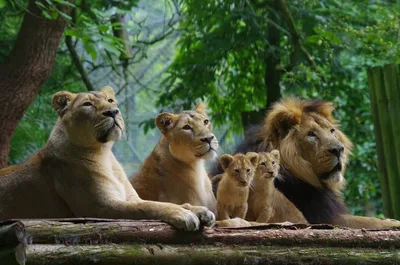 Lion
- spotted hyenas rarely
Ecological equivalents
Related species on this site
Black rhinoceros (same family), Elasmotherium (same family), Indian rhinoceros (same family), Javan Rhinoceros (same family), Rhinoceros (same family), Sumatran Rhinoceros (same family), and more.
 CR
Mammals
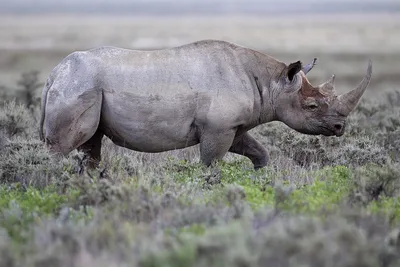
Black rhinoceros
Diceros bicornis
The black rhinoceros is a two-horned browser of eastern and southern Africa with a pointed, gripping upper lip.
Living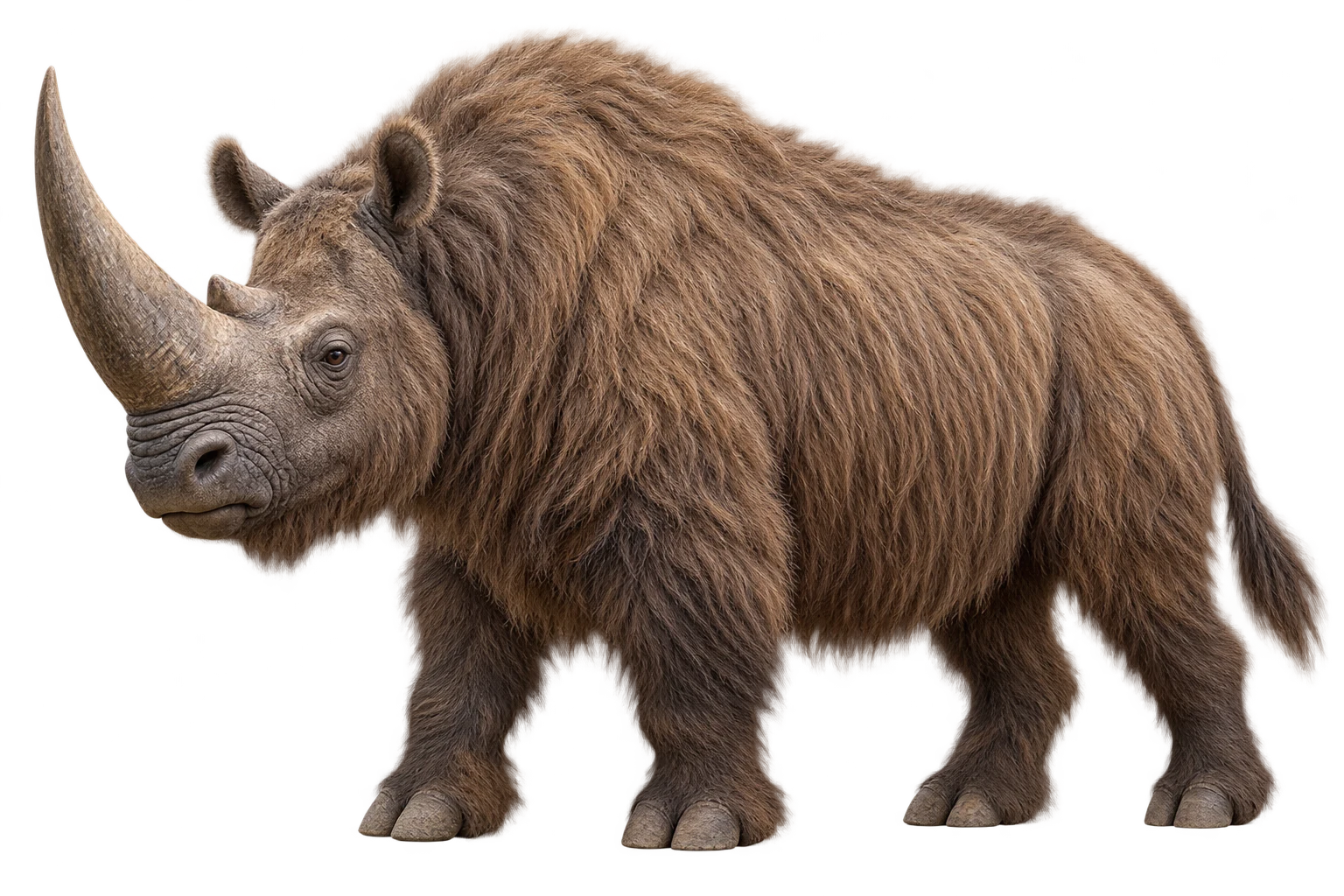
Mammals
Elasmotherium
Elasmotherium
Classification and source reference
ExtinctAI reconstruction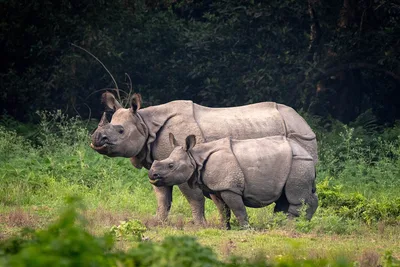 VU
Mammals
Indian rhinoceros
Rhinoceros unicornis
The Indian rhinoceros is the largest rhino in Asia, a one-horned grazer with thick, folded grey skin.
Living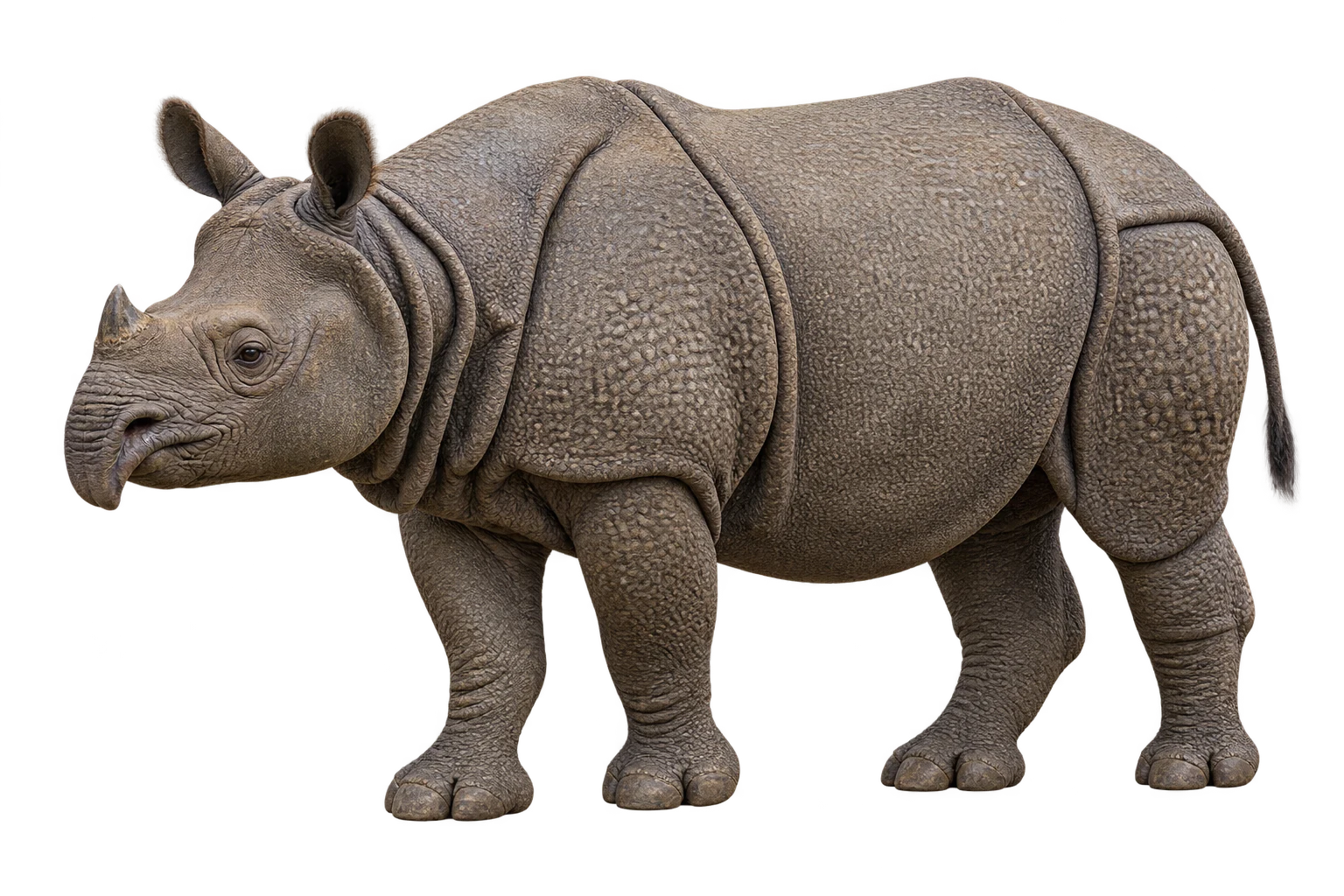
Mammals
Javan Rhinoceros
Rhinoceros sondaicus
Classification and source reference
LivingAI illustration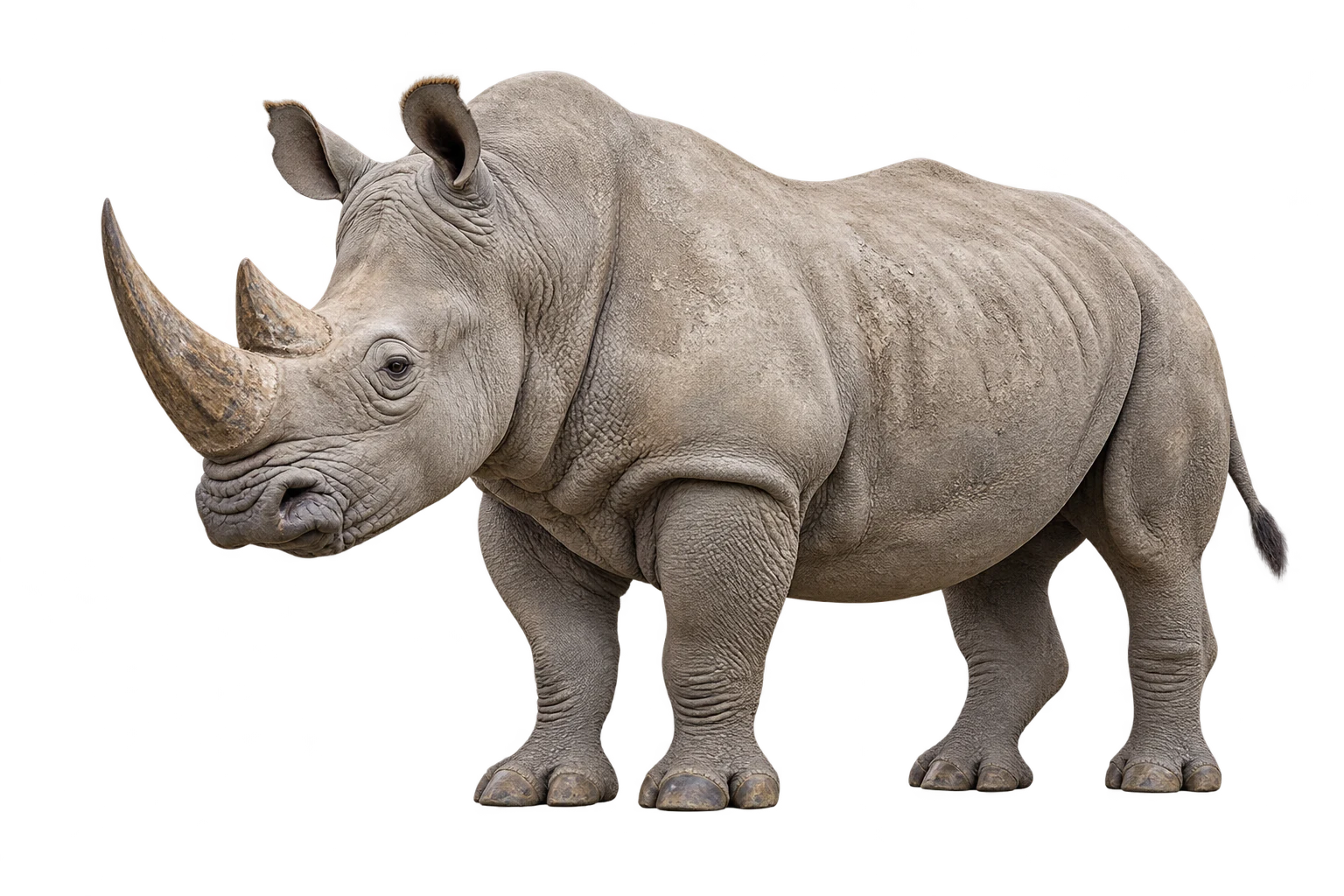
Mammals
Rhinoceros
Rhinocerotidae
Classification and source reference
LivingAI illustration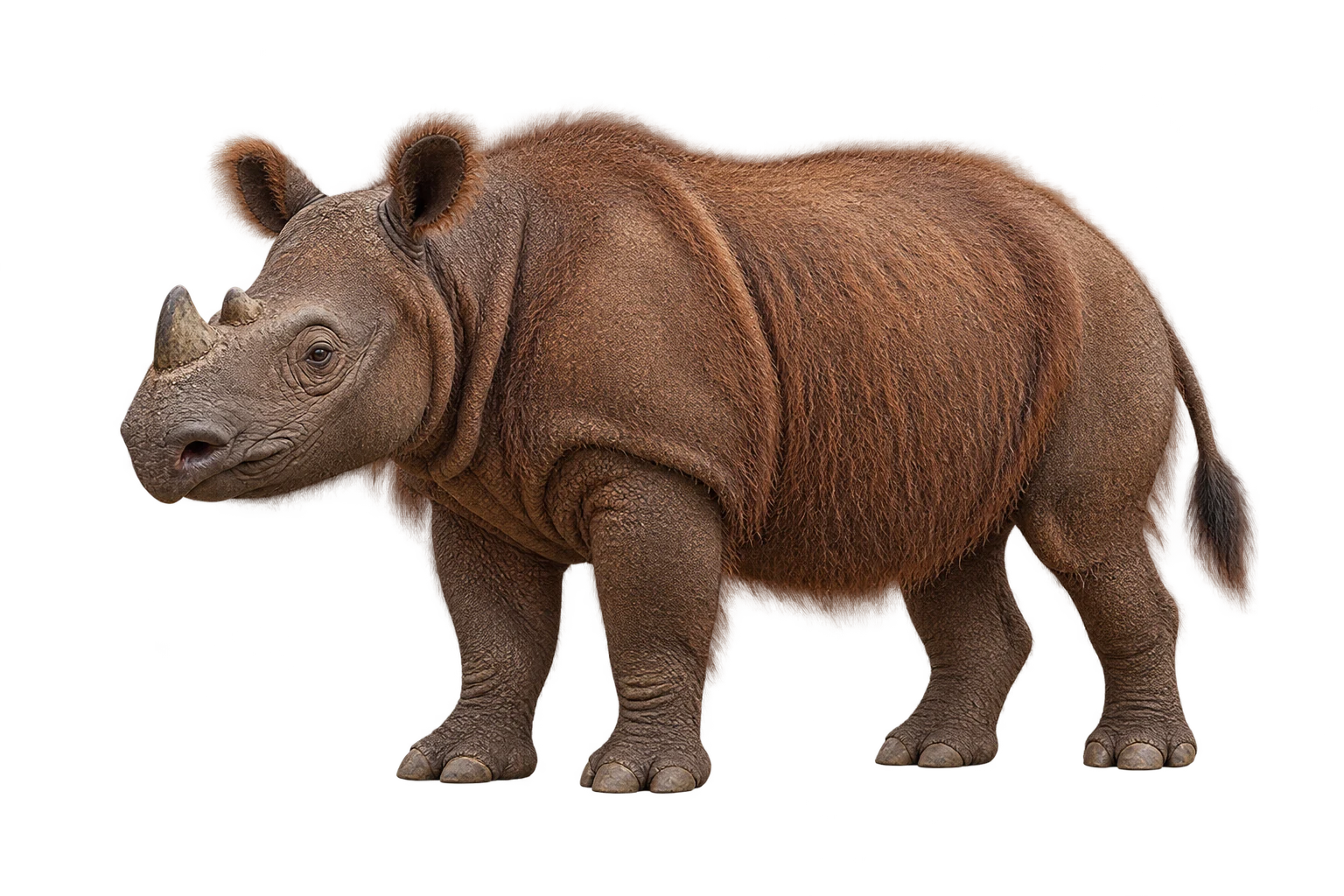
Mammals
Sumatran Rhinoceros
Dicerorhinus sumatrensis
Classification and source reference
LivingAI illustration