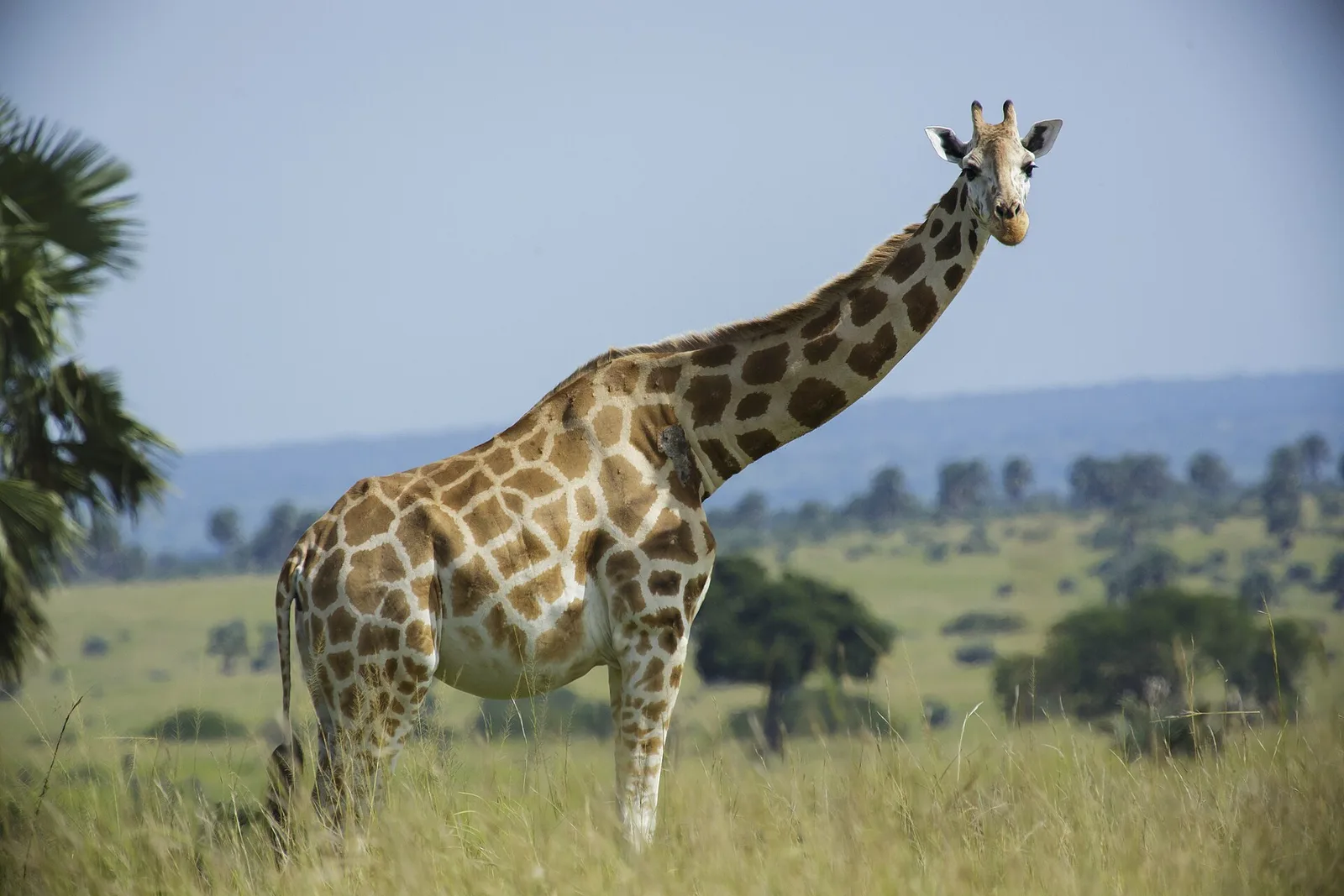
Giraffe
The tallest animal on Earth, with a neck of only seven bones
Giraffa camelopardalis
Living individuals or members of this group exist today. This does not mean they are safe from extinction.
Meet the giraffe
The giraffe is the tallest land animal. It browses the tops of acacia trees with a long neck that has only seven vertebrae, the same number as a human.
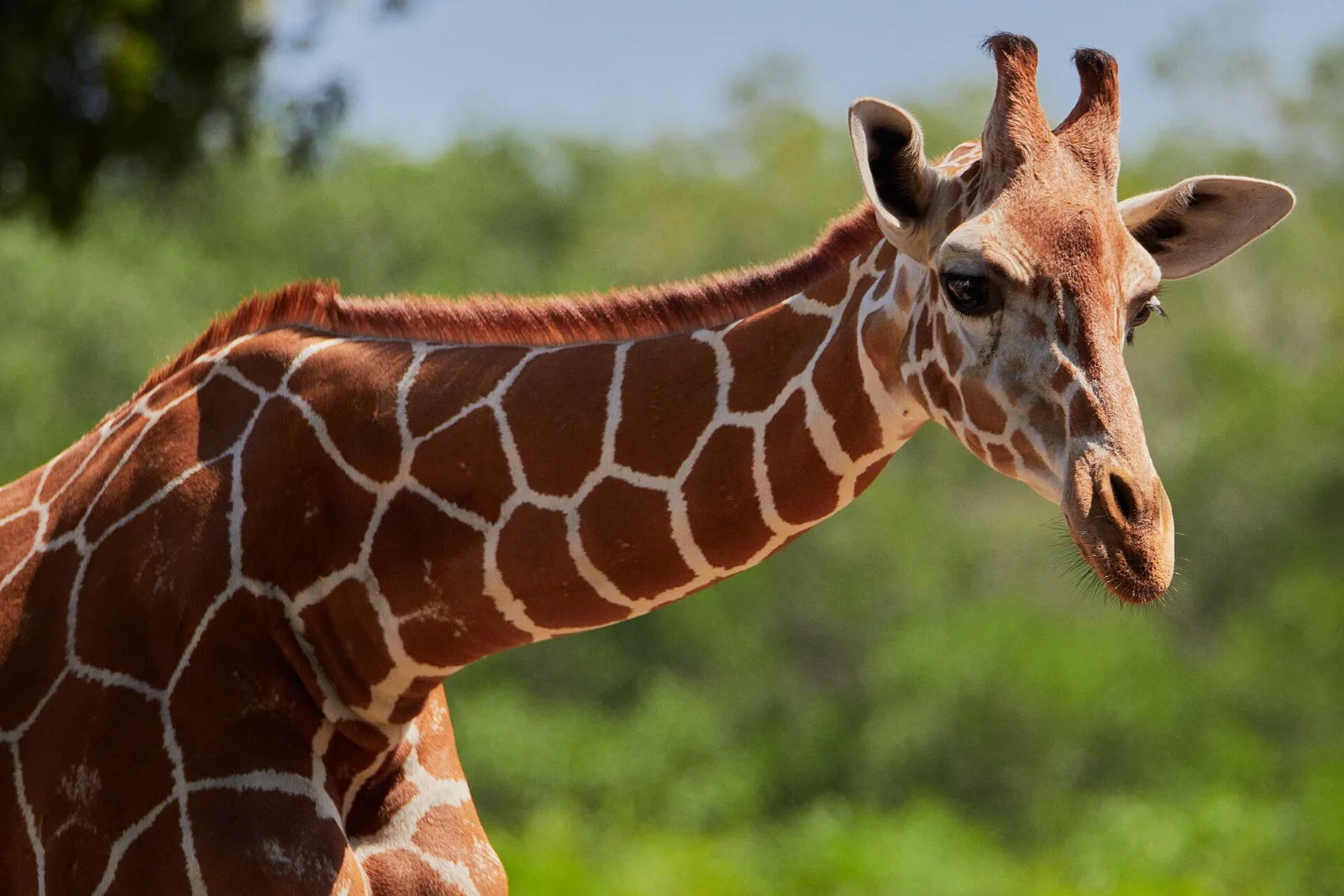
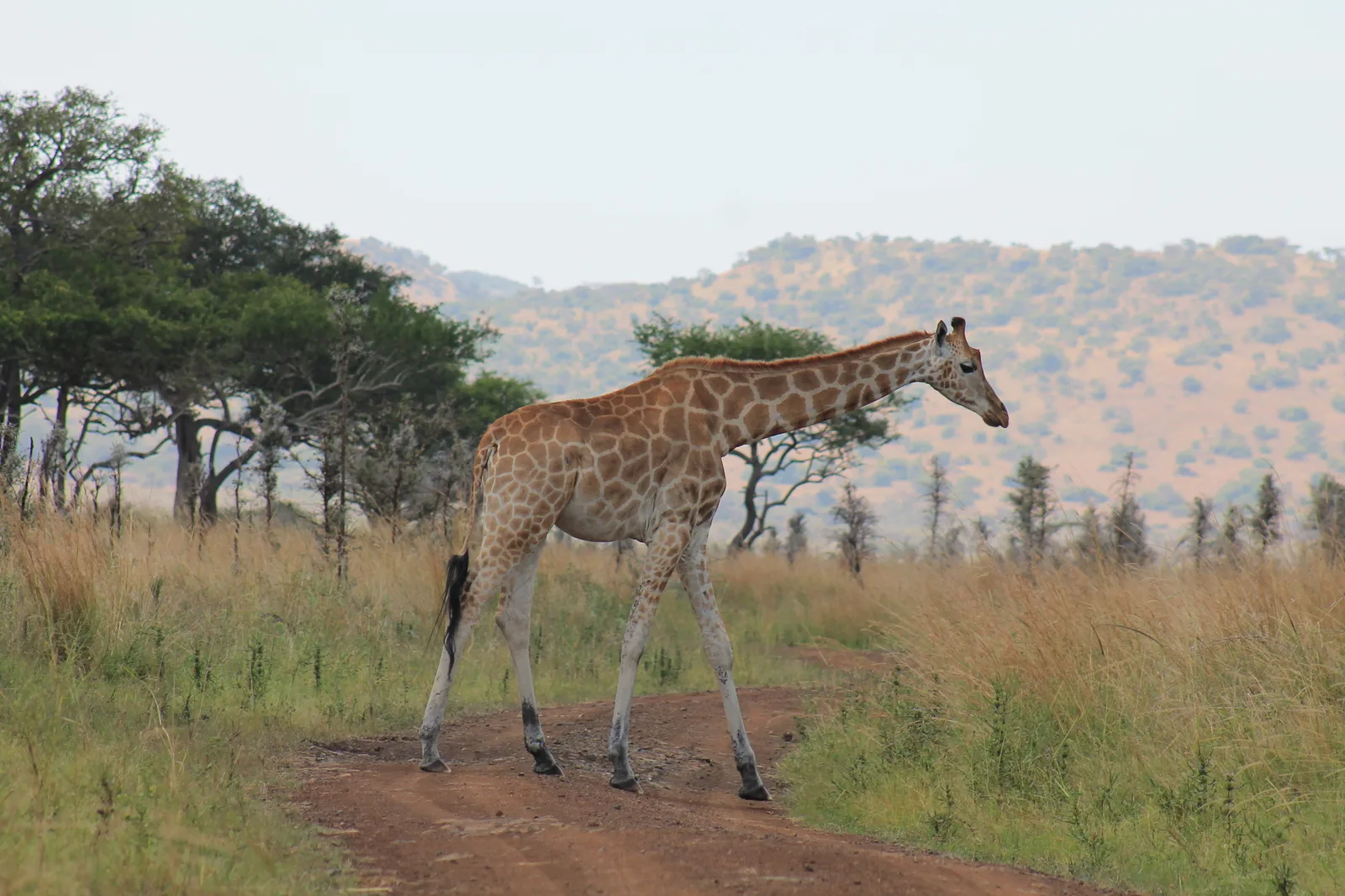
Images of the giraffe
Lifespan in the wild
10 to 15 years
Weight
1.18 to 1.93 t
Height
4.3 to 5.7 m
Top speed
Up to 60 km/h
Fact file
Giraffe
- Location
- Sub-Saharan Africa
- Habitat
- Savanna, Grassland
- Diet
- Herbivore
- Prey / food
- Acacia leaves, shoots and fruit
- Predators
- Lions, crocodiles, hyenas take calves
- Lifestyle
- Diurnal
- Group name
- Tower
- Name of young
- Calf
- Gestation
- About 15 months
- Litter size
- 1 calf
- Population
- About 117,000 in the wild
- Biggest threat
- Habitat loss and poaching
- Distinctive feature
- A neck up to 2 m long and a patterned coat
- Colour
- Tan with brown patches
- Skin type
- Fur
Size
Next to a person
Measurements
Size and speed
- Height
- 4.3 to 5.7 m
- Tail
- 0.8 to 1 m
- Weight
- 1.18 to 1.93 t
- Top speed
- Up to 60 km/h in a sprint
Typical adult ranges. Sources: Animal Diversity Web, Wikipedia.
Life cycle
Lifespan
- In the wild10 to 15, up to 25 years
- In captivity20 to 25, up to 27 years
- 027 years
The pale bar is the record. Source: Animal Diversity Web.
Appearance
Colour and coat
- Primary colours
- tanbrown
- Secondary colours
- creamblack
- Skin type
- fur
- Male and female
- Strong in size. A bull stands 5.7 metres and weighs up to 1,930 kilograms. A cow is 0.7 to 1 metre shorter and weighs up to 1,180 kg. Bulls have thick bare horns and may grow extra ones.
Life cycle
Mating and family
- Mating system
- polygynous
- Social structure
- loose open herds of 10 to 20 that change membership daily
- Breeding
- one calf every 20 to 30 months
A bull tests a cow's urine to find out if she is in heat, then guards her from rivals. She carries one calf for about 457 days and gives birth standing up. The calf stands within an hour, hides for its first weeks, then joins a creche watched by several mothers. Weaning comes at 12 to 16 months. Wild giraffes live 10 to 15 years, and one captive animal reached 27.
Classification
Taxonomy
- Kingdom
- Animalia
- Phylum
- Chordata
- Class
- Mammalia
- Order
- Artiodactyla
- Family
- Giraffidae
- Genus
- Giraffa
- Species
- Giraffa camelopardalis
Conservation
Red List status
- LC
- NT
- VU
- EN
- CR
- EW
- EX
Vulnerable on the IUCN Red List
Range
Recorded in 17 countries
- Angola
- Botswana
- Democratic Republic of the Congo
- Cameroon
- Ethiopia
- Kenya
- Mozambique
- Namibia
- Niger
- Somalia
- South Sudan
- Chad
- Tanzania
- Uganda
- South Africa
- Zambia
- Zimbabwe
Habitat layer: tropical grassland, savanna and shrubland, temperate grassland, savanna and shrubland.
Countries from 1,677 wild records on GBIF (iNaturalist research grade), filtered and checked by hand. Country shapes: Natural Earth. Habitat: RESOLVE Ecoregions 2017, CC BY 4.0. Basemap: Natural Earth.
Habitats
Three things to know
- 1
A newborn giraffe drops about 1.5 m to the ground at birth and stands within an hour.
- 2
The tongue is about 45 cm long and dark purple.
- 3
A giraffe sleeps only a few hours a day, often standing up.
Did you know
Seven more facts
- 1
A giraffe cannot swim, so a large river marks the edge of its range.
- 2
Giraffes sleep standing up and for only a few hours a day.
- 3
In the dry season giraffes chew old bones to get calcium and phosphorus.
- 4
A giraffe's stomach is only half the size of a buffalo's, because leaves digest faster than grass.
- 5
Up to 75% of calves die in their first year.
- 6
The IUCN recognised four species of giraffe in 2025, though most people still speak of one.
- 7
iNaturalist holds 2,942 observations of the giraffe, and GBIF has records from 39 countries.
Field notes
How it looks and acts
Field notes
Distinguishing features
- A height of 4.3 to 5.7 metres, taller than any other land animal.
- A neck about 2.4 metres long with seven stretched vertebrae.
- A patched coat of brown on cream, unique to each animal.
- Skin-covered horns called ossicones, thin and tufted in cows and thick and bare in bulls.
- A steep back that slopes from high shoulders to a low rump.
- A thin tail of 80 to 100 centimetres with a black tuft.
Field notes
Unique adaptations
- A long neck and long legs reach leaves 5 metres up, above every other browser.
- A tough 45 centimetre tongue and a flexible upper lip strip leaves from between acacia thorns.
- A thick-walled heart and doubled blood pressure push blood up to the head.
- Coat patches with sweat glands and dense blood vessels probably shed heat like windows.
- Juicy leaves supply most of its water, so it can live far from rivers.
Field notes
Interesting behaviours
- Browses in the morning and evening and chews the cud through the midday heat.
- Sleeps standing up, with the head sometimes resting on a hind leg.
- Bulls spar by necking, swinging the head at a rival's flank or neck.
- Cows leave calves in a creche and take turns on guard.
- Licks salty soil and chews bones in the dry season.
Field notes
Temperament
- Calm and watchful, spending most of its time feeding.
- Loosely social, with herds that form and dissolve within days.
- Peaceful toward people, but a kick from a front hoof can kill a lion.
Field notes
Communication
- Snorts or grunts to warn the herd of danger.
- A cow whistles to her calf and bellows to find it, and the calf mews back.
- Probably uses infrasound too low for people to hear.
- Keeps in touch with the herd by sight across long distances.
Ecology
Ecological role
The giraffe is the only browser that feeds at the top of the acacia canopy, and it shapes the trees it eats.
- Prunes acacia and Combretum trees from above, which probably keeps their crowns open.
- Feeds lions, and its calves feed leopards, hyenas and crocodiles.
- Carries ticks that oxpecker birds feed on, a partnership that helps both.
- Probably spreads acacia seeds in its dung, as other ruminants do.
Stories
Myths and legends
- In Greek and Roman tradition, the giraffe was a camel-leopard, the offspring of a camel and a leopard.
- In African folktales, the giraffe earned its long neck as a reward or a punishment.
- In some African traditions, the giraffe is a spirit animal that joins the earth to the sky.
- In European star lore, the faint northern constellation Camelopardalis takes its name from the giraffe.
People
Relationship with humans
People
Living alongside us
Giraffes have never been domesticated and do no harm to people or crops. Africans have hunted them for meat, hide and tail hair, and poaching still cuts into some populations. The Greeks and Romans knew the animal from menageries and named it the camel-leopard. Today it draws safari tourists across East and southern Africa and fills zoos worldwide. Niger, Uganda and South Africa run programmes to move and restock giraffes.
- No harm to people from giraffes is on record.
- A kick from a front hoof can kill a lion, so a cornered giraffe deserves space.
- Wild giraffes probably walk away from people on foot rather than confront them.
People
Status, uses and products
- Domestication
- Wild
- As a pet
- Not suitable. A giraffe eats up to 66 kilograms of tree leaves a day and needs a home range of many square kilometres. It cannot be housed, fed or fenced by a private owner, and export from Africa is controlled.
- Uses
- ecotourismzoo exhibitionmeat
- Products
- hidetail hairmeat
The full account
About the giraffe
The giraffe, Giraffa camelopardalis, is the tallest land animal and the largest ruminant. A bull stands up to 5.7 metres from the ground to the tips of his horns. The neck alone is about 2.4 metres long, yet it holds only seven vertebrae, the same number as a human neck. Adults weigh 1,180 to 1,930 kilograms, with bulls far heavier than cows. The coat carries brown patches on a cream ground, and no two giraffes share the same pattern.
Giraffes browse the tops of acacia trees on the savannas and open woodlands of Africa south of the Sahara. They live in loose herds that change from day to day, and bulls settle rank by swinging their necks at each other. A cow carries a single calf for about 457 days and gives birth standing up. The IUCN lists the giraffe as Vulnerable, with about 117,000 left in the wild. Habitat loss and poaching for meat, hide and tail hair are the main threats.
Name and taxonomy
Carl Linnaeus named the giraffe Giraffa camelopardalis in 1758. The species name means camel-leopard: the Greeks and Romans took the animal for a cross between the two. Linnaeus based his description on a picture of a live giraffe drawn by Belon du Mans in 1553, not on a specimen. The type locality was later fixed as Sennar in Sudan, and a skeleton from Ethiopia now serves as the reference specimen. The word giraffe probably reached English through Italian and French from the Arabic zarafa.
The giraffe belongs to the family Giraffidae, which it shares only with the okapi of the Congo forest. It is an even-toed ungulate and a ruminant, so it sits in the same order as cattle, deer and antelope. For most of the last century, scientists recognised one species with nine regional subspecies that all interbreed. Genetic studies then sorted the animals into a West African group, a northern group and a southern group. Since August 2025 the IUCN specialist group for giraffes has counted four species: northern, Masai, reticulated and southern. This page treats the giraffe as one species, the older and still common approach.
Evolution and relatives
Giraffes are thought to have evolved alongside acacia trees across the savannas of Africa. Seven extinct species of Giraffa are known from fossils. The earliest northern giraffes lived in Chad in the late Pliocene. Giraffes lived in Algeria from the early Pleistocene and survived in Morocco, Libya and Egypt until about AD 600. The drying of the Sahara then pushed them south, and they have never lived in the Congo rainforest.
The giraffe's height comes from two stretches of the skeleton: the neck bones and the lower leg bones. All seven neck vertebrae lengthened evenly, and the leg bones thickened their walls to bear the load. Growing that skeleton needs large amounts of calcium and phosphorus, which shapes the animal's diet. The heart changed too: blood pressure is twice that of a mammal of similar size, and the left ventricle wall thickens with neck length. Genetic differences between the regional forms are small, which is why the species question stays open.
Appearance
A bull stands about 3.3 metres at the shoulder and 5.7 metres to the top of the head. A cow is 0.7 to 1 metre shorter. Height to the crown runs from 4.3 to 5.7 metres across the species. Bulls weigh up to 1,930 kilograms and cows up to 1,180 kg. The back slopes steeply from the shoulders to the rump, and the front legs are longer than the hind legs. The tail is thin, 80 to 100 centimetres long, and ends in a black tuft that swats flies.
The coat shows patches of yellow, brown or nearly black on a pale ground. Patches can be large or small, sharp-edged or fuzzy, and the pattern varies by region. Each animal keeps its own pattern for life, though the colour can change with season and health. The skin beneath is a uniform dark grey. The patches hold large sweat glands and a special web of blood vessels, so they probably work as windows that shed heat.
Both sexes carry horns called ossicones, which are bone covered in skin and hair. A cow's horns are thin and tufted, while a bull's are thick and worn smooth by sparring. Some bulls add a second pair further back, and northern bulls carry a third horn on the forehead 76 to 127 millimetres long. The eyes are very large, and the dark tongue is about 45 centimetres long.
Habitat and range
Giraffes live in savanna, grassland and open woodland where acacia trees grow. They favour dry country and can live far from water, because they drink only now and then. Bulls push into denser woodland after more leaves, while cows stay in the open. Big rivers are barriers: a giraffe cannot swim and will not cross flowing water easily.
The species once ranged from Senegal and the Gambia across to Ethiopia and Somalia, and south to the Orange River in South Africa. It is now gone from Senegal, the Gambia, Mali, Mauritania, Nigeria, Eritrea and Mozambique. In West Africa a single population survives in Niger, with a second group started at Gadabedji in 2018. Central Africa holds almost 2,400 Kordofan giraffes in Chad, Cameroon, the Central African Republic and northeast Congo. The strongholds are East and southern Africa: Kenya, Tanzania, Uganda, Namibia, Botswana, Zambia, Zimbabwe and South Africa.
South African game reserves have brought giraffes back to land they had lost, and Eswatini and Rwanda have introduced them. Giraffes hold no territory, and home ranges vary from 5 to 654 square kilometres with the supply of food and water. GBIF holds records from 39 countries, but that count includes zoos and old records.
Diet and feeding
The giraffe is a browser, and it eats leaves, flowers, seed pods and fruit from trees and shrubs. Acacia is the main food, and four kinds of Acacia and four of Combretum make up most of the diet. These trees are rich in protein and calcium, which the giraffe needs for its huge skeleton. A bull can eat up to 66 kilograms of browse a day, but a giraffe survives on 7 kg where food is poor. It eats no grass at all.
The long tongue, narrow muzzle and flexible upper lip pull leaves from between the thorns. A giraffe takes a branch in its mouth and pulls its head away to strip the leaves, and its molars crush the thorns. Bulls feed with the neck fully stretched into the underside of the canopy. Cows feed at body and knee height from lower trees and shrubs, and they choose the most nourishing leaves.
Like cattle, the giraffe is a ruminant with a four-chambered stomach, and it chews the cud through the hot midday. Its stomach is only half the size of a buffalo's, because leaves digest more easily than grass. Most of its water comes from juicy leaves, so it can go a long time without drinking. In the dry season giraffes lick salty soil and chew old bones to top up minerals.
Behaviour and social life
Giraffes live in loose, open herds of 10 to 20 animals, and groups of up to 70 have been seen. Members come and go as they please, and a herd rarely keeps the same animals for more than a few days. A herd may be all cows, all bulls, cows with calves, or a mix. Cows are more social than bulls, and old bulls often wander alone. Herd members scatter widely to feed and gather again at good trees or when a predator appears.
Giraffes feed and drink in the morning and evening and rest in shade through the heat of the day. They sleep standing up, with half-closed eyes and twitching ears, and lie down only now and then. In deep sleep the head rests back on a hind leg with the neck in an arch. A giraffe sleeps only a few hours a day. At a walk both legs on one side swing together, which gives it an odd rolling gait. It can run at 32 to 60 kilometres per hour and keep a sprint going for some distance.
Bulls settle rank by sparring, called necking. Two bulls stand stiff-legged side by side, rub and twine their necks, and lean on each other to test strength. In a real fight each swings his head like a club at the other's flank or neck, and a hard blow can floor a bull. Giraffes have been seen standing over a dead herd member for hours or days.
Communication and senses
People long thought the giraffe was mute, because it is so rarely heard. It does make sounds: grunts, snorts, hisses, moans, snores and whistle-like or flute-like calls. Giraffes are also believed to use infrasound, too low for human ears. An alarmed giraffe grunts or snorts to warn the others. A cow whistles to her calf and bellows when she has lost it, and the calf bleats or mews back. A courting bull coughs loudly.
Sight is the giraffe's main sense, and its height gives it a view no other land mammal has. Herd members keep in visual contact across great distances, and they spot lions far off. Bulls read a cow's readiness by tasting her urine with a curled lip, the flehmen response. Like other ruminants, the giraffe probably relies on smell and hearing more than its silence suggests.
Reproduction and life cycle
Giraffes are polygynous, and a bull guards a cow in heat from other bulls. Courtship starts with the urine test, then the bull rubs his head on the cow's rump and rests it on her back. He licks her tail and lifts a foreleg, and if she is willing she circles him and holds her tail out. Breeding can happen in any month, but most conceptions fall in the rains and most births from May to August. A cow breeds every 20 to 30 months.
Gestation lasts about 457 days, roughly 15 months. The cow gives birth standing or even walking, so the calf falls about 2 metres to the ground. One calf is the rule, and twins are rare. A newborn weighs around 100 kilograms and is on its feet and suckling within an hour. For its first week the calf lies hidden most of the day and night while the mother feeds within 25 metres.
After three or four weeks the mother steers her calf into a creche with other calves. The cows take turns on watch, so a mother can feed up to 200 metres away and return before dark to suckle. Calves suckle for about a year and are weaned at 12 to 16 months. Up to 75% of calves die in their first year, most of them taken by lions. Cows mature at 3 to 4 years, and bulls at 4 to 5, though a bull does not breed until about seven. Wild giraffes live 10 to 15 years, and captive animals 20 to 25, with a record of 27.
Predators and threats
The lion is the main predator, and leopards, hyenas and crocodiles at waterholes also take giraffes. Predators go for calves and for sick or old animals. A healthy adult is hard to kill: it sees danger far off, runs fast and kicks hard enough to kill a lion. The blotched coat also helps hide a feeding giraffe in scrub. Ticks trouble giraffes, and oxpecker birds ride on their necks and backs to pick the ticks off.
People are the larger threat. Giraffes are hunted and poached for meat, hide and tail hair. Farms and settlements take the acacia woodland they feed in. West African numbers have collapsed, while the East and southern populations hold up better. One reason giraffes survive where other big mammals vanish may be their height, which keeps them out of competition with cattle and goats.
Population and conservation
The IUCN Red List rates the giraffe as Vulnerable. The 2016 assessment put the world population at about 97,000, down from at least 100,000 when the species was called not threatened. Current estimates put the total closer to 117,000. Some populations are stable, some grow and others shrink, so the picture varies by country.
The West African giraffe is the worst off, rated Endangered, with fewer than 200 animals in southwest Niger in the early 2000s. Niger has made the giraffe a conservation priority, and its numbers have grown to a few hundred. In 2018 eight giraffes were moved to the Gadabedji Reserve to found a second population, and four more followed in 2022. The northern giraffe as a whole is the least numerous of the four groups and the most endangered.
In Uganda, wildlife officials and a giraffe charity have relocated Nubian giraffes to Kidepo, Pian Upe, Lake Mburo and Murchison Falls. Southern Africa has restocked many reserves from which giraffes had been shot out. Settling the species question would help, because each genetic group would then be assessed and protected on its own.
Relationship with humans
Giraffes have no known harmful effect on people. They do not raid crops, and a giraffe on foot is not aggressive unless cornered. Africans have hunted them for meat and for the thick hide, which was made into buckets, reins, whips and harness straps. The hide has also covered drums and other instruments, and tail hair goes into bracelets and fly whisks.
A live giraffe from Sennar was once kept in Cairo, and it became the basis for the scientific name. A giraffe skull called Zarafa from Sennar sits in the Paris natural history museum, and a giraffe from Ethiopia was the first ever dissected. Today giraffes are a main attraction of zoos and wildlife parks around the world. In Africa they draw safari tourists, which gives parks and neighbouring communities a reason to keep them.
In culture and myth
The Greeks and Romans saw the giraffe as a camel-leopard, a cross between the two, and the name stuck in Latin. The constellation Camelopardalis, in the northern sky, is named after it. African folktales explain how the giraffe came by its long neck, usually as a reward or a punishment. In some African traditions the giraffe is a spirit animal that links the earth to the sky, because its head rides so high.
Modern writers make it a symbol of far-sightedness, grace and flexibility. It has also come to stand for Africa itself on posters, flags and safari brochures. The Swahili name twiga and the Zulu name indlulamithi, which means one who passes over trees, are among dozens of local names. Spirit-animal blogs add meanings of their own, but these seem to be recent inventions rather than folklore.
A sentence with a dotted underline is inferred: it describes the group the animal belongs to, or is a reading of the sources, rather than a measured or reported fact about this species.
Questions
Giraffe questions, answered
How tall is a giraffe?
A giraffe stands 4.3 to 5.7 metres to the top of the head. A bull reaches about 3.3 metres at the shoulder with a neck of about 2.4 metres. A cow is 0.7 to 1 metre shorter than a bull.
How much does a giraffe weigh?
Adults weigh 1,180 to 1,930 kilograms. A bull can reach 1,930 kg, and a cow tops out near 1,180 kg.
How many bones are in a giraffe's neck?
Seven, the same number as in a human neck. Each vertebra is greatly stretched, which gives a neck of about 2.4 metres.
What do giraffes eat?
Leaves, flowers, seed pods and fruit from trees and shrubs, above all acacia. A bull can eat up to 66 kilograms in a day. Giraffes do not eat grass, and they chew the cud like cattle.
Are giraffes endangered?
The IUCN lists the giraffe as Vulnerable, one step below Endangered. About 117,000 remain in the wild. The West African giraffe in Niger is Endangered, with only a few hundred animals.
Where do giraffes live?
On the savannas and open woodlands of Africa south of the Sahara. The strongholds are Kenya, Tanzania, Uganda, Namibia, Botswana, Zambia, Zimbabwe and South Africa. A small population survives in Niger, and about 2,400 Kordofan giraffes live in Central Africa.
How long do giraffes live?
Wild giraffes live 10 to 15 years, and a few reach 25. In captivity 20 to 25 years is typical, and the record is 27.
How fast can a giraffe run?
A giraffe can run at up to 60 kilometres per hour and can keep a sprint going for some distance. Its normal walk swings both legs on one side together.
Do giraffes make any sound?
Yes, though rarely. They grunt, snort, hiss, moan and give whistle-like calls, and mothers bellow for lost calves. They are also thought to use infrasound, which people cannot hear.
How do giraffes sleep?
Mostly standing up, with half-closed eyes, and for only a few hours a day. In deep sleep a giraffe may rest its head back on a hind leg. It lies down only now and then.
How long is a giraffe pregnant?
About 457 days, or roughly 15 months. She gives birth to one calf while standing, so the calf drops about 2 metres to the ground. It stands within an hour.
Why do giraffes fight with their necks?
Bulls settle rank by necking. Two bulls stand side by side and swing their heads like clubs at each other's flanks and necks. A hard blow can knock a bull down, and the winner gets access to cows.
Are giraffes dangerous to humans?
No. Giraffes have no known harmful effect on people and usually walk away. A cornered giraffe can kick hard enough to kill a lion, so keep your distance on foot.
How many species of giraffe are there?
For a long time scientists counted one species with nine subspecies. In 2025 the IUCN specialist group recognised four species: northern, Masai, reticulated and southern. This site treats the giraffe as one species.
Can giraffes swim?
No. A giraffe cannot swim and does not cross flowing rivers easily, so big rivers mark the edges of its range.
Why is the giraffe called camelopardalis?
The Greeks and Romans believed a camel and a leopard had produced it, so they called it a camel-leopard. Linnaeus kept the name when he described the species in 1758.
Food web
Prey and food
- acacia leaves
- shoots
- fruit
Food web
Predators
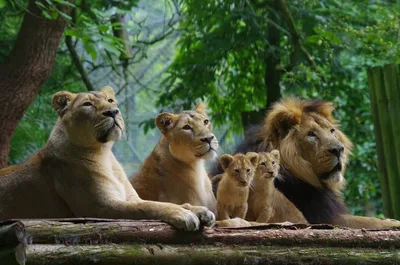 Lion
- crocodiles
- hyenas
Ecological equivalents
Related species on this site
Okapi (same family), Sivatherium (same family), Addax (same order), African buffalo (same order), Alpaca (same order), Alpine Goat (same order), and more.
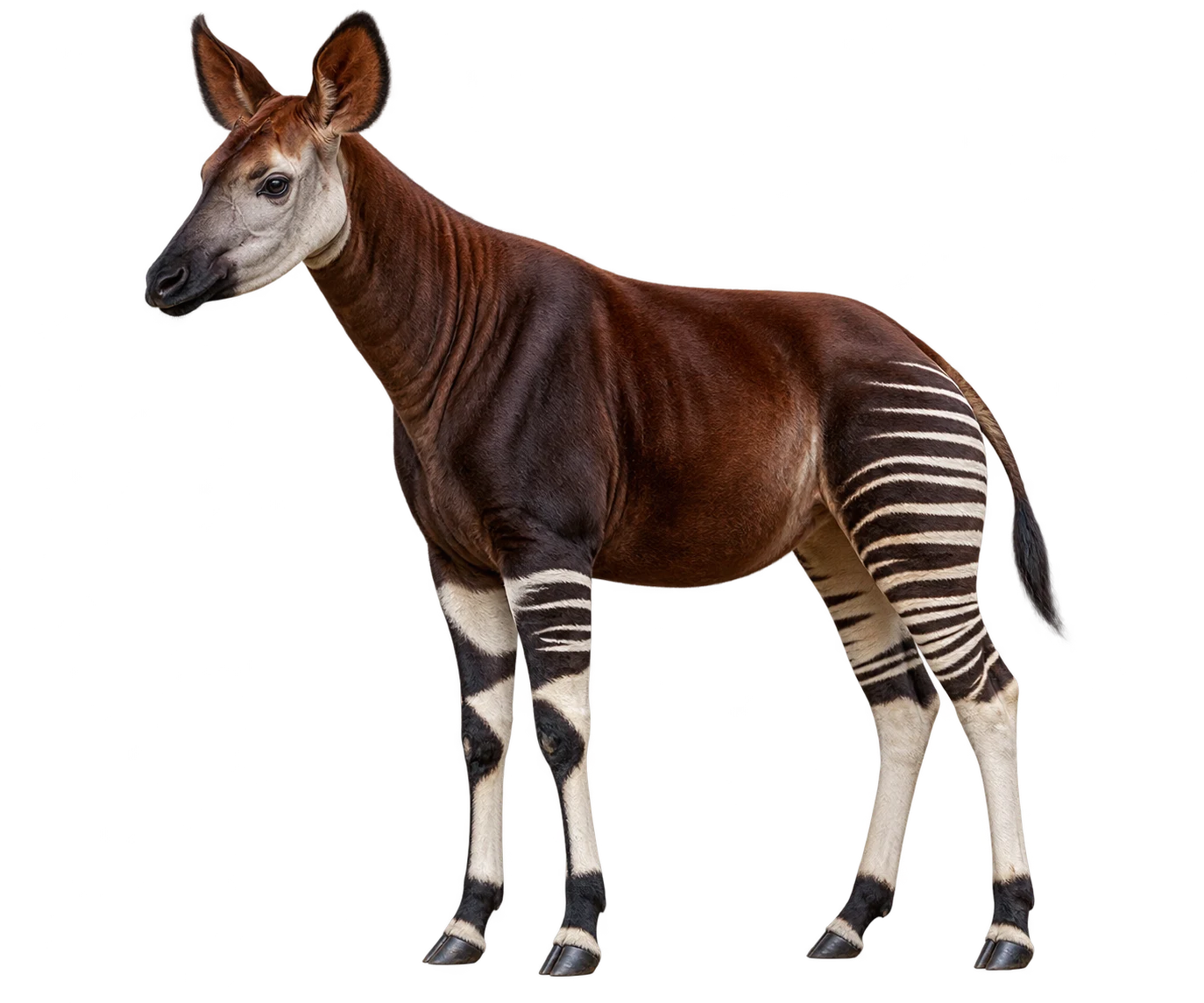
Mammals
Okapi
Okapia johnstoni
Classification and source reference
LivingAI illustration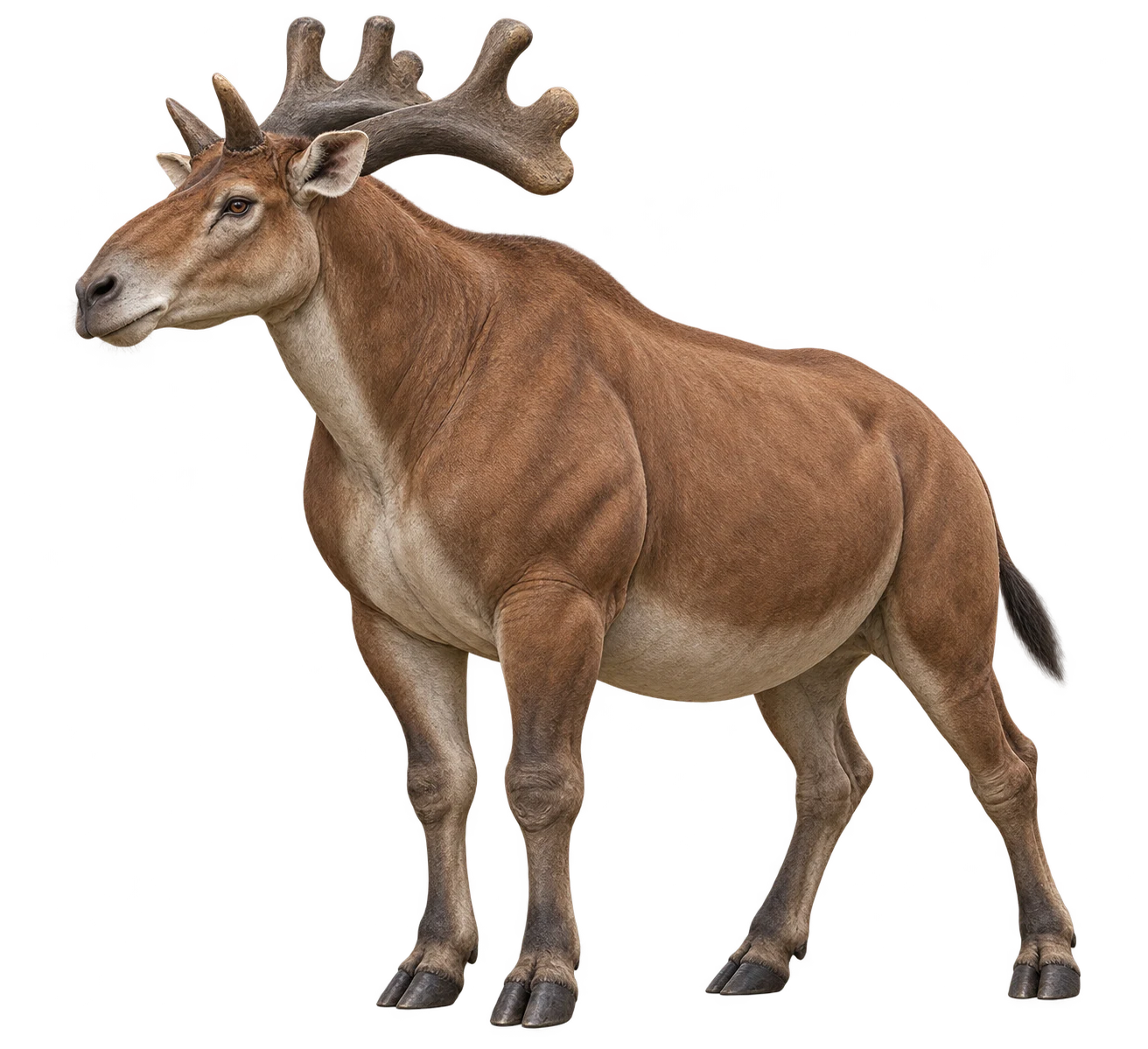
Mammals
Sivatherium
Sivatherium
Classification and source reference
ExtinctAI reconstruction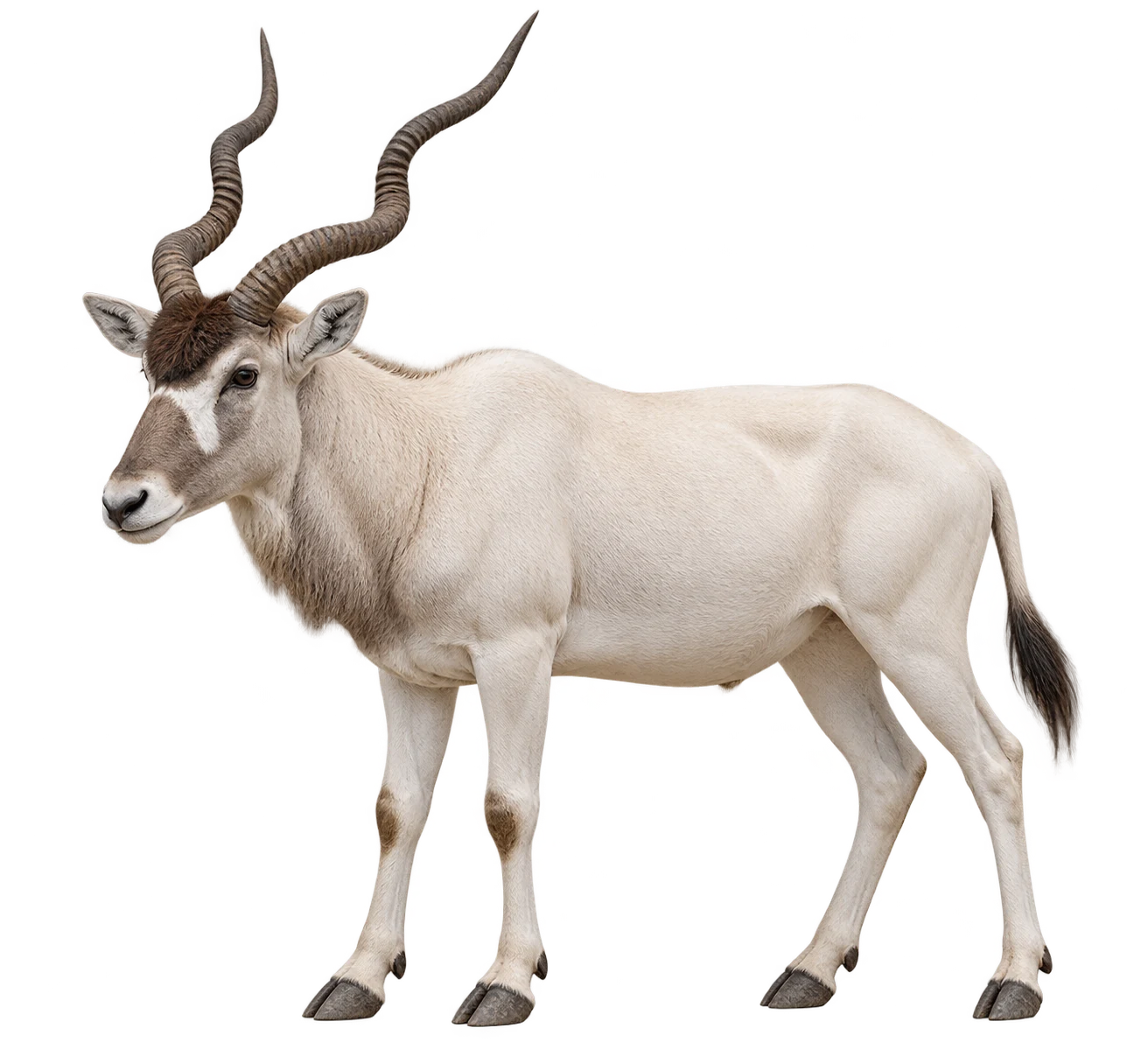
Mammals
Addax
Addax nasomaculatus
Classification and source reference
LivingAI illustration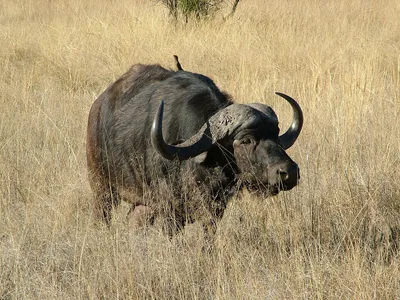 NT
Mammals
African buffalo
Syncerus caffer
The African buffalo is a heavy wild ox of sub-Saharan Africa that lives in herds of dozens to thousands and must drink every day.
Living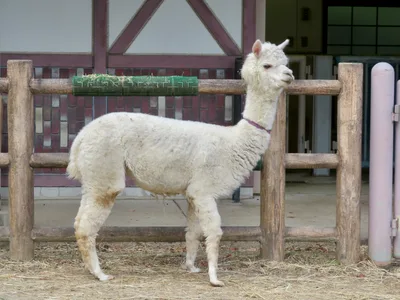
Mammals
Alpaca
Vicugna pacos
The alpaca is a domesticated Andean camelid kept for its fleece.
Living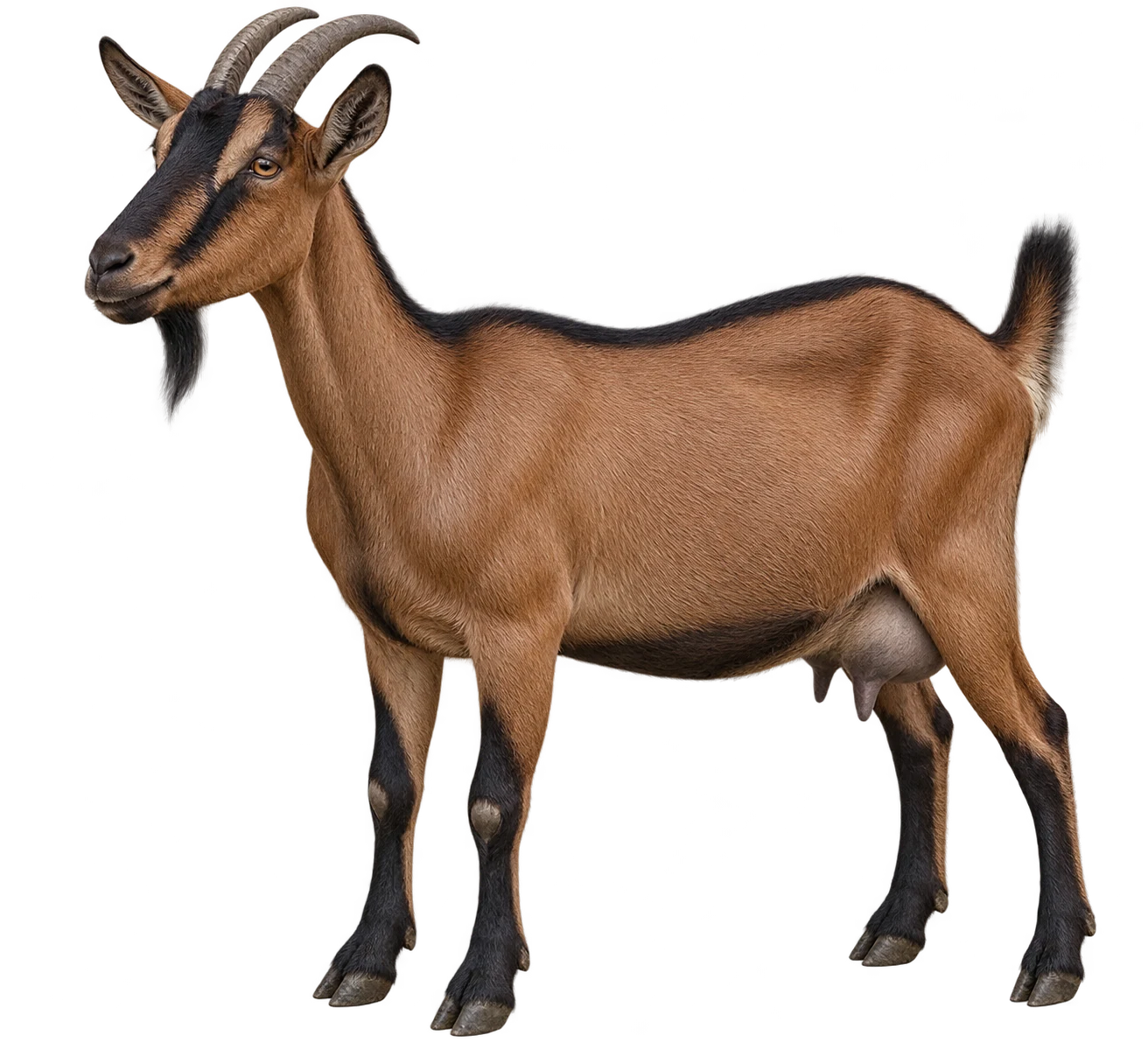
Mammals
Alpine Goat
Capra hircus
Classification and source reference
LivingAI illustration