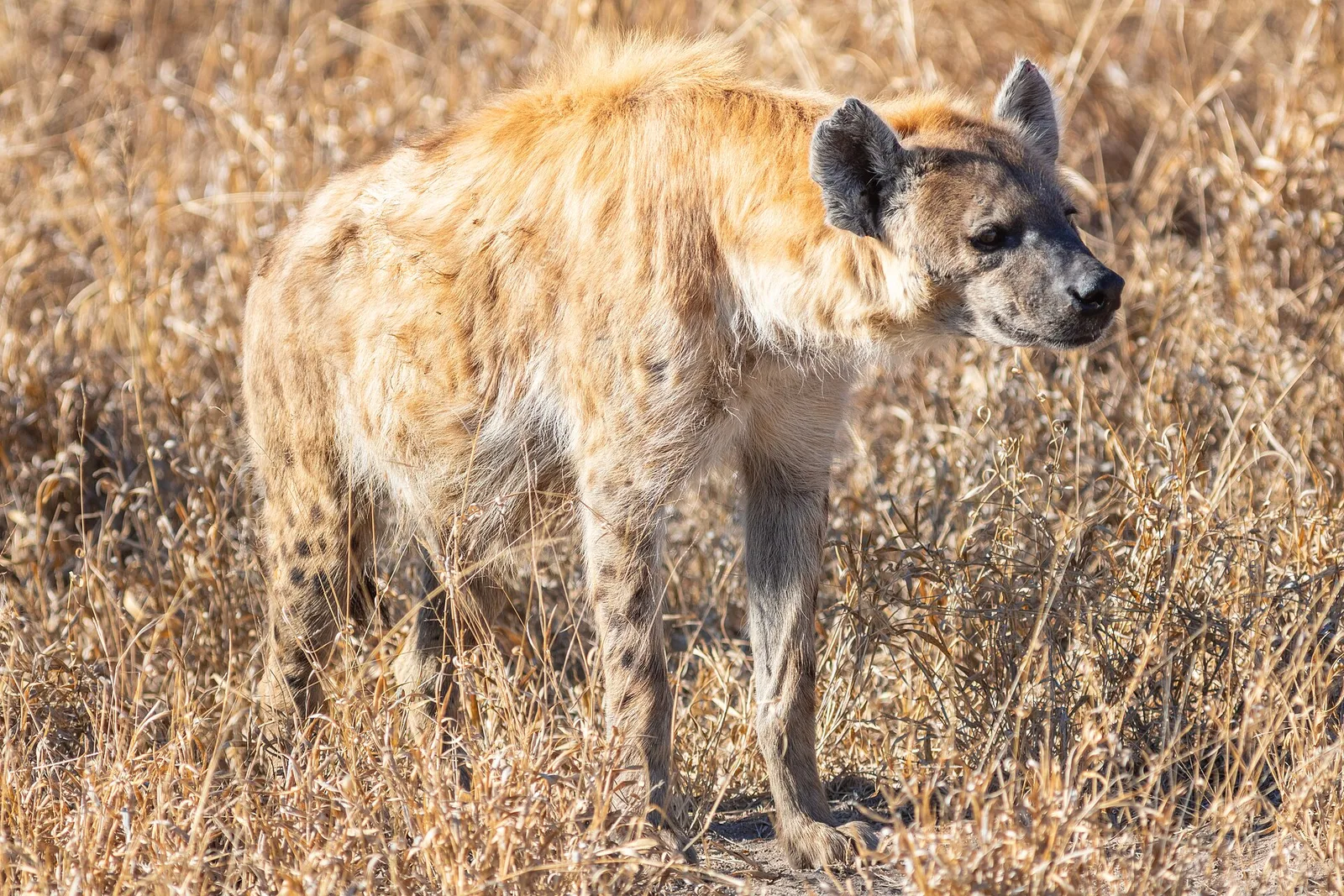
Spotted hyena
Africa's most common large carnivore, ruled by females
Crocuta crocuta
Also called Laughing hyena, Spotted hyaena
Living individuals or members of this group exist today. This does not mean they are safe from extinction.
Meet the spotted hyena
The spotted hyena is Africa's most common large carnivore and a hunter first, not a scavenger. Its clans are ruled by females, and its jaws crack bone.
Images of the spotted hyena
Lifespan in the wild
Up to 20 years
Weight
45 to 80 kg
Length
0.95 to 1.5 m
Top speed
Up to 60 km/h
Fact file
Spotted hyena
- Location
- Sub-Saharan Africa
- Habitat
- Savanna, Grassland, Desert, Mountains
- Diet
- Carnivore
- Prey / food
- Wildebeest, zebra, gazelle, topi, impala, gemsbok
- Predators
- Lions; rock pythons on occasion
- Lifestyle
- Mostly nocturnal, in clans
- Group name
- Clan
- Name of young
- Cub
- Gestation
- About 110 days
- Litter size
- 1 to 4 cubs, usually 2
- Population
- About 27,000 to 47,000 in the wild
- Biggest threat
- Persecution by herders and habitat loss
- Distinctive feature
- Spotted coat, sloping back and a female that looks male
- Colour
- Sandy to grey with dark spots
- Skin type
- Fur
Size
Next to a person
Measurements
Size and speed
- Height
- 70 to 91.5 cm at the shoulder
- Length
- 0.95 to 1.5 m head and body, without the tail
- Tail
- 30 to 36 cm
- Weight
- 45 to 80 kg, up to 90 kg the record of 90 kg is from Wikipedia
- Weight, male
- 45 to 60 kg
- Weight, female
- 55 to 70 kg females weigh 55 to over 70 kg
- Top speed
- Up to 60 km/h
Typical adult ranges. Sources: Animal Diversity Web, Wikipedia.
Life cycle
Lifespan
- In the wildUp to 20 years
- In captivityAbout 12, up to 41 years
- 041 years
The pale bar is the record. Source: Animal Diversity Web.
Appearance
Colour and coat
- Primary colours
- sandyyellowish grey
- Secondary colours
- dark brownblack
- Skin type
- fur
- Male and female
- Reversed. The female is about 10% larger than the male and dominates him. Her genitals look almost the same as his, so the sexes are hard to tell apart.
Life cycle
Mating and family
- Mating system
- promiscuous, with no pair bond
- Social structure
- clans of up to 80 led by a matriarch, with rank passed from mother to cub
- Breeding
- one litter about every 16 months, in any season
The spotted hyena breeds in any month. Gestation lasts about 110 days and the mother gives birth through her clitoris, usually to two cubs. She raises them alone at a communal den and nurses them for 12 to 16 months. Half of all cubs die before they mature at about three years. Wild hyenas live up to 20 years, and one captive animal reached 41.
Classification
Taxonomy
- Kingdom
- Animalia
- Phylum
- Chordata
- Class
- Mammalia
- Order
- Carnivora
- Family
- Hyaenidae
- Genus
- Crocuta
- Species
- Crocuta crocuta
Conservation
Red List status
- LC
- NT
- VU
- EN
- CR
- EW
- EX
Least Concern on the IUCN Red List
Range
Recorded in 12 countries
- Benin
- Botswana
- Central African Republic
- Ethiopia
- Kenya
- Namibia
- Niger
- Tanzania
- Uganda
- South Africa
- Zambia
- Zimbabwe
Habitat layer: tropical grassland, savanna and shrubland, temperate grassland, savanna and shrubland, montane grassland and shrubland, desert and xeric shrubland.
Countries from 7,022 wild records on GBIF (iNaturalist research grade), filtered and checked by hand. Country shapes: Natural Earth. Habitat: RESOLVE Ecoregions 2017, CC BY 4.0. Basemap: Natural Earth.
Habitats
Three things to know
- 1
A clan of 20 to 30 hyenas can eat a whole wildebeest in 13 minutes.
- 2
In a clan, the lowest-ranking adult female still outranks the highest-ranking male.
- 3
Female hyenas give birth through a penis-shaped clitoris.
Did you know
Seven more facts
- 1
A cub is born with open eyes and sharp teeth, and same-sex twins may fight to the death in their first days.
- 2
Cubs drink their mother's milk for 12 to 16 months, longer than almost any other carnivore.
- 3
A hyena's heart is nearly 1% of its body weight, about twice the share of a lion's.
- 4
A nursing female in the Serengeti may travel 2,800 to 3,600 kilometres a year to reach migrating herds.
- 5
Hyenas in the Kalahari have chased an eland for 24 kilometres.
- 6
A hyena may give a false alarm call at a carcass so the others run and it can eat in peace.
- 7
The spots on the coat never change, so researchers use them like fingerprints.
Field notes
How it looks and acts
Field notes
Distinguishing features
- A spotted, short coat with no long mane along the back.
- Rounded ears, where the other hyenas have pointed ears.
- Front legs longer than the hind legs, giving a sloping back.
- A short tail with a black bushy tip, 30 to 36 centimetres long.
- A female that looks like a male, with a penis-shaped clitoris and a false scrotum.
- A wide, flat head and a heavy neck on a body 95 to 150 centimetres long.
Field notes
Unique adaptations
- Bone-crushing premolars set in front of the cutting teeth let it crack bone without blunting its blades.
- A large heart and long front legs give the stamina to chase prey for several kilometres.
- A gut that digests skin, bone and hooves wastes almost nothing from a carcass.
- Very rich milk lets a mother raise cubs on long trips away from the den.
- A rounded rump gives an attacker from behind little to grip.
Field notes
Interesting behaviours
- Forages alone or in small parties, then gathers in a crowd at a kill.
- Commutes long distances from the den to follow migrating herds.
- Marks the clan border with anal-gland paste and shared latrines.
- Mobs lions that enter the clan territory.
- Rests by day in thickets or on rock outcrops, and hunts mostly at night.
Field notes
Temperament
- Fiercely competitive at a carcass, even with clan-mates.
- Cooperative in defence of the territory and against lions.
- Shy of people by day, bold at night.
- Curious and quick to learn, and hard to trap twice.
Field notes
Communication
- A rising whoop as a contact call that carries across the plain.
- A giggle, the laugh, when frightened or excited.
- A greeting in which two hyenas sniff each other's raised genitals.
- Flattened ears, a lowered rump and a tail curled under the belly to show fear.
- Anal-gland paste on grass stems that tells clan from stranger.
Ecology
Ecological role
The spotted hyena is the most numerous large predator in Africa and both a hunter and the continent's main clean-up crew.
- Kills 60% to 95% of its own food, mainly medium and large hooved animals.
- Eats bone, skin and hooves, so it removes what other predators leave.
- Competes directly with lions, with a diet overlap as high as 68.8% in some areas.
- Suppresses wild dogs, whose numbers fall where hyenas are dense.
Stories
Myths and legends
- In Tabwa tradition, the hyena carried the sun to the cold earth.
- In Yoruba tradition, a hyena mask marks the end of the èfè ceremony, because the hyena finishes every meal.
- In Bambara tradition, the hyena is a being of both sexes and stands for wholeness in the Korè cult.
- In Ethiopian and Sudanese tradition, a sorcerer can turn into a hyena, called a bouda.
- In ancient Greek and Roman writing, the hyena was said to copy human voices and robbed graves.
People
Relationship with humans
People
Living alongside us
People have painted the spotted hyena since the Stone Age and have feared and mocked it ever since. It kills livestock, eats corpses and, in rare cases, attacks people who sleep outside. Herders shoot, snare and poison it in return. It is easily tamed but never a good companion, and zoos have long given it their worst cages. Safari tourism now gives it some economic value.
- It can kill a person, and pairs of large hyenas have killed dozens of people in Malawi and Mozambique.
- Attacks happen mostly at night, in the hot season, when people sleep in the open.
- By day it runs from a person at up to 300 metres.
People
Status, uses and products
- Domestication
- Wild
- As a pet
- Not suitable. A tame hyena still has jaws that crack bone, it cannot be house-trained, and it wrecks fences and floors. It needs a clan, a large territory and meat by the kilogram.
- Uses
- safari tourismtraditional medicinesport huntinglivestock guarding
- Products
- body parts for traditional medicinebushmeat
The full account
About the spotted hyena
The spotted hyena, Crocuta crocuta, is the largest of the four living hyena species. It is the only living member of its genus. People also call it the laughing hyena, after its giggling call. It lives across Africa south of the Sahara, from Senegal to South Africa. The IUCN rates it Least Concern, with a wild population of about 27,000 to 47,000.
Its reputation as a scavenger is wrong. Across Africa it kills most of its own food, and in some places it hunts as much as lions do. It lives in clans that can hold up to 80 animals, and every adult female outranks every adult male. An adult weighs 45 to 80 kilograms and measures 95 to 150 centimetres from head to rump. Its jaws crack the leg bones of a giraffe, so almost nothing on a carcass goes to waste.
Name and taxonomy
Johann Erxleben gave the species its scientific name in 1777. He worked from a description that Thomas Pennant published in 1771, based on a captive animal. Pennant was the first writer to separate the spotted hyena from the striped hyena in a consistent way. Crocuta became a genus of its own in 1828. The name Crocuta traces back through Greek to Sanskrit words for the golden jackal, not to a Latin word for saffron.
The spotted hyena sits in the family Hyaenidae within the order Carnivora. Its closest relatives are the striped hyena, the brown hyena and the aardwolf. Naturalists once named many subspecies because coat and size vary so much across Africa. In 1939 L. Harrison Matthews showed that skulls from one Tanzanian population held all of that variation. Today the species is treated as a single form with no subspecies.
Evolution and relatives
The line that led to Crocuta split from the striped and brown hyenas about 10 million years ago. The oldest fossils of the genus come from Africa, about 3.63 to 3.85 million years ago. The earliest remains of the living species are from Sterkfontein in South Africa, at least 2.1 million years old. Fossil clans probably began to form about 350,000 years ago, when other predators competed hard for carcasses. Sharp cutting teeth behind the bone-crushing premolars turned the species from a scavenger into a pack hunter.
Crocuta spread out of Africa and lived across Europe and Asia for at least a million years. These cave hyenas are usually treated as a subspecies of the spotted hyena. Their nuclear genome suggests the African and Eurasian groups split about 2.5 million years ago and still interbred afterwards. Cave hyenas vanished from Western Europe between 14 and 11,000 years ago, as grassland gave way to woodland. Paintings in the Lascaux and Chauvet caves show that they kept their spots.
Appearance
The spotted hyena is built heavy at the front, with a thick neck, a wide flat head and a blunt muzzle. The forelegs outreach the hind legs, so the back slopes down to a rounded rump. The ears are rounded, unlike the pointed ears of the other hyenas. Each foot has four toes with short blunt claws that do not retract. Adults measure 95 to 150 centimetres from head to rump and stand 70 to 91.5 cm at the shoulder. The short tail measures 30 to 36 cm and carries a black brush of hair.
Adults usually weigh 45 to 80 kilograms, and the heaviest on record reached 90 kg. The female is the larger sex, which is rare among mammals. Males weigh about 45 to 60 kg, and females weigh 55 to more than 70 kg. The heart makes up close to 1% of body weight, which supports long chases. The skull is among the strongest in the Carnivora for its size, and the bite reaches 4,500 newtons in one measured animal.
The coat is sandy, yellowish or grey with an irregular pattern of dark spots on the back, flanks and legs. The spots are reddish, deep brown or nearly black and are commonly about 20 millimetres across. They are darkest in young animals and fade with age. Researchers use the spot pattern to identify individuals. The fur is short and coarse, with no long mane along the spine. The female's clitoris is shaped like a penis and can become erect, and fused labia form a false scrotum.
Habitat and range
The spotted hyena lives in savanna, semi-desert, open and dry woodland, swamps and mountain forest. It is recorded up to 4,000 metres above sea level in East Africa and Ethiopia. It stays out of lowland rainforest, the highest alpine zones and the driest desert. In West Africa it keeps to the Guinea and Sudan savannas and avoids the coastal forest belt.
The species once lived across almost all of sub-Saharan Africa. Its range is now patchy, most of all in West Africa, and populations gather in and around protected areas. Large continuous populations remain in Ethiopia, Kenya, Tanzania, Botswana, Namibia and the lowveld of South Africa. It has been wiped out in Algeria and Lesotho and from much of southern South Africa. GBIF holds records from 71 countries, but that count includes zoo animals and does not describe the native range.
Density varies from 0.006 to 1.7 animals per square kilometre. The richest plains of Kenya and Tanzania hold more than one hyena per square kilometre. In good habitat the spotted hyena outnumbers every other large carnivore. In desert the striped and brown hyenas are more common than it is.
Diet and hunting
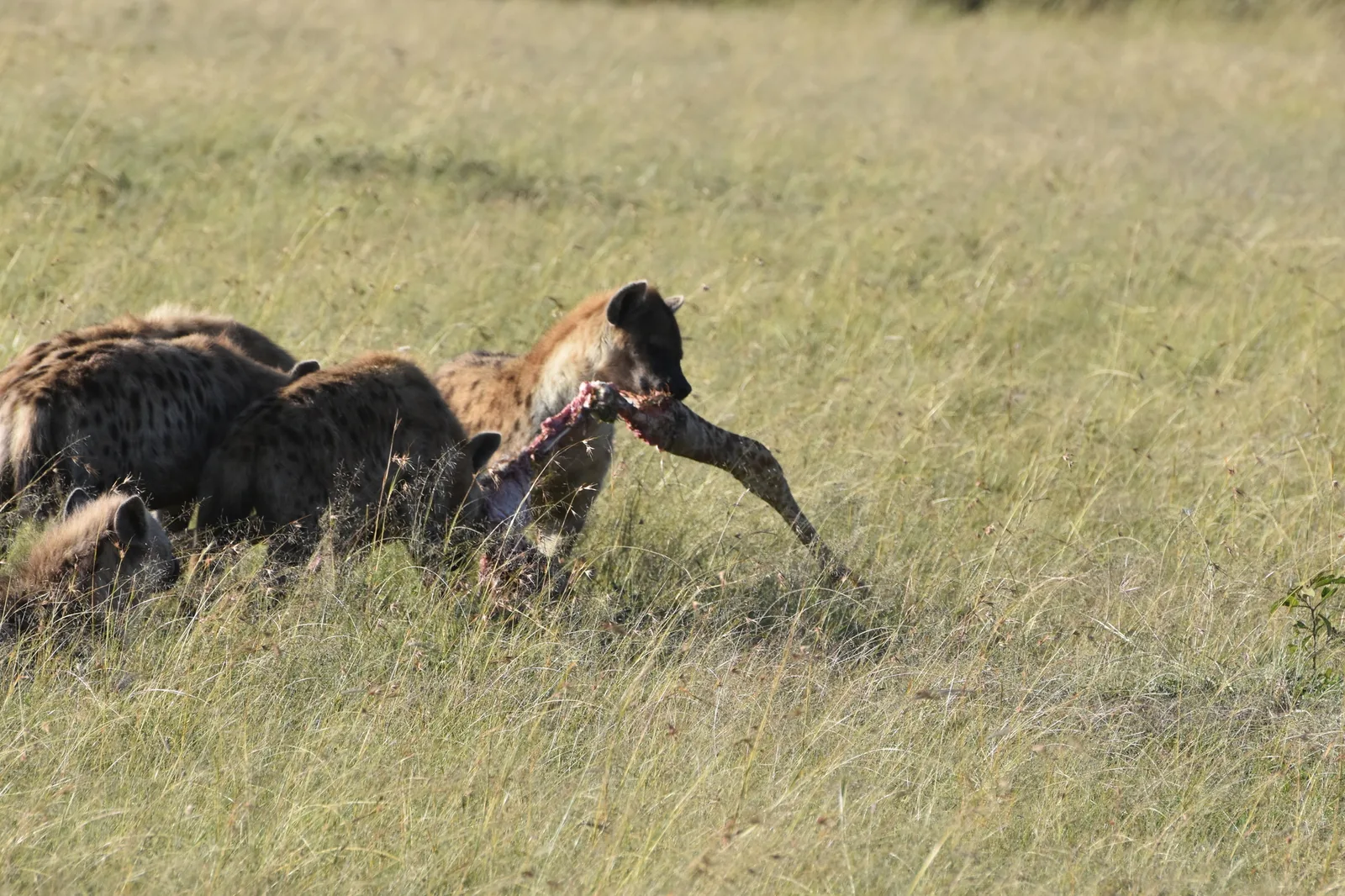
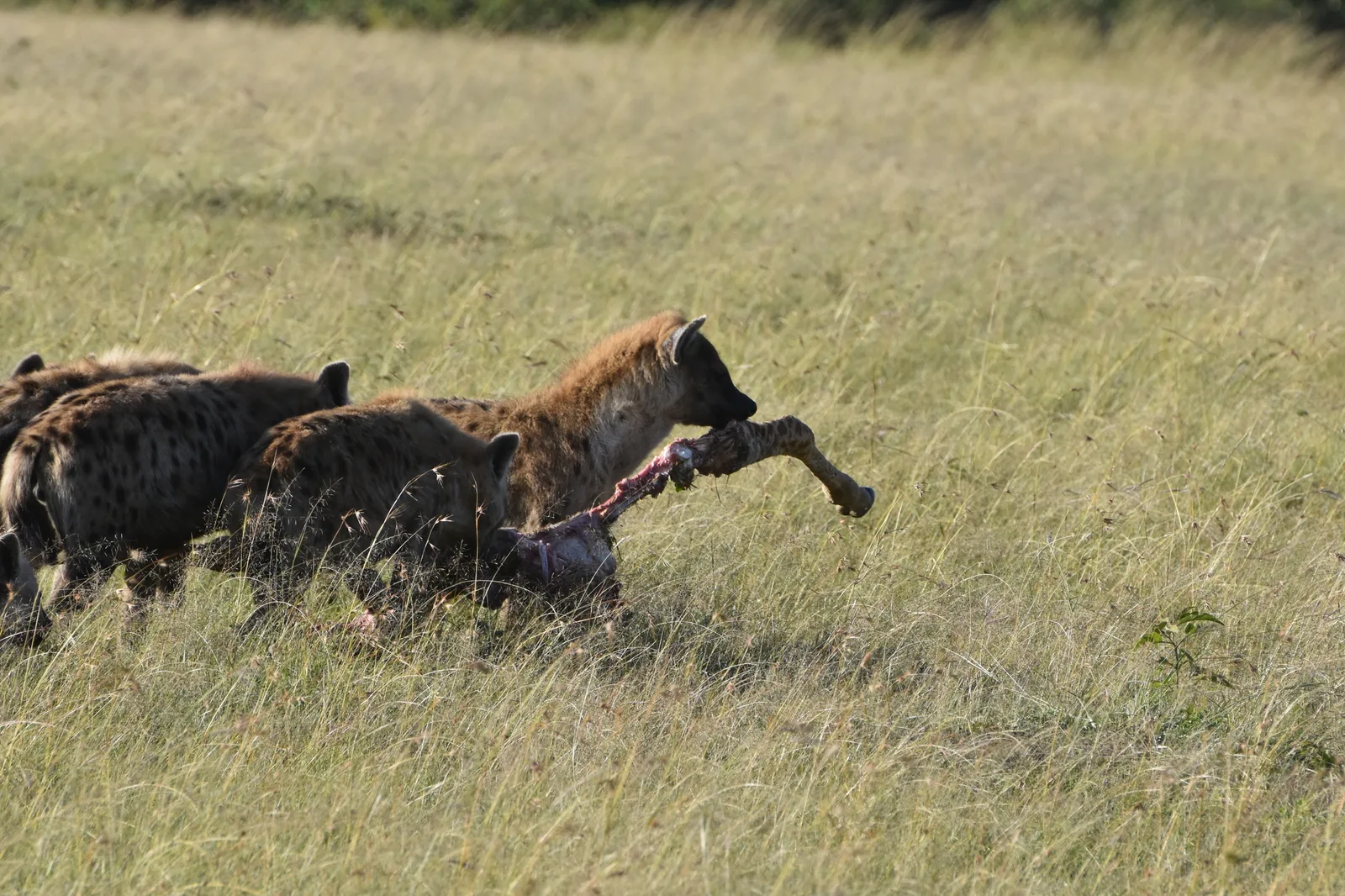
The spotted hyena is the most carnivorous hyena and mainly a predator. Studies since the 1960s show that it kills 60% to 95% of its own food, with the rest scavenged. It prefers prey of 56 to 182 kilograms and takes whatever is common where it lives. In East Africa that means wildebeest, zebra, gazelles and topi. In Kruger the main prey is impala, and in the dry south-west it is gemsbok and springbok. It also eats termites, crocodile eggs, ostrich eggs, hares and the young of giraffe, hippo and rhino.
Hyenas often run through a herd to pick out a young, old or weak animal. They then chase it for several kilometres at up to 60 kilometres per hour. One chase in the Kalahari covered 24 km before an eland was caught. Most hunting parties hold one or two animals, but zebra hunts draw larger groups. A single hyena can pull down a wildebeest three times its own weight. There is no killing bite: the hunters pull the prey down and eat it as it dies.
Feeding is a race, because the noise draws the rest of the clan. A group of 20 to 30 hyenas can strip an adult wildebeest to a pile of stomach contents in 13 minutes. One animal can swallow food equal to 25% to 30% of its body weight at a sitting. The gut digests skin, bone and hooves, so only the horns and stomach contents are left. In the Serengeti a nursing female may commute 80 km round trip to reach migrating herds.
Behaviour and social life
Clans hold from 3 to 80 members, and clan size follows the local prey supply. A clan shares a territory and a communal den, but its members forage alone or in small groups most of the time. The whole clan gathers only at a kill, at the den or when it defends its border. Females stay in their birth clan for life, and males leave at about two and a half years. Immigrant males join a queue and move up the ranks only as older males die.
Every adult female outranks every immigrant male, and a low-ranking female can push a high-ranking male off a kill. A cub takes its mother's rank, one step below her, and keeps it as an adult. Rank depends on allies, not on size or strength, much as it does among baboons. High-ranking females eat first, breed earlier and raise more surviving cubs. A hyena that falls below its inherited rank in its first months is about 1.5 times more likely to die.
Territory size runs from under 40 square kilometres in the Ngorongoro Crater to over 1,000 in the Kalahari. Clans mark the border with anal-gland paste on grass stems and with shared latrines. A hunting hyena may stop dead when its prey crosses into the next clan's land. The species is mostly active at night and around dusk and dawn. Hyenas in Kenya were active for about 32% of the day and walked more than 12 km in 24 hours.
Communication and senses
The spotted hyena has one of the widest vocal ranges of any carnivore. The long rising whoop is a contact call and can be heard far across the plain. The giggle, the famous laugh, comes from a hyena that is afraid or excited, often while it is being chased. A low mooing call comes from an impatient animal waiting at a kill. Grunts, growls and yells go with aggression. A 2022 study found that each hyena's whoop carries an individual signature.
Clan-mates greet by standing head to tail and sniffing each other's raised genitals for up to 30 seconds. An erection during the greeting is a sign of submission, not dominance. A submissive hyena also flattens its ears, lowers its rump and may walk on its front knees. The anal glands produce a paste that smells of burning or cheap soap, and people can smell it several metres downwind. Hyenas can tell clan members from strangers by this scent, which is shaped by the bacteria in the gland. Like other hunters of the night, the species relies on keen smell, hearing and sight to find prey and carrion.
Reproduction and life cycle
Spotted hyenas breed in any month, with a birth peak in the wet season. Both sexes mate with several partners, and no pair bond forms. A male approaches a female in heat with bows and paws the ground, and he retreats at once if she turns on him. Females favour younger males that joined the clan after they themselves were born. Mating is awkward, because the male must enter through the female's clitoris, so forced mating is impossible.
Gestation lasts about 110 days. The female gives birth through her clitoris, which tears and takes weeks to heal. The usual litter is two cubs, and the range is 1 to 4. A newborn weighs about 1 to 1.5 kilograms and is born black, with open eyes and erupted teeth. Cubs of the same sex often fight at once, and the weaker one may die. An estimated 25% of hyenas die this way within a month of birth.
The mother moves her cubs to the communal den at 2 to 5 weeks. She alone feeds them, on milk richer in protein and fat than that of any other land carnivore. Weaning comes late, at 12 to 16 months, when the cubs already have their adult teeth. Cubs join hunts after their first year, and both sexes are mature at about three years. Wild animals live up to 20 years, and one captive hyena reached 41. The average zoo lifespan is 12 years.
Predators and threats
Lions are the main natural killer of spotted hyenas. In one study 13 of 24 hyena carcasses had been killed by lions, and in Etosha lions cause up to 71% of hyena deaths. A male lion may maul a hyena and leave it uneaten. Hyenas answer by mobbing lions that enter their territory. African rock pythons have been seen to take adult hyenas, and hyenas keep clear of crocodile water.
Half of all cubs die before puberty, most of them just after weaning. Hyenas from a neighbouring clan, and sometimes females of the same clan, kill cubs. The species carries antibodies to rabies, canine distemper and several other diseases. A distemper outbreak in 1993 to 1994 struck both hyenas and lions in the Serengeti. Outside parks people are the biggest killer: ranchers shoot, snare, spear and poison hyenas, and cars kill them on roads.
Population and conservation
The IUCN Red List rates the spotted hyena as Least Concern. Its wild population is estimated at 27,000 to 47,000, with several subpopulations above 1,000. The largest numbers live in Kenya, Tanzania, South Africa and Namibia.
Numbers are falling fast outside protected areas because of persecution and habitat loss. The species is listed as threatened in Benin, Burundi, Cameroon, Mauritania, Niger, Nigeria, Rwanda and Sierra Leone. Its survival depends more and more on parks and reserves. The IUCN hyena specialist group names the animal's bad public image as a threat in itself. Many people think it is not worth saving, so education is part of the conservation plan.
Relationship with humans
The spotted hyena is shy of people by day and flees from up to 300 metres away. At night it grows bolder and may follow a person closely. Attacks on people are rare but probably under-reported. Victims are most often women, children and sick men who sleep outside in the hot season. Two large hyenas killed 27 people around Mlanje in Malawi in 1962. A 2004 report counted 35 deaths in one year along a 20 km stretch of road in Mozambique.
Hyenas eat human corpses readily. Maasai and Hadza tradition leaves the dead in the open for hyenas to take. A body the hyenas refuse brings disgrace, so families may smear it with ox fat and blood. Addis Ababa holds up to a thousand hyenas that live on rubbish and stray dogs. In 2013 hyenas killed a baby in the city, and a cull that year shot ten of them.
The spotted hyena takes cattle, sheep and goats, and in parts of Tigray it prefers donkeys. In northern Kenya 90% of stock losses happened outside thorn fences. Hunters seldom want it as a trophy, and most African peoples refuse to eat its meat. Body parts, especially the tail, paws and genitals, are sold for traditional medicine in several countries. It is easy to tame but almost impossible to house-train, and one tame animal tore up a nailed plank in the Tower of London.
In culture and myth
Across Africa the spotted hyena is seen as sly, greedy, foolish and dangerous, but also as powerful and sacred. In many West African tales it stands for dirty habits and the reversal of normal life. Among the Beng of Côte d'Ivoire it plays a bad Muslim who mocks the local spirits. The Beng also leave a village if a hyena defecates inside it. The Tabwa of East Africa say a hyena carried the sun down to warm a cold world.
In the Gelede cult of the Yoruba, a hyena mask closes the èfè ceremony at dawn, because the hyena ends every meal. The Korè cult of the Bambara in Mali treats the hyena as a being of both sexes that joins male and female in the initiate. In Harar, Ethiopia, townspeople feed hyenas by hand and believe they keep devils away. Across East and West Africa, people say that witches ride hyenas after dark and that sorcerers take hyena form. The Ethiopian name for such a were-hyena is bouda.
Western ideas start with Aristotle, who called the animal cowardly and a corpse eater but rejected the hermaphrodite story. Pliny the Elder added that it could copy human voices and that its body parts cured disease. The medieval Physiologus made it a grave-robber with both sexes. In the 20th century Hemingway's Green Hills of Africa and Disney's The Lion King added gluttony and stupidity. Hyena biologists protested the film, and one researcher sued the studio.
A sentence with a dotted underline is inferred: it describes the group the animal belongs to, or is a reading of the sources, rather than a measured or reported fact about this species.
Questions
Spotted hyena questions, answered
Are spotted hyenas scavengers?
No, they are mainly hunters. Studies show they kill 60% to 95% of their own food. They also scavenge, and lions steal more from hyenas than hyenas steal from lions.
How big is a spotted hyena?
Adults weigh 45 to 80 kilograms, with a head and body of 95 to 150 centimetres. They stand 70 to 91.5 cm at the shoulder. The heaviest animals on record reached 90 kg.
Why do hyenas laugh?
The giggle is a sign of fear or excitement, not humour. A hyena gives it when it is chased or attacked, or when it is worked up at a kill.
How fast can a spotted hyena run?
It reaches up to 60 kilometres per hour. Its real strength is stamina, and it can hold a slower chase for several kilometres.
Do female hyenas really have a penis?
The female has a clitoris the size and shape of a penis, and it can become erect. She urinates, mates and gives birth through it. Fused labia form a false scrotum, so the sexes look almost alike.
Why are female hyenas dominant?
Females are larger and rank above all immigrant males. One idea is that dominance wins a mother enough food to make milk for cubs with slow-growing heavy skulls. Rank comes from the mother, not from fighting ability.
What do spotted hyenas eat?
Mostly medium and large hooved animals: wildebeest, zebra, gazelles, topi, impala and gemsbok. They also eat termites, eggs, hares, carrion and the young of giraffe and hippo. They digest bone and skin.
How strong is a hyena's bite?
The jaws exert about 80 kilograms of force per square centimetre, 40% more than a leopard. One animal produced 4,500 newtons on a measuring device. Hyenas crack giraffe leg bones 7 centimetres thick.
Are spotted hyenas dangerous to humans?
They can be. Attacks are rare but real, and most victims are people who sleep outside at night in the hot season. Two hyenas killed 27 people in Malawi in 1962.
Are spotted hyenas endangered?
No. The IUCN lists the species as Least Concern, with 27,000 to 47,000 in the wild. Numbers are falling outside protected areas because of persecution and habitat loss.
How long do spotted hyenas live?
About 20 years in the wild. Zoo animals average 12 years, and the record in captivity is 41 years.
How many cubs does a spotted hyena have?
Usually two, after a gestation of about 110 days. Litters of one to four occur. Cubs nurse for 12 to 16 months and half die before they mature.
Do hyenas and lions fight?
Yes. Lions kill more hyenas than any other animal, and in Etosha they cause up to 71% of hyena deaths. Hyenas mob lions and can drive lionesses off a kill when they outnumber them about four to one.
Are hyenas dogs or cats?
Neither. Hyenas form their own family, Hyaenidae, which sits closer to cats and mongooses than to dogs. Their dog-like body comes from a similar way of hunting.
Where do spotted hyenas live?
Across Africa south of the Sahara, in savanna, semi-desert, open woodland and mountain forest up to 4,000 metres. They avoid lowland rainforest and the driest desert.
Can you keep a hyena as a pet?
No. A hyena is easy to tame but impossible to house-train, and it destroys enclosures. It needs a clan and a large territory, and its bite can kill.
Food web
Prey and food
- wildebeest
- zebra
- gazelle
- topi
- impala
- gemsbok
 Honey badger
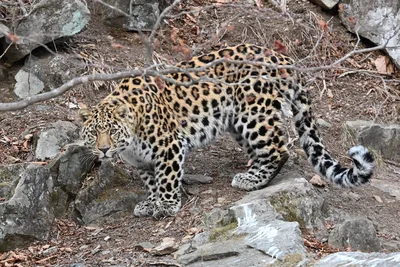 Leopard
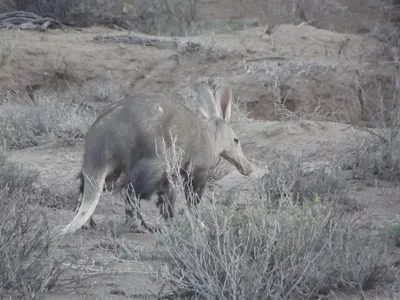 Aardvark
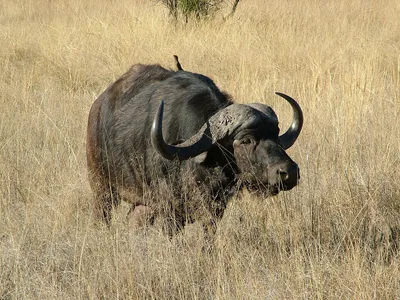 African buffalo
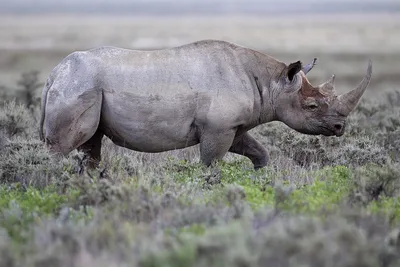 Black rhinoceros
Food web
Predators
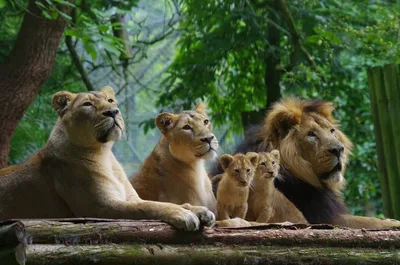 Lion
- rock pythons on occasion
Ecological equivalents
Related species on this site
Aardwolf (same family), Brown Hyena (same family), Hyena (same family), Striped hyena (same family), Abyssinian (same order), Affenpinscher (same order), and more.
 LC
Mammals
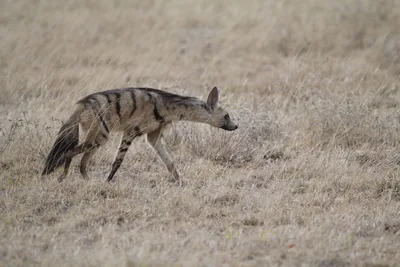
Aardwolf
Proteles cristata
The aardwolf is the smallest member of the hyena family and eats almost nothing but termites.
Living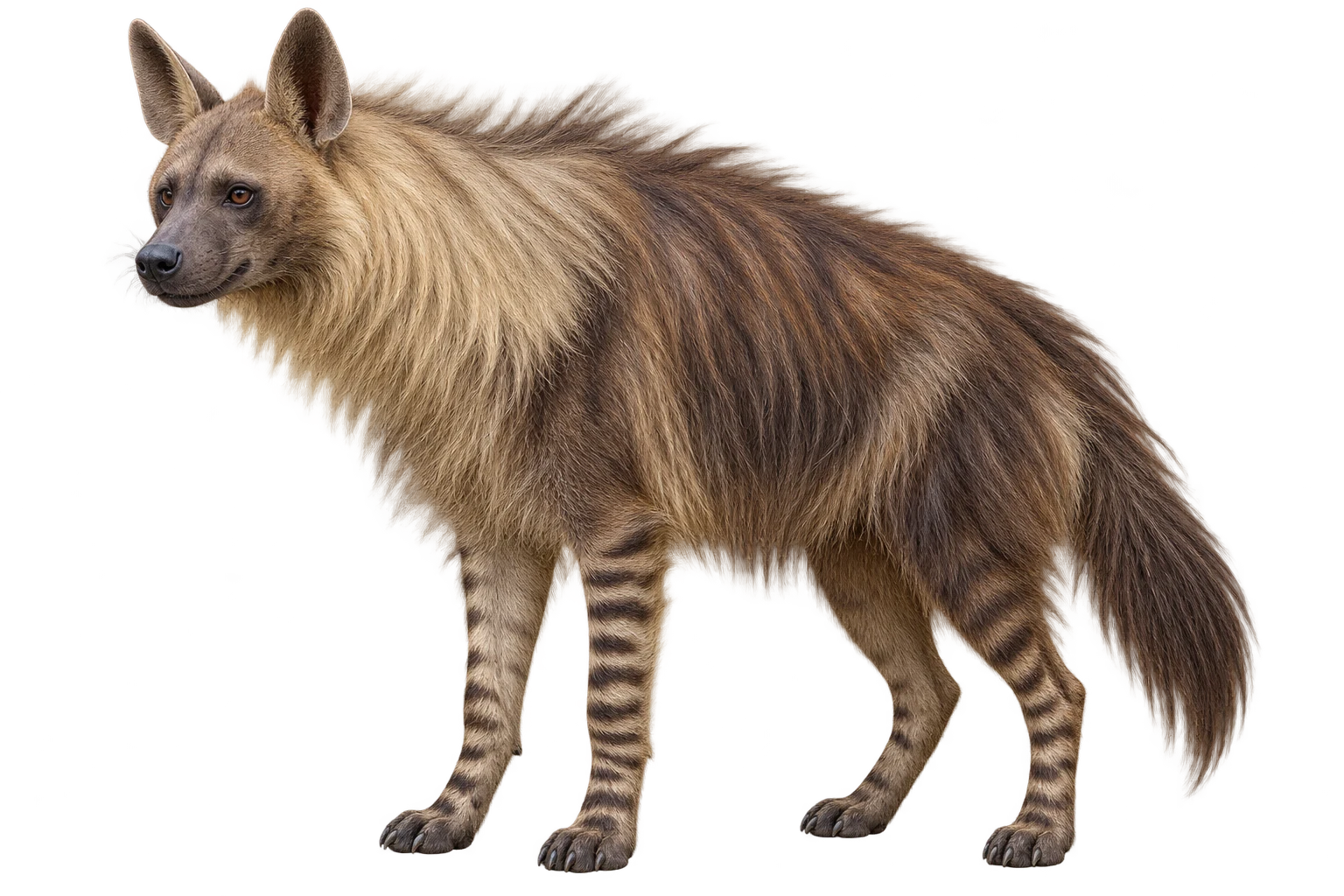
Mammals
Brown Hyena
Parahyaena brunnea
Classification and source reference
LivingAI illustration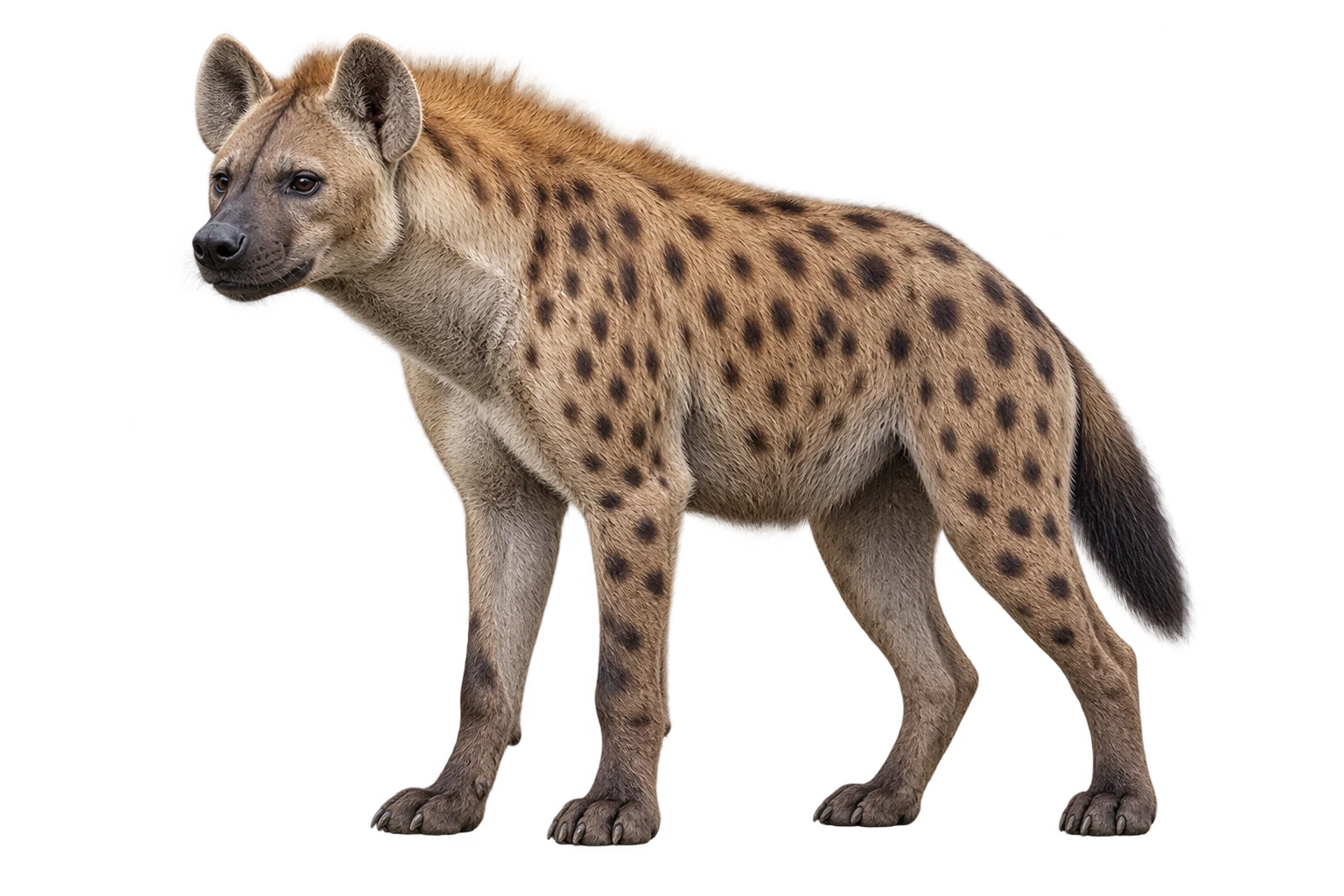
Mammals
Hyena
Hyaenidae
Classification and source reference
LivingAI illustration NT
Mammals
Striped hyena
Hyaena hyaena
The striped hyena is a small, shaggy scavenger of dry country from North Africa to India.
Living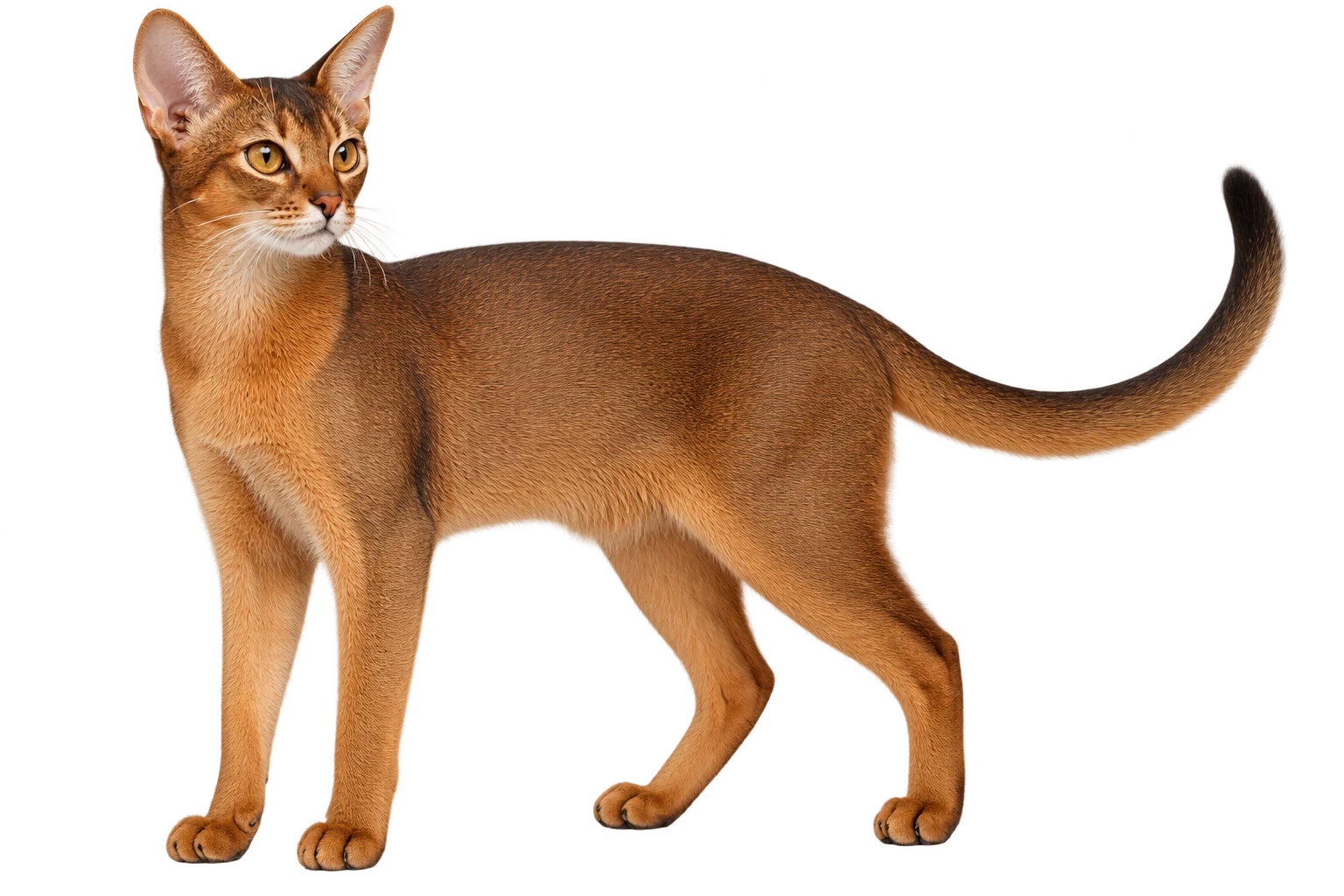
Mammals
Abyssinian
Felis catus
Classification and source reference
LivingAI illustration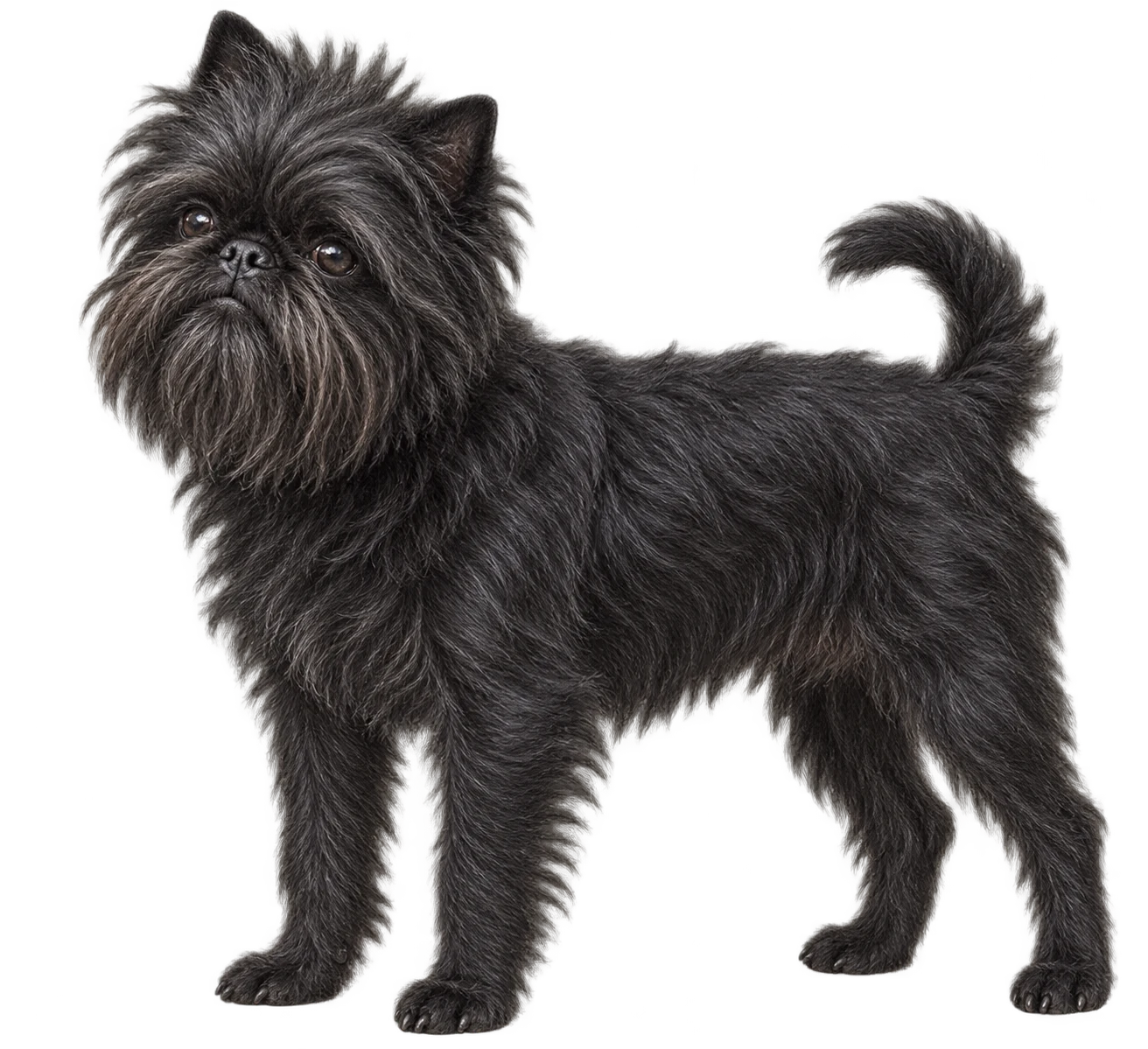
Mammals
Affenpinscher
Canis lupus familiaris
Classification and source reference
LivingAI illustration