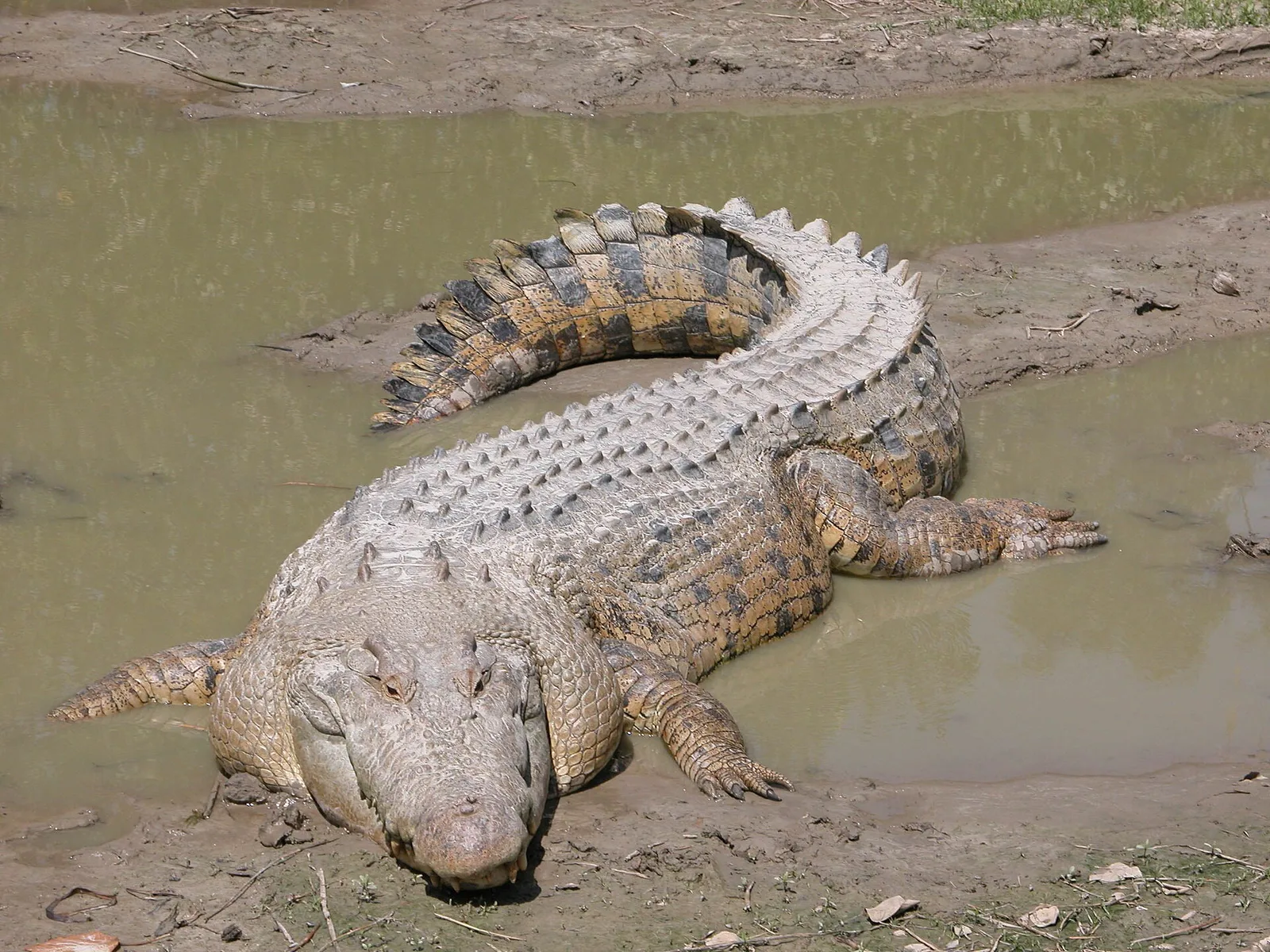
Saltwater crocodile
The largest reptile alive, with the strongest bite
Crocodylus porosus
Also called Estuarine crocodile, Saltie
Living individuals or members of this group exist today. This does not mean they are safe from extinction.
Meet the saltwater crocodile
The saltwater crocodile is the largest living reptile. It ambushes prey at the water's edge in estuaries and rivers from India to northern Australia.
Images of the saltwater crocodile


Lifespan in the wild
About 70 years an estimate
Weight
0.08 to 0.77 t
Length
2.7 to 4.5 m
Fact file
Saltwater crocodile
- Location
- Eastern India to northern Australia
- Habitat
- Coast, Wetlands, Rivers and lakes
- Diet
- Carnivore
- Prey / food
- Fish, birds, buffalo, wild boar, sharks
- Predators
- None as adults
- Lifestyle
- Mostly nocturnal
- Group name
- Bask or float
- Name of young
- Hatchling
- Incubation
- About 90 days of incubation
- Clutch size
- 40 to 60 eggs
- Biggest threat
- Habitat loss; hunting in the past
- Distinctive feature
- A broad snout and armoured back
- Colour
- Dark olive to grey
- Skin type
- Scales and bony plates
Size
Next to a person
Measurements
Size and speed
- Length
- 2.7 to 4.5 m, up to 6.3 m
- Length, male
- 4 to 4.5 m, up to 6.3 m
- Length, female
- 2.7 to 3.1 m, up to 4.3 m
- Weight
- 0.08 to 0.77 t, up to 1.5 t
- Weight, male
- 0.41 to 0.77 t, up to 1.5 t
- Weight, female
- 76 to 103 kg, up to 200 kg
Typical adult ranges. Source: Wikipedia.
Life cycle
Lifespan
- In the wildAbout 70 years an estimate
- In captivityUp to 57 years
- 057 years
Appearance
Colour and coat
- Primary colours
- dark olivegrey
- Secondary colours
- yellowblack
- Skin type
- scales and bony plates
- Male and female
- Extreme. Males measure 400 to 450 centimetres and weigh 408 to 770 kilograms, while females measure 270 to 310 cm and weigh 76 to 103 kg. A male can weigh 4 to 5 times as much as a female.
Life cycle
Mating and family
- Mating system
- polygynous, with territorial males
- Social structure
- solitary and territorial
- Breeding
- one clutch of 40 to 60 eggs in most wet seasons
Pairs court at the start of the wet season and the female builds a mound of mud and plants on a river bank. She lays 40 to 60 eggs and guards them for 80 to 98 days, and nest temperature sets the sex of the young. She digs the hatchlings out when they call and carries them to the water. Only about 1% survive to adulthood. Males mature at about 16 years, and Wikipedia estimates a life expectancy of 70 years.
Classification
Taxonomy
- Kingdom
- Animalia
- Phylum
- Chordata
- Class
- Reptilia
- Order
- Crocodilia
- Family
- Crocodylidae
- Genus
- Crocodylus
- Species
- Crocodylus porosus
Conservation
Red List status
- LC
- NT
- VU
- EN
- CR
- EW
- EX
Least Concern on the IUCN Red List
Range
Recorded in 16 countries
- Ashmore and Cartier Islands
- Bangladesh
- Brunei
- Indonesia
- India
- Sri Lanka
- Myanmar
- Malaysia
- Papua New Guinea
- Philippines
- Solomon Islands
- Singapore
- Thailand
- East Timor
- Vietnam
- Vanuatu
Habitat layer: flooded grassland and savanna, mangrove.
Countries from 7,183 wild records on GBIF (iNaturalist research grade), filtered and checked by hand. Country shapes: Natural Earth. Habitat: RESOLVE Ecoregions 2017, CC BY 4.0. Basemap: Natural Earth.
Habitats
Three things to know
- 1
Its bite is the strongest measured in any living animal.
- 2
It can cross hundreds of kilometres of open sea.
- 3
The temperature of the nest decides whether the eggs hatch male or female.
Did you know
Seven more facts
- 1
The name porosus means pored, after the sensory pits on the jaws.
- 2
Barnacles have been found growing on crocodiles that spent weeks at sea.
- 3
The jaw muscles that close the mouth are huge, but the ones that open it are so weak that tape can hold the jaws shut.
- 4
A hatchling weighs about 71 grams and grows into an animal that can pass 1,000 kilograms.
- 5
The Alligator Rivers in Arnhem Land were misnamed by explorers who took saltwater crocodiles for alligators.
- 6
A crocodile can hold its breath for up to two hours by slowing its heart.
- 7
Only about 1% of hatchlings live to become adults.
Field notes
How it looks and acts
Field notes
Distinguishing features
- A total length of 400 to 450 centimetres in males and 270 to 310 cm in females.
- A broad snout with a pair of ridges running forward from the eyes.
- Fewer neck armour plates than any other crocodilian.
- Dark olive to grey skin with a white or yellow belly.
- Yellow young with black stripes and spots.
- A grey tail with dark bands.
Field notes
Unique adaptations
- Salt glands let it live and hunt in the sea.
- Pressure sensors in pits on the jaws detect ripples from prey.
- A slow metabolism lets it survive months without food.
- A lowered heart rate allows dives of up to two hours.
- Huge jaw muscles deliver the strongest bite measured in any animal.
Field notes
Interesting behaviours
- Floats with only the eyes and nostrils above the water to ambush prey.
- Spins in a death roll to tear pieces from large prey.
- Rides ocean currents between river systems and waits in bays when the current turns.
- Basks on flat rocks in winter and stays in the water in summer.
- Guards its nest mound for 80 to 98 days and carries the hatchlings to water.
Field notes
Temperament
- The most aggressive and territorial of the crocodilians.
- Attacks boats and anything else that enters its territory.
- Wary of people where it has been hunted, and quick to submerge.
- Hatchlings fight each other within hours of reaching the water.
Field notes
Communication
- Short high barks from a juvenile in distress.
- A hiss or cough to threaten an intruder.
- A single bark from a hatchling still inside the egg.
- A long, low bellow from a courting male.
Ecology
Ecological role
The saltwater crocodile is the top predator of the estuaries and tidal rivers of the Indo-Pacific.
- Takes prey from crabs and fish to buffalo, so it shapes many populations at once.
- Helps control feral pigs and buffalo in northern Australia.
- Its eggs and hatchlings feed goannas, fish, birds and pythons.
- Probably moves nutrients between the sea and the rivers on its long journeys.
Stories
Myths and legends
- In Timorese tradition, a giant crocodile turned into the island of Timor, and the animal is holy.
- In Papuan tradition, the crocodile is an ancestor, usually a father or grandfather.
- In Wondjina belief among Indigenous Australians, the crocodile was banished from fresh water for harbouring bad spirits.
- In Larrakia tradition, the people descend from the crocodile and honour it as protector of the harbours.
- In Kakadu tradition, the crocodile Ginga is a creator being who guards sacred waters.
People
Relationship with humans
People
Living alongside us
People hunted the saltwater crocodile for its skin until the 1970s, and the trade nearly emptied northern Australia of crocodiles. Protection since 1971 has brought the Australian population back to 100,000 to 200,000 adults. The animal kills one or two people a year in Australia and more elsewhere. Farms now raise it for leather and meat, and tourists pay to see it. Its danger to people is the main obstacle to its protection in Asia.
- The species kills one or two people a year in Australia and took 106 lives there between 1971 and 2013.
- A predatory attack by a large crocodile is rarely survived once it makes contact.
- Territorial crocodiles attack boats and anything that enters their stretch of water.
People
Status, uses and products
- Domestication
- Wild
- As a pet
- Not suitable. A saltwater crocodile grows to over 4 metres and several hundred kilograms and will attack its keeper. Ownership is illegal in most places, and international trade is controlled by CITES.
- Uses
- ecotourismcrocodile farmingzoo exhibition
- Products
- leathermeateggs
The full account
About the saltwater crocodile
The saltwater crocodile, Crocodylus porosus, is the largest reptile alive today. Adult males measure 400 to 450 centimetres and weigh 408 to 770 kilograms, and the longest verified animal reached 630 cm. Females are far smaller, at 270 to 310 cm and 76 to 103 kg. The species lives in estuaries, mangrove swamps and rivers from the east coast of India through Southeast Asia to northern Australia. It is also called the estuarine crocodile, and Australians call it the saltie.
The crocodile hunts from the water and ambushes anything that comes to the edge, from mud crabs to water buffalo. Its bite is the strongest ever measured in a living animal. Unlike other crocodiles, it goes to sea, and tagged animals have ridden ocean currents for hundreds of kilometres. The IUCN lists it as Least Concern, though hunting for skins cut the Australian population by 95% before protection came in 1971. It kills one or two people a year in Australia and is one of the two crocodiles most likely to eat a human.
Name and taxonomy
Johann Gottlob Schneider described the species in 1801 as Crocodilus porosus. The name porosus means pored, after the tiny pits on the skull and jaws that hold pressure sensors. In 1807 Georges Cuvier gave the name Crocodilus biporcatus to 23 animals from India, Timor and Java, and later authors added more names. In 1985 Wells and Wellington proposed a new species, Crocodylus pethericki, for a heavy, short-tailed animal from the Finnis River. That animal turned out to be an old male with the changed body shape of great age.
Today the saltwater crocodile is treated as a single species with no subspecies. Some workers still think the Australian animals may deserve subspecies status apart from the Asian ones. It belongs to the genus Crocodylus in the family Crocodylidae and the order Crocodilia. Other English names include Indo-Pacific crocodile, marine crocodile and sea crocodile. In Tetum, the language of Timor, it is lafa'ek tasi, the large lizard of the ocean.
Evolution and relatives
Its nearest living kin are two Asian species, the Siamese crocodile and the mugger. Scientists once thought the genus Crocodylus arose in Australia or Asia. A phylogenetic study now points to an African origin, with later spread to Southeast Asia and the Americas. The line split from Voay, an extinct crocodile of Madagascar, about 25 million years ago, at the boundary of the Oligocene and Miocene.
Fossil remains of the species from northern Queensland date to the Pliocene. A 2018 study that combined fossils, anatomy and DNA placed the species within the true crocodiles, and a 2021 revision used DNA from Voay itself. Like other crocodilians, the saltwater crocodile has probably kept much the same body plan since the age of the dinosaurs.
Appearance
An average adult male measures 400 to 450 centimetres and weighs 408 to 770 kilograms. Old males can pass 6 metres, and the largest confirmed animal, which died in a net in Papua New Guinea in 1979, was 6.3 m. A male that size may weigh 1,000 to 1,500 kg. Females measure 270 to 310 cm and weigh 76 to 103 kg, and the largest on record was 430 cm. No other living crocodilian shows such a gap between the sexes: a male can weigh 4 to 5 times as much as a female.
The snout is broad for a crocodile, twice as long as it is wide, with a pair of ridges running back to the eyes. The neck carries fewer armour plates than any other crocodilian, which is why Timorese English calls it the naked-necked crocodile. The jaws hold 64 to 68 peg-like teeth, and the largest tooth measured 9 cm. The head of a big male can weigh over 200 kg on its own, most of it jaw muscle.
Young crocodiles are pale yellow, marked with black spots and stripes along the body and tail. Adults darken to a greenish drab or grey, and some become almost black. The belly is white or yellow at every age, and the tail is grey with dark bands. A hatchling measures about 28 cm and weighs about 71 grams.
Habitat and range
The saltwater crocodile lives in brackish mangrove swamps, river deltas, tidal rivers and freshwater rivers and billabongs. It tolerates salt better than any other crocodile, and it swims out to sea when it needs to. Crocodiles spend the wet season in freshwater swamps and rivers and move down to the estuaries in the dry season. Dominant males hold the best stretches of fresh water, and younger animals are pushed into poor rivers or out to sea.
The range runs from the Bhitarkanika sanctuary in Odisha, the Sundarbans and Sri Lanka through Myanmar, Malaysia, Borneo and Indonesia. It continues through the Philippines, Timor, Papua New Guinea, the Solomon Islands, Vanuatu and Palau to northern Australia. The species is now extinct in Cambodia, China, Thailand, Vietnam and the Seychelles. The Seychelles population, 3,000 km west of the next nearest, was wiped out about 200 years ago. Wanderers have turned up as far away as Fiji and, on three occasions, off Japan.
Northern Australia holds the stronghold, with an estimated 100,000 to 200,000 adults from Broome to Gladstone. The rivers near Darwin, the Adelaide, Mary and Daly, are full of them. In Singapore the only resident population lives in the Sungei Buloh Wetland Reserve. GBIF holds records from 31 countries, but that count includes zoos, farms and strays.
Diet and hunting
The saltwater crocodile eats the widest range of prey of any living crocodilian. Hatchlings take insects, frogs, small fish and small water invertebrates. Once a crocodile passes about 1.2 metres, fish, birds and small mammals replace the invertebrates. Mud crabs of the genus Scylla are a staple in mangroves, and magpie geese are the birds most often taken. Adults kill sambar deer, wild boar, kangaroos, feral pigs, water buffalo, banteng, gaur and, on occasion, tigers and people.
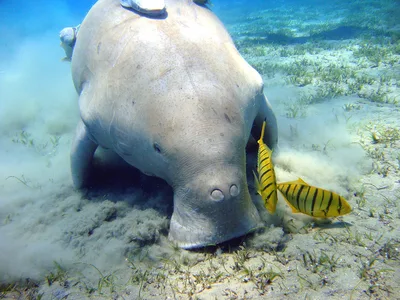
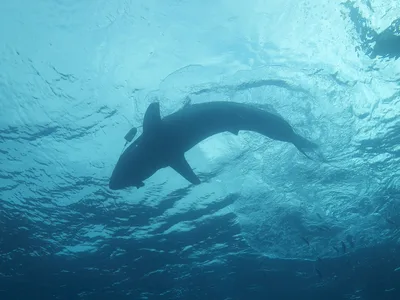
At sea it takes bony fish, sea snakes, sea turtles, dugongs, rays and small sharks, mostly near the shore. Bull sharks are the only large shark that enters its rivers. Deep-sea fish have been found in stomachs, which shows the crocodile hunts far from land as well. It can eat cane toads in small amounts, unlike the freshwater crocodile, which the toads kill.
The hunt is an ambush. The crocodile floats with only its eyes and nostrils showing, sinks, swims quietly to the prey and lunges upward. It does not hunt on dry land. The teeth grip but do not cut, so small prey is swallowed whole and large prey is dragged under and drowned. To tear off a piece, the crocodile clamps on and spins its whole body, the death roll. A 531 kg animal bit with a force of 16,414 newtons in the laboratory, the highest ever recorded.
Behaviour and social life
The saltwater crocodile is the least social and most aggressive of the crocodilians. Adults defend territories, and a male that cannot win a stretch of river is killed or driven out to sea. Even so, the social system shifts with the season and with age and sex. Some pairs keep company for up to five years. The brain is tiny, about 0.05% of body weight, yet captive animals learn tasks quickly and track the seasonal routes of their prey.
The crocodile spends most of the day floating or basking and hunts mainly at night. It is more active in the Australian summer and basks more in winter. When too hot, it slips into the water with only eyes and nostrils showing. When too cold, it lies on a flat rock in the sun. It can go months without a meal.
Satellite tags on 20 Australian crocodiles showed that 8 went out to sea. One travelled 590 km around Cape York in 25 days by riding the current and waiting in bays when it turned. Another swam 411 km in 20 days. Some animals stay at sea long enough for barnacles to grow on their scales. A crocodile can slow its heart and stay under for up to two hours, and it has been recorded at a depth of 15 metres.
Communication and senses
Animal Diversity Web credits the species with about four calls. A juvenile in trouble gives short, high barks. An adult threatens with a hiss or a cough. A hatchling still in the egg gives a single short bark, and its mother digs the nest open when she hears it. During courtship a male bellows, a long low growl.
The pores that give the species its name hold pressure sensors that feel ripples from an animal moving in the water. Like other crocodiles, it probably sees and hears well both above and below the surface. The web notes report that a crocodile can rest one half of its brain while the other half stays alert. Researchers suspect the species communicates in richer ways than science has yet shown.
Reproduction and life cycle
Males mature at about 3.3 metres and 16 years, females at about 2.1 m and 12 to 14 years. Breeding takes place in the wet season, when the water is highest. In Australia courtship happens in September and October, and laying follows between November and March. Most females nest every year, but some skip a year and one tried to raise two broods in a single season.
The female picks the site, and both parents guard the stretch of shore around it. The mound, built from mud and plants, is about 175 cm long and 53 cm high, often in an open spot with little shade. A clutch usually holds 40 to 60 eggs and can reach 90. Each egg is about 8 by 5 cm and weighs 113 grams in Australia and 121 grams in India. The female guards the mound for 80 to 98 days, yet flooding destroys more eggs than any predator.
Nest temperature decides the sex. At 28 to 30 degrees every hatchling is female, at 30 to 32 degrees 86% are male, and above 33 degrees most are female again. Goannas take about 25% of eggs, far fewer than they take from the freshwater crocodile, because the mother is on guard. When she hears the hatchlings call, she opens the nest and rolls stubborn eggs in her mouth to help them hatch. Then she carries the young to the water in her jaws. She stays with them for several months.
Hatchlings fight each other almost at once, and only about 1% reach adulthood. The young disperse at about 8 months and become territorial at about 2.5 years. Wikipedia estimates a life expectancy of 70 years or more, and some animals may pass 100, though no such age has been verified. The AnAge record for a captive animal is 57 years.
Predators and threats
An adult has no natural predator. Hatchlings are eaten by goannas and water monitors, barramundi, wild boar, bandicoot rats, storks, kites, water pythons and freshwater crocodiles. Turtles, mongooses and even ants take some. Older crocodiles of their own species kill many of the rest. Feral pigs and cattle trample nests and eggs.
People were the real threat. The skin is the most valuable of any crocodilian, and unregulated hunting from 1940 to 1970 emptied rivers across the range. By 1971 the population of northern Australia had fallen by 95%. Illegal hunting continues in some countries, and coastal development removes nesting habitat. In the Andaman Islands the freshwater nesting areas are being turned into farmland. In July 2018 a mob of 600 people killed 292 crocodiles in Papua, Indonesia, after one of the animals killed a man.
Population and conservation
The IUCN has listed the saltwater crocodile as Least Concern since 1996. The Australian population of 100,000 to 200,000 adults drives that rating. Queensland lists the species as Vulnerable, and in Singapore it is Critically Endangered. iNaturalist holds 10,341 observations of the species.
Western Australia protected the species in 1970, the Northern Territory in 1971 and Queensland in 1974. CITES Appendix I bans commercial trade in most wild populations, while the Australian, Indonesian and Papua New Guinean animals fall under Appendix II. Recovery is uneven: in Sri Lanka and Palau fewer than 10% of crocodiles seen are adult size, and no big males remain. In Bhitarkanika and Sabah, healthier populations, 28% and 24.2% of animals seen pass 3 metres.
India released more than 1,400 crocodiles at Bhitarkanika, of which about 580 survived, and the country now holds about 1,000. Southern Vietnam, which once had thousands, was down to about 100 wild animals. Australia counts its crocodiles every year, runs farms to hold a breeding stock and teaches the public how to stay safe. Papua New Guinea combines wild harvest, egg and hatchling collection and ranching. A 2022 isotope study found that a switch to feral pigs and buffalo helped Australian crocodiles recover faster.
Relationship with humans
The saltwater crocodile and the Nile crocodile are the two crocodilians most likely to eat people. Australia reports one or two fatal attacks a year, and 106 people died there between 1971 and 2013. Warning signs at billabongs, rivers and beaches keep that number low. In Sarawak, Borneo, fatal attacks averaged 2.8 a year from 2000 to 2003. One study suggests 20 to 30 attacks a year go unreported across Asia. About half of attacks are territorial rather than predatory, and people often survive those.
Fatal attacks tend to involve large animals averaging 4.3 metres. Many crocodiles are wary of people and sink and swim away, especially where they have been hunted. Relocating a problem crocodile rarely works, because it finds its way home. Old claims of thousands of deaths a year were probably invented by leather firms and hunters to blacken the animal's name. The story that crocodiles killed over 400 Japanese soldiers on Ramree Island in 1945 is doubted by historians.
Crocodile farms in Australia, Myanmar, Papua New Guinea and elsewhere raise the species for leather and meat. Eggs are also harvested. Crocodile parks and river cruises make the animal a tourist attraction across northern Australia. The species' danger to people remains the biggest obstacle to public support for its protection.
In culture and myth
On Timor the crocodile is holy, and legend says a giant crocodile became the island itself. Papuan peoples tell a similar story and speak of the crocodile as a father or grandfather. In Wondjina belief, held by Indigenous Australians, the saltwater crocodile was driven out of fresh water for growing too large and filling with bad spirits. The Larrakia people of the Darwin area take the crocodile as their totem, call themselves its descendants and refuse to eat its meat. In Kakadu the creator being Ginga is a crocodile and guards sacred waters.
Rock paintings of the species in Kakadu and Arnhem Land are up to 3,000 years old. Stamps have carried the crocodile since an 1894 North Borneo issue, and Australia printed a rock-art crocodile in 1948. The Crocodile Dundee films, two horror films, Rogue and Black Water, and The Crocodile Hunter series all built on the animal's reputation. The Malay epic Hikayat Hang Tuah, written between 1641 and 1739, called the Singapore Strait a place of man-eating crocodiles.
A sentence with a dotted underline is inferred: it describes the group the animal belongs to, or is a reading of the sources, rather than a measured or reported fact about this species.
Questions
Saltwater crocodile questions, answered
How big is a saltwater crocodile?
An adult male measures 400 to 450 centimetres and weighs 408 to 770 kilograms. The longest verified animal was 630 cm. Females are much smaller, at 270 to 310 cm and 76 to 103 kg.
Is the saltwater crocodile the largest reptile?
Yes. It is the largest living reptile and the largest predator that lives along rivers. Old males can pass 6 metres and weigh 1,000 to 1,500 kg.
How strong is a saltwater crocodile's bite?
A 531 kg crocodile bit with 16,414 newtons in a laboratory test, the strongest bite ever measured in a living animal. The muscles that open the jaw are weak by comparison.
Where do saltwater crocodiles live?
They live in estuaries, mangrove swamps and rivers from eastern India and Sri Lanka through Southeast Asia and New Guinea to northern Australia. Northern Australia holds by far the largest population.
What do saltwater crocodiles eat?
Almost anything that comes to the water. Young crocodiles eat insects, crabs and fish. Adults take fish, birds, turtles, wild boar, deer, water buffalo, sharks and, on occasion, people.
How dangerous are saltwater crocodiles to humans?
Very. Australia records one or two deaths a year, and 106 people died there between 1971 and 2013. Attacks in Asia often go unreported. The only safe policy is to stay out of their water.
Can saltwater crocodiles live in the sea?
Yes. Salt glands let them drink and hunt in salt water. Tagged animals have ridden ocean currents for hundreds of kilometres, and strays have reached Fiji and Japan.
How long do saltwater crocodiles live?
Wikipedia estimates a life expectancy of 70 years or more in the wild. AnAge records a captive animal that reached 57 years. Claims of crocodiles over 100 have never been verified.
How many eggs does a saltwater crocodile lay?
A female usually lays 40 to 60 eggs in a mound of mud and plants, and some clutches reach 90. She guards them for 80 to 98 days.
Does nest temperature decide the sex of crocodiles?
Yes. At 28 to 30 degrees all hatchlings are female. At 30 to 32 degrees most are male, and above 33 degrees most are female again.
Are saltwater crocodiles endangered?
No. The IUCN lists them as Least Concern because Australia holds 100,000 to 200,000 adults. Populations in Sri Lanka, Vietnam and other parts of Asia remain small, and Singapore lists them as Critically Endangered.
How fast can a saltwater crocodile swim?
No measured speed appears in our sources. What is known is stamina: a tagged crocodile covered 590 kilometres in 25 days by riding currents, and another swam 411 km in 20 days.
What is the difference between a saltwater and a freshwater crocodile?
The saltwater crocodile is far larger, with a broader snout and fewer armour plates on its neck. It enters the sea and attacks people, while the Australian freshwater crocodile is smaller and shy. Freshwater crocodiles die from eating cane toads; salties can eat a few.
How long can a saltwater crocodile stay underwater?
It can slow its heart and stay under for up to two hours. It has been recorded at a depth of 15 metres and can probably go deeper.
Do saltwater crocodiles care for their young?
Yes. The mother guards the nest, digs the hatchlings out when she hears them call and carries them to the water in her mouth. She remains with them for some months afterwards.
What was the largest saltwater crocodile ever recorded?
The largest confirmed animal was estimated at 630 centimetres after it drowned in a net in Papua New Guinea in 1979. Lolong, caught in the Philippines, measured 6.17 m and weighed 1,075 kg. Claims of 8 to 10 m animals have never stood up to examination of the skull.
Food web
Prey and food
- fish
- birds
 American bison
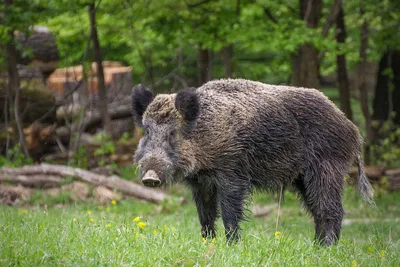 Wild boar
- sharks
 Platypus
 Dugong
Food web
Predators
No natural predator is recorded.
Ecological equivalents
Related species on this site
Freshwater Crocodile (same genus), Nile Crocodile (same genus), Orinoco Crocodile (same genus), Deinosuchus (same family), Dwarf Crocodile (same family).
Reptiles
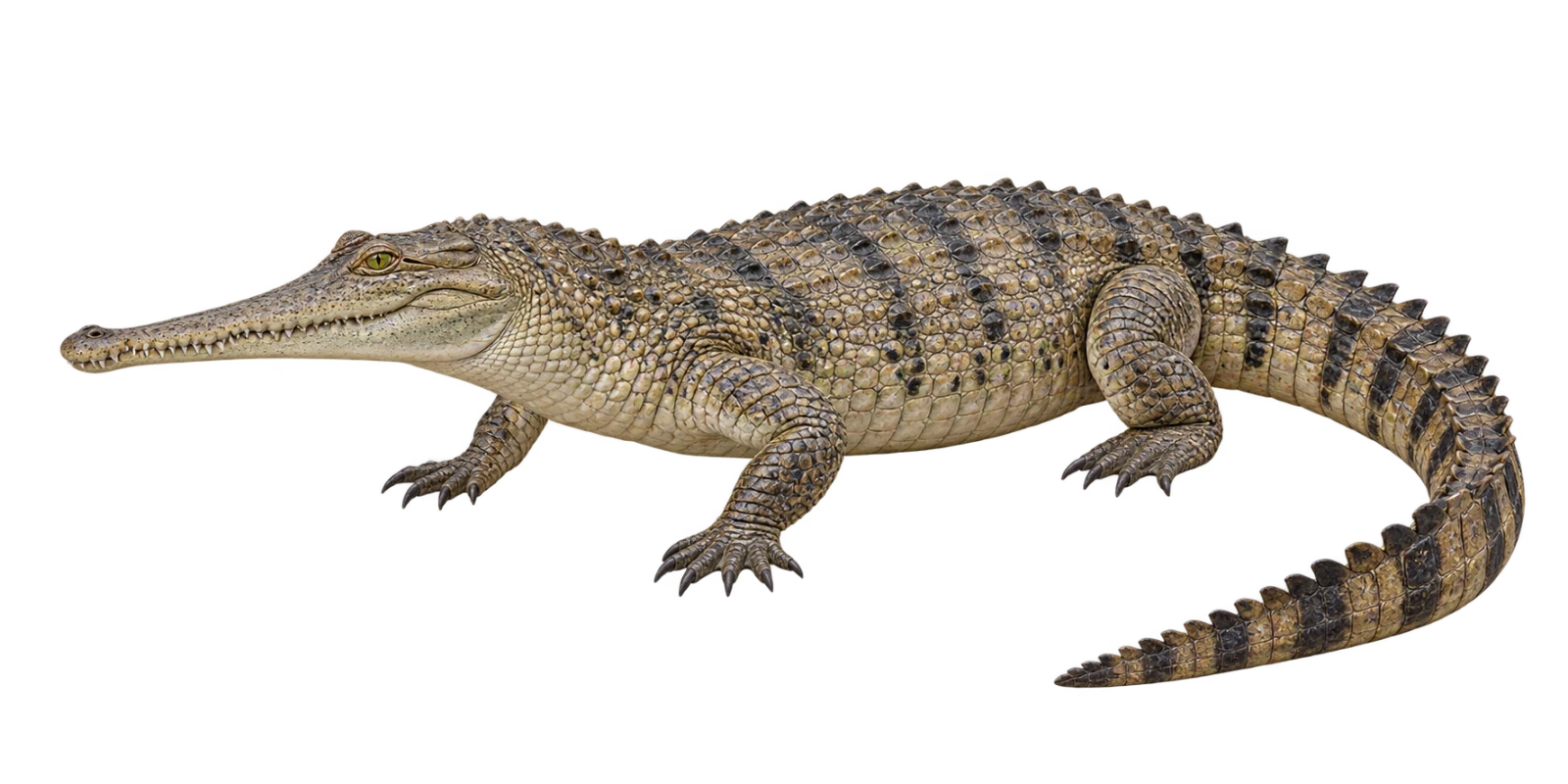
Freshwater Crocodile
Crocodylus johnstoni
Classification and source reference
LivingAI illustration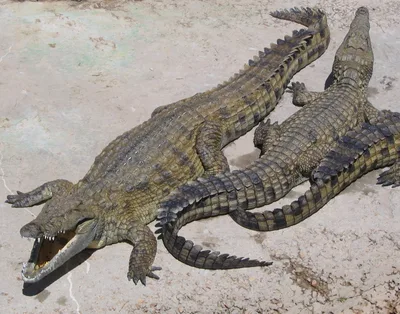
Reptiles
Nile Crocodile
Crocodylus niloticus
The Nile crocodile is a large African crocodilian that hunts in and around water.
Living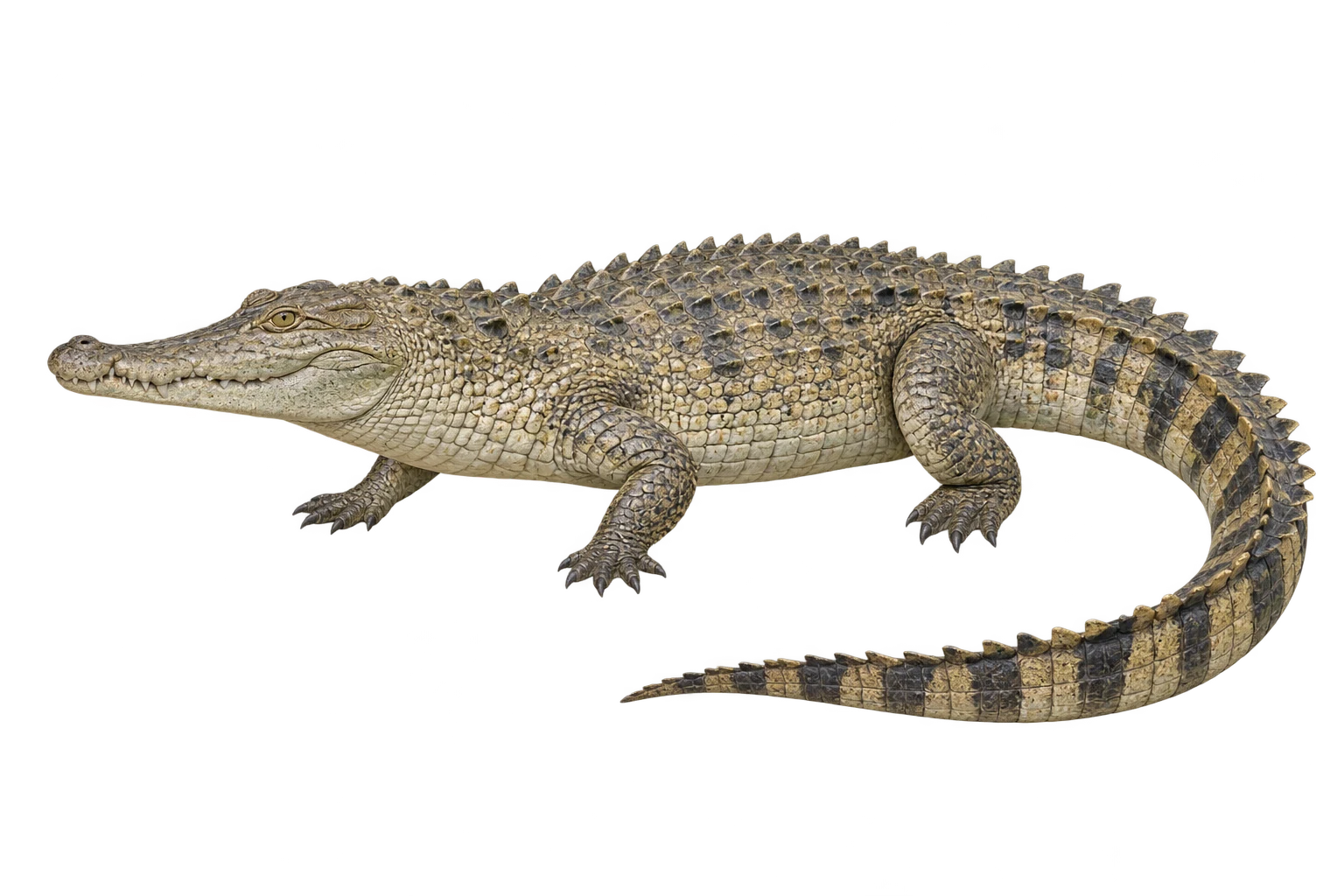
Reptiles
Orinoco Crocodile
Crocodylus intermedius
Classification and source reference
LivingAI illustration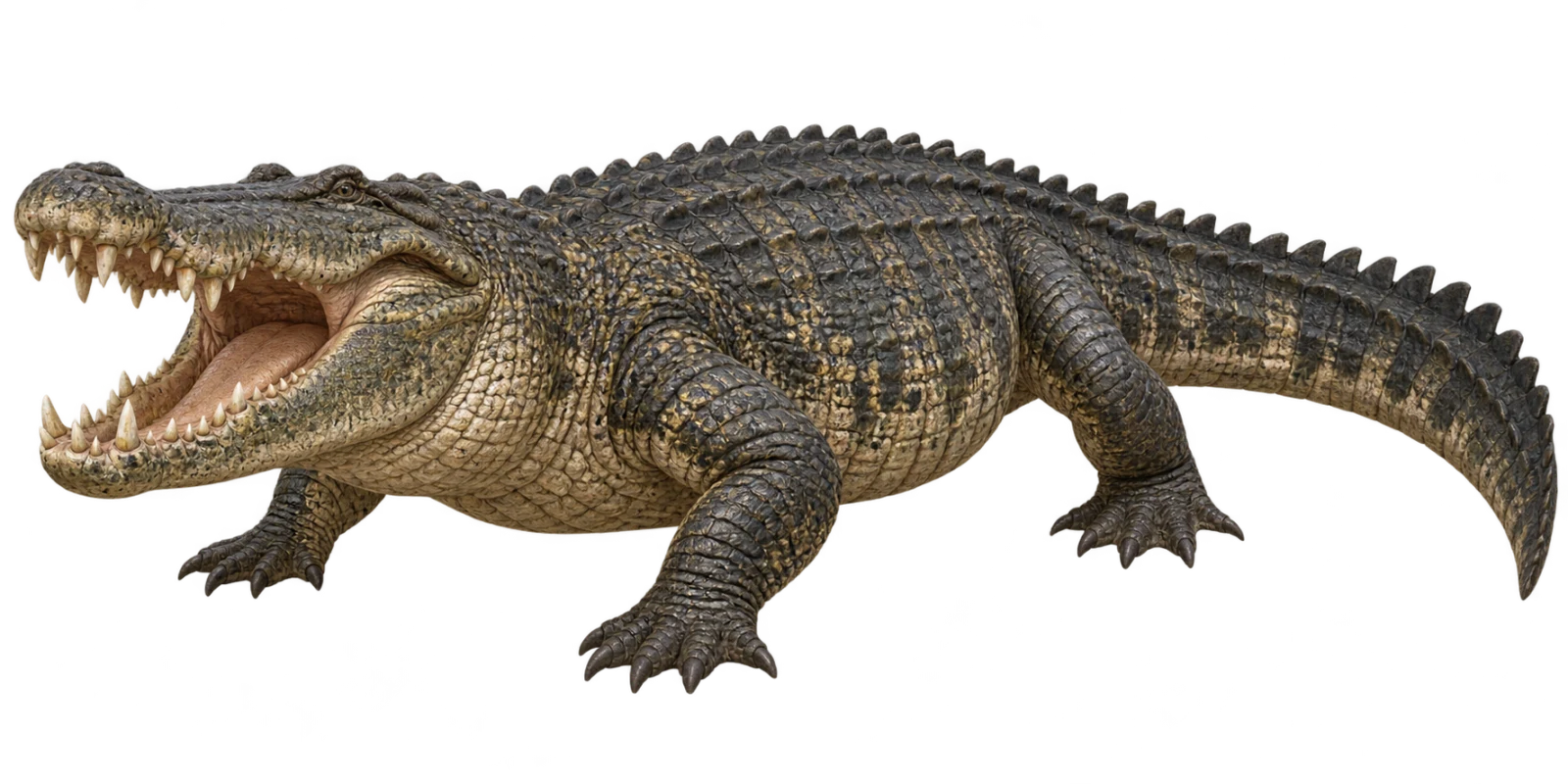
Reptiles
Deinosuchus
Deinosuchus
Classification and source reference
ExtinctAI reconstruction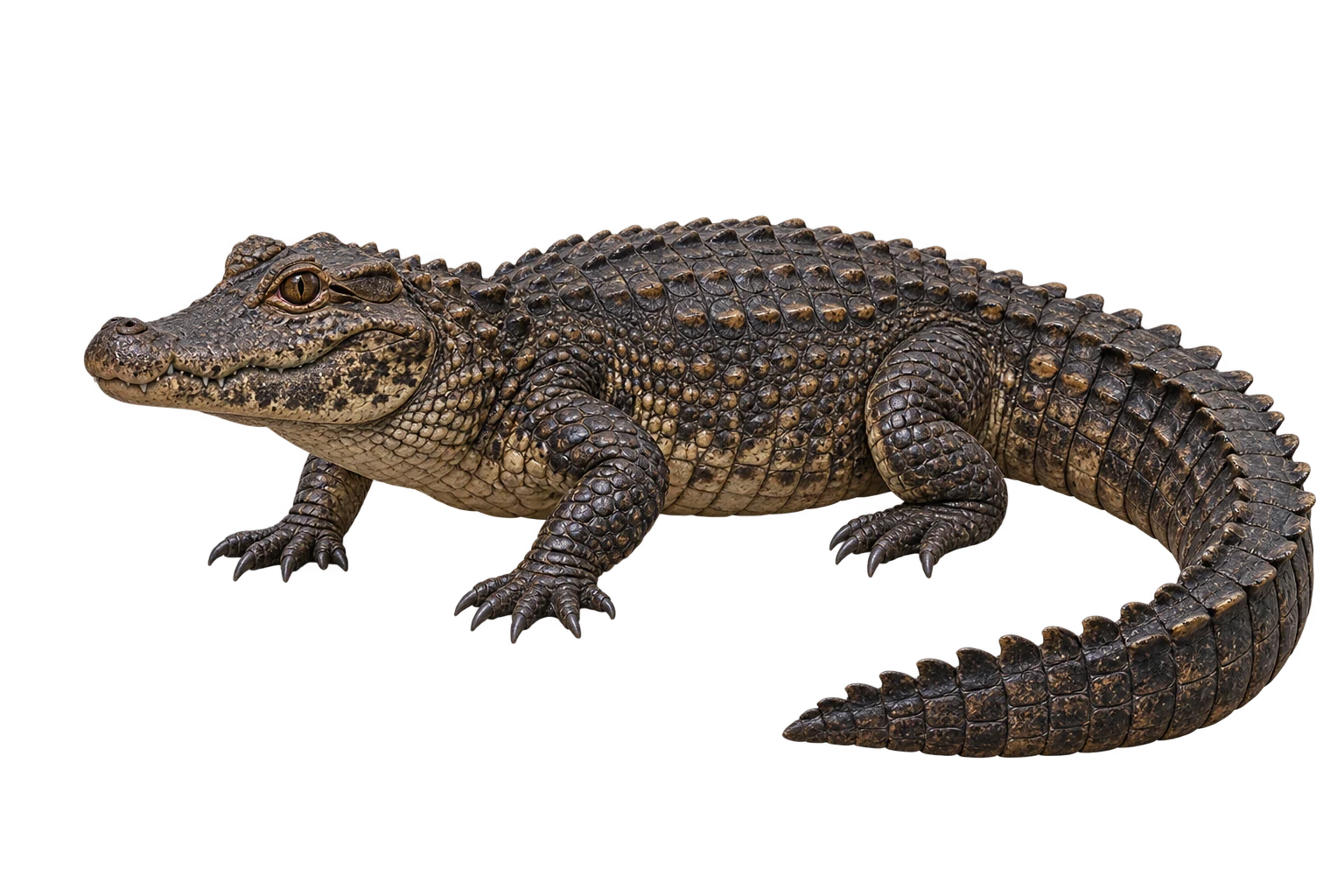
Reptiles
Dwarf Crocodile
Osteolaemus tetraspis
Classification and source reference
LivingAI illustration