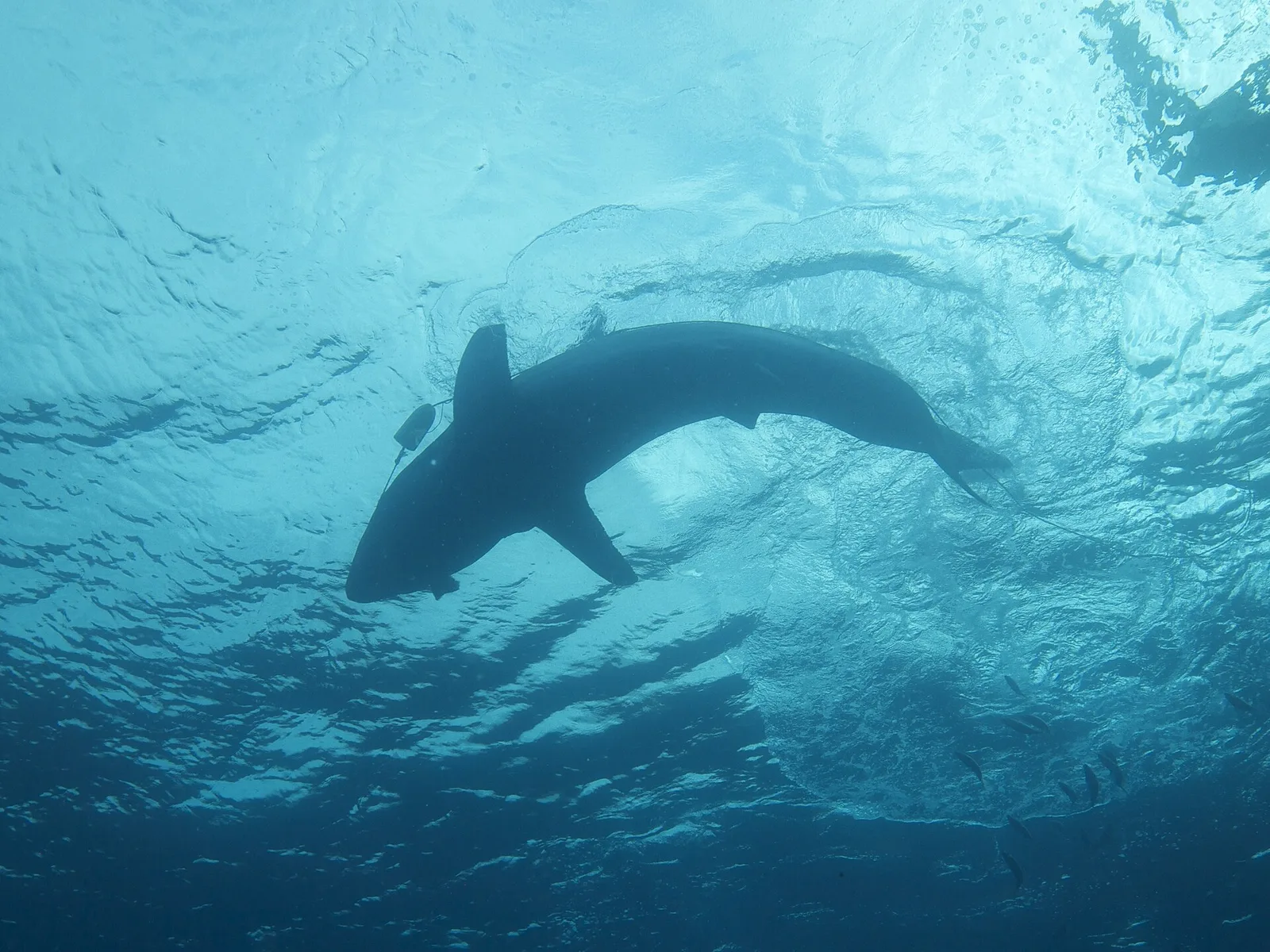
Great white shark
The largest hunting fish, and a warm-blooded one
Carcharodon carcharias
Living individuals or members of this group exist today. This does not mean they are safe from extinction.
Meet the great white shark
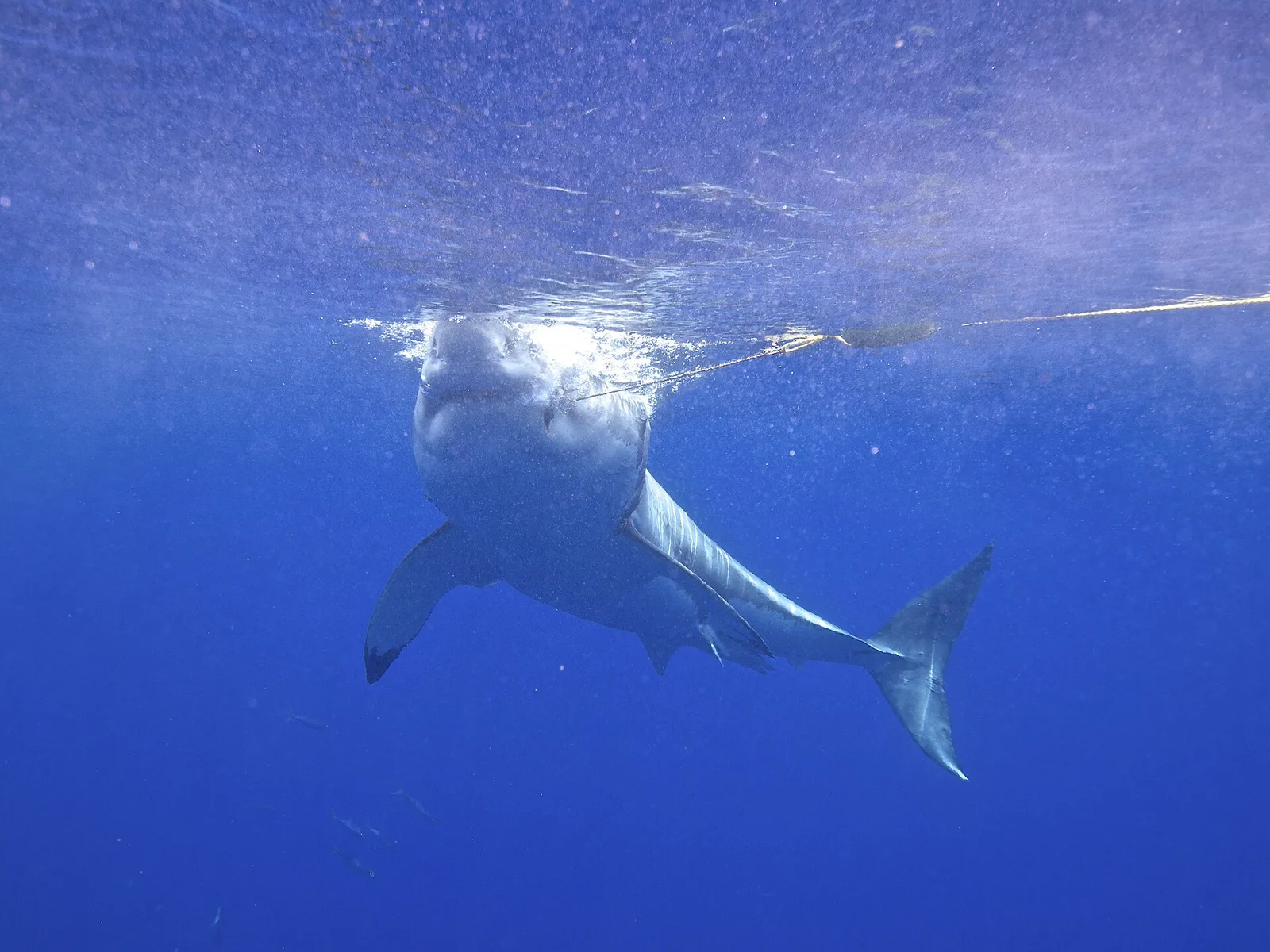
The great white shark is the largest predatory fish. It hunts seals from below in cool coastal seas and crosses whole oceans on long migrations.
Images of the great white shark
Lifespan in the wild
Up to 73 years
Weight
0.68 to 1.9 t
Length
4 to 7 m
Top speed
2.88 to 4.86 km/h
Fact file
Great white shark
- Location
- Cool coastal waters worldwide
- Habitat
- Open ocean, Coast
- Diet
- Carnivore
- Prey / food
- Seals, sea lions, fish, dolphins, whale carcasses
- Predators
- Orcas
- Lifestyle
- Diurnal
- Group name
- School or shiver
- Name of young
- Pup
- Incubation
- About 12 months
- Clutch size
- 2 to 10 pups
- Biggest threat
- Fishing bycatch and trophy hunting
- Distinctive feature
- A conical snout and serrated triangular teeth
- Colour
- Grey above, white below
- Skin type
- Rough skin of tooth-like scales
Size
Next to a person
Measurements
Size and speed
- Length
- 4 to 7 m
- Weight
- 0.68 to 1.9 t
- Weight, male
- 0.68 to 1 t
- Weight, female
- 1 to 1.9 t
- Top speed
- 2.88 to 4.86 km/h, up to 24.1 km/h swimming
Typical adult ranges. Sources: Wikipedia, Animal Diversity Web.
Life cycle
Lifespan
- In the wildUp to 73 years
- 073 years
The pale bar is the record. Source: Wikidata.
Appearance
Colour and coat
- Primary colours
- greywhite
- Secondary colours
- blue-greyblack
- Skin type
- rough skin of tooth-like scales
- Male and female
- Females are larger. They mature at 4.6 to 4.9 metres and weigh 1,000 to 1,900 kilograms. Males mature at 3.4 to 4.0 metres and weigh 680 to 1,000 kg.
Life cycle
Mating and family
- Mating system
- unknown in detail, possibly a lek with female choice
- Social structure
- solitary, with size-ranked gatherings at feeding sites
- Breeding
- 2 to 10 pups every two to three years after a 12 month gestation
Mating has been seen only twice, off New Zealand. The eggs hatch inside the mother, and the pups feed on yolk, uterine milk and unfertilised eggs. After about 12 months she bears 2 to 10 pups of 1 to 1.6 metres in shallow water near islands. She does not breed again for at least two years. Males mature at about 26 years and females at about 33, and the shark lives past 70.
Classification
Taxonomy
- Kingdom
- Animalia
- Phylum
- Chordata
- Class
- Fish (several classes)
- Order
- Lamniformes
- Family
- Lamnidae
- Genus
- Carcharodon
- Species
- Carcharodon carcharias
Conservation
Red List status
- LC
- NT
- VU
- EN
- CR
- EW
- EX
Vulnerable on the IUCN Red List
Range
Recorded in 8 countries
- Ashmore and Cartier Islands
- Canada
- Greece
- Japan
- Mexico
- New Zealand
- United States of America
- South Africa
Habitat layer: mangrove.
Countries from 791 wild records on GBIF (iNaturalist research grade), filtered and checked by hand. Country shapes: Natural Earth. Habitat: RESOLVE Ecoregions 2017, CC BY 4.0. Basemap: Natural Earth.
Habitats
Three things to know
- 1
It can sense the electrical field of a heartbeat.
- 2
A great white replaces its teeth throughout its life.
- 3
Pups are born about 1.2 m long and fully able to hunt.
Did you know
Seven more facts
- 1
A pup is born 1 to 1.6 metres long and can hunt at once.
- 2
Pups eat unfertilised eggs inside the mother before they are born.
- 3
It must swim without stopping, because water only reaches its gills when it moves.
- 4
It has no third eyelid, so it rolls its eyes back when it bites.
- 5
Females may not mature until about 33 years of age.
- 6
It tolerates more mercury and arsenic in its blood than most vertebrates.
- 7
A 2.5 metre juvenile bit with 3,131 newtons at the back of its jaw in a computer model.
Field notes
How it looks and acts
Field notes
Distinguishing features
- A cone-shaped snout on a stocky torpedo body.
- Grey above and white below, with black tips under the pectoral fins.
- Broad triangular teeth with serrated edges, up to 7.5 centimetres.
- A tail with two lobes of nearly equal size and a keel.
- A length of 4 to 7 metres in adults.
- Eyes that look solid black.
Field notes
Unique adaptations
- A network of blood vessels that keeps muscles, eyes and gut warm in cold water.
- Electroreceptors that sense the heartbeat of hidden prey.
- A fatty liver for buoyancy and for fuel on long migrations.
- Countershading that hides it from prey above and below.
- Fast wound healing, backed by selection on healing genes.
Field notes
Interesting behaviours
- Ambushes seals from below and drags them under.
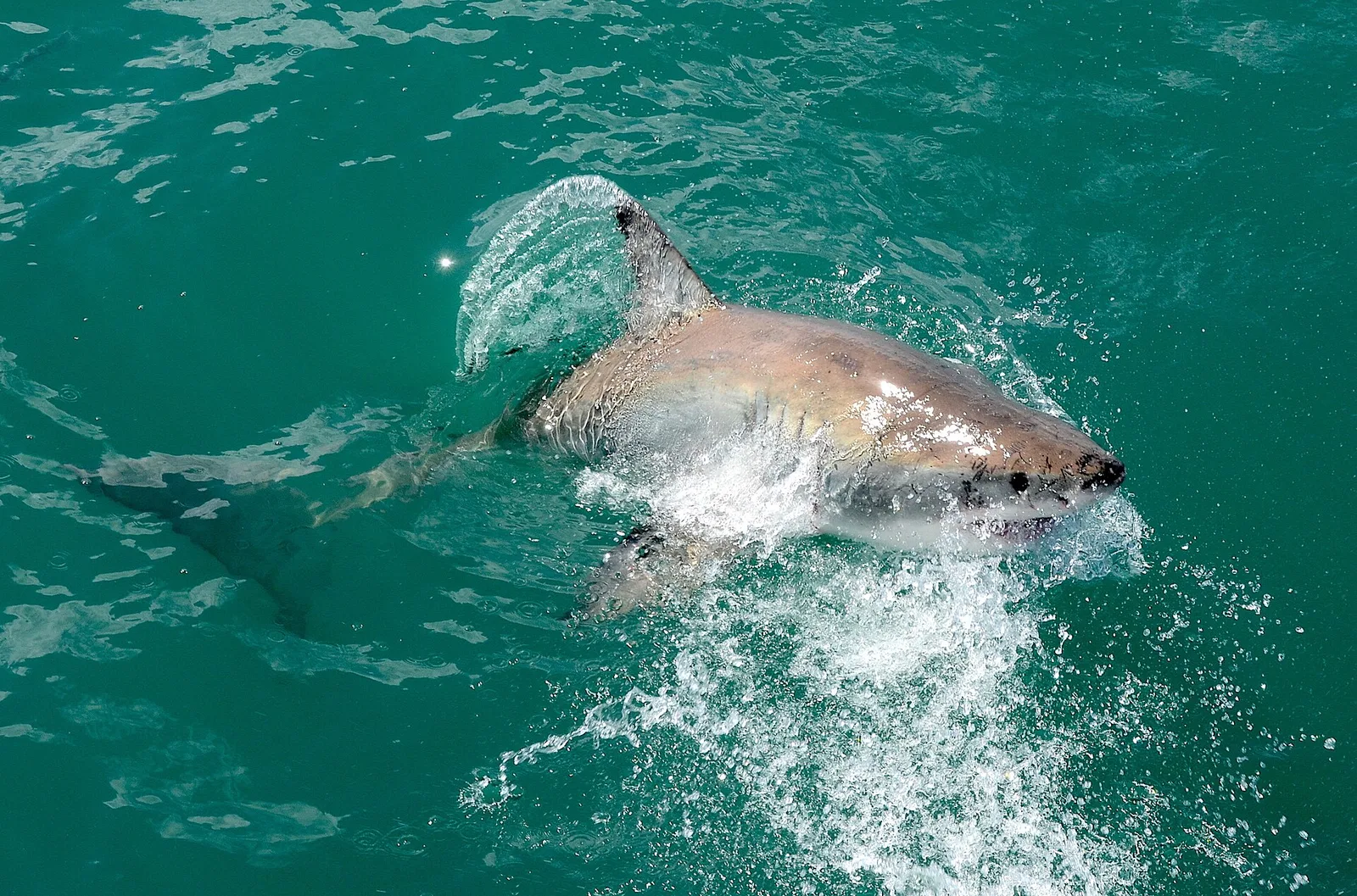
- Leaps clear of the water when it strikes fur seals off South Africa.
- Lifts its head above the surface to look around.
- Migrates across whole oceans with the seasons.
- Gorges on whale carcasses beside other sharks.
Field notes
Temperament
- Solitary but tolerant of other sharks at a carcass.
- Settles disputes by display and tail splashing, rarely by biting.
- Curious, and it tests unknown objects, including boats and people, with a bite.
- Retreats when orcas appear.
Field notes
Communication
- At least 20 forms of body language, mostly parallel or circling swims.
- A side-on display to show size.
- Tail splashes to contest food.
- Gaping at the surface, possibly in frustration after a missed bait.
Ecology
Ecological role
The white shark is a top predator that shapes seal and sea lion populations along temperate coasts.
- Takes weaned seal pups and so limits seal numbers near its feeding sites.
- Cleans up whale carcasses with other scavengers.
- Hosts up to 116 parasite species, including two tapeworms found in no other host.
- Serves as prey for orcas and competes with them for seals.
Stories
Myths and legends
- In Maori tradition, sharks guard people and guide canoes across the sea.
- In Aboriginal Australian tradition, the shark is a clan totem and a creator.
- In Hawaiian tradition, a shark may be an aumakua that protects a family.
- In Japanese tradition, a shark tattoo brings strength and protection.
- In popular Western belief since Jaws, the white shark hunts people, which the science does not support.
People
Relationship with humans
People
Living alongside us
The white shark has bitten more people than any other shark, with 351 unprovoked bites and 59 deaths recorded since 1580. Most bites are single test bites, and the shark does not hunt people. Jaws made it the most feared fish on Earth and drove decades of trophy fishing. Today it is protected in most of its range, and cage diving earns more from a living shark than a dead one.
- A single bite can be fatal, and 59 people have died from white shark bites since records began in 1580.
- Most bites are exploratory, and the shark usually bites once and leaves.
- Fatality rates vary by region, from about 7 percent off the western United States to more than 20 percent off South Africa.
People
Status, uses and products
- Domestication
- Wild
- As a pet
- Not suitable. No aquarium has kept an adult. Monterey Bay Aquarium held young sharks for at most 198 days in a huge tank before they outgrew it and had to be released.
- Uses
- cage-diving tourismsport fishingscientific research
- Products
- jawsteethfinsmeatliver oilskin
The full account
About the great white shark
The great white shark, Carcharodon carcharias, is the largest predatory fish in the sea. Only the whale shark and the basking shark, both filter feeders, grow larger. Adults measure 4 to 7 metres and weigh 680 to 1,900 kilograms, with females the larger sex. The body is grey above and white below, and the mouth holds about 300 triangular serrated teeth. It belongs to the mackerel shark family, Lamnidae, with the makos, the porbeagle and the salmon shark.
It hunts seals, sea lions and dolphins in cool coastal water, and it scavenges dead whales. It can warm its muscles, eyes and gut above the water temperature, which lets it stay active in cold seas. Tagged sharks have crossed from South Africa to Australia and back within a year. The species has bitten more people than any other shark, but most bites are single exploratory bites. The IUCN lists it as Vulnerable worldwide and Critically Endangered in European waters.
Name and taxonomy
Carl Linnaeus named the species Squalus carcharias in 1758, in the same genus as every other shark he knew. Sir Andrew Smith created the genus Carcharodon for it in 1838. The genus name joins the Greek karkharos, sharp, with odon, tooth. The species name carcharias is simply the ancient Greek word for a shark. Pierre Belon had already drawn it in 1553 as Canis carcharias, and Guillaume Rondelet called it Lamia after a child-eating monster.
The white belly gives the animal its English names: great white, white shark and, in Australia, white pointer. Scientists mostly say white shark, because there is no lesser white shark to set it against. GBIF lists dozens of local names, among them the Spanish devorador de hombres, the man-eater, and the English grey death. It is the only living species in its genus and one of five in the family Lamnidae, within the order Lamniformes.
Evolution and relatives
The white shark first appears in Pacific fossils about 6 to 5 million years ago. A shark skeleton is cartilage, so nearly all its fossils are teeth. Those teeth trace the line back to Carcharodon hastalis, a large shark with smooth-edged teeth that mostly ate fish. About 8 to 6 million years ago a Pacific group of C. hastalis became C. hubbelli, and its teeth slowly gained serrations. White sharks descend from C. hubbelli and had spread around the world by the end of the Pliocene. In doing so they took the place of the far larger megalodon.
Living white sharks fall into three genetic groups: North Atlantic, Indo-Pacific and North Pacific. A 2024 study dated the split to 100,000 to 200,000 years ago, when sea levels fell during an ice age. A 2025 study kept the three groups but put the split at about 7,000 years ago, after a long decline that began 800,000 years ago. Cold upwelling off South Africa and warm equatorial water in the Pacific probably keep the groups apart today.
Appearance
The body is stocky and shaped like a torpedo, with a short cone-shaped snout. The first dorsal fin is large and triangular, the second is tiny, and the tail has two lobes of near equal size. The back is blue-grey or grey-brown and the belly is white, a countershading that hides the shark from above and below. The undersides of the pectoral fins carry black tips. The skin is covered in small tooth-like scales with three to five ridges that point backwards.
Adults run from 4 to 7 metres in length. Males weigh 680 to 1,000 kg, and females weigh 1,000 to 1,900 kg. The longest reliably measured shark was 6.02 metres and the heaviest 2,530 kg, in a 2014 review of Pacific catch records. Old claims of sharks over 11 metres have been discredited. A female caught in the Mediterranean in 1956 and kept in Lausanne measures 5.83 metres, the largest preserved specimen.
The teeth reach 7.5 centimetres and sit in rows that move forward like a conveyor belt as front teeth are lost. Young sharks have narrow pointed teeth for fish, and adults have broad serrated teeth for seals. The eyes look black but have blue irises.
Habitat and range
White sharks live in tropical, temperate and even cold seas around the world. The main populations are in the north-west and north-east Pacific, the western North Atlantic, the Mediterranean, southern Africa and Oceania. Animal Diversity Web gives the range as 60° north to 60° south. GBIF holds records from 60 countries, with Australia, the United States and New Zealand far ahead. iNaturalist holds 1,532 observations.
The shark uses both the coast and the open sea. It stays near the surface most of the time but can dive to 1,300 metres. Coastal haunts include island groups, offshore reefs, banks and headlands, especially near seal colonies. Major feeding sites include the Farallon Islands, Guadalupe Island, Cape Cod, the Western Cape, the Neptune Islands and Stewart Island. An offshore gathering place between North America and Hawaii is called the White Shark Café.
Young sharks keep to shallow coastal water between 14 and 24 °C. Their recent appearance in Monterey Bay suggests warming seas are pushing juveniles towards the poles. Adults probably favour cool temperate water, but their warm muscles let them hunt in colder seas than most sharks.
Diet and hunting
The white shark sits at the top of the food web and eats whatever is available: fish, squid, marine mammals, seabirds and turtles. Sharks under 3 metres eat mostly fish and squid, and larger sharks add seals and dolphins. Fat-rich prey is preferred. Target seals include grey seals, harbour seals, northern elephant seals, California sea lions and Cape and New Zealand fur seals. Sharks favour newly weaned pups, which are fat but small and inexperienced.
Off California a shark lies low, rushes up from below, seizes the seal at the surface and drags it under. It lets the seal go once it has bled to death and eats the carcass when it floats. Off South Africa the rush starts about 20 metres down and often ends in a leap clear of the water, up to 3 metres high. A missed seal may be chased, but the longer the chase, the more likely the seal escapes. At Cape Cod sharks hunt in murky shallows and strike from the side.
Dolphins and porpoises are attacked from behind, outside the reach of their echolocation. White sharks rarely kill large whales, but several will gorge on a floating carcass, tearing off chunks by shaking their heads. They eat other sharks too, including dusky sharks off South Africa and blue sharks and makos in the Mediterranean. They kill cormorants, gulls and penguins around Seal Island but rarely eat them.
Behaviour and social life
The shark cruises at 2.88 to 4.86 kilometres per hour and can sprint at up to 24.12 km/h. It must swim without pause to push water over its gills. Over 95% of its muscle is white fast-twitch fibre for short bursts. It lifts its head above the surface to look around, a habit called spyhopping. How it sleeps is unclear, though one shark was filmed drifting slowly along a current at night with its mouth open.
White sharks travel huge distances. One tagged off South Africa swam to north-western Australia and back, about 20,000 kilometres, in under nine months. In the north-east Pacific they feed along the coast in autumn and winter and move far offshore in spring and summer. In the western Atlantic they spend summer from the Gulf of Maine down to Cape Hatteras and move south towards Florida in winter.
The shark is mostly solitary, but it gathers where food is. A 2016 study at Mossel Bay found the sharks mixed at random, while studies at the Neptune Islands and Guadalupe found lasting associations. Some sharks may follow others to learn where prey and carcasses are. Groups at feeding sites form a rank order based mainly on size.
Communication and senses
White sharks hunt with five senses: sight, hearing, smell, electroreception and the lateral line. The brain shows that sight and smell are the strongest. The retina holds more cones than rods, which suits daytime hunting. The shark has no third eyelid, so it rolls its eyes back to protect them when it strikes. Pits on the snout, the ampullae of Lorenzini, sense the electric field of a heartbeat or a moving gill. Animal Diversity Web puts the threshold at 0.005 microvolts and says the shark can smell a drop of blood in 100 litres of water.
Sharks talk to each other with their bodies. Researchers have catalogued at least 20 signals, most of them two sharks swimming past, alongside or around each other. One shark may turn side-on to display its full size. These displays are thought to settle rank by size and avoid a fight. Disputes over food end in splash fights, where each shark slaps the surface with its tail until one gives way. Tail splashing is also aimed at tiger sharks, boats and cages.
Reproduction and life cycle
Mating has almost never been seen. Two accounts from New Zealand, in 1991 and 1997, describe the pair rolling belly to belly. The male probably bites the female's head or fin while he inserts a clasper, as other sharks do. Bite scars on females at Guadalupe and Cape Cod may mark mating grounds. Other work suggests offshore gatherings where females choose among waiting males, or meetings at whale carcasses.
The species is ovoviviparous: the eggs hatch inside the mother and the pups grow in her two uteri. Pups feed first on their yolk, then on a milky secretion from the uterus, and last on unfertilised eggs. After about 12 months the female gives birth to 2 to 10 pups, each 1 to 1.6 metres long. Births happen in spring and summer in shallow water around islands at 15.7 to 23.1 °C. She waits at least two more years before the next litter. A newborn swims off at once and can hunt from its first day.
Age is read from bands in the vertebrae. A 2015 study found males mature at about 26 years and 3.4 metres, and females at about 33 years and 4.6 to 4.9 metres. Growth levels off after 40. White sharks live to more than 70, and Wikidata gives a life expectancy of 73 years.
Predators and threats
The orca is the only regular predator of an adult white shark. The first recorded kill was at the Farallon Islands in 1997, when a female orca killed a shark of 3 to 4 metres. Off South Africa orcas hunt in groups of two to six. They flip the shark upside down, which puts it into a trance called tonic immobility, and then eat its fatty liver. White sharks often leave an area when orcas arrive. Pups and juveniles can also be eaten by other sharks, including bigger white sharks.
As many as 116 parasite species live on or in white sharks, from copepods on the skin to tapeworms in the gut. One shark held 2,533 tapeworms of a single species. The larger threats are human: bycatch in fishing nets, sport fishing, and beach nets and drum lines in Australia and South Africa. Jaws and teeth fetch high prices, and a full jaw can sell for thousands of dollars.
Population and conservation
The IUCN assessed the white shark as Vulnerable in 2018, citing a 30 to 49% decline since about 1859. It is Critically Endangered in European and Mediterranean waters, where fewer than 250 mature sharks remain. Mediterranean sightings have fallen 61% since 1975, and a 2025 study found only four in the last decade. A 2025 study put the global population at a minimum of about 5,800, though one author thinks 20,000 is nearer the truth. Eastern Australia and New Zealand hold an estimated 2,500 to 6,750 sharks, and California about 2,400.
South Africa protected the species in 1991, the United States in 1997, Australia in 1999 and New Zealand in 2007. The European Commission banned its capture in 2009. CITES Appendix II requires permits for trade in any part of the shark. Beach culling still kills white sharks in Queensland and New South Wales, and Western Australia dropped its cull after one year. Off Cape Cod the sharks have increased with the seals, and as many as 800 individuals are recorded there.
Relationship with humans
The white shark has made 351 recorded unprovoked bites on people since 1580, and 59 of them were fatal. That is more than any other shark, but most bites do not kill. In 1984 Tricas and McCosker proposed that sharks mistake surfers for seals. A 2021 study supported that idea, because the shark is probably colour-blind. A 2016 study found most bites on surfers too shallow to kill a seal. A 2023 paper argued that the shark is simply testing an unknown object. A 2025 drone study at shark hotspots saw no aggression towards people at all.
Until the 1970s the shark was known mainly to biologists and fishermen. It was never a big commercial catch, but its size made it a prized game fish. Alf Dean landed a 1,208 kilogram shark at Port Lincoln in 1959, still the record for rod and reel. Aquariums tried to keep it from 1955, but the sharks died or had to be released. Monterey Bay Aquarium held six young sharks between 2004 and 2011, one for 198 days, and then ended the programme. Cage diving now draws tourists in South Africa, Australia and Mexico, though Mexico closed Guadalupe Island to it in 2023.
In culture and myth
Peter Benchley's 1974 novel Jaws and Steven Spielberg's 1975 film fixed the white shark in the public mind as a man-eater. The story drew on the 1916 attacks on the New Jersey shore, five people in 12 days. Some experts think a bull shark was to blame for those. The film set off a wave of trophy hunting, and Benchley later said he regretted it. The 1971 documentary Blue Water, White Death had already introduced the shark to a wide audience.
Older traditions saw the shark differently. In Maori tradition, sharks are guardians and guides for navigators. Aboriginal clans in Australia hold the shark as a totem and a creator figure. In Hawaiian belief, a shark can be an aumakua, a family guardian spirit. In Japan, shark tattoos stand for strength and protection. In 16th-century Europe, Rondelet identified it as the fish that swallowed Jonah.
A sentence with a dotted underline is inferred: it describes the group the animal belongs to, or is a reading of the sources, rather than a measured or reported fact about this species.
Questions
Great white shark questions, answered
How big is a great white shark?
Adults measure 4 to 7 metres. Males weigh 680 to 1,000 kilograms and females 1,000 to 1,900 kg. The longest reliably measured shark was 6.02 metres.
How fast can a great white shark swim?
It cruises at 2.88 to 4.86 kilometres per hour and sprints at up to 24.12 km/h. One migrating shark held 4.7 km/h for long stretches.
What do great white sharks eat?
Adults eat seals, sea lions, dolphins and dead whales. Young sharks eat fish, rays and squid. They also take other sharks, turtles and sometimes seabirds.
Are great white sharks endangered?
The IUCN lists them as Vulnerable worldwide and Critically Endangered in European and Mediterranean waters. The global population is at least about 5,800 and may be nearer 20,000.
Where do great white sharks live?
In temperate and tropical seas worldwide, mostly near coasts with seal colonies. The main populations are off North America, southern Africa, Australia and New Zealand, and in the Mediterranean.
How long do great white sharks live?
More than 70 years. Wikidata gives a life expectancy of 73 years. Females may not mature until about 33.
Do great white sharks attack humans?
Rarely. There have been 351 recorded unprovoked bites since 1580, and 59 were fatal. Most are single exploratory bites, and the shark does not hunt people as prey.
Do great white sharks mistake surfers for seals?
Possibly. A 2021 study found the shark is probably colour-blind and may not tell a surfer from a seal. Other studies argue the shark is simply testing an unfamiliar object with a shallow bite.
Are great white sharks warm-blooded?
Partly. A network of blood vessels keeps the muscles, eyes and gut warmer than the water. One study found stomach temperatures of 24.7 to 26.8 °C in water of 12.9 to 16.1 °C.
How many teeth does a great white shark have?
About 300, arranged in rows. Teeth at the back move forward to replace those lost at the front, so the shark replaces teeth all its life.
What eats great white sharks?
Orcas. They flip the shark upside down to stun it and eat its liver. Young sharks can also be eaten by larger sharks.
How do great white sharks reproduce?
The eggs hatch inside the mother, and after about 12 months she gives birth to 2 to 10 pups. Each pup is 1 to 1.6 metres long and hunts from birth. She breeds again after at least two years.
Can great white sharks be kept in aquariums?
Not for long. Monterey Bay Aquarium kept six young sharks between 2004 and 2011, the longest for 198 days, before releasing them. Adults have never been kept.
Is the great white shark the biggest shark?
No. The whale shark and the basking shark are larger, but both filter plankton. The great white is the largest predatory fish.
How far do great white sharks migrate?
Across whole oceans. One shark swam from South Africa to Australia and back, about 20,000 kilometres, in under nine months. Atlantic sharks reach the Azores.
Was Jaws based on a real shark?
The novel drew on the 1916 New Jersey attacks, which killed five people in 12 days. A white shark was blamed, though some experts suspect a bull shark.
Food web
Prey and food
- seals
- sea lions
- fish
- dolphins
- whale carcasses
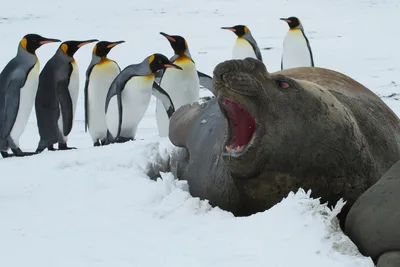 Southern elephant seal
Food web
Predators
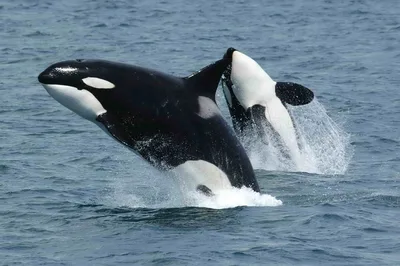 Orca
Ecological equivalents
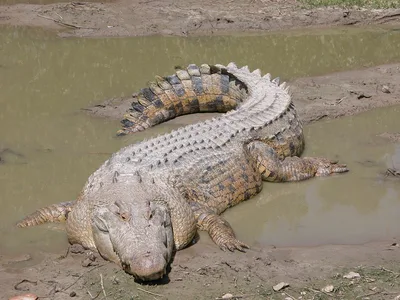
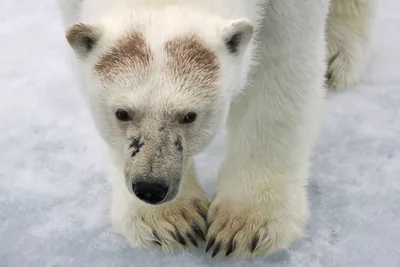
Related species on this site
White Shark (same genus), Longfin Mako Shark (same family), Megalodon (same family), Porbeagle Shark (same family), Salmon Shark (same family), Shortfin Mako Shark (same family), and more.
Fish
White Shark
Carcharodon carcharias
Classification and source reference
LivingFish
Longfin Mako Shark
Isurus paucus
Classification and source reference
Living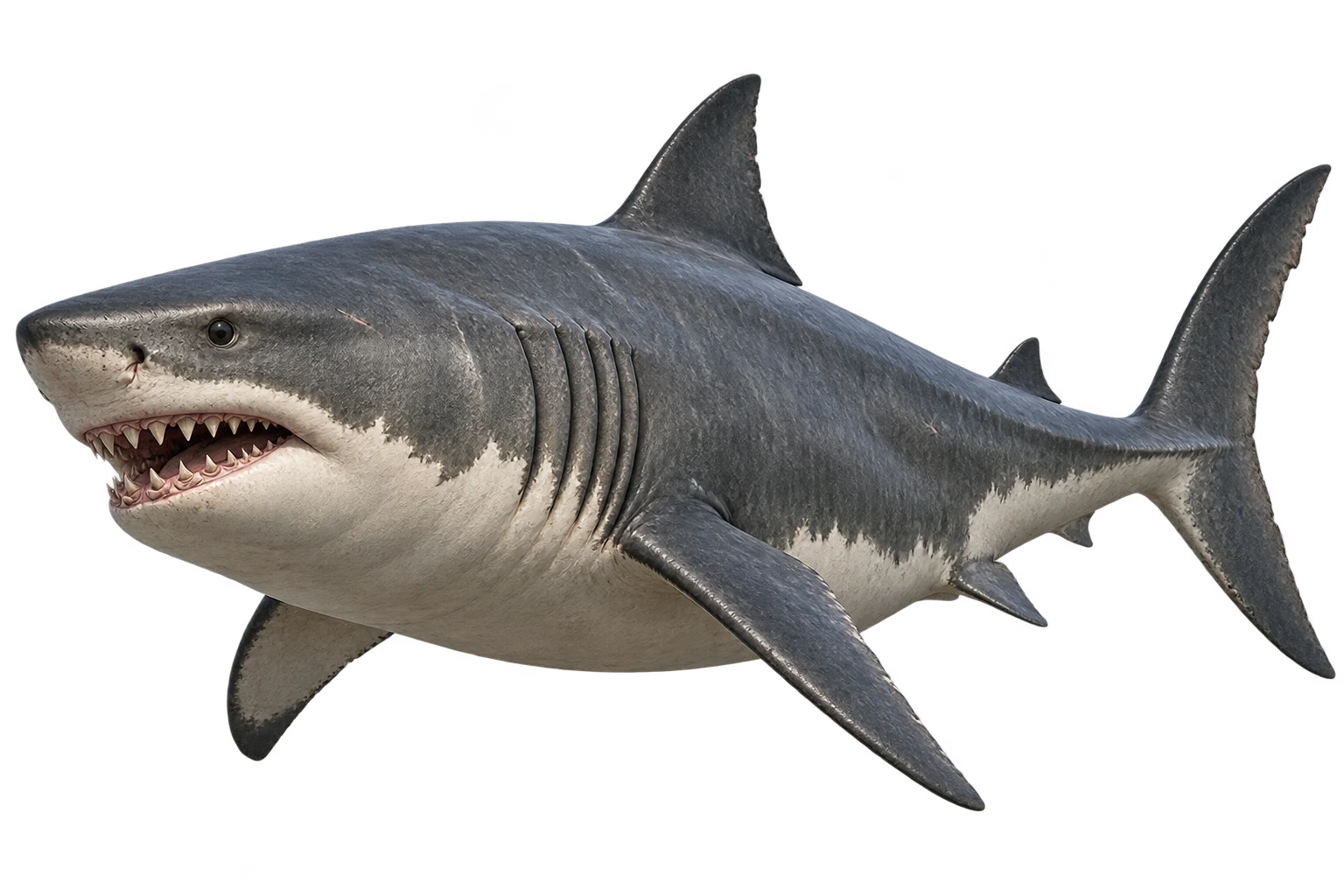
Fish
Megalodon
Otodus megalodon
Megalodon (Otodus megalodon) was a giant extinct shark.
ExtinctAI reconstructionFish
Porbeagle Shark
Lamna nasus
Classification and source reference
LivingFish
Salmon Shark
Lamna ditropis
Classification and source reference
LivingFish
Shortfin Mako Shark
Isurus oxyrinchus
Classification and source reference
Living