Dugong
The seagrass grazer behind the mermaid legend
Dugong dugon
Also called Sea cow, Sea pig, Sea camel
Living individuals or members of this group exist today. This does not mean they are safe from extinction.
Meet the dugong
The dugong is a large marine mammal that grazes seagrass in warm, shallow coastal water from East Africa to Vanuatu. It is the last living member of its family, breeds slowly, and is listed as Vulnerable.
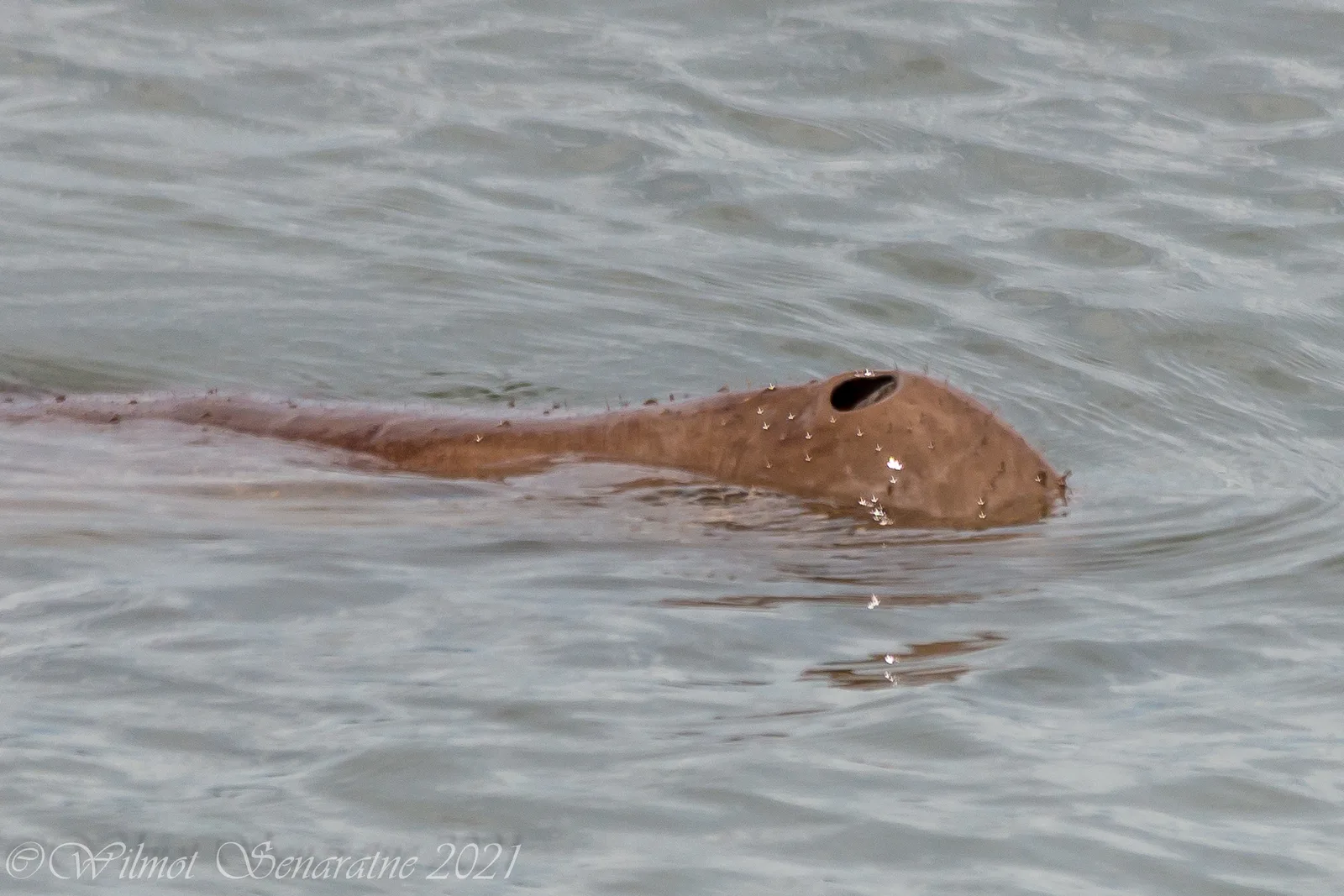
Images of the dugong
Lifespan in the wild
About 70 years age read from growth layers in the tusks
Weight
0.25 to 0.9 t
Length
2.4 to 4 m
Top speed
About 10 km/h
Fact file
Dugong
- Location
- Coasts of the Indian Ocean and western Pacific; northern Australia
- Habitat
- Coast, Coral reef
- Diet
- Herbivore
- Prey / food
- Seagrass of the genera Halophila and Halodule; some algae
- Predators
- Sharks, saltwater crocodiles and orcas take calves
- Lifestyle
- Grazes by day and night in shallow bays; semi-nomadic
- Group name
- Herd
- Name of young
- Calf
- Gestation
- 13 to 15 months
- Litter size
- 1 calf every 2.5 to 7 years
- Population
- Unknown; over 10,000 in Shark Bay and about 25,000 in the Torres Strait
- Biggest threat
- Fishing nets, boat traffic and loss of seagrass
- Distinctive feature
- A fluked tail like a dolphin's and a broad, down-turned snout
- Colour
- Brownish grey, paler below
- Skin type
- Smooth skin with sparse bristles
Size
Next to a person
Measurements
Size and speed
- Length
- 2.4 to 4 m adults rarely pass 3 metres
- Weight
- 0.25 to 0.9 t, up to 1.02 t the record animal came from west India
- Top speed
- About 10 km/h
Typical adult ranges. Sources: Animal Diversity Web, Wikipedia.
Life cycle
Lifespan
- In the wildAbout 70, up to 73 years age read from growth layers in the tusks
- 073 years
The pale bar is the record. Source: Wikipedia.
Appearance
Colour and coat
- Primary colours
- brownish grey
- Secondary colours
- cream
- Skin type
- smooth skin
- Male and female
- Slight. Females tend to be a little larger than males, and tusks show only in adult males and a few old females.
Life cycle
Mating and family
- Mating system
- polyandrous; lekking in some populations, scramble competition in others
- Social structure
- mostly solitary or mother and calf, with short-lived herds on rich seagrass beds
- Breeding
- one calf every 2.5 to 7 years
Dugongs mate in any month. After 13 to 15 months, the female gives birth to a single calf in very shallow water and pushes it up for its first breath. The calf suckles for 14 to 18 months and stays close to her for years. Females mature at about six but often calve first between ten and seventeen. Dugongs live about 70 years, and the oldest known reached 73.
Classification
Taxonomy
- Kingdom
- Animalia
- Phylum
- Chordata
- Class
- Mammalia
- Order
- Sirenia
- Family
- Dugongidae
- Genus
- Dugong
- Species
- Dugong dugon
Conservation
Red List status
- LC
- NT
- VU
- EN
- CR
- EW
- EX
Vulnerable on the IUCN Red List
Range
Recorded in 8 countries
Habitat layer: mangrove.
Countries from 771 wild records on GBIF (iNaturalist research grade), filtered and checked by hand. Country shapes: Natural Earth. Habitat: RESOLVE Ecoregions 2017, CC BY 4.0. Basemap: Natural Earth.
Habitats
Three things to know
- 1
The dugong is the only mammal that lives entirely at sea and eats only plants.
- 2
Its closest relative, Steller's sea cow, was hunted to extinction within 36 years of its discovery.
- 3
A dugong calf may ride on its mother's back and stays with her for years.
Did you know
Seven more facts
- 1
A dugong's ribs are some of the heaviest bones of any animal and work as ballast.
- 2
Scientists read a dugong's age from growth layers in its tusks, as with tree rings.
- 3
A 5,000-year-old cave painting of a dugong survives near Ipoh in Malaysia.
- 4
One dugong was caught fifteen kilometres up a creek near Cooktown.
- 5
The largest dugong on record weighed 1,016 kilograms and measured 4.06 metres.
- 6
Dugong feeding leaves furrows in the seabed that show from the air.
- 7
A dugong was caught and released in Taiwan in 2025, the first live sighting there in 88 years.
Field notes
How it looks and acts
Field notes
Distinguishing features
- A notched, fluked tail like a dolphin's, where a manatee has a round paddle.
- A broad, bristled snout that turns sharply downward.
- No dorsal fin and no hind limbs.
- Short tusks that show in adult males.
- A body of 2.4 to 4 metres in brownish grey.
Field notes
Unique adaptations
- A down-turned mouth and a muscular lip that rips seagrass from the seabed.
- Dense, marrow-free bones that hold the body just under the surface.
- Nostrils on top of the head that seal with valves during a dive.
- Long kidneys that handle salt water and long lungs along the back.
- Blood that clots fast, which limits bleeding from shark bites and tusk wounds.
Field notes
Interesting behaviours
- Grazes along the seabed, walking on its flippers.
- Pulls up a whole seagrass plant and shakes the sand off before eating.
- Rests on its tail with its head above water to breathe.
- Moves with the tide to reach shallow feeding grounds.
- Pushes its newborn calf to the surface for its first breath.
Field notes
Temperament
- Shy, and quick to slip away from a boat or diver.
- Calm and slow, with no record of harm to people.
- Rough in courtship, where males wound each other and the female with their tusks.
Field notes
Communication
- Chirps, whistles, barks and trills that carry underwater.
- Chirp-squeaks of 3 to 18 kilohertz while feeding or patrolling.
- Male display at lek sites to draw females.
- Nuzzling and flipper touches between mother and calf.
Ecology
Ecological role
The dugong is the chief grazer of tropical seagrass meadows and shapes which grasses grow there.
- Clears patches of meadow, which lets fast-growing, nutritious seagrasses replace tough ones.
- Stirs the sediment and fertilises the bed with its dung, which speeds regrowth.
- Feeds sharks, crocodiles and orcas as a calf.
- Hosts many parasites, from worms to cryptosporidium.
Stories
Myths and legends
- In Philippine and Malay tradition, the dugong was once a woman and weeps when it is killed.
- In southern Chinese fishing tradition, the dugong was a miraculous fish that brought bad luck if caught.
- In Kenyan tradition, the dugong is the Queen of the Sea.
- In Aboriginal Australian tradition, the dugong is part of sea-country and, in some stories, a transformed ancestor.
- In one Philippine tale, a mermaid-like Dogong guards the pearl of a sacred giant clam.
People
Relationship with humans
People
Living alongside us
People have hunted dugongs for meat, oil and tusks for at least 5,000 years. The animal holds a deep place in coastal cultures from Africa to Australia. Most countries in its range now protect it, although enforcement varies. Nets, boats and the loss of seagrass kill more dugongs today than hunting does. Watching and swimming tours now give some communities a reason to keep them alive.
- No dugong has ever been recorded harming a person.
- A shy animal, it moves away from swimmers and boats.
- Tour rules still keep swimmers at a distance, because a startled adult of several hundred kilograms could probably bruise a swimmer.
People
Status, uses and products
- Domestication
- Wild
- As a pet
- Not suitable. Only three dugongs were held in captivity worldwide in 2018. The seagrass it eats cannot be grown in a tank, and a calf needs its mother for years.
- Uses
- ecotourismtraditional huntingtraditional medicine
- Products
- meatoiltusk ivoryskin
The full account
About the dugong
The dugong, Dugong dugon, grazes seagrass in warm, shallow coastal water. It belongs to the order Sirenia, the sea cows, together with three species of manatee. It is the only living member of the family Dugongidae, because its nearest relative, Steller's sea cow, was hunted out in the 1700s. An adult measures 2.4 to 4 metres, although most stay under 3 m. Adults weigh from about 250 kilograms to under 900, and the record animal reached 1,016 kg.
Dugongs live along the coasts of about 40 countries from East Africa to Vanuatu. The largest populations swim off northern Australia, between Shark Bay and Moreton Bay. A female bears one calf after a pregnancy of 13 to 15 months and then waits years before the next. People have hunted the dugong for meat and oil for thousands of years, and fishing nets now kill many more. The IUCN lists it as Vulnerable, and many local populations are close to extinction.
Name and taxonomy
The name dugong comes from a Visayan word, dugung, from the Philippines. The French naturalist Buffon spread it as dugon in 1765, after reports from the island of Leyte. A popular claim says the word means lady of the sea in Malay, but linguists reject that reading. Sea cow, sea pig and sea camel are other names, and the Wunambal people of the Kimberley call it balguja.
Müller described the species in 1776 as Trichechus dugon, inside the manatee genus that Linnaeus had set up. Lacépède later made it the type species of the genus Dugong, and Gray placed it in its own family. Studies of mitochondrial DNA show that Southeast Asian dugongs differ from the rest. Australia holds two maternal lineages, and one of them also includes the animals of Africa and Arabia. The two groups mix a little around Timor.
Evolution and relatives
Sirenians are not close to whales or seals. Their nearest living relatives are the elephants, and with the hyraxes and the aardvark they form one of the oldest branches of placental mammals. The fossil record of the group runs back about 50 million years to the early Eocene. The first sea cows lived in the Tethys Ocean. The dugong family and the manatee family parted in the middle Eocene. The family reached its greatest variety in the Oligocene and Miocene and then shrank as the seas cooled.
The dugong and Steller's sea cow split from a shared ancestor in the Miocene. Steller's sea cow grew 7 to 10 metres long and weighed 4,500 to 5,900 kilograms. Sailors and fur hunters killed the last one in 1767, only 36 years after Europeans first saw it. The dugong family probably arose around the Mediterranean and the Caribbean, and a Mediterranean population may have survived into historic times.
Appearance
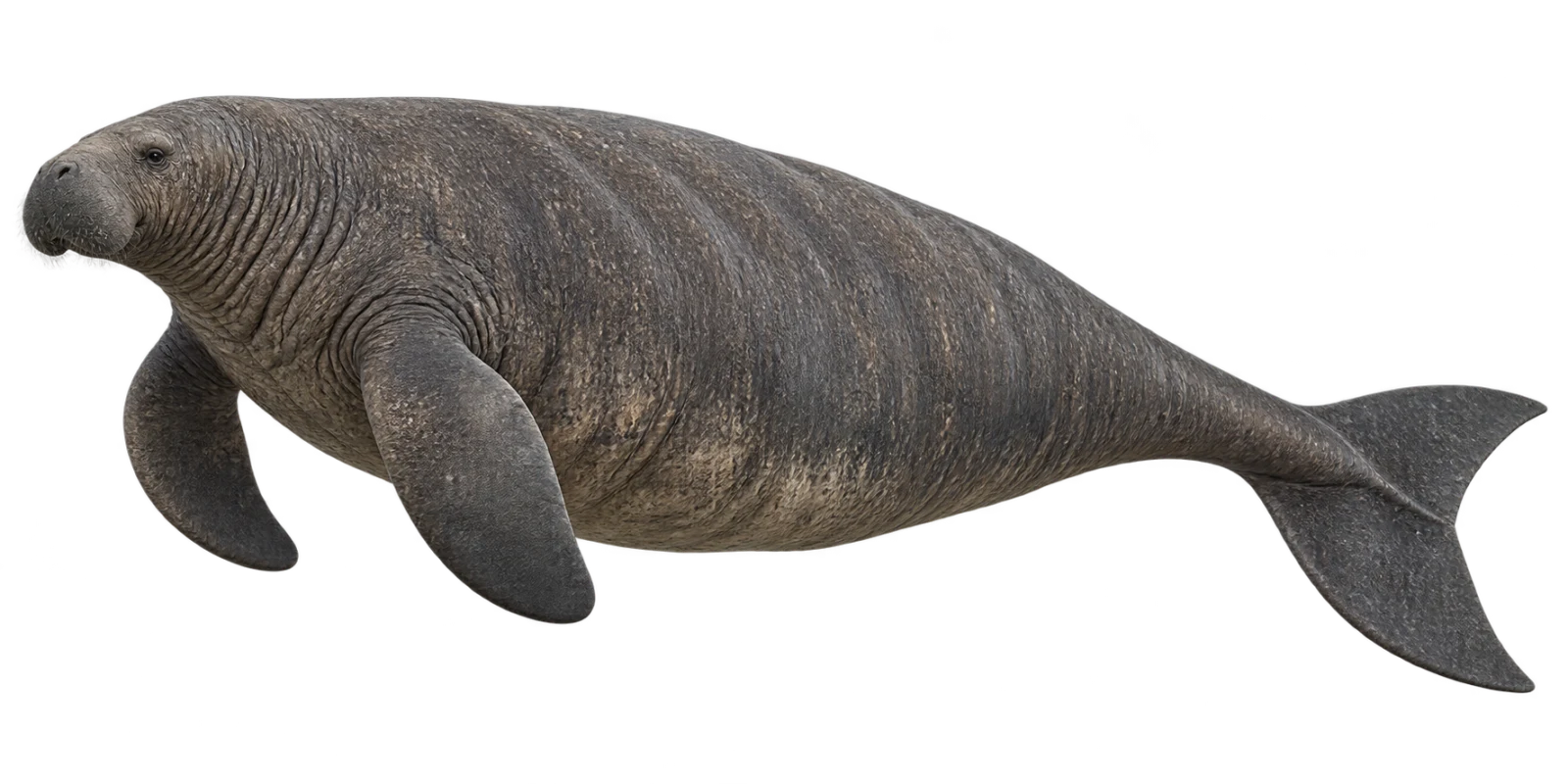
The dugong has a thick, spindle-shaped body that tapers at both ends, with no dorsal fin and no hind limbs. Adults are 2.4 to 4 metres long, and an animal of 3 m weighs about 420 kilograms. Weight runs from about 250 kg to under 900. The largest on record, from the coast of Saurashtra in India, weighed 1,016 kg at 4.06 m. Females tend to be a little larger than males.
The skin is smooth and thick, pale cream at birth and darkening to brownish grey with age. Algae growing on the skin can change the colour. Short bristles dot the body and cluster around the mouth, where a broad, horseshoe-shaped upper lip forms a mobile muzzle. The snout turns sharply downward, which suits an animal that feeds on the seabed. The tail is fluked like a dolphin's, with deep notches, and this is the quickest way to tell a dugong from a manatee.
The flippers are paddle-shaped, have no nails, and make up only 15% of body length. Both sexes carry two incisor tusks, but they break through the gum only in mature males and in some old females. The ribs and long bones are unusually dense and hold little marrow, which acts as ballast. The brain weighs at most 300 grams, about 0.1% of body weight. The nostrils sit on top of the head and close with valves during a dive.
Habitat and range
Dugongs live in warm coastal water between about 26 and 27 degrees north and south of the equator. The range follows about 140,000 kilometres of coastline from East Africa and the Red Sea to Vanuatu. It is broken into many small populations, and about 37 countries and territories hold animals today. Dugongs have vanished from Hong Kong, Mauritius and Taiwan, and from parts of Cambodia, Japan, the Philippines and Vietnam.
The species needs seagrass, so it gathers in wide, shallow, sheltered places: bays, mangrove channels and the lee of inshore islands. It is the only strictly marine herbivorous mammal, although it tolerates the brackish water of coastal wetlands. Most animals stay in water about 10 metres deep. Where the shelf is broad they travel more than ten kilometres offshore and feed as deep as 37 m on deep-water seagrass. Calves are born in very shallow water, and deeper water gives shelter from cold in winter.
Australia holds the world's largest population. Shark Bay has over 10,000, the Gulf of Carpentaria over 20,000 and the Torres Strait over 25,000. The Persian Gulf holds the second largest population, about 5,800 to 7,300 animals. East Africa has fewer than 50, India fewer than 250, and Okinawa perhaps only three. GBIF holds records from 39 countries.
Diet and feeding
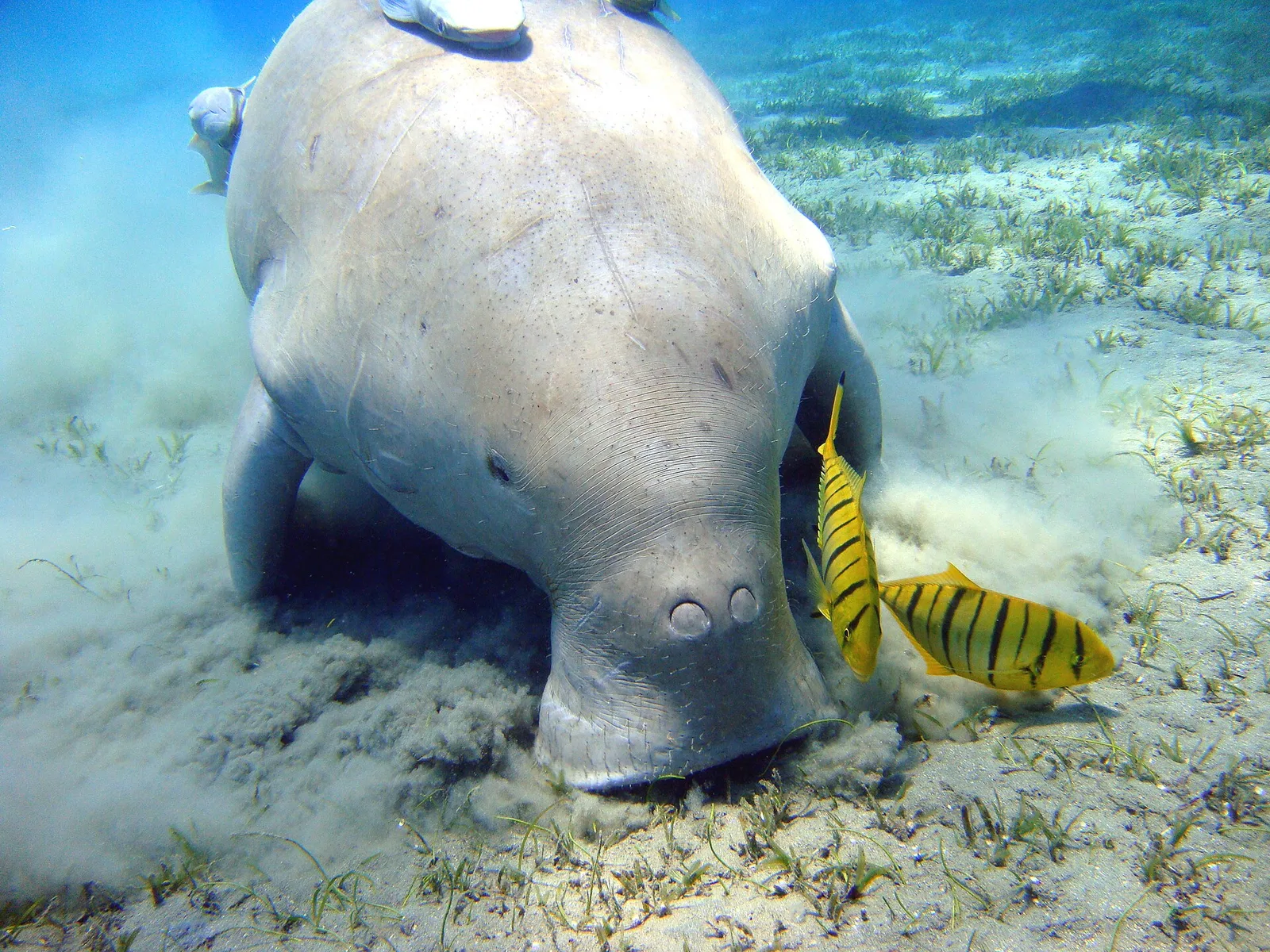
The dugong eats seagrass, above all species of Halophila and Halodule. It prefers grasses that are low in fibre and high in nitrogen, and it feeds where the meadow is sparse rather than lush. It grips a plant with its muscular upper lip, pulls it up by the roots, and shakes off the sand before swallowing. When a plant will not come up, it strips the leaves. The feeding leaves furrows in the sand that surveyors can see from the air.
By clearing patches, dugongs favour the fast-growing grasses they like over slow, tough species, a habit called cultivation grazing. When seagrass is short they eat algae, and in Moreton Bay they take worms, sea squirts and shellfish. Feeding trails have been found at 33 metres, and the deepest recorded dive is 39 m. A dugong walks along the seabed on its flippers as it feeds. It swims at about 10 kilometres per hour and can stay under for six minutes, although about two and a half is typical.
Behaviour and social life
Dugongs are social but usually seen alone or as a mother with her calf, because a seagrass bed cannot feed many. Herds of hundreds form for short spells, and a group of more than 600 was once counted west of Qatar. They are shy, slip away when disturbed, and inspect a diver or boat only from a distance. Because of that, and because they live in murky water, much of their behaviour is still unknown.
The species is semi-nomadic. Animals travel long distances when a seagrass bed runs short, yet stay within one region all their lives. Daily movement follows the tide, and in Moreton Bay dugongs shuttle between the bay and warmer ocean water. A good memory brings them back to the same spots after long journeys. Some individuals cross deep ocean, one reached Sydney, and one was caught fifteen kilometres up a creek near Cooktown. A dugong sometimes rests on its tail with its head above the surface to breathe.
Communication and senses
Dugongs talk with chirps, whistles, barks and trills that carry through the water. Each call has its own pitch and loudness, which suggests a separate purpose. Chirp-squeaks of 3 to 18 kilohertz are heard from animals feeding on the bottom or patrolling a territory. Barks go with aggression, and trills with display.
The eyes are very small and sight is poor, so hearing matters more. The ears have no outer flap but are sharp within a narrow band of pitch. Smell helps find edible plants, and the bristles on the lip and body feel the seagrass and the currents. Touch binds mother and calf: they nuzzle, the calf swims under her flipper, and it reaches out to touch her for reassurance.
Reproduction and life cycle
Dugongs mate all year, and the way they do it varies by place. In South Cove, Western Australia, males hold display territories that females visit, a system called a lek. In Moreton Bay, many males chase one female, thrash and lunge at each other, and mount her from below in turn. Tusk scars on females and rival males record those fights.
Females mature at about six years but often calve first between ten and seventeen. Males mature between 6 and 12 years, when their tusks break through. Pregnancy lasts 13 to 15 months and produces one calf, born in water so shallow that the mother is sometimes almost ashore. She pushes the newborn to the surface for its first breath. A calf is about 1.2 metres long and weighs about 30 kilograms.
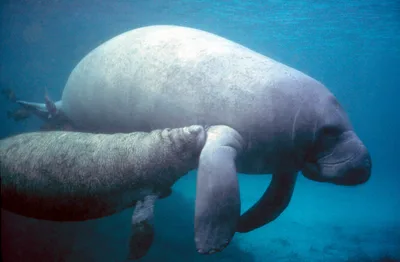
The calf begins to nibble seagrass soon after birth but suckles for 14 to 18 months. It stays beside its mother for years, sometimes riding on her back. A female calves only every 2.5 to 7 years, so she raises few young in her life. Dugongs live about 70 years, and the oldest known animal reached 73. Age is read from growth layers in the tusks.
Predators and threats
Adults have few natural enemies. Their size, tough skin, dense bones and fast-clotting blood all help. Sharks, saltwater crocodiles and orcas take calves, and one dugong died after a stingray barb pierced it. Disease is a bigger killer: in Queensland it has caused about 30% of dugong deaths since 1996.
People are the main threat. Dugongs drown in gill nets, mesh nets and shark nets, because they cannot hold their breath for long. Boats strike them in shallow water, and hunting still weighs on some populations, above all in northern Australia. Sewage, dredging, trawling and land clearing smother seagrass, and a cyclone can strip hundreds of square kilometres of meadow at once. A hungry dugong calves later and less often, so a lost meadow costs a generation. In the Philippines, plastic litter that dugongs mistake for food has become a leading danger.
Population and conservation
The IUCN lists the dugong as Vulnerable, and CITES bans or limits trade in its parts. No reliable world count exists, because many countries have never surveyed their coasts. The last global review, in 2002, judged the species declining or gone across a third of its range and unknown across another half. One estimate puts the worldwide fall at 20 percent over the last 90 years. The Persian Gulf population fell by nearly 25% after 1950 through poaching, oil spills and nets.
A population can grow at most about 5% a year, and killing more than 1 to 2% of females each year drives it down. Australia protects dugongs in every state, and Queensland runs sixteen dugong protection parks with speed limits and net bans. The United Arab Emirates, Bahrain, India, Sri Lanka, Japan and China ban hunting. The Philippines made the dugong the first sea animal under legal protection, and Papua New Guinea counts it as a national animal. Enforcement is weak in many places, and carved dugong parts are still sold openly in Bali markets. In 2022 researchers declared the dugong functionally extinct in Chinese waters.
Relationship with humans
Dugongs were easy targets, and people have hunted them for meat, oil, skin and bone for thousands of years. A wall painting of a dugong in Tambun Cave near Ipoh, Malaysia, is about 5,000 years old. Aboriginal and Torres Strait Islander peoples prize dugong meat and oil, and some hunting is still allowed under Australian law. In Papua New Guinea, the Solomon Islands and New Caledonia the meat and tusk ornaments feature in feasts and rituals. Around the Gulf of Kutch, dugong oil is used to preserve wooden boats.
Watching cruises in Australia and swims with dugongs in the Philippines and Vanuatu now bring in money. Dugongs do no harm to people or fisheries. They fare badly in captivity, because their seagrass cannot be grown in a tank, and only three were held worldwide in 2018. One orphaned calf in Australia is the only calf ever raised in an aquarium.
In culture and myth
The dugong is widely credited as a source of the mermaid legend. In Ilocano, Tausug, Yakan and other languages of the Philippines and Sabah, the word for dugong also means mermaid. Malay speakers use names that translate as woman of the sea and mermaid princess. In the Philippines, Malaysia, Indonesia and Thailand, many people hold that dugongs were once human, usually women, and that they weep when killed. It is bad luck to kill one in those places, and they stayed common there until the 1970s.
Elsewhere in Southeast Asia, dugong tears are sold as a love charm and the meat is eaten as an aphrodisiac. Fishermen of southern China once revered the dugong as a miraculous fish and would not catch it. In Okinawa, dugong ribs carved into butterflies, a symbol of the soul's journey, turn up across the islands. In Kenya it is the Queen of the Sea, and in the Gulf states tusks became sword handles. Aboriginal Australians count the dugong as part of sea-country, a living web of people, animals and coast.
A sentence with a dotted underline is inferred: it describes the group the animal belongs to, or is a reading of the sources, rather than a measured or reported fact about this species.
Questions
Dugong questions, answered
What is a dugong?
A dugong is a marine mammal of the order Sirenia, the sea cows. It grazes seagrass in warm coastal water and is the last living member of its family.
What is the difference between a dugong and a manatee?
A dugong has a fluked tail like a dolphin's, while a manatee has a rounded paddle. Dugongs live only in the sea, and manatees use fresh water. The two belong to different families.
How big is a dugong?
An adult is 2.4 to 4 metres long, although most stay under 3 m. Adults weigh from about 250 kilograms to under 900, and the record is 1,016 kg.
What do dugongs eat?
Seagrass, above all the genera Halophila and Halodule. When seagrass is scarce they eat algae, and in a few places they take worms and shellfish.
Where do dugongs live?
In shallow coastal water from East Africa and the Red Sea across South and Southeast Asia to northern Australia and Vanuatu. Northern Australia holds the largest numbers.
Are dugongs endangered?
The IUCN lists the dugong as Vulnerable. Many local populations are tiny or gone, and the species is functionally extinct in China.
How long do dugongs live?
About 70 years. The oldest recorded dugong reached 73.
Are dugongs related to elephants?
Yes. Sirenians share an ancestor with elephants, hyraxes and the aardvark, and they are not close to whales or seals.
Did dugongs inspire mermaid legends?
Many people think so. In several languages of the Philippines and Malaysia the word for dugong also means mermaid.
How long can a dugong hold its breath?
Up to about six minutes. A typical dive lasts about two and a half minutes.
How deep do dugongs dive?
Most stay in water about 10 metres deep. The deepest recorded dive reached 39 m, and feeding trails have been found at 33 m.
Are dugongs dangerous?
No. Dugongs are shy, slow grazers with no record of harming a person.
How many babies does a dugong have?
One calf, after a pregnancy of 13 to 15 months. A female calves only every 2.5 to 7 years.
What eats dugongs?
Sharks, saltwater crocodiles and orcas take calves. Healthy adults have almost no natural predators, and people are the main threat.
Why is the dugong called a sea cow?
Because it grazes underwater meadows of seagrass much as a cow grazes a field.
Food web
Prey and food
- seagrass of the genera halophila
- halodule
- some algae
Food web
Predators
- sharks
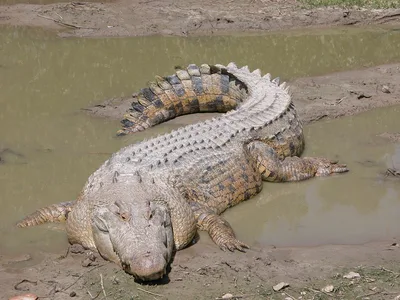 Saltwater crocodile
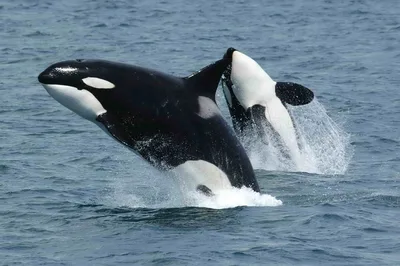 Orca
Ecological equivalents
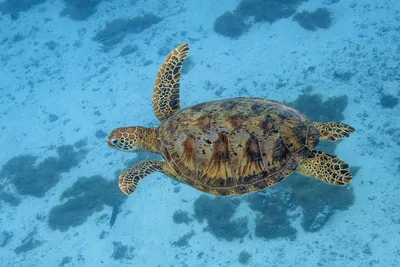
Related species on this site
Steller's sea cow (same family), Manatee (same order).