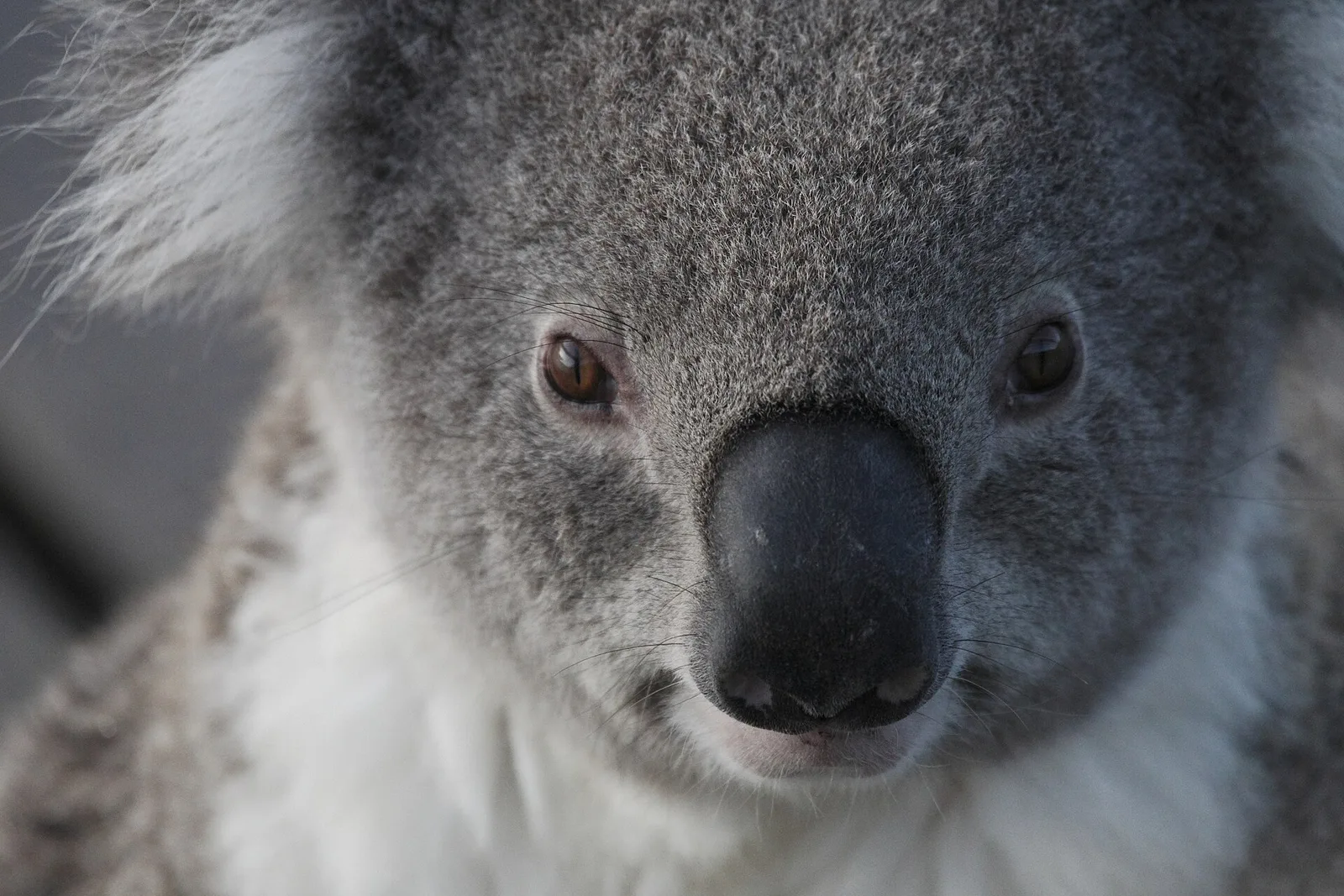
Living individuals or members of this group exist today. This does not mean they are safe from extinction.
Meet the koala
The koala is a tree-living marsupial from eastern Australia. It eats eucalyptus leaves, which are toxic to most animals, and sleeps up to 20 hours a day to digest them.
Images of the koala
Lifespan in the wild
13 to 18 years
Weight
5.1 to 11.8 kg
Length
60 to 85 cm
Fact file
Koala
- Location
- Eastern and south-eastern Australia
- Habitat
- Temperate forest
- Diet
- Herbivore
- Prey / food
- Eucalyptus leaves
- Predators
- Dingoes, large owls, pythons
- Lifestyle
- Nocturnal
- Name of young
- Joey
- Gestation
- About 35 days, then 6 months in the pouch
- Litter size
- 1 joey
- Population
- Between 100,000 and 500,000
- Biggest threat
- Habitat clearing, bushfires and disease
- Distinctive feature
- A large black nose and fluffy round ears
- Colour
- Grey with a white chest
- Skin type
- Fur
Size
Next to a person
Measurements
Size and speed
- Length
- 60 to 85 cm
- Weight
- 5.1 to 11.8 kg
Typical adult ranges. Sources: Animal Diversity Web, Wikipedia.
Life cycle
Lifespan
- In the wild13 to 18 years
- In captivityUp to 22.1 years
- 022.1 years
Appearance
Colour and coat
- Primary colours
- greybrown
- Secondary colours
- white
- Skin type
- fur
- Male and female
- Strong. Males are about 50 percent heavier than females, with a broader face, a more curved nose and a bald scent gland on the chest.
Life cycle
Mating and family
- Mating system
- polygynous
- Social structure
- solitary, with overlapping home ranges
- Breeding
- one joey a year
Koalas mate in the warmer months, and the joey is born after 33 to 35 days weighing under 0.5 grams. It lives in the pouch for six or seven months, then rides on the mother's back. It is weaned at about a year and leaves at one and a half to two years. Wild koalas live 13 to 18 years.
Classification
Taxonomy
- Kingdom
- Animalia
- Phylum
- Chordata
- Class
- Mammalia
- Order
- Diprotodontia
- Family
- Phascolarctidae
- Genus
- Phascolarctos
- Species
- Phascolarctos cinereus
Conservation
Red List status
- LC
- NT
- VU
- EN
- CR
- EW
- EX
Vulnerable on the IUCN Red List
Range
Recorded in 1 country
Habitat layer: temperate broadleaf and mixed forest, temperate conifer forest, boreal forest and taiga.
Countries from 33,549 wild records on GBIF (iNaturalist research grade), filtered and checked by hand. Country shapes: Natural Earth. Habitat: RESOLVE Ecoregions 2017, CC BY 4.0. Basemap: Natural Earth.
Habitats
Three things to know
- 1
A koala is not a bear. It is a marsupial with a pouch.
- 2
Its fingerprints are so like a human's that they can confuse forensic tests.
- 3
A koala gets most of its water from leaves and rarely drinks.
Did you know
Seven more facts
- 1
The word koala comes from a Dharug word that means no water.
- 2
A joey eats a soft pap from its mother's caecum before it can digest leaves.
- 3
Koala milk grows less fatty as the joey grows, the opposite of other marsupials.
- 4
The koala's brain weighs only about 19.2 grams and floats in fluid inside the skull.
- 5
Females do not clean their pouches, which is unusual among marsupials.
- 6
The pupils are vertical slits, rare among marsupials.
- 7
iNaturalist holds 45,574 observations of the species.
Field notes
How it looks and acts
Field notes
Distinguishing features
- A large black leathery nose on a broad face.
- Round ears fringed with long white hairs.
- A stout body with no visible tail.
- Grey to brown back fur and a white chest.
- A body length of 60 to 85 centimetres.
- Two opposable digits on each forepaw.
Field notes
Unique adaptations
- Liver enzymes neutralise the toxins in eucalyptus leaves.
- A long caecum ferments fibrous leaves for days.
- A metabolic rate about half the mammal norm saves energy.
- Dense back fur keeps out wind and rain in the treetops.
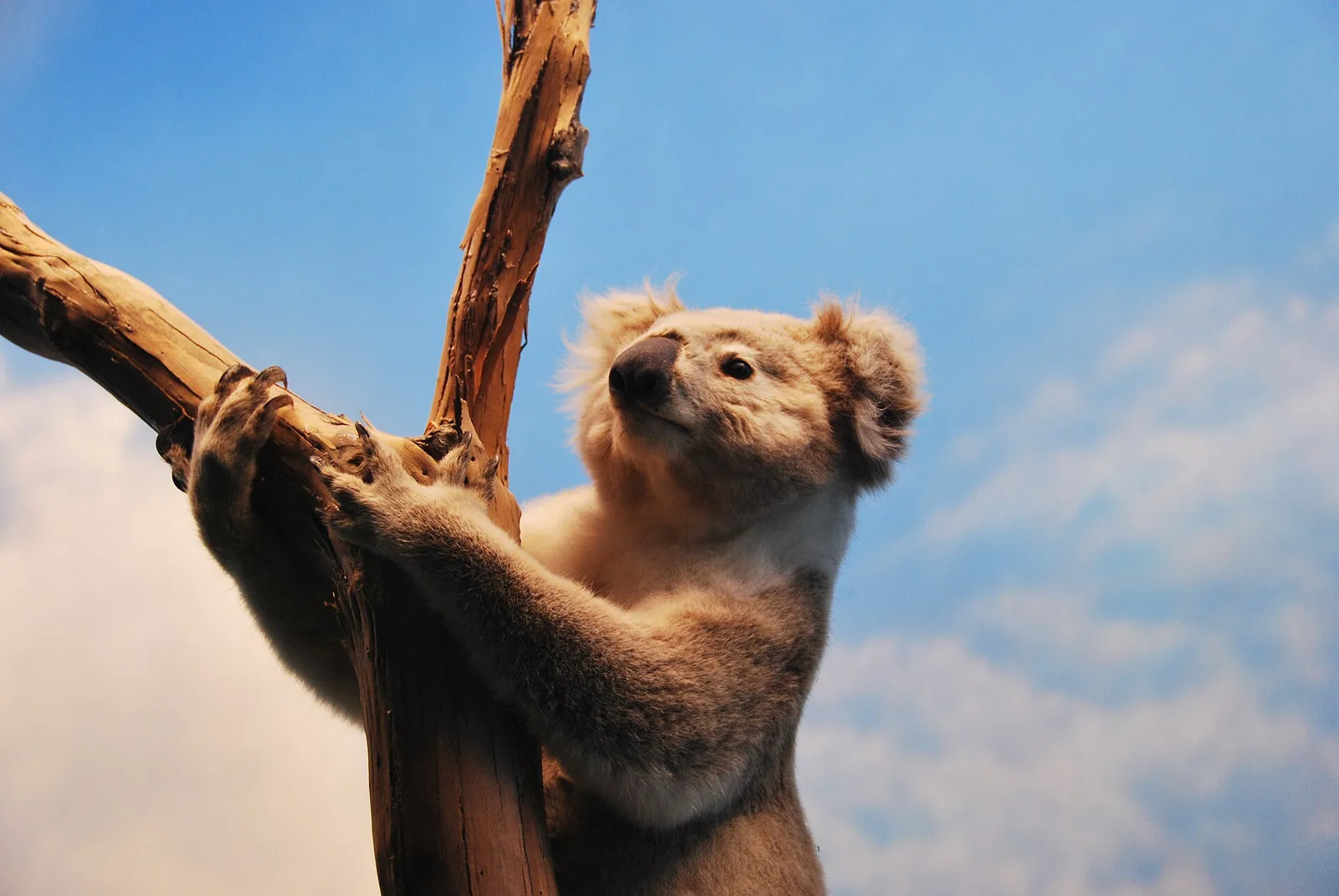
- Sharp curved claws and opposable digits grip smooth bark.
Field notes
Interesting behaviours
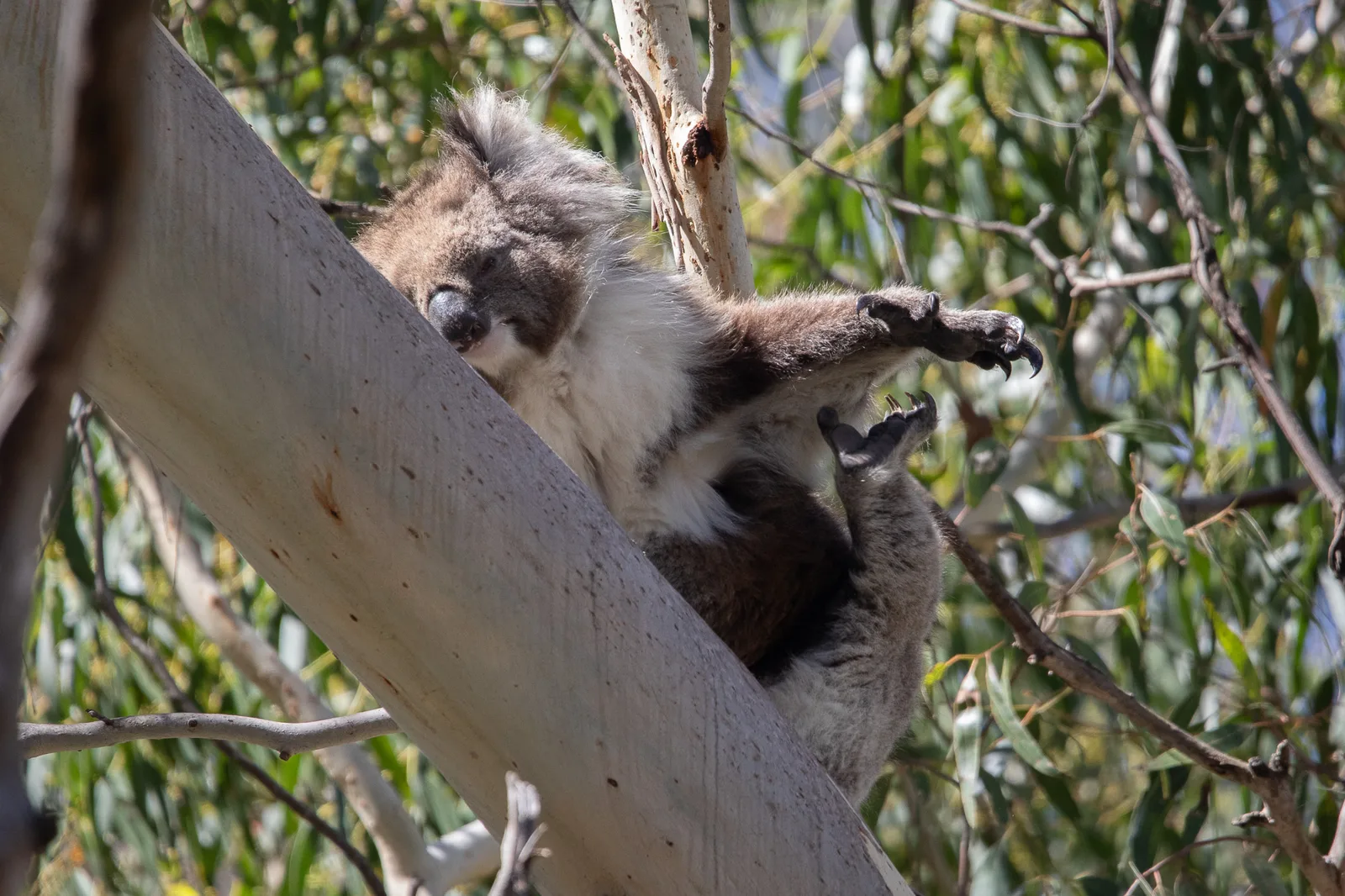
- Sleeps up to 20 hours a day, wedged in a fork.
- Feeds mostly at night, in four to six sessions.
- Hugs a cool trunk low in the tree on hot days.
- Rubs its chest gland on a tree when it arrives.
- Comes to the ground only to move between trees.
Field notes
Temperament
- Solitary and placid, with little social contact.
- A pregnant or nursing female attacks a koala that comes too close.
- Males fight only when a rival will not leave a tree.
Field notes
Communication
- Deep bellows from adult males carry far through the forest.
- Snarls, wails and screams signal distress or threat.
- Chest gland scent rubbed on trunks marks a male's presence.
- Lip and ear positions show mood.
Ecology
Ecological role
The koala is a specialist leaf-eater of eucalyptus woodland, and its numbers rise and fall with the health of its trees.
- Browses a small set of eucalyptus species, and can strip trees where it is over-abundant.
- Provides prey for dingoes, pythons and birds of prey.
- Protecting koala woodland likely shelters many other forest species.
Stories
Myths and legends
- In Tharawal tradition, the koala rowed the boat that carried the people to Australia.
- In Aboriginal tradition of Queensland and Victoria, the koala is a wise animal whose advice is worth taking.
- In Bidjara tradition, the koala made the trees grow in dry country.
- In an Aboriginal tale, a kangaroo cut off the koala's tail to punish its bad manners.
People
Relationship with humans
People
Living alongside us
Aboriginal people hunted the koala and made it a totem long before Europeans arrived. Settlers shot millions for fur until protection came in 1927. Today the koala draws tourists and money to Australian zoos and parks. Cars, dogs and land clearing are now its main killers in settled areas. Governments lend koalas abroad as goodwill ambassadors.
- A koala is slow and defenceless and does not attack people.
- A handled koala may scratch or bite, as with any wild animal.
- Koalas spend almost all their time in trees, so close encounters are rare.
People
Status, uses and products
- Domestication
- Wild
- As a pet
- Not suitable. A koala needs fresh leaves from a few eucalyptus species every day and sleeps most of the time. It is a protected native animal in Australia.
- Uses
- ecotourismzoo exhibitiondiplomacy
- Products
- fur (historic, now banned)
The full account
About the koala
The koala, Phascolarctos cinereus, is a tree-living marsupial from the east and south-east of Australia. It is not a bear, although settlers called it the native bear because of its shape. It is the last living member of the family Phascolarctidae, and its nearest relatives are the wombats. The koala eats eucalyptus leaves, a food so poor and so toxic that few other mammals touch it. To cope, it sleeps up to 20 hours a day.
An adult weighs 5.1 to 11.8 kilograms and measures 60 to 85 centimetres from head to rump. Koalas from Victoria are about twice the weight of those from Queensland. The IUCN lists the species as Vulnerable, and in 2022 Australia listed it as endangered in three states and territories. Land clearing, bushfires, cars, dogs and chlamydia are the main threats. With the kangaroo, the koala is the animal the world associates with Australia.
Name and taxonomy
The name koala comes from gula, a word in the Dharug language that means no water. Settlers first wrote it as coola or koolah, and the modern three-syllable pronunciation probably grew from the later spelling. Phascolarctos joins the Greek words for pouch and bear, and cinereus is Latin for ash-coloured. Early Europeans also called it the native bear and later the koala bear, names that stuck despite being wrong.
Henri de Blainville created the genus Phascolarctos in 1816, but gave no species name. Georg Goldfuss named the animal Lipurus cinereus in 1819, and the two names were later combined. Three subspecies have been described, from Queensland, New South Wales and Victoria, on the basis of size and fur. Their limits follow state borders, and a 2016 genetic study found no support for any subspecies. Most authorities now treat the koala as a single species with a north-to-south cline.
Evolution and relatives
The koala belongs to the order Diprotodontia, which also holds kangaroos, possums and wombats. Within it, the suborder Vombatiformes groups the koala with the wombats and with extinct giants such as the marsupial lion. The koala line may have branched off about 40 million years ago, in the Eocene. Fossil koalas of the Oligocene and Miocene lived in rainforest and ate a wider range of plants. As Australia dried out, eucalyptus woodland spread, and the genus Phascolarctos evolved a skull and teeth suited to the leaves.
A giant koala, Phascolarctos stirtoni, lived alongside the modern species in the Pleistocene. The modern koala's fossil record goes back at least to the middle Pleistocene. A 2026 genome study traced a severe population bottleneck to about 60,000 years ago, before people reached Australia. That old bottleneck explains why koalas today show so little genetic variation. Scientists sequenced the full koala genome in 2013.
Appearance
The koala is a stout animal with a big head, round furry ears and a broad, dark nose. It has almost no tail. Body length runs from 60 to 85 centimetres. Weight runs from about 5.1 kilograms for a northern female to 11.8 kg for a southern male. Males are about 50 percent larger than females and have a bald scent gland on the chest.
Back fur ranges from silver grey in the north to chocolate brown in the south, where it is also longer. The belly and chest are whitish, and the rump is mottled with white. The back fur is the best insulation of any marsupial, and it sheds wind and rain. Sharp curved claws and two opposable digits on each forepaw give a firm grip on small branches. On the hind foot, the second and third toes are fused and their claws work as a comb.
The brain is small for a mammal of this size, at about 19.2 grams, and it does not fill the skull. A small brain probably saves energy on a diet that gives so little of it. The pupils are vertical slits, an unusual feature in a marsupial. Extra vocal folds in the soft palate let the male produce sounds far deeper than his size suggests.
Habitat and range
Koalas live in eucalyptus forest and woodland along the east and south-east of mainland Australia. Their range covers about 1,000,000 square kilometres, from Queensland down through New South Wales and Victoria to South Australia. It spans tropical and temperate climates and about 30 ecoregions. In dry country they keep to river and creek lines, which offer shade and water in drought. The northern limit is Magnetic Island, off Queensland.
Fossils show the koala once reached the south-west of Western Australia. It was introduced there at Yanchep in 1938, but that group had fallen to 4 animals by 2022. Koalas are not native to South Australia. The animals there descend from French Island stock in Victoria, moved to Kangaroo Island and the Mount Lofty Ranges around 1920. GBIF holds records from 13 countries, but those include zoo animals.
A home range is usually 1 to 10 hectares, though it can exceed 300. Where trees are few and koalas many, ranges shrink and overlap.
Diet and feeding
Koalas eat leaves, almost all of them from eucalyptus trees. Australia has over 600 eucalyptus species, but a koala shows a strong preference for about 30. Three species, including the forest red gum and the river red gum, make up more than 20 percent of the diet on average. It picks leaves with more protein and less fibre, and it sniffs the oils of a branchlet to judge them. It also sits in and sometimes eats acacia, casuarina and tea tree.
A koala eats up to 400 grams of leaves a day, in four to six feeding sessions. Typical foliage is 55 percent water and only 4 percent protein. Leaves hold toxic phenols and terpenes, which the koala's liver neutralises with cytochrome P450 enzymes. Fermentation happens in a caecum about 200 centimetres long, and food can stay in the gut for 100 hours. Even so, only about 10 percent of its energy comes from the hindgut.
On each side of each jaw sit one premolar and four molars, which grind the leaves fine. The koala sometimes brings food back up to chew it again. Its metabolic rate is about half that of a typical mammal. It gets nearly all its water from leaves and drinks only in heat or drought. Older koalas wear their molars down, and a koala whose cusps are gone starves.
Behaviour and social life
A koala sleeps or rests for up to 20 hours a day. It is mostly active at night, and it usually eats and sleeps in the same tree. It comes to the ground only to change trees, two or three times a night, for about 10 minutes in total. On a hot day it hugs a cool trunk low in the canopy, and on a cold, wet day it curls up.
Koalas are asocial and spend about 15 minutes a day on social behaviour. Adult females are mostly residents with fixed home ranges, while males are more often transients. A dominant male holds a territory near breeding females, and younger males wait until they reach full size. A male arriving at a fresh tree rubs his chest gland on the trunk and may dribble urine. Quarrels break out when two koalas try to pass on a branch, and a big male may chase and bite a rival. Fights are rare, because they cost energy the diet cannot replace.
During the breeding season, from about October to February, adult males move through their ranges at night. They drive off rivals and mate with any receptive female. A koala grooms itself with the comb-like claws of its hind feet.
Communication and senses
The male's bellow is a long series of deep snoring breaths in and belching breaths out. It is very low in pitch, so it carries far through the forest. Bellows attract females, warn other males and announce a change of tree. The sound exaggerates the caller's size, and females attend more to the bellows of larger males. Females bellow softly, and they snarl, wail and scream in distress or threat.
Young koalas squeak and older ones squawk when upset, and a koala grunts when another climbs over it. Facial expressions carry meaning: a snarling koala curls its upper lip and points its ears forward. Scent matters too, and the chest gland secretion held about 40 compounds in one analysis. Koalas sniff the base of a new tree to read who has been there. The nose gives a good sense of smell, and the round ears give good hearing.
Reproduction and life cycle
Koalas breed in season, with births from October to May. A female in oestrus tips her head back and shakes her body. Males try to mount any female at this time, and she may scream and fight until a dominant or familiar male arrives. Fights around a mating pair leave older males with cuts on the nose and eyelids. Mating induces ovulation.
Gestation lasts only 33 to 35 days. The single joey weighs no more than 0.5 grams at birth and crawls into the pouch, which opens to the rear. It fixes onto one of two teats and stays inside for six or seven months. At 13 weeks it weighs about 50 grams, and by 26 weeks it is fully furred. At six or seven months it leaves the pouch for the first time, weighing 300 to 500 grams.
The mother then feeds it a soft faecal pap from her caecum, which seeds its gut with bacteria for a leaf diet. A joey rides on her back, reaches 1 kilogram at nine months and is weaned at about a year. It stays near its mother until about 18 months to two years of age. Females first breed at about three years and males at four, and a female usually produces one young a year. A wild koala lives 13 to 18 years, and one captive animal reached 22.1 years.
Predators and threats
Adult koalas have few natural predators. Dingoes, large pythons and some birds of prey take them, mainly on the ground. Falls from trees injure young animals and fighting males, though most survive. Domestic dogs and cars kill about 4,000 koalas a year, two thirds of all deaths.
Chlamydia bacteria cause eye disease, urinary infection and sterility, and they are common on the mainland. Koala retrovirus can cause an immune deficiency similar to AIDS. A vaccine programme against chlamydia was under way in 2024. Some island populations, such as Kangaroo Island, remain free of chlamydia.
Bushfire is a special danger, because a koala climbs higher into the flammable canopy rather than fleeing. Fires and land clearing split the habitat and create genetic bottlenecks. Drought and heat kill through dehydration, and climate models predict a shrinking range. In 2000 Australia cleared 564,800 hectares of native vegetation, the fifth highest rate in the world.
Population and conservation
The IUCN moved the koala from Least Concern to Vulnerable in 2014. In February 2022 the Australian government listed it as endangered in Queensland, New South Wales and the ACT. Queensland's own list rates it as Endangered, and New South Wales as Vulnerable. Counts vary widely: a 2021 federal estimate gave 92,000, down from 185,000 two decades earlier. The Australian Koala Foundation put the figure at 43,000 to 100,000 in 2022. Around the start of the 20th century there may have been 8 to 10 million.
Fur hunters killed about 8 million koalas between 1888 and 1927. Public outrage ended the trade, and the species gained legal protection after 1927. Lone Pine Koala Sanctuary in Brisbane and Koala Park Sanctuary in Sydney began the first breeding programmes. Koalas from French Island restocked Victoria and South Australia, where the koala had gone extinct by 1920.
In parts of Victoria and South Australia the species is now too abundant and strips its own food trees. The Mount Lofty Ranges hold about 10 percent of all koalas, and managers there are testing fertility control. Kangaroo Island held about 48,000 koalas before the 2020 fires and between 5 and 10 thousand in 2026. Fencing and underpasses reduce road deaths, and wildlife hospitals treat injured animals.
Relationship with humans
Aboriginal Australians hunted the koala and painted it in rock art for thousands of years. The first European record came in 1798, when John Price met a cullawine in the Blue Mountains. George Perry printed the first picture in 1810 and called it the New Holland Sloth, with open dislike. Robert Brown wrote a scientific description in 1803, but his notes lay unread until 1994. George Waterhouse classified the koala correctly as a marsupial in the 1840s.
Settlers hunted the koala for its warm fur, and Australia exported two million pelts by 1924. Furs became rugs, coat linings and muffs. London Zoo received Britain's first live koala in 1881, and it died when the lid of a washstand fell on it. Today the koala is a major draw for zoos and parks, and it earned tourism over 1 billion dollars in 1998. In 1997 about 75 percent of European and Japanese visitors put it first on their list of animals to see.
Koalas can live in towns if enough trees remain, but cars and dogs then become the main killers. A koala is not dangerous to people, though, as with any wild animal, it can scratch or bite when handled. The Australian government lends koalas to zoos in Japan and Singapore as soft-power diplomacy. The term koala diplomacy dates from the 2014 G20 summit in Brisbane, where world leaders held koalas for the cameras.
In culture and myth
In Aboriginal Dreamtime stories the koala is a totem animal and a wise adviser. The Tharawal people said the koala rowed the boat that brought them to Australia. In another story a tribe kills a koala and turns its long intestines into a bridge. Many tales explain how the koala lost its tail, and in one a kangaroo cuts it off as a punishment. The Bidjara people credited the koala with making trees grow in their dry country.
Early settlers saw a sloth-like creature with a fierce look. The image softened around 1900, and Ethel Pedley's Dot and the Kangaroo of 1899 has a funny native bear. Norman Lindsay drew a human-like koala in The Bulletin from 1904, later Bunyip Bluegum in The Magic Pudding. Dorothy Wall created Blinky Bill in 1933, the best known fictional koala. An Australian stamp carried the koala for the first time in 1930.
Paul McCartney and Michael Jackson released Ode to a Koala Bear as a B-side in 1983. Cartoon koalas starred in The Kwicky Koala Show and Noozles in the early 1980s. The Caramello Koala chocolate bar and the Koala's March biscuit carry its shape. Queen Elizabeth II, Pope John Paul II and Nelson Mandela have all posed with a koala.
A sentence with a dotted underline is inferred: it describes the group the animal belongs to, or is a reading of the sources, rather than a measured or reported fact about this species.
Questions
Koala questions, answered
Is a koala a bear?
No. The koala is a marsupial, related to wombats, that carries its young in a pouch. Settlers called it the native bear because of its shape, and the name stuck.
What do koalas eat?
Eucalyptus leaves, up to 400 grams a day. A koala prefers about 30 of the 600 or more eucalyptus species, and it also uses acacia and tea tree at times.
Why do koalas sleep so much?
Eucalyptus leaves give very little energy and contain toxins that take work to break down. A koala rests up to 20 hours a day to save energy while its gut ferments the leaves.
Are koalas endangered?
The IUCN lists the koala as Vulnerable. Since 2022 Australia lists it as endangered in Queensland, New South Wales and the ACT. In parts of Victoria and South Australia it is over-abundant.
How many koalas are left?
Estimates range from about 43,000 to 500,000, because counts across such a large area are hard. A 2021 government estimate was 92,000.
Where do koalas live?
In eucalyptus forest and woodland along eastern and south-eastern Australia, from Queensland south to Victoria and South Australia. Koalas were also introduced to islands and to Western Australia.
Do koalas drink water?
Rarely. They get nearly all their water from leaves. Large males drink from the ground or tree hollows in heat or drought.
How big is a koala?
An adult measures 60 to 85 centimetres and weighs 5.1 to 11.8 kilograms. Southern koalas are about twice the weight of northern ones.
How long do koalas live?
About 13 to 18 years in the wild. The oldest captive koala reached 22.1 years.
Are koalas dangerous?
No. A koala is slow and defenceless and avoids people. A handled koala may scratch, as with any wild animal.
Why do koalas have chlamydia?
Chlamydia bacteria spread between koalas and cause blindness, urinary disease and infertility. The disease is common on the mainland but absent from some island groups. Vaccination trials began by 2024.
How does a koala joey develop?
It is born after 33 to 35 days weighing under 0.5 grams and crawls into the pouch. It leaves the pouch at six or seven months and rides on its mother's back until it is weaned at about a year.
Can you keep a koala as a pet?
No. It is a protected native animal, and it needs fresh leaves from particular eucalyptus trees every day.
Do koalas really have fingerprints?
Yes. Koala fingerprints are so like human ones that they can confuse forensic tests.
What does the word koala mean?
It comes from gula in the Dharug language, which means no water. The name refers to how seldom the animal drinks.
Why do koalas bellow?
Adult males bellow to attract females, to warn rivals and to announce that they have changed trees. The deep call carries far and makes the male sound larger than he is.
Food web
Prey and food
- eucalyptus leaves
Food web
Predators
- dingoes
- owls
- pythons
Ecological equivalents
Related species on this site
Common Spotted Cuscus (same order), Kangaroo (same order), Nabarlek (same order), Pademelon (same order), Potoroo (same order), Procoptodon (same order), and more.
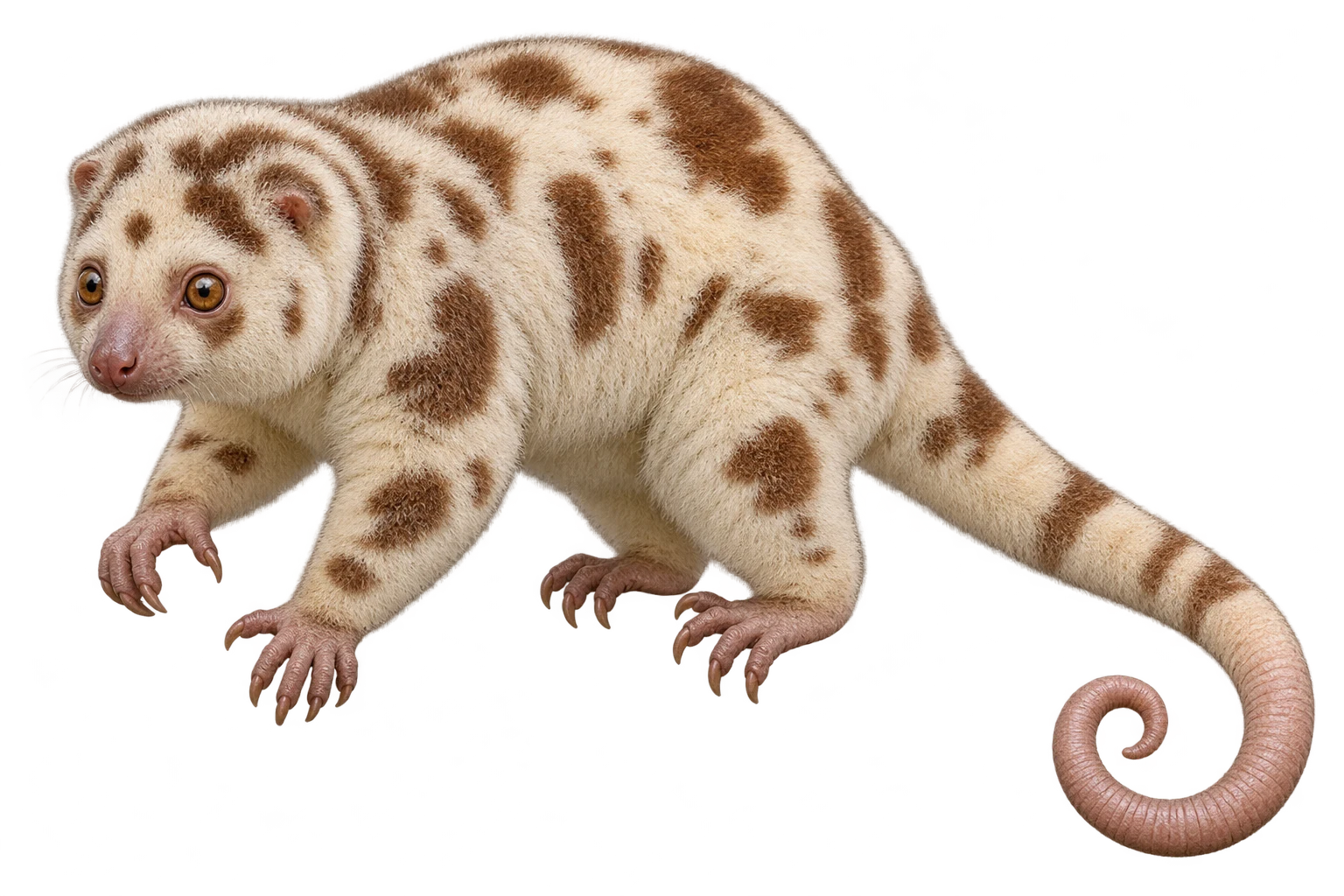
Mammals
Common Spotted Cuscus
Spilocuscus maculatus
Classification and source reference
LivingAI illustration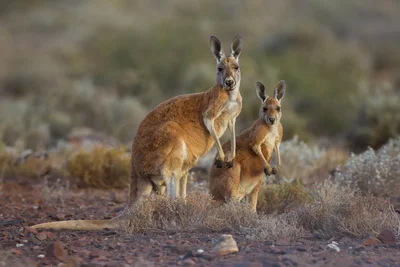
Mammals
Kangaroo
Macropodidae
Kangaroos are hopping marsupials in the macropod family.
Living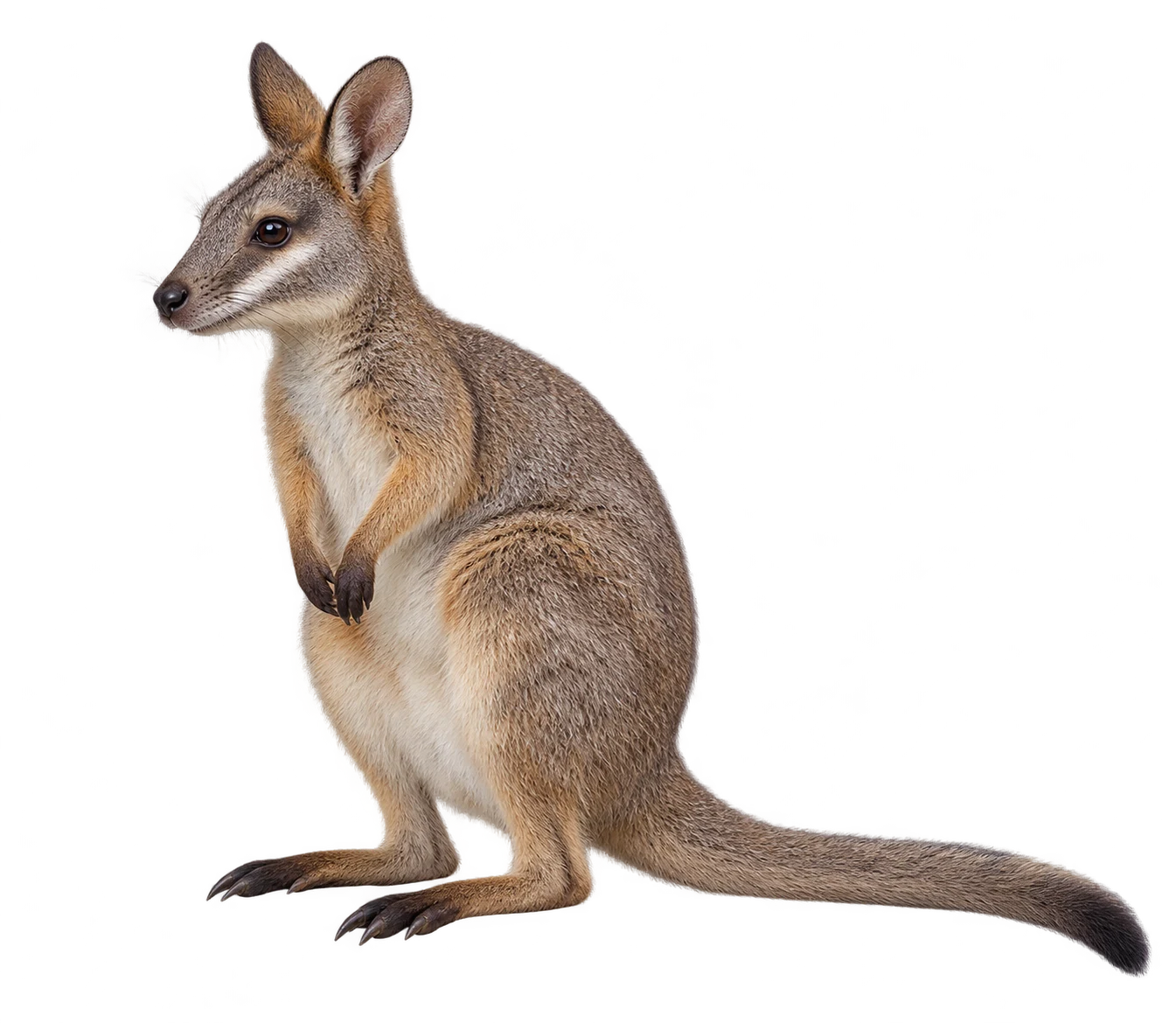
Mammals
Nabarlek
Petrogale concinna
Classification and source reference
LivingAI illustration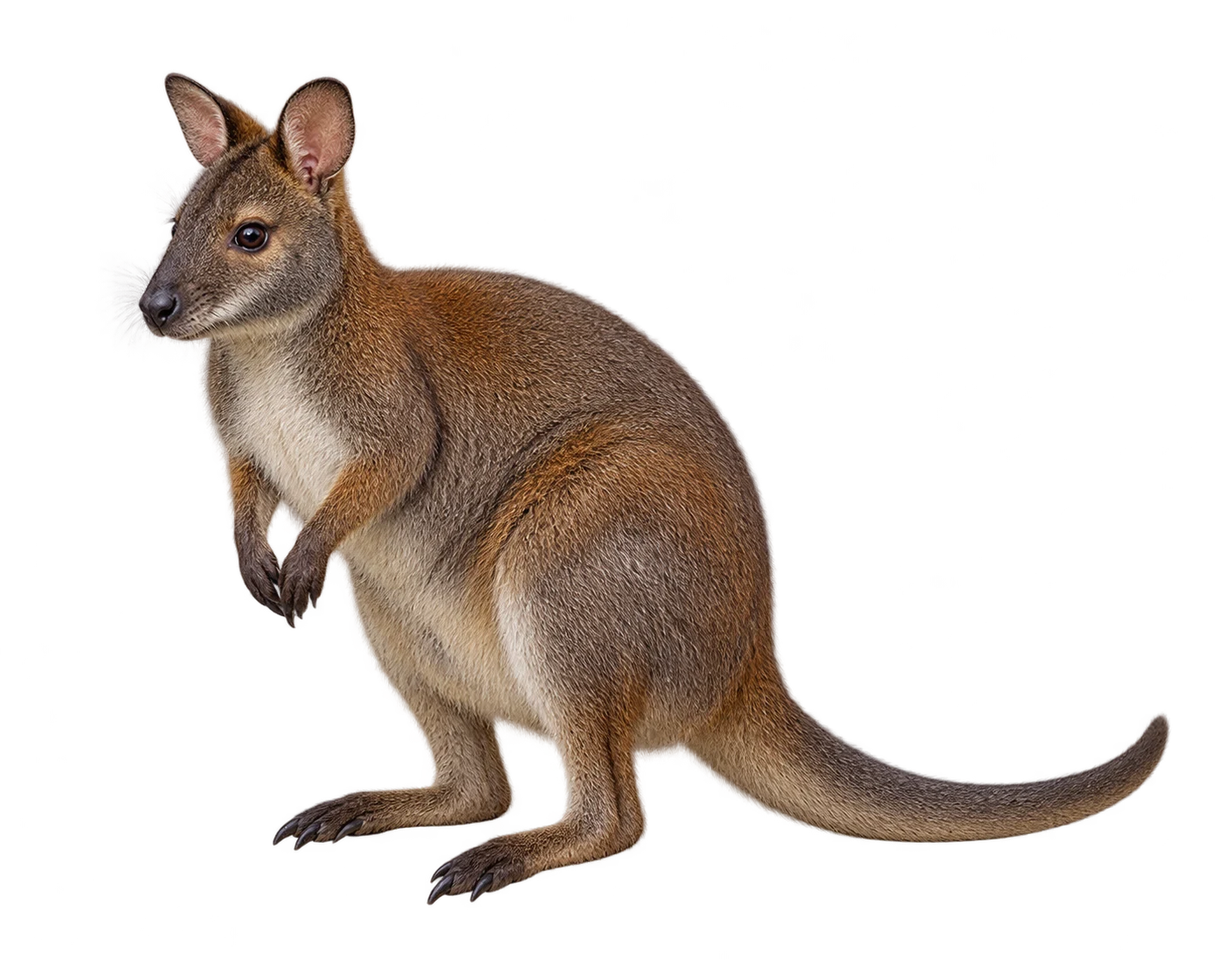
Mammals
Pademelon
Thylogale
Classification and source reference
LivingAI illustration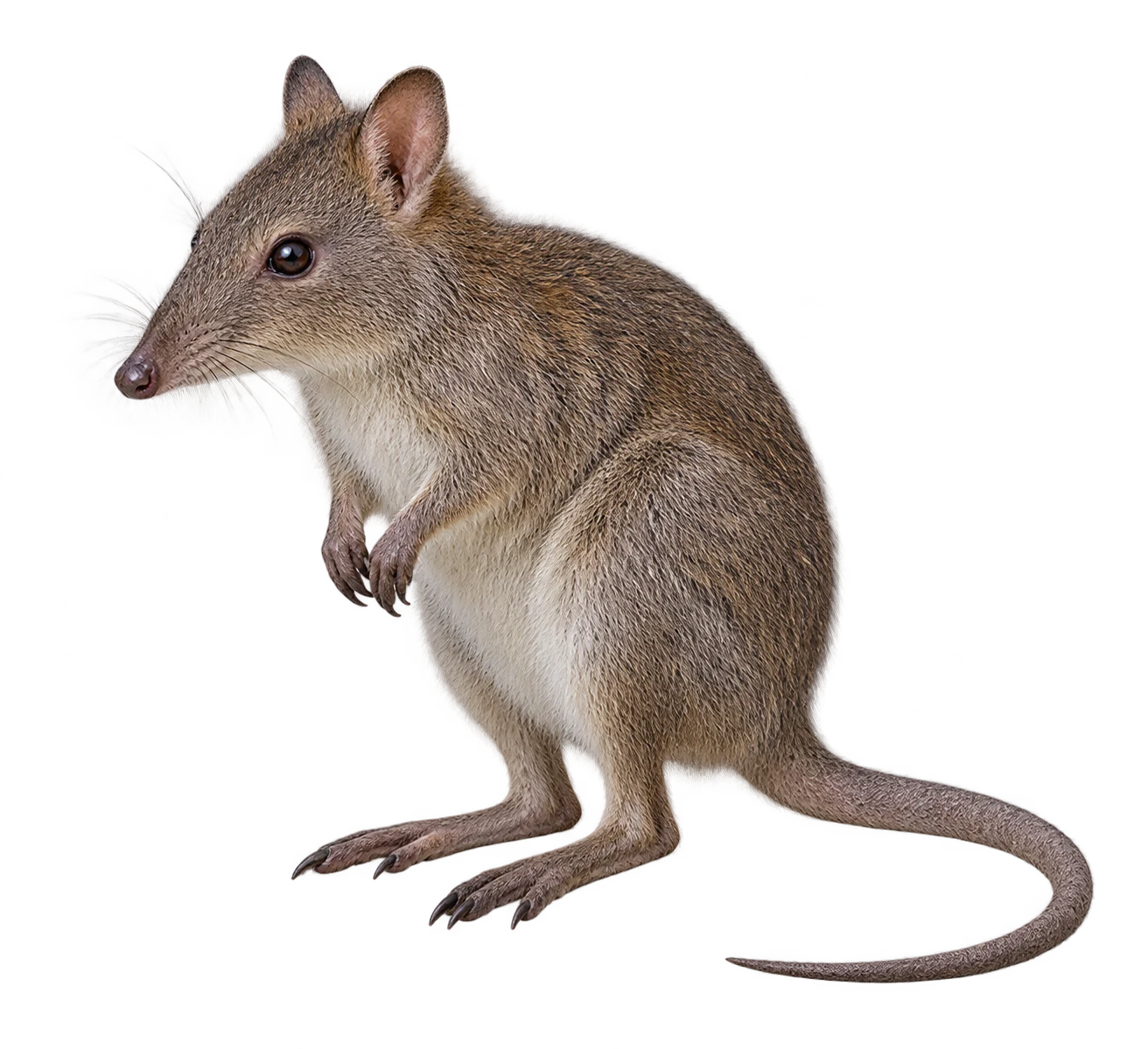
Mammals
Potoroo
Potoroidae
Classification and source reference
LivingAI illustration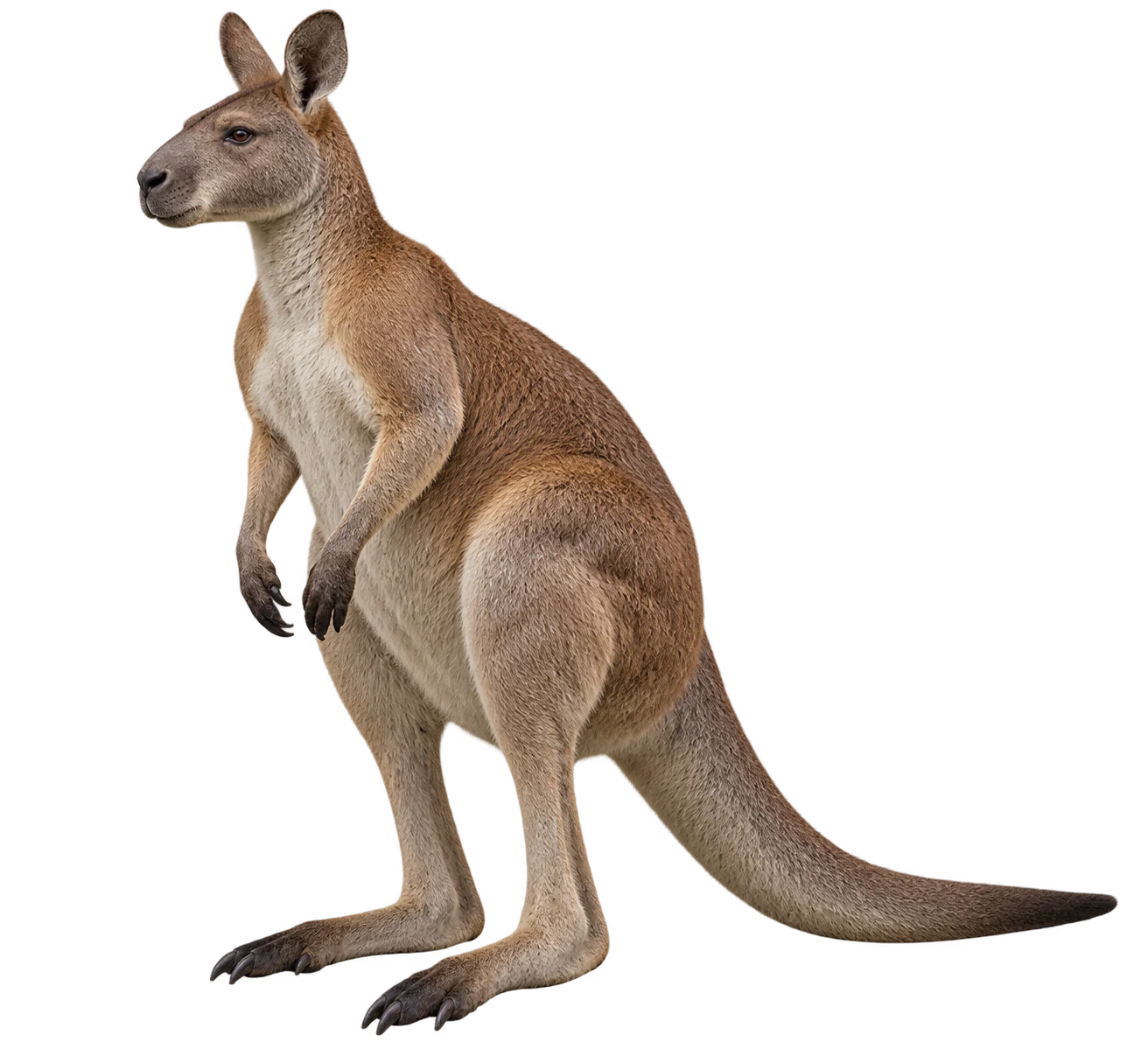
Mammals
Procoptodon
Procoptodon
Classification and source reference
ExtinctAI reconstruction