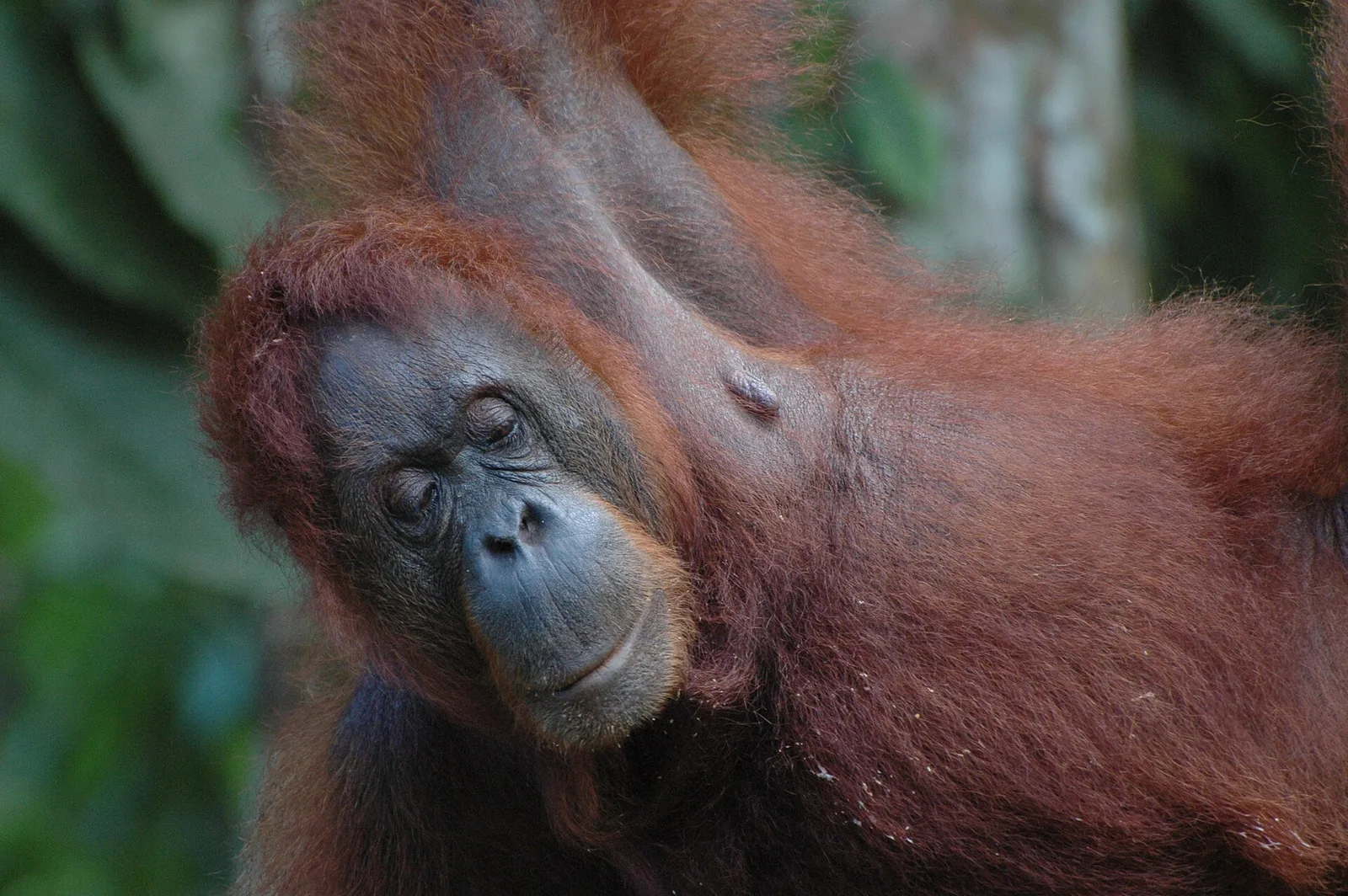
Bornean orangutan
The largest animal that lives its life in the trees
Pongo pygmaeus
Living individuals or members of this group exist today. This does not mean they are safe from extinction.
Meet the bornean orangutan
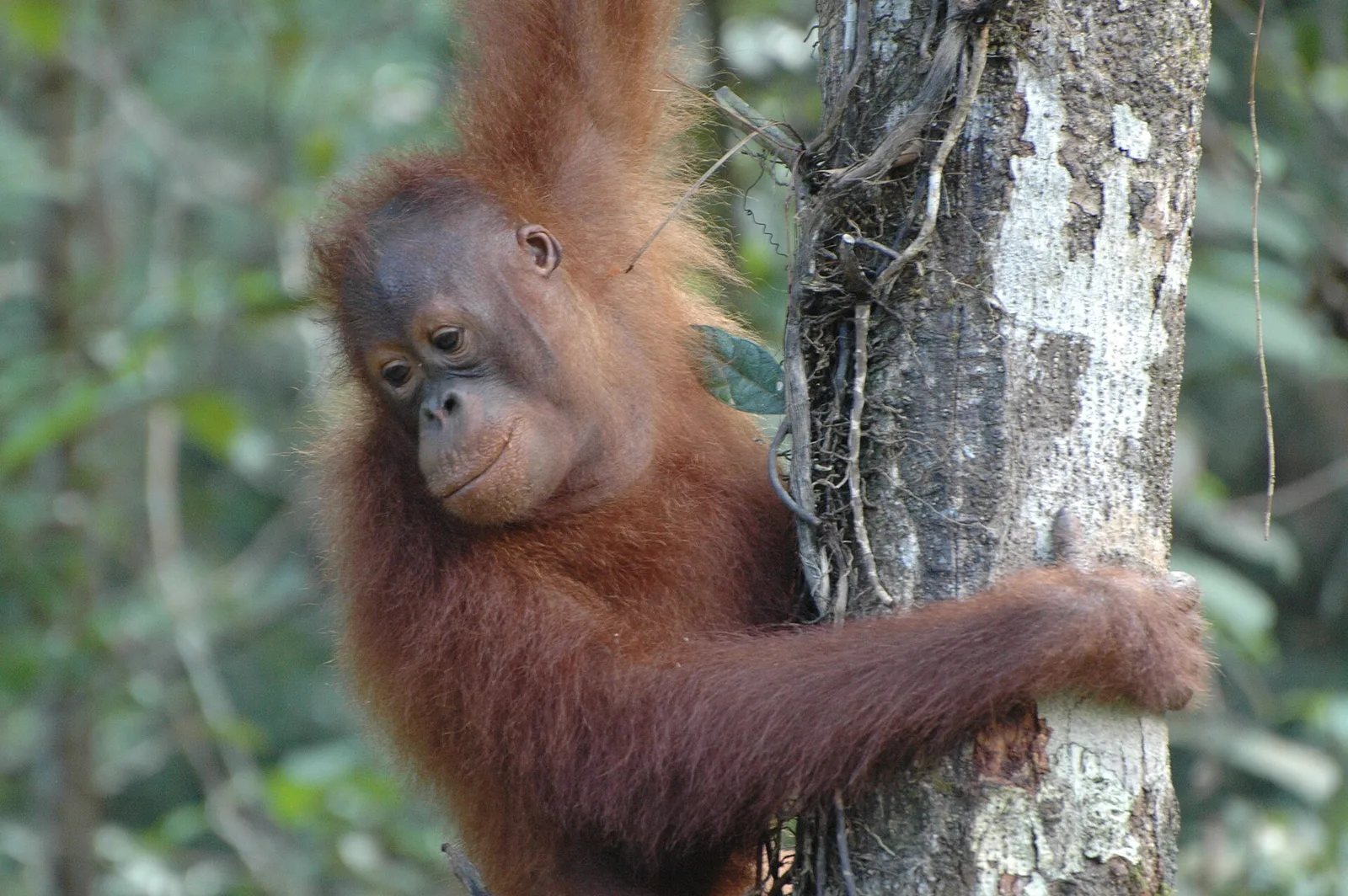
The Bornean orangutan is the largest tree-living animal in the world. It moves slowly through the rainforest canopy and builds a fresh sleeping nest every evening.
Images of the bornean orangutan
Lifespan in the wild
35 to 45 years
Weight
30 to 100 kg
Length
1 to 1.7 m
Fact file
Bornean orangutan
- Location
- The island of Borneo
- Habitat
- Rainforest
- Diet
- Omnivore
- Prey / food
- Fruit, leaves, bark, insects, honey
- Predators
- Clouded leopards and crocodiles in rare cases
- Lifestyle
- Diurnal
- Name of young
- Infant
- Gestation
- About 8.5 months
- Litter size
- 1 infant
- Population
- About 100,000
- Biggest threat
- Deforestation for oil palm and hunting
- Distinctive feature
- Long red hair and, in mature males, wide cheek pads
- Colour
- Red-brown
- Skin type
- Hair
Size
Next to a person
Measurements
Size and speed
- Length
- 1 to 1.7 m
- Length, male
- 1.2 to 1.7 m
- Length, female
- 1 to 1.2 m
- Weight
- 30 to 100 kg
- Weight, male
- 50 to 100 kg
- Weight, female
- 30 to 50 kg
Typical adult ranges. Source: Wikipedia.
Life cycle
Lifespan
- In the wild35 to 45 years
- In captivityUp to 59 years
- 059 years
Appearance
Colour and coat
- Primary colours
- red-brownorange
- Secondary colours
- greyblack
- Skin type
- hair
- Male and female
- Strong. A flanged male is about twice the weight of a female and grows wide cheek pads, a large throat sac and a beard. Females and unflanged males are smaller and look alike.
Life cycle
Mating and family
- Mating system
- polygynous, with one dominant flanged male overlapping several females
- Social structure
- solitary adults, with a mother and her dependent young as the only stable unit
- Breeding
- one infant every 6 to 8 years
There is no breeding season. After a gestation of about 8.5 months the female bears a single infant. It clings to her belly for a year, is weaned at about four years and stays close until about seven. A female first gives birth at about 14 to 15 years and rears four or five young in her life. Wild orangutans live 35 to 45 years.
Classification
Taxonomy
- Kingdom
- Animalia
- Phylum
- Chordata
- Class
- Mammalia
- Order
- Primates
- Family
- Hominidae
- Genus
- Pongo
- Species
- Pongo pygmaeus
Conservation
Red List status
- LC
- NT
- VU
- EN
- CR
- EW
- EX
Critically Endangered on the IUCN Red List
Range
Recorded in 2 countries
Habitats
Three things to know
- 1
An orangutan's arm span can reach 2.2 m.
- 2
A young orangutan stays with its mother for about seven years.
- 3
Orangutans use leaves as umbrellas and sticks as tools.
Did you know
Seven more facts
- 1
The species diverged from the Tapanuli orangutan about 674,000 years ago.
- 2
An orangutan's arm span is so wide that each arm is up to 1.5 metres long.
- 3
The ape cannot swim, so a wide river marks the edge of its range.
- 4
A captive male named Andy weighed 204 kilograms in 1959, more than double a wild male.
- 5
Bornean orangutans walk on their fists, while gorillas and chimpanzees walk on their knuckles.
- 6
A frightened orangutan pushes its lips into a funnel and screams.
- 7
Some orangutans eat soil, which may neutralise the toxins in their leafy diet.
Field notes
How it looks and acts
Field notes
Distinguishing features
- A coarse, shaggy coat of orange to dark red hair.
- Arms up to 1.5 metres long, far longer than the legs.
- Wide fatty cheek pads and a hanging throat sac on a mature male.
- Grey skin on a bare face, with pale rings around the eyes in young animals.
- Hands and feet that both grasp, with a short thumb.
- A body length of 100 to 170 centimetres.
Field notes
Unique adaptations
- Long arms and grasping feet let it hang and reach across gaps in the canopy.
- Heavy jaws and thick tooth enamel crack seeds and strip bark when fruit runs out.
- In good years it stores fat that carries it through an El Nino drought.
- A throat sac amplifies the long call across a large home range.
- A slow, careful way of moving probably keeps a heavy ape safe from falls.
Field notes
Interesting behaviours
- Builds a fresh sleeping nest of branches and leaves each evening.
- Holds a leafy branch over its head as an umbrella in the rain.
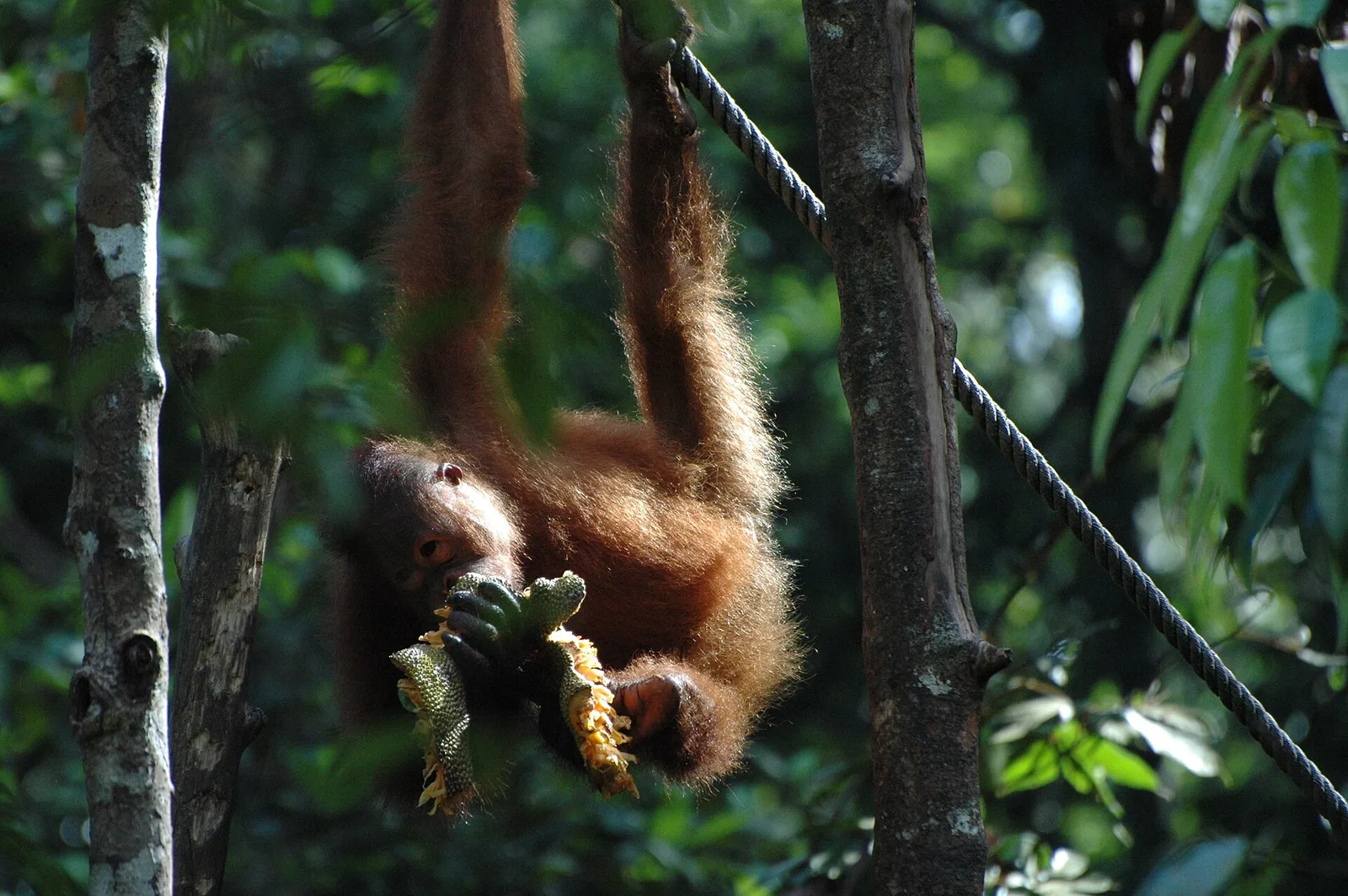
- Uses a pad of leaves to handle a spiny durian.
- Travels long distances to reach trees that are in fruit.
- Comes to the ground more often than a Sumatran orangutan.
Field notes
Temperament
- Solitary, and slow to seek out company.
- Tolerant of other orangutans at a shared fruit tree.
- A flanged male is aggressive to any other adult male that comes close.
- Usually shy of people, but will attack in rare cases over fruit.
Field notes
Communication
- A flanged male gives a long call of one to two minutes to claim his area and attract females.
- A fast call follows a clash between males.
- Lip smacking is used in small groups.
- A scream with funnelled lips shows fear.
Ecology
Ecological role
The Bornean orangutan is the main disperser of large seeds in its forest, which has earned it the name gardener of the forest.
- Carries and drops the seeds of large fruits that smaller animals cannot move.
- Feeds on more than 400 kinds of food, so it spreads many plant species.
- Reaches the highest densities in peat swamp forest, which ties its fate to that habitat.
- Its abandoned nests probably shelter insects and other small animals.
Stories
Myths and legends
- In Malay tradition, the orangutan is a person of the forest, which is what its name means.
- In Bornean tradition, the forest people keep silent so that nobody can force them to work.
- In Greek tradition, the satyr was a half-human spirit of the woods, and Linnaeus gave the ape that name.
People
Relationship with humans
People
Living alongside us
People have cleared most of the orangutan's forest for timber, coal, gold and oil palm. Hunting for meat and the capture of infants for the pet trade add to the loss. Both Malaysia and Indonesia protect the species by law. Rescue centres in Sabah and Kalimantan raise orphans and release them, and they draw tourists whose money funds the work.
- A wild orangutan usually keeps away from people.
- An adult male is very strong and can injure a person if cornered or when it defends fruit.
- Attacks are rare and happen mostly where people and apes compete for durians.
People
Status, uses and products
- Domestication
- Wild
- As a pet
- Not suitable. An orangutan needs a forest, a diet of hundreds of plant foods and a mother for seven years. Capturing an infant usually means killing its mother, and trade in the species is banned under CITES Appendix I.
- Uses
- ecotourismzoo exhibition
- Products
- None recorded
The full account
About the bornean orangutan
The Bornean orangutan, Pongo pygmaeus, is a great ape found only on the island of Borneo. It is the largest animal that spends nearly all of its life in the trees. Only the western gorilla and the eastern gorilla are bigger among the apes. Its coarse red coat and very long arms make it easy to recognise. Mature males grow wide cheek pads, called flanges, and a large throat sac.
Adult males weigh 50 to 100 kilograms, and females weigh 30 to 50 kg. The species eats mostly fruit, and it moves through the canopy to find trees in season. Each evening it builds a fresh nest of bent branches and leaves to sleep in. Adults live alone for most of the year, and a mother keeps her infant with her for about seven years. The IUCN lists the Bornean orangutan as Critically Endangered, because logging, oil palm and hunting have removed most of its forest.
Name and taxonomy
The word orangutan comes from Malay, and it means person of the forest. The genus name Pongo comes from a Bantu word, mpongo, for a large primate, which once described chimpanzees. The species name pygmaeus comes from the Greek word for a dwarf, an odd choice for a large ape. Carl Linnaeus first described the animal under the name Simia satyrus, which means satyr monkey. The type specimen, the holotype, is kept in the British Museum in London.
The species belongs to the family Hominidae, which also holds gorillas, chimpanzees and humans. Within that family it sits in the subfamily Ponginae, the only great ape group native to Asia. Three subspecies are recognised: P. p. pygmaeus in Sarawak and western Kalimantan, P. p. wurmbii in the south, and P. p. morio in the north-east. The split is not settled, because the southern form may be closer to the Sumatran orangutan than to the other Bornean forms. Some authors treat P. p. morio as a synonym of P. p. pygmaeus.
Evolution and relatives
The orangutan line and the human line parted about 14 to 18 million years ago. Fossils show that orangutans once lived on the Asian mainland, up into southern China, and on Java and Sumatra. The first complete fossil skeleton came from Hoa Binh Province in Vietnam and dates from the late Pleistocene. That animal differed from a living orangutan only in having a smaller body in proportion to its head.
The Bornean and Sumatran orangutans were treated as one species until 1996, when studies of mitochondrial DNA separated them. The two split about 400,000 years ago, but a small amount of gene flow continued after that. The Bornean line diverged from the Tapanuli orangutan about 674,000 years ago, and the Tapanuli form was named as a species in 2017. Bornean orangutans carry less genetic diversity than Sumatran ones, because their population went through a sharp decline in the Middle Pleistocene. Orangutans share about 97% of their DNA with humans.
Appearance
The Bornean orangutan has a heavy body, a bulging belly and arms that can be up to 1.5 metres long. A wild male measures 120 to 170 centimetres and weighs about 75 kilograms on average. A female measures 100 to 120 cm and averages about 38.5 kg. Captive animals can grow far heavier, and one obese male named Andy weighed 204 kg in 1959. The skin is grey, and the coat is coarse, shaggy and orange to brown, often darker than a Sumatran orangutan's.
The face is bare apart from a beard and moustache, and infants have pink faces that darken with age. Pale rings of skin around the eyes stay visible through adolescence. The hands and feet both grasp, and the thumb is short, so food is picked with the fingers and palm. A fully mature male grows fatty cheek pads, a much larger throat sac and bigger canine teeth than a female. Males come in two adult forms: a large flanged male and a smaller unflanged male that looks more like a female.
Habitat and range
The species lives only on Borneo, in the Malaysian states of Sabah and Sarawak and in most of Indonesian Kalimantan. Its presence in Brunei is unconfirmed. Habitat loss has broken the range into patches, and the ape is rare in the south-east of the island. It is also absent from the forest between the Rajang River in Sarawak and the Padas River in Sabah. In 2014 researchers found about 50 orangutans in South Kalimantan, a province with no earlier record of the species.
The best habitat is mature riverside forest, freshwater swamp, peat swamp and lowland dipterocarp forest. Swamp forests fruit more regularly than dry forest on the hills, so they hold the highest densities. Most animals live below 500 metres, and the species reaches about 1,500 m in montane forest. It uses old-growth forest and also secondary forest, and it travels long distances to reach trees in fruit. Large rivers and mountain ranges act as barriers, because orangutans cannot swim. GBIF holds records from 19 countries, but that count includes zoos, not the native range.
Diet and feeding
Fruit makes up more than 60% of the diet, and the ape moves through the forest to follow the fruiting season. Wild figs and durians are favourites, and the full menu runs to more than 400 kinds of food. Leaves, shoots, seeds, flowers, sap, inner bark, honey, fungi and bird eggs fill out the list. It also eats insects such as termites, ants and caterpillars, and even spider webs. On rare occasions it takes a small vertebrate, and it has been seen eating dead fish and catching live ones.
Borneo has poor soils, so fruit crops swing sharply from year to year. In El Nino droughts the orangutan falls back on inner bark, and its heavy jaws and thick enamel suit that hard food. In good years it gorges on fruit and dipterocarp seeds and lays down fat for lean months. It drinks from fruit and from water that collects in tree holes. In some areas it eats soil, which probably helps to neutralise toxins in its plant food.
Behaviour and social life
The Bornean orangutan is active by day and spends most of its time in the canopy. It feeds in the morning, rests in the middle of the day, then feeds and travels again until dusk. Adults live alone for most of the year, and the Bornean species is even less sociable than the Sumatran one. Forests on Borneo produce less food, so animals that fed together would compete. Two or three animals with overlapping ranges may meet for a short time, and larger groups gather only at a mass fruiting.
A dominant flanged male holds a large home range that overlaps with the ranges of three or four females. He tolerates no other adult male nearby, and unflanged males keep quiet and out of his way. An adult male range covers about 2 to 6 square kilometres. A young female settles next to her mother's range, while a young male travels much farther. Average density across Bornean forests is about 1 to 3 animals per square kilometre.
Every evening the ape builds a sleeping nest from bent branches, with a base and a leafy mattress. Some nests get a roof against rain, a pillow or a blanket of leafy twigs. Young orangutans learn the skill by watching their mothers, and they practise on play nests. The species uses tools. A leafy branch serves as an umbrella or a fly swat, a pad of leaves holds a spiny durian, and a stick scratches the back. Bornean orangutans walk on the ground more often than Sumatran ones, probably because Borneo has no tigers. On the ground an adult walks on its fists, not its knuckles like other great apes.
Communication and senses
The main signal is the long call, which only a flanged male gives. It lasts one to two minutes, and the throat sac helps it carry for about 1 kilometre, or several km in still air. The call tells other males where he is and draws in females ready to mate. An unflanged male that hears it moves away, and the sound may even hold back his own development into a flanged male.
A fast call follows a fight between males. In a small group the apes smack their lips, and a frightened orangutan pushes its lips out and screams. Orangutans have fewer social calls than other great apes, which fits their solitary lives. Like other great apes, the orangutan relies mostly on colour vision to find ripe fruit in the canopy. Captive animals recognise themselves in a mirror, plan ahead and can deceive.
Reproduction and life cycle
Males and females meet only to mate, and there is no fixed breeding season. A female's cycle runs 22 to 30 days, and she is most fertile when fruit is plentiful. Females prefer flanged males and answer their long calls, though a smaller unflanged male often forces a mating. A female can dodge a flanged male in the canopy because she is far lighter, but an unflanged male matches her size and speed. A pair may stay together for several days before they part.
Gestation lasts about 8.5 months, and a single infant is born, though twins are recorded. The newborn clings to its mother's belly with its fingers in her hair, and it nurses every three to four hours. At about four months it takes soft food from her lips, and later it rides on her back. Weaning is usually complete by about four years, and the youngster stays with its mother until the next birth. Full independence comes at about seven years, and both sexes then leave the mother's range.
A female first ovulates between about six and 11 years, and gives birth for the first time at about 14 to 15. Births come 6 to 8 years apart, one of the longest intervals of any mammal. In a lifetime a female rears about four or five young, and captive females reach menopause at about 48. A male is unflanged from about 8 to 15 years, and most grow flanges between 15 and 20. Wild animals live 35 to 45 years, and the captive record is 59 years.
Predators and threats
An adult Bornean orangutan has no natural predator, because Borneo has no tigers. A clouded leopard can kill a young orangutan, and a crocodile is a risk at the water's edge. People are the real predator, and even hunting at a 2% yearly rate is more than the population can bear. A 2011 survey of 6,983 people in 687 villages estimated that 750 to 1,800 orangutans were killed in one year in Kalimantan. Most respondents, 73%, knew the species was protected, yet prosecutions are rare.
The greatest threat is the loss of forest to logging and to oil palm plantations. When forest is burned to clear land, orangutans burn with it. Two fires, in 1983 and 1998, burned 90% of Kutai National Park, and its orangutans fell from about 4,000 to about 600. In the 1997 to 1998 fires an estimated 8,000 orangutans died in Central Kalimantan, a third of the species in one year. Young animals are captured for the pet trade, which usually means the mother is killed. Crop raiders near plantations are shot, and one rescued female carried 40 air-rifle pellets.
Population and conservation
The IUCN Red List rates the Bornean orangutan as Critically Endangered, and CITES lists it on Appendix I. About 104,700 animals remain, far more than the 14,000 or so Sumatran orangutans. Even so, the total is less than 14% of the population that lived on Borneo before the middle of the 20th century. Numbers fell by more than half in the last 60 years, and the fall continues at the pace of forest loss. Sabangau National Park holds about 6,900 animals, but its peat forest is itself at risk.
No more than 16% of the remaining habitat is protected, and most orangutans live outside reserves in forest slated for logging or oil palm. Malaysia and Indonesia both protect the species by law, and Sarawak lists it as a totally protected animal. Rescue centres take in orphans and teach them forest skills before release. Sepilok in Sabah opened in 1964 as the first rehabilitation centre, and groups such as the Borneo Orangutan Survival Foundation run others. iNaturalist holds 3,449 observations of the species.
Relationship with humans
People and orangutans compete for the same land and sometimes the same durian fruit. Palm oil brings in more than a tenth of Indonesia's export income, and its plantations replace orangutan forest. Plantation staff have paid hunters for dead orangutans, and one case in 2011 involved at least 20 animals. Because the two species are so alike, orangutans can catch human diseases, so contact with people is itself a threat.
Ecotourism at rehabilitation centres brings money to conservation groups and to local communities. Zoos hold Bornean, Sumatran and hybrid orangutans, and a seven-year zoo study found that happier animals lived longer. Wild orangutans usually avoid people, but an ape defending fruit will on rare occasions attack. In both Indonesia and Malaysia the species now serves as the public face of rainforest conservation.
In culture and myth
In Malay the name means person of the forest, and the ape was long seen as a kind of human. Malay and Bornean tales describe forest people who refused speech, because a creature that talks can be made to work. Linnaeus named the animal after the satyr, the half-human forest spirit of Greek myth. The idea of a silent forest person probably grew from the ape's human-like face and hands.
Today the orangutan stands for the rainforest itself in campaigns against palm oil and illegal logging. Rescue centres such as Sepilok and Nyaru Menteng have made orphaned orangutans a familiar image on television. As with the giant panda, the ape's gentle face likely helps it to win public support that less appealing species do not get.
A sentence with a dotted underline is inferred: it describes the group the animal belongs to, or is a reading of the sources, rather than a measured or reported fact about this species.
Questions
Bornean orangutan questions, answered
How big is a Bornean orangutan?
A wild male measures 120 to 170 centimetres and weighs 50 to 100 kilograms, about 75 kg on average. A female measures 100 to 120 cm and weighs 30 to 50 kg. The arms can reach 1.5 metres.
Where do Bornean orangutans live?
They live only on Borneo, in the Malaysian states of Sabah and Sarawak and in Indonesian Kalimantan. They favour lowland swamp and dipterocarp forest below 500 metres, and they reach about 1,500 m in the hills.
What do Bornean orangutans eat?
Mostly fruit, which makes up more than 60% of the diet. Figs and durians are favourites. They also eat leaves, bark, seeds, flowers, honey, insects, bird eggs and sometimes soil.
Are Bornean orangutans endangered?
Yes. The IUCN lists the species as Critically Endangered. About 104,700 remain, and numbers have fallen by more than half in 60 years because of forest loss, fire and hunting.
How long do orangutans live?
A wild Bornean orangutan lives 35 to 45 years. The record in captivity is 59 years.
Are orangutans dangerous to humans?
Rarely. Wild orangutans avoid people, but an adult male is very strong and can injure a person. Most attacks happen where apes and people compete for durian fruit.
How strong is an orangutan?
A flanged male weighs up to 100 kilograms and hangs his whole body from one arm. He is far stronger than a person, though no figure for his strength is measured in the sources here.
Do orangutans use tools?
Yes. Wild Bornean orangutans hold leafy branches as umbrellas, use leaf pads to grip spiny durians, swat bees with branches and scratch their backs with sticks.
How long does a baby orangutan stay with its mother?
About seven years. It is weaned at about four, then stays close until the next infant is born. This is one of the longest childhoods of any animal.
Why do male orangutans have cheek pads?
The pads, or flanges, mark a dominant adult male. Females prefer flanged males, and a flanged male's long call keeps rival males away. Some males stay unflanged for years and may never develop them.
What is the difference between Bornean and Sumatran orangutans?
The Bornean ape is heavier, stockier and darker, and its males have bigger flanges and throat sacs. It is also more solitary and spends more time on the ground, because Borneo has no tigers. The two split about 400,000 years ago.
Do orangutans build nests?
Yes. Every evening an orangutan bends branches into a platform with a leafy mattress. Some nests get a roof, a pillow or a blanket. Young apes learn by watching their mothers.
How many Bornean orangutans are left?
About 104,700 in the wild. That is less than 14% of the number before the mid 20th century. The largest single population, about 6,900 animals, lives in Sabangau National Park.
Can orangutans swim?
No. Orangutans cannot swim, so large rivers form hard edges to their range and split the population into separate groups.
What does the name orangutan mean?
It comes from Malay and means person of the forest. The scientific name Pongo pygmaeus pairs a Bantu word for a large primate with the Greek word for a dwarf.
Why is palm oil bad for orangutans?
Oil palm plantations replace the lowland forest that orangutans need. Forest is often burned to clear it, and orangutans die in the fires. Apes that raid the young palms are shot as pests.
Food web
Prey and food
- fruit
- leaves
- bark
- insects
- honey
Food web
Predators
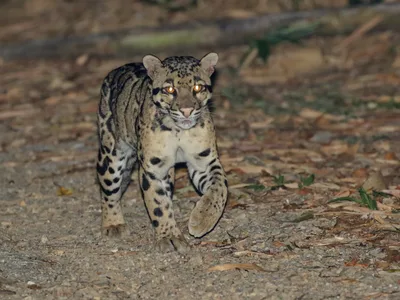 Clouded leopard
- crocodiles
Ecological equivalents
Related species on this site
Sumatran Orangutan (same genus), Tapanuli Orangutan (same genus), Australopithecus (same family), Bonobo (same family), Chimpanzee (same family), Cross River Gorilla (same family), and more.
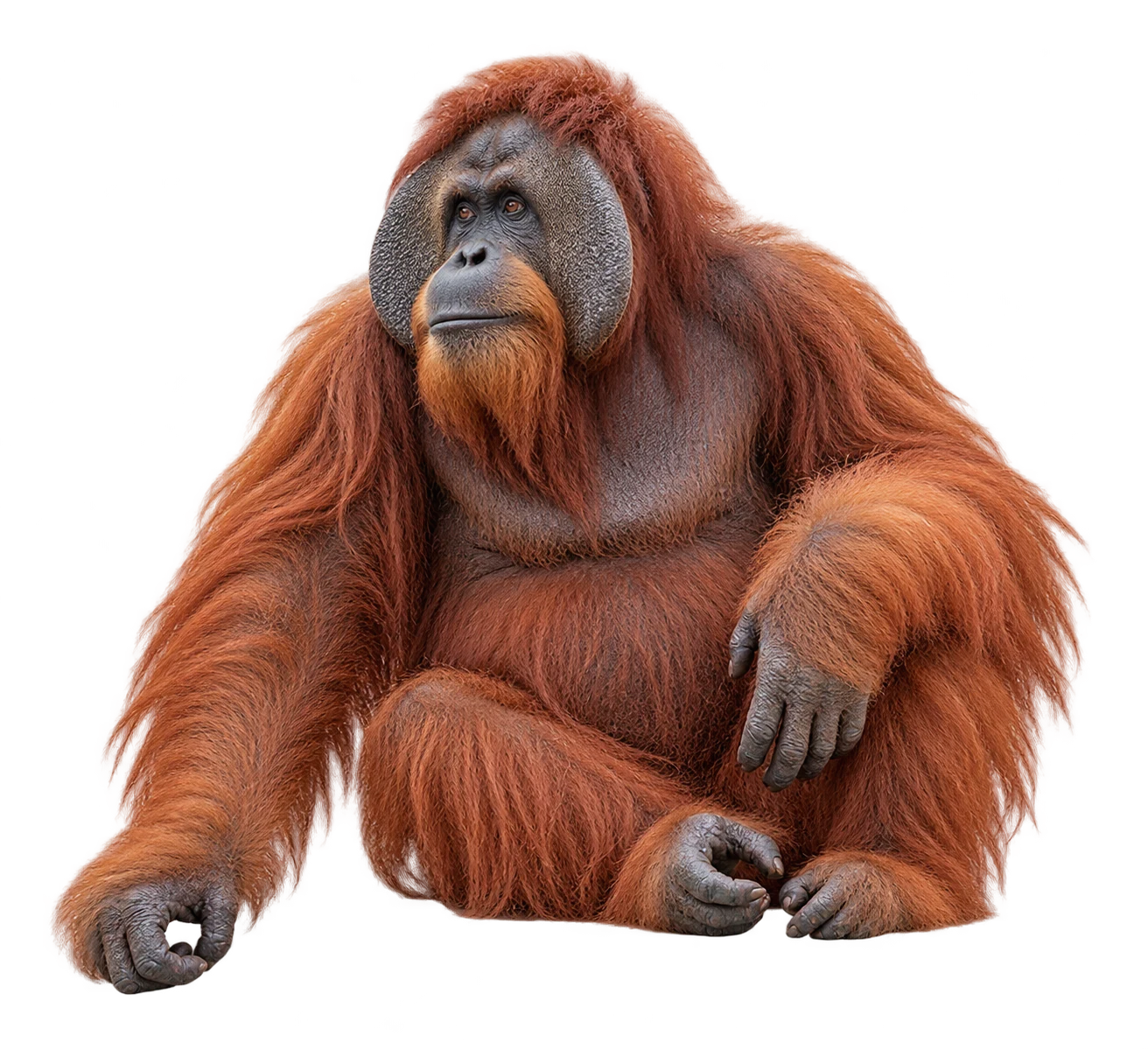
Mammals
Sumatran Orangutan
Pongo abelii
Classification and source reference
LivingAI illustration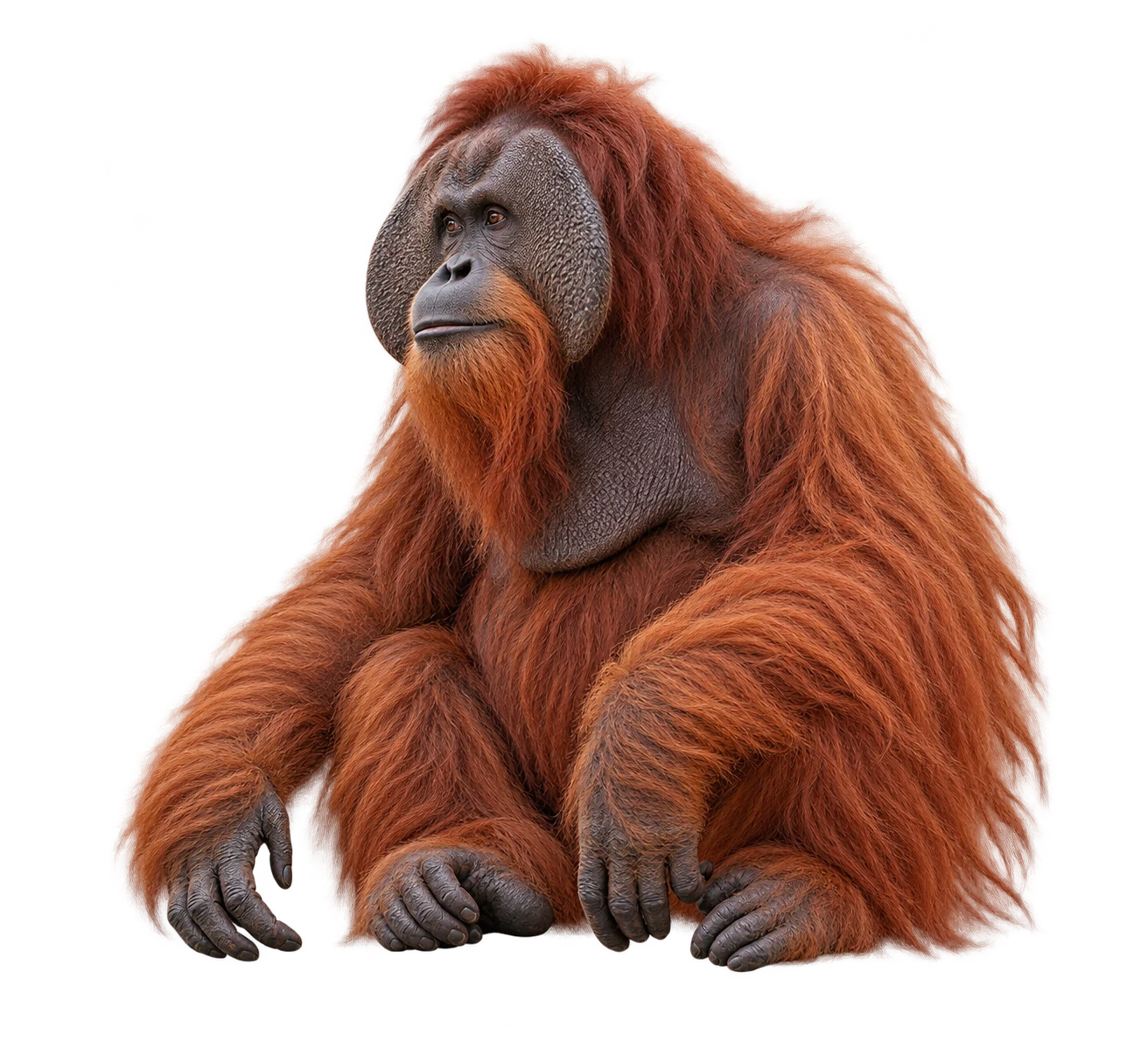
Mammals
Tapanuli Orangutan
Pongo tapanuliensis
Classification and source reference
LivingAI illustration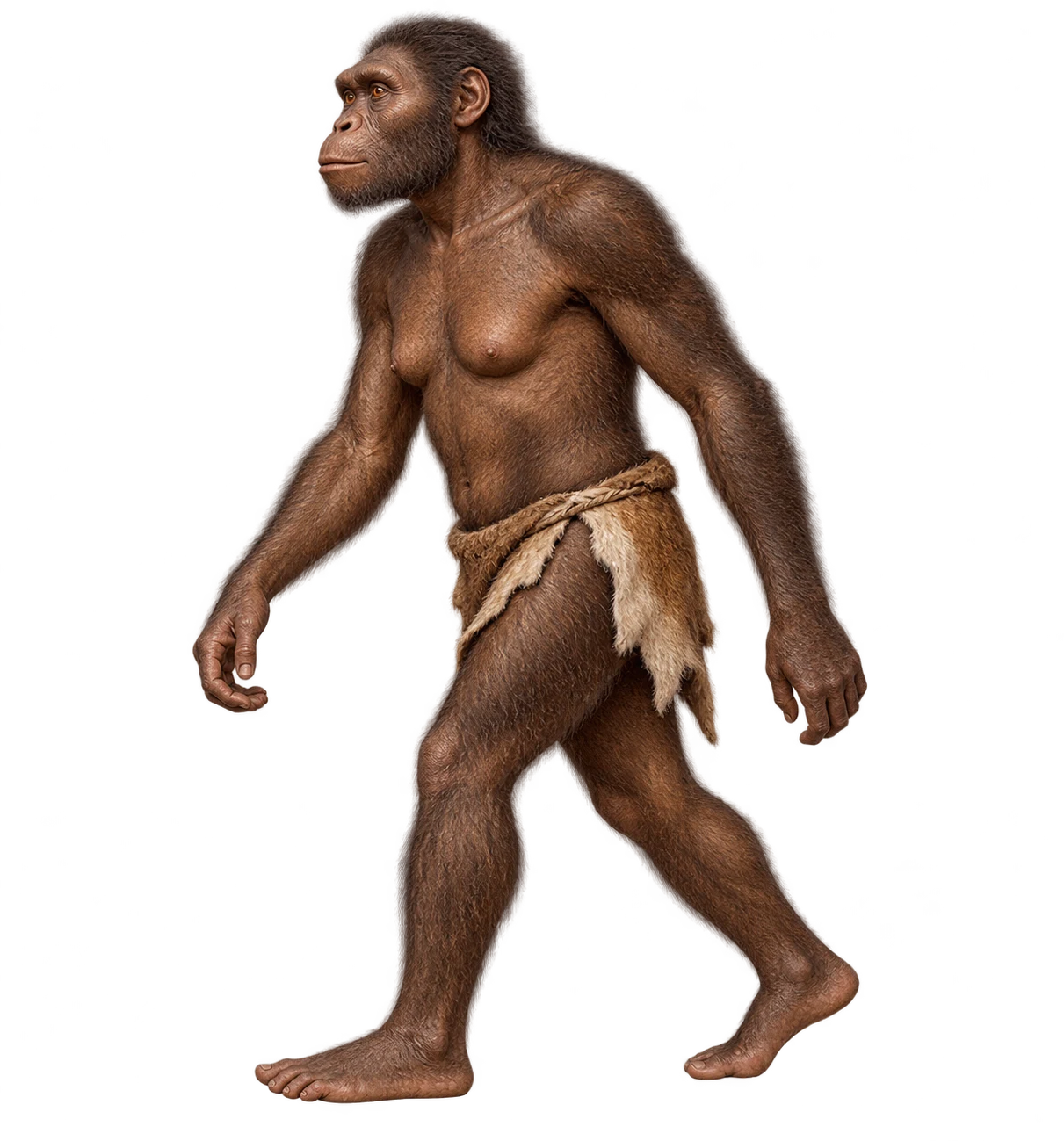
Mammals
Australopithecus
Australopithecus
Classification and source reference
ExtinctAI reconstruction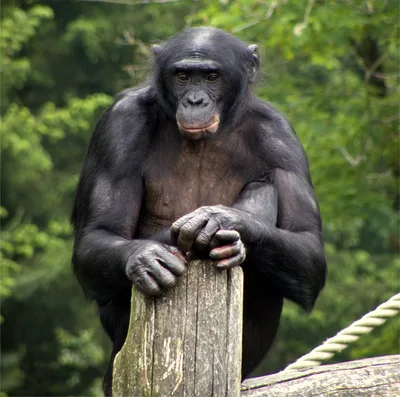
Mammals
Bonobo
Pan paniscus
The bonobo is a great ape of the Congo Basin.
Living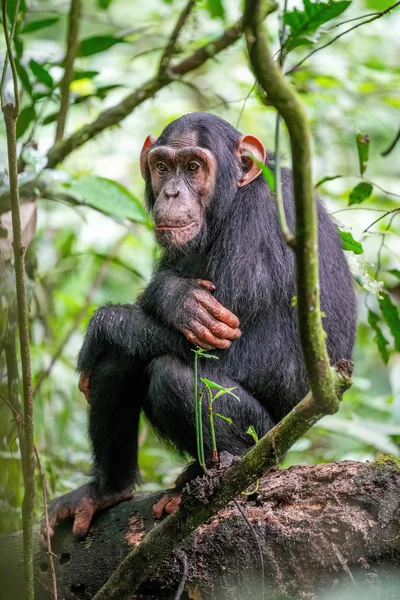
Mammals
Chimpanzee
Pan troglodytes
The chimpanzee is an African great ape that feeds mainly on fruit and other plant foods.
Living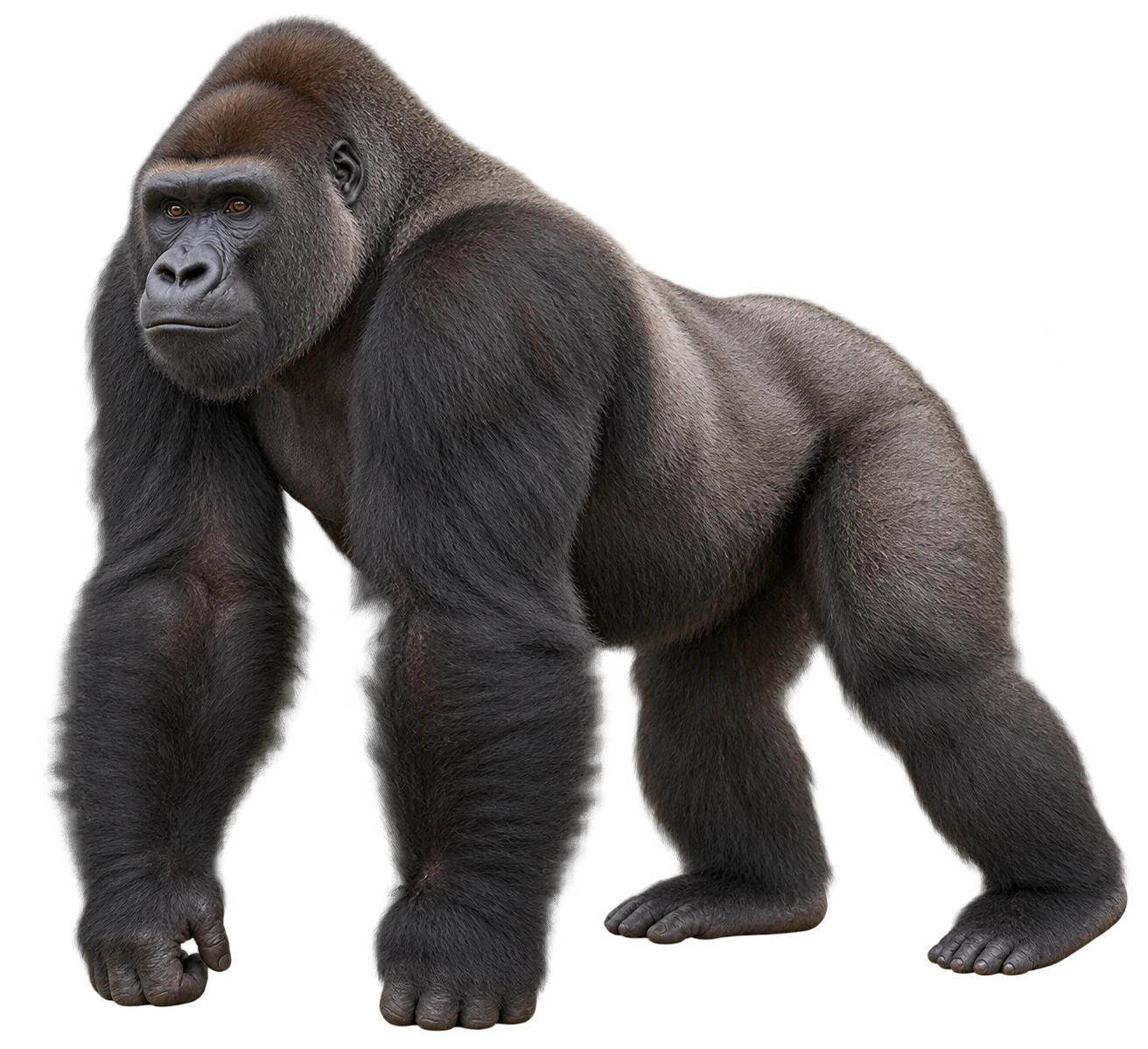
Mammals
Cross River Gorilla
Gorilla gorilla diehli
Classification and source reference
LivingAI illustration