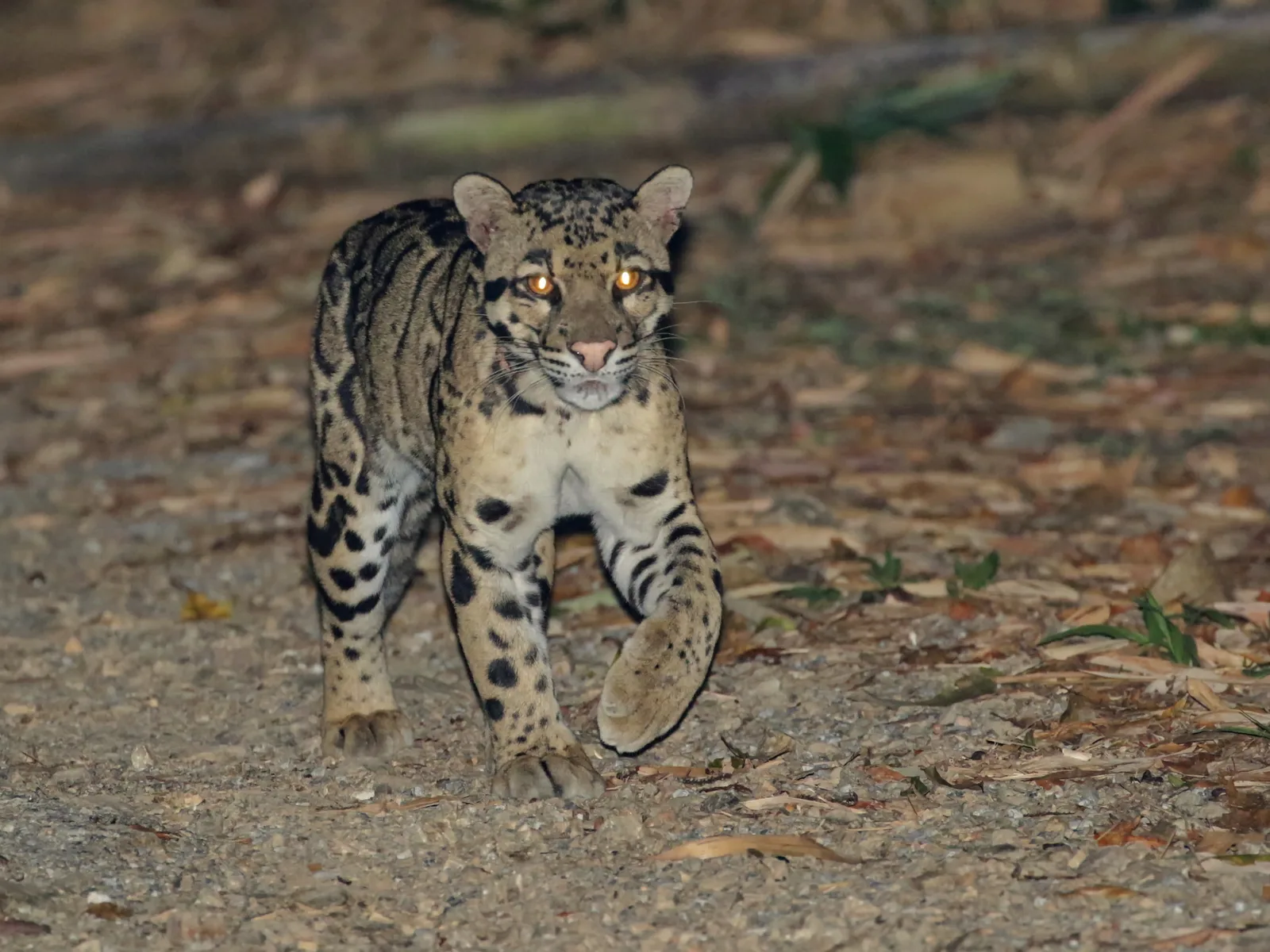
Clouded leopard
The tree cat with the longest fangs of any living feline
Neofelis nebulosa
Also called Mainland clouded leopard, Indochinese clouded leopard
Living individuals or members of this group exist today. This does not mean they are safe from extinction.
Meet the clouded leopard
The clouded leopard is a mid-sized cat of the forests of the Himalayan foothills, Southeast Asia and southern China. It climbs like no other cat and carries the longest canine teeth, for its size, of any living feline.
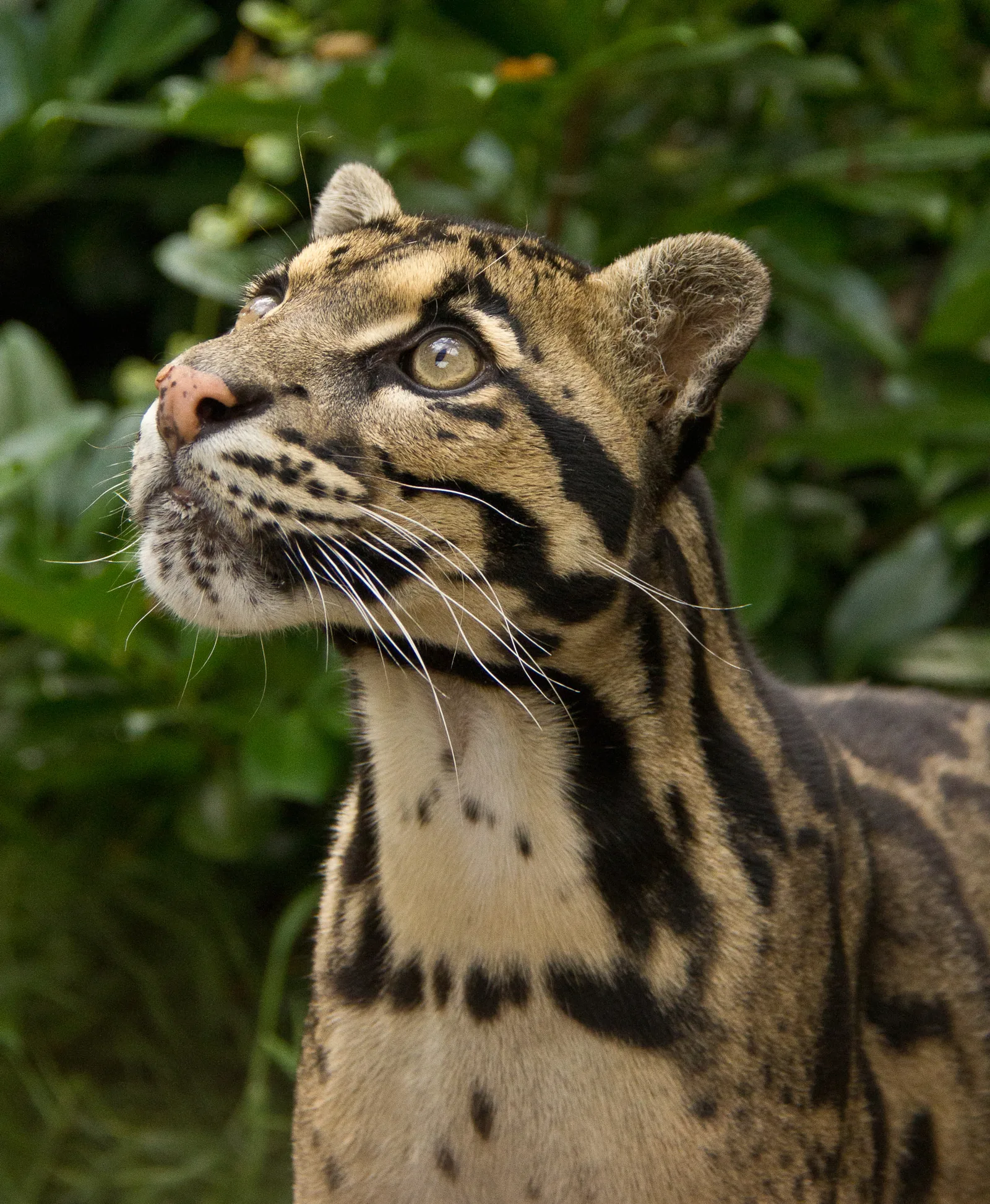
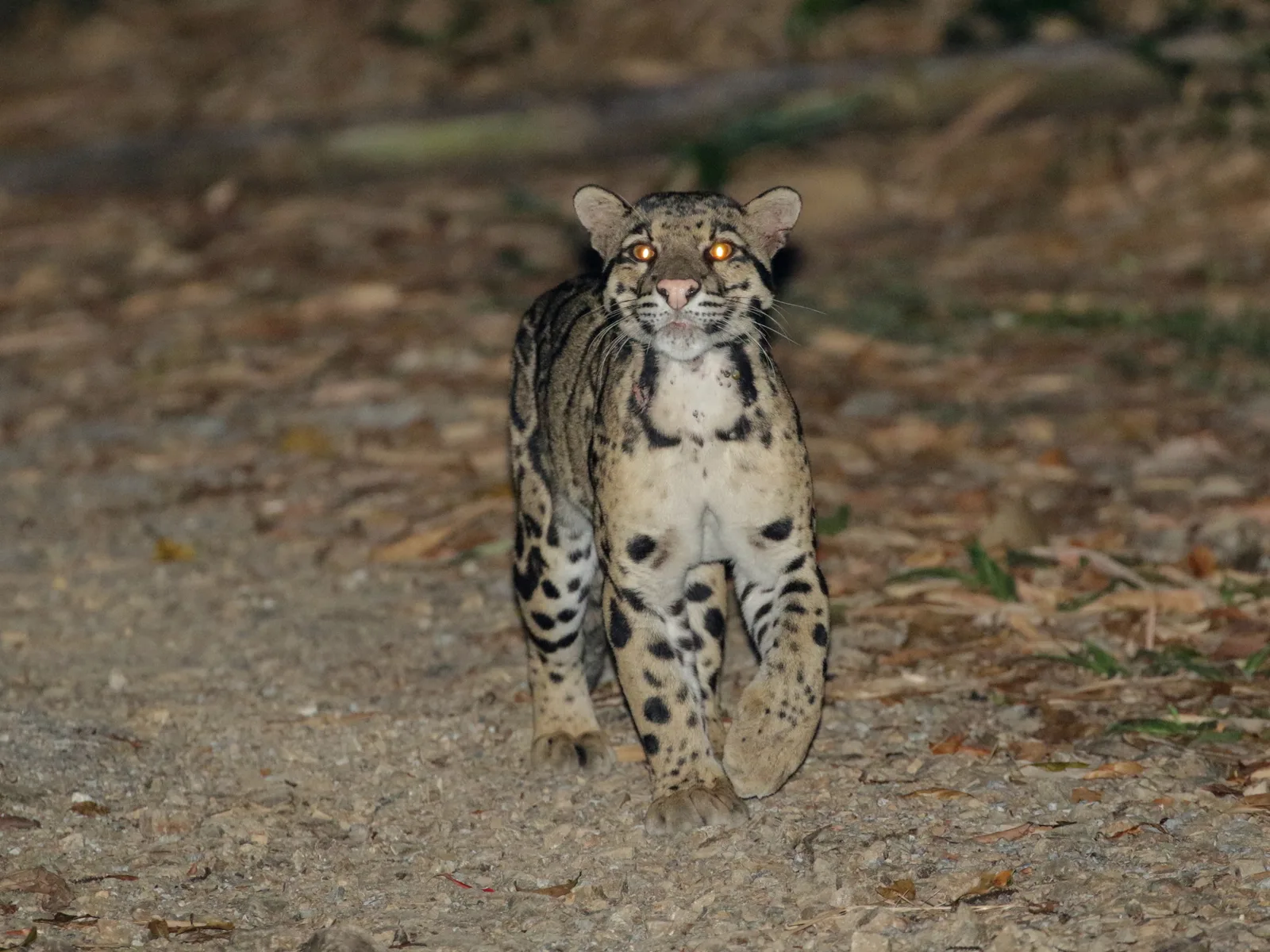
Images of the clouded leopard
Lifespan in the wild
About 11 years an estimate; few wild animals have been followed
Weight
11.5 to 23 kg
Length
0.69 to 1.08 m
Height
50 to 55 cm
Fact file
Clouded leopard
- Location
- Nepal and northeast India through Southeast Asia to southern China
- Habitat
- Rainforest, Temperate forest, Mountains
- Diet
- Carnivore
- Prey / food
- Deer, wild pigs, monkeys, porcupines, pangolins, civets, birds
- Predators
- None known; tigers and leopards may kill it as a rival
- Lifestyle
- Mostly nocturnal, solitary, at home in trees
- Group name
- Solitary
- Name of young
- Cub
- Gestation
- About 93 days
- Litter size
- 1 to 5 cubs, usually 2 or 3
- Population
- Fewer than 10,000 adults, falling
- Biggest threat
- Deforestation and poaching for skins, bones and teeth
- Distinctive feature
- Cloud-shaped blotches, a very long tail and huge canine teeth
- Colour
- Grey to yellow-brown with dark cloud blotches edged in black
- Skin type
- Fur
Size
Next to a person
Measurements
Size and speed
- Height
- 50 to 55 cm at the shoulder
- Length
- 0.69 to 1.08 m head and body; females 68.6 to 94 cm, males 81 to 108 cm
- Length, male
- 0.81 to 1.08 m
- Length, female
- 68.6 to 94 cm
- Tail
- 61 to 91 cm
- Tail, male
- 74 to 91 cm
- Tail, female
- 61 to 82 cm
- Weight
- 11.5 to 23 kg
Typical adult ranges. Source: Wikipedia.
Life cycle
Lifespan
- In the wildAbout 11 years an estimate; few wild animals have been followed
- In captivity13 to 15, up to 19.8 years ADW gives 13 to 15 years as typical; the AnAge record is 19.8
- 019.8 years
The pale bar is the record. Sources: Animal Diversity Web, AnAge.
Appearance
Colour and coat
- Primary colours
- greyyellow-brown
- Secondary colours
- blackwhite
- Skin type
- fur
- Male and female
- Slight. Males are larger, at 81 to 108 centimetres in head and body against 68.6 to 94 cm for females, but the coats are alike.
Life cycle
Mating and family
- Mating system
- probably polygynous; pairs meet only to mate
- Social structure
- solitary
- Breeding
- one litter a year, usually two or three cubs
Wild clouded leopards mate mostly between December and March. After about 93 days the female bears one to five cubs, usually two or three, each weighing 140 to 280 grams. The cubs open their eyes at about 10 days, climb at six weeks and are weaned by 14 weeks. They leave their mother at about 10 months and breed at about 26 months. Wild cats are thought to live about 11 years, and a captive one reached 19.8.
Classification
Taxonomy
- Kingdom
- Animalia
- Phylum
- Chordata
- Class
- Mammalia
- Order
- Carnivora
- Family
- Felidae
- Genus
- Neofelis
- Species
- Neofelis nebulosa
Conservation
Red List status
- LC
- NT
- VU
- EN
- CR
- EW
- EX
Vulnerable on the IUCN Red List
Range
Recorded in 4 countries
Habitat layer: tropical moist broadleaf forest, temperate broadleaf and mixed forest, temperate conifer forest, boreal forest and taiga, montane grassland and shrubland.
Countries from 20 wild records on GBIF (iNaturalist research grade), filtered and checked by hand. Country shapes: Natural Earth. Habitat: RESOLVE Ecoregions 2017, CC BY 4.0. Basemap: Natural Earth.
Habitats
Three things to know
- 1
The clouded leopard can climb down a tree trunk head first and hang from a branch by its hind feet alone.
- 2
Its upper canines reach 4 centimetres or more, the longest of any living cat for its body size.
- 3
Fewer than 10,000 adults remain, and no single population holds more than 1,000.
Did you know
Seven more facts
- 1
The tail is almost as long as the body and helps the cat balance in the trees.
- 2
Its wrist bones can rotate, which lets the paws grip a trunk from any angle.
- 3
Zoo males so often killed their mates that keepers now raise pairs together from cubhood.
- 4
Cubs are born with solid spots that open into clouds at about six months.
- 5
The Sunda clouded leopard of Borneo and Sumatra was only recognised as a separate species in 2006.
- 6
It greets a friend with a prusten, a puff of air that only tigers, snow leopards and jaguars also make.
- 7
International Clouded Leopard Day falls on 4 August.
Field notes
How it looks and acts
Field notes
Distinguishing features
- Large cloud-shaped blotches with black rear edges on a grey to buff coat.
- A very long, thick tail of 61 to 91 centimetres.
- Short, stout legs and broad paws.
- Upper canines of 4 cm or more in a long, low skull.
- Black ears and a white muzzle with spotted cheeks.
- A shoulder height of only 50 to 55 cm.
Field notes
Unique adaptations
- Rotating ankles and unfused forearm bones for climbing head first.
- A long tail as a counterweight on narrow branches.
- Hind legs longer than the front legs, for leaping.
- Huge canines and strong jaw crests for a deep killing bite.
- A clouded coat that hides it among leaves and shadows.
Field notes
Interesting behaviours
- Rests in trees by day and hunts at dusk and by night.
- Stalks or ambushes prey and kills with a bite to the neck.
- Retreats into a tree to digest after a meal.
- Marks its range by spraying, clawing and head rubbing.
- Calls from a high point with a long moaning cry.
Field notes
Temperament
- Secretive and rarely seen, even by camera traps.
- Solitary outside mating and cub rearing.
- Males can be dangerously aggressive to females.
Field notes
Communication
- A short high meow and a loud cry to find another cat.
- A prusten snort in friendly meetings.
- Low growls and hisses with bared teeth when angry.
- Scent marks from urine, claws and cheek glands.
Ecology
Ecological role
The clouded leopard is a top predator of the forest canopy and floor, especially where tigers and leopards are absent.
- It limits deer, pigs, monkeys and porcupines, which eases pressure on forest plants.
- It hosts flukes, tapeworms, roundworms and several ticks picked up from its prey.
- It competes with, and hides from, the larger tigers and leopards.
Stories
Myths and legends
- In Rukai tradition, a clouded leopard led the ancestors to their homeland, so the cat is sacred and never hunted.
- In Paiwan tradition, only nobles may wear a clouded leopard pelt.
- In Rukai and Paiwan tradition, the leopard and the black bear began white, and each painted the other.
People
Relationship with humans
People
Living alongside us
People rarely meet the clouded leopard, but they hunt it hard for its skin, teeth and bones, and they clear the forest it needs. It takes livestock at the forest edge and is poisoned in return. Zoos have bred it since the 1980s after learning to pair cubs early. It is sacred to the Rukai of Taiwan and the state animal of Meghalaya.
- No attacks on people are recorded, and the cat avoids villages.
- It kills goats, pigs, calves and poultry where farms meet forest.
- Like other cats it bites hard when cornered, and its canines are the longest of any living cat for its size.
People
Status, uses and products
- Domestication
- Wild
- As a pet
- Not suitable. The clouded leopard is a Vulnerable wild cat on CITES Appendix I, and trade in live animals is illegal. Cubs sold as pets are poached, and adults are strong, secretive and can be aggressive.
- Uses
- zoo displayecotourism
- Products
- skinsbonesteeth
The full account
About the clouded leopard
The clouded leopard, Neofelis nebulosa, is a mid-sized wild cat of the forests of southern Asia. Large dusky blotches, edged in black and shaped like clouds, cover a grey to yellow-brown coat. The head and body measure 68.6 to 108 centimetres, and the tail adds another 61 to 91 cm. Adults weigh 11.5 to 23 kilograms and stand 50 to 55 cm at the shoulder. For its size it has the longest canine teeth of any living cat, which earns it the nickname of a modern sabre-tooth.
It lives from the Himalayan foothills of Nepal, Bhutan and India through Myanmar and Southeast Asia to southern China. It rests in trees by day and hunts mostly by night, often on the ground. It can climb down a trunk head first and hang from a branch by its hind feet. Fewer than 10,000 adults remain, and the IUCN has listed the species as Vulnerable since 2008. Forest clearance and poaching for skins, bones and teeth drive the decline.
Name and taxonomy
Edward Griffith described the species as Felis nebulosa in 1821. He worked from the skin of an animal brought alive from Guangdong in China to a London menagerie. The Latin nebulosa means cloudy, a likely reference to the coat pattern that also gives the English name. Brian Houghton Hodgson named a Nepalese specimen in 1841, and Robert Swinhoe named a Taiwanese skin in 1862. John Edward Gray created the genus Neofelis for all three in 1867.
A skin from Java, named Felis diardi by Georges Cuvier in 1823, was long treated as a subspecies. In 2006 it was recognised as a separate species, the Sunda clouded leopard of Borneo and Sumatra. The mainland species is now considered monotypic, with no accepted subspecies. Older lists gave a Taiwanese subspecies, brachyura, and a sub-Himalayan one, macrosceloides. Local names include the Chinese yun bao, cloud leopard, and the Thai seua lai mek, cloud-patterned tiger.
Evolution and relatives
The cat family began to diversify in Asia in the Miocene, about 14.45 to 8.38 million years ago by nuclear DNA. The clouded leopard is the sister group to all the other big cats of the Pantherinae. It split from the line that led to lions, tigers and leopards about 9.32 to 4.47 million years ago. Skull studies in the 1960s already placed it as a bridge between the big cats and the small cats.
Mainland cats reached Borneo and Sumatra over a land bridge that is now under the sea, probably in the Pleistocene. Rising and falling seas cut the island cats off, and hair samples show the two species parted about 2.0 to 0.93 million years ago. The clouded leopard has an ossified hyoid bone, so unlike lions and tigers it can purr. Its range of calls still sits closer to that of the big cats. Its long canines are thought to be a return to a sabre-toothed way of killing, with deep stabbing bites.
Appearance
The ground colour runs from dark grey through buff to pale yellow-brown. Big cloud-shaped blotches, darker inside and rimmed in black along their rear edges, cover the sides, and the largest sit on the shoulders. Black spots mark the head and the legs, the ears are black, and broken stripes run from the eyes and mouth back to the shoulders. The thick tail carries large paired spots that merge into rings. The muzzle is white, the irises are brownish yellow to grey-green, and the pupils close to vertical slits. Black clouded leopards occur but are rare.
The body is long and the legs short and stout, with broad paws. The hind legs are longer than the front legs, which helps the cat jump. The bones of the forearm are not fused, so the paws can rotate to grip a trunk. Head and body run 81 to 108 cm in males and 68.6 to 94 cm in females. The tail is 74 to 91 cm in a male and 61 to 82 cm in a female, almost as long as the body. Adults weigh 11.5 to 23 kg, and a big male comes close to the size of a small leopard.
The skull is long and low with strong crests for the jaw muscles. The upper canines measure 4 cm or more, about three times the width of their sockets. A wide gap behind them gives the teeth room, and the first premolar is often missing. The bite force at the canine tip has been measured at 544.3 newtons. Cubs are born with solid dark spots that turn into open clouds by about six months.
Habitat and range
The range runs from the Himalayan foothills of Nepal, Bhutan and northeast India through Bangladesh, Myanmar, Thailand, Laos, Cambodia and Vietnam. It continues south into Peninsular Malaysia and east into China south of the Yangtze. The cat is extinct in Singapore and Taiwan, and perhaps in Hainan and Vietnam. Nepal thought it had lost the species until animals turned up in 1987 and 1988. In India it lives in Sikkim, northern West Bengal, Assam, Meghalaya and the other northeastern states.
Dense primary evergreen forest is the main habitat. The cat also uses dry tropical forest, logged forest, secondary growth, tall grassland and mangrove swamp. Camera traps have caught it from 144 metres in Pakke Tiger Reserve to 3,720 m in Sikkim. In Langtang National Park in Nepal it was recorded between 1,823 and 3,498 m. In Thailand it lives in relatively open dry forest at Huai Kha Khaeng and closed forest at Khao Yai. It needs large areas of intact forest, which many parts of its range no longer have.
Diet and hunting
The clouded leopard is a strict carnivore that hunts alone. It stalks its prey or waits in ambush, then pounces and bites the nape until the animal dies. After a meal it climbs into a tree to rest and digest. It takes prey both on the ground and in the trees. Its powerful build and long canines suggest that it evolved to bring down fairly bulky hoofed animals.
In Thailand it has been seen to kill pig-tailed macaques, hog deer, brush-tailed porcupines, pangolins and ground squirrels. In China it takes muntjac and pheasants, and in India one killed a slow loris. Other recorded prey includes young sambar, mouse deer, bearded pigs, palm civets, langurs and proboscis monkeys. One male in Malaysia was photographed carrying a binturong, a heavy tree-dwelling civet. Fish remains have been found in its droppings, and near villages it kills goats, pigs, calves and poultry. It tears meat from a carcass by stabbing with its teeth and jerking its head back.
Behaviour and social life
The clouded leopard lives alone, and a pair seen together is probably a mating couple or a mother with cubs. Early accounts called it a rare, secretive, nocturnal tree-dweller of deep forest. Radio collars tell a more mixed story. Two collared cats in Thailand were active in 35 to 45 percent of daytime checks. That figure rose to 85 percent at dusk and 60 percent at night. They were quietest around midday and in the hours before dawn. Cats in northeast India moved most in the late evening after sunset.
It is one of the finest climbers among the cats. Captive animals climb down vertical trunks head first, walk upside down along branches and hang by their hind feet. They can jump more than 1.2 metres straight up. Trees serve mainly as resting places, and most travel and hunting happen on the ground. Time in trees may also keep the cat away from ground leeches and from tigers and leopards that would kill it.
Home ranges are known only from Thailand. At Phu Khieo two females held 25.7 and 22.9 square kilometres and two males 29.7 and 49.1. At Khao Yai a female used 39.4 square kilometres and a male 42, each with a core of about 2.9. Ranges of males and females overlap a great deal. Captive cats mark their ground by spraying urine, clawing trees, scraping and rubbing their heads on objects.
Communication and senses
Its calls include a short high meow and a loud crying call, both used to find another cat at a distance. A friendly meeting brings a prusten, a soft snorting puff that only tigers, snow leopards and jaguars also make. An angry cat growls low and hisses with bared teeth and a wrinkled nose. Wild animals climb to a high point to give a long moaning call that carries far. The call may serve to find a mate or to warn off a rival. It also mews and spits like other cats.
Like other cats it has keen night vision, sharp hearing and a good nose. Long whiskers on the muzzle feel the way through dark forest. Scent marks left by spraying, clawing and cheek rubbing probably tell other cats who holds a range and who is ready to breed.
Reproduction and life cycle
Almost everything known about mating comes from zoos. Both sexes first breed at about 26 months on average, within a range of 20 to 30 months. A female is in heat for about six days in a cycle of about 30 days. In the wild most mating happens between December and March, though it can occur all year. The pair mates many times over several days, and the male grips the female by the neck while she calls out. Males are so aggressive that in zoos they have often killed the female with a neck bite.
Zoos now raise a male and a female together from a few weeks old, so that a bond forms before they mature. Artificial insemination produced cubs in 1992, 2015 and 2017. Gestation lasts about 93 days, give or take six, within a reported range of 85 to 109 days. A litter holds one to five cubs, usually two or three. Cubs are born blind and weigh 140 to 280 grams. The eyes open at about 10 days, the cubs walk at about 20 days and climb at six weeks.
They start on meat at 7 to 10 weeks and are weaned at 10 to 14 weeks. By 10 weeks a cub can kill a chicken. The adult cloud pattern appears at about six months, and the young leave their mother at about 10 months. The male plays no part in raising them, and a female can breed every year. Wild cats are thought to live about 11 years, and a captive animal has reached 19.8.
Predators and threats
No animal hunts the clouded leopard for food. Tigers and leopards share much of its range and probably kill it as a competitor. That may be why it keeps to the trees and to the night where they live. People are the real predator, tracking the cat with dogs or poisoning it after it takes livestock. Zoo records show respiratory disease, maternal neglect and infections as the main killers of captive cubs.
Large-scale deforestation removes the intact forest the species needs. Poaching for the wildlife trade is the second threat. In four markets in Myanmar, surveys between 1991 and 2006 found 301 body parts from at least 279 clouded leopards. In Nepal 27 seizures between 1988 and 2020 held parts of at least 51 cats, and in 17 cases the traders were arrested. Skins are sold as decoration and clothing, teeth and bones go into traditional medicine, and live cubs enter the pet trade. Its fragmented populations are also more exposed to disease and disaster.
Population and conservation
The IUCN has listed the clouded leopard as Vulnerable since 2008. Fewer than 10,000 adults are thought to survive, no subpopulation holds more than 1,000, and numbers are falling. Camera-trap surveys find it far less often than the leopard. One survey in southern Thailand in 2016 found about 5.06 cats per 100 square kilometres in a protected core. A disturbed edge zone held 3.13. The Taiwan population is gone: the last skin was found in 1989, and cameras at more than 1,450 sites from 1997 to 2012 saw none.
The species sits on CITES Appendix I, which bans commercial trade, and it counts as Endangered under United States law. Hunting is banned in Bangladesh, China, India, Malaysia, Myanmar, Nepal, Taiwan, Thailand and Vietnam, though enforcement is weak in several of them. Zoos have kept the cat since the early 20th century, opened a studbook in the 1970s and began coordinated breeding in the 1980s. As of 2014, 64 institutions held clouded leopards. International Clouded Leopard Day has been marked on 4 August every year since 2018.
Relationship with humans
Few people ever see a wild clouded leopard, and it avoids villages. Where farms push into forest, it takes calves, goats, pigs and chickens, and villagers answer with poison. Its pelt is a status symbol for some men in Asia, and skins, claws, teeth and bones sell in markets from Myanmar to Cambodia. The cat has even appeared on the menus of expensive restaurants. The Taiwanese subspecies was hunted to extinction, partly to feed this trade.
Zoos struggled to breed the cat for decades because the males killed their mates. In 2011 keepers at Nashville Zoo hand-raised three cubs that each weighed 0.23 kilograms at birth. Four more cubs arrived there in 2012 and four at Point Defiance Zoo in 2015. Meghalaya, a state in India, names it as its state animal. It is not a danger to people, and no attacks on humans appear on record.
In culture and myth
The Rukai people of Taiwan hold the clouded leopard sacred, because their ancestors followed one to the land they settled. For the Rukai, hunting the cat is taboo. Among the Paiwan people, only the nobility could wear its pelt. Both peoples tell how the clouded leopard and the black bear started out white, then painted one another. The leopard took care over the bear's coat, but the bear daubed the leopard. In return the leopard still sets aside part of every kill for the bear. Before Christianity reached Taiwan's hill peoples, the skin was used in ceremonies and the hunter who took one was a hero.
In China the cat is yun bao, the cloud leopard, and in Thailand seua lai mek, the tiger with cloud markings. In the 1970s a print of Rama Samaraweera's painting Clouded leopard became a best-seller in the United States. Modern writers call the cat a living sabre-tooth, an image that probably owes more to its teeth than to any old story.
A sentence with a dotted underline is inferred: it describes the group the animal belongs to, or is a reading of the sources, rather than a measured or reported fact about this species.
Questions
Clouded leopard questions, answered
Is the clouded leopard a real leopard?
No. It is its own genus, Neofelis, and the sister group to all the big cats. It is much smaller than a leopard and has a different coat pattern.
Where do clouded leopards live?
In forests from Nepal, Bhutan and northeast India through Myanmar, Thailand, Laos, Cambodia and Malaysia to southern China. They are extinct in Taiwan and Singapore.
How big is a clouded leopard?
The head and body measure 68.6 to 108 centimetres, the tail 61 to 91 cm, and adults weigh 11.5 to 23 kilograms. The shoulder stands 50 to 55 cm high.
Why are its teeth so long?
Its upper canines reach 4 centimetres or more, the longest of any living cat for its size. They give a deep killing bite, and some call the cat a modern sabre-tooth.
What do clouded leopards eat?
Deer, wild pigs, monkeys, porcupines, pangolins, civets, squirrels and birds. Near villages they take goats, pigs and poultry.
Can clouded leopards climb down trees head first?
Yes. Rotating ankles and flexible forearm bones let them descend a trunk head first and hang from branches by their hind feet.
Are clouded leopards endangered?
The IUCN lists them as Vulnerable, with fewer than 10,000 adults and falling numbers. They are on CITES Appendix I.
Are clouded leopards dangerous to people?
No attacks on people are recorded. The cat is secretive and avoids villages, though it takes livestock.
How many cubs does a clouded leopard have?
One to five, usually two or three, after a pregnancy of about 93 days. Cubs weigh 140 to 280 grams at birth.
How long do clouded leopards live?
About 11 years in the wild, by estimate. Zoo animals average 13 to 15 years, and one reached 19.8.
Can a clouded leopard purr?
Yes. Its hyoid bone is fully ossified, so it can purr. It also greets other cats with a prusten, a soft snort.
Why are they so hard to breed in zoos?
Males often killed females during mating. Zoos now raise a pair together from a few weeks old so that a bond forms first.
What is the Sunda clouded leopard?
A separate species on Borneo and Sumatra, recognised in 2006. The two species split about 2.0 to 0.93 million years ago.
Is the clouded leopard extinct in Taiwan?
Yes. The last skin was found in 1989, and cameras at more than 1,450 sites from 1997 to 2012 recorded none.
What threatens clouded leopards?
Deforestation and poaching. Skins, bones and teeth are sold in markets, and one survey in Myanmar found parts from at least 279 cats.
Food web
Prey and food
- deer
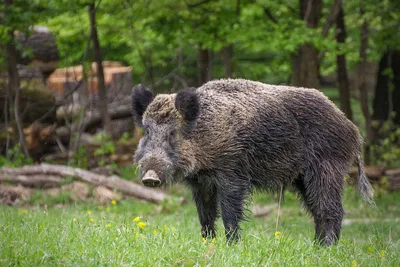 Wild boar
- monkeys
- porcupines
- pangolins
- civets
- birds
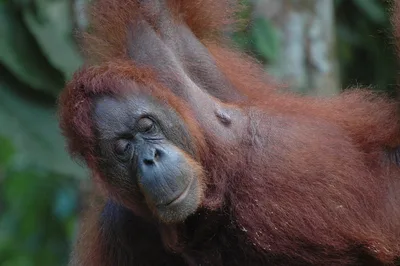 Bornean orangutan
Food web
Predators
- none known
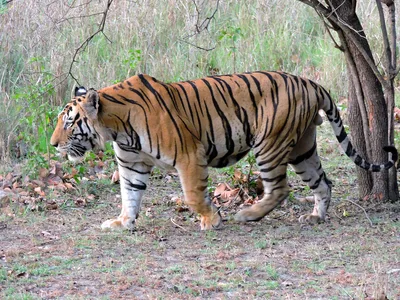 Tiger
- leopards may kill it as a rival
Ecological equivalents
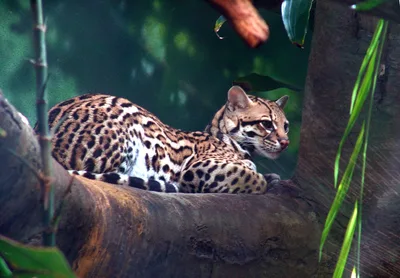
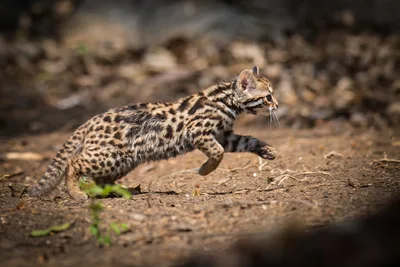
Related species on this site
Abyssinian (same family), African Golden Cat (same family), African wildcat (same family), American Wirehair (same family), Amur Leopard (same family), Australian Mist (same family), and more.
Mammals
Abyssinian
Felis catus
Classification and source reference
LivingAI illustration
Mammals
African Golden Cat
Caracal aurata
Classification and source reference
LivingAI illustration LC
Mammals
African wildcat
Felis lybica
The African wildcat is a small striped cat of dry Africa and Asia, and the ancestor of every domestic cat.
Living
Mammals
American Wirehair
Felis catus
Classification and source reference
LivingAI illustration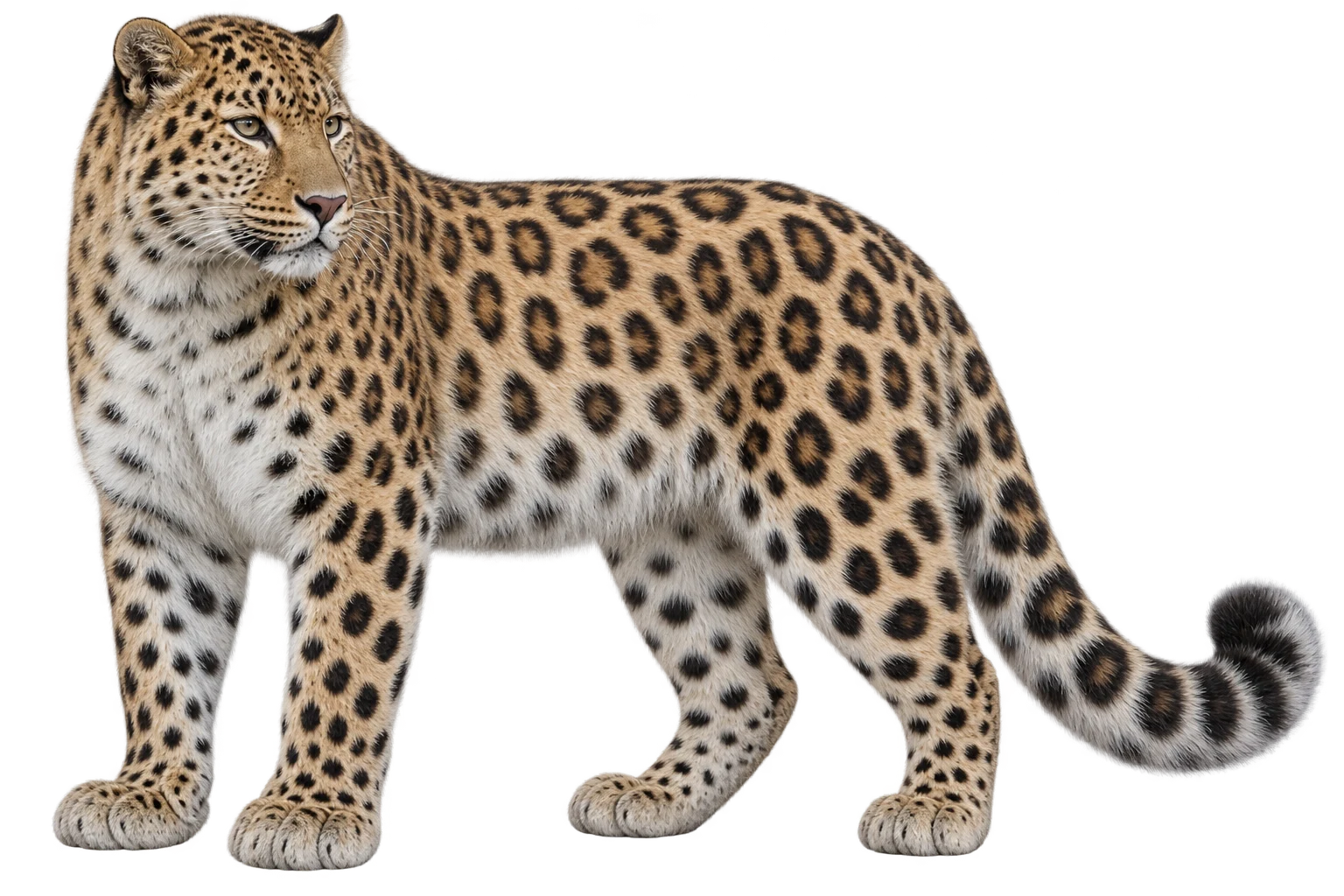
Mammals
Amur Leopard
Panthera pardus orientalis
Classification and source reference
LivingAI illustration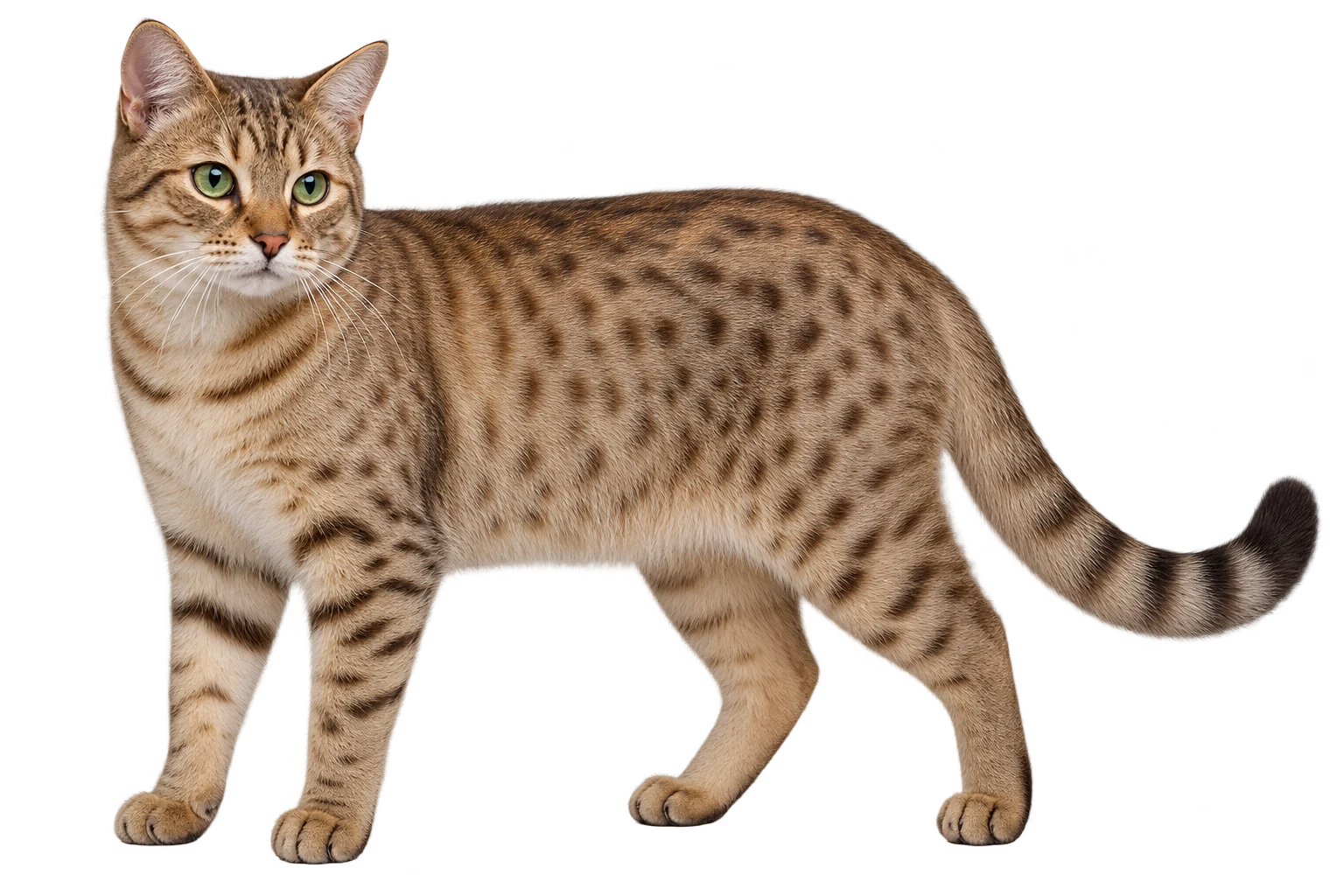
Mammals
Australian Mist
Felis catus
Classification and source reference
LivingAI illustration