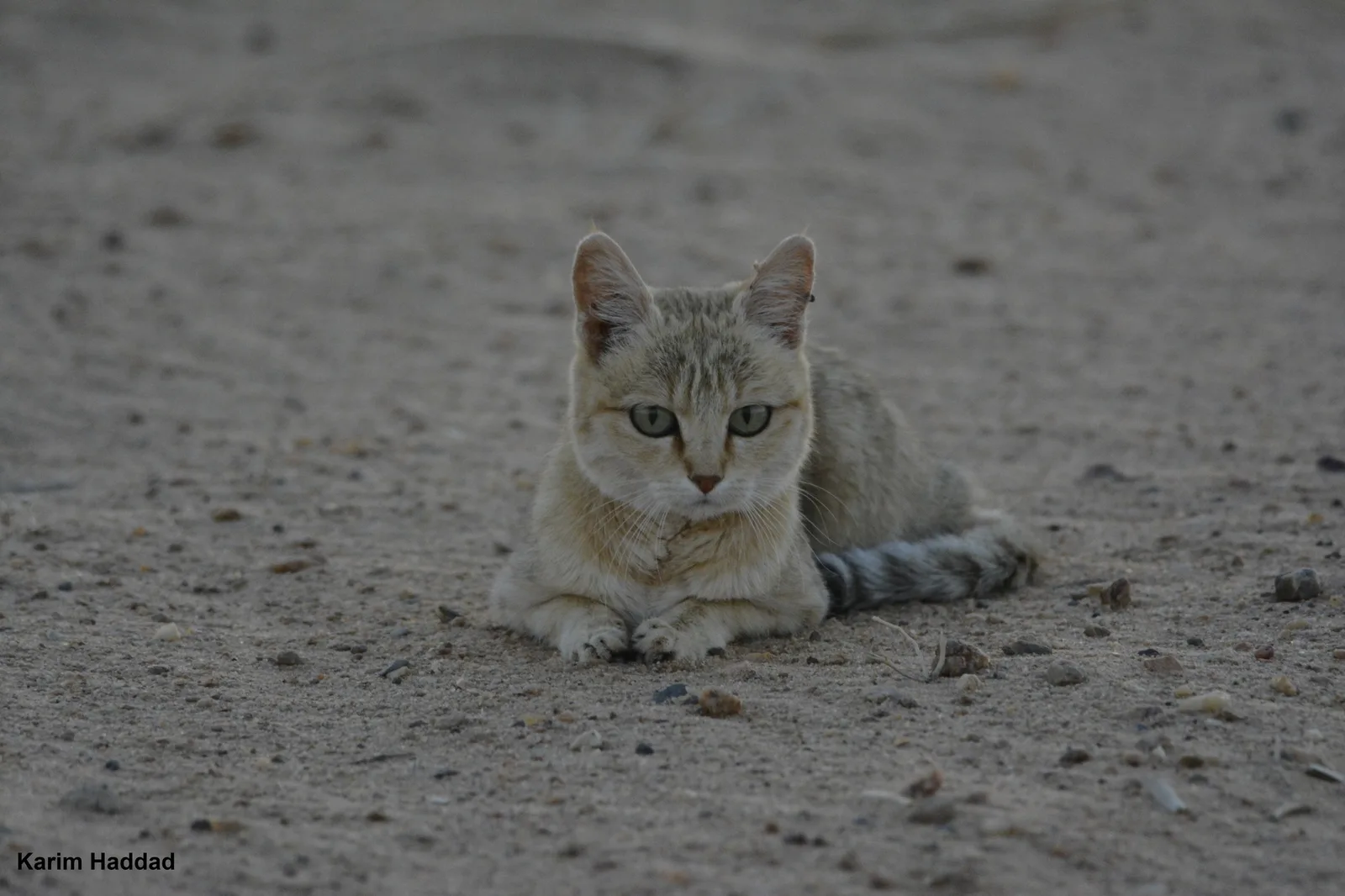
African wildcat
The wild ancestor of every house cat
Felis lybica
Also called Afro-Asiatic wildcat, Bush cat, Steppe cat, Indian desert cat
Living individuals or members of this group exist today. This does not mean they are safe from extinction.
Meet the african wildcat
The African wildcat is a small striped cat of dry Africa and Asia, and the ancestor of every domestic cat. It hunts rodents alone at night.
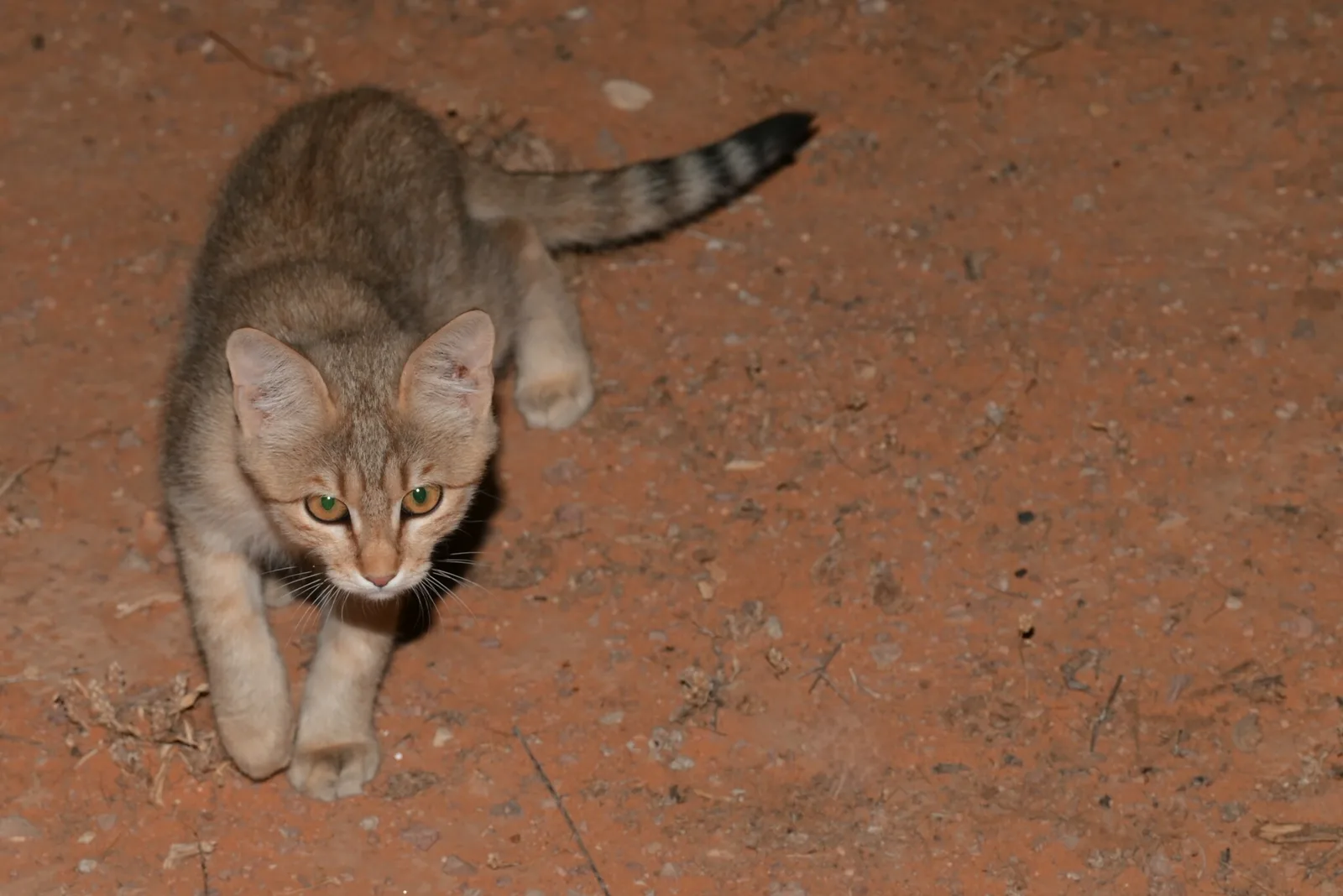
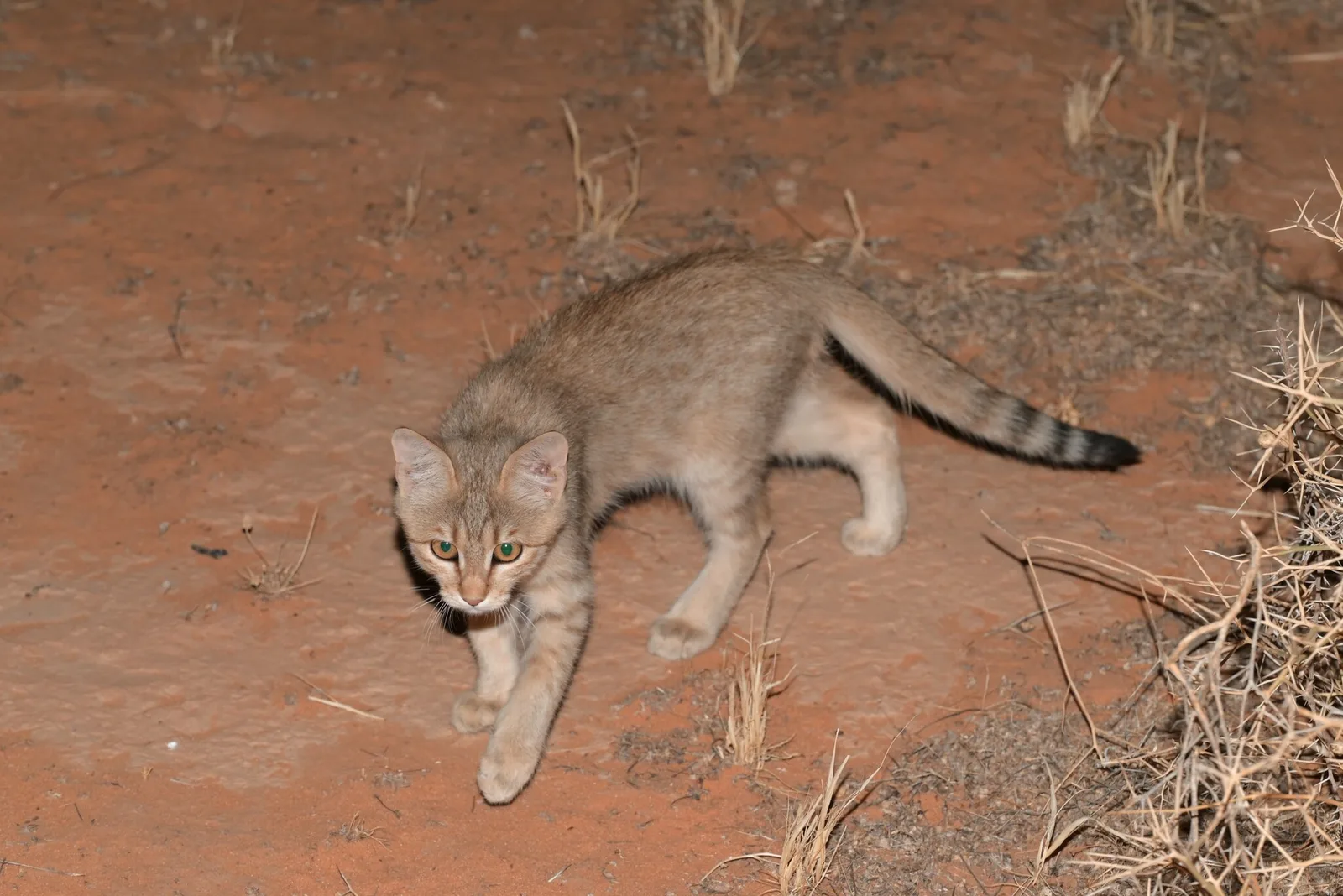
Images of the african wildcat
Lifespan
Up to 19 years a wild-born female of the lybica form, from the AnAge entry for Felis silvestris
Weight
3.2 to 4.5 kg
Length
40.6 to 59.7 cm
Fact file
African wildcat
- Location
- Africa, the Middle East, Central Asia, India
- Habitat
- Savanna, Desert, Grassland, Mountains
- Diet
- Carnivore
- Prey / food
- Mice, rats, gerbils, hares, birds, lizards, insects
- Predators
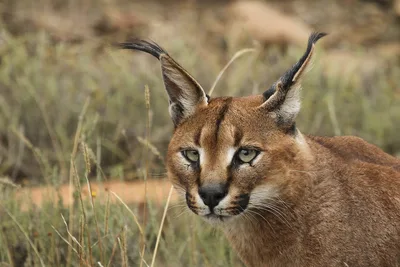
- Leopard, caracal, jackal, hyena, large owls
- Lifestyle
- Nocturnal and solitary
- Group name
- Solitary
- Name of young
- Kitten
- Gestation
- 56 to 60 days
- Litter size
- 1 to 3 kittens, up to 5
- Population
- Not counted; widespread and thought stable
- Biggest threat
- Interbreeding with domestic cats
- Distinctive feature
- Tabby-like coat with reddish ears and a ringed, tapering tail
- Colour
- Sandy grey with darker stripes
- Skin type
- Fur
Size
Next to a person
Measurements
Size and speed
- Length
- 40.6 to 59.7 cm head and body, without the tail
- Length, male
- 47 to 59.7 cm North African skins
- Length, female
- 40.6 to 55.8 cm North African skins
- Tail
- 24.1 to 36.8 cm
- Tail, male
- 26.7 to 36.8 cm
- Tail, female
- 24.1 to 33.7 cm
- Weight
- 3.2 to 4.5 kg
Typical adult ranges. Source: Wikipedia.
Life cycle
Lifespan
- In captivityUp to 19 years a wild-born female of the lybica form, from the AnAge entry for Felis silvestris
- 019 years
The pale bar is the record. Source: AnAge.
Appearance
Colour and coat
- Primary colours
- sandy grey
- Secondary colours
- reddishblack
- Skin type
- fur
- Male and female
- Slight. Males are a little longer than females, but the sexes weigh about the same and share the same coat.
Life cycle
Mating and family
- Mating system
- polygynous, a male's range overlapping those of up to three females
- Social structure
- solitary
- Breeding
- one litter a year, in the wet season where seasons are marked
The African wildcat mates in the breeding season and the female raises the kittens alone. Gestation lasts 56 to 60 days and a litter usually holds one to three kittens. They open their eyes at 10 to 14 days and learn to hunt at about three months. They leave the mother at about six months. One wild-born female reached about 19 years in captivity.
Classification
Taxonomy
- Kingdom
- Animalia
- Phylum
- Chordata
- Class
- Mammalia
- Order
- Carnivora
- Family
- Felidae
- Genus
- Felis
- Species
- Felis lybica
Conservation
Red List status
- LC
- NT
- VU
- EN
- CR
- EW
- EX
Least Concern on the IUCN Red List
Range
Recorded in 21 countries
- Burkina Faso
- Benin
- Botswana
- Algeria
- Western Sahara
- Ethiopia
- Israel
- India
- Iran
- Kenya
- Kazakhstan
- Morocco
- Namibia
- Niger
- Oman
- Russia
- Saudi Arabia
- Chad
- Tanzania
- South Africa
- Zimbabwe
Habitat layer: tropical grassland, savanna and shrubland, temperate grassland, savanna and shrubland, montane grassland and shrubland, desert and xeric shrubland.
Countries from 831 wild records on GBIF (iNaturalist research grade), filtered and checked by hand. Country shapes: Natural Earth. Habitat: RESOLVE Ecoregions 2017, CC BY 4.0. Basemap: Natural Earth.
Habitats
Three things to know
- 1
All domestic cats trace their ancestry to this one small wild species.
- 2
In Cyprus a wildcat lay buried next to a human about 9,500 years ago.
- 3
It seldom needs to drink, because prey gives it most of its water.
Did you know
Seven more facts
- 1
The Persians are said to have won the Battle of Pelusium in 525 BCE by driving cats ahead of their army.
- 2
Ancient Egyptians mummified cats by the hundred thousand as offerings to Bastet.
- 3
A pure wildcat has reddish backs to its ears, which a feral tabby usually lacks.
- 4
The wildcat's tail tapers to a point, while the European wildcat's tail is thick and blunt.
- 5
In northern Namibia the wildcat kills Kirk's dik-dik, an antelope its own size.
- 6
Wildcats in the Kalahari hold ranges of only 3.5 to 7.7 square kilometres.
- 7
GBIF holds records of the species from 55 countries.
Field notes
How it looks and acts
Field notes
Distinguishing features
- A sandy grey coat with faint stripes that fade into spots on the flanks.
- A head and body of 40.6 to 59.7 centimetres, about the size of a house cat.
- A slender ringed tail of 24.1 to 36.8 cm with a black tip.
- Reddish ears with a small tuft at the tip.
- Legs longer than a house cat's, giving an upright sitting posture.
- Two dark rings around each foreleg.
Field notes
Unique adaptations
- Acute hearing that fixes the position of a rodent in cover.
- A pale coat that matches dry grass and sand.
- Kidneys that probably let it go for long periods without drinking.
- Eyes that work in near darkness, like other cats.
- Long legs that give a fast rush at the end of a stalk.
Field notes
Interesting behaviours
- Hunts alone at night and rests in bushes by day.
- Stalks by creeping forward through cover, then rushes.
- Raises its fur to look larger when confronted.
- Marks and defends a territory that overlaps those of several females.
- Gives birth in dense grass, a burrow or a hollow tree.
Field notes
Temperament
- Shy and wary of people, even when raised by hand.
- Solitary except when mating or raising kittens.
- Bold in defence, bluffing with raised fur before it flees.
Field notes
Communication
- Scent marks along the borders of the territory.
- Calls mostly in the breeding season.
- Raised fur, an arched back and flattened ears as a threat display.
- Purring and rubbing between mother and kittens, as with the house cat.
Ecology
Ecological role
The African wildcat is a small nocturnal predator that keeps rodent numbers down across dry Africa and Asia.
- Takes large numbers of mice, rats and gerbils, the main pests of grain and grazing.
- Kills birds, lizards and insects as well, so it sits in several food chains.
- Probably feeds larger carnivores and eagles in turn.
- Its hybrids with domestic cats likely carry wild genes into feral populations.
Stories
Myths and legends
- In ancient Egyptian tradition, the cat goddess Bastet protected the home and the family.
- In ancient Egyptian tradition, Mafdet, the first cat-headed deity, kept snakes and scorpions from the king.
- In Persian tradition, Cambyses drove cats before his army at Pelusium so that the Egyptians would not fight.
- In some sub-Saharan traditions, the wildcat is said to be the eyes of the night, watching for unseen dangers.
People
Relationship with humans
People
Living alongside us
The domestic cat descends from the African wildcat, tamed in the Near East about 10,000 years ago and again in Egypt. Egyptians made it a god, mummified it and punished those who killed it. Today it is a small pest to sheep and goat farmers. Its greatest threat comes from its own descendants, because domestic cats interbreed with it. It is shy and does not make a pet.
- It weighs 3.2 to 4.5 kilograms and avoids people.
- A cornered cat scratches and bites, as any cat does.
- It takes lambs and goat kids in Southern Africa but poses no threat to people.
People
Status, uses and products
- Domestication
- Wild
- As a pet
- Not suitable. A hand-raised wildcat stays wary and restless, sprays and destroys furnishings. Its domestic descendant is the pet; the wild form belongs in the bush.
- Uses
- ecotourismpest control
- Products
- None recorded
The full account
About the african wildcat
Felis lybica, the African wildcat, is a small cat with sandy grey fur and faint stripes. It looks much like a tabby house cat, and that is no accident. Every domestic cat descends from it. People in the Near East began to tame it about 10,000 years ago, and Egypt tamed it again later. Where wild and domestic cats meet, they still breed together.
The species ranges across Africa outside the Congo rainforest and on through Arabia and Iran to India and western China. It lives in desert, savanna, scrub and grassland. An adult weighs 3.2 to 4.5 kilograms, with a head and body of 40.6 to 59.7 centimetres. It hunts alone at night, mostly for mice, rats and gerbils. The IUCN lists it as Least Concern, but mixing with domestic cats is eroding the pure wild form.
Name and taxonomy
Georg Forster named the species Felis lybica in 1780. His type came from Gafsa in Tunisia: house-cat sized, with reddish fur, black ear tufts and a ringed tail. Over the next century and a half, museum curators named more than twenty forms from skins and skulls across Africa and the Near East. Johann Gmelin's Felis ocreata of 1791 came from a cat seen in Ethiopia, and Anselme Desmarest's Felis cafra of 1822 from two Eastern Cape skins. For much of the 20th century the animal was treated as a subspecies of the wildcat, Felis silvestris lybica.
Since 2017 the Cat Specialist Group treats it as a species of its own with three subspecies. F. l. lybica lives in North Africa, Sinai and Sudan. The Southern African wildcat, F. l. cafra, lives in the south of the continent. The Asiatic wildcat, F. l. ornata, lives from the Caspian Sea to India and China. English names in use include Afro-Asiatic wildcat, bush cat, steppe cat and Indian desert cat.
Evolution and relatives
The cat family began to branch in Asia about 14.45 to 8.38 million years ago, according to nuclear DNA. The line that became the genus Felis split from the other small cats about 2.16 to 0.89 million years ago. The jungle cat left the Felis line first, then the black-footed cat, then the sand cat, then the African wildcat. The African wildcat and the European wildcat parted about 173,000 years ago. About 131,000 years ago the African form split again into Near Eastern, Southern African and Asiatic groups.
About 10,000 years ago farmers in the Fertile Crescent tamed some of these cats, probably because they hunted mice in grain stores. A cat buried beside a person at Shillourokambos in Cyprus, about 9,500 years ago, is the oldest sign of a bond between the two. Egypt tamed the wildcat a second time, and Egyptian cats spread around the Mediterranean from the 8th century BCE. By the 5th century CE they had reached the Baltic coast. Domestic cats trace back to at least five female founders in their mitochondrial DNA. The cats of Sardinia and Corsica were once called a wildcat subspecies, but they descend from domestic cats brought from the Near East.
Appearance
The coat is light sandy grey, sometimes with a yellow or reddish tint, and nearly white on the throat and belly. A dark line runs down the spine, and pale vertical stripes on the flanks often break up into spots. Two dark bars cross each cheek, and four to six bands cross the throat. The forelegs carry two dark rings, and the tail ends in two or three rings and a black tip. The ears are reddish to grey with a small tuft and long pale hairs around the rim.
Males from North Africa measure 47 to 59.7 centimetres from head to rump, with a tail of 26.7 to 36.8 cm. Females measure 40.6 to 55.8 cm, with a tail of 24.1 to 33.7 cm. Both sexes weigh 3.2 to 4.5 kilograms. Across the whole Afro-Asiatic range, weights from 2 to 8 kg have been recorded. The legs are longer than a house cat's, so the animal sits more upright and walks with a taller gait.
Next to the European wildcat, the African wildcat is smaller and shorter-haired. Its stripes on the neck and shoulders are faint, and its spinal stripe is less sharp. The tail is slender and tapers to the tip, where the European cat's tail is thick and blunt. A pure wildcat also has a plain tail base and reddish backs to the ears, which help to separate it from a feral tabby.
Habitat and range
The African wildcat lives across the whole of Africa apart from the dense rainforest of the Congo Basin. North of the Sahara it ranges from Morocco to Egypt. South of the desert it lives in the grasslands, savannas and shrublands from Mauritania to the Horn of Africa. It occurs in every country of East and Southern Africa. In the Sahara itself it is scarce and keeps to rough country such as the Hoggar Mountains.
Beyond Africa it lives in the Middle East, including parts of Arabia and most of Iran. It reaches the east shore of the Caspian Sea, crosses Kazakhstan and stops in Xinjiang in China. It also lives in Rajasthan in India. It has been recorded up to 3,000 metres above sea level. GBIF holds records from 55 countries, though that figure counts zoo animals and escapes as well as the native range.
In Syria it is widespread but uncommon, in the wooded coastal hills, the dry steppe around Palmyra and the south-west. A home range covers 1.7 to more than 50 square kilometres, depending on how much food the land offers. In the Kalahari, females held about 3.5 km2 and males 7.7 km2. One female in the United Arab Emirates used 52.7 km2 of desert. In the Serengeti the species lives at 10 to 100 cats per 100 km2.
Diet and hunting
Rodents are the main food: mice, rats, gerbils, jerboas and voles. Hares, small and medium birds such as francolins, lizards, snakes and insects fill out the diet. In the Kgalagadi Transfrontier Park the cats live mostly on mice and rats, with birds, small reptiles and invertebrates as extras. In Southern Africa they also take antelope fawns, lambs and goat kids. In northern Namibia they kill Kirk's dik-dik, an antelope about their own weight.
The wildcat hunts by night and finds its prey by ear. Its hearing is sharp enough to fix the position of a mouse under cover. It creeps forward slowly, uses grass and bushes as cover, and ends the stalk with a short rush. It rarely drinks, because it gets most of its water from prey. Like other small cats, it probably kills with a bite to the neck.
Behaviour and social life
The African wildcat lives alone. Each adult holds a territory that it marks and defends. A male's range overlaps the ranges of up to three females. The species is mainly nocturnal, and it is most strictly so in hot country and near villages. By day it rests in bushes, though it may move about on dark cloudy days.
When it meets a threat it raises its fur to look larger and stands its ground. It is a capable climber and will take to a tree to escape dogs. Like other cats, it probably spends much of the night patrolling its range and much of the day asleep. Near people it grows warier and keeps more strictly to the dark hours.
Communication and senses
Hearing is the wildcat's first sense. The large ears turn fast and independently to pin down a rustle in the grass. Its eyes gather light well, as in all cats, so it sees in near darkness. Scent marks tell neighbours where one territory ends and the next begins.
The cat is quiet for most of the year. Calls come mostly in the breeding season, when males and females meet, and probably include the yowls, growls and hisses of a house cat. Raised fur, an arched back and flattened ears signal a threat. Like the domestic cat, it is thought to purr and to greet by rubbing.
Reproduction and life cycle
Gestation lasts 56 to 60 days. In Botswana most kittens arrive in the warm wet season, when rodents are plentiful. A litter usually holds one to three kittens, and litters of five have been seen. Across the whole range, litters of 1 to 6 are reported, and rarely up to 8. The mother gives birth in a hidden place such as thick grass, a burrow or a hollow tree.
The kittens open their eyes at about 10 to 14 days and move about at a month old. At about three months they begin to learn hunting from their mother. They leave her and live alone from about six months. They are sexually mature at 9 to 12 months, though a first litter probably comes at 18 to 22 months. A wild-born female of this species lived to about 19 years in captivity, and the wild lifespan is probably far shorter.
Predators and threats
Larger carnivores kill wildcats: leopards, caracals, jackals and hyenas take them where ranges overlap. Large owls and eagles probably take kittens. Domestic dogs kill many near farms, and cars kill more on roads. Farmers shoot and poison wildcats that take lambs and kids.
The largest threat is not a predator but a relative. Wild and domestic cats breed freely together, and their hybrids are fertile. In Asia the steppe-type wildcats look so much like tabbies that some populations may descend mostly from feral cats. Diseases that pass from domestic cats are thought to add to the pressure. Loss of grassland to farms and grazing removes both cover and rodents.
Population and conservation
The IUCN Red List rates the African wildcat as Least Concern. It is widespread, and its numbers are thought to be stable across most of the range, with declines in some regions. No firm total exists, because the animal is hard to tell from a feral tabby in the field. It is listed on CITES Appendix II, which controls trade in its skins.
Conservation work centres on keeping pure populations apart from domestic cats. Genetic tests now separate wild, hybrid and feral animals, and reserves in South Africa breed pure stock. A domestic cat can carry a wildcat embryo to term, which zoos have used to raise wildcat kittens. Libya put the species on a set of postage stamps with WWF in 1997.
Relationship with humans
No wild animal has lived closer to people for longer. The tamed wildcat became the house cat, which now lives on every continent except Antarctica. A Fifth Dynasty wall painting at Saqqara, from the 26th century BCE, shows a small cat in a collar, probably a tamed wildcat. Cats appear in Egyptian religious scenes from about 1980 BCE, and the earliest cat mummy known was made about 1350 BCE. From 664 BCE cat mummies were sold to pilgrims as offerings, and cemeteries at Bubastis and Saqqara held vast numbers of them.
Today the wildcat is a minor pest to sheep and goat farmers in Southern Africa. Its skin has little value, and it is not hunted for sport. The real harm runs the other way: pet and feral cats absorb the wild population through interbreeding. A kitten raised by hand stays shy and destructive, and it is not a pet.
In culture and myth
The cat's place in myth begins in Egypt. Mafdet, the first cat-headed god, kept snakes and scorpions out of the king's chambers in the First Dynasty. Bastet was shown with a lion's head at first, and from about 950 BCE with the head of a small cat. Herodotus wrote that her festival at Bubastis drew several hundred thousand pilgrims. Diodorus recorded that a crowd lynched a Roman for killing a cat, between 60 and 56 BCE, though the king tried to stop them.
At Pelusium in 525 BCE the Persian army reportedly pushed cats ahead of its front line, and the Egyptians would not strike. Some sub-Saharan stories, it is said, make the wildcat a watchful spirit that senses dangers people cannot see. The San are said to have believed that a cat's behaviour warned of trouble from the spirit world. Modern spirit-animal writing reads the wildcat as a sign of independence, which probably says more about the writer than the cat. The domestic cat's long trail of folklore, from witches' familiars to lucky black cats, all rests on this one wild species.
A sentence with a dotted underline is inferred: it describes the group the animal belongs to, or is a reading of the sources, rather than a measured or reported fact about this species.
Questions
African wildcat questions, answered
Is the African wildcat the ancestor of the domestic cat?
Yes. All domestic cats descend from African wildcats tamed in the Near East about 10,000 years ago. Egypt tamed the species a second time, and Egyptian cats spread across the Mediterranean.
How big is an African wildcat?
About the size of a house cat. Adults weigh 3.2 to 4.5 kilograms, with a head and body of 40.6 to 59.7 centimetres and a tail of 24.1 to 36.8 cm.
What does an African wildcat eat?
Mainly mice, rats, gerbils and other rodents. It also takes hares, birds, lizards, snakes and insects, and in Southern Africa it kills antelope fawns, lambs and goat kids.
Where do African wildcats live?
Across Africa outside the Congo rainforest, through Arabia and Iran, and east to India and western China. They favour desert, savanna, scrub and grassland.
How can you tell an African wildcat from a feral tabby?
Look for long legs, a slender tapering tail with a black tip, reddish backs to the ears and faint body stripes. Feral cats usually have shorter legs and a plainer or bolder coat. Genetic tests are the only sure way.
Are African wildcats endangered?
No. The IUCN lists them as Least Concern and numbers are thought stable in most of the range. The main worry is interbreeding with domestic cats, which dilutes the wild gene pool.
Do African wildcats breed with house cats?
Yes, freely, wherever the two meet. The hybrids are fertile. In parts of Asia some wild populations may descend mostly from feral cats.
How long do African wildcats live?
The wild lifespan is not well known. A wild-born female of this species lived to about 19 years in captivity, and captive animals usually reach up to 15 or 16 years.
Are African wildcats dangerous?
No. They avoid people and flee when seen. A cornered cat can scratch and bite, but it weighs only 3.2 to 4.5 kilograms.
How many kittens does an African wildcat have?
Usually one to three, after 56 to 60 days of gestation. Litters of up to five have been seen in Botswana, and larger litters are rare.
Can you keep an African wildcat as a pet?
No. Even a hand-raised kitten grows into a shy, restless adult that sprays and destroys things. Keeping one is also illegal in many countries without a permit.
Why were cats sacred in ancient Egypt?
Tamed wildcats killed the snakes and rodents that threatened grain and homes. The goddess Bastet took a cat's head from about 950 BCE, and cats were mummified as offerings to her.
Is the African wildcat nocturnal?
Mostly. It hunts at night and rests in bushes by day, though it may move about on cloudy days. Near villages and in hot deserts it keeps strictly to the dark.
How big is an African wildcat's territory?
From 1.7 to more than 50 square kilometres, depending on food. Kalahari females use about 3.5 km2 and males 7.7 km2, and one desert female in the UAE used 52.7 km2.
Does the African wildcat drink water?
Rarely. It gets most of its water from its prey, which lets it live in deserts such as the Sahara and the Kalahari.
Food web
Prey and food
- mice
- rats
- gerbils
- hares
- birds
- lizards
- insects
Food web
Predators
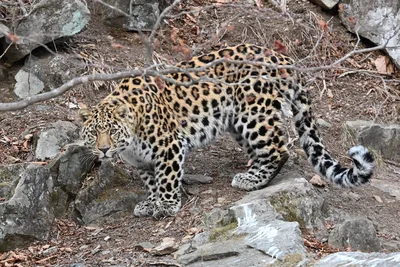 Leopard
 Caracal
Ecological equivalents
Related species on this site
Abyssinian (same genus), American Wirehair (same genus), Australian Mist (same genus), Balinese (same genus), Birman (same genus), Black-footed cat (same genus), and more.
Mammals
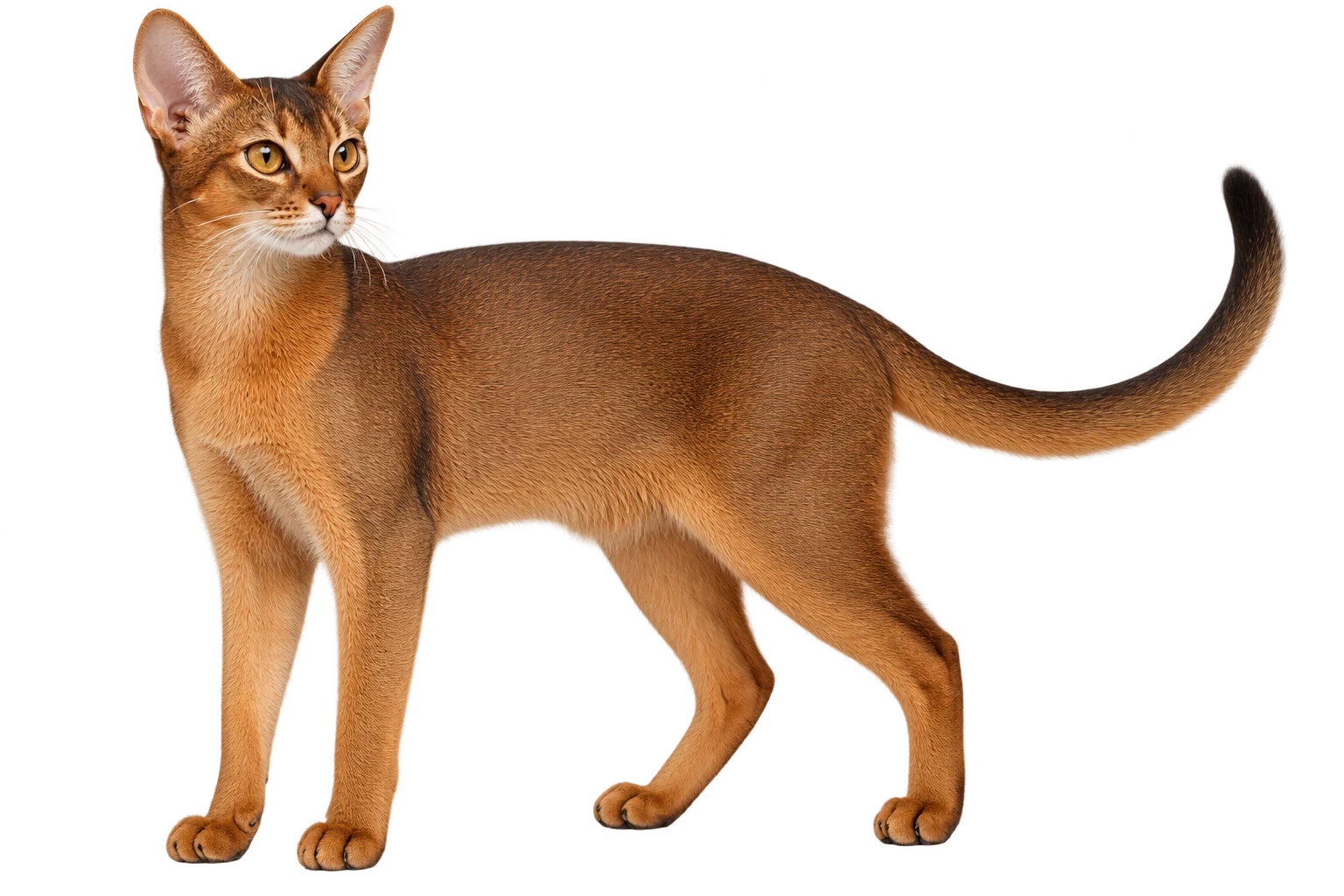
Abyssinian
Felis catus
Classification and source reference
LivingAI illustration
Mammals
American Wirehair
Felis catus
Classification and source reference
LivingAI illustration
Mammals
Australian Mist
Felis catus
Classification and source reference
LivingAI illustration
Mammals
Balinese
Felis catus
Classification and source reference
LivingAI illustration
Mammals
Birman
Felis catus
Classification and source reference
LivingAI illustration VU
Mammals
Black-footed cat
Felis nigripes
The black-footed cat is Africa's smallest wild cat, a spotted night hunter of the dry grasslands of South Africa, Namibia and Botswana.
Living