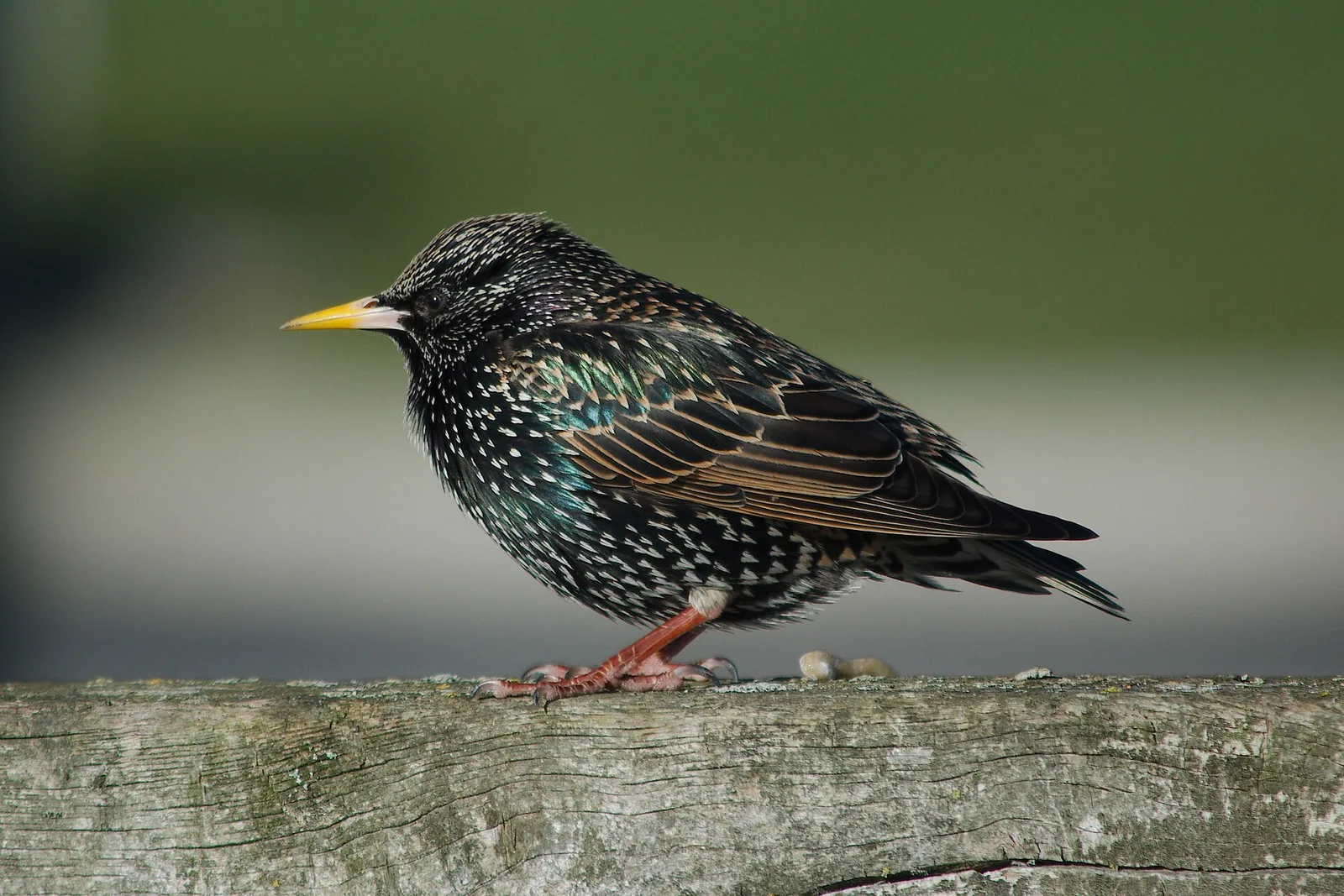
Common starling
The mimic that flies in flocks of a million
Sturnus vulgaris
Also called European starling, Starling, Stare
Living individuals or members of this group exist today. This does not mean they are safe from extinction.
Meet the common starling
The common starling is a glossy black songbird of Europe and Asia, spangled with white spots in winter. It copies other birds and machines, feeds in flocks on open grass, and gathers in winter roosts that can hold a million birds.
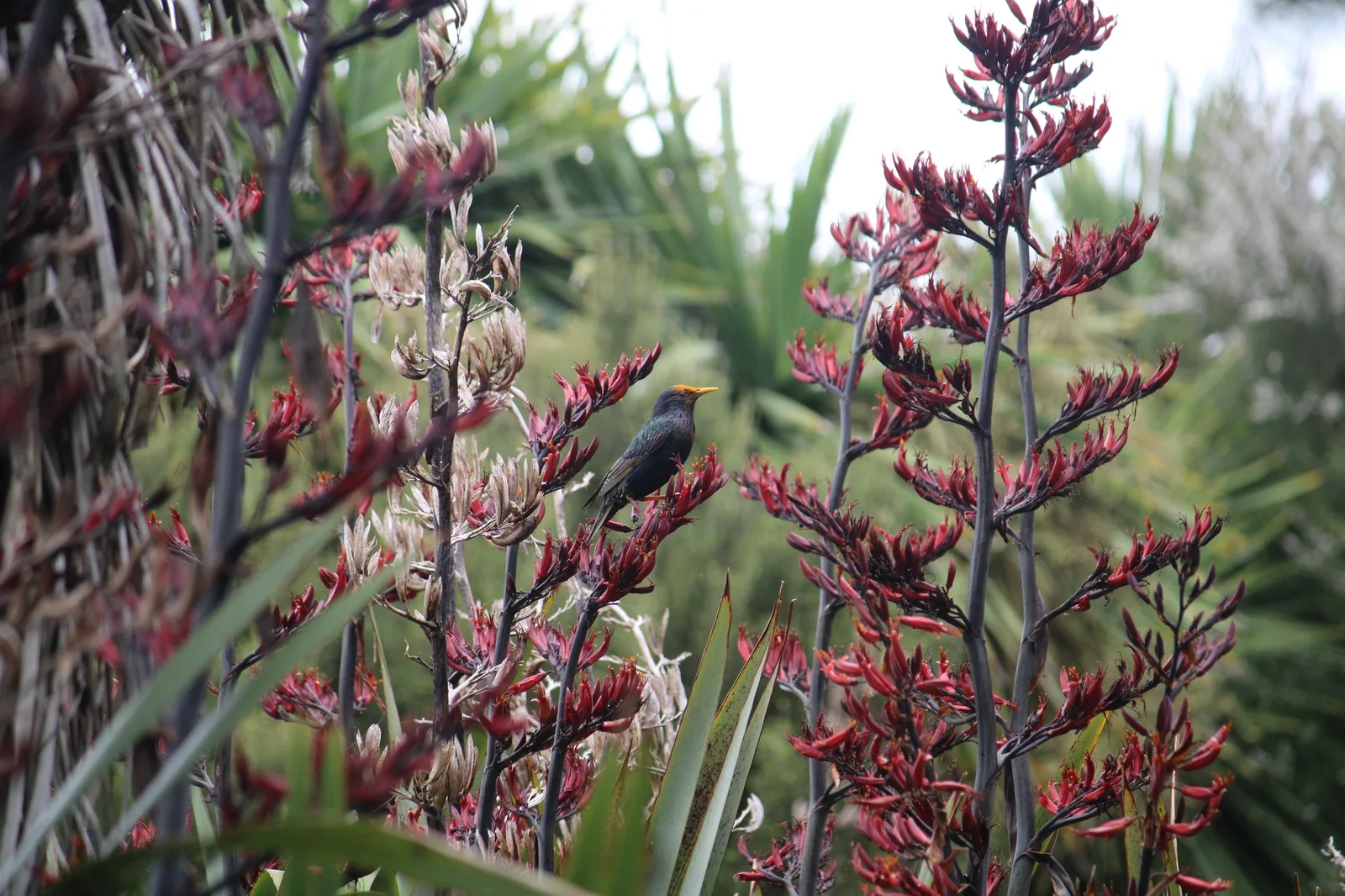
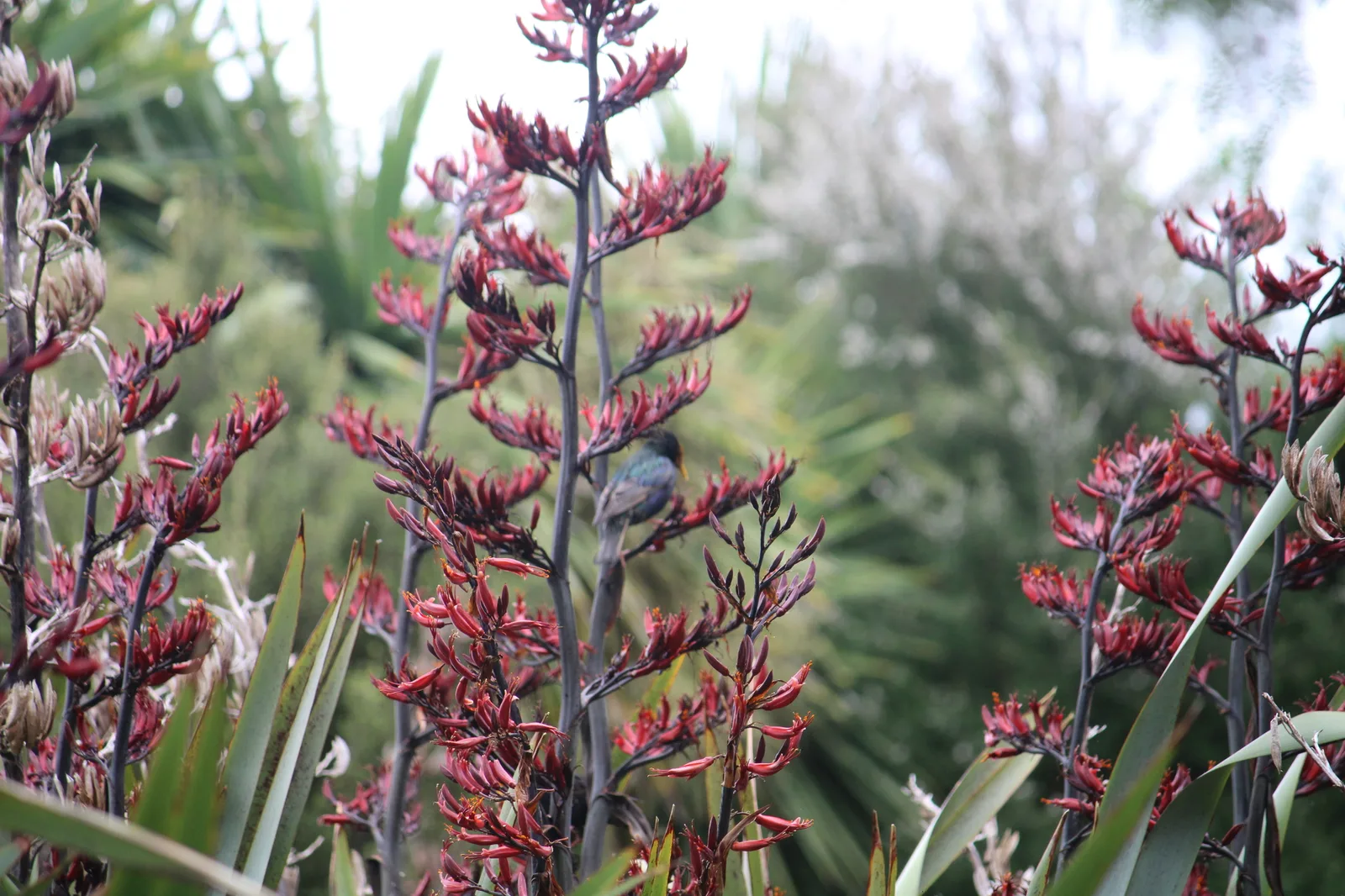
Images of the common starling
Lifespan in the wild
2 to 3 years the average is 2 to 3 years; the record is 22 years and 11 months
Weight
58 to 101 g
Length
19 to 23 cm
Top speed
60 to 80 km/h
Fact file
Common starling
- Location
- Europe and Asia; introduced to North America, Australia, New Zealand and South Africa
- Habitat
- Towns and cities, Grassland, Temperate forest, Wetlands
- Diet
- Omnivore
- Prey / food
- Beetles, flies, caterpillars, earthworms, snails, plus fruit, grain and seeds
- Predators
- Sparrowhawks, peregrine falcons, owls, cats and mustelids
- Lifestyle
- Active by day, gregarious all year
- Group name
- Murmuration
- Name of young
- Chick
- Incubation
- Incubation about 13 days
- Clutch size
- 4 to 5 eggs
- Population
- About 310 million worldwide
- Biggest threat
- Intensive farming, which strips the grassland insects chicks need
- Distinctive feature
- Glossy black plumage spangled with white in winter
- Colour
- Iridescent black with a purple and green sheen
- Skin type
- Feathers
Size
Next to a person
Measurements
Size and speed
- Length
- 19 to 23 cm
- Wingspan
- 31 to 44 cm
- Tail
- 5.8 to 6.8 cm
- Weight
- 58 to 101 g 58 to 101 grams
- Top speed
- 60 to 80 km/h flight speed on migration
Typical adult ranges. Source: Wikipedia.
Life cycle
Lifespan
- In the wild2 to 3, up to 22 years the average is 2 to 3 years; the record is 22 years and 11 months
- 022 years
The pale bar is the record. Source: Wikipedia.
Appearance
Colour and coat
- Primary colours
- black
- Secondary colours
- greenpurplewhite
- Skin type
- feathers
- Male and female
- Slight. The male has long, loose throat feathers and a blue-grey base to the bill, while the female has short throat feathers and a pink base. Females also show more white spotting at the same season.
Life cycle
Mating and family
- Mating system
- mostly monogamous, though a male may take a second mate
- Social structure
- flocks all year, and loose colonies when nesting
- Breeding
- one or two broods a year, sometimes three in the south
A male claims a hole in spring and sings from its entrance to draw a female. She lays four or five pale blue eggs and both birds sit on them for about 13 days. The chicks stay in the nest for three weeks and are fed there by both parents. They are fed for another week or two after they fly, then join flocks of other young birds. Most breed the following spring.
Classification
Taxonomy
- Kingdom
- Animalia
- Phylum
- Chordata
- Class
- Aves
- Order
- Passeriformes
- Family
- Sturnidae
- Genus
- Sturnus
- Species
- Sturnus vulgaris
Conservation
Red List status
- LC
- NT
- VU
- EN
- CR
- EW
- EX
Least Concern on the IUCN Red List
Range
Recorded in 18 countries
- Argentina
- Austria
- Ashmore and Cartier Islands
- Canada
- Germany
- Spain
- France
- United Kingdom
- Ireland
- Italy
- Mexico
- Netherlands
- New Zealand
- Poland
- Russia
- Ukraine
- United States of America
- South Africa
Habitat layer: temperate broadleaf and mixed forest, temperate conifer forest, boreal forest and taiga, tropical grassland, savanna and shrubland, temperate grassland, savanna and shrubland, flooded grassland and savanna, mangrove.
Countries from 241,541 wild records on GBIF (iNaturalist research grade), filtered and checked by hand. Country shapes: Natural Earth. Habitat: RESOLVE Ecoregions 2017, CC BY 4.0. Basemap: Natural Earth.
Habitats
Three things to know
- 1
A good male knows up to 35 song types and can copy a sound it has heard only once.
- 2
Winter roosts in Denmark can hold about a million birds, and Danes call the display the black sun.
- 3
Sixty birds released in New York in 1890 became a population of 150 million across North America.
Did you know
Seven more facts
- 1
The bill changes colour with the season, yellow for summer and blackish for winter.
- 2
A starling walks and runs, while most small birds of its size hop.
- 3
The male's voice organ is about 35% bigger than the female's.
- 4
Starlings cannot digest much sucrose, so many sweet fruits pass through unused.
- 5
A nest box with a hole under 38 mm across will keep starlings out.
- 6
On the Azores the local race raids the nests of the endangered roseate tern.
- 7
Captive starlings store too much iron in the liver, and black tea leaves in the food prevent it.
Field notes
How it looks and acts
Field notes
Distinguishing features
- Glossy black plumage with a green and purple sheen.
- White or buff spangling that is heaviest in winter.
- A short, square tail and sharply pointed wings.
- Stout pink legs and a waddling walk.
- A narrow, pointed bill that turns yellow in summer.
- A body 19 to 23 cm long with a 31 to 44 cm wingspan.
Field notes
Unique adaptations
- A narrow skull and strong jaw muscles let the bird force its bill open in soil.
- Eyes set well forward can look down the length of an open bill.
- A broad diet lets the species live from sea cliffs to city roofs.
- Nesting in any hole means it needs no special tree or ledge.
- Birds put on fat when daylight or food is short.
Field notes
Interesting behaviours
- Massing into a murmuration before settling to roost.
- Probing short grass and opening the bill under the surface.
- Riding on the backs of grazing animals to pick off their parasites.
- Decorating a new nest with flowers and green leaves.
- Rolling forward through a feeding flock to reach fresh ground.
Field notes
Temperament
- Gregarious, and rarely found alone.
- Noisy and quarrelsome while feeding.
- Bold around people, buildings and traffic.
- Aggressive to other hole-nesting birds, which it evicts.
Field notes
Communication
- Long song bouts of whistles, copied sounds and clicks.
- Mimicry of other birds, animals and machines.
- A harsh scream as an alarm.
- A snarl aimed at an intruder at the nest.
- Wing-waving by a male trying to draw a female to his hole.
Ecology
Ecological role
The starling is a soil-probing insect eater at home, and a competitor for nest holes wherever people carried it.
- It eats crop pests such as wireworms in huge numbers.
- Its droppings fertilise woodland soil in small doses and poison it in large ones.
- It spreads seeds of weeds such as blackberry and bridal creeper in Australia.
- It feeds hawks, falcons and owls across its whole range.
Stories
Myths and legends
- In Welsh tradition, Branwen teaches a starling to speak and sends it across the sea for help.
- In Roman tradition, Pliny the Elder held that a starling could learn sentences in two languages.
- In English tradition, Shakespeare's Hotspur wants a starling to repeat one name until the king breaks.
- In Danish tradition, the spring murmuration over the marshes is named the black sun.
- In American tradition, one man is said to have freed the birds to complete Shakespeare's aviary.
People
Relationship with humans
People
Living alongside us
The starling lives closer to people than almost any other songbird. Farmers once put up millions of nest boxes to bring it in as a pest killer. That same reputation carried it to America, Australia, New Zealand and South Africa, where it became a pest itself. It costs American agriculture about US$800 million a year and takes nest holes from native birds. In Europe it is now declining, and Britain protects it by law.
- The bird is probably harmless to people in every setting.
- Droppings at a large roost can grow the fungus that causes histoplasmosis.
- Flocks near runways are a real hazard to aircraft, and a 1960 strike near Boston killed 62 people.
People
Status, uses and products
- Domestication
- Wild
- As a pet
- Not suitable. Hand-reared starlings tame easily and Konrad Lorenz kept them, but they are messy and need constant company. Keeping one is illegal in Britain and in much of Europe without a licence. Injured birds belong with a licensed rehabilitator.
- Uses
- pest controllaboratory researchfood in some countries
- Products
- meat
The full account
About the common starling
The common starling, Sturnus vulgaris, is a medium-sized songbird of Europe and Asia. Adults measure 19 to 23 centimetres long, with a wingspan of 31 to 44 cm. A bird weighs 58 to 101 grams. The plumage is glossy black with a purple and green sheen, spangled with white in winter. The legs are pink, and the bill turns yellow in summer and blackish in winter.
The bird feeds on open grass, probing the soil for insects and worms. It copies other birds, machines and even human speech, which writers have noticed for centuries. Winter flocks called murmurations can hold a million birds and turn as one. People carried the species to North America, Australia, New Zealand and South Africa. The IUCN lists it as Least Concern, on a world population of about 310 million.
Name and taxonomy
Carl Linnaeus named the species in 1758, and the name has not changed since. Sturnus is the Latin word for a starling and vulgaris means common. The Old English name was staer, later stare, and it imitated the bird's call. Starling first appears in the 11th century as a word for the young bird. By the 16th century starling had replaced stare for birds of any age.
North Americans call it the European starling, and British birders simply say starling. About 12 subspecies breed across the native range, and they grade into one another. Because the change is gradual, authorities disagree on how many races to accept. Island birds of Shetland, the Faroes and the Outer Hebrides are darker and slightly larger.
Evolution and relatives
The starling family, Sturnidae, is an Old World group, richest in Southeast Asia and Africa. The genus Sturnus is polyphyletic, so its members do not all share one recent ancestor. The nearest relative is the spotless starling of Iberia and northwest Africa. That bird may descend from a population that sheltered in Iberia during an ice age. Gene studies suggest it could even be counted as a subspecies of the common starling.
There is more genetic variation inside the common starling than between the two species. Remains of the common starling are known from the Middle Pleistocene. The family has a thin fossil record, which is part of why relationships stay unclear. The two species now meet in southwestern France and northwestern Spain and compete there.
Appearance
The feathers are iridescent black, glossed with purple or green. Fresh autumn feathers carry white or buff tips, which give the winter bird its spangled look. Those pale tips wear off by spring, so the breeding bird looks much plainer. The bill is narrow, conical and sharp, yellow in summer and brownish-black in winter. The legs are stout and pinkish-red, which suits a bird that walks rather than hops.
Adults are 19 to 23 cm long and weigh 58 to 101 g. The wingspan runs 31 to 44 cm and the tail is 5.8 to 6.8 cm. The short tail, pointed wings and round belly separate it from thrushes at a glance. Juveniles are plain grey-brown and keep some brown feathers into their first winter. Iris colour tells the sexes apart, and the test is 97% accurate on its own.
Habitat and range
The native range runs from the Azores and Europe east to western Mongolia. It covers about 8,870,000 square kilometres in all. Birds also breed in North Africa, the Middle East, northern India and northwestern China. Towns and suburbs suit them, because buildings and trees give holes to nest in. They feed on short grass: pasture, playing fields, golf courses and airfields.
Reedbeds, woods and city centres hold the winter roosts. The species avoids dense wet forest but does live on sea cliffs and among seaweed. It has been found as high as 1,900 metres above sea level. Northern and eastern birds move south and west for the winter. Migrating birds fly at 60 to 80 kilometres per hour and can cover 1,000 to 1,500 km. GBIF holds records of the species from 145 countries.
Diet and feeding
The starling eats mostly insects and other invertebrates through the breeding season. Beetles, flies, moths, caterpillars, grasshoppers, ants, spiders and earthworms all appear. Outside that season it takes seeds, grain, fruit, nectar and food waste. The family cannot handle much sucrose, though grapes and cherries cause no trouble. In cage tests birds ate 7 to 23 grams of animal food and 20 to 40 g of plant food a day.
The main method is probing: the bird drives its bill into the soil and forces it open. The skull is narrow and the jaw muscles are strong, so the eyes can look down the open bill. Konrad Lorenz first described the action, and German keeps his word zirkeln for it. Starlings also snatch insects in the air and use the same prying trick on rubbish bags. In a large flock the birds at the back keep flying to the front, where the food is untouched. Young birds take time to learn to probe, so their diet holds fewer insects at first.
Behaviour and social life
The starling is a flocking bird in every season and most of all in autumn and winter. A murmuration turns, folds and stretches with no leader at its head. Each bird follows about seven neighbours, so a change of course crosses the flock fast. The habit probably began as a defence, since a shifting mass of birds confuses a hawk. A single roost can hold up to 1.5 million birds.
Droppings under a big roost pile up to 30 cm deep and kill the trees beneath. In small amounts the same droppings fertilise the ground, so foresters move roosts about. The Danish marshes near Tonder and Ribe draw flocks of more than a million in March. Danes call that spring display sort sol, which means black sun. Birds walk and run on the ground and fly straight, with fast beats and short glides.
Communication and senses
The male sings in bouts that run for a minute or more. A bout starts with pure whistles, moves through copied sounds, then clicks, then high notes. A skilled male holds up to 35 song types and as many as 14 kinds of click. One wild bird copied a sound after hearing it a single time. Older males sing more types, pair earlier and raise more young.
The male's syrinx, the voice organ, is about 35% larger than the female's. Females sing too, though less often, and the reason is not understood. Eleven other calls are described, among them a flock call, a threat call and a snarl. Alarm comes out as a harsh scream, and feeding birds squabble without a break. The wings of a passing flock make a whoosh that carries hundreds of metres.
Reproduction and life cycle
An unpaired male picks a hole and starts a nest to attract a female. He decorates it with flowers and fresh greenery, and herbs such as yarrow draw females in by scent. The female pulls the decoration out once she accepts him. The pair then lines the hole with straw, grass, feathers and wool over four or five days. Nests sit in tree holes, buildings, stumps and nest boxes, and in cliffs on Shetland.
The female lays four or five glossy pale blue eggs, one a day. Each egg is 26.5 to 34.5 millimetres long and up to 22.5 mm across. Both parents incubate for about 13 days, and the female sits alone at night. Chicks hatch blind and bare and grow down within seven days. Both parents feed them in the nest for about three weeks, then for another week or two outside.
Two broods a year are usual, and three are possible in the south. Unpaired females often slip an egg into another pair's nest. Between 48% and 79% of nests fledge young, but only 20% of nestlings reach breeding age. About 60% of adults survive from one year to the next. The average life is 2 to 3 years, and the record bird lived 22 years and 11 months.
Predators and threats
Most starling predators are birds, and the flock's answer is to take off together. Sparrowhawks, goshawks, peregrine falcons, hobbies and kestrels catch adults. Kites, buzzards and imperial eagles take the slower young birds. Little owls, long-eared owls, barn owls, tawny owls and eagle-owls take roosting birds at night. Stoats, raccoons, squirrels and cats raid nests or catch careless adults.
Parasites are almost universal in this species. Every one of three hundred birds checked across six American states carried at least one kind. Fleas, mites and ticks were on 99% of them, and worms inside 95%. The gapeworm moves from the lungs to the windpipe and can choke its host. Numbers in northern Europe have fallen since the 1980s as farming grew more intensive.
Population and conservation
The world population is put at more than 310 million birds. The IUCN lists the species as Least Concern, because that total is not falling much overall. Numbers grew across Europe from the 19th century until about the 1960s. The bird spread into Ireland and parts of Scotland from about 1830. It began breeding in northern Sweden in 1850 and in Iceland in 1935.
Since 1980 the picture has reversed across northern and central Europe. Several countries have red-listed the bird after declines of more than 50%. The United Kingdom lost more than 80% of its starlings between 1966 and 2004. Young birds survive poorly, because pasture and meadow hold fewer insects than before. Chicks need grassland invertebrates, so the loss of old pasture hits them hardest.
Relationship with humans
Farmers once welcomed the starling, because it eats wireworms and other crop pests. About 25 million nest boxes went up for the species in the former Soviet Union. That reputation carried the bird abroad, first to New Zealand in 1862 and Melbourne in 1857. Eugene Schieffelin released 60 birds in Central Park in 1890 and 40 more the next year. North America now holds an estimated 150 million starlings.
The IUCN counts the starling among the 100 worst invasive species on Earth. It takes nest holes from woodpeckers, bluebirds, martins and rosellas. Crop damage in the United States is put at about US$800 million a year. Flocks are a hazard to aircraft, and a strike near Boston in 1960 killed 62 people. The United States culled 1.7 million starlings in 2008, more than any other nuisance animal. Western Australia has kept the bird out, and only 300 were left in the state by 2009.
In culture and myth
In the medieval Welsh Mabinogion, Branwen tames a starling and teaches it words. She sends it over the Irish Sea carrying word to her brothers in Wales. Pliny the Elder wrote that starlings could be taught whole sentences in Latin and Greek. In Henry IV, Shakespeare has Hotspur plan to teach a starling one name to torment the king. That single line is probably why Americans tie the bird to Shakespeare.
Mozart kept a pet starling that sang a phrase from one of his piano concertos. He bought the bird after it sang music he had written six weeks earlier. He held an elaborate funeral for it three years later. Konrad Lorenz called the starling the poor man's dog, because anyone could raise one. After the pigeon, it is the bird most used in laboratories.
The story that Schieffelin wanted every Shakespeare bird in America has no early record. It first appears in the 1940s, in an essay by the naturalist Edwin Way Teale. In 1949 so many starlings landed on Big Ben that the clock hands stopped. A 1954 episode of The Goon Show mocked the failed attempts to clear London's roosts. Some Arab countries trap starlings for food, and the tough meat goes into a casserole or a pate.
A sentence with a dotted underline is inferred: it describes the group the animal belongs to, or is a reading of the sources, rather than a measured or reported fact about this species.
Questions
Common starling questions, answered
What is a starling murmuration?
It is a winter flock that wheels and folds in the air before roosting. Flocks range from a few dozen birds to about a million. Each bird tracks about seven neighbours, which is enough to move the whole mass at once.
Why do starlings flock together?
A dense, shifting flock is hard for a hawk or a falcon to single out. Roosting together also shares warmth and information about food. Flocks form near roosts in reedbeds, woods and city centres.
Can starlings talk?
They copy sounds rather than speak. A tame bird can pick up words, telephone rings and machinery, and Mozart's pet sang part of one of his concertos. The words carry no meaning for the bird.
What do starlings eat?
Insects, spiders, earthworms and snails in the breeding season, and seeds, grain and fruit outside it. They probe short grass with the bill, then force it open under the surface.
How big is a starling?
It is 19 to 23 cm long with a wingspan of 31 to 44 cm, and weighs 58 to 101 g. That makes it a little smaller than a blackbird and a good deal chunkier.
Are starlings native to America?
No. Eugene Schieffelin released 60 birds in Central Park in 1890 and 40 more in 1891. The population now reaches about 150 million from southern Canada to Mexico.
Did Shakespeare cause the American starling problem?
Probably not. The claim that the birds were released to bring every Shakespeare species to America first appears in the 1940s, with no earlier record. Pest control is a likelier motive.
Are starlings endangered?
Not globally. The IUCN rates the species Least Concern on a world total of about 310 million. British numbers fell by more than 80% between 1966 and 2004, so the bird is red-listed there.
Why are starlings declining in Britain?
Young birds survive poorly because intensive farming leaves less pasture and meadow. Fewer grassland insects means less food for growing chicks. The decline runs across much of northern Europe.
How long do starlings live?
Most live 2 to 3 years. The oldest known bird reached 22 years and 11 months. Only about 20% of chicks live long enough to breed.
How many eggs do starlings lay?
Four or five pale blue eggs, laid one a day. Both parents incubate for about 13 days. A pair usually raises two broods a year.
Where do starlings nest?
In any suitable hole: a tree cavity, a hole in a wall or roof, a stump or a nest box. On Shetland they use cliff crevices. They line the hole with grass, feathers and wool.
Are starlings pests?
In their introduced range, yes. They damage grapes, cherries and sprouting grain, foul livestock feed and take nest holes from native birds. In Eurasia they also destroy large numbers of crop insects.
How do you keep starlings off a bird feeder?
Take the perches off the feeder and use nest boxes with a hole under 38 mm across. Starlings need a wider hole than that, so smaller birds keep the box.
Do starlings migrate?
Southern and western birds mostly stay put. Birds from northern Europe, Russia and Ukraine move south and west each autumn. A migrating starling flies at 60 to 80 km/h and can cover 1,000 to 1,500 km.
What eats starlings?
Sparrowhawks, peregrine falcons, goshawks, kestrels and hobbies take adults. Owls catch them at the roost at night. Cats, squirrels and small mustelids raid the nests.
Food web
Prey and food
- beetles
- flies
- caterpillars
- earthworms
- snails
- plus fruit
- grain
- seeds
Food web
Predators
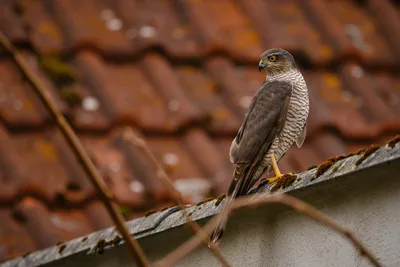 Eurasian sparrowhawk
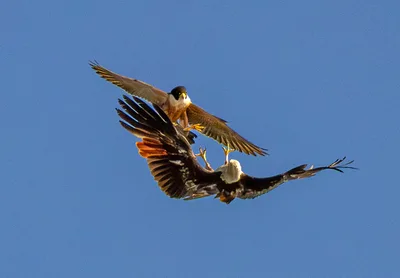 Peregrine falcon
- owls
- cats
- mustelids
Ecological equivalents
Related species on this site
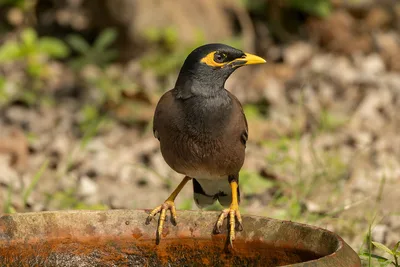
Common myna (same family), Myna Bird (same family), Acadian Flycatcher (same order), Amazonian Royal Flycatcher (same order), American crow (same order), American goldfinch (same order), and more.
 LC
Birds
Common myna
Acridotheres tristis
The common myna is a brown starling with a black head and a bare yellow patch behind the eye, native to southern Asia.
Living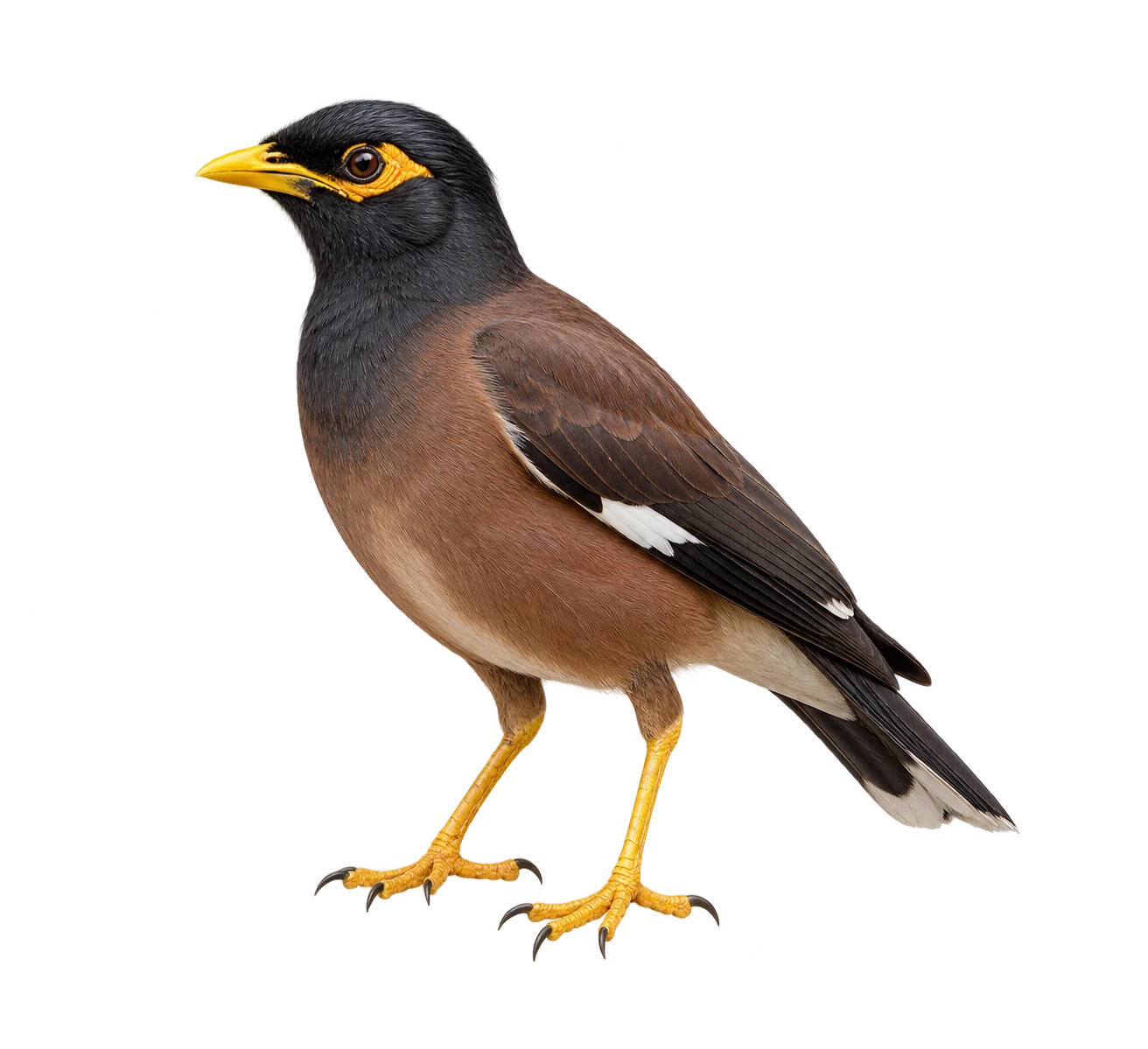
Birds
Myna Bird
Sturnidae
Classification and source reference
LivingAI illustration
Birds
Acadian Flycatcher
Empidonax virescens
Classification and source reference
LivingAI illustration
Birds
Amazonian Royal Flycatcher
Onychorhynchus coronatus
Classification and source reference
LivingAI illustration LC
Birds
American crow
Corvus brachyrhynchos
The American crow is a large all-black bird of farms, woods and city streets across North America.
Living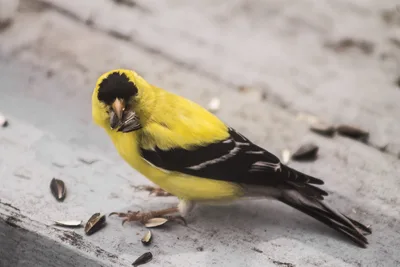 LC
Birds
American goldfinch
Spinus tristis
The American goldfinch is a small seed-eating finch of open weedy country across North America.
Living