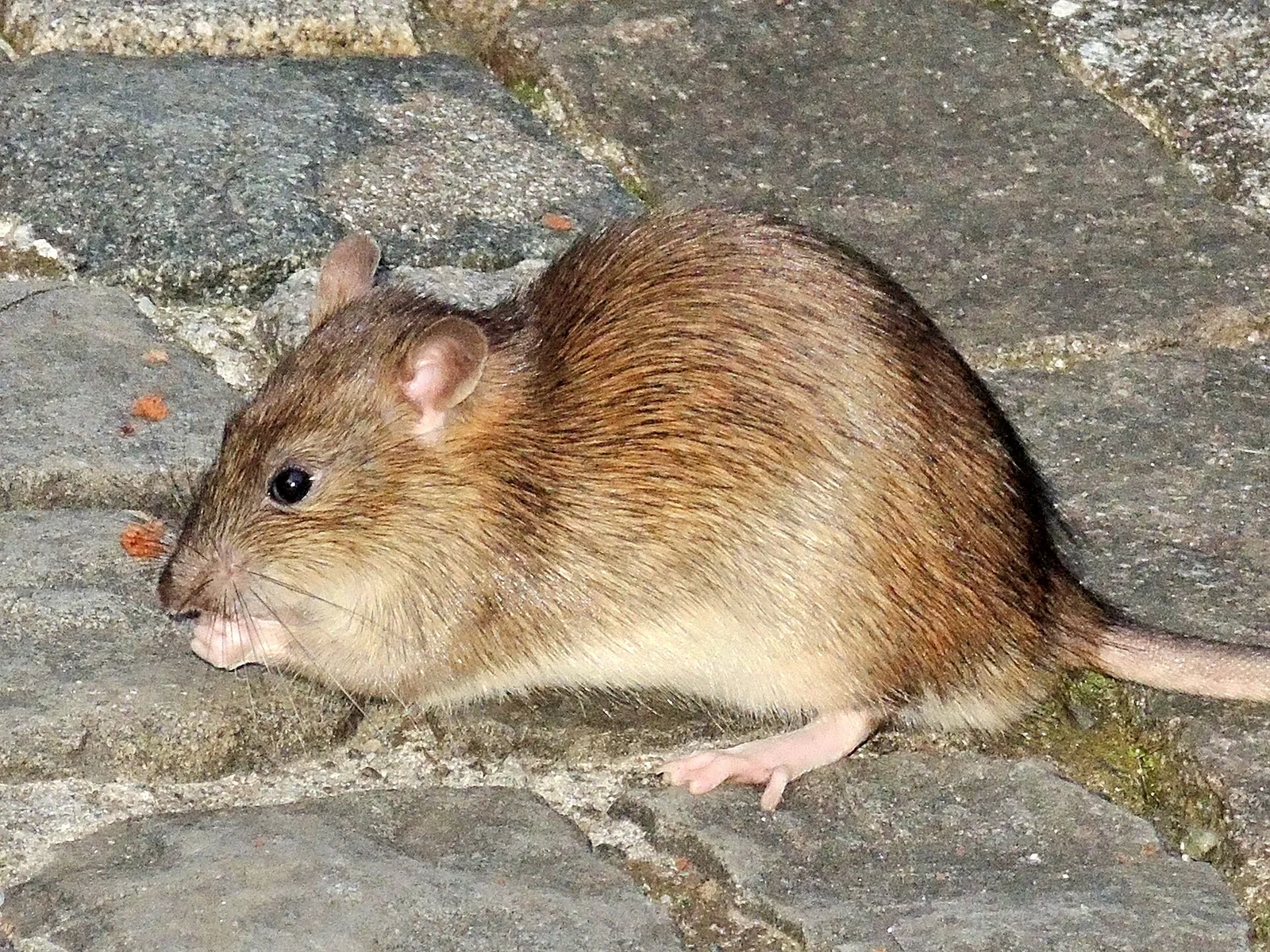
Brown rat
The rodent that followed people to every continent but one
Rattus norvegicus
Also called Norway rat, Common rat, Sewer rat, Street rat, Wharf rat, Hanover rat
Living individuals or members of this group exist today. This does not mean they are safe from extinction.
Meet the brown rat
The brown rat is a large, burrowing rodent that lives wherever people live. It came from northern China and now occupies every continent except Antarctica.
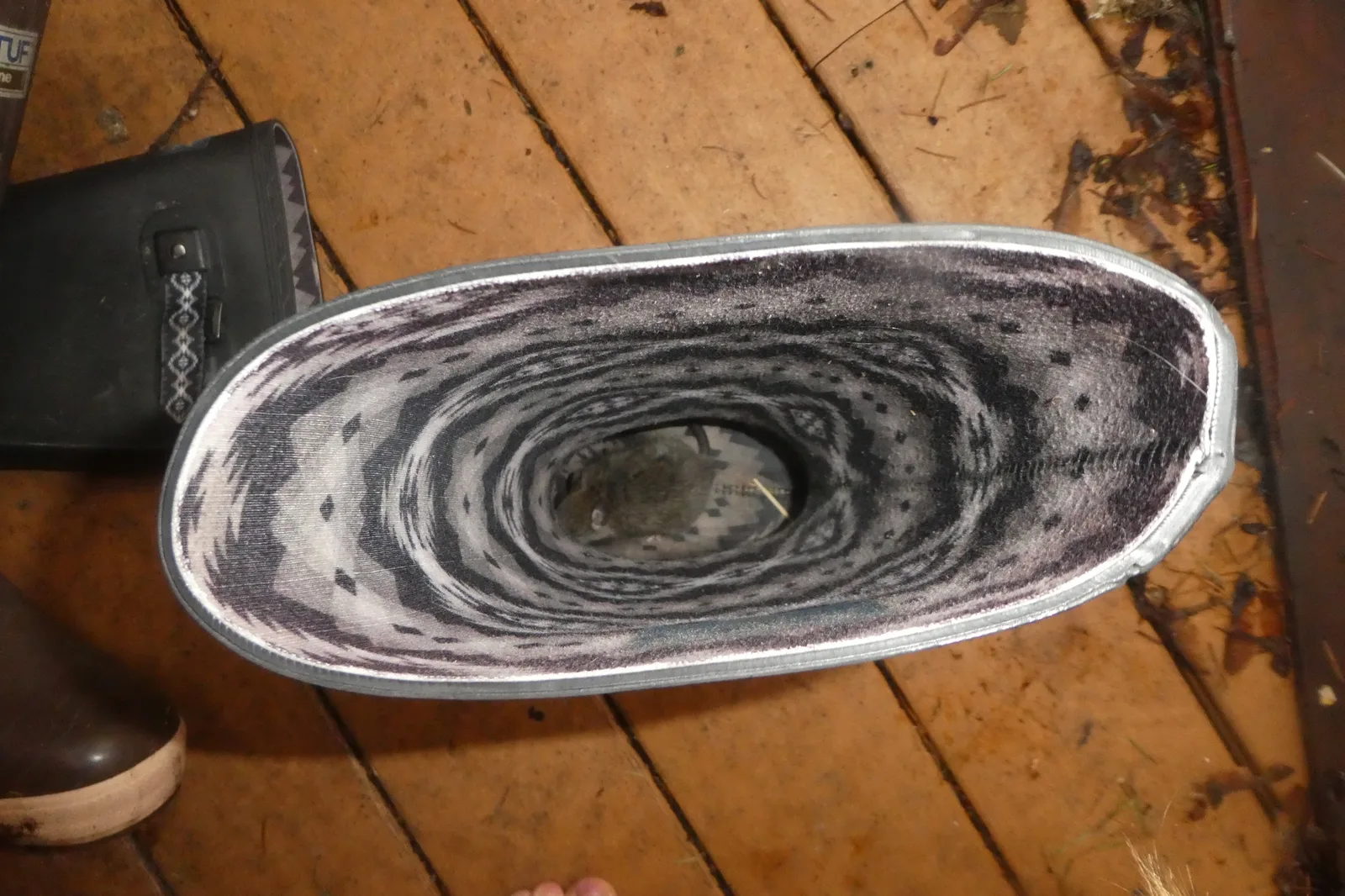
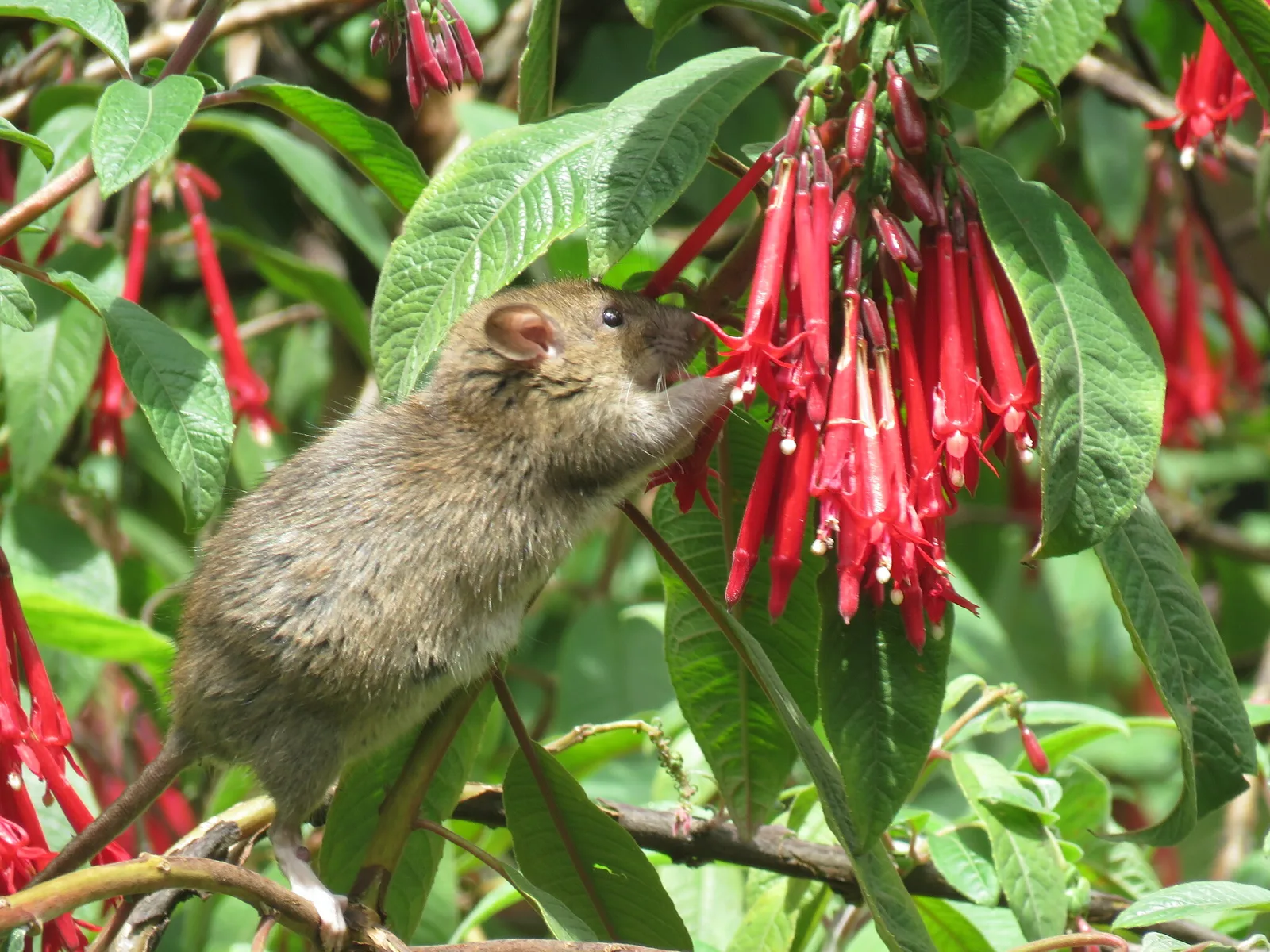
Images of the brown rat
Lifespan in the wild
1 to 2 years most wild rats die in their first year; ADW gives an average of about 2
Weight
140 to 500 g
Length
15 to 28 cm
Fact file
Brown rat
- Location
- Worldwide near people; native to northern China and Mongolia
- Habitat
- Towns and cities, Wetlands, Grassland, Temperate forest
- Diet
- Omnivore
- Prey / food
- Grain, scraps, fruit, seeds, insects, eggs, chicks, mice, fish
- Predators
- Cats, dogs, foxes, owls, hawks, snakes, people
- Lifestyle
- Nocturnal, in large colonies
- Group name
- Colony or pack
- Name of young
- Pup
- Gestation
- 21 to 24 days
- Litter size
- About 7 pups, up to 14
- Population
- Not counted; abundant on six continents
- Biggest threat
- Poison and trapping by people
- Distinctive feature
- Blunt snout, small ears and a tail shorter than the body
- Colour
- Brown or grey above, paler grey below
- Skin type
- Fur
Size
Next to a person
Measurements
Size and speed
- Length
- 15 to 28 cm head and body, without the tail
- Tail
- 10.5 to 24 cm
- Weight
- 140 to 500 g, up to 822 g 140 to 500 grams; the heaviest live rat on record weighed 822 grams
Typical adult ranges. Source: Wikipedia.
Life cycle
Lifespan
- In the wild1 to 2, up to 3 years most wild rats die in their first year; ADW gives an average of about 2
- In captivity2 to 3, up to 4 years
- 04 years
The pale bar is the record. Sources: Wikipedia, Animal Diversity Web.
Appearance
Colour and coat
- Primary colours
- browngrey
- Secondary colours
- white
- Skin type
- fur
- Male and female
- Slight. Males are usually larger and heavier than females, but the sexes look alike in colour and shape.
Life cycle
Mating and family
- Mating system
- polygynandrous, both sexes with many mates
- Social structure
- large colonies with a size-based hierarchy
- Breeding
- up to five litters a year, about seven pups each
Brown rats breed all year where food allows, with a peak in the warm months. Gestation lasts 21 to 24 days, and a litter usually holds about seven pups, up to 14. The mother can mate again within a day of the birth. Pups open their eyes at about two weeks, are weaned at three to four weeks and can breed within a few months. Most wild rats die within a year, and the wild maximum is about 3 years.
Classification
Taxonomy
- Kingdom
- Animalia
- Phylum
- Chordata
- Class
- Mammalia
- Order
- Rodentia
- Family
- Muridae
- Genus
- Rattus
- Species
- Rattus norvegicus
Conservation
Red List status
- LC
- NT
- VU
- EN
- CR
- EW
- EX
Least Concern on the IUCN Red List
Range
Recorded in 20 countries
- Austria
- Ashmore and Cartier Islands
- Belgium
- Canada
- People's Republic of China
- Czech Republic
- Germany
- Denmark
- Spain
- France
- United Kingdom
- Italy
- Mexico
- Netherlands
- New Zealand
- Poland
- Portugal
- Russia
- Ukraine
- United States of America
Habitat layer: temperate broadleaf and mixed forest, temperate conifer forest, boreal forest and taiga, tropical grassland, savanna and shrubland, temperate grassland, savanna and shrubland, flooded grassland and savanna, mangrove.
Countries from 18,796 wild records on GBIF (iNaturalist research grade), filtered and checked by hand. Country shapes: Natural Earth. Habitat: RESOLVE Ecoregions 2017, CC BY 4.0. Basemap: Natural Earth.
Habitats
Three things to know
- 1
A female can produce up to five litters a year, and each litter can hold up to 14 pups.
- 2
Rats chirp in ultrasound when they play or are tickled, at a pitch no human ear can hear.
- 3
The Canadian province of Alberta has kept itself free of breeding rats since the 1950s.
Did you know
Seven more facts
- 1
The brown rat never came from Norway, despite its scientific name.
- 2
In 18th-century England it was called the Hanover rat as a jibe at the royal house.
- 3
A rat can see ultraviolet light that people cannot.
- 4
Several mothers share one nest and nurse each other's pups.
- 5
About 95 percent of wild rats die each year.
- 6
Rats that survive poison can pass it on to the owls that eat them.
- 7
A French town once tried its rats in court for crop damage, in 1522.
Field notes
How it looks and acts
Field notes
Distinguishing features
- A heavy body with a broad, blunt snout.
- Short, hairy ears that do not reach the eyes when folded forward.
- A thick, almost bare tail shorter than the head and body.
- Coarse brown or grey fur above and a paler belly with no sharp dividing line.
- Head and body of 15 to 28 centimetres, far larger than a house mouse.
- Straight ridges on the skull, where the black rat's are curved.
Field notes
Unique adaptations
- A diet that includes almost anything people eat or throw away.
- Rapid breeding, with up to five litters a year and pups that mature within weeks.
- Strong swimming on the surface and under water, which opens up sewers and river banks.
- A keen nose and whiskers that guide it through total darkness.
- Caution towards new objects and foods, which helps it avoid traps and poison.
Field notes
Interesting behaviours
- Digs multi-level burrows with a second exit and a food store.
- Follows the same learned runways every night between nest and food.
- Huddles in piles in cold weather to share warmth.
- Play-fights by chasing, tumbling and boxing, aiming at the neck.
- Carries large food items to cover before eating them.
Field notes
Temperament
- Cautious but curious, it sniffs a new object and darts away.
- Social within its colony, hostile to strangers.
- Bites when cornered or handled roughly.
Field notes
Communication
- Ultrasonic calls from pups, from frightened adults and from rats at play.
- Squeaks of pain and soft singing during a stand-off.
- Tooth-grinding, or bruxing, when content or under stress.
- Fluffed fur, a hiss and a swinging tail to warn off an intruder.
- Scent marks that tell colony members from strangers.
Ecology
Ecological role
The brown rat is a commensal of people, and outside its native range it acts as an invasive predator and competitor.
- It eats the eggs and chicks of seabirds and has wiped out island species of birds, mammals and reptiles.
- It feeds cats, foxes, owls, hawks and snakes wherever it lives.
- It drives out the black rat and steals its nests in crowded places.
- Its burrows turn the soil, and it scatters some seeds as it forages.
Stories
Myths and legends
- In Chinese tradition the Rat won the Great Race by riding on the ox and holds first place in the zodiac.
- In Hindu tradition the rat is the mount of Ganesha and is fed as a holy animal at Karni Mata temple.
- In German tradition the Pied Piper of Hamelin charmed the rats out of town with his pipe.
- In European speech a rat is a traitor or an informer, and on the Isle of Man the word itself is taboo.
People
Relationship with humans
People
Living alongside us
The brown rat lives alongside people almost everywhere. It spoils stored food, damages buildings and can spread disease, so people spend heavily to control it. Its domestic form is the laboratory rat, one of the most studied animals in science, and the fancy rat kept as a pet. Some regions, such as Alberta and parts of New Zealand, have removed it altogether.
- A cornered rat bites, and a bite can pass on rat-bite fever.
- Rat urine can spread Weil's disease, and rats carry hantavirus and Q fever in some places.
- There are reports of rats attacking human infants.
People
Status, uses and products
- Domestication
- Wild
- As a pet
- Kept by some. The domestic fancy rat, bred from this species, is a clean, clever and sociable pet that needs company of its own kind. A wild brown rat is not suitable, and in Alberta keeping any rat is illegal.
- Uses
- laboratory researchpet tradeworking animals
- Products
- None recorded
The full account
About the brown rat
The brown rat, Rattus norvegicus, is the common rat of cities, sewers, farms and docks across most of the world. People also call it the Norway rat, the sewer rat, the wharf rat and the street rat. It is one of the biggest members of the mouse family. The head and body measure 15 to 28 centimetres, and the tail is a little shorter than that. An adult weighs 140 to 500 grams, and the heaviest live rat on record reached 822 grams. The fur is brown or dark grey above and paler below.
The species probably arose on the plains of northern China and Mongolia. It spread with human trade and now lives on every continent except Antarctica. Almost everywhere, it lives close to people, and in cities it favours damp, dark places such as sewers and cellars. It eats almost anything, breeds all year and can carry several diseases that affect people. Selective breeding has produced the laboratory rat and the pet fancy rat, both of the domestic subspecies. The IUCN lists the brown rat as Least Concern, and most governments treat it as a pest.
Name and taxonomy
The English naturalist John Berkenhout named the species Mus norvegicus in 1769. He believed that the rat had arrived in England on Norwegian timber ships in 1728. The rat never came from Norway, and the species was once even listed as extinct there. The name stuck all the same, and Norway rat is still common in North America. In 18th-century England some people called it the Hanover rat, to blame the ruling house for the country's troubles. Charles Dickens noted in his journal that the rat was unknown in Norway when it was already common in England.
The type locality is Great Britain, which says more about where it was described than where it began. It sits in the genus Rattus, within Muridae, which is thought to be the largest family of mammals. Within the genus it forms the norvegicus species group with the Himalayan field rat and the Turkestan rat. The domestic laboratory and pet strains are placed in the subspecies Rattus norvegicus domestica. Subspecies among wild populations remain unsettled and need genetic work.
Evolution and relatives
The brown rat's line split from the black rat's about 2.9 million years ago. Mitochondrial genomes place its origin as a separate species somewhere between 0.5 and 2.9 million years ago. Its closest relative is the Himalayan field rat, which parted from it about 700 thousand years ago. The two species met again later and exchanged genes, and some of the brown rat's smell receptors came from that mixing. The Turkestan rat, the other sister species, lives near the brown rat's ancestral range in Nepal.
The species keeps evolving in the cities it has colonised. Rats in New York carry longer snouts and shorter molar rows than Chinese rats, perhaps to suit cold and human food. Roads and clean districts split city rats into separate populations, sometimes a single block wide. Resistance to the poison warfarin appeared in the mid-20th century, and some British rats now resist newer poisons too. Laboratory rats have smaller testes and brains than wild ones and are far worse at digging and swimming.
Appearance
The brown rat is a robust, heavy-bodied rat with a broad, blunt snout. The coat is long, coarse and shaggy, dirty greyish brown to dark brown on the back. The colour lightens along the sides to a grey or white belly, without a sharp line between the two. The ears are short and hairy, and they do not cover the eyes when folded forward. The tail is thick, almost bare, and darker above than below. Albino and black rats turn up quite often in wild colonies, and pet strains come in many colours and coat types.
Head and body length runs from 15 to 28 cm, and the tail adds 10.5 to 24 cm. The tail is always shorter than the body, which helps separate this species from the black rat. Adults weigh 140 to 500 grams, and wild breeding rats often weigh under 300. A few well-fed city rats pass 800 grams, but the tales of rats the size of cats are false. Males are usually larger than females. A brown rat may be double the weight of a black rat and several times heavier than a house mouse.
Habitat and range
The native range is thought to cover northern China, Mongolia, southeast Siberia and perhaps Japan. There the rat lived in moist forests, brush and fields. It reached Europe by the 16th century at the latest, and a Swiss naturalist may have drawn one in 1553. Reliable records place it in Ireland in 1722, England in 1730, France in 1735 and Germany in 1750. It crossed to North America in about 1750 to 1755 as a stowaway on ships. Today it lives on every continent except Antarctica, though it is less common in Africa.
In cool climates the rat lives outdoors as well as in buildings, and it favours damp ground near water. In the tropics and in deserts it is limited to places that people have built or changed, such as ports and sewers. City rats nest in sewers, wall cavities and burrows, and they rarely stray more than 20 metres from the nest when food is close. As it spread, the brown rat pushed out the black rat, because brick and tile buildings suit a burrower better than a climber. A few large areas remain rat-free: Antarctica, the high Arctic, some islands and the prairie province of Alberta.
Diet and feeding
Brown rats eat almost everything, and grain makes up a large share of the diet. One wild stomach examined in Germany held 4,000 food items, most of them plant matter. Given a choice, rats prefer meat. In cities they live mainly on thrown-away human food. Tests of pet rats found scrambled egg, raw carrot and cooked sweetcorn among the favourites, and raw beetroot and celery among the rejects.
Feeding habits differ from colony to colony and pass from rat to rat by learning. Rats near a fish hatchery in West Virginia catch young fish, and colonies on the Po River in Italy dive for molluscs. On the North Sea island of Norderoog they stalk and kill sparrows and ducks. They also take chicks, eggs, mice, small lizards and shorebirds. Wild rats are wary of new food and objects, and this caution makes poison harder to use. Small crumbs are eaten on the spot, while larger pieces are carried to cover.
Behaviour and social life
The brown rat is nocturnal, and most activity happens before midnight. It swims well on the surface and under water, which suits life in a sewer. It climbs when it must and has been seen shinning up thin metal poles to reach bird feeders. Rats dig long burrow systems with several levels, a second entrance, food stores and nest chambers. A burrow usually starts beside a wall or an object, which forms a firm roof for the top section. Young rats and females dig hard, while old males seldom dig at all.
Rats live in large colonies with a hierarchy, and bigger rats usually rank higher. They groom each other, sleep in piles and play-fight by chasing, tumbling and boxing. Play aims at the neck, while a serious fight aims at the rump. Rats defend their colony against strangers with fluffed fur, hisses and squeals. When food runs short, the lowest-ranked rats die first. If people kill a large share of a colony, the survivors breed faster and the numbers soon recover.
In winter rats huddle cheek to cheek to keep warm. They learn routes through sewers and burrows and follow the same runways every night. One study in 2007 claimed that rats can judge their own knowledge, though later analysis suggested simpler learning. Their quick learning made them the standard animal of the psychology laboratory.
Communication and senses
Smell is the rat's best sense, and it uses scent to find food and to tell colony members apart. Hearing is sharp and extends into ultrasound. Eyesight is poor, around 20/600 in a pigmented rat, and worse in an albino. The rat sees colour much as a red-green colour-blind person does, but it can also see ultraviolet light. Whiskers and paws let it feel its way through total darkness, and it senses faint vibrations in the ground.
Pups call in ultrasound to bring their mother back to the nest. Adults give ultrasonic alarm calls when a predator appears, and a female calls during mating. Young rats chirp in ultrasound when they play or are tickled, and researchers compare the sound to laughter. Pet owners use bat detectors to hear it. Within human hearing, rats squeak in pain, sing softly in a stand-off, and grind their teeth when content. Hard tooth-grinding makes the eyes bulge and retract, a sign called boggling.
Reproduction and life cycle
The mating system is polygynandrous, and both sexes take several partners. A female is in oestrus for about six hours, and in that time she may mate as many as 500 times. Dominant males mate more often, and females tend to use their sperm. A female prefers a new male to one she has already mated with. She can mate again about 18 hours after giving birth, so she can nurse one litter while carrying the next.
Rats breed all year where conditions allow, with peaks in the warmer months. Gestation lasts 21 to 24 days. A litter can hold up to 14 pups, and seven is common. A female can produce up to five litters a year, and by one estimate as many as 60 young. Newborns weigh about 6 grams, and their eyes open at 14 to 17 days. Weaning comes at three to four weeks, and the young can breed at about five weeks in the best conditions.
Several females often share a nest and nurse each other's pups. If a mother dies, another female takes over her litter. Males take no part in raising the young. Wild rats seldom live beyond a year, and about 95 percent die each year. The wild maximum is about 3 years, and a captive rat can reach 4.
Predators and threats
Cats, dogs, foxes, owls, hawks, snakes and many other carnivores eat brown rats. People kill far more rats than any predator does, with poison, traps, gas and dogs. The rat's own kind is a threat too, since fights over space and food kill many. The parasite Toxoplasma gondii can change an infected rat's fear of cats, which makes it easier prey.
Warfarin and later anticoagulant poisons are the main weapon against rats. Rats that survive poison can store the residue in the liver and pass it on to owls and hawks that eat them. Rats also carry lice, fleas, ticks and worms. None of this threatens the species, which the IUCN lists as Least Concern.
Population and conservation
Nobody has counted the world's brown rats, and city figures are guesses. Estimates for New York City range from about 250,000 to almost 100 million. In 2023 New York appointed its first official to lead rat control, with a focus on rubbish rules and trapping. One British estimate puts 81 million rats in the United Kingdom, or 1.3 for every person, helped by mild winters. The saying that a city holds one rat per person is an urban myth for most cities.
The conservation effort runs the other way: people try to remove rats, not save them. Alberta started a rat-control programme in 1951 and has stayed almost rat-free ever since. In 2012 the province dug out and killed 147 rats in a landfill at Medicine Hat, and it recorded zero infestations again in 2013. Keeping a pet rat in Alberta can cost a fine of up to 5,000 Canadian dollars or 60 days in jail. Hawadax Island in Alaska was declared rat-free in 2009, and its shorebirds have since recovered. New Zealand has cleared rats from offshore islands and fenced reserves to protect ground-nesting birds.
Relationship with humans
The brown rat is one of the most damaging animal pests in the world. It eats and fouls stored grain, gnaws buildings and wiring, and kills poultry and game birds. One estimate puts its damage in the United States at almost 1 billion dollars a year. It can carry Weil's disease, rat-bite fever, Q fever, hantavirus and other infections. In one survey of New York sewer rats, 17 percent had caught the COVID-19 virus. It is often blamed for the Black Death, but the black rat and its fleas carried that plague.
On the other side of the ledger stands the laboratory rat. Bred from white rats rescued from the sport of rat baiting, it became a model organism for medicine, genetics and psychology. When a biologist says rat, this species is almost always meant. Fancy rats are popular pets, with breed clubs in Britain, the United States and Australia. Trained working rats, mostly domestic brown rats, do tasks for people. Wild rats bite when cornered, and there are reports of rats attacking human infants.
In culture and myth
In the Chinese zodiac the Rat comes first among the twelve animals. In the Great Race story it crossed the river riding the ox, then leapt ahead at the bank to win. It also failed to wake the cat, which explains why cats hunt rats and have no year of their own. People born in a Rat year, such as 1996, 2008 or 2020, are said to be clever, creative and quick-tempered. In Hindu tradition the rat carries the god Ganesha, and rat statues stand in his temples. At the Karni Mata temple in Rajasthan about 20,000 rats are fed as holy animals, and a white one is a sign of luck.
In Europe the rat has a bad name. To rat on a friend means to betray him, and an informer is called a rat. The town of Autun in France held a formal trial of its rats in 1522 for destroying the crops. The Pied Piper of Hamelin is a German tale set in the late 13th century. A piper charms the rats away with music, and after the town withholds his fee he leads the children away too. On the Isle of Man people avoid saying the word rat at all. Modern stories swing from villains such as Professor Ratigan to the cook Remy in Ratatouille.
A sentence with a dotted underline is inferred: it describes the group the animal belongs to, or is a reading of the sources, rather than a measured or reported fact about this species.
Questions
Brown rat questions, answered
Where do brown rats come from?
They are native to northern China, Mongolia and southeast Siberia. Trade ships carried them to Europe by the 18th century and to North America in about 1750 to 1755.
Why is it called the Norway rat?
John Berkenhout named it in 1769 because he thought it had come to England on Norwegian ships. It never lived in Norway, but the name stuck.
How big is a brown rat?
The head and body measure 15 to 28 centimetres, with a tail of 10.5 to 24 cm. Adults weigh 140 to 500 grams.
What do brown rats eat?
Almost anything. Cereals form a large part of the diet, and city rats live on discarded food. They also take eggs, chicks, mice, fish and molluscs.
How fast do rats breed?
Gestation takes 21 to 24 days, litters can reach 14 pups, and a female can have up to five litters a year. Young rats can breed within a few months.
How long do brown rats live?
Most wild rats die in their first year, and the wild maximum is about 3 years. Pet and laboratory rats live 2 to 3 years, and a few reach 4.
Are brown rats dangerous?
They bite when cornered and can spread Weil's disease, rat-bite fever and other infections. They are a health risk rather than a physical threat.
Did brown rats cause the Black Death?
No. The black rat and its fleas carried that plague. Brown rats can catch plague but are not its main carrier.
Can brown rats swim?
Yes. They swim well on the surface and under water, and some colonies dive for molluscs.
Do rats laugh?
Young rats chirp in ultrasound when they play or are tickled, and researchers link the sound to a positive state. People need a bat detector to hear it.
How many rats live in a city?
Nobody knows. Estimates for New York range from 250,000 to almost 100 million, and the one-rat-per-person rule is a myth for most cities.
Are pet rats the same species?
Yes. Fancy rats and laboratory rats are a domestic subspecies of the brown rat, bred for calm temper and many colours.
Where are there no rats?
Antarctica, the high Arctic, some islands and the Canadian province of Alberta, which has kept rats out since the 1950s.
What eats brown rats?
Cats, dogs, foxes, owls, hawks and snakes. People kill far more rats than any predator.
What is the difference between a brown rat and a black rat?
The brown rat is larger and heavier, with a blunter snout, shorter ears and a tail shorter than its body. It burrows, while the black rat climbs.
Food web
Prey and food
- grain
- scraps
- fruit
- seeds
- insects
- eggs
- chicks
- mice
- fish
Food web
Predators
- cats
- dogs
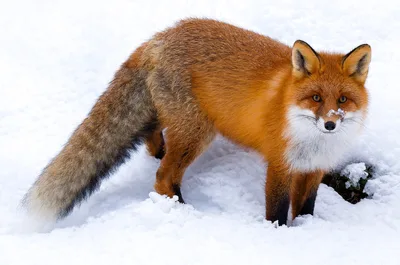 Red fox
- owls
- hawks
- snakes
- people
Ecological equivalents
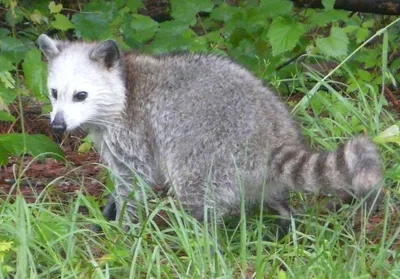
Related species on this site
Palm Rat (same genus), Fancy Mouse (same family), House mouse (same family), Mouse (same family), Abyssinian Guinea Pig (same order), Agouti (same order), and more.
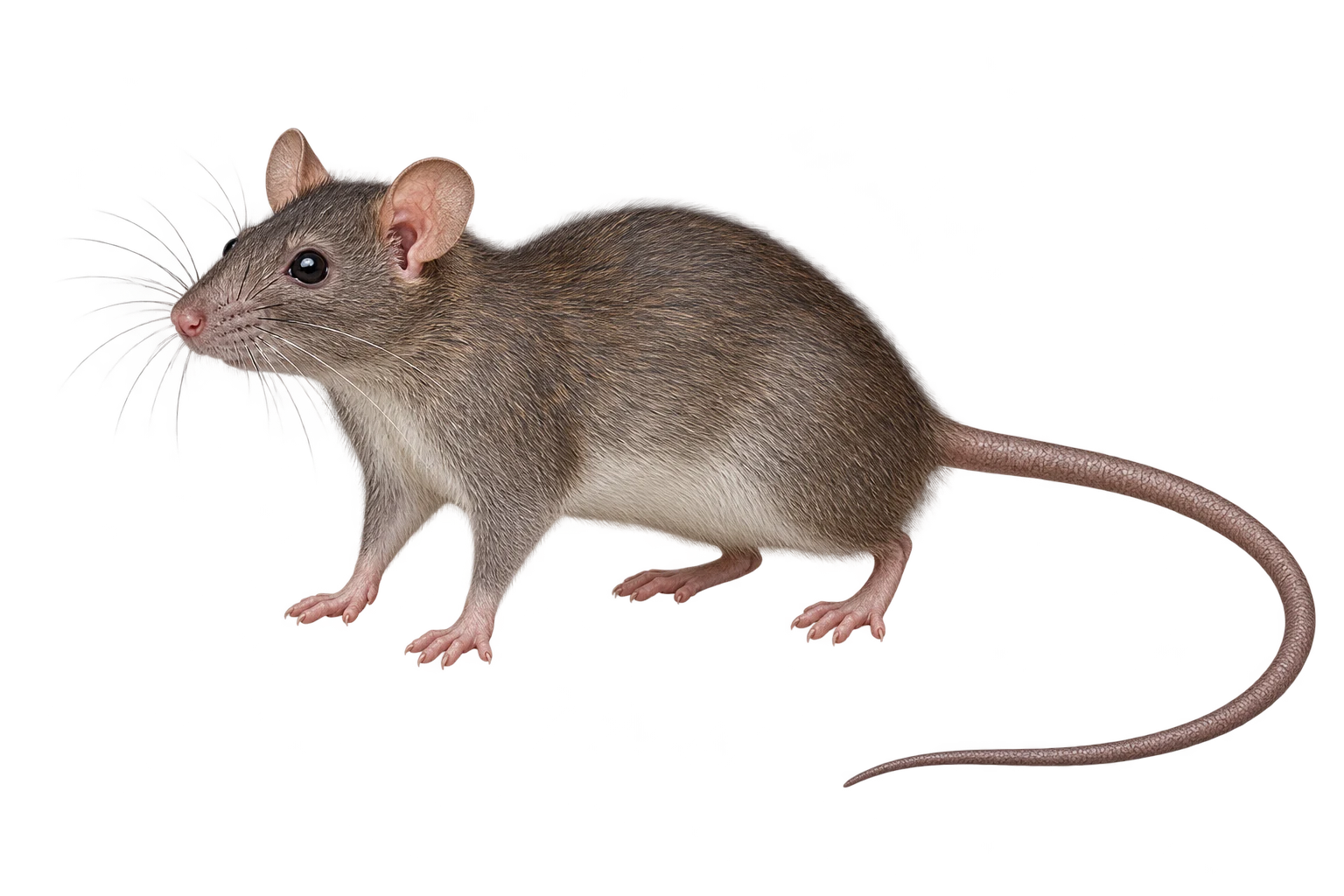
Mammals
Palm Rat
Rattus rattus
Classification and source reference
LivingAI illustration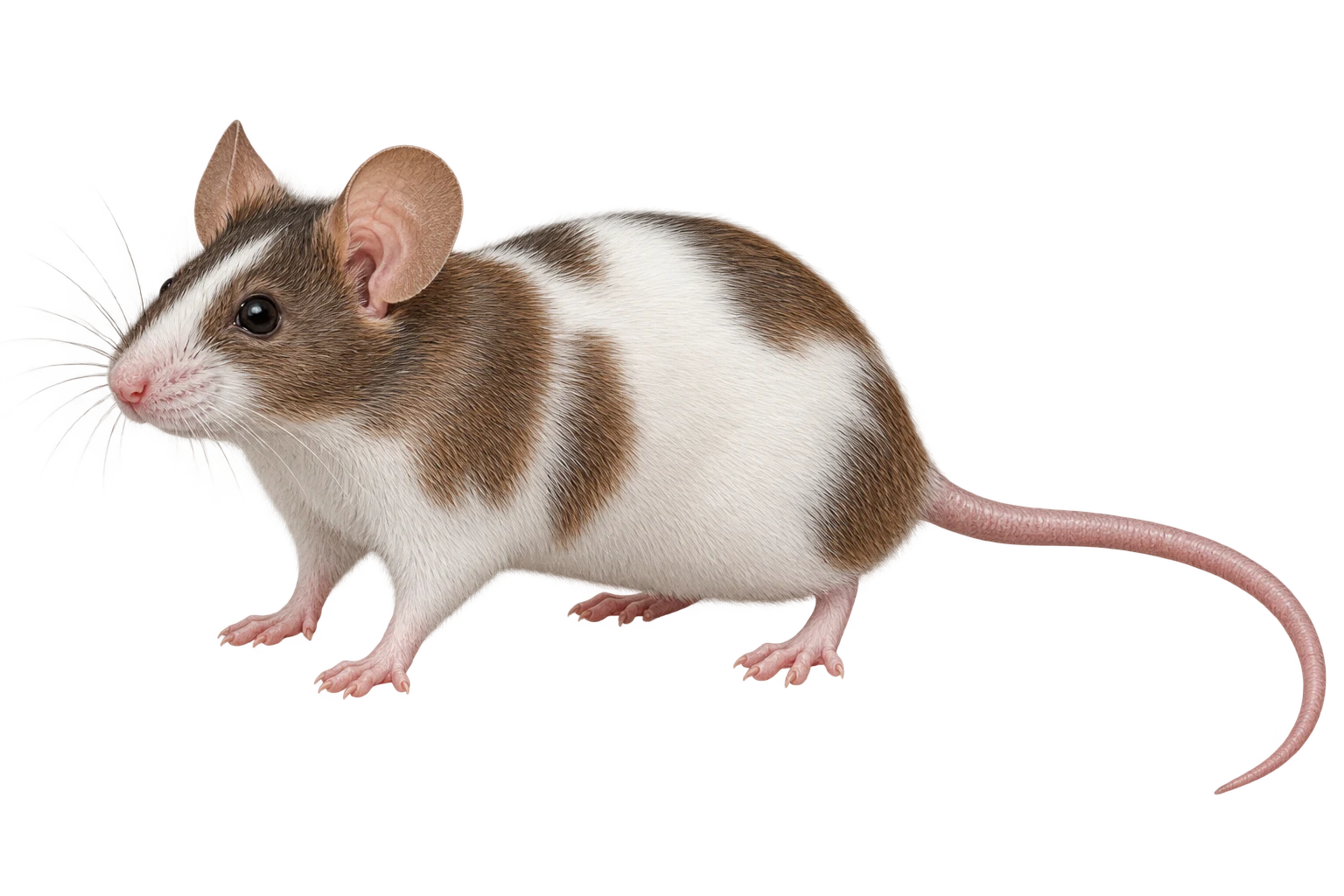
Mammals
Fancy Mouse
Mus musculus
Classification and source reference
LivingAI illustration LC
Mammals
House mouse
Mus musculus
The house mouse is a small grey-brown rodent that lives in and around human buildings on every inhabited continent.
Living
Mammals
Mouse
Muridae
Mice include many small rodents.
Living
Mammals
Abyssinian Guinea Pig
Cavia porcellus
Classification and source reference
LivingAI illustration
Mammals
Agouti
Dasyprocta
Classification and source reference
LivingAI illustration