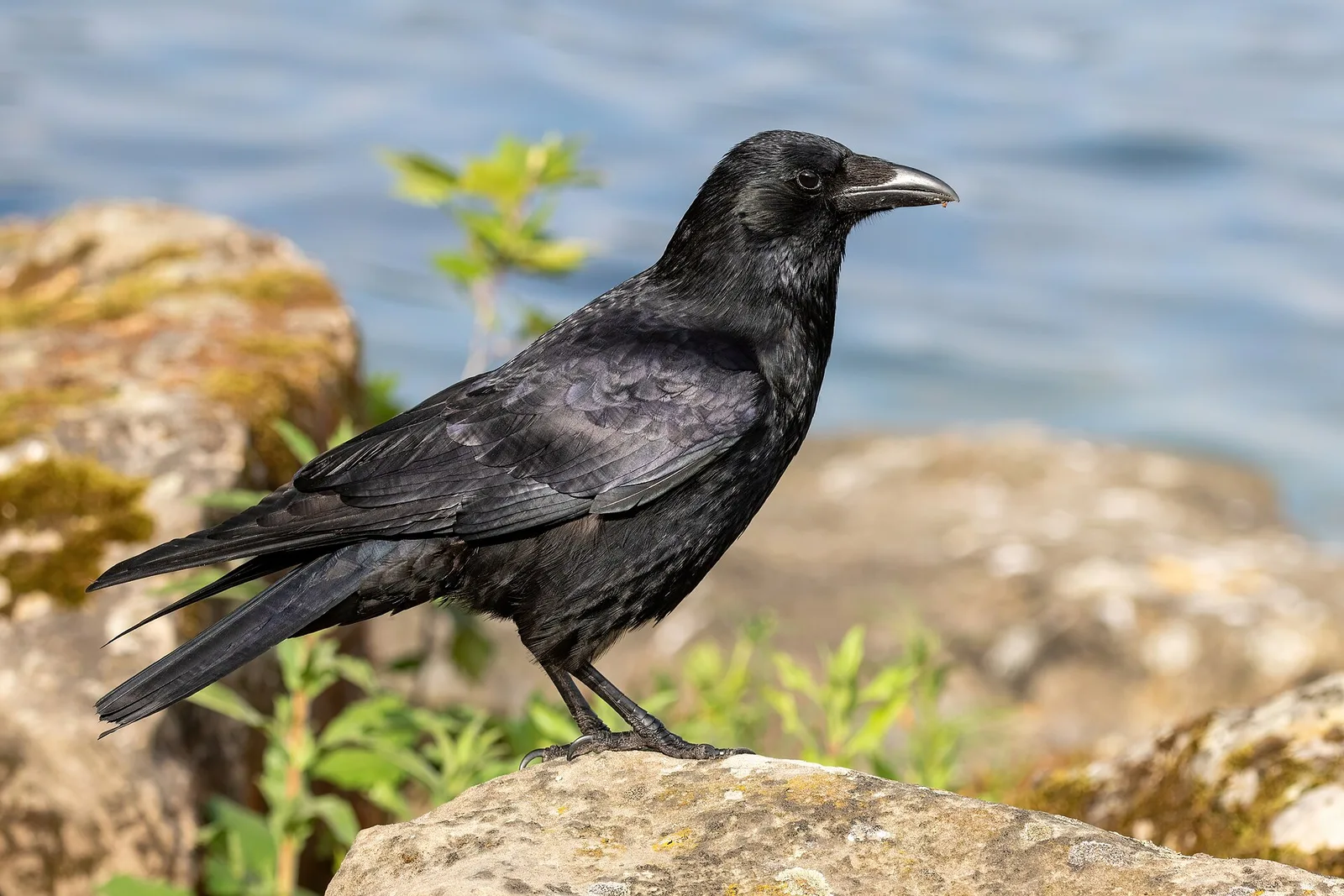
Carrion crow
A black bird that counts, plans and remembers faces
Corvus corone
Also called Common crow, Eastern carrion crow
Living individuals or members of this group exist today. This does not mean they are safe from extinction.
Meet the carrion crow
The carrion crow is an all-black crow of western Europe and eastern Asia with a heavy bill and a harsh croak. It eats almost anything, holds a territory as a pair, and ranks among the cleverest birds studied.
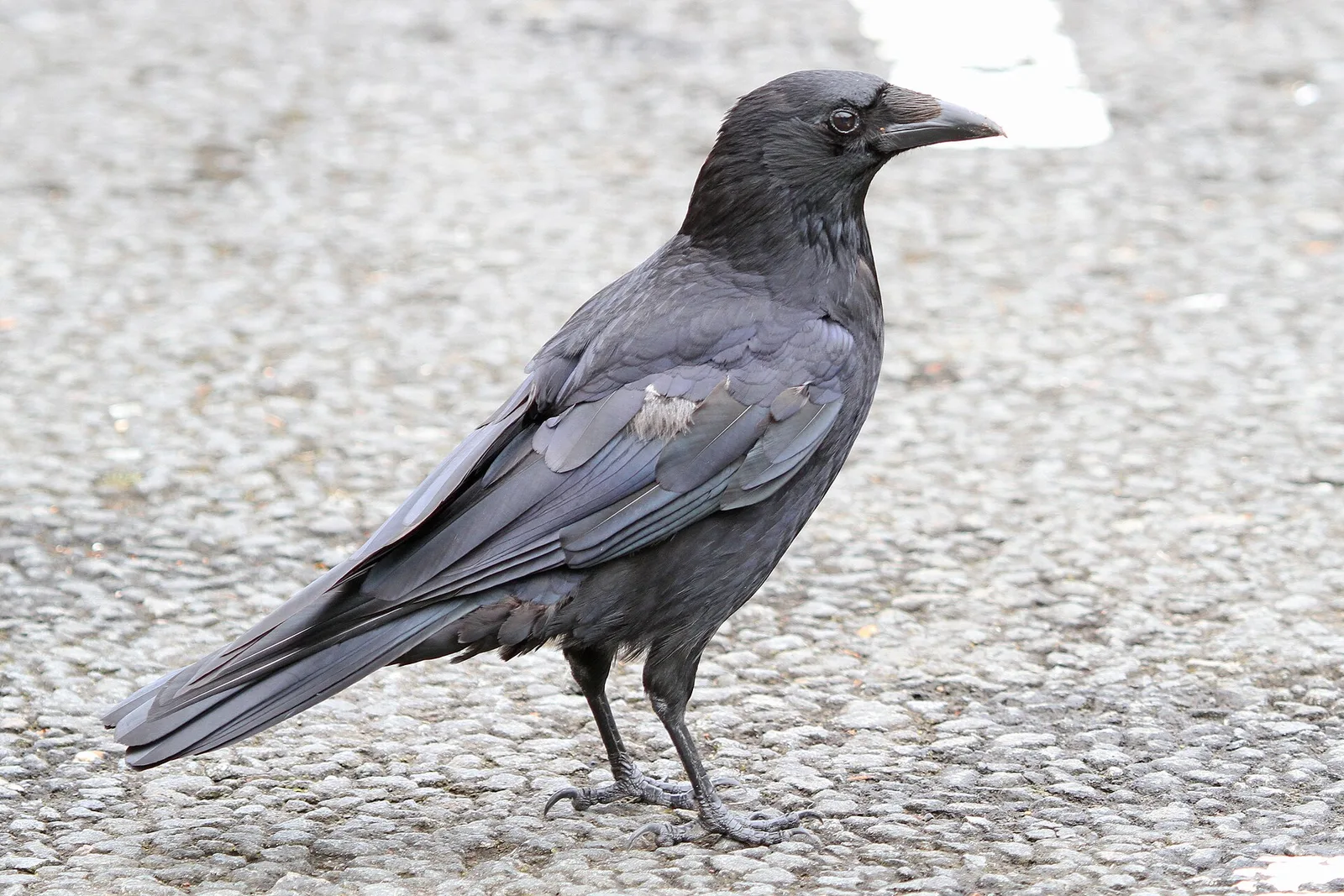
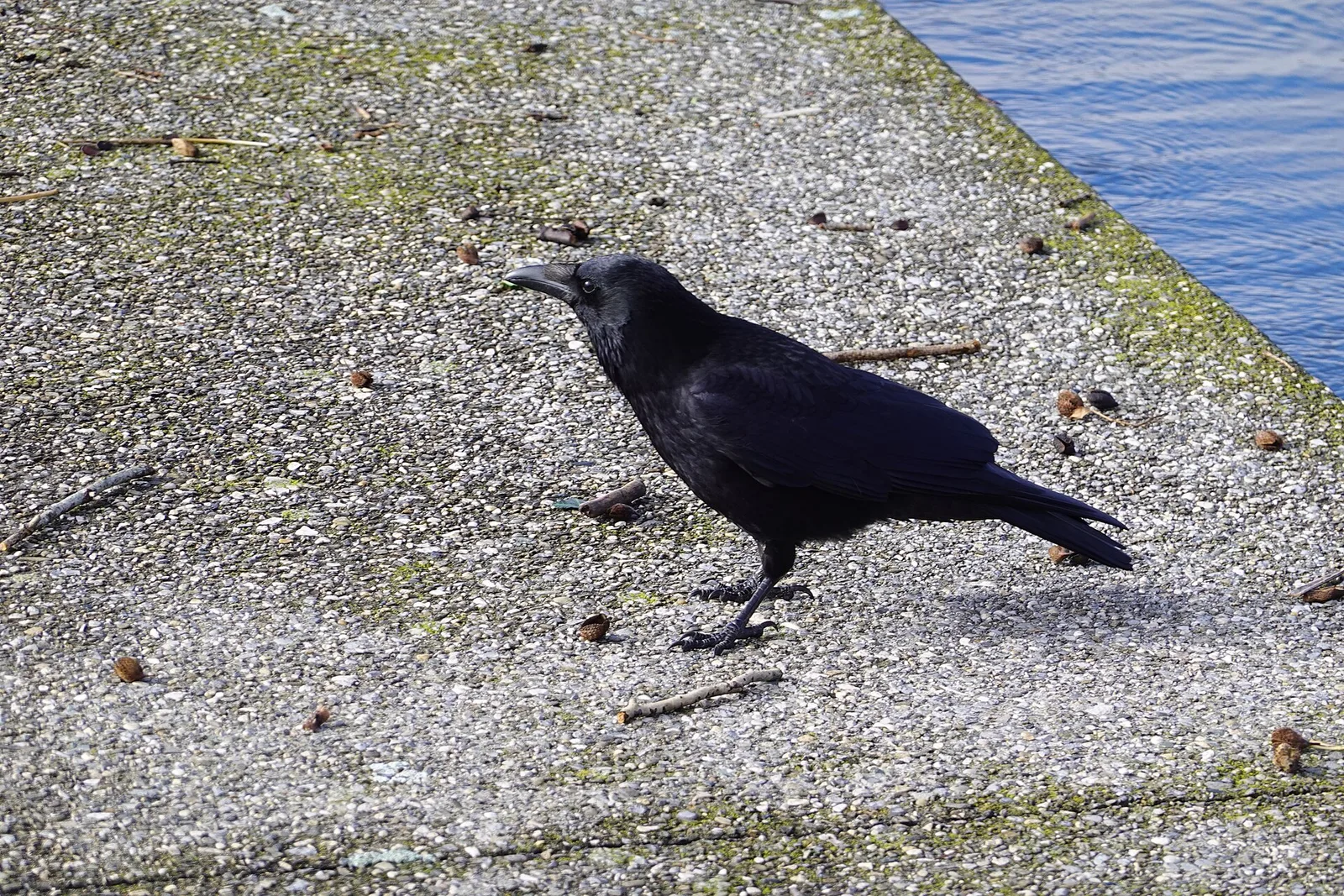
Images of the carrion crow
Lifespan in the wild
About 10 years for a bird that survives its first year
Weight
400 to 600 g
Length
48 to 52 cm
Wingspan
0.84 to 1 m
Fact file
Carrion crow
- Location
- Western Europe and eastern Asia, plus a small population on the Nile
- Habitat
- Towns and cities, Temperate forest, Grassland, Coast
- Diet
- Omnivore
- Prey / food
- Carrion, earthworms, insects, eggs, small mammals, fish, grain, fruit
- Predators
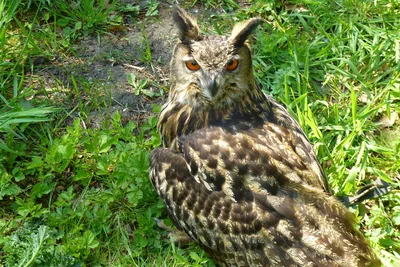
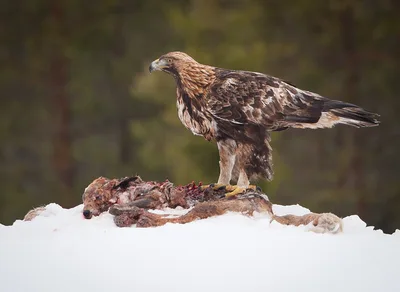
- Eurasian goshawk, peregrine falcon, Eurasian eagle-owl, golden eagle
- Lifestyle
- Pairs hold a territory all year, and young birds roam in flocks
- Group name
- A flock of crows is a murder
- Name of young
- Chick
- Incubation
- Incubation 18 to 20 days
- Clutch size
- 3 to 5 eggs
- Population
- Large and increasing across Eurasia
- Biggest threat
- Shooting and trapping by farmers and gamekeepers
- Distinctive feature
- All-black plumage with a green or purple gloss
- Colour
- Black, glossed green or purple; brown with blue eyes when young
- Skin type
- Feathers
Size
Next to a person
Measurements
Size and speed
- Length
- 48 to 52 cm
- Wingspan
- 0.84 to 1 m
- Weight
- 400 to 600 g 400 to 600 grams
Typical adult ranges. Sources: Wikipedia, Animal Diversity Web.
Life cycle
Lifespan
- In the wildAbout 10 years for a bird that survives its first year
- In captivityUp to 29 years
- 029 years
The pale bar is the record. Source: Animal Diversity Web.
Appearance
Colour and coat
- Primary colours
- black
- Secondary colours
- greenpurple
- Skin type
- feathers
- Male and female
- None known. Males and females share the same black plumage and the same size, and they cannot be told apart in the field.
Life cycle
Mating and family
- Mating system
- monogamous pairs for life
- Social structure
- territorial pairs, with non-breeding birds in flocks
- Breeding
- one clutch a year, in March or April
A pair builds a stick nest high in a tree and defends the ground around it. The female lays three to five speckled eggs and sits alone while the male brings food. The chicks hatch after 18 to 20 days and fly about a month later. Some young stay a further year and help their parents raise the next brood. Half of all crows die in their first year, and a survivor can reach 10 years or more.
Classification
Taxonomy
- Kingdom
- Animalia
- Phylum
- Chordata
- Class
- Aves
- Order
- Passeriformes
- Family
- Corvidae
- Genus
- Corvus
- Species
- Corvus corone
Conservation
Red List status
- LC
- NT
- VU
- EN
- CR
- EW
- EX
Least Concern on the IUCN Red List
Range
Recorded in 13 countries
- Austria
- Belgium
- Switzerland
- Germany
- Spain
- France
- United Kingdom
- Italy
- Japan
- Luxembourg
- Netherlands
- Portugal
- Russia
Habitat layer: temperate broadleaf and mixed forest, temperate conifer forest, boreal forest and taiga, tropical grassland, savanna and shrubland, temperate grassland, savanna and shrubland, mangrove.
Countries from 65,135 wild records on GBIF (iNaturalist research grade), filtered and checked by hand. Country shapes: Natural Earth. Habitat: RESOLVE Ecoregions 2017, CC BY 4.0. Basemap: Natural Earth.
Habitats
Three things to know
- 1
Carrion crows tell numbers apart up to thirty and learn human faces.
- 2
The hooded crow differs from it in less than a third of one per cent of the genome.
- 3
Some drop hard nuts on roads and let passing cars break them open.
Did you know
Seven more facts
- 1
The name Corvus means raven in Latin, so the crow is named after its bigger cousin.
- 2
A young carrion crow has blue eyes and brown feathers, and both darken with age.
- 3
A group of crows is a murder, but a breeding pair keeps to itself all year.
- 4
Crows pull in baited fishing lines with the bill and the feet to take the fish.
- 5
The great spotted cuckoo lays its eggs in crow nests and leaves the work to them.
- 6
Carrion crows nest as far north as the Arctic Circle in Russia.
- 7
The oldest captive bird on record died at 29 years old.
Field notes
How it looks and acts
Field notes
Distinguishing features
- The whole bird is black, including the bill, the legs and the feet.
- The gloss on the feathers is green or purple in good light.
- The bill is heavy and deep, unlike the slimmer bill of a young rook.
- The bird is far smaller than a raven, which averages 63 cm long.
- The wings beat more slowly and heavily than a rook's do.
- A wingspan of 84 to 100 cm makes a broad, square-ended silhouette.
Field notes
Unique adaptations
- A general diet lets the bird live on carrion, crops, eggs or rubbish as supply changes.
- A heavy bill opens carcasses, cracks shells and digs for worms.
- A large brain supports counting, rule switching and face memory.
- Food caching stores a glut for a lean day.
- Mobbing in a group drives off predators that a single crow could not face.
Field notes
Interesting behaviours
- It defends one territory as a pair through the whole year.
- It joins a roaming murder while it is still too young to breed.
- It hides surplus food and returns for it later.
- It harasses foxes and raptors until they leave a carcass.
- It uses tools in the laboratory, such as a stick to reach food.
Field notes
Temperament
- The carrion crow appears wary and watchful, and it learns quickly what is safe.
- It grows tame around people who feed it or ignore it.
- It is bold against much larger birds when it acts in a group.
- Pairs are aggressive towards other crows on their ground.
Field notes
Communication
- The main call is a hard, low kraa repeated three or four times.
- The caller bows its head and raises its shoulders with each note.
- The voice is deeper and rougher than the call of a rook.
- Captive birds mimic other sounds, including human words.
- Scent appears to carry information about mates and relatives.
Ecology
Ecological role
The carrion crow is a scavenger and a nest robber, so it both clears the dead and holds down the young of other birds.
- It removes carcasses, though nobody has measured how much it clears.
- It eats the eggs of other birds and can cut their broods.
- It hosts roundworms and other parasites.
- It hides seeds and nuts, some of which are probably left to grow.
Stories
Myths and legends
- In Irish myth, the goddess Badb becomes a crow and drives armies into panic.
- In Greek myth, Apollo turned a white crow black for reporting an unwelcome truth.
- In Greek star lore, the crow of Corvus is kept thirsty for lying about a snake.
- In Japanese myth, the three-legged Yatagarasu guided Emperor Jimmu across the mountains.
- In modern Japanese use, that same crow serves as an emblem and names an asteroid.
People
Relationship with humans
People
Living alongside us
The carrion crow follows people and profits from what they leave behind. It feeds at landfill sites, in parks and along roads, and it nests on buildings and pylons. Farmers and gamekeepers kill large numbers over damage to crops and livestock. Research says that damage is much smaller than the public believes, and the population keeps rising.
- The carrion crow may attack a person only near a nest that holds chicks.
- A parent bird may swoop at a walker who passes too close to a fledgling.
- Crows scavenge at refuse tips, so they may carry the organisms found there.
People
Status, uses and products
- Domestication
- Wild
- As a pet
- Not suitable. A carrion crow is loud, destructive and needs constant mental work. It is protected in most European countries, so keeping one usually breaks the law. A hand-reared crow also loses its fear of people, which puts it in danger outdoors.
- Uses
- pest control by farmersresearch on animal cognition
- Products
- None recorded
The full account
About the carrion crow
The carrion crow, Corvus corone, is an all-black crow of Europe and eastern Asia. It belongs to the family Corvidae, which holds the crows, the ravens and the jays. Adults measure 48 to 52 centimetres from the bill to the tail tip. The wings span 84 to 100 cm, and a bird weighs 0.4 to 0.6 kilograms.
Black covers the whole bird, and the feathers carry a green or purple sheen. The bird eats carrion, worms, insects, eggs, grain, fruit and household waste. A pair holds a territory all year and defends it against every intruder. Younger birds travel in flocks until they find a mate of their own. The IUCN lists the species as Least Concern, and the population is growing.
Name and taxonomy
Carl Linnaeus described the carrion crow in 1758, and the name he gave it still stands. Corvus is the Latin word for a raven, and korone is the Greek word for a crow. The hooded crow was once treated as a subspecies of this bird. Most authorities now list it as the separate species Corvus cornix. The eastern form, C. c. orientalis, may deserve the same treatment.
The two forms of carrion crow sit at opposite ends of the Eurasian landmass. Both hold wet coastal country, and the dry middle of the continent separates them. They may have evolved apart in those two places without ever meeting. Japanese birds hold the mountains, the woods and the cities of that country.
Evolution and relatives
The carrion crow and the hooded crow are as close as two species can be. Researchers sequenced almost the whole genome of both birds. The two proved genetically identical, apart from a patch of under 0.28 per cent. That patch sits on chromosome 18 and controls the pale body plumage of the hooded crow. The glaciations of the Pleistocene probably split one ancestral population into two.
The two birds meet along a narrow contact zone and can breed together. They rarely do, because black birds pair with black birds and grey with grey. Appearance alone appears to keep the two species apart. Researchers still argue about why the preference is so strong. Across Eurasia the bird fills the role that the American crow fills in North America.
Appearance
An adult carrion crow is black from bill to tail. The gloss is green or purple, and it is greener than the sheen on a rook. ADW gives an average length of 47 cm for the species. A wingspan of 84 to 100 cm carries a body of 300 to 600 grams. The bill is heavy and deep, and the feet carry three toes forward and one back.
Young birds are browner than their parents and have blue eyes. Both darken as the bird grows, so an adult shows a brown eye and black feathers. Males and females look the same. The common raven is much bigger, at an average of 63 cm, with a heavier bill. A young rook looks close, but the crow has the larger beak and no bare face patch.
Habitat and range
In Europe the range runs from northern Sweden to southern Spain. The Atlantic is the western edge. In Asia the southern edge crosses Iraq, Iran, Afghanistan and northern China. The birds hold the whole of Japan and the eastern coast of Russia. Breeding reaches about 70 degrees north in Russia, just past the Arctic Circle. A small African population lives along the Nile in Egypt.
Carrion crows once kept to marshland, light farmland and the coast. They have since moved into suburbs and city centres in large numbers. Parks and buildings serve for nesting, and landfill and bins serve for food. City birds find as much food as country birds do. Their measured nutrition is poorer, which is the one clear cost of town life. GBIF holds records of the species from 88 countries.
Diet and feeding
The carrion crow eats almost anything it can handle. Dead animals of every kind form part of the diet, as the name says. It also takes insects, earthworms, grain, fruit, seeds, nuts and small mammals. Amphibians, fish, human scraps and stolen eggs go the same way. Crows harass birds of prey and even foxes until they drop a kill. They sometimes hunt together, and a pair can take a duckling.
Foraging tricks are the part of the diet that draws most study. Birds pull baited fishing lines in with the bill and the feet to steal the catch. Others drop nuts on a road and let the traffic crack them open. Crows hide surplus food when rivals are about. They recall hundreds or thousands of hiding places and what lies in each. They eat perishable stores first and leave the lasting ones for later.
Behaviour and social life
Young carrion crows live in flocks, and a flock of crows is called a murder. A murder holds five to twenty birds from a few families. The group roams a wide area and uses its numbers to win food from rivals. A bird leaves the flock when it finds a mate. The new pair claims a territory and holds it through the year. A defended patch measures 200 to 500 square metres.
Crows mob any predator that enters the territory. A group will dive at a goshawk or an owl until the bird leaves. This works even when the raptor makes no move towards them. Pairs in cold regions may move south for the winter. Winter roosts can be sociable, even for birds that feed alone by day.
The species ranks with the cleverest birds tested. Captive crows tell numbers apart up to thirty. They switch between rules in a task without retraining. They recognise the faces of people and of other crows. A crow brain is built quite differently from a primate brain. The two lines probably reached similar minds by separate routes.
Communication and senses
The call is a deep, slightly grating kraa. A rook gives a higher kaaa, so the voice is the surest way to tell them apart. A crow calls three or four times in quick succession from a roof or a treetop. It pauses between each series and then starts again. With each caw the bird lifts its shoulders and bows its head forward. Captive birds copy sounds, and some copy human speech.
Vision is the strongest sense. In tests the birds followed a hidden object through the moves of a shell game. They found objects from visual clues alone, and they saw through deceptive hiding. Smell matters more than people once assumed. Crows react more to familiar odours than to strange ones. Scent appears to help them find food, avoid predators and know their own kin.
Reproduction and life cycle
Carrion crows form monogamous pairs that stay together for life. Breeding starts in early spring, from March into April. The nest is a bulky cup of sticks, usually high in a tall tree. Cliff ledges, old buildings and pylons serve as well, and a few nests sit near the ground. Both birds build, and the nest is smaller than a raven's.
A clutch holds three to five eggs, blue or greenish with brown speckles. The female alone incubates for 18 to 20 days while the male feeds her. Both parents then feed and guard the chicks. The young leave the nest at about 29 to 30 days old. Families often feed together after the young can fly.
Offspring from the year before sometimes stay to help raise the next brood. About 3 per cent of birds breed co-operatively, and helpers are usually relatives. In parts of northern Spain most nests have helpers, and a group can reach fifteen birds. Both sexes start breeding at about three years old. Roughly half of all crows die before their first birthday. A survivor lives around 10 years, and a captive bird reached 29.
Predators and threats
Few animals take a healthy adult carrion crow. Eurasian goshawks, peregrine falcons, Eurasian eagle-owls and golden eagles all kill them. Crows form a large share of the prey of some raptors in some places. Nobody has studied the predators of this crow directly. Like other corvids, it probably loses eggs and chicks to owls and to mammals.
The great spotted cuckoo lays its eggs in carrion crow nests. Several roundworms live in the bird as parasites. Mobbing is the usual defence, and it almost always sends the attacker away. People remain the largest source of deaths. Farmers and gamekeepers shoot and trap crows over supposed damage to livestock. Research suggests the public greatly overstates that damage.
Population and conservation
The IUCN lists the carrion crow as Least Concern. The wild population is increasing, and no conservation programme is in place. National lists in Finland, Portugal, France and Israel agree with the global one. iNaturalist holds 118,592 observations of the species. The move into towns has probably added to the total.
Persecution continues in farmland across much of Europe. Control appears to be legal in many countries under general pest licences. It has not dented the population at a national scale. The bird probably gains from waste, from roadkill and from open bins. Its future appears safer than that of most farmland birds.
Relationship with humans
Carrion crows live beside people and often lose their fear of them. City birds compete with gulls, ducks and other corvids for scraps in parks. They learn individual people who live near their territory. In one study captive crows scored better with a tester they already knew. That memory for a face may last for years.
Farmers accuse the bird of taking crops and killing young livestock. It does steal grain, and maize is the crop most often named. Reports of lambs killed are far commoner than the evidence supports. Any effect on a national farm economy is probably small. Crows also eat insect larvae and pest species, though nobody has measured the benefit. The species appears in no pet trade and has no market value.
In culture and myth
Crows appear in more European stories than almost any other bird. In Irish tradition the war goddess Badb takes crow shape and is called the battle crow. She spreads fear through an army, and a battlefield could be named her garden. With Macha and the Morrigan she forms a trio of war goddesses. The link between crows and battle probably began with birds feeding on the dead.
In Greek myth Apollo kept a white crow that told him of his lover's betrayal. He scorched its feathers black in his anger, and crows have been black since. A second story has the crow sent for water, delayed by figs and caught in a lie. Apollo threw the bird, its cup and a serpent into the sky as the constellation Corvus. He left the cup beyond reach, so the crow is always thirsty.
In Japanese belief the three-legged crow Yatagarasu guided the first emperor to Yamato. Its name reads as the eight-span crow, a comment on its size. The three legs stand for heaven, earth and humanity in one reading. Another reading gives them as sunrise, daylight and sunset. Modern Japan still uses the bird as a badge, and an asteroid carries its name.
A sentence with a dotted underline is inferred: it describes the group the animal belongs to, or is a reading of the sources, rather than a measured or reported fact about this species.
Questions
Carrion crow questions, answered
How big is a carrion crow?
The body is 48 to 52 cm long and the wings span 84 to 100 cm. A bird weighs 400 to 600 grams.
What is the difference between a crow and a raven?
Size is the quickest test. A raven averages 63 cm long, well above a crow, and it has a much heavier bill and a wedge-shaped tail.
What is the difference between a carrion crow and a rook?
Listen first. The rook gives a high kaaa and the crow a deep kraa. An adult rook also shows a bare pale face, and rooks nest in colonies.
What do carrion crows eat?
Almost anything. Carrion, worms, insects, eggs, small mammals, fish, grain, fruit and human waste all appear in the diet.
Are carrion crows intelligent?
Yes. They tell numbers apart up to thirty, switch between rules in a task, use tools and recognise individual human faces.
Why is a group of crows called a murder?
The term is an old collective noun for a flock, not a description of behaviour. Young carrion crows do travel in flocks of five to twenty birds.
How long do carrion crows live?
About half die in their first year. A bird that gets past that lives around 10 years, and one captive crow reached 29.
How many eggs does a carrion crow lay?
Three to five, blue or greenish with brown speckles. The female incubates them alone for 18 to 20 days.
Do carrion crows mate for life?
Yes. Pairs are monogamous and stay together, and they defend the same territory year after year.
Are carrion crows endangered?
No. The IUCN lists the species as Least Concern and the population is increasing. No conservation programme exists for it.
Do carrion crows kill lambs?
Reports are common but the evidence is thin. Research suggests the public greatly overestimates the losses, and the economic effect is very small.
Do crows remember faces?
Yes. Carrion crows recognise both human and crow faces, and captive birds perform better for a person they already know.
Where do carrion crows live?
Western Europe and eastern Asia, with a gap between the two. They also live along the Nile in Egypt and throughout Japan.
Is the hooded crow a different species?
Most authorities now say yes. The two differ in less than 0.28 per cent of the genome, and that patch only sets the plumage colour.
Can you keep a carrion crow as a pet?
No. The bird is protected across most of Europe, and it is loud and destructive indoors. Injured birds belong with a licensed rescue.
Food web
Prey and food
- carrion
- earthworms
- insects
- eggs
- mammals
- fish
- grain
- fruit
Food web
Predators
- eurasian goshawk
 Peregrine falcon
 Eurasian eagle-owl
 Golden eagle
Ecological equivalents
Related species on this site
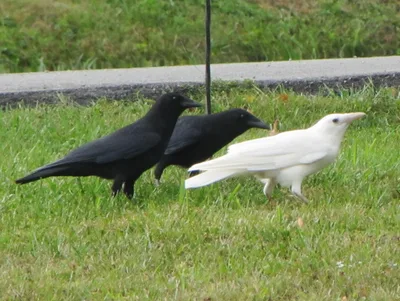
American crow (same genus), Common raven (same genus), Hawaiian Crow (same genus), Rook (same genus), Blue jay (same family), Common Green Magpie (same family), and more.
 LC
Birds
American crow
Corvus brachyrhynchos
The American crow is a large all-black bird of farms, woods and city streets across North America.
Living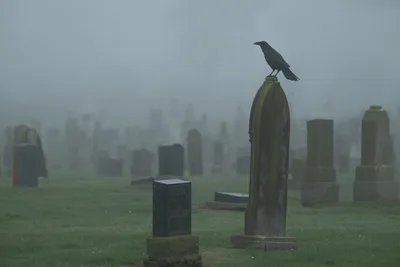 LC
Birds
Common raven
Corvus corax
The common raven is a large black crow that lives right across the northern half of the world.
Living
Birds
Hawaiian Crow
Corvus hawaiiensis
Classification and source reference
LivingAI illustration LC
Birds
Rook
Corvus frugilegus
The rook is a large black crow of European and Asian farmland, known by the bare pale skin around the base of its bill.
Living LC
Birds
Blue jay
Cyanocitta cristata
The blue jay is a loud blue songbird of the crow family, native to eastern and central North America.
Living
Birds
Common Green Magpie
Cissa chinensis
Classification and source reference
LivingAI illustration