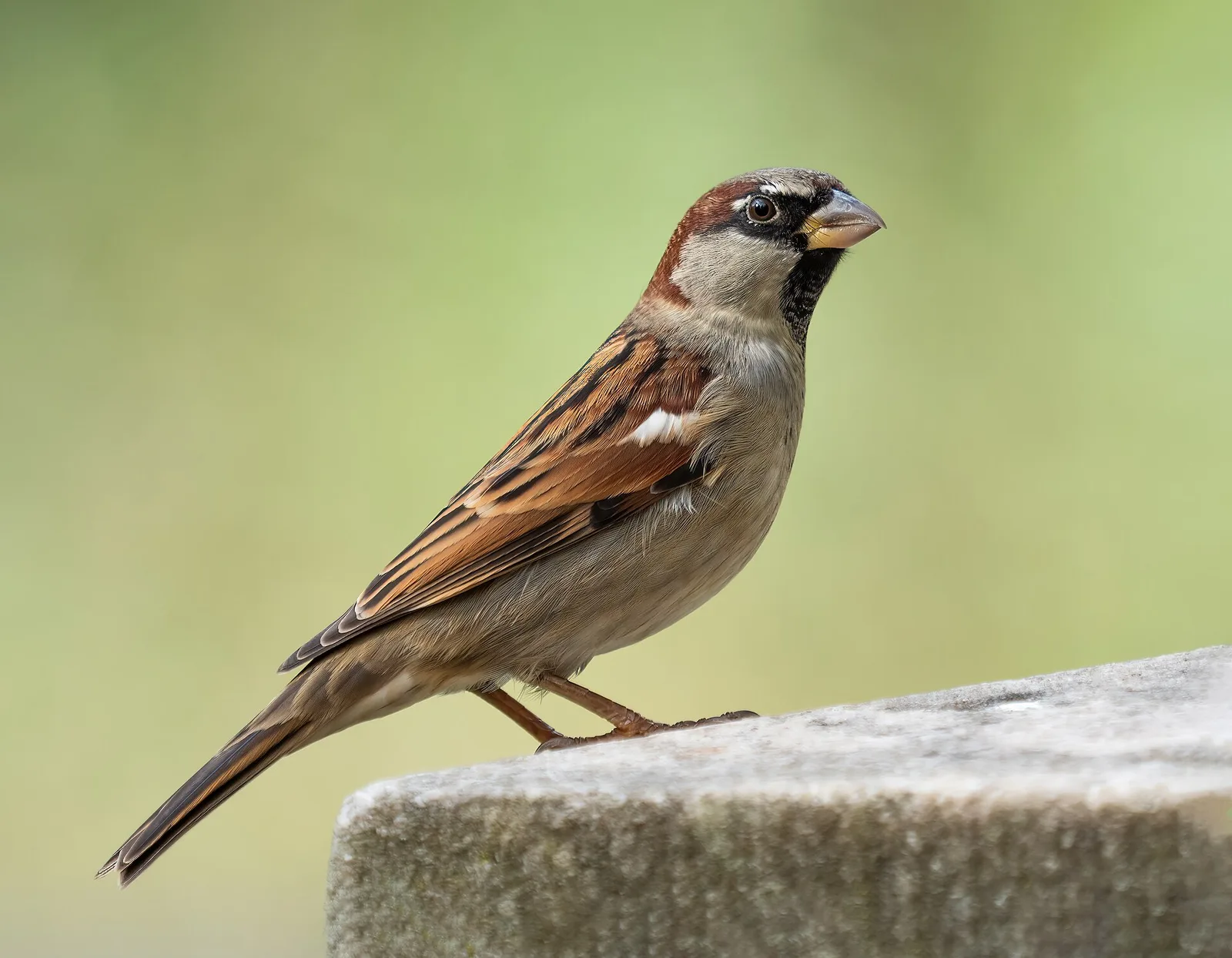
House sparrow
The wild bird that followed people around the world
Passer domesticus
Also called English sparrow, Indian sparrow, Spadger, Spuggy
Living individuals or members of this group exist today. This does not mean they are safe from extinction.
Meet the house sparrow
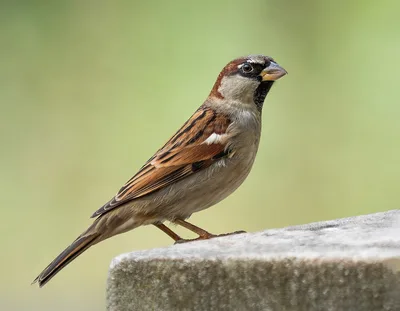
The house sparrow is a small brown and grey bird that lives beside people almost everywhere on earth. It began in the Middle East, spread with farming, and reached the rest of the world in ships and crates.
Images of the house sparrow
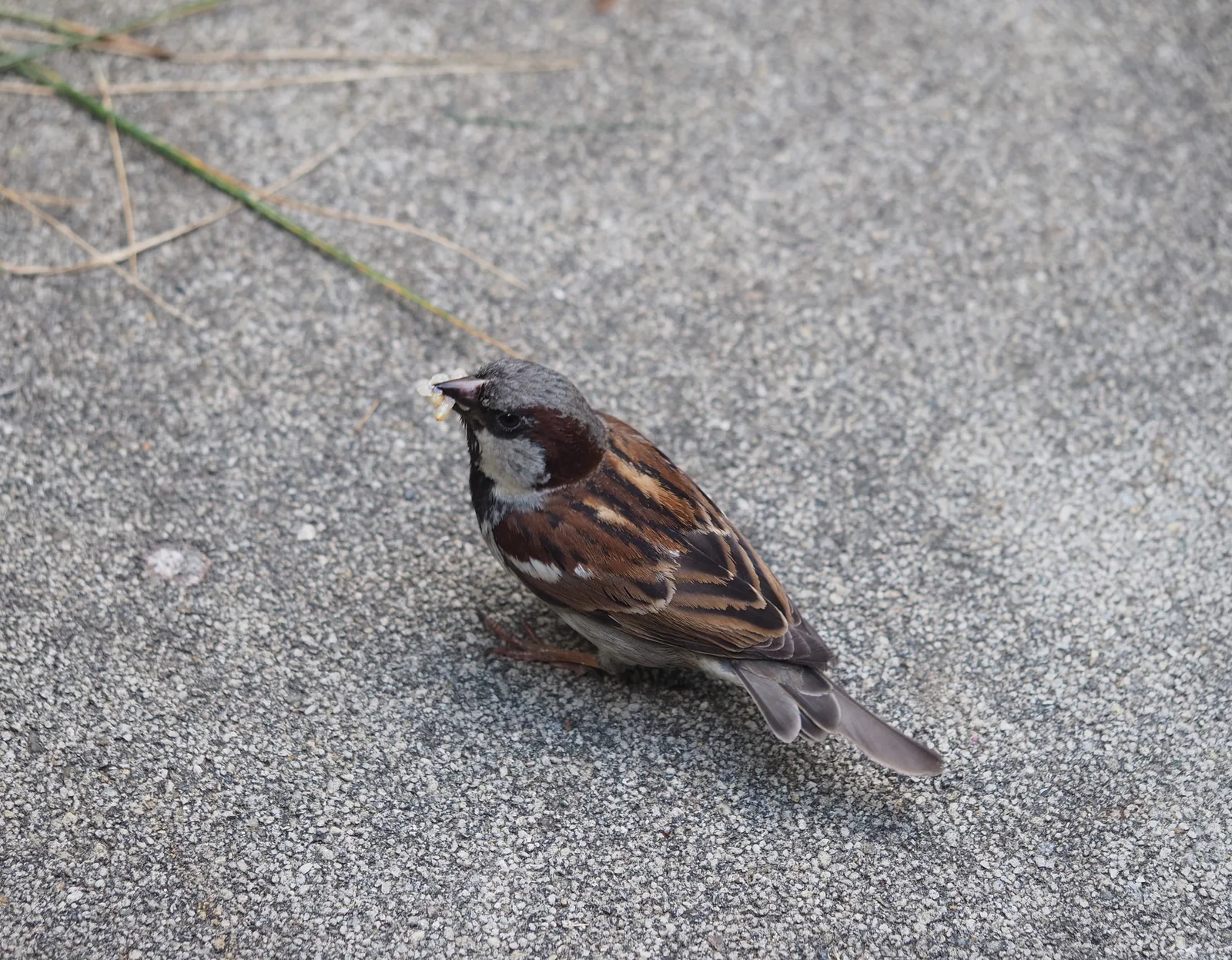
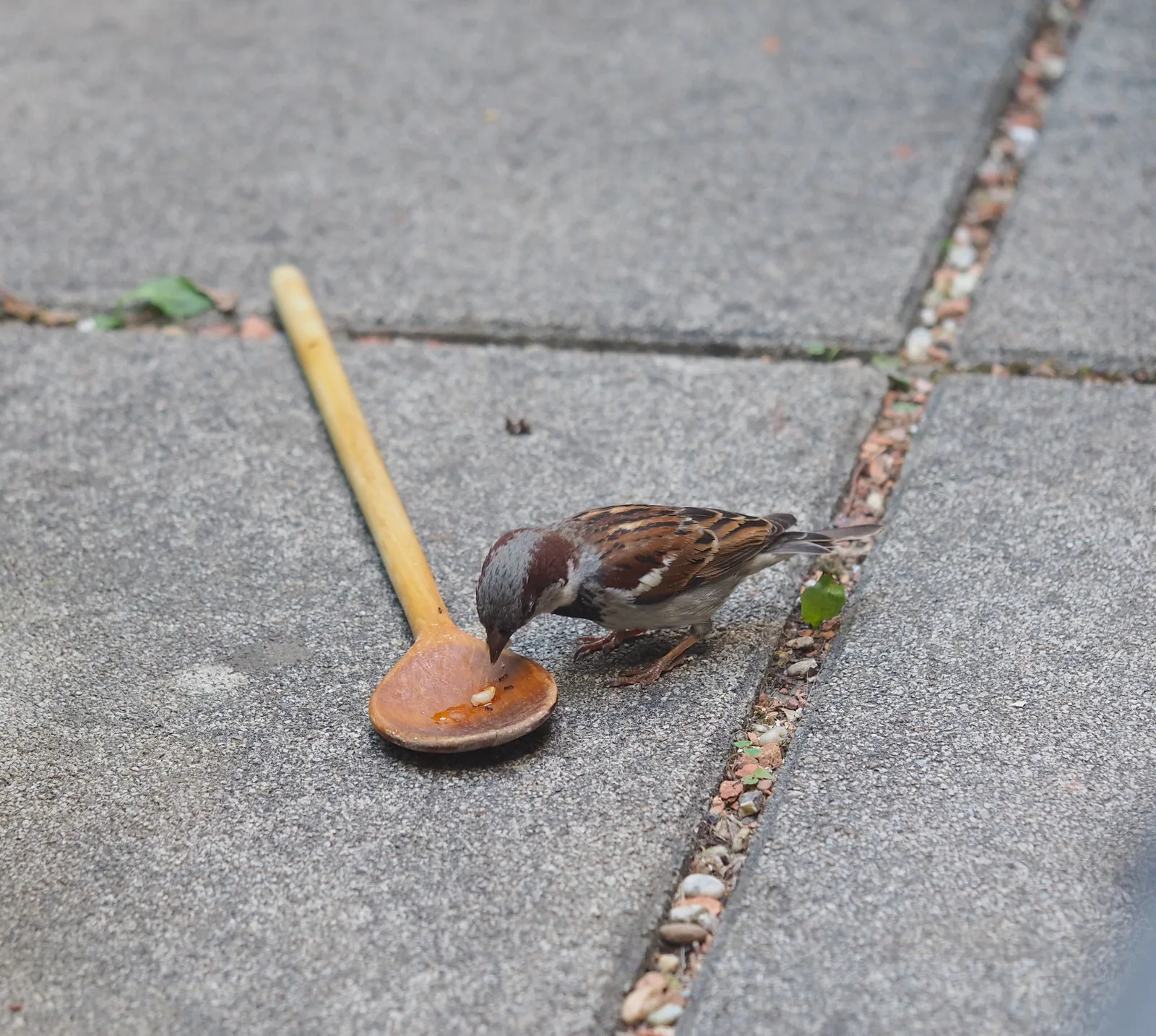
Lifespan in the wild
Up to 19 years a ringed bird in Denmark was found dead 19 years and 9 months after it was ringed
Weight
24 to 39.5 g
Length
14 to 18 cm
Top speed
About 45.5 km/h
Fact file
House sparrow
- Location
- Native to Eurasia and North Africa, introduced almost worldwide
- Habitat
- Towns and cities, Grassland
- Diet
- Omnivore
- Prey / food
- Cereal grain, weed seeds, beetles, caterpillars, flies, aphids, grasshoppers
- Predators
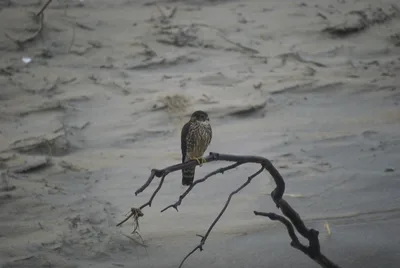
- Cats, sparrowhawks, merlins, crows and squirrels
- Lifestyle
- Social and active by day, and never far from people
- Group name
- Flock
- Name of young
- Chick
- Incubation
- Incubation 11 to 14 days
- Clutch size
- 4 or 5 eggs, and up to four clutches a year
- Population
- Up to about 1.4 billion
- Biggest threat
- Too few insects for the chicks, and too few nest holes
- Distinctive feature
- The male's black bib and grey crown
- Colour
- Brown and grey, with black and white on the male's head
- Skin type
- Feathers
Size
Next to a person
Measurements
Size and speed
- Length
- 14 to 18 cm
- Wingspan
- 19 to 25 cm
- Weight
- 24 to 39.5 g 24 to 39.5 grams; the European median is about 30 g
- Top speed
- About 45.5 km/h average level flight speed
Typical adult ranges. Source: Wikipedia.
Life cycle
Lifespan
- In the wildUp to 19 years a ringed bird in Denmark was found dead 19 years and 9 months after it was ringed
- In captivityUp to 23 years
- 023 years
Appearance
Colour and coat
- Primary colours
- browngrey
- Secondary colours
- blackwhitechestnut
- Skin type
- feathers
- Male and female
- The sexes differ strongly. The male has a grey crown, chestnut head sides and a black bib. The female is plain buff-brown with a pale stripe over the eye.
Life cycle
Mating and family
- Mating system
- monogamous pairs, often for life
- Social structure
- flocks all year, with nests grouped in loose colonies
- Breeding
- two clutches a year as a rule, up to four in temperate country
A male claims a nest hole and calls beside it until a female joins him. The pair build a domed nest of stems, grass and feathers. The female lays four or five eggs and sits for 11 to 14 days. Chicks stay in the nest 14 to 16 days and eat almost nothing but insects at first. Young birds can breed in the season after they hatch, though few succeed at that age.
Classification
Taxonomy
- Kingdom
- Animalia
- Phylum
- Chordata
- Class
- Aves
- Order
- Passeriformes
- Family
- Passeridae
- Genus
- Passer
- Species
- Passer domesticus
Conservation
Red List status
- LC
- NT
- VU
- EN
- CR
- EW
- EX
Least Concern on the IUCN Red List
Range
Recorded in 18 countries
- Argentina
- Austria
- Ashmore and Cartier Islands
- Brazil
- Canada
- Germany
- Spain
- France
- United Kingdom
- India
- Mexico
- New Zealand
- Poland
- Portugal
- Russia
- Ukraine
- United States of America
- South Africa
Habitat layer: tropical grassland, savanna and shrubland, temperate grassland, savanna and shrubland.
Countries from 389,672 wild records on GBIF (iNaturalist research grade), filtered and checked by hand. Country shapes: Natural Earth. Habitat: RESOLVE Ecoregions 2017, CC BY 4.0. Basemap: Natural Earth.
Habitats
Three things to know
- 1
It is the most widely spread wild bird on the planet, and people carried it to most of that range.
- 2
A pair once nested in an English coal mine 640 metres below ground.
- 3
British numbers have fallen by 68% since the early 1970s, and by about 90% in some places.
Did you know
Seven more facts
- 1
Female sparrows outrank males at feeders, although they are the smaller sex.
- 2
About 15% of chicks in a nest are not fathered by the female's mate.
- 3
A sparrow flies at about 45.5 kilometres per hour with roughly 15 wingbeats a second.
- 4
A single nest can hold more than 1,400 species of scavenging beetle over time.
- 5
Sparrows can live without drinking by taking the water in berries.
- 6
The bird hops on the ground rather than walking.
- 7
In much of eastern Asia there are no house sparrows at all, because the tree sparrow holds that ground.
Field notes
How it looks and acts
Field notes
Distinguishing features
- A black bib on the male's throat and chest.
- A grey crown on the male, with chestnut behind the eye.
- A plain brown female with a pale stripe over the eye and no black at all.
- A stout conical bill with a ridge of 1.1 to 1.5 centimetres.
- A compact body of about 16 centimetres with a 19 to 25 cm wingspan.
- A short tail of 5.2 to 6.5 centimetres.
Field notes
Unique adaptations
- A thick conical bill cracks hard cereal grain.
- A tolerance of salt and a taste for berries let the bird live where water is scarce.
- Nesting in holes in buildings probably gives it shelter that no natural site can match.
- Social learning spreads knowledge of a new food through a flock.
- A wide diet means the bird can switch from grain to insects to scraps as supply changes.
Field notes
Interesting behaviours
- Flock feeding: sparrows feed on the ground in groups, often with other species.
- Communal roosting: birds gather in a bush or tree and chirp loudly before they settle.
- Dust bathing: sparrows work dust or water through the feathers.
- Nest usurping: a pair will drive another bird out of a hole and take it over.
- Food stealing: sparrows rob other birds of prey items they have already caught.
Field notes
Temperament
- Bold near people, and quick to feed at a table or a pavement cafe.
- Aggressive at the nest hole, where a pair will kill to keep a site.
- Cautious with anything new, and individuals differ widely in how far they will go.
- Sociable at all times of year, which is unusual for a small songbird in general.
Field notes
Communication
- The chirp is the core call and does most of the work.
- A repeated fast chirp from a male by a nest hole serves as a song.
- A trilled call marks aggression in both sexes.
- A nasal quer warns the flock, and a shrill chree signals real distress.
- A soft quee between mates calms a quarrel.
Ecology
Ecological role
The house sparrow is a seed eater and an insect eater that lives in the habitat people build.
- It takes crop pests such as caterpillars and aphids during the breeding season.
- It feeds cats, sparrowhawks, merlins and crows in almost every town in its range.
- Where it is introduced it competes with native cavity nesters such as bluebirds.
- Its nests support a whole community of scavenging flies and beetles.
Stories
Myths and legends
- In ancient Greek tradition, sparrows belonged to Aphrodite and stood for lust.
- In Christian tradition, the sparrow of the Gospel of Matthew shows that nothing is too small to be watched over.
- In English country tradition, sparrow pie was eaten as an aphrodisiac.
- In Tamil tradition, a sparrow medicine was sold with the same claim.
- In modern Indian conservation the sparrow has become the face of World Sparrow Day.
People
Relationship with humans
People
Living alongside us
No wild bird lives closer to people. The house sparrow has followed farming for about 10,000 years and nests in the fabric of buildings. Most countries have treated it as a pest and tried to kill it in bulk, and every large campaign has failed. People have also eaten it, farmed its chicks in clay pots and kept it as a pet. Today the concern runs the other way, because town numbers have collapsed.
- A house sparrow weighs 24 to 39.5 grams and cannot injure a person.
- The species can pass diseases to people and to farm animals.
- Nests in roof spaces bring mites and beetles indoors, which may be a nuisance.
People
Status, uses and products
- Domestication
- Wild
- As a pet
- Not suitable. People have kept house sparrows for centuries, but the birds have no bright colour and no real song, and rearing them is hard. They belong outdoors.
- Uses
- birdwatchingpest control in cropsfood in some regions
- Products
- None recorded
The full account
About the house sparrow
The house sparrow is a small brown and grey bird of the family Passeridae. It is about 16 centimetres long, and the range runs from 14 to 18 cm. The wings span 19 to 25 cm, and the bird weighs 24 to 39.5 grams. Females and young birds are plain brown, while males carry a grey crown and a black bib. The natural home of the species covers most of Europe, the Mediterranean lands and much of Asia.
People carried it to the Americas, southern Africa, Australia and New Zealand. It is now the most widely distributed wild bird on earth. The sparrow lives beside people, in towns, on farms and inside buildings. It eats mostly seed, and it feeds insects to its chicks. The IUCN rates the species as Least Concern, but numbers have crashed in Britain and much of Europe.
Name and taxonomy
Carl Linnaeus named the house sparrow in 1758, in the tenth edition of Systema Naturae. He called it Fringilla domestica, from a specimen collected in Sweden. The genus Fringilla later became the home of the chaffinches alone. Mathurin Jacques Brisson set up the genus Passer in 1760, and the sparrow moved into it.
The Latin passer means a small quick bird, and it shares that sense with the English word sparrow. The species name domesticus means belonging to the house. North Americans often call the bird the English sparrow, and readers in India say Indian sparrow. English dialects add spadger and spadgick in the south, spug and spuggy in the north, and spur in Scotland. German speakers who settled in North America brought spatzie, from Spatz.
Evolution and relatives
The genus Passer holds about 25 or 26 species, depending on the authority. They are dull birds with square tails and thick conical beaks, and they run 11 to 18 centimetres long. The house sparrow belongs to the Palaearctic group with black bibs. Studies of mitochondrial DNA place most of the splitting in the Pleistocene or earlier.
Its closest relatives are the willow sparrows of the Mediterranean. The Spanish sparrow is the main one, and the two species hybridise widely in North Africa. Mixed populations there run all the way from pure house sparrow to pure Spanish sparrow. The Italian sparrow of Italy looks like a bird halfway between the two. It may be a species that arose from hybrids long ago, and the argument is not settled.
Appearance
The house sparrow is compact, with a full chest and a large round head. A typical bird is 16 centimetres long, with a wingspan of 19 to 25 cm. Weight runs from 24 to 39.5 grams, and the European median is about 30 g. Southern subspecies are lighter, at around 26 grams. The bill is stout and conical, and its ridge measures 1.1 to 1.5 centimetres.
The male has a dark grey crown, chestnut sides to the head and a black bib on the throat and chest. His back is warm brown with heavy black streaks, and his underparts are pale grey. Fresh autumn feathers have pale tips that hide the pattern, and wear brings it out again by spring. The female has no black and no grey cap, only brown upperparts, dark streaks and a pale stripe over the eye. The size of a male's bib is thought to signal his status, though the studies agree only that it grows with age.
Habitat and range
The house sparrow started in the Middle East and spread across Eurasia with farming. Since the middle of the nineteenth century it has reached nearly every part of the world. Settlers released English birds in New York in 1852 to control a moth that stripped lime trees. Melbourne received sparrows in 1863, New Zealand in 1859 and Buenos Aires around 1870. Where the bird is new it can push its range forward by more than 230 kilometres in a year.
Dense forest and tundra are the only land habitats it does not use. It nests indoors in factories, warehouses and zoos without any trouble. One pair bred in an English coal mine 640 metres below the surface. Another bird fed at night on the observation deck of the Empire State Building. Densities peak in city centres, but more chicks survive in suburbs, where insects are easier to find.
The sparrow prefers dry conditions and copes with salt in its food. It can go without drinking water by eating berries instead. Most of eastern Asia has no house sparrows, because the Eurasian tree sparrow fills the same place there. GBIF holds records from 222 countries and territories, which is a measure of how far people have carried it.
Diet and feeding
Seeds of cereals and weeds make up most of the adult diet. Studies in temperate farmland put the seed share at about 90%. Given a choice the bird takes oats, wheat or maize first. Country sparrows pick waste grain out of dung and stubble, while town sparrows take bird seed and crumbs. The bird also eats buds, berries, grapes and cherries, and it tears yellow flowers apart in spring.
Insects matter most in the breeding season, especially beetles, caterpillars, flies and aphids. Parents feed the chicks on insects alone for roughly their first 15 days out of the egg. Grasshoppers and crickets are the commonest food that parents bring in. Sparrows swallow grit, either stone or broken shell, to grind hard food in the gizzard. They also steal food from other birds, including the American robin.
The species solves problems to reach a meal. Sparrows have triggered automatic supermarket doors and clung to hotel walls to watch food on balconies. In New Zealand they rob nectar from kowhai flowers. That flexibility probably explains why the bird settles so easily in a new country.
Behaviour and social life
The house sparrow is social in every season and feeds in flocks. It often joins other seed-eating birds at a food source. Nests sit in loose clumps rather than in defended territories. Birds bathe in dust and in water, and they sing together in a bush for no obvious reason. Females dominate males at feeders and at the nest, although they are the smaller sex.
Outside the breeding season the birds roost together in trees and shrubs. They chirp loudly before they settle at dusk and again before they leave at dawn. A sleeping sparrow tucks its bill under the shoulder feathers. Flight is direct rather than bouncing, at about 45.5 kilometres per hour and around 15 wingbeats a second. On the ground the bird hops, and it can swim if a predator forces it into water.
Sparrows learn from each other about strange objects and new food. Some individuals approach anything new, and others keep well away. Captive birds changed their behaviour after watching another bird, and even after hearing recorded calls. Most house sparrows move only a few kilometres in a whole lifetime. Two Central Asian subspecies are the exception, because they migrate and put on fat first.
Communication and senses
Almost every sparrow sound is a version of the short chirp. Writers transcribe it as chirrup, tschilp or philip. A resting flock uses it to keep contact, and a male uses it to claim a nest hole and call for a mate. In the breeding season he repeats it fast and hard, which counts as his song. Young birds, especially in captivity, produce a real warbling song like a greenfinch's.
An angry male trills the call, and a female uses the same trill to push a male off the nest. A nasal quer serves as the alarm, and a shrill chree marks real distress. A soft quee between paired birds calms an argument. None of these sounds is unique, because every sparrow in the family uses much the same set. Sight rules the bird's world, as it probably does for most small seed eaters.
Reproduction and life cycle
House sparrows pair for life and defend a nest site rather than a territory. An unmated male starts a nest and calls beside it until a female comes. He displays by drooping and shivering his wings, raising his tail and showing off the bib. Pairs are faithful in name only, and about 15% of fledglings are not the mate's young. Birds that find no nest may help a pair instead, which puts them first in line for a vacancy.
Cavities are the favourite nest site, above all a gap in the eaves of a house. Holes in cliffs and banks, tree hollows, street lights and old swallow nests all serve. The nest is a domed mass of stems and roots, lined with dead grass, leaves, feathers and paper. It measures roughly 20 by 30 centimetres on the outside, though the size varies a lot. In cold weather the birds build extra roost nests to hold in heat.
A clutch usually holds four or five eggs, and counts from one to 10 are on record. The eggs are white to greenish white with brown or grey spots, and each weighs about 2.9 grams. Incubation lasts 11 to 14 days and falls mostly to the female, who alone has a brood patch. Chicks stay in the nest 14 to 16 days as a rule, and both parents feed them. Two clutches a year are normal, four are possible in temperate country and seven in the tropics.
Predators and threats
Cats and birds of prey kill the most house sparrows. Sparrowhawks and merlins are the sharpest bird hunters, but cats probably take the greater toll. Crows, magpies and squirrels rob nests, and people have eaten sparrows in many countries. On European roads the house sparrow is the bird most often found dead.
Only about 20 to 25% of hatched sparrows live to their first breeding season. An adult has a 45 to 65% chance of surviving each year. A ringed bird in Denmark was found dead 19 years and 9 months after it was marked. The oldest captive bird reached 23 years. Nests carry a heavy load of parasites, including blowflies and more than 1,400 kinds of beetle.
Population and conservation
The IUCN rates the house sparrow as Least Concern and puts the world total near 1.4 billion birds. Only the red-billed quelea may be more numerous among wild birds. Naturalists have logged 560542 house sparrow observations on iNaturalist. The global figure hides a steep decline close to the bird's Eurasian home.
A 21-year citizen science study found European numbers down by nearly 60% by 2021. British numbers peaked in the early 1970s and have since fallen 68%, and about 90% in some regions. The RSPB puts the house sparrow on its red list for the United Kingdom. Dutch numbers halved after the 1980s, and North American numbers are down 84% since 1966. The bird has largely gone from central London and from several large South Asian cities.
A shortage of insect food for the chicks looks like the main cause. Monoculture crops, heavy pesticide use and paved gardens all cut the insect supply. Modern buildings offer fewer holes, so conservation groups now push sparrow nest boxes. Sparrowhawk predation, avian malaria and traffic fumes have all been proposed as extra causes. Delhi named the house sparrow its state bird in 2012 to help the campaign.
Relationship with humans
Sparrows have lived with people for about 10,000 years. Most of the world treats the bird as a pest, because it takes grain and shares diseases with livestock. In most countries no law protects it. Control has meant traps, poison, shooting, blocked holes and destroyed nests. Every large campaign has failed, and the sparrow eats crop pests as well as crops.
The bird has also been food for a very long time. From about 1560 people in northern Europe hung earthenware sparrow pots under the eaves to farm the young. Sparrow pie was a country dish, and eaters believed it worked as an aphrodisiac. Sparrow clubs in early twentieth-century England killed millions of birds and eggs to little effect. Germany persecuted the species from at least 1650 until 1970.
In culture and myth
In ancient Greek tradition the sparrow belonged to Aphrodite, the goddess of love. The birds seemed lustful to Greek observers, and Chaucer and Shakespeare kept that idea alive. In the Gospel of Matthew the sparrow stands for the care that God takes of small things. That line reached Hamlet, and later the hymn His Eye Is on the Sparrow. For most people the house sparrow stands for the ordinary and the common.
China ran the Four Pests campaign against sparrows from 1958, though it mainly hit the Eurasian tree sparrow. Whole towns turned out with gongs, poles and slingshots, and reported kills reached nearly 2 billion in one year. Insects then multiplied without the birds, which helped bring on the famine that followed. World Sparrow Day has been held on 20 March since 2010, and the Nature Forever Society of India started it. Its founder, Mohammed Dilawar, meant it to draw attention to the birds that people stop noticing.
A sentence with a dotted underline is inferred: it describes the group the animal belongs to, or is a reading of the sources, rather than a measured or reported fact about this species.
Questions
House sparrow questions, answered
How big is a house sparrow?
A house sparrow is about 16 centimetres long, with a range of 14 to 18 cm. It spans 19 to 25 cm across the wings and weighs 24 to 39.5 grams.
What do house sparrows eat?
Adults eat mostly seeds, and studies on farmland put the seed share near 90%. Chicks are fed almost entirely on insects for their first two weeks.
Where do house sparrows live?
They are native to Europe, the Mediterranean and much of Asia, and people have introduced them nearly everywhere else. They avoid only dense forest and tundra.
Why are house sparrows declining?
The main cause looks like a shortage of insect food for the chicks. Fewer nest holes in modern buildings, pesticides and paved gardens all add to it.
How many house sparrows are there?
The IUCN puts the world population near 1.4 billion. Among wild birds only the red-billed quelea may be more numerous.
How do you tell a male house sparrow from a female?
The male has a grey crown, chestnut behind the eye and a black bib on the throat. The female is plain brown with a pale stripe over the eye and no black.
How long do house sparrows live?
Most die young, and only 20 to 25% of chicks reach their first breeding season. A ringed Danish bird lived 19 years and 9 months, and a captive bird reached 23 years.
How many eggs does a house sparrow lay?
Usually four or five, though clutches from one to 10 are recorded. Two clutches a year are normal and four are possible in temperate country.
Do house sparrows migrate?
Most never move more than a few kilometres in their lives. Two Central Asian subspecies are true migrants and put on fat before they travel.
Are house sparrows a pest?
Many countries treat them as one, because they take grain and can spread disease. They also eat crop insects, and every large control campaign has failed.
Where do house sparrows nest?
In holes, above all in the eaves of buildings. They also use cliffs, tree hollows, street lights and the old nests of other birds.
How fast do house sparrows fly?
Level flight averages about 45.5 kilometres per hour, with roughly 15 wingbeats a second. The flight is direct rather than bouncing.
Are house sparrows endangered?
Not globally, and the IUCN rates the species Least Concern. In Britain the RSPB puts it on the red list after a 68% fall since the 1970s.
What is the difference between a house sparrow and a tree sparrow?
The Eurasian tree sparrow is smaller and slimmer. It shows a chestnut cap and one black spot on each white cheek, where a male house sparrow has a grey cap.
When is World Sparrow Day?
It falls on 20 March each year and has run since 2010. The Nature Forever Society of India started it to draw attention to common town birds.
Do house sparrows mate for life?
Pairs usually stay together for life, and the bond is tied to a nest site. Even so, about 15% of the chicks in a nest have another father.
Food web
Prey and food
- cereal grain
- weed seeds
- beetles
- caterpillars
- flies
- aphids
- grasshoppers
Food web
Predators
- cats
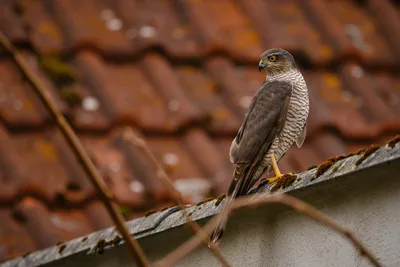 Eurasian sparrowhawk
 Merlin
- crows
- squirrels
Ecological equivalents
Related species on this site
Sparrow (same family), Acadian Flycatcher (same order), Amazonian Royal Flycatcher (same order), American crow (same order), American goldfinch (same order), American robin (same order), and more.
Birds
Sparrow
Passeridae
Sparrows are small seed-eating songbirds.
Living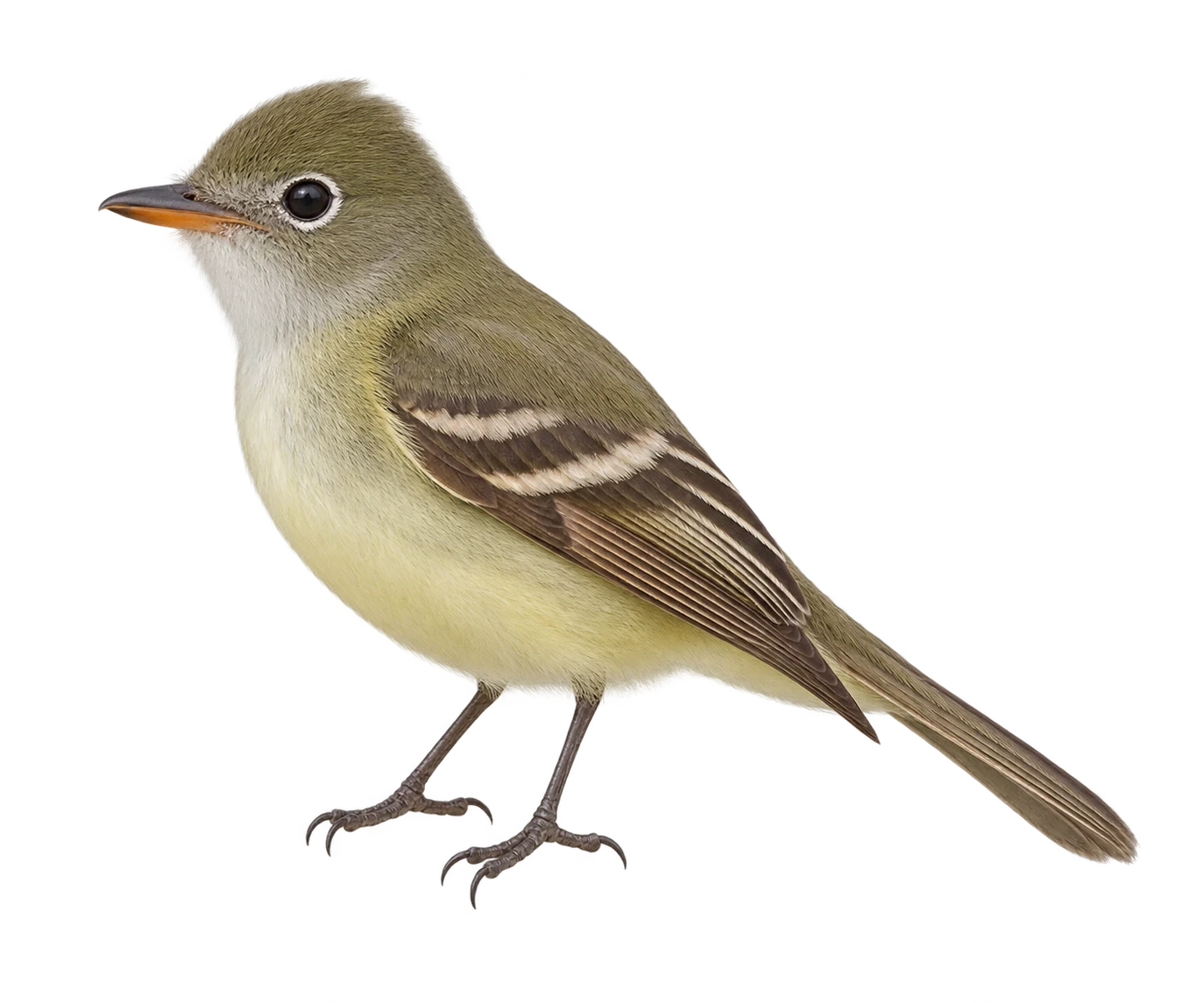
Birds
Acadian Flycatcher
Empidonax virescens
Classification and source reference
LivingAI illustration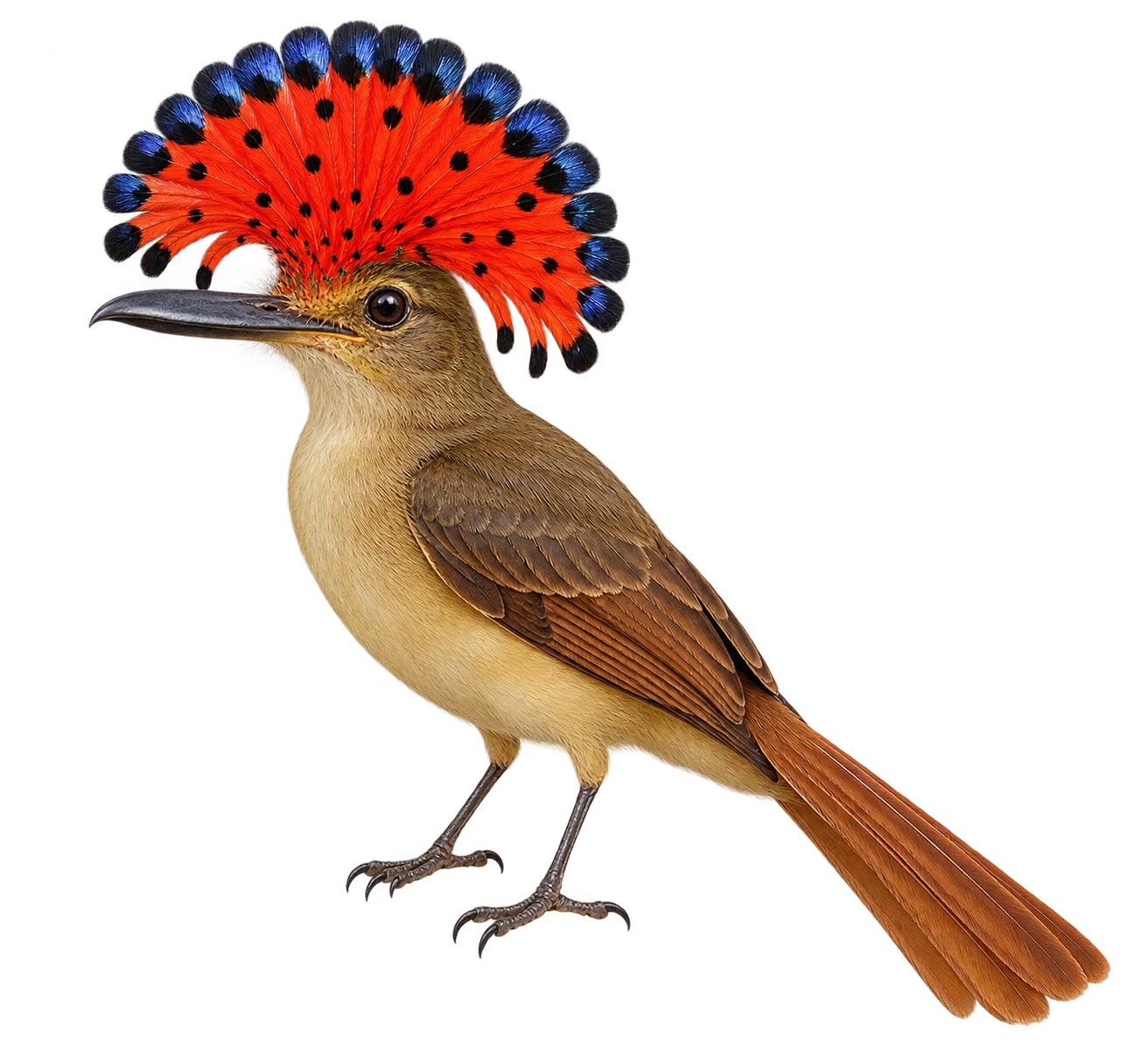
Birds
Amazonian Royal Flycatcher
Onychorhynchus coronatus
Classification and source reference
LivingAI illustration LC
Birds
American crow
Corvus brachyrhynchos
The American crow is a large all-black bird of farms, woods and city streets across North America.
Living LC
Birds
American goldfinch
Spinus tristis
The American goldfinch is a small seed-eating finch of open weedy country across North America.
Living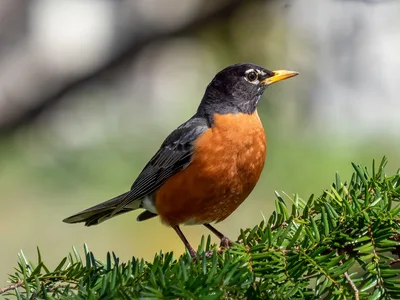 LC
Birds
American robin
Turdus migratorius
The American robin is a large thrush that feeds on lawns and open ground across North America.
Living