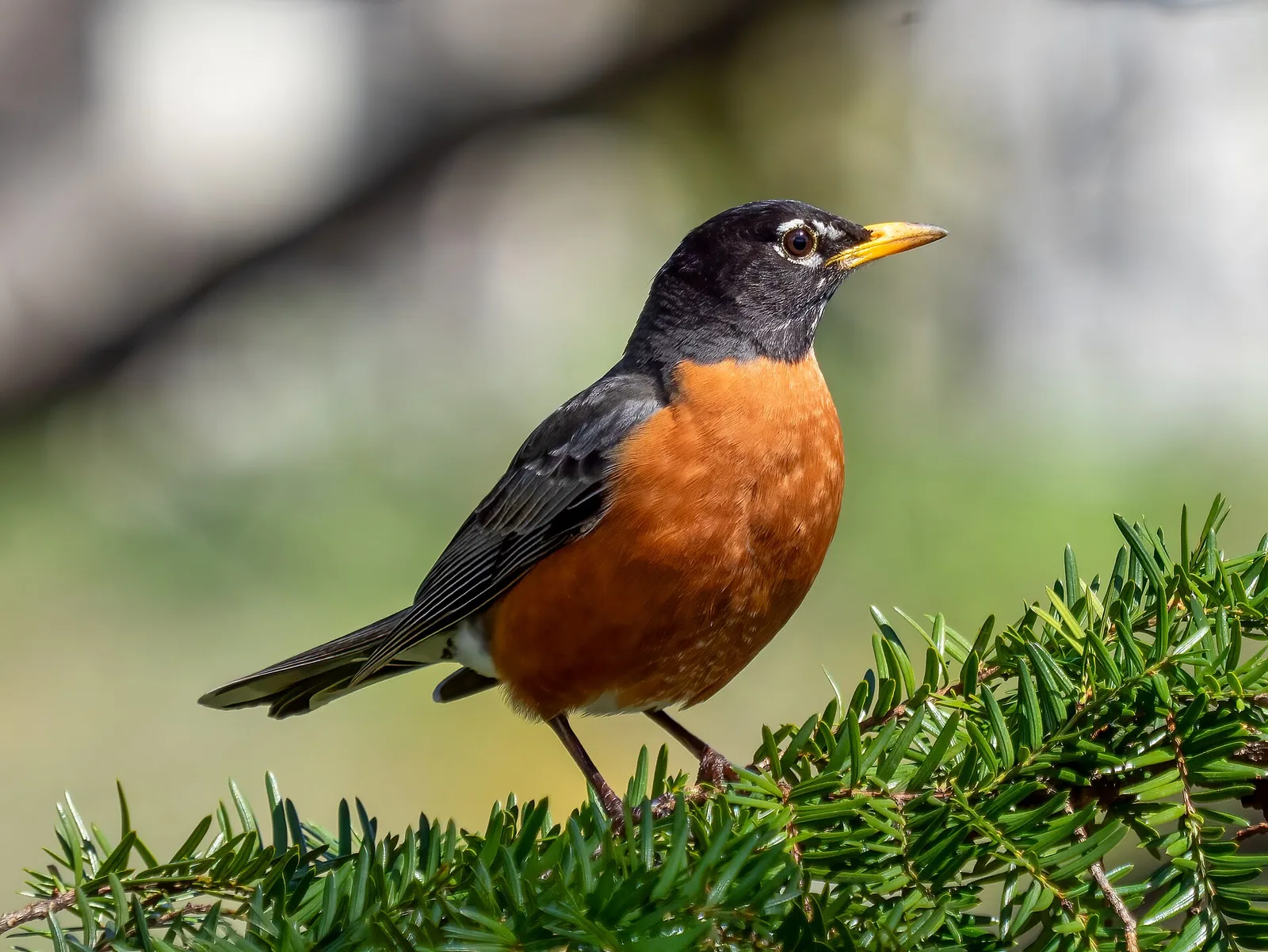
American robin
The lawn thrush that arrives with the thaw
Turdus migratorius
Also called Robin redbreast, Northern robin
Living individuals or members of this group exist today. This does not mean they are safe from extinction.
Meet the american robin
The American robin is a large thrush that feeds on lawns and open ground across North America. It eats worms and insects in spring, switches to fruit for the rest of the year, and is the continent's most numerous land bird.
Images of the american robin
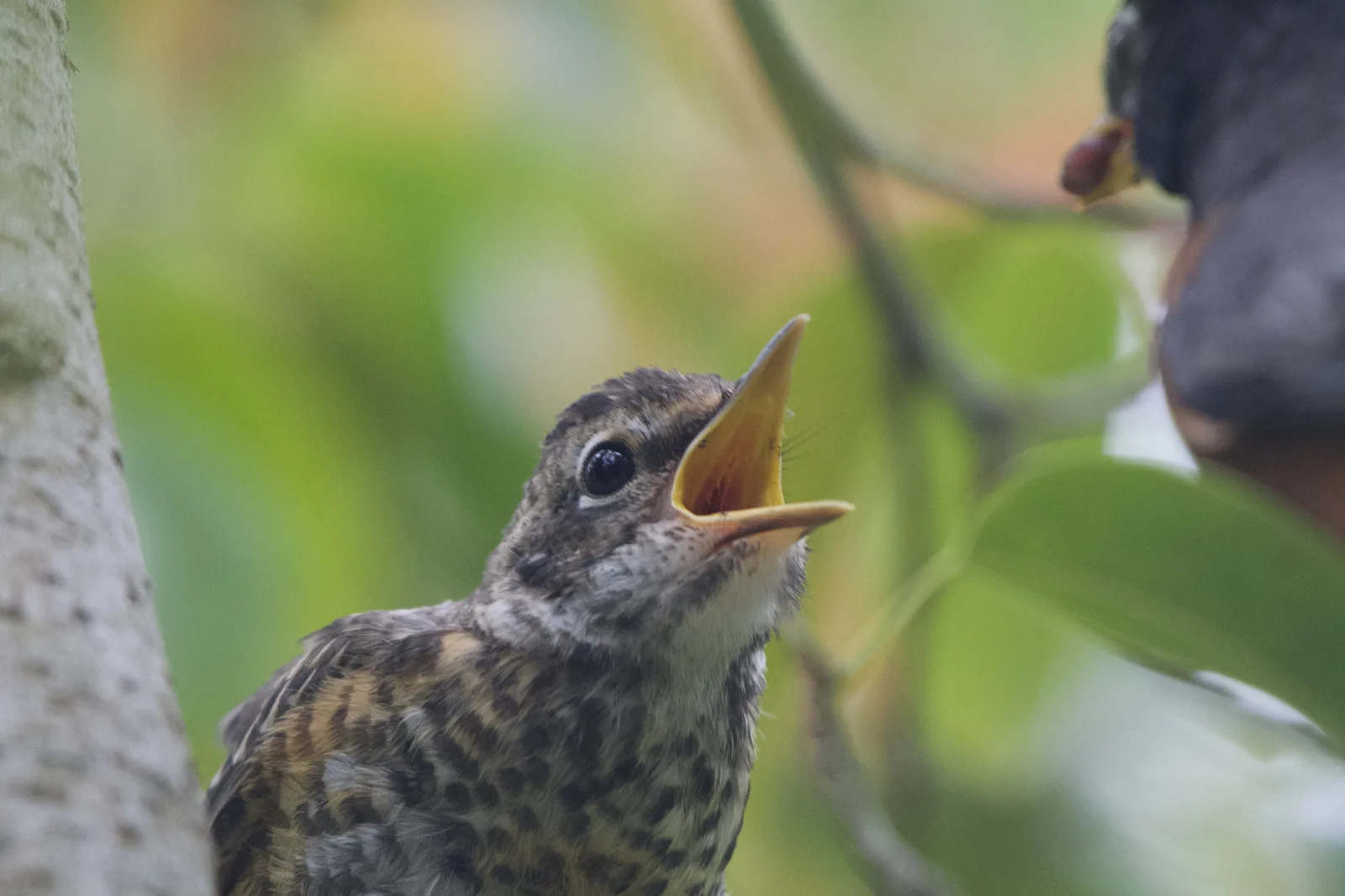
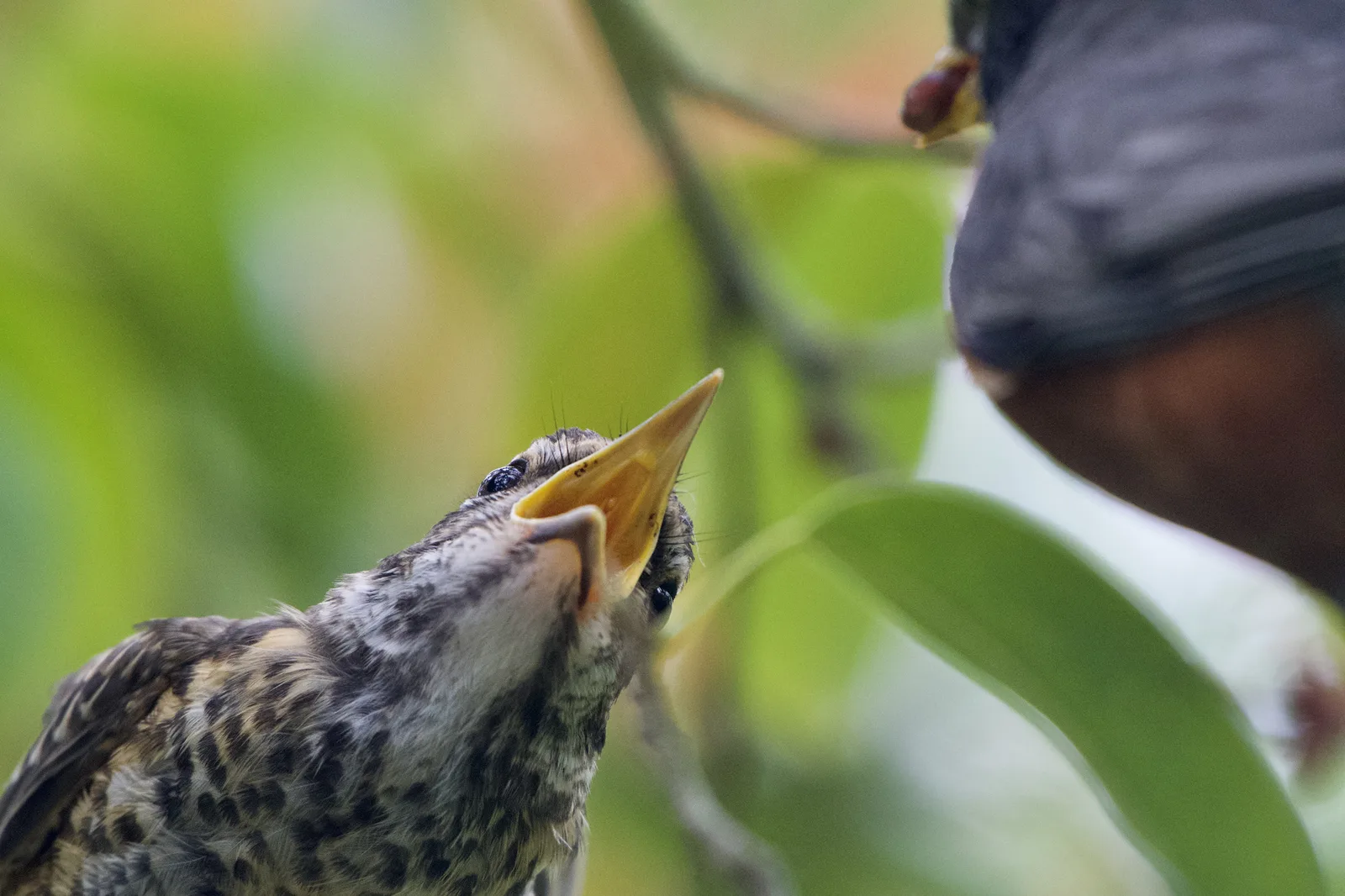
Lifespan in the wild
About 2 years most robins live about two years, and the oldest wild bird on record reached 14
Weight
59 to 94 g
Length
23 to 28 cm
Wingspan
31 to 41 cm
Fact file
American robin
- Location
- North America, from Alaska to central Mexico
- Habitat
- Temperate forest, Grassland, Towns and cities
- Diet
- Omnivore
- Prey / food
- Earthworms, beetle grubs, caterpillars, grasshoppers, berries
- Predators
- Cats, hawks, snakes, squirrels, jays, raccoons
- Lifestyle
- Active by day, and roosting in winter flocks at night
- Group name
- Flock
- Name of young
- Chick
- Incubation
- Incubation about 14 days
- Clutch size
- 3 to 5 eggs
- Population
- About 370 million
- Biggest threat
- Domestic cats, and severe weather from climate change
- Distinctive feature
- A brick-red breast and a yellow bill
- Colour
- Grey-brown above with a reddish-orange breast
- Skin type
- Feathers
Size
Next to a person
Measurements
Size and speed
- Length
- 23 to 28 cm bill to tail
- Wingspan
- 31 to 41 cm
- Weight
- 59 to 94 g males 72 to 94 grams, females 59 to 91 grams, with a species average near 77
- Weight, male
- 72 to 94 g
- Weight, female
- 59 to 91 g
Typical adult ranges. Source: Wikipedia.
Life cycle
Lifespan
- In the wildAbout 2, up to 14 years most robins live about two years, and the oldest wild bird on record reached 14
- 014 years
The pale bar is the record. Source: Wikipedia.
Appearance
Colour and coat
- Primary colours
- grey-brownreddish-orange
- Secondary colours
- whiteblackyellow
- Skin type
- feathers
- Male and female
- Males and females are alike in size and shape. The female is duller, with a browner head and a paler breast. Some individuals cannot be sexed by plumage at all.
Life cycle
Mating and family
- Mating system
- monogamous pairs for one season
- Social structure
- territorial pairs in summer, large flocks in winter
- Breeding
- two or three broods between April and July
The female builds a mud-lined nest and lays three to five pale blue eggs. She incubates the clutch alone for about 14 days. Both parents feed the chicks, which leave the nest about two weeks after hatching. The young beg from their parents for two more weeks before they fly well. Robins can breed at one year old, but only a quarter of them reach that age.
Classification
Taxonomy
- Kingdom
- Animalia
- Phylum
- Chordata
- Class
- Aves
- Order
- Passeriformes
- Family
- Turdidae
- Genus
- Turdus
- Species
- Turdus migratorius
Conservation
Red List status
- LC
- NT
- VU
- EN
- CR
- EW
- EX
Least Concern on the IUCN Red List
Range
Recorded in 3 countries
Habitat layer: temperate broadleaf and mixed forest, temperate conifer forest, boreal forest and taiga, tropical grassland, savanna and shrubland, temperate grassland, savanna and shrubland.
Countries from 336,482 wild records on GBIF (iNaturalist research grade), filtered and checked by hand. Country shapes: Natural Earth. Habitat: RESOLVE Ecoregions 2017, CC BY 4.0. Basemap: Natural Earth.
Habitats
Three things to know
- 1
The female alone builds the nest and lines the cup with mud from her own breast.
- 2
Three states, Connecticut, Michigan and Wisconsin, chose the robin as their bird.
- 3
A pair can raise three broods of chicks in a single summer.
Did you know
Seven more facts
- 1
The American robin is a thrush, and the European robin it was named after is not.
- 2
Robins have lost the enzyme that breaks down table sugar.
- 3
One wild robin lived 14 years, but the average is about 2.
- 4
Only a quarter of young robins live through their first year.
- 5
The birds track the spring thaw north across the continent.
- 6
A robin tagged in Alaska may travel 3.5 times as far each year as one from Massachusetts.
- 7
Robins reject the eggs that brown-headed cowbirds try to leave in their nests.
Field notes
How it looks and acts
Field notes
Distinguishing features
- A brick-red to orange breast on a grey-brown body.
- White crescents above and below the eye.
- A yellow bill with a dark tip that spreads in winter.
- A white throat streaked with black.
- White under the tail, which shows as the bird flies away.
- A run and stop walk across open grass.
Field notes
Unique adaptations
- A gut that copes with fruit lets the robin winter further north than its relatives.
- Hearing sharp enough to place a worm below the surface.
- A mud lining that binds the nest cup and holds its shape.
- Two or three broods a season probably offset the heavy loss of young.
- Tolerance of mown grass and buildings, which turned suburbs into robin country.
Field notes
Interesting behaviours
- Runs a few steps across a lawn, stops, then tilts its head to look for prey.
- Gathers in big winter roosts in swamps and dense cover.
- Mobs jays and snakes instead of fleeing from them.
- Holds and defends a summer territory against other males.
- Attacks its own reflection in glass and chrome.
Field notes
Temperament
- Bold around people, traffic and machinery.
- Aggressive towards other robins through the breeding season.
- Alert while feeding, and quick to copy a neighbour's alarm.
- Sociable in winter, when hundreds share one roost.
Field notes
Communication
- The male sings a carol of repeated short units from a high perch.
- Listeners render the song as cheerily, cheer up, cheer up.
- Separate calls mark a ground predator and a threat to the nest.
- Nestlings chirp to beg for food within days of hatching.
- Neighbours call together to drive a predator out of the area.
Ecology
Ecological role
The robin is both a heavy consumer of soil animals and a bulk food supply for predators.
- It takes large numbers of beetles, caterpillars and earthworms through the breeding season.
- It swallows berries whole and drops the seeds elsewhere, which spreads fruiting plants.
- Its sheer numbers make it a staple prey item for hawks, snakes and nest raiders.
- It holds West Nile virus long enough to pass the infection back to mosquitoes.
Stories
Myths and legends
- In one Native American story, the robin reddened its breast by fanning a dying campfire to save two people.
- In Tlingit tradition, Raven created the robin so that its song would give people pleasure.
- In Quebec folklore, the person who sees the first robin of spring wins good luck.
- In British tradition the red breast belongs to a different bird, the European robin of the flycatcher family.
- In American popular culture, the robin's return is the accepted sign that winter has ended.
People
Relationship with humans
People
Living alongside us
The American robin lives alongside people right across its range. Lawns, parks and garden shrubs give it both food and nest sites. Gardeners welcome the bird for the insects it takes, while fruit growers treat it as a pest. Federal law protects the species throughout the United States.
- The robin has no weapon that can injure a person.
- A parent may dive at a cat or a person who stands too close to the nest.
- The species carries West Nile virus, which reaches people through mosquitoes.
People
Status, uses and products
- Domestication
- Wild
- As a pet
- Not suitable. Keeping an American robin is illegal in the United States. The bird also needs live prey and open ground to hunt on.
- Uses
- birdwatchinggarden insect control
- Products
- None recorded
The full account
About the american robin
The American robin, Turdus migratorius, is a large thrush of gardens, parks and woodland edges across North America. Settlers named it after the European robin, a smaller bird from another family, because both have a red front. Adults measure 23 to 28 centimetres from bill to tail. A robin weighs about 77 grams, and the heaviest males reach 94 g.
Few birds are easier to watch. The robin feeds on open ground, runs a few steps, stops, then tilts its head to look for a worm. It takes worms and insects in spring and turns to fruit for the rest of the year. The species is the most numerous land bird in North America, at about 370 million individuals. The IUCN lists it as Least Concern, and its numbers look stable.
Name and taxonomy
Carl Linnaeus described this bird in 1766, in the twelfth edition of Systema Naturae. The scientific name joins the Latin word for a thrush with a verb meaning to move house. English speakers have used the word robin for the bird since at least 1703. The European robin sits in the Old World flycatcher family, so the shared name records a shared colour and nothing more. The American bird is a true thrush of the genus Turdus, in the family Turdidae.
Seven subspecies are accepted. Six of them blend into one another where their ranges meet, so the borders between them are vague. Only the bird of southern Baja California stands clearly apart. That form, T. m. confinis, is small, pale and does not migrate. It breeds above 1,000 metres in the Sierra de la Laguna. Two major bird checklists still treat it as a subspecies rather than a species.
Evolution and relatives
Genetic work published in 2020 placed the rufous-collared thrush of Central America as the closest relative. A study from 2007 had reached the same answer. Work published in 2026 went further, and suggested the rufous-collared thrush sits inside the American robin's own family tree. The same work found the Baja California population to be the oldest branch of the group. That population may deserve the rank of a full species.
Beyond that trio, the nearest relatives are other Central American thrushes. The black thrush and the sooty thrush are the next pair out. The pattern points to a recent spread northwards from Central America into the rest of the continent. Two older studies of a single mitochondrial gene had pointed instead to African thrushes. Support for that result was weak, and the newer work overturned it.
Appearance
An adult robin has a grey-brown back, a dark head, and a breast that runs from deep brick red to soft orange. A white throat carries black streaks, and the belly and lower tail are white. A white arc sits above and below each eye. The bill is yellow with a dark tip that spreads across it in winter. Legs and feet are brown.
The wingspan measures 31 to 41 centimetres. Males weigh 72 to 94 grams, and females weigh 59 to 91 g. The sexes look alike in shape, but the female is duller, with more brown on the head and a paler front. Plumage alone cannot sex every bird. A young robin is paler again, with heavy dark spots on the breast and whitish edges to the wing coverts. A male in his first year often looks like an adult female.
Habitat and range
The robin breeds from Alaska and northern Canada south to northern Florida and into Mexico. It nests in woodland, orchards, farmland, parks and gardens. The bird needs short grass or bare soil to feed on and a dense shrub or tree to nest in. Suburbs supply both, so robins are common wherever people keep lawns. In the far south of the United States it becomes scarcer, and there it favours big shade trees.
Most birds leave the north by the end of August. They come back in February and March, and the date shifts with latitude and weather. Robins move north with the 3 degree Celsius spring isotherm, which is why they arrive with the thaw. Winter flocks spread across the southern states, central Mexico and the Pacific seaboard. Some birds stay north through the winter wherever fruit lasts. One study found that robins tagged in Alaska travelled up to 3.5 times as far between seasons as birds from Massachusetts.
The species reaches western Europe as a rare vagrant. Britain had logged 30 records by the end of 2024. Stray birds have also turned up in Greenland, Sweden, Jamaica, Puerto Rico and Belize. The birds that reach Greenland include the Newfoundland subspecies.
Diet and feeding
About 40 percent of the robin's food is small invertebrates, and about 60 percent is fruit. Earthworms, beetle grubs, caterpillars and grasshoppers make up most of the animal share. Wild and cultivated berries make up the rest. The ability to live on fruit lets robins winter much further north than other thrushes of the continent. Robins have lost the enzyme that splits table sugar, so sucrose tastes wrong to them. Growers use that fact, and spray sugar to keep the birds off a crop.
A robin hunts on the ground, and vision leads the search. It runs, halts, and cocks its head to one side to catch any movement. Tests show that a robin can also place a worm underground by sound alone. Once it finds a worm it pounces and pulls the animal out of the soil. Parents feed nestlings on earthworms and other soft-bodied prey. Birds that gorge on fermented berries lose their balance and topple over as they walk.
Behaviour and social life
The robin is active by day. In winter it roosts at night in large flocks, often in a swamp or a block of thick cover. Those roosts break up at dawn, and the birds feed on fruit in smaller parties. In summer the pattern reverses. Each male holds a breeding territory and drives rival males off it.
Young robins stay near the nest site for their first four months. They then join flocks of mixed ages before the move south. Almost every population migrates. A feeding robin watches its neighbours, and reads their alarm as its own. The bird will mob a jay or a snake rather than hide from it. Males also attack their own reflection in glass and polished metal.
Communication and senses
The male sings a long carol of short units, repeated and strung together with brief gaps. Listeners write the phrase as cheerily, cheer up, cheer up. He sings from a high perch, and the style changes with the region and the hour. The song season runs from late February to late July. Some eastern birds carry on into September or beyond. Robins open the dawn chorus, often hours before any light shows.
The Baja California subspecies has a thinner song, without clear notes. Besides the song, the robin has calls that carry specific news. One call marks a predator on the ground, and another marks a threat to the nest. Nestlings chirp to beg within days of hatching. Rival neighbours will drop their quarrel and band together to drive a predator away. Sight leads the hunt for food, but hearing, smell and probably touch all play a part.
Reproduction and life cycle
Breeding starts soon after the birds reach the summer range, and it runs from April to July. It is among the earliest egg layers of any bird on the continent. A pair raises two or three broods in a season. The male and female stay together through the summer and share the work.
The female builds the nest alone. She weaves an outer cup of coarse grass, twigs, paper and feathers. She then works mud into the inside with her breast and lines it with fine grass. Most nests sit 1.5 to 4.5 metres up, in a thick bush or a fork between branches. A window ledge or a porch beam will serve just as well. The pair builds a fresh nest for every brood.
A clutch holds three to five pale blue eggs. The female incubates them for about 14 days. The chicks hatch naked, with their eyes shut for the first days. Parents carry the waste away, so the nest stays clean. The brood leaves the nest about two weeks after hatching, and all the chicks go within two days of each other. Fledglings follow their parents and beg for two more weeks before they fly well.
Predators and threats
The domestic cat is the adult robin's main predator. Accipiter hawks and large snakes such as rat snakes and gopher snakes also take adults. Twenty-eight species of bird of prey hunt this one thrush. Martens, ringtails and long-tailed weasels catch adults on the ground. An adult is most exposed while it is busy with a nest.
Squirrels, snakes, jays, grackles, crows and ravens rob the nests. Raccoons raid nests too, and foxes and dogs pick up fledglings from the ground. Brown-headed cowbirds try to lay in robin nests, but the robin usually throws the egg out. A cowbird chick rarely survives to leave a robin nest. Internal parasites are common, and one study of 105 young robins found 77.1 percent carried them. The robin also acts as a reservoir for West Nile virus.
Population and conservation
The IUCN lists the American robin as Least Concern. The population stands at about 370 million birds, the highest count for any land bird on the continent. The range covers about 16 million square kilometres. The trend appears steady, and the species is nowhere near the thresholds for a higher category. The western subspecies is spreading in central California, and probably in other parts of the United States.
Climate change and severe weather are the listed threats. NatureServe rates the robin as secure in every Canadian province and territory that assesses it. People once shot robins for the table in some southern states. Federal law now protects the species across the United States. Volunteers have logged 468,239 sightings on iNaturalist. The bird is recorded in 30 countries on GBIF.
Relationship with humans
The robin lives close to people and profits from it. Mown grass, sprinklers and garden shrubs supply food and nest sites. The bird will nest on a porch or a window ledge without much fuss. Gardeners value robins for the beetles and grubs they take from a bed. Fruit growers hold the opposite view, because flocks strip a berry crop.
Males peck at windows, windscreens and hubcaps when they see a rival in the reflection. The robin is harmless to people. The one health link runs the other way, through West Nile virus in mosquitoes. Like other wild thrushes, it needs live prey and open ground, so it does not suit a cage. Keeping one is illegal in the United States in any case.
In culture and myth
Connecticut, Michigan and Wisconsin all name the robin as their state bird. Canada put it on the two dollar note of the 1986 Birds of Canada series. A Native American story tells how the bird gained its red breast. In that story it fanned a dying campfire back to life and saved a man and a boy. The Tlingit of the northwest coast held that Raven made the robin so its song would please people.
In Quebec, a superstition promises good luck to whoever sees the first robin of spring. William Henry Drummond built a poem on that belief. Emily Dickinson wrote about dreading the year's first robin. Harry M. Woods wrote a popular song about a red robin bobbing along. A cartoon strip from 1990 used the same idea for a joke about spring.
The paint and crayon colour robin egg blue takes its name from the eggs. A study of 209 psychology students found the robin was their model of what a bird is. A family of robins nested on the Canadian end of the Peace Bridge and drew press attention in the 1930s.
A sentence with a dotted underline is inferred: it describes the group the animal belongs to, or is a reading of the sources, rather than a measured or reported fact about this species.
Questions
American robin questions, answered
What does an American robin eat?
About 40 percent of its food is invertebrates such as earthworms, grubs and caterpillars. The other 60 percent is fruit and berries.
How big is an American robin?
Adults are 23 to 28 centimetres long. The wingspan is 31 to 41 cm, and the weight is about 77 grams.
How long do American robins live?
Most live about 2 years. The oldest wild bird on record reached 14 years.
Are American robins endangered?
No. The IUCN lists them as Least Concern, and the world population is about 370 million.
Do American robins migrate?
Almost every population does. Most birds leave the north by late August and return in February and March.
Why are robin eggs blue?
The eggs are a pale blue that gave the colour robin egg blue its name. The shade is thought to come from pigment laid into the shell.
How many eggs does an American robin lay?
A clutch holds three to five eggs. Two or three broods follow in one summer.
How long do robin eggs take to hatch?
The female sits on the clutch alone. The eggs hatch after about 14 days.
Can American robins hear worms underground?
Yes. Experiments show that a robin can place a worm by sound, although it usually hunts by sight.
Why do robins run and stop on lawns?
The robin hunts by eye on open ground. It stops so that its head is still, then watches for movement.
Is the American robin related to the European robin?
No. The American bird is a true thrush, and the European robin belongs to the Old World flycatcher family.
Where do American robins nest?
The female builds a mud-lined cup 1.5 to 4.5 metres above the ground. Bushes, tree forks and building ledges all serve.
What eats American robins?
Domestic cats take the most adults near houses. Hawks, snakes, squirrels, jays and raccoons take adults, eggs and chicks.
Why does a robin attack my window?
A male reads his own reflection as a rival. He pecks at the glass to drive the other bird away.
Are American robins a sign of spring?
Many people treat them that way. The birds move north with the 3 degree Celsius spring isotherm, so they arrive with the thaw.
Can I keep an American robin as a pet?
No. The Migratory Bird Treaty Act makes it illegal in the United States.
Food web
Prey and food
- earthworms
- beetle grubs
- caterpillars
- grasshoppers
- berries
Food web
Predators
- cats
- hawks
- snakes
- squirrels
- jays
 Raccoon
Ecological equivalents
Related species on this site
Common blackbird (same genus), Song Thrush (same genus), Eastern Bluebird (same family), Mountain Bluebird (same family), Thrush (same family), Veery (same family), and more.
 LC
Birds
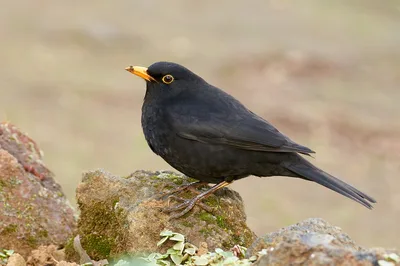
Common blackbird
Turdus merula
The common blackbird is a true thrush of Europe, North Africa and western Asia, and the male is glossy black with a yellow eye-ring.
Living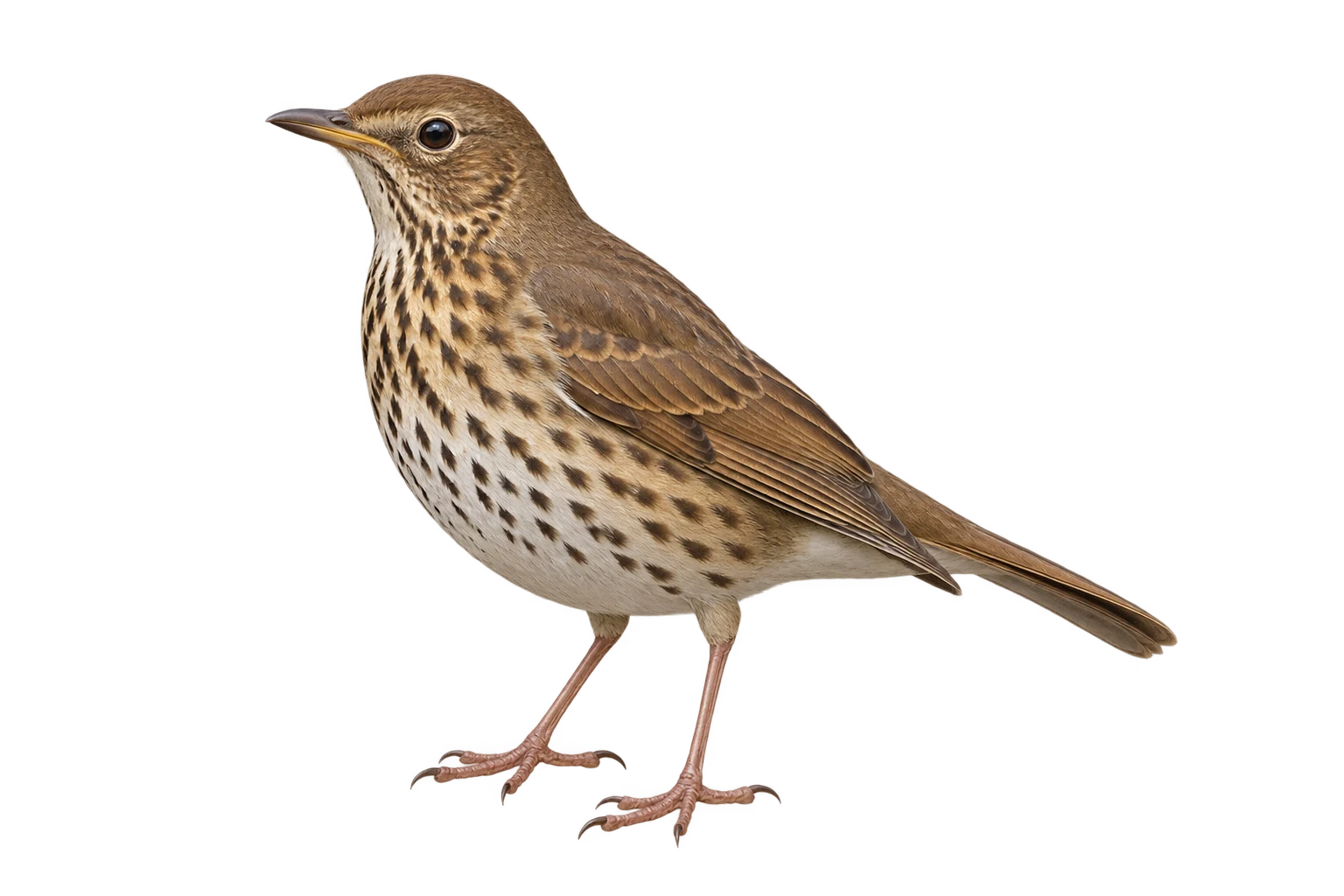
Birds
Song Thrush
Turdus philomelos
Classification and source reference
LivingAI illustration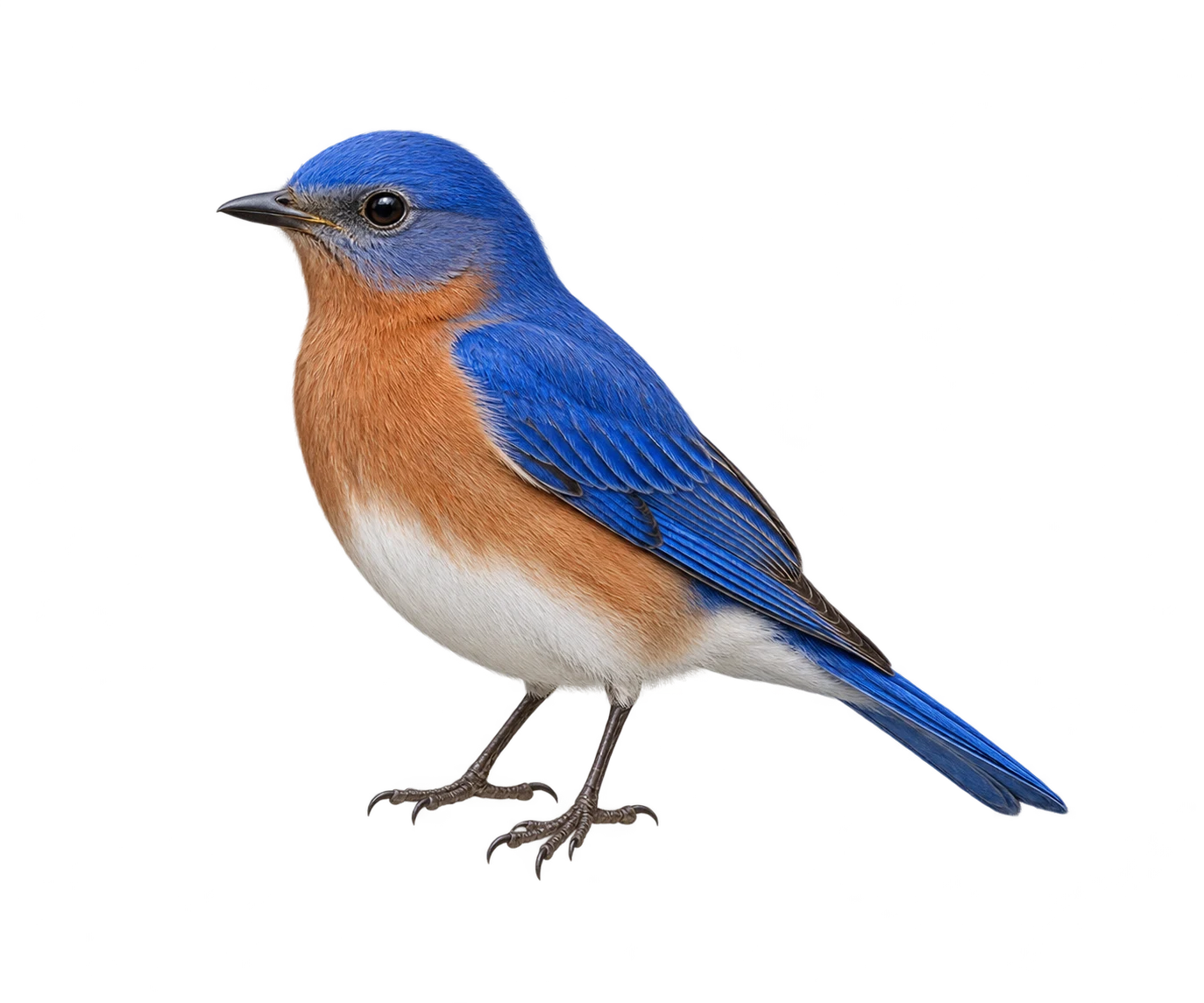
Birds
Eastern Bluebird
Sialia sialis
Classification and source reference
LivingAI illustration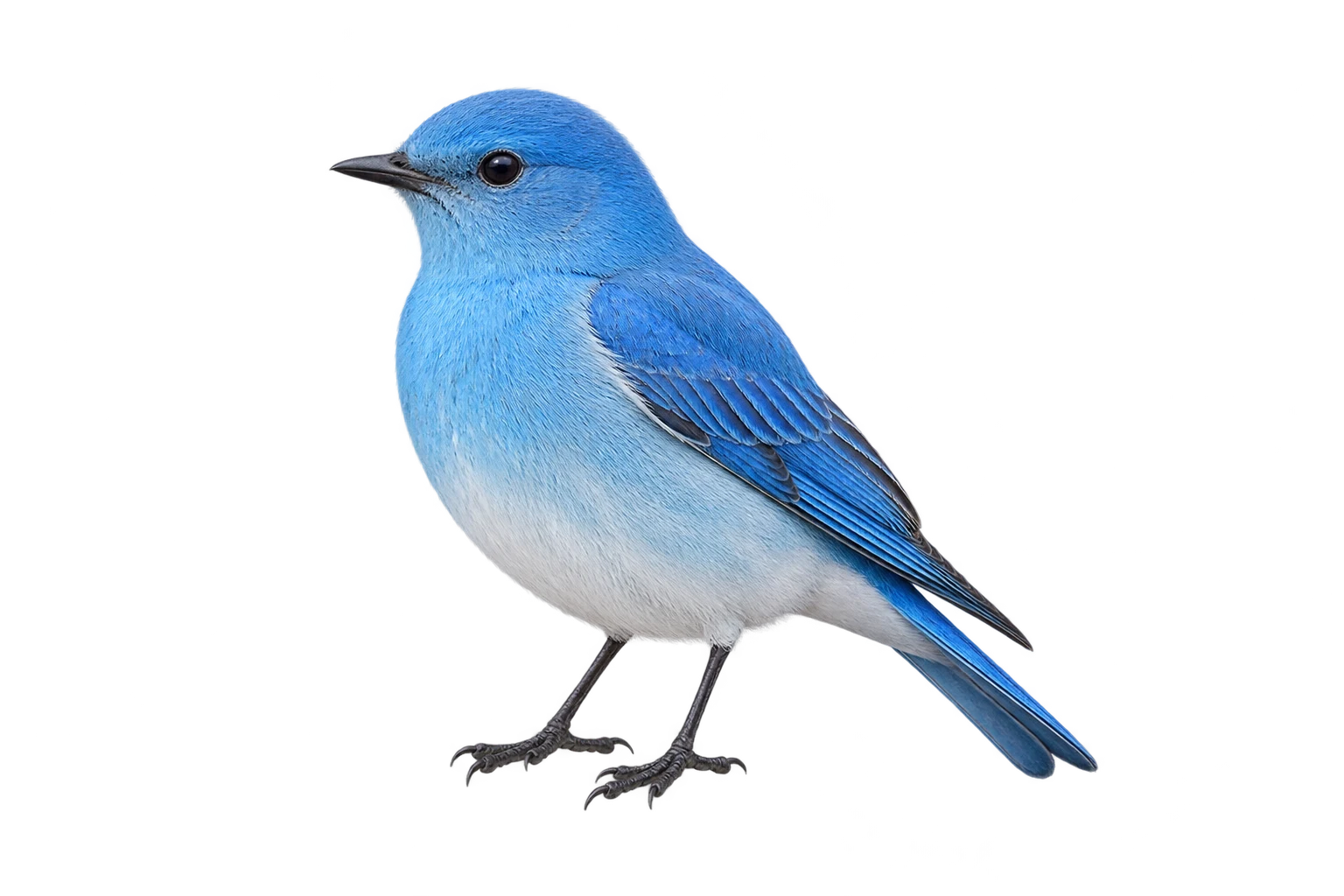
Birds
Mountain Bluebird
Sialia currucoides
Classification and source reference
LivingAI illustration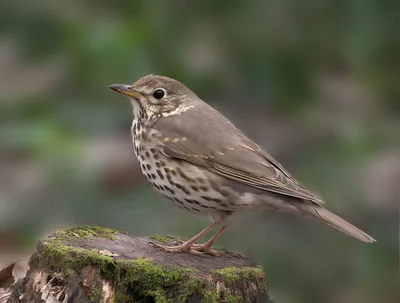
Birds
Thrush
Turdidae
Thrushes include many spotted and unspotted songbirds.
Living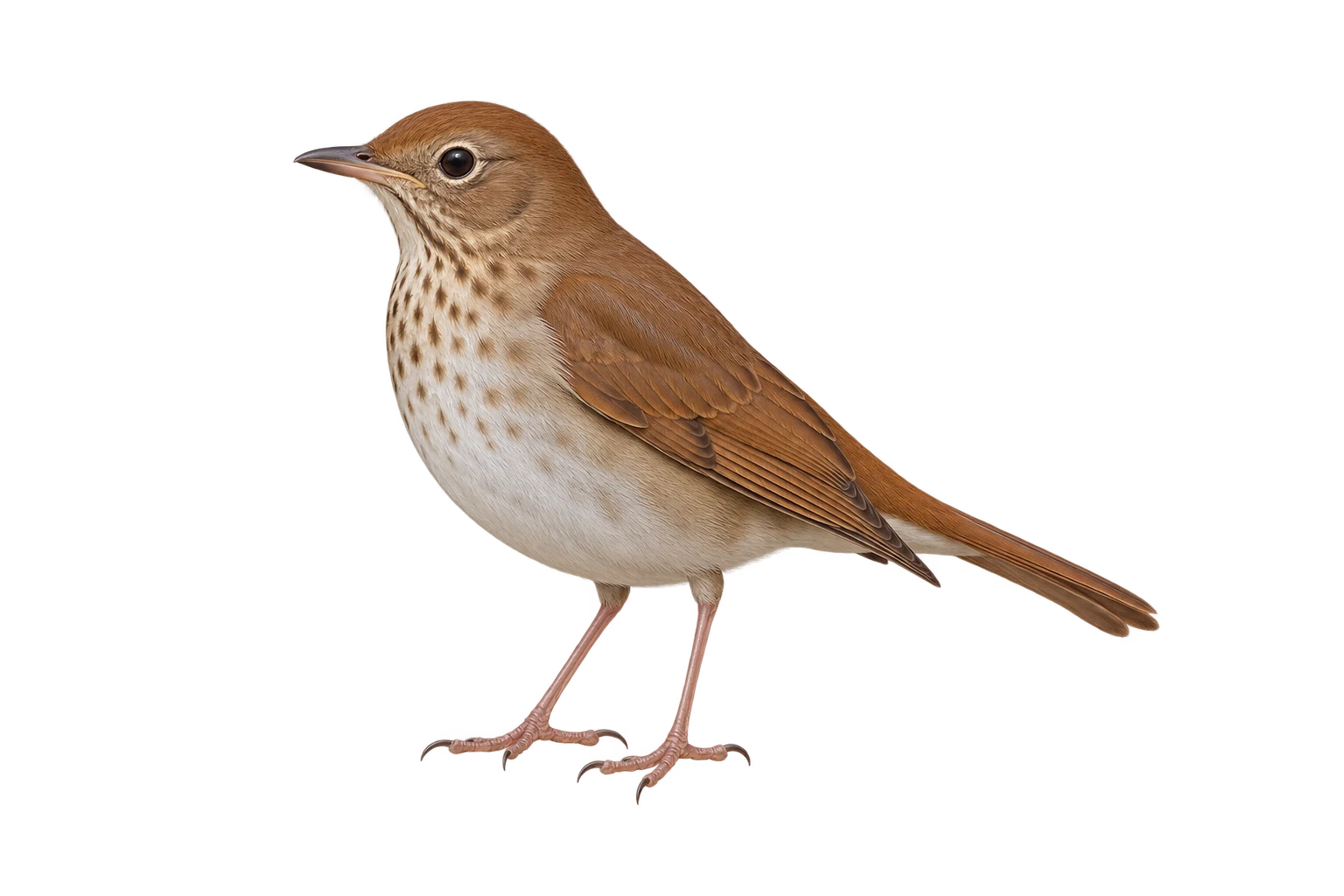
Birds
Veery
Catharus fuscescens
Classification and source reference
LivingAI illustration