Ruby-throated hummingbird
A three-gram bird that crosses the Gulf of Mexico non-stop
Archilochus colubris
Living individuals or members of this group exist today. This does not mean they are safe from extinction.
Meet the ruby-throated hummingbird
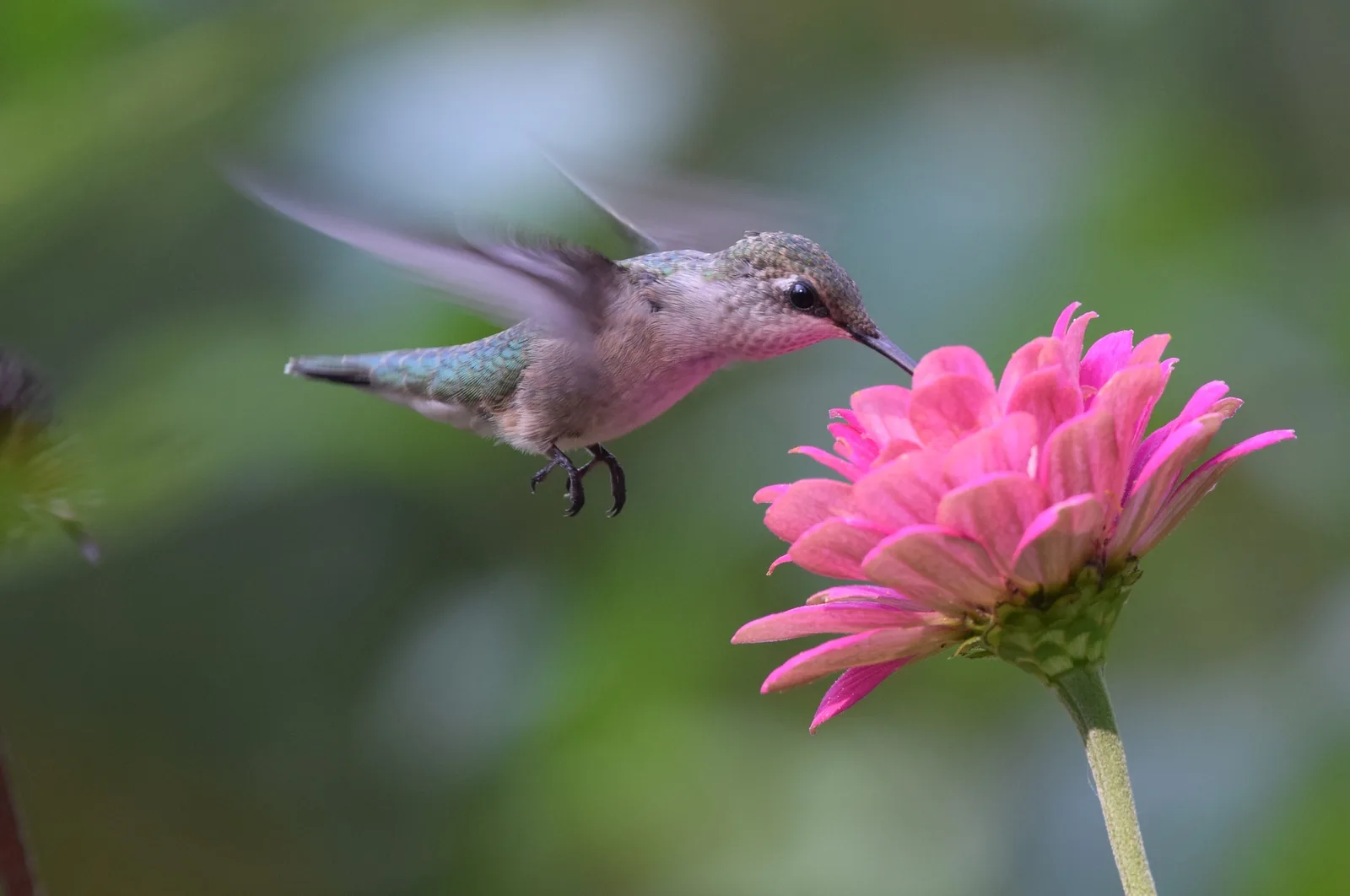
The ruby-throated hummingbird is the only hummingbird that breeds in eastern North America. It hovers at flowers, then crosses the Gulf of Mexico non-stop each autumn.
Images of the ruby-throated hummingbird
Lifespan in the wild
5 to 9.1 years
Weight
2 to 6 g
Length
7 to 9 cm
Wingspan
8 to 11 cm
Fact file
Ruby-throated hummingbird
- Location
- Eastern North America; winters in Central America
- Habitat
- Temperate forest, Towns and cities, Grassland
- Diet
- Nectarivore
- Prey / food
- Nectar, small insects, spiders
- Predators
- Hawks, large praying mantises, spiders
- Lifestyle
- Diurnal
- Name of young
- Chick
- Incubation
- About 14 days of incubation
- Clutch size
- 2 eggs
- Biggest threat
- Habitat loss and window collisions
- Distinctive feature
- An iridescent red throat on the male
- Colour
- Emerald green above; red throat on the male
- Skin type
- Feathers
Size
Next to a person
Measurements
Size and speed
- Length
- 7 to 9 cm
- Wingspan
- 8 to 11 cm
- Weight
- 2 to 6 g
Typical adult ranges. Source: Wikipedia.
Life cycle
Lifespan
- In the wild5 to 9.1 years
- 09.1 years
Source: Animal Diversity Web.
Appearance
Colour and coat
- Primary colours
- greenwhite
- Secondary colours
- redblack
- Skin type
- feathers
- Male and female
- Marked. The male has a ruby red throat and a forked black tail. The female has a white throat, a notched white-tipped tail and is slightly larger.
Life cycle
Mating and family
- Mating system
- polygynous, with no pair bond
- Social structure
- solitary and territorial
- Breeding
- one to three broods of two eggs each summer
Males arrive first and court each female with dives and a shuttle flight. After mating the female builds a walnut-sized nest alone and lays two white eggs. She incubates them for 10 to 14 days and feeds the chicks on insects until they fly at 18 to 22 days. She may raise up to three broods. A wild bird lives 5 to 9.1 years at most.
Classification
Taxonomy
- Kingdom
- Animalia
- Phylum
- Chordata
- Class
- Aves
- Order
- Apodiformes
- Family
- Trochilidae
- Genus
- Archilochus
- Species
- Archilochus colubris
Conservation
Red List status
- LC
- NT
- VU
- EN
- CR
- EW
- EX
Least Concern on the IUCN Red List
Range
Recorded in 10 countries
- Belize
- Canada
- Costa Rica
- Guatemala
- Honduras
- Mexico
- Nicaragua
- Panama
- El Salvador
- United States of America
Habitat layer: temperate broadleaf and mixed forest, temperate conifer forest, boreal forest and taiga, tropical grassland, savanna and shrubland, temperate grassland, savanna and shrubland.
Countries from 61,207 wild records on GBIF (iNaturalist research grade), filtered and checked by hand. Country shapes: Natural Earth. Habitat: RESOLVE Ecoregions 2017, CC BY 4.0. Basemap: Natural Earth.
Habitats
Three things to know
- 1
The wings beat about 53 times a second.
- 2
The heart can beat over 1,200 times a minute.
- 3
The nest is about the size of a walnut and held together with spider silk.
Did you know
Seven more facts
- 1
The species name colubris is just the Spanish word for hummingbird.
- 2
The nest is the size of a walnut and held together with spider silk.
- 3
The male's red throat looks black from most angles.
- 4
The legs are so short that the bird can only shuffle along a branch.
- 5
It sees ultraviolet light down to 370 nanometres.
- 6
Some nests have been built on a chain, a wire or even an extension cord.
- 7
iNaturalist holds 97,721 observations, and GBIF has records from 23 countries.
Field notes
How it looks and acts
Field notes
Distinguishing features
- A body only 7 to 9 centimetres long.
- Metallic green upperparts and a greyish white belly.
- A ruby red gorget on the male, edged with velvet black.
- A forked tail in the male and a white-tipped notched tail in the female.
- A slender straight bill up to 2 cm long.
Field notes
Unique adaptations
- A shoulder joint that turns the wing almost 180 degrees for hovering.
- Flight muscles that make up 25 to 30% of body weight.
- A long extendable tongue that reaches nectar deep in a flower.
- Night torpor that cuts energy use in the cold.
- Fat storage that doubles body mass before the Gulf crossing.
Field notes
Interesting behaviours
- Hovers at a flower and drinks nectar through an extended tongue.
- Chases every other hummingbird out of its feeding patch.
- Drops into torpor on a cold night.
- Crosses the Gulf of Mexico non-stop each spring and autumn.
- Repairs and reuses an old nest for several seasons.
Field notes
Temperament
- Solitary, and tolerant of others only for a few minutes of courtship.
- Aggressive toward other hummingbirds at any age.
- Probably bold around people at feeders.
Field notes
Communication
- Rapid squeaky chips as a threat.
- A mew call from a receptive female.
- A tik-tik wing sound in the shuttle display.
- A tail whine in the dive display.
Ecology
Ecological role
The ruby-throated hummingbird is the main bird pollinator of eastern North America, and some plants depend on it.
- Pollinates trumpet creeper, cardinal flower, jewelweed and many other tubular flowers.
- Eats gnats, mosquitoes, fruit flies and small spiders.
- Feeds small hawks, shrikes, cats and even praying mantises.
- Gives way to other hummingbird species where their ranges overlap.
Stories
Myths and legends
- In Aztec tradition, the war god Huitzilopochtli was a hummingbird.
- In Mesoamerican tradition, hummingbirds carried the souls of warriors killed in battle.
- In modern popular symbolism, the hummingbird is thought to stand for joy and love.
People
Relationship with humans
People
Living alongside us
People across eastern North America feed this bird in their gardens and plant flowers to draw it. It pollinates crops and native plants and harms nothing. Collectors once shot it for its skin, and today windows, cats and cleared forest are the main dangers. It is protected by treaty and by CITES.
- The bird has no known harmful effect on people.
- A male may buzz a person who stands near his feeder, but he cannot hurt anyone.
- Its bill is a nectar probe and probably could not injure a person.
People
Status, uses and products
- Domestication
- Wild
- As a pet
- Not suitable. A hummingbird needs nectar every few minutes, live insects and room to fly. It is protected under the Migratory Bird Treaty, so keeping one is illegal in the United States and Canada. Hang a feeder instead.
- Uses
- pollinationgarden birdwatching
- Products
- None recorded
The full account
About the ruby-throated hummingbird
The ruby-throated hummingbird, Archilochus colubris, is the only hummingbird that breeds in eastern North America. It measures 7 to 9 centimetres long, spans 8 to 11 cm across the wings and weighs 2 to 6 grams. The back is metallic green, the underside greyish white, and the male wears a throat patch of iridescent red. It hovers at flowers, flies backwards and beats its wings dozens of times a second. It is the most common hummingbird east of the Mississippi, with about 35 million birds counted in 2021.
The bird lives on nectar and on the small insects and spiders it catches on the wing or picks from leaves. Adults are solitary and meet only to mate, and the female alone builds the nest and raises the young. Each autumn many of these birds cross the Gulf of Mexico without a stop, a flight of about 800 kilometres. To manage it they double their fat before they leave. The IUCN lists the species as Least Concern, though the 2021 census found numbers down by 17%.
Name and taxonomy
Carl Linnaeus named the bird Trochilus colubris in 1758, in the tenth edition of Systema Naturae. He worked from two earlier accounts: Mark Catesby's natural history of Carolina from 1729 and George Edwards's book of uncommon birds from 1743. The type locality is South Carolina. The species name colubris comes from the Spanish word colibri, which simply means hummingbird.
Ludwig Reichenbach, a German naturalist, created the genus Archilochus in 1854, and the species now sits there. It belongs to the family Trochilidae, the hummingbirds, in the order Apodiformes alongside the swifts. No subspecies are recognised. In French it is the colibri a gorge rubis and in German the Rubinkehlkolibri, and both names mean the same as the English one.
Evolution and relatives
Hummingbirds and swifts share an order, and both groups have short upper arm bones and long hands built for fast wingbeats. Within the hummingbirds, Wikidata places Archilochus in the subfamily Trochilinae, which holds most of the North American species. The closest relative is probably the black-chinned hummingbird of the west, the only other member of the genus. Like other hummingbirds, the species probably evolved its hovering flight alongside the tubular flowers it pollinates.
The wing joins the body only at the shoulder, so it can rotate almost 180 degrees. That joint and flight muscles of 25 to 30% of body weight give lift on both the downstroke and the upstroke. The split is about 75% on the downstroke and 25% on the upstroke, much as in an insect. No other group of birds flies this way.
Appearance
The bird is 7 to 9 centimetres long with a wingspan of 8 to 11 cm. It weighs 2 to 6 grams, and a male averages about 3.4 g against 3.8 g for the slightly larger female. The bill is long, straight and slender, up to 2 cm. The legs are so short that the bird can only shuffle along a perch. Three toes point forward and one back, and their ridged inner surfaces grip a flower stem.
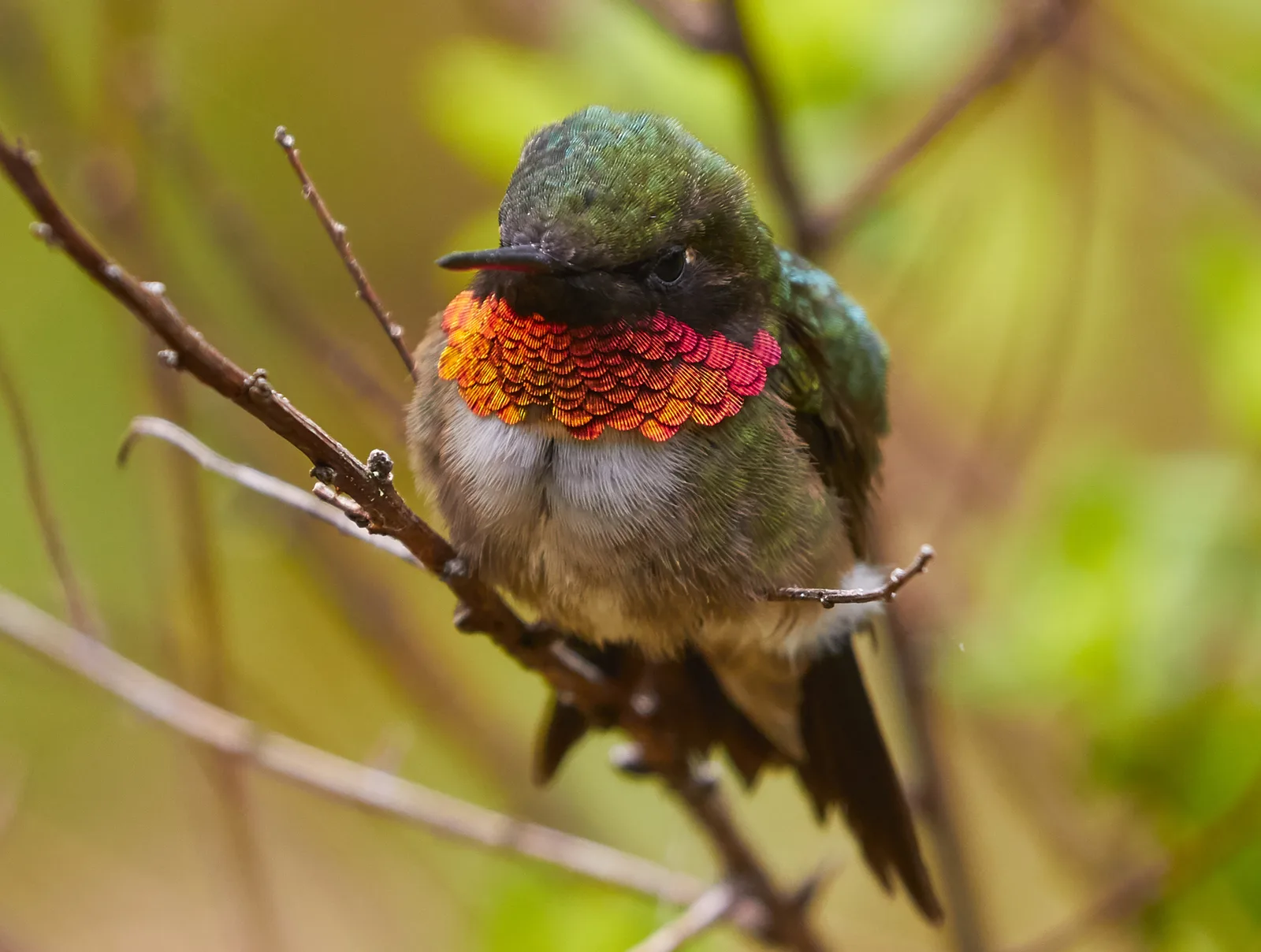
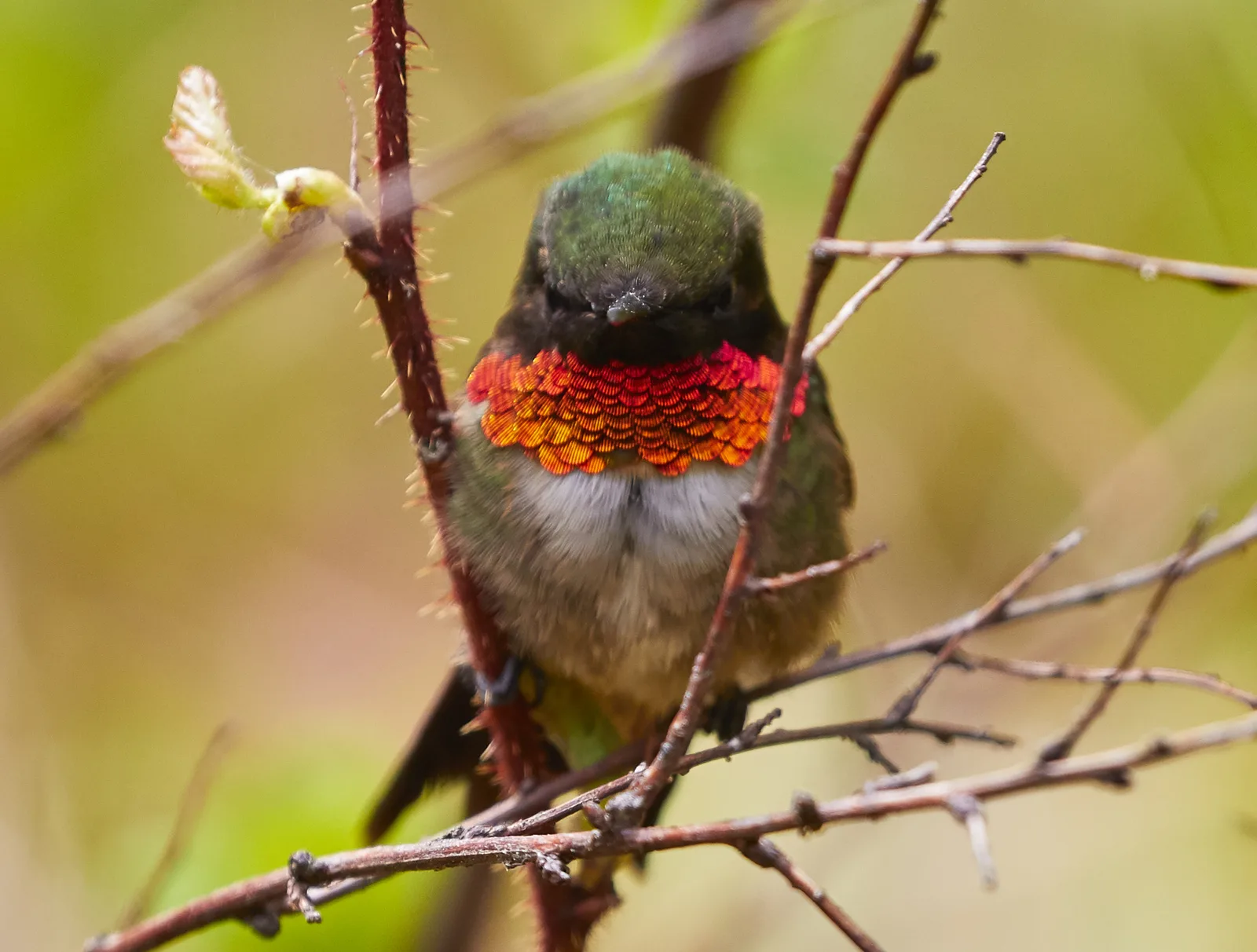
Both sexes are metallic green above with near-black wings and a greyish white underside. The adult male has a gorget of ruby red edged in velvet black, and his forked black tail carries a faint violet gloss. The red shows only from certain angles and looks dull black from the rest. The female has a white throat, sometimes with faint dusky streaks, and a notched tail with outer feathers banded green, black and white. A young male looks like a female with heavier throat marks and may carry a few red feathers.
The plumage is moulted once a year on the wintering grounds, from early autumn to late winter.
Habitat and range
The breeding range takes in the United States from the 100th meridian eastward, and southern Canada, especially Ontario. It is the largest breeding range of any hummingbird in the United States. The birds nest in deciduous and pine forest, along forest edges, and in orchards and gardens. Feeders and flower beds have made the species a familiar garden bird across the east. West of the plains, other hummingbirds probably take over, which is why this one is the only breeder in the east.
In winter the birds move to Florida, southern Mexico, Central America as far as western Panama, and the West Indies. There they use tropical dry forest, citrus groves, hedgerows, river edges, marshes and old fields. Many cross the Gulf of Mexico in one flight of about 800 kilometres and 20 hours, with no food or water on the way. The spring return is timed so that the birds arrive as their food plants come into flower. A round trip can reach 1,600 km.
GBIF holds records from 23 countries, and iNaturalist has 97,721 observations, most of them from gardens and feeders. British Columbia and Newfoundland list the bird as rare at the edges of its range.
Diet and feeding
Nectar is the main fuel, and small insects and spiders supply protein, minerals and vitamins. The bird prefers red, orange and bright pink tubular flowers, such as trumpet creeper, cardinal flower, jewelweed and coral honeysuckle. It also visits flowers that were never built for hummingbirds, such as willow catkins. When nectar is scarce it drinks sap from the holes that sapsuckers drill in trees. A flower that the bird visits often is probably built for it, with a long tube, little scent and no place to land.
The bird hovers in front of a flower and reaches in with a long tongue that extends far beyond the bill. It may visit up to about 1,000 flowers a day and eats about twice its own weight in food each day. It catches gnats, mosquitoes, fruit flies and small bees in the air and picks spiders and insects from leaves, bark and webs. Nestlings are fed mostly insects, because nectar alone would not let them grow.
The metabolism behind all this is among the highest of any animal. The heart can beat up to 1,260 times a minute, and the bird takes about 250 breaths a minute even at rest. In flight, each gram of muscle uses about ten times the oxygen of an elite human athlete's.
Behaviour and social life
The ruby-throated hummingbird is active by day and lives alone. Adults meet only for a courtship that lasts a few minutes, and there is no pair bond. Both sexes and all ages are aggressive toward other hummingbirds. A bird holds a feeding territory around good flowers or a feeder and chases out every intruder. A resident male first calls at rising volume. If the intruder stays, he chases it and may jab it with his bill or kick it.
On a cold night the bird drops into torpor, a state like short hibernation. Its body cools by several degrees and its functions slow, which saves the energy it cannot spare. By day it feeds almost without pause. Before the autumn crossing it doubles its fat and then burns the whole reserve over the Gulf. Older birds set off heavier and better fuelled than first-year birds.
In normal flight the wings beat about 53 times a second, and reports run up to 80 or 90 beats in hovering flight. During a courtship display the rate can reach 200 beats a second. The bird flies forward, backward, sideways and straight up, and it can hang still in front of a flower.
Communication and senses
The voice is a rapid, squeaky chip, used mostly as a threat. A male calls to warn off another male, and a receptive female gives a mew call to a displaying male. Much of the sound comes from the wings and tail. In the shuttle display the male's wings make a rapid tik-tik tik-tik at each end of his swing. In the dive he spreads and shuts his tail, and the outer tail feathers give a faint repeated whine.
The bird sees into the blue-violet and near ultraviolet range, from 370 to 570 nanometres, beyond what people see. That probably helps it pick out flowers that hold nectar. It may also use smell to tell food sources apart. Touch matters too, and the bird grips stems and petals with its ridged toes while it feeds.
Reproduction and life cycle
The species is thought to be polygynous, and a female or a male may have several mates in a season. Males arrive on the breeding ground first and set up territories, and each courts the females that enter his patch. He rises 2.45 to 3.1 metres above her and dives in loops. If she perches, he shuttles back and forth less than half a metre in front of her. A receptive female cocks her tail, droops her wings and calls. The pair separate as soon as they have mated, and the male gives no care at all.
The female picks the site and builds the nest alone, usually on a small downward-sloping limb 3.1 to 12.2 metres up. She favours deciduous trees such as oak, hornbeam, birch and poplar, though pines are used too. Some nests sit on a loop of chain or on a wire. The nest is about the size of a walnut. She builds it from bud scales, binds it with spider silk and covers the outside with lichen. The lining is thistle or dandelion down and animal hair. An old nest may be repaired and used for several seasons.
The clutch is usually two white eggs, sometimes one or three, each about 12.9 by 8.5 millimetres. The female incubates them for 10 to 14 days. The chicks hatch helpless, and she feeds them by regurgitation one to three times an hour, often while she hovers. They are feathered and warm-blooded by 12 to 14 days and fly at 18 to 22 days. She keeps feeding them until they are 22 to 25 days old. A female may raise one to three broods a summer and can probably breed at one year old. A wild bird lives 5 to 9.1 years at most, and almost every bird over 7 is a female.
Predators and threats
A free-flying adult is too quick for most predators, so attacks come mostly at a perch or a feeder. Sharp-shinned hawks, merlins, American kestrels, Mississippi kites, loggerhead shrikes and roadrunners ambush adults. House cats are probably the commonest predator of all. Praying mantises have caught adult hummingbirds at feeders more than once, and orb-weaver spiders and green darner dragonflies take them too. On the wintering grounds, lizards and black rat snakes join the list.
Blue jays and other crows raid nests, along with grackles, bats, squirrels and chipmunks. Yearly survival at one Pennsylvania reserve was 31% for males and 42% for females. Males die sooner, probably because they lose weight defending a territory and then face a costly migration. Habitat loss and window collisions are the main threats from people.
Population and conservation
The IUCN lists the ruby-throated hummingbird as Least Concern. A 2021 census put the population at 34 to 36 million birds, the most of any North American hummingbird. An older figure of 7,300,000 appears on Animal Diversity Web. Numbers grew from 1970 into the early 21st century, but the 2021 count showed a 17% fall. Many other common North American hummingbirds are in steeper decline.
The Migratory Bird Treaty between the United States and Canada protects the bird. Like every hummingbird, it is on Appendix II of CITES, which regulates trade. Collectors shot the species for its plumage in the nineteenth century, but the population never became threatened. Gardeners who plant native tubular flowers and keep feeders clean probably do the most for it today.
Relationship with humans
The ruby-throated hummingbird is a garden favourite across eastern North America. Millions of people hang sugar-water feeders for it, and it visits orchards and flower beds freely. It pollinates many native and cultivated plants, and the trumpet creeper vine seems shaped for this one bird. It does no harm to people or crops.
In the nineteenth century collectors prized its skin for its size and brilliance. Today the harm is indirect: cleared forest, glass windows and cats. A window strike is probably fatal to so small a bird, so screens and decals on glass may save many. Ringing studies at places such as Powdermill Nature Reserve in Pennsylvania track survival year by year. Feeders at the Gulf coast also let researchers weigh birds before the crossing.
In culture and myth
In Mesoamerican belief, hummingbirds carried the souls of dead warriors. The Aztec god of war and the sun, Huitzilopochtli, took the form of a hummingbird. Hummingbird feathers probably went into the ceremonial dress of Aztec nobles and warriors. Those beliefs belong to the tropical wintering grounds, where this species shares the flowers with dozens of other hummingbirds.
In modern North America the bird is thought to stand for energy, agility, love and joy. It appears on stamps, garden signs and countless feeders, and its return each spring is watched and mapped by volunteers. The Gulf crossing seems to have made it a symbol of endurance out of all proportion to its size.
A sentence with a dotted underline is inferred: it describes the group the animal belongs to, or is a reading of the sources, rather than a measured or reported fact about this species.
Questions
Ruby-throated hummingbird questions, answered
How big is a ruby-throated hummingbird?
It is 7 to 9 centimetres long with a wingspan of 8 to 11 cm and weighs 2 to 6 grams. A male averages about 3.4 g and a female 3.8 g.
How fast does a hummingbird's heart beat?
Up to 1,260 beats a minute. The bird also takes about 250 breaths a minute at rest.
How fast do a ruby-throated hummingbird's wings beat?
About 53 times a second in ordinary flight, and up to 80 or 90 when hovering. In a courtship display the rate can reach 200 beats a second.
What do ruby-throated hummingbirds eat?
Nectar from tubular flowers, especially red ones, plus small insects and spiders for protein. They also drink tree sap from sapsucker holes. A bird eats about twice its weight a day.
Do hummingbirds really fly across the Gulf of Mexico?
Yes. Many cross about 800 kilometres of open water in one 20-hour flight. They double their fat first and burn all of it on the way.
Where do ruby-throated hummingbirds go in winter?
To Florida, southern Mexico, Central America as far as Panama, and the West Indies. They return in spring as their food plants flower.
How do I attract ruby-throated hummingbirds?
Plant red or orange tubular flowers such as trumpet creeper, cardinal flower and coral honeysuckle. A clean feeder of sugar water also draws them, and one bird will often claim it as territory.
Are ruby-throated hummingbirds endangered?
No. The IUCN lists the species as Least Concern, and a 2021 census counted 34 to 36 million birds. Numbers did fall by 17% in that census.
How long do ruby-throated hummingbirds live?
The oldest known wild bird was 9 years and 1 month, and most live 5 years or less. Almost every bird over 7 is a female.
Do male hummingbirds help raise the young?
No. The male leaves right after mating. The female builds the nest, incubates the eggs and feeds the chicks alone.
How many eggs does a ruby-throated hummingbird lay?
Usually two white eggs, sometimes one or three, each about 12.9 by 8.5 millimetres. She may raise up to three broods a summer.
What does a hummingbird nest look like?
A cup the size of a walnut, built of bud scales and plant down, bound with spider silk and covered in lichen. It sits on a sloping branch 3.1 to 12.2 metres up.
Why does the male's throat look black?
The red is iridescent and shows only when the light hits it from the right angle. From most angles the gorget looks dull black.
What eats hummingbirds?
Small hawks, kestrels, shrikes, house cats and even praying mantises and large spiders. Blue jays raid the nests. A flying adult is too quick for most predators.
Do hummingbirds sleep at night?
Yes, and on cold nights they enter torpor. The body cools by several degrees and the metabolism slows to save energy until morning.
Food web
Prey and food
- nectar
- insects
- spiders
Food web
Predators
- hawks
- praying mantises
- spiders
Ecological equivalents
Related species on this site
Anna's Hummingbird (same family), Bee hummingbird (same family), Costa’s Hummingbird (same family), Hummingbird (same family), Rufous Hummingbird (same family), Tufted Coquette (same family), and more.
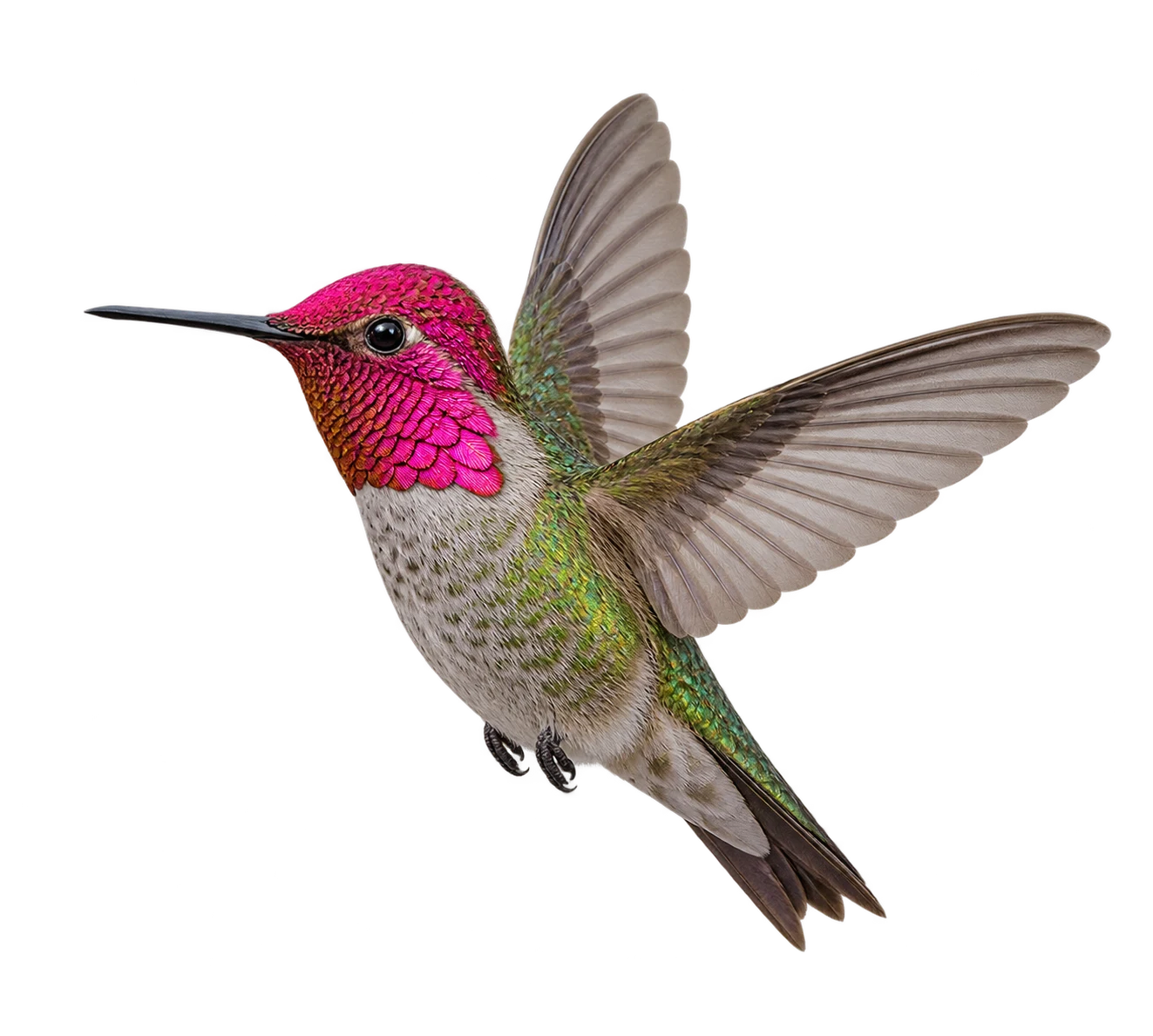
Birds
Anna's Hummingbird
Calypte anna
Classification and source reference
LivingAI illustration NT
Birds
Bee hummingbird
Mellisuga helenae
The bee hummingbird of Cuba is the smallest bird in the world, at about 2.28 grams.
Living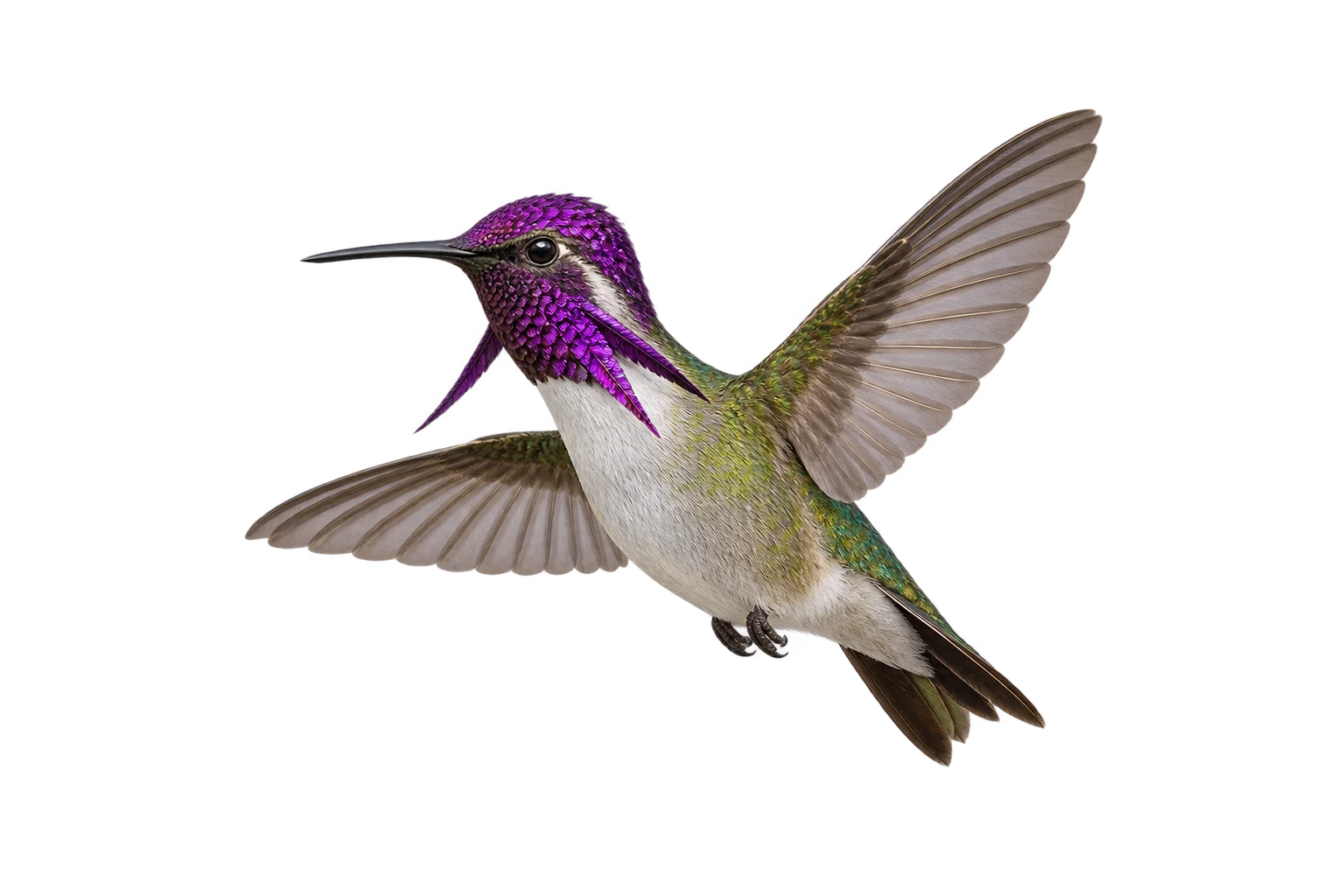
Birds
Costa’s Hummingbird
Calypte costae
Classification and source reference
LivingAI illustration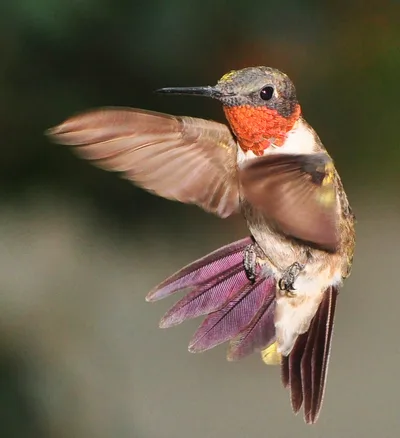
Birds
Hummingbird
Trochilidae
Hummingbirds are tiny nectar-feeding birds.
Living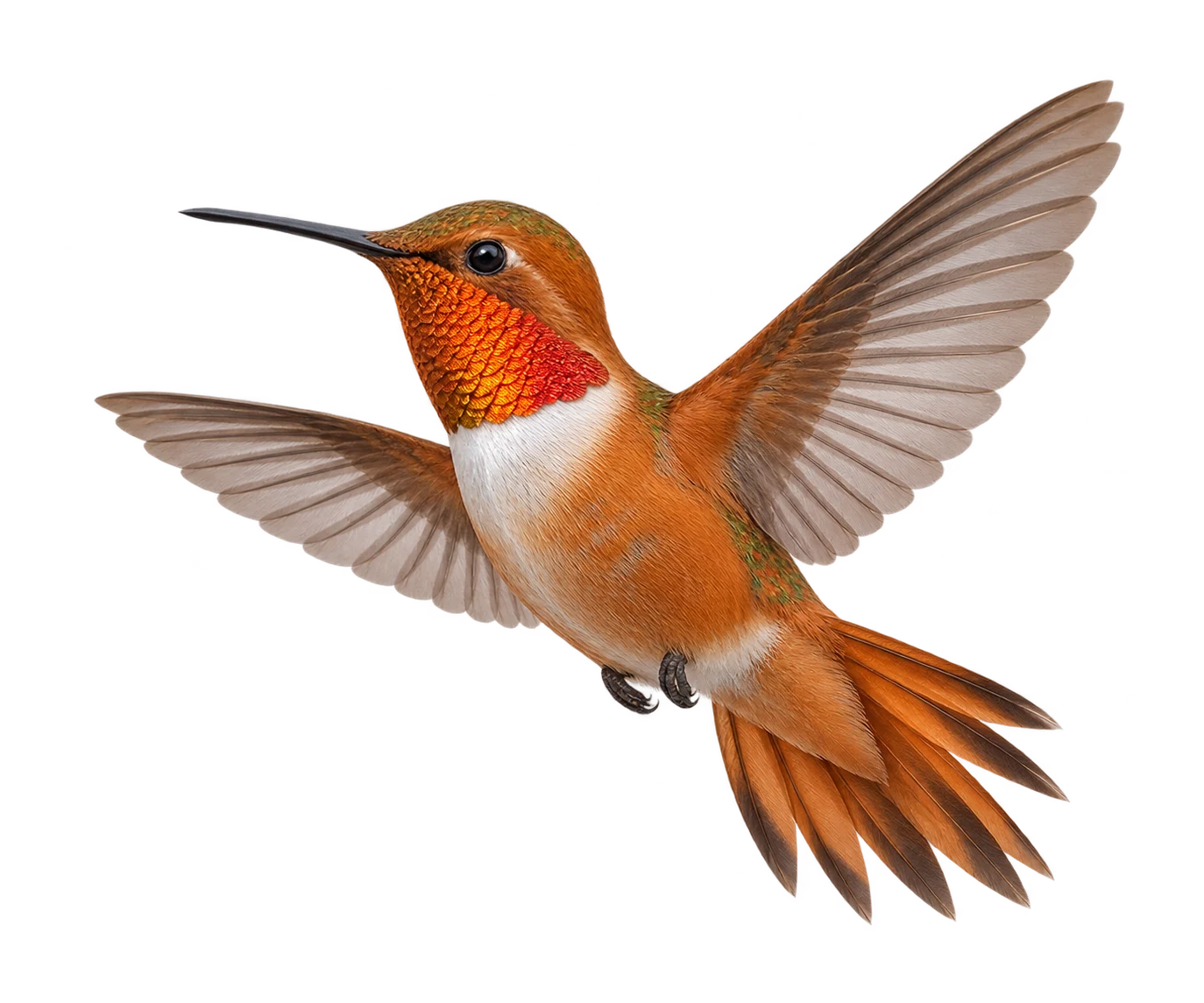
Birds
Rufous Hummingbird
Selasphorus rufus
Classification and source reference
LivingAI illustration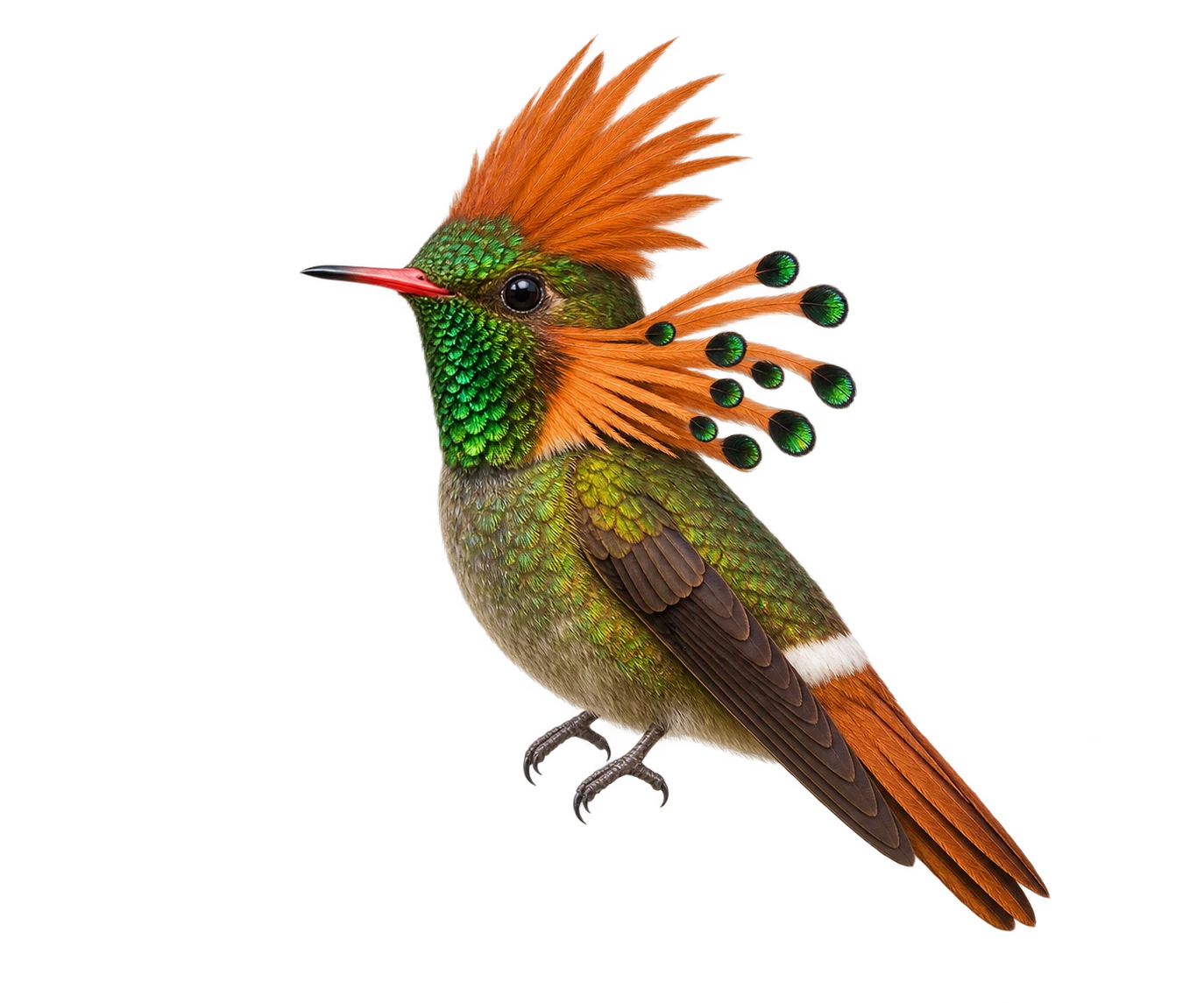
Birds
Tufted Coquette
Lophornis ornatus
Classification and source reference
LivingAI illustration