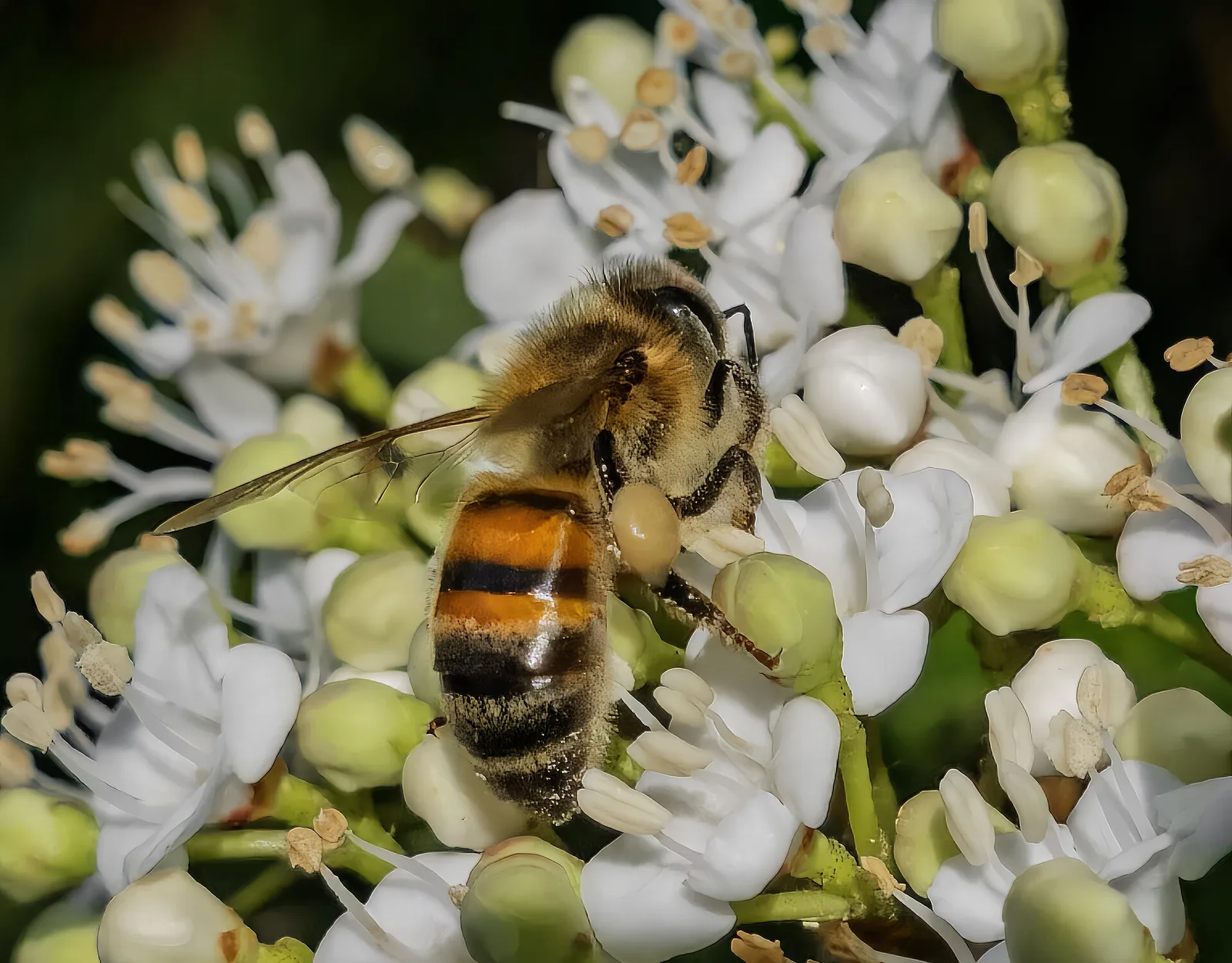
Western honey bee
Dances to tell its sisters where the flowers are
Apis mellifera
Also called European honey bee
Living individuals or members of this group exist today. This does not mean they are safe from extinction.
Meet the western honey bee
The western honey bee lives in colonies of tens of thousands and turns nectar into honey. People have kept it for thousands of years, and it now pollinates crops on every continent except Antarctica.
Images of the western honey bee


Lifespan in the wild
2 to 3 years for a queen
Length
10 to 20 mm
Fact file
Western honey bee
- Location
- Native to Europe, Africa and western Asia; kept worldwide
- Habitat
- Grassland, Temperate forest, Towns and cities
- Diet
- Nectarivore
- Prey / food
- Nectar and pollen
- Predators
- Bee-eaters, hornets, bears, skunks
- Lifestyle
- Diurnal
- Group name
- Colony or swarm
- Name of young
- Larva
- Incubation
- About 3 days of egg development
- Clutch size
- A queen lays up to 2,000 eggs a day
- Biggest threat
- Varroa mites, pesticides and loss of forage
- Distinctive feature
- Pollen baskets on the hind legs
- Colour
- Golden brown with dark bands
- Skin type
- Hairy exoskeleton
Size
Next to a person
Measurements
Size and speed
- Length
- 10 to 20 mm across the castes
Typical adult ranges. Source: Animal Diversity Web.
Life cycle
Lifespan
- In the wild2 to 3 years for a queen
- 03 years
A worker lives for weeks in summer. The queen lives for years.
Source: Animal Diversity Web.
Appearance
Colour and coat
- Primary colours
- golden brownblack
- Secondary colours
- orange-yellow
- Skin type
- hairy exoskeleton
- Male and female
- Three castes differ. Workers are 10 to 15 millimetres and carry a barbed sting. Queens are 18 to 20 millimetres with a long abdomen. Drones are 15 to 17 millimetres with huge eyes and no sting.
Life cycle
Mating and family
- Mating system
- one queen mates with 1 to 17 drones in flight, then never again
- Social structure
- eusocial colony of one queen, tens of thousands of workers and seasonal drones
- Breeding
- the queen lays continuously, up to 2,500 eggs a day in spring
A queen mates in the air within two weeks of emerging and stores the sperm for life. She lays one egg per cell, and nurses feed the larva for about a week before sealing it in. A worker emerges after 21 days, a queen after 16 and a drone after 24. Summer workers live 2 to 4 weeks, winter workers up to 11 months. A queen usually lives 2 to 3 years, and the colony reproduces by swarming.
Classification
Taxonomy
- Kingdom
- Animalia
- Phylum
- Arthropoda
- Class
- Insecta
- Order
- Hymenoptera
- Family
- Apidae
- Genus
- Apis
- Species
- Apis mellifera
Conservation
Red List status
- LC
- NT
- VU
- EN
- CR
- EW
- EX
Data Deficient. The IUCN has no category for this species yet.
Range
Recorded in 21 countries
- Argentina
- Austria
- Ashmore and Cartier Islands
- Brazil
- Canada
- Colombia
- Czech Republic
- Germany
- Ecuador
- Spain
- France
- United Kingdom
- Italy
- Mexico
- New Zealand
- Poland
- Portugal
- Russia
- Ukraine
- United States of America
- South Africa
Habitat layer: temperate broadleaf and mixed forest, temperate conifer forest, boreal forest and taiga, tropical grassland, savanna and shrubland, temperate grassland, savanna and shrubland.
Countries from 530,350 wild records on GBIF (iNaturalist research grade), filtered and checked by hand. Country shapes: Natural Earth. Habitat: RESOLVE Ecoregions 2017, CC BY 4.0. Basemap: Natural Earth.
Habitats
Three things to know
- 1
A colony flies about 90,000 km to make one kilogram of honey.
- 2
Workers tell each other where flowers are with a waggle dance.
- 3
A worker's sting is barbed and stays in the skin; the bee dies afterwards.
Did you know
Seven more facts
- 1
A drone dies the moment he mates.
- 2
A queen mates with up to 17 drones in her first two weeks and never again.
- 3
About 1% of a colony's workers die naturally every day.
- 4
Workers can throw a hive's whole drone population out to freeze before winter.
- 5
Bees see ultraviolet patterns on flowers that people cannot see.
- 6
The greater honeyguide bird leads honey badgers and people to wild nests.
- 7
GBIF holds records of the species from 227 countries and territories.
Field notes
How it looks and acts
Field notes
Distinguishing features
- A golden brown body with black bands on the abdomen.
- A pollen basket of stiff hairs on each hind leg.
- A hairy thorax and a less hairy abdomen.
- A body length of 1 to 2 centimetres, depending on the caste.
- A barbed sting on the worker.
- Huge eyes on the drone that meet at the top of the head.
Field notes
Unique adaptations
- Wax glands on the abdomen let workers build hexagonal comb.
- A crop stores nectar separately from the gut for the flight home.
- Shivering flight muscles warm the bee and the winter cluster.
- The waggle dance recruits sisters to a patch faster than any solitary bee can work it.
- A barbed sting that stays in the wound deters mammals from the hive.
Field notes
Interesting behaviours
- Dances on the comb to report food.
- Changes job with age, from nurse to builder to guard to forager.
- Swarms in spring, when the old queen leaves with most of the workers.
- Fans its wings to dry nectar into honey and to cool the hive.
- Grooms mites off nest mates and pulls sick brood from the comb.
Field notes
Temperament
- Calm when foraging, and stings only in defence.
- Fierce at the hive entrance, where guards attack any stranger.
- Far more aggressive in the African subspecies than in the European ones.
- Easily calmed with smoke, a trait beekeepers have bred for.
Field notes
Communication
- The waggle dance encodes direction, distance and quality of food.
- The round dance says food is near, within about 50 metres.
- Queen pheromones hold the colony together and stop workers laying.
- Alarm pheromone from a sting summons other defenders.
- A shaking signal wakes idle workers for the day's foraging.
Ecology
Ecological role
The honey bee is the main managed pollinator on Earth and a heavy competitor with wild bees where it is not native.
- Pollinates a large share of the world's crops and many wild plants.
- Recruits sisters by dancing, so it can strip a flower patch faster than solitary bees.
- Feeds bee-eaters, hornets, bears and honey badgers.
- Passes viruses and mites to wild bees where hives are dense.
Stories
Myths and legends
- In Greek tradition, bees carried messages from the gods, and the Delphic priestesses were called bees.
- In ancient Egyptian tradition, the bee stood for Lower Egypt.
- In British and European tradition, a family told the bees when someone in the house died.
- In French imperial tradition, Napoleon took the bee as his personal emblem.
People
Relationship with humans
People
Living alongside us
People have taken honey from this bee for at least 7,000 years and kept it in hives since ancient Egypt. Beekeepers now truck millions of colonies to pollinate almonds, apples and blueberries, a service worth billions of dollars a year. Hives give honey, wax, pollen, propolis and royal jelly. Varroa mites, disease and pesticides kill colonies every year. A sting hurts, but it is dangerous only to people with an allergy.
- A single sting is painful but harmless unless the person is allergic, when it can kill.
- A life is at risk at roughly 20 stings for every kilogram of body weight.
- Africanised bees attack in large numbers and pursue for long distances, and they have caused many deaths.
People
Status, uses and products
- Domestication
- Domestic
- As a pet
- Kept by some. A hive is a common hobby, but it needs a movable-frame hive, protective clothing, mite control and inspection for disease. Check local rules first, and keep the bees away from neighbours who are allergic.
- Uses
- pollinationbeekeepingresearch
- Products
- honeybeeswaxpollenpropolisroyal jellyvenom
The full account
About the western honey bee
Apis mellifera, the western honey bee, is the most common of the 7 to 12 honey bee species in the world. It lives in a colony of one queen, tens of thousands of worker females and, in season, a few hundred males called drones. Workers turn flower nectar into honey and store it in wax comb for the winter. A returning forager tells her sisters where the flowers are with a waggle dance on the comb.
The species is native to Europe, Africa and western Asia. People have kept it for thousands of years, and it now lives on every continent except Antarctica. A worker is 1 to 2 centimetres long, depending on caste, and lives only a few weeks in summer. A queen lives 2 to 3 years and lays up to 2,000 eggs a day. The IUCN rates the species as Data Deficient, because managed hives hide the state of the wild population.
Name and taxonomy
Carl Linnaeus named the species Apis mellifera in 1758. Apis is Latin for bee, and mellifera means honey-bearing. English speakers also call it the European honey bee, and the common name is written both as one word and two. It belongs to the family Apidae, which also holds the bumblebees, and to the order Hymenoptera with the ants and wasps.
As the species spread it adapted to local climates, and 31 subspecies are now recognised. They fall into four branches: African, north-western European, south-western European and Middle Eastern. A. m. mellifera, the dark bee of northern Europe, was long thought to interbreed freely with the rest. In 2013 researchers found that its queens do not mate with drones of other subspecies. The African subspecies A. m. scutellata, released by accident in South America, became the so-called killer bee.
Evolution and relatives
The genus Apis holds six other species, among them the Asian honey bee, the giant honey bee and the dwarf honey bee. All six arose in southern and south-eastern Asia. Only the western honey bee is thought to have arisen in Europe, Asia and Africa together. Its genome suggests an origin in Africa, followed by two ancient spreads into Europe.
The genome was fully sequenced in October 2006, making the honey bee the third insect mapped after the fruit fly and the mosquito. Females carry 32 chromosomes and males only 16, because a drone grows from an unfertilised egg. Genes for smell far outnumber genes for taste. The bee's body-clock genes look more like those of vertebrates than those of other insects. The waggle dance is more precise than the dance of the dwarf honey bee, so it seems to have improved since the two lines split.
Appearance
The body is red-brown to golden, banded in black, with rings of orange-yellow on the abdomen. Hair covers the thorax, and the abdomen carries less. The legs are dark brown or black, and each hind leg carries a pollen basket, a fringe of stiff hairs that holds a pollen load. The colour and banding differ between subspecies, some darker and some more mixed.
There are three castes, and the field ranges from 1 to 2 centimetres across them. A worker is 10 to 15 millimetres long, a drone 15 to 17, and a queen 18 to 20. The queen has a longer, rounder abdomen, and the drone has much larger eyes for spotting a flying queen. Workers are smaller than drones, yet their wings are longer.
Queens and workers carry a sting formed from the egg-laying tube. The worker's sting is barbed and tears out of her body when it lodges in skin, so she dies. The queen's sting has no barb, and drones have no sting at all. The barbs only catch in elastic material, so a bee can sting another insect and fly off unharmed.
Habitat and range
The species arose in Africa or Asia and spread on its own through Africa, the Middle East and Europe. Europeans shipped colonies to North America in 1622, and settlers carried them to South America, Australia, New Zealand and East Asia. The bees spread ahead of the settlers, and Native Americans called them the white man's fly. GBIF holds records from 227 countries and territories, more than for almost any other animal.
Honey bees do best where flowers are plentiful: meadows, open woodland and gardens. They can live in grassland, desert and wetland if there is water, food and shelter. A wild colony needs a cavity, usually a hollow tree, and seals every gap but one with propolis. Workers forage within about 3 kilometres of the hive and can fly 8 to 13 km for food or water.
The bee needs a body temperature of 35 degrees Celsius to fly, and the nest is held at that heat for the brood. Below 7 to 10 degrees a bee cannot move, and above 38 degrees it slows. In winter the colony clusters and shivers to keep its core at 20 degrees or more. In a hot hive the bee spits up a drop of nectar and lets it evaporate, which cools the head by 10 degrees.
Diet and feeding
Honey bees eat nectar and pollen from flowers. A forager sucks nectar with her tongue and stores it in a crop at the front of the gut. She combs pollen off her body into the baskets on her hind legs. Bees also take honeydew, the sweet waste of aphids, and will rob a weak hive of its stores.
Back at the hive the forager passes the nectar to younger workers, who chew it for about 30 minutes with enzymes. They spread it in open cells and fan it with their wings until the water content falls below 20%. The result is honey, mostly glucose and fructose, which they seal under wax and which never rots. Nectar starts at nearly 80% water. Pollen ferments into bee bread, the protein food for the larvae.
Foraging happens only by day, but never in heavy rain or high wind. Light rain stops pollen collection but not nectar collection. A worker cannot fly once her body drops below 10 degrees, and a sudden change in light sends every forager home. In North America some native milkweeds trap and kill honey bees, whose feet catch in the flowers' slits.
Behaviour and social life
The colony is a superorganism, and the colony, not the bee, is the unit that reproduces. A healthy hive in midsummer holds 40,000 to 80,000 bees. Females make up 90% or more of them at any time. The queen does nothing but lay eggs, and her pheromones stop the workers from laying. Drones exist to mate, and in temperate climates the workers throw them out before winter to starve.
A worker changes job as she ages. For her first 10 days she cleans cells and feeds larvae with jelly from glands in her head. In her second week her wax glands switch on and she builds comb. Between days 12 and 25 she takes a turn as a guard at the entrance. After about three weeks her glands shrink and she forages until she dies.
A colony reproduces by swarming in spring or early summer. Workers raise one to two dozen new queens, and just before they emerge the old queen leaves with about two-thirds of the adults. The swarm hangs in a tree while scouts search for a cavity. In the old hive the first new queen to emerge stings her sisters to death in their cells. Workers also police the hive and eat any eggs laid by another worker.
Communication and senses
Karl von Frisch won the 1973 Nobel Prize for showing that bees talk with dance. A forager back from a rich patch runs a figure of eight across the face of the comb. The angle of the straight run from vertical gives the direction of the food relative to the sun. The length of the waggle gives the distance, and the vigour of the dance gives the quality. A simpler round dance means food is close, within about 50 metres, but gives no direction. A young bee picks up the dance in part by watching older dancers.
Pheromones govern almost every activity: mating, alarm, defence, orientation and recognising nest mates. Each hive has its own scent, and guards attack any bee that smells wrong. When a worker stings, her sting releases an alarm pheromone that draws other workers to the enemy. A worker also shakes a nest mate with a jerking signal to change her activity, and experienced foragers give 92% of these signals.
The eyes see ultraviolet light, which shows markings on flowers that people cannot see. Part of the eye senses polarised light, so a bee can find the sun on a cloudy day. Bees hear vibration, and workers feel the waggle dance through the comb. New queens pipe to each other before they emerge.
Reproduction and life cycle
A young queen flies out to a spot where drones gather, usually about 9 metres above a clearing, with males from many hives. The drones smell her, spot her by eye and couple with her in the air. She mates with 1 to 17 drones over one or more flights within two weeks of emerging, and never again. Each drone dies at once, because mating tears his body.
The queen lays one egg in each wax cell. At the peak of spring she may lay over 2,500 a day, more than her own weight. A fertilised egg becomes a female, and an unfertilised egg in a larger cell becomes a drone. Eggs hatch in 28 to 144 hours, depending on warmth, into blind, legless larvae. Nurse bees feed every larva royal jelly for three days, then switch future workers to bee bread. A larva that stays on royal jelly grows into a queen.
After about a week the nurses seal the cell and the larva spins a cocoon and pupates. A queen emerges after 16 days, a worker after 21 and a drone after 24. Summer workers live 2 to 4 weeks, and winter workers up to 11 months. A queen usually lives 2 to 3 years, and some reach 5. When her sperm store runs low she lays more drone eggs, so beekeepers replace her every year or two.
Predators and threats
Bee-eaters are the specialist bird hunters, and flycatchers, grackles and summer tanagers pick off bees at the hive entrance. Hornets, beewolf wasps, dragonflies, robber flies and crab spiders take bees in the field. Toads and opossums sit at the entrance and eat workers as they leave. Bears, honey badgers, skunks and even baboons and chimpanzees tear open nests for the honey and brood. In Africa the greater honeyguide leads a mammal to a nest and feeds on the comb once it is opened.
The worst enemy is the mite Varroa destructor, which jumped from the Asian honey bee. Its young feed on bee larvae and pupae, and adults spread viruses among the workers. It has reached every continent except Australia, and it wiped out nearly all the wild colonies in North America. Tracheal mites, the small hive beetle, wax moths, foulbrood bacteria, chalkbrood fungus and at least 18 viruses also attack colonies. Colony collapse disorder, first named in 2006 and 2007, empties a hive of its workers with no single known cause.
Pesticides add to the load. A 2020 study found that neonicotinoids disturbed bee development, and drones suffered more than females. Farm chemicals can also upset the bacteria in the bee gut.
Population and conservation
The IUCN Red List rates the western honey bee as Data Deficient, as of 2025. The species is enormously numerous in hives, but nobody knows how many wild colonies remain. iNaturalist holds 725,171 observations of it. In Europe the worry is that commercial beekeeping swamps local subspecies with imported stock.
Varroa mites cut North American and European colonies badly in the early 1990s. Chemical treatments and better husbandry saved most commercial operations. Wild colonies are slowly recovering in mild climates, as natural selection favours mite-resistant bees. Some subspecies groom mites off each other and pull infected brood from the comb, and breeders now select for that habit.
In the Americas and Australia the honey bee is not native, and some entomologists see it as a threat. In San Diego County it made up about 98% of bee biomass in 2025. A 2017 review found evidence that managed bees compete with wild bees and pass them diseases. The US Department of Agriculture does not list it as invasive.
Relationship with humans
Rock art in France and Spain shows people taking honey about 7,000 BCE. Egyptian tomb paintings show beekeeping before 2600 BCE. Beekeepers have bred for gentle bees that swarm less, survive cold and make more honey than they need. Some biologists call the species domesticated, and others say it is a wild insect that people merely house. Drones mate freely with wild colonies, so the managed and wild populations mix.
Pollination is worth far more than honey. In 2005 the bee's global commercial value was put at just under 200 billion dollars. One estimate in 2000 put its value to US food crops at 14.6 billion dollars a year. California almonds need two hives per acre, and their February bloom draws more than a third of all managed hives in the country. Trucks carry hives to apples in New York and Washington and to blueberries in Maine.
A hive yields honey, wax for candles, pollen, propolis, royal jelly and edible brood. Propolis gives a Stradivarius violin its red colour. A single sting hurts but is harmless unless the person is allergic. Around 20 stings for each kilogram of body weight can threaten a life. Africanised bees in the Americas attack in far greater numbers and have killed many people.
In culture and myth
In Greek tradition bees were messengers of the gods, and Aristaeus was the god of beekeeping. The priestesses at Delphi were called bees. In ancient Egypt the bee was the symbol of Lower Egypt. Napoleon took the bee as his emblem, and it is embroidered on his robes.
In Britain and much of Europe a family would tell the bees of a death in the house, or the bees would leave. Utah calls itself the Beehive State, and Manchester wears the worker bee as its symbol of industry. Thomas Jefferson wrote that Native Americans saw the arrival of bees as a sign that settlers were near. Across cultures the bee probably stands for hard work and order because of the visible discipline of the hive.
A sentence with a dotted underline is inferred: it describes the group the animal belongs to, or is a reading of the sources, rather than a measured or reported fact about this species.
Questions
Western honey bee questions, answered
How long does a honey bee live?
A summer worker lives 2 to 4 weeks, and a winter worker up to 11 months. A drone lives 4 to 8 weeks. Queens usually last 2 to 3 years, and a few reach 5.
Do honey bees die when they sting?
A worker usually dies after stinging a person, because the barbed sting tears out of her body. She can sting another insect and survive. Queens and drones do not die from stinging.
How do honey bees make honey?
Foragers carry nectar home in a crop. Hive bees chew it with enzymes for about 30 minutes, spread it in cells and fan it until the water falls below 20%. Then they seal it under wax.
What is the waggle dance?
A figure-of-eight run on the comb. The angle from vertical shows the direction of food relative to the sun, and the length of the waggle shows the distance.
How many bees are in a hive?
In midsummer a healthy hive holds between 40,000 and 80,000 bees. There is one queen, and 90% or more of the rest are female workers.
How many eggs does a queen bee lay?
At the peak of spring she can lay over 2,500 a day, more than her own weight. Laying slows in autumn and may stop in winter.
Are honey bees endangered?
The IUCN rates the species Data Deficient. Managed hives are numerous, but Varroa mites wiped out most wild colonies in North America, and the state of the wild population is unknown.
What is colony collapse disorder?
A condition in which the workers vanish from a hive and leave the queen and brood. It hit US beekeepers hard in 2006 and 2007, and no single cause has been found.
Are honey bees native to America?
No. Settlers shipped the first colonies from England to Virginia in 1622. The bees spread ahead of the settlers.
How far does a honey bee fly?
Usually within about 3 kilometres of the hive, and up to 8 to 13 km if it must. Foragers work only in daylight and stay home in heavy rain or high wind.
What is the difference between a queen, a worker and a drone?
The queen is the only fertile female and lays all the eggs. Workers are sterile females that do every other job. Drones are males whose only role is to mate, and they have no sting.
How does a larva become a queen?
Every larva gets royal jelly for three days. Workers then switch to bee bread, but a larva kept on royal jelly grows into a queen.
Why do bees swarm?
Swarming is how a colony reproduces. In spring the old queen leaves with about two-thirds of the workers to find a new home. A new queen takes over the old hive.
Is a bee sting dangerous?
One sting is painful but harmless unless you are allergic. Roughly 20 stings for each kilogram of body weight puts a life at risk. Africanised bees are dangerous because they attack in huge numbers.
What are killer bees?
An African subspecies, Apis mellifera scutellata, released by accident in South America. It has spread to the southern United States and attacks intruders far more fiercely than European bees.
Do honey bees harm wild bees?
They can. Managed hives compete with wild bees for flowers and pass them diseases. In San Diego County honey bees made up about 98% of bee biomass in 2025.
Food web
Prey and food
- nectar
- pollen
Food web
Predators
- bee-eaters
- hornets
- bears
- skunks
Ecological equivalents

Related species on this site
Africanized bee (killer bee) (same genus), Barbut's Cuckoo Bumblebee (same family), Field Cuckoo Bumblebee (same family), Forest Cuckoo Bumblebee (same family), Gypsy Cuckoo Bumblebee (same family), Hairy-footed Flower Bee (same family), and more.
Insects
Africanized bee (killer bee)
Apis mellifera
Classification and source reference
LivingInsects
Barbut's Cuckoo Bumblebee
Bombus barbutellus
Classification and source reference
LivingInsects
Field Cuckoo Bumblebee
Bombus campestris
Classification and source reference
LivingInsects
Forest Cuckoo Bumblebee
Bombus sylvestris
Classification and source reference
LivingInsects
Gypsy Cuckoo Bumblebee
Bombus bohemicus
Classification and source reference
LivingInsects
Hairy-footed Flower Bee
Anthophora plumipes
Classification and source reference
Living