Living individuals or members of this group exist today. This does not mean they are safe from extinction.
Meet the leafcutter ant
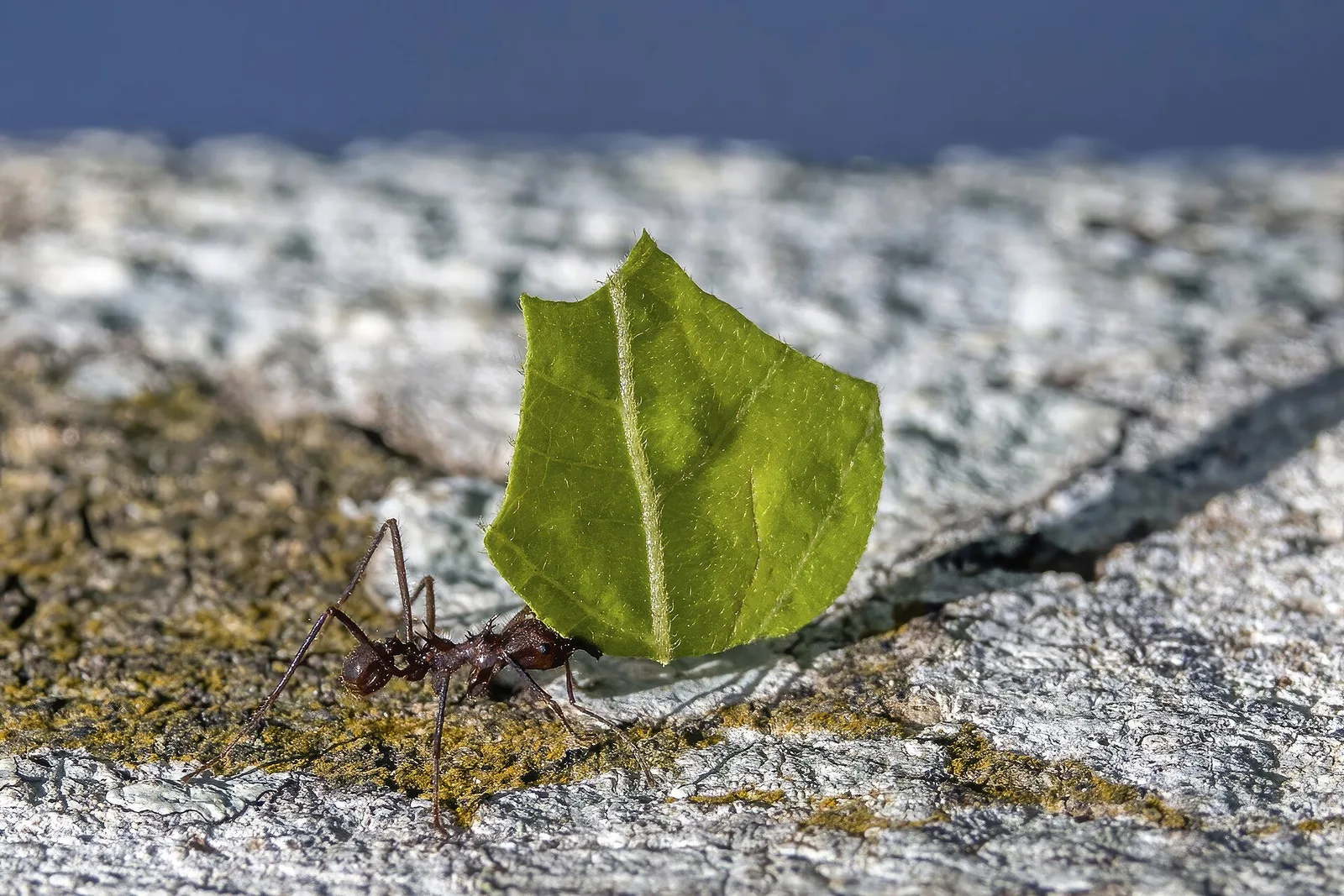
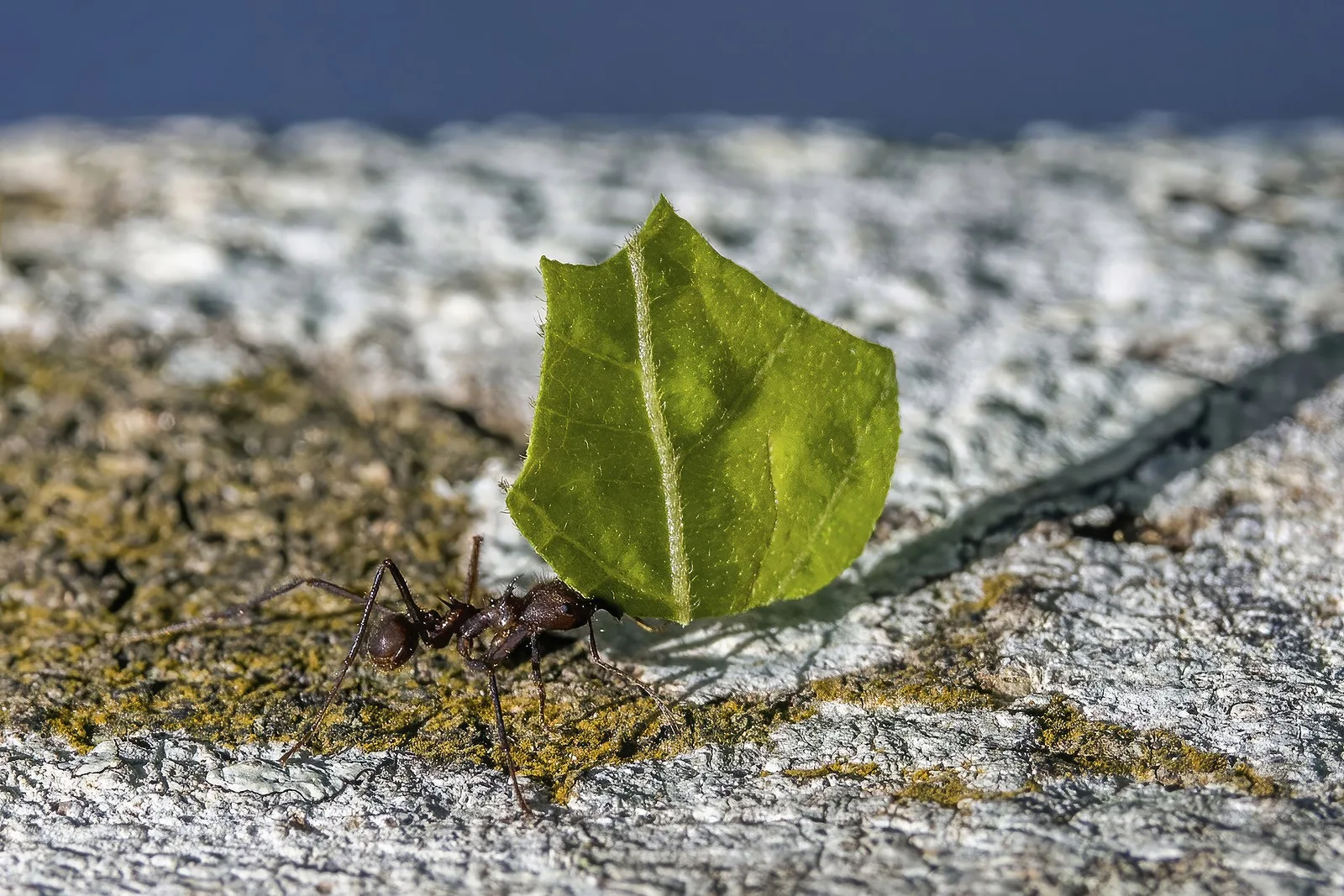
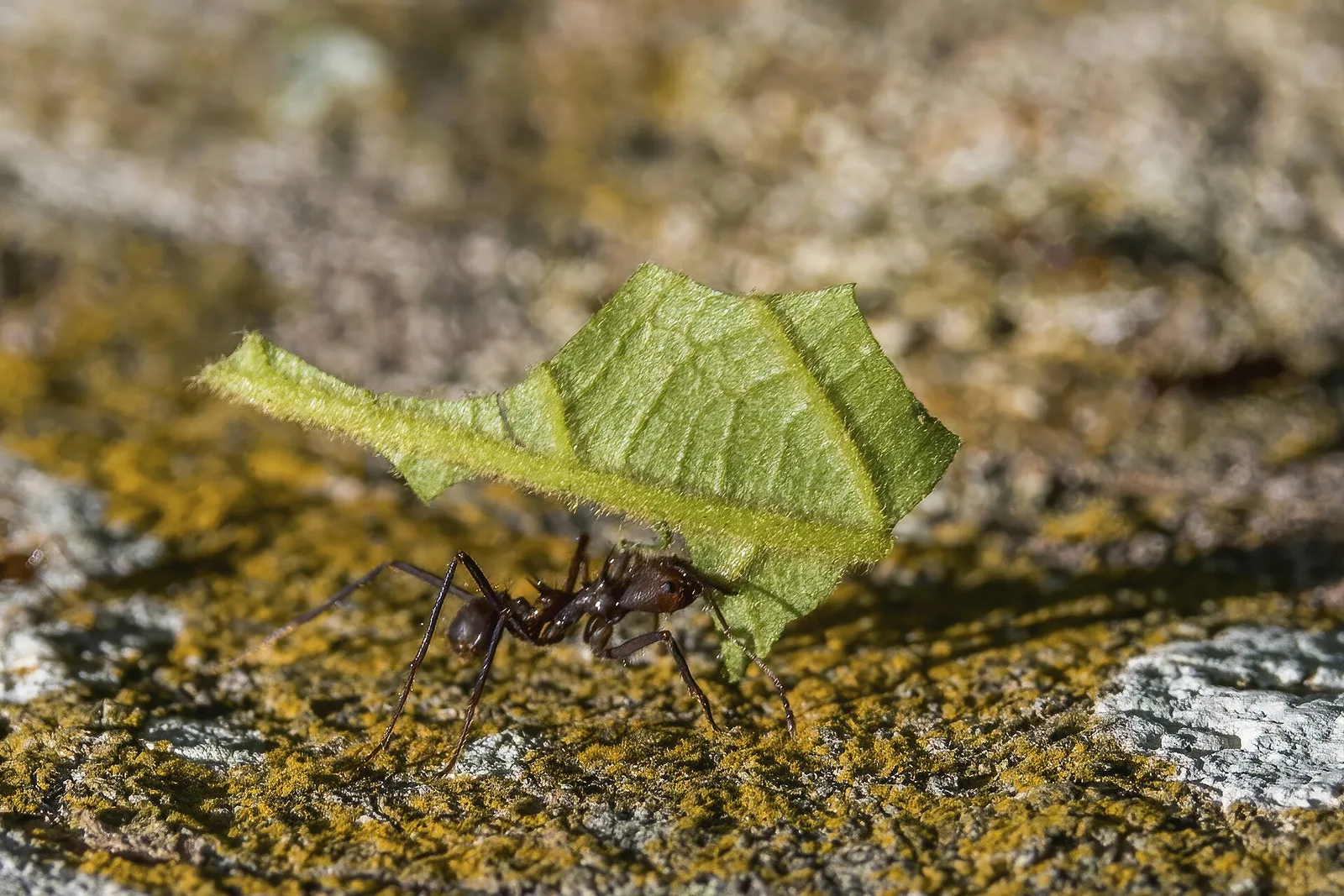
Leafcutter ants carry pieces of leaf back to the nest, but they do not eat them. They use the leaves to grow a fungus, which is the colony's only food.
Images of the leafcutter ant
Lifespan in the wild
Up to 20 years for a queen
Fact file
Leafcutter ant
- Location
- Central and South America
- Habitat
- Rainforest
- Diet
- Herbivore
- Prey / food
- A fungus grown on cut leaves
- Predators
- Armadillos, anteaters, birds, parasitic flies
- Lifestyle
- Diurnal and nocturnal
- Group name
- Colony
- Name of young
- Larva
- Incubation
- About 4 weeks from egg to adult
- Clutch size
- A queen lays millions of eggs in her life
- Biggest threat
- None; treated as a crop pest
- Distinctive feature
- Workers carrying leaf pieces many times their own weight
- Colour
- Red-brown
- Skin type
- Exoskeleton
Size
Next to a person
Life cycle
Lifespan
- In the wildUp to 20 years for a queen
- 020 years
Workers live for months. A colony can hold millions of them.
The pale bar is the record. Source: Wikipedia.
Appearance
Colour and coat
- Primary colours
- red-brown
- Skin type
- exoskeleton
- Male and female
- Strong. The queen is much larger than any worker and grows wings for her mating flight. Males are winged and short-lived. Workers are all female and come in several sizes.
Life cycle
Mating and family
- Mating system
- one queen mates on a nuptial flight and founds a colony alone
- Social structure
- one queen with up to 5 million sterile female workers in size castes
- Breeding
- winged queens and males leave on mating flights, and the queen lays for the rest of her life
A winged queen leaves her home nest with a lump of fungus in her mouth. After the mating flight she sheds her wings, digs a chamber and starts a garden. Her first workers take over the cutting and the care of the garden. An egg becomes an adult in about 4 weeks. Workers live for months, and the queen lives up to 20 years.
Classification
Taxonomy
- Kingdom
- Animalia
- Phylum
- Arthropoda
- Class
- Insecta
- Order
- Hymenoptera
- Family
- Formicidae
- Genus
- Atta
- Species
- Atta cephalotes
Conservation
Red List status
- LC
- NT
- VU
- EN
- CR
- EW
- EX
Not Evaluated. The IUCN has no category for this species yet.
Range
Recorded in 17 countries
- Bolivia
- Brazil
- Belize
- Colombia
- Costa Rica
- Ecuador
- Guatemala
- Guyana
- Honduras
- Mexico
- Nicaragua
- Panama
- Peru
- Suriname
- El Salvador
- Trinidad and Tobago
- Venezuela
Habitat layer: tropical moist broadleaf forest.
Countries from 3,953 wild records on GBIF (iNaturalist research grade), filtered and checked by hand. Country shapes: Natural Earth. Habitat: RESOLVE Ecoregions 2017, CC BY 4.0. Basemap: Natural Earth.
Habitats
Three things to know
- 1
A large colony can hold up to 8 million ants.
- 2
The nest can be 30 m across with hundreds of chambers.
- 3
A worker can carry a piece of leaf 50 times its own weight.
Did you know
Seven more facts
- 1
Carl Linnaeus named the species in 1758, in the same book that named the lion.
- 2
Nests reach 7 metres deep, and the ants angle them so that a breeze vents the carbon dioxide.
- 3
About 90 percent of the leaf cutting happens inside the nest.
- 4
The oldest workers run the rubbish dump, and their nest mates will kill them if they leave it.
- 5
A new queen carries a lump of fungus from her home nest to seed her own garden.
- 6
The species has no IUCN assessment, and its main enemy is the farmer.
- 7
iNaturalist holds 9,696 observations of the species.
Field notes
How it looks and acts
Field notes
Distinguishing features
- A red-brown body with a hard exoskeleton.
- Workers in several sizes, from minims to majors, within one colony.
- A soldier with a large, bristled head, which gives the ant the name hairy-headed.
- A long column of workers, each carrying a piece of green leaf above its body.
- Like other ants, a narrow waist, elbowed antennae and six legs.
Field notes
Unique adaptations
- Strong jaws that cut a living leaf, and a body that carries the piece home.
- A caste system that gives each size of worker one job.
- A bacterium on the body that makes an antibiotic against garden mould.
- A nest built to vent the carbon dioxide that the fungus gives off.
- A pocket in the queen's mouth that carries fungus to a new nest.
Field notes
Interesting behaviours
- Cuts leaves and carries them along trails to the nest.
- Chews leaf pieces into a mulch and feeds it to the fungus.
- Weeds the fungus garden and removes infected patches.
- Isolates the rubbish dump and the workers who run it.
- Rides on carried leaves to guard against phorid flies.
Field notes
Temperament
- Cooperative within the colony, with each caste at its own task.
- Hostile to dump workers that leave the dump.
- Like other ants, it defends the trail and the nest but does not seek out people.
Field notes
Communication
- Lays a pheromone trail from a food source back to the nest.
- Probably passes scent by touching antennae, as other ants do.
- Is thought to tell nest mates from strangers by smell.
- Probably senses vibration through the ground.
Ecology
Ecological role
The leafcutter ant is one of the main plant eaters of the Neotropical forest and a large-scale mover of soil.
- Cuts leaves from many plants and moves them underground, where they feed a fungus.
- Digs nests up to 7 metres deep, which turns over the soil.
- Feeds armadillos, anteaters and birds.
- Its spent mulch and dump probably return nutrients to the forest floor.
Stories
Myths and legends
- In Colombian tradition, the fat winged queens of a related Atta species are a seasonal food called hormigas culonas.
- In Aztec tradition, an ant is thought to have led Quetzalcoatl to the hidden maize.
- In Greek tradition, Aesop's ant is thought to stand for thrift and hard work.
- In Hebrew tradition, the Book of Proverbs is thought to hold up the ant as a model of diligence.
People
Relationship with humans
People
Living alongside us
The leafcutter ant is a crop pest across the Neotropics, and farmers destroy its nests. Scientists study it for its fungus farming and for the antibiotic bacteria it carries. European zoos keep colonies for display. In Colombia people eat the queens of a related species. The ant is not dangerous to people.
- A soldier can bite, and the bite probably hurts, but it does no lasting harm.
- The ants do not hunt or attack people.
- The only real damage is to crops and garden plants.
People
Status, uses and products
- Domestication
- Wild
- As a pet
- Not suitable. A colony needs a queen, a live fungus garden, fresh leaves every day and a large nest with ventilation. Zoos manage it, and a home keeper probably cannot.
- Uses
- scientific researchzoo exhibitionfood from a related species
- Products
- None recorded
The full account
About the leafcutter ant
The leafcutter ant, Atta cephalotes, lives in the forests of Central and South America. Its workers cut pieces from living leaves and carry them back to the nest along long trails. The ants never eat the leaves. They chew the pieces into a mulch and grow a fungus on it, and that fungus is the colony's only food. A colony can hold up to 5 million ants, and one queen heads it for more than 20 years.
The colony splits its work between castes of different sizes, from tiny garden tenders to large soldiers. Each caste does a separate job, and biologists call this division of labour task partitioning. The species ranges from Mexico south to Bolivia, with two separate populations in Amazonas and north-eastern Brazil. The IUCN has not assessed the species, and it is common enough that farmers treat it as a crop pest. iNaturalist holds 9,696 observations of it, many of them photographs of a leaf-carrying column.
Name and taxonomy
Carl Linnaeus described the species in 1758, in the tenth edition of Systema Naturae. He named it Formica cephalotes and placed it in the genus Formica beside 16 other ants. Johan Christian Fabricius moved it into the new genus Atta in 1804, together with five other species. William Morton Wheeler made A. cephalotes the type species of Atta in 1911. An older genus name, Oecodoma, also used it as a type species, but that name is now a synonym of Atta.
The species belongs to the ant family Formicidae, inside the order Hymenoptera with the bees and wasps. Within the ants it sits in the subfamily Myrmicinae and the tribe Attini, the fungus-growing ants. iNaturalist calls it the hairy-headed leafcutter ant, and Wikidata lists leaf-cutter ant as the plain English name. French speakers call it fourmi céphalote or fourmi grosse. The name cephalotes probably refers to the wide head of the soldier caste.
Evolution and relatives
The tribe Attini holds the ants that grow fungus for food, and A. cephalotes belongs to the subtribe Attina. Like other attine ants, the leafcutter ant is thought to descend from one ancestor that took up fungus farming. Most attine ants are thought to feed their fungus on dead plant matter, and only the leafcutter genera cut fresh leaves. The genus Atta contains the leafcutter ants of the Americas, and A. cephalotes is the species that defines the genus.
Ants, bees and wasps form the order Hymenoptera, and ants sit inside the stinging group Aculeata. Like most Myrmicinae, the leafcutter ant carries a two-segment waist between the thorax and the abdomen. Its closest relatives are probably the other Atta species, such as Atta laevigata, which people eat in Colombia.
Appearance
The worker is red-brown, and a hard exoskeleton covers its body in place of a skeleton. The sources give no measured body length for this species, so this page describes size by caste, not in millimetres. The smallest workers are the minims, which tend the fungus garden and ride on the leaves that larger ants carry. The mediae are workers of middle size, and they do the cutting and carrying. The majors are the largest workers, and their common name, hairy-headed, points to the bristled head of the soldier.
Like other ants, the body has three parts, a head, a thorax and an abdomen, with six legs and two elbowed antennae. Like other ants, only the queen and the males grow wings, and the queen sheds hers after her mating flight. The queen is probably many times the size of a minim, because she must carry eggs for a colony of millions. The fields hold no weight or length for the species, so no figure on this page is a measured one.
Habitat and range
The species lives in the Neotropical region, from Mexico through Central America to Bolivia. Two separate populations live in Amazonas and in north-eastern Brazil. It is a rainforest ant, and one colony usually covers about 200 square metres of the forest floor. Nests reach 7 metres deep. The ants place the nest so that a breeze can carry away the carbon dioxide that the fungus gives off. Without that airflow the gas would build to dangerous levels inside the chambers.
The nest mound can spread over 30 metres, and side mounds reach out to 80 metres from the centre. Inside, the nest holds hundreds of chambers, each one a garden, a nursery or a rubbish store. GBIF lists records from 23 countries, but that count includes zoo colonies in Europe and is not the native range. Costa Rica and Colombia give the most records, which probably reflects where people look rather than where colonies are densest. In Colombia the species is recorded across most departments, from Amazonas in the south to Vichada in the east.
Diet and feeding
The leafcutter ant counts as a herbivore in one sense only: it cuts leaves, but it never eats them. Workers chew the leaf pieces into a mulch and add the mulch to the fungus garden inside the nest. The fungus is Leucoagaricus gongylophorus, and it grows swollen tips called gongylidia. The ants eat these swollen tips, and the fungus is the only food the colony has. About 90 percent of the leaf cutting happens inside the nest, not on the tree.
The ants weed the garden and remove patches that a mould has infected. They carry a bacterium on their bodies, and this bacterium makes an antibiotic that protects the garden. The species is one of the main plant eaters of the Neotropics, and it strips crops as readily as wild trees. Like other leafcutters, a colony probably takes leaves from many plant species and moves on when one tree is stripped. The larvae are thought to feed only on the fungus, as the adults do.
Behaviour and social life
One queen founds and heads each colony, and the colony can grow to 5 million members. Our fact file puts the largest colonies at up to 8 million ants. The work is split between castes by body size, a system that biologists call task partitioning. Minims dig, tend the fungus and care for the brood inside the nest. Minors clean the nest and nurse the young. Mediae are the harvesters: they cut leaves and carry them home along the trails. Majors guard the trails against other insects and do little else.
The oldest workers run the rubbish dump, where the colony discards spent mulch and dead fungus. The rest of the colony keeps these dump workers apart. A dump worker that wanders out is forced back or killed by its nest mates. Dump workers pick up disease and toxins, and they live only half as long as workers of the same age. Minims also ride on the leaves that mediae carry, and from there they fight off parasitic flies. These phorid flies try to lay eggs inside the heads of the leaf carriers.
The colony is active by day and by night. Like other ants, a worker probably spends its whole life inside the colony and never breeds. A colony of millions is thought to work without any central control, because each ant follows simple local rules.
Communication and senses
A forager lays a pheromone trail on the way back from a good tree, and other workers follow the trail out. Like other ants, the leafcutter ant reads these chemical signals with its antennae, which carry most of its sense of smell and taste. Workers probably also touch antennae to pass on the scent of a good leaf, as other ants do. The compound eyes are small, and vision is thought to matter less than smell inside a dark nest.
Like other ants, workers probably sense vibration through the ground and use it as a warning. The colony also uses scent to sort nest mates from strangers, and a dump worker probably carries a scent that marks it as unclean. The ants are thought to sense the carbon dioxide from the fungus, because they build the nest to vent it. A minim on a leaf probably feels a phorid fly land before it sees it, and it snaps at the fly with its jaws.
Reproduction and life cycle
The queen lives up to 20 years, and she is the only ant in the colony that lays eggs. Winged queens and males leave the nest on a mating flight. A new queen carries a small lump of fungus, taken from her home nest, in a pocket in her mouth. She uses that lump to start a new garden, and the garden feeds her first workers. Like other ants, she sheds her wings after the flight and digs her first chamber alone.
Development from egg to adult takes about 4 weeks. Like other Hymenoptera, the young pass through a larva and a pupa before the adult stage, so an adult ant never moults. The queen lays millions of eggs over her life. Workers live for months, not years, and dump workers live half as long as the rest. Which caste a larva becomes is thought to depend on how much food it receives. A colony probably dies when its single queen dies, because no worker can replace her.
Predators and threats
Armadillos, anteaters and birds eat leafcutter ants. Phorid flies attack the workers on the trails and lay their eggs inside the ants' heads. The minims that ride on carried leaves defend the carriers from these flies. Majors guard the trails from other insects. Moulds in the fungus garden are probably the greatest danger to a colony, which is why the ants weed and carry antibiotic bacteria.
The rubbish dump holds disease and toxins, so the colony walls it off together with the workers who run it. No source lists a threat to the species as a whole. Its main enemy is the farmer who treats it as a pest and destroys the nest.
Population and conservation
The IUCN has not evaluated the species, so its code is NE, Not Evaluated. iNaturalist lists no regional conservation status for it either. With colonies of millions and a range from Mexico to Bolivia, it is not a species in trouble. iNaturalist holds 9,696 observations, and GBIF holds records from 23 countries. Those counts suggest a common animal that people notice easily, because its trails cross forest paths.
Farmers regard the species as a crop pest, and they kill colonies rather than protect them. Clearing of rainforest removes colonies, but the ant is thought to persist well on farmland and in gardens. Nobody counts leafcutter colonies, so the true trend of the population is probably unknown.
Relationship with humans
People in the Neotropics meet the leafcutter ant mostly as a pest. A colony can strip crop plants and garden trees, and it takes leaves from many kinds of plant. In Colombia people eat the winged queens of a related species, Atta laevigata, as hormigas culonas. Zoos in Europe keep colonies, which is why GBIF lists records from the Netherlands, Germany and Switzerland.
Scientists study the antibiotic bacteria on the ants, which may point the way to new medicines. A soldier can give a painful bite, but the species is thought to pose no real danger to people. The species is wild, and nobody has domesticated it. A leafcutter column is probably the ant that visitors to a Neotropical forest remember most.
In culture and myth
In Colombia, people fry the winged queens of a related species, Atta laevigata, and eat them as hormigas culonas. That custom is thought to date from before the Spanish conquest, and the season for it falls with the mating flights. In Aztec tradition, the god Quetzalcoatl is thought to have followed an ant to the hidden store of maize. Ants in general appear in Aesop's fable of the ant and the grasshopper, where the ant stands for hard work.
The leafcutter ant appears in many nature films, because a moving line of green leaf pieces is easy to film. Zoo displays of a leafcutter colony seem to draw crowds, and several European zoos keep one. The ant's farming is often used to suggest that agriculture is older than humans.
A sentence with a dotted underline is inferred: it describes the group the animal belongs to, or is a reading of the sources, rather than a measured or reported fact about this species.
Questions
Leafcutter ant questions, answered
What do leafcutter ants eat?
They eat a fungus, Leucoagaricus gongylophorus, that they grow on chewed leaves. The ants never eat the leaves themselves. The fungus is the colony's only food.
Why do leafcutter ants carry leaves?
They carry leaves to feed the fungus garden inside the nest. Workers chew each piece into a mulch and add it to the garden. About 90 percent of the cutting happens in the nest.
How big is a leafcutter ant colony?
A colony can hold up to 5 million ants. The nest mound can spread over 30 metres, with side mounds out to 80 metres, and holds hundreds of chambers.
How long does a leafcutter ant queen live?
A queen can live up to 20 years. She is the only egg layer, and she lays millions of eggs over her life. Workers live for months.
Where do leafcutter ants live?
Atta cephalotes lives in the Neotropics, from Mexico south through Central America to Bolivia. Two separate populations live in Amazonas and north-eastern Brazil. It is a rainforest ant.
How deep is a leafcutter ant nest?
A nest can reach 7 metres deep. A colony usually covers about 200 square metres of forest floor. The ants build the nest so that a breeze vents the carbon dioxide from the fungus.
Do leafcutter ants bite?
A soldier can bite, and the bite probably hurts. The ants do not attack people, and the species is not dangerous.
Are leafcutter ants endangered?
No. The IUCN has not evaluated the species, so its code is NE. It is common across its range, and farmers treat it as a pest.
What are the castes of a leafcutter ant?
Minims tend the garden and the brood. Minors keep the nest clean and feed the larvae. Mediae harvest the leaves, and majors guard the trails.
What eats leafcutter ants?
Armadillos, anteaters and birds eat them. Phorid flies lay eggs inside the heads of workers on the trails.
How do leafcutter ants find their way?
A forager lays a pheromone trail on the way home from a good tree. Other workers follow the scent out and back.
How does a new leafcutter colony start?
A winged queen carries a lump of fungus from her home nest. After the mating flight she digs a chamber and grows a new garden from it. Her first workers then take over the harvesting.
Do leafcutter ants use antibiotics?
Yes. The ants carry a bacterium on their bodies that makes an antibiotic. It protects the fungus garden from mould.
Can you keep leafcutter ants as pets?
It is not practical. A colony needs a queen, a live fungus garden, fresh leaves and a ventilated nest. Zoos keep them, and a home keeper probably cannot.
Are leafcutter ants a pest?
Yes. The species is one of the main plant eaters of the Neotropics, and a colony can strip crops and garden trees. Farmers destroy nests where they can.
Food web
Prey and food
- a fungus grown on cut leaves
Food web
Predators
- armadillos
- anteaters
- birds
- parasitic flies
Ecological equivalents
Related species on this site
Yellow Crazy Ant (same family), Africanized bee (killer bee) (same order), Ashy Mining Bee (same order), Asian Giant Hornet (same order), Barbut's Cuckoo Bumblebee (same order), Bee (same order), and more.
Insects
Yellow Crazy Ant
Anoplolepis gracilipes
Classification and source reference
LivingInsects
Africanized bee (killer bee)
Apis mellifera
Classification and source reference
LivingInsects
Ashy Mining Bee
Andrena cineraria
Classification and source reference
LivingInsects
Asian Giant Hornet
Vespa mandarinia
Classification and source reference
LivingInsects
Barbut's Cuckoo Bumblebee
Bombus barbutellus
Classification and source reference
LivingInsects
Bee
Hymenoptera
Classification and source reference
Living