Leopard seal
The spotted hunter of the Antarctic pack ice
Hydrurga leptonyx
Also called Sea leopard
Living individuals or members of this group exist today. This does not mean they are safe from extinction.
Meet the leopard seal
The leopard seal is a long, spotted seal of the Antarctic pack ice that hunts penguins, seals, fish and krill. It is the top predator among the southern seals, and only the orca hunts it.
Images of the leopard seal
Lifespan in the wild
About 26 years
Weight
300 to 500 kg
Length
3 to 3.8 m
Fact file
Leopard seal
- Location
- Antarctic pack ice and the Southern Ocean; vagrants reach South America, southern Africa, Australia and New Zealand
- Habitat
- Polar ice, Open ocean, Coast
- Diet
- Carnivore
- Prey / food
- Penguins, krill, fish, squid, crabeater seal pups, fur seal pups
- Predators
- Orca
- Lifestyle
- Solitary; hunts along the edge of the ice
- Group name
- None; solitary
- Name of young
- Pup
- Gestation
- About 274 days, including a delay of 2 months
- Litter size
- 1 pup
- Population
- About 220,000 to 440,000
- Biggest threat
- Loss of pack ice; krill fishing
- Distinctive feature
- A long body, a huge reptile-like head and a spotted coat
- Colour
- Dark grey above, silver below, with dark spots
- Skin type
- Short fur over thick blubber
Size
Next to a person
Measurements
Size and speed
- Length
- 3 to 3.8 m females are the larger sex
- Length, male
- Up to 3 m
- Length, female
- Up to 3.8 m
- Weight
- 300 to 500 kg males about 300 kg, females up to 500 kg; Wikipedia gives 200 to 600 kg
- Weight, male
- Up to 300 kg
- Weight, female
- Up to 500 kg
Typical adult ranges. Source: Animal Diversity Web.
Life cycle
Lifespan
- In the wildAbout 26, up to 30 years
- In captivityUp to 17.3 years
- 030 years
The pale bar is the record. Sources: Animal Diversity Web, AnAge.
Appearance
Colour and coat
- Primary colours
- dark greysilver
- Secondary colours
- black
- Skin type
- short fur over thick blubber
- Male and female
- Reversed. Females are larger than males, by up to 50%, but both sexes carry the same spotted coat.
Life cycle
Mating and family
- Mating system
- polygynous
- Social structure
- solitary
- Breeding
- one pup a year
Leopard seals mate in the water from December into early January. The pregnancy lasts about 274 days, including a 2-month pause before the embryo implants. A single pup is born on the pack ice in November or early December. The mother nurses it for about 4 weeks and then leaves it. About a quarter of pups die in their first year. A wild adult lives about 26 years, and the record is 30.
Classification
Taxonomy
- Kingdom
- Animalia
- Phylum
- Chordata
- Class
- Mammalia
- Order
- Carnivora
- Family
- Phocidae
- Genus
- Hydrurga
- Species
- Hydrurga leptonyx
Conservation
Red List status
- LC
- NT
- VU
- EN
- CR
- EW
- EX
Least Concern on the IUCN Red List
Range
Recorded in 7 countries
- Antarctica
- Argentina
- Ashmore and Cartier Islands
- Chile
- South Georgia and the South Sandwich Islands
- New Zealand
- South Africa
Habitat layer: tundra, mangrove.
Countries from 1,123 wild records on GBIF (iNaturalist research grade), filtered and checked by hand. Country shapes: Natural Earth. Habitat: RESOLVE Ecoregions 2017, CC BY 4.0. Basemap: Natural Earth.
Habitats
Three things to know
- 1
The leopard seal is as long as a walrus but usually less than half its weight.
- 2
Its back teeth lock together into a sieve, so it can strain krill from the water.
- 3
Males sing underwater for hours each day in the breeding season, hanging upside down as they call.
Did you know
Seven more facts
- 1
Female leopard seals can be up to 50% larger than males.
- 2
A newborn pup already weighs about 30 kilograms and measures about 120 centimetres.
- 3
A singing male hangs upside down in the water and rocks from side to side.
- 4
The seal collapses its lungs on a deep dive and reinflates them at the surface.
- 5
Leopard seals like to bite the black pontoons of inflatable boats.
- 6
A seal called Owha lived around New Zealand's North Island for at least ten years.
- 7
Blainville described the species in 1820 from a stuffed skin and could not find its ear opening.
Field notes
How it looks and acts
Field notes
Distinguishing features
- A long, slim body of 300 to 380 centimetres.
- A large narrow head with a long snout and a very wide gape.
- A dark grey back with dark spots and a silver, spotted belly.
- Very long front flippers for a true seal.
- Canine teeth up to 2.5 cm and three-cusped cheek teeth.
- No outer ear flaps.
Field notes
Unique adaptations
- Locking cheek teeth sieve krill, so the seal can eat tiny prey as well as large prey.
- Thick blubber keeps it warm and smooths the body for speed.
- Long front flippers give sharp turns while chasing penguins.
- Extra lung surfactant and a stiff windpipe let the lungs collapse and recover on deep dives.
- Hearing and whiskers together locate prey in dark water.
Field notes
Interesting behaviours
- Waits almost submerged at the ice edge for penguins to enter the water.
- Shakes and slaps a penguin against the surface to kill it.
- Sleeps on floes, beaches and in kelp beds.
- Moves north with the growing ice in autumn and south in spring.
- Sings underwater for hours a day in the breeding season.
Field notes
Temperament
- Solitary and indifferent to other adults outside the breeding season.
- Curious and sometimes bold toward boats and divers.
- Capable of attacking a person, though such attacks are rare.
Field notes
Communication
- Five stylised male calls: trills at three pitches and a hoot.
- Individual call sequences that work like a song.
- A mother's call to summon her pup.
- A visual display: back arched, chest inflated, body rocking.
Ecology
Ecological role
The leopard seal is the top predator among the seals of the Antarctic pack ice.
- Takes penguins, seal pups and fish, and so shapes the numbers of those species near the ice edge.
- Eats large amounts of krill, especially when young.
- Serves as occasional prey for the orca.
Stories
Myths and legends
- In Antarctic exploration lore, the sea leopard that chased Orde-Lees stands for the dangers of the ice.
- In Maori tradition, the New Zealand seal Owha was named a gift from the ancestors.
- In modern spirit-animal writing, the leopard seal is said to stand for independence and survival.
People
Relationship with humans
People
Living alongside us
People rarely meet the leopard seal, and it has never been hunted in numbers. Early explorers shot a few for food, and Soviet sealers killed about 650 in a trial harvest in the 1980s. The species is now protected under the Antarctic seal convention. A handful of attacks on people, including one death in 2003, have given it a fierce name, and researchers now keep their distance.
- A leopard seal killed a snorkelling biologist in 2003, the only recorded human death.
- Seals have chased people across the ice, bitten a man on the leg and harassed spearfishers.
- Attacks are rare, and most seals ignore or only watch people.
People
Status, uses and products
- Domestication
- Wild
- As a pet
- Not suitable. A leopard seal is a 500-kilogram predator that needs cold ocean water and live prey. Only a rescued vagrant has ever lived in a zoo, and only because it could not go home.
- Uses
- scientific researcheducationecotourism
- Products
- None recorded
The full account
About the leopard seal
The leopard seal, Hydrurga leptonyx, is a long, muscular seal of the Southern Ocean. Sailors called it the sea leopard for the dark spots on its silver and grey coat. Only the southern elephant seal is a bigger seal in Antarctic waters. Adults weigh about 300 to 500 kilograms and measure 300 to 380 centimetres long. Females are the larger sex, which is unusual among seals.
The leopard seal is a top predator with huge jaws and a wide gape. It hunts penguins, other seals, fish and squid, and it strains krill through its locking teeth. Only the orca hunts it. It lives alone on and around the Antarctic pack ice, and vagrants reach as far as South Africa and Brazil. The IUCN lists it as Least Concern, with an estimated 220,000 to 440,000 animals.
Name and taxonomy
The French zoologist Henri de Blainville described the species in 1820 as Phoca leptonyx. He worked from a stuffed skin in Le Havre, which had come from the seas around the Falkland Islands. He could not find the ear opening, and he thought the head looked like that of a monk seal. Johannes Gistel created the genus Hydrurga in 1848. The leopard seal is the only species in that genus, and it has no subspecies.
The common name comes from the spotted coat. GBIF lists only two English names, leopard seal and sea leopard. Blainville believed that his new species was the animal that southern sailors called the sea calf.
Evolution and relatives
The leopard seal is a true seal of the family Phocidae, in the order Carnivora. Like all true seals it has no outer ear flaps, only an ear canal that opens on the skin. The Ross, crabeater and Weddell seals are its nearest relatives. Together they form the tribe Lobodontini, the Antarctic seals. The name of the tribe refers to their lobed cheek teeth, which lock together to sieve krill.
The crabeater seal shares this sieve, but the leopard seal adds large canines for big prey. Fossils show that leopard seals reached South Africa in the Late Pleistocene. It swims with its long front flippers, in the way that sea lions do, which is unusual for a true seal.
Appearance
The leopard seal has a longer and more muscular body than other seals. Adults measure 300 to 380 centimetres, and males weigh about 300 kilograms while females reach 500 kg. Wikipedia gives a wider spread of 2.4 to 3.5 metres and 200 to 600 kg. Females can be up to 50% larger than males. That makes the leopard seal as long as a walrus but usually under half its weight.
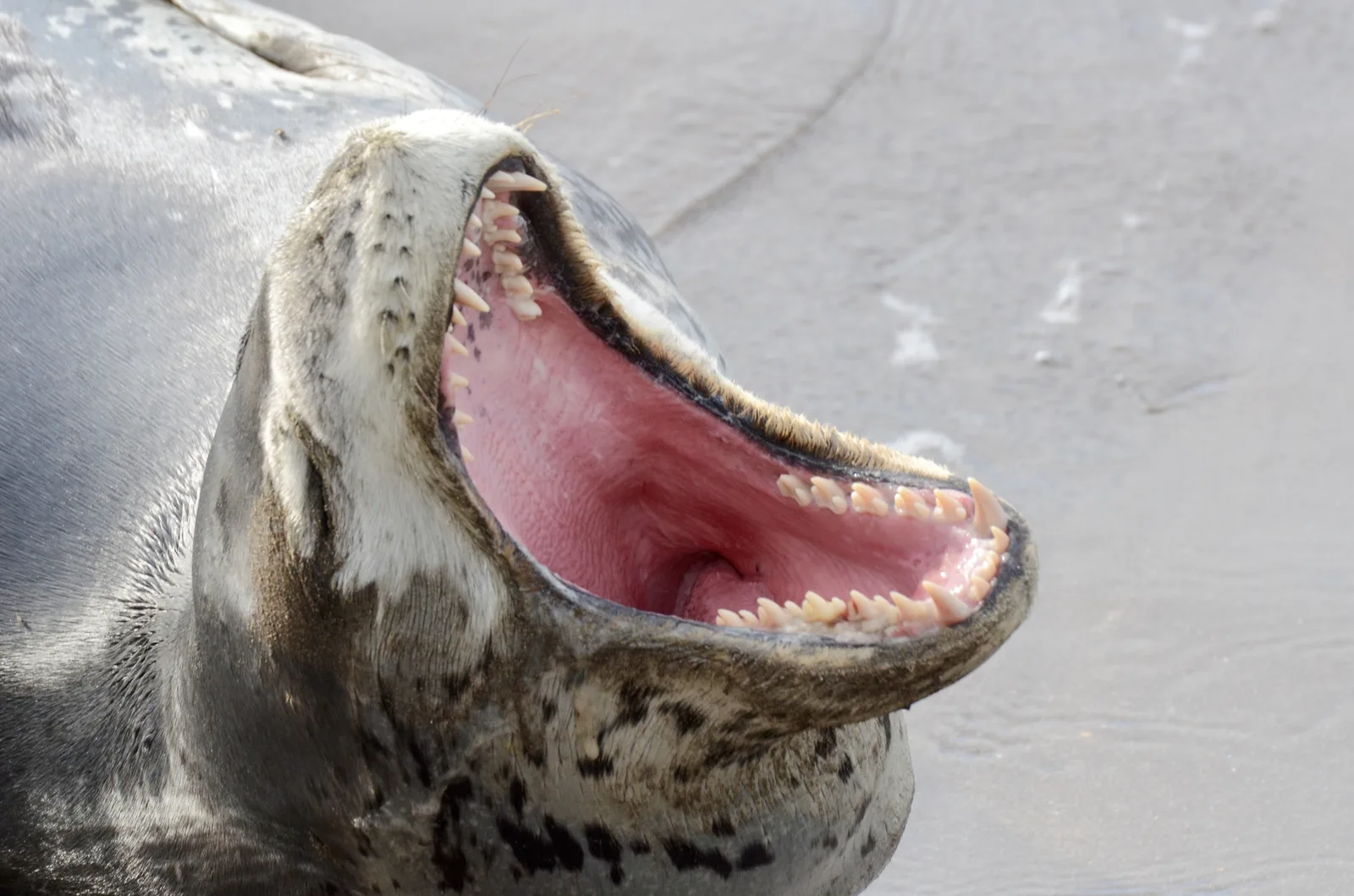
The head is large and narrow, with a long snout and a very wide gape. Many people say it looks like a reptile. The canine teeth reach 2.5 cm, and the cheek teeth carry three sharp cusps each. The whiskers are short and clear. The front flippers are very long for a true seal, and the body tapers quickly behind the chest.
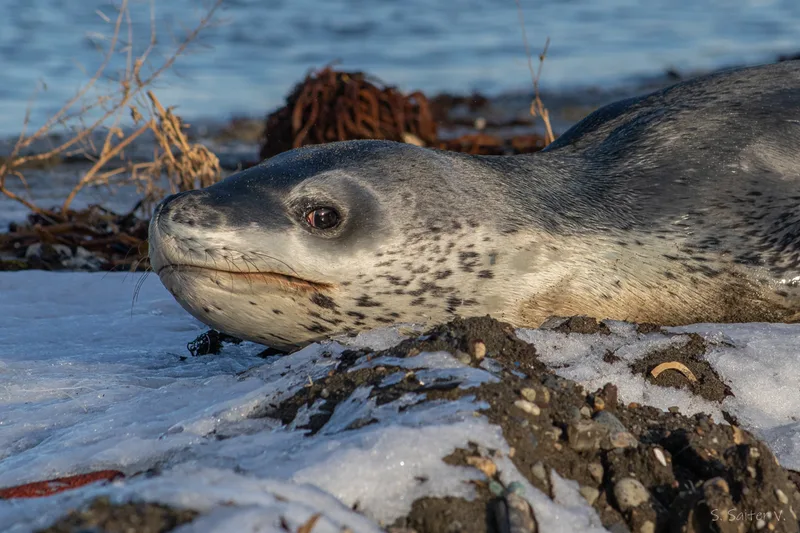
The coat is dark grey on the back and silver to pale grey on the belly. Dark spots and blotches cover the back, and the belly is heavily spotted too. A thick blubber layer keeps the seal warm and gives the body a smooth outline for fast swimming. A newborn pup measures about 120 cm and weighs around 30 kg.
Habitat and range
The leopard seal is an ice-loving species of the Antarctic pack ice, between about 50 and 80 degrees south. Densities are highest in West Antarctica. Most animals stay within the pack ice all year. Satellite tags show them moving north as the ice grows in autumn and south again as it melts in spring.
In the southern winter, mothers with pups may move north to sub-Antarctic islands and southern coasts. A population appears to live and breed in Patagonia. Seasonal visitors and vagrants reach South Georgia, Kerguelen, Heard, Macquarie and the Falkland Islands. Single animals have turned up in Western Australia, New Zealand, Argentina, Brazil, Uruguay, South Africa and Easter Island. GBIF holds records from 20 countries, which include these wanderers.
The seal spends most of its time in the water, hunting near the surface. It hauls out on ice floes, icebergs and beaches to sleep. At Bird Island, South Georgia, seals even sleep in kelp beds with their heads above the water. One female, Owha, lived around New Zealand's North Island for a decade, from 2012 until at least 2022.
Diet and hunting
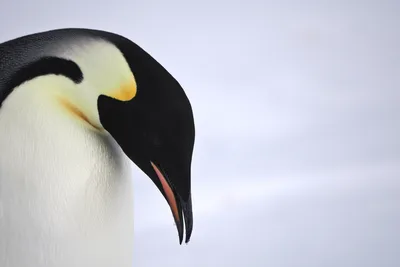
The leopard seal has the widest diet of any Antarctic seal. Young seals eat mostly krill, squid and fish. Adults add penguins, including emperor, king, Adelie, gentoo and chinstrap penguins. They also kill young crabeater, Weddell and Ross seals, elephant seal pups and fur seal pups. Around South Georgia the Antarctic fur seal is the main prey, taken mostly from late December to mid-February.
To catch a penguin, the seal waits almost submerged near the edge of the ice. It grabs the feet of a swimming bird, then shakes it and beats it on the water surface until it dies. It cannot cut meat into pieces, so it thrashes the carcass from side to side to tear it apart. Old reports that it skins a penguin before eating are wrong.
Krill is taken by suction and strained out through the locking cheek teeth. This lets one animal switch between big prey and tiny prey as the season changes. Most dives are shallow, but the seal can go deeper than 80 metres, and the longest known dive lasted about 15 minutes. It collapses its lungs on a deep dive and reinflates them at the surface. Vagrants in New Zealand have eaten elephantfish, ghost sharks and spiny dogfish.
Behaviour and social life
The leopard seal lives alone. The only lasting bond is between a mother and her pup, and it ends at weaning. During surveys, adults seen near one another showed no interaction at all. Seals gather more densely on the pack ice in the breeding season and when pups are born.
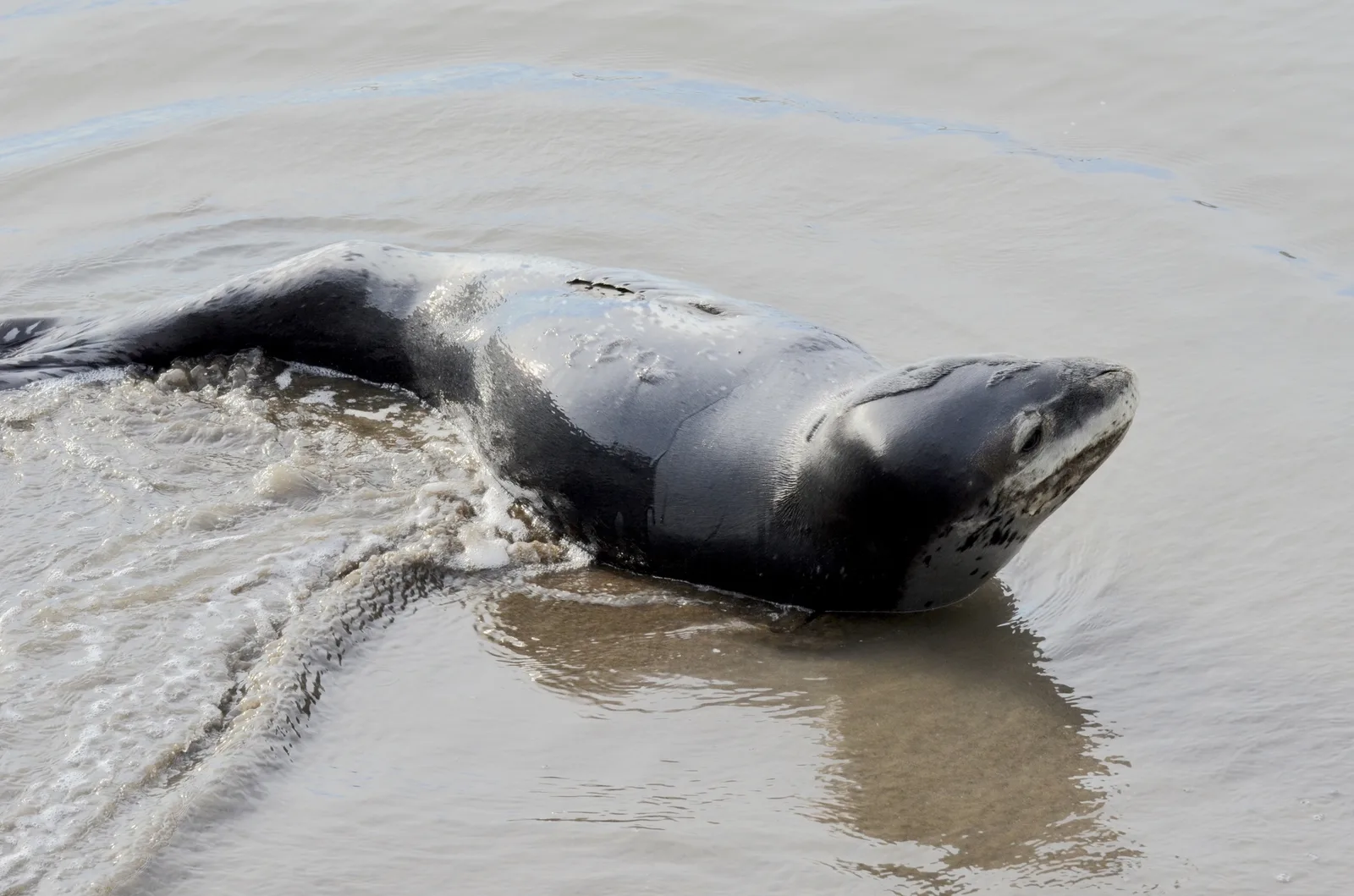
In the water the seal is fast and agile, steering with its big front flippers. On ice and land it moves clumsily. It sleeps on floes, on beaches and among kelp. It keeps to open water and does not travel far under solid ice, as Weddell seals do.
A juvenile can hold its breath for only about 7 minutes, so it cannot reach deep winter krill. That may explain the rare cases of two seals hunting fur seal pups together. One female brought live, injured and then dead penguins to a photographer over four days, as if to feed him. Leopard seals also bite the black pontoons of inflatable boats, so researchers fit guards to them.
Communication and senses
Leopard seals hear in air about as well as a person does. Underwater they use hearing and their whiskers together to track prey. Most sightings come from acoustic surveys, because the seals call underwater through the southern spring and summer.
Males sing underwater for many hours each day in summer, at 153 to 177 decibels. A singing male hangs upside down, arches his back, inflates his chest and rocks from side to side. Scientists recognise five male sounds: a high double trill, a medium single trill, two low trills and a hoot. Each male strings his few calls into his own sequence, like a song. Young males have many variable calls, while mature males keep a few fixed ones, as in some birds.
The songs are thought to mark out space between males and to draw females. Captive females call when their breeding hormones rise. A mother also calls to get the attention of her pup when she returns from feeding.
Reproduction and life cycle
Much of the breeding cycle is unknown, because the pack ice is hard for people to reach. The system is polygynous, and one male mates with several females. Mating takes place in the water from December into early January, soon after the pups are weaned. Males become fertile at about 3 to 6 years and females at 2 to 7 years.
Pregnancy averages 274 days, and the embryo pauses for 2 months before it implants. The mother digs a round hollow in the ice for the pup. One pup is born in November or early December on the floating pack ice. It weighs about 30 kg at birth and measures about 120 cm. The mother nurses it on an ice floe for about 4 weeks, and then it is on its own.
The father plays no part and returns to his solitary life after mating. About 25% of pups die in their first year. Survey voyages found about one pup for every three adults in November and December. A wild leopard seal probably lives about 26 years, and the record is 30. One wild-born animal died in captivity at about 17.3 years.
Predators and threats
No animal other than the orca hunts an adult leopard seal. Even so, orcas rarely eat leopard seals. Vagrants in Australia and New Zealand carry wounds from stingrays, chimaeras and cookiecutter sharks.
People pose no direct threat today, and no hunting takes place. Early explorers killed a few for food and for their sled dogs. Soviet sealers took about 650 in an experimental harvest in 1986 and 1987. The Convention for the Conservation of Antarctic Seals now protects the species from harvest.
The larger worries are indirect. Shrinking pack ice would remove the platform on which the seal gives birth and nurses. Commercial krill fishing competes for its main prey. Tourism, tangling in marine debris and canine distemper virus add further risks.
Population and conservation
The IUCN gives the species the code LC, Least Concern. Estimates of the world population range from 220,000 to 440,000 animals. A 2012 survey gave 35,000, which the IUCN considers a serious undercount. The trend is unknown, but nothing points to a decline.
Counting these seals is hard and costly, because they are spread across the pack ice and spend long periods underwater. Visual surveys miss them in spring and summer, when they are busy calling below the surface. Acoustic surveys, of the kind used for whales, now give most of what is known about their numbers.
In New Zealand waters the Marine Mammals Protection Act protects the species. Australia's Taronga Zoo kept three rescued vagrants, Brooke, Sabine and Casey, between 1999 and 2014. They were not released, for fear of carrying disease back to the wild population.
Relationship with humans
Few people ever meet a leopard seal, and attacks on humans are rare. Most of its fierce reputation comes from the early days of Antarctic exploration. In Shackleton's expedition of 1914 to 1917, a seal about 3.7 metres long and 500 kg chased Thomas Orde-Lees across the ice. Frank Wild shot it to save him. In 1985 a seal bit the explorer Gareth Wood twice and tried to drag him into the sea.
In 2003 the biologist Kirsty Brown died while snorkelling near Rothera Research Station. A leopard seal dragged her down to about 70 metres and held her under for about six minutes. It was the first recorded human death caused by the species. An expert at the inquiry suggested the seal took her for a fur seal or attacked in fright. In 2021 a seal harassed three spearfishers off Simon's Town in South Africa for half an hour and bit them.
Researchers and tourists now keep a distance from the seals and armour their boats. The species is used in science and education, and it has no known economic harm. More people in Antarctica may bring more encounters.
In culture and myth
No people ever lived in Antarctica, so traditional myth has little to say about the leopard seal. The selkie stories of Scotland and Ireland concern northern seals, not this species. Spirit-animal writers read it as a sign of strength, independence and survival, but that reading is probably modern.
Its cultural life began with the explorers' journals. The story of the sea leopard that chased Orde-Lees became one of the famous episodes of Shackleton's expedition. Nature films later seem to have fixed its image as the penguin's chief enemy. Paul Nicklen's photographs of a female offering him penguins showed a gentler side and spread widely. In New Zealand the seal Owha carries a Maori name that means a gift from my ancestors.
A sentence with a dotted underline is inferred: it describes the group the animal belongs to, or is a reading of the sources, rather than a measured or reported fact about this species.
Questions
Leopard seal questions, answered
How big is a leopard seal?
An adult measures 300 to 380 centimetres and weighs about 300 to 500 kilograms. Females are the larger sex and can be up to 50% bigger than males.
What do leopard seals eat?
Penguins, krill, fish, squid and the pups of other seals. Young seals eat mostly krill, squid and fish, and adults take penguins and fur seal or crabeater seal pups.
Are leopard seals dangerous to humans?
They can be. A leopard seal killed a biologist in 2003, and others have chased and bitten people. Attacks are still rare, and most seals ignore people.
Where do leopard seals live?
On and around the Antarctic pack ice, between about 50 and 80 degrees south. Some reach sub-Antarctic islands and Patagonia, and vagrants turn up in New Zealand, Australia, South Africa and South America.
What eats a leopard seal?
Only the orca. Even orcas take them rarely.
How do leopard seals kill penguins?
The seal waits almost submerged at the edge of the ice. It grabs a swimming penguin by the feet, shakes it, and slaps it against the water. Then it tears the body apart by thrashing it from side to side.
Are leopard seals endangered?
No. The IUCN lists them as Least Concern, with an estimated 220,000 to 440,000 animals. Loss of pack ice and krill fishing could become threats.
How long do leopard seals live?
About 26 years in the wild, and up to 30. Little is known about captive lifespans, because so few have been kept.
Do leopard seals eat krill?
Yes. They suck in krill and strain it through cheek teeth that lock together like a sieve. Krill is the main food of young seals.
Why is it called a leopard seal?
Because of the dark spots on its grey and silver coat. Early sailors also called it the sea leopard.
How deep can a leopard seal dive?
Most dives are shallow, but tagged seals have gone deeper than 80 metres. The longest recorded dive lasted about 15 minutes.
Do leopard seals live in groups?
No. They live alone, and the only bond is between a mother and her pup for about 4 weeks. Adults seen near each other do not interact.
Why do leopard seals sing?
Males call underwater for hours a day in the breeding season, from November into January. The songs are thought to keep males apart and to attract females.
How many leopard seals are there?
Estimates range from 220,000 to 440,000. Counting is difficult on the pack ice, and a 2012 survey that found 35,000 is considered a serious undercount.
Is the leopard seal the biggest Antarctic seal?
No. The southern elephant seal is larger. The leopard seal comes second and is the largest of the four true Antarctic seals in the tribe Lobodontini.
Food web
Prey and food
- penguins
- krill
- fish
- squid
- crabeater seal pups
- fur seal pups
 Emperor penguin
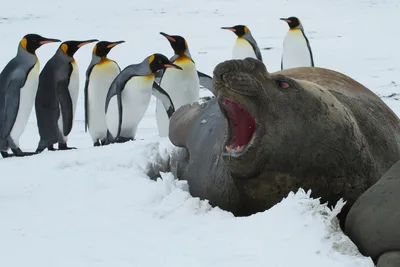 Southern elephant seal
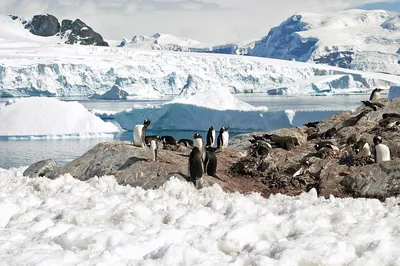 Gentoo penguin
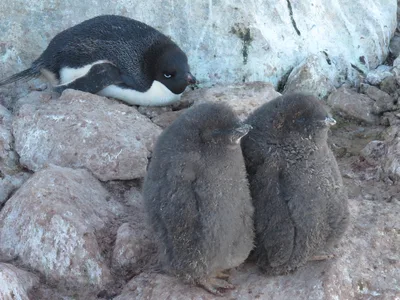 Adélie penguin
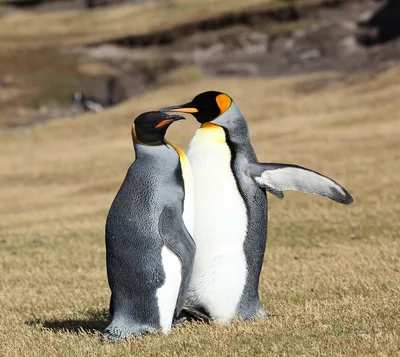 King penguin
Food web
Predators
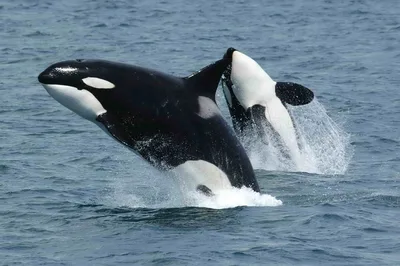 Orca
Ecological equivalents
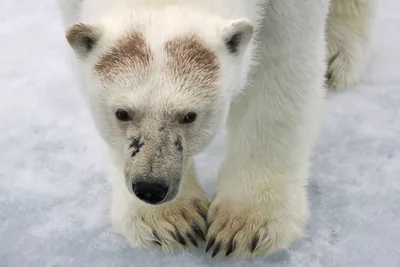
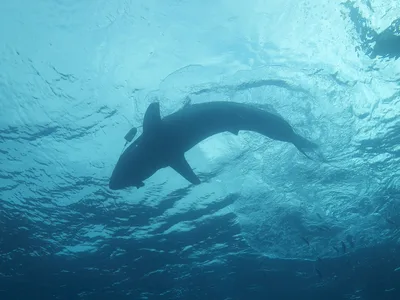
Related species on this site
Crabeater Seal (same family), Elephant Seal (same family), Grey Seal (same family), Harbor Seal (same family), Harp Seal (same family), Hawaiian Monk Seal (same family), and more.
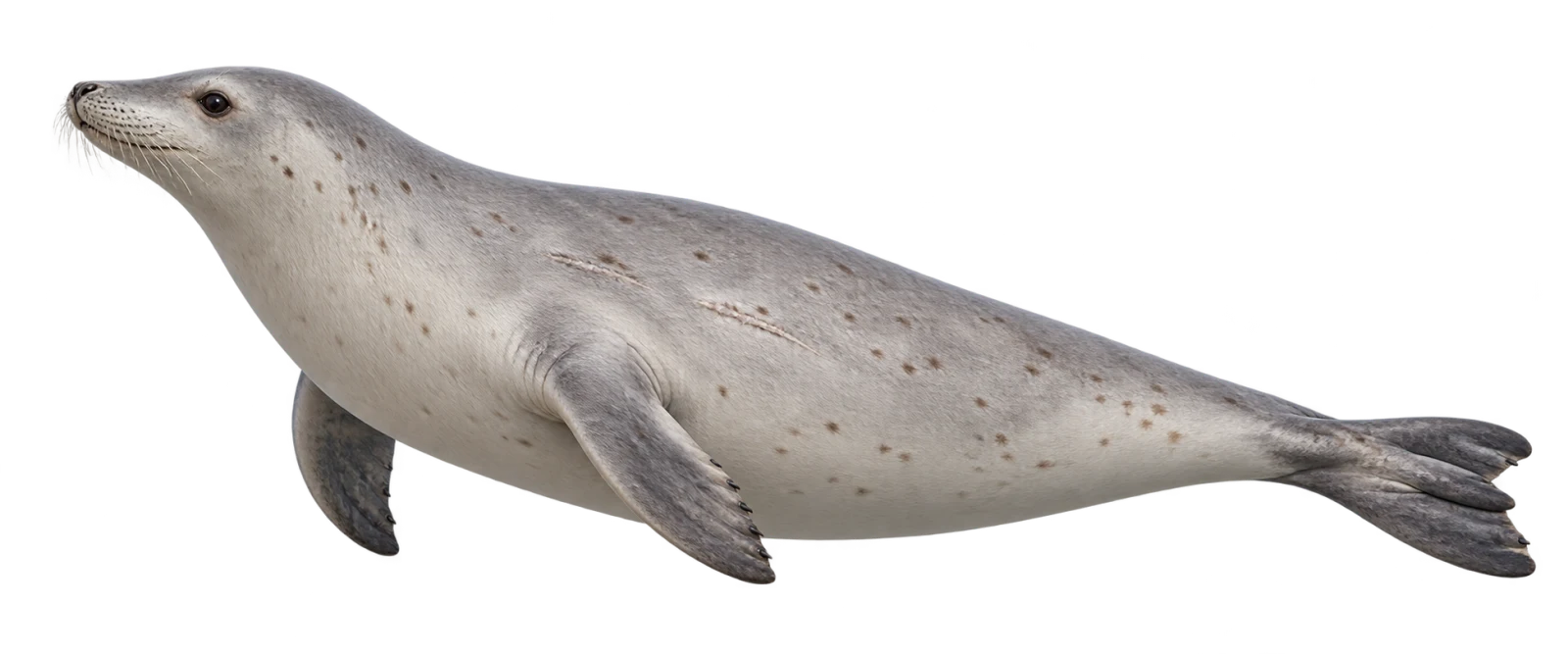
Mammals
Crabeater Seal
Lobodon carcinophaga
Classification and source reference
LivingAI illustration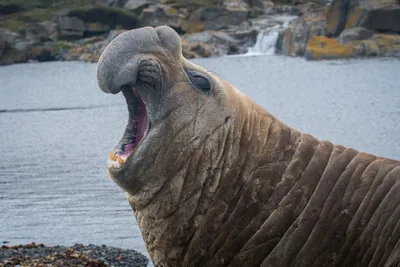
Mammals
Elephant Seal
Mirounga
Elephant seals are large marine mammals.
Living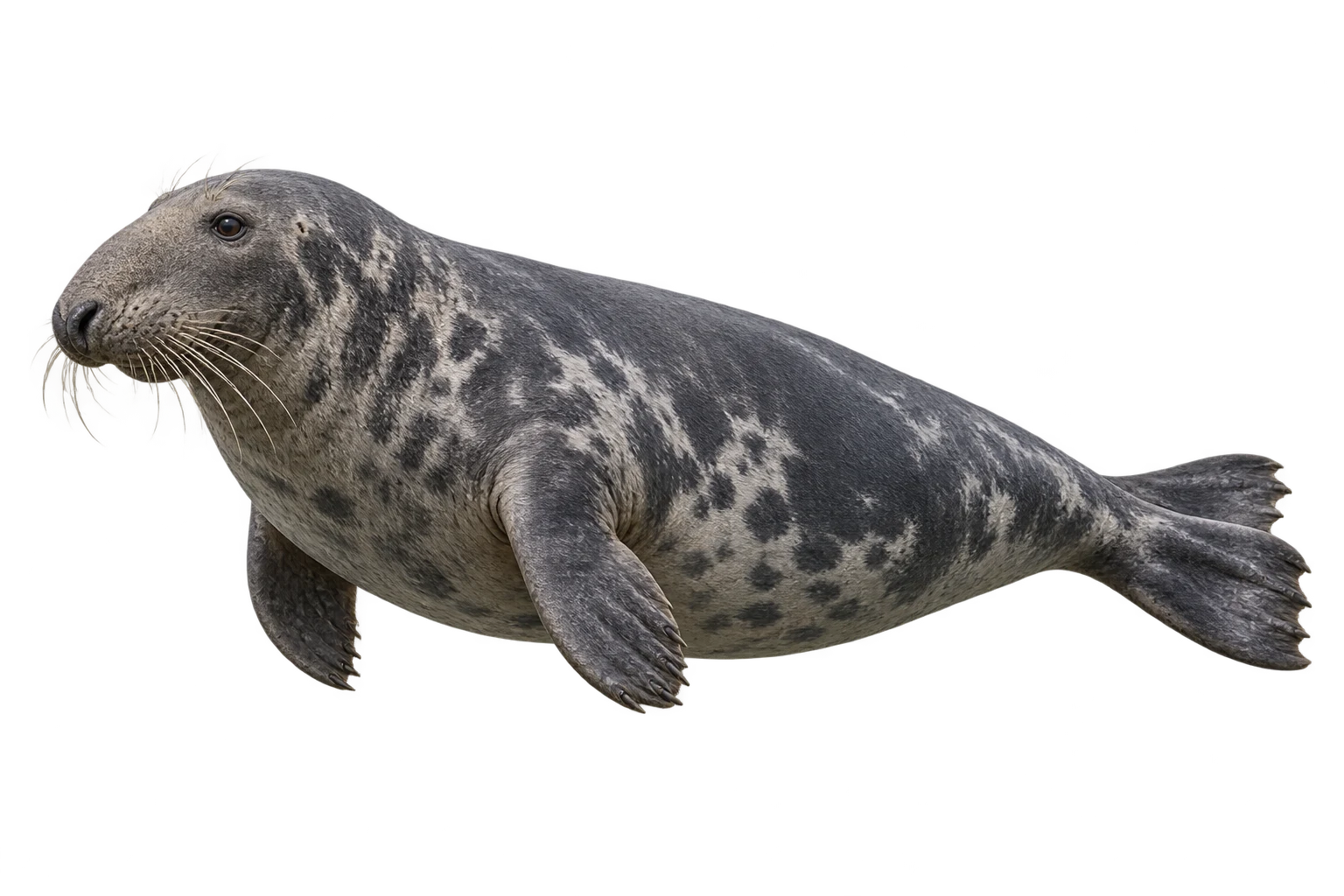
Mammals
Grey Seal
Halichoerus grypus
Classification and source reference
LivingAI illustration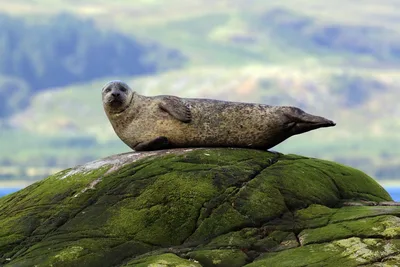
Mammals
Harbor Seal
Phoca vitulina
The harbor seal is a spotted marine mammal of northern coastal waters.
Living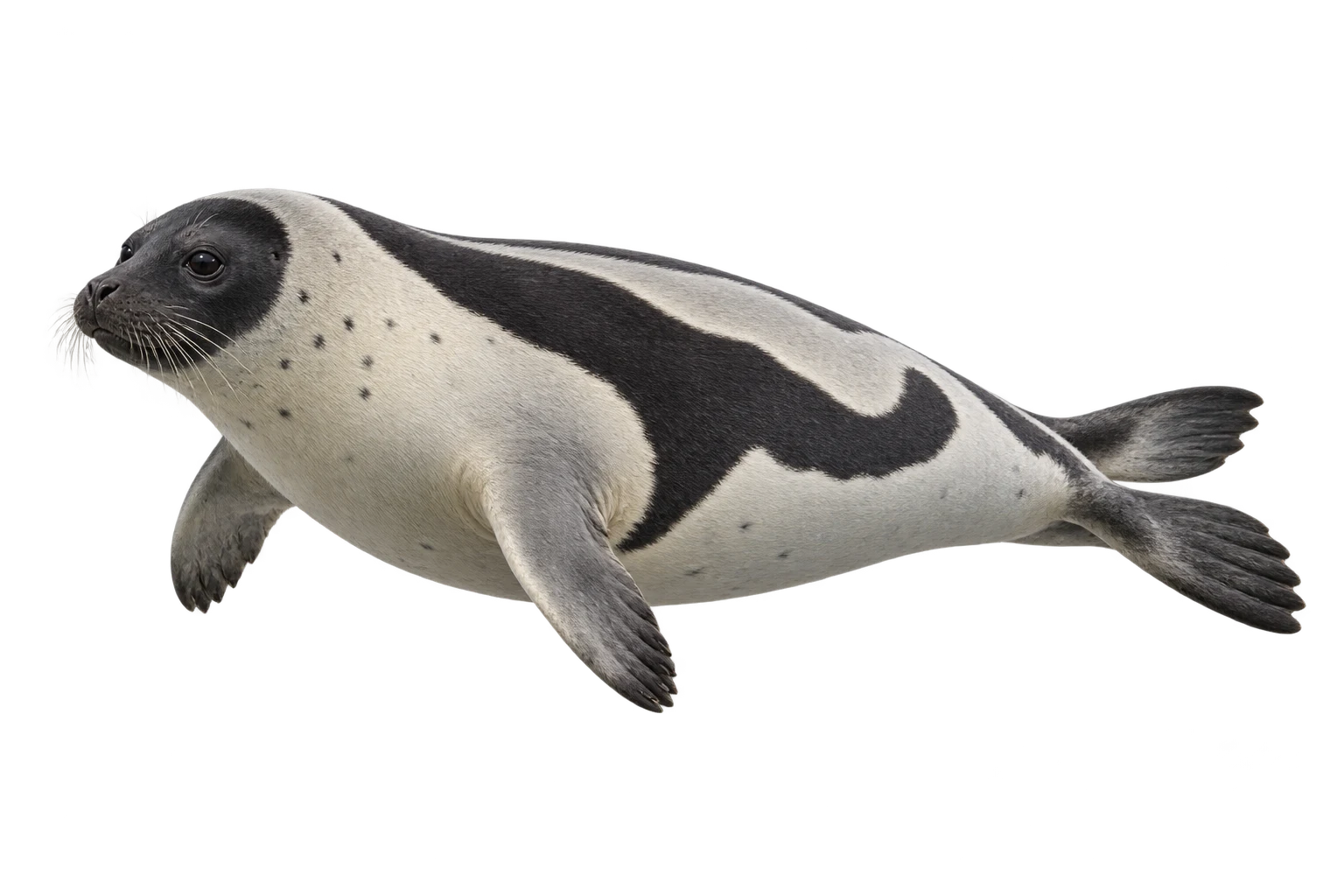
Mammals
Harp Seal
Pagophilus groenlandicus
Classification and source reference
LivingAI illustration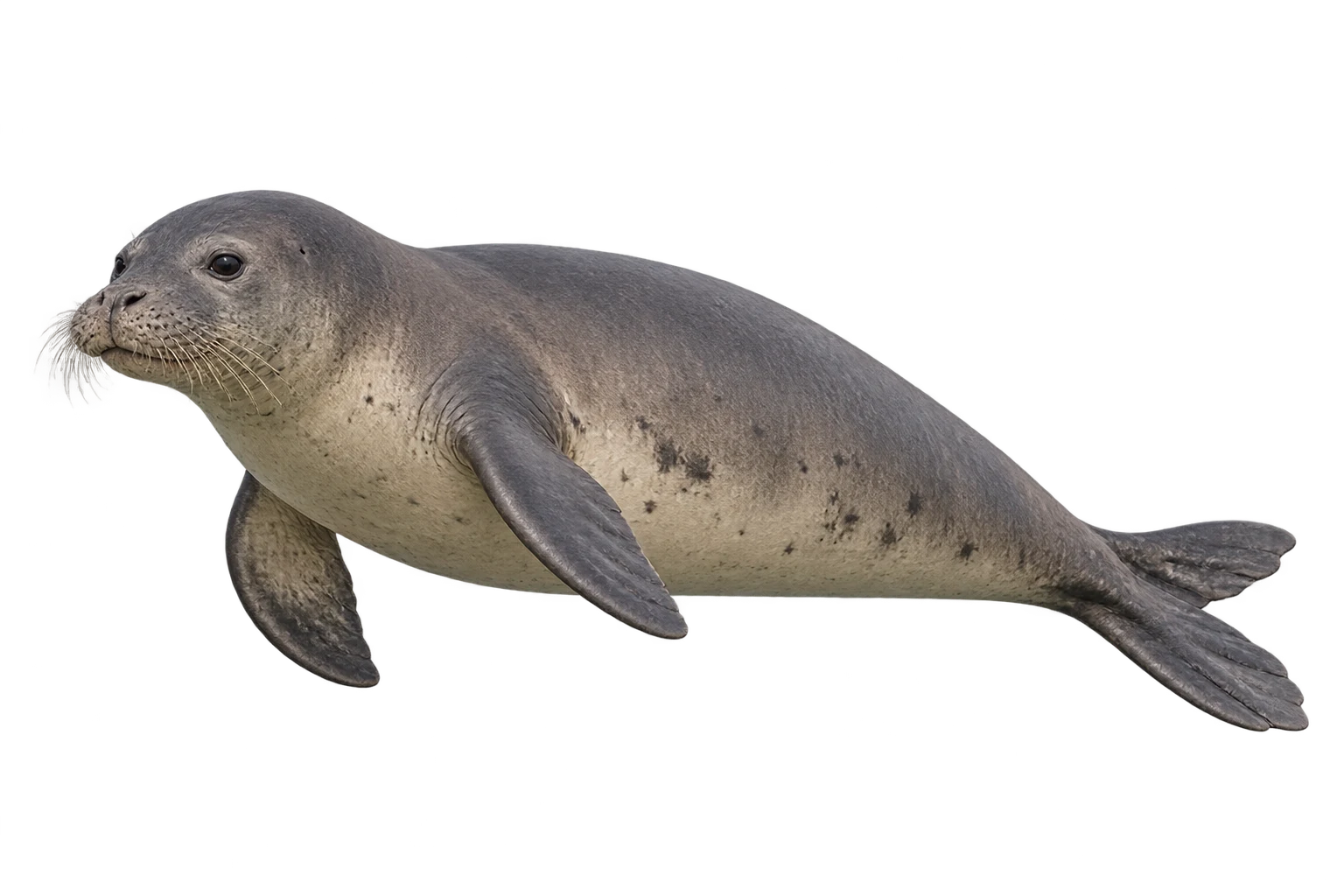
Mammals
Hawaiian Monk Seal
Neomonachus schauinslandi
Classification and source reference
LivingAI illustration