King penguin
The second largest penguin, and the slowest to raise a chick
Aptenodytes patagonicus
Also called Manchot royal, Pingüino rey, Pinguim-rei
Living individuals or members of this group exist today. This does not mean they are safe from extinction.
Meet the king penguin
The king penguin is the second largest penguin, an orange-throated bird of subantarctic island beaches. It dives past 100 metres for lanternfish and takes over a year to raise one chick.
Images of the king penguin
Lifespan in the wild
Up to 27 years one banded bird of at least 27 years
Weight
9.3 to 17.3 kg
Height
85 to 95 cm
Top speed
6.5 to 10 km/h
Fact file
King penguin
- Location
- Subantarctic islands between 45 and 55 degrees south
- Habitat
- Coast, Open ocean
- Diet
- Piscivore
- Prey / food
- Lanternfish, squid, krill
- Predators
- Leopard seals, orcas and fur seals; skuas and giant petrels take chicks
- Lifestyle
- Colonial and active by day; weeks at sea between shifts on shore
- Group name
- Colony
- Name of young
- Chick
- Incubation
- About 55 days of incubation
- Clutch size
- 1 egg
- Population
- About 2.23 million breeding pairs, and increasing
- Biggest threat
- Ocean warming that moves its fish away from the colonies
- Distinctive feature
- Orange patches behind the eyes and an orange throat
- Colour
- Silver-grey back, white front, black head with orange marks
- Skin type
- Feathers
Size
Next to a person
Measurements
Size and speed
- Height
- 85 to 95 cm standing height; Wikipedia gives a wider 70 to 100 centimetres
- Weight
- 9.3 to 17.3 kg
- Weight, male
- About 12.8 kg
- Weight, female
- About 11.5 kg
- Top speed
- 6.5 to 10 km/h average swimming speed
Typical adult ranges. Sources: Animal Diversity Web, Wikipedia, Wikidata.
Life cycle
Lifespan
- In the wildUp to 27 years one banded bird of at least 27 years
- In captivityUp to 26 years
- 027 years
The pale bar is the record. Sources: AnAge, Animal Diversity Web.
Appearance
Colour and coat
- Primary colours
- blackwhitegrey
- Secondary colours
- orangeyellow
- Skin type
- feathers
- Male and female
- Slight. Males average about 12.8 kg and females about 11.5 kg, and the plumage is the same on both. The sexes can be told apart by their calls.
Life cycle
Mating and family
- Mating system
- serially monogamous, usually with a new mate each year
- Social structure
- dense colonies of thousands of pairs
- Breeding
- one chick, usually twice in three years
Adults come ashore to moult between September and November, then court. The female lays one egg that both birds incubate on their feet for about 55 days. A parent guards the chick for 30 to 40 days, then the young join a crèche. The chick fasts through winter and goes to sea 14 to 16 months after the egg was laid. Birds first breed at about five or six years old.
Classification
Taxonomy
- Kingdom
- Animalia
- Phylum
- Chordata
- Class
- Aves
- Order
- Sphenisciformes
- Family
- Spheniscidae
- Genus
- Aptenodytes
- Species
- Aptenodytes patagonicus
Conservation
Red List status
- LC
- NT
- VU
- EN
- CR
- EW
- EX
Least Concern on the IUCN Red List
Range
Recorded in 9 countries
- Antarctica
- Argentina
- Ashmore and Cartier Islands
- Chile
- Falkland Islands
- South Georgia and the South Sandwich Islands
- New Zealand
- French Southern and Antarctic Lands
- South Africa
Habitat layer: mangrove.
Countries from 1,553 wild records on GBIF (iNaturalist research grade), filtered and checked by hand. Country shapes: Natural Earth. Habitat: RESOLVE Ecoregions 2017, CC BY 4.0. Basemap: Natural Earth.
Habitats
Three things to know
- 1
It carries its single egg on its feet instead of building a nest.
- 2
The chick takes 14 to 16 months to reach the sea, longer than in any other penguin.
- 3
The deepest dive on record for the species reached 343 metres.
Did you know
Seven more facts
- 1
The longest recorded dive by the species lasted 552 seconds.
- 2
About 88 percent of its dives hold a single depth while the bird hunts along it.
- 3
Chicks fast through the subantarctic winter and lose much of their weight.
- 4
The bill stripe reflects ultraviolet light that people cannot see.
- 5
Whalers once burned king penguins as fuel because the islands had no firewood.
- 6
Salisbury Plain in South Georgia holds over 30,000 breeding pairs in one colony.
- 7
Norway released king penguins in Finnmark in 1936, and the birds died out by 1949.
Field notes
How it looks and acts
Field notes
Distinguishing features
- Spoon-shaped orange patches sit behind each eye on a near-black head.
- The throat is deep orange and fades into pale yellow on the breast.
- The back is silvery grey, not the black of most penguins.
- The bill is long and slender with a bright stripe on the lower half.
- Adults stand 85 to 95 centimetres tall, second only to the emperor penguin.
- Chicks wear heavy brown down that hides the shape of the bird.
Field notes
Unique adaptations
- A brood pouch of belly skin holds the egg off the cold ground.
- Dense overlapping feathers keep the bird warm in the water for hours.
- A two-part voice box lets a parent broadcast on two frequencies at once.
- Stiff flippers drive the bird to depths beyond 300 metres.
- Thick fat reserves carry an adult through weeks of fasting on shore.
Field notes
Interesting behaviours
- Adults toboggan on the belly to cross flat ground quickly.
- Swimmers porpoise clear of the water to breathe at speed.
- Chicks gather into crèches while both parents fish.
- Pairs hold a pecking distance from their neighbours all season.
- Birds huddle in blizzards to share heat.
Field notes
Temperament
- The king penguin is social and lives packed among thousands of others.
- It is aggressive at close range and jabs at any neighbour that crowds it.
- It appears to fear people little and often walks up to visitors.
- Pairs are faithful within a season but usually change mates between years.
Field notes
Communication
- Adults trumpet to advertise for a mate and to hold a spot.
- Calls carry three to seven syllables and two frequencies at once.
- Courting pairs bow, shake, strut and stretch face to face.
- Chicks answer the parental call and learn it in their first weeks.
- Smell may help a bird recognise its own colony.
Ecology
Ecological role
The king penguin is the large fish-eater of the subantarctic islands, moving food from the open ocean onto land.
- It takes lanternfish and squid from deep water far from shore.
- It feeds leopard seals, orcas, fur seals, skuas and giant petrels.
- Its colonies probably fertilise thin island soils with guano over decades.
- Its numbers track the Antarctic Convergence, so it works as an indicator of ocean change.
Stories
Myths and legends
- In Norwegian military tradition a king penguin holds the rank of major general.
- In Norwegian heraldic play the same bird carries the title Baron of Bouvet Island.
- In Danish children's publishing the king penguin Pondus became a household picture.
- In Australian popular culture the outsized chick Pesto became a 2024 celebrity.
People
Relationship with humans
People
Living alongside us
Whalers almost wiped out the South Georgia and Falklands colonies by the 1920s, burning the oily birds as fuel. The species is now fully protected and the population is rising. Tourists visit the colonies under tight rules on access. Zoos keep king penguins as a flagship species, and one bird holds a Norwegian military rank. Commercial fishing and ocean warming are the pressures that remain.
- The king penguin appears to take no interest in people and does not attack them.
- A cornered bird may jab with the bill and beat with the flippers, which can bruise.
- Visitors are kept at a distance mainly to protect the birds from disease.
People
Status, uses and products
- Domestication
- Wild
- As a pet
- Not suitable. No. The bird needs cold water, several kilograms of fresh fish and the company of a colony. It is protected everywhere it breeds, and only licensed zoos and aquaria may hold it.
- Uses
- ecotourismzoo display
- Products
- None recorded
The full account
About the king penguin
The king penguin is the second largest penguin, behind the emperor penguin. It stands 85 to 95 centimetres tall and weighs 9.3 to 17.3 kilograms. A bright orange patch sits on each side of the dark head, and orange washes down the throat. The back is silver-grey rather than black, which sets the bird apart from every other penguin.
King penguins breed on subantarctic islands ringing the Southern Ocean. They hunt lanternfish and squid, diving well past 100 metres for them. The bird takes 14 to 16 months to raise a single chick, which is longer than any other penguin. Colonies are enormous, and the largest of them hold several hundred thousand pairs.
Name and taxonomy
The English illustrator John Frederick Miller published a hand-coloured plate of the bird in 1778. He gave it the name Aptenodytes patagonica and set the type locality as the Antarctic Ocean. Gregory Mathews narrowed that locality to South Georgia in 1911. The genus Aptenodytes holds only this bird and the emperor penguin.
The International Ornithologists' Union treats the species as one form, with no subspecies. Other authorities split it in two, one in the South Atlantic and one in the South Indian Ocean. French speakers call the bird manchot royal, Spanish speakers pingüino rey and Portuguese speakers pinguim-rei. The word king in the name probably marks its size beside the smaller penguins of the same islands.
Evolution and relatives
The king penguin sits in the family Spheniscidae, which holds every living penguin. Its closest relative is the emperor penguin, the only other member of the genus. The two look alike at a glance, and both carry an egg on their feet instead of building a nest. The emperor breeds on sea ice in the Antarctic winter, while the king breeds on island beaches.
The king is about a quarter shorter than the emperor and weighs around a third less. Its cheek patch is solid orange, and the emperor's is yellow fading into white. The king has a longer, straighter bill, larger flippers and a sleeker body. Bone studies show the species grows in two phases, split by a winter fast, which appears unique among penguins. That growth pattern probably follows from the long breeding cycle rather than from ancestry.
Appearance
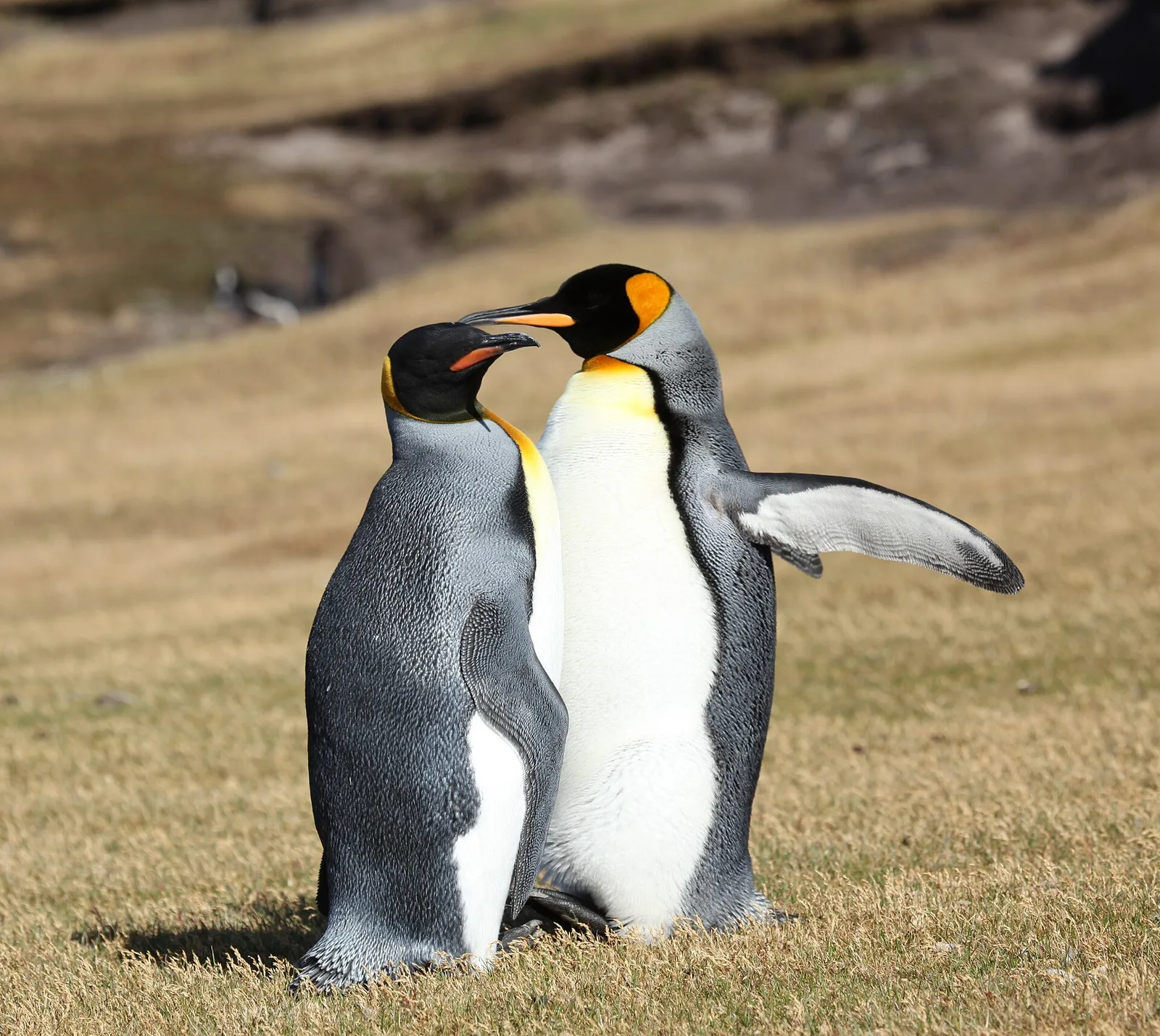
An adult stands 85 to 95 centimetres tall and weighs 9.3 to 17.3 kg, with an average near 11.8 kg. Weight swings through the year, because the bird fasts for weeks on shore. Males average about 12.8 kg and females about 11.5 kg. The head is almost black, with a spoon-shaped orange patch behind each eye. Orange is strongest at the throat, then fades to pale yellow and to a white belly.
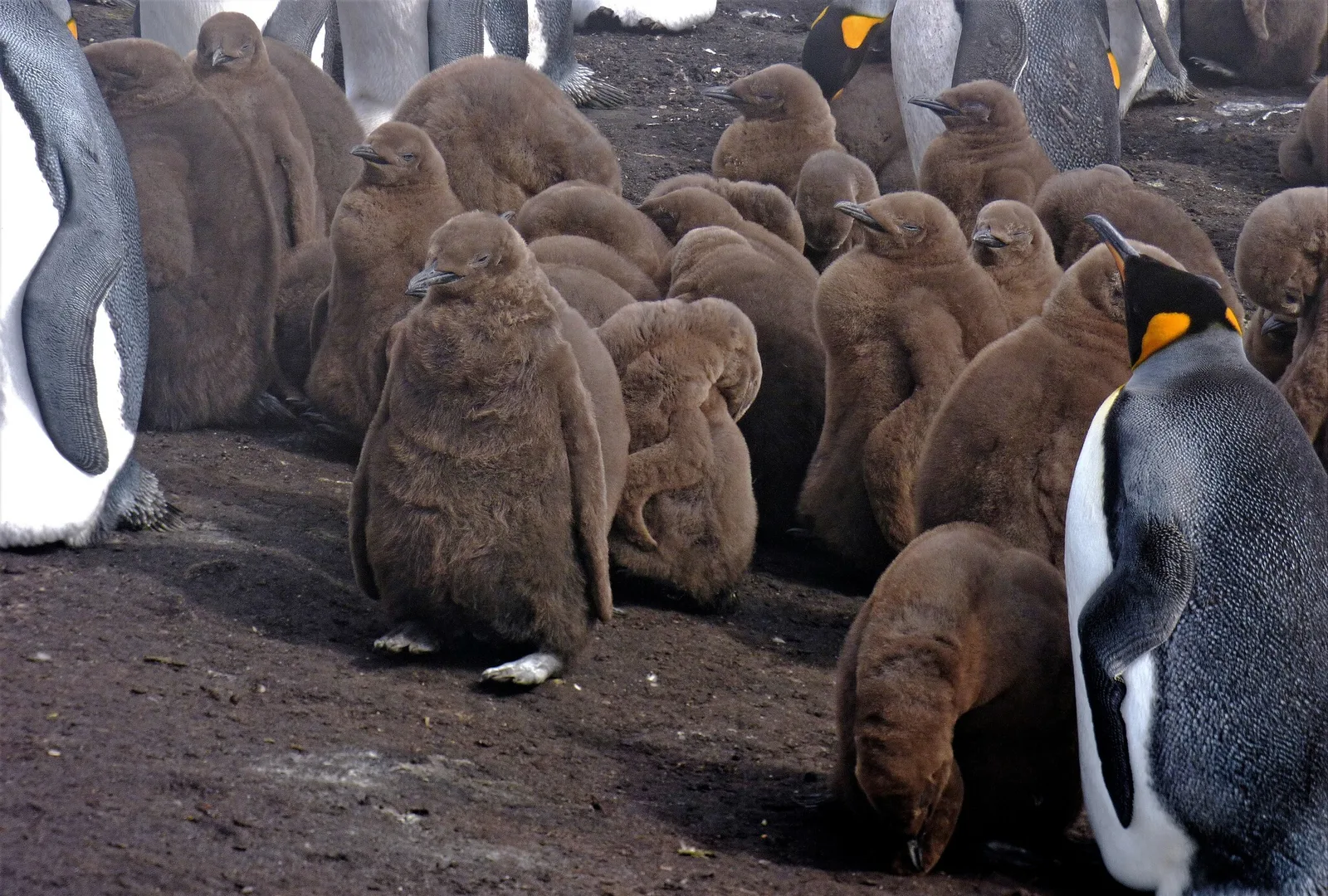
The back and flippers are grey and black with a silvery sheen, and a thin black line edges the flanks. The long slender bill carries a coloured stripe on the lower half, from pinkish red to orange-yellow. That stripe reflects ultraviolet light, and researchers think it signals maturity, health or standing. Chicks wear thick dark brown down and look nothing like the adults. Juveniles that have moulted resemble their parents but carry duller colour until about three years old.
Habitat and range
The species breeds on subantarctic island beaches lying between 45 and 55 degrees south. The main colonies lie on the Crozet, Prince Edward, Kerguelen, Heard, Macquarie and South Georgia islands. Birds also breed on the Falkland Islands and on the Argentine part of Tierra del Fuego. No colony has been found south of 60 degrees south, so this is not a bird of the ice shelf.
Colonies sit on flat, sparsely vegetated ground near a beach, because the birds avoid climbing. At sea the species stays around the Antarctic Convergence, where its fish gather. Wanderers reach South Africa, Australia, New Zealand, Brazil and the Antarctic Peninsula. GBIF holds records from 23 countries and territories, most of them from Heard Island and South Georgia. Norway released birds at Gjesvær and Røst in 1936, and the last accepted sighting there was in 1949.
Diet and feeding
Fish make up roughly 80 percent of the diet for most of the year. In July and August that share falls to around 30 percent, and squid takes its place. Lanternfish are the main catch, along with slender escolar and icefish. Squid taken include the hooked squid and the sevenstar flying squid. Krill fills out the rest of the diet.
The bird feeds by day and dives repeatedly to between 100 and 300 metres. It stays under for about five minutes on a working dive. At night it works shallower water, less than 30 metres down. The deepest dive on record reached 343 metres near the Falkland Islands. The longest recorded dive lasted 552 seconds, at the Crozet Islands.
About 88 percent of dives are flat-bottomed, so the bird holds a depth and hunts along it. The remaining dives cut down through the water and come straight back up. Average swimming speed is 6.5 to 10 kilometres per hour. Foraging trips can run 300 to 500 kilometres from the colony and last more than a week.
Behaviour and social life
King penguins live in dense colonies that are occupied all year round. The colony at St Andrews Bay in South Georgia holds over 150,000 pairs. Birds build no nest, but each pair defends about half a square metre of ground. Positions in a colony stay stable for weeks and are spaced at pecking distance. Penguins near the centre are more aggressive and breed more successfully than those at the edge.
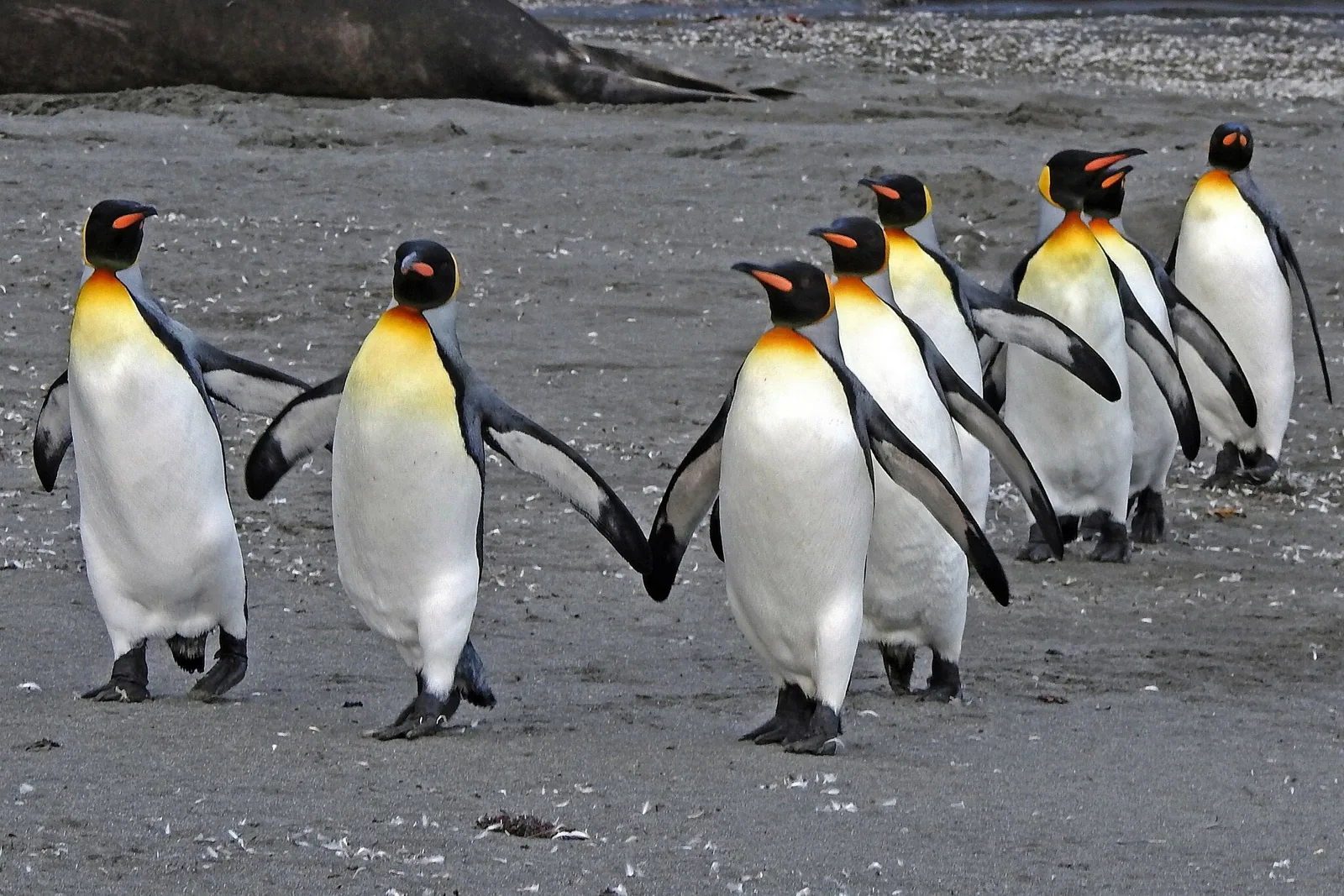
On land the bird alternates a wobbling walk with tobogganing on its belly. At sea it porpoises, leaping clear of the surface to breathe without losing speed. Birds huddle together in blizzards to hold their heat. They bathe in the sea before a fishing trip. Like other penguins, this bird cannot fly at all.
Communication and senses
The voice comes from a two-part syrinx, and each half makes its own sound. Among penguins that organ is found only in this genus. A colony is loud, so an adult calls out three to seven syllables at two frequencies to find its chick. The chick appears to pick out the lower frequency, which carries further through the noise. Researchers call this the cocktail-party effect, and a chick learns the call in its first five weeks.
Without nests or landmarks, that call is the only way a parent finds its own young. Males advertise with a trumpeting call and stretch to full height with the bill raised. A pair that forms then bows, shakes, struts and calls face to face. The birds can also smell feathers and droppings of their own species, which may help them locate a colony.
Reproduction and life cycle
The cycle starts between September and November, when adults come ashore to moult. They go back to sea for about three weeks, then land again to court in November or December. The female lays one pear-shaped white egg that weighs 300 grams. The egg measures about 10 centimetres by 7 cm and hardens to a pale green. No nest is built, so the egg rests on the parent's feet under a fold of belly skin.
Incubation lasts around 55 days, and the pair swap shifts of 6 to 18 days. Hatching can take two or three days, and the chick emerges with only thin down. For 30 to 40 days a parent guards the chick on its feet while the other feeds at sea. The pair change places every three to seven days during that guard phase. Chicks then gather in a crèche watched over by a few adults.
A chick is almost full grown by April, then loses weight through a winter fast. It regains the weight in September and goes to sea in late spring or early summer. The whole cycle takes 14 to 16 months, so a pair cannot raise a chick every year. Most successful pairs breed twice in three years, and fidelity between years is under 30 percent. Birds can breed at three years old, but the average age at first breeding is five or six. One banded wild bird reached at least 27 years, and captive birds live up to 26 years.
Predators and threats
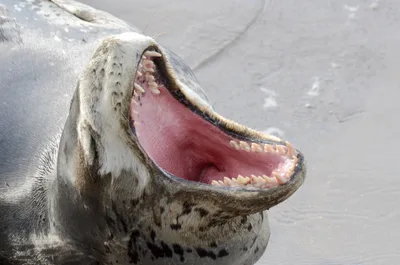
Leopard seals take adults and fledglings in the water. Orcas hunt king penguins at sea, and fur seals kill them on the beach. Giant petrels take chicks of every size and sometimes kill weak adults. Skuas take eggs and small chicks, and sheathbills and kelp gulls scavenge what is left. None of these hunters appears to hold the population down.
Hard ticks and a bird louse both infest king penguins. Heavy tick infestation has killed birds, though the death rate is not known. Commercial fishing for lanternfish is a newer threat, and over 200,000 tonnes were taken near South Georgia by the early 1990s. Ocean warming is pushing the Antarctic Convergence away from the breeding islands.
Population and conservation
The IUCN Red List rates the king penguin as Least Concern. The world population is put at 2.23 million breeding pairs and is rising. The Crozet Islands hold about 455,000 pairs and the Prince Edward Islands about 228,000. Kerguelen holds 240,000 to 280,000 pairs, South Georgia over 100,000 and Macquarie about 70,000. Adult survival has stayed high since the 1970s.
The record is not uniform across the range. The colony on Île aux Cochons fell from about half a million pairs in the 1980s to around 60,000 in 2017. Chile lists the species as Endangered and South Africa as Near Threatened. One projection expects 70 percent of the population to go within 80 years. Colonies in Crozet and Kerguelen sit inside French nature reserves, and Falklands wildlife is protected by a 1999 bill.
Relationship with humans
Whalers on South Georgia and the Falklands nearly destroyed the population by the early 1920s. The islands had no trees, so the crews burned oily penguins as fuel under the blubber pots. They also ate the birds and their eggs and burned the oil in lamps. The species is fully protected today, and the colonies have recovered.
Tourism has replaced hunting as the main contact. In one Falklands study every visitor went to the king penguin colony, and they stayed a mean of 63 minutes. Access to breeding sites is now limited, to keep disease and disturbance out. Zoos keep the bird as a flagship species, and 176 were counted in North American collections in 1999. No one may keep a king penguin privately, and the cold-water diet alone would defeat a keeper.
In culture and myth
The best known king penguin is Nils Olav, mascot of the Norwegian King's Guard at Edinburgh Zoo. The guard adopted the first bird in 1972 and named him after two of its own officers. Successive birds have held the title, rising from lance corporal to colonel-in-chief in 2005. King Harald V knighted Nils Olav in 2008, the first penguin so honoured in the Norwegian army. The third holder became a brigadier in 2016 and a major general in 2023.
Guinness World Records lists him as the highest-ranking penguin, and he carries the title Baron of Bouvet Island. A bronze statue of the bird stands at Edinburgh Zoo and another at the guard's Oslo headquarters. Danish children's books photographed a king penguin named Pondus, who then became a shop character across Canada. Pesto, a very large chick at Sea Life Melbourne, drew wide attention in 2024. The species probably carries no old myth, because no people lived on its islands before sealers arrived.
A sentence with a dotted underline is inferred: it describes the group the animal belongs to, or is a reading of the sources, rather than a measured or reported fact about this species.
Questions
King penguin questions, answered
How big is a king penguin?
Adults stand 85 to 95 centimetres tall. They weigh 9.3 to 17.3 kilograms, with an average near 11.8 kg.
What is the difference between a king penguin and an emperor penguin?
The king is smaller, with a solid orange cheek patch and a grey back. The emperor has a yellow and white patch, a blacker back and breeds on sea ice.
Where do king penguins live?
On subantarctic islands between 45 and 55 degrees south. The main colonies are on Crozet, Kerguelen, Prince Edward, Heard, Macquarie and South Georgia.
What do king penguins eat?
Mostly lanternfish, with squid and krill. Fish make up about 80 percent of the diet outside midwinter.
How deep can a king penguin dive?
It usually works between 100 and 300 metres. The deepest recorded dive reached 343 metres.
How long do king penguins live?
One banded wild bird was at least 27 years old. Captive birds live up to 26 years.
How many eggs does a king penguin lay?
One, weighing 300 grams. Both parents incubate it on their feet for about 55 days.
Why does a king penguin take so long to raise a chick?
The chick is large and must survive a winter of poor fishing. From egg to independence takes 14 to 16 months.
Do king penguins build nests?
No. They carry the egg and the small chick on their feet, and defend about half a square metre of ground.
How do king penguins find their chicks in a huge colony?
By voice. An adult calls on two frequencies at once, and the chick picks out the lower one, which carries through the noise.
Are king penguins endangered?
No. The IUCN Red List rates the species Least Concern, and the world population is put at 2.23 million breeding pairs.
How many king penguins are there?
About 2.23 million breeding pairs. The Crozet Islands alone hold around 455,000 pairs.
How fast can a king penguin swim?
It averages 6.5 to 10 kilometres per hour. It swims slower on shallow dives and faster on deep ones.
Who is Nils Olav?
Nils Olav is a king penguin at Edinburgh Zoo and the mascot of the Norwegian King's Guard. He was knighted in 2008 and made a major general in 2023.
Can you keep a king penguin as a pet?
No. It is protected across its range and needs cold water, fresh fish and other penguins. Only licensed zoos may hold it.
Food web
Prey and food
- lanternfish
- squid
- krill
Food web
Predators
 Leopard seal
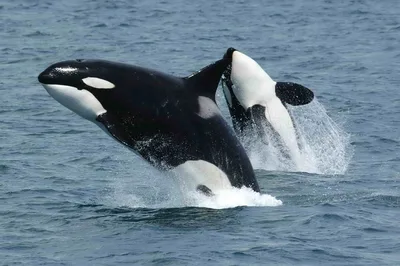 Orca
- fur seals
- skuas
- giant petrels
Ecological equivalents
Related species on this site
Emperor penguin (same genus), Adélie penguin (same family), African penguin (same family), Chinstrap Penguin (same family), Crested Penguin (same family), Galapagos Penguin (same family), and more.
 EN
Birds
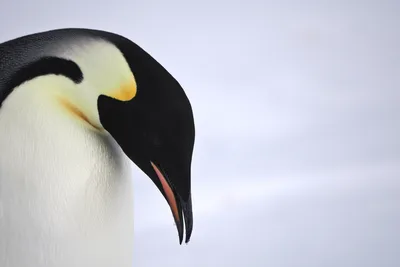
Emperor penguin
Aptenodytes forsteri
The emperor penguin is the largest penguin and the only bird that breeds through the Antarctic winter.
Living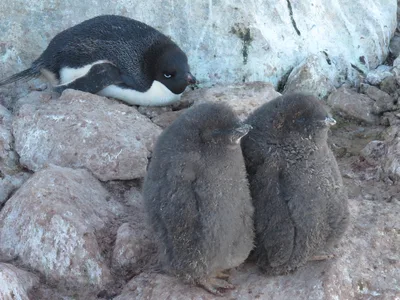 LC
Birds
Adélie penguin
Pygoscelis adeliae
The Adelie penguin is the most widespread penguin of the Antarctic coast.
Living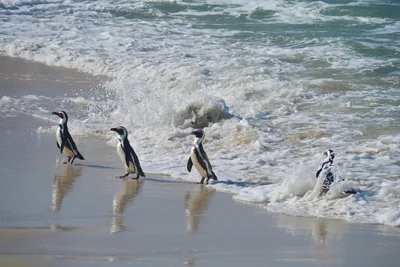 CR
Birds
African penguin
Spheniscus demersus
The African penguin is the only penguin that breeds on the African continent.
Living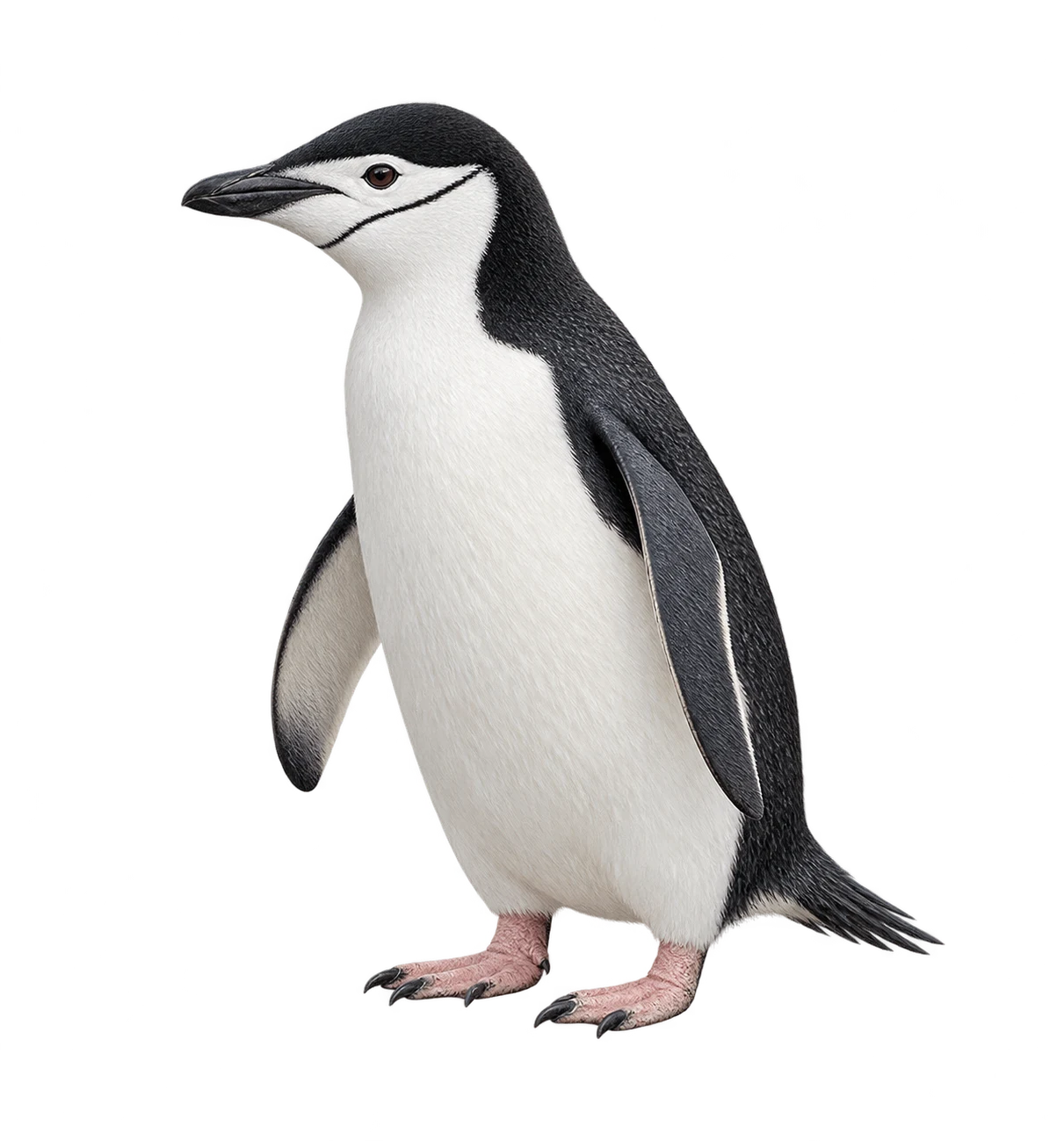
Birds
Chinstrap Penguin
Pygoscelis antarcticus
Classification and source reference
LivingAI illustration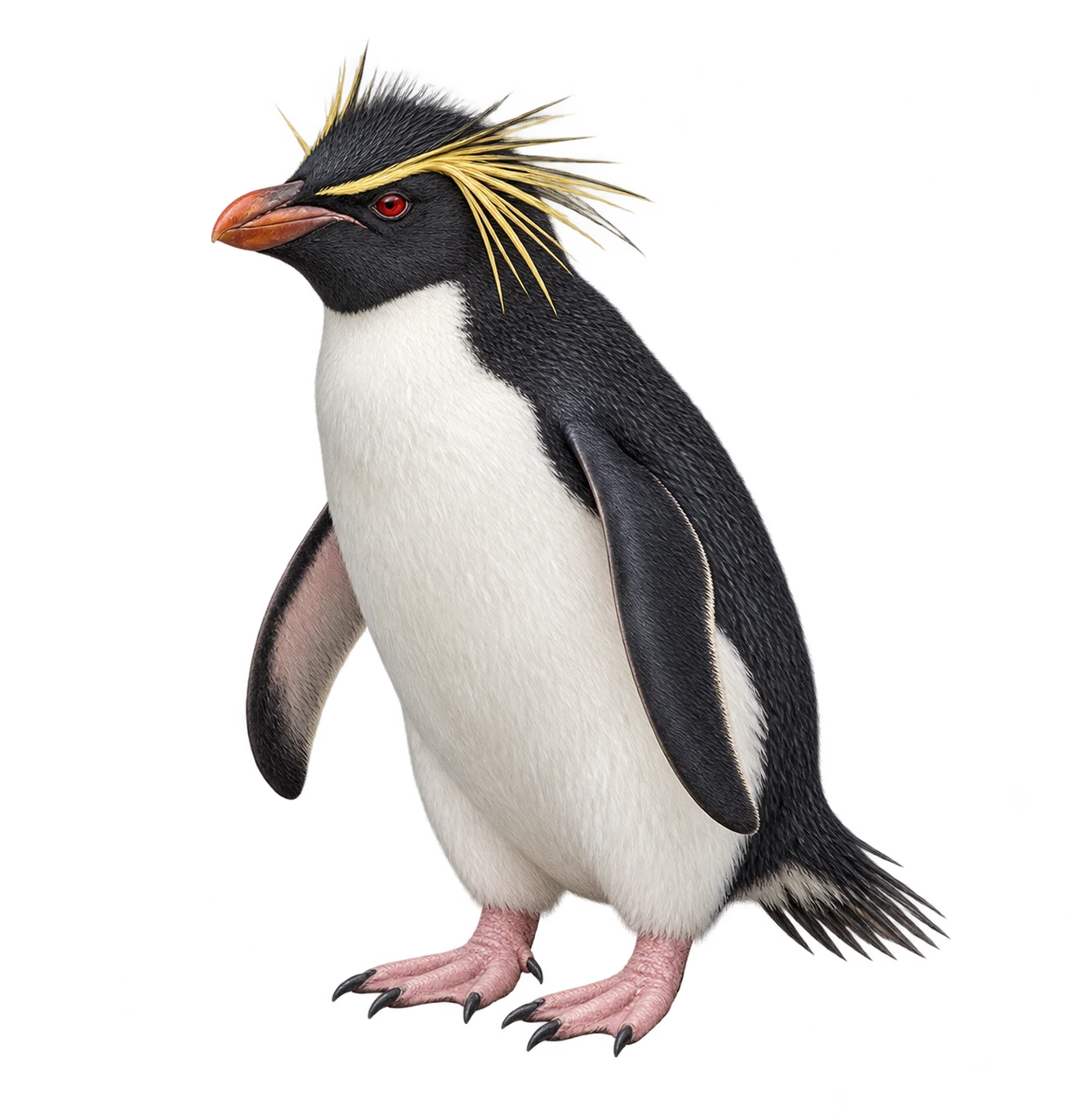
Birds
Crested Penguin
Eudyptes
Classification and source reference
LivingAI illustration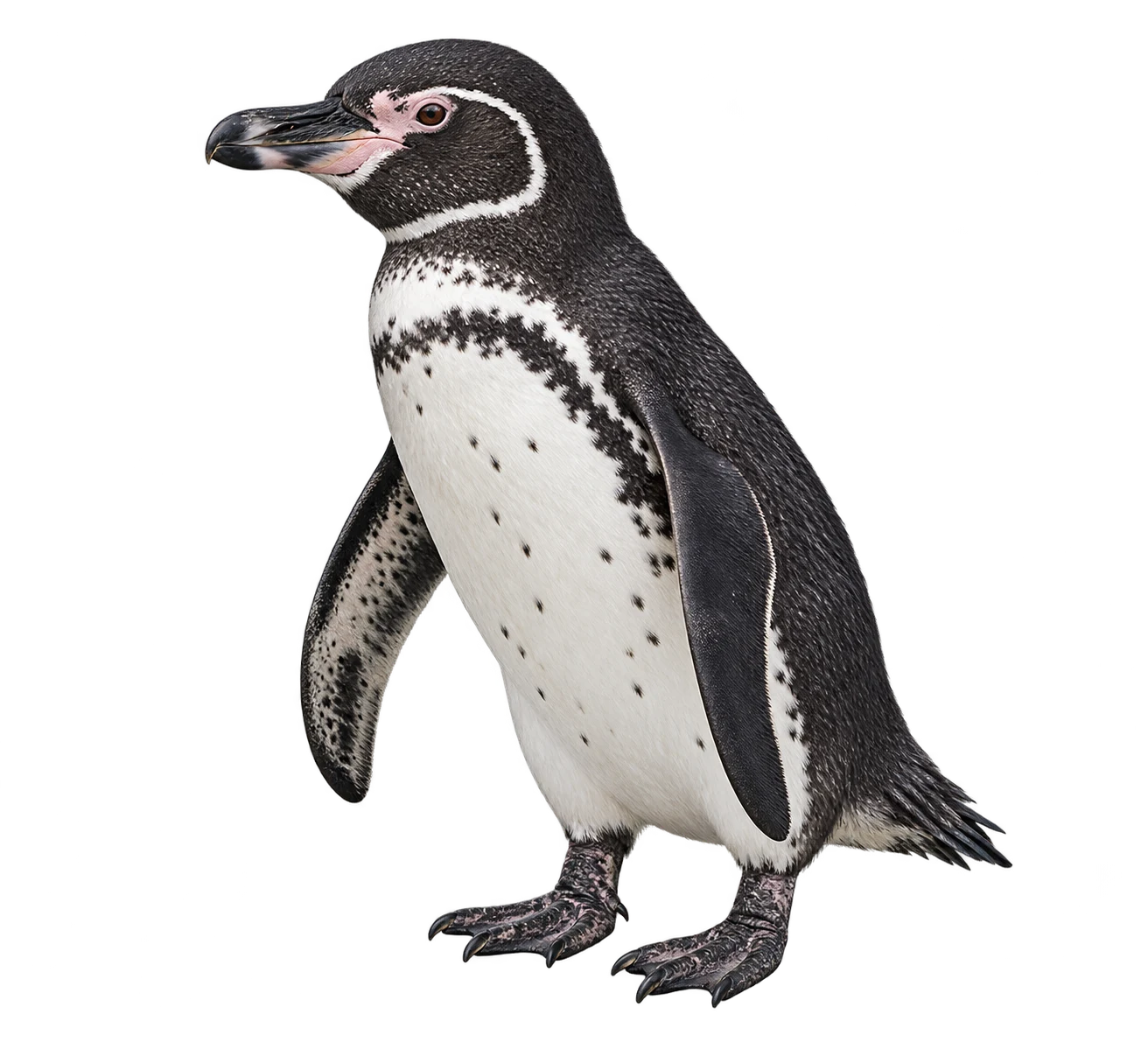
Birds
Galapagos Penguin
Spheniscus mendiculus
Classification and source reference
LivingAI illustration