Muskox
The bearded one, a survivor of the Ice Age tundra
Ovibos moschatus
Also called Musk ox, Umingmak, Oomingmak
Living individuals or members of this group exist today. This does not mean they are safe from extinction.
Meet the muskox
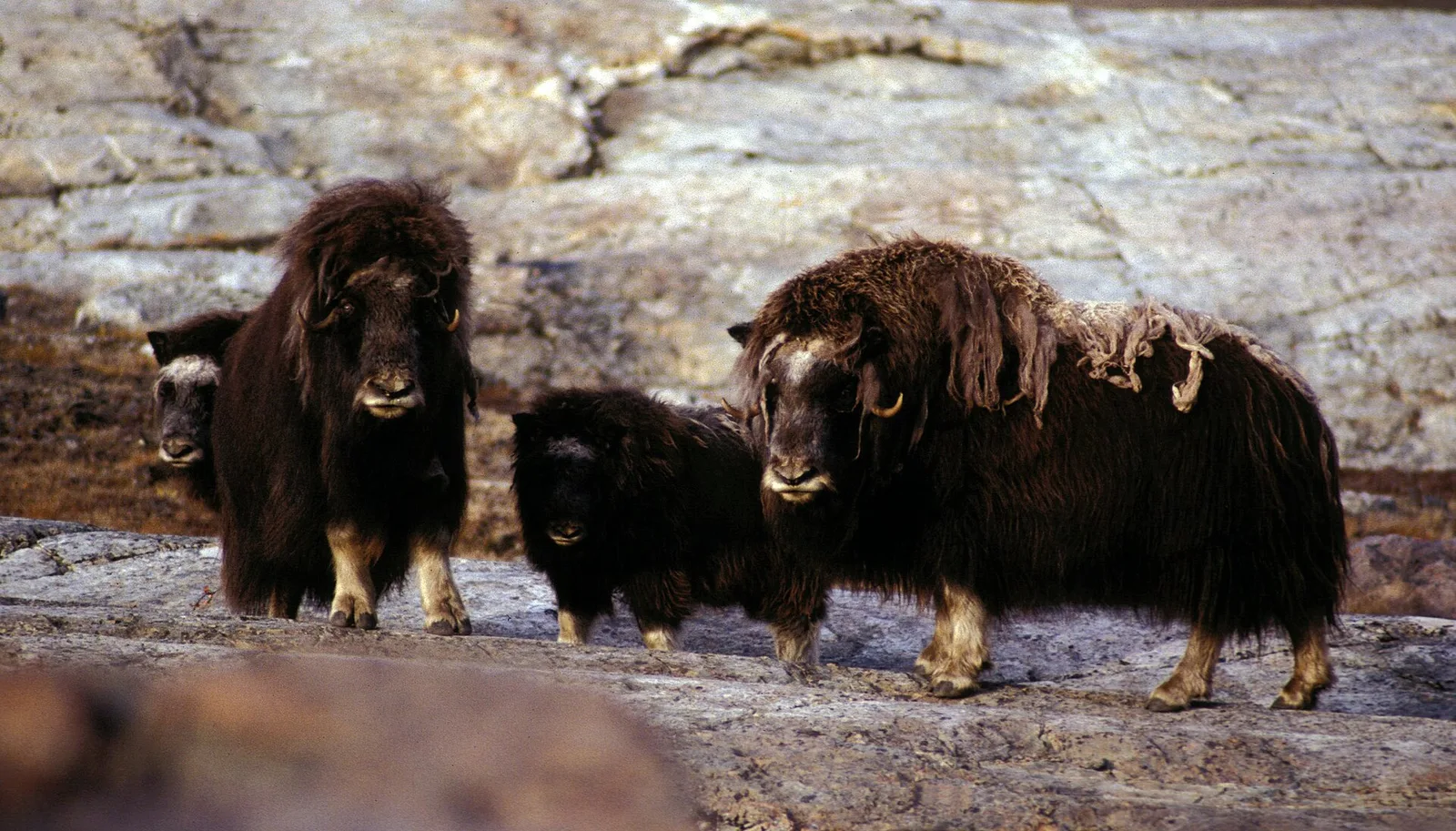
The muskox is a shaggy Arctic grazer, a giant relative of sheep and goats that outlived the Ice Age in Canada and Greenland. Its herds form a horned ring against wolves, and its underwool, qiviut, is warmer than any sheep's fleece.
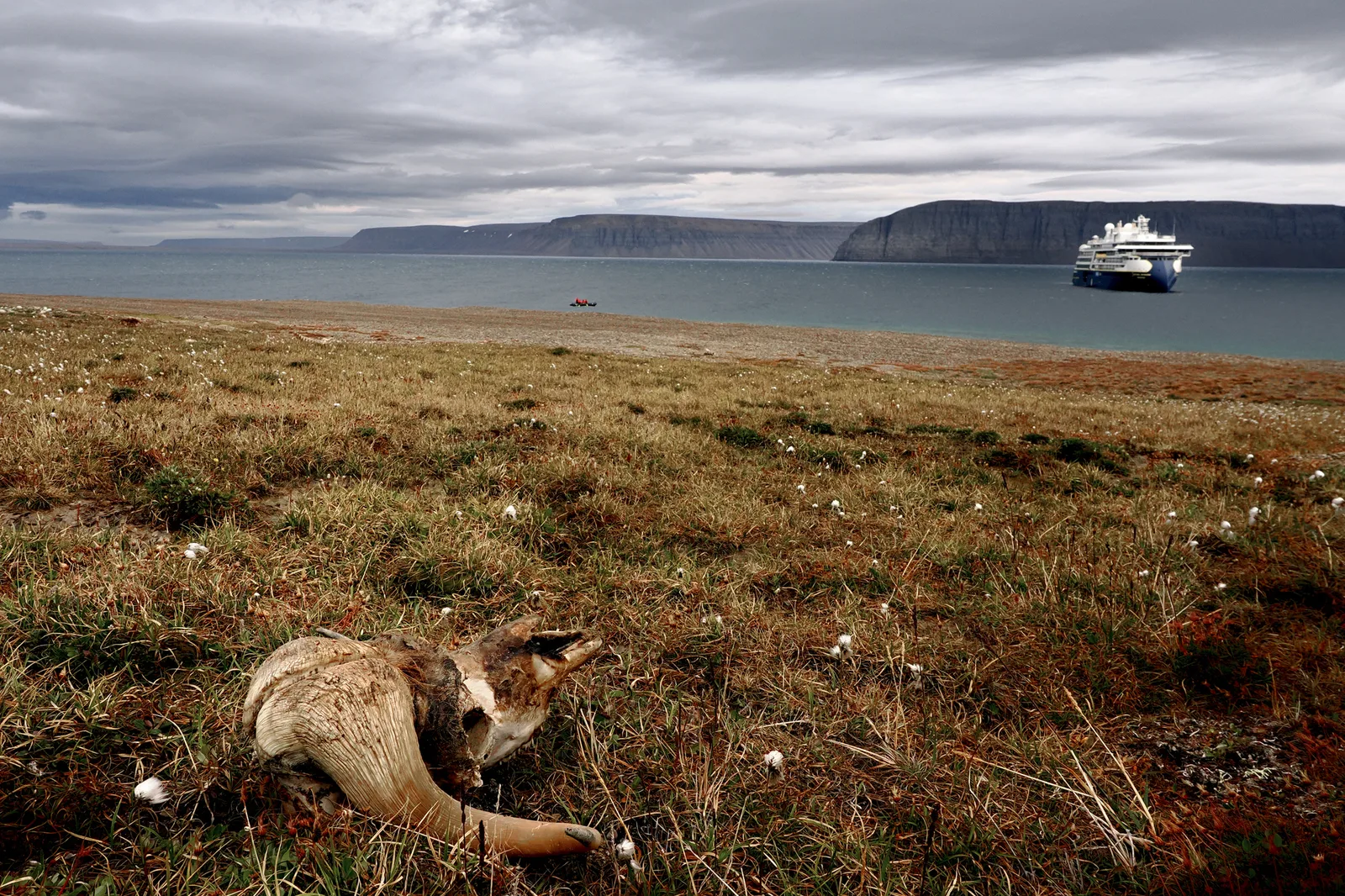
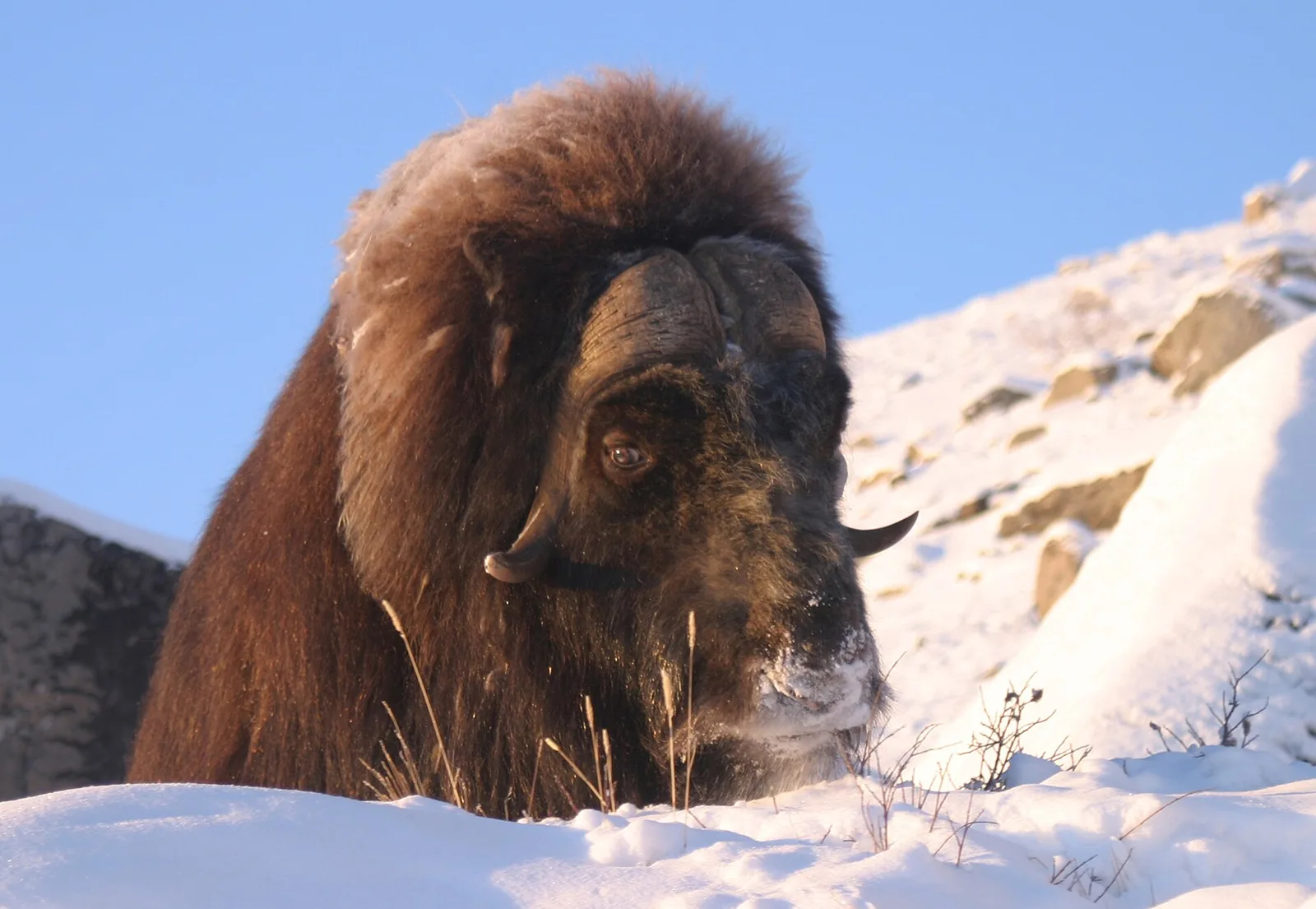
Images of the muskox
Lifespan in the wild
12 to 20 years
Weight
180 to 410 kg
Length
1.35 to 2.5 m
Top speed
Up to 60 km/h
Fact file
Muskox
- Location
- Arctic Canada and Greenland; reintroduced to Alaska, Siberia, Norway and Sweden
- Habitat
- Tundra, Polar ice, Mountains
- Diet
- Herbivore
- Prey / food
- Sedges, grasses, willows, forbs, dwarf birch, moss, lichen
- Predators
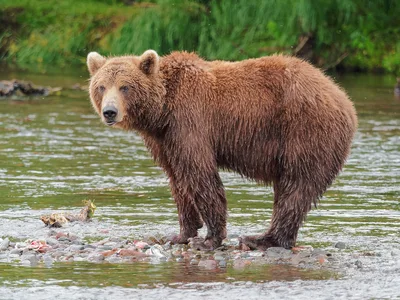
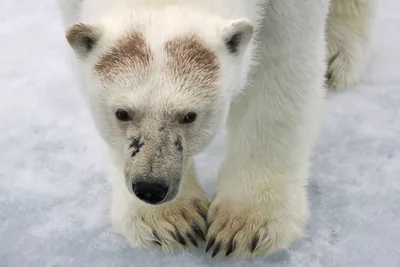
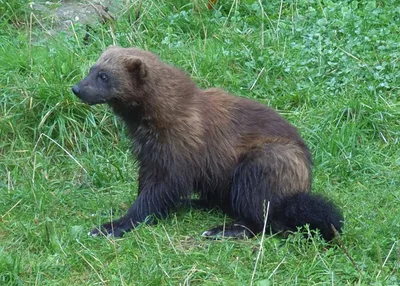
- Arctic wolf; grizzly bears, polar bears and wolverines take calves
- Lifestyle
- Herd-living; active by day, feeding most of the winter
- Group name
- Herd
- Name of young
- Calf
- Gestation
- About 8 to 9 months
- Litter size
- 1 calf
- Population
- 80,000 to 125,000 worldwide
- Biggest threat
- Hard winters and icing of the forage; formerly overhunting
- Distinctive feature
- A ground-length shaggy coat and horns that meet in a boss across the forehead
- Colour
- Dark brown to black with a pale saddle and white legs
- Skin type
- Fur
Size
Next to a person
Measurements
Size and speed
- Height
- 1.1 to 1.5 m at the withers
- Length
- 1.35 to 2.5 m females 135 to 200, males 200 to 250
- Length, male
- 2 to 2.5 m
- Length, female
- 1.35 to 2 m
- Tail
- About 10 cm
- Weight
- 180 to 410 kg, up to 650 kg average about 285; the 650 was a zoo animal
- Weight, male
- 300 to 400 kg
- Weight, female
- 180 to 275 kg
- Top speed
- Up to 60 km/h
Typical adult ranges. Sources: Wikipedia, Animal Diversity Web.
Life cycle
Lifespan
- In the wild12 to 20 years
- In captivityUp to 27.4 years
- 027.4 years
Appearance
Colour and coat
- Primary colours
- dark brownblack
- Secondary colours
- creamgrey
- Skin type
- fur
- Male and female
- Bulls are about 25 percent larger, at 200 to 250 centimetres long against 135 to 200 cm for cows. Bulls also carry a thick horn boss that cows lack.
Life cycle
Mating and family
- Mating system
- polygynous; a dominant bull holds a harem of six or seven cows
- Social structure
- mixed herds of about 10 to 20, larger in winter; bachelor groups of beaten bulls
- Breeding
- one calf every year or two, born April to June
Bulls fight for harems from late June, and mating takes place in August and September. Pregnancy lasts about eight to nine months. A single calf of about 10 kilograms is born between mid-April and early June, often in deep cold. The calf stands within 45 minutes and shelters under its mother's coat through its first winter. Cows first calve at about three and skip a year after a hard winter. Life expectancy is 12 to 20 years.
Classification
Taxonomy
- Kingdom
- Animalia
- Phylum
- Chordata
- Class
- Mammalia
- Order
- Artiodactyla
- Family
- Bovidae
- Genus
- Ovibos
- Species
- Ovibos moschatus
Conservation
Red List status
- LC
- NT
- VU
- EN
- CR
- EW
- EX
Least Concern on the IUCN Red List
Range
Recorded in 5 countries
Habitat layer: montane grassland and shrubland, tundra.
Countries from 1,563 wild records on GBIF (iNaturalist research grade), filtered and checked by hand. Country shapes: Natural Earth. Habitat: RESOLVE Ecoregions 2017, CC BY 4.0. Basemap: Natural Earth.
Habitats
Three things to know
- 1
A muskox herd meets a wolf pack by forming a ring of horns with the calves inside.
- 2
The muskox's underwool, qiviut, is finer than cashmere and insulates eight times better than sheep's wool.
- 3
Rutting bulls charge each other head-on from about 20 metres apart and crash together on their horn bosses.
Did you know
Seven more facts
- 1
The muskox's nearest kin are sheep and goats, not cattle.
- 2
Its haemoglobin is three times less sensitive to temperature than a human's, so it loads oxygen in the cold.
- 3
A newborn calf can stand and nurse within 45 minutes.
- 4
A bull's horn boss is 15 to 20 centimetres thick.
- 5
Rare white muskoxen live in the Queen Maud Gulf Bird Sanctuary.
- 6
Alaska's 4,000 muskoxen all descend from 34 animals shipped from Greenland in 1930.
- 7
The muskox can run at up to 60 kilometres per hour but overheats fast.
Field notes
How it looks and acts
Field notes
Distinguishing features
- A shaggy coat of guard hairs that hangs almost to the ground.
- Curved horns on both sexes that dip beside the face and hook upward.
- A thick horn boss across a bull's forehead.
- A humped shoulder, a short neck and a pale saddle on the back.
- A shoulder height of 1.1 to 1.5 metres on short stout legs.
- A tail of about 10 centimetres, hidden in the fur.
Field notes
Unique adaptations
- A double coat of guard hair and qiviut that keeps out Arctic wind.
- Cooler lower legs that lose less heat to the snow.
- Haemoglobin that keeps carrying oxygen in extreme cold.
- A high fat threshold for breeding, so cows skip a year after a hard winter.
- A defensive ring that sets horns against wolves.
Field notes
Interesting behaviours
- Grazes wet valleys in summer and wind-swept ridges in winter.
- Forms a ring or a line with calves behind when predators approach.
- Bulls fight for harems with repeated head-on charges.
- Cows lead the herd's movements outside the rut.
- Calves play chasing games and mock head-butting.
Field notes
Temperament
- Placid and slow-moving for most of the year.
- Steadfast under threat, standing its ground rather than fleeing.
- Aggressive in bulls during the rut and in cows during pregnancy.
- Dangerous to a person who crowds it, though attacks are very rare.
Field notes
Communication
- Calves bleat, and adults roar, rumble, grunt and snort.
- A cow brays to call her calf.
- Bulls scent their forelegs with urine and rub face glands on objects.
- Head swinging, sideways walking and pawing the ground signal dominance.
Ecology
Ecological role
The muskox is the largest year-round grazer of the High Arctic tundra and the main prey of the Arctic wolf.
- Its grazing and dung shape the sedge meadows and willow scrub of the tundra.
- It feeds wolves and, as carrion, bears, foxes and ravens.
- It may carry seeds across the tundra in its coat and gut.
- Its winter craters in the snow probably open forage that other animals can reach.
Stories
Myths and legends
- In Inuit tradition, the muskox is umingmak, the bearded one.
- In Woods Cree tradition, it is the ugly moose or the ugly bison.
- In Alaska Native tradition, women's cooperatives knit qiviut into lace as a village craft.
- In Russian science, the muskox seems to be a flagship of the Pleistocene Park plan to rebuild the mammoth steppe.
People
Relationship with humans
People
Living alongside us
Arctic peoples have hunted the muskox for its meat and hide for thousands of years, and Inuit hunters still take it under quota. Commercial hunters in the 1800s emptied Alaska and cut the Canadian herds, and reintroductions since 1930 have rebuilt them. Farms in Alaska now raise the animal for qiviut, the underwool that Alaska Native women knit through the Oomingmak cooperative. Attacks on people are very rare, but two have been fatal.
- The muskox is not aggressive and almost never attacks a person.
- Two fatal attacks are on record: in Norway in 1964 and near Nome, Alaska, in 2022.
- Both victims had approached or tried to drive off the animals.
People
Status, uses and products
- Domestication
- Wild
- As a pet
- Not suitable. A muskox weighs up to 410 kilograms, needs Arctic cold and open tundra, and overheats in a temperate summer. Farms keep semi-domestic herds for qiviut, but it is a research and ranch animal, not a pet.
- Uses
- qiviut woolsubsistence huntingtrophy huntingwildlife tourismresearch
- Products
- qiviutmeathidehorn
The full account
About the muskox
The muskox is a shaggy, horned grazer of the Arctic tundra. Despite its name it is a giant relative of sheep and goats, not of cattle. It lives in northern Canada and Greenland and has been returned to Alaska, Siberia, Norway and Sweden. Its Inuktitut name, umingmak, means the bearded one.
An adult stands 1.1 to 1.5 metres at the shoulder and weighs 180 to 410 kilograms. A coat of guard hairs reaches almost to the ground, and beneath it grows qiviut, an underwool finer than cashmere. Both sexes carry curved horns, and rutting bulls charge each other head-on from about 20 metres apart.
The muskox came across the Bering land bridge from Siberia and outlived the mammoth. Hunters wiped it out in Alaska and drove it down elsewhere, but protection has brought the world herd back to 80,000 to 125,000. The IUCN lists it as Least Concern.
Name and taxonomy
The scientific name is Ovibos moschatus. Ovibos is Latin for sheep-ox, and moschatus refers to the musky smell of a rutting bull. The English name comes from that smell too. Inuit call the animal umingmak, and the Woods Cree names mean ugly moose and ugly bison.
The muskox is a bovid in the tribe Caprini, the sheep and goats, and sits in a subtribe of its own, Ovibovina. Two subspecies are named: the barren-ground muskox of Canada and the slightly smaller white-faced muskox of Greenland. Mitochondrial DNA shows only small differences between populations, and some authors treat the species as a single form.
Evolution and relatives
The muskox's closest living relatives are the gorals of Central and East Asia, not the takin, which resembles it by convergence. Its line arose in the temperate forests of Asia and moved out onto the grasslands in the Pliocene. Early relatives with high, sheep-like horns spread through Siberia, and the shrub-ox Euceratherium crossed to North America two million years ago. The giant muskox Praeovibos reached Alaska a million years ago and may be the direct ancestor of Ovibos.
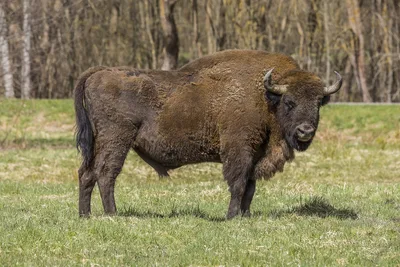
Modern muskoxen appeared in Germany almost a million years ago and reached Britain in the Mindel glaciation. Today's animals descend from a wave that crossed from Siberia between 200,000 and 90,000 years ago. Only a few large Ice Age mammals survive in North America today, and the muskox stands beside the bison and the pronghorn among them. The last European herd died out in Sweden 9,000 years ago, and the last Asian one on the Taymyr about 2,700 years ago.
Appearance
The muskox is a blocky animal with a broad head, a short neck, a humped shoulder and short stout legs. It stands 1.1 to 1.5 metres at the withers. Females measure 135 to 200 centimetres long and males 200 to 250 cm. Adults average 285 kilograms and range from 180 to 410 kg, and a zoo animal has reached 650 kg. The tail is only about 10 cm long and hides under the fur.
The coat is a mix of black, grey and brown. Long guard hairs hang like a skirt almost to the ground, and older animals grow a mane on the shoulders. A lighter saddle of shorter hair marks the middle of the back, and the legs and muzzle are pale. Beneath the guard hairs grows qiviut, a dense underwool that the animal sheds each spring. Rare white muskoxen have been seen in the Queen Maud Gulf Bird Sanctuary.
Both sexes carry amber horns that sweep down beside the face and hook up at sharp tips. A bull's horns meet across the forehead in a boss 15 to 20 cm thick, which takes the shock of a head-on charge. A cow's horns are thinner and lack the boss. Bulls are about 25 percent larger than cows.
Habitat and range
The native range covers the Arctic tundra of northern Canada, from the mainland barrens to Banks and Ellesmere Islands, and north-east Greenland. Muskoxen once lived from Point Barrow in Alaska to north-east Manitoba, but Alaska lost its herds in the late 1800s. Greenland stock restored them to Nunivak Island in the 1930s, and from there to the Seward Peninsula and northern Alaska. Russia released animals on the Taymyr Peninsula and Wrangel Island in 1974 and 1975, and Norway's Dovrefjell herd seeded a Swedish one in 1971.
The muskox lives north of the tree line on tundra where the snow stays shallow. In summer it grazes wet river valleys, sedge meadows and coastal plains. In winter it climbs to wind-swept ridges where the snow blows off the forage. It survives cold that reaches minus 80 degrees Celsius with wind chill.
Summer home ranges in Alaska average 223 square kilometres and shrink to 27 to 70 in winter. Tagged animals have moved 120 to 130 km, though most herds shift only locally with the seasons. GBIF holds records from 18 countries, a count that includes zoos and introductions.
Diet and feeding
The muskox is a grazer first. Sedges and grasses make up most of the diet, and on the Taymyr grasses supply 47 to 86 percent of the year's food. Willows and forbs matter in summer and autumn, and willow is rich in nitrogen. In winter it turns to willow, dwarf birch, roots, moss and lichen, whatever it can dig from under the snow.
Feeding fills most of the winter day, because the animal must keep its fat reserves up. A cow will not come into heat after a hard winter, so the breeding rate follows the food. Deep snow costs energy to dig through, which is why herds seek shallow snow. Calves take adult food within weeks of birth but nurse for about a year.
Behaviour and social life
Muskoxen live in herds of 8 to 20 in summer and 12 to 24 in winter. Winter groups of 60 or more have been recorded. They hold no territories but mark their trails with the glands in front of the eyes. Males and females each have their own rank order by age, and dominant animals take the best grazing. Animals shift between herds, so membership is loose.
In the rut a dominant bull drives the other males out and holds a harem of six or seven cows and their young. Rivals roar, swing their heads, paw the ground and rub their face glands on their legs. Then they back off about 20 metres, lower their heads and crash together on the horn bosses. They repeat the charge until one gives up, and the fights are rarely fatal. Beaten bulls form bachelor groups or wander alone and rejoin the herd when danger appears.
Outside the rut the pregnant cows lead. They decide how far the herd travels each day and where it beds. When wolves come, the adults turn outward in a ring or a line with the calves behind them. A big adult may charge out to hook or trample a wolf. The muskox can run at up to 60 kilometres per hour, but it overheats quickly, so it stands and fights instead.
Communication and senses
Calves bleat, and the call deepens with age into the roars and rumbles of adults, which carry a long way. Adults grunt and snort at one another, at their calves and at intruders. A cow calls her calf with a bray.
Scent does much of the work in the rut. A bull urinates on his forelegs and dribbles urine as he displays, and the rank smell spreads through the belly fur. The gland secretion smells light and sweet, and analysis found benzaldehyde and a series of lactones. Bulls also walk sideways to show their bulk and horn the ground to throw up turf.
Reproduction and life cycle
The rut begins in late June or July and mating takes place in August and September. A bull taps a cow with his foreleg to calm her before mating. Pregnancy lasts about eight to nine months, or 235 to 245 days by one account. Most calves arrive from mid-April to early June, into temperatures as low as minus 30 degrees Celsius.
A cow bears one calf of about 10 kilograms, and twins are very rare. Within 45 minutes the calf is standing and nursing, and within hours it can keep up with the herd. It shelters under its mother's skirt of hair through the first winter. Calves nurse for 10 months to a year and grow up to 0.5 kg a day. The bond with the mother weakens after two years.
Cows first calve at about three years and may calve until 18, usually in alternate years. Bulls mature at three to four years but cannot win a harem until about six to eight. Life expectancy is 12 to 20 years, and a captive animal reached 27.4. Cows outlive bulls, whose rut wears them out, and worn molars end most long lives.
Predators and threats
The Arctic wolf is the main predator and may cause half of all muskox deaths. Grizzly bears, polar bears and wolverines take calves and weak adults. The defensive ring works against a single wolf, but a pack can probably hold the herd in place and pick off a calf.
Hard winters kill calves and old animals, and rain that freezes over the forage can starve a whole herd. Norway's herd lost 29 animals to a measles outbreak in 2004. Small scattered herds, as in Greenland, are exposed to local swings in climate. Trains on the Dovre railway kill a few animals each year.
Population and conservation
The IUCN lists the muskox as Least Concern. The world population is put at 80,000 to 125,000, with about 47,000 on Banks Island alone. Overhunting in the 1800s emptied Alaska and cut the Canadian herds, and hunting quotas since the late 1900s have driven the recovery.
Reintroductions have restored the species across its old range and beyond. Alaska began in 1930 with 34 animals from East Greenland and now holds about 4,000. Wrangel Island held about 1,100 by 2019 and the Taymyr 11,000 to 14,000. Quebec's herd, released from a failed farm between 1973 and 1983, reached about 1,400 by 2003. Norway's Dovrefjell herd numbered about 300 in 2012.
In Greenland most herds live inside national parks and reserves and are fully protected. In Alaska hunters draw permits by lottery. The Pleistocene Park team on the Kolyma released six animals in 2010 to test whether hunting, not climate, ended the Siberian herds.
Relationship with humans
Arctic peoples hunted the muskox for meat, hide and horn for thousands of years, and Inuit hunters still take it under quota. Market hunting in the 1800s came close to wiping it out. The animal is not aggressive, but a person who crowds it can be attacked. A 73-year-old man died in Norway in 1964. A court officer died near Nome, Alaska, in December 2022 while chasing a group from his dog kennel.
Qiviut is the muskox's gift to people. The underwool is finer than cashmere, insulates eight times better than sheep's wool, and does not shrink in water. It is combed from farmed animals or gathered during the spring moult, never sheared. In 2016 a gram of raw fibre cost about 1.2 dollars, and a scarf about 275 dollars.
Farms in Alaska raise the animal for wool, and the Oomingmak cooperative, founded by Alaska Native women in the late 1960s, has about 200 members. The Large Animal Research Station in Fairbanks keeps about 40 muskoxen for research. A Quebec farm set up in 1967 to build an Inuit qiviut trade was closed. The province wanted wild herds for hunting instead.
In culture and myth
In Inuit tradition, the animal is umingmak, the bearded one, and its name lives on in the Oomingmak cooperative and the community of Umingmaktok. In Woods Cree tradition, the names mâthi-môs and mâthi-mostos call it the ugly moose and the ugly bison. In Alaska Native tradition, qiviut knitting has become a village craft and a source of income since the 1960s.
Norwegian railway workers found two fossil vertebrae on Dovrefjell in 1913, and the find inspired the first muskox release in the world in 1925. In Russia, the muskox appears to serve as a symbol of the Pleistocene Park project, which aims to rebuild the Ice Age grassland. The Ice Age defensive ring is thought to have evolved against wolves, and it is often cited as an image of solidarity.
A sentence with a dotted underline is inferred: it describes the group the animal belongs to, or is a reading of the sources, rather than a measured or reported fact about this species.
Questions
Muskox questions, answered
How big is a muskox?
An adult stands 1.1 to 1.5 metres at the shoulder and weighs 180 to 410 kilograms, with an average of about 285 kg. Bulls run 200 to 250 centimetres long and cows 135 to 200 cm.
Is a muskox an ox?
No. It is a bovid, but it belongs with the sheep and goats in the tribe Caprini. Its closest living relatives are the gorals of Asia.
Why is it called a muskox?
Bulls give off a strong musky smell in the rut, spread through the belly fur with urine. The smell attracts cows.
Where do muskoxen live?
On the Arctic tundra of northern Canada and Greenland, and in reintroduced herds in Alaska, Siberia, Norway, Sweden and Quebec.
What do muskoxen eat?
Sedges, grasses, willows and forbs in summer, and willow, dwarf birch, roots, moss and lichen dug from under the snow in winter.
How do muskoxen defend themselves from wolves?
The adults form a ring or a line with their horns facing out and the calves behind them. Now and then a large adult breaks out to hook or trample a wolf.
What is qiviut?
The muskox's soft underwool, shed each spring and combed out rather than sheared. It is finer than cashmere, insulates eight times better than sheep's wool, and sells for about 1.2 dollars a gram raw.
Are muskoxen dangerous?
Rarely. They are not aggressive, but a person who crowds or harasses one can be attacked. Two deaths are on record, in Norway in 1964 and in Alaska in 2022.
How fast can a muskox run?
Up to 60 kilometres per hour, but its thick coat makes it overheat quickly, so it usually stands its ground instead of running.
Are muskoxen endangered?
No. The IUCN lists them as Least Concern. The world population is 80,000 to 125,000, and about 47,000 live on Banks Island in Canada.
How long do muskoxen live?
Between 12 and 20 years. Cows live longer than bulls, and one captive animal reached 27.4 years.
How many calves does a muskox have?
One, born between mid-April and early June after about eight to nine months. A cow usually calves in alternate years, and twins are very rare.
Do female muskoxen have horns?
Yes. Cows carry curved horns like the bulls but thinner, and they lack the thick boss across the forehead.
Did muskoxen live with mammoths?
Yes. Muskoxen shared the Ice Age tundra with woolly mammoths, wild horses and reindeer. They are among the few large mammals of that time still alive in North America.
What does umingmak mean?
It is the Inuktitut name for the muskox and means the bearded one, from the long hair that hangs from its chin and body.
Food web
Prey and food
- sedges
- grasses
- willows
- forbs
- dwarf birch
- moss
- lichen
Food web
Predators
- arctic wolf
 Brown bear
 Polar bear
 Wolverine
Ecological equivalents
Related species on this site
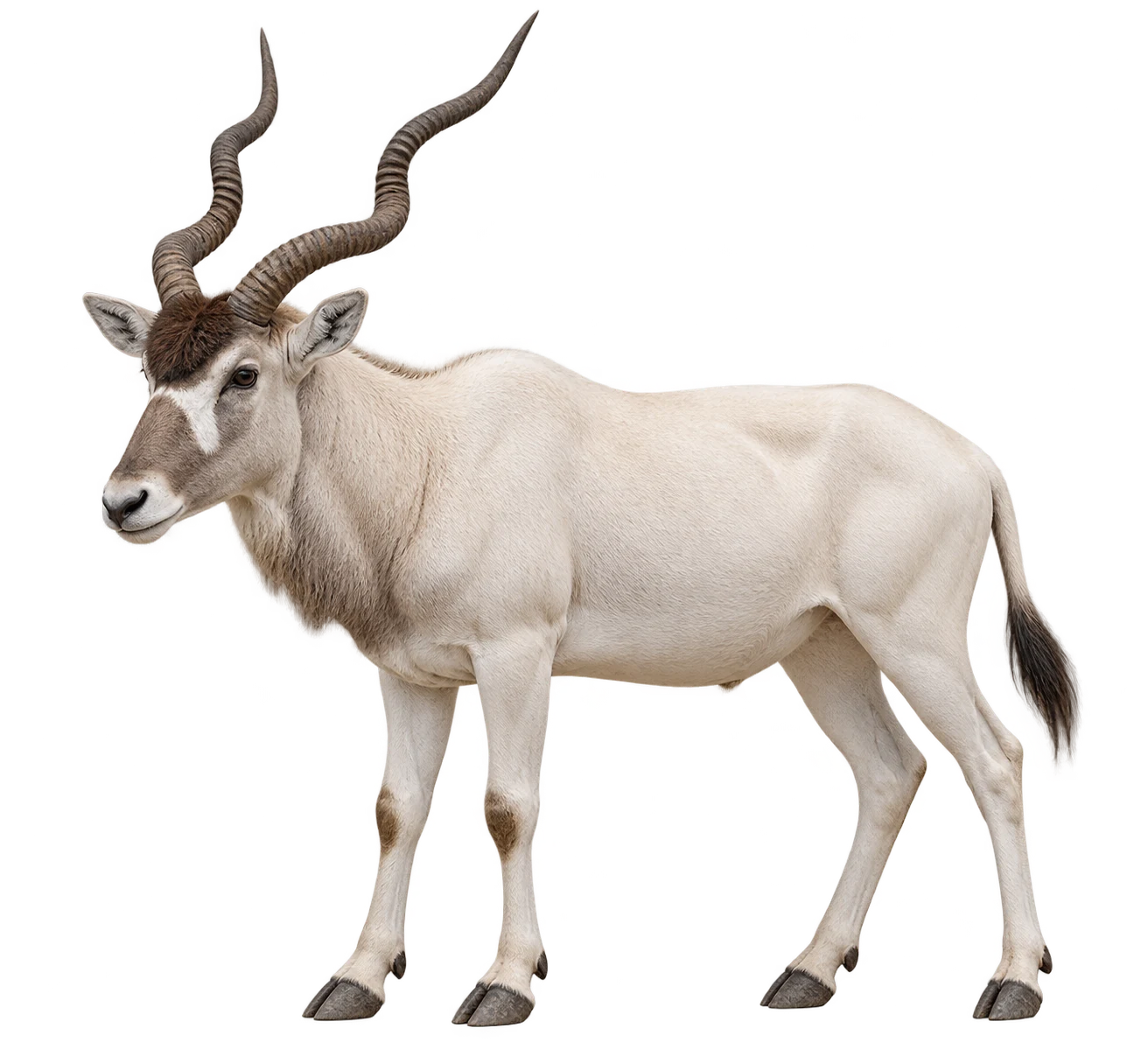
Addax (same family), African buffalo (same family), Alpine Goat (same family), American bison (same family), American Pygmy Goat (same family), Antelope (same family), and more.
Mammals
Addax
Addax nasomaculatus
Classification and source reference
LivingAI illustration NT
Mammals
African buffalo
Syncerus caffer
The African buffalo is a heavy wild ox of sub-Saharan Africa that lives in herds of dozens to thousands and must drink every day.
Living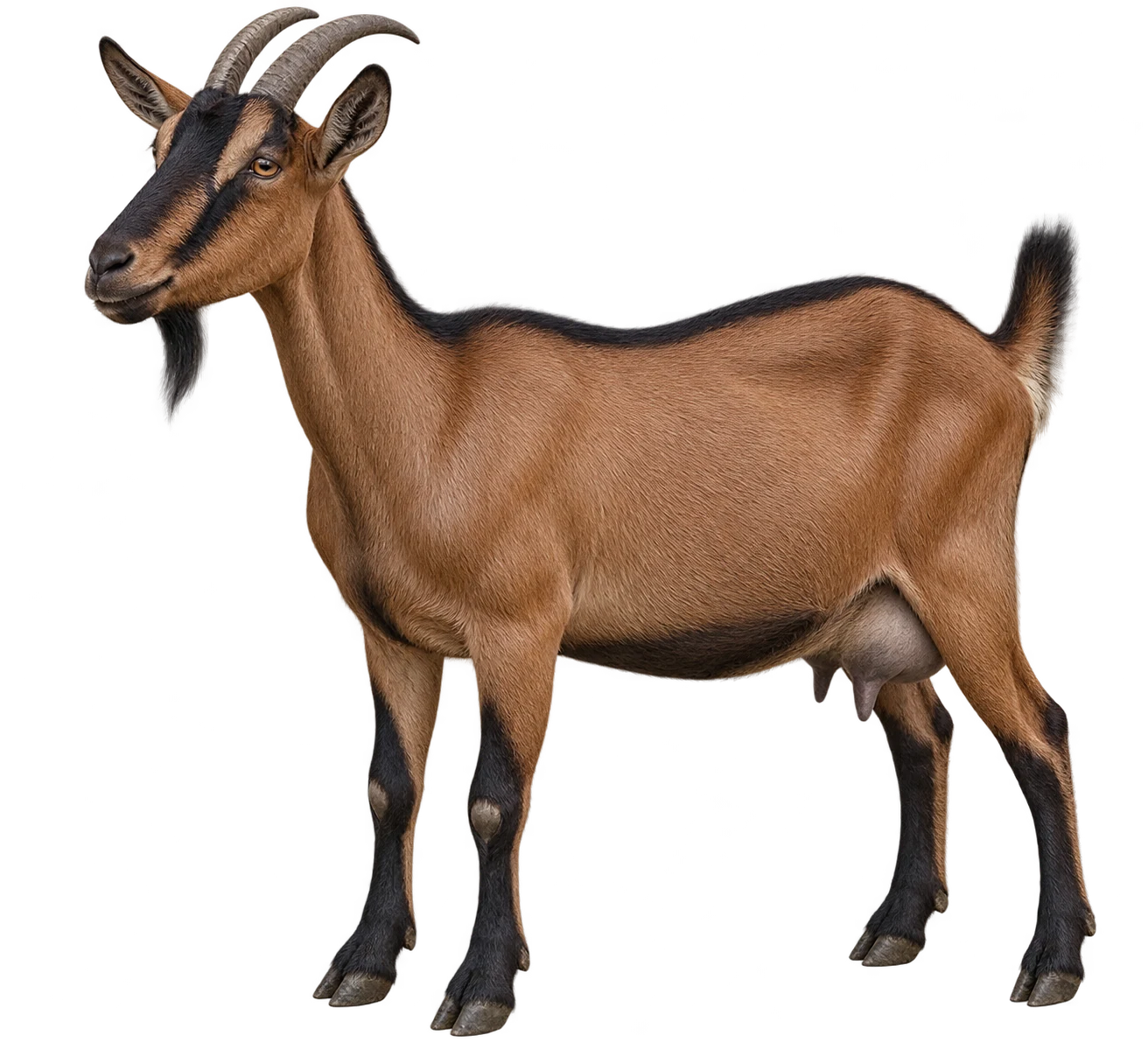
Mammals
Alpine Goat
Capra hircus
Classification and source reference
LivingAI illustration NT
Mammals
American bison
Bison bison
The American bison is the heaviest land animal in North America and the national mammal of the United States.
Living
Mammals
American Pygmy Goat
Capra hircus
Classification and source reference
LivingAI illustration
Mammals
Antelope
Bovidae
Classification and source reference
LivingAI illustration