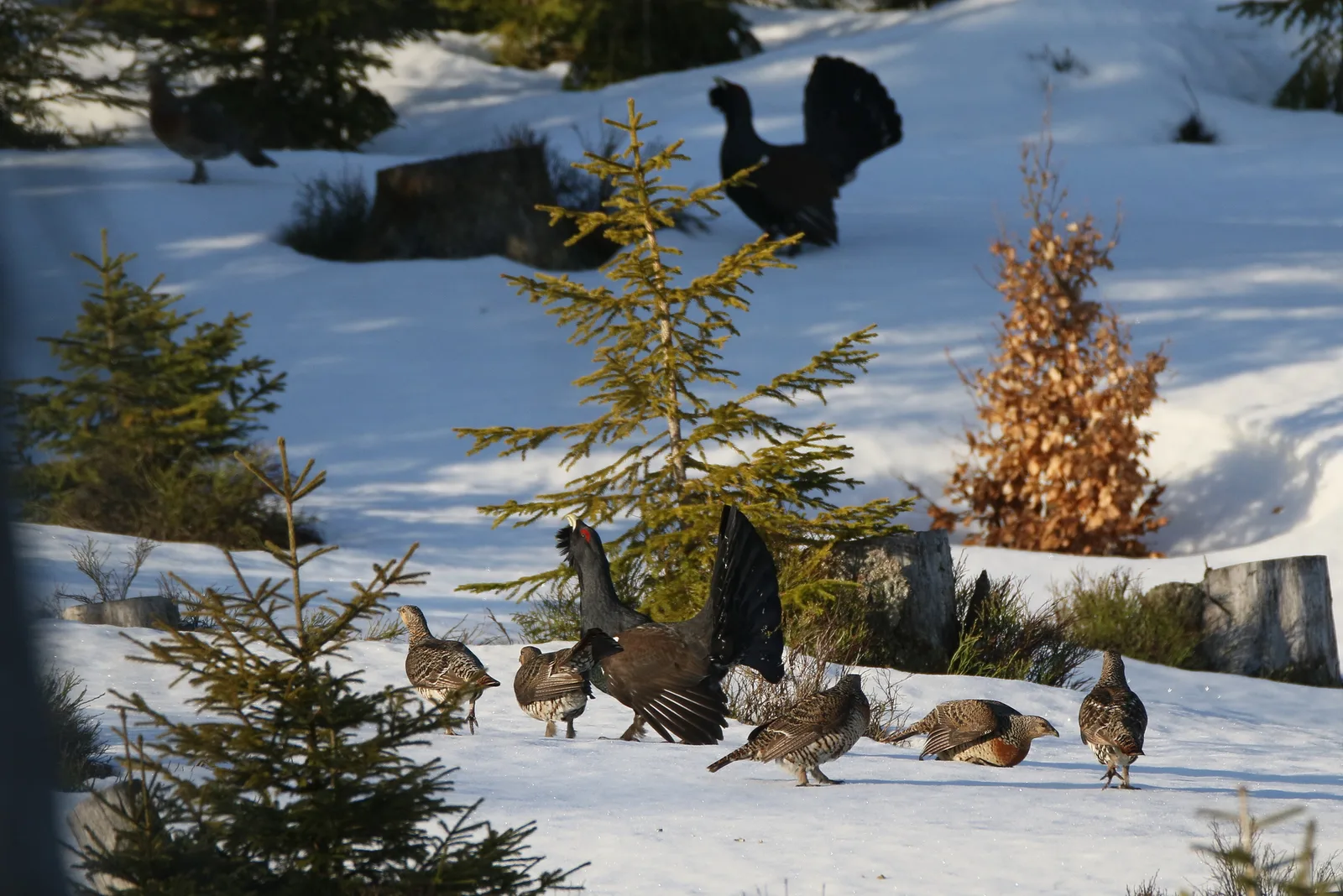
Western capercaillie
The biggest grouse, and the loudest bird at dawn
Tetrao urogallus
Also called Eurasian capercaillie, Wood grouse, Heather cock, Cock-of-the-woods, Capercailzie
Living individuals or members of this group exist today. This does not mean they are safe from extinction.
Meet the western capercaillie
The western capercaillie is the largest grouse in the world and lives in old conifer forest across northern Eurasia. Cocks gather each spring at a display ground and sing a clicking song that ends with a pop.
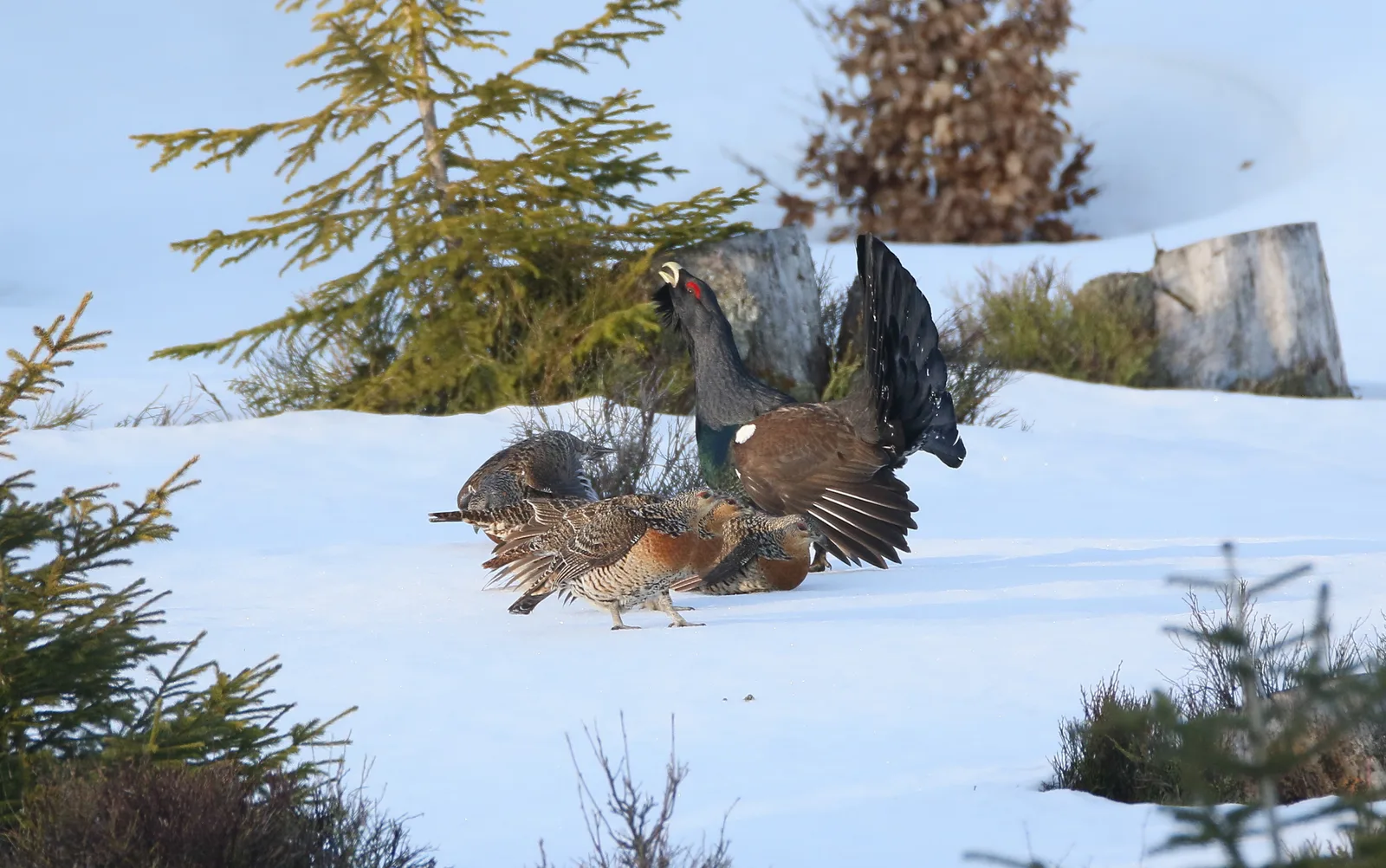
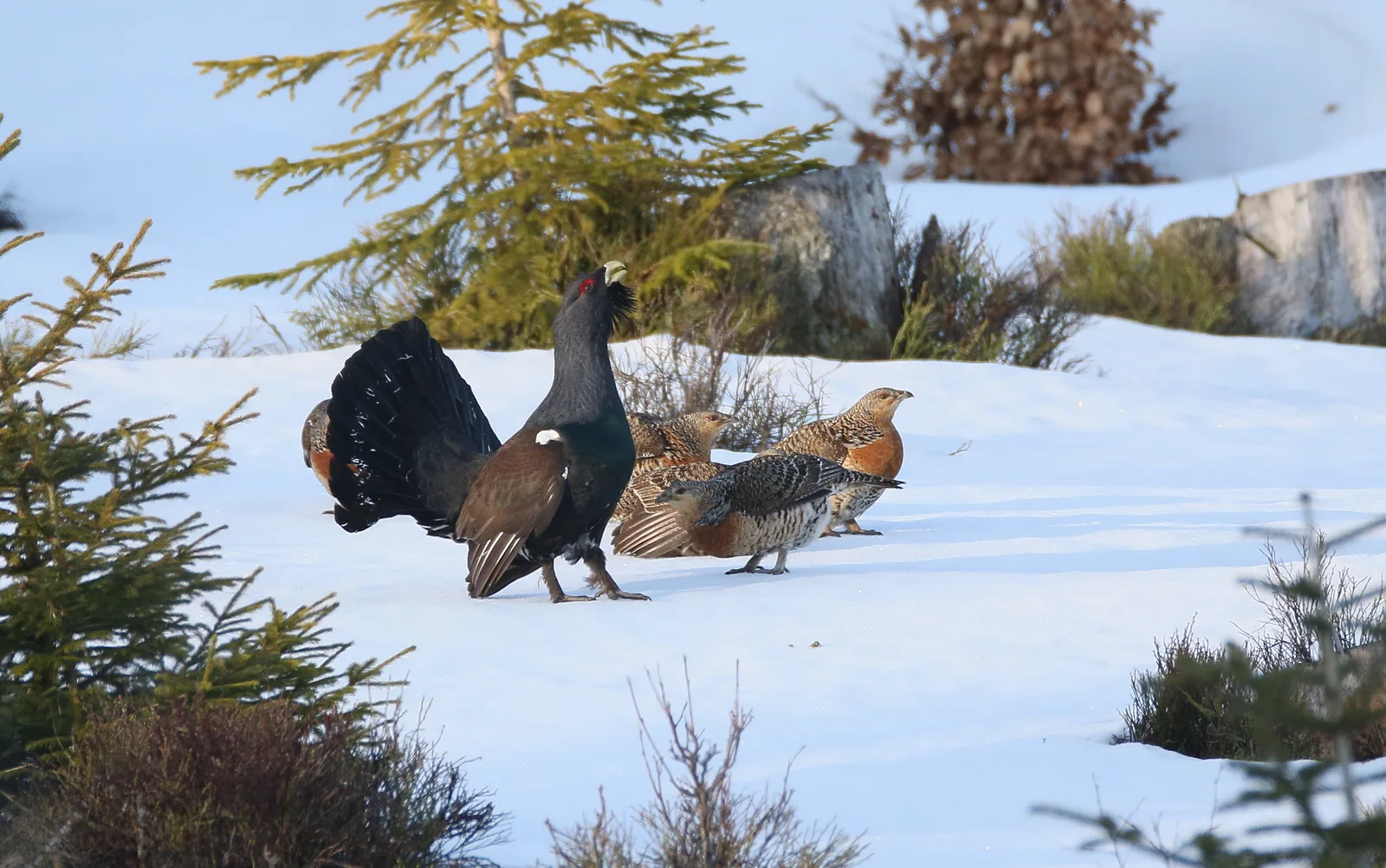
Images of the western capercaillie
Lifespan in the wild
Up to 3.5 years one wild bird in the United Kingdom
Weight
1.5 to 5.05 kg
Length
0.54 to 0.85 m
Wingspan
0.7 to 1.25 m
Fact file
Western capercaillie
- Location
- Northern Europe and the Palearctic east to central Siberia
- Habitat
- Temperate forest, Mountains
- Diet
- Herbivore
- Predators
- Golden eagle, goshawk, eagle-owl, lynx, fox, pine marten
- Lifestyle
- Active by day, roosts in trees at night
- Group name
- Lek, for the displaying cocks
- Name of young
- Chick
- Incubation
- Incubation 26 to 28 days
- Clutch size
- 8 eggs on average, up to 12
- Population
- 1.5 to 2 million in Europe
- Biggest threat
- Loss of old mixed conifer forest
- Distinctive feature
- Bare red skin above the eye and a fanned tail
- Colour
- Cock dark grey to black with a green breast; hen barred brown
- Skin type
- Feathers
Size
Next to a person
Measurements
Size and speed
- Length
- 0.54 to 0.85 m, up to 1 m hens 54 to 64 cm, cocks 74 to 85 cm; the largest wild cocks reach 100 cm
- Length, male
- 0.74 to 0.85 m, up to 1 m
- Length, female
- 54 to 64 cm
- Wingspan
- 0.7 to 1.25 m hens about 70 cm, cocks 90 to 125 cm
- Wingspan, male
- 0.9 to 1.25 m
- Weight
- 1.5 to 5.05 kg, up to 7.2 kg hens 1.5 to 2.5 kg, cocks 3.6 to 5.05 kg; the heaviest captive bird weighed 7.2 kg
- Weight, male
- 3.6 to 5.05 kg, up to 6.7 kg
- Weight, female
- 1.5 to 2.5 kg
Typical adult ranges. Source: Wikipedia.
Life cycle
Lifespan
- In the wildUp to 3.5 years one wild bird in the United Kingdom
- In captivityUp to 18 years
- 018 years
The pale bar is the record. Source: Animal Diversity Web.
Appearance
Colour and coat
- Primary colours
- blackbrown
- Secondary colours
- greenredwhite
- Skin type
- feathers
- Male and female
- Extreme. A cock weighs about twice as much as a hen and is dark, with a green sheen on the breast and a broad fanned tail. A hen is barred in brown, black and silver with an orange-brown breast.
Life cycle
Mating and family
- Mating system
- polygynous, with cocks displaying at leks
- Social structure
- solitary cocks, hens with broods, loose winter flocks
- Breeding
- one clutch a year
Cocks gather at a traditional lek from March and display until May or June. The top cock takes most of the matings, and the hen then leaves to nest alone. She lays about eight eggs in a scrape on the ground and sits for 26 to 28 days. The chicks feed themselves at once but need the hen for warmth for several weeks. Families split up from September, and the young cocks disperse first.
Classification
Taxonomy
- Kingdom
- Animalia
- Phylum
- Chordata
- Class
- Aves
- Order
- Galliformes
- Family
- Phasianidae
- Genus
- Tetrao
- Species
- Tetrao urogallus
Conservation
Red List status
- LC
- NT
- VU
- EN
- CR
- EW
- EX
Least Concern on the IUCN Red List
Range
Recorded in 15 countries
- Austria
- Germany
- Estonia
- Spain
- Finland
- France
- United Kingdom
- Italy
- Lithuania
- Norway
- Poland
- Romania
- Russia
- Sweden
- Ukraine
Habitat layer: temperate broadleaf and mixed forest, temperate conifer forest, boreal forest and taiga, montane grassland and shrubland.
Countries from 3,027 wild records on GBIF (iNaturalist research grade), filtered and checked by hand. Country shapes: Natural Earth. Habitat: RESOLVE Ecoregions 2017, CC BY 4.0. Basemap: Natural Earth.
Habitats
Three things to know
- 1
A cock capercaillie weighs about twice as much as a hen.
- 2
In winter the bird lives up in the trees and eats conifer needles.
- 3
Scottish capercaillies died out by 1785 and were replaced with Swedish birds.
Did you know
Seven more facts
- 1
The capercaillie swallows small stones so that its gizzard can grind pine needles.
- 2
Two side pouches in the gut grow longer in winter to handle tough food.
- 3
On short winter days the bird produces a dropping about every ten minutes.
- 4
The droppings turn blue-black when the bilberries ripen.
- 5
A single dominant cock can perform more than 90% of the matings at a lek.
- 6
Bold cocks that chase people carry about five times the normal testosterone level.
- 7
A display ground can stay in use for a hundred years.
Field notes
How it looks and acts
Field notes
Distinguishing features
- A cock 74 to 85 centimetres long, larger than any other grouse.
- Dark grey and brown plumage with a metallic green breast on the cock.
- Bare red skin above each eye.
- A broad tail that the cock fans into a half circle.
- A hen barred in brown, black and silver with an orange-brown breast.
- A white spot at the bend of each wing in both sexes.
Field notes
Unique adaptations
- Horny points along the toes spread the bird's weight on snow.
- Feathered legs hold heat in through the winter.
- A muscular gizzard and swallowed grit break down conifer needles.
- Long gut pouches hold bacteria that ferment plant fibre.
- Barred plumage hides the hen on the forest floor.
Field notes
Interesting behaviours
- Singing from a branch at first light through the breeding season.
- Dropping to the ground in a loud drumming flight.
- Fanning the tail and drooping the wings on the lek.
- Roosting for several nights in one tree.
- Feeding in the canopy through the winter months.
Field notes
Temperament
- Wary, and quick to fly when a person approaches.
- Aggressive in spring, when a cock defends his patch of the lek.
- Steady on the nest as hatching nears, when a hen sits tight.
- Quiet and hard to find for the rest of the year.
Field notes
Communication
- A four-part song of clicks, a roll, a pop and scraping notes.
- A noisy wing-drumming flight from tree to ground.
- A posture with fanned tail, raised neck and drooped wings.
- A soft begging call from the hen when she is ready to mate.
Ecology
Ecological role
The capercaillie depends on old conifer forest, so its numbers show how healthy that forest is.
- It is a large prey item for golden eagles, goshawks and lynx.
- It eats juniper and other berries and may move a few seeds.
- Conservationists treat it as an umbrella species for the whole pinewood community.
- Its decline usually points to the loss of bilberry and of open old forest.
Stories
Myths and legends
- In Scottish Gaelic tradition the bird is the capall coille, the horse of the wood.
- In German hunting tradition the bare red skin above the eye is called a rose.
- In central European hunting tradition the leading cock at a lek was the prize trophy.
- In Finnish regional tradition Central Finland carries the capercaillie on its coat of arms.
- In Scottish folk music tradition a well known band carries the bird's name.
People
Relationship with humans
People
Living alongside us
People have hunted the capercaillie for food and for trophies across Europe. The Scottish birds died out by 1785, and Swedish stock was released in 1837. Britain and Germany ended the hunt decades ago, and British law now protects the bird. Foresters manage pinewoods for it, and birdwatchers travel to see the spring display.
- The capercaillie does not attack people in normal circumstances.
- A cock holding a lek sometimes chases a walker and pecks at the legs.
- A charging cock may bruise a person, but it does no lasting harm.
People
Status, uses and products
- Domestication
- Wild
- As a pet
- Not suitable. The capercaillie is a wild forest bird that needs a large area of old pinewood and a diet of conifer needles and bilberry. It does badly in captivity, and the law protects it across much of its range.
- Uses
- game huntingtrophy huntingbirdwatching tourism
- Products
- meatfeathers
The full account
About the western capercaillie
The western capercaillie, Tetrao urogallus, is the largest grouse in the world. It lives in old conifer forest across northern Europe and Siberia. A cock measures 74 to 85 centimetres from bill to tail, and a hen only 54 to 64. Cocks weigh 3.6 to 5.05 kilograms, and hens weigh 1.5 to 2.5 kg. Few birds differ so much between the sexes.
The cock is dark grey and brown with a green sheen across the breast. The hen is barred in brown and buff, and she hides well on the forest floor. Each spring the cocks gather at a display ground called a lek. There each bird sings a run of clicks that finishes with a pop. The IUCN lists the species as Least Concern, because Scandinavia and Russia still hold large numbers. Populations in central Europe are shrinking, and Scotland holds only 532 birds.
Name and taxonomy
Carl Linnaeus named the species in 1758, in the tenth edition of Systema Naturae. He gave Europe as the type locality, and later workers narrowed that to Sweden. Tetrao is a Latin name that once covered this bird and the black grouse together. The epithet urogallus echoes the German word Auerhuhn, which Conrad Gessner used in 1555. The English name comes from the Scottish Gaelic capall coille, which means the horse of the wood. William Yarrell fixed the modern spelling in 1843 and replaced the Scots form capercailzie.
Ornithologists recognise about a dozen subspecies across the range. Cocks carry more white on the belly the further east they live. Birds in western Europe are almost wholly black underneath, and Siberian birds are nearly white. The native Scottish birds died out by the 1780s and may have been a subspecies of their own. The species also crosses with black grouse, and German hunters call the hybrid a Rackelhahn.
Evolution and relatives
The capercaillie belongs to the grouse, a group inside the pheasant family Phasianidae. Its only close relative is the black-billed capercaillie of eastern Russia and Mongolia. That bird breeds in larch taiga, while this one keeps to pine and spruce. The two are the only living members of the genus Tetrao. Like other grouse, the capercaillie has feathered legs and a gut built for coarse plant food. Its heavy body and short rounded wings probably suit a life spent mostly on the ground.
The species probably survived the ice ages in refuges in southern Europe. The Cantabrian birds of northwest Spain are described as a remnant of that cold period. They sit far from the main range and may be the most distinct population of all.
Appearance
The cock is a heavy, dark bird with a broad tail and a shaggy beard of throat feathers. The body plumage runs from dark grey to dark brown, and the breast shines metallic green. The belly ranges from black to white depending on the subspecies. A patch of bare red skin sits above each eye. German hunters call these patches roses. Both sexes show a white spot at the bend of the wing.
The hen weighs about half as much as the cock. Her upperparts are brown, barred with black and silver, and her underside is pale buff. An orange-brown throat and breast separate her from a female black grouse. Cocks span 90 to 125 centimetres across the wings, and hens about 70 cm. The largest wild cocks reach 100 cm in length and 6.7 kilograms in weight. One captive bird weighed 7.2 kg, the heaviest ever recorded. Both sexes grow rows of small horny points along the toes for the winter. These act like snowshoes and spread the bird's weight on soft snow.
Habitat and range
The capercaillie does not migrate and stays in the same forest all year. It needs mature conifer woodland with an open canopy and a thick carpet of bilberry. The best woods mix spruce, pine and fir with a few broadleaved trees. Dense young plantations offer neither food nor room to fly, so the bird avoids them. In the north it lives in lowland taiga, and in the south only in the mountains.
The range runs from Scotland and Spain east across Russia to central Siberia. Norway, Sweden, Finland, Russia and Romania still hold large numbers. Germany, Switzerland, France and Spain hold small and scattered groups. The bird vanished from Ireland in the 18th century and from the French Alps. GBIF holds occurrence records from 46 countries. iNaturalist carries 4,725 observations of the species.
A cock defends 50 to 60 hectares of good forest, and a hen uses about 40 hectares. Spring density works out at roughly 25 hectares for each bird. Storms and deep snow can push birds several kilometres downhill for the winter.
Diet and feeding
The capercaillie is a plant eater with a narrow menu. In summer it takes bilberry leaves and berries, buds, shoots, grass seeds and sedges. Bilberry matters so much that the droppings turn blue-black when the fruit ripens. In winter deep snow buries the ground plants, and the bird moves up into the trees. It then feeds almost entirely on needles from spruce, pine and fir. Buds of beech and rowan fill out the winter diet.
Needles are hard to break down, so the bird swallows small stones. The muscular gizzard grinds the food against this grit. Two side pouches in the gut lengthen in winter and hold bacteria that digest the fibre. On a short winter day the bird feeds almost without pause and drops a pellet every ten minutes. Chicks need protein and take caterpillars, ants, beetles and spiders for their first weeks. Warm dry weather brings plenty of insects, and cold wet weather kills many chicks.
Behaviour and social life
The capercaillie is active by day and roosts at night in old trees with level branches. It uses the same roost tree for several nights, and the droppings pile up below it. A hen sits on her nest through the night once she has eggs. Outside the breeding season the adult cocks live alone. Hens and young birds forage in loose flocks through the winter.
Flight is heavy and noisy, because the body is large and the wings are short. Take-off makes a sudden clatter that can startle a fox or a marten. In the air the bird mixes flapping with short glides, and the feathers whistle. A young cock may travel up to 7 kilometres in a day between display grounds. Adult cocks turn aggressive in spring and have chased walkers out of the wood. One study found five times more testosterone in these bold cocks than in ordinary ones.
Communication and senses
The song of the cock has four parts and lasts only a few seconds. It opens with a run of double clicks that speeds up into a roll. The roll ends in a hollow pop. This note probably carries further through the trees than the clicks do. Three to five scraping notes finish the song, like a blade drawn across a whetstone. A hen answers with a soft begging call when she is ready to mate.
The display is visual as well as vocal, probably because dense forest blocks sound. The cock raises and fans the tail, stretches the neck and points the bill upward. He droops the wings so that the white shoulder spots show. A loud drumming flight down from the roost tree announces him to the whole lek. Rival cocks face each other bill to bill and ruffle the neck feathers before they fight. Hens see well and leave the nest as soon as a person comes close.
Reproduction and life cycle
Display starts between March and April and runs into May or June. Cocks return to the same lek year after year, and some grounds have been used for a century. Most of the season is a contest between neighbouring cocks rather than courtship. Hens arrive late, and the top cock takes most of the matings. In one study a single dominant cock performed over 90% of the copulations. The birds are easily disturbed at this point, and one walker can stop a pairing.
The hen lays about three days after mating and takes ten days to finish the clutch. A clutch holds eight eggs on average and up to 12, though four or five occur. The eggs match a chicken's eggs in size but carry brown speckles. She incubates alone for 26 to 28 days in a shallow scrape under low branches. The nest often sits at the foot of a tree with thick cover above it. All the eggs hatch together, and the brood leaves the nest soon afterwards.
Chicks feed themselves from the first day but cannot hold their body heat. The hen broods them every few minutes in cold or wet weather. They fly short distances at three to four weeks and roost in trees on warm nights. By six weeks they keep themselves warm without her. A moult at about three months brings plumage that shows the sex. Families break up from September, and the young cocks leave first.
Predators and threats
Golden eagles take capercaillie in Sweden, where the bird is their main prey. Goshawks kill many, mostly young ones, and eagle-owls take one now and then. Lynx and wolves catch adults, though both prefer larger prey. Foxes, pine martens, beech martens, wild boar, brown bears and crows raid the nests. The hen's barred plumage hides her and her eggs from most of these hunters.
Habitat loss is the largest threat across the range. Native forest turned into single-species plantation loses the bilberry the bird needs. Deer fences around young plantations kill birds that fly into them. Badly marked ski-lift cables kill birds in mountain resorts. The loss of wolves and bears has let foxes and other small hunters increase. Walkers, skiers and cyclists disturb hens and cocks in spring.
Population and conservation
The IUCN lists the western capercaillie as Least Concern. Europe alone holds between 1.5 and 2 million birds. The range covers a huge belt of northern forest. Numbers are falling, but not fast enough to meet the threshold for a threatened listing. The picture differs sharply between the north and the south of the range.
Scotland has lost almost all of its birds. The Scottish total fell from about 10,000 pairs in the 1960s to 532 birds by 2025. The survivors keep to the Caledonian pine forest of the Highlands. In 2015 the capercaillie was named the British bird most likely to die out. A NatureScot review in 2022 called for urgent work on the survival of eggs and chicks. Mowing heather to let bilberry spread is one of the measures now used.
Germany treats the bird as threatened with extinction, and captive breeding has not stopped the fall. Fewer than 20 birds remain in the Cevennes of France. Conservationists treat the species as an umbrella, because the forest it needs holds many other animals.
Relationship with humans
The capercaillie has been a game bird for centuries. Hunters used guns and dogs across central and northern Europe. From the 18th century some hunts were reserved for the patrician class. The old method was to stalk a singing cock at the lek in spring. The highest ranking cock made the best trophy. Britain and Germany stopped hunting the bird decades ago.
Trophy hunting continues in parts of central Europe and now draws paying visitors. Overhunting and forest clearance wiped out the Scottish birds by 1785. Swedish stock was released in Scotland in 1837, and the flock later fell to about 1,000 by 1999. Birdwatchers now travel to see the display, and the species supports local ecotourism. British law protects the bird under the Wildlife and Countryside Act 1981.
In culture and myth
The Gaelic name capall coille means the horse of the wood. The name probably refers to the bird's size and to the noise it makes on take-off. German hunters built a whole vocabulary around the species. They call the red skin above the eye a rose, and the grouse group rough-footed hens. The German name Auerhuhn gave the species its scientific epithet.
The capercaillie appears on the coat of arms of Central Finland and serves as the regional bird. A Scottish folk band took the name Capercaillie in 1984 and made Gaelic song popular again. The band sold over a million albums and reached the UK top 40 with a Gaelic single in 1992. In Spain the naturalist Felix Rodriguez de la Fuente used his Fauna series to defend the Cantabrian birds. He blamed the trade in holly branches for Christmas decoration for part of their decline.
Scottish conservation groups now use the bird as a badge for the old pine forest. Ministers have called it iconic and magnificent while arguing for its rescue.
A sentence with a dotted underline is inferred: it describes the group the animal belongs to, or is a reading of the sources, rather than a measured or reported fact about this species.
Questions
Western capercaillie questions, answered
How big is a capercaillie?
A cock is 74 to 85 centimetres long and weighs 3.6 to 5.05 kilograms. The largest wild cocks reach 100 cm and 6.7 kg. A hen is 54 to 64 cm long and weighs 1.5 to 2.5 kg.
What is the largest grouse in the world?
The western capercaillie. No other grouse comes near it in size. A big cock outweighs a hen by about two to one.
What does a capercaillie eat?
In summer it eats bilberry leaves and berries, buds, shoots and grass seeds. In winter it eats conifer needles from spruce, pine and fir. Chicks eat insects for their first weeks.
Where do capercaillies live?
In mature conifer forest from Scotland and Spain east to central Siberia. Northern birds live in lowland taiga. Southern birds survive only in mountains.
Why is it called a capercaillie?
The name comes from the Scottish Gaelic capall coille, the horse of the wood. William Yarrell fixed the modern spelling in 1843.
What is a capercaillie lek?
A lek is a traditional clearing where cocks display each spring. Hens visit it to choose a mate. Some leks have been in use for a hundred years.
What sound does a capercaillie make?
The cock sings a run of double clicks that speeds into a roll. The roll ends in a pop. Scraping notes finish the song.
Are capercaillies endangered?
The IUCN lists the species as Least Concern, and Europe holds 1.5 to 2 million birds. Groups in central Europe are shrinking. Scotland is down to 532 birds.
How many capercaillies are left in Scotland?
About 532 in 2025, down from roughly 10,000 pairs in the 1960s. They hang on in the Caledonian pine forest of the Highlands.
Do capercaillies attack people?
A cock defending a lek sometimes chases walkers and pecks at them. The worst result is a bruise. The bird is shy for the rest of the year.
How many eggs does a capercaillie lay?
Eight on average, and up to 12. The clutch takes ten days to lay. The hen then sits for 26 to 28 days.
How long do capercaillies live?
One wild bird in the United Kingdom reached 3.5 years. A captive bird lived to 18 years. Most wild birds die much younger.
Can capercaillies fly?
Yes, but heavily. The bird bursts off the ground with a loud clatter and then glides between flaps. It keeps out of dense young woodland, where there is no room.
What eats a capercaillie?
Golden eagles, goshawks, eagle-owls, lynx and wolves take adults. Foxes, pine martens, wild boar and crows take eggs and chicks.
Why did capercaillies die out in Scotland?
Overhunting and the clearance of the pine forest ended the native population by 1785. Birds from Sweden were released in 1837.
Do capercaillies migrate?
No. The species stays in one forest all year. Heavy snow may push birds a few kilometres downhill in winter.
Food web
Prey and food
Not recorded.
Food web
Predators
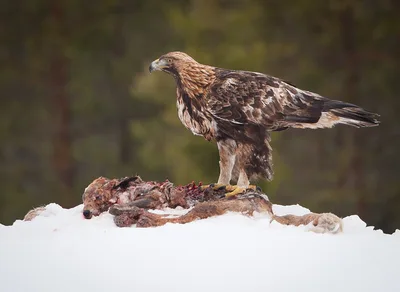 Golden eagle
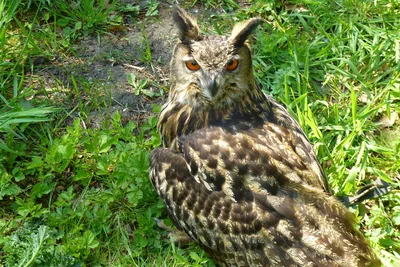 Eurasian eagle-owl
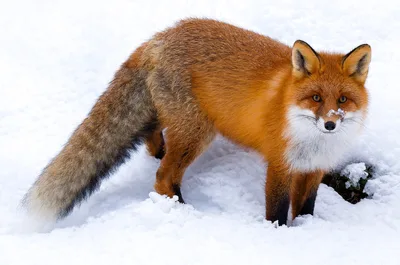 Red fox
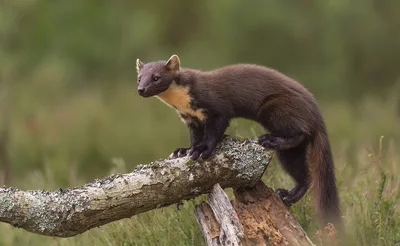 European pine marten
Ecological equivalents
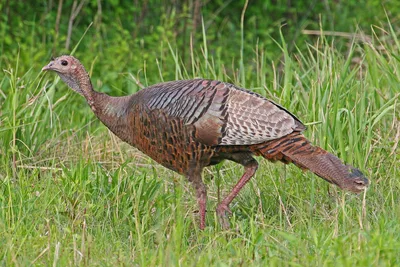
Related species on this site
Australorp Chicken (same family), Ayam Cemani (same family), Barnevelder (same family), Blue Andalusian (same family), Brahma Chicken (same family), Buff Orpington Chicken (same family), and more.
Birds
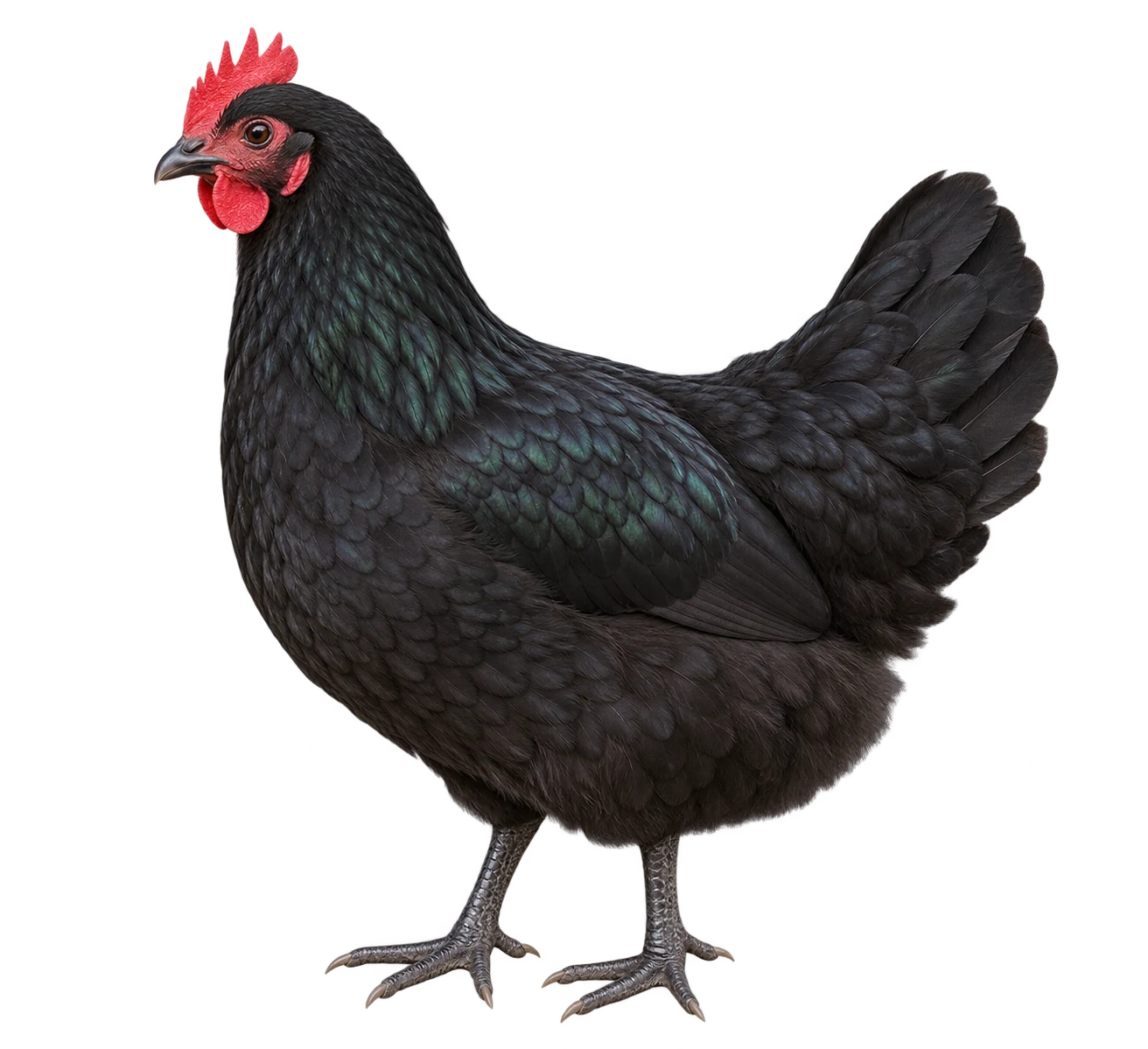
Australorp Chicken
Gallus gallus domesticus
Classification and source reference
LivingAI illustration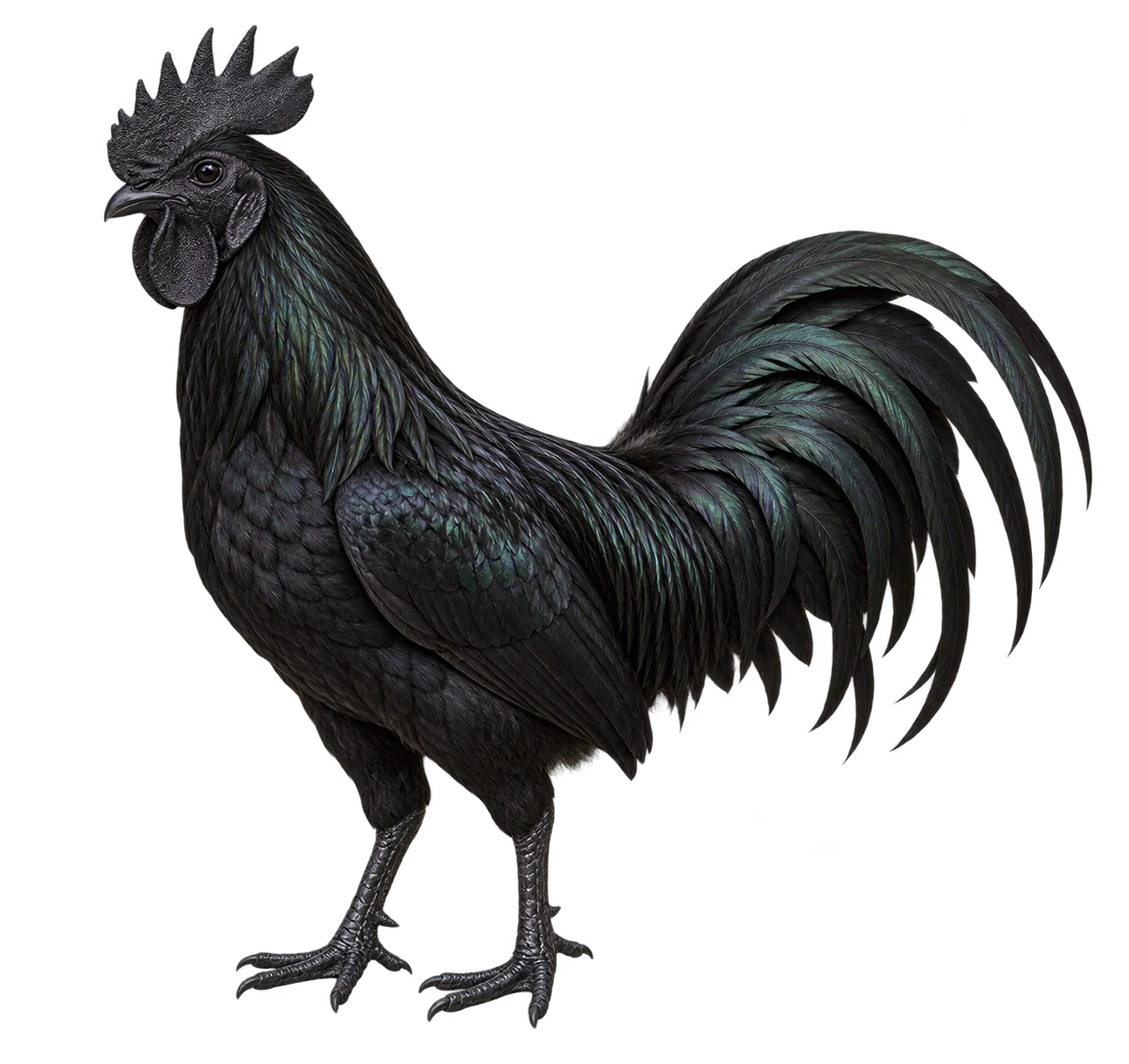
Birds
Ayam Cemani
Gallus gallus domesticus
Classification and source reference
LivingAI illustration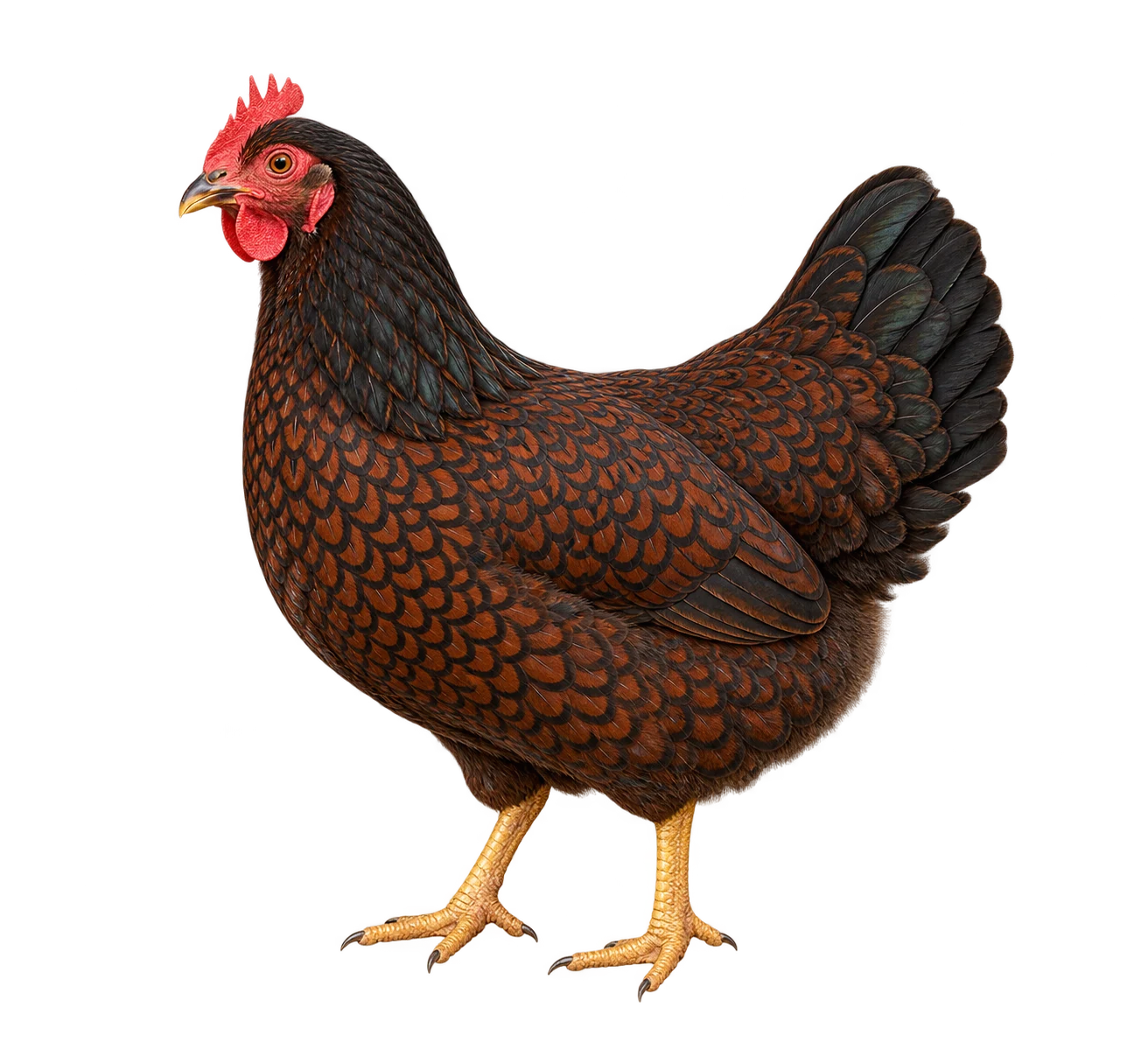
Birds
Barnevelder
Gallus gallus domesticus
Classification and source reference
LivingAI illustration
Birds
Blue Andalusian
Gallus gallus domesticus
Classification and source reference
LivingAI illustration
Birds
Brahma Chicken
Gallus gallus domesticus
Classification and source reference
LivingAI illustration
Birds
Buff Orpington Chicken
Gallus gallus domesticus
Classification and source reference
LivingAI illustration