Indian peafowl
A hundred painted eyes on a fan of back feathers
Pavo cristatus
Also called Common peafowl, Blue peafowl, Indian peacock
Living individuals or members of this group exist today. This does not mean they are safe from extinction.
Meet the indian peafowl
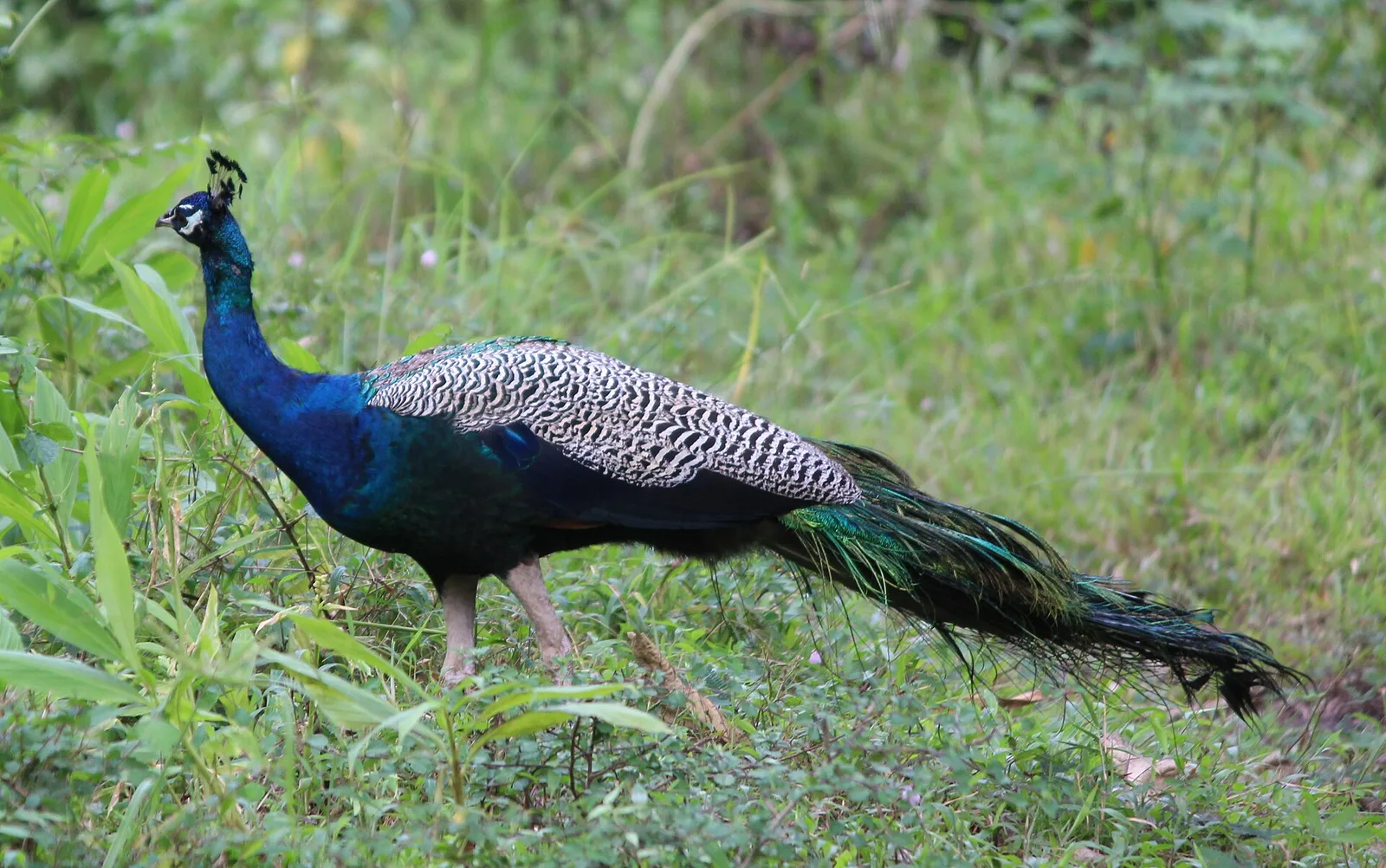
The Indian peafowl is the large ground bird of India and Sri Lanka, and it is India's national bird. The peacock carries a train of eyespot feathers that he fans and quivers in front of the peahens.
Images of the indian peafowl
Lifespan in the wild
10 to 20 years
Weight
2.7 to 5.2 kg
Length
0.97 to 1.2 m
Wingspan
1.4 to 1.6 m
Fact file
Indian peafowl
- Location
- India and Sri Lanka, with feral flocks worldwide
- Habitat
- Temperate forest, Grassland, Towns and cities
- Diet
- Omnivore
- Prey / food
- Grain, seeds, berries, insects, lizards, snakes and small rodents
- Predators
- Tigers, leopards, dholes, jackals, hyenas and eagles
- Lifestyle
- Feeds on the ground by day, roosts in trees at night
- Group name
- Muster
- Name of young
- Peachick
- Incubation
- Incubation 28 to 30 days
- Clutch size
- 3 to 8 eggs
- Population
- More than 100,000 by a 2002 estimate
- Biggest threat
- Poaching, and poisoning by treated seed
- Distinctive feature
- The peacock's train of eyespot feathers
- Colour
- Blue head and neck, with a bronze-green train
- Skin type
- Feathers
Size
Next to a person
Measurements
Size and speed
- Length
- 0.97 to 1.2 m, up to 2.3 m peahens about 97, peacocks 100 to 120 to the tail, and up to 230 to the end of the train
- Length, male
- 1 to 1.2 m, up to 2.3 m
- Length, female
- About 97 cm
- Wingspan
- 1.4 to 1.6 m
- Weight
- 2.7 to 5.2 kg peahens 2.7 to 4.1, peacocks 4.1 to 5.2
- Weight, male
- 4.1 to 5.2 kg
- Weight, female
- 2.7 to 4.1 kg
Typical adult ranges. Sources: Wikipedia, Animal Diversity Web.
Life cycle
Lifespan
- In the wild10 to 20 years
- In captivityUp to 23.2 years
- 023.2 years
The pale bar is the record. Sources: Animal Diversity Web, AnAge.
Appearance
Colour and coat
- Primary colours
- bluebronze-green
- Secondary colours
- brownwhitechestnut
- Skin type
- feathers
- Male and female
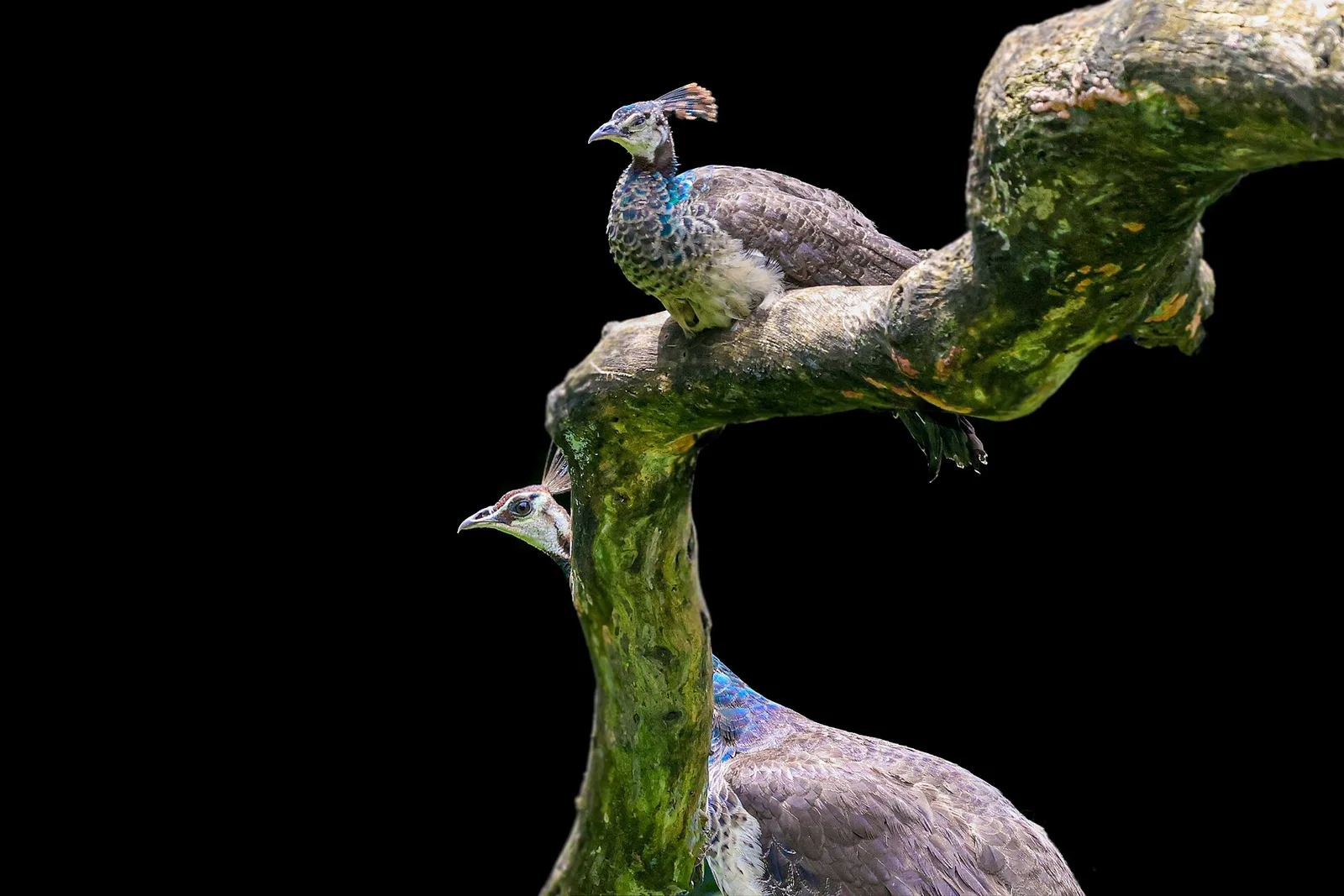
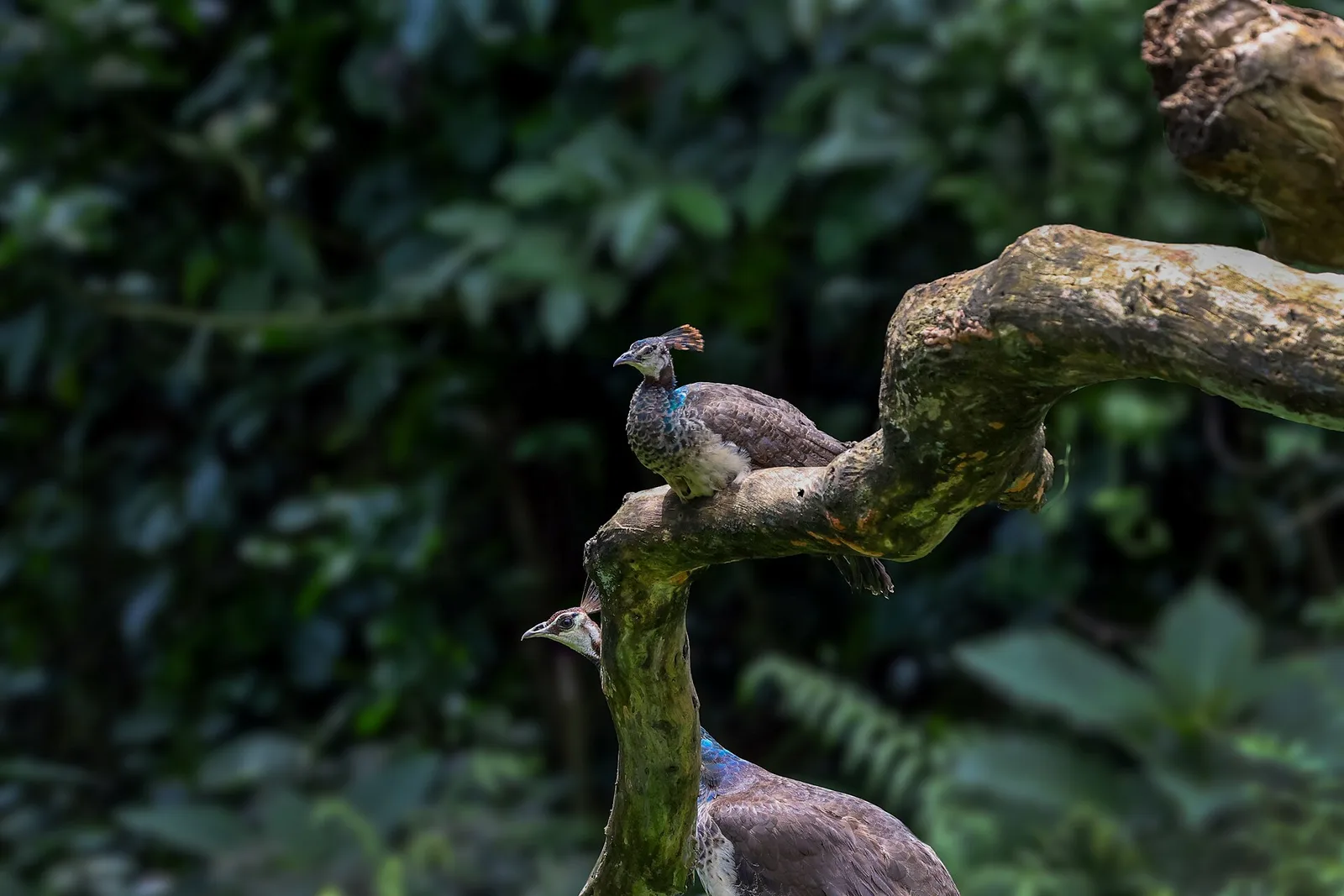
- The difference is extreme. The peacock has a blue head and neck and a long train of eyespot feathers. The peahen is brown, with a white face, a green lower neck and no train.
Life cycle
Mating and family
- Mating system
- polygynous, at a lek
- Social structure
- small musters of one male and several females
- Breeding
- one clutch a year, with the monsoon
Related males hold small display territories side by side, and peahens visit them. A peacock fans and quivers his train, then turns to show it from behind. The peahen scrapes a hollow in the ground and lays three to eight eggs. She sits on them alone for about a month. The chicks follow her from the day they hatch.
Classification
Taxonomy
- Kingdom
- Animalia
- Phylum
- Chordata
- Class
- Aves
- Order
- Galliformes
- Family
- Phasianidae
- Genus
- Pavo
- Species
- Pavo cristatus
Conservation
Red List status
- LC
- NT
- VU
- EN
- CR
- EW
- EX
Least Concern on the IUCN Red List
Range
Recorded in 14 countries
- Ashmore and Cartier Islands
- Brazil
- Canada
- Spain
- United Kingdom
- Greece
- India
- Sri Lanka
- Nepal
- New Zealand
- Portugal
- Singapore
- United States of America
- South Africa
Habitat layer: temperate broadleaf and mixed forest, temperate conifer forest, boreal forest and taiga, tropical grassland, savanna and shrubland, temperate grassland, savanna and shrubland.
Countries from 24,423 wild records on GBIF (iNaturalist research grade), filtered and checked by hand. Country shapes: Natural Earth. Habitat: RESOLVE Ecoregions 2017, CC BY 4.0. Basemap: Natural Earth.
Habitats
Three things to know
- 1
The peacock's train is made of back feathers, not tail feathers.
- 2
A peahen lays her eggs in a scrape on the ground and rears the chicks alone.
- 3
Peafowl roost high in trees to stay out of a tiger's reach.
Did you know
Seven more facts
- 1
The peacock ranks among the heaviest birds in the pheasant family.
- 2
A peacock weighs 4.1 to 5.2 kilograms and a peahen 2.7 to 4.1 kg.
- 3
Peafowl take dust baths, because wet feathers weigh them down.
- 4
A peacock must roost five metres up, because a tiger can reach three metres.
- 5
Charles Darwin wrote that the sight of a peacock's feather made him feel ill.
- 6
The genus name Pavo travelled from Tamil through Persian and Greek into Latin.
- 7
Indian law allows people to collect shed peacock feathers but not plucked ones.
Field notes
How it looks and acts
Field notes
Distinguishing features
- A train of bronze-green feathers with eyespots, on the male.
- A fan-shaped crest on the crown of both sexes.
- A metallic blue head and neck on the male.
- Bare white skin above and below the eye.
- A brown body and a green lower neck on the female.
- A spur on the back of each leg on the male.
Field notes
Unique adaptations
- Feather microstructure that makes colour without any pigment.
- Loud calls that pass an alarm through a whole group.
- Strong legs for running into cover instead of flying.
- High roosts, which keep the bird beyond a tiger's reach.
- A broad diet, which probably lets the bird live beside farms.
Field notes
Interesting behaviours
- Forages in a small muster of one male and several females.
- Walks in single file to a waterhole.
- Takes a dust bath at dusk.
- Climbs to a roost branch by branch at nightfall.
- Leaps and strikes downward with its spurs in a fight.
Field notes
Temperament
- Watchful, with the head always turning.
- Calm around people, unlike its green and Congo relatives.
- Noisy, and quick to raise an alarm.
- Ready to run rather than fight.
Field notes
Communication
- A loud pia-ow call that carries across open country.
- Six alarm calls, and about seven other calls.
- Three extra calls that only a mature male makes in the breeding season.
- The rattle of the train, made by shaking the quills.
- The spread fan itself, which signals the male's condition.
Ecology
Ecological role
The peafowl is a ground omnivore that both eats farm pests and feeds the big predators.
- It spreads the seeds of the fruit it eats through farmland and forest.
- It holds down the numbers of venomous snakes, lizards and insects.
- It feeds tigers, leopards, dholes and jackals.
- It carries lice and bacteria, which pass from a mother to her chicks.
Stories
Myths and legends
- In Hindu tradition, Kartikeya the war god rides a peacock, and Krishna wears its feather.
- In the Ramayana, Indra blesses the peacock with a thousand eyes and no fear of snakes.
- In Greek myth, Hera set the hundred eyes of Argus into the peacock's tail.
- In Yazidi belief, the Peacock Angel Melek Taus rules the affairs of the earth.
- In medieval European chivalry, knights swore a vow of the peacock and wore its plumes.
People
Relationship with humans
People
Living alongside us
The Indian peafowl has lived alongside Indian farming for centuries. It eats crop pests, and it also damages rice fields and gardens. India makes it the national bird, and law protects it there and in Sri Lanka. Zoos and private keepers hold breeding stock worldwide.
- The bird runs from people and does not attack them.
- A cornered male can strike with the spurs on his legs.
- Feral flocks damage property rather than people.
People
Status, uses and products
- Domestication
- Wild
- As a pet
- Not suitable. Peafowl belong in a large garden or a park, not in a house. They are loud, they need space, and they damage plants and paintwork.
- Uses
- ornamental keepingfeather collectionfolk medicineeggs
- Products
- featherseggsmeat
The full account
About the indian peafowl
The Indian peafowl, Pavo cristatus, is the large ground bird of India and Sri Lanka. A male is a peacock and a female is a peahen. The peacock carries a train of bronze-green feathers, each of the longest ending in an eyespot. He measures 100 to 120 centimetres from bill to tail, and up to 230 cm to the tip of the train. He weighs 4.1 to 5.2 kilograms.
The peahen is smaller, browner, and has no train at all. Both birds live on the ground and roost in tall trees at night. They eat grain, berries, insects, lizards and small snakes. India names the peafowl as its national bird. The IUCN lists the species as Least Concern.
Name and taxonomy
Carl Linnaeus described the bird in 1758 and gave it the name it still carries. Pavo is the Latin word for a peacock. It reached Latin through Greek and Persian from a Tamil word. The second word, cristatus, means crested. No subspecies are recognised, so the species stands alone.
Geoffrey Chaucer used the English word peacock in the 14th century. Older spellings include pecok, pokok and pocok. In everyday speech people call both sexes a peacock. Writers who need to be exact probably prefer peafowl for the species as a whole.
Evolution and relatives
The Indian peafowl belongs to the pheasant family, Phasianidae. It ranks among the heaviest birds in that family. The green peafowl of southeast Asia shares the genus Pavo. A green peacock crossed with an Indian peahen gives a stable hybrid called a Spalding. The name honours Keith Spalding, a bird fancier from California. Hybrids of unknown parentage do badly when released, as Haldane's rule predicts.
The first whole genome of the species held 15,970 protein-coding sequences. It carries less repetitive DNA than the genome of the chicken. Two population bottlenecks show in that genome. The later one falls about 450,000 years ago, and it cut the breeding population hard. The black-shouldered form was once treated as a separate species. Charles Darwin showed it is a colour variety bred under domestication.
Appearance
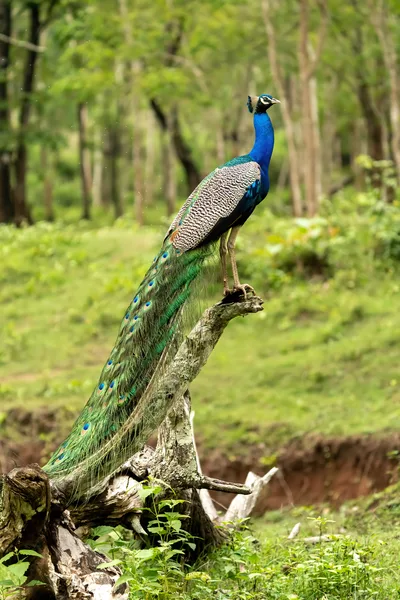
The peacock has a metallic blue head and neck. A fan-shaped crest stands on the crown, on bare black shafts tipped with bluish green. Bare white skin makes a stripe above the eye and a crescent below it. The back is scaly bronze-green, and the wings carry chestnut and black. The train grows from the rump rather than the tail, and it is made of upper tail coverts. Each eyespot has a black heart at the centre, a blue ring, a copper rim and bands of green and bronze.
No pigment makes those colours. The fine structure of the feather bends light instead. A peacock grows his train and his leg spur in his second year. The train is not complete until he is four. He moults it each year after the monsoon and regrows it by February or March.
A peahen measures about 97 centimetres and weighs 2.7 to 4.1 kilograms. She has a brown head, a crest tipped with chestnut, and a metallic green lower neck. Her back is brown with pale mottling and her underparts are whitish. Young males look much like the female at first. Both sexes have dark brown eyes, a brown bill and brown legs.
Habitat and range
The peafowl breeds across most of India and Sri Lanka. In India it runs from the Indus valley to Assam, and from the Himalayas to the southern tip. It skips the marshland of the Sundarbans. It climbs to 1,500 metres in the north and to 1,800 metres in the southern hills. In Sri Lanka it holds the drier lowlands.
Open deciduous forest, scrub, small hills and farmland all suit it. Water nearby matters, because the birds drink a great deal. A roost tree, a small territory and enough food are the whole requirement. Many birds live half tame around villages and temples.
People have carried the bird around the world, and feral flocks now live on several continents. It is recorded in 150 countries on GBIF. Alexander the Great is said to have brought it to Europe. Peafowl may have reached Athens earlier than that, by 450 BCE. Captive birds cope with cold, and they winter outdoors in southern Britain under a simple shelter.
Diet and feeding
The peafowl eats both plants and animals. It feeds early in the morning in the open and rests under cover through the heat. Grass, seed, flower buds, fruit, insects and small reptiles all go down. Groups walk in single file to a waterhole to drink. Around villages the birds take scraps from people. Crops in the diet include peanut, tomato, rice, chilli and banana.
The mix changes from place to place. In the Gir forest, Zizyphus berries make up a large share. In the Anaikatty Hills, animal food is under 9 percent of the diet. That animal share is ants, termites, grasshoppers, beetles and earthworms. Peafowl also kill snakes, and they hold down cobra numbers near farms. Two birds were once watched pecking at a cobra without killing it.
Behaviour and social life
Peafowl forage in small groups called musters. A muster often holds one peacock and three to five peahens. After the breeding season the flocks are females and young. The birds stay watchful, and the head turns constantly. They dust-bathe at dusk and never bathe in water, because wet feathers weigh too much.
The peafowl can fly, but it prefers to run into cover. Its colours hide it well, and fifteen birds can vanish into shade in seconds. At dusk it flies up to a roost tree branch by branch, and calls before it settles. A peacock needs to roost at least five metres up, because a tiger can reach three metres. Rocks and rooftops serve as roosts too. A fighting male leaps and strikes downward with the spurs on his legs.
Communication and senses
The usual call is a loud pia-ow, and it comes more often before the monsoon. Peafowl call to mark a predator, and a tiger in the forest sets them off. Other calls include a rapid ka-aan and a low explosive honk. About seven calls and six alarm calls have been described. One bird's alarm passes down a line of neighbours, even at night.
Males add three calls that belong to the breeding season alone. Only a mature male makes those. Calls with more than five notes bring more mating success. The calls may count for more than the train itself. The train makes sound too, because the quills rattle as the bird shakes them. Peafowl read the world through sight, hearing, touch and chemical cues.
Reproduction and life cycle
Breeding follows the arrival of the monsoon. The peacock is polygamous and guards no harem. Related males gather at a lek and hold small territories side by side. Peahens walk in to look, and they are free to leave again. A displaying peacock raises the train into an arched fan and quivers it. He holds the wings half open, then turns to show the fan from behind.
Display sites are open and raised, such as a fallen tree, a boulder or a roof. A peacock will also stand over food and freeze, which invites a peahen closer. Peahens often keep feeding and appear to ignore the whole performance. Males shed the train between late July and late October, depending on the region.
The nest is a shallow scrape in the soil, with a lining of leaves, twigs and litter. A crevice in a building or an abandoned vulture nest will do instead. A peahen lays three to eight eggs. Each egg is 6.2 to 7.6 centimetres long, thick-shelled, and pale white to reddish-brown. She incubates the clutch alone for about 28 to 30 days. The male takes no part in hatching or rearing.
Chicks leave the nest at once and follow their mother. A downy chick may ride on her back, and she can carry it up to a safe branch. The young are independent at seven to ten weeks. Females can breed from one to three years old, and males from two to three.
Predators and threats
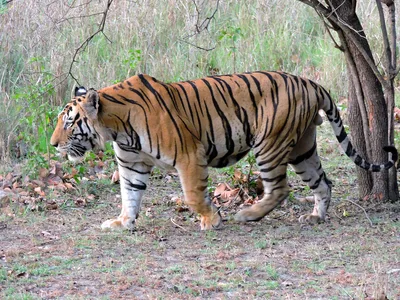
Tigers, leopards, dholes, jackals and hyenas ambush adult peafowl. Civets take them as well. A changeable hawk-eagle or a rock eagle-owl takes smaller birds. Chicks die far more often than adults. Near villages, dogs and people kill them.
A predator has to surprise the bird, because a peafowl runs and hides well. The train is a liability, since it blocks the view behind a drinking or displaying male. A big cat can also snatch the train of a male that roosts too low. Spurs give some defence, but they rarely stop a large predator.
Poaching for meat and feathers is a real threat. Birds are also poisoned when they eat seed treated with pesticide. Some are killed for folk remedies. Habitat loss caused by people has done the most damage of all.
Population and conservation
The IUCN lists the Indian peafowl as Least Concern. A conservative estimate in 2002 put the population above 100,000. Nobody knows the exact figure, and nobody believes the trend is downward. Naturalists have logged 55,862 records on iNaturalist. Law protects the bird in India and in Sri Lanka.
Indian law allows the collection of shed feathers only. Tests can now tell a plucked feather from a moulted one. Several sanctuaries exist for the species, such as Choolannur and Viralimalai. Cities run management programmes that teach people how to limit damage humanely. The bird breeds readily in captivity, and zoos and fanciers keep stock worldwide.
Relationship with humans
The peafowl has lived beside Indian farming for centuries. It spreads seed and eats insects and small rodents in the fields. It also costs the farmer, and it can cut a rice yield by 40 percent. In towns the birds strip garden plants. They attack their own reflections and break glass and mirrors. They perch on cars, scratch the paint and leave droppings.
Feathers are gathered when a male moults, and one bird sheds over a hundred. That collection does the bird no harm. Feathers decorate hats, arrows, cloth and flower arrangements. Indian folk medicine uses a feather extract against viper and cobra bites. The extract is rich in iron and protein and blocks enzymes in the venom. Peafowl eggs are sold where religion does not protect the bird.
In culture and myth
The Indian peafowl is the national bird of India. In Hindu tradition the war god Kartikeya rides a peacock named Paravani. Krishna wears a peacock feather in his crown. The Ramayana says Indra sheltered under a peacock's wing from the demon king Ravana. He then blessed the bird with a thousand eyes and freedom from fear of snakes. In Buddhist thought the peacock stands for wisdom.
In Greek myth, Hera set the giant Argus to guard Io. Argus was covered in eyes and never slept. Hermes killed him, and Hera moved his eyes into the peacock's tail. In Yazidi belief the Peacock Angel, Melek Taus, leads the divine beings and rules the earth. Yazidis may not hunt, eat or curse a peacock. A golden peacock is a symbol of Ashkenazi Jewish culture and appears in Yiddish song.
Medieval European knights swore a vow of the peacock and wore its plumes on their helmets. In the Robin Hood stories the archer fletches his arrows with peacock feathers. Peacock feathers were buried with Viking warriors. In 1526 Cardinal Wolsey called the English judges to decide whether the bird was wild or tame. They ruled it a domestic fowl. In heraldry, a peacock facing the viewer with the tail spread is said to be in his pride.
A sentence with a dotted underline is inferred: it describes the group the animal belongs to, or is a reading of the sources, rather than a measured or reported fact about this species.
Questions
Indian peafowl questions, answered
What is the difference between a peacock and a peahen?
The peacock is the male, with a blue neck and a long train. The peahen is the female, brown and without a train.
How big is a peacock?
A peacock is 100 to 120 centimetres from bill to tail. With the train he reaches 230 cm.
How much does a peacock weigh?
A peacock weighs 4.1 to 5.2 kilograms. A peahen weighs 2.7 to 4.1 kg.
Can peacocks fly?
Yes, but they rarely do. They run into cover when disturbed, and they fly up to a tree at night.
What do peafowl eat?
Grass, seed, flower buds, fruit and insects. They also take lizards, small snakes and rodents.
Do peacocks eat snakes?
Yes. They kill snakes near farms, and cobras are among the species they take.
Why does a peacock have a train?
He fans and quivers it in front of peahens. Biologists still argue about how much the display decides a female's choice.
Is the peacock's train its tail?
No. The train grows from the rump and is made of upper tail coverts. The true tail is short and brown.
How many eggs does a peahen lay?
Three to eight, in a shallow scrape on the ground. She sits on them without help.
How long do peafowl eggs take to hatch?
About 28 to 30 days. The chicks follow the peahen as soon as they hatch.
How long do peafowl live?
Wild birds usually live 10 to 20 years, with about 15 as the average. A captive bird has reached 23.2 years.
Are Indian peafowl endangered?
No. The IUCN lists them as Least Concern, and an estimate in 2002 put them above 100,000.
Where do wild peafowl live?
Across most of India and Sri Lanka. Feral flocks now live in many other countries.
Why is the peacock India's national bird?
The bird is native, familiar and woven into Hindu tradition. India adopted it as a national symbol.
Are white peacocks albinos?
No. The white form is a leucistic colour mutation bred in captivity.
Do peafowl make good garden birds?
They need a lot of space and they are very loud. They also strip plants and scratch cars.
Food web
Prey and food
- grain
- seeds
- berries
- insects
- lizards
- snakes
- rodents
Food web
Predators
 Tiger
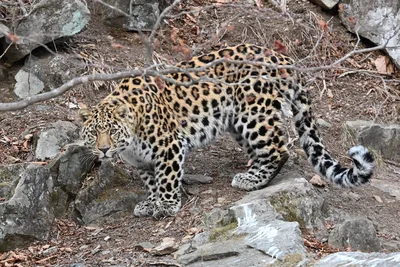 Leopard
Ecological equivalents
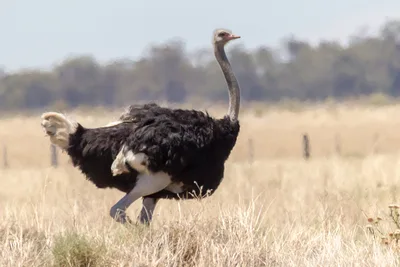
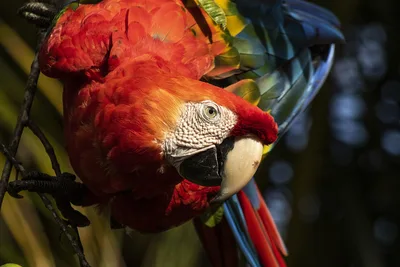
Related species on this site
Peacock (same genus), Australorp Chicken (same family), Ayam Cemani (same family), Barnevelder (same family), Blue Andalusian (same family), Brahma Chicken (same family), and more.
Birds
Peacock
Pavo cristatus
The Indian peafowl is a ground-foraging bird native to South Asia.
Living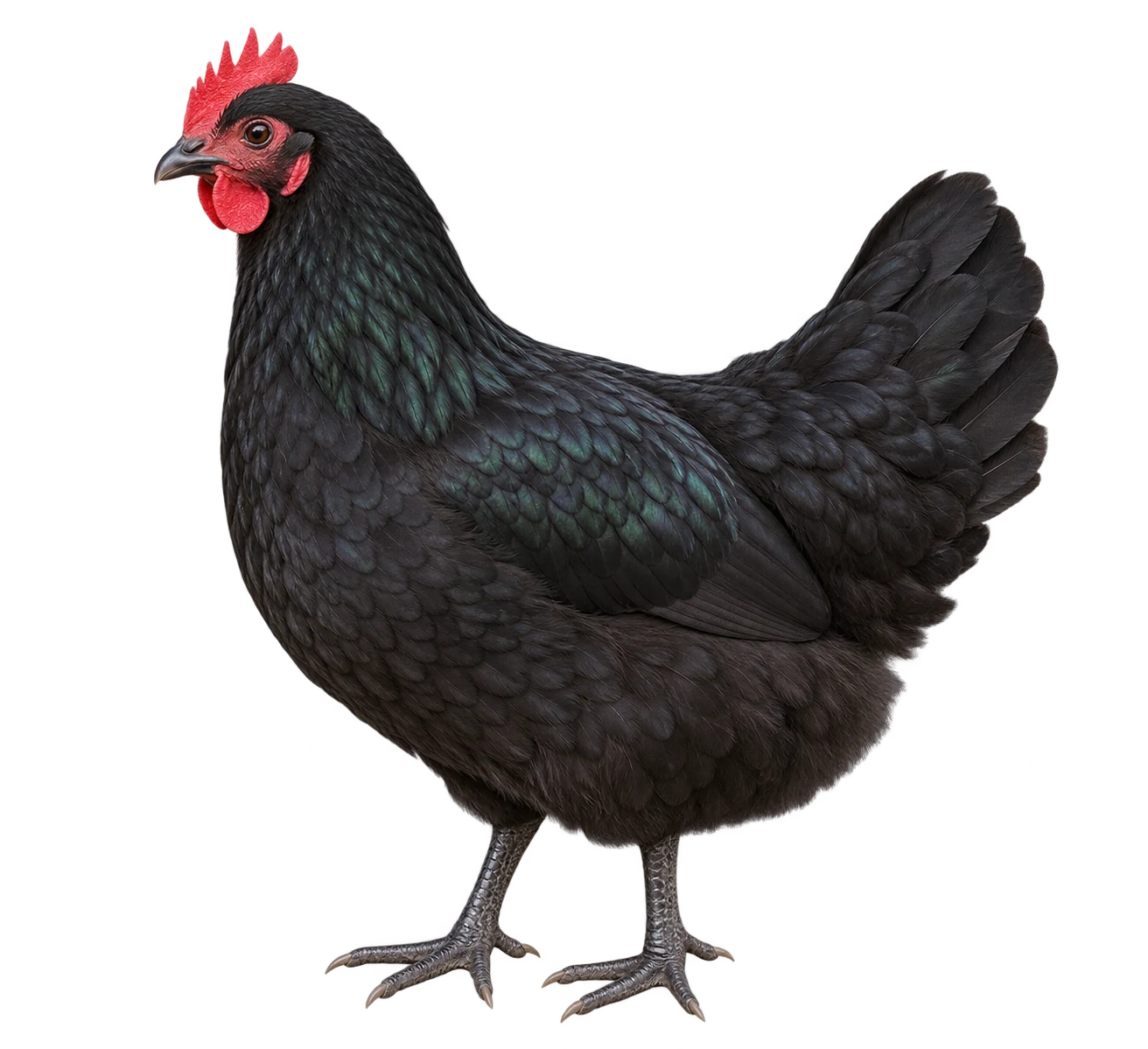
Birds
Australorp Chicken
Gallus gallus domesticus
Classification and source reference
LivingAI illustration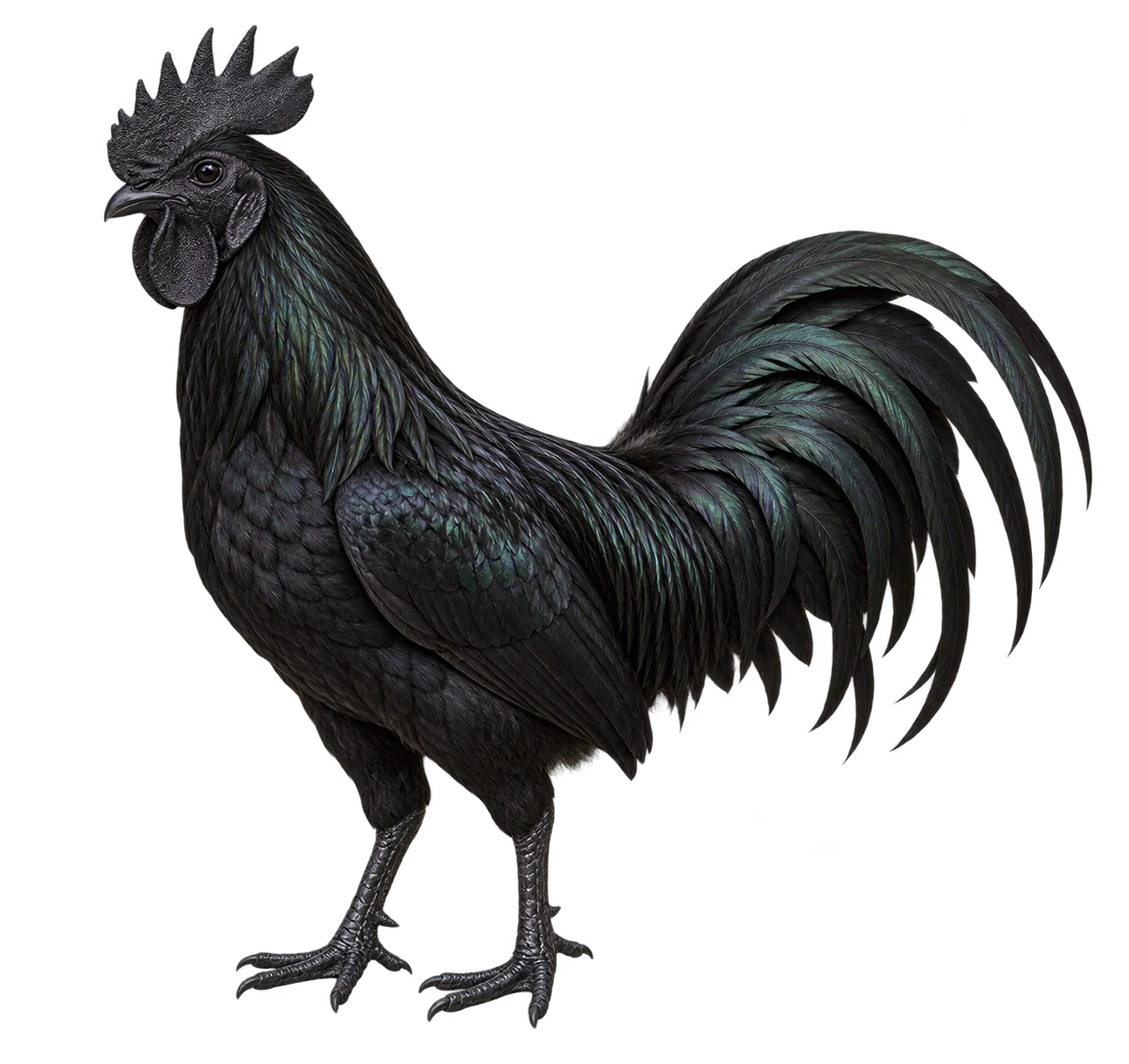
Birds
Ayam Cemani
Gallus gallus domesticus
Classification and source reference
LivingAI illustration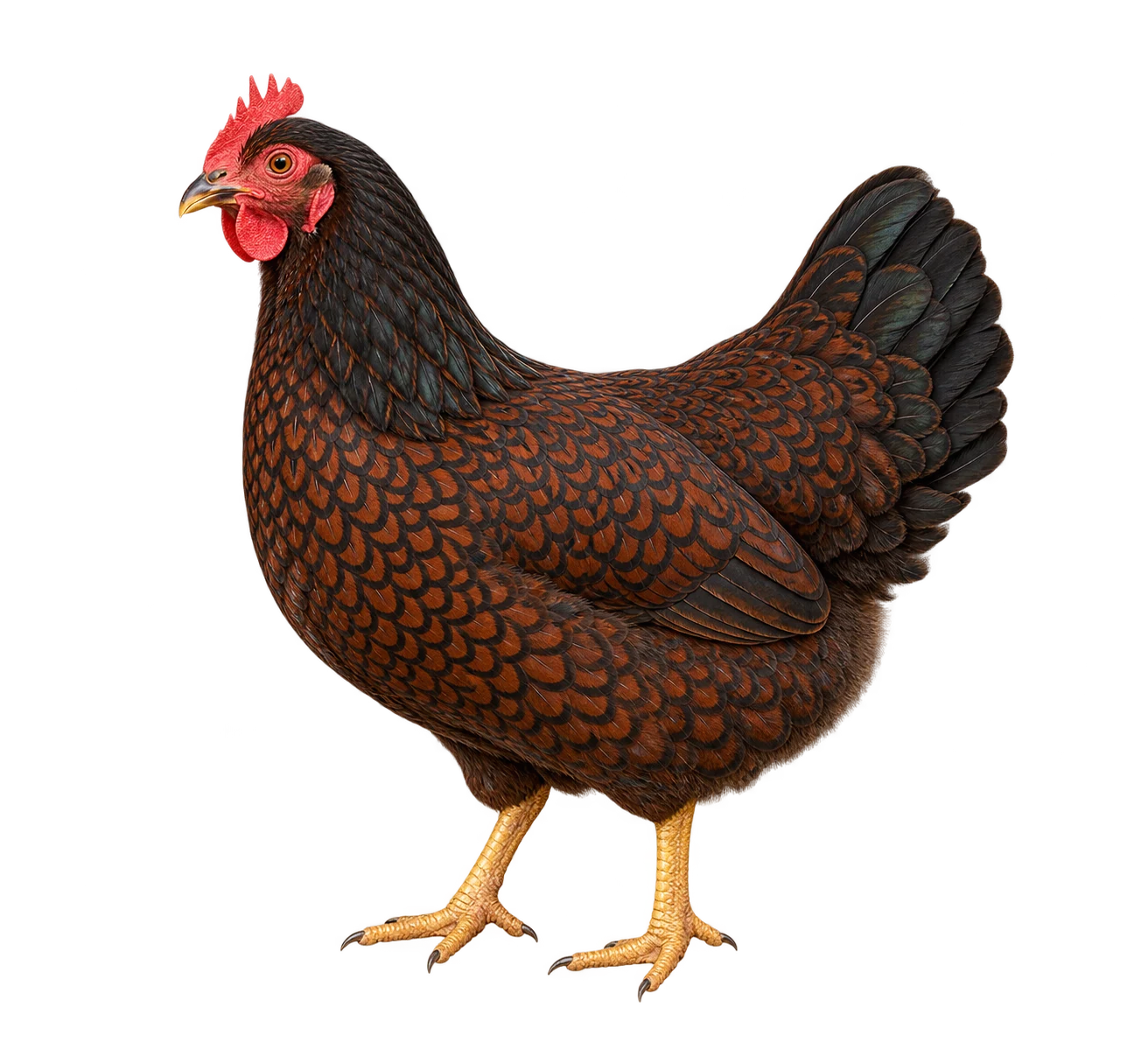
Birds
Barnevelder
Gallus gallus domesticus
Classification and source reference
LivingAI illustration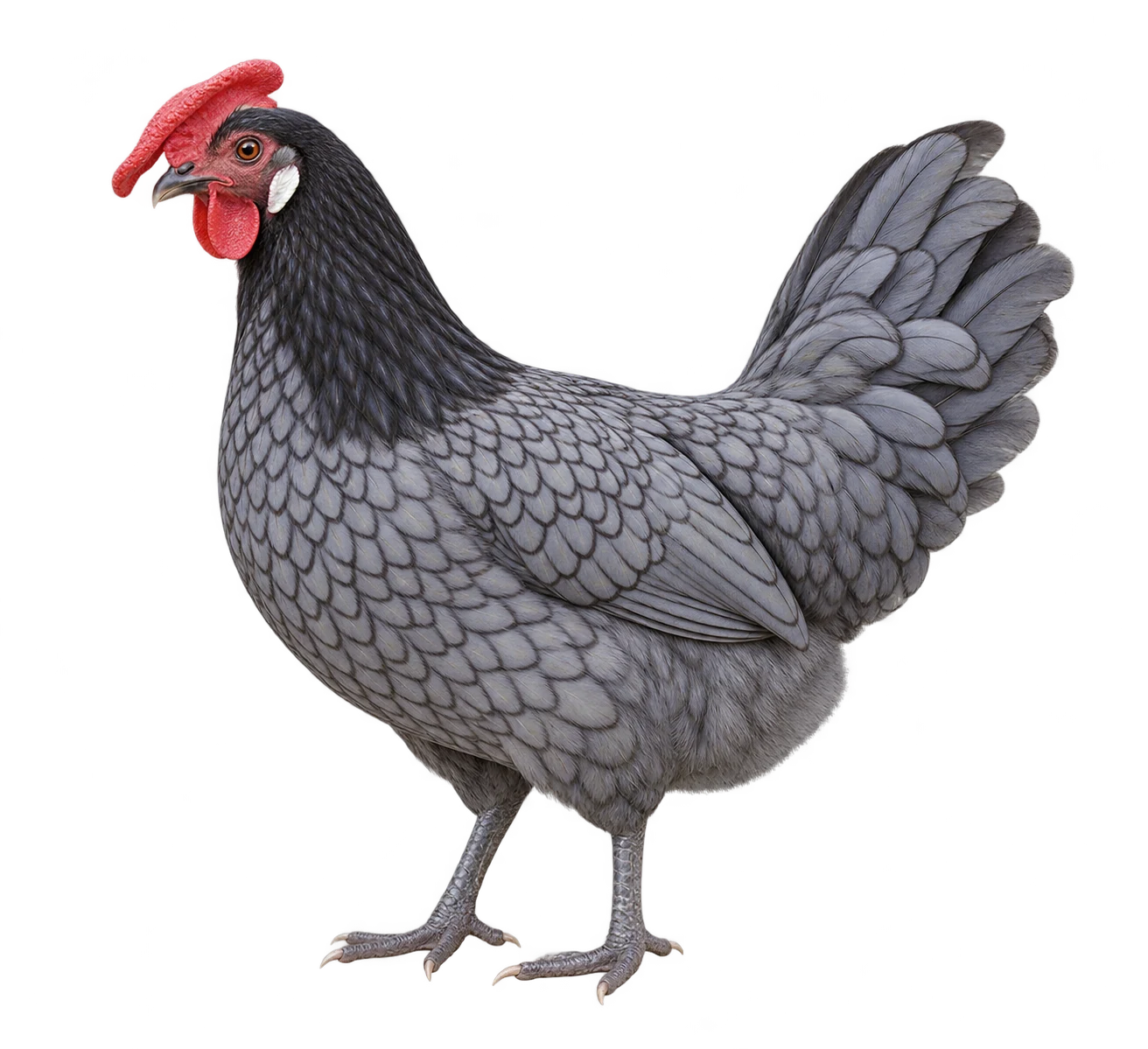
Birds
Blue Andalusian
Gallus gallus domesticus
Classification and source reference
LivingAI illustration
Birds
Brahma Chicken
Gallus gallus domesticus
Classification and source reference
LivingAI illustration