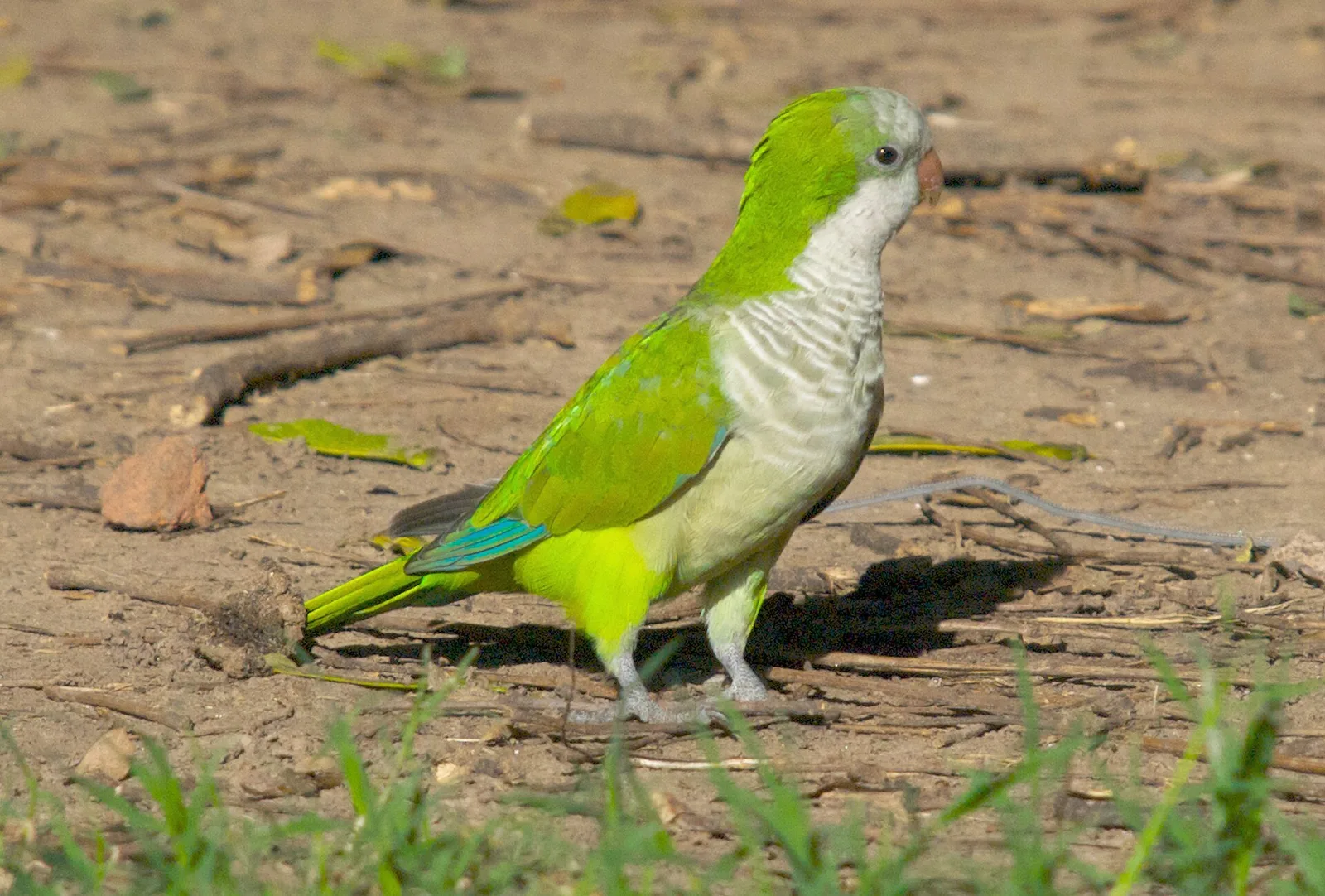
Monk parakeet
The only parrot that builds a stick house
Myiopsitta monachus
Also called Quaker parrot, Monk parrot
Living individuals or members of this group exist today. This does not mean they are safe from extinction.
Meet the monk parakeet
The monk parakeet is a small green parrot from southern South America with a pale grey face and breast. It is the parrot that weaves its own stick nest, and escaped cage birds have carried the habit into cities worldwide.
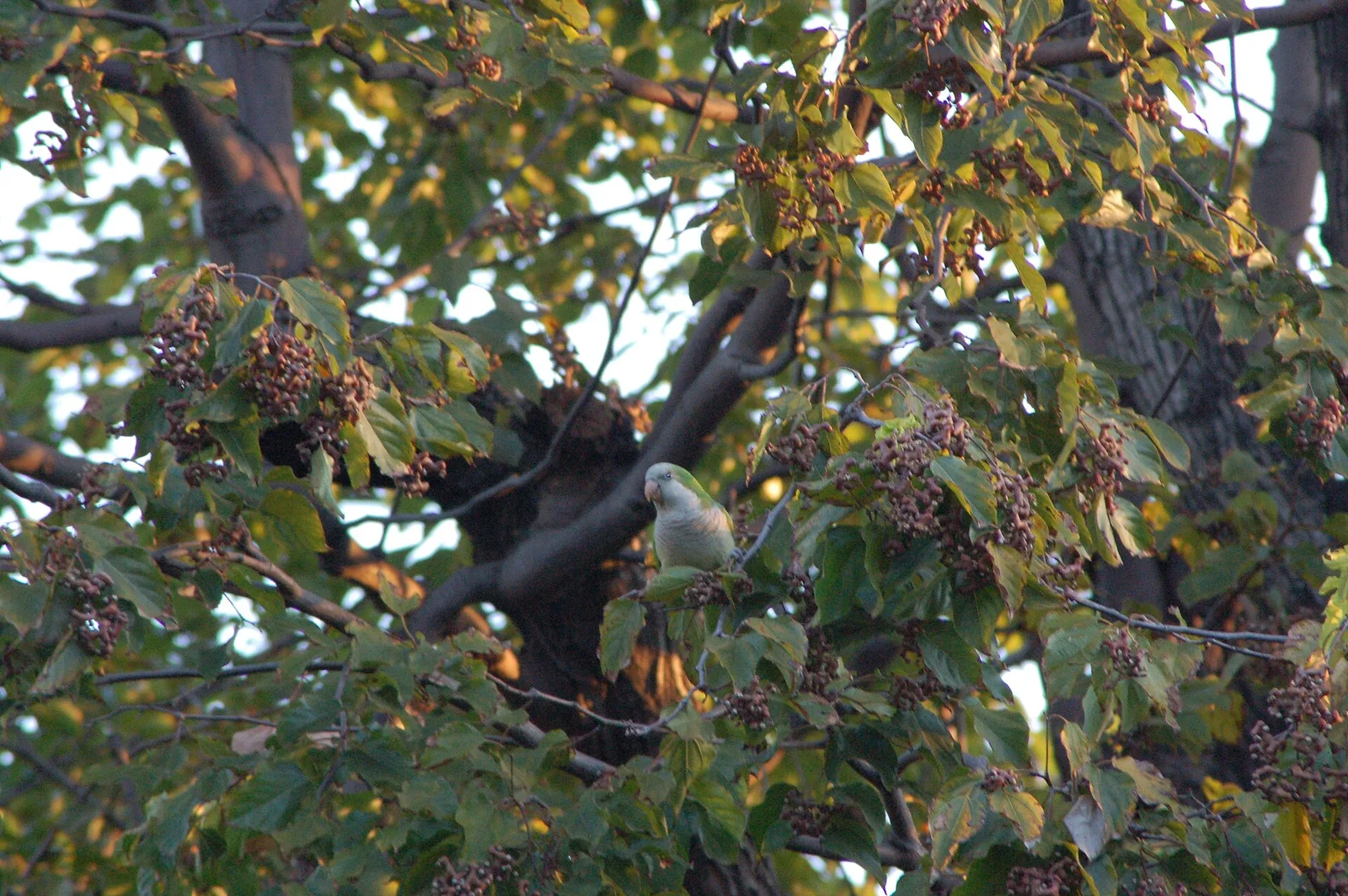
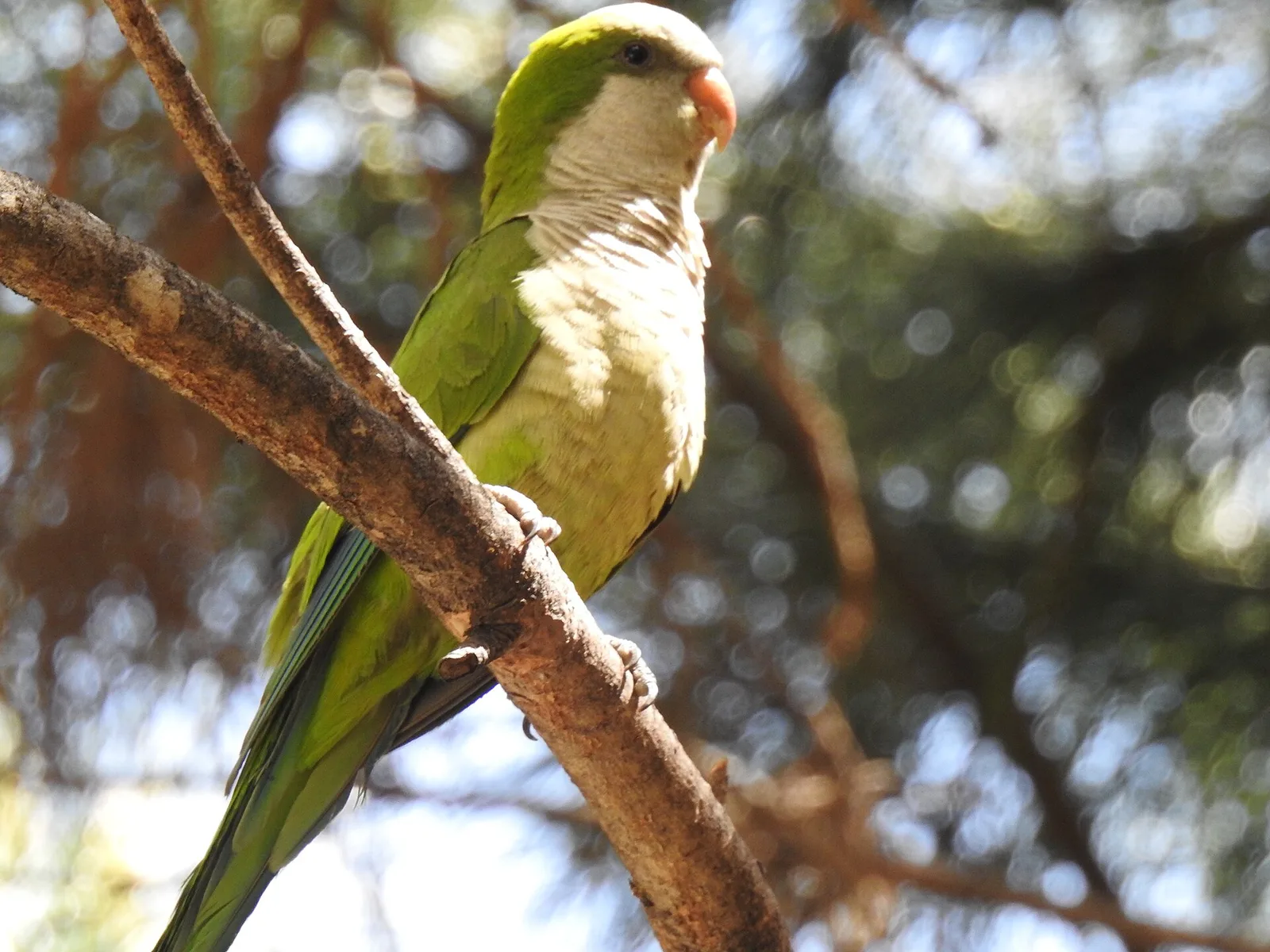
Images of the monk parakeet
Lifespan in the wild
About 6 years
Weight
About 100 g
Length
About 29 cm
Wingspan
About 48 cm
Fact file
Monk parakeet
- Location
- Southern South America, plus feral flocks in Europe and North America
- Habitat
- Savanna, Temperate forest, Grassland, Towns and cities
- Diet
- Omnivore
- Predators
- Few recorded; hawks and owls take some adults
- Lifestyle
- Social by day, and roosts in the nest at night
- Group name
- Flock, and a colony shares one nest
- Name of young
- Chick
- Incubation
- Incubation about 20 days
- Clutch size
- 4 to 7 eggs, and up to 11 recorded
- Population
- Perhaps 20 million worldwide
- Biggest threat
- Control programmes and nest removal
- Distinctive feature
- Pale grey face and scalloped grey breast
- Colour
- Bright green above, grey face and breast, blue flight feathers
- Skin type
- Feathers
Size
Next to a person
Measurements
Size and speed
- Length
- About 29 cm the nominate subspecies, bill to tail tip
- Wingspan
- About 48 cm
- Weight
- About 100 g about 100 grams
Typical adult ranges. Source: Wikipedia.
Life cycle
Lifespan
- In the wildAbout 6 years
- In captivity10 to 30 years
- 030 years
Source: Wikipedia.
Appearance
Colour and coat
- Primary colours
- greengrey
- Secondary colours
- blueyelloworange
- Skin type
- feathers
- Male and female
- Slight. Females average 10 to 20 per cent smaller than males. The plumage difference is too fine for the human eye, so breeders use a DNA or feather test.
Life cycle
Mating and family
- Mating system
- monogamous pairs, sometimes with helpers
- Social structure
- colonies that share one large stick nest
- Breeding
- one brood a year, from late August to November
A pair builds or claims a set of chambers in the colony nest. The female lays four to seven white eggs and sits on them without a break while the male feeds her. The eggs hatch after about 20 days, and both parents carry food to the chicks. Grown offspring from an earlier year sometimes stay to help. Wild birds live about 6 years, and captive ones can pass 20.
Classification
Taxonomy
- Kingdom
- Animalia
- Phylum
- Chordata
- Class
- Aves
- Order
- Psittaciformes
- Family
- Psittacidae
- Genus
- Myiopsitta
- Species
- Myiopsitta monachus
Conservation
Red List status
- LC
- NT
- VU
- EN
- CR
- EW
- EX
Least Concern on the IUCN Red List
Range
Recorded in 13 countries
- Argentina
- Belgium
- Brazil
- Chile
- Spain
- Greece
- Israel
- Italy
- Mexico
- Puerto Rico
- Singapore
- United States of America
- Uruguay
Habitat layer: temperate broadleaf and mixed forest, temperate conifer forest, boreal forest and taiga, tropical grassland, savanna and shrubland, temperate grassland, savanna and shrubland.
Countries from 31,747 wild records on GBIF (iNaturalist research grade), filtered and checked by hand. Country shapes: Natural Earth. Habitat: RESOLVE Ecoregions 2017, CC BY 4.0. Basemap: Natural Earth.
Habitats
Three things to know
- 1
A colony nest of woven sticks can grow as big as a small car.
- 2
Pairs sleep in their nest all year, which lets the species hold out through cold winters.
- 3
Feral flocks develop local dialects, and three of them occur around one Connecticut town.
Did you know
Seven more facts
- 1
The genus name means mouse parrot and refers to the grey face.
- 2
The nest has separate chambers for eggs, for older chicks and for keeping watch.
- 3
Nests built on warm electrical gear can start fires.
- 4
Manhattan stays free of the birds because it has no overhead wires to build on.
- 5
Grown chicks sometimes stay at home and help their parents feed the next brood.
- 6
Domestic breeding has produced blue, yellow and white birds, but feral flocks stay green.
- 7
The cliff parakeet was split off from this species by committees between 2015 and 2024.
Field notes
How it looks and acts
Field notes
Distinguishing features
- The face and breast are pale grey against otherwise green plumage.
- Light edges on the breast feathers make a scalloped, barred pattern.
- The flight feathers are dark blue and show clearly in flight.
- The tail is long and tapers to a point.
- The bill is orange, and the legs and feet are grey.
- A bird measures about 29 cm from the head to the tail tip.
Field notes
Unique adaptations
- The woven stick nest gives shelter that other parrots must find in a tree hole.
- Roosting indoors all year lets the species live where winters are freezing.
- A broad diet of seeds, fruit, buds and insects suits farmland and city alike.
- Colony life probably gives many eyes to watch for danger.
- The bird takes readily to eucalyptus and other planted trees.
Field notes
Interesting behaviours
- It weaves branches into a nest rather than looking for a hole.
- It adds new rooms to the colony nest as the flock grows.
- It forages in flocks on farmland, in parks and on the ground.
- It calls loudly and almost constantly while the flock moves.
- It returns to the same nest to sleep every night of the year.
Field notes
Temperament
- The monk parakeet is bold and shows little fear of people or traffic.
- It is highly social and rarely stays alone for long.
- Pet birds appear confident and talkative, and many are possessive about the cage.
- Flocks probably defend the nest tree against intruders with noise.
Field notes
Communication
- The flight call is a harsh screech that carries across a park.
- Colonies keep up a running chatter from dawn to dusk.
- Individual voice prints appear to let birds know each other by sound.
- Feral colonies build dialects that differ from one town to the next.
- Captive birds copy human speech and learn many phrases.
Ecology
Ecological role
The monk parakeet is a seed eater and a builder, and its nests give shelter to animals that cannot build for themselves.
- It eats seeds and fruit, and it may carry some away from the parent plant.
- Its nests house pigeons, sparrows, kestrels, teal and squirrels.
- It competes with native birds for food and for nest sites where it is introduced.
- Large flocks strip grain and fruit crops in South America.
Stories
Myths and legends
- In New York folklore, the city flock began when a shipping crate broke open at an airport.
- In American pet-trade usage, the name Quaker is said to come from the plain grey front.
- In Latin naming, monachus casts the grey head as a monk's hood.
- In Chicago city lore, the Hyde Park colony became a cause that a mayor defended.
People
Relationship with humans
People
Living alongside us
People made this parrot a global bird by shipping it as a pet. Thousands of birds went as pets to North America in the last century, and the escapees founded flocks. Farmers in South America treat the species as a serious pest, and several countries now ban its sale. City people often take the opposite view and defend the colonies they live with.
- The bird does not attack people, and a flock may simply fly off when anyone climbs near.
- A frightened pet may bite hard enough to break the skin.
- Nests on power lines start fires and cut off electricity supply.
People
Status, uses and products
- Domestication
- Wild
- As a pet
- Kept by some. The monk parakeet is a popular cage bird that talks well and lives for decades. It is loud, needs company and chews everything it can reach. Many American states and several countries ban ownership, so check the law first.
- Uses
- pet tradebirdwatching
- Products
- None recorded
The full account
About the monk parakeet
The monk parakeet, Myiopsitta monachus, is a small green parrot of southern South America. The pet trade calls it the Quaker parrot. The nominate subspecies averages 29 centimetres long, with a wingspan of 48 cm. A bird weighs about 100 grams.
Green covers the back and the wings, and the face and breast are pale grey. Pale edges on the grey feathers give the breast a scalloped pattern. It is one of very few parrots that weave a stick nest instead of using a tree hole. Escaped cage birds have founded wild flocks in North America, Europe and beyond. The IUCN lists the species as Least Concern, and numbers are rising in many places.
Name and taxonomy
The Comte de Buffon described the bird in 1780 in his work on the birds. Buffon attached no scientific name, so the Dutch naturalist Pieter Boddaert supplied one in 1783. He called it Psittacus monachus, and monachus is Late Latin for a monk. Charles Lucien Bonaparte set up the genus Myiopsitta in 1854. The genus name joins Greek and Latin roots for mouse and parrot, after the grey face.
Three subspecies are recognised, and their ranges meet in Paraguay. The nominate form of Argentina and Uruguay is the largest of the three. The cliff parakeet of Bolivia was once counted as a fourth form. Committees raised it to a full species between 2015 and 2024, and one list still disagrees. Buffon named no place of origin for his bird. James Peters fixed the type locality at Montevideo in Uruguay in 1937. The forms calita and cotorra are poorly separated, and the boundary needs more study.
Evolution and relatives
The monk parakeet belongs to Arinae, the New World parrots. Its only close relative is the cliff parakeet, which nests on rock faces. The two birds live at different heights, so their ranges barely touch. Nest building separates the genus from almost every other parrot in the world. Only some of the African lovebirds build anything of the kind. The habit probably arose in open country, where tree holes are scarce.
The species sits in Psittacidae, the family of the true parrots. Its order, Psittaciformes, sits close to the falcons and the perching birds. Nest building is probably a late invention inside that order. No fossil appears to record when the first stick nest was built.
Appearance
The upperparts are bright green. The forehead is blue grey, and the cheeks and throat are a paler grey. Feathers on the throat and belly carry light edges, which produce a barred look. The lower belly, the legs and the underside of the tail are yellowish green. The flight feathers are dark blue, and the tail narrows towards its tip. The bill is orange to pinkish brown, the legs are grey and the eyes are brown.
Females run 10 to 20 per cent smaller than males. The sexes still look alike, and only a DNA or feather test names them with confidence. AnAge gives an average adult mass of 81.7 g for the species. Breeders have produced blue, yellow, white, cinnamon and pied birds for the pet trade. Feral flocks stay green, because a pale bird has less cover from predators. A perched bird appears stocky, with a short neck and a heavy head.
Habitat and range
The native range covers Argentina, Uruguay, Paraguay, Bolivia and southern Brazil. The birds use open savanna, scrub woodland and palm groves, mostly where rain is light. They gather near large bodies of water. City parks, farms, orchards and gardens hold them as well. The calita subspecies climbs the Andean foothills to 1,000 metres. Birds far from towns move in winter to find better feeding grounds.
Feral flocks now live in Europe, North America, North Africa, the Middle East and Asia. Spain holds more than 80 per cent of the European total. Madrid counted 10,800 birds in 2015, and Barcelona about 5,000 in the same year. Seville rose from 1,200 birds in 2013 to 6,300 by 2021. Estimates for Florida alone run from 150,000 to 500,000. GBIF holds records of the species from 63 countries. Athens has a breeding colony in the National Garden at the centre of the city. Brussels has held wild birds since the 1970s.
Diet and feeding
The monk parakeet eats seeds, fruit, blossom, leaf buds, thistles and grasses. It takes insects too, so the diet is not purely vegetable. Sunflower, safflower and pumpkin seeds all appear on the list. Near farms the birds eat maize, sorghum, citrus fruit, legumes and sweet potato. They even take meat that has been hung out to dry. Flocks feed together, and a group strips a crop quickly. Citrus groves and fruit trees draw flocks in the native range.
Farmers in Argentina, Brazil and Uruguay treat the bird as a major pest. Charles Darwin was among those who noted the damage. Argentine officials have claimed losses of up to two thirds of a planted grain crop. Reports from Chicago find no serious crop damage there. The spread of eucalyptus plantations probably helped the South American population grow. Those plantations give safe nest sites with few rival species.
Behaviour and social life
Monk parakeets live in flocks all year round. The nest is the centre of the life of the flock. Pairs weave sticks, twigs and small branches into a bulky structure. A colony nest can grow to the size of a small car. Each pair keeps its own entrance and its own set of chambers inside. One chamber holds the eggs, another the older chicks, and a third serves as a lookout.
Other animals move into the spare rooms. Pigeons, sparrows, American kestrels and yellow-billed teal have all been found as tenants. Red squirrels use the nests too. The birds sleep in the nest at night through the year, not only when they breed. That habit lets the species hold out in cold winters far from its home range. Some flocks build on electrical gear, where the warmth helps and the fire risk is real. A pair rarely travels far when food sits near the nest.
Communication and senses
The usual call is a loud, throaty screech. Written forms include chape-yee and quak quaki quak-wi quarr. A flock stays noisy for most of the day. Each bird appears to carry its own voice print, which lets the others recognise it. The print seems to work whatever call type the bird uses. An alarm call probably lifts the whole colony into the air at once.
Feral groups develop local dialects. A colony founded by a few birds may keep the odd dialect of those founders. Three separate dialects occur among the parakeets around Milford, Connecticut. Pet birds learn scores of human words and phrases. Like other parrots, the species copies sounds it hears often.
Reproduction and life cycle
Breeding in the native range runs from late August into November. A pair is the usual unit, and both birds share the work. A Barcelona study found three to five birds in about 20 per cent of breeding units. Those groups mix related and unrelated birds, and more than one female may lay in a nest. The clutch usually holds four to seven white eggs, and counts up to eleven are recorded.
The female sits without a break, and the male brings her food. Incubation lasts about 20 days. Both parents then feed the chicks in the nest. Grown young sometimes stay to help feed the next brood, which is rare in parrots. The nest itself is used again, and the colony adds rooms as it grows. Young birds may breed in the season after they leave the nest.
A wild monk parakeet lives about 6 years on average. Captive birds reach 10 to 30 years, and AnAge records one that made 22.1 years. Wikipedia gives an overall average near 15 years across wild and captive birds.
Predators and threats
Like other small parrots, it is probably taken by hawks, falcons and owls. The thick stick nest may shield the eggs and chicks from most attackers. The main pressure on the species comes from people. In the United States, people pull the nests down as a routine measure. Crews return each year, because a colony may rebuild on the same pole. British authorities announced trapping, nest removal and shooting in 2011.
Spain outlawed keeping and trading the bird in 2013. Auckland banned its sale, breeding and distribution from September 2022. More than a dozen American states forbid sale and ownership outright. Cold weather also limits the species, and several European colonies have died out. Denmark, Germany, Austria and Czechia lost theirs, and so did some French and Dutch groups. A Bahamian colony on Eleuthera lasted from 1985 until the middle 1990s. Hurricanes may have ended it.
Population and conservation
The IUCN places the monk parakeet in the Least Concern category. The bird is very common across its native range. One published estimate puts the world total near 20 million. Numbers in South America have risen along with eucalyptus plantations. iNaturalist holds 60,914 observations of the species.
Most official effort goes into control rather than protection. Chicago residents resisted removal of their colony, and the mayor of the city joined them. That flock numbers about 1,000 birds, and the first city nest was found in 1973. Argentina files no national threat category, while Uruguay lists the bird as Least Concern. Unlike many parrots, this one appears to be gaining ground rather than losing it. Puerto Rico now holds more of these parakeets than of any other parrot.
Relationship with humans
Thousands of monk parakeets reached the United States as pets between the 1960s and the 1980s. Many escaped or were released, and wild flocks followed. By the early 1970s the species bred in seven states, and eight more had it by 1995. Mexico City recorded its first birds in the middle 1990s. By 2015 the parakeet lived in 97 Mexican cities and in every region of the country. Some sellers there dye the head and breast yellow to pass a bird off as a rarer parrot. A Mexican ban on trade in native parrots pushed the market towards this one.
The birds nest on utility poles, which causes fires and power cuts. Manhattan has no flock, because its wiring runs underground. Brooklyn, Queens and western Long Island suit them much better. As a pet the monk parakeet is bold, loud and clever. Owners report vocabularies of dozens of words and phrases. Rules differ by state, and some require banding, a permit or clipped flight feathers. Canada gained its first wild birds after a pet shop released six near Montreal.
In culture and myth
The species appears to carry no ancient folklore, and its stories are modern and urban. Both of its names point at religious dress. The Latin monachus means monk, and it refers to the grey hood of the plumage. The pet trade name Quaker probably follows the same plain grey idea. New Yorkers tell a story that their flock began with a broken crate at an airport. The tale is told of the 1960s, and it appears impossible to check.
Birds hold the gate spires at Green-Wood Cemetery in Brooklyn. Local people treat those birds as an emblem, and a website has chronicled them for years. In Chicago the parakeets became a political question. Hyde Park residents defended the colony, and the mayor of the city took their side. In Spain and in Argentina the same bird appears in the press as a pest. The meaning of the parakeet seems to follow the place rather than the bird. Bird watchers seem to welcome the flocks, and power companies do not.
A sentence with a dotted underline is inferred: it describes the group the animal belongs to, or is a reading of the sources, rather than a measured or reported fact about this species.
Questions
Monk parakeet questions, answered
How big is a monk parakeet?
About 29 cm long from head to tail tip, with a 48 cm wingspan. A bird weighs roughly 100 grams.
Is a monk parakeet the same as a Quaker parrot?
Yes. Quaker parrot and monk parrot are pet-trade names for Myiopsitta monachus. The bird is the same species under all three names.
What do monk parakeets eat?
Seeds, fruit, blossom, buds, grasses and insects. Near farms they also take maize, sorghum, citrus fruit and legumes.
Where do monk parakeets come from?
Southern South America. The native birds live in Argentina, Uruguay, Paraguay, Bolivia and the south of Brazil.
Why do monk parakeets build nests when other parrots do not?
No one knows for certain. The bird evolved in open country where tree holes are scarce, so building may have been the only option.
How big does a monk parakeet nest get?
A colony nest can reach the size of a small car. Each pair holds its own entrance and its own chambers within it.
How long do monk parakeets live?
About 6 years in the wild. In captivity they reach 10 to 30 years, and one recorded bird lived 22.1 years.
How many eggs do monk parakeets lay?
Usually four to seven white eggs, though clutches from one to eleven are on record. They hatch after about 20 days.
Are monk parakeets endangered?
No. The IUCN lists the species as Least Concern, and one estimate puts the world total near 20 million birds.
How did monk parakeets get to the United States?
They arrived as pets between the 1960s and the 1980s. Many escaped or were released, and by 1995 they bred in fifteen states.
Are monk parakeets a pest?
In South America they strip grain and fruit crops. Elsewhere the complaint is usually about nests on power lines rather than about farming.
Can monk parakeets survive cold winters?
Yes. They sleep inside their stick nests all year, which keeps flocks alive in Chicago, Brussels and Montreal.
Do monk parakeets talk?
Pet birds learn scores of words and phrases. They are among the better talkers of the small parrots.
Is it legal to keep a monk parakeet?
It depends where you live. More than a dozen American states ban sale and ownership. Spain outlawed the trade in 2013, and some places allow a bird with a permit or a band.
How can I tell a monk parakeet from a rose-ringed parakeet?
Look at the face and the tail. The monk parakeet has a grey face and breast and a shorter tail. The rose-ringed parakeet is green-faced with a very long tail.
Food web
Prey and food
Not recorded.
Food web
Predators
- few recorded
- hawks
- owls
Ecological equivalents
Related species on this site
African Grey Parrot (same family), Amazon Parrot (same family), Budgerigar (same family), Carolina parakeet (same family), Cockatiel (same family), Conure (same family), and more.
Birds
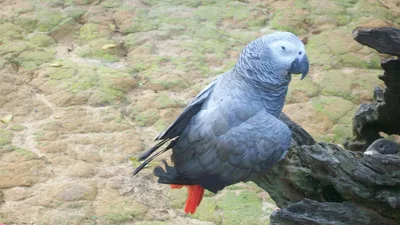
African Grey Parrot
Psittacus erithacus
Grey parrots are social African birds with grey feathers, a red tail and a strong curved bill.
Living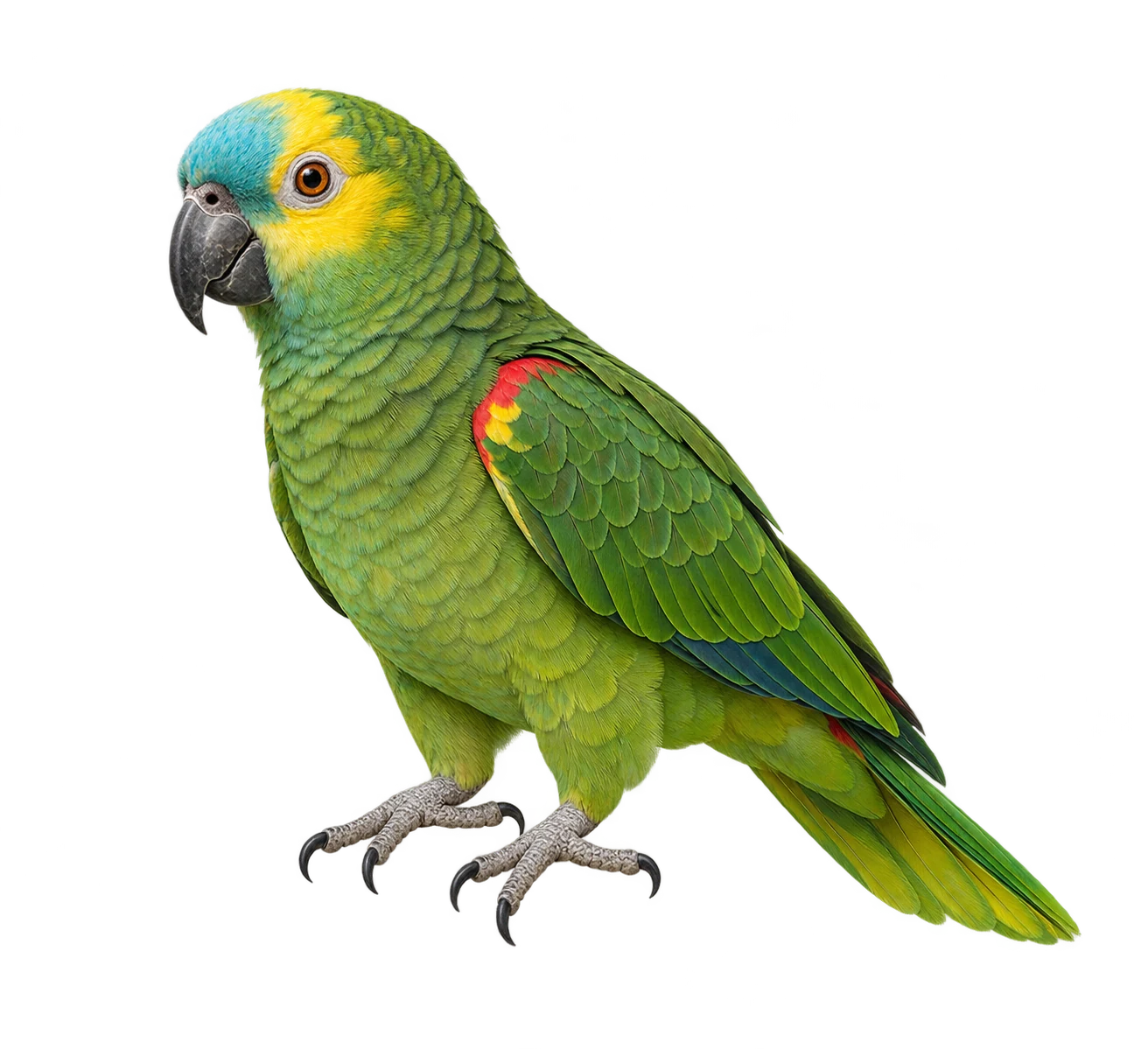
Birds
Amazon Parrot
Amazona
Classification and source reference
LivingAI illustration LC
Birds
Budgerigar
Melopsittacus undulatus
The budgerigar is a small green and yellow parrot from the dry interior of Australia.
Living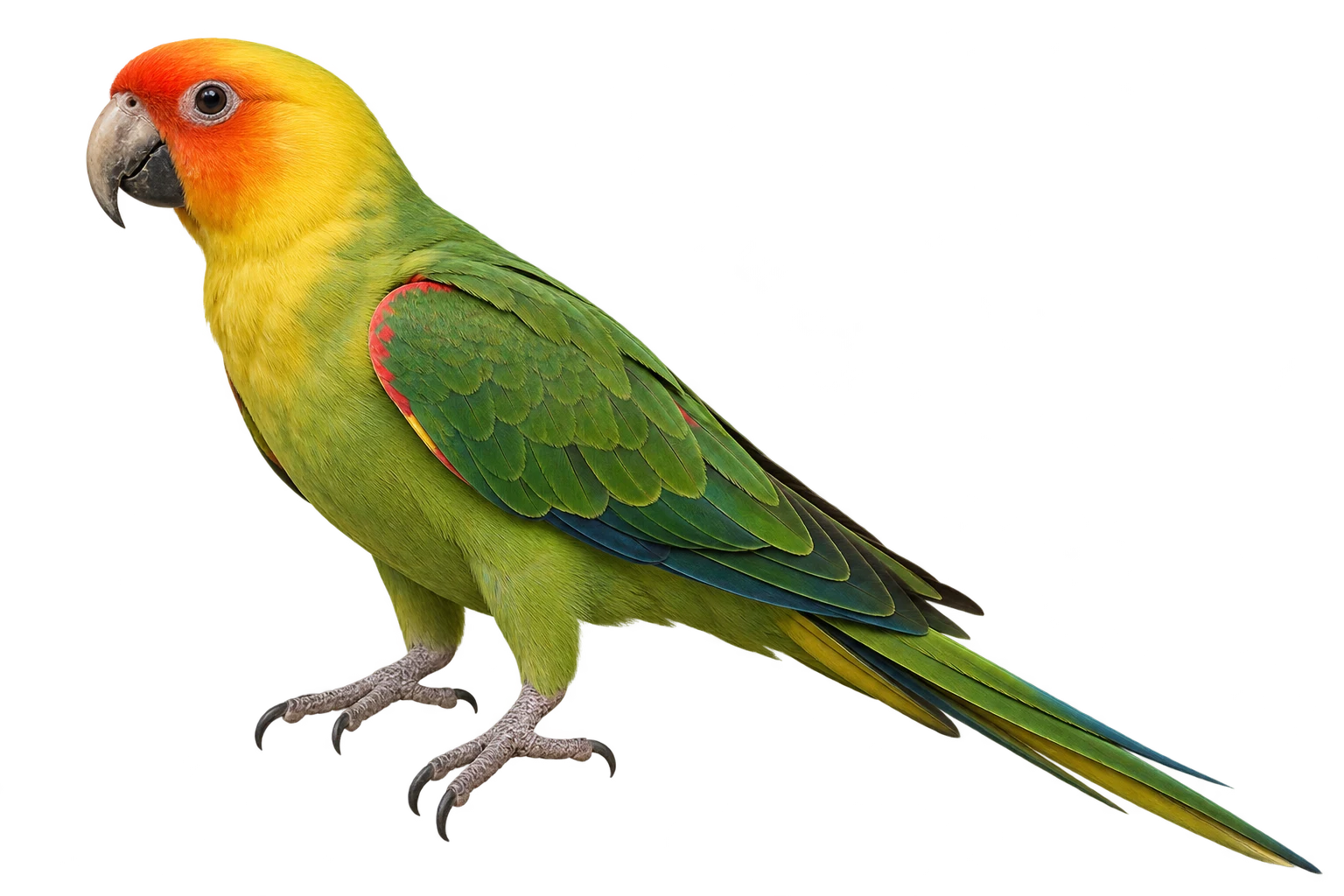 EX
Birds
Carolina parakeet
Conuropsis carolinensis
The Carolina parakeet was the only parrot native to the eastern United States.
ExtinctAI reconstruction LC
Birds
Cockatiel
Nymphicus hollandicus
The cockatiel is the smallest cockatoo, and it lives across the dry inland of Australia.
Living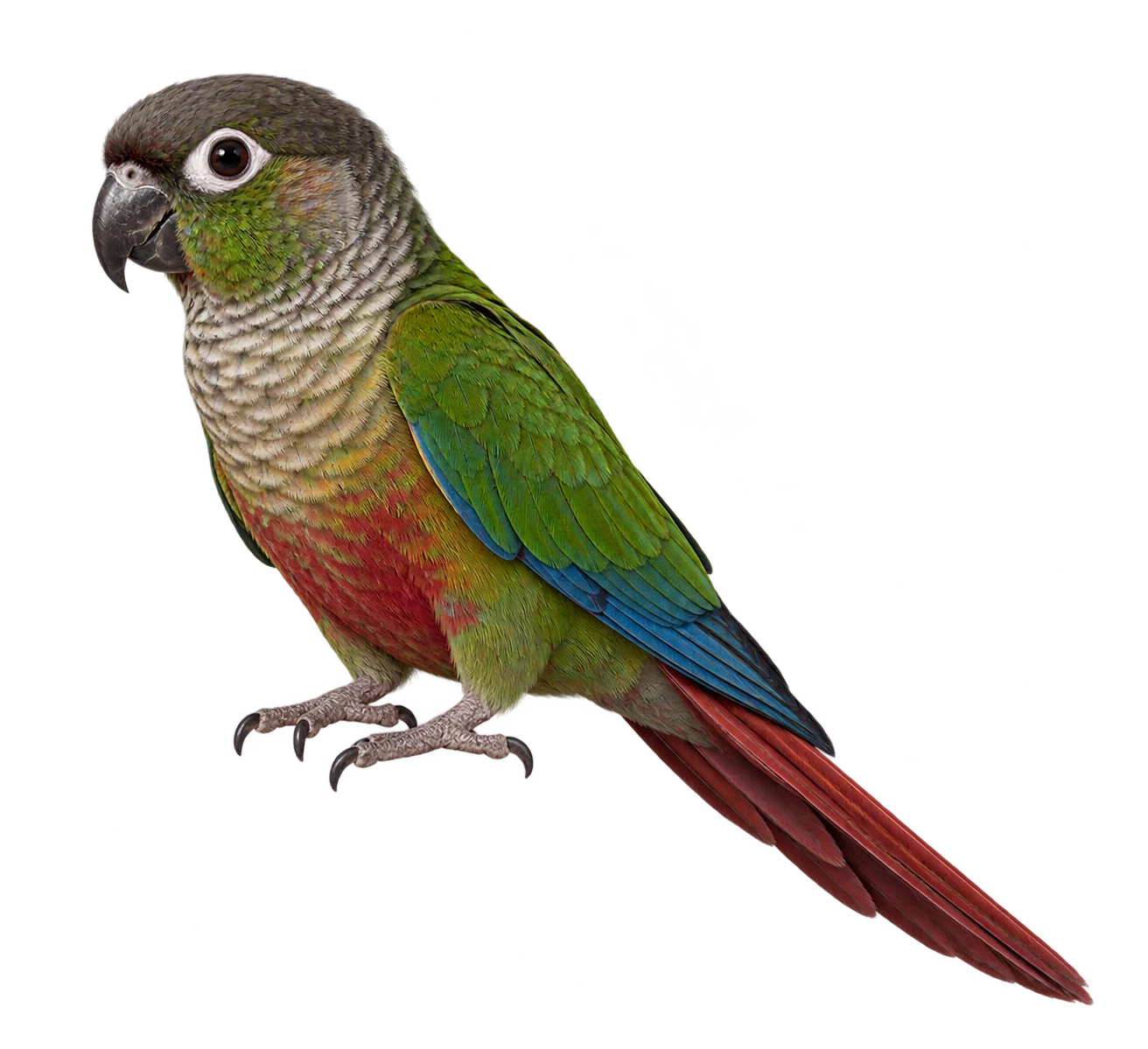
Birds
Conure
Psittacidae
Classification and source reference
LivingAI illustration