Kinkajou
A night-time fruit eater with a tail that works as a hand
Potos flavus
Also called Honey bear, Night ape, Night walker, Micoleón, Jupará, Perro de monte
Living individuals or members of this group exist today. This does not mean they are safe from extinction.
Meet the kinkajou
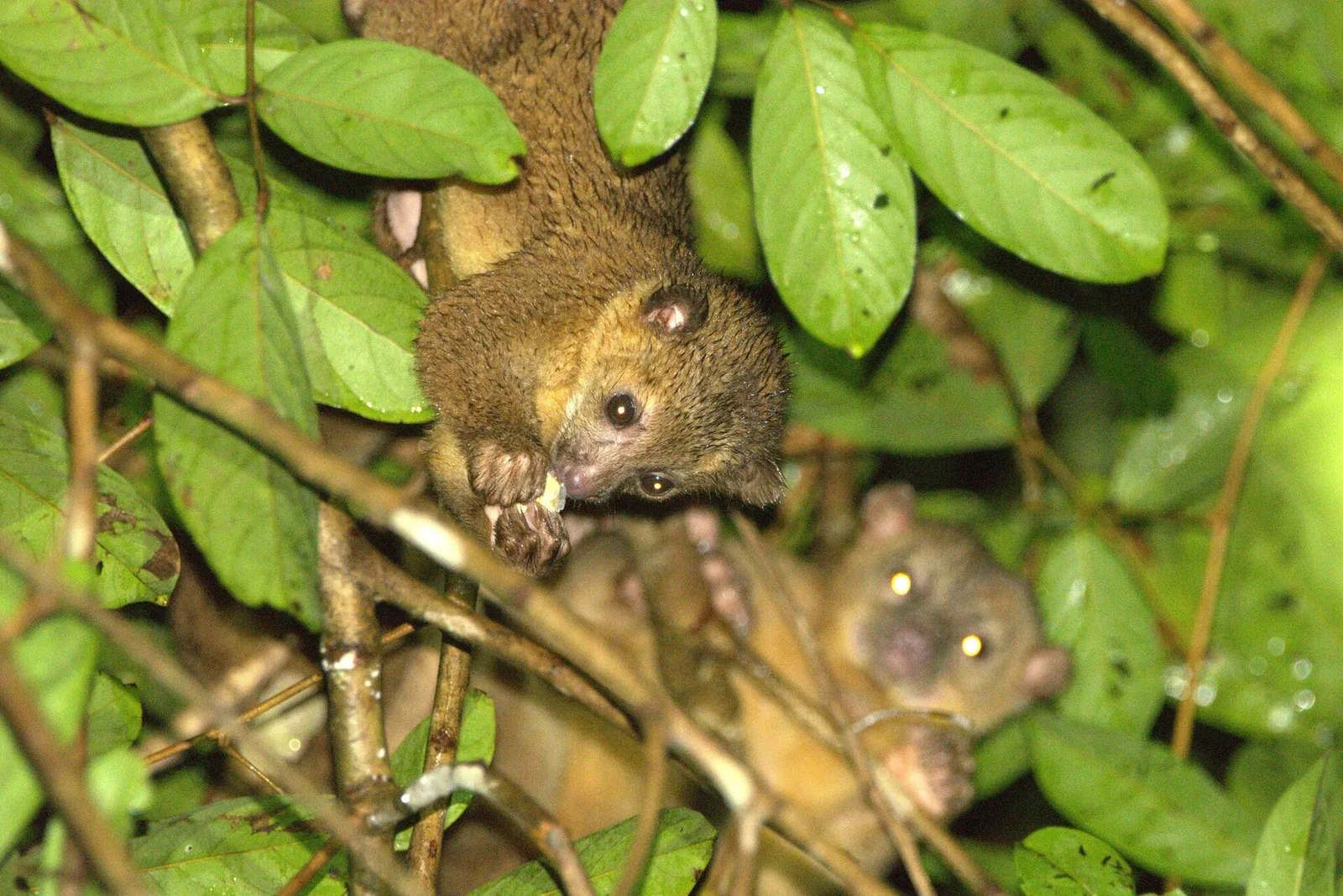
The kinkajou is a small nocturnal relative of the raccoon that lives in the canopy of tropical forests from Mexico to Brazil. It eats mostly fruit, grips branches with a prehensile tail and licks nectar with a long tongue.
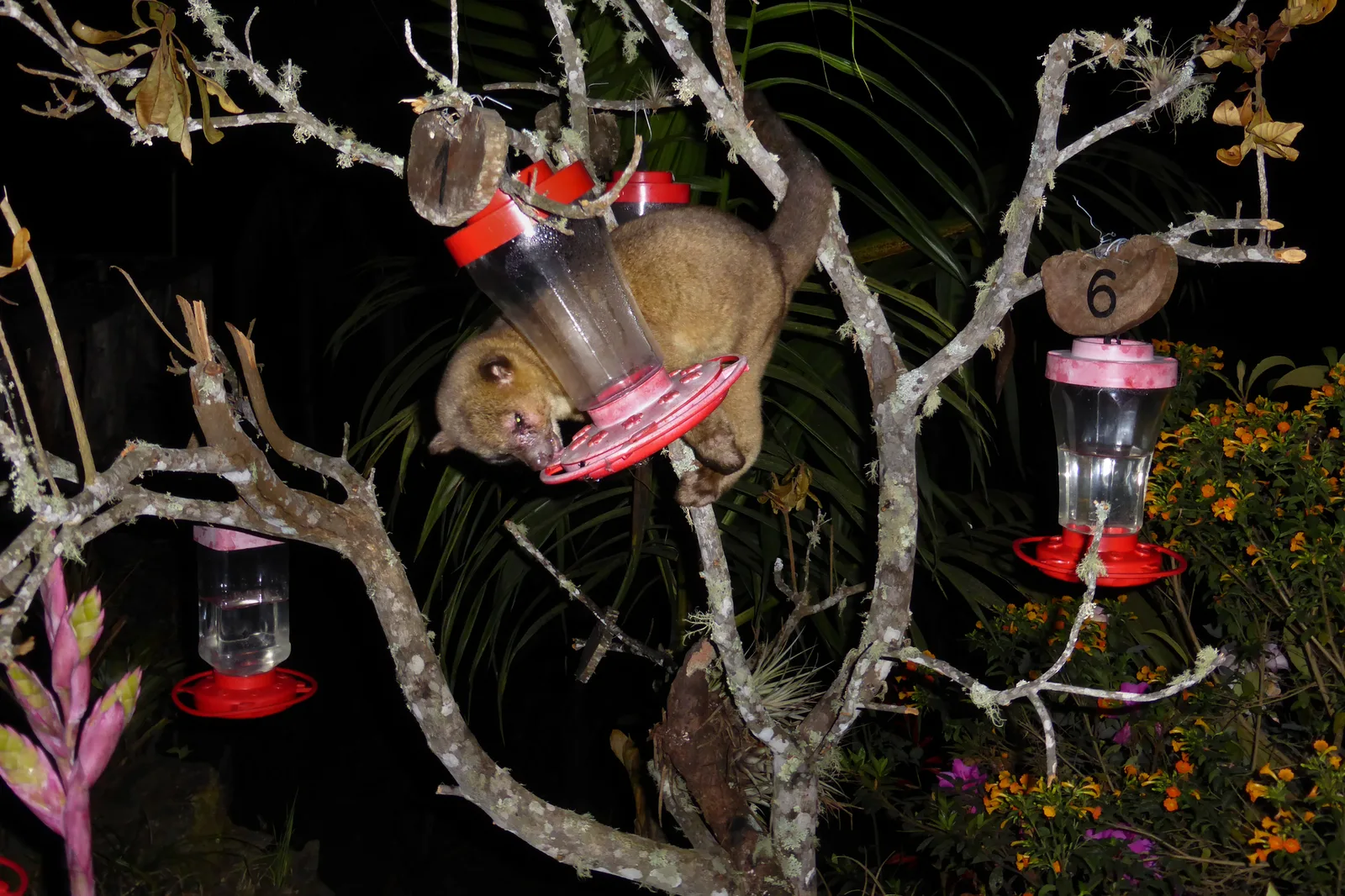
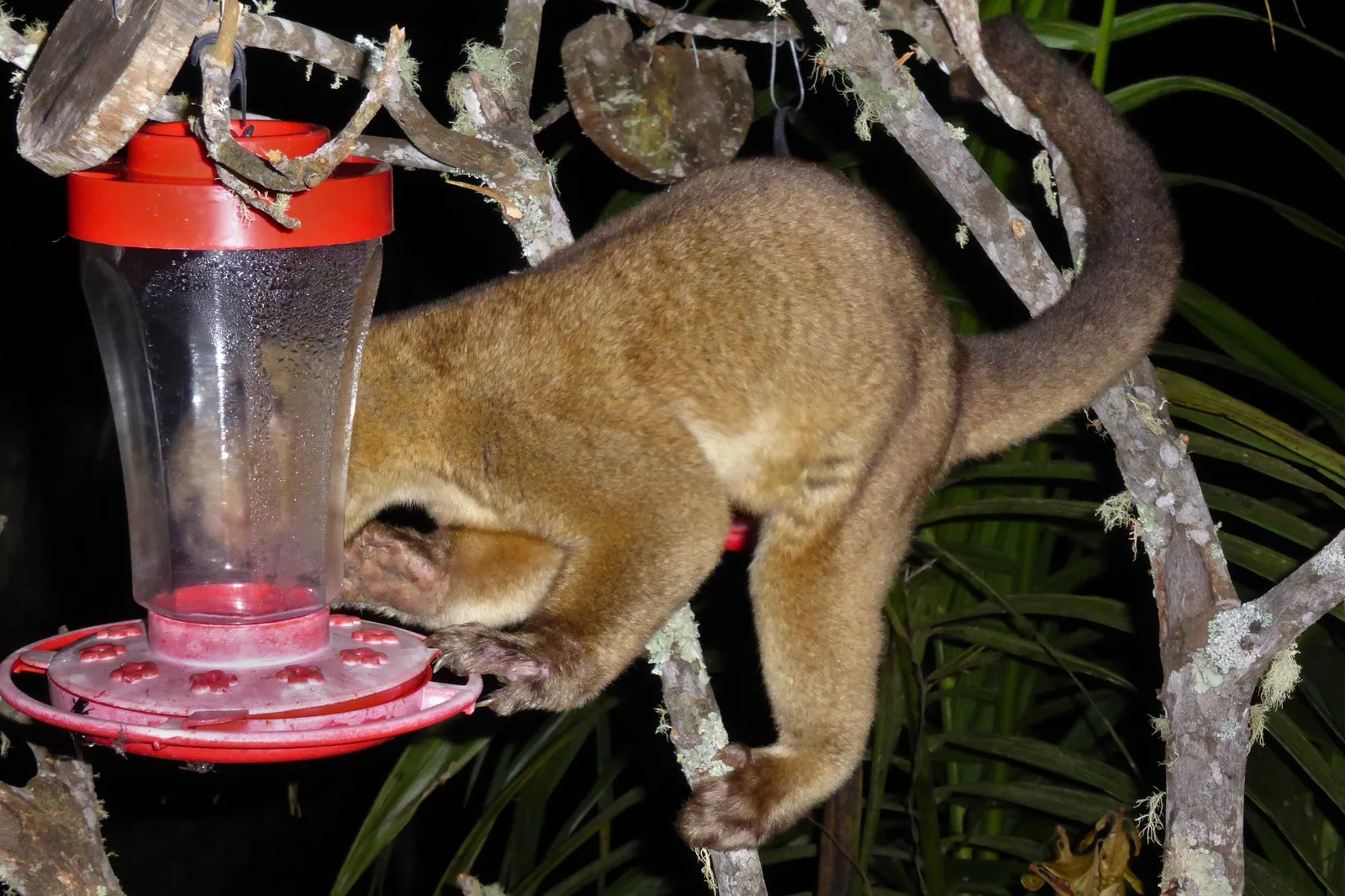
Images of the kinkajou
Lifespan in the wild
About 29 years a demographic estimate; wild lifespan is poorly known
Weight
1.4 to 4.6 kg
Length
0.82 to 1.33 m
Fact file
Kinkajou
- Location
- Southern Mexico, Central America, the Amazon basin and the Atlantic Forest of Brazil
- Habitat
- Rainforest, Temperate forest
- Diet
- Omnivore
- Prey / food
- Figs and other ripe fruit, nectar, flowers, leaves, ants
- Predators
- Harpy eagle, Isidor's eagle, jaguar, humans
- Lifestyle
- Strictly nocturnal, and lives in trees
- Group name
- Troop
- Name of young
- Pup
- Gestation
- About 112 to 118 days
- Litter size
- 1 pup, rarely 2
- Population
- Common across much of its range; no estimate exists
- Biggest threat
- Deforestation, and capture for the pet trade
- Distinctive feature
- A prehensile tail and a long, extendable tongue
- Colour
- Honey brown to tawny olive above, buff below
- Skin type
- Fur
Size
Next to a person
Measurements
Size and speed
- Length
- 0.82 to 1.33 m including the tail
- Tail
- 39 to 57 cm
- Weight
- 1.4 to 4.6 kg
Typical adult ranges. Source: Wikipedia.
Life cycle
Lifespan
- In the wildAbout 29 years a demographic estimate; wild lifespan is poorly known
- In captivityAbout 23, up to 42 years
- 042 years
The pale bar is the record. Sources: Animal Diversity Web, Wikipedia.
Appearance
Colour and coat
- Primary colours
- honey browntawny olive
- Secondary colours
- buffdark brown
- Skin type
- fur
- Male and female
- Slight. Males are a little larger and have slightly bigger canine teeth. Otherwise the sexes look alike.
Life cycle
Mating and family
- Mating system
- polygynous and polyandrous, with one dominant male fathering most pups
- Social structure
- small groups of two males, one female and their young, sharing a day den
- Breeding
- one pup a year at most, in any month
A dominant male follows a female in season for hours through the trees, with the second male close behind. After 112 to 118 days she gives birth to a single pup. It eats no solid food for eight weeks and cannot climb well until three months. She parks it in a tree while she feeds, and it is independent by about four months. Captive kinkajous live about 23 years.
Classification
Taxonomy
- Kingdom
- Animalia
- Phylum
- Chordata
- Class
- Mammalia
- Order
- Carnivora
- Family
- Procyonidae
- Genus
- Potos
- Species
- Potos flavus
Conservation
Red List status
- LC
- NT
- VU
- EN
- CR
- EW
- EX
Least Concern on the IUCN Red List
Range
Recorded in 12 countries
Habitat layer: tropical moist broadleaf forest, temperate broadleaf and mixed forest, temperate conifer forest, boreal forest and taiga.
Countries from 1,245 wild records on GBIF (iNaturalist research grade), filtered and checked by hand. Country shapes: Natural Earth. Habitat: RESOLVE Ecoregions 2017, CC BY 4.0. Basemap: Natural Earth.
Habitats
Three things to know
- 1
No other carnivoran in the Americas has a tail that can grip a branch.
- 2
Fruit makes up about 90% of its diet, though it belongs to the order Carnivora.
- 3
It can turn its hind feet 180 degrees and climb down a trunk head first.
Did you know
Seven more facts
- 1
The name kinkajou comes from an Algonquian word for the wolverine, a different animal entirely.
- 2
One Panama group used 44 different sleeping dens in a single year.
- 3
A group usually has two adult males and only one adult female.
- 4
Seeds that pass through a kinkajou sprout faster than seeds that never did.
- 5
The record captive lifespan is 42 years.
- 6
Escaped pet kinkajous were living wild in Florida by 2023.
- 7
Its eyes shine green or bright yellow when a torch catches them.
Field notes
How it looks and acts
Field notes
Distinguishing features
- A long, muscular, prehensile tail furred to the tip.
- Large forward-facing eyes and small round ears on a round head.
- A short, woolly, honey-brown coat, sometimes with a dark stripe down the back.
- A long, thick tongue that extends about 13 centimetres.
- A total length of 82 to 133 cm, of which the tail is 39 to 57 cm.
Field notes
Unique adaptations
- The prehensile tail acts as a fifth hand and lets it hang while both paws hold fruit.
- Hind feet that rotate 180 degrees allow a head-first descent down a trunk.
- A spine so flexible that the head can turn 180 degrees to the pelvis reaches fruit on thin end branches.
- A long tongue reaches nectar deep in flowers and pulp inside fruit.
- Nocturnal habits avoid daytime hawks and eagles and avoid competition with monkeys.
Field notes
Interesting behaviours
- Leaves its den about 15 minutes after sunset and returns before dawn.
- Sleeps by day in a tree hole with the rest of its group.
- Grooms group mates at dusk, then forages alone.
- Hangs by its tail to feed and scoops soft fruit with its tongue.
- Rubs scent glands on branches to mark routes and territory.
Field notes
Temperament
- Quiet and docile most of the time.
- Dislikes noise, sudden movement and being woken in daylight.
- Screams and attacks with claws and teeth when upset.
- Tolerant of group members, and males even play with pups.
Field notes
Communication
- A snort followed by a run of whistles is the everyday call.
- Hisses and screams signal a fight.
- Scent from glands on the mouth, throat and belly marks territory and attracts mates.
- Barks, chirps, squeaks and grunts round out a large vocabulary.
Ecology
Ecological role
The kinkajou is a night-shift seed disperser and pollinator of the tropical forest canopy.
- Swallows huge numbers of seeds that pass through it intact and germinate faster.
- Carries pollen on its face from flower to flower as it drinks nectar.
- Fills the same role as the spider monkey, but at night instead of by day.
- Feeds harpy eagles, other large raptors and the occasional jaguar.
Stories
Myths and legends
- In Central American and Amazonian village tradition, the kinkajou is the quiet sweet thief that rustles the canopy at night.
- In the beekeeping folklore of the Neotropics, the kinkajou can find sweetness and is blamed for emptied hives.
- In Peruvian usage, the pet kinkajou is a lirón, a dormouse, and is called a bear-monkey.
- In modern spirit-animal writing, the kinkajou is said to stand for adaptability and the moon, but that is not old folklore.
People
Relationship with humans
People
Living alongside us
Most people never see a kinkajou, because it moves only at night and high in the trees. Where it is caught, it goes into the pet trade, into the pot, or to a tannery for wallets and saddles. As a pet it is playful and quiet but can bite hard, and it can carry a roundworm dangerous to humans. It does little damage to crops beyond a few young coconuts. Forest clearance is the bigger issue.
- A wild kinkajou avoids people and is almost never met on the ground.
- An agitated pet screams, claws and can bite deeply.
- Pet kinkajous can pass raccoon roundworm to people, which can cause serious illness or death.
People
Status, uses and products
- Domestication
- Wild
- As a pet
- Not suitable. It is legal in some places and docile when calm. But it is awake all night, needs climbing space and fruit, and bites when startled. The roundworm risk is real. It belongs in the forest.
- Uses
- pet tradebushmeat
- Products
- skins for wallets and saddlesmeat
The full account
About the kinkajou
The kinkajou, Potos flavus, is a small, golden-brown mammal of the tropical American forest canopy. It belongs to the raccoon family, Procyonidae, yet it looks more like a monkey. It has big forward-facing eyes, a round head, short legs and a long tail that can grip a branch. The species is the only member of its genus. Because it is strictly nocturnal, few people ever see one, even where it is common.
Kinkajous live from southern Mexico through Central America to Bolivia and the Atlantic Forest of Brazil. An adult weighs 1.4 to 4.6 kilograms and measures 82 to 133 centimetres from nose to tail tip. Although it sits in the order Carnivora, about 90% of its food is fruit, above all figs. It also laps nectar with a long tongue, which earned it the name honey bear. The IUCN lists it as Least Concern, but deforestation and the pet trade both take a toll.
Name and taxonomy
The word kinkajou comes from the French quincajou, which itself came from an Algonquian name for the wolverine. The name is close to the Ojibwe word gwiingwa'aage. English speakers also call it the honey bear, the night ape and the night walker. Spanish and Portuguese speakers say jupará, cuchi cuchi, leoncillo, marta or perro de monte, and many of these words come from Old Tupi. In Suriname the Dutch names nachtaap and rolstaartbeer mean night monkey and curl-tail bear.
Schreber described the animal in 1774 as Lemur flavus, a lemur, which shows how monkey-like it looks. The description mixed a real lemur with Pennant's account of a kinkajou said to come from the mountains of Jamaica. Oldfield Thomas corrected the type locality to Suriname in 1902 and fixed the name Potos flavus. Saint-Hilaire and Cuvier had set up the genus Potos in 1795. Eight subspecies have been proposed, and a 2016 study of mitochondrial DNA found five clades that may deserve species rank.
Evolution and relatives
The kinkajou is the sister group to every other living procyonid. Its line split from the rest of the family 24 to 21.6 million years ago, at the end of the Oligocene. The remaining procyonids then divided into two branches. One led to the olingos and the coatis, the other to the ringtail, the cacomistle and the raccoons.
The species probably arose in North America. They crossed into South America after the Isthmus of Panama formed, as part of the Great American Interchange. The prehensile tail evolved on its own, because no other tree-dwelling mammal group is a close relative. Only one other carnivoran, the much larger binturong of South-east Asia, has a tail that can grip.
Appearance
The kinkajou has a round head, a short pointed snout, large eyes and small rounded ears of 3.6 to 5.4 centimetres. Its body is long and its legs are short. Head, body and tail together measure 82 to 133 cm, and the tail alone is 39 to 57 cm. Adults weigh 1.4 to 4.6 kilograms, and males are a little larger than females. The eyes shine green or bright yellow in a torch beam.
The fur is short, woolly and dense. The upper coat runs from tawny olive through wood brown to yellowish tawny, and the belly is buff or brownish yellow. Some animals carry a dark stripe down the spine, and some in central Panama have a white tail tip. Two kinds of hair, pale and brown-tipped, reflect light differently and give a false look of spots and lines. Colour grows paler from south to north across the range.
The tail is muscular, furred to the tip and fully prehensile. The tongue is long and thick and can extend about 13 cm. The claws are short and sharp, and the soles of the feet are heavily furred. An olingo looks similar but is smaller, has a fluffy tail that cannot grip, and has a longer muzzle.
Habitat and range
The range runs from southern Tamaulipas in Mexico, east and south of the Sierra Madre, down through Central America. In South America it covers the Amazon basin east of the Andes, the Guianas, and the Atlantic Forest of Brazil. It lives from sea level up to about 2,500 metres. GBIF holds records from 28 countries.
The kinkajou needs closed-canopy forest that produces fruit all year. That includes lowland rainforest, cloud forest, dry forest, gallery forest along rivers and regrown secondary forest. It is rare in palm swamp and thorn forest. It uses every layer of the canopy and hardly ever comes to the ground. Clearing of forest is the main threat to its habitat.
Diet and feeding
The kinkajou has the sharp teeth of a carnivore and the diet of a fruit bat. Fruit makes up about 90% of its food, and in one Panama study 90 to 99%. It prefers ripe fruit, and figs can be half of everything it eats. The Panama animals took 78 plant species from 29 families. It picks a fruit by how common and how easy it is to reach, not by colour or size.
To eat a soft fruit it holds it in its forepaws and scoops out the pulp with its tongue. It often hangs by the tail and hind feet and handles the fruit with both hands. Leaves, flowers and nectar make up most of the other 10%. In Bolivia, six kinkajous had ants of nine species in their stomachs, so insects matter in some places and seasons. It may take a bird's egg or a small animal now and then.
Captive kinkajous eat honey eagerly, but honey is rarely recorded in wild diets. It usually feeds alone, but several gather in a big fruiting tree where there is plenty for all. It follows known routes back to favourite fruit trees. Where food is short, the larger kinkajou drives olingos away.
Behaviour and social life
The kinkajou is one of the most nocturnal of all mammals. It leaves its den about 15 minutes after sunset and returns 15 to 30 minutes before sunrise. Activity is highest from about 7 pm until midnight, with a second burst in the hour before dawn. By day it sleeps in a tree hole or a shaded tangle of leaves, out of direct sun. One group in Panama used 44 different dens in a year.
Biologists once thought the kinkajou solitary, but radio tracking revealed a social life. A typical group holds two grown males, a single grown female, one subadult and one juvenile. Young males stay with their birth group or move next door, while young females leave. Group members sleep together in the day den at least 55% of the time. At dusk they groom each other and socialise, then split up to forage alone.
A home range covers 10 to 50 hectares, and a male uses a little more than a female. An animal travels about 2 kilometres a night, and moving between trees takes 50 to 65% of its time. Groups defend a territory by scent, and the second male helps with marking and threat calls. Density varies with fruit supply, from 12 to 74 animals per square kilometre. It can turn its ankles 180 degrees, so it runs backwards along a limb and climbs down a trunk head first.
Communication and senses
Scent glands lie beside the mouth, under the chin and along the belly. The kinkajou rubs them on branches to mark its territory and its regular routes. Scent also plays a part in courtship. Unlike olingos, kinkajous have no anal scent glands.
The species is noisy for its size. The commonest call is a snort followed by a run of whistling notes, which researchers call the snort-weedle. Group members call for under 30 seconds when they meet at night. Hisses and screams mean a fight, and barks, chirps, squeaks, grunts and whistles have all been recorded. Like other nocturnal mammals, it probably relies on hearing and smell more than on sight, though its eyes are large.
Reproduction and life cycle
The mating system is unusual, both polygynous and polyandrous. The dominant male mates with the group female and with any lone females on the edge of his range. The second male sometimes mates with the group female too, but genetic tests show the dominant male fathers nearly all pups. A female is in season for up to 17 days and receptive for about two. Breeding can happen in any month, but local peaks follow the fruit crop.
Pregnancy lasts 112 to 118 days, and the female bears one pup, rarely two. The pup takes no solid food until eight weeks and cannot move well in the branches until three months. Pregnancy and nursing together take about eight months, a long investment for a small mammal. The mother parks the pup alone in a tree while she feeds. Males give no care but tolerate the young, share dens and sometimes play with them.
A pup is independent at about four months. Males mature at about a year and a half, and females at a little over two years. Captive kinkajous usually live about 23 years, and the record is 42. Wild lifespan is poorly known, but the slow breeding suggests a long life.
Predators and threats
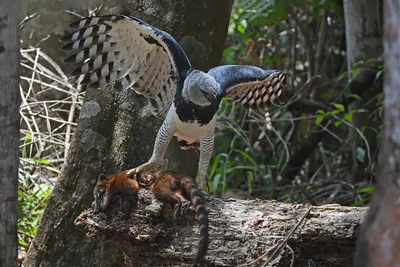
Living high in the trees and moving only at night keeps the kinkajou fairly safe. Most attacks probably come by day, while it sleeps in its den. Harpy eagles and Isidor's eagles have been seen eating kinkajous. Jaguars take one now and then.
People are the main predator. Kinkajous are caught for the pet trade, shot for meat, and skinned for wallets and horse saddles. Hundreds of live animals and skins leave Peru each year. The meat is not a favourite food, and the fur has no large market, so hunting pressure is patchy. Honduras has placed the species on CITES Appendix III, which controls exports from that country.
Population and conservation
The IUCN lists the kinkajou as Least Concern. It is common over much of its range, and it is hard to count, so no good population estimate exists. It copes with fragmented forest only moderately well. Deforestation is the main reason its range and numbers have shrunk.
Local hunting and the pet trade add pressure in some regions. Because it breeds slowly, one pup a year at most, a hunted population recovers slowly. Some of the five genetic clades may turn out to be separate species, which would change how each is assessed. For now, protecting fruit-rich forest appears to be the whole conservation plan.
Relationship with humans
Kinkajous are sold as exotic pets. They are playful, quiet and nearly odourless, but they hate noise, sudden movement and being woken by day. An upset animal screams, claws and can bite deeply. In 2011 the US Centers for Disease Control warned that pet kinkajous can carry raccoon roundworm, which can be fatal to people. By 2023 escaped pets were living wild in Florida.
In El Salvador, Guatemala and Honduras a pet kinkajou is a micoleón, a lion monkey. In Peru it is a lirón, a dormouse, and people describe it as a bear-monkey. It does little harm to farms, though it eats young coconuts on plantations. Local people eat the meat and sell the skins. In return, the animal spreads the seeds of the forest trees that people also depend on.
In culture and myth
The kinkajou is so seldom seen that it seems to have left little mark on myth. Its many local names show that forest peoples knew it well, from the Tupi jupará to the Ojibwe-derived kinkajou. Many native cultures do not tell it apart from the olingo. In villages of Central America and the Amazon, people blame night-time rustling in the canopy on kinkajous, the quiet sweet thieves. Beekeepers and orchard growers tell stories that the animal can find sweetness, and they blame it for emptied hives.
Modern spirit-animal writers make the kinkajou a symbol of adaptability, intuition and the moon, but these appear to be recent inventions. One such blog claims an African folk role for the animal, which seems impossible, because it does not live in Africa. The name honey bear links it in popular imagination to bees and hives, even though wild kinkajous rarely eat honey.
A sentence with a dotted underline is inferred: it describes the group the animal belongs to, or is a reading of the sources, rather than a measured or reported fact about this species.
Questions
Kinkajou questions, answered
What is a kinkajou?
A small nocturnal mammal of the raccoon family that lives in the canopy of tropical American forests. It looks like a monkey, with big eyes and a gripping tail, but it is a carnivoran.
Is a kinkajou a monkey?
No. It belongs to the family Procyonidae with raccoons, coatis and olingos. Its prehensile tail and forward-facing eyes evolved separately from those of monkeys.
What do kinkajous eat?
Mostly ripe fruit, especially figs, which can be half the diet. They also lap nectar, eat flowers and leaves, and take ants and other insects in some seasons. Fruit is about 90% of the total.
Where do kinkajous live?
In closed-canopy tropical forest from southern Mexico through Central America to Bolivia and south-east Brazil. They live from sea level to about 2,500 metres and rarely come to the ground.
Are kinkajous endangered?
No. The IUCN lists the kinkajou as Least Concern, and it is common in much of its range. Deforestation and the pet trade are the main pressures.
How big is a kinkajou?
An adult weighs 1.4 to 4.6 kilograms. It measures 82 to 133 centimetres from nose to tail tip, and the tail alone is 39 to 57 cm.
Why is the kinkajou called a honey bear?
Because captive kinkajous eat honey eagerly and use a long tongue to reach it. In the wild, honey is rarely recorded in the diet, so the name says more about pets than about forest life.
Are kinkajous nocturnal?
Yes, strictly. They leave the den about 15 minutes after sunset and return before sunrise. Peak activity runs from about 7 pm to midnight.
Do kinkajous make good pets?
Not really. They are quiet and playful when calm, but they are awake all night, dislike handling by day, and bite deeply when startled. They can also carry raccoon roundworm, which is dangerous to people.
How long do kinkajous live?
About 23 years in captivity, with a record of 42. Wild lifespan is poorly known, but their slow breeding points to a long life.
Can a kinkajou hang by its tail?
Yes. The tail is fully prehensile and works as a fifth hand. A feeding kinkajou often hangs by its tail and hind feet while holding fruit in both paws.
Do kinkajous live in groups?
Yes, in small groups of two adult males, one adult female and their young. They sleep together by day, groom at dusk and then forage alone.
What eats kinkajous?
Harpy eagles, Isidor's eagles and jaguars take some, mostly by day while the kinkajou sleeps. People are the main predator, for meat, skins and the pet trade.
What is the difference between a kinkajou and an olingo?
The kinkajou is two to three times larger, has a muscular gripping tail and a shorter muzzle. The olingo has a fluffy tail that cannot grip and a sharper line between dark back and pale belly.
How many babies does a kinkajou have?
Usually one pup, rarely two, after a pregnancy of 112 to 118 days. The pup stays dependent for about four months.
Food web
Prey and food
- figs
- ripe fruit
- nectar
- flowers
- leaves
- ants
Food web
Predators
 Harpy eagle
- isidor's eagle
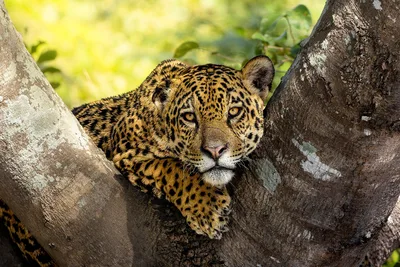 Jaguar
- humans
Ecological equivalents
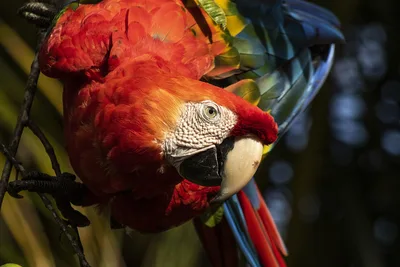
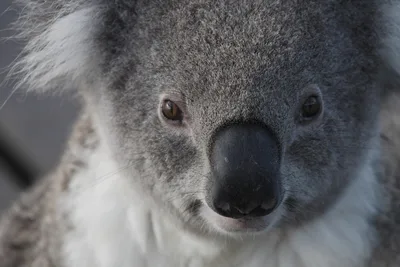
Related species on this site
Coati (same family), Olingo (same family), Raccoon (same family), Aardwolf (same order), Abyssinian (same order), Affenpinscher (same order), and more.
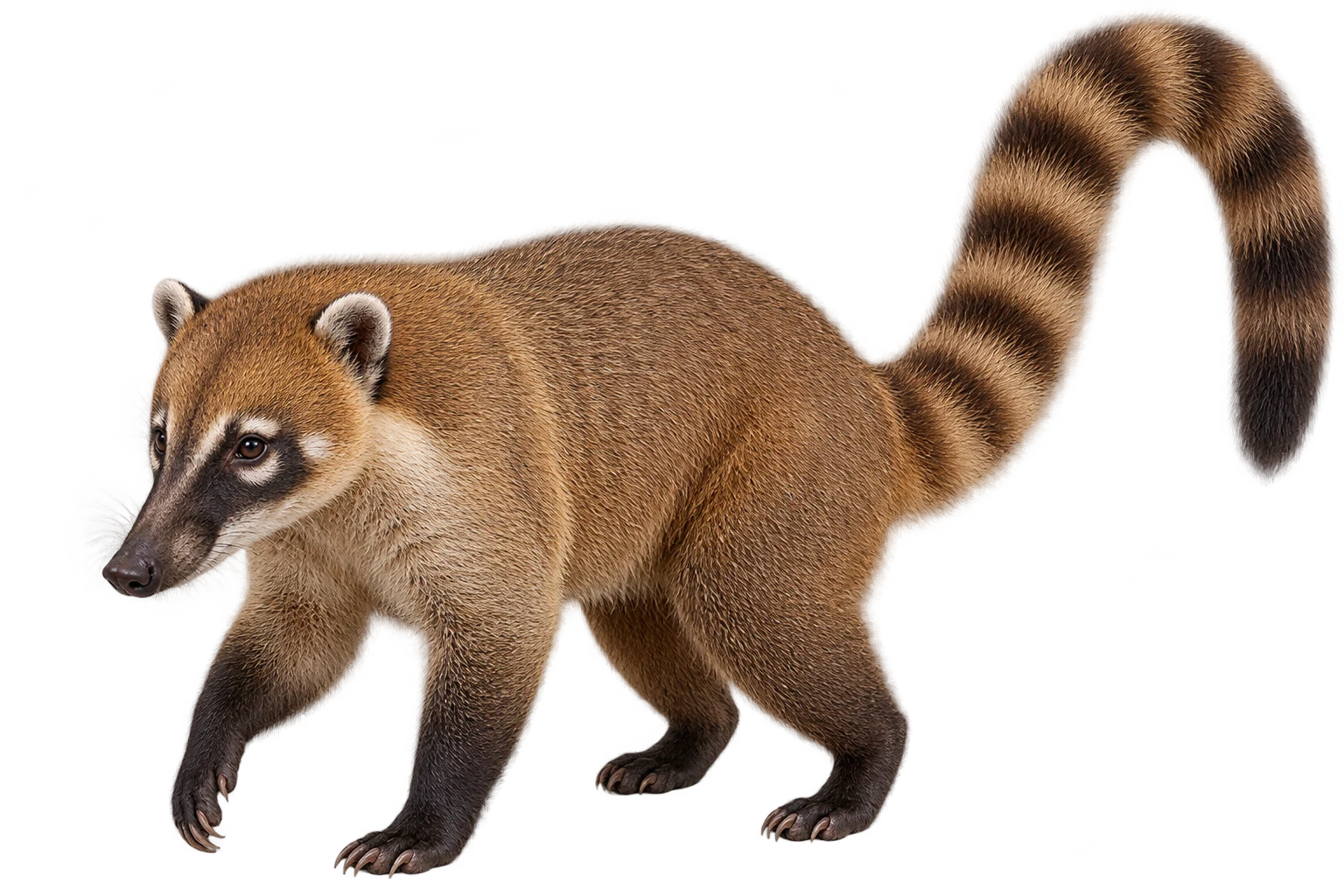
Mammals
Coati
Nasua
Classification and source reference
LivingAI illustration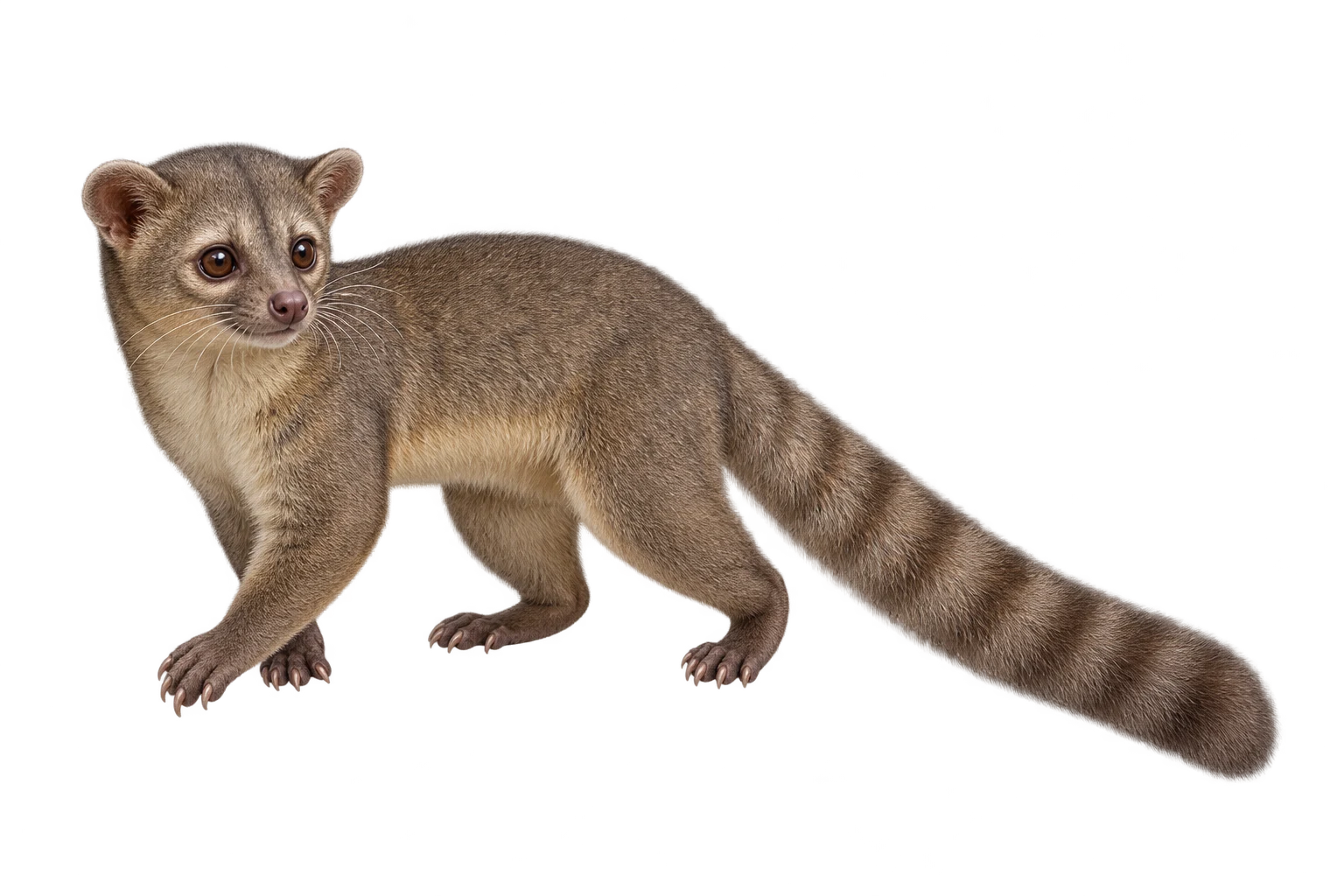
Mammals
Olingo
Bassaricyon
Classification and source reference
LivingAI illustration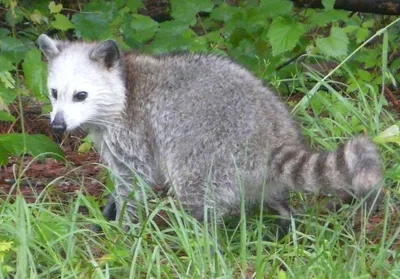 LC
Mammals
Raccoon
Procyon lotor
The raccoon is a masked, ring-tailed omnivore native to North America.
Living LC
Mammals
Aardwolf
Proteles cristata
The aardwolf is the smallest member of the hyena family and eats almost nothing but termites.
Living
Mammals
Abyssinian
Felis catus
Classification and source reference
LivingAI illustration
Mammals
Affenpinscher
Canis lupus familiaris
Classification and source reference
LivingAI illustration