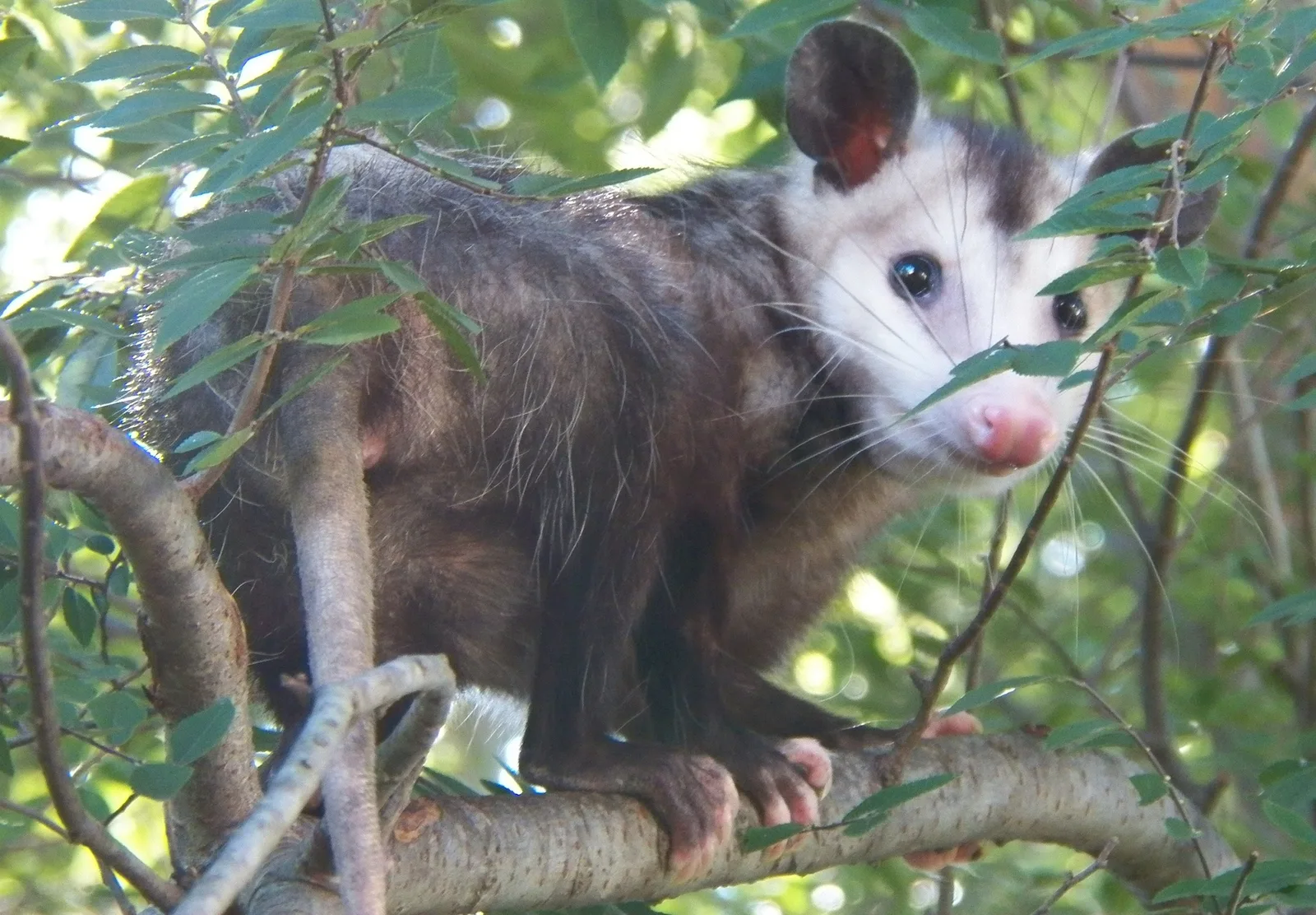
Virginia opossum
The northernmost marsupial, and a master of playing dead
Didelphis virginiana
Also called North American opossum, Possum, Opossum
Living individuals or members of this group exist today. This does not mean they are safe from extinction.
Meet the virginia opossum
The Virginia opossum is a cat-sized marsupial that ranges from Costa Rica to southern Canada, further north than any other marsupial. It eats almost anything, raises its young in a pouch, and feigns death when it cannot escape.
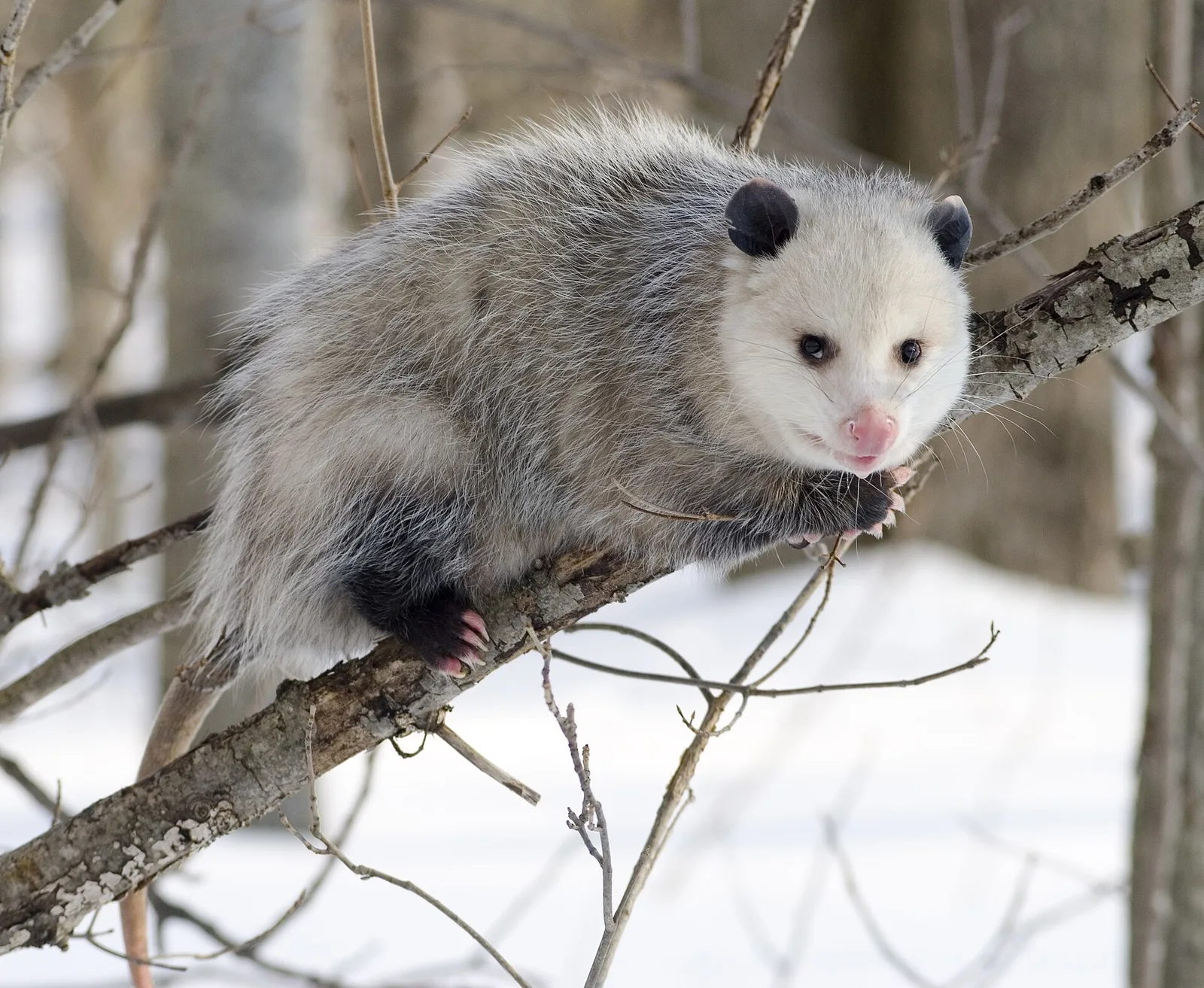
Images of the virginia opossum

Lifespan in the wild
1.5 to 2 years
Weight
1.9 to 6 kg
Length
33 to 55 cm
Top speed
7.1 to 7.4 km/h
Fact file
Virginia opossum
- Location
- Central America and North America, from Costa Rica to southern Canada
- Habitat
- Temperate forest, Towns and cities, Wetlands
- Diet
- Omnivore
- Prey / food
- Insects, earthworms, mice, voles, birds, snakes, frogs, carrion, fruit, persimmons, acorns
- Predators
- Owls, coyotes, red foxes, bobcats, dogs, large snakes; motor vehicles
- Lifestyle
- Solitary and nocturnal; active all year
- Group name
- Solitary
- Name of young
- Joey
- Gestation
- About 12 to 13 days, then about 2.5 months in the pouch
- Litter size
- Usually 8 to 9 pouch young; up to 25 born
- Population
- Abundant and spreading north; no total estimate
- Biggest threat
- Motor vehicles and hard winters; no threat to the species
- Distinctive feature
- White face, naked ears and a long bare prehensile tail
- Colour
- Grizzled grey-brown with a white face
- Skin type
- Fur
Size
Next to a person
Measurements
Size and speed
- Length
- 33 to 55 cm snout to the base of the tail
- Tail
- 25 to 54 cm
- Weight
- 1.9 to 6 kg most adults weigh 1.9 to 2.8 kg; urban animals run heavier
- Weight, male
- 2.1 to 2.8 kg
- Weight, female
- 1.9 to 2.1 kg
- Top speed
- 7.1 to 7.4 km/h
Typical adult ranges. Sources: Animal Diversity Web, Wikipedia.
Life cycle
Lifespan
- In the wild1.5 to 2 years
- In captivity3 to 4, up to 10 years
- 010 years
The pale bar is the record. Source: Animal Diversity Web.
Appearance
Colour and coat
- Primary colours
- greywhite
- Secondary colours
- brownblack
- Skin type
- fur
- Male and female
- Males are slightly larger, at 2.1 to 2.8 kilograms against 1.9 to 2.1 kg for females, and a male has a musky chest gland.
Life cycle
Mating and family
- Mating system
- polygynous
- Social structure
- solitary
- Breeding
- one to three litters a year, depending on latitude
Males compete for females from winter to late summer. Pregnancy lasts about 12 to 13 days, and the honeybee-sized newborns climb into the pouch. About 8 young survive there for about 2.5 months, then ride on the mother's back. They become independent at 3 to 4 months. Few live beyond 2 years in the wild.
Classification
Taxonomy
- Kingdom
- Animalia
- Phylum
- Chordata
- Class
- Mammalia
- Order
- Didelphimorphia
- Family
- Didelphidae
- Genus
- Didelphis
- Species
- Didelphis virginiana
Conservation
Red List status
- LC
- NT
- VU
- EN
- CR
- EW
- EX
Least Concern on the IUCN Red List
Range
Recorded in 3 countries
Habitat layer: temperate broadleaf and mixed forest, temperate conifer forest, boreal forest and taiga, flooded grassland and savanna, mangrove.
Countries from 53,088 wild records on GBIF (iNaturalist research grade), filtered and checked by hand. Country shapes: Natural Earth. Habitat: RESOLVE Ecoregions 2017, CC BY 4.0. Basemap: Natural Earth.
Habitats
Three things to know
- 1
It has 50 teeth, more than any other land mammal in North America.
- 2
A newborn is about the size of a honeybee and must climb to the pouch on its own.
- 3
Its blood carries a protein that neutralises the venom of rattlesnakes and other pit vipers.
Did you know
Seven more facts
- 1
Opossums on a predator-free island off Georgia live up to 50% longer than mainland ones.
- 2
Its brain is about one fifth the size of a raccoon's.
- 3
A mother has 13 teats, so any extra newborns starve.
- 4
It carries leaves to its den in a curl of its tail.
- 5
It spreads saliva on its fur to cool down in hot weather.
- 6
Wild opossum stomachs examined in 2021 held no ticks, despite the popular claim.
- 7
The Australian possum was named after this animal, though the two are only distant relatives.
Field notes
How it looks and acts
Field notes
Distinguishing features
- A white face on a grizzled grey body.
- Thin, dark, nearly hairless ears.
- A long, scaly, prehensile tail with little fur.
- A clawless opposable thumb on each hind foot.
- A long, flat, pointed snout with a pink nose.
- A pouch on the belly of the female.
Field notes
Unique adaptations
- A prehensile tail and grasping hind feet for climbing.
- Blood proteins that neutralise pit viper venom.
- Death feigning that switches off a predator's attack.
- A very short pregnancy and a pouch, so a lost litter probably costs the mother little.
- A broad diet and a taste for rubbish that let it live in cities.
Field notes
Interesting behaviours
- Forages alone from dusk to dawn.
- Moves den every few days, except while weaning young.
- Stays in the den for days when the temperature drops well below freezing.
- Carries young on her back once they leave the pouch.
- Bares its teeth, hisses and drools before it resorts to playing dead.
Field notes
Temperament
- Shy and slow, and it avoids people.
- Defensive when cornered, with a loud hiss and a show of teeth.
- Aggressive to other opossums outside the mating season.
- Docile in captivity, where hand-raised animals form peaceful hierarchies.
Field notes
Communication
- Metallic clicks from a courting male.
- Clicks, lip smacks and bird-like calls between mother and young.
- Hisses, growls and screeches at a threat.
- Musky scent from the chest gland of a male and from the pouch of a nursing female.
Ecology
Ecological role
The opossum is a scavenger, a seed carrier and a link in the food chain between insects and larger predators.
- Spreads undamaged seeds of pawpaw and persimmon in its droppings.
- Cleans up carrion and eats large numbers of insects.
- Feeds owls, coyotes, foxes and bobcats.
- Hosts dozens of parasite species, and it can carry leptospirosis and other diseases.
Stories
Myths and legends
- In many Native American traditions, Opossum is a braggart who plays dead out of shame.
- In Aztec tradition, the opossum stole fire from the gods for people.
- In Maya tradition, the opossum embodies the female side of creation.
- In the folklore of the American South, the possum is a game animal, a song subject and a comic figure.
People
Relationship with humans
People
Living alongside us
The opossum lives beside people across North America, where it raids bins, gardens and hen houses. It is harmless, resists rabies and eats pests and carrion. It was once a common food in the American South, and it remains a comic figure in songs and cartoons. Cars kill more opossums than any predator. Some people keep it as a pet where the law allows.
- It hisses and shows its teeth but almost never attacks a person.
- It resists rabies, though a few rabid animals turn up each year.
- It can carry leptospirosis and other diseases, so wash after any contact.
People
Status, uses and products
- Domestication
- Wild
- As a pet
- Not suitable. Illegal to keep in many states. A captive opossum can be litter trained, but it grows fat, lives only a few years and needs a specialist diet.
- Uses
- huntingfoodfolk medicine
- Products
- meatfur
The full account
About the virginia opossum
The Virginia opossum, Didelphis virginiana, is the only marsupial that lives north of Mexico. It is about the size of a house cat, with short legs, a white face, bare ears and a long naked tail. Its range reaches from Costa Rica to southern Canada, and no other marsupial lives so far north. Most North Americans simply call it the possum.
An adult measures 33 to 55 centimetres from snout to rump, and the tail adds 25 to 54 cm. Most adults weigh about 1.9 to 2.8 kilograms. The opossum is solitary and nocturnal, and it eats almost anything, from insects and fruit to carrion and pet food. When cornered it may collapse into a death-like trance, the origin of the phrase playing possum. The IUCN lists it as Least Concern, and it does well in towns and cities.
Name and taxonomy
The word opossum comes from an Algonquian word, wapathemwa, which means white animal. This species is the original opossum, and the name later spread to the whole family. The possums of Australia took their name from a likeness to this animal, but they belong to a different order, the Diprotodontia. The genus name Didelphis joins the Greek words for two and womb, because the female has a paired reproductive tract. John Smith described the animal in 1608 as having the head of a pig, the tail of a rat and the size of a cat.
The species sits in the family Didelphidae and the order Didelphimorphia, the American opossums. The naturalist Edward Tyson published a formal anatomy of a male opossum in London in 1698. GBIF lists English names that include North American opossum, Virginia opossum and simply possum. Despite a passing likeness, the opossum is not a rodent, and it is not close to any placental mammal.
Evolution and relatives
The ancestors of the Virginia opossum evolved in South America. They reached North America during the Great American Interchange, after the Isthmus of Panama formed about 3 million years ago. The genus Didelphis was a late arrival, and it crossed into North America about 0.8 million years ago. Its closest relatives are probably the other large opossums of the genus Didelphis in Central and South America.
The opossum has one of the lowest brain-to-body ratios of any marsupial. Its brain is about one fifth the size of a raccoon's brain. Even so, it is one of the most successful mammals on the continent, and its range still grows. Like other marsupials, it keeps an ancient body plan: a pouch, a short pregnancy and tiny newborns that finish their growth outside the womb.
Appearance
The coat is a grizzled grey, and it can lean toward brown, red or black. Long white-tipped guard hairs give the grizzled look, and northern animals have thicker underfur. The face is pale grey-white, the nose is long and flat, and the ears are thin, dark and almost hairless. Bare ears and a bare tail suffer frostbite in the north, and reports of lost ear tips are common.
Head and body measure 33 to 55 centimetres, and the tail runs 25 to 54 cm. Males weigh 2.1 to 2.8 kilograms, and females 1.9 to 2.1 kg. Some sources put well-fed animals at up to 6 kg, and town opossums weigh about 34% more than rural ones. Northern animals run larger, and tropical animals run smaller. It can move at about 7.1 to 7.4 kilometres per hour, which is a slow trot for a mammal of its size.
The mouth holds 50 teeth, more than any other land mammal in North America, including 10 upper incisors. The tail is prehensile and can grip a branch or carry a bundle of leaves. Each hind foot has a clawless, opposable thumb, which prints at a wide angle in a track. A female has 13 teats, arranged as a ring of 12 around a single central one.
Habitat and range
The opossum lives from northern Costa Rica through Mexico and the United States into southern Ontario and Quebec. East of the Rocky Mountains it is widespread, and it also lives along the Pacific coast. People released it on the West Coast during the Great Depression, probably as food, and it now reaches British Columbia. Small isolated groups live in eastern New Mexico and around Tucson in Arizona.
Before European settlement, the northern edge of the range ran through Maryland, Ohio, Indiana, Illinois, Missouri and Kansas. Cleared forest, fewer predators and warmer winters let it push north after 1900. It now lives across New England, New York, Michigan, Wisconsin, Minnesota and much of Nebraska. Some animals may have crossed into Ontario by riding on trucks or trains over the border rivers. A hard winter with deep snow can cut a northern population sharply, because the animal has thin fur and poor cold tolerance.
It prefers woodland and thickets near water, such as a stream or a swamp. It also thrives in farmland, suburbs and cities, and it dens in brush piles, hollow trees, drains and buildings. ADW records it from sea level up to 3,000 metres. GBIF holds records from 23 countries, a figure that includes animals outside the native range.
Diet and feeding
The opossum is an opportunist that eats whatever the season offers. Grasshoppers, crickets and beetles supply most of its animal food. It also takes earthworms, snails, crayfish, frogs, lizards, snakes, birds, eggs, mice, voles and young rabbits. Carrion is a regular part of the diet, and roadkill draws it onto highways. Its blood carries a protein that neutralises snake venom, so it can eat rattlesnakes, copperheads and cottonmouths.
Plant food matters most in late summer, autumn and early winter. It eats raspberries, blackberries, apples, acorns, beechnuts, seeds, grain and bulbs. Persimmons are a favourite autumn food. Stomach studies across the United States found 14 to 27% mammal tissue, 10 to 18% fruit and seeds, and 3 to 13.5% insects. In Portland, Oregon, rubbish and pet food each made up about 9% of the diet.
A popular claim says an opossum eats up to 5,000 ticks a season and removes 95% of the ticks it meets. That claim rests on a 2009 laboratory study of grooming. A 2021 study of wild opossum stomachs in Illinois found no ticks at all. No paper has yet reported a tick in a wild opossum's stomach.
Behaviour and social life
The opossum is solitary, and adults meet only to mate or to fight. It comes out around dusk and forages until dawn. It walks with a pacing gait, moving both legs on one side and then both on the other, as bears and raccoons do. It climbs well, using the tail as a fifth limb, and it swims when it must. It changes dens often, and it lines each one with dry leaves or shredded paper carried in the curled tail.
It does not hibernate, but it slows down in winter. When the temperature falls below about −7 to −4 °C, it may stay in the den for several days. It survives Canadian winters by burning fat and by sheltering in human structures. In extreme heat it spreads saliva on its body to cool down. Home ranges run about 12.5 to 38.8 hectares, and a male ranges further than a female.
A threatened opossum first bares its teeth, hisses, drools and raises its fur. If that fails, it may drop into a trance: limp on its side, mouth open, tongue out, eyes open. The heart rate halves, breathing almost stops, and a foul green fluid may leak from the anal glands. The state can last from a minute to about 6 hours, and it ends when the threat leaves. ADW notes that the trance is rare in adults, which more often stand their ground or run.
Communication and senses
Scent carries most of the messages. A male has a scent gland on his chest that gives off a musky smell and stains his fur before the breeding season. A male can tell one female from another by smell, but a female only tells male from female. The pouch of a nursing female turns orange-brown and smells musky, which probably helps the newborns find it.
A courting male makes metallic clicks with his mouth. A mother keeps in touch with her young through clicks, lip smacks and bird-like calls. A frightened animal hisses, growls or screeches. Its whiskers guide it in the dark, and its eyes hold about 50 rods for every cone, five times the ratio in a cat. Colour vision and taste are thought to be weak.
Reproduction and life cycle
The mating system is polygynous, and males compete for females. The season runs from about January to August in the south and February to September in the north. A northern female raises one litter a year, and a southern female may raise up to 3. Her cycle lasts about 28 to 29.5 days, and she is receptive for about 36 hours. Females can breed at about 6 months old and males at 8, though most start near 10 months.
Pregnancy lasts only 12 to 13 days. The newborns are the size of a honeybee, about 14 millimetres long and 0.13 to 0.20 grams. Each one climbs unaided to the pouch with strong front legs and clamps onto a teat. As many as 25 may be born, but the mother has only 13 teats, so the rest die. An average litter settles at about 8 pouch young.
The young stay fixed to a teat for 50 to 70 days and remain in the pouch for about 2.5 months. They then ride on the mother's back while she forages, and they start solid food at about 85 days. Weaning ends at 93 to 105 days, and some young stay in the den until about 120 days. About 60% die soon after independence, and only one young in ten reaches breeding age. A wild adult lives about 1.5 to 2 years, and a captive one about 3 to 4, with a record near 10.
Predators and threats
Owls, coyotes, red foxes, bobcats, raccoons, domestic dogs and large snakes all take opossums. The trance may work because many predators refuse prey that looks dead. It also tells large animals that the opossum poses no threat to their young. Pit viper venom does not harm it, so a rattlesnake bite is rarely fatal. Predation risk is lower in cities, which helps explain why the animal does so well there.
Motor vehicles are probably the biggest single killer. The opossum is slow, it feeds on roadside carrion, and it may freeze in a trance in front of a car. Males roam widely in the breeding season, and mothers carrying young move slowly, so both face more traffic and more predators. Cold is the other main killer, and most adult deaths fall in winter.
The opossum ages fast for a mammal of its size. Scientists think that heavy predation left no evolutionary reward for a long life. On Sapelo Island, about 8 kilometres off Georgia, opossums have lived without predators for thousands of years. Steven Austad found that these island animals live up to 50% longer than mainland opossums.
Population and conservation
The IUCN lists the Virginia opossum as Least Concern. It is common across its range, and it is still spreading north, northwest and northeast at a steady pace. No one appears to have counted the whole population, and no estimate exists. A single trapping study handled about 12,000 opossums, which gives a sense of its abundance.
The species faces no organised threat. In the 1970s a model predicted it would never pass Vermont and New Hampshire, but it now lives in Maine. Warmer winters and human shelter carry it further north each decade. Many states treat it as a game or furbearer species with a hunting or trapping season. North Carolina made it the state marsupial in 2013, and New Hampshire followed in 2025.
Relationship with humans
The opossum is not dangerous to people. Its open-mouthed hiss looks like rabies, but the species resists the virus and only a few rabid cases turn up each year. It can carry leptospirosis, tuberculosis and tularemia, and ADW counts at least 24 internal and 13 external parasites. It raids bird feeders, gardens, compost heaps, bins and pet bowls, and it takes poultry from farms. Its body grows larger near people, probably on a richer diet.
The opossum was once a favourite game animal in the southern United States. Older editions of The Joy of Cooking gave recipes, and baked possum was a traditional dish. Today a possum pie is usually a sweet dessert with no meat in it. Some Mexican folk remedies use opossum meat, fat and bones against inflammation, epilepsy and allergies. Pelts are sold, though they have little value.
People sometimes keep opossums as pets, which is illegal in many states. A captive animal can be litter trained and often becomes obese. Injured opossums should not be housed together, because captives sometimes eat each other.
In culture and myth
In the tales of many North American tribes, Opossum is a buffoon or a braggart. One story says he plays dead out of shame after he makes a fool of himself. Further south, in Mexico and Central America, he becomes a trickster or a hero who talks his way out of danger. In Aztec tradition the opossum stole fire from the gods and gave it to people, and it is linked to the maguey plant and pulque. Maya tradition treats it as a female force of creation, and some Nahua women still drink a brew of opossum tail to ease childbirth.
In the United States the opossum belongs to the folklore of the Southeast. Sam Lucas wrote the minstrel song Carve dat Possum in 1875. Cartoons often use it to stand for a rustic or a hillbilly, and it appeared in The Beverly Hillbillies in 1965. Walt Kelly's comic strip Pogo starred an opossum for decades. Billy Possum, a toy meant to link President Taft to a mascot like the teddy bear, failed because people did not like the animal.
A sculpture of a possum stands for protection on the Perelman Building in Philadelphia, built as an insurance office in the 1920s. In 2010 a cross-eyed opossum named Heidi at Leipzig Zoo became famous worldwide and predicted the 2011 Oscar winners on television. Spirit-animal blogs read the opossum as adaptability and rebirth, but that seems a modern reading rather than a folk tradition.
A sentence with a dotted underline is inferred: it describes the group the animal belongs to, or is a reading of the sources, rather than a measured or reported fact about this species.
Questions
Virginia opossum questions, answered
Is the Virginia opossum a marsupial?
Yes. It is the only marsupial in the United States and Canada, and the female raises her young in a pouch.
Do opossums really play dead?
Yes, but only as a last resort. A cornered opossum first hisses and bares its teeth. If that fails, it may fall into a trance that can last up to about 6 hours.
What do opossums eat?
Almost anything: insects, worms, mice, birds, eggs, snakes, fruit, nuts, carrion, pet food and rubbish. Persimmons are a favourite in autumn.
Do opossums eat ticks?
Probably far fewer than people think. A 2021 study of wild opossum stomachs found no ticks, and the 5,000-a-season claim came from a laboratory grooming study.
Are opossums dangerous?
No. They hiss and drool when scared, but they almost never bite a person. They can carry diseases such as leptospirosis, so avoid handling them.
Do opossums carry rabies?
Rarely. The species resists the virus, and only a few rabid opossums are found in a typical year.
How big is a Virginia opossum?
About the size of a house cat. The body is 33 to 55 centimetres long, the tail adds 25 to 54 cm, and most adults weigh 1.9 to 2.8 kilograms.
How long do opossums live?
Only about 1.5 to 2 years in the wild. Captive animals usually reach 3 to 4 years, and a few have reached 8 to 10.
How many babies does an opossum have?
Up to 25 can be born, but the mother has 13 teats, so about 8 or 9 survive in the pouch. She may raise up to 3 litters a year in the south.
Where do opossums live?
From Costa Rica through Mexico and the eastern and central United States into southern Canada, and along the Pacific coast after an introduction.
Do opossums hibernate?
No. They slow down in winter and may stay in the den for days during a hard freeze, but they stay active through the year.
Can opossums hang by their tails?
The tail can grip a branch and carry leaves, and a young animal may hang briefly. An adult is too heavy to hang for long.
Are opossums immune to snake venom?
They resist the venom of pit vipers such as rattlesnakes, copperheads and cottonmouths, thanks to a protein in their blood.
Is an opossum the same as an Australian possum?
No. Australian possums were named after this animal, but they belong to a different order of marsupials.
Can you keep an opossum as a pet?
It is illegal in many states, and the animal lives only a few years. Captives can be litter trained but tend to become obese.
Food web
Prey and food
- insects
- earthworms
- mice
- voles
- birds
- snakes
- frogs
- carrion
- fruit
- persimmons
- acorns
 Turkey vulture
 Hyacinth macaw
Food web
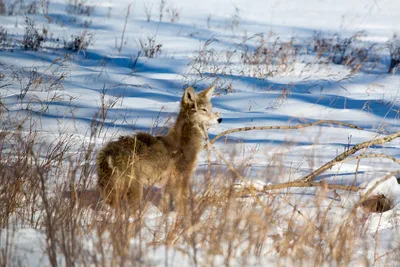 Coyote
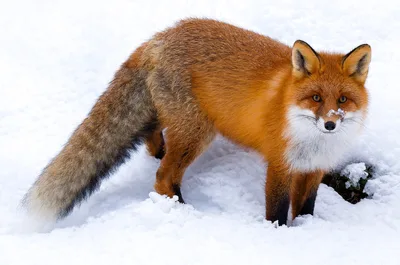 Red fox
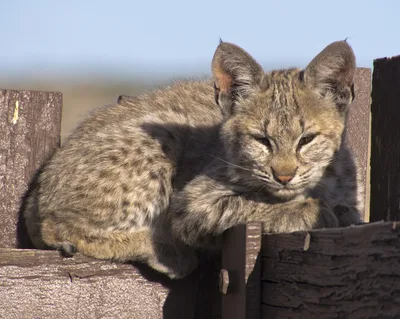 Bobcat
 Thylacine
 Ocelot
 Wedge-tailed eagle