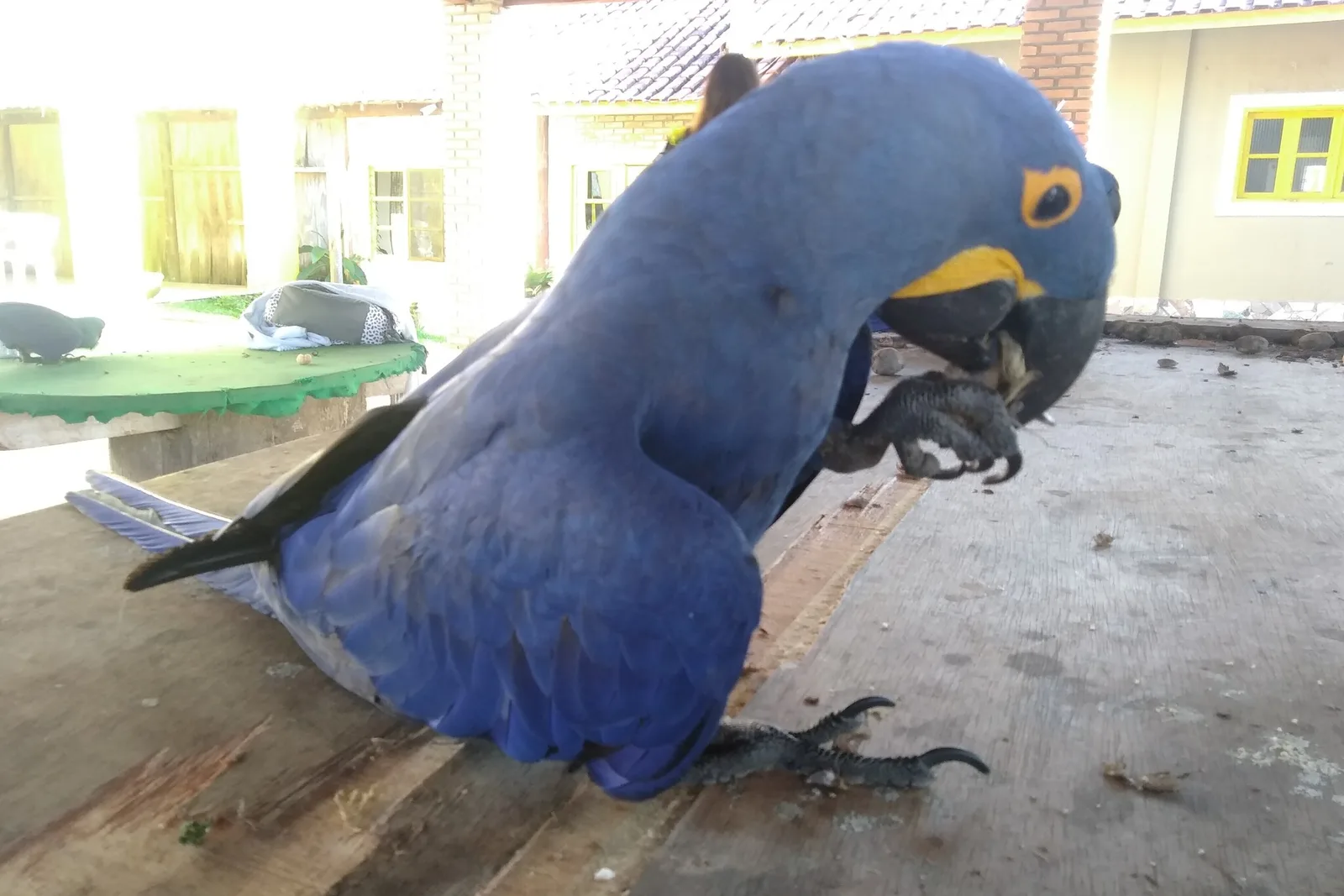
Hyacinth macaw
The longest parrot alive, and the strongest bill of any
Anodorhynchus hyacinthinus
Also called Hyacinthine macaw, Blue macaw
Living individuals or members of this group exist today. This does not mean they are safe from extinction.
Meet the hyacinth macaw
The hyacinth macaw is the longest parrot in the world, a cobalt blue bird with bare yellow skin around the eye. It lives in the Pantanal and the dry woodlands of Brazil, where it cracks palm nuts with the strongest bill of any parrot.
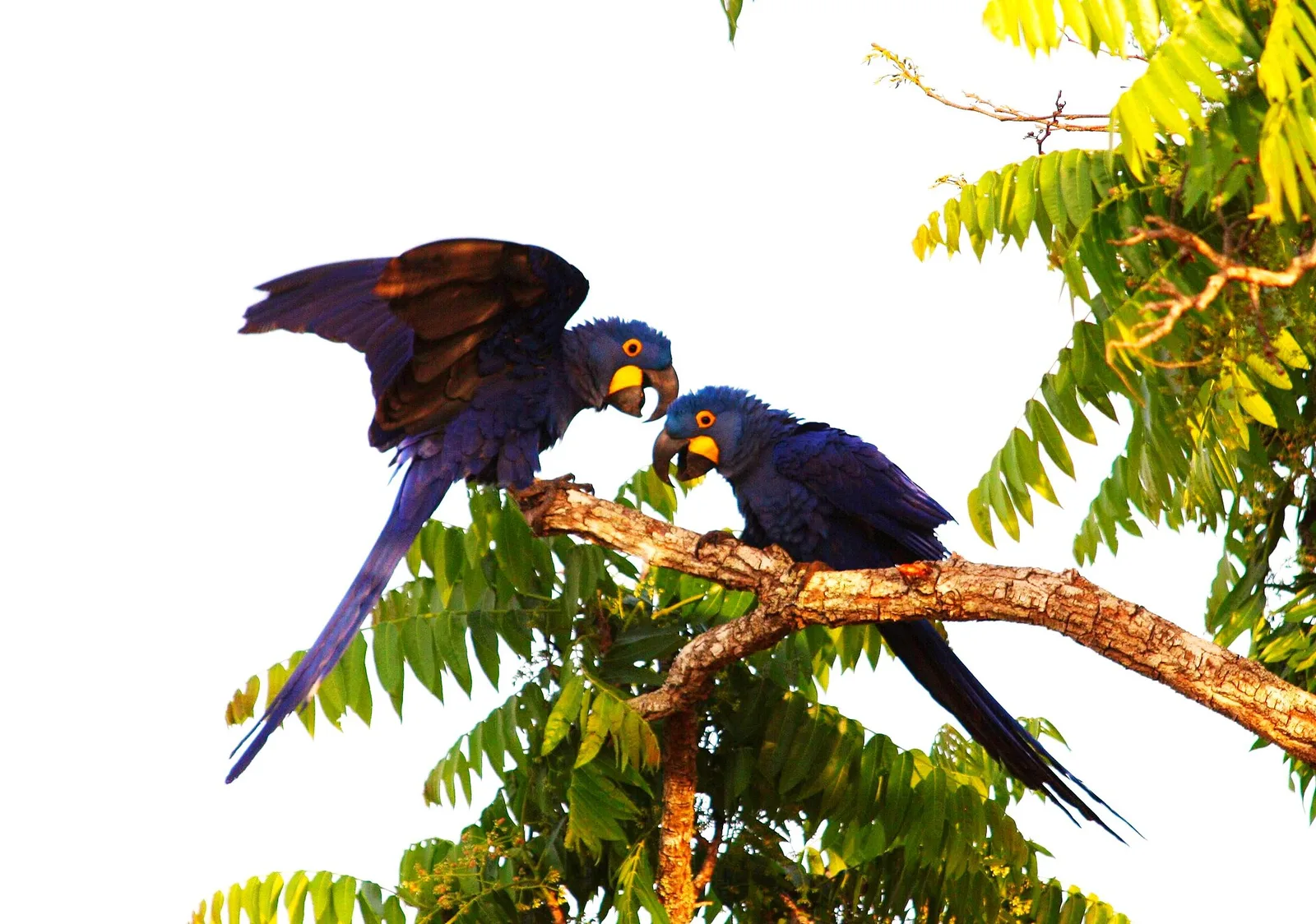
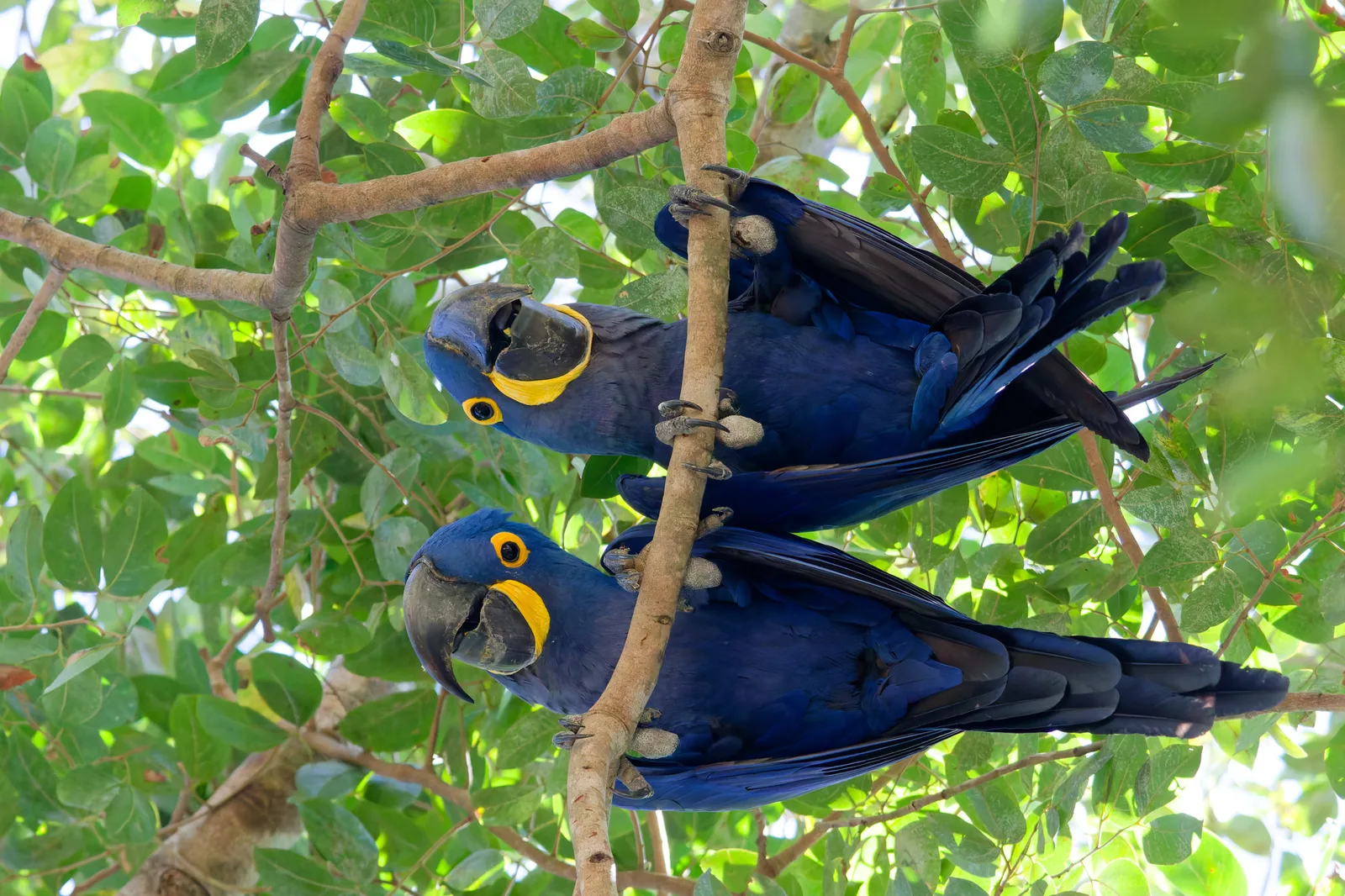
Images of the hyacinth macaw
Lifespan in the wild
About 50 years an estimate only, because the bird outlives most studies
Weight
1.2 to 1.7 kg
Length
0.95 to 1 m
Wingspan
1.17 to 1.27 m
Fact file
Hyacinth macaw
- Location
- Pantanal, cerrado and eastern Amazon of Brazil, plus Bolivia and Paraguay
- Habitat
- Savanna, Temperate forest, Wetlands
- Diet
- Herbivore
- Predators
- Toucans, jays, crows, coatis, skunks and opossums take the eggs
- Lifestyle
- Active by day, almost always in pairs
- Group name
- Flock
- Name of young
- Chick
- Incubation
- Incubation 25 to 28 days
- Clutch size
- 1 or 2 eggs
- Population
- About 6,500 in the wild
- Biggest threat
- Habitat loss and illegal trapping for the cage trade
- Distinctive feature
- Bare yellow skin around the eye and under the bill
- Colour
- Deep cobalt blue with yellow face markings
- Skin type
- Feathers
Size
Next to a person
Measurements
Size and speed
- Length
- 0.95 to 1 m about half of the length is tail
- Wingspan
- 1.17 to 1.27 m
- Weight
- 1.2 to 1.7 kg
Typical adult ranges. Sources: Wikipedia, Animal Diversity Web.
Life cycle
Lifespan
- In the wildAbout 50 years an estimate only, because the bird outlives most studies
- In captivityUp to 38.8 years one bird reached 38.8 years; an unverified report claims 54.3
- 038.8 years
The pale bar is the record. Sources: Animal Diversity Web, AnAge.
Appearance
Colour and coat
- Primary colours
- blue
- Secondary colours
- yellowblack
- Skin type
- feathers
- Male and female
- None known. Males and females carry the same cobalt plumage, the same yellow face markings and the same size.
Life cycle
Mating and family
- Mating system
- monogamous pairs that stay together for life
- Social structure
- pairs and small family parties, with larger flocks at food
- Breeding
- one clutch a year, of one or two eggs
A pair keeps one nest hollow, usually in a manduvi tree at least 60 years old. The hen lays one or two eggs two days apart and sits on them for 25 to 28 days. The male brings her food while she incubates. Only one chick normally survives, and it flies at about 110 days. Young birds stay near their parents for up to 18 months and start breeding at about seven years.
Classification
Taxonomy
- Kingdom
- Animalia
- Phylum
- Chordata
- Class
- Aves
- Order
- Psittaciformes
- Family
- Psittacidae
- Genus
- Anodorhynchus
- Species
- Anodorhynchus hyacinthinus
Conservation
Red List status
- LC
- NT
- VU
- EN
- CR
- EW
- EX
Vulnerable on the IUCN Red List
Range
Recorded in 2 countries
Habitat layer: temperate broadleaf and mixed forest, temperate conifer forest, boreal forest and taiga, tropical grassland, savanna and shrubland, flooded grassland and savanna, mangrove.
Countries from 1,083 wild records on GBIF (iNaturalist research grade), filtered and checked by hand. Country shapes: Natural Earth. Habitat: RESOLVE Ecoregions 2017, CC BY 4.0. Basemap: Natural Earth.
Habitats
Three things to know
- 1
It is the longest parrot alive, at about one metre from head to tail tip.
- 2
Its bill splits palm nuts that a heavy hammer struggles to break.
- 3
It nests almost only in manduvi trees, and a hollow that fits takes 60 years to form.
Did you know
Seven more facts
- 1
The toco toucan eats macaw eggs and also plants the trees the macaws nest in.
- 2
A young bird can sell for US$10,000 to a private keeper.
- 3
Keepers nickname the species the gentle giant.
- 4
One hundred wild pairs raise only 7 to 25 chicks in a year.
- 5
Trappers took about 10,000 of these macaws from the wild during the 1980s.
- 6
The World Parrot Trust asks owners to give the bird a 15 metre flight outdoors.
- 7
Mato Grosso do Sul made the hyacinth macaw its official bird in 2025.
Field notes
How it looks and acts
Field notes
Distinguishing features
- An even cobalt blue plumage with black under the wings and tail.
- A bare yellow ring around the eye.
- A yellow band along the base of the lower bill.
- A massive black hooked bill.
- A total length of 95 to 100 centimetres, half of it tail.
- A wingspan of 117 to 127 cm, wider than any other parrot in its range.
Field notes
Unique adaptations
- A bill strong enough to file and split the hardest palm nuts.
- A dry tongue with a bone inside that prises fruit apart.
- The habit of wedging leaves or wood under a nut to hold it still.
- Short strong legs for hanging sideways and upside down in a palm.
- A very long life, which offsets a low rate of breeding.
Field notes
Interesting behaviours
- Flying to the feeding grounds in parties of two to eight.
- Feeding on the ground under fruiting palms.
- Returning to a fixed roost tree at sunset.
- Enlarging an old tree hollow and lining the floor with wood chips.
- Climbing with the bill used as a third foot.
Field notes
Temperament
- Calm and even-tempered for a parrot of its size.
- Curious and bold, which is why trappers find it easy.
- Strongly attached to one partner for life.
- Prone to nervous behaviour when badly kept in captivity.
Field notes
Communication
- Harsh guttural calls, loudest when the bird is alarmed.
- Contact calls between the two birds of a pair in flight.
- A bright yellow face patch that shows plainly at close range.
- A small vocabulary of human words in captivity.
Ecology
Ecological role
The hyacinth macaw moves palm seeds around the Pantanal and depends in turn on a single tree and a single toucan.
- It carries and drops palm nuts and seeds across its home range.
- It relies on the manduvi tree for nine nests in ten in the Pantanal.
- The toco toucan spreads 83% of the manduvi seeds and eats macaw eggs as well.
- Its feeding under palms probably leaves broken nuts for smaller animals.
Stories
Myths and legends
- In Kayapo tradition, a chief's feather headdress stands for the rays of the sun.
- In Kayapo tradition, a man's radiating feather headband stands for the universe.
- In Inca and Nazca tradition, macaw feathers went into fine cloth and burial bundles.
- In the border country of Bolivia, the macaw is a regional emblem and people feed it maize.
- In Mato Grosso do Sul, a law of 2025 made the bird a symbol of the state.
People
Relationship with humans
People
Living alongside us
People have trapped, traded and kept hyacinth macaws for centuries. The pet trade took about 10,000 birds from the wild in the 1980s and drove the species onto CITES Appendix I. A young bird can still cost US$10,000 from a legal breeder. Ranchers in the Pantanal now protect the macaws on their land and earn money from visitors who come to see them. Indigenous peoples have used the feathers in ceremonial dress for a very long time.
- The bird is probably no threat to anyone, and it flies away from disturbance.
- A pet macaw can break skin when it mouths a hand in play.
- There are no known adverse effects of this species on humans.
People
Status, uses and products
- Domestication
- Wild
- As a pet
- Not suitable. This parrot needs a room of its own, a steel cage, daily company and an outdoor flight of at least 15 metres. It lives for decades, costs thousands of dollars and can destroy furniture. Only an experienced keeper should take one on.
- Uses
- ecotourismavicultureceremonial feathers
- Products
- feathers
The full account
About the hyacinth macaw
The hyacinth macaw, Anodorhynchus hyacinthinus, is a parrot of central and eastern South America. It measures 95 to 100 centimetres from the head to the tip of the tail. No other parrot is longer, and none of the flying parrots is larger. Adults weigh 1.2 to 1.7 kilograms, and the wingspan runs 117 to 127 cm. The feathers are a deep cobalt blue, and bare yellow skin rings the eye.
The bird lives on palm nuts, and its bill is the strongest of any parrot. It nests in hollow trees and on cliffs, mostly in the Brazilian Pantanal. Trappers and habitat loss cut the wild population hard in the twentieth century. The IUCN lists the species as Vulnerable, and CITES bans commercial trade in wild birds. About 6,500 birds now live in the wild, up from an estimate of 3,000 in 1987.
Name and taxonomy
The English physician and artist John Latham described the bird in 1790. He named it Psittacus hyacinthinus and worked from a single stuffed skin. That skin came from a live bird once kept by Lord Orford. It went to the Leverian Museum after the bird died. Latham knew of no other specimen until 1822.
Tony Pittman argued in 2000 that Latham may have measured a Lear's macaw. The drawing in Latham's work still looks like a true hyacinth macaw. Early authors also used the name blue macaw for several unrelated parrots. Trade in live birds moved parrots around the world and confused their origins. The English name probably comes from the deep blue of the hyacinth flower.
Evolution and relatives
The genus Anodorhynchus holds two living species and one that has almost certainly gone. Lear's macaw of north-eastern Brazil is the smaller living relative. The glaucous macaw is the third member, and it is probably extinct. All three are blue, so old sight records may be hard to sort out. Macaws sit in the parrot family Psittacidae.
Parrots are among the most threatened birds on Earth. In tropical America, 46 of 145 parrot species face a serious risk of extinction. Genetic variation in the hyacinth macaw is low. That alone does not endanger the species today. A smaller population would let genetic drift take a stronger hold. Researchers therefore want each regional group protected on its own.
Appearance
Adults measure 95 to 100 centimetres from the crown to the tail tip. About half of that length is the long, pointed tail. The wingspan runs 117 to 127 cm, and each wing is 38.8 to 42.5 cm long. Weight ranges from 1.2 to 1.7 kilograms. The plumage is an even ultramarine blue, glossy and slightly lighter on the back.
The underside of the wing and tail shows a lot of black. Neck feathers can carry a faint grey cast. A ring of bare yellow skin circles each eye. A second yellow band runs along the base of the lower bill. The huge hooked bill is black, and the legs are short and sturdy. Males and females look alike, so a watcher probably cannot separate them in the field.
Habitat and range
Three main areas hold the species today. The first is the Pantanal of Brazil, with eastern Bolivia and north-eastern Paraguay. The second is the cerrado country of the eastern Brazilian interior. The third lies along the Tocantins, Xingu and Tapajos rivers and on Marajo island. GBIF holds occurrence records from 10 countries, and iNaturalist carries 2,274 observations.
The bird likes semi-open, lightly wooded country. It avoids dense humid forest and keeps to edges and river banks where such forest dominates. Elsewhere it uses savanna grassland, dry caatinga thorn woodland and palm swamp. About 80% of the Pantanal floodplain goes under water in the rains. In Bolivia the macaws favour cattle ranches that graze their land lightly. Escaped birds live in Florida, but nobody has shown that they breed there.
Diet and feeding
Palm nuts make up most of what the hyacinth macaw eats. The acuri and bocaiuva palms are the main sources across the range. In the Pantanal the birds live almost entirely on two palms, Acrocomia aculeata and Attalea phalerata. One count put the number of palm species used at eight. The birds also take fruit, small seeds, palm sprouts and the odd snail. They will fly a long way to reach the ripest crop.
The bill first files the shell thin in one place, then splits it cleanly. It can break coconuts, Brazil nut pods and macadamia nuts. The tongue is dry and smooth, with a bone inside that helps prise fruit open. Most feeding happens on the ground, under the palms. The acuri nut only softens enough to eat after cattle have passed it. Keepers offer macadamia nuts to captive birds instead of the native palms.
Wild and captive macaws both use simple tools while feeding. A bird wedges a chewed leaf or a scrap of wood against a nut. The wedge stops the nut slipping as the bill bites in. Hand-reared birds do it too, so the habit may be innate rather than learned. Older macaws open seeds faster than young ones. Henry Walter Bates described the nut cracking in 1863, and Charles Darwin called the bird splendid.
Behaviour and social life
Hyacinth macaws are highly social and spend most of their lives in pairs. Courtship, mating and bonding go on all through the year. Birds are busiest from early morning to the middle of the afternoon. They fly to feeding grounds in parties of two to eight. At sunset they return to a roost tree and stay there for the night.
The size of a home range depends on where the palm crop is. Some pairs stay near the roost, while others commute a long way each day. The bill works as a third foot when the bird climbs. Short strong legs let a macaw hang sideways or upside down in a palm. Keepers call the species a gentle giant, because it is calm for its size. The bird is noisy, bold, curious and predictable, which makes it easy to trap.
Communication and senses
The voice is harsh and guttural, and alarm brings the loudest calls. A pair calls back and forth in flight, which probably keeps them together. Captive birds learn a few words and can use them in the right place. They are not strong talkers compared with some other parrots. Owners still rate the species as an intelligent bird.
The bare yellow face stands out sharply against the blue plumage. Such a patch may work as a close-range signal between birds. Parrots elsewhere in the Amazon gather at clay banks to eat earth. Research by Donald Brightsmith points to the sodium in the earth as the reason. Like other parrots, the macaw relies most on sight and hearing.
Reproduction and life cycle
Pairs stay together for life and defend one nest site. Nesting runs from July to December, and in the Pantanal it follows the wet season. Nine nests in ten in the Pantanal sit in a manduvi tree. Only a manduvi of about 60 years or more grows a hollow of the right size. Competition for those hollows is fierce among many hole-nesting animals. The pair widens an old hole and part fills the floor with wood chips.
Nest holes usually sit 4 to 14 metres above the ground. The hen lays one or two eggs, two days apart. Incubation lasts 25 to 28 days, and the hen sits for about 70% of the time. The male feeds her at the nest throughout. About nine eggs in ten hatch when predators leave them alone. When both eggs hatch, the second chick almost never survives the first.
Biologists call the second egg an insurance egg against an early failure. A chick fledges at about 110 days, or roughly 13 weeks. It depends on its parents for six months and often stays near them for 18 months. Birds breed from about seven years old, and some wait until they are 10. One hundred pairs produce only 7 to 25 young in a year. A long life makes up for the slow rate, and wild birds may reach 50 years.
Predators and threats
Egg thieves are the main natural danger. Jays, crows, coatis, skunks and opossums all raid the nests. The toco toucan takes over half of the eggs that are lost to predators. The same toucan spreads 83% of the manduvi seeds the macaw depends on. Larvae of Philornis flies feed on the chicks in the nest.
The heaviest pressure comes from people. Cattle ranching and mechanised farming have taken or altered much of the habitat. Dams on the Tocantins and Xingu flooded more of it. Grass fires lit by farmers each year destroy nest trees. Cattle also eat the young manduvi saplings that would replace them.
Trappers took an estimated 10,000 birds from the wild during the 1980s. Half of those were sold inside Brazil. In the markets of Santa Cruz the bird fetched the top price of US$1,000. Chicks travel badly, and a Paraguayan dealer who received 300 in 1972 lost all but three. Poachers therefore target adults, which strips breeding birds from the population fastest. Feather demand adds pressure, because up to 10 macaws go into one headdress.
Population and conservation
The IUCN lists the hyacinth macaw as Vulnerable. Charles Munn published the first real estimate in 1987 at 3,000 birds. His range ran from 2,500 to 5,000. By 2004 the World Wildlife Fund put the wild total at 6,500. Brazil and Bolivia protect the bird by law. CITES placed it on Appendix I in 1987, which bans commercial export.
Bolivian counts in one protected area gave 231, 107, 134 and 166 birds. Surveyors think about 300 live in that area, though the swamps make counting hard. Conservationists want each of the three main populations kept above 500. The Hyacinth Macaw Project rings birds and puts up artificial nest boxes. The European Endangered Species Programme began in 1989 after captive breeding proved hard. Mato Grosso do Sul named the bird its symbolic species in 2025.
Relationship with humans
People keep hyacinth macaws as companion parrots, though the bird suits no beginner. A young bird can cost US$10,000. The bill destroys ordinary cages, so keepers use custom stainless steel. The World Parrot Trust asks that no bird live permanently indoors. It should have a flight of at least 15 metres for part of the year.
The species needs company, exercise and things it is allowed to chew. A bored or badly reared bird can turn phobic and hard to handle. It is even-tempered, but a playful bite still breaks skin. Hand-reared chicks die more often than parent-reared ones in the first month.
The bird is probably worth more alive to local people than it ever was to a trapper. Birdwatchers travel to the Pantanal to see it, and tourism supports local work. Many ranch owners in the Pantanal and the Gerais now bar trappers from their land. Local people have also hunted the macaw for food.
In culture and myth
The Kayapo of south-central Brazil use macaw feathers in ceremonial dress. A chief's headdress carries bright plumes, and each one represents a ray of sunlight. Men wear headbands of radiating feathers as an image of the whole universe. The Kayapo do not dye the feathers, because Amazon birds are already bright. Commercial demand for such work has raised the toll on wild macaws.
Macaw feathers mattered across pre-Columbian South America. Inca, Wari and Nazca weavers worked them into cloth, ornaments and burial bundles. Ychsma traders on the coast kept live birds, brought over the mountains, as a feather source. That trade suggests how far a bright feather could travel before Europeans arrived.
Near the Bolivian border with Brazil and Paraguay the macaw is a regional emblem. Local people feed the birds maize in the way they feed chickens. In 2025 the Brazilian state of Mato Grosso do Sul made it the state bird by law. Supporters hope the title will protect the species and draw visitors. Charles Darwin repeated Bates's account and called the macaw a splendid bird.
A sentence with a dotted underline is inferred: it describes the group the animal belongs to, or is a reading of the sources, rather than a measured or reported fact about this species.
Questions
Hyacinth macaw questions, answered
How big is a hyacinth macaw?
It measures 95 to 100 centimetres from head to tail tip, and about half of that is tail. The wingspan is 117 to 127 cm. Adults weigh 1.2 to 1.7 kilograms.
Is the hyacinth macaw the biggest parrot?
It is the longest parrot in the world and the largest that can fly. The flightless kakapo of New Zealand is heavier.
What do hyacinth macaws eat?
Mostly palm nuts, especially from the acuri and bocaiuva palms. They add fruit, seeds, palm sprouts and the occasional snail. Most feeding happens on the ground.
How strong is a hyacinth macaw's bill?
It is the strongest bill of any parrot. The bird files a hard shell thin in one spot and then splits it. It can open coconuts and macadamia nuts.
Where do hyacinth macaws live?
The Pantanal of Brazil, with eastern Bolivia and Paraguay, holds one population. The cerrado of eastern Brazil holds another. A third lives along the Tocantins, Xingu and Tapajos rivers.
Are hyacinth macaws endangered?
The IUCN lists them as Vulnerable. About 6,500 live in the wild, up from an estimate of 3,000 in 1987. Trapping and habitat loss remain the main threats.
How long do hyacinth macaws live?
Wild birds are thought to reach about 50 years, though nobody has followed one for a lifetime. One captive bird lived 38.8 years.
How many eggs does a hyacinth macaw lay?
One or two, laid two days apart. Incubation takes 25 to 28 days. When both hatch, the younger chick rarely survives.
Why do hyacinth macaws need manduvi trees?
Only an old manduvi grows a hollow wide enough for the nest. Trees of about 60 years or more qualify. Nine Pantanal nests in ten are in one.
Do hyacinth macaws use tools?
Yes. A bird wedges a chewed leaf or a piece of wood under a nut. The wedge stops the nut sliding while the bill works on it.
Can you keep a hyacinth macaw as a pet?
It is legal from a licensed breeder in many countries, but it is a poor choice for most people. The bird needs a steel cage, a large outdoor flight and constant company.
How much does a hyacinth macaw cost?
A young bird from a breeder often costs about US$10,000. In the illegal markets of Santa Cruz the species drew the highest price of any parrot, around US$1,000.
Can hyacinth macaws talk?
They can learn a few words and use them in the right situation. They are weaker talkers than several smaller parrots.
What eats hyacinth macaws?
Adults have few enemies. Eggs and chicks are taken by toco toucans, jays, crows, coatis, skunks and opossums, and fly larvae attack the young in the nest.
Why is the hyacinth macaw blue?
The colour comes from the structure of the feather rather than a blue pigment. A deep blue bird is hard to follow against the sky and the shade of a palm grove.
How fast do hyacinth macaws breed?
Very slowly. One hundred pairs raise only 7 to 25 young in a year, and birds do not breed until about seven years old. A long life balances that out.
Food web
Prey and food
Not recorded.
Food web
Predators
- toucans
- jays
- crows
- coatis
- skunks
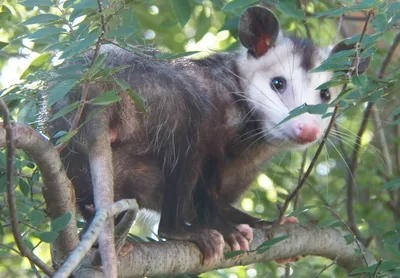 Virginia opossum
Ecological equivalents
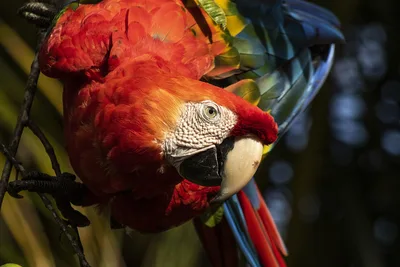
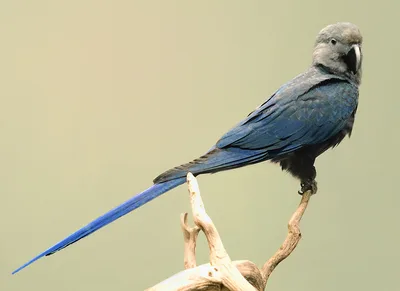
Related species on this site
African Grey Parrot (same family), Amazon Parrot (same family), Budgerigar (same family), Carolina parakeet (same family), Cockatiel (same family), Conure (same family), and more.
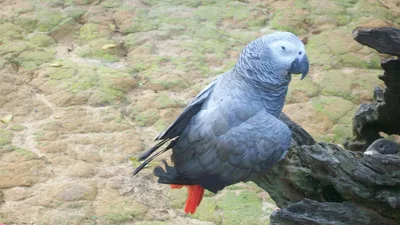
Birds
African Grey Parrot
Psittacus erithacus
Grey parrots are social African birds with grey feathers, a red tail and a strong curved bill.
Living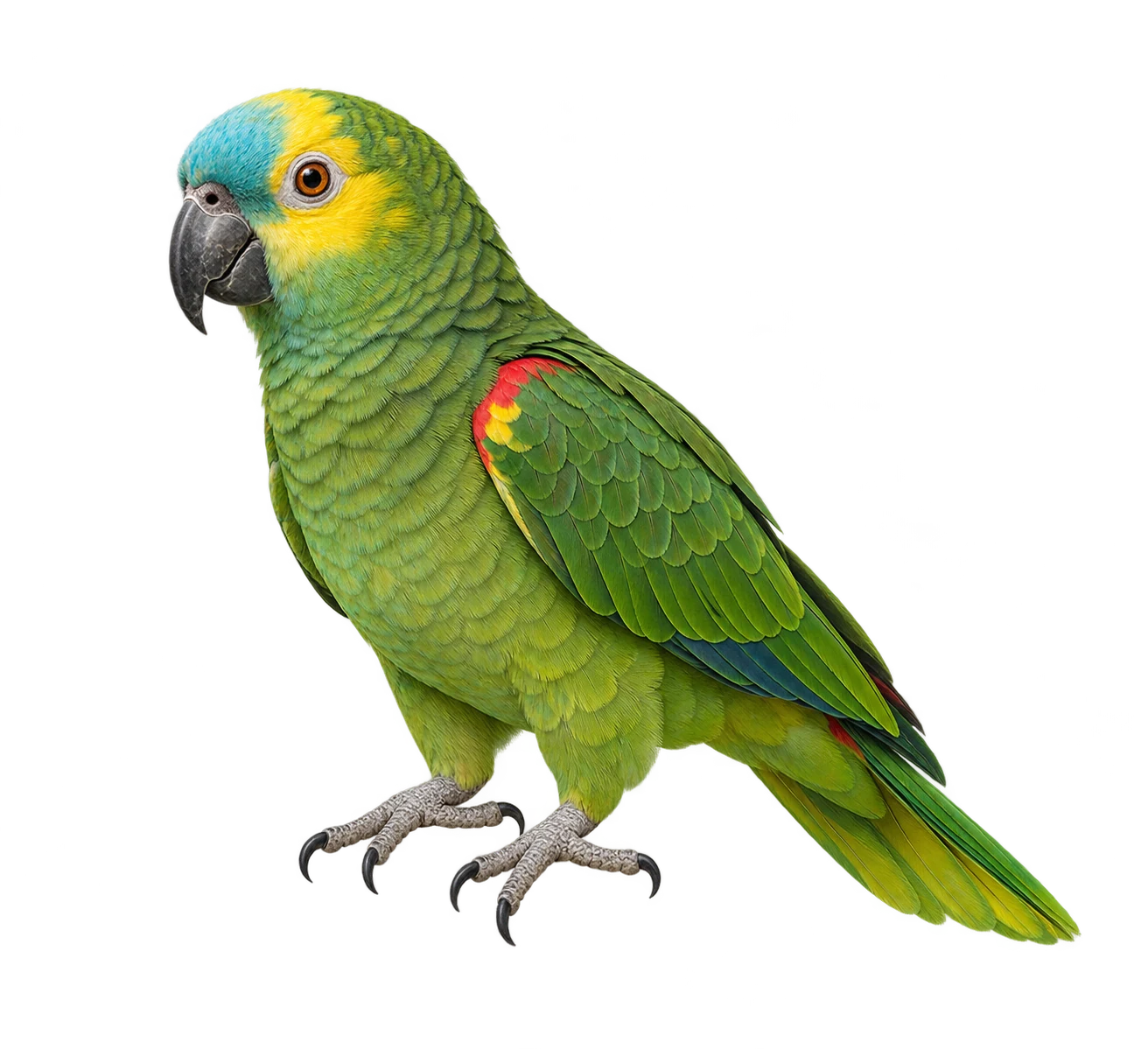
Birds
Amazon Parrot
Amazona
Classification and source reference
LivingAI illustration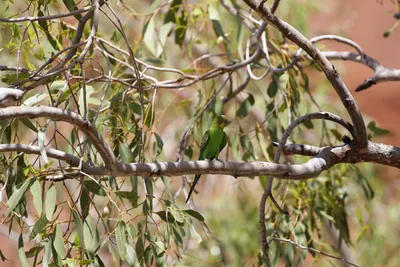 LC
Birds
Budgerigar
Melopsittacus undulatus
The budgerigar is a small green and yellow parrot from the dry interior of Australia.
Living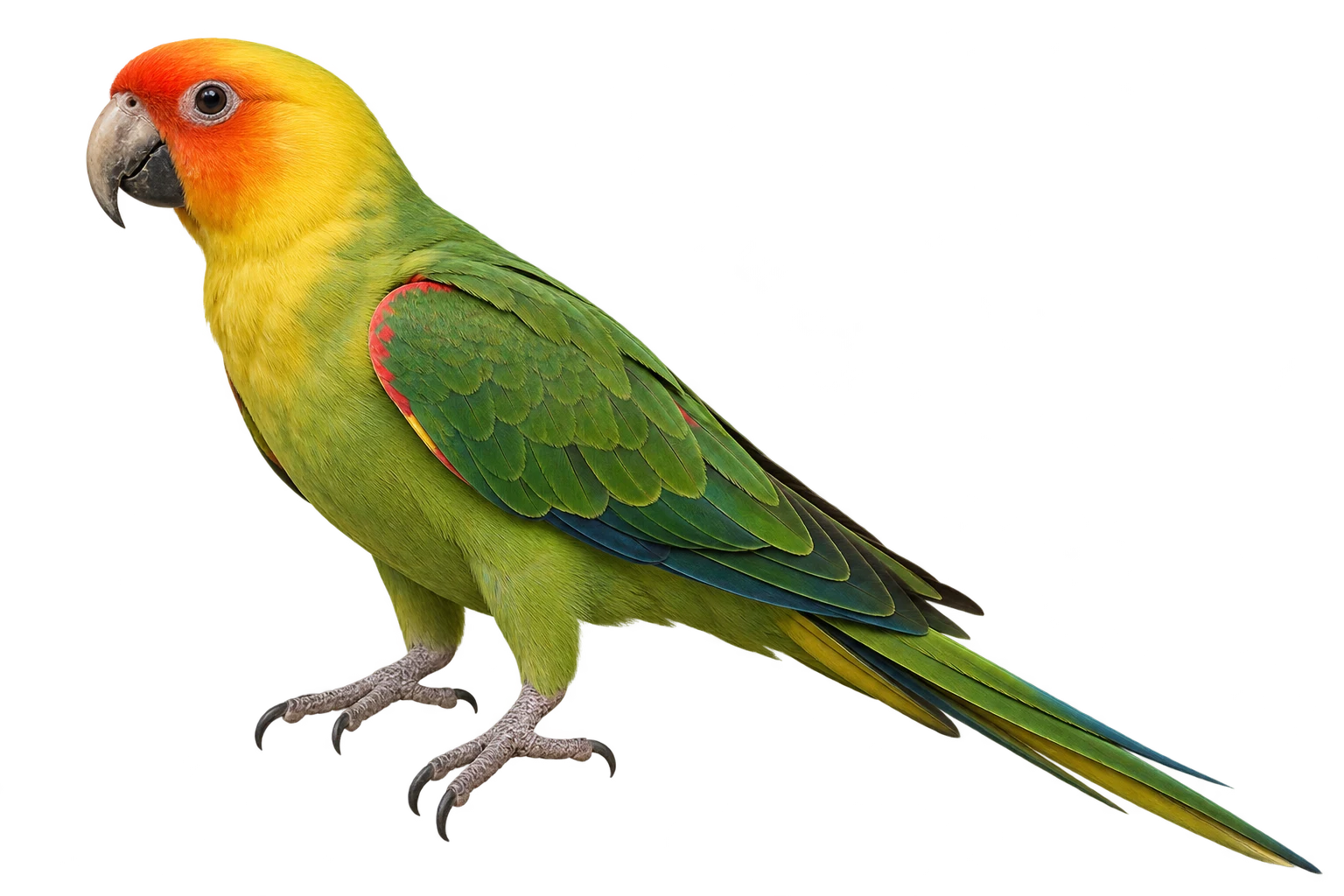 EX
Birds
Carolina parakeet
Conuropsis carolinensis
The Carolina parakeet was the only parrot native to the eastern United States.
ExtinctAI reconstruction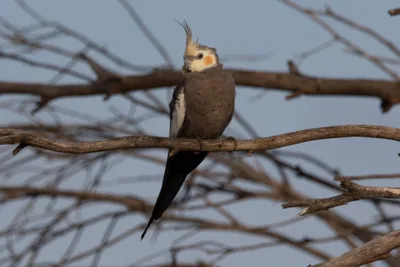 LC
Birds
Cockatiel
Nymphicus hollandicus
The cockatiel is the smallest cockatoo, and it lives across the dry inland of Australia.
Living
Birds
Conure
Psittacidae
Classification and source reference
LivingAI illustration