Mandarin duck
The tree-nesting duck with sails on its back
Aix galericulata
Also called Yuanyang, Oshidori, Chinese teal
Living individuals or members of this group exist today. This does not mean they are safe from extinction.
Meet the mandarin duck
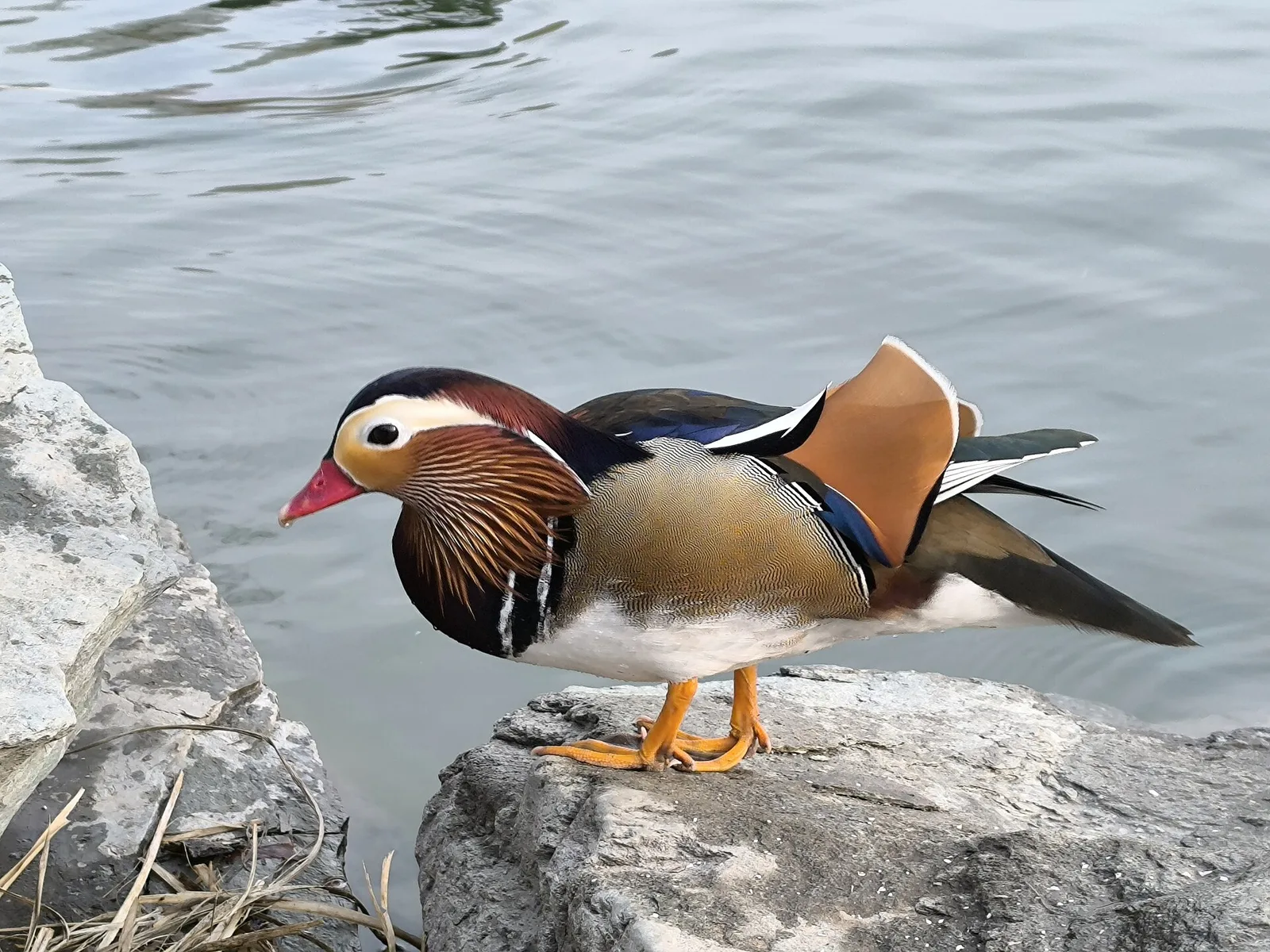
The mandarin duck is a small perching duck of East Asian woodland rivers. The drake is one of the most strongly patterned ducks in the world. It nests in tree holes, and escaped birds have built a large feral population in Britain.
Images of the mandarin duck
Lifespan in the wild
Up to 10.4 years
Weight
428 to 693 g
Length
41 to 49 cm
Wingspan
65 to 75 cm
Fact file
Mandarin duck
- Location
- East and Northeast Asia, with feral flocks in Britain and Europe
- Habitat
- Rivers and lakes, Temperate forest, Wetlands
- Diet
- Omnivore
- Prey / food
- Acorns, beech mast, grain, snails, insects, small fish
- Predators
- Mink, otters, polecats, raccoon dogs, eagle-owls, grass snakes
- Lifestyle
- Perches and nests in trees, active at dawn and dusk
- Group name
- Flock
- Name of young
- Duckling
- Incubation
- Incubation 28 to 30 days
- Clutch size
- Nine to twelve eggs
- Population
- About 12,000 to 14,000 in China and around 7,000 in Britain
- Biggest threat
- Loss of riverside forest to logging
- Distinctive feature
- The drake's upright orange sail feathers
- Colour
- Orange, purple, white and grey
- Skin type
- Feathers
Size
Next to a person
Measurements
Size and speed
- Length
- 41 to 49 cm
- Wingspan
- 65 to 75 cm
- Weight
- 428 to 693 g
Typical adult ranges. Sources: Wikipedia, Animal Diversity Web.
Life cycle
Lifespan
- In the wildUp to 10.4 years
- 010.4 years
The pale bar is the record. Source: AnAge.
Appearance
Colour and coat
- Primary colours
- orangepurplegrey
- Secondary colours
- whitebrowngreen
- Skin type
- feathers
- Male and female
- The sexes look completely different in the breeding season. The drake is orange, purple and white with upright sails, while the female is grey brown with a white eye-ring.
Life cycle
Mating and family
- Mating system
- monogamous pairs, formed in early winter
- Social structure
- pairs and small flocks
- Breeding
- one clutch a year, in April or May
Pairs form at the start of winter and may last several seasons. The female picks a tree hole, lines it with down and lays nine to twelve eggs. She incubates alone for 28 to 30 days while the drake leaves. The ducklings jump from the hole within a day of hatching and follow her to water. They fly at 40 to 45 days and then join a flock.
Classification
Taxonomy
- Kingdom
- Animalia
- Phylum
- Chordata
- Class
- Aves
- Order
- Anseriformes
- Family
- Anatidae
- Genus
- Aix
- Species
- Aix galericulata
Conservation
Red List status
- LC
- NT
- VU
- EN
- CR
- EW
- EX
Least Concern on the IUCN Red List
Range
Recorded in 21 countries
- Austria
- Belgium
- Canada
- Switzerland
- People's Republic of China
- Czech Republic
- Germany
- Denmark
- Spain
- France
- United Kingdom
- Croatia
- Italy
- Japan
- South Korea
- Netherlands
- Poland
- Portugal
- Russia
- Taiwan
- United States of America
Habitat layer: temperate broadleaf and mixed forest, temperate conifer forest, boreal forest and taiga, flooded grassland and savanna, mangrove.
Countries from 18,440 wild records on GBIF (iNaturalist research grade), filtered and checked by hand. Country shapes: Natural Earth. Habitat: RESOLVE Ecoregions 2017, CC BY 4.0. Basemap: Natural Earth.
Habitats
Three things to know
- 1
The drake carries two orange feathers that stand up over the back like sails.
- 2
Mandarin ducks nest in tree holes, and the ducklings jump to the ground.
- 3
Chinese, Korean and Japanese tradition all treat the pair as a sign of a good marriage.
Did you know
Seven more facts
- 1
The genus name comes from a Greek word Aristotle used for an unknown diving bird.
- 2
George Edwards called the species the Chinese teal in 1747.
- 3
A nest hole can be thirty feet above the ground.
- 4
At one Chinese reserve, 46.1% of females laid eggs in another duck's nest.
- 5
The drake loses his crest when he moults into eclipse plumage.
- 6
Mandarin ducks have covered 500 miles in a single day.
- 7
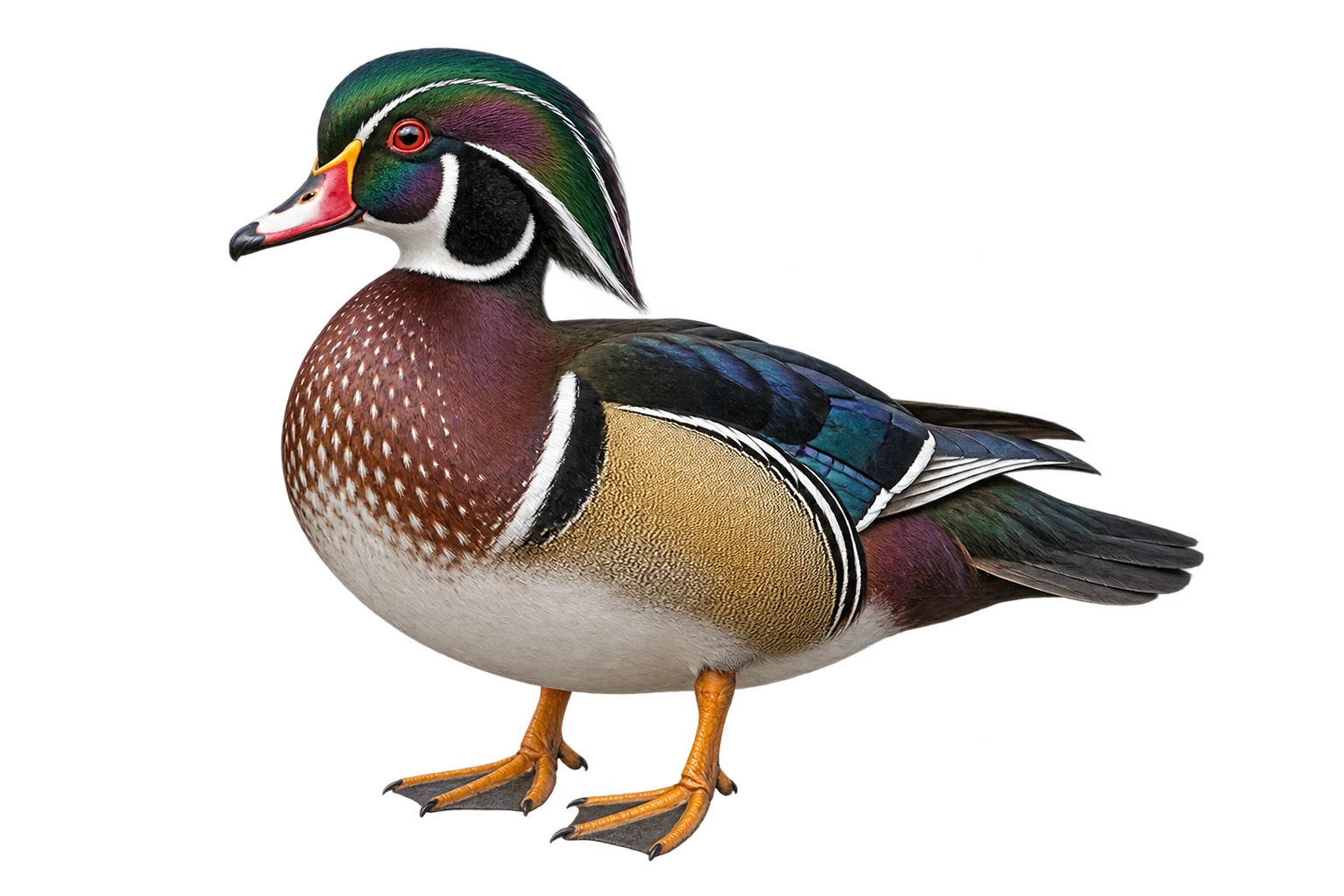
The wood duck of North America is the only other bird in the genus.
Field notes
How it looks and acts
Field notes
Distinguishing features
- Two upright orange sail feathers on the drake's back.
- A broad white crescent above the drake's eye.
- A purple breast crossed by two white bars.
- A crest on both sexes, stronger and purpler on the male.
- A thin white eye-ring and trailing white stripe on the female.
- A blue-green wing patch that shows only in flight.
Field notes
Unique adaptations
- Sharp claws let the bird grip a branch, which few ducks can do.
- A tree cavity keeps the eggs above ground predators.
- Ducklings are light enough to survive a long drop to the ground.
- The gizzard probably grinds acorns, so hard mast becomes winter food.
- Eclipse plumage probably hides the drake while he moults.
Field notes
Interesting behaviours
- The ducks feed near dawn and dusk and rest through the middle of the day.
- They shelter under overhanging branches when disturbed.
- Drakes court by mock drinking and by shaking the body.
- Females inspect several tree holes before choosing one.
- Some females lay their eggs in a neighbour's nest.
Field notes
Temperament
- The species is shy and keeps to cover in its native range.
- Park birds used to people can become quite bold.
- Flocks are small and quiet compared with other ducks.
Field notes
Communication
- The drake displays by raising his crest and his orange sails.
- Mock drinking and shaking are set courtship moves.
- The female calls her ducklings down from the nest hole.
- The wing patch flashes in flight and may hold a flock together.
Ecology
Ecological role
The mandarin duck links woodland and water, feeding on mast in the trees and on animals in the shallows.
- It probably moves acorns and seeds away from the trees that dropped them.
- It depends on old trees with holes, so it marks mature riverside woodland.
- Its eggs and ducklings feed mink, otters, polecats and eagle-owls.
- In Britain it fills a niche that no native duck was using.
Stories
Myths and legends
- In Chinese tradition, a pair of these ducks means a marriage that lasts.
- In Chinese speech, a proverb about two ducks in the water describes lovers.
- In Korean tradition, carved wooden ducks are given to a bride and groom.
- In Japanese speech, oshidori fufu names a couple who never quarrel.
- In Cantonese usage, the name became a word for two unlike things paired together.
People
Relationship with humans
People
Living alongside us
People have kept mandarin ducks in collections since 1745, mainly for the drake's colours. Breeders have produced silver and white forms. Escaped birds founded the British and German populations. In the native range the birds face logging and accidental shooting. Nobody eats them, because the meat tastes bad.
- The mandarin duck is small, shy and harmless to people.
- Like other small ducks, it flies away rather than defending itself.
- Like other park waterfowl, it can grow pushy where visitors feed it.
People
Status, uses and products
- Domestication
- Wild
- As a pet
- Not suitable. This is a collection bird, not a house pet. It needs open water, a nest box high off the ground and a licence in many countries. Keepers must also stop escapes, because feral flocks start that way.
- Uses
- ornamental waterfowl collectionsbirdwatchingwedding symbolism
- Products
- None recorded
The full account
About the mandarin duck
The mandarin duck is a small perching duck of East Asian woodland waters. The drake is one of the most strongly marked ducks alive. He has a red bill, orange cheek feathers, a purple breast and two orange sails on the back. The female is grey brown, with a white ring around the eye and a white line behind it.
Adults measure 41 to 49 centimetres long, with a wingspan of 65 to 75 cm. They weigh 0.428 to 0.693 kilograms. The species breeds in southeast Siberia, Korea, Japan and eastern China. Birds that escaped from collections now breed across Britain and parts of Europe.
The duck nests in a hole in a tree, and the ducklings jump to the ground. The IUCN rates the species as Least Concern. In China, Korea and Japan a pair of these ducks stands for a happy marriage.
Name and taxonomy
The scientific name of the mandarin duck is Aix galericulata. Aristotle used the Greek word aix for a diving bird that nobody has identified. The second half of the name comes from a Latin word for a wig or a cap. It probably refers to the crest that both sexes carry.
The German traveller Engelbert Kaempfer wrote about the bird in 1727. He gave the Japanese name kinmodsui and said he could hardly believe the colours. The English naturalist George Edwards figured it in 1747 as the Chinese teal. He drew a living bird kept at Richmond by the merchant Matthew Decker. Carl Linnaeus named it Anas galericulata in 1758. Friedrich Boie set up the genus Aix in 1828, and the duck sits there today.
The species is monotypic, so no subspecies are recognised. Chinese speakers call it yuanyang, Korean speakers use a carved pair at weddings, and Japanese speakers say oshidori. The English name probably points at the officials of imperial China and their bright robes.
Evolution and relatives
Only two species belong to the genus Aix. The other is the wood duck of North America. Both birds perch in trees and lay their eggs in hollow trunks. The two females look so much alike that birdwatchers confuse them. The mandarin is a little smaller than its American cousin.
The mandarin duck carries 84 chromosomes, and every one of them is acrocentric. Other ducks usually carry 80, and many of those are submetacentric. That difference makes crossing with other ducks very hard, and it may rule it out. Hybrids with six other duck species have been reported, but none has been confirmed. A fossil bone from West Runton in England was once given to this species. Later work reassigned it to an unnamed member of the duck subfamily.
Appearance
An adult is 41 to 49 cm long with a wingspan of 65 to 75 cm. Weight runs from 0.428 to 0.693 kg. The body is shorter than that of most dabbling ducks. A newly hatched duckling weighs about 41 grams.
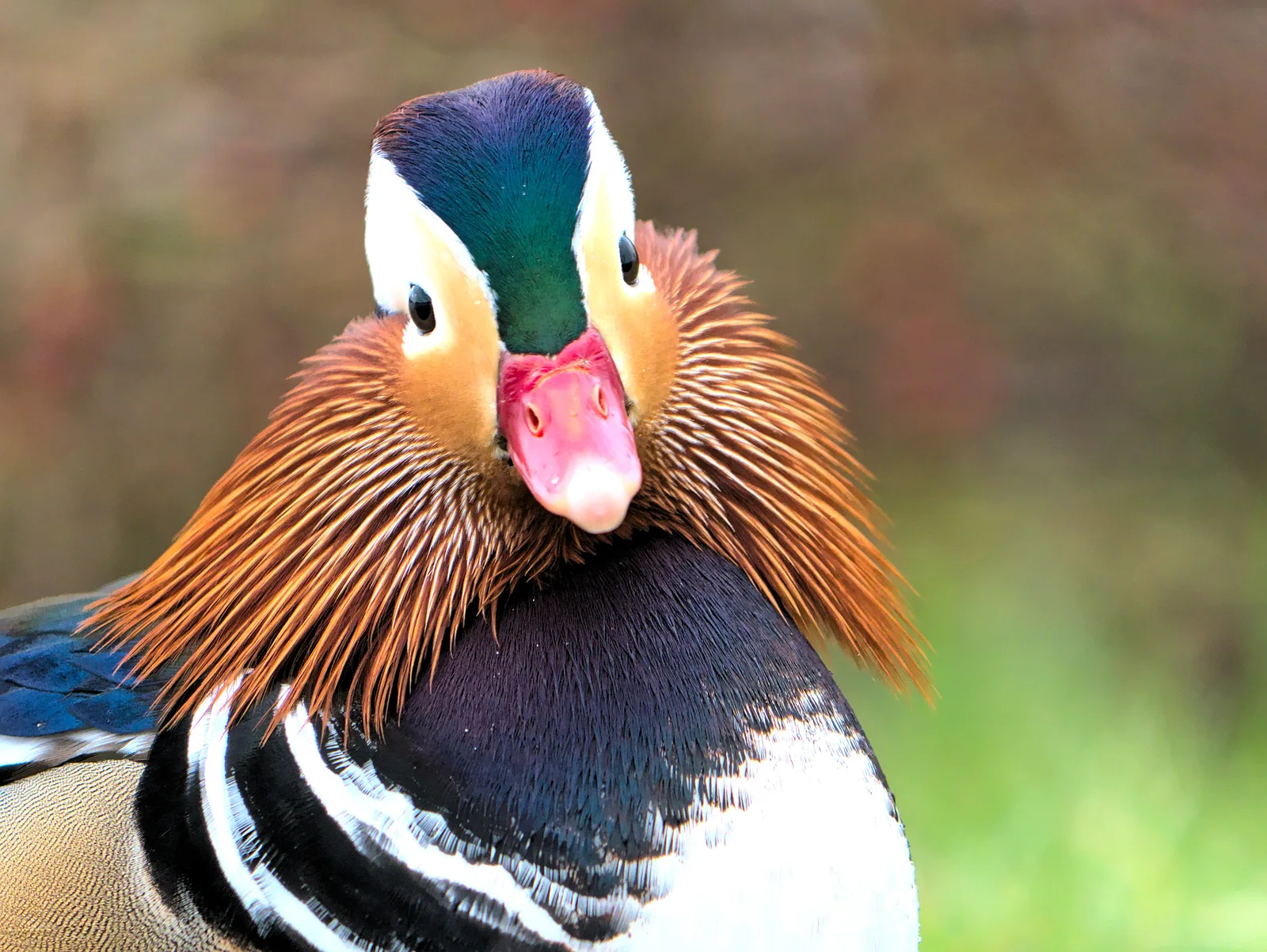
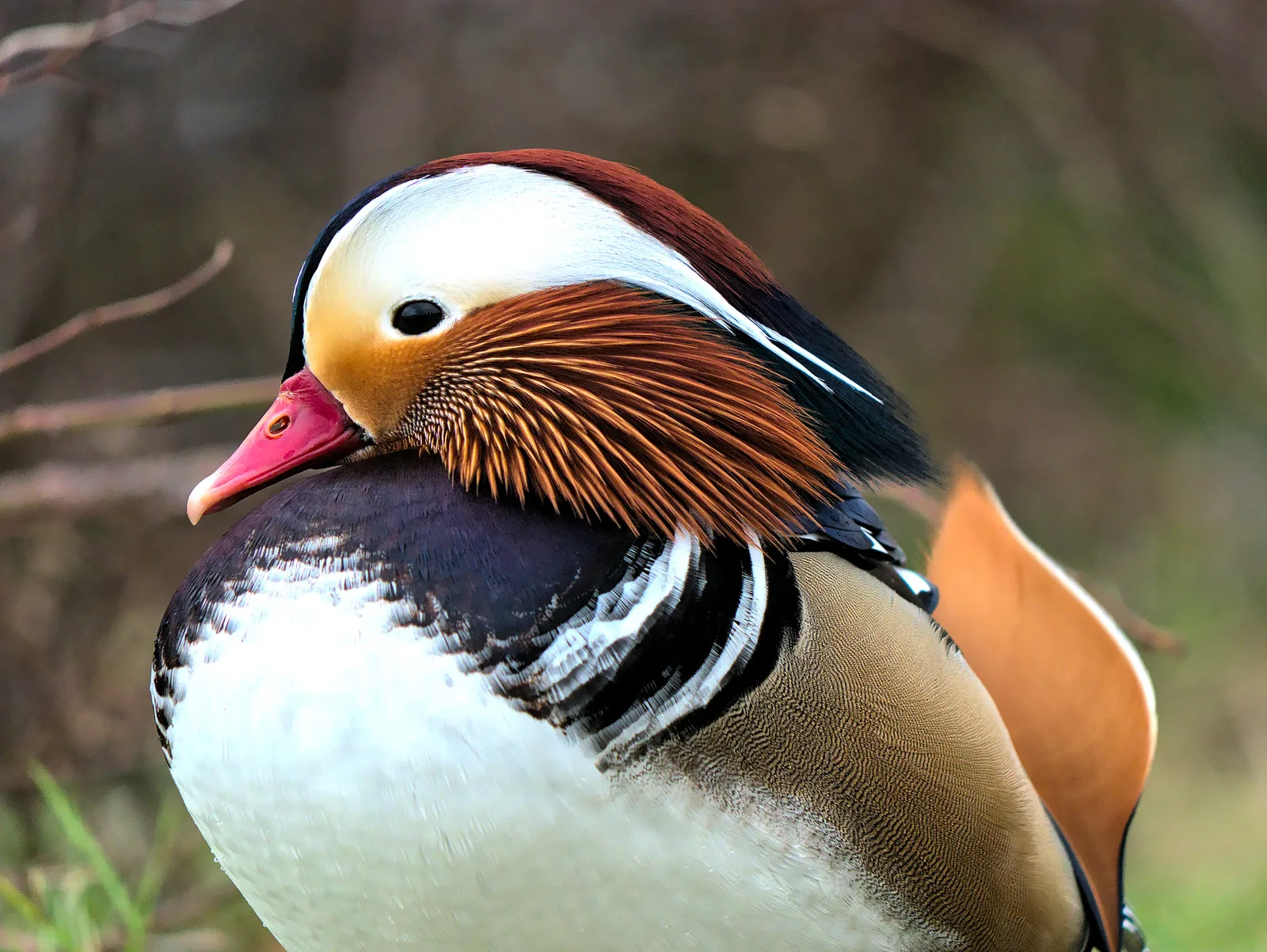
The drake has a small red bill and a broad white crescent above the eye. His face is reddish, with long feathers that look like whiskers. Two white bars cross the purple breast, and the flanks are a warm ruddy brown. Two orange sail feathers stand upright at the back. Each sail is a modified secondary flight feather with a widened inner vane. Both sexes have a crest, and the purple crest of the drake is the stronger one.
The female is greyish brown, with a thin white eye-ring and a white stripe behind the eye. She is paler below, carries a small white flank stripe and has a pale bill tip. Both sexes flash a blue-green speculum on the wing in flight. After the breeding season the drake moults into eclipse plumage and looks like the female. An eclipse drake still shows a bright yellow-orange or red bill and loses the crest. Ducklings resemble young wood ducks, and their eye-stripe stops at the eye.
Habitat and range
The native range covers East and Northeast Asia. Birds breed in southeast Siberia, the Korean peninsula, Japan and eastern China. The favoured ground is a river or lake edge with thick shrubs and standing timber. Most pairs stay in the lowlands, though some breed in valleys as high as 1,500 m. Asian birds migrate, and they winter in lowland eastern China and southern Japan.
Winter birds add marshes, flooded fields and open rivers to their range. Fresh water suits them best, but some winter in coastal lagoons and estuaries. The species is recorded in 93 countries on GBIF, which counts escapes as well as wild birds.
Escapes from waterfowl collections built a feral population in Great Britain during the twentieth century. About 7,000 now live there. Small numbers breed in Ireland, mostly in the parks of Dublin. The largest mainland European group lives around Berlin. In the United States there are birds at Black Mountain in North Carolina and several hundred in Sonoma County, California. European birds use more open ground than Asian ones, including lake edges, water meadows and farmland near woods.
Diet and feeding
The mandarin duck feeds by dabbling at the surface or by walking on land. Plants and seeds make up most of what it eats. Acorns and beech mast are the staples, and rice and other grain matter too. The bird adds snails, insects and small fish through the year.
The diet shifts with the season. Autumn and winter birds live mainly on acorns and grain. Spring birds turn to insects, snails, fish and water plants. Summer birds take small worms, small fish, frogs, molluscs and small snakes. Feeding happens near dawn and near dusk. By day the ducks rest in trees or on the ground. Like other perching ducks, the mandarin can break down a swallowed acorn in its gizzard.
Behaviour and social life
The mandarin duck is shy for a duck. It looks for cover under trees, and an overhanging willow is a favourite spot. Flocks are smaller than those of most other ducks. Birds that live near people can grow much bolder.
This is a perching duck, so it settles on branches without trouble. Like other perching ducks, it grips the bark with sharp claws. Pairs form at the start of winter and may hold together for several seasons.
Birds in the Far East migrate every year. Most of the British birds stay in one place. Some British birds still make long journeys. Animal Diversity Web reports flights of 500 miles inside 24 hours.
Communication and senses
The mandarin duck appears to signal with plumage more than with sound. A displaying drake raises his crest and lifts the orange sails clear of the back. Courtship includes mock drinking and a shaking movement. The white crescent over the eye and the white breast bars probably show up at a distance. The blue-green wing patch shows only in flight, and it may help a flock stay together.
Sight leads the search for a nest hole, and the female inspects each site herself. The drake follows her from tree to tree. The most important call of the year is probably the one after hatching. The female drops to the ground and calls up to the nest. The ducklings answer by leaving the hole one after another. A drake in eclipse plumage loses his crest, so his signals probably fade with the colours.
Reproduction and life cycle
Pairs form early in the winter, well before the nesting season. A bond may last for many seasons. The female chooses the nest hole, and the male joins her on the search. Nests sit in cavities in trees near shallow lakes, marshes or ponds. A hole can be as much as thirty feet above the ground. The female lines it with down from her own breast.
A single clutch of nine to twelve white oval eggs is laid in April or May. The eggs go down at daily intervals. The female alone sits on them, for 28 to 30 days. The drake may guard her, but he leaves before the eggs hatch. Every egg hatches inside the same few hours.
The mother flies down and calls, and each duckling climbs out and drops. The young land unhurt and follow her to the nearest water. They can fly after 40 to 45 days and then join a new flock. Ringing gives a maximum wild age of 10.4 years. AnAge suggests that figure is low, and anecdotes reach 20 years.
Female mandarin ducks often lay in the nest of another bird. At the Zuojia Nature Reserve in northeast China, 46.1% of the ducks did so. A shortage of nest holes makes the habit more common. The laying female saves the cost of sitting and cuts her own risk from predators. Extra eggs did not lower the hatching success of the host's own clutch.
Predators and threats
Predators differ from one part of the range to another. Mink, raccoon dogs, otters and polecats all take mandarin ducks. Eurasian eagle-owls hunt them from the air. Grass snakes reach eggs and small young. A nest high in a trunk is safer than one on the ground, which is probably why the habit spread.
The heaviest pressure comes from logging, which removes the old trees the birds need. Hunters cannot tell a mandarin from another duck in flight, so many are shot by mistake. Nobody hunts the species for meat, because it tastes bad. Poachers still take birds for their looks. Heavy export and forest clearance cut Russia and China below 1,000 pairs each by the 1980s.
Population and conservation
The IUCN lists the mandarin duck as Least Concern. Japan was thought to hold about 5,000 pairs when the mainland numbers crashed. A survey in 2009 put the Chinese total at 12,000 to 14,000 birds. Animal Diversity Web suggests the whole Asian population may sit under 20,000. China now protects the species by law.
The bird has a long record of local decline. Settlers were let into the Tung Ling forest in 1911, and clearance followed. By 1928 few good breeding areas were left there. Taiwan rates the duck as Vulnerable on its own red list. Russia includes it in the national Red Book.
The feral British flock of about 7,000 is probably a large share of the world total. Birdwatchers record the species often, and iNaturalist holds 27,023 observations. Protecting old riverside woodland is probably the practical measure in the native range.
Relationship with humans
People have shipped mandarin ducks west since 1745. Britain took the largest share. European aviculturists breed the species in numbers. Zoos and waterfowl collections keep it for its colours. Breeders have selected pale silver birds and white birds.
Escaped birds started the British population, and they now breed without help. The duck appears to have done no harm to native British wildfowl. It does not fight other ducks for habitat, and it filled a gap that was empty. Britain does not treat it as an invasive species. As the range spreads it may meet the common goldeneye, which also nests in trees.
In culture and myth
Chinese tradition calls the bird yuanyang. The first syllable names the drake and the second names the duck. Chinese lore holds that a pair stays together for life, unlike other ducks. The pair therefore stands for married love and loyalty, and painters use it often. A proverb about two mandarin ducks in the water describes a devoted couple. Chinese weddings use the symbol to wish the couple a settled life.
The two sexes look so unlike that Cantonese speakers took the word for other purposes. Yuen-yeung can mean an odd pair, or two unlike things of one kind. A drink of coffee mixed with tea carries the name, and so does a kind of fried rice. The bird also flew on the flag of Weihaiwei while Britain ruled the territory.
Korean tradition reads the pair as peace, faithfulness and many children. Carved wooden ducks are given as a wedding present and kept afterwards. Japanese speakers call the bird oshidori. The phrase oshidori fufu describes a couple who are devoted to each other. The Japanese Crown Prince wears a sokutai patterned with the bird.
A sentence with a dotted underline is inferred: it describes the group the animal belongs to, or is a reading of the sources, rather than a measured or reported fact about this species.
Questions
Mandarin duck questions, answered
What is a mandarin duck?
It is a small perching duck from East Asia, and one of only two species in the genus Aix. The drake carries orange sail feathers on his back.
How big is a mandarin duck?
Adults are 41 to 49 cm from bill to tail. The wingspan is 65 to 75 cm and the weight 0.428 to 0.693 kg.
Do mandarin ducks mate for life?
Chinese and Korean tradition says they do. In practice a pair forms in early winter and may stay together for several seasons, but the drake leaves before the eggs hatch.
Where do mandarin ducks live?
They breed in southeast Siberia, Korea, Japan and eastern China. Feral flocks live in Britain, around Berlin and in two parts of the United States.
What do mandarin ducks eat?
Mostly plants and seeds, above all acorns and beech mast. They also take snails, insects, worms, frogs and small fish.
Do mandarin ducks nest in trees?
Yes. The female chooses a cavity in a trunk, sometimes thirty feet up, and lines it with down.
How do mandarin ducklings get out of the nest?
The mother lands below the tree and calls. Each duckling climbs to the entrance and drops, then follows her to water.
How many eggs does a mandarin duck lay?
A clutch holds nine to twelve white eggs, laid one a day. The female incubates them alone for 28 to 30 days.
How long do mandarin ducks live?
Ringing gives a maximum of 10.4 years in the wild. AnAge calls that figure low, and reports of 20 years exist.
Are mandarin ducks endangered?
No. The IUCN rates them Least Concern, though Taiwan lists them as Vulnerable and China protects them by law.
How many mandarin ducks live in Britain?
About 7,000 birds. They all descend from escapes from waterfowl collections during the twentieth century.
Are mandarin ducks invasive in Britain?
They are not treated as invasive. They use a habitat that native ducks leave alone and do not compete with them for it.
Why is the mandarin duck a wedding symbol?
Chinese lore holds that the pair stays together for life. Korean couples receive carved wooden pairs, and Japanese uses the bird in a phrase for a devoted marriage.
Can mandarin ducks breed with other ducks?
It is very difficult. The species has 84 chromosomes against 80 in other ducks, and no reported hybrid has been confirmed.
Can you keep a mandarin duck as a pet?
It is a collection bird rather than a pet. It needs open water, a raised nest box and, in many countries, a licence.
What is the difference between a mandarin duck and a wood duck?
They are the two species of the genus Aix, and the mandarin is slightly smaller. The drakes differ sharply, while the two females look much alike.
Food web
Prey and food
- acorns
- beech mast
- grain
- snails
- insects
- fish
Food web
Predators
- mink
- otters
- polecats
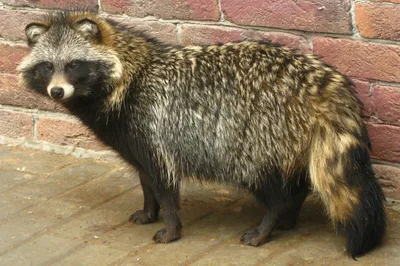 Common raccoon dog
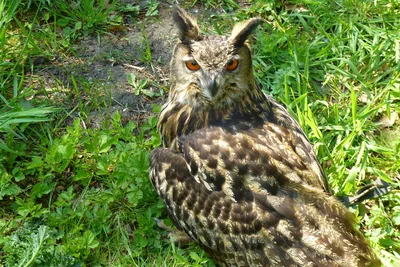 Eurasian eagle-owl
- grass snakes
Ecological equivalents
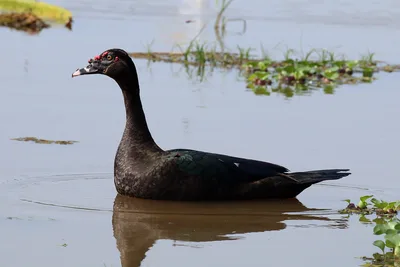
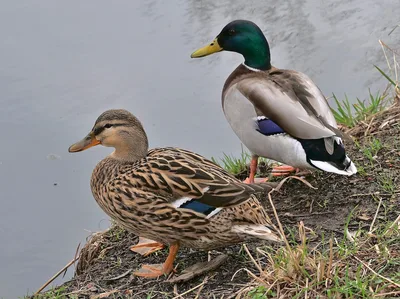
Related species on this site
Wood Duck (same genus), Black swan (same family), Black-Bellied Whistling Duck (same family), Canada goose (same family), Canvasback (same family), Chinese Geese (same family), and more.
Birds
Wood Duck
Aix sponsa
Classification and source reference
LivingAI illustration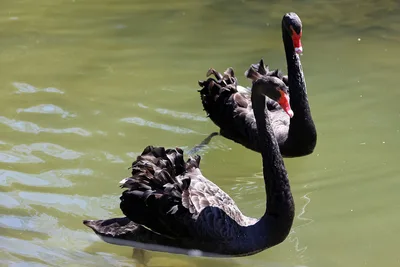 LC
Birds
Black swan
Cygnus atratus
The black swan is a large Australian waterbird with black plumage, white flight feathers and a bright red bill.
Living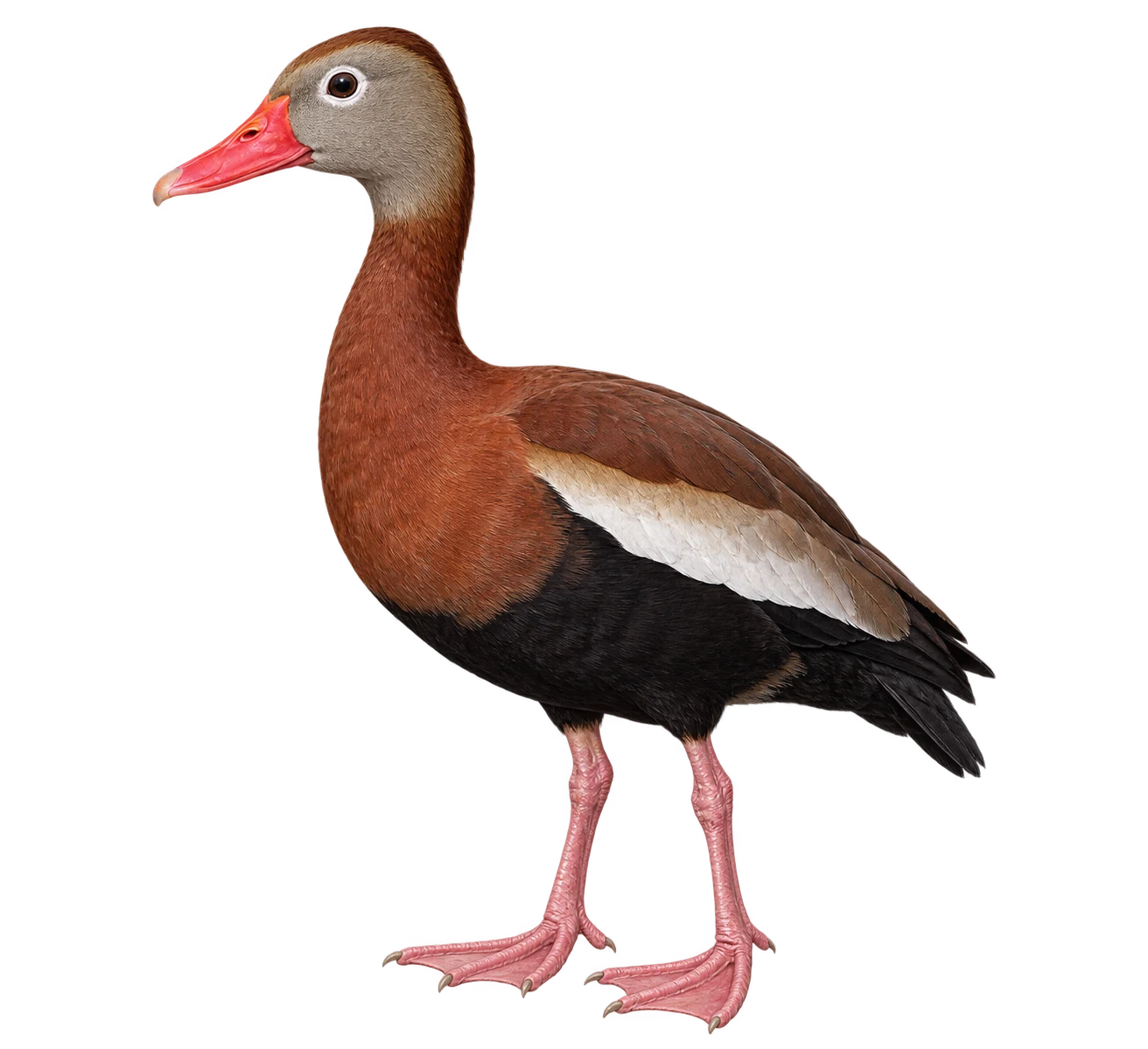
Birds
Black-Bellied Whistling Duck
Dendrocygna autumnalis
Classification and source reference
LivingAI illustration LC
Birds
Canada goose
Branta canadensis
The Canada goose is a large black-necked goose with a white chinstrap, native to North America and now settled on four continents.
Living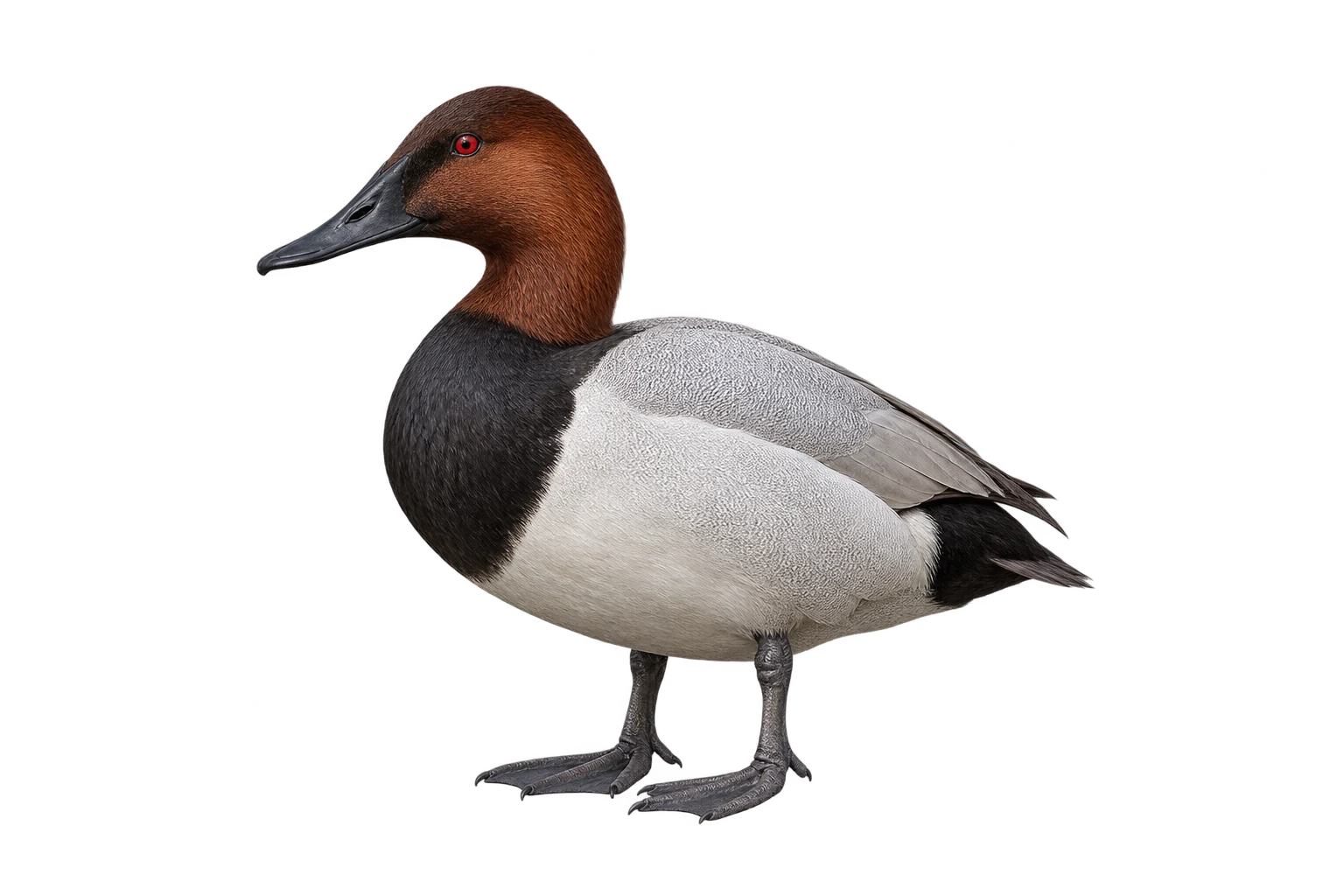
Birds
Canvasback
Aythya valisineria
Classification and source reference
LivingAI illustration
Birds
Chinese Geese
Anser cygnoides domesticus
Classification and source reference
LivingAI illustration