Groundhog
The whistling marmot that sleeps through the winter
Marmota monax
Also called Woodchuck, Whistle-pig, Canada marmot, Thickwood badger
Living individuals or members of this group exist today. This does not mean they are safe from extinction.
Meet the groundhog
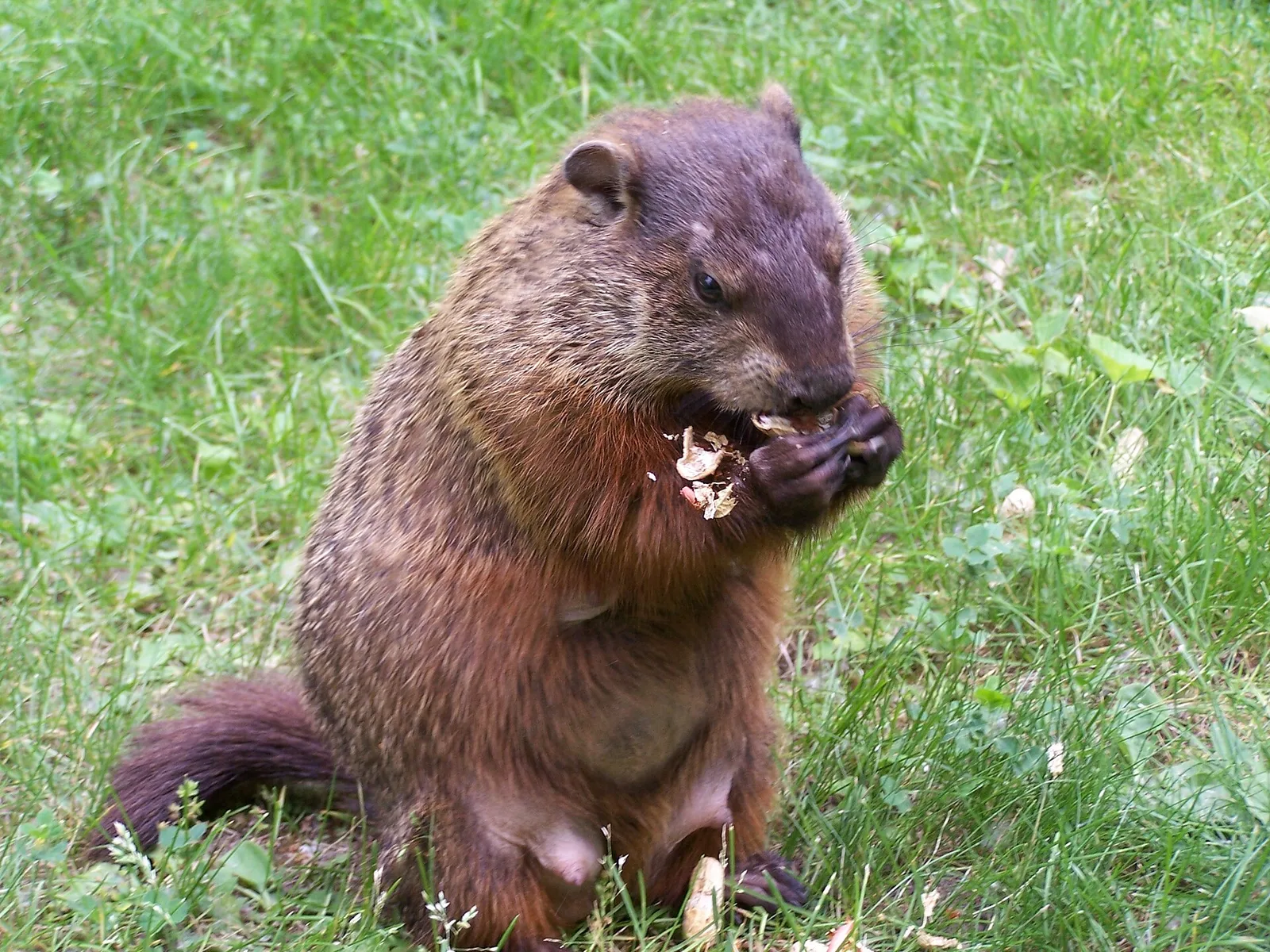
The groundhog is a large ground squirrel of eastern and northern North America that digs long burrows and hibernates through the winter. It grazes on grasses and clover, whistles when alarmed, and stars in the Groundhog Day custom each February.
Images of the groundhog
Lifespan in the wild
4 to 6 years
Weight
2 to 6 kg
Length
41.5 to 67.5 cm
Fact file
Groundhog
- Location
- Eastern United States, across Canada, into Alaska
- Habitat
- Grassland, Temperate forest, Towns and cities
- Diet
- Herbivore
- Prey / food
- Grasses, clover, alfalfa, dandelion, berries, bark, leaves, occasionally insects and bird eggs
- Predators
- Coyote, red fox, bobcat, badger, hawks, domestic dogs
- Lifestyle
- Diurnal; hibernates from October to March or April
- Group name
- None; solitary
- Name of young
- Pup or chuckling
- Gestation
- 31 to 32 days
- Litter size
- 1 to 9 pups, usually 3 to 5
- Population
- Abundant and stable; no total count
- Biggest threat
- Hunting and pest control by people; road traffic
- Distinctive feature
- Stocky body, short bushy tail, white incisors and a grizzled coat
- Colour
- Grizzled grey to cinnamon brown
- Skin type
- Fur
Size
Next to a person
Measurements
Size and speed
- Length
- 41.5 to 67.5 cm including the tail
- Tail
- 10 to 16 cm
- Weight
- 2 to 6 kg heaviest in autumn before hibernation
Typical adult ranges. Source: Animal Diversity Web.
Life cycle
Lifespan
- In the wild4 to 6 years
- In captivityUp to 14 years
- 014 years
The pale bar is the record. Sources: Animal Diversity Web, AnAge.
Appearance
Colour and coat
- Primary colours
- grizzled greycinnamon brown
- Secondary colours
- dark brownblack
- Skin type
- fur
- Male and female
- Slight. Males are a little larger than females, but the coat colour is the same.
Life cycle
Mating and family
- Mating system
- polygynous
- Social structure
- solitary and territorial
- Breeding
- one litter a year
Groundhogs mate soon after they wake from hibernation, from early March to late April. Pregnancy lasts 31 to 32 days, and a female bears 1 to 9 pups, usually 3 to 5. The mother rears them alone, nurses them for about 44 days, and sends them off at about 2 months. Most breed first at 2 years old. Wild animals seldom pass 6 years, while the captive record is 14.
Classification
Taxonomy
- Kingdom
- Animalia
- Phylum
- Chordata
- Class
- Mammalia
- Order
- Rodentia
- Family
- Sciuridae
- Genus
- Marmota
- Species
- Marmota monax
Conservation
Red List status
- LC
- NT
- VU
- EN
- CR
- EW
- EX
Least Concern on the IUCN Red List
Range
Recorded in 2 countries
Habitat layer: temperate broadleaf and mixed forest, temperate conifer forest, boreal forest and taiga, tropical grassland, savanna and shrubland, temperate grassland, savanna and shrubland.
Countries from 44,029 wild records on GBIF (iNaturalist research grade), filtered and checked by hand. Country shapes: Natural Earth. Habitat: RESOLVE Ecoregions 2017, CC BY 4.0. Basemap: Natural Earth.
Habitats
Three things to know
- 1
In hibernation the heart slows to 4 to 10 beats a minute and the body cools to about 2 degrees Celsius.
- 2
A groundhog burrow can run 14 metres with side galleries, and other animals move in when it is abandoned.
- 3
Its four incisors grow about 1.5 millimetres a week and wear down by the same amount.
Did you know
Seven more facts
- 1
The name woodchuck comes from an Algonquian word, wuchak, and has nothing to do with wood.
- 2
A groundhog's incisors are white, unlike the orange teeth of most rodents.
- 3
A newborn pup weighs only 26 to 27 grams.
- 4
Groundhogs swim well and climb trees.
- 5
A groundhog can lose half its weight while it hibernates.
- 6
Its ears close over the ear canal to keep soil out while it digs.
- 7
Doctors study the groundhog because its hepatitis virus resembles human hepatitis B.
Field notes
How it looks and acts
Field notes
Distinguishing features
- A stocky body of 2 to 6 kilograms with short strong legs.
- A grizzled coat, grey to cinnamon to dark brown, with pale-tipped guard hairs.
- A short bushy dark tail, about a quarter of the body length.
- White incisors.
- Long broad claws for digging.
Field notes
Unique adaptations
- True hibernation cuts the heart rate to 4 to 10 beats a minute and saves energy through the winter.
- Autumn feeding doubles its body weight as stored fat.
- Strong legs and broad claws dig burrows with several escape holes.
- Ears that close keep soil out of the ear canal.
- Incisors that grow all its life replace what chewing wears away.
Field notes
Interesting behaviours
- Feeds twice a day in summer, in the morning and the afternoon.
- Stands upright on its hind feet to watch for danger.
- Suns itself in the middle of a summer day.
- Retreats to its burrow at the first sign of a threat.
- Hibernates alone from October to March or April.
Field notes
Temperament
- Solitary and territorial toward its own kind.
- Shy of people, and it hides when it sees, hears or smells an observer.
- Fights hard with teeth and claws when cornered in its burrow.
- Aggressive in captivity, even when raised by hand.
Field notes
Communication
- A shrill whistle warns other groundhogs of danger.
- Hisses, growls, barks and teeth-chatter threaten a rival.
- Scent from face and anal glands marks the edges of a territory.
- An arched back, bared teeth and a raised tail signal a threat.
Ecology
Ecological role
The groundhog is a soil engineer whose burrows shelter dozens of other species.
- Brings subsoil to the surface and improves the soil as it digs.
- Leaves burrows that rabbits, foxes, skunks, otters, snakes and many small mammals use.
- Feeds coyotes, foxes, bobcats and hawks.
- Shelters foxes and skunks that eat crop pests, so it probably helps the farmer in an indirect way.
Stories
Myths and legends
- In North American tradition, the groundhog forecasts on 2 February whether six more weeks of winter will come.
- In Pennsylvania German tradition, settlers are thought to have moved the Candlemas badger lore onto the groundhog.
- In Ojibwe tradition, a groundhog clan is said to stand for healing, though only symbolism writers report it.
- In New England tradition, an 1883 New Hampshire committee report painted the woodchuck as a wayward sinner.
People
Relationship with humans
People
Living alongside us
People have hunted the groundhog for food and sport for centuries, and farmers fight it as a crop pest. Its burrows can damage machinery and foundations. Medical researchers use it as the main animal model for hepatitis B liver disease. Each 2 February a captive groundhog forecasts the weather in the Groundhog Day custom.
- A groundhog avoids people and runs for its burrow.
- A cornered animal can bite hard with its incisors.
- It can carry rabies and tularemia, so a bite needs medical care.
People
Status, uses and products
- Domestication
- Wild
- As a pet
- Not suitable. A groundhog stays aggressive even when raised by hand, digs constantly, and needs to hibernate. Rescued animals that cannot be released are kept only by trained carers.
- Uses
- huntingmedical researchGroundhog Day festivals
- Products
- meatfur
The full account
About the groundhog
The groundhog, Marmota monax, is a large ground squirrel of North America. It is also called the woodchuck, and country people know it as the whistle-pig. It belongs to the marmots, but unlike its mountain cousins it lives in lowland fields and woodland edges. An adult weighs 2 to 6 kilograms and measures 41.5 to 67.5 centimetres from nose to tail tip. It is the largest member of the squirrel family across most of its range.
The groundhog lives from the eastern United States across Canada and into Alaska. It digs deep burrows, eats grasses and clover, and sleeps through the winter in true hibernation. Farmers and gardeners treat it as a pest, but its old burrows shelter foxes, rabbits and snakes. The IUCN lists the species as Least Concern, because it is common and its numbers are stable. Every 2 February a groundhog called Punxsutawney Phil is asked whether winter will last.
Name and taxonomy
Carl Linnaeus named the species Mus monax in 1758. He worked from a description that George Edwards published in 1743. The species later moved into the marmot genus, Marmota, within the squirrel family Sciuridae. Monax is an Algonquian word that means digger. Nine subspecies are recognised, and GBIF lists four of them by name.
The name woodchuck has nothing to do with wood or with chucking. It comes from an Algonquian name for the animal, wuchak, possibly from the Narragansett language. The likeness of the two words gave rise to the tongue-twister about how much wood a woodchuck could chuck. Other names include groundpig, whistler, thickwood badger, Canada marmot, land beaver and, in French Canada, siffleux. Young groundhogs are sometimes called chucklings.
Evolution and relatives
The groundhog is a rodent of the order Rodentia and a ground squirrel of the family Sciuridae. It is one of 14 marmot species, and the most widespread marmot in North America. Its closest relatives include the hoary marmot and the yellow-bellied marmot of the western mountains. Those species live among rocks at high altitude, while the groundhog stays in the lowlands. In British Columbia the two ranges meet, and the hoary marmot there is a little larger.
Groundhogs are thought to be the least social of the marmots. Like other marmots, they are true hibernators, and they carry 38 chromosomes. Groundhog bones have turned up in ancient mounds at Aztalan in Wisconsin.
Appearance
The groundhog is stocky, with short strong legs, long broad claws and a short bushy tail. Adults weigh 2 to 6 kilograms, and the tail adds 10 to 16 centimetres to a total length of 41.5 to 67.5 cm. Males average about 3.83 kg over the year and females about 3.53 kg. Every animal is far heavier in autumn than in spring, because it lays down fat for the winter. Weight climbs during the first two or three summers of life and then levels off.
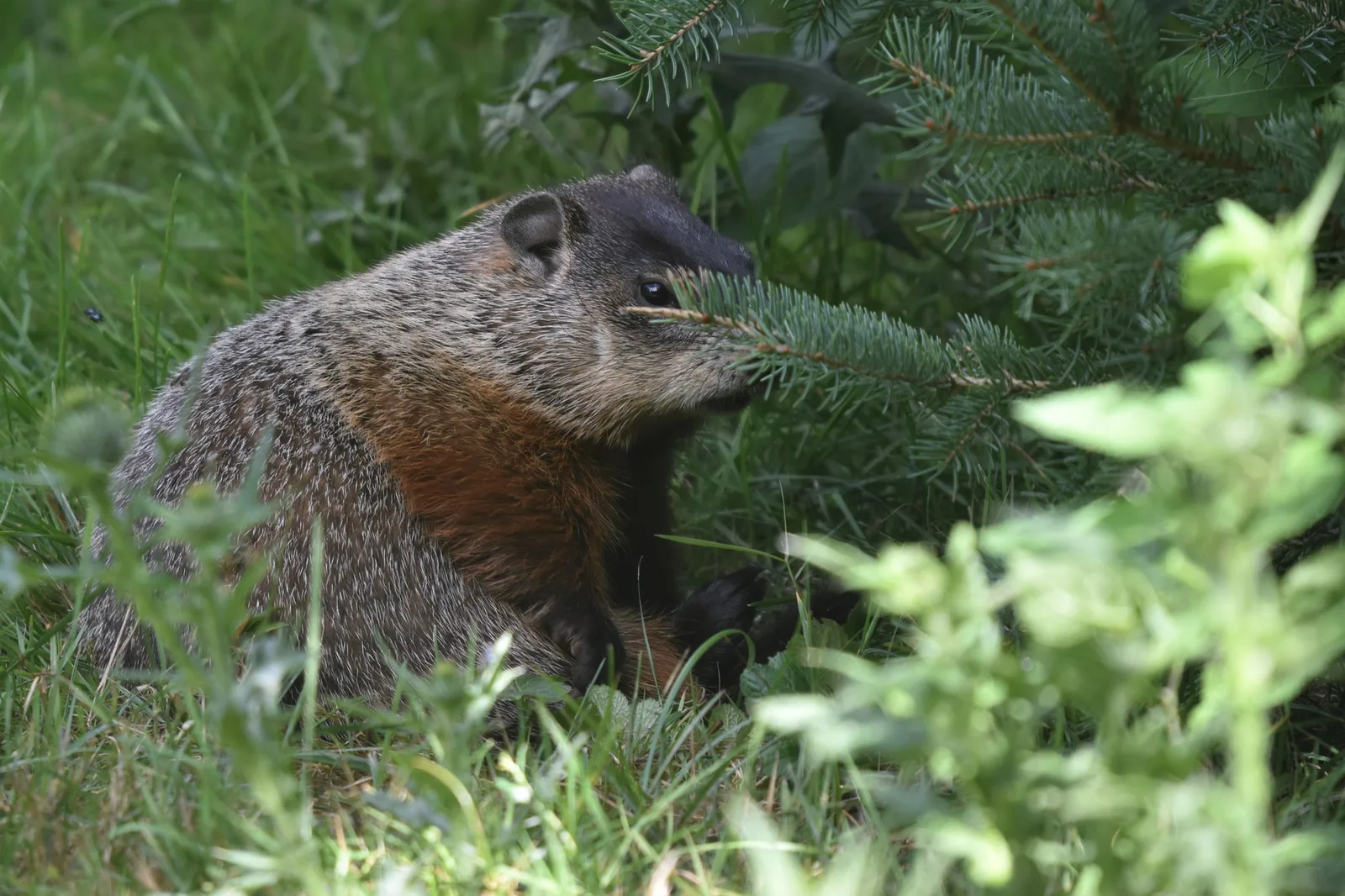
The coat runs from grey through cinnamon to dark brown. Pale tips on the guard hairs give it a frosted, grizzled look. The paws are usually black or dark brown, the tail is dark, and pale patches surround the snout and chin. The tail is about a quarter of the body length, shorter than in other squirrels.
The four incisors are white rather than the orange of most rodents. They grow about 1.5 millimetres a week, and chewing wears them down at the same rate. The groundhog has 22 teeth in all. Its rounded ears can close over the ear canal, which keeps soil out while it digs.
Habitat and range
The groundhog ranges from Alaska across southern Canada to Labrador and south through the eastern United States. Its southern limit runs from eastern Oklahoma and northern Louisiana through Alabama and Georgia to North Carolina. It also reaches down the Rocky Mountains, possibly as far as northern Idaho. GBIF holds records from 7 countries, which include a few animals outside the native range.
It prefers open country next to woodland, and it rarely strays far from a burrow entrance. Typical homes are small woodlots, low forests, fields, pastures, orchards, hedgerows and roadsides. It also lives in urban parks and under buildings and bridges. Cleared forest, roads and farming have given it more food, so it has spread with people.
It digs its burrows in well-drained soil. Most animals keep a summer den near food and a separate winter den near cover. A burrow usually has two to five entrances, one of them a spy hole. The longest burrow measured ran 7.3 metres, or 14.62 metres when its side galleries were counted.
Diet and feeding
The groundhog is mostly a plant eater. It grazes on wild grasses, clover, alfalfa, dandelion and coltsfoot, and it takes berries, leaves, bark and crops. Now and then it eats grubs, grasshoppers, snails, bird eggs and nestlings. It climbs trees for leaves, fruit and soft seeds. It gets most of its water from plant juices and from rain or dew on the leaves.
An adult can eat more than 0.45 kilograms of plants in a day. It usually feeds twice a day in summer, in the morning and in the afternoon. Each feeding bout lasts less than 2 hours. From early June its metabolism slows, and it can double its weight as it stores fat. It does not store food in the burrow, because the fat carries it through the winter.
Behaviour and social life
The groundhog is active by day, most of all in the early morning and the late afternoon. In towns it may also move about at dusk or at night. It often sits upright on its hind feet and stays nearly still while it watches for danger. When a threat appears it runs for the burrow, and it will fight with teeth and claws if the burrow is invaded. It swims well, and it climbs a tree when chased or when it wants a better view.
Adults live alone and defend a territory. A dominant male holds a home range of about 10,000 square metres, which overlaps the ranges of two or more females. A female uses about 2,500 square metres in spring, and more after her pups are born. Young males without a territory wander. Meetings between adults are usually hostile, though close relatives are a little more tolerant.
Groundhogs are true hibernators, and many dig a separate winter burrow below the frost line. In most areas they sleep from October until March or April, but in mild regions the sleep can last only three months. Body temperature falls to about 2 degrees Celsius, the heart slows to 4 to 10 beats a minute, and one breath comes every six minutes. By February a hibernating groundhog may have lost half its body weight. Males wake before females and set up territories before the females appear.
Communication and senses
Sight, smell and sound all matter to the groundhog. It relies on its eyes to spot predators and to threaten rivals. Glands on the face and near the anus produce scent, which it rubs on stumps and rocks to mark its ground. A threatened animal arches its body, bares its teeth and raises its tail.
The best-known call is a shrill whistle, given when danger is near. That alarm warns other groundhogs, especially the young, and it gave the animal the name whistle-pig. It also hisses, growls, barks, shrieks and chatters its teeth. A groundhog squeals when it fights, when it is badly hurt, or when a predator catches it. On the rare occasions when two meet peacefully, they may touch noses.
Reproduction and life cycle
Groundhogs are polygynous, and a male mates with several females in a season. Mating comes soon after hibernation ends, from early March to late April, and later in the north. A female comes into heat once a year. The pair may share a den during the 31 to 32 days of pregnancy, and the male leaves before the birth. In Ohio, some males and females stay together through the year and from year to year.
A female bears one litter a year, of 1 to 9 pups, most often 3 to 5. A newborn weighs 26 to 27 grams and is blind and naked. The mother does all the rearing. The pups nurse for about 44 days. They leave the burrow at five to six weeks, once their fur has grown and their eyes are open. They are independent at about 2 months, and most scatter to dig their own burrows by the end of August.
Most groundhogs first breed at 2 years old, though some yearlings breed with less success. They keep growing for two to three years. A wild groundhog lives 4 to 6 years, and a captive one has reached 14. Many die before their third year from predators and disease.
Predators and threats
Coyotes, red foxes, grey foxes, bobcats and badgers take adult groundhogs across eastern North America. Most of these hunters stalk and surprise a groundhog before it can reach its burrow. Badgers probably dig them out. In one Pennsylvania study the groundhog was the third most important prey of the coyote. Wolves, black bears, lynx and cougars take some in Canada.
Young groundhogs also fall to mink, cats, hawks and timber rattlesnakes. Red-tailed hawks catch animals up to yearling size, and goshawks take some young adults in spring. Golden eagles and great horned owls can kill an adult but seldom meet one. Near towns the main killers are people, dogs and cars.
Groundhogs carry botflies, ticks, fleas and mites, and some die from parasites or the bacteria they spread. A share of the population carries the woodchuck hepatitis virus, which harms the liver. They can also carry tularemia and rabies.
Population and conservation
The IUCN lists the groundhog as Least Concern. It is abundant, its range is wide, and its numbers are stable. Forest clearance and farming have helped it, and it thrives near people. No one appears to have counted the whole population.
Local numbers can still fall under heavy hunting. In the dairy country of southern Wisconsin the species was nearly wiped out by 1950 after exaggerated reports of crop damage. Wisconsin then protected it until 2017. Kentucky hunters took an estimated 267,500 a year between 1964 and 1971. Numbers appear to have dropped in Illinois.
Relationship with humans
Farmers and gardeners see the groundhog as a pest. It eats vegetables, hay, cereals and orchard fruit. Its holes can break farm machinery, injure livestock and, over many years, weaken a foundation. A New Hampshire committee report of 1883 called the woodchuck a nuisance and a bore.
In many states the groundhog is a game animal, hunted for sport, meat and fur. In parts of the United States people have long eaten it, and some still call it a delicacy. Its burrows at the Ufferman Site in Ohio brought bones, pottery and stone tools to the surface for archaeologists.
Groundhogs matter in medicine, because the woodchuck hepatitis virus resembles human hepatitis B. The virus cannot infect people, so the groundhog is the main animal model for liver cancer caused by hepatitis. Researchers also study its hibernation in the hope of slowing a patient's heart during surgery. In captivity it stays aggressive, and a zookeeper has to work hard to tame one.
In culture and myth
In the United States and Canada, Groundhog Day falls on 2 February. If the groundhog sees its shadow, the story says, six more weeks of winter are thought to follow. The custom is thought to descend from European Candlemas lore, in which Pennsylvania German settlers swapped the badger for the groundhog. Punxsutawney Phil in Pennsylvania is the most famous forecaster, alongside Buckeye Chuck, Wiarton Willie, Shubenacadie Sam and Staten Island Chuck. The 1993 comedy film Groundhog Day put Phil and his ceremony on cinema screens.
The Algonquian names monax and wuchak show how long the animal has been part of North American life. In Ojibwe tradition, symbolism writers suggest, a groundhog clan is tied to healing. Robert Frost's poem A Drumlin Woodchuck uses a groundhog dug into a ridge as a picture of his own reserve. The tongue-twister about the woodchuck chucking wood is the animal's best-known line in English.
A sentence with a dotted underline is inferred: it describes the group the animal belongs to, or is a reading of the sources, rather than a measured or reported fact about this species.
Questions
Groundhog questions, answered
Is a groundhog the same as a woodchuck?
Yes. Groundhog and woodchuck are two names for one species, Marmota monax. It is also called the whistle-pig, the Canada marmot and the thickwood badger.
How big is a groundhog?
An adult weighs 2 to 6 kilograms and measures 41.5 to 67.5 centimetres including the tail. Males are a little larger than females, and every animal is heaviest in autumn.
What do groundhogs eat?
Mostly grasses, clover, alfalfa, dandelion and other plants, plus berries, leaves, bark and garden crops. Now and then they eat insects, snails and bird eggs. An adult can eat more than 0.45 kilograms of plants a day.
Do groundhogs hibernate?
Yes. The groundhog is a true hibernator. It sleeps from about October to March or April in a burrow below the frost line. Its heart slows to 4 to 10 beats a minute.
Where do groundhogs live?
They live across the eastern United States, through southern Canada to Labrador, and north into Alaska. They favour fields, pastures and woodland edges, and they also live in parks and under buildings.
How long do groundhogs live?
A wild groundhog lives 4 to 6 years, and many die before they are 3. In captivity one lived 14 years.
Are groundhogs dangerous?
No. A groundhog runs from people, and it only bites when it is cornered or handled. It can carry rabies, so leave a sick or bold animal alone.
How deep is a groundhog burrow?
The nest chamber usually lies 51 to 91 centimetres down, and one burrow reached 120 cm at its deepest point. Burrows run 4.3 metres on average and up to 7.3 metres, with two to five entrances.
Do groundhogs climb trees?
Yes. Despite their heavy build they climb well, both to escape a predator and to feed on leaves and fruit. They also swim well.
Why is it called a whistle-pig?
Because it gives a loud shrill whistle when it spots danger. The call warns other groundhogs nearby, especially the young.
How many babies does a groundhog have?
A female has one litter a year of 1 to 9 pups, usually 3 to 5. They are born after 31 to 32 days, weigh about 26 to 27 grams, and leave the burrow at five to six weeks.
What eats groundhogs?
Coyotes, foxes, bobcats and badgers take adults. Hawks, mink, cats and snakes take the young. Near towns, dogs and cars kill many.
Are groundhogs endangered?
No. The IUCN rates the groundhog as Least Concern. It is common across a wide range and has spread as forests were cleared.
What is Groundhog Day?
A custom held on 2 February in the United States and Canada. A groundhog such as Punxsutawney Phil is brought out, and the story says its shadow foretells six more weeks of winter.
How do I keep groundhogs out of my garden?
Fence the plot with buried wire mesh, remove brush piles and woodpiles where they hide, and block old burrow entrances when they are empty. Trapping may need a permit in your state.
Food web
Prey and food
- grasses
- clover
- alfalfa
- dandelion
- berries
- bark
- leaves
- occasionally insects
- bird eggs
Food web
Predators
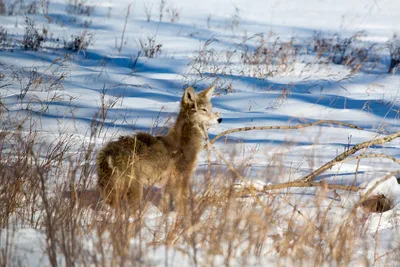 Coyote
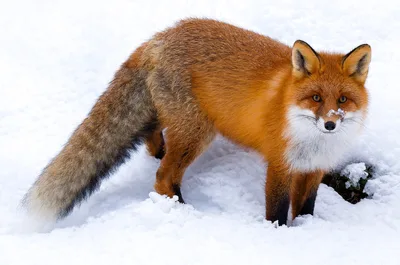 Red fox
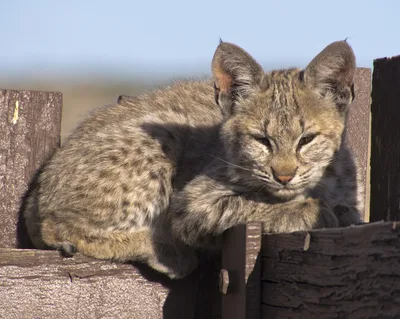 Bobcat
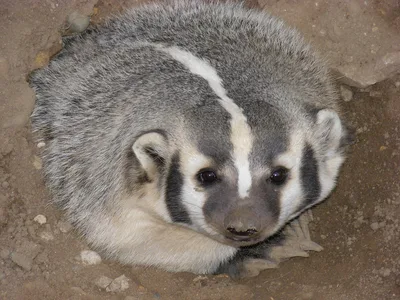 American badger
- hawks
- domestic dogs
Ecological equivalents
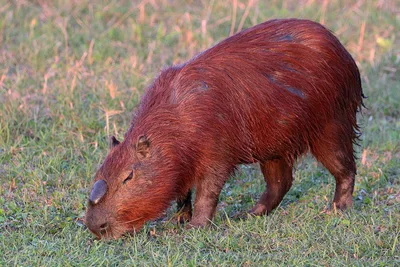
Related species on this site
Groundhog (Woodchuck) (same genus), Olympic Marmot (same genus), Chipmunk (same family), Eastern Chipmunk (same family), Eastern gray squirrel (same family), Flying Squirrel (same family), and more.
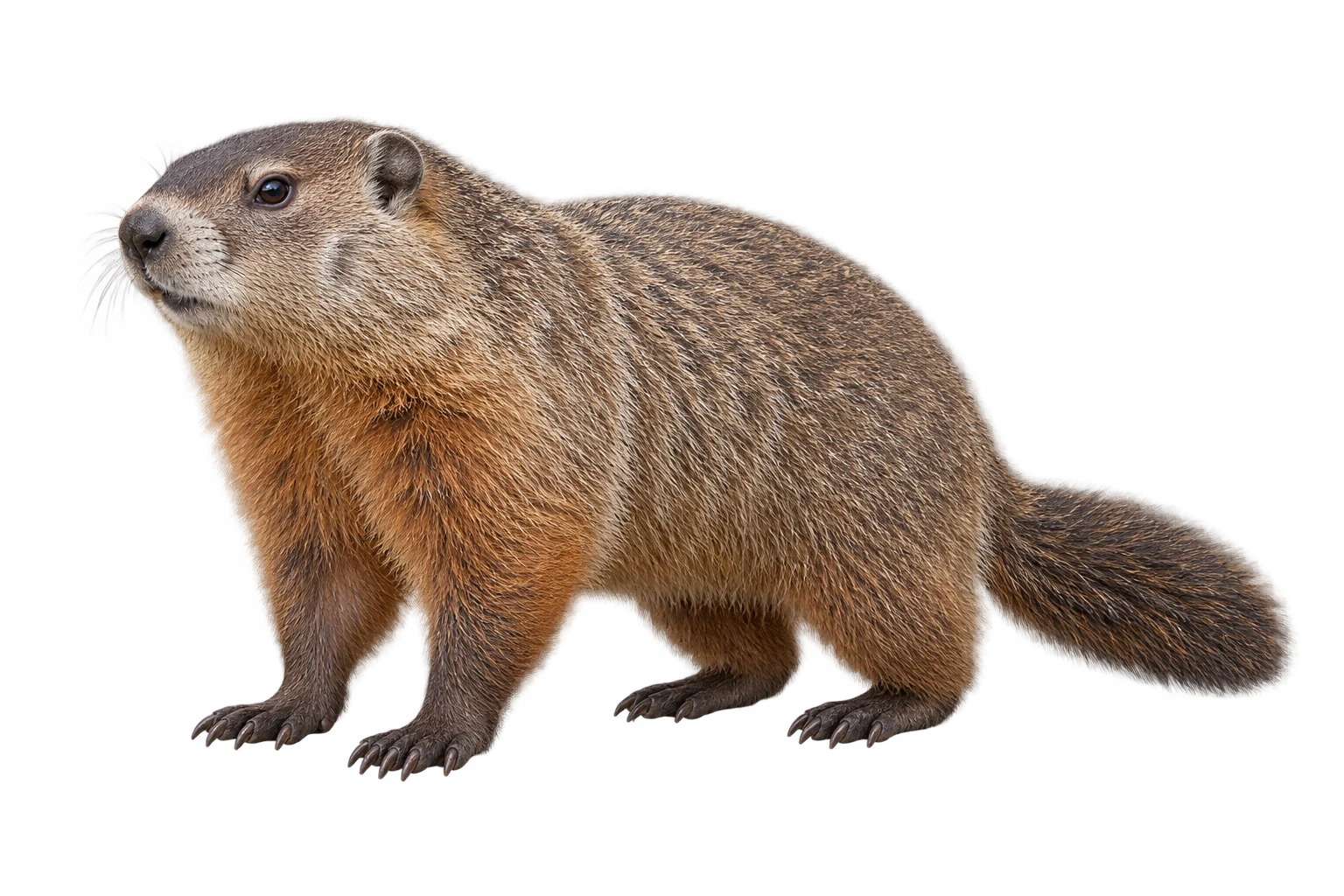
Mammals
Groundhog (Woodchuck)
Marmota monax
Classification and source reference
LivingAI illustration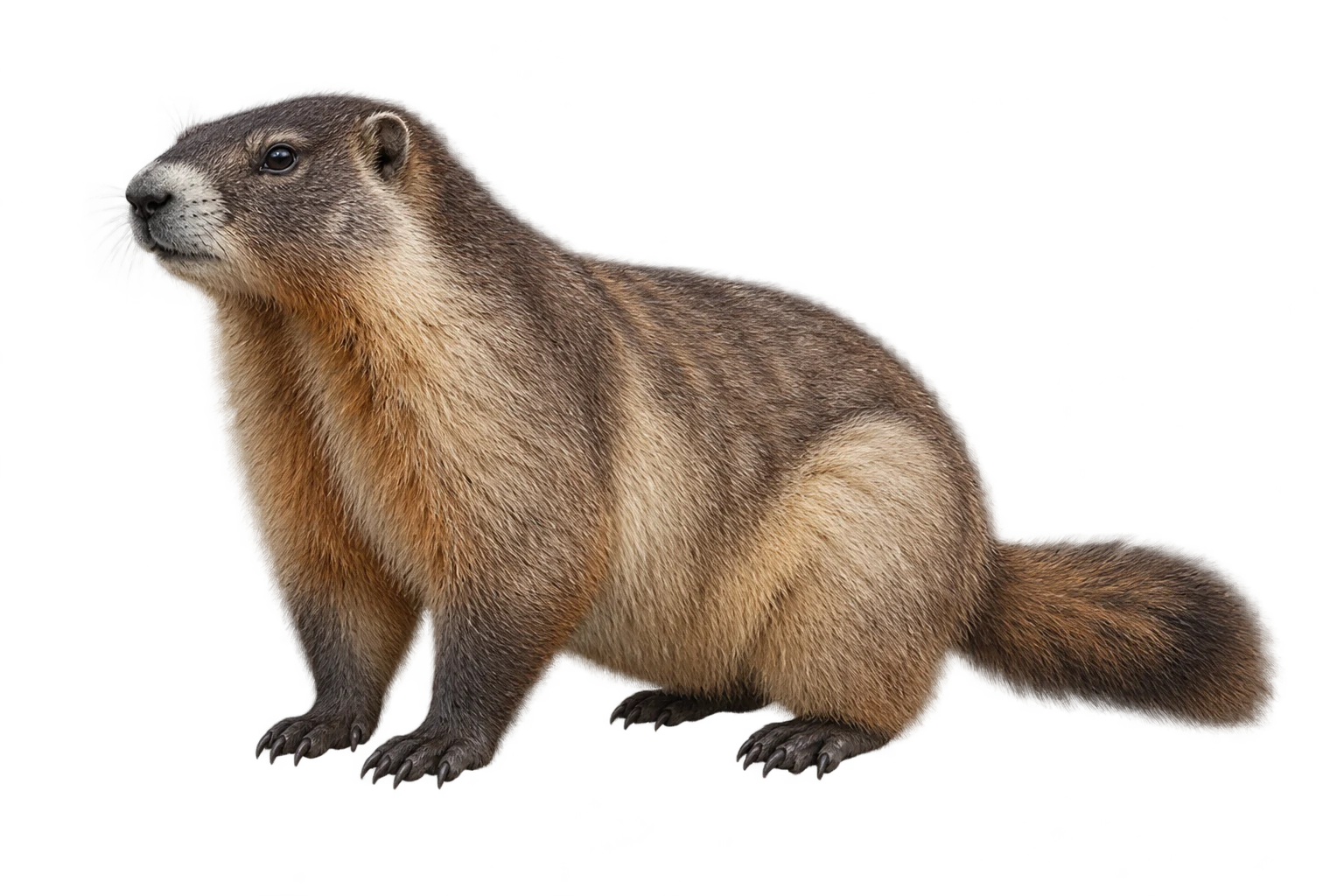
Mammals
Olympic Marmot
Marmota olympus
Classification and source reference
LivingAI illustration
Mammals
Chipmunk
Tamias
Chipmunks are small striped squirrels.
Living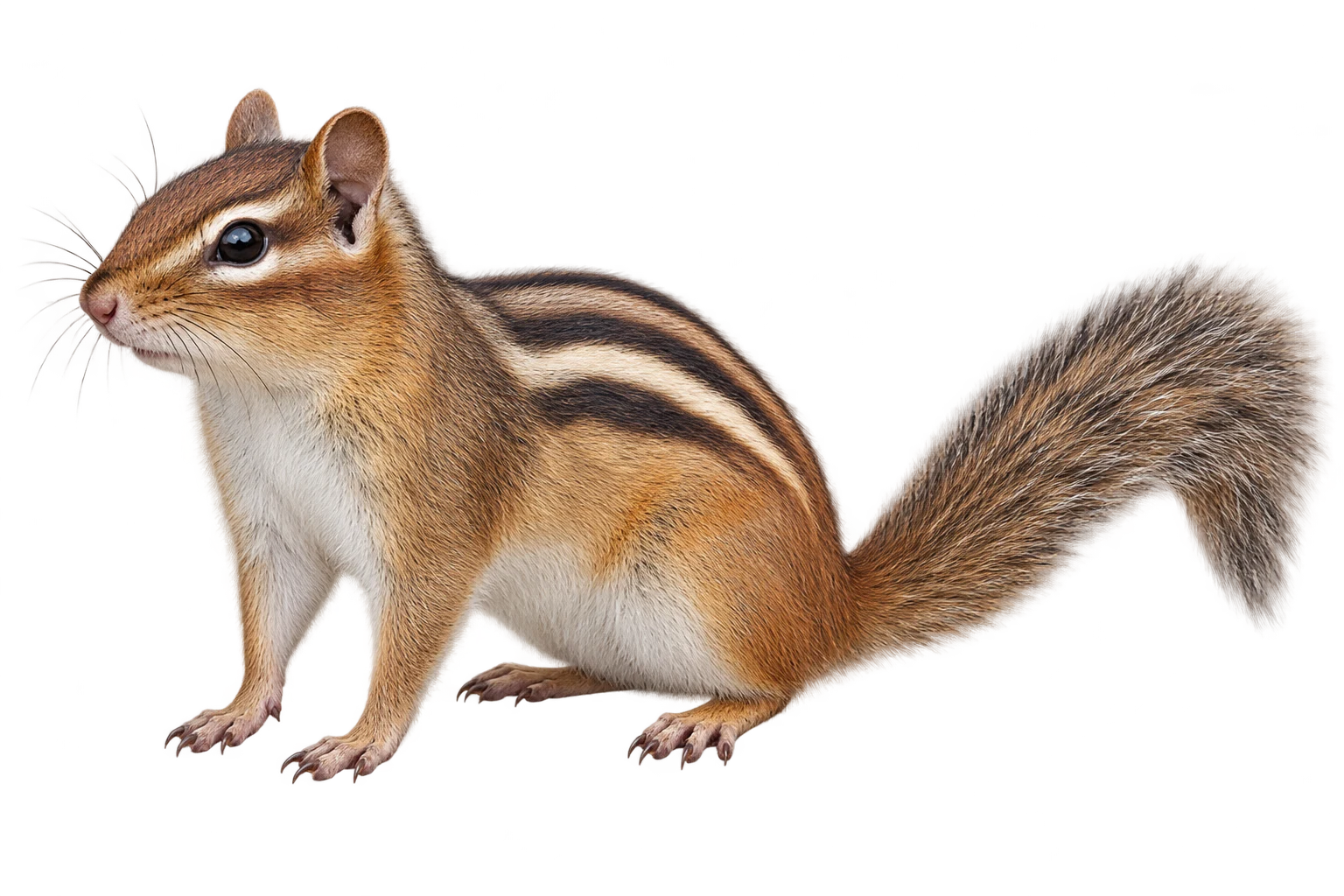
Mammals
Eastern Chipmunk
Tamias striatus
Classification and source reference
LivingAI illustration LC
Mammals
Eastern gray squirrel
Sciurus carolinensis
The eastern gray squirrel is a medium-sized tree squirrel of the oak and hickory forests of eastern North America.
Living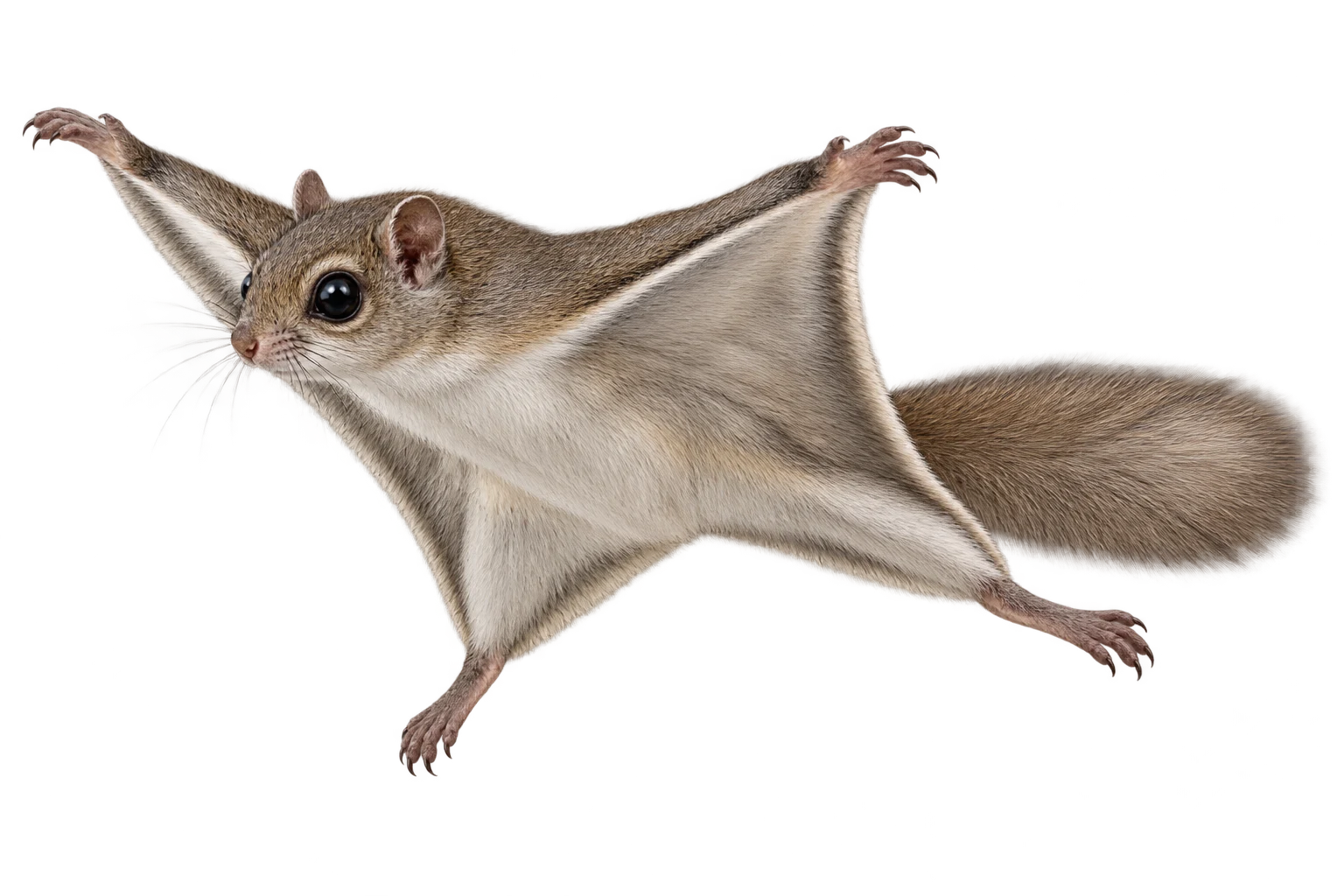
Mammals
Flying Squirrel
Sciuridae
Classification and source reference
LivingAI illustration