White stork
The rooftop bird that flies to Africa on warm air
Ciconia ciconia
Also called European white stork
Living individuals or members of this group exist today. This does not mean they are safe from extinction.
Meet the white stork
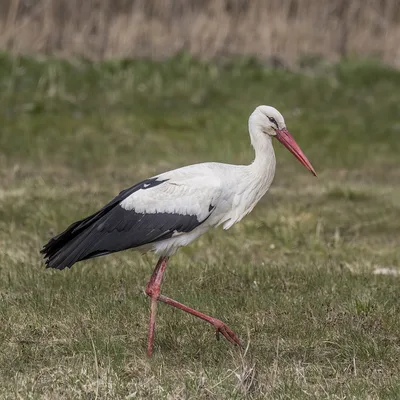
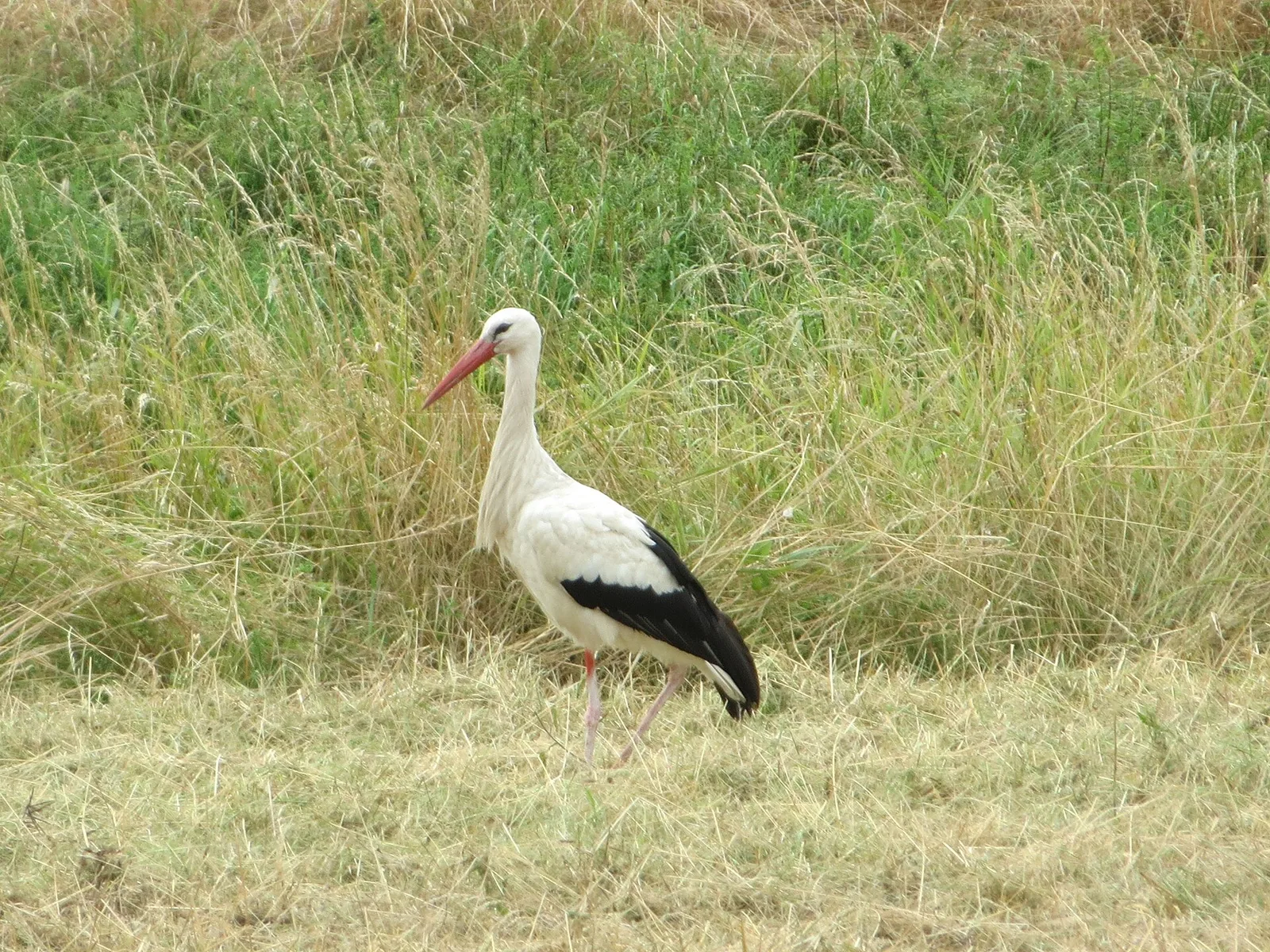
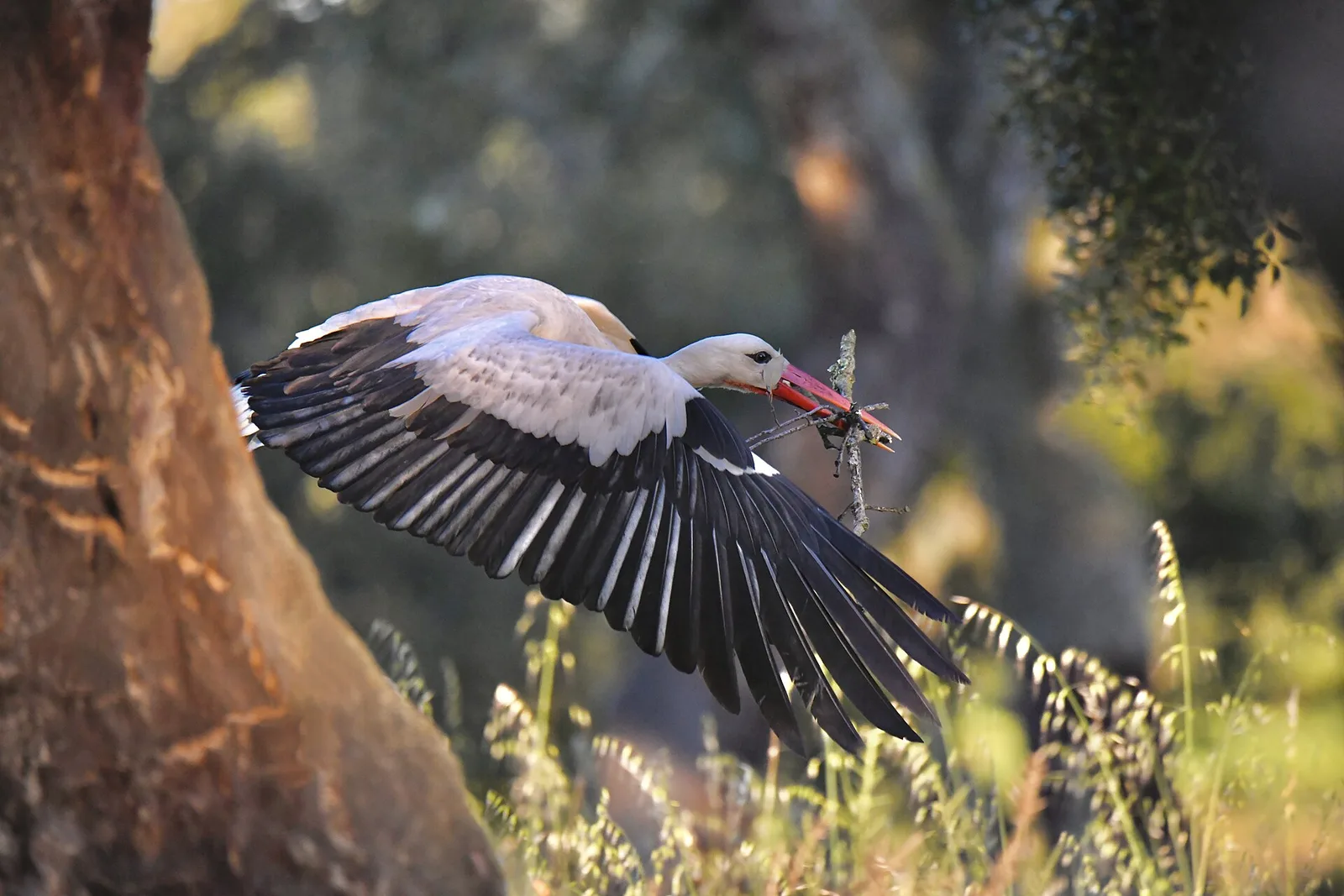
The white stork is a large white bird with black wings, a red bill and long red legs. It nests on European rooftops and flies to Africa each autumn, riding thermals instead of crossing the sea.
Images of the white stork
Lifespan in the wild
20 to 25 years a bird ringed in Switzerland reached 39 years
Weight
2.3 to 4.5 kg
Length
1 to 1.15 m
Height
1 to 1.25 m
Fact file
White stork
- Location
- Europe, western Asia and North Africa, wintering in Africa and India
- Habitat
- Grassland, Wetlands, Savanna, Towns and cities
- Diet
- Carnivore
- Prey / food
- Insects, earthworms, frogs, lizards, snakes, voles, moles, shrews, fish
- Predators
- Few as adults, but hawks and eagles take nestlings
- Lifestyle
- Migratory, social, active by day
- Group name
- Flock
- Name of young
- Chick
- Incubation
- Incubation 33 to 34 days
- Clutch size
- Usually 4 eggs
- Population
- Least Concern, with 52500 pairs in Poland alone
- Biggest threat
- Loss of wet meadows, and collision with power lines
- Distinctive feature
- A white body with black flight feathers and a red bill
- Colour
- White with black wings, a red bill and red legs
- Skin type
- Feathers
Size
Next to a person
Measurements
Size and speed
- Height
- 1 to 1.25 m standing height, half of it leg
- Length
- 1 to 1.15 m from the bill tip to the end of the tail
- Wingspan
- 1.55 to 2.15 m
- Weight
- 2.3 to 4.5 kg
Typical adult ranges. Source: Wikipedia.
Life cycle
Lifespan
- In the wild20 to 25, up to 39 years a bird ringed in Switzerland reached 39 years
- In captivityUp to 48 years
- 048 years
The pale bar is the record. Source: Animal Diversity Web.
Appearance
Colour and coat
- Primary colours
- whiteblack
- Secondary colours
- red
- Skin type
- feathers
- Male and female
- Slight. Males average larger than females, but the plumage is the same in both. A young bird has duller brownish-red legs and a dark-tipped bill.
Life cycle
Mating and family
- Mating system
- monogamous pairs that keep the same nest
- Social structure
- loose colonies in summer, large flocks on migration
- Breeding
- one brood a year, in spring
A male returns first and takes over the nest he used the year before. The pair greet with head-shaking and up-down displays. The female lays about four eggs, and both birds incubate for 33 to 34 days. The chicks hatch on different days, because sitting begins with the first egg. The young fly at 58 to 64 days and are fed for up to 20 days more.
Classification
Taxonomy
- Kingdom
- Animalia
- Phylum
- Chordata
- Class
- Aves
- Order
- Ciconiiformes
- Family
- Ciconiidae
- Genus
- Ciconia
- Species
- Ciconia ciconia
Conservation
Red List status
- LC
- NT
- VU
- EN
- CR
- EW
- EX
Least Concern on the IUCN Red List
Range
Recorded in 26 countries
- Austria
- Belgium
- Bulgaria
- Belarus
- Switzerland
- Czech Republic
- Germany
- Algeria
- Spain
- France
- United Kingdom
- Greece
- Croatia
- Hungary
- Israel
- Italy
- Lithuania
- Morocco
- Netherlands
- Poland
- Portugal
- Romania
- Russia
- Turkey
- Ukraine
- South Africa
Habitat layer: tropical grassland, savanna and shrubland, temperate grassland, savanna and shrubland, flooded grassland and savanna, mangrove.
Countries from 61,302 wild records on GBIF (iNaturalist research grade), filtered and checked by hand. Country shapes: Natural Earth. Habitat: RESOLVE Ecoregions 2017, CC BY 4.0. Basemap: Natural Earth.
Habitats
Three things to know
- 1
A stork nest built up over many years can weigh 250 kilograms.
- 2
A stork found in Germany in 1822 carried an African spear, which proved that birds migrate.
- 3
Adult storks have almost no voice, and a pair greets by clattering the bill.
Did you know
Seven more facts
- 1
The white stork has almost no voice and greets by clattering its bill.
- 2
Migrating flocks of storks, raptors and pelicans can stretch for 200 km.
- 3
The spring journey north averages 49 days, and the autumn journey takes about 26.
- 4
One quarter of all white storks breed in Poland.
- 5
Storks climb to 1200 or 1500 metres on a thermal, and one bird reached 3300 m.
- 6
Sparrows, starlings, kestrels and little owls all nest inside a stork's nest.
- 7
A ringed wild stork reached 39 years, and a captive bird reached 48.
Field notes
How it looks and acts
Field notes
Distinguishing features
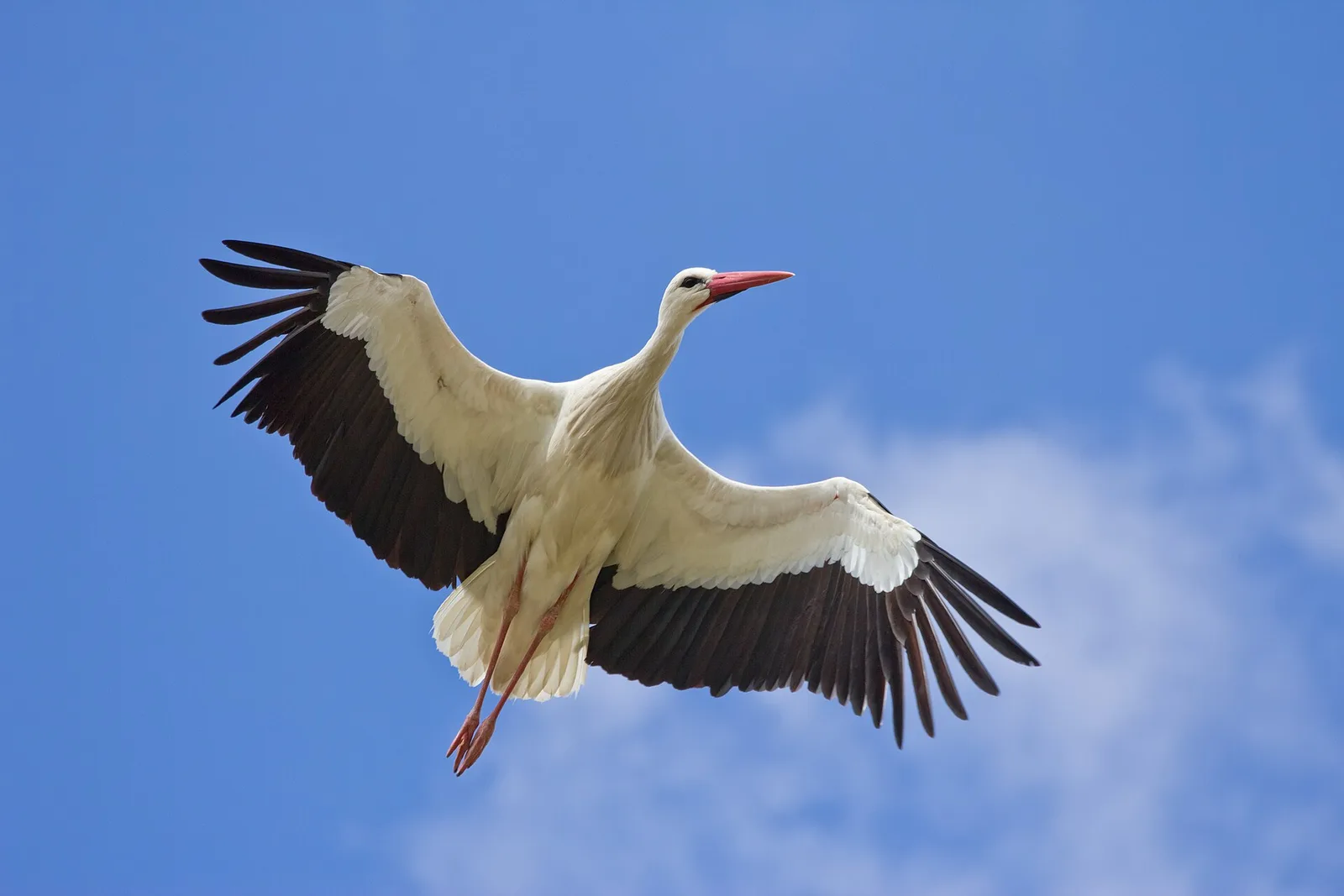
- White plumage with black flight feathers and wing coverts.
- A long, straight, pointed red bill.
- Long red legs that trail well past the tail in flight.
- A shaggy ruff of long breast feathers.
- A wingspan of 155 to 215 cm on a body of 100 to 115 cm.
- A neck held straight forward in flight, unlike a heron.
Field notes
Unique adaptations
- Long broad wings that let the bird soar without flapping.
- A migration route that goes round the sea, where thermals fail.
- Legs long enough to wade in shallow water.
- A bill that snaps shut by reflex in 25 milliseconds.
- Urohidrosis, which cools the bird through its own legs.
Field notes
Interesting behaviours
- Building a stick nest on a roof, a chimney or a platform.
- Clattering the bill as a greeting and as a threat.
- Throwing the head back onto the crown in the up-down display.
- Preening the head of a sitting partner at the nest.
- Following blackbuck in India to catch the insects they flush.
Field notes
Temperament
- Calm around people, and undisturbed by a busy village.
- Sociable, and often in flocks outside the nesting season.
- Defensive of a nest and of chicks.
- Not territorial away from the nest site.
Field notes
Communication
- Bill-clattering amplified by the throat pouch.
- A faint hiss, the only voiced sound an adult makes.
- Hisses, cheeps and cat-like mews from hungry chicks.
- The up-down display, with the head thrown back.
- A crouch with the tail cocked and the wings out, used as a threat.
Ecology
Ecological role
The white stork is the large ground predator of European wet meadows, and it moves that role to Africa every winter.
- It holds down numbers of grasshoppers, locusts and armyworms.
- It eats voles, moles and shrews on farmland.
- Its nest houses sparrows, starlings and even kestrels and little owls.
- Its nest litter feeds a community of thousands of mites.
Stories
Myths and legends
- In German folklore, the stork brought babies from caves or marshes to the house.
- In Slavic belief, the stork carried unborn souls from Vyraj each spring.
- In Greek tradition, the law of Pelargonia made children care for aged parents.
- In Roman writing, the stork's return told farmers to plant their vines.
- In Islamic tradition, the annual journey was read as a pilgrimage to Mecca.
People
Relationship with humans
People
Living alongside us
The white stork has lived alongside European farmers for centuries. It gained when medieval clearance opened the woods, and it lost when wetlands were drained. Households in Germany, the Netherlands and Poland built platforms to attract a pair. Ringing of storks at Rossitten from 1906 helped to map bird migration. Reintroduction has now brought the bird back to Belgium, Switzerland, Sweden, the Netherlands and England.
- The stork weighs 2.3 to 4.5 kg and has never been a danger to people.
- A cornered bird may jab with its long bill, as any large wader might.
- A heavy nest on a chimney or a pylon is the real hazard, and groups move such nests.
People
Status, uses and products
- Domestication
- Wild
- As a pet
- Not suitable. The white stork is not a pet. It is a large migratory bird that needs open meadow, shallow water and a long flight each year. It is protected across Europe under national law and under an international waterbird agreement. People help it best by leaving a nest platform and wet ground.
- Uses
- pest controlecotourismnational symbol
- Products
- None recorded
The full account
About the white stork
The white stork is a large wading bird with a white body and black wings. The bill and the long legs are bright red. An adult measures 100 to 115 centimetres from bill tip to tail. It stands 100 to 125 cm tall, and half of that height is leg. The wings span 155 to 215 cm, and a bird weighs 2.3 to 4.5 kilograms.
The species breeds across Europe, western Asia and northwest Africa. Most birds fly to Africa for the winter, and some go to India. They soar on rising warm air, so they go round the Mediterranean rather than over it. They hunt insects, worms, frogs, lizards and small mammals in open country. The IUCN lists the white stork as Least Concern. No European bird carries more folklore, and the best-known story gives it the delivery of babies.
Name and taxonomy
Francis Willughby wrote about the bird in the 17th century and called it Ciconia alba. His account rested on a drawing that Sir Thomas Browne of Norwich had posted to him. Carl Linnaeus listed it in 1758 as Ardea ciconia. Mathurin Jacques Brisson moved it into a new genus, Ciconia, in 1760. Both halves of the modern name come from the Latin word for stork.
Two subspecies are recognised. The nominate form breeds in Europe, northwest Africa, western Asia and southern Africa. Nikolai Severtzov described the eastern form in 1873. It breeds in Turkestan, winters between Iran and India, and is a little larger. Wikidata also records the name European white stork.
Evolution and relatives
The stork family holds 20 living species in six genera. They fall into three groups: the open-billed and wood storks, the giant storks, and the typical storks. The white stork belongs to the typical storks, which have straight pointed bills and black and white plumage. Its nearest relatives are the oriental stork of east Asia and the maguari stork of South America. The oriental bird was once treated as a subspecies of this one.
Behaviour and genetics both point to the same close grouping inside Ciconia. Studies used mitochondrial cytochrome b sequences and DNA hybridisation. A fossil arm bone from Rusinga Island in Kenya is 24 to 6 million years old. It may belong to the white stork or to the black stork, because the two share a bone plan. More remains have come from the Middle Miocene beds of Maboko Island.
Appearance
The plumage is white apart from the black flight feathers and wing coverts. Melanin gives those feathers their colour. The breast feathers are long and shaggy, and form a ruff used in display. The eye is dull brown or grey, and the skin around it is black. Carotenoids from the diet give the bill and the legs their red. In parts of Spain that pigment comes from an introduced crayfish.
An adult measures 100 to 115 cm long and spans 155 to 215 cm. A bird weighs 2.3 to 4.5 kg, and males average larger than females. The sexes are alike in plumage. A chick hatches under thin whitish down, which a woolly coat replaces within a week. Black shoulder and flight feathers appear by three weeks. A young bird takes adult colours by its second summer.
Habitat and range
The white stork feeds in grassy meadows, farmland and shallow wetland. It avoids ground under tall grass and scrub, where prey is hard to see. It nests in open farmland close to marshy ground. Its needs match those of farmers, which has tied the bird to people for centuries. A quarter of the world population breeds in Poland.
The eastern subspecies numbers about 1450 birds between the Aral Sea and Xinjiang. The Chinese part of that group is thought to have died out around 1980. Winter takes the species to Tunisia, Uganda, Angola, Zambia, Botswana and many other African countries. A small number winter in India instead. Estonia holds about 5000 breeding pairs, while nearby Finland has almost none. The range has spread east into western Russia in recent years.
Storks near Chernobyl fell away after the accident of 1986, as farmland turned to scrub. In parts of Poland, thin feeding grounds have pushed birds onto rubbish dumps since 1999. Storks also forage on dumps in the Middle East, North Africa and South Africa. Litter turned up in the pellets of a third of Polish breeding pairs. In southern Poland the birds first bred in the Podhale uplands in 1931. They have nested higher ever since, and reached 890 metres in 1999.
Diet and feeding
The white stork is a carnivore with a very wide menu. Beetles, grasshoppers, locusts and crickets make up much of the insect share. Earthworms, frogs, lizards, snakes and small mammals such as voles and moles are all taken. Fish, molluscs, crustaceans, scorpions, bird eggs and nestlings appear less often. The bird hunts by day and walks slowly with the bill angled down. It jabs forward when it sees prey, then swallows small items whole.
Pairs prefer meadows within about 5 km of the nest. In dry years the diet leans on insects and mice, and in wet years on water animals. Locust and armyworm outbreaks draw storks in large numbers. Birds back in Latvia in spring find moor frogs by listening for the male chorus. Storks in India follow blackbuck and catch the insects the antelope disturb. Rubber bands are sometimes swallowed as worms, and they can block the gut.
Behaviour and social life
The white stork is sociable and gathers in flocks of thousands on migration. Non-breeding birds form groups of 40 or 50 during the breeding season. Nesting is loosely colonial, and the structure of a colony is not fixed. Older birds hold the central nests and raise more young. Young breeders are pushed to the edge of the group.
Birds preen each other at the nest, and nowhere else. A standing bird grooms the head of a sitting bird. Parents preen chicks, and chicks preen each other. A stork walks slowly with the neck up, and rests with the head between the shoulders. It never spreads its wings in the sun, though it lets them droop when wet.
A stork sometimes aims its droppings onto its own legs, which turns them white. The water evaporates and cools the bird, a trick called urohidrosis. The species also uses a tool: a parent squeezes wet moss to drip water into a chick. Flapping flight burns 23 times the fat of soaring over the same distance. So a stork climbs on a thermal to 1200 or 1500 metres and glides on.
Communication and senses
An adult white stork has almost no voice. Storks do own a syrinx, but it is poorly developed and little used. The main sound is bill-clattering, made by snapping the beak open and shut. The throat pouch works as a resonator and carries the noise a long way. Clattering grows louder the longer it runs, and its rhythm changes with the situation.
The only voiced sound from an adult is a faint hiss. A chick can hiss harshly, cheep, and mew like a cat when it begs. Chicks over 14 days old tap the parent's bill to ask for food. In the up-down display, a bird throws its head back onto its own crown and returns it slowly. The same display serves as a greeting, as a follow-up to mating, and as a threat.
Reproduction and life cycle
Males return to the breeding grounds first, in March or April. A male picks a nest and builds it up before the female arrives. The nest is a mass of sticks in a tree, on a roof or on a purpose-built platform. It stands 1 to 2 metres deep and 0.8 to 1.5 metres across. A long-used nest can weigh 60 to 250 kilograms. Larger nests raise more young, so birds compete for them.
A pair greets with head-shaking and up-down displays and loud clattering. Pairs mate often through the month before laying. The bond is strong, and a pair usually keeps the same nest from year to year. A female lays four eggs in a normal year, and clutches of one to seven are known. An egg measures about 73 by 52 millimetres and weighs 96 to 129 grams. About 11 g of that weight is shell.
Incubation starts with the first egg, so the chicks hatch on different days. Hatching comes 33 to 34 days after laying, and both parents take turns. A chick reaches about 3.4 kg by 45 days. The young leave the nest 58 to 64 days after hatching. The parents feed them for a further 7 to 20 days. Birds first breed at 3 to 5 years, and wild storks live 20 to 25 years.
Predators and threats
An adult white stork has few predators. Hawks and eagles take nestlings and fledglings. A nest set high on a roof or a tree keeps ground animals away. Parents defend the young hard. Mortality after the second year runs at about 21 percent, and it is higher before that.
Parasites matter more than predators for this bird. Chewing lice and feather mites live in the plumage and feed on fungi there. A survey of twelve nests found 13352 mites of 34 species. Those nest mites eat insect eggs and nematodes, and parasitic mites were absent. Flukes, tapeworms and roundworms all live inside the bird.
Drained wetlands and ploughed meadows remain the largest threat. Storks also collide with overhead power lines. Pesticides used against African locusts reach the birds that eat them. Illegal shooting continues along the migration routes. A ring on the leg can gather droppings, which may tighten and injure the leg.
Population and conservation
The IUCN has rated the white stork as Least Concern since 1994. It stood at Near Threatened in 1988. The last wild birds went from Belgium in 1895, Switzerland in 1950 and Sweden in 1955. The Netherlands lost its last wild pair in 1991. Reintroduction has since brought the bird back to all four countries.
A census in 2004 and 2005 counted 52500 pairs in Poland. Spain held 33217 pairs and Ukraine 30000. Lithuania holds the densest population in the world, at 13000 pairs. Western Europe counted far fewer, with 973 French pairs and 528 Dutch ones. iNaturalist holds 84322 observations, and GBIF records the bird from 140 countries.
The species is covered by the agreement on African-Eurasian migratory waterbirds. Numbers have risen by about 20 percent under new land-use rules. Spain and the countries of eastern Europe led that recovery. In England, storks bred at Knepp in 2020 for the first time in 600 years. Young birds were held in a 2.6 hectare pen there until they were old enough to release.
Relationship with humans
The white stork probably lives closer to people than any other large wild bird in Europe. It nests on churches, chimneys, hay stacks, ruins and electricity pylons. German, Dutch and Polish households built platforms to invite a pair in. The bird gained from medieval clearance of woodland. It lost heavily to drainage and industrial farming in the 19th century.
Farmers value the stork because it eats grasshoppers and other pests. A nest on a chimney or a pylon can be a hazard, and Polish groups move such nests. Ringing began at Rossitten in 1906 under Johannes Thienemann. About 100000 storks were ringed in Europe before the Second World War. That work produced over 2000 long-distance recoveries between 1908 and 1954.
In culture and myth
In European folklore, the stork delivers babies to new parents. Hans Christian Andersen made the old story famous in the 19th century. German tellings had the bird lift babies from caves or marshes. A household that wanted a child left sweets on the window sill. A birthmark on the back of a baby's head is still called a stork bite.
In Slavic belief, storks carried unborn souls from Vyraj to the world in spring. Early Slavs held that killing a stork brought bad luck. Greek and Roman writers made the stork a model parent. The Greek law called Pelargonia required a citizen to look after aged parents. Hera turned the Trojan princess Antigone into a stork for claiming equal beauty. The bird appears in at least three of Aesop's fables.
Muslims respected storks because the yearly journey looked like a pilgrimage to Mecca. In German belief, a nest on a house guarded it against fire. A stork shot in Germany in 1822 carried a 75 cm African spear through the neck. That bird ended older ideas that birds slept the winter under water. It stands today in the collection of the University of Rostock.
A sentence with a dotted underline is inferred: it describes the group the animal belongs to, or is a reading of the sources, rather than a measured or reported fact about this species.
Questions
White stork questions, answered
How big is a white stork?
It measures 100 to 115 cm from bill to tail and stands 100 to 125 cm tall. The wingspan is 155 to 215 cm. A bird weighs 2.3 to 4.5 kg.
Where do white storks migrate to?
European birds winter in African savanna, from Uganda and Kenya down to the Cape. Some eastern birds go to India instead. They leave in August and September and come back in late March and April.
Why do storks avoid flying over the sea?
They soar on thermals, and thermals do not form over water. Flapping burns 23 times the fat that soaring does. So they detour over the Bosphorus and the Levant, or over the Strait of Gibraltar.
What do white storks eat?
Insects, earthworms, frogs, lizards, snakes and small mammals such as voles and moles. They also take fish, crustaceans, scorpions and the eggs of ground-nesting birds. They hunt on foot by day.
Do white storks really bring babies?
No. The story is old European folklore, and Hans Christian Andersen made it famous. German versions had the bird carry a baby from a cave or a marsh.
What sound does a white stork make?
Mostly none. An adult manages only a faint hiss, and it clatters its bill instead. The throat pouch amplifies the clatter, which has been compared to distant gunfire.
How many eggs does a white stork lay?
Usually four, though clutches of one to seven are recorded. Incubation runs 33 to 34 days. The chicks hatch on different days, because sitting starts with the first egg.
How long do white storks live?
Wild birds usually reach 20 to 25 years. A stork ringed in Switzerland lived 39 years. Captive birds have been reported at 48 years.
How big is a white stork nest?
It is 1 to 2 metres deep and 0.8 to 1.5 metres across. After years of rebuilding it can weigh 60 to 250 kilograms. Other birds nest inside the structure.
Are white storks endangered?
No. The IUCN has rated the species Least Concern since 1994, after a Near Threatened rating in 1988. Several European countries still list it as threatened within their own borders.
Where do most white storks breed?
Poland holds a quarter of the world population, with 52500 pairs counted in 2004 and 2005. Spain, Ukraine, Belarus and Lithuania also hold large numbers. Lithuania has the densest population of all.
Do white storks nest on houses?
Yes, on roofs, chimneys, church towers and purpose-built platforms. People have long encouraged them, because a nest was thought to bring luck. In Germany a nest was also said to protect a house from fire.
Do white storks breed in Britain?
Yes, again. A rewilding project at Knepp in West Sussex raised chicks in 2020. That was the first wild brood in England for 600 years.
What is a Pfeilstorch?
It is a stork found in Europe carrying an African arrow or spear. The most famous was shot near Klutz in 1822 with a 75 cm spear through its neck. It proved that birds fly to Africa and back.
What eats a white stork?
Very little takes a healthy adult. Eagles and hawks do catch nestlings and young fledged birds. A high nest keeps ground predators away.
How high do white storks fly?
They usually climb to 1200 or 1500 metres on a thermal before gliding. One bird over western Sudan was recorded at 3300 metres. They cannot gain height without rising warm air.
Food web
Prey and food
- insects
- earthworms
- frogs
- lizards
- snakes
- voles
- moles
- shrews
- fish
Food web
Predators
- few
Ecological equivalents
Related species on this site
Jabiru (same family), Marabou Stork (same family), Stork (same family).