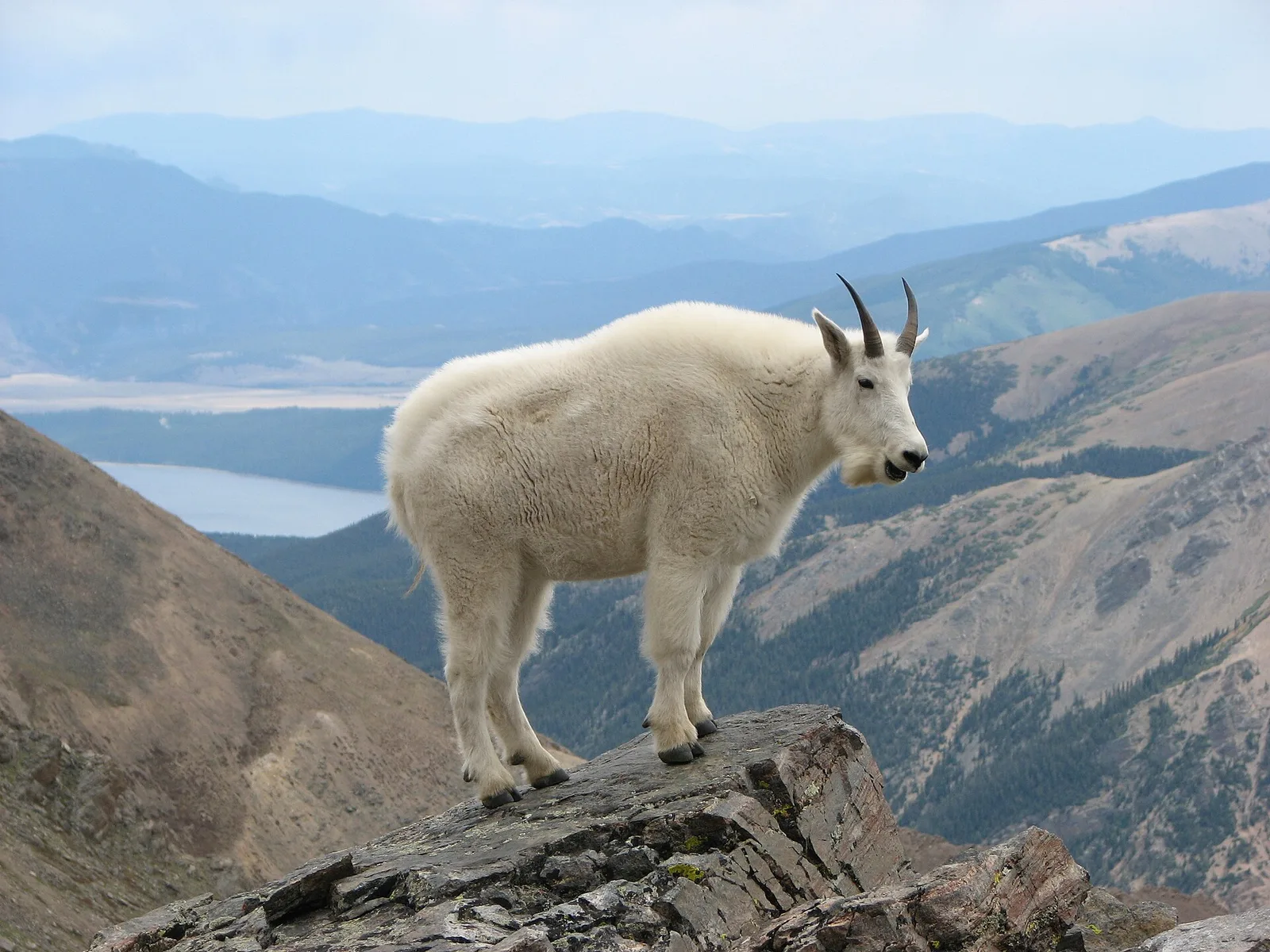
Mountain goat
The white climber that is not a goat at all
Oreamnos americanus
Also called Rocky Mountain goat, White goat, Snow goat
Living individuals or members of this group exist today. This does not mean they are safe from extinction.
Meet the mountain goat
The mountain goat is a white, cliff-climbing goat-antelope of western North America. It lives above the tree line, where steep rock keeps it safe from wolves and bears.
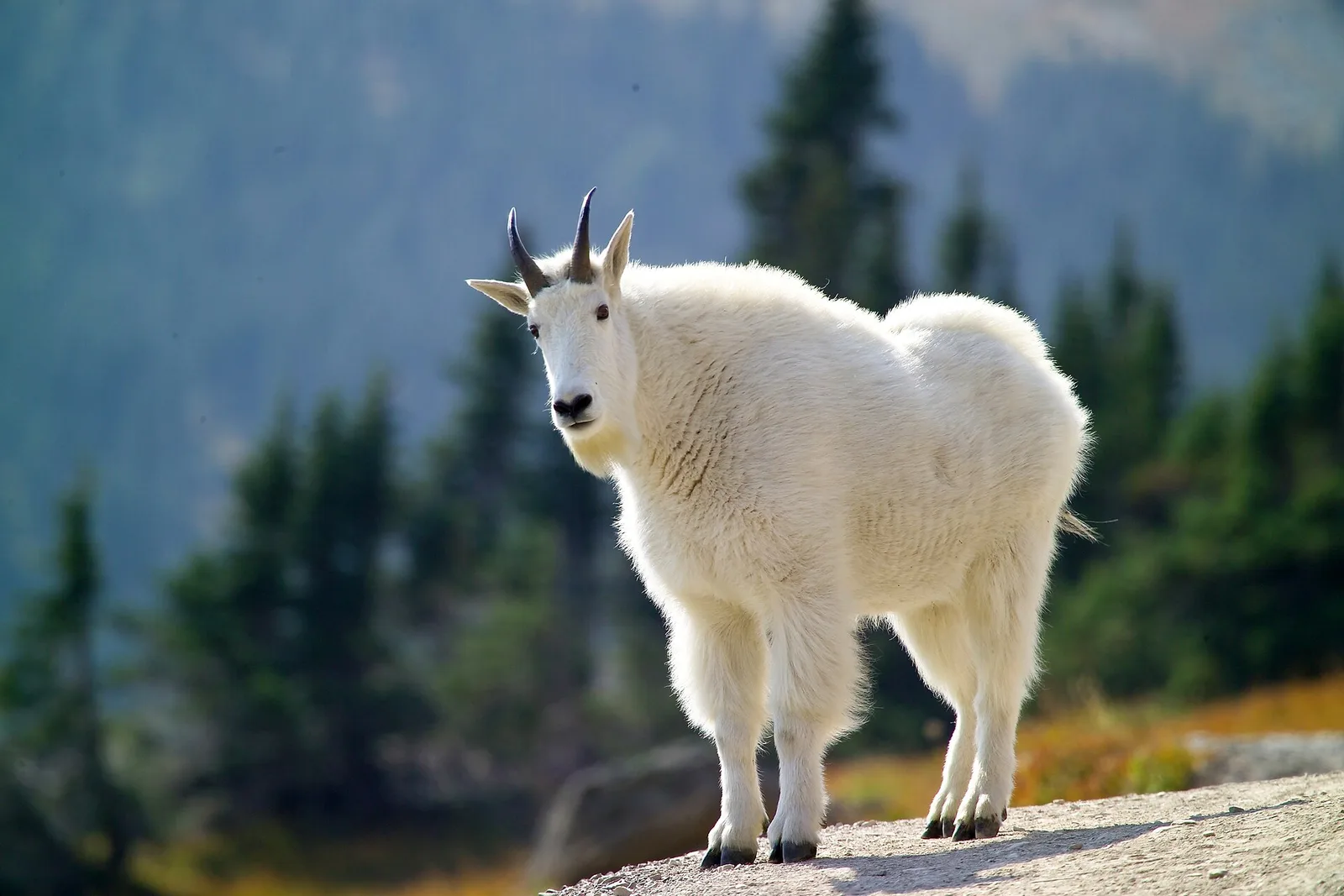
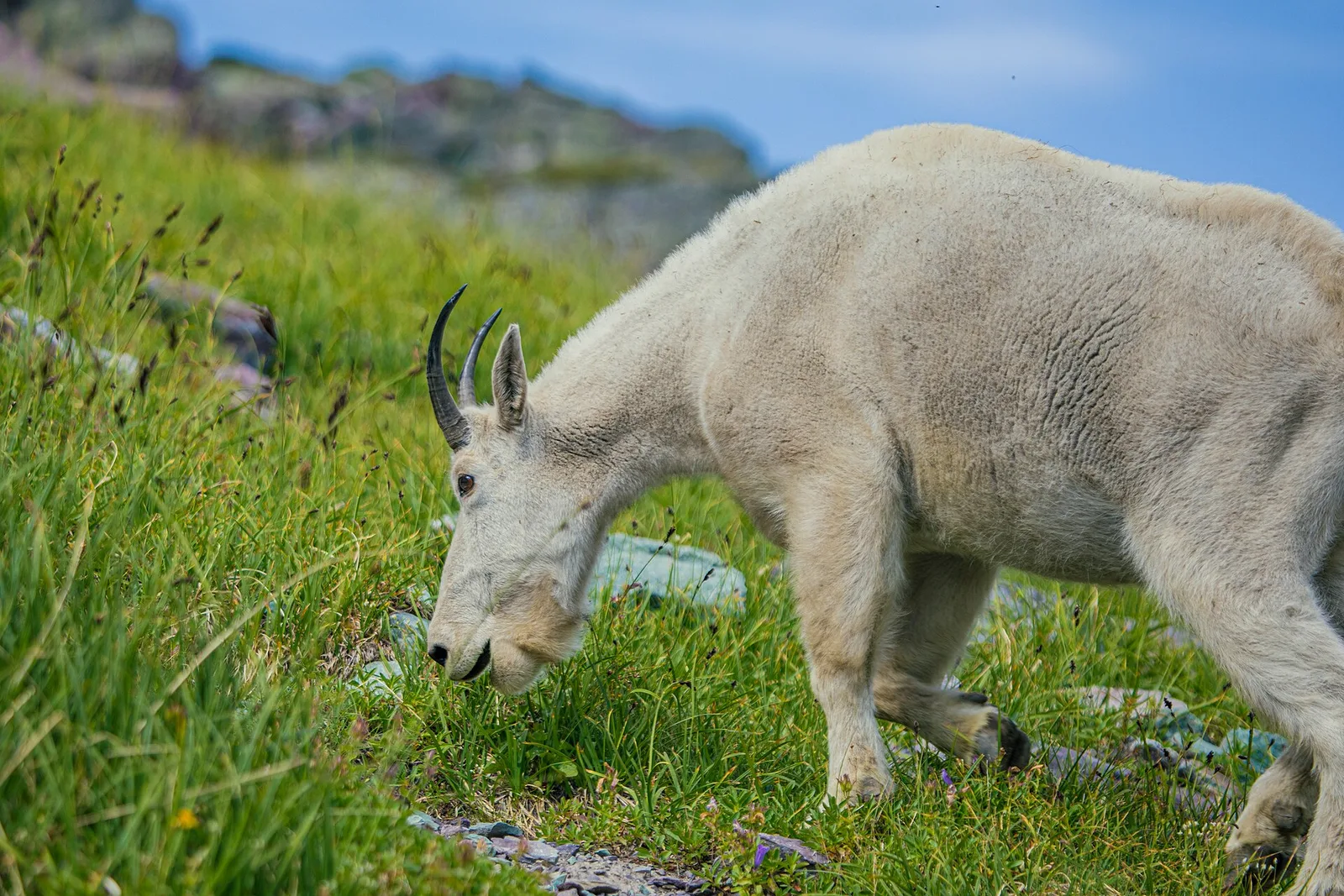
Images of the mountain goat
Lifespan in the wild
12 to 15 years the oldest recorded female was 18, the oldest male 15.5
Weight
56.8 to 81.8 kg
Length
1.2 to 1.79 m
Height
About 1 m
Fact file
Mountain goat
- Location
- Rocky Mountains, Cascades and coastal ranges from Alaska to Idaho
- Habitat
- Mountains, Tundra, Temperate forest
- Diet
- Herbivore
- Prey / food
- Grasses, sedges, forbs, mosses, lichens, conifer twigs
- Predators
- Cougar; wolves, bears, wolverines and eagles take kids
- Lifestyle
- Diurnal, in seasonal herds
- Group name
- Herd or band
- Name of young
- Kid
- Gestation
- About 185 to 195 days
- Litter size
- 1 kid, rarely twins
- Population
- About 75,000 to 110,000 in North America
- Biggest threat
- Avalanches, human disturbance and habitat loss
- Distinctive feature
- Shaggy white coat and thin black horns on both sexes
- Colour
- White, sometimes with a little brown on the back
- Skin type
- Fur
Size
Next to a person
Measurements
Size and speed
- Height
- About 1 m a male at the shoulder
- Length
- 1.2 to 1.79 m head and body, without the tail
- Tail
- 10 to 20 cm
- Weight
- 56.8 to 81.8 kg females from 56.8 kg, males to 81.8 kg; other accounts put large males at 95 to 115 kg
- Weight, male
- 61.4 to 81.8 kg
- Weight, female
- 56.8 to 70.5 kg
Typical adult ranges. Sources: Animal Diversity Web, Wikipedia.
Life cycle
Lifespan
- In the wild12 to 15, up to 18 years the oldest recorded female was 18, the oldest male 15.5
- In captivity16 to 20, up to 20.8 years
- 020.8 years
The pale bar is the record. Sources: Animal Diversity Web, AnAge.
Appearance
Colour and coat
- Primary colours
- white
- Secondary colours
- blackbrown
- Skin type
- fur
- Male and female
- Moderate. Males are 40 to 60 percent heavier than females, with longer beards and horns that curve back more and are thicker at the base. The sexes are hard to tell apart in the field.
Life cycle
Mating and family
- Mating system
- polygynandrous, both sexes with several mates
- Social structure
- nursery herds of females and young; males alone or in small bands
- Breeding
- one kid a year, born in late May or June
The rut runs from late October into December, and a female carries her kid for about 185 to 195 days. She gives birth alone on a steep ledge, usually to a single kid that can climb within hours. The kid is weaned at 90 to 120 days but follows its mother until her next birth. Both sexes mature at about 30 months, though females often first give birth at four or five. Wild goats live 12 to 15 years, and the oldest known female reached 18.
Classification
Taxonomy
- Kingdom
- Animalia
- Phylum
- Chordata
- Class
- Mammalia
- Order
- Artiodactyla
- Family
- Bovidae
- Genus
- Oreamnos
- Species
- Oreamnos americanus
Conservation
Red List status
- LC
- NT
- VU
- EN
- CR
- EW
- EX
Least Concern on the IUCN Red List
Range
Recorded in 2 countries
Habitat layer: temperate broadleaf and mixed forest, temperate conifer forest, boreal forest and taiga, montane grassland and shrubland, tundra.
Countries from 6,874 wild records on GBIF (iNaturalist research grade), filtered and checked by hand. Country shapes: Natural Earth. Habitat: RESOLVE Ecoregions 2017, CC BY 4.0. Basemap: Natural Earth.
Habitats
Three things to know
- 1
The mountain goat is not a true goat but a goat-antelope, a relative of the chamois and the takin.
- 2
Its coat keeps it alive at minus 46 degrees Celsius in winds of 160 kilometres per hour.
- 3
Northwest Coast peoples wove Chilkat blankets from the wool that wild goats shed each spring.
Did you know
Seven more facts
- 1
Outside the rut, adult females rank above every male in the herd.
- 2
A newborn kid tries to run and climb within hours of birth.
- 3
The horns are never shed, and their growth rings give the animal's age.
- 4
A mother walks below her kid on a steep slope to stop a fall.
- 5
Rutting males stab at each other's flanks instead of clashing heads.
- 6
In Alaska avalanches cause 23 to 65 percent of goat deaths, depending on the region.
- 7
British Columbia holds about half of the world's mountain goats.
Field notes
How it looks and acts
Field notes
Distinguishing features
- A shaggy, uniformly white coat with a ridge of long hair along the back.
- Thin black horns of 15 to 28 centimetres on both sexes.
- A beard on the chin in males and females alike.
- A stocky body on short, thick legs, about 1 metre tall at the shoulder in a male.
- Large oval hooves with a hard rim and a soft central pad.
- A short tail of 10 to 20 centimetres.
Field notes
Unique adaptations
- Hooves that spread on rough rock and dewclaws that stop a slide.
- Strong shoulder and neck muscles that push the body up steep pitches.
- A hollow-haired outer coat over dense wool, for deep cold and high wind.
- Thick skin on the flanks, which blunts the horn stabs of rutting rivals.
- A gut that switches from grasses and forbs in summer to conifer browse, mosses and lichens in winter.
Field notes
Interesting behaviours
- Gathers in large herds in winter and at salt licks in spring, then scatters in summer.
- Scrapes a shallow bed in the ground and dust-bathes in it.
- Walks many kilometres in spring to reach a natural mineral lick.
- Rubs its winter coat off on rocks and tree trunks each spring.
- Gives birth alone on an isolated ledge, away from the herd.
Field notes
Temperament
- Females are quick to threaten and fight over space and food.
- Most threats are bluff, and serious injury is rare.
- Shy of people in the wild, but bold and pushy once habituated to salt from hikers.
Field notes
Communication
- Calls are mostly limited to the mating season.
- A broadside stance with an arched back is a threat display.
- A low stretch along the ground signals that the animal will not fight.
- A courting male licks the female's coat and kicks at her flank.
Ecology
Ecological role
The mountain goat is the largest mammal of the high alpine zone and the main large prey of the cougar there.
- Its grazing shapes alpine meadows, and heavy use can damage rare plants where the goat was introduced.
- Kids and weakened adults feed cougars, wolves, bears, wolverines and eagles.
- Its beds and trails disturb thin alpine soils.
- It carries ticks, lice, tapeworms and lungworms, and may pass disease to native animals where it is introduced.
Stories
Myths and legends
- In some Native American traditions the mountain goat gave itself to people as food and is honoured with rituals.
- In several tribal traditions the goat belongs to the sky and can act as a guardian spirit.
- In Northwest Coast tradition its wool goes into the ceremonial Chilkat blanket.
- In modern spirit-animal writing it is thought to stand for balance and persistence, a claim with no old source.
People
Relationship with humans
People
Living alongside us
People have never tamed the mountain goat. Northwest Coast nations hunted it, honoured it and wove its shed wool into Chilkat blankets. Today it is a difficult trophy animal under permit and a draw for park visitors. Introduced herds have damaged alpine plants, and habituated goats seek the salt in human sweat.
- A habituated goat in Olympic National Park killed a hiker in 2010.
- Goats drawn to salt approach hikers closely and can act aggressively.
- The horns are sharp enough to kill a grizzly bear, as one did in 2021.
People
Status, uses and products
- Domestication
- Wild
- As a pet
- Not suitable. The mountain goat needs cliffs, cold and a large alpine range. It weighs up to about 81.8 kilograms and carries sharp horns. It is a wild, protected game animal and has never been domesticated.
- Uses
- trophy huntingsubsistence huntingwildlife watching
- Products
- woolmeat
The full account
About the mountain goat
The mountain goat, Oreamnos americanus, is a white, cliff-climbing hoofed mammal of western North America. Its name misleads, because it is not a true goat of the genus Capra. It belongs instead with the chamois, the gorals, the serows and the takins, a group often called the goat-antelopes. Both sexes carry a beard, a short tail and thin black horns. Adults measure 120 to 179 centimetres from head to rump, and a male stands about 1 metre at the shoulder. Weights run from about 56.8 to 81.8 kilograms, and the biggest males weigh far more than the females.
The species lives above the tree line in the Rocky Mountains, the Cascade Range and the coastal ranges up to Alaska. British Columbia holds about half of all the mountain goats in the world. Steep rock is its main defence, so it climbs where wolves and bears cannot follow. It feeds on grasses, sedges, herbs, mosses, lichens and the twigs of low shrubs. The IUCN lists it as Least Concern, with a population thought to be 75,000 to 110,000. Introduced herds live in several states outside the native range, and some have damaged alpine plants.
Name and taxonomy
The French zoologist Blainville described the species in 1816. An earlier name, Ovis montanus, came from Ord in 1815 and treated the animal as a sheep. The type locality was later fixed at Mount Adams in the Cascade Mountains of Washington. The genus name Oreamnos joins two Greek words, one for mountain and one for lamb. Some writers read the first part as a reference to a mountain nymph instead. The species is the only living member of its genus.
English speakers also call it the Rocky Mountain goat, the white goat or the snow goat. The German and Dutch names translate as snow goat, and the French call it the goat of the Rockies. It sits in the family Bovidae, with cattle, antelopes and gazelles, and in the subfamily Caprinae. That subfamily also holds the true goats, the wild sheep, the chamois and the muskox.
Evolution and relatives
The goat-antelope group arose in the Late Miocene, and most of its lines still hold a species from the eastern Himalaya. So the ancestors of the mountain goat probably lived somewhere between Tibet and Mongolia. Its line split from its relatives about 7.5 to 8 million years ago. The takins of the Himalaya evolved in parallel from a similar ancestral goat and remain close relatives. Sheep are also close, while the muskox line stands further away. Its ancestors probably crossed the Bering land bridge into North America before the last glaciation.
The fossil record is short and comes only from North America. A smaller species, Oreamnos harringtoni, once lived further south in the Rockies during the Pleistocene. Ancient DNA shows that it was a sister species rather than an ancestor. One handbook notes that the exact position of Oreamnos among the Caprini remains unclear.
Appearance
The coat is white, sometimes with a little brown along the back, and it grows thick and shaggy in winter. It has two layers: a dense woolly undercoat and an outer layer of long hollow hairs. This coat lets the animal stand winter cold of minus 46 degrees Celsius and winds of 160 kilometres per hour. A ridge of longer hair runs along the spine, and both sexes have a beard on the chin. The goats moult in spring by rubbing on rocks and trees, and pregnant females shed last. The horns are black, slender and slightly curved, and they measure 15 to 28 centimetres.
The horns are never shed, and each year adds a growth ring that shows the animal's age. A male's horns curve back more strongly and are thicker at the base. Head-and-body length is 120 to 179 cm, and the tail adds 10 to 20 cm. Males weigh 61.4 to 81.8 kg and females 56.8 to 70.5 kg, by the Animal Diversity Web figures. Other accounts put large males at 95 to 115 kilograms, up to 30 percent more than a female. Telling the sexes apart in the field is hard all the same.
The hooves are large and oval, with a hard rim and a soft, rubbery inner pad that grips rock. The two toes spread apart on rough ground, and sharp dewclaws stop a slide. Strong shoulder and neck muscles push the body up slopes steeper than 60 degrees. Black scent glands sit at the base of the horns.
Habitat and range
The native range runs from southeast Alaska and the southern Yukon through British Columbia and Alberta. It continues south into Washington, Idaho and western Montana. Whether the species was ever native to Oregon is not settled. People have moved goats into Colorado, Utah, Nevada, Wyoming, South Dakota and the Olympic Peninsula. Introduced herds also live on Kodiak, Chichagof and Baranof islands in Alaska. The northern limit of the range is thought to lie in the Talkeetna Mountains of south-central Alaska.
The goats live in a patchwork of alpine meadows, ridges, scree and bare cliffs. Cliffs are escape terrain, and in winter the herds stay within 300 to 500 metres of them. Elevations range from sea level on the coast to above 4,000 metres. Most herds stay above the tree line all year, but they move up and down the slope with the seasons. In winter they favour snow-free slopes that face south or west, close to the tree line. Spring trips to mineral licks can take a herd several kilometres through forest. In the Cascades the goats occur mainly at 600 to 2,400 metres.
Diet and feeding
The mountain goat is a herbivore and a grazer for most of the year. Across its range the summer diet is about 52 percent grasses, 30 percent forbs and 16 percent browse. In winter browse rises to about 32 percent, and conifer twigs become a large part of it. Sedges, ferns, mosses and lichens fill in where grass is scarce. In South Dakota mosses and lichens made up 60 percent of one winter diet. In Colorado captive animals ate mostly forbs in both seasons, so no single figure fits every herd.
The goats take most of their water from plants and from snow banks that last through summer. In spring they walk many kilometres to natural salt licks for minerals. Where licks are absent, as in the Olympic Mountains, they lick human sweat and urine for the salt. In summer they feed in six or seven bouts a day and rest between each. Zoo animals also accept grain, alfalfa, fruit and vegetables.
Behaviour and social life
Group size changes with the season. Herds are largest in winter and at spring salt licks, and smallest in summer. Nursery groups hold females, kids and one- and two-year-olds, and can pass 100 animals in summer. By late autumn most nursery groups shrink to under 30. Adult males live alone or in small bachelor bands and keep apart from the females. Outside the rut, adult females dominate every other age and sex class, including the males.
Females form a linear hierarchy, and age decides rank, not horn size or weight. They compete hard for space and food. Two rivals circle each other with heads low and horns displayed, and most bouts end without contact. A goat that wants to avoid a fight stretches low to the ground. Kids sort out their first ranks through play. The goats scrape shallow beds, 25 to 50 millimetres deep, and rest in them at midday and at night.
They also dust-bathe in these beds, which may help them shed parasites and loose hair. They are most active in early morning and late afternoon, with some feeding at night. Daily movement stays on one mountain face or one basin. Summer home ranges are about 23 square kilometres, and winter ranges are much smaller. Some radio-collared goats in British Columbia used winter and summer ranges 8 to 13 kilometres apart. In 2021 a goat in Yoho National Park killed a grizzly bear with its horns.
Communication and senses
Mountain goats are mostly quiet, and most calls come in the mating season. Like other bovids, a mother and her kid probably keep contact with soft bleats. Posture carries most of the message. In a present threat the goat turns broadside and arches its back to look bigger. A horn threat swings the horns at a rival, and a rush threat is a sudden charge. A walking version, the orientation threat, is the mildest form.
Almost all of this is bluff, and injuries are rare. A courting male approaches low, shows the side of his face and beard, licks the female's coat and kicks her flank. The scent glands at the horn base probably mark rocks and rivals, as in other goat-antelopes. Like most hoofed prey, the goat seems to rely on sharp eyesight to spot a predator far below.
Reproduction and life cycle
Courtship begins in September, when males try to join small bands of females. A male digs a rutting pit and rolls in it, so his coat turns dirty and marks him out. Mating peaks in November and December, and the females in a herd come into season together. Mature males stare at females for long spells, dig pits and fight in showy but sometimes dangerous bouts. Rivals do not clash head to head but stand side by side and stab at each other's flanks. Thick skin on the flanks limits the damage, but deaths from chest and neck wounds are known.
Both sexes usually mate with several partners, though a dominant male tries to guard a female in oestrus. Gestation lasts about 185 to 195 days, and kids are born in late May or June. The female moves to a lonely ledge to give birth, licks the kid dry and eats the afterbirth. Most births are single, twins are rare, and triplets are on record. A newborn weighs a little over 3 kilograms and tries to run and climb within hours. It stays hidden for about a week until it can follow its mother across rough ground.
Weaning comes at 90 to 120 days, but the kid follows its mother for a full year. She stands over it when a predator appears and walks below it on a steep slope to break a fall. Both sexes mature at about 30 months, but females at Caw Ridge in Alberta first gave birth at four or five. At Caw Ridge 87 percent of kids reached weaning and 64 percent reached one year. Wild goats usually live 12 to 15 years, and the oldest known female reached 18. Zoo animals live 16 to 20 years, and one reached 20.8.
Predators and threats
The cougar is the main predator, because it can kill an adult and can follow one across rock. Wolves, wolverines, lynx, coyotes and both bear species take goats when they catch them on gentler ground. Golden eagles and bald eagles sometimes carry off a newborn kid. One wolf killed a yearling female in 1995, but soon after a mother drove an adult wolf off her kid. Such defence is rare, and one study in 2006 recorded only 5 cases. Steep cliffs are the real defence, and a goat that stays on the rock is hard for any bear to reach.
Avalanches are a major killer, and in Alaska they cause 23 to 65 percent of deaths, depending on the region. Ticks and chewing lice live on the coat, and tapeworms and lungworms live inside. Unregulated tourism, mining, oil and gas work and clear-cut logging disturb herds outside protected areas. Roads and other building split the range into pieces. Herds cope poorly with hunting that takes females, so managers set cautious quotas.
Population and conservation
The IUCN lists the mountain goat as Least Concern. One estimate puts 75,000 to 110,000 animals in North America. British Columbia holds 36,000 to 63,000 of them and Alaska 24,000 to 30,000. Numbers have stayed fairly stable, and the species is in no danger of extinction. Some herds are falling, such as those in the Cascade Mountains of Washington, where hunting is closed. Biologists there fit goats with GPS collars to learn why the herds are shrinking.
Introduced herds bring a different problem. In the Olympic Mountains, goats released in the 1920s trampled rare alpine plants and pestered hikers for salt. After one goat killed a hiker in 2010, the park removed hundreds, mostly by capture and release in the Cascades. Yellowstone allows controlled hunting to keep its introduced goats in check. Managers now advise caution before releasing goats into new alpine areas.
Relationship with humans
The mountain goat has never been domesticated. Pacific Northwest Coast peoples gathered the wool that wild goats shed on rocks each spring. They spun it into yarn and wove it into Chilkat blankets and other ceremonial textiles. Northwest Coast nations also hunted the goat, and many treated it as a sacred animal that gave itself as food. Today the goat is a prized trophy, and the hunt is hard because of the terrain. Hunting is closed where herds decline and allowed under quota elsewhere.
Visitors watch goats in national parks such as Kenai Fjords in Alaska. The goat is usually shy of people, but it is not harmless. Habituated goats crave the salt in human sweat and urine and approach hikers closely. The 2010 death in Olympic National Park shows what a horn thrust can do. Introduced goats in Olympic and Yellowstone also destroy native plants and may carry new diseases to native animals.
In culture and myth
The mountain goat appears in the stories of the Northwest Coast nations more than anywhere else. In several traditions it counts among the animals that gave themselves to people as food, so hunters honoured it with rituals. Certain tribes place the goat in the sky, and others treat it as a guardian spirit. Its wool in a Chilkat blanket gave the animal a place in ceremonial dress. Lewis and Clark saw the animal on the Columbia River, and Ord named it as a sheep from their reports in 1815.
Spirit-animal writers read the goat as a sign of balance, sure footing and persistence. These are modern blog claims and probably reflect the animal's climbing rather than any old tradition. Old World goat symbols, from the Capricorn of the zodiac to the sun and rain goats of ancient Iranian pottery, belong to other species. The name still confuses people, since the animal is a goat-antelope and not a goat.
A sentence with a dotted underline is inferred: it describes the group the animal belongs to, or is a reading of the sources, rather than a measured or reported fact about this species.
Questions
Mountain goat questions, answered
Is a mountain goat a real goat?
No. It is a goat-antelope in the subfamily Caprinae, closer to the chamois and the takin than to the true goats of the genus Capra.
Where do mountain goats live?
They live in the Rocky Mountains, the Cascades and the coastal ranges from southeast Alaska through British Columbia to Washington, Idaho and Montana. Introduced herds live in several other western states.
How do mountain goats climb so well?
Their hooves have a hard rim and a soft rubbery pad, and the two toes spread on rough rock. Strong shoulder muscles push them up slopes steeper than 60 degrees.
What do mountain goats eat?
Mostly grasses and forbs in summer, with more browse, mosses and lichens in winter. They also travel to salt licks in spring.
How big is a mountain goat?
Adults measure 120 to 179 centimetres from head to rump and stand about 1 metre at the shoulder. Weights run from about 56.8 to 81.8 kilograms, and some large males weigh more.
Are mountain goats dangerous to people?
Usually not, but a habituated goat can be. One killed a hiker in Olympic National Park in 2010 after goats there learnt to seek salt from people.
Do female mountain goats have horns?
Yes. Both sexes carry thin black horns of 15 to 28 centimetres, and a female's can be as long as a male's.
How long do mountain goats live?
About 12 to 15 years in the wild, until their teeth wear down. The oldest known female reached 18, and a captive animal lived 20.8 years.
What eats mountain goats?
The cougar is the main predator. Wolves, bears, wolverines, lynx and coyotes also take them, and eagles sometimes carry off newborn kids.
Are mountain goats endangered?
No. The IUCN lists them as Least Concern, with about 75,000 to 110,000 in North America. Some local herds, such as those in the Washington Cascades, are declining.
When are mountain goat kids born?
In late May or June, after a gestation of about 185 to 195 days. A female usually has one kid, and twins are rare.
Do mountain goats fight?
Yes. Females threaten and circle each other over food and space, and rutting males stab at each other's flanks. Most contests are bluff.
How cold can a mountain goat survive?
Its double coat protects it in temperatures down to minus 46 degrees Celsius and winds of 160 kilometres per hour.
Why do mountain goats lick rocks and hikers?
They need minerals. Herds walk to natural salt licks in spring, and where licks are absent they lick the salt in human sweat and urine.
Can you keep a mountain goat as a pet?
No. It is a wild, protected game animal that needs cliffs and cold, and it has never been domesticated.
Food web
Prey and food
- grasses
- sedges
- forbs
- mosses
- lichens
- conifer twigs
Food web
Predators
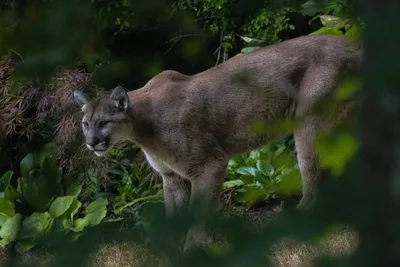 Cougar
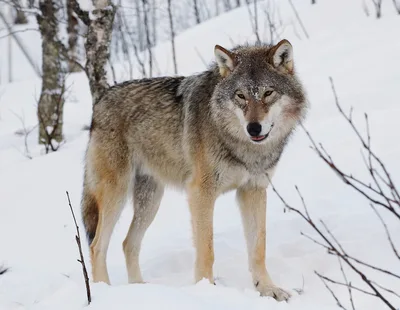 Gray wolf
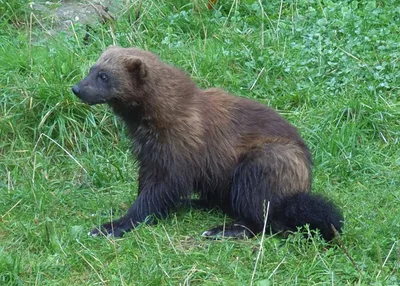 Wolverine
Ecological equivalents
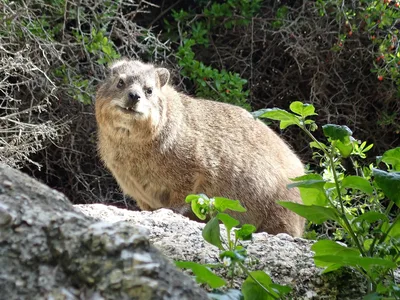
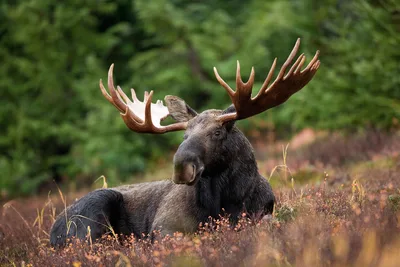
Related species on this site
Addax (same family), African buffalo (same family), Alpine Goat (same family), American bison (same family), American Pygmy Goat (same family), Antelope (same family), and more.
Mammals
Addax
Addax nasomaculatus
Classification and source reference
LivingAI illustration NT
Mammals
African buffalo
Syncerus caffer
The African buffalo is a heavy wild ox of sub-Saharan Africa that lives in herds of dozens to thousands and must drink every day.
Living
Mammals
Alpine Goat
Capra hircus
Classification and source reference
LivingAI illustration NT
Mammals
American bison
Bison bison
The American bison is the heaviest land animal in North America and the national mammal of the United States.
Living
Mammals
American Pygmy Goat
Capra hircus
Classification and source reference
LivingAI illustration
Mammals
Antelope
Bovidae
Classification and source reference
LivingAI illustration