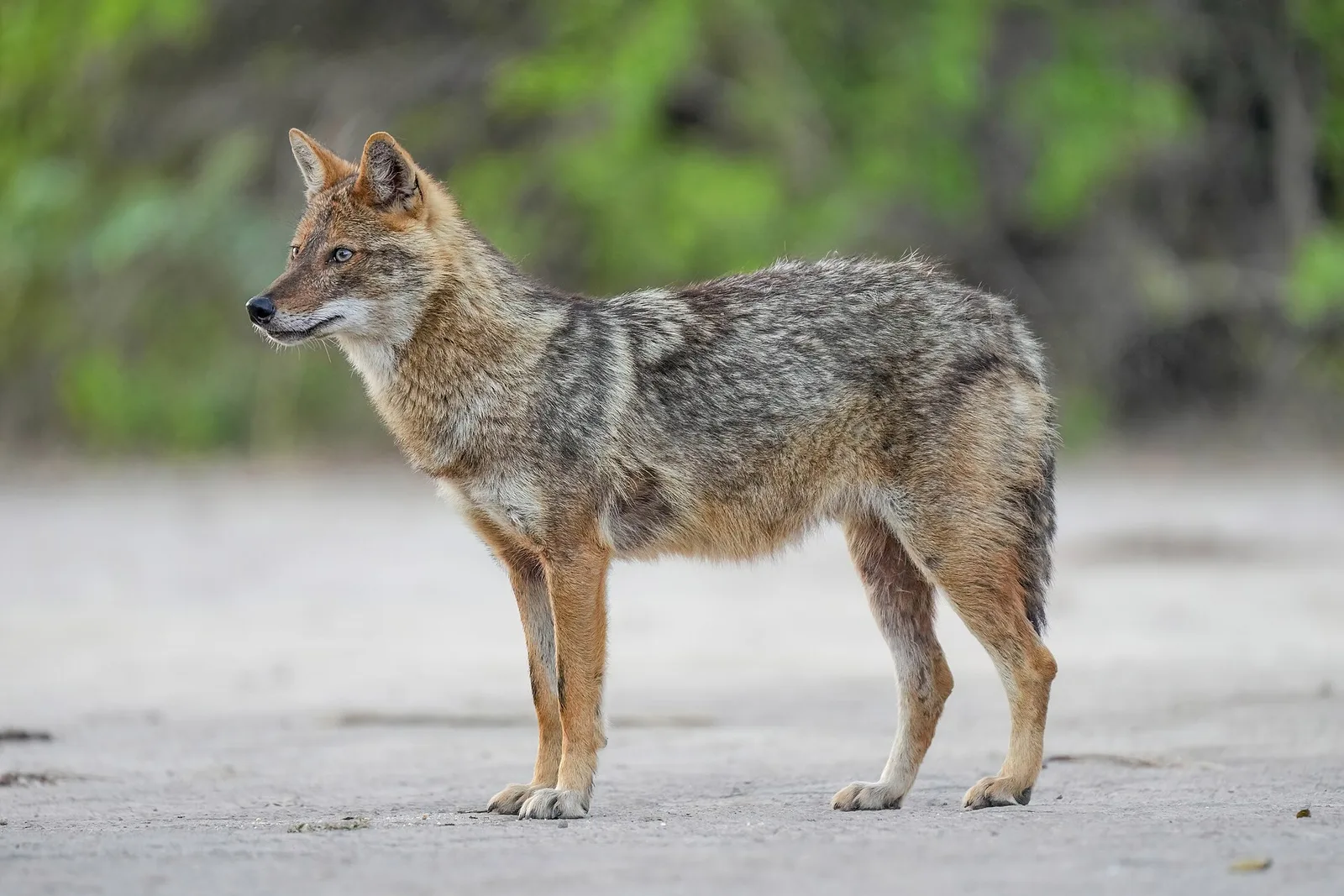
Golden jackal
A small wolf relative now trotting into western Europe
Canis aureus
Also called Common jackal, Asiatic jackal, Eurasian golden jackal, Reed wolf
Living individuals or members of this group exist today. This does not mean they are safe from extinction.
Meet the golden jackal
The golden jackal is a small wolf-like canid of Europe and southern Asia that lives in lifelong pairs and eats anything from voles to fruit. Listed as Least Concern, it is now spreading fast across Europe into land the wolf has left.
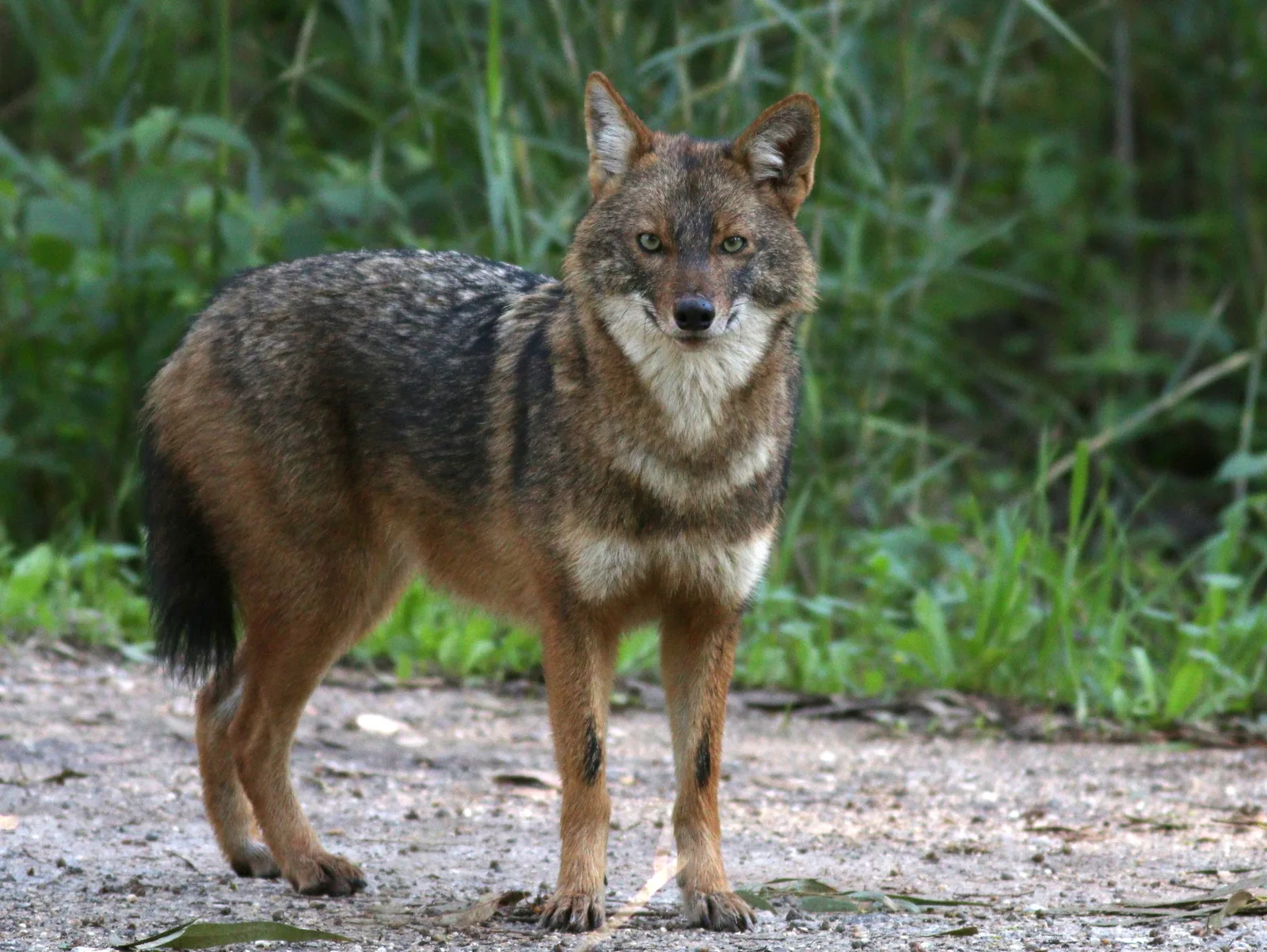
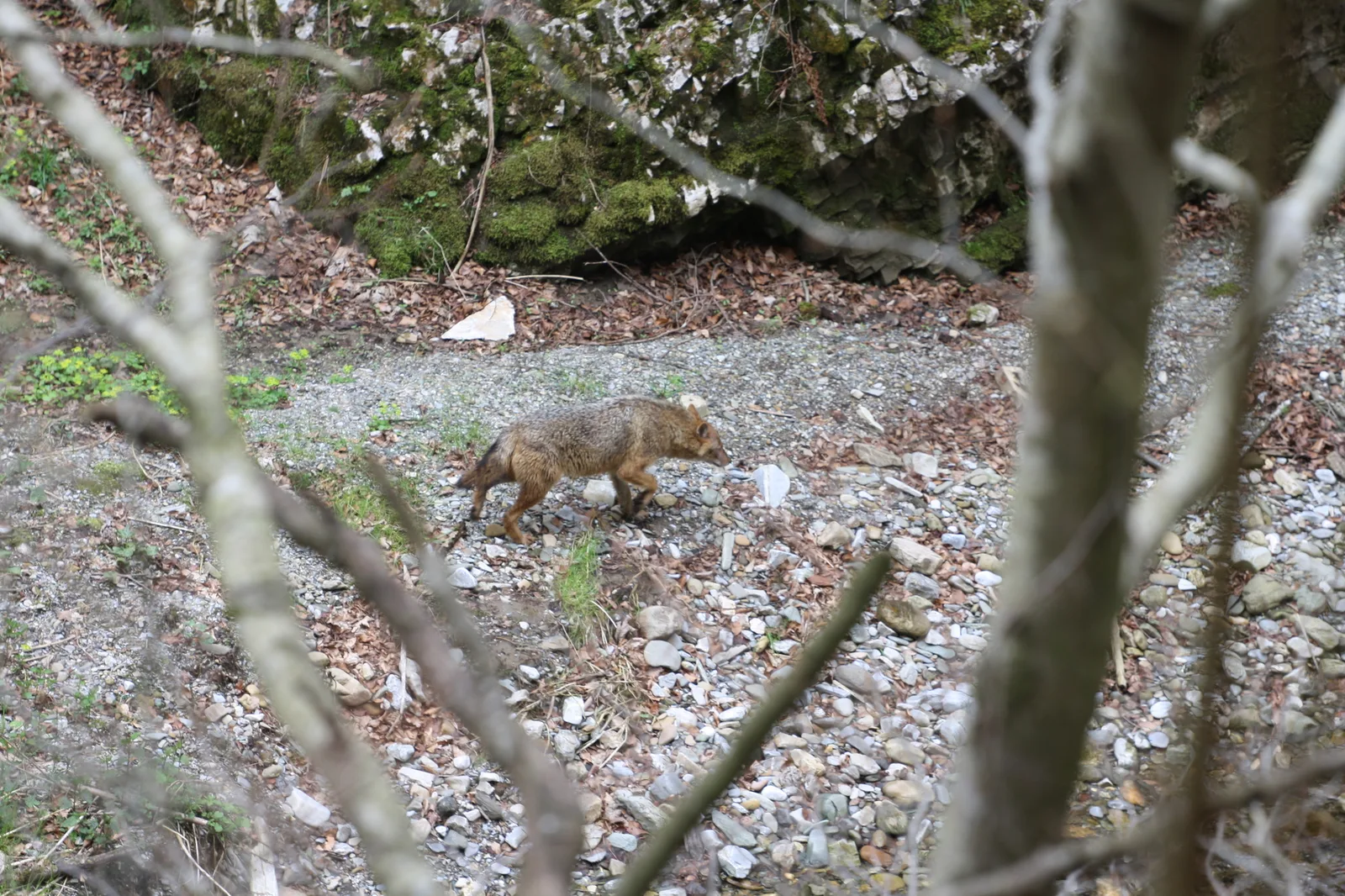
Images of the golden jackal
Lifespan
About 16 years the average is from ADW, the record from AnAge
Weight
6 to 14 kg
Length
69 to 85 cm
Height
45 to 50 cm
Fact file
Golden jackal
- Location
- South-eastern and central Europe; Southwest, Central, South and Southeast Asia
- Habitat
- Grassland, Wetlands, Temperate forest, Savanna
- Diet
- Omnivore
- Prey / food
- Rodents, hares, birds, reptiles, insects, fruit, carrion
- Predators
- Wolves, striped hyenas, Eurasian lynx, dogs
- Lifestyle
- Nocturnal near people, partly diurnal elsewhere
- Group name
- Pair, family
- Name of young
- Pup
- Gestation
- 63 days
- Litter size
- 1 to 9 pups, usually 2 to 4
- Population
- About 70,000 in Europe; over 80,000 in the Indian subcontinent
- Biggest threat
- Hunting, rabies control campaigns, hybridisation with dogs
- Distinctive feature
- Golden coat, narrow pointed muzzle, black-tipped bushy tail
- Colour
- Golden to tawny, cream underside
- Skin type
- Fur
Size
Next to a person
Measurements
Size and speed
- Height
- 45 to 50 cm at the shoulder
- Length
- 69 to 85 cm head and body, without the tail
- Length, male
- 71 to 85 cm
- Length, female
- 69 to 73 cm
- Tail
- About 25 cm
- Weight
- 6 to 14 kg
- Weight, male
- 6 to 14 kg
- Weight, female
- 7 to 11 kg
Typical adult ranges. Sources: Wikipedia, Animal Diversity Web.
Life cycle
Lifespan
- In captivityAbout 16, up to 18.8 years the average is from ADW, the record from AnAge
- 018.8 years
The pale bar is the record. Source: AnAge.
Appearance
Colour and coat
- Primary colours
- goldentawny
- Secondary colours
- blackcream
- Skin type
- fur
- Male and female
- Slight. Males are a little longer, at 71 to 85 centimetres against 69 to 73 for females, and can weigh more. The coats are the same.
Life cycle
Mating and family
- Mating system
- monogamous pairs for life
- Social structure
- a breeding pair with its pups and one or two grown helpers
- Breeding
- one litter a year
A pair mates once a year, in late winter across most of the range. Gestation lasts 63 days and the litter holds 1 to 9 pups, usually 2 to 4. The eyes open at 8 to 11 days, meat starts at 15 to 20 days and nursing ends by 8 to 10 weeks. Females breed at 10 to 11 months and males at 21 to 22 months. A captive jackal lives about 16 years, and the record is 18.8.
Classification
Taxonomy
- Kingdom
- Animalia
- Phylum
- Chordata
- Class
- Mammalia
- Order
- Carnivora
- Family
- Canidae
- Genus
- Canis
- Species
- Canis aureus
Conservation
Red List status
- LC
- NT
- VU
- EN
- CR
- EW
- EX
Least Concern on the IUCN Red List
Range
Recorded in 19 countries
- Bangladesh
- Bulgaria
- Georgia
- Greece
- Croatia
- Israel
- India
- Iran
- Italy
- Kazakhstan
- Lebanon
- Sri Lanka
- Nepal
- Pakistan
- Romania
- Russia
- Thailand
- Turkey
- Ukraine
Habitat layer: temperate broadleaf and mixed forest, temperate conifer forest, boreal forest and taiga, tropical grassland, savanna and shrubland, temperate grassland, savanna and shrubland, flooded grassland and savanna, mangrove.
Countries from 4,221 wild records on GBIF (iNaturalist research grade), filtered and checked by hand. Country shapes: Natural Earth. Habitat: RESOLVE Ecoregions 2017, CC BY 4.0. Basemap: Natural Earth.
Habitats
Three things to know
- 1
A pair hunting together succeeds about three times as often as a lone jackal.
- 2
Europe holds about 70,000 golden jackals, far more than its 12,000 wolves.
- 3
The species spread out of India after the last ice age.
Did you know
Seven more facts
- 1
The oldest golden jackal fossil is a single tooth fragment from Lebanon, about 7,600 years old.
- 2
A jackal buries spare meat in a trench and packs the soil down with its nose.
- 3
Lone jackals in India, called kol-bahl, follow a tiger at a safe distance and feed on its kills.
- 4
Ancient mixing with jackals accounts for up to 15% of the genome of wolves in Israel.
- 5
A jackal can cross 12 to 15 kilometres in a single night.
- 6
In Transcaucasia trappers once caught jackals on baited fishing hooks hung 75 to 100 centimetres above the ground.
- 7
The Netherlands declared the jackal a native species in July 2026.
Field notes
How it looks and acts
Field notes
Distinguishing features
- A golden coat that turns from pale cream in summer to dark tawny in winter.
- A narrow, pointed muzzle and a flatter forehead than a wolf.
- A shoulder height of 45 to 50 centimetres and a weight of 6 to 14 kilograms.
- A bushy tail about 25 cm long with a tan to black tip.
- Black, brown and white hairs on the back that can form a dark saddle.
- Light throat and chest markings that differ from one animal to the next.
Field notes
Unique adaptations
- Long legs and a light body for trotting long distances in search of food.
- Can go without water for long spells, even on islands with no fresh water.
- A varied diet that shifts from voles to carcasses to fruit as the season changes.
- A thick winter coat, so it survives cold down to minus 25 degrees Celsius.
- Helpers at the den, which probably raise the number of pups that survive.
Field notes
Interesting behaviours
- Trots, stops, sniffs and listens, then pounces on hidden rodents.
- Howls in chorus with its mate at dawn and dusk.
- Buries surplus meat when other scavengers arrive.
- Follows wolves, tigers and dholes to scavenge their kills.
- Moves pups between 2 to 4 dens while they are small.
Field notes
Temperament
- Affectionate within the pair and the family, and wary of strangers.
- Bold near villages at night, but shy in daylight where people live.
- Mothers with pups will attack a person who comes too close.
- Gives way to wolves and dogs, but bullies red foxes.
Field notes
Communication
- A rising howl of wails and yelps that locates mates and claims territory.
- A distinct warning call when a wolf or tiger is near.
- A rumbling growl and a predator bark that send pups into the den.
- Urine and dung marks along trails and around the den.
Ecology
Ecological role
The golden jackal is Eurasia's coyote: a mid-sized predator, a scavenger and a seed spreader in one.
- Controls rodents and hares, and eats snakes in Israel.
- Clears carcasses left by lions, tigers, wolves and by farmers.
- Suppresses red foxes and the invasive raccoon dog where it becomes common.
- Probably spreads the seeds of the fruit it eats, as other canids do.
Stories
Myths and legends
- In Hindu tradition, the jackal accompanies Chamunda and Kali, goddesses of the cremation ground.
- In Indian tradition, a jackal crossing the road from the left brings luck to a morning traveller.
- In Sri Lankan tradition, a horn hidden in a jackal's skull was a charm with magic powers.
- In ancient Egyptian tradition, the jackal-headed Anubis guarded the dead.
- In Kamar tradition from Raipur, Shiva flooded the world to punish a jackal.
People
Relationship with humans
People
Living alongside us
People have lived beside the jackal since the first farms, and a carving 11,000 years old shows a man holding one. Villagers value it for clearing refuse and rodents and curse it for taking lambs, poultry and melons. It carries rabies and is hunted for its coarse fur. Russia bred it with dogs to make scent-detection animals. In Europe its rapid spread now divides governments between protection and hunting.
- Jackals attacked people 220 times in one Indian district between 1998 and 2005, though nobody died.
- A mother with pups is the most likely to attack, and jackals chased from villages grow aggressive.
- The species carries rabies and Leishmania, which can pass to people.
People
Status, uses and products
- Domestication
- Wild
- As a pet
- Not suitable. A hand-raised jackal can become house-trained and dog-like, but it stays shy of strangers and never fully tame. It is a wild carnivore that needs a territory and a mate, and it is protected or regulated in most countries.
- Uses
- scent-detection hybridscoursingfood in some Indian communities
- Products
- fur
The full account
About the golden jackal
The golden jackal, Canis aureus, is a wolf-like canid of Europe and southern Asia. It looks like a small, slim wolf, with a narrow pointed muzzle, long legs and a bushy tail. Adults weigh 6 to 14 kilograms and measure 69 to 85 centimetres from nose to rump. Its coat is golden, and it shifts from pale cream in summer to dark tawny in winter. Despite the name, it is closer to wolves and coyotes than to the two African jackals.
The species lives in pairs that hold a territory and raise pups together, often with a grown pup as helper. It eats almost anything: rodents, hares, birds, fruit, insects, carrion and refuse. The IUCN lists it as Least Concern, and it is one of the few large carnivores that is gaining ground. From the Balkans it now spreads north and west, into areas where wolves are rare or absent. Europe holds an estimated 70,000 golden jackals, and the Indian subcontinent more than 80,000.
Name and taxonomy
Carl Linnaeus placed the golden jackal in the genus Canis in 1758, in his Systema Naturae. The English word jackal arrived around 1600, from the Turkish çakal, which in turn came from the Persian šagāl. The species is also called the common jackal, and in parts of Asia the Asiatic jackal or reed wolf.
The golden jackal belongs to the order Carnivora and the family Canidae. Within the family it sits among the wolf-like canids, all of which carry 78 chromosomes and can interbreed. The black-backed and side-striped jackals of Africa are now placed in a separate genus, Lupulella. Since 1758 naturalists have named 13 subspecies. In 2015 a large DNA study moved the six African subspecies into a new species, the African wolf, Canis anthus. That left seven subspecies of golden jackal, all in Eurasia.
Evolution and relatives
The likely ancestor is the Arno river dog, Canis arnensis, a small jackal-like canid of Mediterranean Europe about 1.9 million years ago. Genetic trees put the split between the golden jackal and the wolf and coyote line at about 1.9 million years ago. The African wolf branched off later, about 1.3 million years ago, and its similar skull long confused taxonomists. The nearest living relatives are the grey wolf, the coyote and the Ethiopian wolf, and all of them can breed with dogs.
Mitochondrial DNA shows that India was the centre from which the species spread. Indian jackals carry the highest genetic diversity, and the living lineage began to grow there about 37,000 years ago. After the Last Glacial Maximum, which lasted from about 25,000 to 18,000 years ago, jackals moved out of India across Eurasia. The oldest fossil, a tooth fragment from the Ksar Akil rock shelter near Beirut, is about 7,600 years old. The oldest European fossils come from Delphi and Kitsos in Greece and date to 7,000 to 6,500 years ago.
The golden jackal still exchanges genes with its relatives. Female jackals sometimes mate with grey wolves, and the hybrids look like wolves. Female jackals also breed with male dogs and produce fertile young. Up to 15% of the genome of Israeli wolves comes from ancient mixing with jackals.
Appearance
Males measure 71 to 85 centimetres in head and body length, and females 69 to 73 cm. Males weigh 6 to 14 kilograms and females 7 to 11 kg. Both sexes stand 45 to 50 cm at the shoulder, and the tail is about 25 cm long. Next to a wolf the jackal has a longer body, shorter legs and tail, a flatter forehead and a narrower muzzle.
The fur is coarse and fairly short. The base colour is golden, from pale creamy yellow to dark tawny by season. Black, brown and white hairs mix along the back, which can look like a dark saddle. The underside is pale ginger to cream, and each animal has its own light markings on the throat and chest. The bushy tail ends in a tan to black tip.
Black jackals occur through melanism, and they were once fairly common in Bengal. It sheds its coat twice a year, and the spring moult takes 60 to 65 days. The skull is smaller and lighter than a wolf's, with thinner canine teeth and weaker carnassials. Those features fit a diet of small prey, insects, carrion and fruit rather than large game.
Habitat and range
The golden jackal lives across Europe and Southwest, Central, South and Southeast Asia. It is most common in valleys and along rivers, canals, lakes and seashores, and rarer in foothills and low mountains. It favours dry open country, short grassland and steppe, as well as reed beds, thorny thickets and forest. It can go without water for long periods and has been recorded on islands that hold no fresh water. In Central Asia it avoids the Karakum and Kyzylkum deserts, but in India it lives in the Thar Desert.
Jackals climb to over 1,000 metres on the Himalayan slopes and live around Indian hill stations at 2,000 m. They tolerate cold down to minus 25 degrees Celsius, and sometimes minus 35. Snow defeats them, though, so in snowy country they follow the tracks of larger animals or people. In Estonia the species has settled coastal grassland, alvars and reed beds, where wolves seldom go. One jackal was even trapped near Sodankylä in Finland, inside the Arctic Circle.
Until the 19th century most of Europe had no jackals. Late in the 20th century the spread became rapid, and today jackals reach as far west as France and north to the Baltic.
Diet and hunting
The golden jackal fills the role in Eurasia that the coyote fills in North America. It is both predator and scavenger, and its menu changes with place and season. ADW puts the split at 54% animal food and 46% plant food. In Keoladeo National Park in India, over 60% of the diet was rodents, birds and fruit. In the Kanha Tiger Reserve, rodents, reptiles and fruit made up 80%. In Hungary, voles supplied 55% of the diet and wild boar carcasses 41%.
A jackal usually hunts alone, sometimes in a pair, and rarely in a pack. It trots across its range, stops to sniff and listen, then hides, closes in and pounces. It finds rodents in grass by ear and leaps into the air to land on them. In India it digs gerbils out of their burrows. It also takes young, old or sick hoofed animals up to 4 to 5 times its own weight. A pair hunting together succeeds about three times as often as a single jackal.
Jackals scavenge the kills of lions, tigers, leopards, dholes and wolves. Packs of 5 to 18 jackals have gathered on large carcasses in India and Israel. Surplus food is buried: the jackal digs a trench with its forepaws, lays the meat in and closes it with its nose. In Israel jackals eat many snakes, and human snakebite reports rose while a poisoning campaign kept jackal numbers down.
Behaviour and social life
The basic social unit is a mated pair, often with its latest litter. In India, 31% of sightings are of a single jackal, 35% of two, 14% of three and 20% of more than three. Family groups of 4 to 5 have been recorded, and summer packs of 8 to 12 in Transcaucasia join more than one family. Most families keep one or two helpers, young adults that stay a year without breeding and help raise the next litter. A helper guards the den, brings food to the nursing mother and frees the parents to hunt.
Pairs forage and rest together, and their movements are closely matched. Partners groom and scratch each other, while strangers meet with threat or submission. Both sexes mark the territory with urine, the male with a raised hind leg and the female in a squat. Territories run to 2 to 3 square kilometres, and home ranges vary from 1 to 20 km2 with the food supply. A jackal may cover 12 to 15 km in one night in search of food or better ground.
Near people jackals are strictly nocturnal, but elsewhere they are partly active by day. They shelter in dens they dig, in rock crevices or in burrows left by other animals. Wolves dominate jackals, jackals dominate red foxes, and a fox population shrinks where jackals are common.
Communication and senses
The howl is the jackal's signature. It opens with 2 to 3 low calls that rise in pitch. Then comes a wail repeated 3 to 4 times on a rising scale, and three short yelps. Jackals howl at dawn and dusk, sometimes at midday, and a single howl draws answers from every jackal within earshot. Howling peaks from December to April, when pairs form and breed, so it probably marks and defends territory. A pair howls in chorus, which shows the bond between them.
Jackals answer church bells, sirens, steam whistles and human imitations of their howl. A separate warning call, unlike the howl, sounds when a wolf or tiger is near. Parents give a rumbling growl or a predator bark to send pups underground. Scent marks of urine and droppings surround the den and line the trails the family uses most. Like other canids, the jackal hunts mainly by hearing and smell.
Reproduction and life cycle
Golden jackals are monogamous and stay with one partner until death. A female has one breeding cycle a year. Israeli jackals mate between October and March, and those in India, Turkmenistan, Bulgaria and Transcaucasia in February and March. The mating period lasts up to 26 to 28 days, and a female in her first season is often chased by several quarrelling males. Gestation lasts 63 days, and births fall in the season when food is most plentiful.
The den is 2 to 3 metres long and 0.5 to 1 m deep, with 1 to 3 openings, and the male helps dig it. Litters hold 1 to 9 pups, but 2 to 4 is usual, and the Indian average is four. A newborn weighs 200 to 250 grams. The eyes open after 8 to 11 days, the ears stand up at 10 to 13 days and the first teeth appear at 11 days. They start on meat at 15 to 20 days, which the parents bring up from their stomachs, and nursing lasts 8 to 10 weeks.
Jackal pups turn aggressive at 4 to 6 weeks, when play fights become real bites, until a rank order forms by 10 to 12 weeks. Once nursing ends the mother drives the pups off, and late litters leave in early autumn, alone or in groups of two to four. Females mature at 10 to 11 months, males at 21 to 22 months. In captivity the average lifespan is about 16 years, and the record is 18.8 years.
Predators and threats
Wolves are the main enemy, and jackals leave a territory when a wolf pack arrives. In one experiment, loudspeakers playing jackal calls drew wolves at a trot to chase off the supposed rivals. Loose dogs chase jackals on sight, and an Indian wolf under study in Iran killed one in 2017. Striped hyenas eat jackals, and one hyena den held three jackal carcasses.
People kill jackals to protect livestock, for fur and in rabies campaigns. An anti-rabies drive in Israel and Lebanon cut the Syrian jackal population after the 1930s and 1940s. Jackals carry rabies and Leishmania, and in Tajikistan up to 16 kinds of worm and 12 kinds of tick. Hybridisation with dogs and African wolves blurs the species in the Middle East. None of these pressures threatens the species as a whole.
Population and conservation
The IUCN lists the golden jackal as Least Concern. It is common through its range, and it reaches high densities where food and cover are plentiful. Europe holds an estimated 70,000 jackals, against about 12,000 wolves. The Indian subcontinent holds more than 80,000, and the species occurs in all Indian protected areas below the high Himalayas. India lists it on CITES Appendix III and in Schedule III of its 1972 Wildlife Protection Act.
Europe cannot agree on what the jackal is. Albania, North Macedonia, Germany, Italy, Poland and Switzerland protect it fully. Bulgaria, Croatia, Hungary, Romania, Serbia, Ukraine and several other states hunt it. Some governments argue that it is an invader rather than native wildlife, while EU habitat law limits what they can do. In July 2026 the Netherlands recognised it as a native species and placed it under the national wildlife laws.
Relationship with humans
Jackals clean up refuse and carrion around villages and keep rodents and hares in check. They also raid maize, sugarcane, grapes, melons and nuts, and they take poultry, lambs, kids and even buffalo calves. Southern Bulgaria recorded over 1,000 attacks on sheep and lambs between 1982 and 1987. In the Golan Heights about 1.5 to 1.9% of calves die to predators, mainly jackals.
Attacks on people are rare but not unknown. In the Marwahi forest division of Chhattisgarh, India, 220 attacks were reported between 1998 and 2005, none fatal. Most happened in villages built on the jackals' denning hills, and mothers with pups attacked most often. ADW records two children killed by jackals in 1979, and the species can spread rabies. No attack on a person is known in Europe.
Its coarse flat fur makes cheap collars and coats, and the Soviet Union tanned 20,000 to 25,000 skins a year in the early 1930s. A carving from Göbekli Tepe, 11,000 years old, shows a man holding a jackal, so people may have tamed it early. Hand-raised jackals become house-trained and dog-like, though they stay shy of strangers. Russian scientist Klim Sulimov crossed jackals with dogs, and his Sulimov dogs sniff for explosives at Sheremetyevo Airport near Moscow.
In culture and myth
Indian folklore makes the jackal a clever schemer, much as European tales treat the fox. In the Mahabharata a learned jackal sets a tiger, a wolf, a mongoose and a mouse against one another to keep a gazelle for himself. In the Panchatantra a jackal tricks a wolf and a lion so that they lose their shares of a camel. An Indian saying calls the jackal the sharpest of beasts, the crow the sharpest of birds and the barber the sharpest of men. A jackal howling at dawn, or crossing the road from the left, was a good omen for a traveller.
In Hinduism the jackal attends fierce goddesses of the cremation ground, above all Chamunda and Kali. The goddess Shivaduti wears a jackal's head, and in Tibet jackals serve as mounts for protective deities. In ancient Egypt the jackal-headed god Anubis guarded tombs and led souls to the afterlife. The Egyptian animal is probably the African wolf, which science split from the golden jackal in 2015. The Bible mentions the jackal repeatedly, as an image of ruin and desolation.
In South Asia many people still believe in the jackal's horn, a bony spur about 13 millimetres long hidden in the fur on the skull. No such horn exists, but in Sri Lanka it was prized as a charm with magic powers. In Rudyard Kipling's The Jungle Book, Tabaqui the jackal fawns on Shere Khan and the wolves despise him.
A sentence with a dotted underline is inferred: it describes the group the animal belongs to, or is a reading of the sources, rather than a measured or reported fact about this species.
Questions
Golden jackal questions, answered
How big is a golden jackal?
A male measures 71 to 85 centimetres in head and body length, and a female 69 to 73 cm. Both stand 45 to 50 cm at the shoulder. A male weighs 6 to 14 kilograms, a female 7 to 11 kg.
Is a golden jackal a wolf?
No, but it is a close relative. It sits in the genus Canis with the grey wolf and coyote, and it can breed with both wolves and dogs. It is not closely related to the black-backed and side-striped jackals of Africa.
What do golden jackals eat?
Rodents, hares, birds and their eggs, reptiles, insects, fruit and carrion. About half the diet is animal food and half plant food. They scavenge the kills of wolves and big cats and raid rubbish dumps.
Where do golden jackals live?
Across south-eastern and central Europe and through Southwest, Central, South and Southeast Asia. They prefer valleys, river banks, reed beds and open grassland, and they avoid high mountains and deep snow.
Why are golden jackals spreading into Europe?
They moved north and west from the Balkans as wolves were wiped out, because wolves drive jackals away. Farm carcasses and rubbish dumps also feed them. They have reached France, the Baltic states and even Finland.
Are golden jackals dangerous to humans?
Rarely. One Indian district recorded 220 attacks between 1998 and 2005, none fatal, mostly by mothers with pups. Europe has no recorded attack on a person. Rabies is the more serious risk.
Do golden jackals hunt in packs?
Usually not. A jackal hunts alone or with its mate, and a pair succeeds about three times as often as a single animal. Packs of 5 to 18 gather only at large carcasses.
How long do golden jackals live?
In captivity the average is about 16 years and the record is 18.8 years. Wild lifespans are shorter, but no measured figure is available.
Do golden jackals mate for life?
Yes. Pairs stay together until one partner dies. Both parents dig the den, feed the pups and defend the territory, and grown pups often stay a year as helpers.
How many pups does a golden jackal have?
A litter holds 1 to 9 pups, most often 2 to 4, after a gestation of 63 days. There is one litter a year.
Why do golden jackals howl?
To find each other, to claim territory and to strengthen the pair bond. Howling peaks from December to April, when pairs form and breed. They also answer sirens, bells and human imitations.
Are golden jackals endangered?
No. The IUCN lists the species as Least Concern. Europe holds about 70,000 and the Indian subcontinent more than 80,000, and the range is growing.
What is the difference between a golden jackal and a coyote?
They fill the same role on different continents. The jackal lives in Eurasia and the coyote in North America. They are close relatives of similar size, and both are omnivores that scavenge as well as hunt.
Can a golden jackal be kept as a pet?
A hand-raised jackal becomes house-trained and dog-like, but it stays shy of strangers. It remains a wild carnivore, and most countries regulate or protect it, so it is not a suitable pet.
What is a jackal's horn?
A small bony spur that people in South Asia believe grows on some jackal skulls, hidden by fur. No such horn has ever been found, but in Sri Lanka it was treated as a magic charm.
Is Anubis a golden jackal?
Anubis, the Egyptian god of embalming, has a jackal's head. The Egyptian animal is probably the African wolf, which scientists separated from the golden jackal in 2015.
Food web
Prey and food
- rodents
- hares
- birds
- reptiles
- insects
- fruit
- carrion
 Sand cat
Food web
Predators
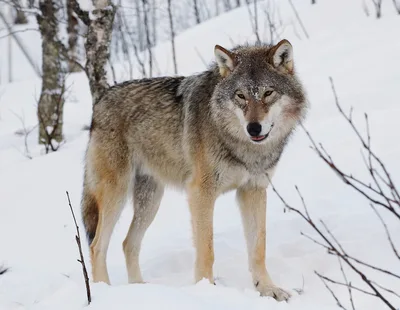 Gray wolf
 Striped hyena
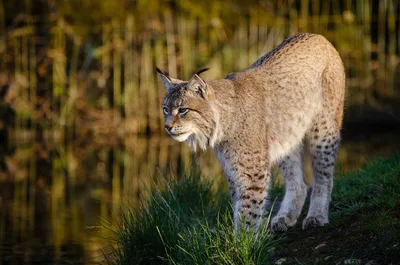 Eurasian lynx
Ecological equivalents
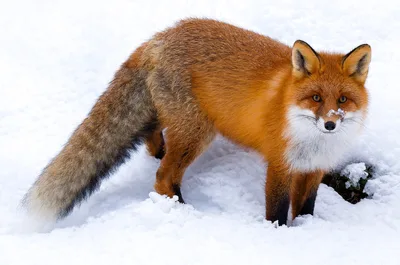
Related species on this site
Affenpinscher (same genus), Afghan Hound (same genus), Aidi (same genus), Ainu (same genus), Airedale Terrier (same genus), Airedoodle (same genus), and more.
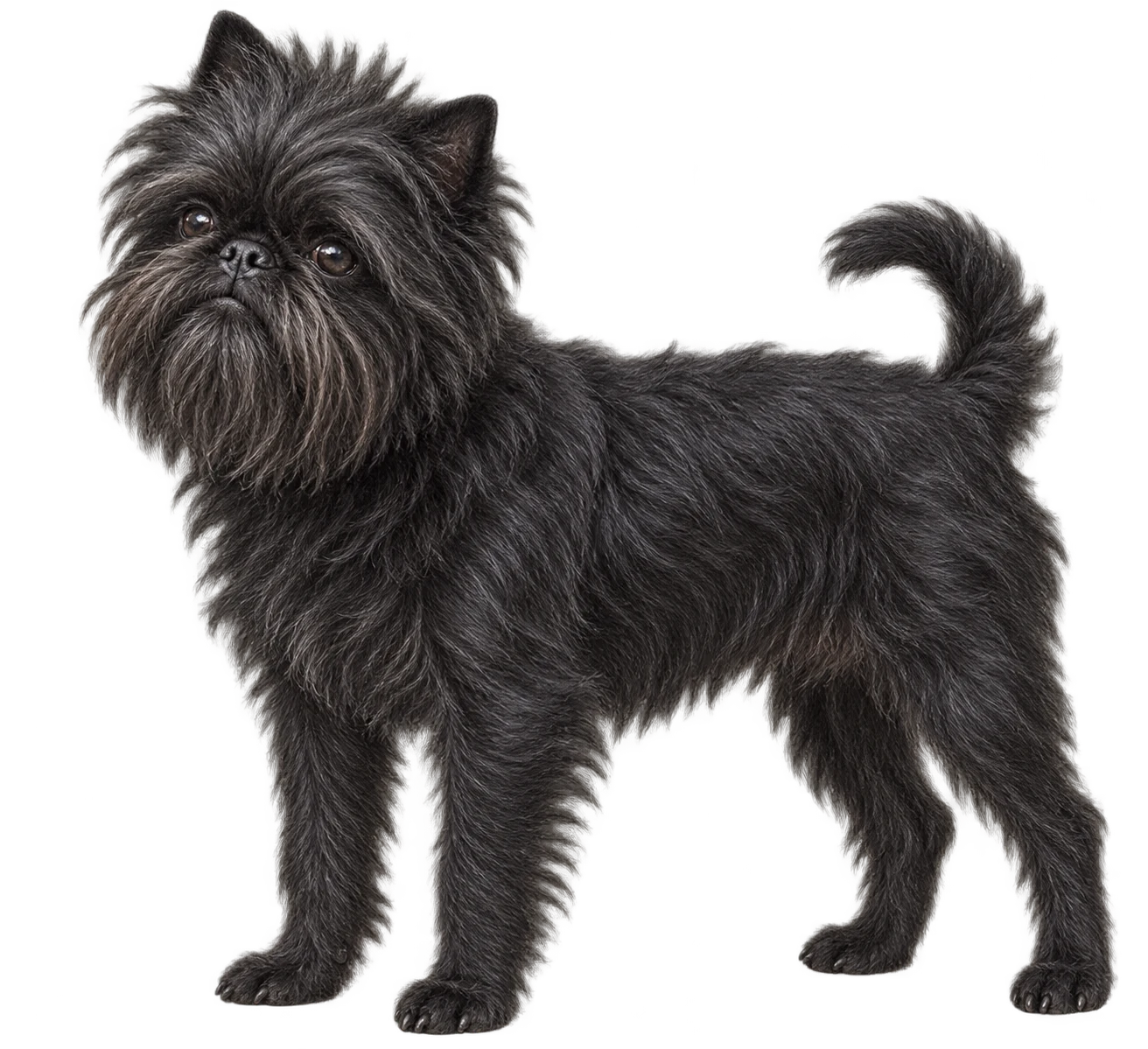
Mammals
Affenpinscher
Canis lupus familiaris
Classification and source reference
LivingAI illustration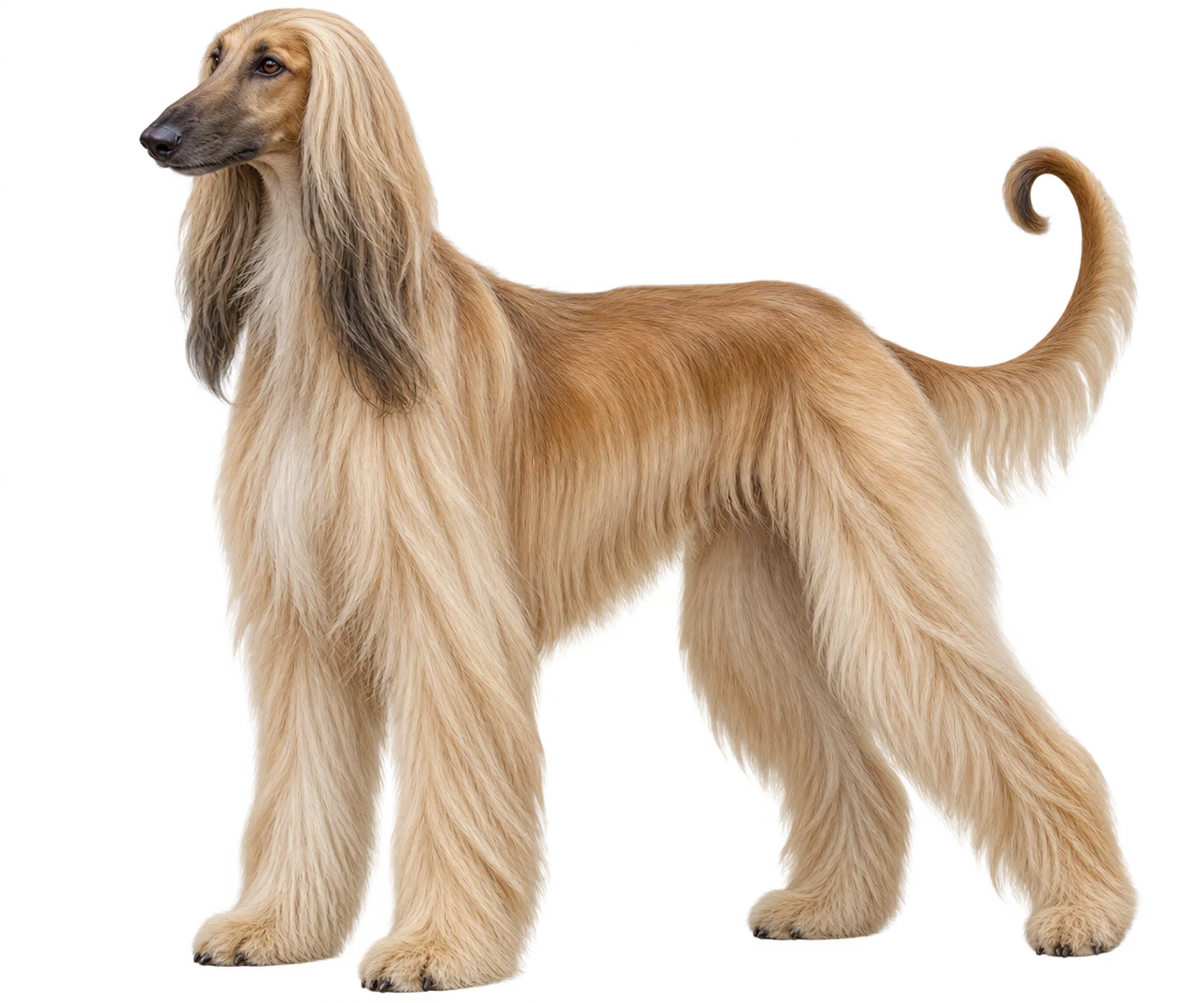
Mammals
Afghan Hound
Canis lupus familiaris
Classification and source reference
LivingAI illustration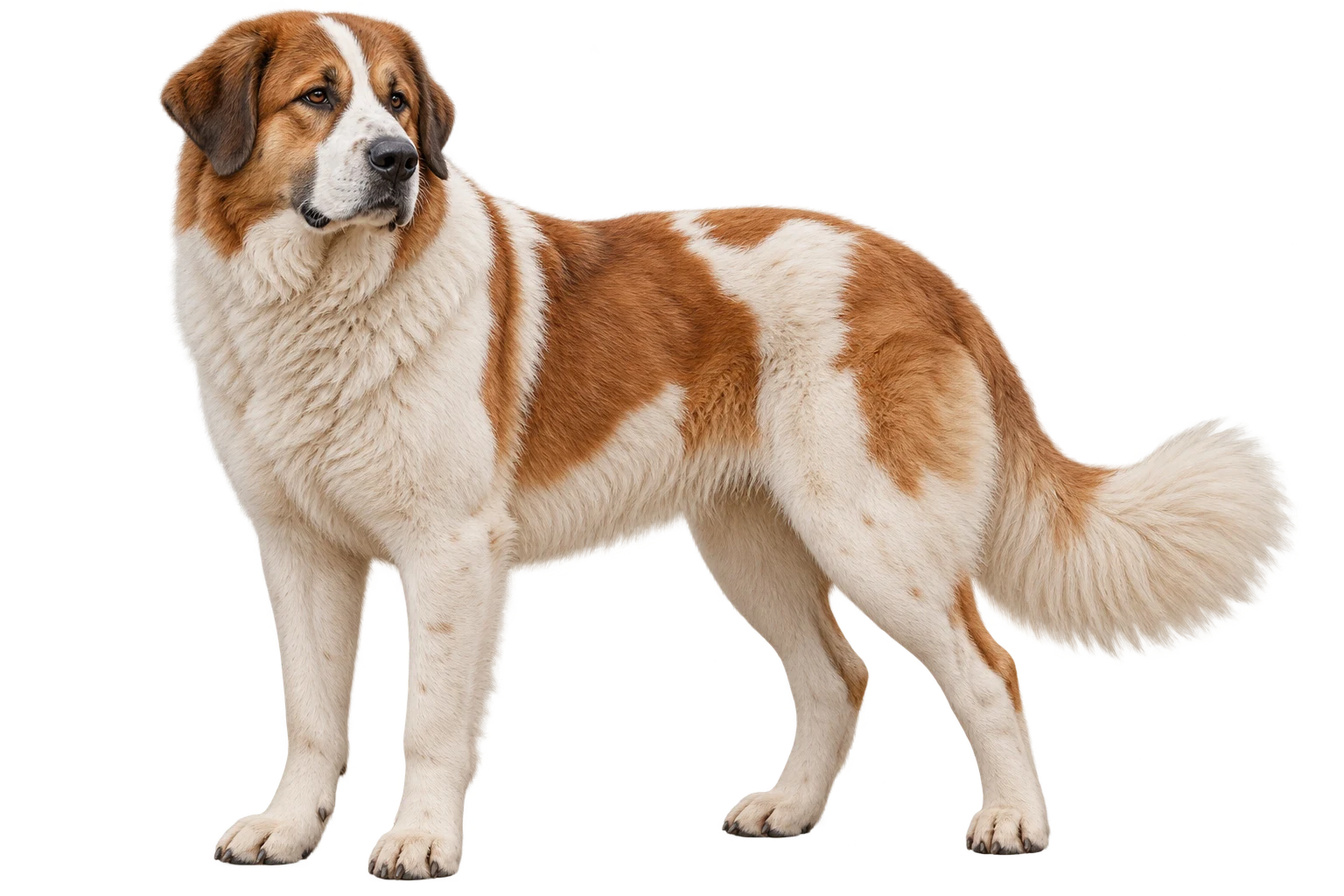
Mammals
Aidi
Canis lupus familiaris
Classification and source reference
LivingAI illustration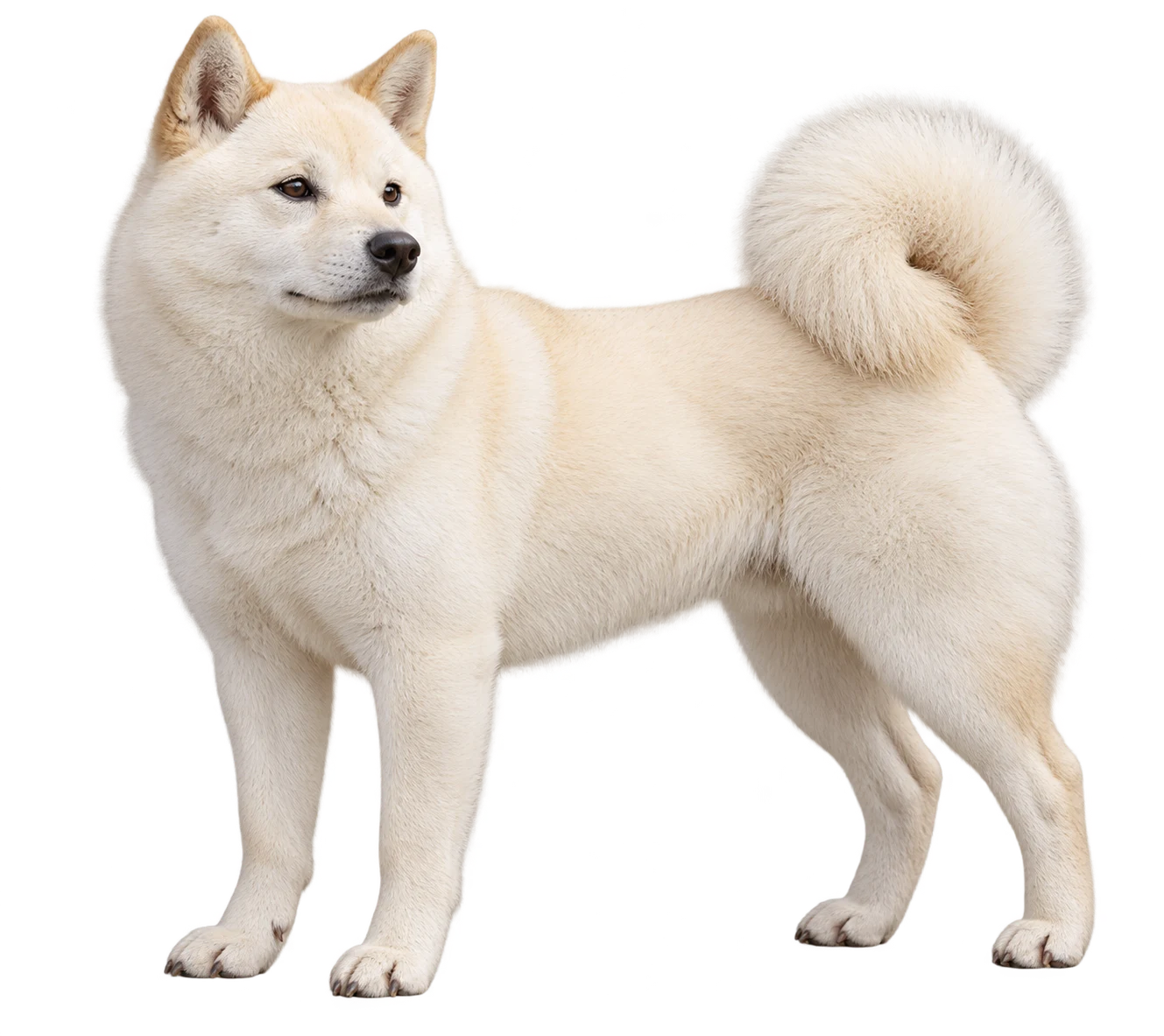
Mammals
Ainu
Canis lupus familiaris
Classification and source reference
LivingAI illustration
Mammals
Airedale Terrier
Canis lupus familiaris
Classification and source reference
LivingAI illustration
Mammals
Airedoodle
Canis lupus familiaris
Classification and source reference
LivingAI illustration